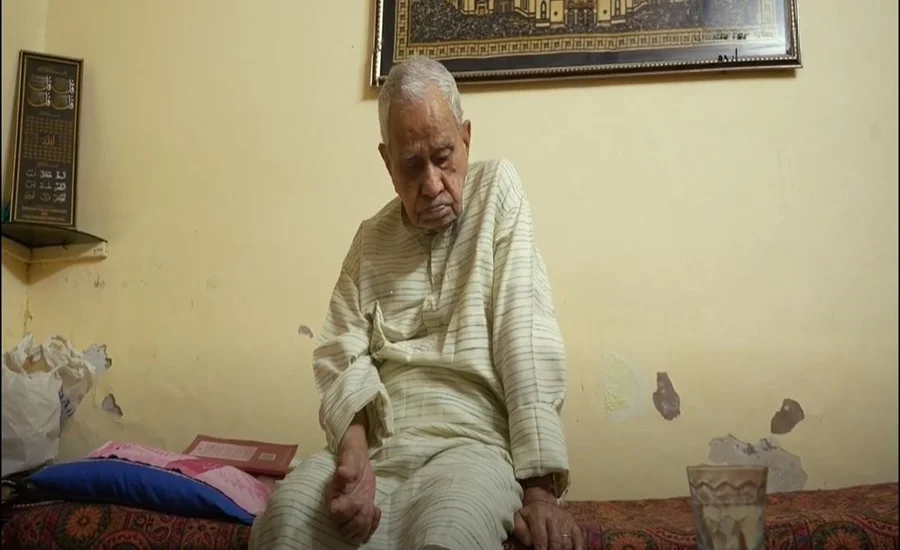
Bolwar (Puttur Taluk, Dakshina Kannada) / Bengaluru, KARNATAKA :
Writer Bolwar Mahamad Kunhi talks about literature and fests.

Karnataka : Bengaluru : 30/10/2017 : Bolwar Mohammed kunhi during The Bengaluru Literature festival in Bengaluru on Sunday. Photo : Sudhakara Jain.
Bolwar Mahamad Kunhi, 66, is the only Indian writer conferred with two Central Sahitya Academy Awards (2010 & 2016) for creative prose in Kannada. He received the Atta Gallata Bangalore Lit Fest 2017 Award for Kannada for his overall contribution on the concluding day of the Lit Fest on Sunday. With 250 short stories and a host of novels, with several directed towards children behind him, Kunhi a recipient of the Karnataka Rajyothsava Award and Karnataka Sahitya Academy’s Lifetime Achievement Award says, “Young writers should regularly read what seniors write and get inspired to find their own words and voice.” Kunhi, who said every recognition is a moment of inspiration to writers, spoke to MetroPlus regarding his life and writing. Excerpts:
Do you think such literary fests are important for the growth of literature?
Yes. Such festivals also add their share to other ingredients required for a healthy literary growth, look at the buzz they create, have you ever seen this kind of an unprecedented crowd? I am not as aware of the present statistics of other languages. This is my uncorroborated research. In recent times Kannada literature has seen a huge number of publications, possibly surpassing that of any other Indian language. The number of literary events or the number of Jnanapeeth awardees we have could surpass those from any other language. This could be another reason some Kannada writers have achieved celebrity status.
Is literature the voice of society?
Literature always augurs well for society and provides wisdom to humanity. All religious books, which I consider part of literature, are works of wisdom which have had a great impact on humankind. Literature also taught civic sense to man who lived like a wild animal. The conversations and dialogues in such events also propagate the same wisdom.
After Chand Ali in ‘Swathantrayada Ota’ who is the next character in your work awaiting attention?
In the last two years I have been busy in understanding two important characters for different reasons. First to write 1000 couplets about Ambedkar and second to write a novel on the Prophet’s beloved wife, Ayesha. The second has gained more traction in the last few months. When I wrote the first ever historic novel on Prophet Muhammad Oidiri two years ago, it was well-received. But most of the characters in Odiri were male. The thoughts, words, actions, and the attitude was male. I always wondered if the women of that time had opinions of their own. Did they ever voice what they felt? Even in solitude? This is the subject of the proposed novel titled Umma (Mother) inspired by the life of Ayesha. I am not sure which one will be completed first.
After Gorur Ramaswamy Iyengar who wrote on Gandhiji, your book on the Mahatma received instant recognition. How important is it for today’s children to read about Gandhiji?
To guide our children in the right way we show them role models. It is a shame we are unable to give them contemporary examples to encourage and mould their personality. The examples that we provide from history or mythology seem too overwhelming for them. Historical characters are kept on a pedestal and are inaccessible. Gandhiji maybe one example which children can relate to since they read and learn about him a lot and he is the most recent of those examples! To these children my book attempts to show that Mahatma Gandhi was not an unachievable superhuman. He was a common, simple boy, who grew up like most of us, as a darling to his parents, went to school, studied prescribed text books and qualified as a lawyer. As a young man he fought for the downtrodden and stood for truth, non-violence and social justice. I tried to depict him as a common man who lived an uncommon life to become a Mahatma.
Do female characters get more importance in your novels?
I don’t think so. Being feminist writer is not an easy way to popularity. Though I was born in a male-dominated community, I was brought up with the love of various women in my early life – my mother, my sisters and my first teacher. They were the ones who tolerated my anger, frustration and ego and loved me unconditionally. That guilt might be the reason women are central to my work. I dedicated my first story collection to ‘Appi Bayi’, the teacher who taught me to write alphabets. The second one was to my mother who I buried with the same hands that I dedicated it to. Another work was to my elder sister and another to my two daughters. My mega novel is dedicated to my beloved. All of this could be due the same guilt. May be my work as an emotional man resonates with like-minded people and thus gets appreciated.
How was your experience writing the screenplay for ‘Munnudi’ and ‘Athithi’?
My writing is like a sculptor’s. It takes shape with time. I don’t believe in inspirations. Cinema, definitely is not my medium. I wrote the screenplay under the persuasion and for the love of my friends P. Sheshadri, who bagged nine National awards in a row and Dattanna, an inimitable character actor. I wrote what I felt for both movies and they incidentally won national awards. I cannot comment on what else I might be able to do in cinema, at least not now.
Can you talk about your initiation to writing considering you have no writers in the family?
I joined Syndicate Bank in Gulbarga after my B.Sc. Much later when I was associated with the Sahitya Academy I discovered that most members had masters degrees. It enthused me into getting an MA in Kannada in the 1980s.
My desire to write was another one of such self-imposed challenges. During a casual conversation while playing carrom with writer Arooru Lakshmana Seth in Gulbarga, I asked him how he was able to visualise and write so much. His said “non-writers like me cannot understand the process.” That comment propelled me into writing a short story and getting published in Navbharat which was the beginning.
source: http://www.thehindu.com / The Hindu / Home> Books> Authors / by Ranjani Govind / October 30th, 2017