Tag Archives: Sabir Ahamed

Bridging Divides, Building Bonds: How ‘Know Your Neighbour’ Is Redefining Harmony in Kolkata

Kolkata, WEST BENGAL :
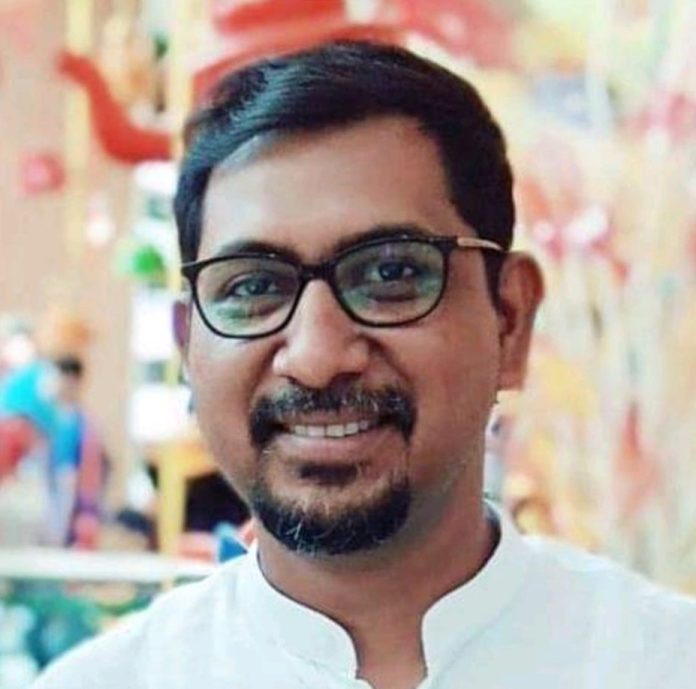
Sabir Ahamed, Programme Director at Pratichi Institute, Pratichi (India) Trust, and Founder Director of the Sabar Institute

Sabir Ahamed is the Programme Director at Pratichi Institute, and Founder Director of the Sabar Institute. His research spans the socio-economic status of Muslims in India, child protection, and education. He is proficient in analysing official datasets (NSS, Census, DISE, AISHS) using tools like Stata and R. Sabir has led largescale research and evaluation projects for the Government of West Bengal, including assessments of Kanyashree Prakalpa, Sabooj Sathi, Duare Sarkar, Lakshmir Bhandar, and the PM Poshan School Nutrition Garden Survey. He is currently leading the Human Development Report 2025 for West Bengal and directed the Second Human Development Report for Tripura.

His experience includes work with international organisations like Railway Children UK on projects supported by the European Union and UNICEF.

He served as the West Bengal State Lead for a UNICEF-commissioned study on secondary education transitions and was awarded the Just Transition Writing and Research Fellowship at IIT Kanpur (2022–2023).

He actively promotes the RTI Act (2005) in West Bengal and is a core member of the Know Your Neighbour campaign. He contributes op-eds to national dailies and has co-edited publications on development issues.

Excerpts from his interview with Mohd. Naushad Khan:

Q: How was the idea Know Your Neighbour conceptualised, when and how did it start, and what was the basic objective of this campaign?

We started the initiative because we noticed a deep division between different communities in our city.  The immediate context was the publication of a report titled ‘Living Reality of Muslims in West Bengal’ in 2013. The findings shed lights on the deplorable condition of Muslims in West Bengal, yet a large section of people was unaware the status of Muslims. Many academics and Journalists were surprised to see those facts, especially they were educationally and economically backward. Secondly, historically different communities are living in the city for generations, Partition has created some chasm between Hindus and Muslims. The worst outcome is the spatial segregation – this led to the concept call ‘living together separately’. This gave birth of a plethora of myth and misconception about the Muslims.

We found that even well-meaning and educated people in Kolkata knew very little about the city’s Muslim community, even though it makes up 20% of the population.

We learned that most people didn’t visit Muslim-majority neighbourhoods because they didn’t have friends there or, in some cases, they believed the areas were unsafe.

To break the misinformation about Muslims and its neighbourhood, Know Your Neighbour (KYN) started neighbourhood walk in 2026. Till then, thousands of young people had participated in the walks and discussion.

The main goal is to build familiarity between communities that live close to each other but knew little about the other. The campaign aims to break down stereotypes and overcome the ignorance and distrust that can grow from different religious identities. This ignorance and distrust are the biggest barriers to communal harmony.

Q: Since its inception, how do you see the journey of KYN, and what were the challenges faced so far?

The journey of KYN involves actively bringing people from different backgrounds together. The main way it does this is by organising walks or visits to:

  1. Areas with large Muslim populations, like Metiabruz and Rajabazar, Kidderpore, etc.
  2. Places with shared, syncretic histories, like the Daptaripada area near College Street, where book-binding communities have co-existed.
  3. Sites that remind people of the legacy of past communal violence, such as Selimpada.
  4. Areas facing common problems that affect everyone, like pollution in the Rajapur canal, where both Hindus and Muslims use the water.

The campaign also organises events like Dosti ki Iftar (Friendship Iftar) and joint Durga Puja celebrations, allowing people to learn about and join in each other’s religious festivals.

The main challenge the campaign faces is ignorance, stereotypes, and fear that keep communities separated from each other.

Q: What has been the impact of KYN in Bengal, and how have people responded to this campaign?

Over the years, neighbourhood walks conducted by KYN have made a lasting impression on young minds, promoting peace, social cohesion, and pluralism. Around 1,500 students have joined us in exploring overlooked neighbourhoods across Kolkata through these immersive walks.

The initiative aims to instil core constitutional values – secularism, pluralism, and fraternity – through lived experiences and encounters with historical memory embedded in the urban fabric. These walks offer students a unique opportunity to engage with diverse communities, reflect on shared histories, and foster a deeper understanding of inclusive citizenship.

In collaboration with Maulana Azad College, our language course in Arabic, Persian, and Bengali enabled about 90 students to learn the basic reading of these languages. These programmes strengthen cultural roots and encourage appreciation for linguistic plurality.

We run a WhatsApp support network of over 850 students from marginalised areas, offering career counselling, peer mentoring, job opportunities, and regular workshops to help them navigate academic and professional spaces. We have trained more than 250 students on career counselling.

In partnership with Swayam and Azad Foundation, we’ve held group counselling sessions for children affected by communal tension, providing psychological support and nurturing safe spaces for recovery.

We conducted a hands-on RTI (Right to Information) workshop for students and professionals, teaching them how to use RTI to uncover critical datasets and hold government institutions accountable. Many participants have since used RTI to pursue issues of social relevance.

We host regular book reading and discussion sessions with acclaimed writers and scholars. Sabar Institute’s data for better lives initiative regularly post data on discrimination, lack of opportunity among the disadvantaged communities.

People, including college students, have started visiting Muslim-majority areas, even without our facilitation. The response from students has been particularly rewarding. These students, who had often been told by their parents not to go into minority areas, visited them and reported that they do not feel unsafe.

Q: Why do you think such campaigns are necessary in Bengal and elsewhere in the country?

Campaigns like KYN are necessary to repair growing divisions in our society. They are needed to address the loss of camaraderie between communities. The goal is to stop ignorance and indifference from turning into alienation.

Even among the educated city-dwellers, there is often a lack of friendship and familiarity with people from other communities. Campaigns are necessary to remove the distrust and ignorance that come from religious differences, calling this the biggest barrier to communal harmony. In a time of divisive politics and attacks on secular values, new ways of building unity are needed. Campaigns like KYN are important because they build social solidarity and brotherly or sisterly bonds directly between citizens.

Q: Finally, how can such a campaign add to the concept of a value-based society?

These campaigns are a key part of building a value-based society, as they focus on human connection.

The campaign helps build fraternity, which is a core value in the Indian Constitution. This means it focuses on building strong relationships and bonds of trust among citizens.

Instead of just using rational intellectual arguments for equality, these campaigns use shared cultures, local histories, and neighbourhood connections. This has a broad emotional appeal and helps trigger empathy in people.

By creating deeper emotional solidarity, the campaign helps people connect based on the shared value of equality. Ultimately, by creating new friendships and shared celebrations, these campaigns help to repair and restore the social fabric and build a more inclusive and united society.

source: http://www.radiancenews.com / Radiance News / Home> Face To Face> Focus / by Radiance News Bureau / November 20th, 2025
Celebrating Nawab Wajid Ali Shah and His Contribution to Kolkata’s Culture

Kolkata, WEST BENGAL :

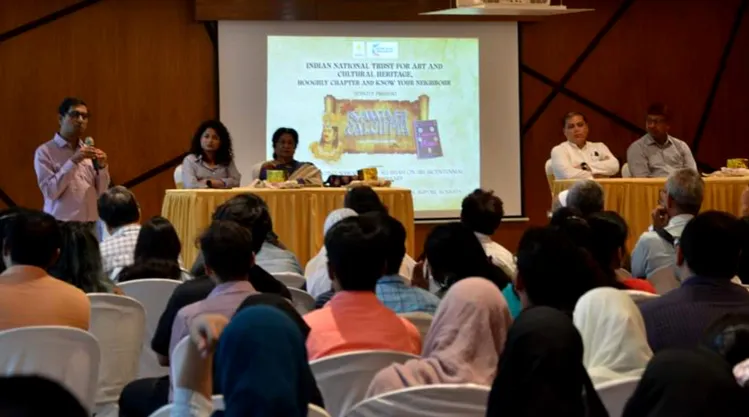
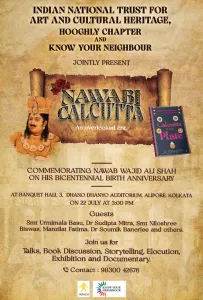
Nawabi Calcutta: An overlooked era, organised by Know Your Neighbour and INTACH, highlights how Thumri, Kathak and Urdu blossomed under King of Oudh’s patronage.

Speaker Sabir Ahamed during the bicentenary celebration of Nawab Wajid Ali Shah | Picture: Know Your Neighbour

Kolkata:

We all remember the story of Wajid Ali Shah, the ruler of Oudh, being exiled to Kolkata by the East India Company for being a poor administrator. But how many of us know that the ruler had travelled to the colonial Kolkata with around 6000 attendants in 1856, in hope of travelling to London to place his case before Queen Victoria concerning the unfair annexation of his kingdom? How many of us are aware of the fact that it was only in 1857, when the first revolt for independence broke out that the recuperating Shah was kept under house arrest?

But the most intriguing aspect about the Shah’s stay in Kolkata was his ability to not lose hope, despite being robbed of his throne and his journey of recreating mini-Lucknow (Metiabruz) along the bank of river Hooghly. And little by little bringing the Lucknowi style to Bengal.

How the Shah took on to his new life, patronised art and rebuilt a mini-empire of his miles away the banks of Gomti was what Nawabi Calcutta: An overlooked era attempted to recall.

“There is more to Wajid Ali Shah and his ‘Chota Lucknow’. We shouldn’t just remember him for bringing biryani to Kolkata and giving it a spin by introducing potato to it,” said Sabir Ahamed, of Know Your Neighbour (KYN), during his inaugural speech.

The remains of structures built by Wajid Ali Shah, have often been overlooked by Kolkatans. Rare images of old Metiabruz and structures built by the last king of Oudh were screened during the programme. Ninety-nine per cent of these structures built by the Wajid Ali Shah, no longer exist, said Shaikh Sohail, who conducts heritage tours in Metiabruz. He gave a call to all to come and visit the remains and know the history of the Shah’s ‘Chota Lucknow.”

The invitation card of the event

Remembering the last king of Oudh, Sudipta Mitra, author of Pearl by the River ( a book that documents the life of Wajid Ali Shah)  chose to highlight his love for rare animals. A connoisseur of wild animals, the Shah even created a mini zoo, which home some rare animals including an open snake house much ahead of Kolkata having a zoo of its own.

“His love to collect unique or rare wild animals for his personal zoo was so famed that zoologist  Edward Blyth once wrote to his friend Charles Darwin about the King of Oudh and his love for animals. He wrote that till the Shah is alive, animal trade would flourish in India,” said Mitra.

He then went on to add, “Once Oudh was annexed, about 18 tigers from the Shah’s personal collection were brought by Blyth for Rs 20 each. These tigers were put on display for the public at the present age Teratti Bazar. And later when the Shah made Metiabruz his home, he brought three tigers from his pre-owned collection for his new personal zoo at a much higher price.”

In a bid to feel at home, the pining Shah, even established the famed Sibtainabad Imbara, where he now rests, much like his father Amjad Ali Shah, who rests at Hazratganj’s Sibtainabad Imbara.

Debunking the poor administrator theory was Dr Soumik Bhattacharjee. While addressing the audience, Dr Bhattacharjee said, “The East India Company (EIC) created a narrative to justify their annexation of Oudh. The Shah was a lover of art, and that’s not a crime. He promoted thumrikathak and a lot of artists during his reign. He also introduced a number of administrative reforms, which were good for Oudh. But the ECI brought in laws that made it difficult for the king to do his work in a judicious way. The king, failing to understand the implications of the new laws, fell prey to ECI’s trap.”

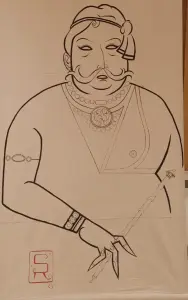
A portrait of Nawab Wajid Ali Shah at the event venue| Picture: Soumyadeep Roy

“While Prem Chand was almost reprimanding in his play Shatranj Ke Khiladi, Satyajit Ray was more understanding towards the king of Oudh. The king’s decision to not revolt against the British and approach Queen Victoria regarding the unfair annexation should be seen as his fondness for non-violence and not weakness,” he summed up.

Taking up from where Dr Bhattacharjee left, was foodpreneur and great great granddaughter of the Shah, Manzilat Fatima. “It’s sad that not many know about the history and reality of Wajid Ali Shah. My father, Dr Kaukab Quder Meerza, wrote a book on him in Urdu, which has been translated into English by sister Talat Fatima.” She added that they are also working on a project to highlight the revolutionary work of Begum Hazrat Mahal.

On being asked if the Indian historians have been a little harsh on the king of Oudh, she said, “It’s sad that the historians despite being Indians chose to highlight the narrative set by the British and East India Company. But it’s heartening to see so many remember Wajid Ali Shah with great fondness. I am humbled by the number of events that are being organised to mark his bicentenary. As his descendants, we will try doing our bit to keep his legacy alive.

While, Mohammad Reyaz, Assistant Professor, Aliah University, highlighted the central focus of the Nawab’s migration – rebuilding a new city, which was demolished after his death and the legacy that he created in the field of art. “The Nawab of Oudh was beyond bringing biryani to Kolkata,” he said.

The event organised by INTACH (Indian National Trust for Art and Cultural Heritage) and Know Your Neighbour, also hosted an art exhibition – Dastan-e-Akhtar by visual artist Soumyadeep Roy, who chose to pay tribute to the king through his paintings.

Also present at the event was Sarod maestro Irfan Md Khan, whose ancestor had travelled to Kolkata with Wajid Ali Shah. He summed up by saying, “The Shah was a patron of art. He patronised and promoted kathak, thumri and sarod to this city.”

source: http://www.enewsroom.in / eNewsRoom India / Home> Bengal> Inclusive India / by Shabina Akhtar / July 26th, 2023

In Kolkata, history builds bridges between communities

Kolkata, WEST BENGAL :

Sabir Ahamed leading a KYN walk. Photo: Special Arrangement

Neighbourhood walks resume after pandemic to promote communal harmony

While history has turned out to be a source of confrontation in some parts of the country, with the Taj Mahal and the Gyanvapi mosque once again in the news for the wrong reasons, history is building bonds between communities in Kolkata.

A social experiment called ‘Know Your Neighbourhood’ or KYN, which began in 2016, has returned after a pandemic-forced gap of two years, and is once again using history — through neighbourhood walks — to dispel apprehensions and promote communal harmony in West Bengal.

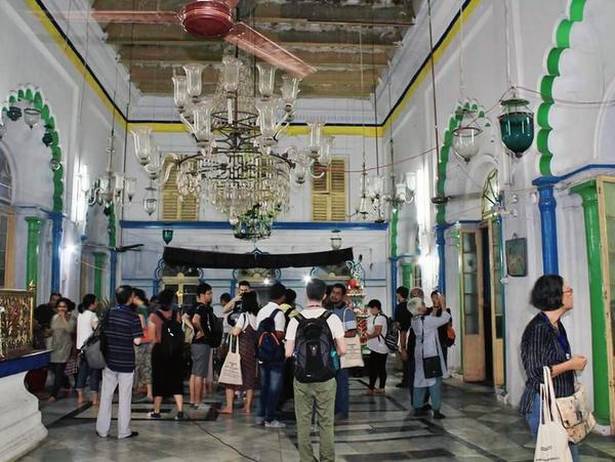
The next walk is in June, and the one held most recently — on April 23, during Ramzan — had led to the 1784-built Niyamatullah Ghat Masjid in north Kolkata. The mosque visit was held under what KYN organisers call Dosti-ki-Iftar, which has Muslims and non-Muslims breaking bread together, and saw about 150 participants, several of them non-Muslim women who were allowed into its premises for the first time.

“The idea came to me in 2015, when communal violence was taking place in parts of West Bengal — in Barasat, in Naihati. Rumours were being spread and there were cases of lynching. That’s when we realised that there was inadequate information and adequate misinformation about Muslims. KYN is an attempt to bridge the gap between communities using dialogue as a tool,” Sabir Ahamed, national research coordinator with the Pratichi Trust, and the convenor of KYN, told The Hindu.

“Neighbourhood walks in an important tool of dialogue because even though we share the same geography and live in the same city, we do not go to each other’s neighbourhoods or bother to find out about each other’s customs. Hatred breeds in this atmosphere of ignorance. Today, KYN has become a popular campaign, aiming to tackle religious prejudices and dismantle stereotypes,” Mr. Ahamed said.

The initiative, according to him, has succeeded in breaking new ground. During one of the walks, non-Muslim women climbed to the top of a minaret of the famous Nakhoda mosque for a majestic view of old Kolkata. Participants also discovered that water from the Hooghly river is used for ablutions before the offering of prayers at the mosque.

“Many young people admitted — after our events — that they harboured hatred because of misinformation and that they had changed their minds. A young lady told us that she never got into a cab if she found the driver to be a Muslim. Many students often refuse field surveys in Kidderpore (a locality with a large population of Muslims) because they fear something might happen to them, many believe that all you see in Muslim neighbourhoods is green flags — we need these ideas to change,” Mr. Ahamed said.

“That’s why we would like to work with colleges and univarsities to bring about a lasting change in the way we know each other. We are working with Presidency University and other colleges,” he said.

Samata Biswas, who teaches English at the Sanskrit College and University, said of her experience at recent walks in Kidderpore and in Taltala: “They reminded us of the confluence of faiths, cultures and people that has created modern Calcutta. From the Tamil church at Kidderpore to the historic Calcutta Madrassa which is older than both Presidency and my own institution — this aspect of Bengal’s history is often forgotten, the one that has Anglo-Indians, Jews, Parsis, Muslims, Tamils and Afghans living and working together in Calcutta.”

She added: “The trip to Baker Hostel, where Sheikh Mujibur Rahman was a resident, reminded me of the shared history of the two Bengals and Calcutta’s contribution to Bangladesh’s Liberation War. These are stories we seldom hear — stories that remind us that Calcutta is not merely for and by the Bengali bhadralok (elite), and that it has accommodated multiple cultures, institutions, cuisines and religious beliefs.”

source: http://www.thehindu.com / The Hindu / Home> News> Cities> Kolkata / by Bishwanath Ghosh / Kolkata – May 14th, 2022

Muslims in Kolkata find a place to call home

Kolkata, WEST BENGAL :

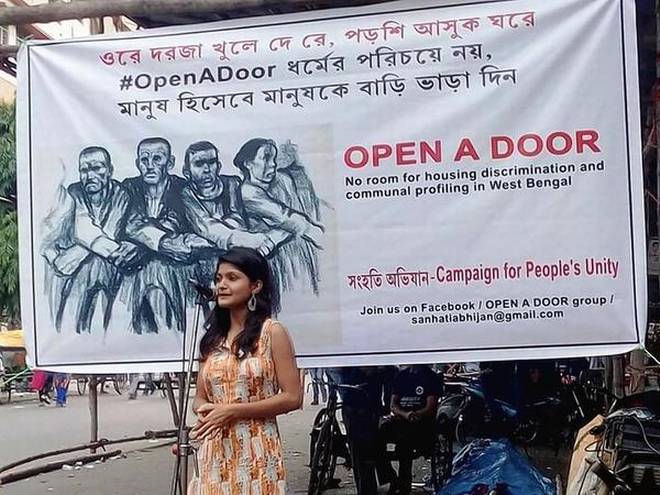
Tanvi Sultana speaks at a gathering organised by Sanghati Abhijan at Jadavpur. Photo: Special Arrangement

Two voluntary groups enable Hindus and Muslims to interact and look beyond communal misconceptions.

After being turned away by several landlords for months, Aftab Alam and his three friends, all of them doctors, finally found a place to rent in south KolkataTheir elation, however, was short-lived. Soon after moving in, a neighbour told their landlord that they ought to be evicted, arguing, “Four Muslim men staying in a predominantly Hindu neighbourhood is problematic.”

Dr. Alam recalls, “It was disheartening. I rented the flat to the rest after strenuous night shifts. Suddenly, the peace was disrupted…[we had] huge expectations from Kolkata.”

His predicament was unexpectedly addressed. When he spoke of it on social media, Dr. Alam was contacted by Sanghati Abhijan (SA), a voluntary group that recently initiated its ‘Open-a-Door’ campaign to stop discrimination against potential Muslim tenants. SA’s volunteers resolved the situation by engaging peacefully with the neighbours, the landlord and the tenants themselves.

“We thank them for their support at a critical time,” says Dr. Alam. The intervention helped him and his friends stay on instead of relocating, as they had first planned.

‘Communal remarks’

In another instance, Tanvi Sultana, an undergraduate student, was allegedly targeted with “communal remarks” while looking for a flat in south Kolkata, at times being instructed not to bring beef to her residence. As with Dr. Alam and his friends, SA helped her live in the same apartment. “I thank them and wish for the initiative to grow,” Ms. Sultana says.

Since February, SA has helped about 30 such home-seekers in dire need via its social media group, ‘People’s Unity’. The platform provides a database of houses, apartments and guest houses, with information such on the location of the property, contact details of owners, and rent. The group’s meetings are eye-openers on the communal tensions between property owners and tenants.

“We only enlist property owners who are keen on letting out accommodation without discriminating against a particular faith or on the basis of marital status,” said Dwaipayan Banerjee, one of SA’s co-founders. However, Mr. Banerjee admits that while “hundreds” of tenants approach them, the property owners are “far fewer” in numbers.

SA’s members say they want to “break the culture of silence” which, in turn, could “curb rising Islamophobia.” Anindya Ray Ahmed, a student, was told openly by brokers, “Muslims are dirty and potential terrorists.”

He was ‘rejected’ by 16 landlords before he could find a place to live, but after accepting a deposit, the landlady telephoned him to say, “My husband has a problem with Muslims, so you cannot stay.” Mr. Ahmed alleges that she lowered his deposit down in a bag from her floor above, declining to “stand near a Muslim.”

SA’s members favour direct mediation, but their Facebook page has witnessed about 150 such disagreements and their resolution through virtual owner-tenant interaction on the social media platform.

In another incident, SA informed the Jadavpur University Teachers’ Association and authorities when two students faced misbehaviour from the superintendent and boarders at their hostel “for being Muslim.” An enquiry committee is looking into this case.

SA member Deborshi Chakraborty calls this “exponential ghettoisation” because, often, Muslim tenants seek proximity to their religious peers so that they will not be judged.

Alongside, SA has been prey to moral policing and expressions of paranoia by potential lessors.

The campaign has apparently irked Tripura’s former Governor Tathagata Roy, now Governor of Meghalaya. On August 11, he re-posted a newspaper article on SA and remarked on social media that the paper was trying to “teach Hindu house-owners of Kolkata that they must rent out their premises to Muslims. Otherwise, they are not sufficiently ‘secular’.”

Along similar lines, the Know Your Neighbour (KYN) campaign aimed at reducing communal tensions between Hindus and Muslims is gaining momentum in Kolkata and several districts, too. On a shoestring budget, KYN has organised meetings, sponsored heritage walks, staged plays, and focussed on food to find common ground.

Participants of the Know Your Neighbour campaign visit to Metiabruz in Kolkata. Photo: Anirban Kar | Photo Credit: Anirban Kar

Food walks

“We arrange food walks as the city has a massive culinary culture developed over centuries,” said Sabir Ahamed, a KYN organiser. “Cultural ignorance brews fear. Financial constraints coupled with little-known practices like the Dastarkhān, a traditional space for meals kept on a yellow cloth featuring Urdu couplets, became the basis for speculation over why Muslims ‘eat in bed’. Such ‘myths’ must be broken, which is why we translate the Muslim ‘jargon’ that often dictates daily routine,” says Mr. Ahamed. His intends to delve deeper into this in his forthcoming Masjidi Kolkata project.

KYN’s walks journey into quintessential ‘Muslim pockets’ of Kolkata — Metiabruz, Khidderpore and parts of central Kolkata around the mosques set up by Muslims from Kutch — are followed by interactions with locals.

“Although I am a resident of Kolkata, I had never been to Khidderpore. I took this opportunity to know more about Bengal’s Islamic culture, and to redeem myself of the guilt of assuming that it is a crime-prone area,” says Sanjukta Choudhury, who participated in a KYN walk.

Novelist, academic and foodie Samim Ahmed, an expert on both the Mahabharata and Nawab Wajid Ali Shah’s Bengal, says visits to areas like the Sibtainabad Imambara, a less ornate grave of the last King of Oudh, Wajid Ali Shah, “adds more excitement to the walk.”

Often, visitors discuss food traditions with locals and learn, for instance, about the German bread distributed in Kolkata during the Second World War, dry fruits, and recipes for delicious haleem and biryani.

Non-Muslims are invited to break bread with their Muslim counterparts in KYN’s ‘Dosti ki Iftari’ get-together.

Linguistic explorations, such as tracing the etymological roots of ‘azaan’ (the Islamic call for worship) ringing within the old architecture of the Nakhoda Masjid, are also encouraged.

“Hindus barely visit these pockets of Kolkata, whereas such paranoia is less intense in the rural areas. We aim to eradicate cultural misconceptions by spreading knowledge on prevalent Islamic practices,” Mr. Ahmed says, adding, “Such walks provide an opportunity for communities to know each other in an atmosphere of unmitigated fun.”

source: http://www.thehindu.com / The Hindu / Home> News> Cities> Kolkata / by Tannistha Sinha / Kolkata – August 25th, 2018