Indian students anxious as ATMs run out of cash and they run low on funds for food.
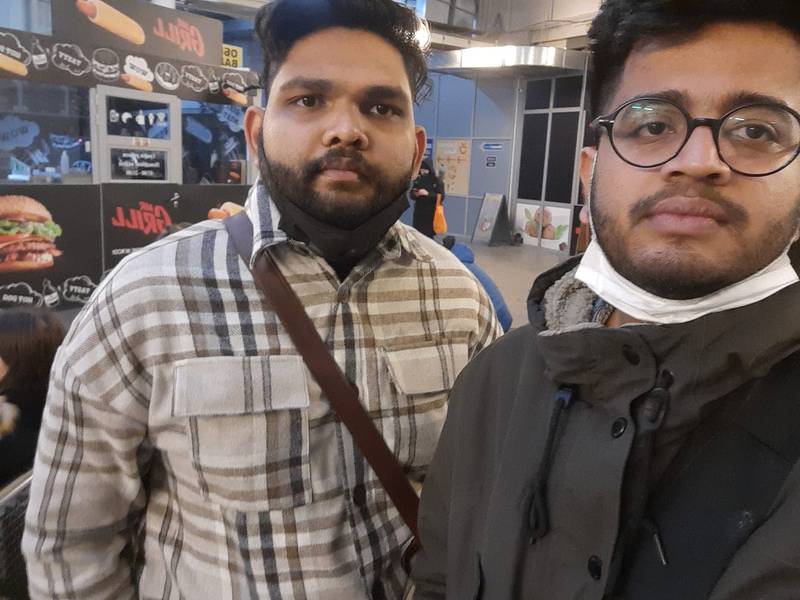
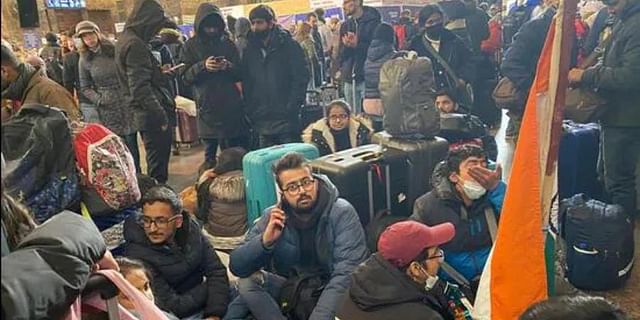
Sanabil SP, right, with Haneen Kuniyil, medical students in Ukraine at a bus station where they took shelter after explosions rocked Kiev airport. The students were booked to travel to Abu Dhabi when bombs hit the airport at the start of Russia’s invasion of Ukraine on Thursday. Photo: Sanabil SP
Scores of Indian students fleeing Ukraine for their families in the UAE and home country were terrified when bombs went off at Kiev airport on Thursday, forcing them to leave the airport.
They heard Ukrainians shout out warnings: “The Russians are invading ,” as passengers ran out amid loud explosions.
Many students had booked flights home but their plans were shattered when Russian President Vladimir Putin ordered a military assault on Ukraine.
After fleeing Kiev’s Boryspil International Airport, a group of 35 waited for more than 11 hours at a bus shelter trying to find safe accommodation.
“When I heard the blast I was too scared. People were shouting: ‘Russia is invading’. We saw jets flying above. People ran out of the airport,” said Milin Susan Joseph, 23, a fourth-year medical student who had a flight booked to Trivandrum, India.
Dubai resident Mohammed Adil Javad was on one of the last flights to leave Ukraine. The medical student landed in Abu Dhabi on Thursday morning before the attack on Ukraine began. Photo: Mohammed Adil Javad
“Everyone panicked. We just got more and more scared. We didn’t know where to go. We saw six to seven buses outside the airport and we just got in.”
The students took shelter at a nearby bus station with dozens of other travellers.
Many students had travelled the night before for about eight hours by road from Zaporizhzhia State Medical University to Kiev airport.
“We will try to get back to the university. We don’t know how safe it is to travel because people are being told to stay home,” Ms Joseph told The National.
The sight of armoured vehicles and soldiers on the streets has added to their anxiety.
“We can see tanks and military vehicles on the roads. Everyone is scared out of hell,” said Sanabil SP, 23, also a fourth-year student who was booked on a flight to his family’s home in Abu Dhabi.
“We heard two blasts as we were reaching the airport. People began rushing out of the airport. They were saying that the Russians had invaded.”
Another concern is access to money, because ATMs at the bus station ran out of cash. One group managed to reach the Indian embassy but were told they would need to make their own arrangements.
“The situation is real and scary for us. I really want people to know that we need help getting to a safe place,” said Mr Sanabil. “There is no money in the ATMs. You need money even to go to the public washrooms.
“The [Indian] embassy said they don’t have space for 30 students but we need help to find a safe place nearby.”
_____
India in Ukraine @IndiainUkraine
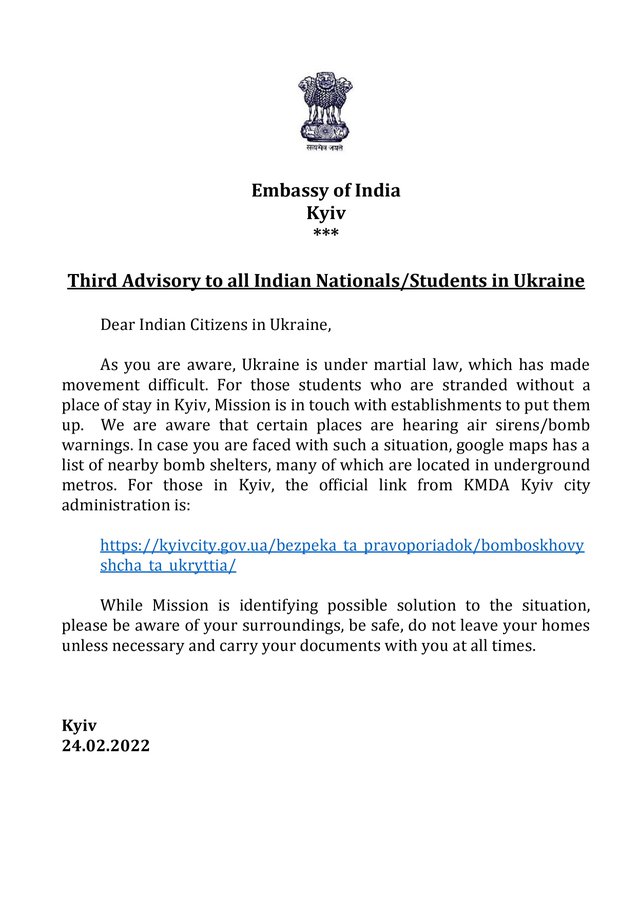
Third Advisory to all Indian Nationals/Students in Ukraine
By evening, they managed to contact other students living in universities in Kiev and hope to find shelter in dormitories.
Some took the last flight out of Ukraine before the air space was shut down and have reached the UAE.
“I’m safe now but half of me is still there [in Ukraine] because that is where my friends are,” said Mohammed Adil Javad, who landed in Abu Dhabi on Thursday, before the attack began.
“I’m hoping India will start an evacuation of students. They need help.
“There are students stuck between Zaporizhzhia and Kiev. They are in the middle of nowhere – not in the university and not at the airport. They are being told to find bomb shelters and tunnels for safety. We are all tense.”
About 18,000 Indian students are in Ukraine, according to government figures.
The embassy last week asked them to leave the country temporarily until the situation returned to normal.
But students said exorbitant air fares – more than 60,000 rupees ($792) one-way to India – and the absence of a clear message to evacuate meant that thousands remain in Ukraine.
“We would all left much before if we had been told we must leave immediately,” Mr Javad said.
“Also how can thousands of students leave in a few days? There are just not enough flights.”
The embassy said it was making arrangements for accommodation for students and asked them to familiarise themselves with the locations of bomb shelters.
“While the mission is identifying possible solution to the situation, please be aware of your surroundings, be safe, do not leave your homes unless necessary and carry your documents with you at all times,” the mission said.
source: http://www.thenationalnews.com / The National / Home> UAE / by Ramola Talwar Badam / February 24th, 2022
Muzaffar Alam’s ‘The Mughals and the Sufis’ is a remarkable and original work of scholarship.
Mughal emperor Jahangir chooses the Sufis. | Public Domain
The literature on the precepts of Sufism and the chronicles of its saints across various orders has a deep and prodigious lineage: from the great Kashf al-Mahjub of al-Hujwiri and the Risala of al-Qushayri, through Abdul Rahman Jaami’s Nufahat-ul-Uns, the wonderfully lucid Sakinat ul Auliya and Safinat ul Auliya, written by the 17th century Mughal Crown Prince Dara Shukoh, to the monumental compendium, A History of Sufism, by Saiyid Athar Abbas Rizvi, in our own times. The examination of the subtle and complicated interplay between religious doctrine, political influence, legitimacy and kingship throughout the Islamic period in India, though, is more recent.
Muzaffar Alam’s earlier book, The Languages of Political Islam in India c 1200-1800, published in 2004, was an important contribution to this discourse. It offered a fresh perspective by decoding the political vocabulary of those times to reveal the calibrations in theology, injunction and juridical practice, as Islam gradually became more “Indianised”.
In his new book, The Mughals and the Sufis – Islam and Political Imagination in India: 1500–1750, Alam once again breaks new ground, this time by harmonising two major domains of scholarship – Mughal History and Indian Islam – honed with painstaking care over a lifetime of study. What emerges is a highly nuanced and complex examination of the relationship between Mughal political culture and the two dominant strains of Islam’s Sufi traditions in South Asia: one centred around orthodoxy, the other focusing on a more inclusive and mystical spirituality.
The Sufi trajectory
The constituent chapters in the book, which can also be studied as stand-alone essays, chart the trajectory of the various Sufi silsilas and their principal actors, from the early, tenuous days of Babur and Humayun, through the 16th and 17th centuries, as the imperial position shifted from the more liberal outlook of Emperor Akbar (r 1556–1605) to the rigid attitudes of his great-grandson, Aurangzeb ’Alamgir (r 1658–1701).
Alam premises his critical study on a large number of contemporary Persian texts, court chronicles, epistolary collections, and biographies of Sufi mystics. Interestingly, the Maktubat-i Khwaja Muhammad Saif al-Din, compiled by Muhammad A’zam, Khwaja Muhammad Nasib Andalib’s Nala-i’ Andalib, and Muhammad Akram bin Shaikh Muhammad Ali’s Sawati‘al-Anwar are accorded no less importance than the staple Akbarnama or Badauni’s Muntakhab al-Tawarikh, known to every student of Mughal history.
This particular approach to Alam’s programme of study for his latest book serves two functions. First, his focus on relatively lesser-known figures and their writings, as well as many rare manuscripts, automatically inducts these long-underutilised texts into the bibliographical repertoire of mainstream historical research. Second, his own investigations enable Alam to challenge popular notions about the Sufis, upend unitonal hagiographic narratives of Sufi silsilas, and provide an alternate system of coordinates through which to view our cultural and religious history, in the process, reorienting our understanding of political Islam during the Mughal period.
A fundamental aspect of reappraisal is the relationship of a Sufi leader with the Mughal emperor. The usual perception is that the sole function of a Sufi saint was to be a spiritual pir (preceptor) for his murids (disciples), including those of royal blood. Alam cites numerous instances to the contrary, following a tradition that harked back to the Naqshbandi Sufis of Timurid times.
One of the key figures to emerge in this context is Khwaja ’Ubaid-Allah Ahrar, whose disciples included Timurid rulers and a number of their vassals throughout Central Asia. He and several of his descendants claimed they were not spiritual masters alone, but also the source of strength and assistance in the dispensation of politics as well as power struggles.
Although Khwaja Ahrar had died several years before Babur appeared at the threshold of Hindustan, the latter nevertheless ascribed many of his military achievements to the benediction of the pir. Most famously, at the Battle of Panipat against Ibrahim Lodhi in 1526, Babur, facing an enemy force that vastly outnumbered his own, is said to have meditated upon the image of the Khwaja, who then appeared as a horseman dressed in white, routing the Afghans.
Breaking myths
The Mughals and the Sufis also dispels some lingering stereotypes around the positions of the pirs in the Chishti and Naqshbandi orders. For instance, the Chishti pirs didn’t necessarily find ready disciples in the early Mughals and winning their allegiance was no trivial matter. A case in point is Shaikh ’Abd al-Quddus Gangohi, a member of the Sabiri branch of the Chishti order.
Khwaja Gangohi was a prominent preceptor of the Afghan elite at the Lodhi court, in fact, very nearly – the official royal pir. But as Babur established his supremacy in northern India through a series of brilliant, swift military campaigns, it took all of the Khwaja’s wisdom, tact and diplomacy, to reconcile himself to the rapidly changing realities. For his very vocal support of the Afghans, he had to suffer humiliation at the hands of the Mughals.
A similar stereotype concerns the perception of the non-inclusive, intransigent position of the Naqshandis throughout their history, as something of a monolith. Alam shows that the fervour of orthodoxy did sustain itself, from the pirs who were contemporaries of Amir Timur, to the Ahraris in the 15th and 16th centuries, through to the strident conservatism of Shaikh Ahmad Sirhindi and his followers in the 17th century. Aurangzeb’s unwavering support of the Naqshbandis ensured that the family of Shaikh Sirhindi enjoyed a favoured position at the imperial court.
Not only did this influence continue well after Alamgir’s reign, evidence is sighted of its influence outside the court in Delhi, for instance in literary circles, and beyond the capital, making inroads among sections of the civil society in Awadh, hitherto firmly entrenched in the Chishti-Sabiri tradition.
Through the following two centuries, however, Alam explains how a more muted and inclusive tenor of discourse developed within the Naqshbandi order, their change in position underscored by the triple forces of reformism, revivalism and modernism or Westernisation. Certainly, challenges from the West played a material role in changing the approach of modern Muslim intellectuals to Sufism.
Underlying many of the discussions are themes of influence, rivalry and conflict. Documentary evidence points to Sufis playing a role in informing and modulating imperial policy. Likewise, it is shown how the struggle for supremacy among rival princes (and princesses) was mirrored in the rise and fall of imperial allegiance to various silsilas.
Thus, when Akbar, at the peak of his religious innovations, is confronted by the outraged Naqshabandis, it is the latter who have to recant. And not long after Aurangzeb ascends the throne as the emperor Alamgir, Dara Shukoh’s Qadiri pir, Mullah Shah, is summoned to the imperial court and interrogated by the ’ulama. When it comes to a deeply critical and iconoclastic element of the Sufis, such as Sarmad Kashani, nothing less than execution would satisfy the emperor and conservative clergy. Viewed through this prism, the narrative of political Islam appears as a glazed mirror of the vicissitudes of princely wars of succession, and the leanings and idiosyncrasies of successive emperors.
What the women did
One of the criticisms that is often levelled against the academic patriarchy of medieval history is its scant attention to the women of the imperial household, their role and influence in contemporary politics and decisions that morphed and changed the empire. In this regard, the chapter-essay, “Piety, Poetry, and the Contested Loyalties of Mughal Princesses, c 1635-1700”, is a welcome inclusion in the present volume.
The legend of Jahanara, as the other-worldly princess who eschewed imperial titles in favour of the sobriquet of al Fakira, is well known. What is less well-known, though, are her allegiances to specific Sufi pirs and silsilas, and those of her sister, Roshanara, and her niece, Aurangzeb’s daughter, Zebunissa. This essay juxtaposes the contrasting religious beliefs and mystical leanings of these three ladies of the imperial household, despite their common upbringing.
Jahanara, even though she was initiated into the Qadiri sect, continued to retain a close spiritual affinity for the Chishti saints, in particular, Nizamuddin Auliya. Her choice is both a continuation of the pluralistic ethos instituted as imperial policy by Akbar, and a reflection of the deeply syncretic views of her favourite brother, Dara Shukoh – views that she wholeheartedly shared with him.
Roshanara played a far less public role than her sister, although she was a shrewd political observer, and increasingly, a key player in the filial strife that led to the War of Succession in 1657, ending with Aurangzeb’s ascendancy to the throne. Her close connection with the Naqshbandi-Mujaddidi order saw her acting as a mediator, during the attempts made by the sect to expand their influence over the entire imperial zenana.
Their sustained efforts to maintain dealings with the princess Zebunissa notwithstanding, the latter was far more inclined towards the practice and patronage of literary pursuits, than to the encouragement of the Mujaddidi brand of Islamic revival.
In a volume that offers much new perspective, the most insightful and striking essay is the penultimate chapter, “In Search of a Sacred King, Dara Shukoh and the Yogavsisthas of Mughal India”. In the author’s estimate, the Mughal Empire finds its intellectual and spiritual apotheosis not in the figure of Akbar, but Dara Shukoh, who, he boldly asserts, “is a step ahead of his great grandfather, Akbar”.
With this, Alam breaks with an unbroken line of rather uncritical adulation as regards Akbar that has stretched across generations of historians. For all his astute matrimonial alliances with Rajput chieftains, within the pecking order of the Hindu caste system, Akbar could only aspire to the status of a Kshatriya, Alam points out. Dara’s quest was far loftier – like Visvamitra, he sought to synthesise and embody the dual powers of the Kshatriya Raja and the Brahmin Rishi.
Akbar’s interest in Hindu scriptures, mythology and epics such as the Mahabharata reflect his curiosity about India’s political culture, but there was no great imperative for him to imbibe Indic norms of governance. In contrast, Dara’s project of translating the Yogavasistha goes well beyond intellectual curiosity or the inclination to recognise alternative formulations of spirituality. He becomes deeply immersed in the text, to the point of inhabiting it.
For Dara, the book is not only a philosophical treatise, worthy of study for a syncretic practicing Sufi – but a political manifesto – as the Crown Prince grapples with the eternal conflict between spiritual truth and temporal power. Rama Chandra is not the indigenous god from a hoary past but, in Dara’s dream, Lord Rama is a fellow-seeker of Truth, an elder brother.
In his quest for mystical and spiritual learning, Dara had perused the texts of several religious cultures, including his own. But it is only in the Yogavasistha, Alam proposes, that Dara finally found his model for the saint-king, one on which he wished to build the moral foundations of his own reign.
In a refracted light, The Mughals and the Sufis can perhaps be seen as an intellectual self-portrait, painted in the hues of scholarship, investigation and analysis. Now approaching his mid-70s, Alam remains as indefatigable as ever, poring over forgotten texts and rare manuscripts, to reveal the haqa’iq wa ma’arif (realities and truths) hidden within them.
The Mughals and the Sufis – Islam and Political Imagination in India: 1500-1750, Muzaffar Alam, Permanent Black.
source: http://www.scroll.in / Scroll.in / Home> Book Review / by Avik Chanda / April 28th, 2021
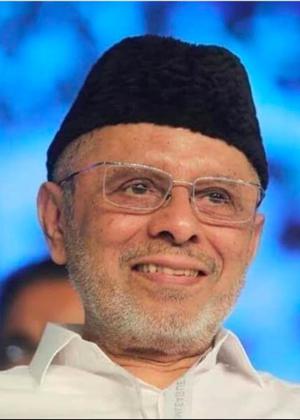
Sayed Hyderali Shihab Thangal | Photo Credit: The Hindu
He was the national chairman of Indian Union Muslim League
Indian Union Muslim League (IUML) national chairman and Kerala State president Sayed Hyderali Shihab Thangal, 74, passed away on March 6. He died after fighting cancer for over a year. He was declared dead around 12.30 pm at Little Flower Hospital, Angamaly.
Thangal’s condition had deteriorated the previous day and he was put on a ventilator. However, his younger brother Sayed Sadikali Shihab Thangal and IUML national general secretary P.K. Kunhalikutty had said that there was nothing to worry.
Thangal’s death has brought a pall of gloom to Kerala’s Muslim community, over which he wielded considerable influence. He was widely respected by the people irrespective of their faith and political affiliation.
Condolence messages started pouring in soon after the death was announced. The body will be taken to his house at Panakkad soon. His family said the funeral plans were on. Details were being worked out.
source: http://www.thehindu.com / The Hindu / Home> News> National> Kerala / Malappuram – March 06th, 2022
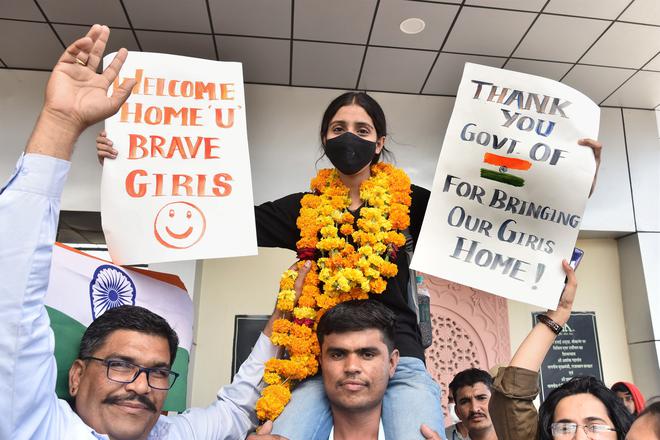
The students were received by their family members, who were overwhelmed to see their children back home
Four students of Dakshina Kannada returned from war-torn Ukraine on March 7. Anaina Anna, Claton Osmond D’Souza, Ahamed Saad Arshad and Shalvin Preeti Aranha landed at the Mangaluru International Airport on March 7 morning. They had reached New Delhi on March 6. They were received by their family members, who were overwhelmed to see their children back home.
“We were worried till they reached New Delhi. Relieved to see them back,” said Sandhya, mother of Anaina Anna, whose passport is with the travel agent. She thanked the Indian embassy for arranging another passport and also for helping students return safely to their home towns.
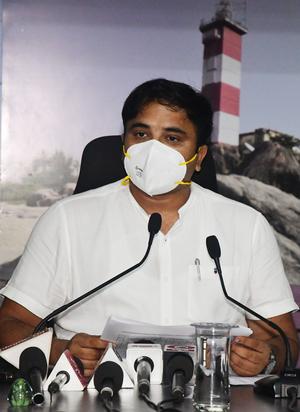
The students and family members met Deputy Commissioner K. V. Rajendra in his office in Mangaluru before proceeding to their homes, on March 7, 2022. | Photo Credit: MANJUNATH H.S.
The students and their family members thanked the Dakshina Kannada district administration, more so Deputy Commissioner K.V. Rajendra, for being in touch with them all through since February 24 till they reached Mangaluru. “He has acted just like our own brother and took all steps to bring our children back safely,” said Claton D’Souza’s mother.
The students and family members met Dr. Rajendra in his office before proceeding to their homes.
source: http://www.thehindu.com / The Hindu / Home> News> Cities> Mangaluru / by The Hindu Bureau / Mangaluru – March 07th, 2022
Amid severe cold, we travelled in a train standing for almost 17 hours to the Poland border and crossed over on foot, said Pavan Kumar from Moodbidri who returned from Ukraine on March 4.
Indian students stranded in Ukraine. (Photo | PTI)
Mangaluru :
Sheikh Mohammad Thaha, a medical student from Mangaluru, is yet to get out of war-hit Ukraine. Thaha had been staying in a shelter just 10 km away from Kharkiv. Thaha said he spent more than a week in a bunker.
“We are near Poltava, which is 130 km away from Kharkiv, right now and the Indian embassy is expected to send buses to transport the remaining students. We could hear heavy shelling in Kharkiv as it is just 10 km away from the place we were staying.”
Meanwhile, Pavan Kumar from Moodbidri returned from Ukraine on Friday. Pavan said , “We did not have enough food and basic facilities. Amid severe cold, we travelled in a train standing for almost 17 hours to the Poland border and crossed over on foot. We had our final examination on May 22, and, since we did not know the severity of the war, we could not move out on time. There are still over 600 students stranded in Ukraine,” he said.
source: http://www.newindianexpress.com / The New Indian Express / Home> States> Karnataka / by Divya Cutinho / Express News Service / March 06th, 2022
Rajia Begum and her son Nizamuddin. File | Photo Credit: Special Arrangement
Her son is stuck in Sumy bordering Russia
A school teacher in Nizamabad, who had travelled 1,400 km on a two-wheeler all by herself to bring back her son stranded in Nellore, Andhra Pradesh, following the sudden imposition of lockdown in March 2020, is in distress again.
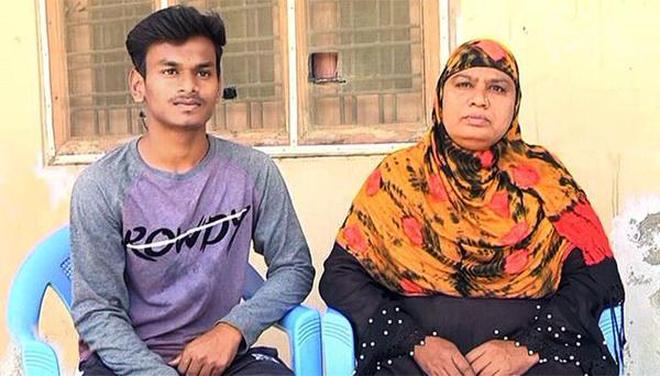
Razia Begum’s 19-year-old Nizammudin Aman is stuck in Sumy, a city in north-eastern Ukraine, where he is pursuing MBBS first-year studies. He is among the 500-odd Indian students cooped up in hostel rooms or bunkers even as Russia has escalated the military offensive on the war-hit country. The students stuck there say Sumy, close to the Russia border, has been badly affected. The nearest metro station was blown up, and roadways are damaged too, they say. The distressed mother has written to Chief Minister K. Chandrasekhar Rao, Home Minister Mohammed Mahmood Ali, and senior State government officials on Wednesday requesting help in evacuating her son from Ukraine.
Back in March 2020, Nizam had gone to Nellore to drop off a friend. They were undergoing coaching for NEET-PG. As lockdown was suddenly announced, Ms Razia, who works as a teacher at Salampad Camp village at Bodhan in Nizamabad, set off on a solo journey to rescue her stranded son.
With just a pack of rotis, fruits, and a five-litre fuel can on April 6, 2020, Ms Razia embarked on a long, arduous journey on her two-wheeler. She drove alongside heavy vehicles on highways, even at night, and reached Nellore the next day. After picking up her son, they drove back to their home in Bodhan. Ms Razia lost her husband, also a school teacher, 14 years ago due to kidney failure. In the letter addressed to the government officials, she stated that the medical condition and helplessness made her son opt for the medical profession so that he could serve such patients in future.
Nizam is once again stranded, this time in a far-away country, amid a hostile situation, and Ms Razia cannot stop feeling anxious. “They are not able to get out of there since it is not safe to step out. I appeal to Prime Minister Narendra Modi to rescue my son along with other Indian students stuck there,” she appealed.
source: http://www.thehindu.com / The Hindu / Home> News> National> Telangana / by K Shiva Shanker / Hyderabad – March 07th, 2022
An Indian student reunited with her family members after being evacuated from war-torn Ukraine, on March 4 | Photo Credit: –
The students said that there are regular power outages
Indian students stuck in Sumy, Ukraine, are in dire situation. After a bomb exploded in the city on Thursday evening, there is no water supply to them. The students said that they are forced to collect snow, melt and use it for drinking, cooking.
“We stored some water yesterday which was over by Friday morning. So we have collected the snow in buckets, melted it, filtered and consumed it,” said Abdul Rawoof, one among close to 600-800 Indian students in Sumy waiting to be rescued.
Another student Nizammudin Aman said that the water supply is cut off from Thursday night. “Thankfully it’s heavily snowing today. So now we’re collecting snow from outside our hostel and melting it using electric induction and kettles,” said Mr. Nizammudin.
It started snowing from Friday morning. The distressed students who were in need of water found it to be a blessing in the harrowing time. Their primary request is to be evacuated. With no supply of water, their washrooms have become stinky.
The students said that there are regular power outages. Since it started snowing, they need heaters which function when there is power supply. Other basic thing which they are running out of is food. Super markets are closed. Only cash is accepted to buy groceries but ATMs have run out of cash.
“Our contactor is providing one meal a day. We are arranging another meal using bread, nutella, eggs,” said Mr. Rawoof. The students have been urging Indian government to evacuate them at the earliest. They have started uploading videos on social media platforms explaining their situation and requesting for help.
source: http://www.thehindu.com / The Hindu / Home> News> National> Telangana / by K Shiva Shankar / Hyderabad, March 04th, 2022
His short film Please Hold is in the reckoning for an Oscar.
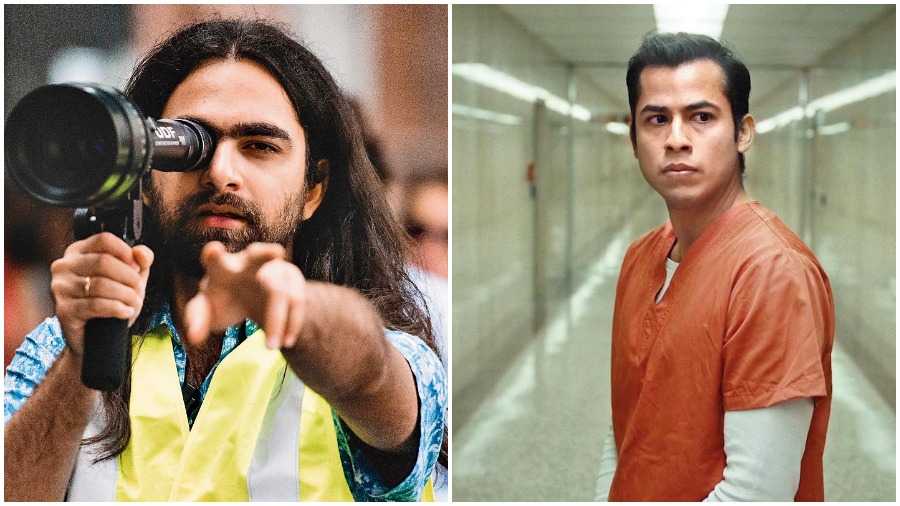
(L-R) Farhad Ahmed Dehlvi; a moment from Please Hold
Please Hold, a 19-minute sci-fi short about a young man’s life being derailed as he finds himself at the mercy of automated “justice”, is in the running for an Academy Award in the category of Best Live Action Short Film. Please Hold has been shot by ace cinematographer Farhad Ahmed Dehlvi, who has films like four-time Oscar winner Life of Pi, among others, to his credit. The Telegraph caught up with Dehlvi, who was born and raised in Delhi, for a chat on Please Hold, his craft and more.
Congratulations for Please Hold’s Oscar nomination. You are not new to awards and accolades, but does the fact that this is an Academy Award nomination make it more special?
It is special because of the history and prestige associated with the Oscars, and also the fact that ours is a Latino story, an outsider’s story about the privatised prison system in America and the degree of control technology can hold over our lives. I’m glad to see the Academy recognising this kind of work.
You can’t think about the outcome, awards or accolades while making a film… each film is a leap of faith. You hope that you do justice to the story and that it will have an impact on the audience. I’m happy that the film moved members of the Academy enough to vote in our favour. The nomination is a real honour and we have our fingers crossed for March 27. I hope people watch our film and hopefully engage in the ongoing conversations about the subject!
What makes Please Hold different from the other prestigious projects that you have shot?
One of the things I’m most proud of in Please Hold is the tone we struck, both visually, and in how the story plays out. It is a dark comedy that gets increasingly absurd and Kafkaesque. I drew inspiration from the portraits of Lucien Freud and the films Minority Report and Trainspotting. By the end of the film, I hope that you’re left with a pit in your stomach because of how closely this ‘science fiction’ parallels our reality.
One of the challenges of a short is that there isn’t much screen time to set up the world, to build context for the story. As a cinematographer, I search for ways to do this as simply and effectively as possible. With Please Hold, we found an elegant solution — to have a mural on the wall behind the character in the opening scene. The mural, which depicts a fire-breathing, rampaging robot with Lilliputian humans trying to control it, tells us so much about the world and setting of the film.
Our resources were very limited and we benefited from a lot of goodwill from within both the industry and the community. In particular, Panavision, with whom I’ve worked for many years, supported the project with a camera package and our choice of ‘Panavision Ultra Speed’ lenses to tell this story.
Your work, both as cinematographer and film-maker, has been eclectic. What would you pick as the biggest turning points in your career?
After finishing grad school at the American Film Institute in Los Angeles, I spent a few years travelling across the US working on documentary projects. My time on the road, especially in the rural south, was a real schooling in the stratifications and power structures of American society, and triggered a process of reflection that has given me a new perspective on my own culture and my childhood in India. Looking back, I’d have to say the biggest turning points have been the collaborators I met, some of whom have become like family now. They’ve taken me on journeys I could never have dreamed of, tasking me to lend images to their stories.
A large part of your work focuses on making the universal personal. What is the key to achieving that?
I strongly believe that beyond entertaining or diverting us, inclusive cinema has the power to bridge cultural divides, to help us recognise our own pathos as we see it in others. I acknowledge the dignity of those that stand in front of my lens, I accept their nuance and individuality, and treat each one as the hero of their own story.
I don’t use the camera as a shield or a dividing line on set. I recognise the intimacy between subject and cinematographer and step out from behind the lens and acknowledge that the actors are more than icons or subjects and they are living, breathing people. Of course you do this while respecting the actors’ space and their own process.
My hope is that when the credits roll at the end of a film, the audience has a moment, however brief or subliminal, where they see their own circumstances in a different light and through the shared experience of the film, perhaps feel more closely connected to the person in the next seat.
I draw a lot of influence from the world outside of film. In recent years I have been studying folk crafts, both across India and the ‘Mingei’ movement in Japan. In particular, I’ve been looking at the use of pattern, and how a motif evolves over time. The timeless quality of traditional patterns is something I want to infuse into my work. The writing of Soetsu Yanagi has had a big impact on me. Also the artist Agnes Martin and photographer Sebastiao Salgado.
Your work is distinguished by its simplicity. In this age of visual effects and tech tools, how do you manage to retain that?
My first priority is always to serve the story. Everything I do, my creative choices, my methodology, the technical decisions are all in service of translating the essence of the written word into images that can connect the audience with our characters. I spend a lot of time with the material in pre-production to ensure that I’m prepared to actively create the visuals while ensuring that the mechanistic aspects of our work don’t disrupt the flow of the performances. This often involves months of work together with the director and production designer where we break down the film and build the visual language piece by piece, talking about light, colour, movement, and also how we can best use the set design and blocking to support our storytelling.
I aim to create a safe and flexible space for the actors and director to work in. I try to keep the equipment and crew outside the set as much as possible, and once we are into a scene, be ready to capture the performances that unfold.
Of course, there are times when a scene calls for a more technical approach, whether it is a precisely constructed camera movement or a particular lighting technique. These moments can feel more mechanical on set, but you have to trust the medium, trust the craft, and if you’re in service of the story, then the final scene, when it plays on screen, will look effortless and truly emotional. The audience will be transported into the movie. These moments are far more effective when you’ve built them into the grammar of the visual storytelling, contrasted them against the quiet moments in the film. It is like a piece of music — you need the pianissimo to feel the effect of the big crescendos. So I wouldn’t say that I eschew any particular tech tools or follow a dogmatic approach of simplicity. I’m always in service of each moment in the story.
Growing up in Delhi, was there an epiphanic moment that made you want to pursue this as both career and passion?
There are many! With both parents working in the industry, I was introduced to films at an early age One moment comes to mind — my first memory looking through the viewfinder of a camera. A visiting photographer, a friend of my parents, allowed me to look through his camera. It was a Hasselblad, a medium-format still camera, and had a viewfinder that showed you a reversed image that was very crisp, almost like a 3D projection. I fell in love with the way this camera’s viewfinder made the everyday image of our garden look magical, more real than reality, like a glimmering 3D projection. I was quite young at the time, and was enchanted with this ‘black box’ that could literally turn the world inside out. Of course now I understand the physics behind it.
I love the mechanical, the optical, the photochemical side of film-making, and I think this goes all the way back to my earliest experiences with a still camera. Getting some black-and-white film out of my father’s ‘stash’ in the fridge, watching him load it into the camera, going out and pressing the shutter with a child’s curiosity and then watching the images develop in a darkroom tray. This process has always been magical for me — a kind of alchemy, pulling images from a place that lies even beyond my imagination. I try and bring that curiosity to my work every day.
Is directing a natural extension of your work in cinematography?
I have always been narratively driven in my work, and having been in the director’s chair has made me a more sensitive and thoughtful cinematographer. I can see things with a broader perspective, am better able to shoot “for the edit” and am more closely in tune with the overall rhythm of the film. I think each informs the other, but I don’t see directing as an extension of cinematography.
I’d like to explore directing, particularly in episodic fiction while continuing to work as a cinematographer. There are several cinematographers who are balancing directing and shooting. Andrij Parekh did this with HBO’s Succession a few years ago, and Dana Gonzales on Fargo.
source: http://www.telegraphindia.com / The Telegraph Online / Home> My Kolkata> Life Style – Oscar / by Priyanka Roy / March 01st, 2022
Safina Nabi has always felt like a storyteller and, as she put it, a “story listener.” As a child growing up in Kashmir, she would listen to radio programs with her grandfather, showing a natural curiosity about them. “I would have dozens of questions and he would explain [it to] me,” she said. “Growing up, I think journalism came naturally to me.”
Nabi started working in radio programming while studying for her master’s degree in journalism and mass communication at the University of Kashmir.
At one point, she hosted an hour-long live morning show. “I wasn’t interested in writing at all,” she said. “I loved to be in front of the camera, taking pictures or doing interviews.”
In 2014, Nabi was forced to move to Delhi due to flooding in Kashmir. While in Delhi, she began to take on writing jobs as a way to make some extra money. After several years of exploring different mediums and “trying everything,” she decided that writing was what she wanted to do.
Much of Nabi’s work explores issues of gender and how it intersects with health, conflict, social justice and human rights.
She has written for The Guardian, MIT Technology Review, Vice, Al Jazeera and more.
Her stories are built around strong female characters; she feels that people are the most important part of any piece.
Over the past couple of years, Nabi also started writing about her culture and community. She sees it as a way to preserve her heritage. “We [Kashmiris] are an ethnic group and we come from a minority background. We need to preserve our history, our language, and our cultural roots. I think one of the major and important ways to do that is to document them.”
Nabi has received two grants from the Pulitzer Center for her work, the first of which she found on IJNet. Initially, she wasn’t even sure she would apply because she was anxious about being rejected. “The tab remained [open] on my laptop for days and days,” said Nabi. Finally, she told herself she had to act. She applied and received a positive response within a week. “I was so excited about it,” she said. The project, Kashmir’s Tribal Women Fight the Stigma of Birth Control, focused on the lack of access to family planning resources for nomadic Kashmiri women. “I have received really great feedback. I really think [working independently] is something that has helped me grow, because I can tell the story the way that I want to,” Nabi said.
The ability to control the direction of her stories is incredibly important to Nabi. She spoke with frustration about the limitations of the journalism industry, and how difficult it was to get started as a young journalist with new ideas. “As a journalist who is juggling lots of other issues like internet gags and communication blockades, we don’t have the kind of time to actually research each and everything,” she said. Grants give her more freedom to control her stories, and resources like IJNet, she explained, help her find new opportunities.
Nabi’s most recent project is an in-depth piece funded by the Pulitzer Center. Titled, “How Kashmir’s half-widows are denied their basic property rights,” it highlights the struggles of Kashmiri women whose husbands have disappeared, but cannot be proven dead, leaving them in limbo.
Telling stories like this is what keeps Nabi going when facing situations like months-long internet and phone blackouts, government censorship and intimidation. “Who will tell the stories of these people who are suffering unnecessarily and [who] do not have avenues to reach out to people, to government, to authorities, and there is nobody to listen to them? I feel this is my obligation and this is my duty, to actually give voices to those people who cannot raise their voice, and I think that that’s something that keeps me pushing still,” she said.
It’s a very difficult phase of journalism in Asia right now, especially for women, Nabi explained. “In Kashmir, we don’t even have a women’s journalism association or a union. I think if we all come together collectively and take [up] that space, I’m sure the struggle is not going to end there, but at least we’ll have that kind of space where we will be able to share our vulnerabilities and our problems and discuss them, and be that support system for each other when in trouble.”
Nabi also noted the importance of media organizations and publications supporting and inspiring young women to become journalists. “I think it’s an obligation and duty of other [sites] like IJNet to give space and give more grants to journalists who come from these small backgrounds and give them chances, amplify their voices and their stories. That’s what will help more journalists to come out, especially women, and feel like, “Okay, there are some people who are making it big despite obstacles or struggles that they are facing.”
Photos courtesy of Safina Nabi.
source: http://www.ijnet.org / IJNET (Int’l Journalist Network) / Home> Newsletter > Journalist of the month / by Daniela Riddle / March 01st, 2022
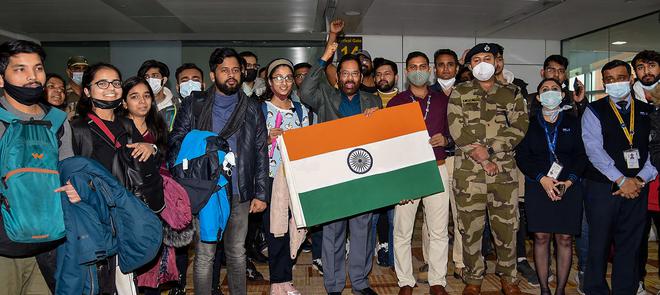
Union Minister for Minority Affairs Mukhtar Abbas Naqvi receives Indian nationals, who have been safely evacuated from Ukraine, as a part of ‘Operation Ganga’, at Indira Gandhi International Airport in Delhi. | Photo Credit: PTI
1,200 walk 15 km out of city after embassy advisory; 60 bused out after 18 hour wait
Following the government’s “urgent advisory” asking all Indian nationals to leave Kharkiv and reach towns on its outskirts, hundreds of students, who braved bombs to cover a 10-15km of journey on foot, were on Thursday unaware of what they were expected to do next, or if there was a plan to evacuate them.
“We have been told to wait for embassy officials who may come tonight, but we are not sure if that will happen,” said Mohammed Thaha Sheikh, a student of Kharkiv National Medical University, from an abandoned hotel in Pisochyn, a western suburb of Kharkiv.
On Thursday, the Indian Embassy in Kyiv issued an advisory asking all Indian nationals in Kharkiv to leave the city “immediately” and asked them to proceed to Pisochyn, Babaye and Bezlyudovka on the west and south of Kharkiv. Everyone was told to reach these towns by 6 p.m. local time
At the time the advisory was issued, Mr. Sheikh said he was at the Kharkiv train station amidst “intense shelling”. While some girls were allowed to board a train, hundreds of other Indian students were not allowed to do so, he said. “Five trains crossed us but we were not allowed to board them. The ticket collector was allowing only Ukrainian women and children. I have heard there was also violence and some students were thrown off a train,” said Mr. Sheikh.
As the 6 p.m. deadline was approaching, he along with 1,200 others decided to proceed to Pisochyn. They covered a distance of 12 kms in three hours in relative peace once they hit the highway. But before that there were Ukrainian military men and tanks enroute and they were told to “run fast” and were also provided shelter for “10-15 minutes” by Ukrainian soldiers. Once they reached Pisochyn, they found an abandoned hotel.
“They were not expecting us there and there were only two-three staff. They assigned us two buildings, but there is no food here,” said Mr. Sheikh.
18 hours later, the students were still waiting to hear from the embassy on the next course of action.
Later in the evening, their student co-ordinator (or agent) started arranging buses and 60 students left in two buses to the western border.
Russia on Thursday said it was considering providing a humanitarian corridor so that Indian students in cities in eastern Ukraine such as Kharkiv and Sumy could be evacuated through Russian territory. For those who manage to escape the war zones, the journey back to India is a long one.
At a shelter in Bercini in Romania, Tanya Shekhar has been waiting for nearly four days for news from the local Indian embassy on their transportation to the city airport. She is part of a group of 47 students “We spent 48 hours at the border check-post standing in the open in sub-zero temperatures and managed to cross the border. But there was no embassy official in sight.
We have been at a shelter arranged by the Romanian government since February 28. Though we have been mailing the embassy and calling their helpline to know about our transportation, we only heard back from them today. We have been told there will be a bus today,” said Ms. Shekhar.
source: http://www.thehindu.com / The Hindu / Home> News> National / by Jagriti Chandra / New Delhi – March 03rd, 2022