Monthly Archives: August 2025

Obituary: Maulana Muhammad Salim Qasmi, an ocean of knowledge

Deoband, UTTAR PRADESH :

With scarcity of good ulama, the passing away of Maulana Muhammad Salim Qasmi, rector of Al-Jamia Al-Islamia Darul Uloom Waqf, Deoband, has sent a sense of gloom across India.

People have written obituaries describing his death as the loss of the last chain in the golden series of Khanwada-e-Qasmiyat, a metaphor used to describe the great legacy whose history got prominence with establishment of Darul Uloom in Deoband in 1867 against the backdrop of persistent British onslaught on Indians on the one hand and its ugly design to kill ulama in large numbers on the other hand, to mitigate the impact of resistance against the Colonial power.

Maulana Salim Qasmi was a witness to the British cruelty on Indians and the Indian ulama during the eventful years if Independence. He had lived those times as a young student of India’s most prominent madrasa that had been a great centre of anti-British movements like the Silk Letter Movement.

Being the great-grandson of Maulana Muhammad Qasim Nanautwi, Salim Qasmi knew well the role he had to play to live up to the reputation and expectations both of his family and its followers and admirers spread over countries and continents. He rightly did so. His demise thus has rightly been described as the end of that golden chain. However, as there are others from the same family trying to carry forward both the academic and social and historical legacy, will they be able to do justice with that, only time will tell.

Muhammad Salim was born on 8 January, 1926 at Deoband and received primary education from many teachers. He completed his studies in 1948 from Darul Uloom Deoband where his teachers included great luminaries like Maulana Hussain Ahmad Madani, Maulana Aizaz Ali, Allama Ibrahim Balyawi, Maulana Syed Fakhrul Hasan Moradabadi.

He is said to be the last surviving disciple of Maulana Ashraf Ali Thanwi from whom he studied Mizan, an important book of Arabic grammar. Soon after passing out, he was appointed a teacher there. However, later, due to a serious conflict and crisis then in Darul Uloom, he along with some other colleagues, decided to stay away from it and established Darul Uloom Waqf which he nurtured till his last breath. Besides looking after its administrative affairs as a rector, he also taught Bukhari Sharif, the well-known book of hadith. Earlier, he had taught Muslim Sharif, another important book of hadith.

Some of the key positions he held at the time of his death are as follows:

Chief Rector, Al-Jamia Al-Islamia Darul Uloom Waqf, Deoband,

Vice-President, All India Muslim Personal Law Board,

Member, Aligarh Muslim University Court,

Member of Advisory Board and Managing Committee, Darul Uloom Nadwatul Ulama,

Member of Advisory Board, Mazahir Uloom Waqf, Saharanpur,

Permanent Member of the Fiqh Council, Al-Azhar,Cairo,

President, All India Muslim Majlis-e-Mushawarat (before two fractions of it finally united),

Patron, Kul Hind Rabta-e-Masajid,

Patron, Islamic Fiqh Academy, India.

About his written contribution to the domain of knowledge, the website of Darul Uloom Waqf Deoband mentions that besides being:

… one of the top speakers of ulama, his articles and writings are also much admired. Some of the books are worthy to be mentioned here like (1) Mabaadi al-Tarbiyat al-Islami (Arabic), (2) Jaiza Tarjama Quran Karim, (3) Taajdar-e-Arz-e-Haram ka Paigham, (4) Mardaan-e-Ghaazi, (5) Ek Azeem Tarikhi Khidmat, (6) Safar Nama-e-Burma.

(7) The book Khutbat-e-Khatibul Islam (a collection of his speeches) has been published in 5 volumes. Moreover, there are many articles and scripts awaiting publication.

Formally, Maulana received bai’at (a reformative and self-actualization method historically in vogue for quite long as an Islamic tradition in certain schools of thought) at the hand of Maulana Shah Abdul Qadir Raipuri. However, he received much of the training from his glorious father, Qari Muhammad Tayyib (d. 17 July, 1983)

A remarkable trait of his personality was to maintain the dignity of a true aalim (religious scholar) by not partaking in sectarian lines as is the wont of some Ulama. He was therefore respected among all sections of Muslims and his views were very well received. Maulana Salim did not create the binary division of education between religious and modern. He believed that ‘the source of all streams of knowledge is one’.

In recognition of his services to the domain of knowledge and ideas Maulana Salim was honoured with many awards, some of which are as follows:

Nishan-e-Imtiyaz (Mark of Distinction) from the Government of Egypt for being a distinguished aalim of the Indian Sub-Continent,

Imam Muhammad Qasim Nanotwi Award,

Shah Waliullah Award.

Prominent leaders and ulama from different countries have expressed grief over the demise of Maulana Salim Qasmi. In her telephonic message, External Affairs Minister Sushma Swaraj said that Maulana Salim’s love for education was amazing. Outside the country he worked as an exemplary ambassador of education. Congress President Rahul Gandhi said Maulana Salim Qasmi illuminated the world through education and he would touch people through simplicity. Samajwadi Party chief, Mulayam Singh Yadav said that Maulana never asked anything for himself. He was a crown prince of education whose absence would be felt long.

Former Justice of Pakistan’s Shariah Court, Mufti Taqi Usmani described Maulana Salim Qasmi as an ocean of knowledge. His death is a huge loss to the Islamic world. The simplicity with which he lived is rare, he said adding, “His service in the field of education is a golden chapter”.

Member of Parliament and AIUDF President Maulana Badruddin Ajmal Qasmi termed the demise of Maulana Salim Qasmi as ‘end of an era’ whose enumerable services are worth to be written in golden words. Senior leaders Ahmad Patel, Ghulam Nabi Azad, Syed Shahnawaz Hussain and others also sent their condolence messages.

Maulana Syed Rabey Hasani Nadwi, President of All India Muslim Personal Law Board, who had closely worked with Maulana Salim Qasmi and had also been his classmate at Darul Uloom Deoaband, wrote an article in which he stated that Maulana Salim Sahab had acquired many of the qualities of his father Qari Tayyib Sahab and his great grandfather Maulana Qasim Nanautwi. He worked in a similar way from whom different sections of ummah benefitted. His death therefore has caused concerns about the void in the ummah and in religious circles.

Maulana Arshad Madani described Maulana Salim Qasmi’s death as a loss which does not seem to be filled in near future. “Whenever there is a crisis he would be remembered’ he said. The responsibility to protect the institution that he established falls on all of us.

Prof Humayun Murad said that Maulana knew well how to avoid confrontation and find peaceful and constructive ways. Darul Uloom Waqf Deoband is its living example.

Maulana Muhammad Sayeedi, nazim, Mazahir Uloom Waqf said, “In the passing away of Maulana Salim Qasmi, Mazahir Uloom has been deprived of one of its true guide and patron”. He was its member since 1988. Mufti Muzaffar Husain would trust him a lot and his suggestions were highly helpful.

As against the commonly held opinion of ulama who do not tire of speaking about the division of knowledge between religious and modern or worldly, Maulana Salim Qasmi, in June 2013, had in a public programme, very categorically said that all the available forms of knowledge are from Allah. There is nothing as religious and worldly knowledge.

Maulana Qasmi said that the division of knowledge (between religious and worldly) is a political creation because all streams of knowledge flow from God. He then asked heads of madrasas to invite people of other faiths to their madrasas and exchange views and, share their problems with them also.

As I write this obituary, his soft-spoken words remind me of the sincerity with which he would draw the attention of the people to real issues and to the approaches that need to be adopted to find their solution.

Maulana Salim Qasmi was among the important personalities who had set up the Darul Uloom Waqf. His colleagues Maulana Muhammad Nayeem Deobandi died a little over a decade ago on 23 August, 2007, Shaikhul Hadith Maulana Syed Anzar Shah Kashmiri died 10 years ago on 26 April, 2008, Mufti Khursheed Alam died on 7 February, 2012, while Maulana Salim’s younger brother Maulana Muhammad Aslam Qasmi, an outstanding orator, died about five months ago on 13 November, 2017. Finally, this great son of the great Khanwada-e-Qasmiyat passed away on 14 April, 2018. He is survived by four sons and two daughters.

May the Almighty grant him an exalted place in Jannah!

The author is a PhD Fellow at the Academy of International Studies, Jamia Millia Islamia and is also doing an online program “Contending Modernities” of the University of Notre Dame, USA.

source: http://www.twocircles.net / TwoCircles.net / Home> Articles> Indian Muslim> Lead Story / by Manzar Imam for TwoCircles.net / April 28th, 2018
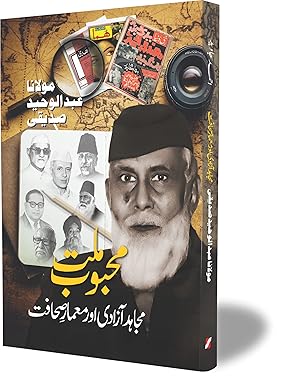
Maulana Abdul Waheed Siddiqui Mujahide-Azadi aur Meyma’re-Sahafat

DELHI :

The alternative historiography and discovery of real heroes of the society is always important in any age or any society.

The compilation and publication of “Maulana Abdul Waheed Siddiqui: Mujahide-Azadi Aur Meyma’re-Sahafat” is the result of this realisation.

The book and authors have tried to explore his personality and achievements in the broader context of history and developments of his times.

The contents of the book are documentary in nature.

The commentaries of Maulana Imdad Sabri are the personal observations and experiences of an eminent scholar and historian of Urdu journalism.

Similarly, the articles by Maulana Anzar Shah Kashmiri of Daryl Ulum Deoband, Mr. Parwana Rudaulavi , a senior journalist, Maulana S M Wali Rahmani, Dr. Khalique Anjum, Mr. G D Chandan, Mr. Shariful Hasan Naqvi, Sardar Rachpal Singh, Maulana A M Siddiqui Rahi, Ms. Surayya Siddiqui and Mr. Shahid Siddiqui are observations and experiences of those who saw and experienced him closely. These are also opinions of eminent critics and experts of language, literature, journalism, politics and history.

History and biographies open the windows of experiences and observations to human beings, and gives them the ability to discover themselves, understand their surroundings, see the impact of situations and events, look inside them and build future paths. History is the name of the waves and splashes of water in the river of time from which people emerge and nations are formed.

Maulana Abdul Waheed Siddiqui, the journalist and freedom fighter is a milestone, a bridge and a delicate and difficult chapter of modern Indian history, which holds many lessons, for present and future generations.

Maulana was a visionary, a man with deep roots in Muslim culture and religious ethos but with a very modern and enlightened outlook.

He laid the foundations of free press in post independence India. He gave the confidence to Indian Muslims to stand up and fight for their rights under the Constitution and not.

source: http://www.amazon.in

Ahmed Bhai, a friend and one of the few political leaders who inspired respect

GUJARAT / NEW DELHI :

Obituary

A man of few words, he would listen more and speak less. He was not known for dropping names, loose talk or gossip. No wonder he had friends across the political spectrum, recalls Shahid Siddiqui.

I met Ahmed Patel in 1980 for the first time as a journalist.

He mostly preferred to remain away from lime light but I persuaded him to give an interview to my weekly Nai Duniya. Even then I was impressed by his very precise responses to the most provocative questions. I came to know him in last thirty-five years both as a politician and friend. What held him above other politicians in Delhi was his honesty and dedication not only to the Congress Party but to basic moral values of public life. While many leaders protected their personal interests at the cost of the party, Ahmed Bhai did everything rising above his own political and personal interests.

Ahmed Patel was one of the finest Congressman in modern times, especially after the demise of the generation of leaders groomed by Indira Gandhi. Congress was in shambles in the post-Narsimha Rao period and with the emergence of NDA, future seemed to be bleak for Congress. It was pragmatic, realistic, dedicated hard work of Ahmed Patel and few others, which allowed UPA, led by Indian National Congress to form a government in Delhi in 2004. His networking abilities, his humble demeanor, his ability to listen to everyone and then give a sane and practical advice to the Congress President Sonia Gandhi and Prime Minister Manmohan Singh was what kept UPA together and allowed it to come back to power with larger numbers in 2009.

There came many occasions when this twenty-four or more parties’ ragtag alliance would have collapsed, but for the persuasive abilities of Ahmed Bhai. Political analysts call him troubleshooter for Sonia Gandhi, in my view he was Sankat Mochak and firefighter for the Congress Party.

On 7th December 1992, a day after the demolition of Babri Masjid, I sent my resignation from the Congress Party. I was an AICC member and part of a Committee with Shri Pranab Mukherjee, Manmohan Singh ji, K. R. Narayanan Saheb, called, ‘Pamphlet Committee’. Ahmed Bhai immediately rushed to my house and said if you resign I will also resign, and if we Muslims resign from Congress in large numbers, would we be helping the cause of Secularism or damaging it? Ultimately a call from Harkishan Singh Surjeet, who in a way was my political Guru, persuaded me to withdraw my resignation. Much later I learned that Ahmed Bhai had requested Comrade Surjeet to call me and desist from resigning from the Congress Party.

Ahmed Bhai was famous for his nighttime politics when he would call friends and opponents for advice and information. He was fond of good food and would suddenly ring me up at night saying, ‘Yaar can I come to have a few kebabs at your house’. He used to come alone without fanfare at midnight and chat. He was a political animal, who breathed Congress politics twenty-four-seven, but never tried to harm even his worst opponents.

Ahmed Bhai was ears and eyes to Sonia Ji in the most crucial days of her Presidentship. Her ability to take everyone along and keep the party together made Congress a force again, but no less was the contribution of Ahmed Bhai, who didn’t hesitate in sacrificing even his close friends if the party’s interest demanded it and advised Sonia Ji accordingly. He was one Congressman who had hundreds of critics and opponents but no enemies. Even most bitter enemies of the Congress Party could speak to Ahmed Bhai in confidence, knowing that their faith will never be betrayed.

Congress has no replacement for Ahmed Patel, at a juncture when he is required most. His contribution to Indian democracy and Secularism is immense. At a time when politicians of all hues and parties are losing respect in the eyes of the common man, Ahmed Patel will be missed much more for his cool, unemotional, positive attitude.

source: http://www.nationalheraldindia.com / National Herald / Home> States360 > Obituary / by Shahid Siddiqui / November 25th, 2020

The rebirth of Nai Duniya

DELHI :

The seven-decade-old Urdu paper is set to go digital

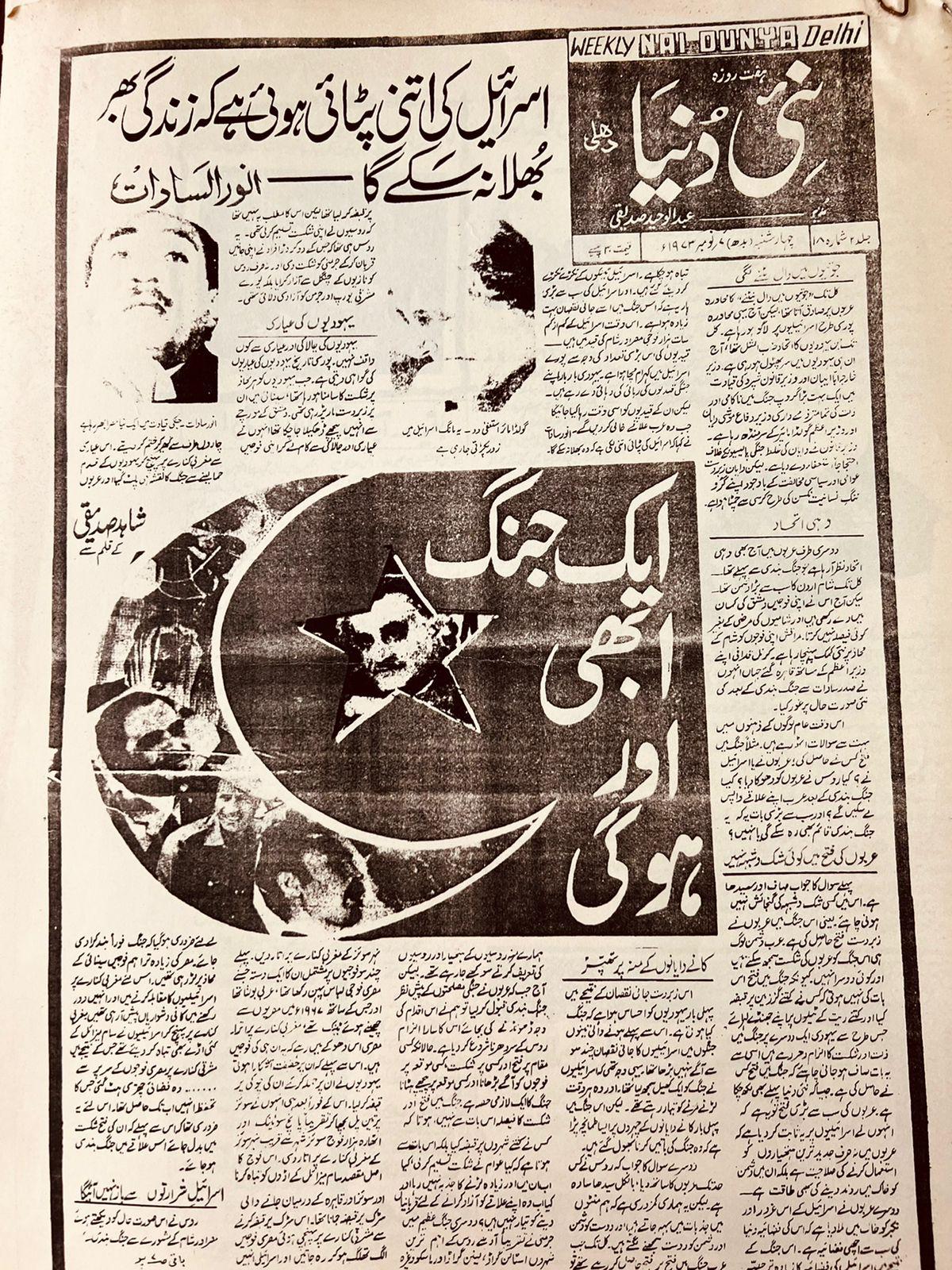
Milestone: Nai Duniya issues of 1973 | Photo Credit: Special Arrangement

A 72-year-old newspaper is ready to shave off its white beard. Helping it speak to the hep and happening young readers is the equally old editor-politician-author Shahid Siddiqui.

Starting in 1950 as an eveninger, Nai Duniya was among the first victims of COVID-induced restrictions and challenges. Now it is poised for a comeback albeit as a weekly in digital format. Siddiqui says, “At a time when it is difficult for even English magazines to find vendors, and given the increased online traffic, it makes sense to re-launch Nai Duniya in the language of the new world. We will revive Nai Duniya as an Urdu weekly in digital format.”

Siddiqui is the right person to revive the paper. He had re-launched it in 1973 after his father Abdul Waheed Siddiqui had to pay the price for skirmishes with the government. Recalls Siddiqui, “I was still pursuing my Master’s degree from Delhi University when I realised there was a demand for Nai Duniya. I revived the paper a little before Emergency and took on an established paper like Blitz which was quite popular among Urdu readers. At the time of Emergency, we were the only Urdu newspaper to criticise the government. Incidentally, Indira Gandhi gave us an  interview soon after losing power in 1977.”

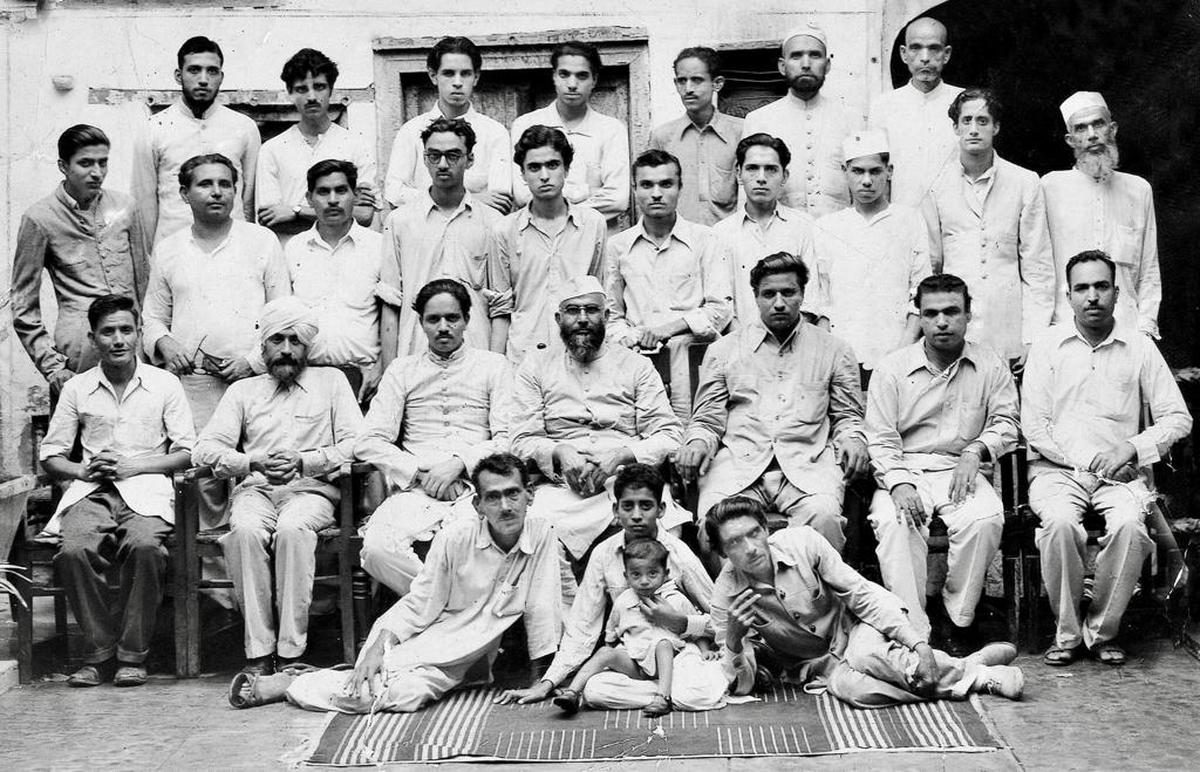
THOSE WERE THE DAYS Staff of Nai Duniya in 1951 with the founder Abdul Waheed Siddiqui (seated in the centre). Young Shahid Siddiqui, the present editor, can be seen in the lap of his brother.  | Photo Credit: Special Arrangement

Though Nai Duniya developed distinct political contours over time, it started as a hangout zone for the best Urdu writers and poets of Old Delhi. Shortly after the paper went to press around 3 p.m., the poets and writers would gather at its office in Haveli Hisamuddin in Ballimaran. Over endless cups of tea, they would recite poetry, crack jokes and take a dig at the society and polity. Among them were the likes of Zubair Rizvi, Salam Machchlishahri and Josh Malihabadi.

As Siddiqui says, “My father had worked with Al Jamiat. After Independence, the newspaper refused to speak against the Congress party. He parted ways and started Nai Duniya instead.”

The good times of soirees and gentle jokes did not last long. Soon the paper found itself embroiled in a controversy related to Kashmir. The paper had opposed the arrest of Sheikh Abdullah. Its entry was banned in the State. The declaration of the paper was cancelled, its security forfeited and in 1964-65, the paper had to fold up.  

“My father brought out two other papers instead – Himmat and Taqat. They did not last long. Then Nai Duniya was revived after Feroz Gandhi introduced a private member’s Bill in Parliament against asking for a security deposit for a newspaper. The Bill was passed. Nai Duniya once again raised its voice against the ongoing riots and paid the price. There were raids at our place, all the stuff was checked, even the pillows were ripped apart to see anything suspicious hidden there,” recounts Siddiqui.

Milestone: Nai Duniya issue of 2002 | Photo Credit: Special Arrangement

Finally, Nai Duniya came back in a new avatar as a weekly. Within six months, it became the highest-selling weekly in the country, selling from stalls in Kashmir to Karnataka. Denizens of Old Delhi, in particular, used to wait for it and would discuss its stories over endless cups of tea all over again. The government took note too. Its founding editor Abdul Waheed was arrested during the Emergency.

The Kashmir challenge remained for the paper. Siddiqui received death threats from Lashkar-e-Taiba, Hizbul Mujahideen, etc in the mid-80s. Recalls Siddiqui, “I was arrested under TADA after Farooq Abdullah’s government was felled.”

Yet amidst all the challenges, Nai Duniya flourished. Its office moved from the cultural hub of Old Delhi to the more upmarket Nizamuddin. From an eight-pager, the paper grew into a 24-page tabloid with stories carrying a punch. Along the way, it was the first to introduce computers in Urdu newspapers, started the concept of theme-based pages and invited the best journalists to write for it.

It worked well until the pandemic enforced its closure. Now at 72, it is set to revive again, this time as a digital newspaper, yet with the same old fire and punch.

source: http://www.thehindu.com / The Hindu / Home> News> Cities> Delhi / by Ziya Us Salam / June 24th, 2022

Shared experiences

DELHI :

Speakers talked poignantly at the launch of Shahid Siddiqui’s novel about the indivisible history of India and Pakistan

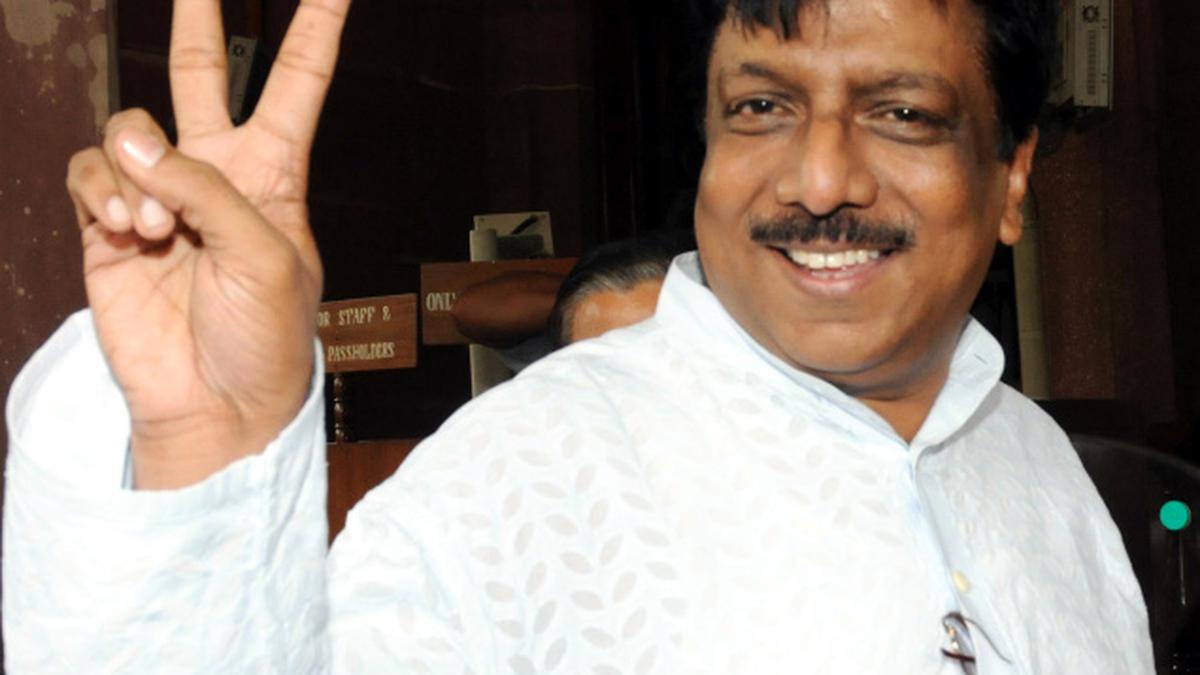
Shahid Siddiqui. Photo: R.V. Moorthy

The love-hate relationship between the people of India and Pakistan has been masterfully woven around the lives and aspirations of two brothers, Shiraz and Aijaz, by the politician and journalist turned author, Shahid Siddiqui. The launch of Siddiqui’s first work of English fiction, “The Golden Pigeon”(Harper Collins), saw a packed house at the India International Centre this Wednesday.

pix: harpercollins.co.in

The book was released by veteran journalist Kuldip Nayar who spoke passionately about the need to believe in Gandhi’s ideas of secularism and pluralism in this time of increasing hatred and ‘love jihad’. Barkha Dutt, group editor NDTV, moderated an interesting dialogue between the author, Nayar and noted film director Mahesh Bhatt.

Nayar recounted his experience of covering the post Partition riots — the disillusionment, horror of countless people rendered orphans and homeless, killed and maimed, families torn apart — and felt that Siddiqui’s book brought out the trauma and fear of Partition in a very sensitive manner. “The book reminds me of my younger days in Ballimaran — the old world charm, the magic of an era forgotten, the memories of riots. Reading the book brought tears to my eyes,” he said.

Barkha commented that the book is a story at many different levels, of schizophrenia about Pakistan’s devious designs to stir trouble in India, of dysfunctional love, manufactured stories about love jihad and passion.

Siddiqui said the book was rooted in his experiences of growing up in Shahjahanabad, the struggles of people in post Partition India, the invisible line drawn between the two countries, of aspirations, anger and fear of a people divided by a political decision. “My book is full of magical realism and begins from where the famous movie Garm Hava ends. It is a bird’s-eye view of the social upheaval and political turmoil in the subcontinent and post Partition angst. But this is not a political book at all,” said Siddiqui emphatically.

Bhatt felt that the book has what he likes to call ‘the perfume of sorrow’ and said he could easily identify with the central characters in the novel. “This book caught me by my jugular. It’s my life in print — a fiction of facts,” said Bhatt while discussing at length the dichotomy of growing up as the love child of a Muslim woman and a Hindu man. He recounted how his mother braved the odds to raise him as a Hindu while she hid her own identity as a Muslim under the garb of a mangalsutra and bindi. He also said the character of the beautiful Hina Kauser in the book was a portrayal of his mother’s steely determination to survive the odds. “The compass of our nation and that of Pakistan points towards hope. A time will come when the boundaries in our hearts and minds will fade away. The change has already begun,” said Bhatt.

source: http://www.thehindu.com / The Hindu / Home> Features> Metroplus / by Anasuya Basu / image edited : Harper Collins / November 21st, 2014

Ballimaran in its infinite labyrinth of turmoil

DELHI :

An excerpt from Shahid Siddiqui’s fascinating memoir of culture, society and politics

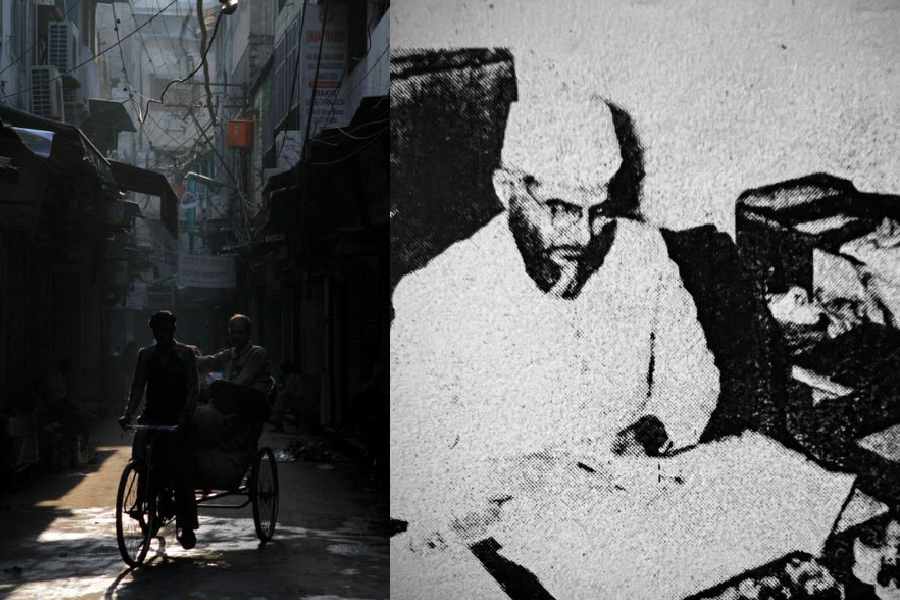
WORLD APART: The tangled lanes of Old Delhi where Abdul Waheed Siddiqui (right) started the evening daily Nai DuniyaSourced by the Telegraph

In those post-Partition days, there were unseen borders drawn in old Delhi — what in today’s parlance is called Delhi-6. There were Muslim and Hindu areas within the same lane. Haveli Hesamuddin in Ballimaran was the mohalla (locality) of a prosperous Muslim business community called Punjabis or the Shamsi baradari. It was, therefore, in common parlance known as ‘Punjabi Phatak’ (Punjabi Gate). In reality, they were not Punjabis, but had migrated from Central Asia; they were very fair-skinned, some of them had blue eyes and blond hair. None of them spoke Punjabi. Most of them owned shops and businesses in Chandni Chowk and Sadar Bazar. Many of them owned large showrooms and hotels in Connaught Place and Kashmiri Gate, with palatial houses in Civil Lines, which was at that time the most expensive and posh residential area of Delhi. Our family was one of the few non-Punjabis living there, and was looked upon with suspicion. The government and administration allotted us a house that belonged to a prosperous Muslim family that had migrated to Pakistan…

…In the 1950s, Ballimaran was in great turmoil, and undergoing significant demographic and emotional changes. While some prominent families had migrated to Pakistan, others were gravitating to this place from different parts of India. It emerged as the hub of new post-Partition Muslim politics and cultural renaissance. Things were changing, and education was becoming popular. Mohani shifted to our mohalla, and brought all the writers, poets, revolutionaries and freedom fighters with him. Ballimaran was known as the Mohalla of Mirza Asad Ullah Khan Ghalib. With Mohani also spending his last days here, it became a centre of activity for all those with patriotic zeal and revolutionary ideas. Prominent journalist Kuldip Nayar, who migrated from Lahore, came here to spend time with Mohani and practise Urdu journalism. Famous poet Josh Malihabadi, whenever he was in Delhi, preferred to stay here. Theatre practitioners like Habib Tanvir and Baba Niaz Haider found refuge in Haveli Hesamuddin and Ballimaran.

When Abba decided to resign from Aljamiat and launch a daily newspaper Nai Duniya in 1951, the ground floor of the haveli was converted into a newspaper office. For some time, we lived on the upper floor of this two-storey house, but later shifted to a house next door. The upper floor, with large rooms and enormous terraces, became the refuge for those who had no place to go. Nai Duniya was an evening newspaper, so all office work was over by the afternoon. After that, the whole office, its courtyard and terraces were available to idealists, culturally adventurous political mavericks, revolutionary young men, and the most outspoken journalists to spend their time there.

There would be rehearsals for a play on one terrace, while impromptu mushairas would be organized on the other if Jigar Moradabadi or any other famous poet were visiting the city. While Communist Party members would have heated debates on the class character of Nehru’s government in one room, in another, some ulema would plan relief work for some place where a communal riot had broken out. From Habib Tanvir and young M.F. Hussain to poets like Gulzar and Zubair Rizvi, many creatives spent their time in the Nai Duniya office. There were dozens of cots (charpai or khat as we call them in Hindustani) on the terrace. Anyone could sleep there, and have a cup of tea and nahari-roti for breakfast. Thus, in my growing years, my young mind was exposed to the most exciting and dynamic melee of ideas and cultural cocktails possible.

In 1952, a young woman called Sarla Gupta, who belonged to a prominent family of Delhi lalas, and lived in Haveli Hyder Quli in Chandni Chowk, came to meet Abba. She wanted to contest the municipal corporation elections from Ballimaran on a Communist Party of India ticket. She had just graduated from Delhi University, and was burning to change society and build a new India. It was unthinkable for a communist to contest and win from a predominantly Muslim constituency, and that too when the candidate was a young woman who had just graduated from university.

Muslims, who had been divided between the Indian National Congress and the Muslim League before Independence, believed that in independent India only Congress could help and protect them. Even those who harboured a dislike for Nehru, Azad and Patel now looked at them as their saviours, and voted for Congress.

They looked at the Hindu Mahasabha and the newly formed Bharatiya Jana Sangh (BJS) with suspicion and fear, apprehending that if these parties came to power, they would marginalize them and treat them as second-class citizens. They regarded any third party as ‘vote katwa’ (divider of their votes), which would ultimately help parties like the Hindu Mahasabha and BJS, which were trying to gain a foothold among Hindus in the post-Partition atmosphere of suspicion and hatred.

Abba’s undeniable spirit pushed him forward, and he agreed to back Sarla Gupta. She defeated the powerful Congress candidate with Abba’s support. It was a prestigious election for Muslim Congressmen, and a test case inasmuch as it was the first post-Partition election. This made the Congress government extremely wary.

Govind Ballabh Pant, a freedom fighter, close confidant of Sardar Vallabhbhai Patel, and the first chief minister of Uttar Pradesh from 1946 to 1954, was highly wary of communists, and regarded them as dangerous for the country. Sarla’s victory from a Muslim area was exaggerated to foment the fear that Muslims were gravitating in large numbers towards the communists. Some rightist Hindu organizations saw this election as a massive conspiracy — a political takeover of India by the communists with the help and support of Muslims. In the aftermath of the Partition when most Muslim leaders, even progressive ones, had left Indian Muslims in the lurch and migrated to Pakistan, the latter had no one to look up to or raise their voice, and believed that democracy was not meant for them, but only for the Hindu majority.

Reproduced with permission from I, Witness; by Rupa Publications

source: http://www.telegraphindia.com / The Telegraph Online / Home> Life / by Shahid Siddiqui / August 17th, 2025

Secab Engineering College Vijaypur Celebrates 79th Independence Day

Vijaypur (Vijayapura), KARNATAKA:

Vijaypur:

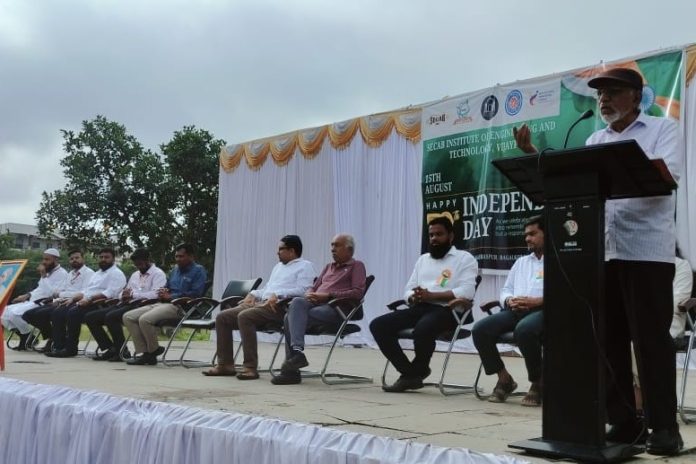
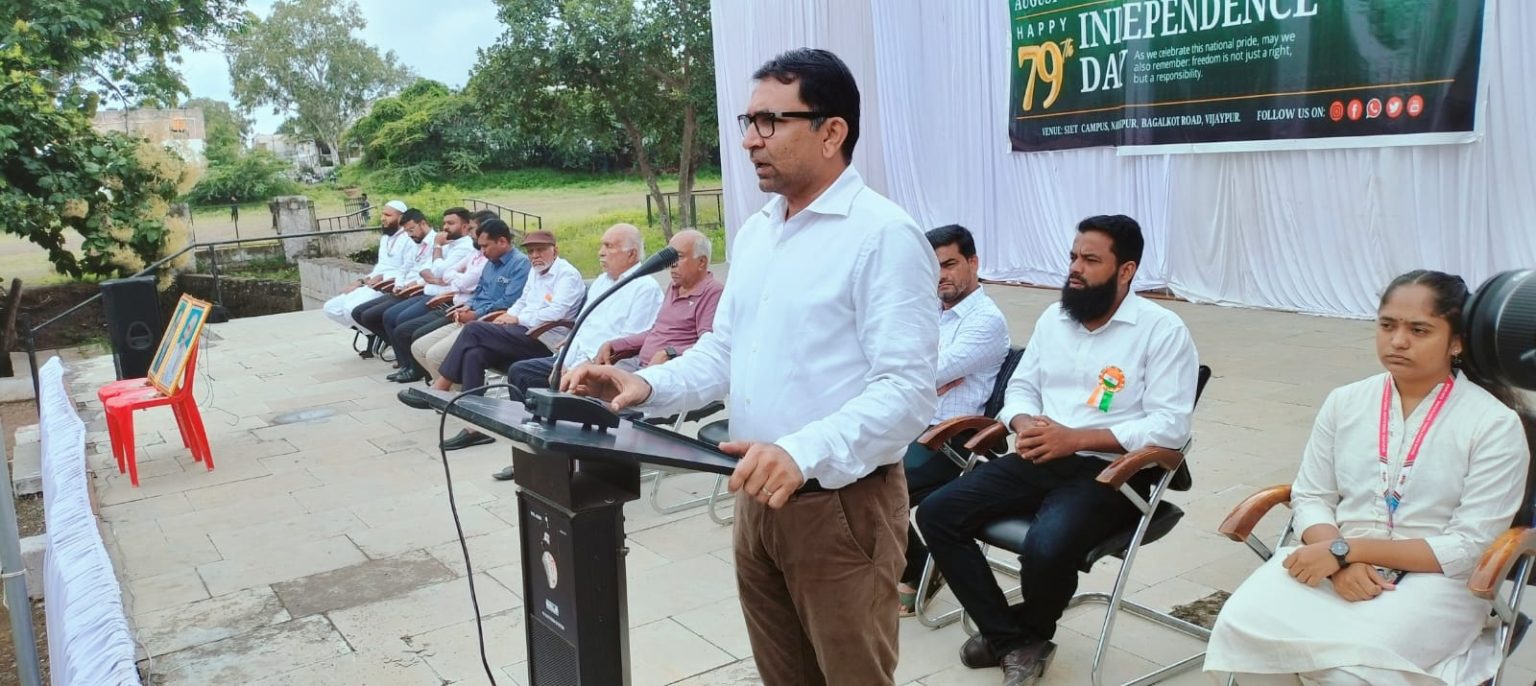
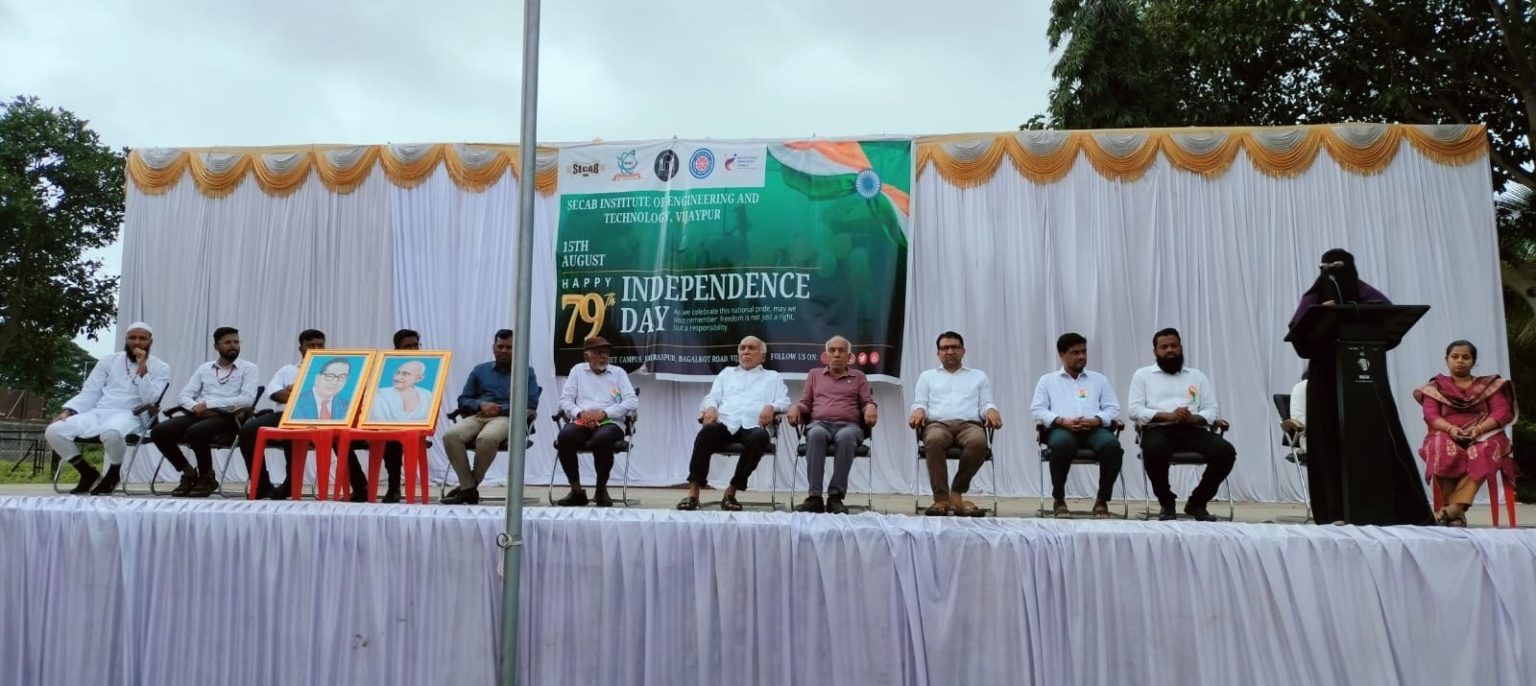
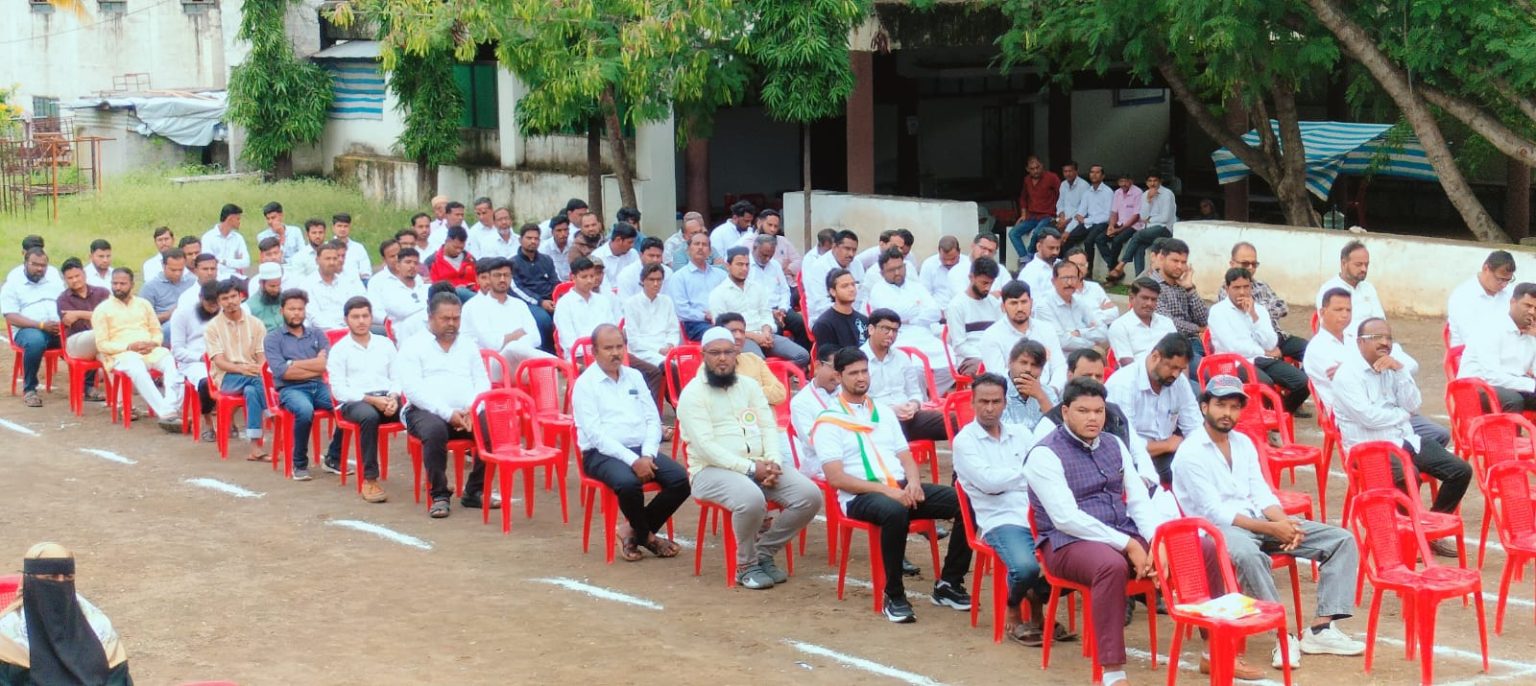
The 79th Independence Day was celebrated at Secab Engineering College here on 15th August 2025 with great enthusiasm. The chief guest of the function was Salauddin Ayub Punekar.

After the flag hoisting, Nazeer Ahmed Kazi, Retired Executive Engineer, addressed the gathering. In his speech, he highlighted that India, with a population of 140 crore, is home to people of many religions, yet united as one nation. He said, “Unity in diversity is the true culture of our country. Nowhere else in the world do we find such an example. Let us be proud of it.”

He reminded everyone that Independence Day marks India’s freedom from British colonial rule on 15th August 1947. The day honours the courage and sacrifices of the freedom fighters and inspires citizens to uphold the values of liberty, unity, and responsibility. He recalled the contributions of great leaders like Mahatma Gandhi, Jawaharlal Nehru, Maulana Abul Kalam Azad, and Lokmanya Bal Gangadhar Tilak, who declared in 1916: “Swaraj is my birth-right and I shall have it.”

Quoting Dr. APJ Abdul Kalam, he stressed the need for India to be self-reliant and globally competitive. Addressing the students, he said that engineers have a dual responsibility – both as citizens and as professionals – in nation-building. Referring to Pandit Jawaharlal Nehru’s vision of engineers as the builders of the nation, he urged them to come to the forefront in technology development and achieve technological independence through innovative and globally competitive practices.

He also acknowledged India’s remarkable progress, standing today as one of the world’s largest and fastest-growing economies. However, he cautioned against persisting challenges like communalism, casteism, corruption, unemployment, and social injustice, calling for collective efforts to overcome them.

The Director of SECAB Association, Salauddin Punekar, in his address, emphasised that independence should not remain a symbolic celebration but must reflect in every walk of life.

Several students and staff members also spoke on the occasion.

The Founder of SECAB Association, Shamshuddin Punekar, was present on the dais along with Principal Abbas Ali. The programme concluded with the President’s address, who welcomed all and extended heartfelt Independence Day wishes.

It was a memorable and meaningful celebration.

source: http://www.radiancenews.com / Radiance News / Home> Latest News> Report / by Radiance News Bureau / August 17th, 2025

Kadaba: Student Fathima Sajla Ismail creates record by handwriting Quran in five years

Baitadka ,Kaniyur Village (Kadaba Taluk, Dakshina Kannada District) , KARNATAKA :

Kadaba :

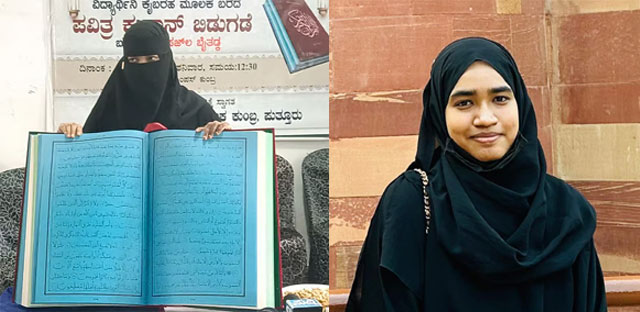
A remarkable achievement by a student from Kumbra’s Markazul Huda Women’s College has drawn attention, as she meticulously handwritten the entire Quran using an ink pen.

The achiever, Fathima Sajla Ismail, a BCom student, hails from Baitadka in Kaniyur village of Kadaba taluk and is the daughter of Ismail and Zahra Jasmine. She dedicated nearly five years to this extraordinary work, beginning in January 2021 and completing it in August 2025.

For the handwritten manuscript, Sajla used white, light blue, and light green papers, along with a black ink pen. The Quran consists of 604 pages, bound with a red and gold-coloured protective cover, and weighs about 14 kg.

“Writing a single page would take me around four hours. On some days, I managed to write two pages in eight hours. In total, I completed the work in 302 days, spending 2,416 hours,” shared Sajla.

The unveiling of the handwritten copy and recognition of her achievement took place at Markazul Huda Women’s College in Kumbra.

The manuscript was officially released by Yaseen Sakhafi Al Azhari, a Mudarris from Markaz Knowledge City, Kerala.

source: http://www.daijiworld.com / Daijiworld.com / Home> Top Stories / by DaijiWorld Media Network – Kadaba (headline and name edited) / August 18th, 2025

All India Muslim Development Council (AIMDC) Unveils List of 40 Future Leaders 

INDIA :

The All India Muslim Development Council (AIMDC) has officially unveiled the final list of “40 Under 40 Leaders” — a landmark initiative aimed at identifying, nurturing, and empowering the next generation of Muslim leaders in India. The announcement follows one of the most exhaustive and merit-based selection processes in the nation’s recent history, spanning a year-long journey and involving multiple stages of evaluation.

From 950 Applications to 40 Leaders 

The initiative drew an overwhelming response, with approximately 95 applications from across the country. Candidates came from diverse fields — education, politics, corporate leadership, engineering, medicine, activism, journalism, law, research, academia, entrepreneurship, economics, Shariah scholarship, counselling, motivational speaking, Ulemas, students and governance.

The journey began with a meticulous application process, requiring detailed documentation of qualifications, achievements, contributions to society, and personal background. Based on rigorous assessment criteria, 215 applicants were shortlisted for personal interviews.

An expert panel then conducted comprehensive interviews, narrowing the field to 112. Following further scrutiny, 105 exceptional candidates earned a place in the in-person finale for 4 days.

Four Days of Intense Evaluation in Bengaluru 

In India’s startup capital, Bengaluru, hosted the four-day in-person selection event.

Candidates participated in group discussions, parliamentary-style debates, and collaborative tasks designed to assess both individual brilliance and teamwork capabilities.

Organizers also closely evaluated their commitment to nation-building, sincerity towards the Community, Human Relations and personal discipline

From this stage, 70 leaders were selected, each awarded a Certificate of Leadership in addition to a Certificate of Participation.

Silent Assessment for the Final 40 

On July 1, 2025, the same day as the 70 Leaders’ announcement, AIMDC formed an Adhoc (Consultation) Committee of 40 Under 40 Leader blending self-nominated leaders and organizer nominations.

They were asked to pick two projects of their interest from a curated list of initiatives aligned with Community and nation-building. The objective: evaluate their decision-making capabilities, foster team bonding, spark brainstorming, and plant the foundational seeds of advanced leadership skills.

Unbeknownst to many participants, this period doubled as an “invisible” final evaluation. Organizers monitored sincerity, akhlaaq (good character), ikhlaas (pure intentions), punctuality, and the ability to follow through on commitments. Participation in educational events, organizational skills, and collaborative spirit were also critical factors in determining who would advance.

The Final 40 — India’s Muslim Leaders of Tomorrow 

After months of observation, assessment, and engagement, AIMDC has now announced the final 40 Under 40 Leaders — individuals under the age of 40 whose vision, expertise, and dedication position them as catalysts for positive change.

We were truly overwhelmed by the remarkable talent, dedication, and vision demonstrated by all 70 leaders who participated in the process. After a rigorous evaluation, the final 40 leaders selected under the 40 Under 40 Initiative will form the National Executive, serving as the strategic and driving force of the initiative.

Recognizing the immense value and potential of the remaining 30 outstanding leaders, we have proudly welcomed them as members of the National 40u40 Team. They will play a pivotal role in executing projects and events at all levels, ensuring our mission reaches communities across the country and contributes meaningfully to nation-building.

“This initiative is more than a recognition program — it is the foundation of a Change,” said an AIMDC Gen Secretary. – Mohammed Imthiyaz “These leaders represent the intellectual, moral, and strategic strength needed to guide our community and contribute meaningfully to the nation.”

“I came here thinking I would meet other young leaders. I leave knowing I am part of a network, a brotherhood and sisterhood of purpose,” said one of the selected leaders from Maharashtra.

“The process was humbling. It wasn’t just about our CVs — it was about our character, our sincerity, and our ability to work for something bigger than ourselves,” added another finalist from Kerala.

Sidebar: Fields of Expertise Represented in the Final 40

•                   Education Specialists

•                   Politicians & Policy Advocates

•                   Corporate Leaders & Entrepreneurs

•                   Engineers & Doctors

•                   Activists & Journalists

•                   Legal Experts & Researchers

•                   Shariah Scholars & Counsellors

•                   Motivational Speakers & Coaches

•                   Economic Policy Experts

•                   Ulemas

•                   Students

Names of the Selected  Candidates: 

Afza Khan

Imaan Hawwa Hafiz

Amreen Farooq

Juveriya Sarkar

Amrin Ayaz Shaikh

K. HAJIRA SULTHANA

Areefa ali

Ramsa Jaan

B Seeni Rahfu Nisha

Raniya Zulaikha

Fathima Saba

Rikza Pervez

Gulzar Karishma Malik

Shabnam Mohammed Akbar Khan

Hina Fatima Sarfraz Ali Sayed

Zulekha S Rajani

Mufti Yahya Moin Samar

Mohd Imad Ali

Abdul Gani Nadeem Punjabi

Mohd Ovais

Adil kampoo

Mohd Zeeshan

Afsar Rayeen

Mossab Mustafa Khan

Asadullah Waliullah Khan

Muhammed Rafi KE

Asiruddin Shaikh

Mujtaba Muneeb

Dr Bilal Sheth

Nawaz S

Dr Mirza Alamdar Ali Baig

Nouman Alam

Fahad Abdul Basit Hani

Ramiz Abdul Wadood

Khan Abdur Rehman

Reyaz Haider

Md Faizan

Sarfaraz Khan

Md Faizan Ahmad

Sarfraj Nawaj

Md Faizul Bari

Seemab Qayyum

Md Fateen Raza

Shaaz ahmed faruqui

Md Hifzur Rahman

Shaik Shabeer

Md Osama

Sharukh Syed

Md Sadaf Kamran

Sheikh Khurshid Alam

Md Saleh Umar

Suhaim ul islam

Md Yazdani Feroze

Syed Ansar Ali

Meer Faisal

Syed Hamid Ali Moin

Mohamed Maaz

Syed Shoaib Qasim

Mohammad Aamir Ansari

Syed Umar Ahmed

Mohammad Abdul Ahad

Tariq Abdullah Akhon

Mohammed Aftab Ahamed

Umar Farooq Masoodi

Mohammed Feroz

Wafi Shihad

Mohammed Gulam Ahmed Khan

Yusuf Mohamedy

Mohammed Ismail

Zubair Ahmed

About AIMDC’s Vision

The All India Muslim Development Council (AIMDC) is committed to fostering leadership that serves both the Community and the nation with excellence, integrity, and unity. The 40 Under 40 Leaders Initiative is envisioned as an incubator for change-makers, equipping them with networks, mentorship, and the moral compass required to navigate the complex challenges of modern society with Collective Efforts

source: http://www.muslimmirror.com / Muslim Mirror / Home> Indian Muslims> Positive Story / by Muslim Mirror Network / August 16th, 2025

Dr M G Anwar Batcha Celebrates 50 Years of Literary Service

Coimbatore, TAMIL NADU :

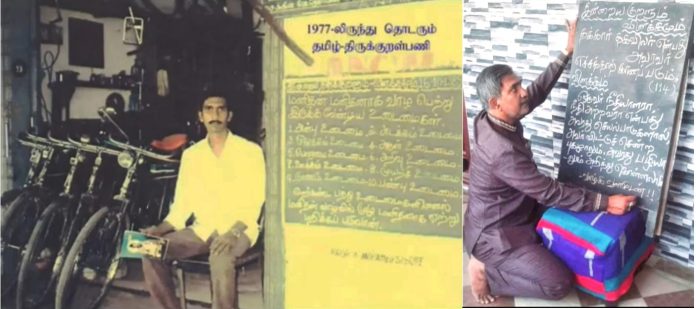
THEN AND NOW: Dr M G Anwar Batcha started writing a Thirukkural couplet with its meaning everyday since 1977 on a black board kept at a cycle shop at Coimbatore Gandhi Park. Post retirement, he continues his mission of popularising and promoting Thirukkural among the public.

So goes the inspiring quote of Missile Man of India Dr APJ Abdul Kalam – “Every small step taken with determination leads to great achievements.” Taking a cue from this, a former Tamil teacher Dr M G Anwar Batcha, known as Kural Yogi in the literary circle, celebrated 50 years of his literary journey penning books, writing a couplet with its meaning everyday on a board kept at a cycle shop at Gandhi Park in the heart of Coimbatore city since 1977.

It’s always fascinating to rewind the golden days of teaching, speaking at literary meetings and what not. As a faculty with 25-year service at Chokkampudur SBOA Matriculation Higher Secondary School in Coimbatore city, Thirukkural Batcha, a resident of Kuniyamuthur, took a trip down the memory lane to share his experience about Thirukkural, which is close to his heart.

It may be noted that a special story was featured on him in 2010 in The New Indian Express when S Kamalakannan was a senior photographer and during a routine round across the city found him writing a couplet on a black board. Worth mentioning that he makes it a point to sensitise people through his books and speeches at a plethora of events both inland and abroad. Words cannot express the amount of happiness he has in doing this literary service for over 50 years or so.

In all smiles, he said, “Life is indeed a journey filled with ups and downs, and how we navigate these fluctuations defines our resilience and character.” And that’s what Saint Thiruvalluvar had said in his 1330 couplets. Elaborating on it further, he remarked, “This ancient Tamil text is a profound testament to the intellectual and cultural achievements of Tamil civilization. Beyond its philosophical depth, the Thirukkural holds immense historical significance as a cornerstone of Tamil literature and a universal guide for human conduct. Shedding more light on it, he said Thirukkural’s focus on equality is evident in its rejection of caste discrimination, a radical stance in an era when hierarchical structures were prevalent.

Crossing a 50-year milestone,  Anwar Batcha no doubt is creating a silent revolution. All credit goes to his mentors Pulavar Rasiannan and Pulavar Arumugam, while studying at City Municipal High School at Variety Hall Road, who groomed him and brought the best out of him to be what he is now. In a step further, they motivated him to enhance his skills in Tamil.

To his credit, Anwar Batcha has awards including Tamil Nadu Government honour, Kural Neri Chelvar, Thirukkural Thoothar, Thirukkural Vendar and Thirukkural Thondar. And he penned a book on Thirukkural with English translation besides a book titled Valluvar Manimozhigal and Valluvaridam Kettathum Kidaithathum. Batcha is quite proficient in Urdu, Hindi, Malayalam and Telugu.

Retired, but not tired to actively involve in literary organisations like Thirukkural Aaivu Kazhagam, Ulaga Kalai Tamil Mandram, Coimbatore World Thirukkural Centre and organiser of Kovai Islamiya Tamil Sangam, Anwar Batcha did his doctorate on ‘Samuga Nokkil Thirukkuralum, Thirukkuranum’. US-based writer of inspirational maxims William Arthur Ward rightly categorised teachers thus: The mediocre teacher tells. The good teacher explains. The superior teacher demonstrates. The great teacher inspires. True to his words, Dr Anwar Batcha has inspired scores of his students who have made their ‘guru’ proud.

[The author is former Indian Express and Deccan Chronicle chief]

source: http://www.radiancenews.com / Radiance News / Home> Latest News / by M Rafi Ahmed / by Radiance News Bureau / August 16th, 2025