The retired surgeon of Gauhati Medical College and Hospital traverses like a nomad to advocate birth control, especially among Assam’s rural Muslim populace.
Dr. Ilias Ali. | Express Photo Services
Guwahati :
Assam’s “family planning jihadi”, who quotes from the holy texts, has finally got his dues, the Padma Shri.
For the past many years, Dr. Ilias Ali has been on a holy mission. The retired surgeon of Gauhati Medical College and Hospital traverses like a nomad to advocate birth control, especially among Assam’s rural Muslim populace.
The 63-year-old often adopts unusual but unique methods to motivate people to go for ‘No Scalpel Vasectomy’ (NSV). He quotes verses from the Quran and the Hadith to encourage people to go for NSV. He mostly works in the state’s Bengali Muslim settlements where people view NSV and the use of contraceptive pills as un-Islamic. Resistance is common, yet he has been able to motivate over 55,000 people to go for NSV.
“The first few years of my mission were very challenging. Those days, my family would get scared when I embarked on a journey to conduct an NSV camp. It feared for my life,” Dr. Ali, who is still a part of Assam’s NSV programme, told this correspondent.
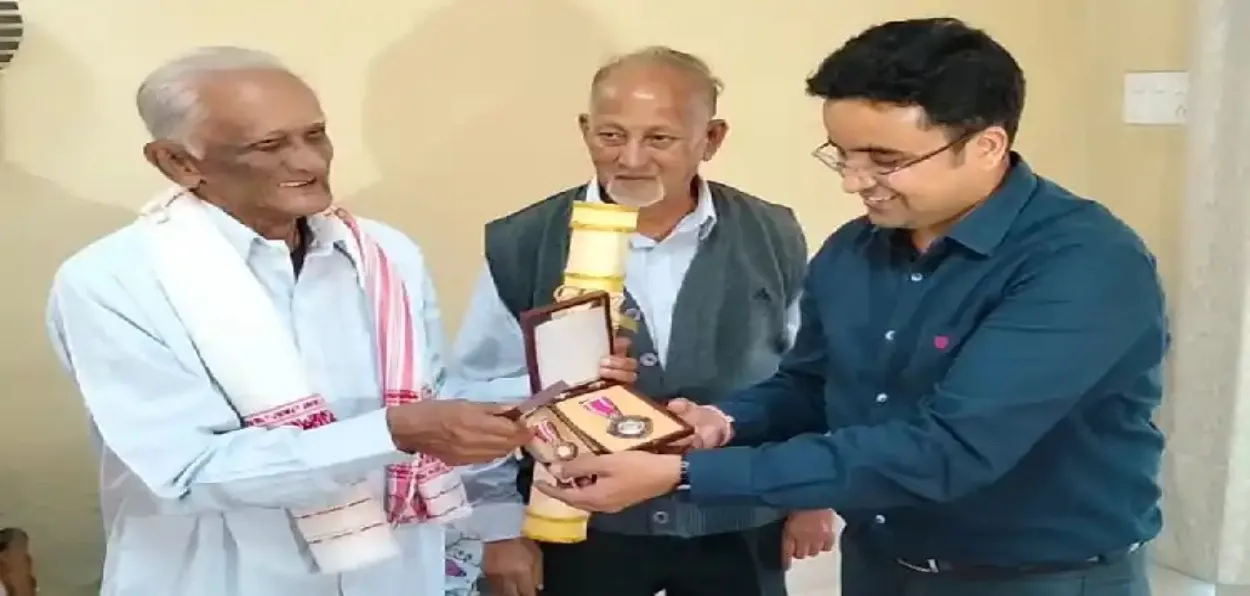
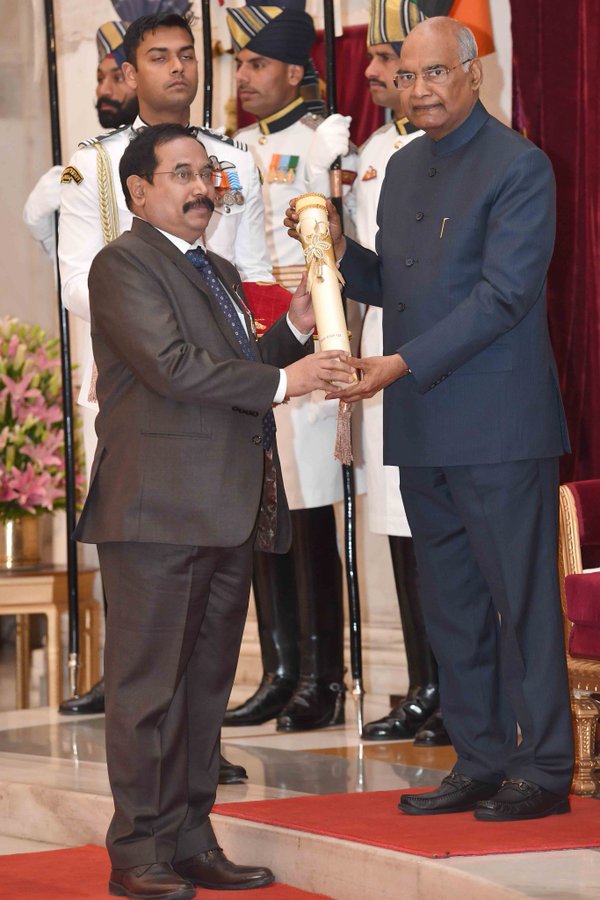
President Kovind presents Padma Shri to Prof Dr Ilias Ali for Medicine. A public health specialist, he has spread awareness about family planning and popularised different means of birth control / pix: rashtrapatibhvn
He is happy that the government has recognised his contribution to society.
“I am very happy that my contribution has been recognised. It is an honour to the entire medical team that I have been a part with for years,” he said.
Uddhab Bharali is the other person from Assam to be named for the award. The 57-year-old has to his kitty over 150 innovations.
Three decades ago, Bharali had to drop out of his engineering studies as he could not afford to pay fees and was required to take care of his family. However, that was hardly an obstacle. Riding on his passion for creativity and innovation, he started developing machines, mostly from scrap, for everyday use. The turnaround was when he created a polythene-making machine for surrounding tea estates.
Much of his inventions are today centred round agriculture. His machines for de-seeding of pomegranates, peeling areca nuts and cassava, cutting tobacco leaves to extracting passion fruit juice helped in speedy agricultural process and provided livelihood to many.
Earlier, the BBC had done a documentary on the innovations of Bharali who is a recipient of several awards including three from abroad. He said he was very happy to be honoured.
“I’m feeling very happy that I have got a national recognition. I will continue with my work,” the innovator who works with students from various IITs, said. Bharali takes care of 25 families with poor financial backgrounds and is widely known for his philanthropic works.
Two others from the Northeast to be named for Padma Shri are archer Bombayla Devi Laishram of Manipur and flutist Thanga Darlong of Tripura. The 99-year-old Darlong is the last tribal musician to play “Rosem” which is a bamboo-made flute-like musical instrument.
source: http://www.newindianexpress.com / The New Indian Express / Home> Nation / by Prasanta Mazumdar (picture edited) / Express News Service / additional photograph of Padma Shri Award introduced – pix: source: rashtrapatibhvn: / January 26th, 2019
‘I invite any Indian who claims to be a nationalist to the core to have a conversation with me,’ Rana wrote for The Wire in 2017.
Munawwar Rana (1952-2024). Photo: Youtube
New Delhi:
Urdu poet Munawwar Rana died on Sunday, January 14. He was 71.
Rana, who had been suffering from throat cancer, breathed his last at the Sanjay Gandhi Post Graduate Institute of Medical Sciences in Lucknow.
The poet is survived by his wife, four daughters and a son, PTI has reported.
Rana was an outspoken artist and was vocal against communal politics.
In 2021, Lucknow police registered an FIR against him for allegedly inciting religious feelings for his comments on Valmiki, who wrote Ramayan.
“Valmiki became a god after he wrote the Ramayana, before that he was a dacoit. A person’s character can change. Similarly, the Taliban for now are terrorists but people and characters change…When you talk about Valmiki, you will have to talk about his past. In your religion, you make anyone god. But he was a writer who wrote the Ramayana, but we are not in competition here,” Rana had said.
In 2017, the poet, who wrote the famous Maa, wrote for The Wire:
“I invite any Indian who claims to be a nationalist to the core to have a conversation with me. Let him decide the time and place. If Allah wills it, they will emerge as traitors; and we will emerge as nationalist Indians. You say ‘Bharat Mata ki jai’. My friend, we kneel on earth and kiss this soil 94 times in veneration while offering our prayers.”
On social media, many have condoled his passing.
source: http://www.thewire.in / The Wire / Home> Books / by The Wire Staff / January 15th, 2024
MILLIONS of people around the world benefit from interest-free baking. But, not many know that the scholar who made it possible within the context of the modern economic system left for his final abode on November 11 in San Jose, some 8,000 miles away from a small village in Northern India where he was born in Gorakhpur in 1931.
Dr. Muhammad Nejatullah Siddiqi left a legacy that will continue to help countless access interest-free loans to achieve their dreams. Nejat means salvation. Dr. Nejatullah’s work proved salvation to people who could not advance their financial growth in the highly competitive world due to a lack of capital. Who would have thought that growing up in colonial India, Dr. Nejat would surpass the peak of academic excellence and achieve professorship in two of the world’s most prestigious universities, the Muslim University of Aligarh and Kind Abdul Aziz University, Saudi Arabia. Indeed, education in British India was reluctant to open the door for an aspiring Muslim student to help develop the Islamic Development Bank, which has financed thousands of development projects worldwide.
But he did it with dedication, commitment, and desire to translate concepts into concrete programs to benefit people. He labored hard to author 63 significant books, hundreds of articles, and thousands of lectures worldwide while pioneering economics based on divine principles of justice and equity.
His most widely read book is “Banking without interest,” published in more than 30 editions between 1973 and 2022. His other works in English include Recent Theories of Profit: A Critical Examination (1971); Economic Enterprise in Islam (1972); Muslim Economic Thinking (1981); Banking Without Interest (1983); Issues in Islamic banking: selected papers (1983); Partnership and profit-sharing in Islamic law (1985); Insurance in an Islamic Economy (1985); Teaching Economics in Islamic Perspective (1996); Role of State in Islamic Economy (1996); Dialogue in Islamic Economics (2002) and Islam’s View on Property (1969). He received two major awards for his work: King Faisal International Prize for service to Islamic Studies and Shah Waliullah Award for his contribution to Islamic Economics.
Describing the future of Islamic Economics, he wrote in 2013 that the changing world would call for five strategic changes in approach: Family rather than the market as the starting point in economic analysis; Cooperation playing a more significant role in the economy, complementing competition; Debts playing a subsidiary rather than the dominant role in financial markets; Interest and interest-bearing instruments playing no part in money creation and monetary management; and, lastly, Maqasid based thinking supplanting analogical reasoning in Islamic economic jurisprudence. In what follows, I’d like to discuss these points to help you get in touch with these challenging propositions.
He wrote about his involvement in Islamic economics.
“I have been involved in Islamic economics most of my life. At school, however, I studied science subjects but switched to economics, Arabic, and English literature for my BA degree at Aligarh Muslim University (AMU), which I joined in 1949. My reading habit influenced my decision. I was devoted to al-Hilal and al-Balagh magazines, published under Maulana Abul Kalam Azad (1888–1958), poet, critic, thinker, and one of the great leaders of the Independence Movement. I also read al-Tableegh and was influenced by the Deobandi scholar Maulana Ashraf Ali Thanawi (1863–1943), the author of the famous book on belief and correct conduct (for women), Heavenly Ornaments. And as most young people of my age and time, I studied the works of Maulana Abul Ala Maududi (1903–1979). Two of Maududi’s pieces deeply impacted me: lectures at Nadwatul Ulama, Lucknow, and a scheme he proposed to Aligarh Muslim University, both in the mid-1940s, later published in a collection titled Taleemat. Under the influence of these ulama – religious scholars – I abandoned science and the engineering career I had planned. Instead, I wanted to learn Arabic, gain direct access to Islamic sources, and discover how modern life and Islamic teachings interacted. I stuck to this mission, even though I had to take several detours stretching over six years – to Sanwi Darsgah e Jamaat e Islami, Rampur, and Madrasatul Islah in Saraimir before I arrived eventually at Aligarh to earn a Ph.D. in economics.
The years spent in Rampur and Saraimir were full of lively interaction with Ulama. We spent most of our time discussing the Qur’an, the traditions of the Prophet, commentaries on the Qur’an, fiqh (jurisprudence), and usul-e-fiqh, or principles of jurisprudence. That this happened in the company of young men my age, fired by the same zeal, was an added advantage. We had each chosen a subject – political science, philosophy, economics – that we thought would enhance our understanding of modern life. We combined modern secular and old-religious learning to produce something that would right what was wrong with the world. We received a warm welcome from Zakir Hussain (1897–1969), the former President of India, then Vice-Chancellor of Aligarh Muslim University; Mohammad Aaqil Saheb, Professor of Economics at Jamia Milliyah Islamia, Delhi; and by eminent teachers at Osmania University in Hyderabad.
Our mission was to introduce Islamic ideas to economics. These were at three levels:
A background provided by Islam’s worldview places economic matters in a holistic framework.
A set of goals for individual behavior and monetary policy,
Norms and values, resulting in appropriate institutions.
Maududi argued that this exercise performed in critical social sciences would pave the way for progress toward an ‘Islamic society. I was fully sold on the idea. We were also influenced by the extraordinary times through which Islam and Muslims were passing worldwide. Islam was ‘re-emerging’ after three centuries of colonization which was preceded by another three centuries of stagnation and intellectual atrophy. The great depression had just exposed capitalism’s darker side, and Russian-sponsored socialism was enlisting sympathizers. We thought Islam had a chance if only a convincing case could be made.
Dr. Nejatullah Siddiqi devoted an entire book to the Objectives of Shariah (Maqasid Shariah). He did not agree with those writers who insisted on the five categories of objectives mentioned by al-Ghazali, claiming that many other purposes come under them in one way or another. He suggested more goals to be added beside and beyond the five mentioned above, such as honor and dignity of humankind, fundamental freedom, justice and equity, poverty alleviation, sustenance for all, social equality, bridging the gap between the rich and the poor, peace and security, preservation of system, and cooperation at the world level. He supports his stand by various verses of the Qur’an and the sayings of the Prophet, especially in dealing with the non-Muslims.”
Dr. Siddiqi surveyed the history of the idea of Shariah objectives. To him, the concept of Shariah objectives has existed from the very beginning of Islamic history. But it was al-Juwayni (d. 478/1085) who first used the term, from whom his disciple al-Ghazali (d. 505/1111) took it and divided it into five categories: Protection of religion, life, reason, progeny, and property. Ibn Taymiyah (d. 728H/1328) introduced the protection of dignity in place of progeny. He also argued that objectives should not be limited to the protection from haram (forbidden) but should include securing benefits. Thus, the number would be unrestricted to five objectives. Ibn al-Qayyim followed the suit of his teacher, Ibn Taymiyah, and included justice among the objectives. He examined the opinions of al-Shatibi (d. 790/1389), Shah Wali Allah al- Dihlawi (d. 1172/1763), and a quick survey of the contemporary literature.
At 91, when he breathed his last in this mortal world surrounded by his life-long partner, three sons, and two daughters, Dr. Nejat had already achieved what only a few chosen ones achieved. He ensured perpetual reward from his creator for his contributions to bringing millions into the fold of economic growth. As a result, marginalized people who lagged because of the lack of capital are in the process of building a stable financial life. Dr. Nejatullah turned concepts of divine justice and equity into practical reality. When he started his work on Islamic banking, there was hardly an institution applying religious principles; now, there are over 500 Islamic banks and thousands of other non-interest-bearing financial institutions. His legacy is there to stay and benefit people worldwide. His work has turned him into a legend, and the future generation would rightly call him the father of modern Islamic banking. His nephew, Dr. Ahmadullah Siddiq, Professor of Media Studies in Illinois, said, “It is not a loss of a family, but a loss of a generation that always looked at uncle Nejatullah as a shining source of inspiration.”
Academic honours
Awarded King Faisal International Prize for Islamic Studies, 1982.
American Finance House Award, 1993
Ph.D. in Economics from Aligarh Muslim University, India, 1966.
Arabic and Islamic learning from Rampur, India, 1954.
Work experience
Professor of Economics, King Abdulaziz University, Jeddah, Saudi Arabia, from October 1978 to the present.
Professor of Islamic Studies, Aligarh Muslim University, India, from 1977 to 1978. (On leave from AMU from 1978 to 1983)
Reader (Associate Professor) in Economics, Aligarh Muslim University, India, from 1975 to 1976.
Lecturer (Assistant Professor) in Economics, Aligarh Muslim University, India, from 1961 to 1974.
Supervised several Ph.D. dissertations at Aligarh University, Ummul Qura University, Makkah, Imam Saud University, Riyadh, and Sokoto University, Nigeria.
Editorial and Advisory positions
Member, Editorial Board, Journal of King Abdulaziz University: Islamic Economics, Jeddah from 1983 to present.
Member International Board, Review of Islamic Economics, International Association of Islamic Economics, Leicester, U.K. from 1991 to present.
Member, Advisory Board, Islamic Economic Studies, Islamic Research, and Training Institute, Islamic Development Bank, Jeddah.
Member, Board of Trustees, AAOIFI (Accounting and Auditing Organization for Islamic Financial Institutions, Bahrain) 1999 –
Member, Editorial Board, IQTISAD Journal of Islamic Economics, Yogyakarta, Indonesia, 1999
Member, Advisory Editorial Board, The American Journal of Islamic Social Sciences, AMSS & IIIT, U.S.A. from 1985 to 1991.
Member, Advisory Board of the Journal, Humonomics, Toronto, Canada from 1985 to Present.
Member, Advisory Board, MASS, Journal of Islamic Sciences, Aligarh, India, from 1985 to 1997.
Editor, Islamic Thought, Aligarh, 1954-1959.
List of published books
English
1. Economics, an Islamic Approach, The Islamic Foundation, Leicester, U.K. 1999
2. Teaching Economics in Islamic Perspective, Centre for Research in Islamic Economics, KAAU, Jeddah, 1996
3. Role of the State in the Economy, The Islamic Foundation, Leicester, U.K, 1996
4. Insurance in an Islamic Economy, The Islamic Foundation, Leicester, U.K. 1985
5. Partnership and Profit-Sharing in Islamic Law. The Islamic Foundation, Leicester, U.K. 1985
6. Banking Without Interest, The Islamic Foundation, Leicester, U.K. 1983
7. Issues in Islamic Banking. The Islamic Foundation, Leicester, U.K. 1983
8. Muslim Economic Thinking. The Islamic Foundation, Leicester, U.K. 1981
9. Contemporary Literature on Islamic Economics, The Islamic Foundation, Leicester, U.K. 1978
10. Economic Enterprise in Islam, Markazi Maktaba Islami, Delhi, India. 1972
11. Some Aspects of the Islamic Economy, Markazi Maktaba Islami, Delhi, India. 1972
12. Muslim Personal Law (Edited), Markazi Maktaba Islami, Delhi, India. 1972
13. Recent Theories of Profit: A Critical Examination. Asia Publishing House, Bombay, India. 1971
N.B: Some of these books have also been published in Arabic, Persian, Turkish, Indonesian, Malay, Hindi, and Bengali languages.
Urdu
1. Tahreek Islami Asr Hazir Men (Contemporary Islamic Movement). 1995 Markazi Maktaba Islami, Delhi, India.
2. Quran awr Science (Excerpts from Syed Qutb’s Tafsir with a detailed Introduction). 1978 Markazi Maktaba Islami, Delhi, India.
3. Nash’at Saniyah Ki Rah (Towards Islamic Renaissance) 1974 Markazi Maktaba Islami, Delhi, India.
4. Insurance Islami Ma’ishat Men (Insurance in Islamic Economy). 1974 Markazi Maktaba Islami, Delhi, India.
5. Ghair Sudi Bank Kari (Interest Free Banking) 1969 Markazi Maktaba Islami, Delhi, India.
6. Shirkat awr Mudarabat Ke Shar’i Usul (Sharia Principles of Partnership and Profit-Sharing). 1969 Markazi Maktaba Islami, Delhi, India.
7. Islam Ka Nazarriyah Milkiyat (2 Vols.) (Islam’s Theory of Property). 1969 Islamic Publications, Lahore, Pakistan.
8. Islam Ka Nizam-e-Mahasil (Translation of Abu Yusuf’s Kitab al Kharaj).1966 Islamic Publications, Lahore, Pakistan.
9. Islam Men `Adl-e-Ijtimat’i (Translation of Syed Qutb’s al `Adalah al Ijtimaiyah fi’l Islam). 1963 Islamic Publications, Lahore, Pakistan.
10. Islami Adab (edited) (Islami Literature) 1960 Markazi Maktaba Islami, Delhi, India.
_______
Dr Aslam Abdullah is an Indian American writer and activist.
source: http://www.clarionindia.net / Clarion India / Home> Features> Indian Muslim / by Dr. Aslam Abdullah / November 14th, 2022
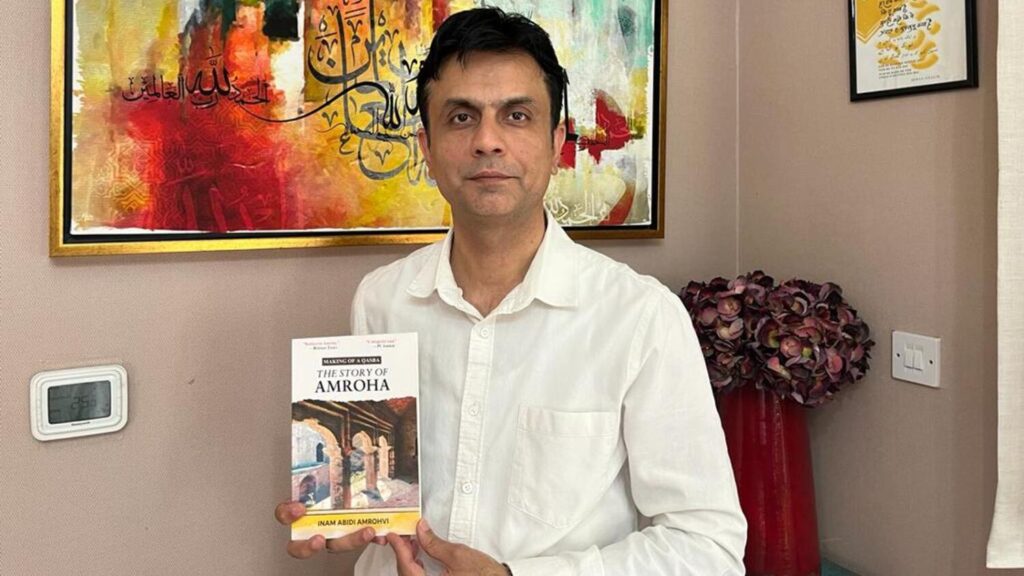
It is the first detailed account of the Indian city of Amroha in English.
Supplied photo
Inam Abidi, a Dubai resident since 2006, wears two hats with equal passion — one as a cloud consultant by profession, and the other as a writer at heart.
His journey as an author reached its culmination earlier this year with the publication of his first book, Making of a Qasba: The Story of Amroha. This achievement marked the realisation of a long-held dream that had been nurtured since his college days.
The book, painstakingly researched over three years, stands as the first comprehensive historical account of the city of Amroha presented in the English language.
Amroha, Inam’s hometown, is situated in the northern Indian state of Uttar Pradesh, renowned for its association with luminaries like Kamal Amrohvi, Jaun Elia, Sadequain, and Jai Krishna Agarwal.
The Qasba of Amroha holds a distinguished status as a prominent Sufi centre, steeped in history and tradition.
Inam said the idea of the book first struck him 2015 when he was researching for an article about Amroha, with the intention of acquainting his children with their ancestral heritage.
“I looked up everywhere, but couldn’t find much in English,” he recalled. “It was then that I recognised the significant gap in English accounts detailing the city’s rich history. This realisation spurred me to delve into the project of writing a book.”
Over the years, Inam made multiple visits to Amroha, which his family had left in the 1970s when they moved to Lucknow. He engaged in meetings with individuals well-acquainted with the city’s heritage, scoured through a multitude of books in various languages including Urdu, Persian, Hindi, and English, and examined numerous YouTube videos.
Along this journey, he encountered a variety of people, from a former senior government official who initially believed he was co-writing the book and subsequently ceased communication when he learned otherwise, to a rickshaw puller who went out of his way to capture images of historical sites within the city and shared them with Inam.
Regarding the most gratifying part of his experience, Inam shared, “I stumbled upon a rare painting of Amroha and became curious about the artist behind it. It turned out he was also a resident of Lucknow. Meeting Jai Krishna Agarwal, a renowned Indian printmaker from Amroha, was a privilege. Despite being in his 80s, he had vivid memories of the city to share with me.”
In the world of historical accounts, Inam knew controversies were common. He stated, “As a researcher, one grapples with conflicting accounts and the biases of the ruling elite. It’s also challenging to assess past events with contemporary knowledge.”
Inam’s perspective on technology and history is insightful. He believes that technology streamlines the present and prepares us for the future, while history teaches us invaluable lessons from the past.
One aspect that tinges Inam’s achievement with sadness is the loss of his father, who passed away a year before the book’s publication. He reflected, “My father would have been elated.”
source: http://www.khaleejtimes.com / Khaleej Times / Home> Lifestyle> Books / by Mazhar Farooqui / October 27th, 2023
Ulfat, who has also authored a travelogue, a poetry collection, and a novel, says it was important for him to preserve rich heritage of language.
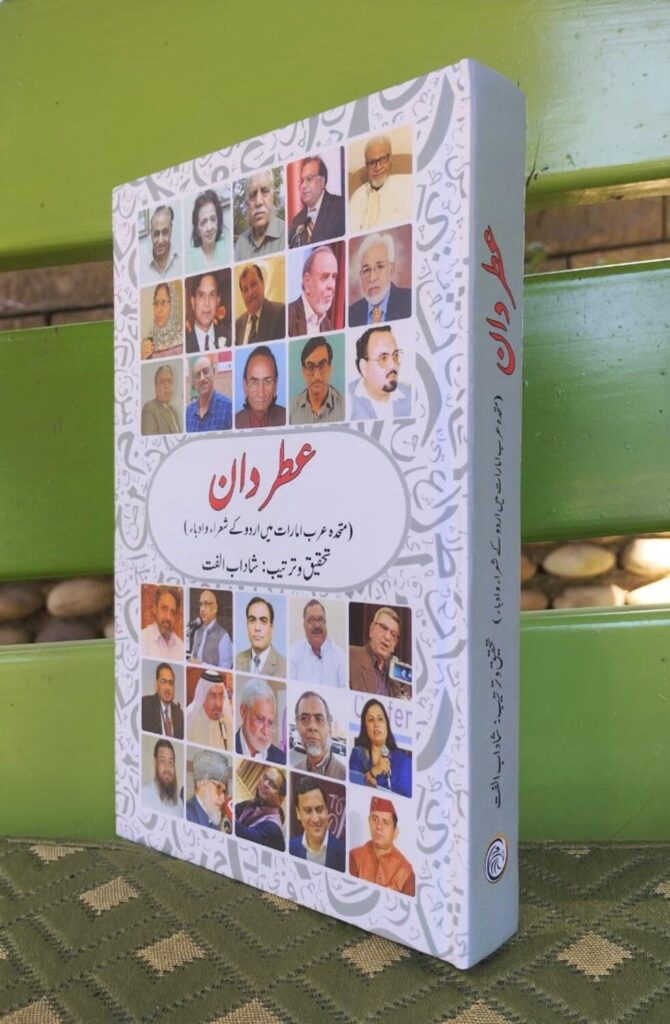
The Sharjah International Book Fair (SIBF) saw the launch of a remarkable book titled ‘Itrdaan,’ offering an intriguing exploration of the history of Urdu literature in the UAE.
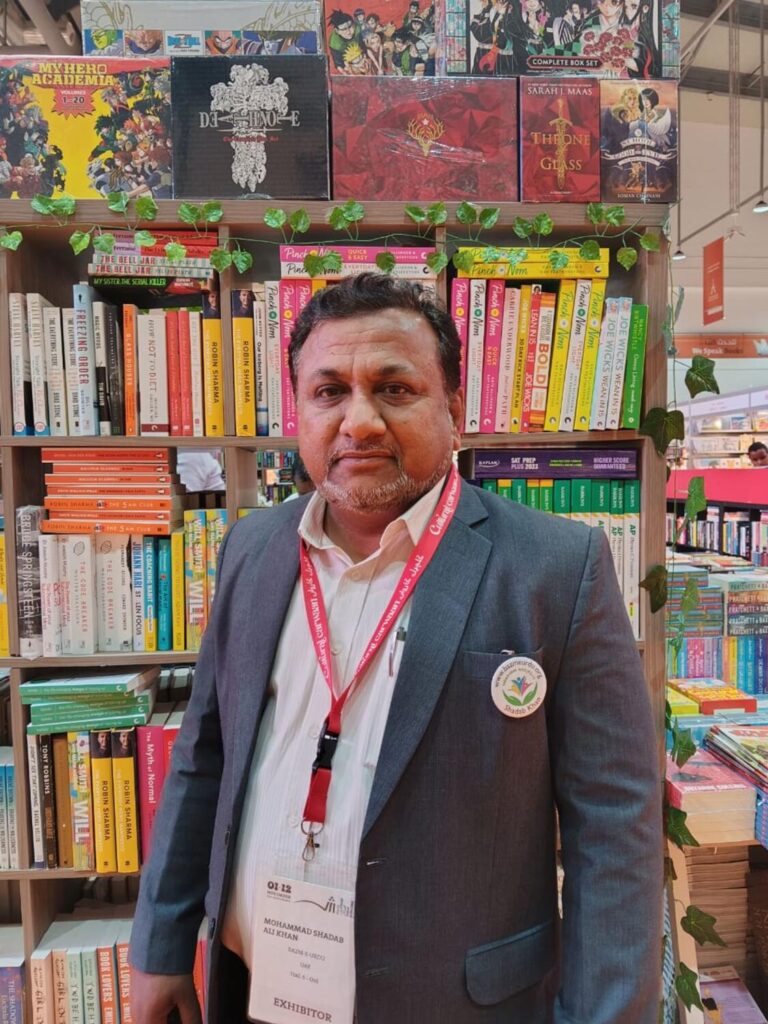
Authored by Shadab Ulfat, an Indian expatriate, the 326-page book sheds light on the significant contributions of over 180 UAE-based individuals to the Urdu language, which ranks as the 10th most widely spoken language globally.
‘Itrdaan,’ a term that translates to “fragrance” in English, is structured into three distinct sections. The first section delves into the pivotal role played by individuals from earlier times in shaping Urdu literature in the country. The second section spotlights the present-day contributors to Urdu literature in the region, while the third part introduces the new and promising voices in the UAE’s Urdu literary scene.
Ulfat expressed his inspiration for this work, saying, “I was deeply moved by our elders, who would fondly reminisce about the bygone days of Urdu when we gathered together. Their stories motivated me to embark on a two-year journey to immortalise their memories and invaluable contributions within the pages of this book.” Ulfat, who has also authored a travelogue, a poetry collection, and a novel, said it was important for him to preserve this rich heritage.
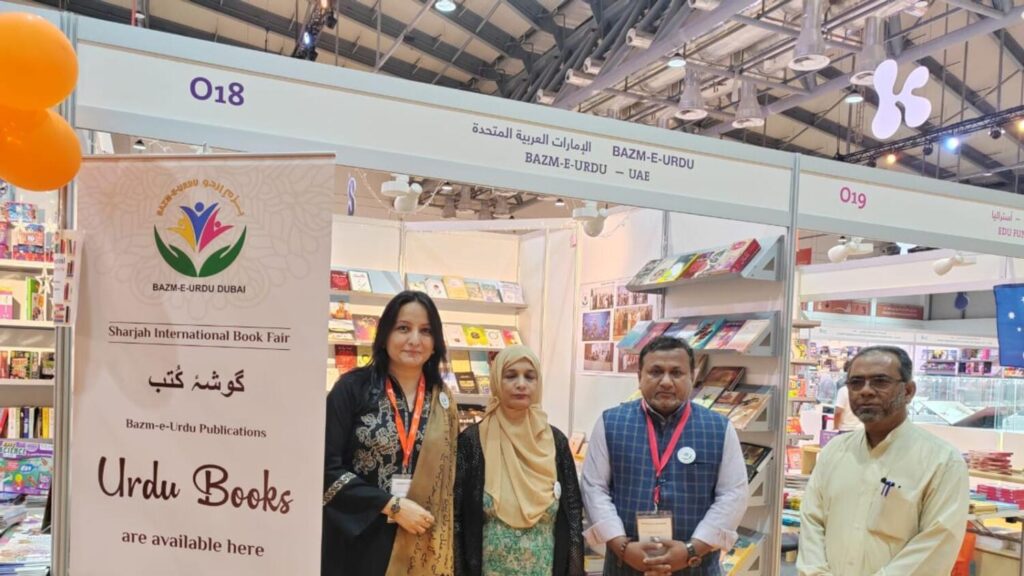
The publishing process, including the book launch, was managed by Bazm e Urdu, a Dubai-based organisation dedicated to promoting Urdu language and literature in the country.
Bazm e Urdu has been closely collaborating with the Sharjah Book Authority (SBA) and SIBF for several years. They have organised events for schools during the Sharjah Children’s Reading Festival (SCRF) and hosted celebrity talk shows and book launches during SIBF. However, this marks the first time they have a stall of their own at the fair.
Rehan Khan, the founder and general secretary of Bazm e Urdu, mentioned that ‘Itrdaan’ can be found at the ‘Gosha-e-Kutub’ Stall at SIBF, where it shares space with 500 other Urdu titles by renowned authors and esteemed publishing houses. The collection caters to readers of all ages, encompassing poetry, prose, biographies, historical fiction, and even Urdu translations or adaptations of the record-breaking Harry Potter series.
Khan stressed that their aim is to rekindle and promote love for the Urdu language, uniting people across all barriers of age, race, and religion. The Sharjah International Book Fair runs at Expo Centre Sharjah until November 11.
source: http://www.khaleejtimes.com / Khaleej Times / Home> UAE / by Mazhar Farooqui / November 06th, 2023
Sabahat Afreen’s life will make you believe in the adage: where there is a will there is a way. Being born into an educated and prosperous family, Sabahat realized early in her life that her family was not open to women coming out of the four walls of the house, bracing against all odds to create their identity. She was raised seeing all women in her family in purdah.
However, somewhere in her heart, Sabahat Afreen was like a Secret Superstar of the Hindi movie by that name. Afreen was raised in a small village in Siddharthnagar district of Uttar Pradesh by her advocate father and a homemaker mother.
Sabahat Afreen started living in purdah in 10th class and after passing her 12th standard, She was not supposed to move out of the house alone. This resulted in her not attending college and opting for home study and writing examinations as a private student for her graduation years.
She was completing her master’s degree when she got married. Her husband’s family was politically connected and prosperous. She could have easily lived in comfort; Sabahat did not like to dress up like a doll wearing jewelery and expensive sarees and lounging around all day.
She said, “My mother was fond of reading and writing. She had an impact on me too. I used to write poems and stories in my childhood. Mom and Dad always encouraged me. It is a different matter that my works were never sent for publication as they didn’t believe in getting a picture of their daughter printed in the newspaper.”
Sabahat Afreen with her book
She also realized the environment in her in-laws’ house was less conservative. “My father-in-law knew that I write, so he used to gift me a diary and pen; my husband also supported me.” She told Awaz-the Voice.
After marriage, she opened a secret account on Facebook and did not use her pictures for the DP. “I started writing stories on Facebook, my posts went viral. Someone suggested that I should send my stories to Neelesh Misra, (Editor, Gaon Connection, lyricist, and storyteller). His storytelling was popular. I emailed my story to him and he liked it. From that point, I was in his circle.”
Like Insia Malik (Played by Zaira Wasim) of Aamir Khan’s 2017 film Secret Superstar, she revealed her talent to the world by hiding her identity. Soon Sabahat Afrin was writing audio series, stories, and books for magazines and many apps across the country. She moved her two little daughters out of the closed environs of the village to Lucknow.
As it happens in such cases, most of the people who had opposed her once now praise and respect her. Her family is proud of her.
Recently her first story collection Mujhe Jugnuon Ke Desh Jaana Hai (I Want to Go to the Land of Fireflies)(Rujhan Publications, Rajasthan) was released. In it, Sabahat imagines in this country of fireflies women are also enjoying the same freedom as men, the doors of their hearts cannot be guarded, they too have the freedom to remarry after divorce, and they have the right to decide if they want to return to their husband’s house after feeling unwanted there.
Sabahat Afreen with friends
Her stories are set in the backdrop of Muslim culture, but she manages to show that when it comes to the status and rights of women, it’s the same every year. Sabahat wants to free the fireflies from the clenched fists of Afreen women.Her first remuneration of Rs 30,000 as a writer was encouraging for Sabahat. She felt that being financially strong should be the priority of a woman. Now she shares her pictures on social media and with her stories.
Sabahat has written amazing stories that she must have picked up from around her and kept in the secret chamber of her heart to let them metamorphose into another form. Her stories look familiar to readers; after reading each one of her stories, the reader feels that he has seen these incidents.
Sabahat has adapted one such incident into a captivating story. The story Khoobsurat auratein (Beautiful Women) starts with this sentence – “even good looks are like a punishment, wherever she went people’s eyes were fixed on her.’ The heroine of the story, Alia, is very beautiful.”
Sabahat Afreen with her daughters
Women are at the center of all Sabahat’s stories. The joys and sorrows of a woman, her dreams, her desire to fulfill them and social restrictions are the key elements in her stories. Sabahat is seen breaking these restrictions and traditions. Women in her stories are silent protesters except for Alia from her story Beautiful Women. However, they encounter opposition and in some cases, it’s also effective.
Sabahat becomes emotional while narrating her stories. She wishes to create a world for women where they have the freedom to fulfill their wishes and make their dreams come true. Her stories reflect her progressive thoughts.
Sabahat says that she never went to the market alone and yet when people knew about her through her stories, she felt confident to move to a big city with her daughters. “I reached Lucknow and rented out an apartment and enrolled my daughters in a good school. Today my daughters are studying, and life has become a bit easier for all three of us.”
source: http://www.awazthevoice.in / Awaz, The Voice / Home> Story / by Onika Maheshwari, New Delhi / January 03rd, 2024
Asif’s mantra, “My life is the purpose of everyone’s work,” resonates deeply within his rich personality. Dr. Khan aptly encapsulates Asif’s unwavering commitment to illuminating the path of education and eradicating societal darkness, echoing the sentiment that Asif’s life is dedicated to serving others.
In the landscape of educators, Asif Iqbal stands as a beacon of inspiration and dedication, reshaping the conventional norms of teaching and community engagement. While the average routine for most teachers comprises daily duties and personal engagements, Asif Iqbal, a 41-year-old teacher, exemplifies an extraordinary commitment that extends far beyond the traditional roles.
His passion for teaching goes beyond the classroom walls. Asif’s dedication spans across various domains, including social work, promotion of Urdu language and literature, active political participation, and tireless efforts toward educational empowerment. Unlike many, his primary focus lies in the upliftment of students and communities, striving to instigate positive transformations in their lives.
Embarking on his journey after completing a Diploma in Education, Asif began his career at a Zilla Parishad primary school in 2001. However, it was his departure from a secure government job in 2010 that marked a pivotal shift. At the young age of 28, he joined a renowned government-aided school in his city, ultimately rising to the position of Head Master at the SSA Urdu Primary School in Solapur.
His responsibilities extend far beyond the confines of an educational institution. As the spokesperson for the City Indian National Congress committee and President of the Lions Club Solapur (Classic), Asif actively engages in diverse social and political roles. Additionally, his affiliations with organizations like the All India Human Rights Association, Khidmate Khalq Organization of India, and various literary bodies underline his multifaceted contributions.
Asif’s devotion to education and his compassionate approach have earned him immense popularity among students and parents alike.
Maaz A. Gafoor Sagri, one of his brightest students currently preparing for NEET, hails Asif as a motivator who consistently creates platforms for students to showcase their talents. Despite the school’s substantial size of nearly 2000 students, Asif manages to establish personal connections with a vast majority, prioritizing character and behavior development.
Dr. A.A. Pagan, a PTA member of the school, lauds Asif Iqbal for his administrative prowess, capacity for work, and forward-thinking attitude. According to Dr. Pagan, Asif’s initiatives have brought about positive changes and regular personality development activities within the school.
In a conversation with Muslim Mirror, Asif reflects on the dearth of educational infrastructure in his city, especially for the substantial Muslim population. He laments the absence of universities and well-equipped campuses, emphasizing the need for investments in education over commercial endeavors like land development and construction projects.
Highlighting the broader educational landscape in Maharashtra, Asif points out the scarcity of institutions offering higher and professional education, while acknowledging the few notable ones like PA Inamdar University in Pune and Anjuman E Islam in Mumbai.
Asif’s vision extends beyond his current commitments. He expresses a strong desire to build an Asian Minority University, a dream he is diligently working towards with the acquisition of a 100-acre land. This envisioned educational hub aims to become a center for Indian Muslims, fostering educational growth and empowerment.
His influence on Urdu literature and poetry is equally significant. As a host to numerous All India Mushairas, including prestigious events like the Delhi Urdu Academy in the presence of Delhi’s Deputy Chief Minister Manish Sisodia, Asif has actively contributed to nurturing Urdu literary talents.
Despite commendations for his leadership potential in politics, Prakash Wale, a senior Congress Party leader, advocates for Asif’s continued presence in the education sector, acknowledging its need for individuals like Asif Iqbal, while cautioning about the intricate nature of politics.
Dr. Asadullah Khan, an eminent figure in the education realm, celebrates Asif Iqbal as a catalyst for educational and social transformation in Solapur. Recognizing Asif’s multifaceted abilities as an educator, poet, and orator, Dr. Khan commends his dedication to service and highlights Asif’s poetic work, “Naya Asman,” as a significant contribution to the world of literature.
Asif’s mantra, “My life is the purpose of everyone’s work,” resonates deeply within his rich personality. Dr. Khan aptly encapsulates Asif’s unwavering commitment to illuminating the path of education and eradicating societal darkness, echoing the sentiment that Asif’s life is dedicated to serving others.
This expansion not only delves deeper into Asif Iqbal’s multifaceted contributions but also elaborates on his vision, impact, and the endorsements he has received from various stakeholders within the education, social, and political spheres.
source: http://www.muslimmirror.com / Muslim Mirror / Home> Education> Positive Story / by Imran Inamdar / December 19th, 2023
A college professor from the J&K’s Higher Education Department (JK-HED) has published a book with the Indian branch of the reputed publishing company, Oxford…
Srinagar:
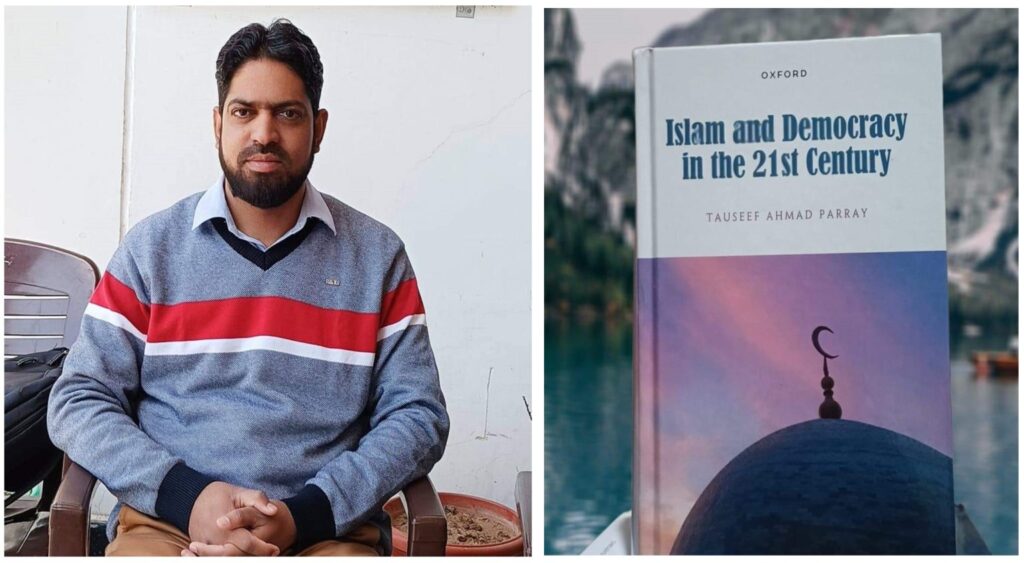
A college professor from the J&K’s Higher Education Department (JK-HED) has published a book with the Indian branch of the reputed publishing company, Oxford University Press.
The book, authored by Dr Tauseef Ahmad Parray, highlights an emerging discourse in the Islamic political thought, “Islam and Democracy in the 21 st Century”.
Dr. Parray, an Assistant Professor of Islamic Studies in the JK-HED since 2016, is presently posted at GDC Sogam, Kupwara, and hails from south Kashmir’s Tral, Pulwama.
His major areas of specialization are Islamic political thought, Islam and modernity, Islamic intellectual tradition and Quranic studies.
Spanning over 400-pages, the book offers very “useful discussions in framing the contemporary debates surrounding Islam and democracy”, by treading through “diverse theoretical Islamic texts like the Qur’an, Sunnah and other more contemporary works by eminent scholars” and analysts and activists of the Arab world, sub-continent and the Muslims scholars of the West of the last two-and-half-centuries. It consists of seven chapters and discusses democracy and democratization in the Muslim world, democratic notions in Islam, Islam-democracy discourse (from mid-19 th to 21 st centuries) in the light of both proponents and opponents. It addresses the crucial question: Is Islam compatible with democracy?
The book was announced officially by OUP on 13th September and is currently available on OUP website, Amazon and other online portals (Publisher’s Link; Amazon Link) by publishing this book, Dr Tauseef, in his late 30s, has become one of the youngest academicians of J&K to be published by OUP and thus is a feat attained by a college Professor. It is “a huge accomplishment at such a young age”, said a professor.
The book has endorsements and praise from internationally acclaimed eminent scholars and specialists of Islamic Studies and Islamic political thought from the USA (Professor Asma Afsarudin), Australia (Professor Abdullah Saeed), Qatar (Professor Louay Safi) and Bosnia (Dr. Joseph J. Kaminski).
Furthermore, it has a foreword by Dr. M. A. Muqtedar Khan (an Indian-American Professor and expert on Islam and global affairs at the University of Delaware, USA), who has described it as being “central to Islam and democracy, and any future research on the topic can and should begin with this book”.
The book is a helpful source for the students and scholars of comparative politics and islamic studies, and is equally fascinating for the readers interested in knowing the contemporary political dynamics of the Muslim world.
source: http://www.greaterkashmir.com / Greater Kashmir / Home> Education / by GK News Service / September 30th, 2023
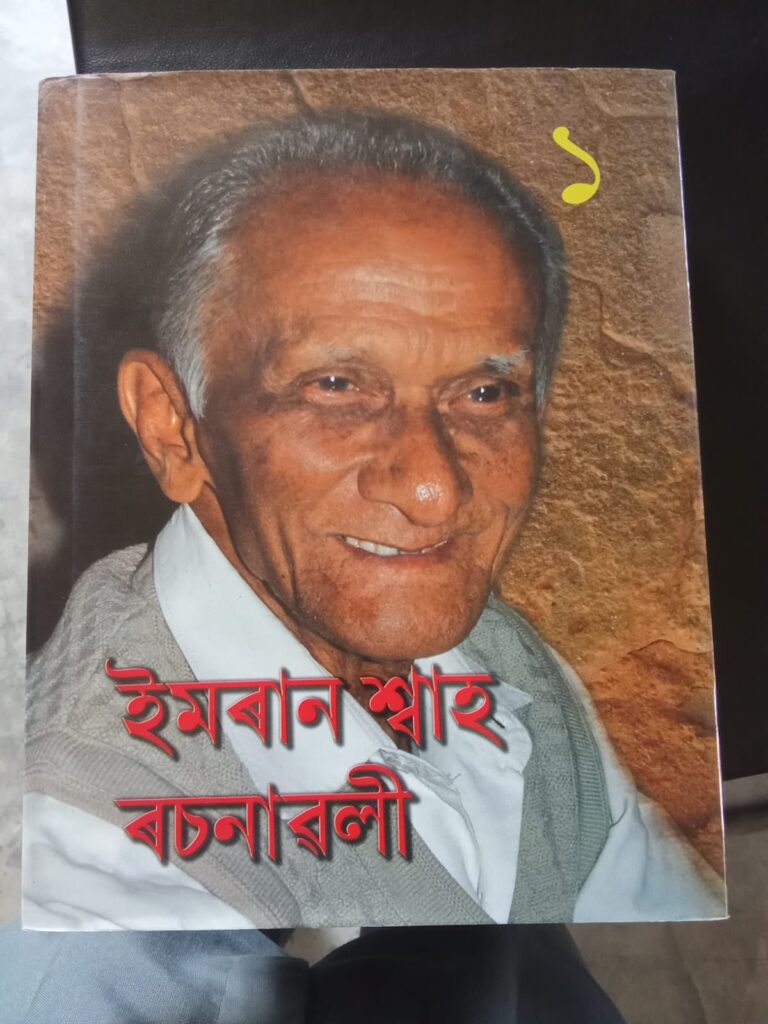
If Dr Bhupen Hazarika is known as the Bard of the Brahmaputra, Imran Shah is the Nawab of Assamese literature. Known for his powerful writings, this soft-spoken and shy doyen is one of the literary giants of Assam. Imran Shah, 90, invariably wears a smile on his face and flashes it even to strangers. Honoured with the Padma Shri in 2021, Imran Shah, a wizard in wordplay, the poet, lyricist, writer, novelist, playwright, scholar and educationist has enriched Assamese literature with his works.
He is generally called the Nawab of Assamese writing but he also writes under the pen names Ishan Dutta, Anamika Baruah, Kumbhakarna, and Animesh Baruah. He has also been conferred with the Assam Valley Literary Award (2009) by Magor Education Trust, Ajan Pir Award (2008) by the government of Assam, Sahityarathi Lakshminath Bezbarua Award (2022), Sabdwa Sahitya Award, Syed Abdul Malik Award (2013), Rangpur Gaurav Award (2016), Bor Asom Samannoy Award (2021) and many more for his contributions to the Assamese literature. He has so far published his 19 Novels, innumerable short stories, and poetry collections and many more manuscripts are ready to go to press.
Imran Shah with Rajib Dutta
Born on 23 November 1933 at Dhai Ali, Sivasagar, Imran Shah rates Assamese literature as the best in contemporary India. He says three Assamese litterateurs have so far been awarded the – Jnanpith – India’s highest award in litterateur. This distinction is achieved by no other Indian language so far. The former Asam Sahitya Sabha president is disappointed to see the lack of promotion of Assamese literature. He feels Assamese literature is still facing a lack of patronage as far as publishing is concerned. The ‘Assamese by heart and soul’ is also unhappy with the government trying to create a divide in the Assamese society – majority, minority, indigenous, etc.
Awaz-The Voice caught up with Imran Shah for a tête-à-tête at his Dhai Ali residence in Sivasagar town in eastern Assam. Excerpts:
To begin with, please tell us what inspired you to take up the pen and paper.
It all started during my school days (at Sibsagar Govt HS & MP School) when I used to compose poems for my friends. I penned several short poems for them. However, I was not seriously into poetry at that time. Soon I gained confidence, and my first anthology Banavashi (1951) was published while I was in Class IX. (His classmate Liyakat Hussain was the publisher). Inspired by my friends in Class X, I wrote my first novel Sangeetor Hkhipaare (1952, again published by Liyakat Hussain).
Soon after my college life started, I took up the pen to write seriously. My short story was published in Ramdhenu, then a highly influential Assamese literary magazine in 1957-58. Since then I have been writing without a break. I write whatever I like, and people give me a lot of love in return.
Which is your most prized work so far and why do you like it so much?
I have no answer because I love all my creations. If you ask me which one is your favourite creation, I would say I like all the short stories, novels, and poems I have penned. Based on contemporary psycho, I go on writing on varied subjects. I can’t answer which is my favourite.
A book on Imran Shah’s writtings
For which work you had to work the hardest and why?
Imran Shah: All of my creations needed equal efforts. I haven’t encountered any hardship in writing. Whenever I find myself free I sit down with my ink and paper. Whenever I have resources enough, I indulge in my habit (writing).
Do you feel recognitions came on time? Or was it late?
I don’t think so. I have never written for awards, prizes, and recognition. Based on my literary achievements, I have been awarded by the people. Only the readers reserve the right to evaluate me.
Belonging to a small community (Assamese Muslim) as far as number is concerned, how do you feel about your rise to the pinnacle of literature in Assam?
The question has pained me. I am neither a minority nor a majority. I am an Assamese by heart and soul. Why should I be singled out only for my name? Religion in personal belief. I always keep myself far away from the division of minority and majority. This kind of bifurcation harms the society. Presently it is also included in our textbooks. This is an irreparable injustice to the Assamese community and society. Any answer to this question can mislead our society.
Did you face any kind of hurdle during your accent to the position of president of Assam Sahitya Sabha?
There had not been any issue in my becoming the president of Asam Sahitya Sabha. My name was proposed by someone. Till then I was a person who would not step out of my home. I never campaigned or lobbied. I was elected the president with a majority of votes which was undoubtedly a big recognition of my work.
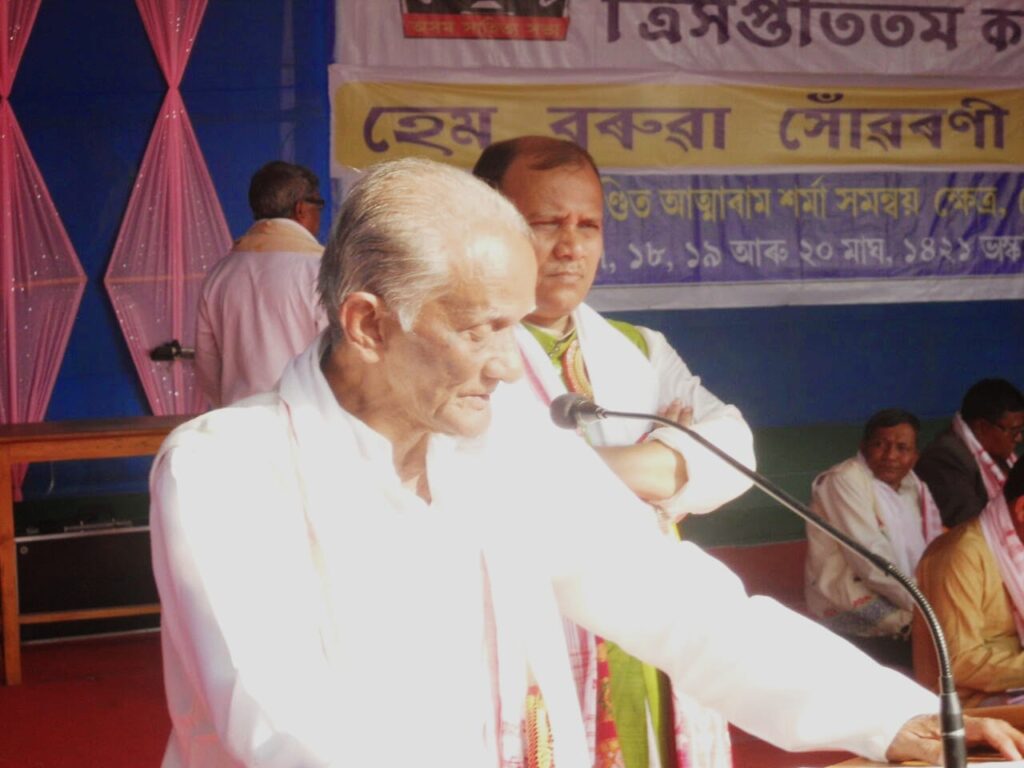
Imran Shah speaking as President of Assam Sahitya Sabha
What is your take on contemporary Indian literature?
Very bright, Assamese literature is lagging due to a lack of publishers. No publisher at all! The writers are publishing themselves. There are a large number of colleges and universities in Assam. I don’t understand why those institutions don’t come forward to publish. One of my stories, Etuku Dukh was translated into Hindi by a former professor of Banaras Hindu University Dr Charbey. After three months, the story was translated into English with the title A Piece of Sadness. Later on, it was translated into Bengali, Telegu, Tamil, Malayalam, and other languages of the world. Besides my short stories Morom, Yudha, and other select stories were published in various Indian languages. You see if my works or those of Syed Abdul Malik and Saurav Chaliha get translated into different Indian languages, the Assamese language can gain a lot.
Where do you think is Assamese literature placed in the contemporary Indian literary scenario?
It’s in definitely number one. You know Jnanpith is the highest literary award in India and it has been conferred on 3 Assamese writers, namely Birendra Kumar Bhattacharya, Dr Mamoni Roisom Goswami alias Indira Goswami, and Nilamani Phukan. Then why do we suffer from an inferiority complex? Can anyone take away that position from us?
How can Assamese literature grow further?
Our publishing agencies are very weak. There is no publisher to publish and that can lead to the development of Assamese literature. They do only business. In developed countries, the universities have their publications and this is something we lack in our country. Even during British rule, the PhD thesis of Dr Moidul Islam Borah, the first Assamese doctorate, was published by the then-education department of Assam. The developed nations have a culture of patronizing literature which we have to emulate.
Although Assam’s population comprises over 34% Muslims, the Assamese Muslim community is still a negligible minority as far as numbers are concerned. The present Assam government has recognized 5 ethnic groups of Assamese Muslims as indigenous. What is your take on it? How should the government take it forward to develop the community?
I think otherwise. Those who are concerned with these issues, let them solve it. I do never take part in any kind of conflict arising out of the issue and shall never claim as majority, minority, or indigenous. My forefathers have passed away living here as Assamese. I also think of myself as an Assamese from the core of my heart. The government should not take any initiative, especially for the minorities. They should be made part of the all-round development process meant for all the communities. Then all would prosper.
source: http://www.awazthevoice.in / Awaz, The Voice / Home> Stories / by Rajib Dutta, Sivasagar / December 19th, 2023
In your final rest
on a rope-cot,
were you still dreaming
of a piece of bread?
Beloved one,
we the people
of this country,
of that country,
can make anything
but a piece of bread
for you.
--Evening with a Sufi: Selected Poemsby Afsar Mohammad, translated from the Telugu by Afsar Mohammad & Shamala Gallagher, Red River Books, 2022.
These lines send shivers down the spine and recreate an empathetic longing for immigrant souls in search of succour. They also swiftly draw an image laced with poignancy — a loss, a regret, the economics that deny innovative young men their keep and force immigration in search of sustenance. Would the poet have been one of them?
Travelling from a small village in the South Indian state of Telangana, Afsar Mohammad has journeyed across continents and now teaches South Asian Studies at the University of Pennsylvania. Known as a trendsetting poet and literary critic for post-1980s Telugu literature, Afsar has brought out five volumes of poetry, one collection of short stories and two volumes of literary theory essays. He is also a distinguished scholar of Indian studies and has published extensively with various international presses, including Oxford and Cambridge. He is currently working on a translation of Sufi poetry from Telugu to English. In this interview, we trace his growth as a writer and editor of the webzine, Saranga, which now seems to be transcending linguistic barriers to give voice to multiple cultures…
Tell us about your journey as a writer. When and how did it start?
It’s a long story, but to cut it short — the beginnings were somewhat puzzling… Inspired by Shakespearean sonnets, I first wrote some sonnets in English, and then switched to free verse. Since most of my friends in my high school started pushing me to write something in Telugu, I had to migrate to Telugu. Quite surprisingly, I was first published in English, and then it took me a while to get something published in Telugu. I had hard time getting published in Telugu due to its newness in expressions and most editors felt that there was nothing “Telugu” in that kind of writing. So, my early writings quite naturally found their home in some English journals!
Your poetry rings with the pain of distance, the pain and struggle from others’ suffering transcending your own self. What is the source of your inspiration — is it your past or your present?What affects you more — your being an immigrant or a Sufi?
We’re distanced by many things — not just physically! We live in many shattered and scattered worlds, and sometimes we fail to reflect on those worlds. I feel like I’m a constant immigrant — despite my formal citizenship and legal boundaries. Sufism is merely a segment of this expansive realm. Both past and present define our destiny, right?! Of course, I try to live in the present rather than in the past, but never deny the baggage of the past.
Why do you subscribe to the Sufi school of poetry? What is Sufism all about?
I come from an extremely local rural setting where such Sufi mystical practices openly defined my everyday life. It’s not about the technicalities and theories or institutionalised Sufi schools of their philosophies, this is more about what I learned from my childhood, and its physical surroundings dotted by several hybrid shrines. I’ve described this cultural setting in my 2013 Oxford University Press publication, The Festival of Pirs: Popular Islam and Shared Devotion in South India. This version of Sufism has more to do with everyday life rather than a spiritual domain.
You have lived away from your country for long, and yet the past seems to still haunt you. What is the identity you seek as a poet? Is it necessary to have a unique identity or can one be like a drop that flows and moulds as per the needs of the vessel?
In a way — physically– I’m away from my birth place, but in many ways, I’m also closer to my homeland than in my past. When I moved away from the actual picture, I see many dimensions from a new lens. Each dimension contributed to my rethinking and reconsidering the idea of India. As I wander around and meet totally different places and people, I learn more about my birthplace and moved a little closer to it. I totally understand this as a process to reconcile with the past and connect it to a new present intensified by many factors, not just personal. We’re living in a virtual world, which also looks like “real” in its sounds, colours and words. Every moment it makes me realise that I’m actually not that far. On the other hand, I also see the people in my homeland who are far more removed by their immediate reality and everyday experiences. We need to read this conditionality more in terms of perspective rather than physical distance.
You are fluent in Telugu, Urdu and English. You started writing in English and then moved to Telugu. And all your poetry collections have been in Telugu. Why? Would the outreach of English not have been wider? What made you pick Telugu over English?
Great question! My literary graph is neither linear nor simplistic. When I look back and reflect on it, it’s a quite messy roadmap — actually, there’s nothing like a map to get its contours. Yes, I started writing in English and then suddenly stopped sending out the poems to magazines. In fact, I write more in my personal journals rather than in print journals. Theoretically, I saw poetry as a personal diary for my experiences for many years. Due to financial concerns within my family, I had to start working very early on and left most of my journals at home. Then, my friends found them by chance and put them together that became my first collection of poems in Telugu. The collection was an instant success for its innovative style and then that opened up my career in Telugu rather than English which was my first language of literary expression.
You are now bringing out a bi-lingual online magazine, Saranga? What made you think of a magazine in two languages?
Before entering into teaching career, I worked as an editor of the literary supplement and Sunday magazine for a largest circulated Telugu newspaper. When we moved to the USA, I thought it would be better to have some outlet to engage with my home language and literature. In the early phase, Saranga was primarily a Telugu webmagazine. When I started teaching South Asian literature, then I realised the importance of making Indian literary texts available to contemporary generation in the USA. That was just one reason, but there’re were many factors as our team saw a rise in the Indian diaspora writings in the new millennium. Luckily, we got wonderful support from writers and poets in various Indian languages. The humble beginnings have actually ended up as a rewarding experience.
What is it you look for in contributors from two languages? Is it the same guidelines or different?
We’re still learning how this works! As it appears now, these two sections require two different approaches and guidelines. Since the English section has been now attracting writers from various languages, it’s moving more towards a multi-lingual base. We’re trying to accommodate more translations into English from different Indian languages. We still need to do lots of work there.
Is the journal only aimed at South Asian diaspora or would you be extending your services to all cultures and all geographies?
Saranga, as we see it right now, is more about South Asia and its diaspora. As you know, we need more such spaces for South Asia and its diaspora. Not sure about its future directions at this point, however, if the situation demands, we will extend its services further.
You have number of essays and academic books in English. But all your creative writing is in Telugu. Why? Would you be thinking of writing in English too because proficiency in the language is obviously not an issue?
Most of my academic writing came out of my teaching experience. As I started teaching new courses, I then realised that we need more material from South Asia. I started focusing on producing such materials primarily for my courses and then gradually, they became useful for many academicians elsewhere too. I still believe creating writing as a more personal space — that enables me to articulate more about myself. However, the publication of Evening with a Sufi, brought a new change — as I’ve been getting more requests for more writing in English for the last two years. As you know pretty well, I’m an extremely slow writer.
How do you perceive language as a tool for a poet?
I see language working many ways since I dwell in multiple languages. I started my elementary education in Urdu, and my middle school was in Telugu, and the subsequent studies were in English. Through the last day of her life, my mother was extremely particular about me learning Arabic and Farsi. So, I believe that helped me so much to understand how language works in a poem. When I published my first poem in Telugu, the immediate critique was it was a not a “Telugu” poem. Telugu literary critics labelled me as a poet who thinks either in Urdu or English, then writes in Telugu. Of course, most of them were also fascinated by the new syntax of my Telugu poems and the new images and metaphors—that totally deviate from a normative or mainstream Telugu poem of those days. The uses of language in a poem varies for each poet. If you’re reading, writing and thinking in just “one” language, that might be a safe condition. A contemporary or modern poet, however, belongs to many languages and cultures. We also migrate from one language to another in our everyday life.
Do borders of nationalism, mother tongue and geographies divide or connect in your opinion? Do these impact your writing?
The response to this question might be an extension to the above conditionality of a person. Anyway, I’m not a big fan of those ideas of nationalism, mother tongue and singular geographies. They don’t exist in my world. Most of my writings both creative and academic contest such boundaries and borders. To describe this in a single term- borderless. In fact, I believe we’re all borderless, but unfortunately, many boundaries and borders are now being imposed on our personalities.
(The online interview has been conducted by emails by Mitali Chakravarty)

.jpeg)
.jpeg)