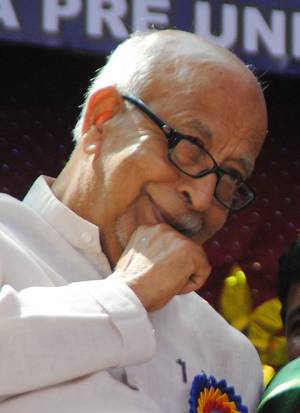
Come Ramzan and the Siasat daily plans to publish a list of 680 formulae used by the royal kitchenette of the 6 Nizam, Mir Mahboob Ali Khan
The world knows them for fabulous jewels and splendid palaces. But not many know that the erstwhile Hyderabad rulers had a weakness for a rich diet as well.
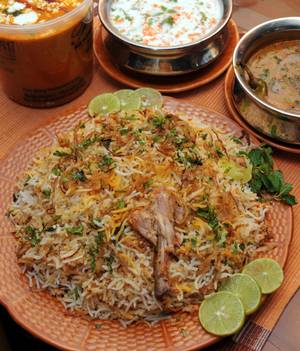
Sample this: Biryani Dulhan, Yeqni Palou Shirazi, Khorma Murgh, Qhalia Chamkura, Kabab Gul Khatai. A ‘shahi’ spread any which way. If your mouth is doing a tango, you are not to be blamed.
Now, one can try out these dishes. Urdu daily Siasat has stumbled upon a dog-eared copy containing a list of 680 formulae used by the royal kitchenette of the 6 Nizam, Mir Mahboob Ali Khan (1866 – 1911). The newspaper plans to publish the recipes in Urdu and English on art paper shortly.
The book, titled Matbaqe Asafia, is expected to hit the market in the next two months.
“It will be in time for Ramzan, the month of fasting,” Siasat’s Editor Zahed Ali Khan says.
Tell me what you eat and I will tell you what you are. A look at the recipes and the ingredients that go into making these sumptuous dishes give an inkling of the royal taste — cuisinethat is never clichéd. Every formula differs from the other in the set of instructions and ingredients.
The ‘Khwan Nemat-e-Asafia’ lists 15 different types of biryanis such as Biryani Rumi, Biryani Mahboobi, Biryani Nargis, Biryani Hazar Afreen. As the name suggests, the ‘Dulhan Biryani’ is highly decorated with a fried banana in covering of ‘warq’ (silver foil).
Besides, there are 18 kinds of pulav, 16 of khichidi, 48 of do-pyaza, 21 variants of khorma, 45 of kabab and 29 types of naan. Besides, there are 25 varieties of chutneys (condiments) and 33 types of achaar. Apart from an assortment of spices and dry fruits, the ingredients also include a generous sprinkle of perfumes and sandal.
Piece of advice
But some of the formulas could be a recipe for sickness, given the heavy doze of ‘pure ghee’ suggested. There are also some recipes, which, if tried now could land one in trouble. For instance, the book contains formulas for cooking animals which now attract provisions of the Wildlife Act.
“But we don’t propose to include such recipes since they are banned now”, Mr. Khan says.
So gourmets, get ready for a royal repast.
source: http://www.thehindu.com / The Hindu / Home> News> Cities> Hyderabad / by J.S. Ifthekhar / Hyderabad – May 13th, 2013
In 1859, Delhi’s most famous poet, Mirza Asad Ullah Ghalib, was asked what Delhi was like these days. He replied: “My friend, what a question to ask! Five things kept Delhi alive—the Fort, the Chandni Chauk, the daily crowds at the Jama Masjid, the weekly walk to the Jumna bridge, and the yearly fair of the flower men. None of these survives, so how could Delhi survive?” Ghalib’s despondency notwithstanding, the fair celebrating the monsoon, known as the Phulwalon ki sair or the Sair-e gulfaroshan, started again soon after the turmoil of the Revolt had died down and has survived until the present day.…
What makes the Phulwalon ki sair such a fascinating topic for the exploration of monsoon feelings is the density and variety of commentary it brought forth over the last two hundred years. These sources range from colonial reports to the no less matter-of-fact newsletters from the Mughal court. They include memoirs and essays recalling the world lost in 1857, and texts which depicted contemporary experiences up to the present day. Songs and poems were often included in other texts, but we also have a printed poem from 1876, which praises the joys of the Phulwalon ki sair and was probably meant to be performed during the festival. Together they present a rich image from which we can reconstruct many of the basic facts of the festival, such as who the people were who went to Mehrauli and what they did there. But the sources go further. They allow us an insight into the meaning different participants ascribed to the festival, and even into their emotions. Together they help us understand why Ghalib deemed the festival so important, not only for the identity but for the very survival of Delhi.
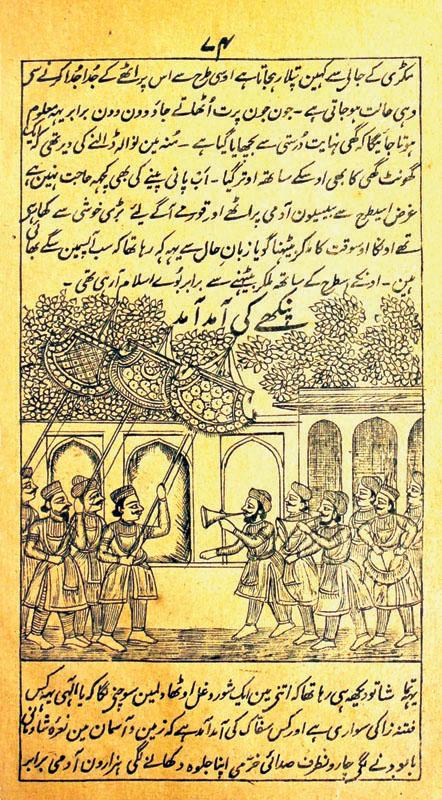
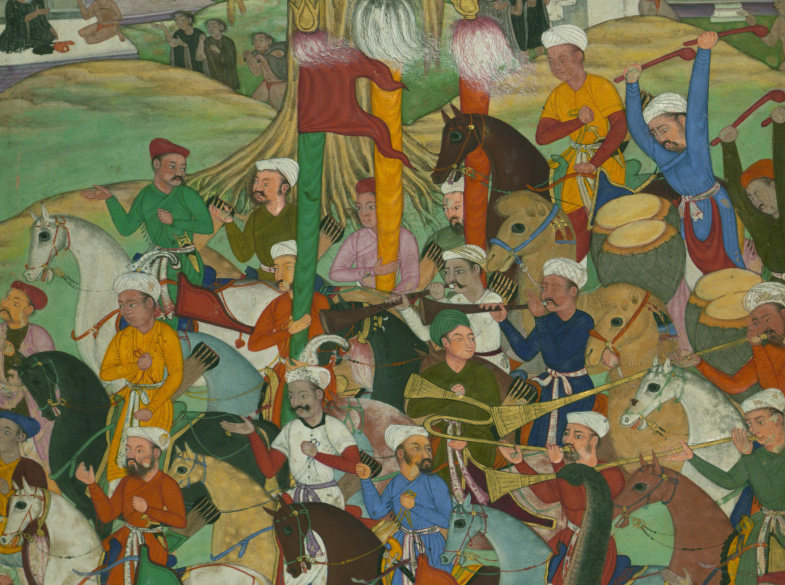
Procession with flower fans and musicians playing nafiri trumpets and drums. Illustration by an unknown artist in Mirza Hairat Dihlavi’s Phulwalon ki Sair, 1889.…
The earliest references to the processions can be found in the newsletters from the royal court for 1830. Akbar Shah and his entourage moved to Mehrauli in late July and instructed the flower-sellers to get the pankhas ready for the ceremony at Qutb ud-Din’s dargah. Every day, “His Majesty went to the jharnawith the ladies. He sat in the barahdari, enjoyed the view of the jharna and the bathing of the ladies. They sat on the swing and sang.” Akbar Shah also enjoyed sitting on the platform above the gate of his palace, from where he could watch the bustle of the bazaar and the performance of acrobats. It is from there that he watched the procession of the flower-sellers and the fair, for which numerous crowds of people had gathered.
…
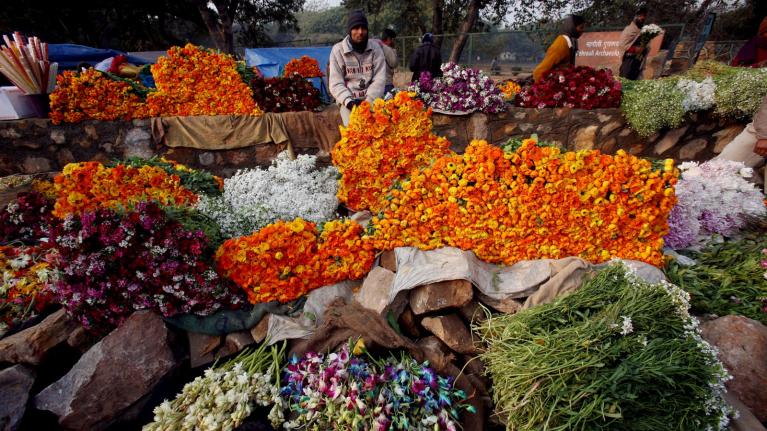
Fazl ud-Din described the traditional references to shringararasa, the clouds, the peacocks, and the koyals, the lushness of the hills and trees that had recovered their greenery, the flowers that burst into bloom, the mangoes and jamuns which were so abundant that they fell from the trees before people could pluck them. This revelry brought together the nobility and the common people, Fazl ud-Din pointed out, the rich and the poor, the owners of shops and the bazaris: no one was left behind in the empty city of Delhi. All the houses were decorated and the food was rich and plenty, while the rain continued to drizzle softly. The emotional experience was mediated through the senses of sight, of touch and of taste, but equally important were the sounds of the festival, the calling out of the shopkeepers, the songs of the ladies, and the musicians accompanying the processions, mainly nafiri trumpets, shahnais and a large variety of drums. Other texts also invoked the presence of an entire naubat, travelling on an open platform.
In Fazl ud-Din’s account, the emotions came to a culmination during the procession, which moved to the temple of Jogmaya on the first day and to the dargah of Qutb Sahib on the second day. The procession was led by the royal musketeers, followed by different professional groups. At the centre, right next to the elephants of the princes, were the flower-sellers and their pankhas, ornamented with a thousand flowers:
Look how packed the street is! People are falling over each other. A sweet drizzle is falling, and a cool wind is blowing. The bleating sound of the nafiris blares loudly. The pleasant forest and the crowd of people! In the evening the pankhas reach the royal palace with a lot of commotion.
…
By the beginning of the twentieth century, the tone of the writings changed. The new generation of authors no longer had a personal experience or even memory of the festival, even before it was discontinued after the first non-cooperation movement. In 1906, we find one Saiyid Bunyad Husain from Aligarh College, writing an article for the ladies’ magazine Khatun. He praised the Phulwalon ki sair as an extraordinary festival without equal, except perhaps for one festival, which takes place every year in Paris, but his knowledge is sketchy. He mused about possible origins of the festival: as it symbolised luxury and pleasure, ‘aish o ‘ishrat, he rules out the later Mughals, as theirs was a period of decline, and finally settled on Muhammad Shah as the probable initiator, as he was known for being inclined to sensual pleasures.
…
The festival at Mehrauli lost its specific anchoring in a time and place and became a symbol for a world that had been lost. The emotions that matter were no longer those of the participants in the procession and the revelries, but the communion of sentiment created between the author and his readers. This changed the tone.
…
A Symbol of National Unity
Nostalgia might have had a critical potential, but a nostalgia that was looking back to the last days of the Mughals and was geared towards a critique not only of colonialism but of modernity seemed increasingly out of tune, certainly with Jawaharlal Nehru’s vision of what independent India would stand for. And still, it was Nehru who in 1961 suggested the revival of the festival, which had been stopped in 1921. He called together a group of influential citizens and public figures from Delhi, who inaugurated the first festival after independence in 1962. What had changed?
The beginning of the 1960s was the period when the new nation increasingly faced the challenges of poverty, internal disruptions and conflicts, between religious communities but also between language groups and states. In this situation “emotional integration,” a felicitous phrase created by Nehru, became the rallying cry:
Political integration has already taken place to some extent, but what I am after is something much deeper than that—an emotional integration of the Indian people, so that we might be welded into one, and made into one strong national unit, maintaining at the same time all our wonderful diversity.
As a festival that was jointly celebrated by Hindus and Muslims, which had already been read as a symbol of Delhi’s tolerance and cosmopolitanism, the Phulwalon ki sair offered vast symbolic potential, and has been patronised by almost all prime ministers since Nehru. Many are the presidents of the republic who have come to deliver speeches at its inaugural function or at least sent messages of support, while the administrative elite of Delhi has always been involved in the planning of the festival and many have participated in some function or other during its three days.
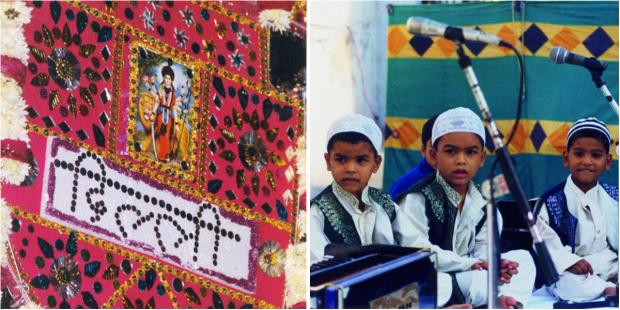
Left: A flower fan carried in the Phulwalon ki sair. Right: Children of qawwals at Quutb Sahib.
The festival, especially during its heyday in the nineteenth century, was an intensive experience for those who participated, involving all the senses at the same time. The eyes saw the beauty of the blossoms and the greenery of the forest, the alluring sight of the ladies and courtesans displaying their fineries and frolicking around the jharnaand the lakes, the decoration of the bazaars, the lights in the evening and the fireworks. The ears heard the calls of the birds associated with the monsoon, the koyal and the peacock foremost among them, but also the songs of the ladies, the blaring of the nafiris and the resounding drums. The skin felt the relief of the cooling drizzle of rain, the embrace of the beloved, the closeness of other bodies during the procession; the tongue relished the abundance of mangoes and the delicacies prepared in the bazaar; the nose took in the smell of rain on the scorched earth, the perfume of the flowers, and the aroma of the food.
…
Looking at the procession over a time span of almost two hundred years also brings out the close relation of emotions and politics—even in this case, which at first sight involved nothing more than coming together to enjoy the rainy season. The Phulwalon ki sairalways was (also) a political statement, though these of course changed through time.
The memoir inaugurates a subgenre as there are hardly any platforms where the Indian Muslim experience has been articulated as clearly as it has been in this book.
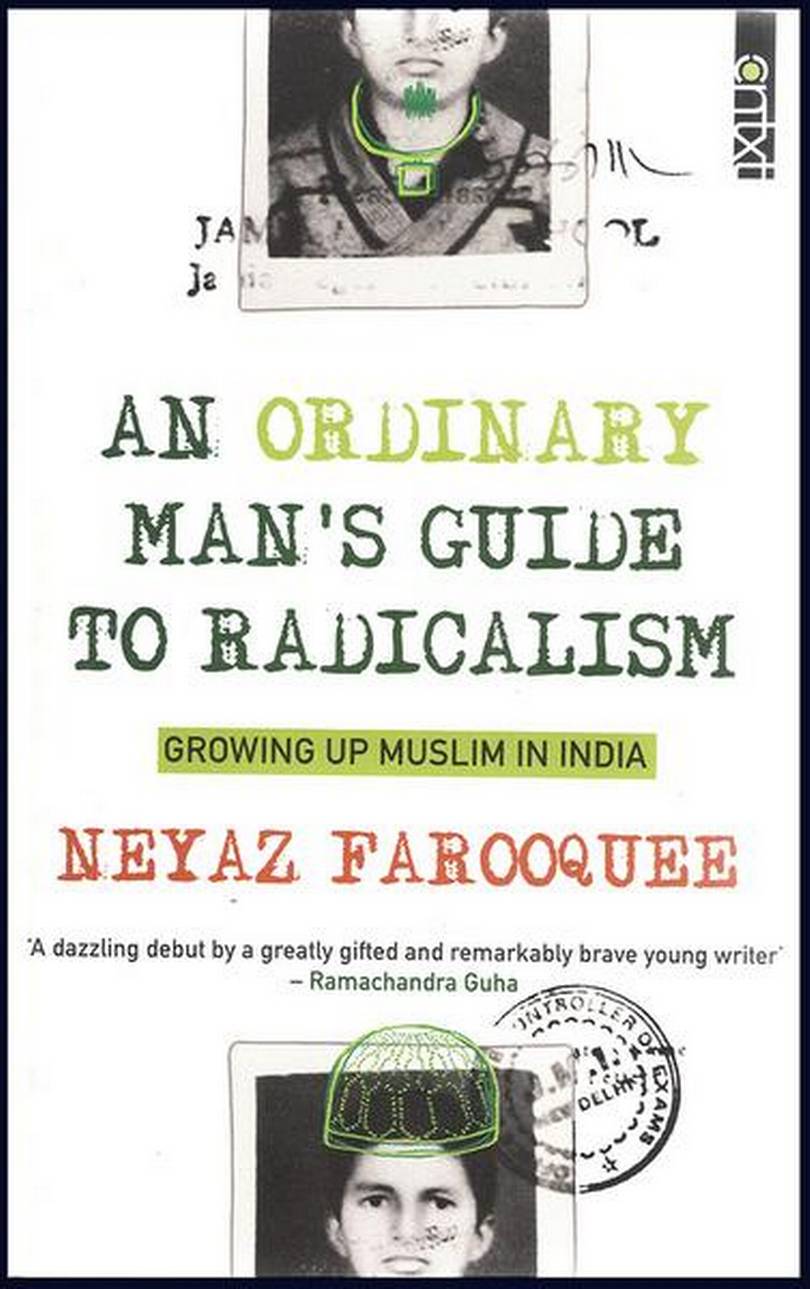
ON September 19, 2008, an encounter took place at Batla House, a building in the Muslim-dominated locality of Jamia Nagar in Delhi. In what has come to be known as the “Batla House Encounter”, Delhi Police shot dead two individuals who they alleged belonged to a terrorist outfit. Some civil society activists pointed out that there were flaws in the police’s narrative, leading to allegations that the encounter was staged. This is the event that ties up Neyaz Farooquee’s easy-to-read memoir on growing up Muslim in India. Farooquee was at the time a student of Jamia Millia Islamia and lived close to Batla House. His tryst with his Muslim identity in the wake of the encounter forms the backdrop of the book.
There is no nuanced way to say this, but it is not easy to be Muslim in India. Anti-Muslim prejudice runs deep in Indian society and manifests itself in a variety of ways. In its gentlest form, the Indian Muslim may be casually called “Pakistani” in the most rarefied of spaces, leaving him to cringe silently because of this unfair association with a neighbouring country. In its most savage form, anti-Muslim bigotry leads to horrendous and usually one-sided communal violence with state sanction that leaves Muslims feeling scarred, besieged and vulnerable. In between, there are various degrees of bias and hate that Indian Muslims face on a daily basis all over the country.
In the imagination of early Hindutva ideologues, Muslims are permanent fifth columnists who could never be truly Indian. Going by this credo, the Indian Muslim can be and is held guilty of events across time and space. A Muslim in Bengaluru in 2018 is often held guilty for M.A. Jinnah’s demand for Pakistan, and its eventual formation in 1947, as well as the supposed excesses of Muslim rulers of medieval India.
In the same way, lazy bigotry would also hold him accountable for a violent terrorist attack that takes place halfway across the world. Since the Narendra Modi-led National Democratic Alliance government came to power in 2014, anti-Muslim sentiment has exploded in India and has been institutionalised to a great extent, with prejudicial sentiments being expressed brazenly. A hateful statement (say, by a senior leader of the Bharatiya Janata Party like Anant Kumar Hegde that Islam must be effaced from the earth) that would have earlier caused an uproar only causes a grumpy murmur in Indian society now.
Surprisingly, there is little literature on this theme by Indian Muslims, even though it informs their existence tremendously. Dalits, who are another marginalised segment of Indian society, have a far richer corpus of literature on the experience of leading a discriminated existence. So, what is the responsibility of journalists and writers in such a scenario? As chroniclers of society, they have a certain obligation of writing about the Indian Muslim experience, considering that Muslims are the largest religious minority in India with a population of more than 170 million (according to the 2011 Census).
Farooquee’s memoir is novel in the sense that it inaugurates a subgenre as there are hardly any platforms where the Indian Muslim experience has been articulated as clearly and candidly as it has been in this book. Twin narratives chug the story along. One tells the tale of Farooquee’s early life growing up in a village in Bihar and his journey and life in Delhi, while a second narrative tells the story of his life after the Batla House encounter. Farooquee came to Delhi as a child and enrolled in a school. The book describes how he grew up away from his parents in Jamia Nagar in Delhi and eventually found his feet in the Muslim ghetto. His parents hoped that he would become an Indian Administrative Service officer, but he ended up becoming a journalist. His relationship with his grandfather and his secular world view are described in touching detail. It is heartbreaking to read about Farooquee’s anxiety after the Batla House encounter and of how his life changed, considering the general Indian Muslim distrust of investigating agencies. The murkiness of information about the encounter in the public domain and the contradictory reportage of a media quick to make slapdash conclusions are also dealt with in some detail in the book.
At one point, Farooquee writes: “Jamia Nagar creates a jumble of names, faces and identities, and possibly faulty memories. That memory could be yours, or someone else’s, and if that someone else is, let’s say, a Terror Suspect disguised as a Normal Human Being, you have no idea how is memory is going to behave. It was an alarming thought and it made everyone untrustworthy. Friends, close friends, acquaintances, strangers, everyone.” At another point, he writes about how something as innocuous as travel bags caused him consternation: “The reports also said the Terrorists had many travel bags in their flat, suggesting that they sheltered Terrorist-friends from out of town and were themselves given to travelling to different cities in India to plant bombs. It was as if none of these reporters had lived the life of a middle-class Indian student. My own bag served as a cupboard. Often, there were other bags lying around, from when friends, relatives and acquaintances stayed over—a free dormitory.”
A pall of restrained melancholia hangs over the story, and one feels that the narrative may erupt into something more violent—there is a gory retelling of the brutal killing of an uncle in the Bombay riots of 1992-93—but Farooquee’s story is not about the physical violence of the state but about what it does to the mind. The experience of an Indian Muslim and his constant state of vulnerability is what the memoir is all about. There is some stodginess with which the author articulates this, but that is a matter of style. There is also a lot of trite information which makes one feel that the story could have been told in the form of a long essay rather than a book. Nonetheless, Farooquee writes on an important theme, and hopefully, memoirs with richer stories on what it means to be an Indian Muslim will follow this account.
source: http://www.frontline.in / Frontline / Home> Books / by Vikhar Ahmed Sayeed / Print edition: August 17th, 2018
Many Indian dishes can be traced back, indirectly, to a 16th-century, food-obsessed ruler named Babur.
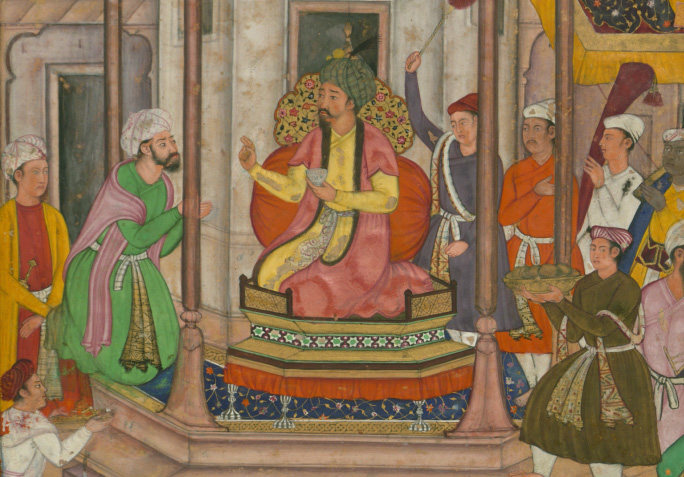
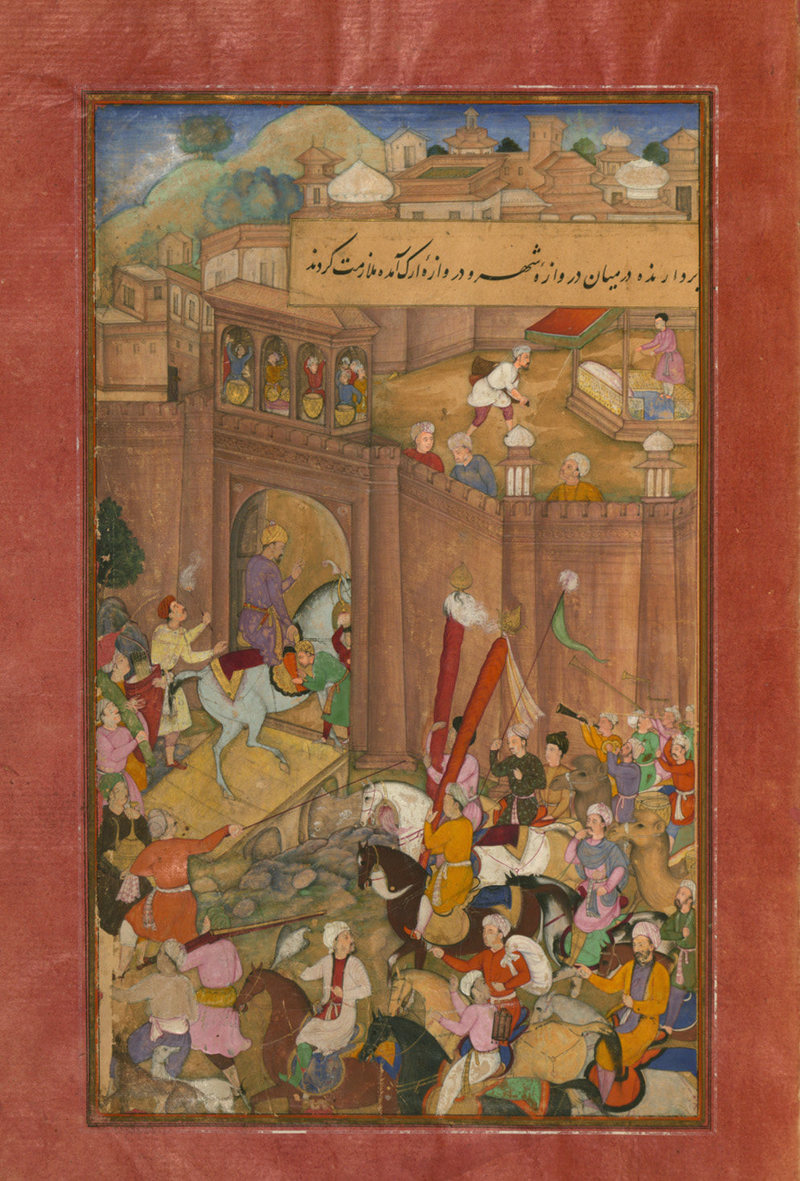
Babur Being Entertained in Ghazni, from the Baburnama, the memoirs of Ẓahīr al-din Muhammad. PUBLIC DOMAIN
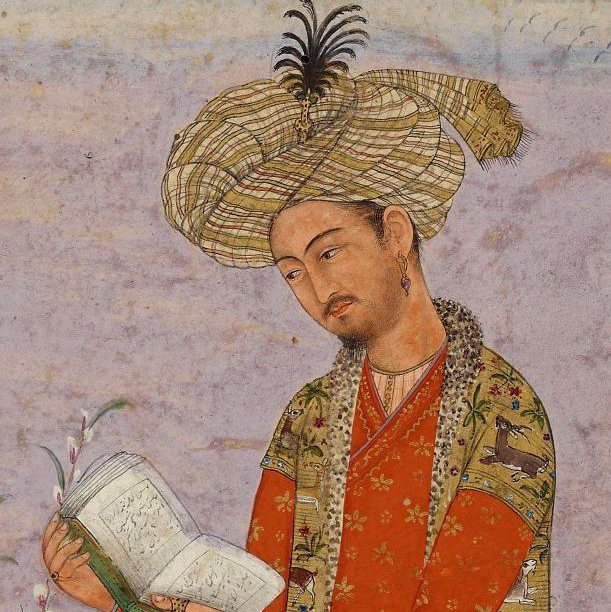
ZAHIR AL-DIN MUHAMMAD, THE 16TH century Central Asian prince better known as Babur, is renowned for his fierce pedigree and proclivities. Descended from both Timur and Genghis Khan, he used military genius to overcome strife and exile, conquer northern India, and found the Moghul dynasty, which endured for over 300 years. He was a warlord who built towers of his enemies’ skulls on at least four occasions. Yet he was also a cultured man who wrote tomes on law and Sufi philosophy, collections of poetry, and a shockingly honest memoir, the Baburnama, in which he appears to us as one of the most complex and human figures of the early modern era.
Through the Baburnama, we learn that Babur was versed in courtly Persian speech and custom, yet nonetheless a populist who built strong ties with nomads and championed the vernacular Chagatai Turkic tongue in the arts. He was a pious man, but was also given to libertine escapades, including massive, wine-fueled parties.
But the first—and arguably one of the most culturally consequential—personal details he reveals is that he was a food snob. Babur loved the foods of his homeland and hated those he found when he had to reestablish himself in India, which to him was mostly a way station on the bloody road back to the melon patches of his youth. He didn’t just whinge about missing foods from home, though. He imported and glorified them in his new kingdom, laying the groundwork for his descendants to warp Indian cuisine so profoundly that they redefined that culinary tradition, as many know it worldwide, to this day.
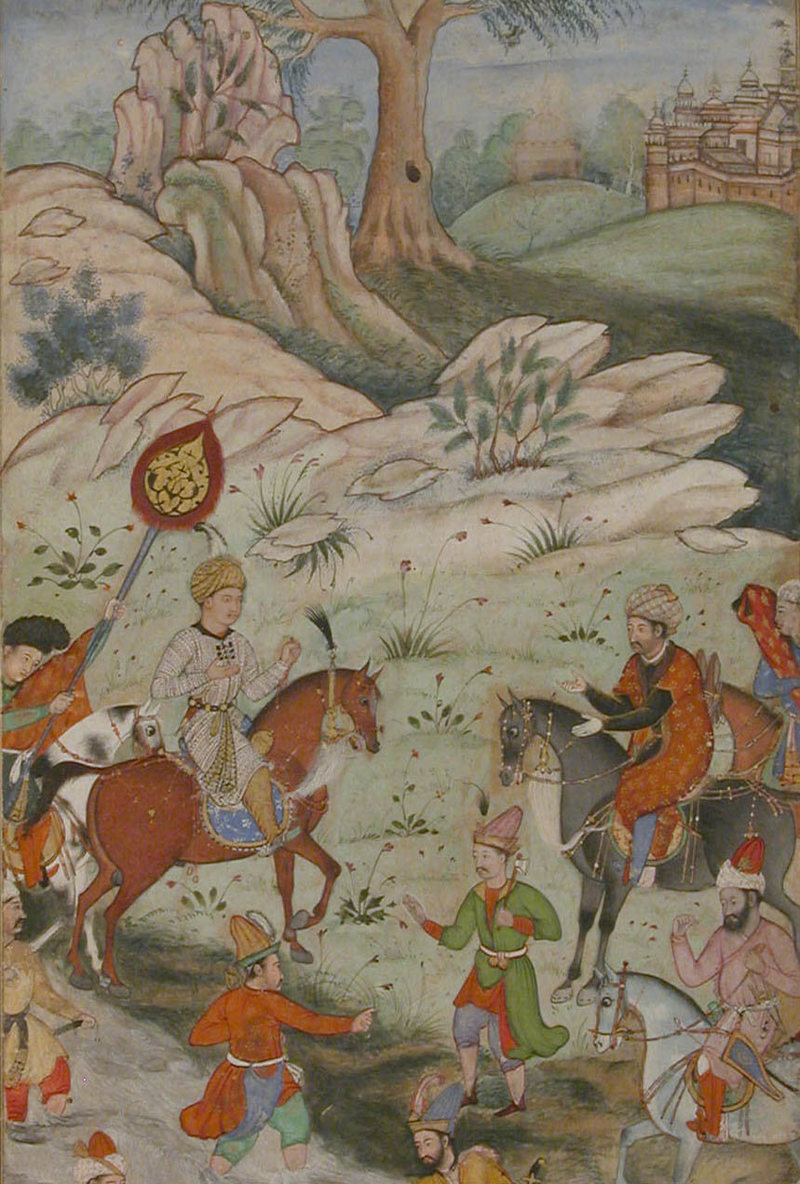
A depiction of Babur meeting Sultan ‘Ali Mirza near Samarqand, from the Baburnama. PUBLIC DOMAIN
The Baburnama opens with a description of Ferghana, a region now split between Kyrgyzstan, Tajikistan, and Uzbekistan, where Babur grew up. Known then and now as the breadbasket of Central Asia, it follows that Babur would touch on agriculture. But in introducing his hometown of Andijan, Babur opens with a note on the quality of its grapes and melons before turning his attention to its layout and fortifications. He then ducks back to praise its game meats, especially its pheasants, which “are so fat, that the report goes that four persons may dine on the broth of one of them and not be able to finish it.” Only then does he tell us of the people who live there.
Almost anytime he describes a place back home, he starts with vittles. Margilan is known for its dried apricots, pitted and stuffed with almonds. Khojand’s pomegranates are proverbially good, but they pale next to Margilan’s. And Kandbadam is tiny and insignificant, but it grows the best almonds in the region, so it’s worth mentioning.
“Early sections of his Baburnama,” writes Fabrizio Foschini, in a report on Afghanistani melons authored in 2011, “really sound like a consumer guide to the fruit markets of Central Asia.”
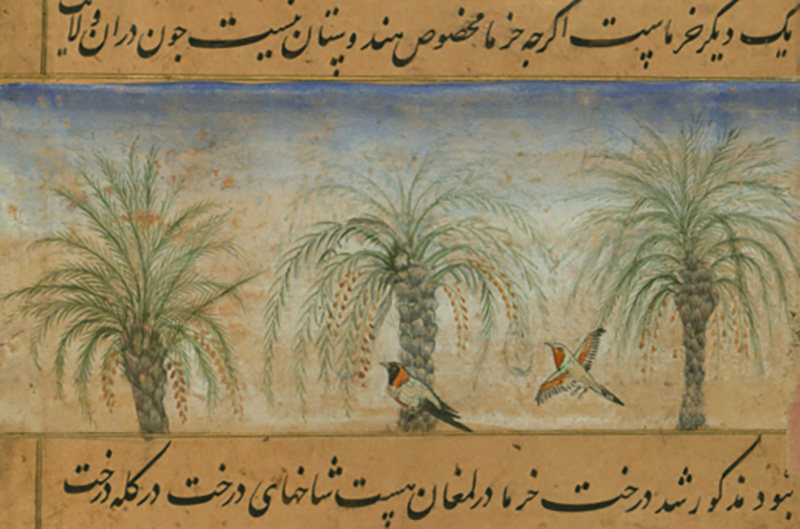
A detail of date trees illustrated in the Baburnama. PUBLIC DOMAIN
Babur doesn’t forget food once he gets into the meaty war stories, either. He breaks one narrative to note that the area around a castle he just besieged grew a unique melon with puckered yellow skin, apple-like seeds, and pulp as thick as four fingers.
The Baburnama is not solely concerned with food. The bulk of it is a painstaking record of families and feuds, and Babur dwells on other seemingly random details that tickled him, such as a courtier’s talent at leapfrog. Since we don’t have a similarly honest accounting from his peers, it’s hard to say whether Babur’s epicureanism was atypical.
Given the chaos he grew up in, though, it’s incredible that Babur could spare any thought for food. Thrust to power at age 11 (by the Gregorian calendar), in 1494, he had to navigate bloody infighting amongst his relatives. Known as the Timurid princes after their conqueror-ancestor Timur, they jockeyed against each other for regional control. Babur became an active participant in this Central Asian game of thrones—he seemed particularly obsessed with taking the regional cultural capital of Samarkand. While he seized it in 1497, he lost the city almost immediately, as well as Ferghana, and (a very long story short) spent the rest of his teenage years reclaiming or losing bits of territory, fleeing into exile with remote nomadic tribes, and trying to court new followers and surge back. Although he never stopped trying to reclaim Samarkand and his homeland, by 1504, at age 21, he’d effectively been forced out of the region for the rest of his life.
A portrait of Babur. PUBLIC DOMAIN
That year, he pulled off a fantastic feat of warlord jiujitsu, flipping a rival’s forces into his service and marching on Kabul, which was vulnerable after undergoing its own contentious power shift. Babur took the city, and, naturally, set to cultivating its produce scene. In and around the city, he built at least 10 grand gardens that included a fair number of fruiting plants.
While Babur’s writings suggest a personal obsession with food, it’s hard to disentangle this obsession from homesickness. There were also political reasons for him to pay so much attention to cuisine: Food snobbery was a standard way for a Timurid prince such as Babur to make his mark and prove his elite bona fides in a new land. “The Timurids, while ethnically Turkic, based their legitimacy to a large extent on their being champions of Persianate ‘high’ culture,” says Central Asian historian Richard Foltz, “which included taste in food.”
Kabul proved ill endowed to support a successful campaign back to Ferghana, though. So Babur turned his attention to neighboring India. He got a lucky break when a new king—an inept man who clearly had dissenters and rebels in his ranks—came to power in the northern Sultanate of Delhi. Babur struck at this weakness, invading the region through the early 1520s. Despite being outmanned by a ratio of perhaps five-to-one in his final standoff with the sultan, he usurped the throne in 1526.
Babur entering Kabul. PUBLIC DOMAIN
According to Foltz, Central Asians mostly looked down on Indians, who were neither Muslims nor Persianate. Babur, his recent biographer Stephen Dale notes, was also still deeply homesick. These factors, and possibly personal tastes, led him to dismiss his new territory, and especially its food: “Hindustan is a country that has few pleasures to recommend it. … [There is] no good flesh, no grapes or muskmelons, no good fruits, no ice or cold water, no good bread or food in their bazaars.”
Babur shouldn’t have had time for food in India either. He spent the last four years of his life fighting local insurgencies and consolidating his power. In 1530, he died at the age of 48, in Agra, the north Indian city where his great-great grandson Shah Jahan (lived 1592–1666) would later build the Taj Mahal. But he wrote letters in those years expressing his desire to return home, or at least taste its grapes and melons. He describes receiving a melon from Kabul and weeping as he ate it. He planted Central Asian grapes and melons in India, which brought him some joy. He even asked local chefs to make Persianate food for him, although one of them tried to poison him.
By establishing supply chains that brought his native agriculture and cuisine to the region, Babur left a lasting legacy. “He probably played a role in bringing Central Asian influences into the elite, courtly Indian life,” says Elizabeth Collingham, a food historian who explored Babur’s life and influence in her history of curries .
Babur, on the Way to Hindustan, Camping at Jam, from the Baburnama. PUBLIC DOMAIN
Granted, Babur was not the first Central Asian lord in what is now India. From 1206 to Babur’s day, five prior Central Asian dynasties ruled from Delhi. They too imported foods from home, cooked dishes they knew, and even did some fusion cooking. Trade and migration also meant there’d always been interplay between the regions, including culinary influence. Glimpses of this cultural mingling include the first mentions of samosas in the region’s written record—in accounts of those earlier medieval sultans’ feasts.
But according to Rukhsana Iftikhar, a historian of social life amongst the Mughals, the Persian word for “Mongols” by which Babur’s descendants came to be known, many of these dishes differed in style and flavor profile from the Persian-influenced Central Asian cuisine Babur preferred. They likely had not caught on with the general Indian population by the time Babur arrived, and few of them would sound familiar to fans of global Indian fare today.
Historians like Dale and Foltz chalk this up to the fact that previous dynasties—while they had some cultural influence—seemed to see India mostly as a piggy bank. They didn’t like to mix with local elites, and their culture was not grand or stable enough to invite mimicry and adaptation.
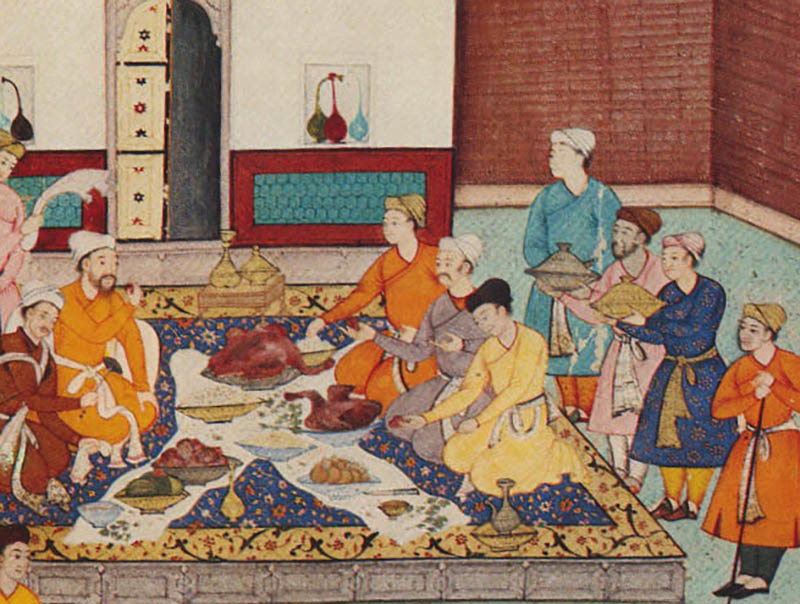
A banquet with roast goose. PUBLIC DOMAIN
Babur, by contrast, was more statesman than raider. His pedigree and strong connections to Iran also gave him and his descendants more cultural cachet, and those descendants mixed more readily with the local populace. And for over a century after his death, Mughal rulers continued to praise the same foods Babur praised and keep the caravans of his beloved Central Asian fruits and nuts flowing. Babur’s successor Humayun brought Persian cooks to Delhi, and Humayun’s son, Akbar, was notably cosmopolitan and curious in the kitchen. Later descendents were not as invested in Persianate culture and the foods of Ferghana as Babur. But either as a means of displaying their wealth or of brandishing the superiority of their heritage, they carried on the culinary trajectory Babur set up.
Babur’s descendants also spent lavishly on their kitchens, elevating food as a status symbol. But unlike Babur, they made it a point to round up chefs from around their Indian domains, a practice that invited fusion. The grandeur and duration of their courts, argues Collingham, led local elites to copy their Persianate and Central Asian motifs and augment their own kitchens, leading to parallel fusion work in places like Hyderabad, Kashmir, and Lucknow. Over the centuries, these innovations coalesced into Mughlai food, a stable cuisine common across, although not ubiquitous in, northern India by the early 20th century.
This cuisine was defined by, among other things, aromatic, creamy curries, often incorporating the nuts and dried fruits Babur adored. It includes many dishes familiar to Western diners today: Korma, a blend of Central Asian nuts and dairy with Persian and Indian spices. Rogan Josh, a slow-cooked, Persian-style meat spiced up in the kitchens of Kashmir. And tandoori grilling, facilitated by Mughal tweaks to said grills and to marinades and spicing styles.
These dishes became ubiquitous in the West, Collingham says, because haute Indian chefs have long viewed Mughlai cooking the same way Western cooks used to see Le Cordon Bleu. Indians who set up restaurants abroad made Mughlai food the template of Indian food in the U.S. and U.K.—to the chagrin of Indians who grew up eating many other cuisines that remain hard to find outside their homelands.
None of this was a conscious project for Babur. But by setting up shop in Agra and Delhi, he created a wave that shook the foundations of India, culinary and otherwise. His tastes indirectly fueled 300-plus years of kitchen innovation. It’s no Central Asian dynasty of skulls and melons. It’s something more widespread and enduring, if unexpected or unwanted.
Gastro Obscura covers the world’s most wondrous food and drink.
source: http://www.atlasobscura.com / Atlas Obscura / Home> Stories / by Mark Hay / November 15th, 2017
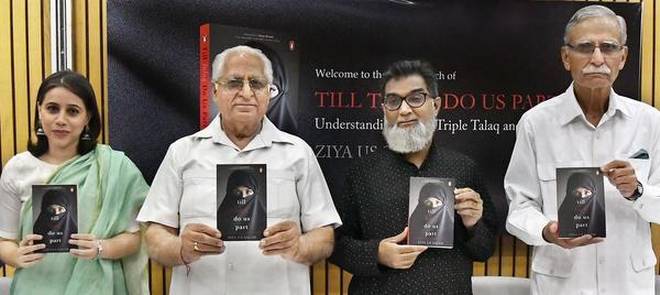
FOR A FAIR CONTRACT At the discussion that followed the book release, the panellists (from left) journalist Marya Shakil, lawyer J.C. Batra, author Ziya Us Salam and Lt. Gen. (Retd.) Zameeruddin Shah) discussed women’s rights in Islam
Ziya Us Salam’s “Till Talaq Do Us Part” defogs the miasma around the issue of instant triple talaq
Triple talaq is a phrase that the citizens of India became acutely aware of post the events of 2017, when seven women petitioners moved the Supreme Court against their instant divorce brought about through the uttering of the words ‘talaq, talaq, talaq.’ The apex Court had, on August 22, ruled that instant triple talaq was a practice not sanctioned in the Quran, yet a fog of confusion and obfuscation surrounds the general discourse and public understanding of what exactly constitutes an Islamic divorce. In this context, Till Talaq Do Us Part (Penguin Random House) by senior journalist Ziya Us Salam is a book that acquires much significance as it tries to brush the dust away and bring clarity to the issue by reverting to the most authentic source for Islamic knowledge — the Quran.
Released this past evening at the India International Centre by Lt. Gen. (Retd.) Zamiruddin Shah, the book defines nine types of divorce interpreted from Quranic verses.
Among them some of the most important ones are Khula, the inalienable right of the woman to instantly divorce her husband on the grounds of his inability to take care of her needs or even simply her dislike for him; Talaq e Ehsan where the man pronounces divorce once but the woman lives with him for the next three months, after which he can divorce her or they can reconcile; Talaq e Hasan where the man pronounces divorce three times in three months, but only in the interim periods of menstrual cycles; Mubarat which takes place through mutual consent, Faskh or judicial divorce; Talaq e Tafweez which is incorporated into the Nikahnama wherein the husband vests the rights of divorce in his wife.
Lack of information
“In the present scenario within the country, the right information on Islam was not reaching the masses,” says Salam. Which is why he decided to write this book that talks about numerous aspects of marriage including the model nikahnama that the AIMPLB spoke of circulating but never quite got down to the task. He also speaks of the importance of meher, the dower paid by the man to the woman at the time of marriage, and how it is entirely neglected among Muslims in India. The meher must be paid either in full to the woman at the time of nikah, or in part with the husband giving a written undertaking that he would pay the rest in future, he emphasises. “One of the most important things is to have one regular nikahnama for all Muslims — at the most two, one for Sunnis and the other for Shias — but ideally, just one.”
Understanding halala
The book also deals with the highly controversial issue of halala, which in truth has been contorted and disfigured heavily into an abhorrent act of female exploitation. Halala, explains Salam, actually gives a woman the right to choose.
If perchance a woman’s second husband either passes away or the second marriage too results in divorce, she has the right to go back and choose her first husband again. However, with the entirely invalid and un-Quranic practice of triple talaq, instant divorces are carried out in a fit of anger and when the man comes to his senses and wishes to reconcile with the woman, they are forced into a monstrous distortion of Halala. When triple talaq gets pushed out of the scene, the question of a one-night halala would not arise at all.
Several scholars state that triple talaq was made legal by Umar Ibn Khattab, the second Caliph in Islamic history. “The important fact which is overlooked, though, is that it was made legal upon the condition that the man giving triple talaq would be flogged,” he highlights. “So why do the maulanas forget to flog the men giving triple talaq?”
A very important point here is that instant triple talaq did not exist at the time of Prophet Mohammad at all, nor the time of the first Caliph. Equally pertinently, it was later made entirely invalid and illegal by Ali Ibn Abi Talib, the fourth Caliph of Islam.
Many Islamic countries have made the instant talaq illegal and it is non-existent among the Shia sect. In fact it is illegal in all other sects except the Hanafis, but as the author writes in his book, “there is no direct word from Imam Hanifa on triple talaq.”
But social structures are rigid and herd tendencies difficult to change, which is why the Supreme Court judgement against instant triple talaq cannot be enough, just as dowry and caste system still exist despite being grossly unconstitutional. In addition, the maulanas whom the masses look to for religious guidance are ill-equipped for the task, caught as they are between rote-recitation and following customs without an attempt at understanding. “Across the country, a vast number of Imams don’t even know (the meaning of) what they have read in namaz!” avers Salam. “They prevent women from coming to mosques but at the Kaaba in Mecca, women and men pray together, perform Hajj together. There is no restriction at all upon women praying in mosques.”
The important task, then, is for the community to be educated and made aware of their rights, for people to read translations of the Quran and develop a deeper understanding. One may pick any translation and exegesis among the many reputed ones, but the most important thing is to explore. In addition, the men must be made aware of the rights of women as much as the women themselves. As Salam says, “We have reduced the understanding of the Quran to the monopoly of some aalim. But the Quran came for all of humanity, not a select group of scholars.”
source: http://www.thehindu.com / The Hindu / Home> Books> Authors / by Zehra Naqvi / May 03rd, 2018
The legendary singer extended his vocal range to foreign languages whenever he got the opportunity.
Mohammed Rafi | Sujata Dev
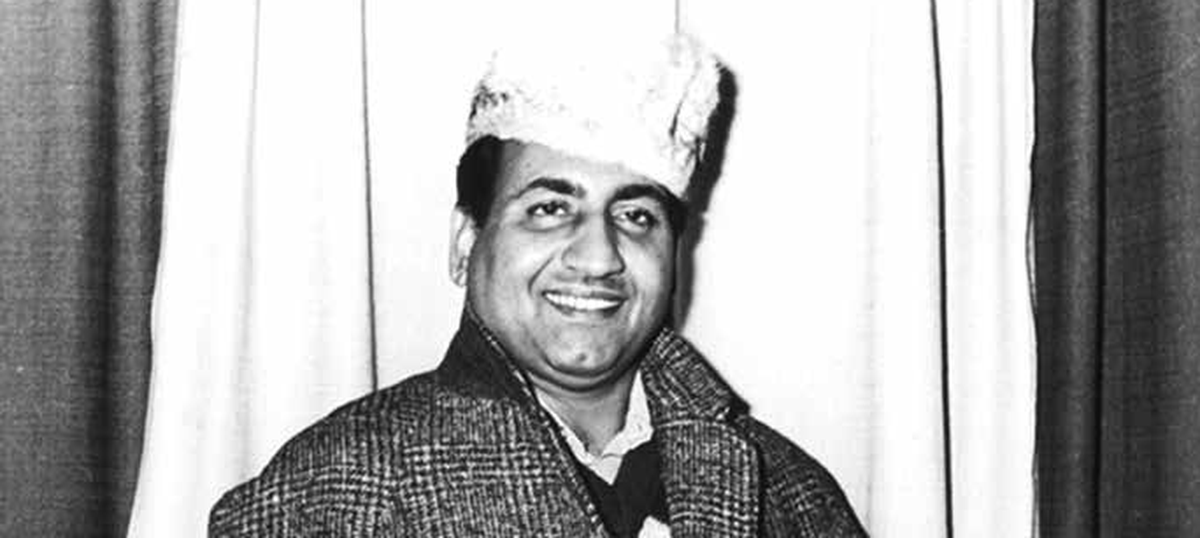
Mohammed Rafi’s first break as a singer came in 1942, when he sang the duet Goriye ni Heeriye ni with Zeenat Begum for composer Shyam Sunder in the Punjabi film Gul Baloch (1944). Since then, he sang an estimated 4,500-5,000 songs in 14 Indian languages and four foreign languages until his death on July 31, 1980.
Not a bad feat at all for a singer who struggled with even English. In the biography Mohammed Rafi: Golden Voice of the Silver Screen, Sujata Dev writes about how the unlettered singer would politely turn down requests for autographs as his fame grew. “He began practising his signature diligently and when Ammi (mother) enquired why he was wasting reams of paper, he told her that he did not want to deprive his fans and so was learning to sign his name in English,” Rafi’s son, Shahid, told Dev. “Soon he began signing autographs in English and enjoyed doing so. It came as a great compliment for all his efforts when a journalist mentioned that he had the best signature in the industry.”
Rafi was born on December 24, 1924, in Kotla, a village near Amritsar. Singing in English became one of his greatest triumphs, especially since the language was a stumbling block throughout his life. When music composers Shankar-Jaikishen approached him to sing English numbers for a non-film music album in 1968, the singer was hesitant. Maverick actor-writer Harindranath Chattopadhyay , an ardent fan of the singer, wrote the lyrics. He convinced Rafi to take up the assignment, helping the singer perfect his diction for the recording. The two songs were Although we hail from different lands, based on the same composition as Baharon phool barsao (Suraj, 1966), and The she I love, based on the composition Hum kaale hain toh kya hua (Gumnaam, 1965).
Rafi’s English songs pale in comparison to the command he had over Hindi songs but never one to back down, he made a valiant effort to overcome his fears and grasp his limitations as a singer. It also gave him the courage to test his vocals in other foreign languages such as Dutch, Creole and Persian.
In this clip, Rafi sings in Creole, the local language of Mauritius, when he toured the country in the 1960s. He sings Mo le coeur toujours soif zot l’amour camarade (My heart will always be thirsty for your love, my friends), based on the tune of Ehsaan mere dil pe tumhara hai doston(Gaban, 1966).
‘Mo le coeur toujours soif zot l’amour camarade’.
This video clip shows Rafi performing at a concert in Dutch. He sings Ik zal jou nooit vergeten al zal ik in India zijn (I will never forget you, although I will be in India). The music is by Shankar-Jaikishen from the composition Baharon phool barsao, which remains immensely popular among Rafi fans.
https://www.youtube.com/watch?v=vz2piQTmraY
‘Ik zal jou nooit vergeten al zal ik in India zijn’.
For the Persian track Aye Taaza Gul (O fresh flower), Rafi collaborated with Afghani singer Zheela.
‘Aye Taaza Gul’.
In Mohammed Rafi: Golden Voice of the Silver Screen, Sujata Dev writes, “Kersi Lord, the multi-faceted musician had a long association with Rafi. He also happened to be the singer’s next door neighbour. ‘I remember once an Iranian couple had come to India and they wanted Rafi Sahab to sing an Iranian song. He called me home to play the synthesizer as he sang the song, with a fluency that made it seem as if it was his own mother tongue. The couple was left spellbound.”
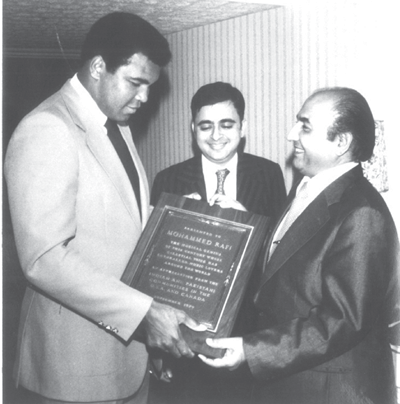
Boxer Muhammad Ali felicitates Rafi in Chicago during one of his tours. Courtesy Sujata Dev’s ‘Mohammed Rafi’.
source: http://www.scroll.in / The Scroll / Home> The Reel> Tribute / by Manish Gaekwad / July 31st, 2016
Maulvi Barkatullah Bhopali believed the spirit of Marx’s thought and divine religions was the same. “The objective of both is to provide a dignified and peaceful life to the oppressed.”
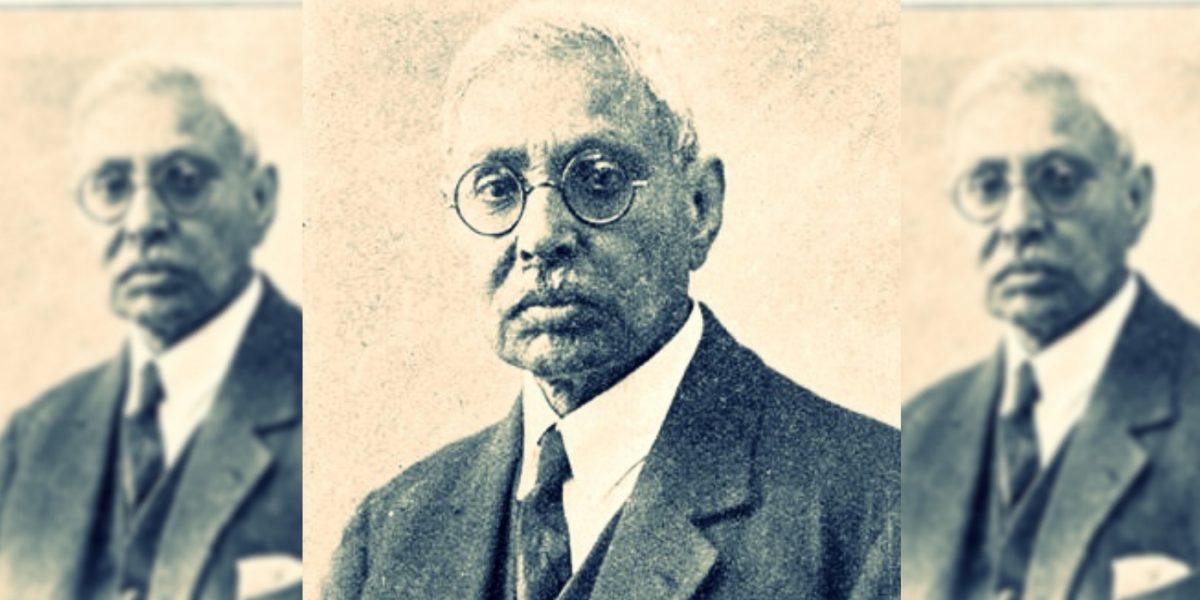
Maulvi Barkatullah Bhopali, who was born 164 years ago this month, was a glorious standard-bearer of the Indian independence movement. He toured Great Britain, Europe, Japan and America, in addition to the Soviet Union in connection with the struggle against British imperialism. He was among those few ulema who travelled to Moscow in May 1919, just a short period after the Bolshevik Revolution; he saw the conditions there with his own eyes, and met Lenin and other Bolshevik leaders. During his stay in Moscow, he said during an interview with the Izvestia newspaper:
“I am not a communist or a socialist, but right now my political program includes throwing the British out of Asia. I am a staunch enemy of European capitalism in Asia. Therefore, there is complete compromise between myself and the communists over these objectives and we are allies on this field. I do not know what shape the future events will take, but what I can definitely say is that the famous appeal of the Soviet government of Russia, in which the people of all nations have been requested to rise up and conduct jihad against capitalists, has greatly influenced us, and what we like more than that is that the Soviet Union has revealed all the secret agreements (between Russia and Great Britain) whose objective was to enslave other nations, especially the Eastern nations. Not only this, but the Soviet Union has unilaterally cancelled all such agreements. Russia accepts the principle of equality and evenness between all small and great nations. The ideas of the Bolsheviks, which we call socialism, are also making a place in the hearts of the common Indian people.”
In his book, Bolshevism and Islamic Nations, Maulvi Barkatullah writes, “The actual spirit of Marx’s thought and divine religions is the same. The objective of both is to provide a dignified and peaceful life to the oppressed, punished people of god by freeing them from cruelty and oppression.”
“The philosopher Plato has presented such a map of his ideal Republic in which ownership would be common and public. The provision of basic needs, sources of entertainment, opportunities for employment will be equal for all. Because of the progress of education, every individual of the nation will benefit from knowledge in a way that his every act will be reasonable and right. These are the basic principles on whose foundation Karl Marx presented the majestic structure, behind which was the knowledge and experience of many generations,” he continued.
Maulvi Barkatullah bemoans the fact that in his time, there is not even a single Muslim kingdom which can be called independent in a meaningful sense. He writes, “Today not even a single independent Muslim state remains because Muslim countries have been subdued at the hands of British imperialism and the dictatorial royal tsar, French or Italian colonialism in the 20th century. They are being fully exploited.”
But he is not hopeless with this situation. He says,
“There is no cause for hopelessness. After the dark night of the czar’s oppression and tyranny, the dawn of human freedom has arisen on the horizon of Russia in which Lenin is giving the good news of human prosperity, sprinkling the light of his ideas like the sun (sic). That grand scheme which was presented 2000 years before by the philosopher Plato, which was transferred as a great heritage from one generation to the other; today the principles and ideologies of this ideal republic are being given practical shape. Under the leadership of Lenin, this is being popularly accepted as a reality. Across the length and breadth of Russia and in Turkistan, the entire arrangement and administration has been given to workers, people employed in agriculture and ordinary soldiers. The equal rights of all classes and nations have been accepted, every individual has been guaranteed a better life.’
Maulvi Barkatullah not only completely supported the Bolshevik government of Russia, but appealed forcefully to the Russian people, especially the Muslims of the eastern region, to support the Soviet government wholeheartedly and array themselves against its enemies so that the successes of the revolution could be defended; and the intervention and conspiracies of the imperialists could be countered.
He says, “Now the time has come that the Muslims of the whole world and Asian nations obtain complete information about Russian socialism, understand those golden principles and accept them with full passion and sincerity. The noble and high objectives hidden in the foundation of this modern system demand that Muslims should completely support and defend it. They should unite with Bolshevik forces to make the aggression of British followers and other tyrant rulers unsuccessful; send their children to Russian schools without wasting time so that they can obtain modern science, high arts, practical physics, chemistry and mechanical technique.’
In her book, Haj to Utopia, Maia Ramnath writes that Barkatullah “single-handedly embodied the overlap between the Bolshevik and Pan-Islamist networks, utilising the connective tissue of the Ghadar infrastructure to do so. She cites a foreign office report of 1915 as saying: “It would appear that Barkatullah was a sort of connecting link between three different movements, namely, the Pan-Islamic, Asia for the Asiatics and the Indian Sedition”. A German diplomat wrote that he was “first in line a nationalist and then a Moslem”.
Maulvi Barkatullah’s was a warrior life. He passed away in San Francisco on September 20, 1927.
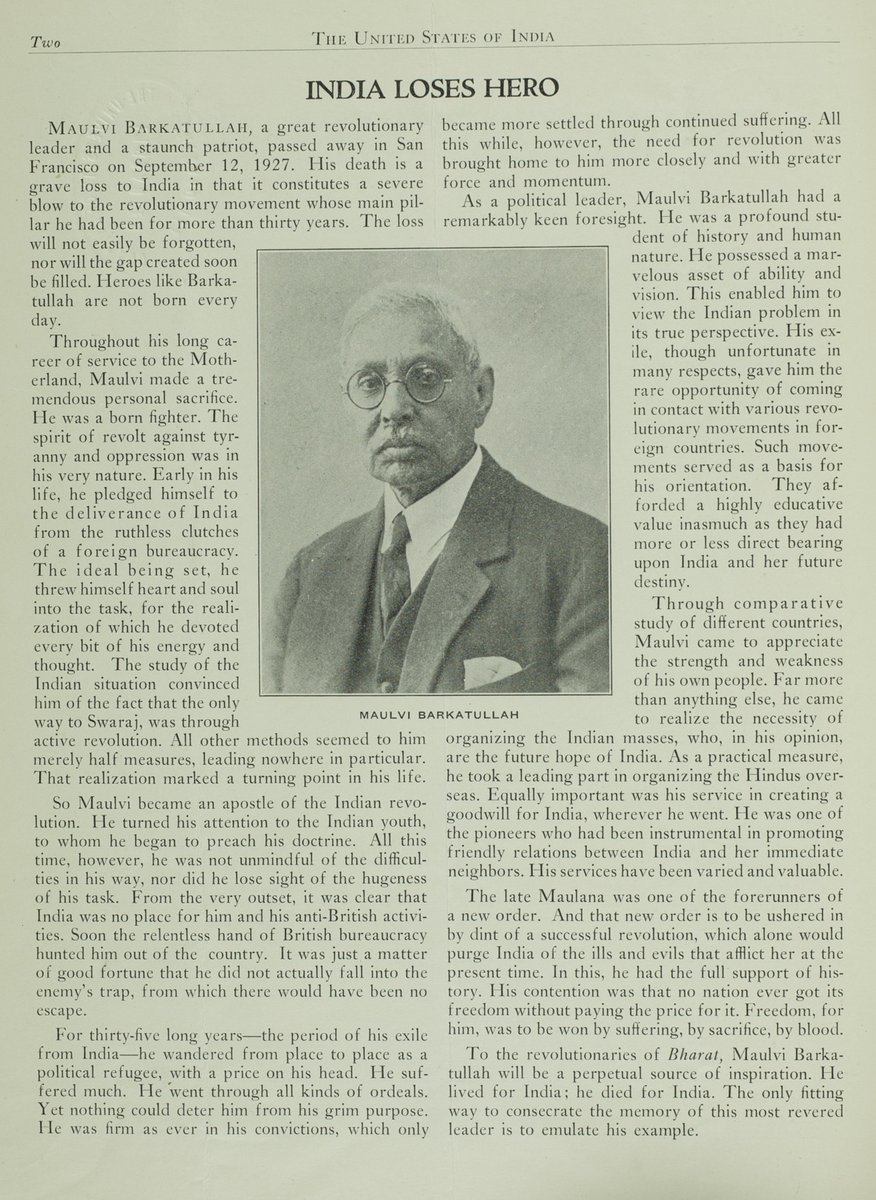
Tribute paid to Barkatullah in the United States of India, a publication of the Ghadar Party in the United States, in 1927. Credit: South Asian American Digital Archive
Barkatullah had been one of those who had backed the Ghadar uprising against the British during and after World War I. In a tribute to him after his death, published in the United States of India, a publication of the Ghadar Party in the US, the magazine wrote:
“To the revolutionaries of Bharat, Maulvi Barkatullah will be a perpetual source of inspiration. He lived for India; he died for India. The only fitting way to consecrate the memory of this most revered leader is to emulate his example.”
Raza Naeem is a Pakistani social scientist currently teaching in Lahore. He is also the president of the Progressive Writers Association in Lahore. His most recent work is an introduction to the reissued edition (HarperCollins India, 2016) of Abdullah Hussein’s classic novel The Weary Generations. He can be reached at: razanaeem@hotmail.com .
source: http://www.thewire.in / The Wire / Home> History / by Raza Naeem / July 15th, 2018
Dr Ali Khan Mahmudabad has come to be one of the world’s foremost voices on Muslim issues. His writing spans across publications and languages, from Huffington Post to The Indian Express, from Urdu to French. Outside of being a journalist, he teaches history and political science at Ashoka University and also advises think tanks on subjects such as politics, religion and security in South and West Asia.
In his new book The Making of North Indian Muslim Identity: Poetry, Politics, and Religion 1850–1950, he talks about the role of poetry in expressing identity, particularly what it meant to be both Muslim and Indian in a time of sociopolitical exigency. The book charts the rich history of the mushā‘irah (poetic symposium) and investigates changing notions of nationality and patriotism in that space. It offers new perspectives on how Muslim intellectuals, poets, political leaders, and journalists conceived of and expressed their relationship to India and to the trans-national Muslim community.
Mahmudabad spoke to Firstpost about the impact of literature and poetry on shaping political identity and the role of Muslim identity in Indian politics.
Why have you chosen to look at Muslim-Indian identity from the viewpoint of the mushā‘irah?
From its inception, Islam fostered a culture of ‘orality’. Poetry, of course, was and has been one of the most important ways in which Muslims have grappled with questions to do with religion, culture, politics, history not to forget love! This tradition of reciting poetry publicly and the prominence poets were accorded by society in general and elites in particular continued before and during the life of the Prophet and thus gradually poetry became interwoven and inextricably linked with many Islamic traditions beyond just the Arabic speaking world. The tradition of public poetry recitals was a prominent part of various other Muslim societies, notably Persian, though what sets the mushā‘irah apart is that it is, as is argued in the books, part of a distinctly Indo-Islamic heritage. In India, of course, there was already a long tradition of such gatherings such as the gosthi in Malyalam or the Kavigon in Bangla.
Ali Khan Mahmudabad’s new book is titled The Making of North Indian Muslim Identity: Poetry, Politics, and Religion 1850–1950
In India, political polarisation that began to crystallise in the 19th century largely revolved around religion and language. The so-called Urdu-Hindi language divide is perceived to have been one such intractable binary and there has been much academic work questioning this. The differences that did exist tended to focus on the script but with the mushā’irah, an oral space, the problem was script was of course absent. This combined with the fact that the main theme of ghazals was to do with absent beloveds meant that the mushā’irah was a cosmopolitan space that acted as a bridge between members of various communities. The importance of the mushā’irah was also underscored by the fact that the British also chose to patronise them and use them to try and catalyse new directions in Urdu poetry that dealt with the material and natural world. Despite this, of course, the power of the ghazal — the power of love — continued and to this day remains a unique feature of the mushā’irahs history. In the quest for locating and trying to understand what the ‘public sphere’ was composed of in the period before the creation of the Indian nation-state, the mushā’irah offers a window into how poets from a variety of backgrounds were grappling with rapidly changing social, political, cultural, economic, religious and even technological changes. Although not within the purview of this book, but part of my other research focuses on other spaces that have not been explored enough because our conception of what constitutes the public sphere derives mostly from European definitions. Thus spaces in and around shrines and temples, public religious processions and other institutions, both physical and more liminal, allow us to track the manner in which people were reacting to the tumultuous changes at the end of the 19th and beginning of the 20th century.
How do you think the Indian Muslim identity has evolved since 1950?
Rather than speaking of evolution, it is better to speak of changes. Of course in a country as large as India it is impossible to generalise. There are dozens of different schools of thought and sects beyond the lazy binary that people are prone to use of Shia and Sunni. However, it is safe to say that following the Constituent Assembly debates and in the decades following partition, questions to do with Muslims in the political sphere largely revolved around cultural, religious and linguistic rights and social (eg. caste), political and economic questions do not get as much attention.
Apart from this, the manner in which land reform was carried out, particularly in a place like Uttar Pradesh, meant that many institutions, like religious trusts, madrassas and charities amongst others looked elsewhere for patronage, often looking to the greater Middle East. More recently with market liberalisation, ease of travel and the rise of social media new questions have begun to arise about what it means to be authentically Muslim as Indians see how people in other parts of the Muslim world practice their religion. Indeed many of the identity problems that emerge in many parts of the world are precisely because the Mirpuri, Bengali or Bihari Muslim is forced to confront questions about his or her religious and cultural practice when they meet Arabs, North Africans, Turks, Iranians and others at the local mosque who do things a different way. A substantial number of Muslims from various parts of India have also now spent considerable time working in various parts of the Arabian Peninsula and this too has brought about interesting socio-cultural and religious changes although data is still hard to come by.
All these aspects have also had an impact on material culture. I think this has also sadly led to a number of misconceptions. For instance, a prominent columnist complained that she was seeing many more hijabs than she used. Of course, she saw this a sign of increasing religiosity but the truth is that a lot of these women who choose to wear the hijab are doing so and coming out to work rather than staying at home as might have been more common even a few decades ago. The hijab in a sense has been something that has facilitated this transition. This is just a small example but the point is that young Muslims are adapting to the times while also proudly being rooted in their religious identity.
Politically speaking, it was already clear pre-1947 that there is no such thing as a Muslim vote bank although this myth is still propagated by parties seeking to polarise or counter-polarise electorates and one thing that remains the same from, say, the 1937 election to now is that while voting Muslims take into account a huge range of local and regional factors and therefore do not vote solely on the basis of religious identity.
Do you think that literature and poetry still have the same effect in shaping sociopolitical identity?
Literature and poetry continue to have a very important role to play. Mushā’irahs are as important as ever and are held everywhere, from small towns in UP to Delhi and even Dallas and Dubai. Poets tend to be revered and although most literary critics and scholars would say that the quality and level of poetry has fallen drastically, the fact remains that poetry, in whatever form, still remains an important form of entertainment and even political resistance. The rise of literature festivals — like Rekhta — the popularity of Rana Safvi’s #shair and Javed Akhtar’s ‘Rediscover Poetry’ as a paid service for Tata Sky’s Television network are just some examples of how Urdu in particular remains curiously popular despite the number of official Urdu speakers in North India falling according to latest census figures.
Away from the internet and large metropolises, poets like Kumar Vishwas and Imran Pratapgarhi recite to audiences of thousands even in far removed and remote areas they are treated like rock stars. Some critics complain that the quality of this poetry leaves much to be desired but then again I think these poets are responding to changes taking place in society and are able to detect the pulse of the people which often means that it might not be high literature or refined poetry but nonetheless it reflects the tastes and mindsets of the audience. Literature in various Indian languages continues to be tremendously important and has a high readership across the country despite the fact that English is muscling out these languages because it has more utility in ‘aspirational’ India.
You explore the idea of hubb-e watanī in your book. In what ways did patriotism evolve under the purview of your book?
Well, it took a book to answer this question so you will have to read it! What I try and trace is how people’s sense of belonging and rootedness changed over a period of more than 100 years. So I start with the shahr ashob genre, literally the affliction or lament of the city, in Urdu as opposed to its Persian roots. Many poets following Nadir Shah and Ahmad Shah Abdali’s attacks on Delhi fled and articulated a sense of grief and longing for the loss of their homes. Of course, this was an elite response and was limited in its scope but what is interesting is that people used poetry to confront this trauma, as poets have for millennia. This displacement and loss continued into the 19th century and the trauma of 1857 was again grappled with through poetry.
Following the rise of the colonial government and its desire to ‘order’ society through census’, categorisation, knowledge creation etc and the influx of new ideas of what constituted the natural world, of nationhood and citizenship, people had to yet again grapple with an entirely new vocabulary. I would go so far as to say a new moral vocabulary was created to cope with these changes and this even affected something like poetry because the British tried to ‘reason’ that poets should give up their more ‘hedonistic’ symbols and concentrate on writing natural poetry. The nazm as a form of poetry really fully came about in this period of the last quarter of the 19th century. The importance of the local and regional remained but it is safe to say that there was something of a shift from imagining India in more metaphysical terms to articulating a more material conception. In a sense, I think this is where the problem began because it is much easier to differ about material identifiers than metaphysical ideas. People from various communities obviously had different ideas of the material markers that defined India. In addition to this, an understanding of ‘their’ history, which at the time was particularly influenced by what the British and others came to define as history, became more exclusionist and the categories through which people defined themselves more rigid.
At the same time the telegraph, ease of travel and print technology opened up new vistas for people and so news from Ottoman Turkey or Libya could travel to India relatively quickly. Imperialism and colonialism’s global net of oppression also opened up people to the suffering of others and thus you begin to see the umma or community of Muslims emerge as a political category. Of course, the umma is not something new to this period and has its roots in the Quran but the manner in which it was seen towards the end of the 19th century is somewhat new. Interestingly, the spectre of ‘pan-Islamism’ or some kind of global Muslim threat that is often talked about today can already be seen in colonial archives where movements for freedom and independence were immediately dismissed as the result of the violent machinations of Muslims.
Today the question of Qaum vs Umma or nation vs community is something that is brought up again and again all over the world but I hope that my work shows is that these two categories need not be contradictory and indeed how poets, in particular, were able to negotiate both while also being anchored in the local or regional. I think the tragedy is that identity as it exists in the modern age privileges binary and fixity or even rigidity while we see that even in the period before the creation of the Indian nation-state, people had managed to come up with novel ways of resolving perceived tensions which demonstrated how fluid and malleable identities were.
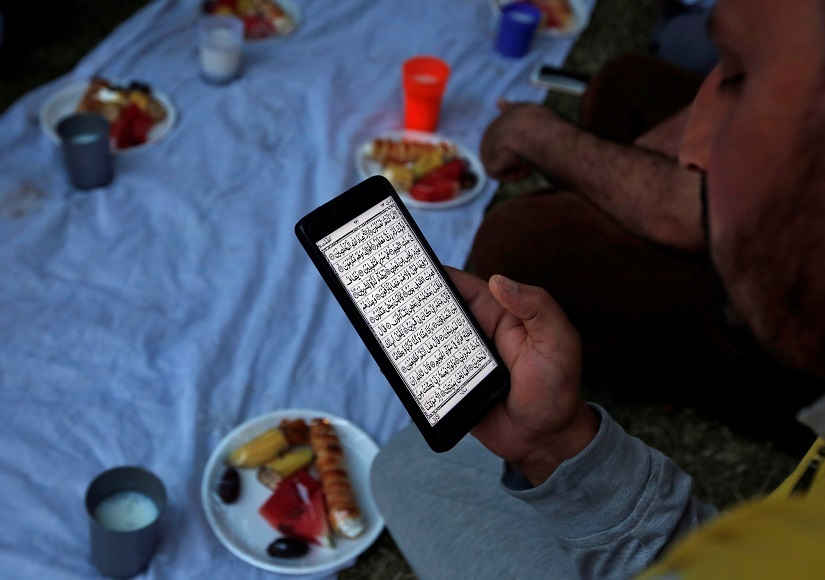
A man reads the Quran on his cellphone. REUTERS
How have your students influenced the way you look at your work?
Most of this work was carried out before I began teaching, but I have used some of it in my class called ‘Political Thought in the Age of Nationalism.’ My students come from highly diverse backgrounds from all over India and even from other parts of the world and so it is useful to see how deep differences go within a small group of 10-12 people let alone an entire country. Many of the students have pushed me to think more about Partition and its aftermath, particularly because many of them, indeed many of us, inherit history which we might not always have the tools to deconstruct and understand. On the first day of classes, I ask students to write an essay on what nationalism means to them and I allow them to write in any style they wish. These essays have been eye-opening for me in terms of trying to understand how from a very young age people are exposed to narratives and stories that that on the face of it are harmless but put in a larger perspective show just how divisive they can be. What was refreshing to see was how the students were already critically aware of this and indeed it was interesting for me to see and try and understand the mechanisms through which these young people have tried to resolve or reconfigure pressing questions to do with their identity. Sometimes, there has been a student who points out a new way of reading or understanding a poem based on a perspective that had eluded me. While this might be articulated through asking a question, the question in itself allows me to learn and this is truly one of the pleasures of teaching.
You have seen the Muslim identity expressed in many different ways across the globe. How similar or different is the Muslim identity in the Middle East from that of India?
Nowadays it has become very fashionable to talk of Indian Islam, particularly in counter-terrorism and countering violent extremism circles (CVE). I am afraid this kind of talk is rather reductionist and frankly is more telling of the political exigencies faced by political and security establishments rather than anything deeper. Of course, because of historic differences and more importantly because of language and culture, there are differences in the manner in which Islam became embedded in different geographic areas but this does not mean that its essence is different in India from say Iran or Egypt. In fact, I would caution you in using the binary of the Middle East and India because both these terms also gloss over the fact that there is huge diversity in them internally.
During Hajj, for instance, people are largely divided according to nationality but traditionally and even now there is an awareness, even a recognition I would say, amongst the Muslims who go on the pilgrimage of a shared spiritual bond with people from vastly different ethnic, racial and cultural backgrounds. Now the fact remains that the rituals, customs and manner in which Islam is practiced in India is inevitably affected by the fact that these came about over the course of centuries in a particular context. Thus, in terms of even something as abstract as beauty or aesthetics, there will be a difference between how an Algerian Muslim defines what is beautiful and how a North Indian Muslim might define it. Both will be circumscribed by parameters that are laid out according to Islamic principles, and these might be very broad, but within these, they might be radically different.
You see, religion cannot exist in isolation from culture, language and I would even say geography and technology — and so the differences that we see between various parts of the Muslim world are not simply religious differences but also differences that arise from these other factors. Of course with the rise of the internet and social media, people are grappling with the mind-boggling diversity amongst Muslims across the world, particularly as debates rage about what is and what is not authentically Islamic. In some instances, there is probably an insecurity that develops when people in South Asia or South East Asia see how Muslims practice their religion in the Arab world but these are such large changes that I don’t think much can be done about them. The rise of a more puritanical and literalist Islam across the world is as much the result of the modern world than anything else because it needs the least amount of cultural mediation and seeks to create a more uniform globalised Muslim identity. Of course, these are issues that will play out over the next decades and it is too early to begin to make any kind of substantial claims.
What role do you think religion plays in India’s politics today? How do you think the Muslim identity is represented in Indian politics today, if at all?
Religion is ubiquitous in Indian politics. Our Constitution, which I think is a remarkable document, is something that is anchored in values and principles that took more than 300 years to organically emerge from within Europe’s public sphere: universities, newspapers, town squares, cafes, salons, associations and clubs, etc. They were an organic part of the tumultuous history of the reformation and enlightenment. However, they came to our part of the world through imperial and colonial networks and thus did not emerge from a bottom-up social churn within our own societies. This is not to say that the principles themselves are not relevant but the larger argument is that they were not embedded in our society and our languages. A new political and indeed moral vocabulary was constructed but I would argue this did not necessarily translate well — or was not translated — into terms that made sense for people whose entire identity and worldview stemmed from and revolved around their religious identity. The point is that it was assumed that people would transcend their religious identity and thus the country would gradually imbibe the values of the constitution but as we can see this is at best a fraught project. Until and unless we can seriously locate the values of the constitution and endow them with a moral legitimacy in the eyes of those who are religious, we will continue to see a fractured political landscape. For example, for some Dalit movements across India the constitution is almost a scared document because it has morally empowered them but sadly this is not the case for many others. For many people, whether Hindu, Muslim, Sikh or Christian, their ideas of right and wrong stem from their religious beliefs and the attendant vocabulary and the constitution merely serves as a legal list of do’s and don’ts to put it crudely. How many people will honestly admit that they see the constitution as a ‘moral authority.’
As for how I think Muslim identity is represented in Indian politics today, well unfortunately I think that Muslim identity is only spoken of in terms of platitudes and generalisations. This is partly because the community’s leadership has been in the hands of people who have had a vested interest in promoting insecurity and emphasising issues that, although important, detract from the very real political, social and economic needs of the Muslims. As I said earlier, Muslims have almost never voted en bloc, yet talk of Muslim vote banks is prevalent. Together with this Muslims are nearly always labelled as backward and needing ‘upliftment’ but very few people are ready to admit the systemic and institutional factors that have brought Muslims to such a pass. Today to speak of discrimination is to allegedly play victim politics, to draw attention to the Sachar report is to beg for sops, to ask for rights and security is to seek appeasement. It seems that Muslims are now political untouchables. This is dangerous because exclusion nearly always breeds discontent and eventually can catalyse extreme reactions.
Muslims are caught in a vicious circle between the machinations of so-called Muslim leaders whose politics thrives on catalysing fear and insecurity and the systematic manner in which the politicians evoke the spectre of the ‘muslim threat’ or indeed of the Muslim vote bloc in elections. The political marginalisation of the Muslims is, of course, something that needs to also be seen in the light of the global pressure of the so-called war on terror. From my experience in the field, Muslims want the same things as everyone else, autonomy, dignity, security, justice and the access to the facilities and institutions of the state.
Who are the writers and poets who inspire your own style of writing?
I must admit that much of who inspires me depends on the context I find myself in, but on the whole, I can say that in Urdu Mir Taqi Mir, Majaz Lucknawi and Faiz are always sources of comfort. In Pharsi Fakhruddin Iraqi and Bedil and amongst the modern poets Fareedoon Moshiri. In English, my own supervisor, the late Professor CA Bayly’s style of writing. The poetry of Auden and Yeats. I really like Chimamanda Adichie’s writing style. I think the person whose ‘voice’ I really admire is that of my mother, who from a young age read her stories and work to us and inspired us to read often and widely.
Whom and what are you reading right now?
In Praise of Shadows by Junichiro Tanizaki, Religion as Critique: Islamic Critical Thinking from Mecca to the Marketplace by Irfan Ahmad, Debt by David Graebar, Idrak-e Zawal-e Ummat (Understanding the Fall of the [Muslim] Community) (Vol. 1) by Rashid Shaz, Mahzalah al-‘Aql al-Bashari (Mockery of the Human Mind) by Iraqi intellectual Ali al-Wardi and Vimal Kumar’s poetry collection Hatya se Atmhatya Tak.
source: http://www.firstpost.com / FirstPost. / Home> Latest News> Living News / by Payal Shah / July 15th, 2018
A look at the processes of social exclusion which have led to the economic, educational and political decline of Muslims
The urgency with which a batch of homologous petitions have been filed against halala and polygyny this year, and the media attention that instant talaq received last year, would make anyone think that these are big, and the only issues facing Indian Muslims.
The reality, however, is different. Instant talaq despite its atrociousness was never a major problem and its setting aside by the apex court had rendered halala too redundant. There is also no statistical evidence to show that polygyny is widely prevalent among Muslims.
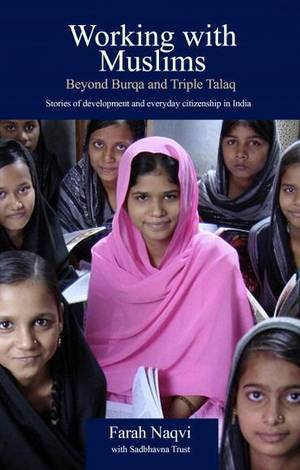
Thankfully, Farah Naqvi’s latest book Working with Muslims: Beyond Burqa and Triple Talaq written in collaboration with the Sadhbhavna Trust makes a spirited attempt to pierce the veil of nescience shrouding real Muslim issues. It looks at the complex historical processes of social exclusion which contributed to the economic, educational and political decline of India’s single largest minority.
Comprehensive study
The book catalogues the findings of a seminal study conducted between 2011 and 2013 of 359 NGOs working with deprived Muslims in eight states and Mewat, a region that straddles Haryana and Rajasthan. Naqvi’s reasons for profiling these NGOs are perceptive. She points out that while Dalits and tribals were constitutionally defined as “development subjects” to overcome the historical discrimination that had affected their progress, Muslims were imagined as “cultural subjects” and constitutional commitments to them were restricted to protection of their religious freedom and personal law.
This allowed the state to absolve itself of responsibility towards Muslims and instead locate the blame in the “religious-community space” where the community is faulted for its own backwardness. It is no wonder that even years after the formation of the Ministry of Minority Affairs and release of the path-breaking Sachar Committee Report, government attitude hasn’t changed.
To prove her point, Naqvi cites Amitabh Kundu’s Post-Sachar Evaluation Committeereport of 2014 which inter alia warned that government interventions were not big enough to address the huge deprivation of the Muslims and that implementation structures had not been designed to directly and effectively benefit the minorities.
Hence, says Naqvi, there was never a greater need for the NGO sector in India to take forward a long overdue engagement with the Muslim community especially its women who are invariably seen through the typical tropes of shariah and hijab and never as persons deserving education, health, employment and public representation.
In this context, her study explains the difficulty of addressing Muslim deprivation in terms of their religious identity. Naqvi writes that although NGOs do not discriminate against any community on the basis of religion they were very reluctant to talk about their work with the Muslims. Their fear was that they may come under the CBI scanner or their funds may get frozen.
Climate of fear
Some NGOs openly suspected the stated objectives of Naqvi’s study. They thought her research team was spying for the state and wanted to hide the fact that they were working with deprived Muslims. In other words, the NGOs were able to “walk the walk” but did not have the courage to talk.
Yet Naqvi and Sadbhavna Trust were able to locate 76 NGOs who primarily work with Muslims out of the 359 they mapped. The rest worked with other groups including Dalits, tribals and Muslims. Working with Muslims also contains 30 fascinating stories from across India of the great work done by dedicated NGOs for the Muslims in areas such as women’s rights, rehabilitation of sex workers, education, urban and rural development, child and disability rights, health, access to credit, and democratic participation.
Nonetheless, Naqvi decries the climate of fear under which the NGOs seem to be working for Muslims. She feels the prevalence of such fear amounts to denying that Muslims face a development deficit which polarises and isolates them selectively. Therefore, if a minority community is subjected to such treatment on the basis of its religious identity then that identity calls for secular recognition.
Naqvi’s earnest appeal deserves to be taken seriously because secularism cannot be used as a pretext to ignore discrimination on grounds only of religion or caste which is prohibited under Article 15 of our Constitution, or to violate the spirit of this Article by neglecting to make special provisions for the advancement of any socially and educationally backward classes of citizens. Canadian political philosopher Will Kymlicka in his book Multicultural Citizenship states that “a comprehensive theory of justice in a multicultural state will include both universal rights, assigned to individuals regardless of group membership, and certain group-differentiated rights or ‘special status’ for minority cultures.”
In this regard, Working with Muslims is a trailblazing contribution to the study of Muslim marginalisation in India. It not just encourages the Indian state to not let religion hinder affirmative action programmes for Muslims but serves as an invaluable source of information for those genuinely interested in knowing if Muslims have issues beyond polygyny, triple talaq and halala.
Working with Muslims: Beyond Burqa and Triple Talaq; Farah Naqvi, with Sadbhavna Trust, Three Essays Collective, ₹450.
source: http://www.thehindu.com / The Hindu / Home> Books> Review / by A. Faizur Rahman / July 14th, 2018
Former Karnataka Higher Education Minister B.A. Moideen passed away in a hospital in Bengaluru on Tuesday. He was 81.
Born to Abdul Khader and Haleema at Pejawar in Bajpe village in May 1938, Moideen, joined Congress in 1969 and held various positions in the party before getting elected to Karnataka Legislative Assembly in 1978 from Bantwal assembly constituency in Dakshina Kannada district. However, he was denied party ticket to contest subsequent elections following which he joined Janata Dal in the later days.
Moideen was a member of the Legislative Council for two terms, from 1990 to 2002. He was the Minister for Higher Education in the J.H. Patel government between 1995 and 1999, when he earned the name of a honest administrator. He rejoined the Congress later. Moideen, a staunch follower of D. Devaraj Urs, was conferred with the Devaraj Urs Award instituted by the State Government in 2016.
Moideen’s autobiography, Nannolagina Naanu (Me within Me) was to be released shortly. Though he was reluctant to pen down his life, two writers, Muhammed Kulai and B.A. Muhammad Ali, coaxed him to do so and wrote the book.
Moideen, recalling his early political days, was learnt to have blamed three senior Congress leaders, M. Veerappa Moily, B. Poojary Poojary and Oscar Fernandes for his political debacle after 1983. “I didn’t do any harm to them and in fact had helped them when needed. Yet I can’t understand why they did hold grudge against me,” he had said.
source: http://www.thehindu.com / The Hindu / Home> News> States> Karnataka / by Special Correspondent / Mangaluru – July 10th, 2018