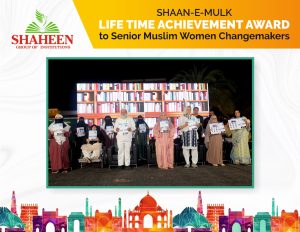
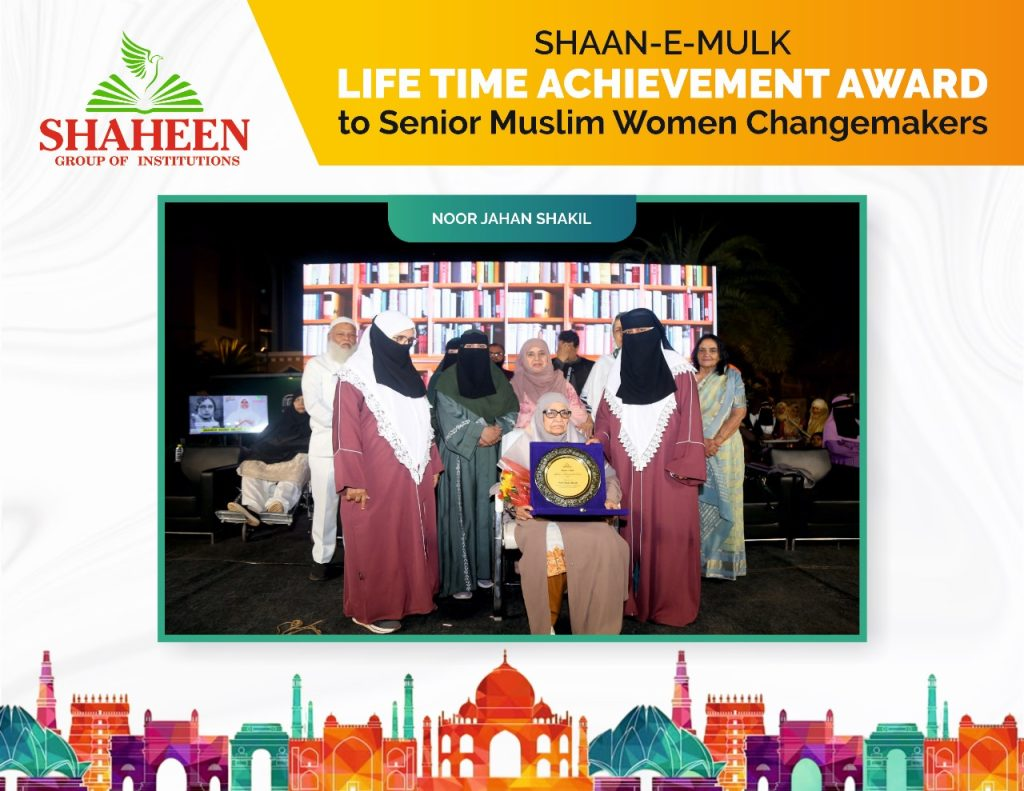
On India’s 76th Republic Day, Shaheen Group of Institutions, Bidar, organized the “Shaan-e-Mulk” Lifetime Achievement Award to honor five distinguished women for their contributions to education, business, humanitarian services, and healthcare.
Dr. Abdul Qadeer, Chairman of Shaheen Group, emphasized the vital role of women in society, stating, “Women are the backbone of families and communities, yet their contributions often go unrecognized. It is crucial to celebrate their achievements and inspire future generations.
Honorees
The award was presented to:
Ms. Shaukat Begum (Institutional Development)
Ms. Noor Jahan Shakeel (Humanitarian Services)
Dr. Rana Noor Siddiqui (Education & Research)
Ms. Uzma Naheed (Entrepreneurship)
Dr. Noor Jahan Sagheer (Healthcare)
The event, attended by thousands of female students, showcased academic performances and aimed to challenge stereotypes, inspire young women, and foster community pride.
Key attendees included Managing Director Abdul Haseeb, Academic Director Abdul Muqeet, and directors Shaista, Wafa, Zakia, Meher Sultana, Afra Naaz, and Munir Deshmukh.
source: http://www.thehindustangazette.com / The Hindustan Gazette / Home> Education / by The Hindustan Gazette / January 29th, 2025
Bombay High Court rejects discrimination by medical boards in landmark disability rights verdict; it rules that certified disabled students cannot be repeatedly questioned on their eligibility
New Delhi :
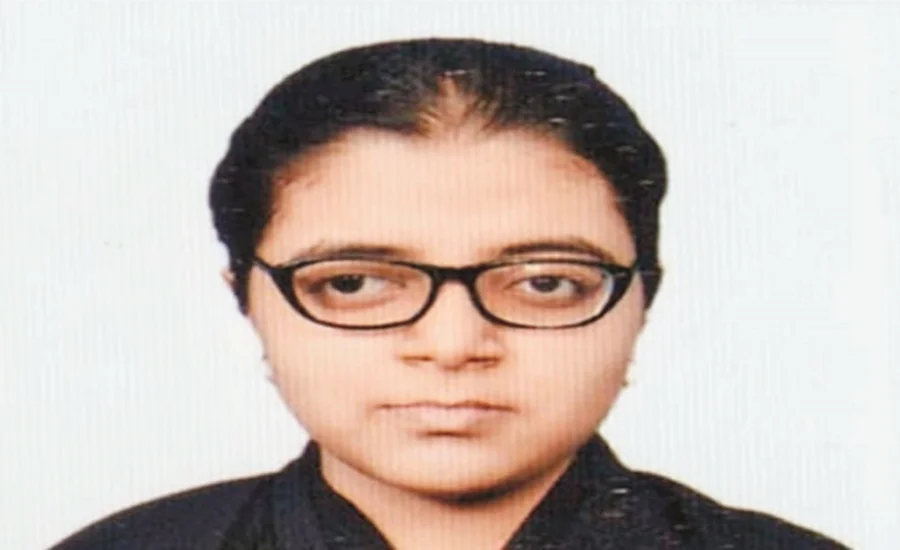
In a powerful judgment that reaffirmed the fundamental right to education for all, the Bombay High Court has ruled in favour of Uzma Rashid Khan, a blind Muslim student from Jogeshwari West in Mumbai, who was unjustly denied admission to an MBBS course under the disability quota.
This week (October 8), the court declared that a certified person with a disability cannot be forced to repeatedly prove eligibility before different medical boards. The verdict allows Uzma to participate in the third round of NEET UG 2025 counselling under the PwBD (Persons with Benchmark Disabilities) category.
Delivering the order under the Rights of Persons with Disabilities Act, 2016, the court stated that no educational institution has the right to deny admission on the basis of disability. The judgment described the disability category as a legal right, not a special concession.
Uzma Khan, who has a 40% visual disability certificate and a Unique Disability ID (UDID) card, had earlier been declared ineligible for the PwD quota by the medical boards of AIIMS Nagpur and Grant Medical College JJ Hospital in Mumbai. The rejection came despite her official disability certification.
Determined not to surrender, Uzma fought back. Guided by Advocate Rahul Bajaj, she filed a petition in the Bombay High Court, challenging what she called a “deeply unfair and humiliating decision.”
In a detailed order, the court held that since Uzma already possessed a valid certificate confirming her disability, she could not be made to undergo multiple verifications. The judgment further recognised her as fully capable of pursuing medical education and directed authorities to include her in the third round of NEET counselling.
The timing of the judgment is extraordinary. The third round of NEET counselling was nearing its final stage and the portal for filling preferences had already closed. However, in what many called an “unprecedented act of fairness,” the court ordered the reopening of the admission portal for half an hour exclusively for Uzma so that she could submit her form.
The decision not only secured Uzma’s admission but also became a milestone in the struggle for equal educational opportunities for disabled students across India.
“This is not just my victory,” Uzma told local media after hearing the verdict. “It is the victory of every disabled student who dreams of becoming something in life despite physical challenges. I thank Allah and the court for doing justice.”
Uzma’s father, speaking to reporters with visible emotion, recalled the family’s struggle:
“One day, while studying for NEET, Uzma suddenly cried that her vision had become blurry. It was the most painful moment of our lives,” he said. “We went from one hospital to another, losing precious time. Later, she was certified as 40% blind, and we got her UDID card made.”
He added, “Uzma prepared hard for NEET 2025 and scored 286 marks. She was confident of getting admission in a government medical college under the disability quota. But during verification, she was declared ineligible. It felt like the world collapsed around us.”
After being rejected, the family turned to Khidmat Trust, which guided them to Advocate Bajaj. “He stood by us, filed the petition, and kept our hope alive,” Uzma’s father said. “By God’s grace, the court’s decision proved that truth always wins.”
The news of Uzma’s victory spread rapidly in her neighbourhood. Teachers, schoolmates, and local residents celebrated what they called “a triumph of justice and faith.”
The principal of Al-Ittihad Urdu School, where Uzma completed her schooling, praised her resilience: “She was one of our brightest students. Even after losing her sight, she never gave up. This decision is a reminder that disability should never define a person’s potential.”
Her teachers remembered her as a hardworking and humble student who always inspired others. “Uzma’s story will motivate many children facing similar challenges,” said a teacher, adding that “she has set an example for the entire community.”
Legal experts believe the judgment has far-reaching implications. It reaffirms that persons with disabilities must be treated with dignity and that bureaucratic obstacles cannot override constitutional and human rights.
Advocate Rahul Bajaj, who represented Uzma, said, “This verdict has clarified that once a person is certified as disabled, they should not be made to undergo endless scrutiny. The system must trust official certification and respect the law.”
The Rights of Persons with Disabilities Act, 2016, ensures that individuals with disabilities enjoy equality and non-discrimination in education, employment, and public life. Yet, as Uzma’s case shows, many still face unnecessary hurdles.
“This judgment will hopefully make institutions more sensitive,” Bajaj said. “It’s a reminder that education is a right, not a privilege, and disability should never become a reason for exclusion.”
For Uzma and her family, this moment represents years of struggle, sleepless nights, and unwavering faith. As her father put it, “We prayed every day for justice. Today, we feel proud that our daughter has shown what courage really means.”
Her story, now celebrated by students and activists alike, stands as a beacon of hope — not only for disabled learners but also for every Indian Muslim family that values education as both a right and a duty.
In the words of Uzma herself: “I want to become a doctor to serve those who suffer, just as I did. Disability can’t stop dreams — only doubt can.”
source: http://www.clarionindia.net / Clarion India / Home> Editor’s Pick> India> Indian Muslim / by Team Clarion / October 13th, 2025
Remembering the fearless freedom fighter, who led thousands of women in civil protests, championed Urdu and education, and defied social evils
Patna :
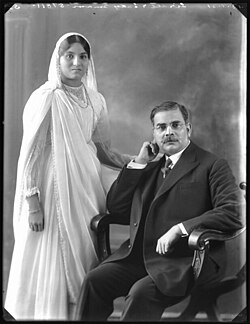
In the midst of the ongoing Bihar Assembly election campaigns, the state pauses to honour a remarkable figure in its history: Anees Fatima, Bihar’s first Muslim woman MLA, a freedom fighter, teacher, and social reformer whose courage and vision continue to inspire generations.
Born in Patna in 1901, Anees Fatima’s early years were marked by a sharp mind and fearless disposition, qualities that distinguished her in a time when women’s education and participation in public life were extremely limited. She completed her primary education at the Badshah Nawaz Rizvi School, also known as Madrasa Islamia, setting the stage for a life devoted to public service and national freedom.
“From childhood, she was determined not to remain silent,” said historian Dr Meena Sharma. “Her courage and intellect made her stand out, and she carried these traits into the freedom struggle, inspiring countless others.”
Anees Fatima’s commitment to India’s freedom movement was evident from her active participation in the Non-Cooperation Movement launched by Mahatma Gandhi in 1920. She fearlessly led protests against liquor shops in Patna, an audacious move for a woman at the time. During the 1930 Civil Disobedience Movement, she and fellow activist Gauri Das led a procession of more than 3,000 women in Patna. When fined ₹201 by the British government for her activism, she refused to pay.
She had to go to jail for her boldness but she neither accepted defeat in front of the British nor did she weaken in front of the cruelty of the British.
Her remarkable leadership earned her national recognition, with the Indian National Congress including her in the delegation sent to England to protest the Montagu-Chelmsford Reforms.
In 1937, Anees Fatima made history as Bihar’s first woman MLA, contesting and winning the election as an independent candidate. Her oratory skills were so compelling that she was awarded the title of “Lady Imam.” She was also an active member of Anjuman Tehreek-e-Urdu, campaigning for Urdu to be recognised as Bihar’s second language.
“Her election was more than a political victory,” said educationist Prof Arif Khan. “It was a statement that women, and especially Muslim women, could lead and shape society.”
Beyond politics, she dedicated her post-independence years to promoting education in Bihar, remaining associated with the Khuda Baksh Oriental Public Library, and advocating against social evils like child marriage and strict purdah practices.
Anees Fatima’s life reflects a deep commitment to service, courage, and women’s empowerment. Married to Sir Syed Ali Imam, she helped lay the foundations for what is considered “Jadid Bihar,” or New Bihar, through her tireless efforts in education, social reform, and public service.
“Anees Fatima showed that courage and dedication know no gender,” remarked local activist Fatima Rizvi. “She not only fought for the nation’s independence but also for the rights of girls and women in society. Her legacy continues to guide us.”
As Bihar celebrates its electoral processes, remembering pioneers like Anees Fatima offers a reminder that true leadership is measured not by position but by service, bravery, and commitment to equality and justice.
source: http://www.clarionindia.net / Clarion India / Home> Editor’s Pick> India> Indian Muslim / by Team Clarion / October 16th, 2025
Dr Syed Amjed Ahmed, a pioneering communication scholar and educator who shaped generations of journalists, media professionals, and educators, passed away in Bengaluru at the age of 76. Known for his deep patience, open-minded teaching, and visionary contributions to educational broadcasting, Dr Amjed’s passing marks the end of an era in Indian media education.
Throughout his career, Dr Amjed transformed the Department of Mass Communication and Journalism at the University of Calicut into a nationally recognised centre of excellence. His students today occupy senior positions in journalism, advertising, public relations, technical communication, and academia across India and abroad. A true academic innovator, he was among the first to identify technical writing as a viable career for communication graduates, long before the digital revolution took hold.
A man of science and sensitivity, Dr Amjed earned a Master’s in Geology and an MS in Communication from Bangalore University before dedicating his life to teaching in Kerala.
As the founding director of the Audio Visual Research Centre (AVRC) at Calicut University, he led the institution to national acclaim by producing award-winning educational documentaries for the University Grants Commission. One such production, which featured real visuals of an open-heart surgery from the Sri Chitra Tirunal Institute in Trivandrum, became a landmark in educational media and inspired other AVRCs to embrace creative and visual storytelling.
Colleagues recall that he navigated multiple bureaucratic and institutional hurdles with quiet resilience. His leadership combined administrative acumen with human warmth, ensuring that the AVRC became both technologically forward and academically rigorous.
As a teacher, Dr Amjed believed in dialogue over dictation. His classroom was a space of debate, reflection, and dissent. He encouraged students to think critically, question conventions, and link theory to experience. If a student disagreed or even displayed anger, he would listen calmly and respond with logic and empathy. He believed that listening was central to education and that disagreement was an essential ingredient of learning.
His contributions extended beyond pedagogy. He introduced round-the-clock PTI teleprinter services for journalism training, built a best-in-class media library, and installed one of the earliest Apple Macintosh DTP systems for hands-on experience in editing and design. His work ethic inspired students and colleagues alike, while his humility kept him grounded despite his many accomplishments.
Those who knew him describe him as a rare educator who never used authority to impose discipline, but empathy to earn respect. Even as a department head, he supported student activism and believed that education must nurture conviction alongside competence.
For his students and peers, Dr Amjed was not just a teacher but a lifelong mentor, guide, and friend. His influence on media education in India endures through the thousands he taught and inspired to think independently, act ethically, and communicate truthfully.
source: http://www.radiancenews.com / Radiance News / Home> Latest News> Markers of Excellence> Obituary> Report / by Radiance News Bureau / October 17th, 2025
Prof. Ziaur Rahman Siddiqui, Department of Urdu, AMU
Aligarh:
In a proud moment for the global Urdu community, Prof. Ziaur Rahman Siddiqui, Department of Urdu, Aligarh Muslim University (AMU), has been nominated for the prestigious Nishan-e-Urdu 2023–24 award by Urdu Markaz, New York (USA).
The award, to be formally presented in New York on Sir Syed Day, honours individuals for their outstanding contributions to the promotion and enrichment of the Urdu language.
Mr. Raees Warsi, Founder and President of Urdu Markaz, New York, remarked, “Prof. Siddiqui’s nomination recognises his remarkable work in Urdu scholarship, research, criticism, and pedagogy.”
Prof Siddiqui is the author of more than two dozen books and over a hundred research and critical papers, blending intellectual depth with literary artistry.
source: http://www.radiancenews.com / Radiance News / Home> Pride of the Nation> Awards> Latest News / by Radiance News Bureau / October 13th, 2025
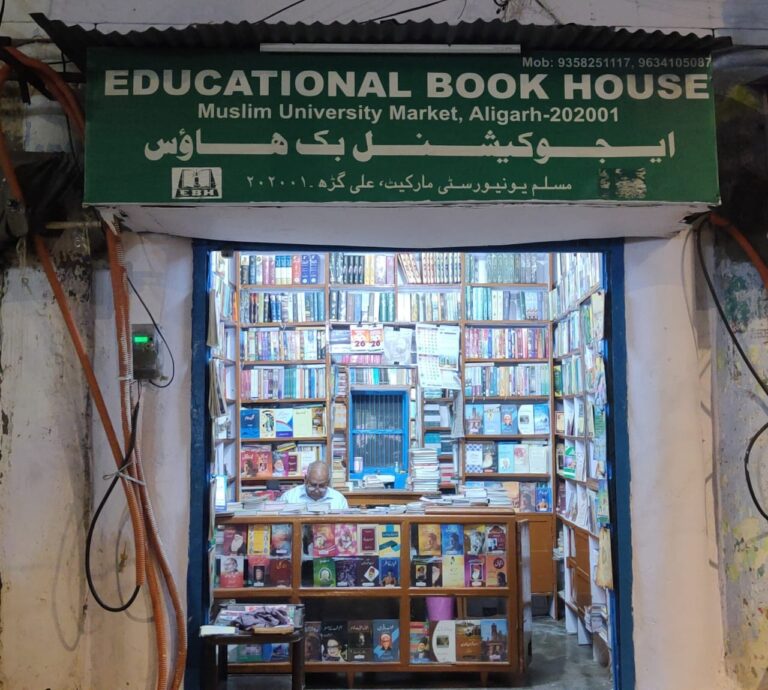
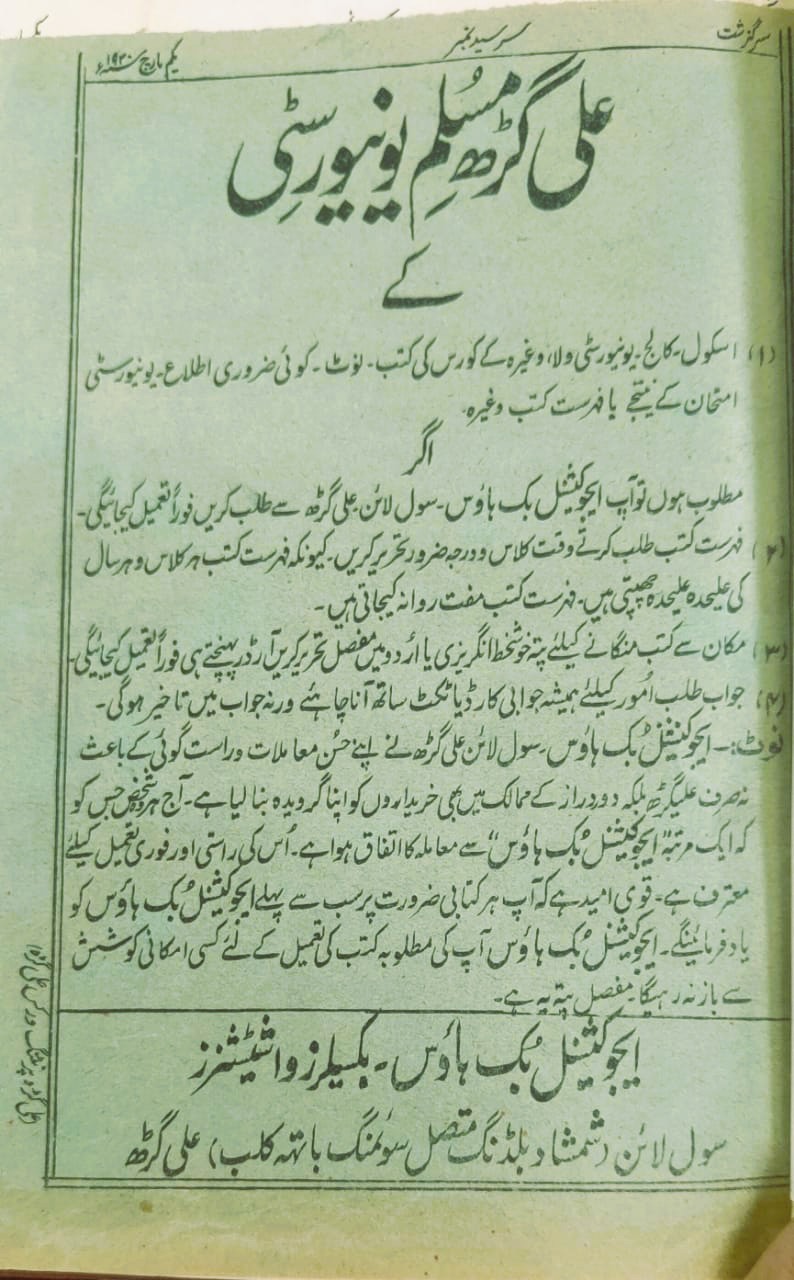
Responding to this need, Abdul Shaheed Khan, an alumnus of MAO College Aligarh from Meerut, opened a small stationery shop in 1925, named this establishment “Educational Book House”, marking the beginning of a new chapter in Aligarh’s literary landscape.
Aligarh Muslim University, renowned as a beacon of knowledge and service to the nation, has nurtured multiple institutions dedicated to education and culture since its inception. Among these, the Educational Book House (EBH) stands out as a distinguished establishment, symbolizing a century of dedication to the dissemination of literature and learning.
Established in 1925, EBH is more than an ordinary bookstore; it holds a revered position among bibliophiles, scholars, and literary circles both nationally and internationally. Over the past hundred years, EBH has played a pivotal role in spreading the literary and academic works of Aligarh across a broad audience, ensuring its legacy endures today. Its contribution to the development and promotion of Urdu language and literature is of profound importance in the history of book publishing
Historical Roots of Book House at Aligarh:
The story of Book house in Aligarh is intertwined with the visionary efforts of Sir Syed Ahmad Khan (1817-1898) and his pioneering movement to elevate Muslim education in India. As early as 1888, Sir Syed aimed to establish a bookstore in Aligarh to serve the students and teachers of his educational institutions. He launched a campaign to establish a bookstore in Aligarh and even raised funds for this purpose. An advertisement in the Aligarh Institute Gazette dated 7th July 1888 announced the opening of a bookshop: “Aik Tijarti Dukan Kitabon aur Stationary yani Saman Nosht wa Khwand Kay Farokht Ke Aligarh Mein” – a commercial shop for books and stationery in Aligarh. (see AIG, 7th July 1888)
This initial venture was called the “College Book Depot” which quickly became a vital hub for literature, academic materials, and stationary. It functioned as a bridge connecting scholars, students, and the wider community, fostering a culture of learning and intellectual curiosity in Aligarh. The original depot thrived under the stewardship of Mir Wilayat Hussain (1862-1949) but faced decline after his retirement in 1920, eventually closing down. (see Aap Beeti ya MAO College Ke Kahani, Mir Wilayat Hussain Ki Zubani, Sir Syed Academy, Aligarh, 2024, p.126).
The Birth of EBH
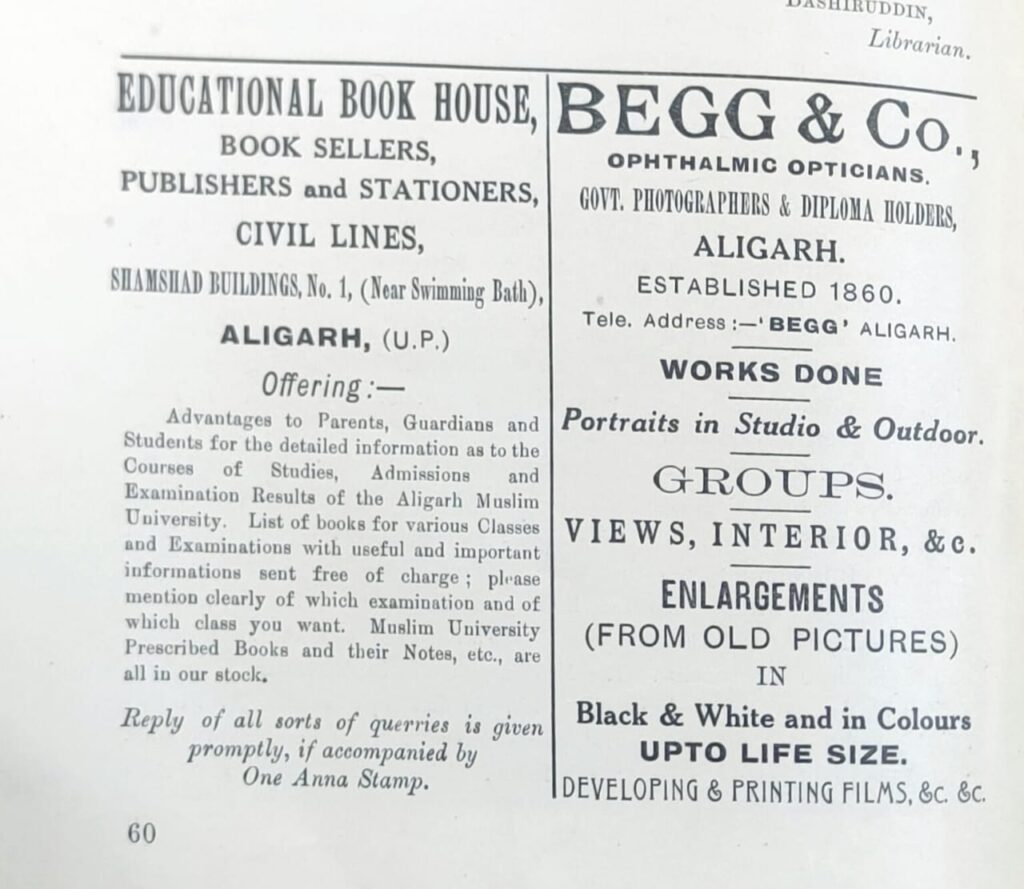
The establishment of Aligarh Muslim University in 1920 created a renewed demand for a dedicated bookstore that could cater to the needs of students and faculty alike. Responding to this need, Abdul Shaheed Khan (1898-1968), an alumnus of MAO College Aligarh from Meerut, opened a small stationery shop in 1925 near Fuller Road, close to Tasweer Mahal. He named this establishment “Educational Book House”, marking the beginning of a new chapter in Aligarh’s literary landscape. His vision was to provide affordable and accessible academic books and stationery, supporting the educational aspirations of students and teachers.
Abdul Shaheed Khan, Founder EBH
Moving to Shamshad Market:
In 1928, Sahibzada Shamshad Ahmed Khan (1888-1954), son of eminent educationist and vice-chancellor of AMU, Sahibzada Aftab Ahmed Khan (1867-1930), built a bustling commercial complex known as “Shamshad Building” in civil line Aligarh near AMU. This market was designed to serve the needs of the university community and local residents, housing shops for tailoring, groceries, milk, bread, bicycle repairs, and more. A mosque was also constructed within the complex, serving as a spiritual and community center.
Recognizing the importance of proximity and accessibility, Sahibzada Shamshad Ahmed Khan requested Abdul Shaheed Khan to relocate EBH to this new marketplace. The bookstore shifted there in 1929, anchoring itself within a vibrant hub of activity. This move significantly increased EBH’s visibility and accessibility, making it a central point for students and scholars seeking academic and literary materials.
The Aligarh Magazine (1929-30) praised Shamshad Market as a vital institution, emphasizing how it simplified the lives of students by providing essential books and stationery close to their place of study. In an editorial note, editor write:
“The Shamshad building has undoubtedly rendered an invaluable service to the student community of the University, for all the requirements of the students are to be found in the shops contained in the building and they have no more to worry themselves by running down to the city to fetch even the most ordinary things of everyday use. Sahibzada Shamshad Ahmad Khan deserves the thanks of all those whose life has been made easy and pleasant by the erection of this splendid building and we most cordially congratulate him on this.” (see Editorial Notes, Aligarh Magazine, 1929-30, p.11)
According to renowned historian Prof. Iftikhar Alam Khan, in his authoritative work “Muslim University Ki Kahani, Imarton Ke Zubani 1920 to 1947”, the Shamshad Building was constructed in 1929 at a cost of Rs. 30,000, financed by Sahibzada Shamshad Ahmed Khan’s mother. The building housed 18 shops, including EBH, and was a bustling center of commercial and cultural activity.
EBH’s shop within this complex charged the highest rent—Rs. 31—indicating its prominence and importance in the market. Its strategic location made it an essential resource for students, teachers, and literary enthusiasts, solidifying its reputation as a hub of education and culture. (See “Muslim University Ki Kahani, Imarton Ke Zubani 1920 to 1947”, EBH, Aligarh, 2006, pp. 161-165)
Early Contributions to Literature and Publishing:
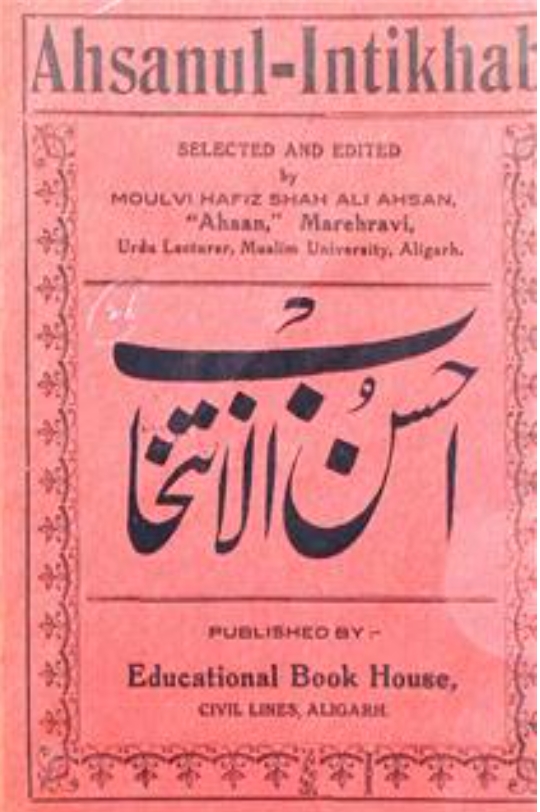
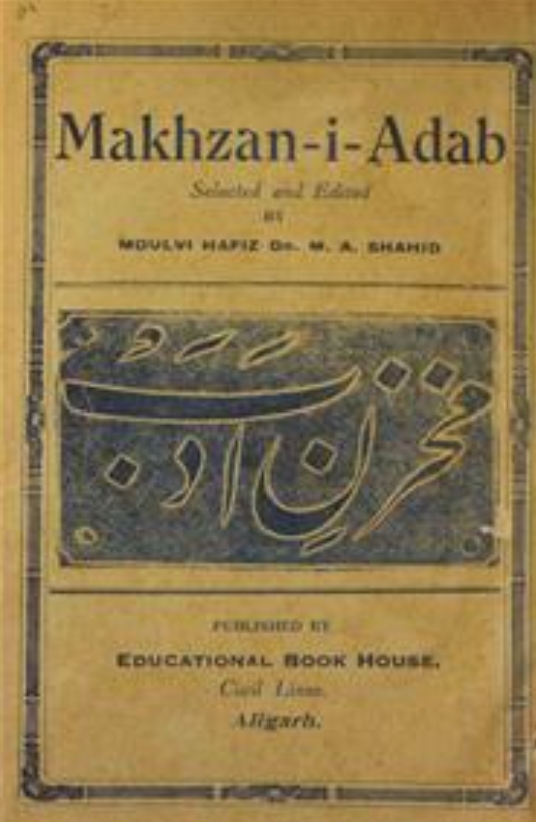
Even before India’s independence, EBH distinguished itself as a publisher committed to a broad spectrum of subjects. Unlike many publishers focused solely on literature or religion, EBH ventured into publishing works on children’s psychology, social sciences, philosophy, history, linguistics, and sciences. Its publications catered to the academic community and the general public, fostering a culture of knowledge dissemination. Notable early publications included: “Kainat Adab” by M. A. Hameed Alig (1935) editor Nazara Meerut, “Ahsan-ul-Intikhab’’ by Ahsan Marehrawi, “Makhzan Adab” by M. A. Shahid, “Sukhna Nau”, “Husn-e-Intikhab’’ by Abdul Jaleel Kidwai, “Delhi Ka Ek Madar Akhiri Mushaira” by Mirza Farhatullah Beg, “Dastan Rani Ketki Aur Kanwar Uday Bhan Ki” by Syed Inshallah Khan Insha, “Bachhon Ki Tarbiyyah” by Musarrat Zamani, “Al-Aqeedah Al-Hasna” by Molvi Sham and Maulana Abdussalam etc.
These works reflected EBH’s commitment to educational and literary growth, providing resources that supported scholarly pursuits and cultural development.
Post-Independence Challenges and Resilience:
The partition of India in 1947 was a tumultuous period that resulted in massive migrations and upheavals. Many families left their ancestral homes, but Abdul Shaheed Khan chose to remain in Aligarh. His son Asad Yar Khan says that just after independence many of his father’s relatives and friends asked him, he also migrate to Pakistan, but Professor Rashid Ahmed Siddiqui and Dr. Aale Ahmad Suroor advised him to continue his work from here, thus his father put this idea out of his mind.
His dedication ensured that EBH continued serving the community, moving from Shamshad Market to the Conference Market in 1951 to accommodate expanding operations.
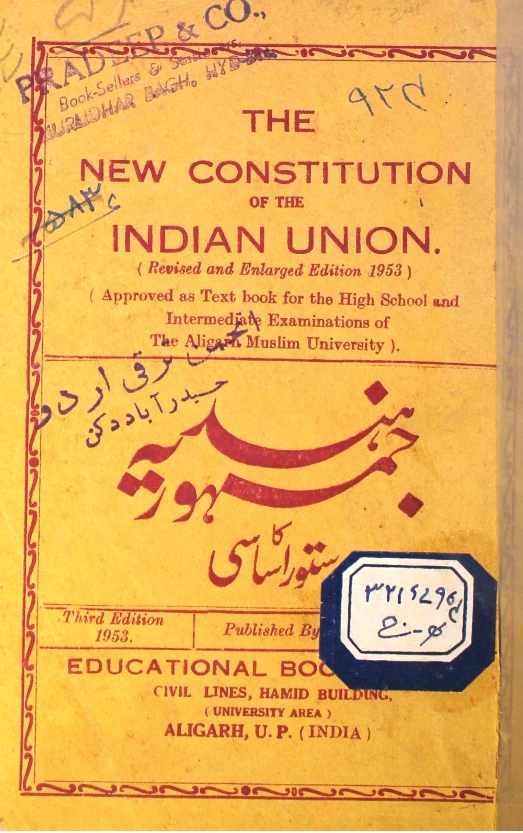
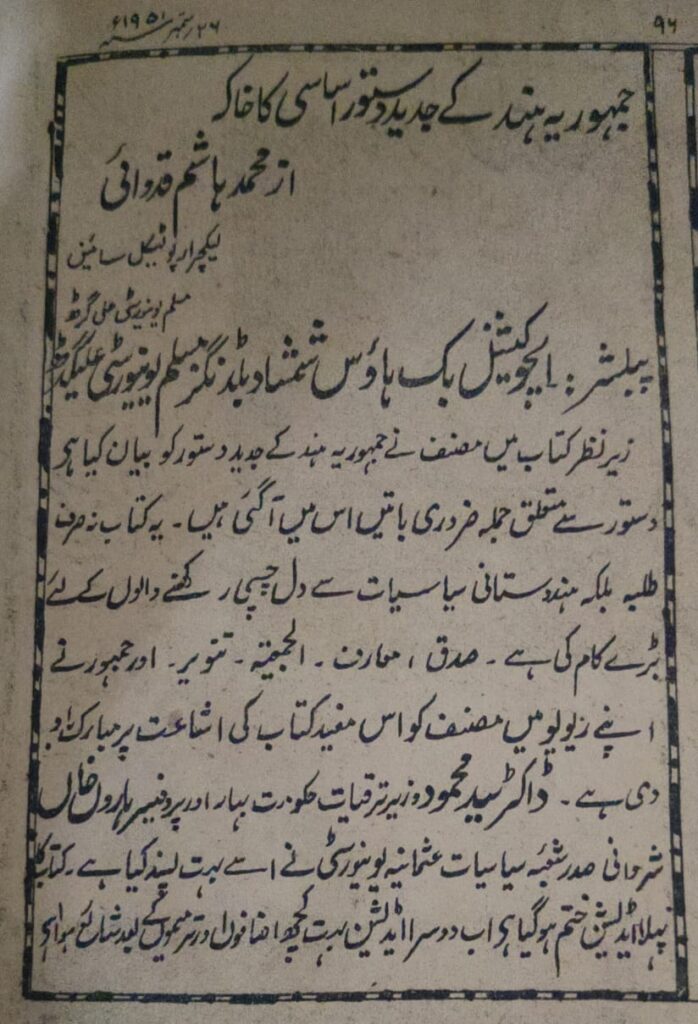
In this period, EBH expanded its publishing activities further. It published influential titles on Indian politics and governance, including Dr. Hashim Kidwai’s“Jhamooriya Hind” (1951), which analyzed India’s political system and constitution. Apart from Jhamooriya Hind, some of his titles are: Mubadiat Ilm Madniat (1951), Duniya Ke Hukoomatain(1961), Mubadi Siyasiyat (1971), Tareekh-e-Afkar siyasi (1982), Usool-e-Tammaddun, Usool-e-Siyasiyat (1988).
An Advertisements of book highlighted the importance of such works for students, scholars, and policymakers appeared in Weekly Jhamoor Aligarh dated 26th December 1955 states:
“In the book under consideration, the author has described the modern constitution of the Republic of India, all the essential things related to the constitution have been included in it. This book has done a great job not only for students but also for those interested in Indian political science. Sadq, Maarif, Jamiyat, Tanveer and Jamhur in their reviews congratulated the author for publishing this useful book. Dr. Syed Mahmood, Minister for Development, Government of Bihar, and Professor Haroon Khan Sherwani, Head of the Department of Political Science, Osmania University, have liked it very much.”
Supporting Urdu Education and Literature:
A vital aspect of EBH’s mission was promoting Urdu language and education. The bookstore provided textbooks for institutions such as Jamia Osmania, Hyderabad, Aligarh Muslim University and Jamia Urdu, Aligarh and collaborated with teachers from Aligarh Muslim University to develop curricula that emphasized Urdu literature and linguistics.
This support helped to sustain and foster Urdu’s growth as a language of scholarship and culture across the region.
Asad Yar Khan
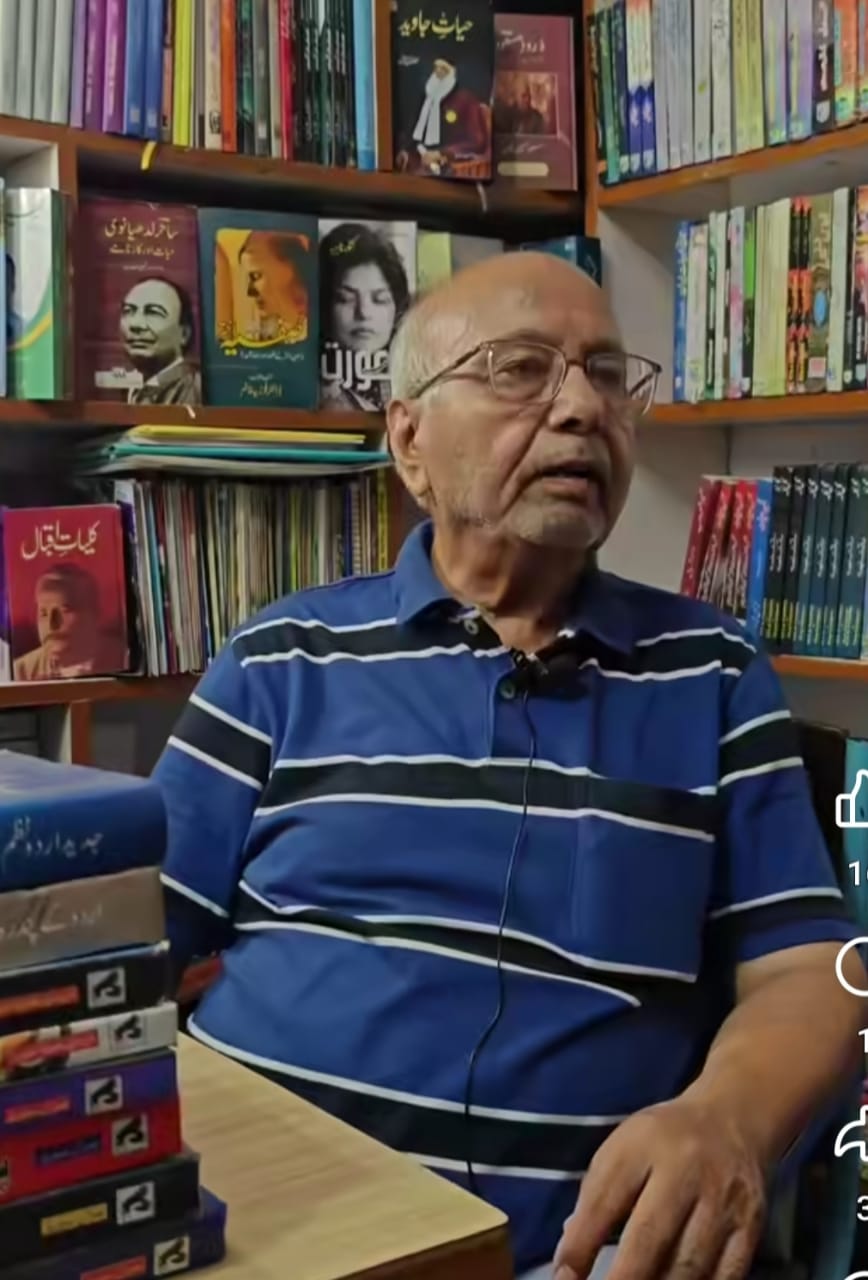
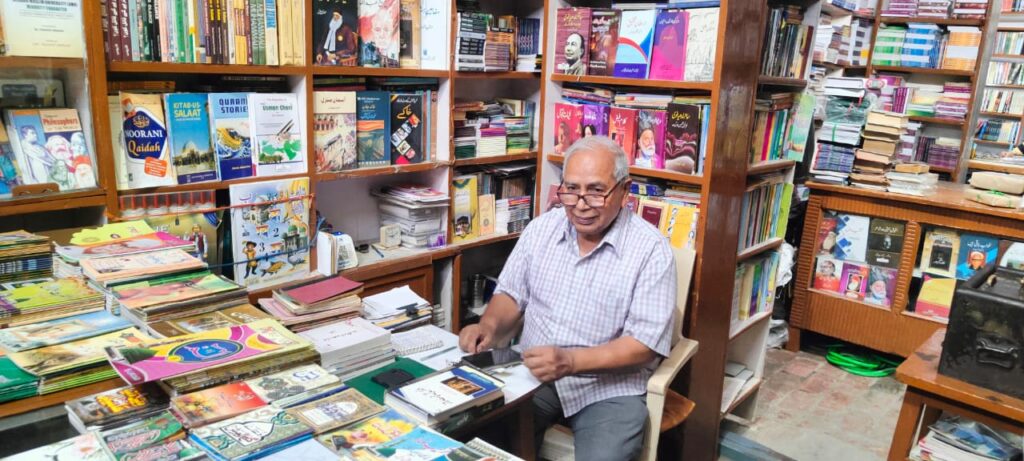
Following the death of Abdul Shaheed Khan in 1968, his sons, Asad Yar Khan (b. 1941, famously known as Kaptan Sb. as he served the Captain of Horse Riding in AMU several years) and Ahmed Saeed Khan (b.1948, affectionately Bhayya of all known people), inherited the legacy. Under their leadership, EBH grew into one of the most respected Urdu publishing houses in the subcontinent. They enhanced the quality of printing, expanded their catalog to include works of eminent poets, scholars, and political thinkers.
Ahmed Saeed Khan
Works of Prominent literary figures such as Iqbal, Faiz Ahmed Faiz, Khalifa Abdul Hakeem, and Ghulam Sarwar published and promoted through EBH, significantly contributing to the Urdu literary renaissance.
It also published works of Wazir Agha, Abu Lais Siddiqui, Hassan Askari, Masood Hussain Khan, Akhtar Ansari, Syed Abdullah, Khaliq Ahmed Nizami, Muhammad Hashim Kidwai, Vaqar Azeem, Majnoon Gorakhpur, Ateeq Ahmad Siddiqui, Ibadat Barelvi, Raza Ali Abidi, Qurratul ain Haidar, Aal-e-Ahmad Suroor, Khurshid-ul-Islam, Abdul Qadir Sarwari, Waheed Quraishi, Athar Parvez, Zaheer Ahmad Siddiqui, Khadeeja Mastoor, Ziauddin Alvi, Abdul Mughni, A.A. Hashmi, Rasheed Hasan Khan, Masood Hasan Khan, Masood Hassan Rizvi, Shaharyar, Manzar Abbass Naqvi, Mirza Khalil Beg, Abul Kalam Qasmi, Iftikhar Alam Khan, Asghar Abbas, Surraya Hussain, Sagheer Afrahim etc.
The Literary Magazine “Alfaaz”: A Cultural Milestone:
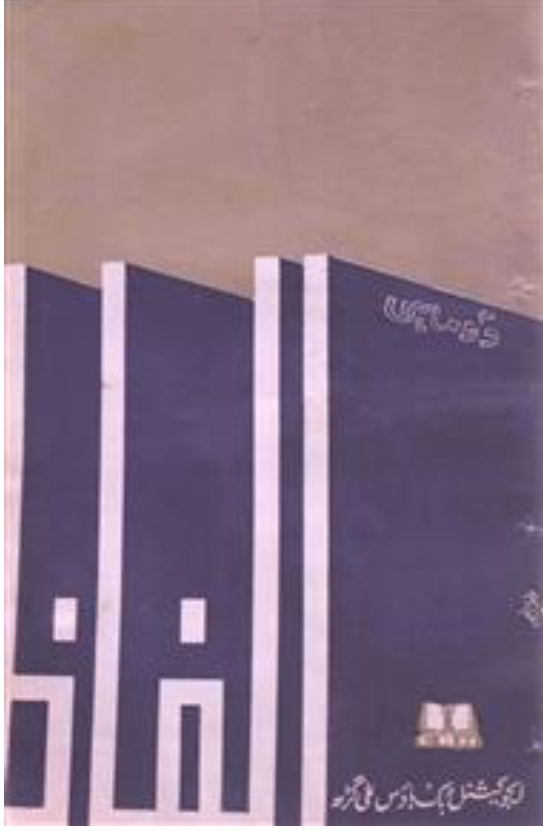
In 1975, Asad Yar Khan launched “Alfaaz”, a literary magazine dedicated to Urdu literature. Edited initially by Abul Kalam Qasmi, Alfaaz became a vital platform for poetry, literary criticism, and cultural dialogue. It provided a space for emerging writers and established intellectuals to exchange ideas, debate, and showcase their work.
The magazine’s editorial board included notable scholars such as Khurshid-ul-Islam, Khalil-ur-Rehman Azmi, and Naseem Qureshi. Over nearly two decades, Alfaaz played an essential role in nurturing Urdu literature, fostering new talent, and preserving the cultural heritage of Urdu language and thought.
Personal Reflections:
The author’s personal association with EBH began in 1995, when as a seventh-grade student, he first visited the bookstore to buy storybooks and magazines. Over the years, this relationship deepened, leading to interactions with notable scholars, poets, and literary figures, including Professor Hashim Kidwai, Professor Mushir-ul-Hasan, Professor Qazi Abdul Sattar, Manzoor Hashmi, Professor Abul Kalam Qasmi, Qurban Ali (BBC Hindi), Tariq Hasan (Prominent Journalist), Mirza Masood Beg (Prominent Linguists) and many others.
In 2016, EBH published the author’s book on Aligarh’s journalism, “Aligarh Ke Urdu Sahafat”, a testament to their ongoing support for young writers and scholars.
Celebrating a Century of Service:
Today, as EBH celebrates its hundred years of existence, it stands as an integral part of Aligarh’s intellectual and cultural heritage. The dedication and honesty of Late Abdul Shaheed Khan and later his sons have made EBH a symbol of Urdu literature’s resilience and growth. Their efforts to promote Urdu, support education, and foster literary excellence have left an indelible mark on the Urdu circle.
A Legacy for the Future:
It is hoped that EBH continues to serve as a beacon of literary and educational excellence, nurturing new talents, publishing significant works, and promoting the Urdu language. As it celebrates a century of remarkable service, the entire community extends heartfelt congratulations and best wishes for its future endeavours.
The Educational Book House’s journey over the past hundred years stands as a shining example of dedication to knowledge, culture, and language. Its legacy is a reflection of the enduring power of literature to unite, educate, and inspire. May EBH continue to flourish and illuminate the path of learning for many more generations to come.
source: http://www.heritagetimes.in / Heritage Times / Home / by Dr Asad Faisal Farooqui / July 27th, 2025
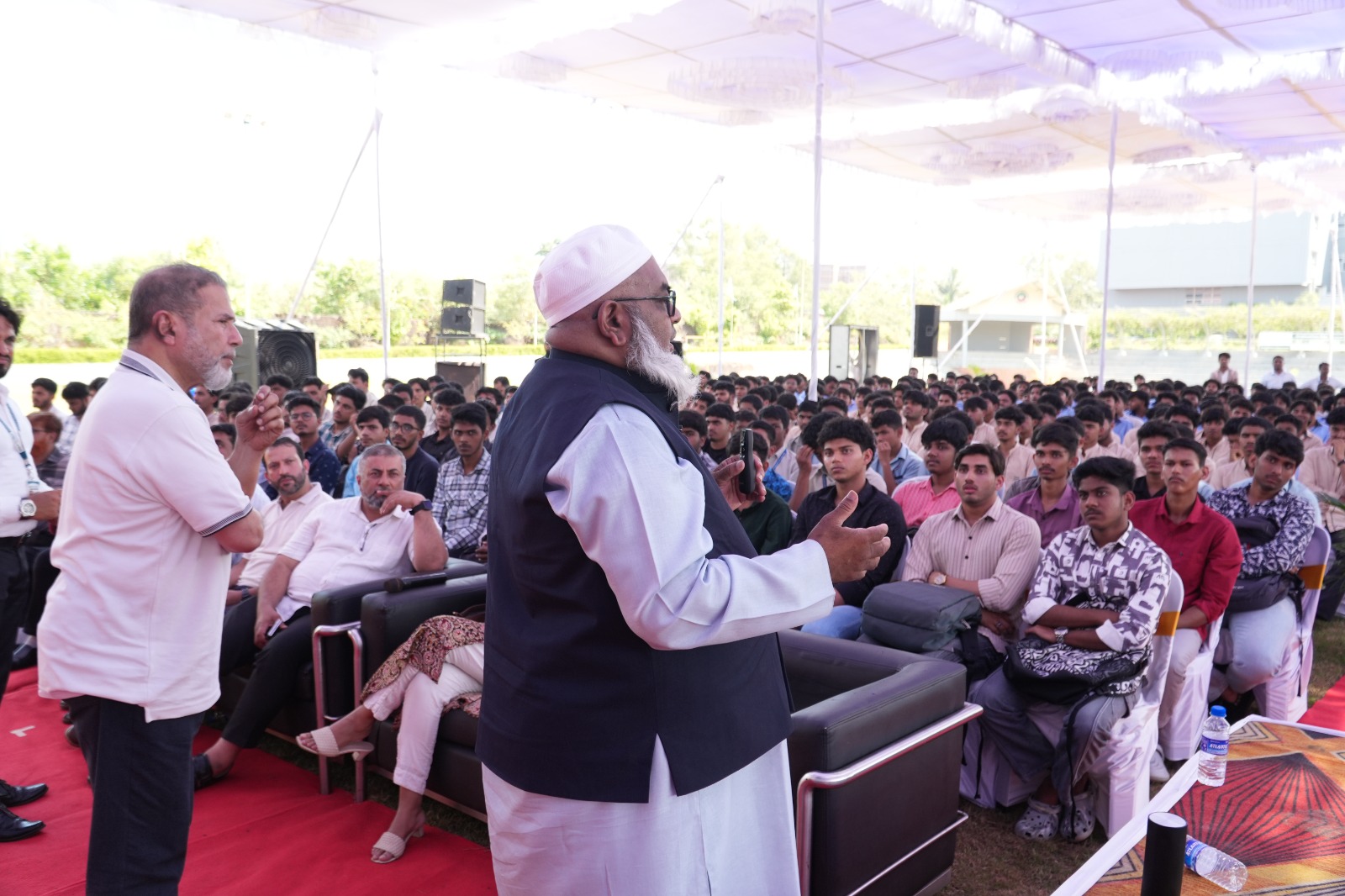
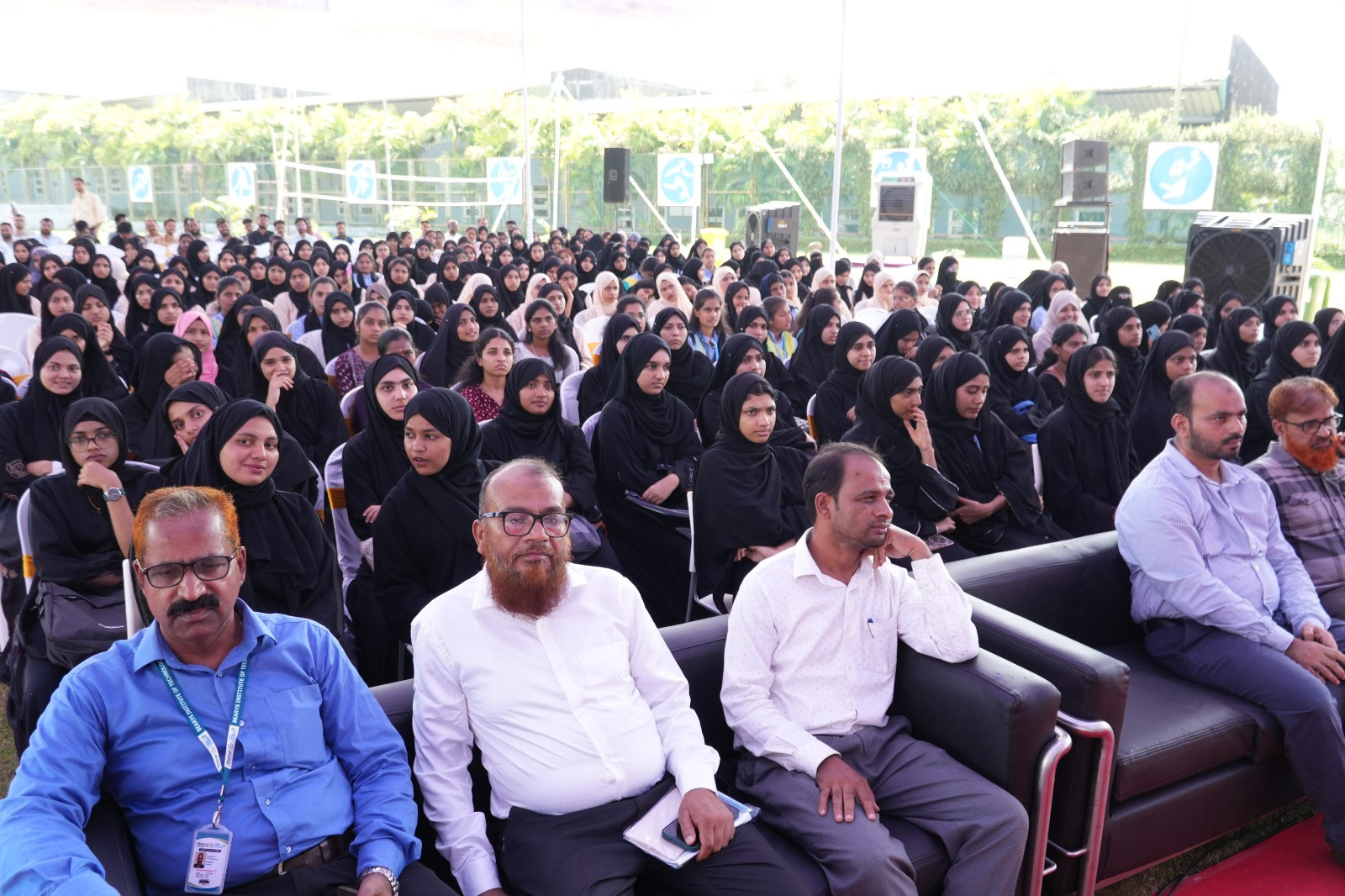
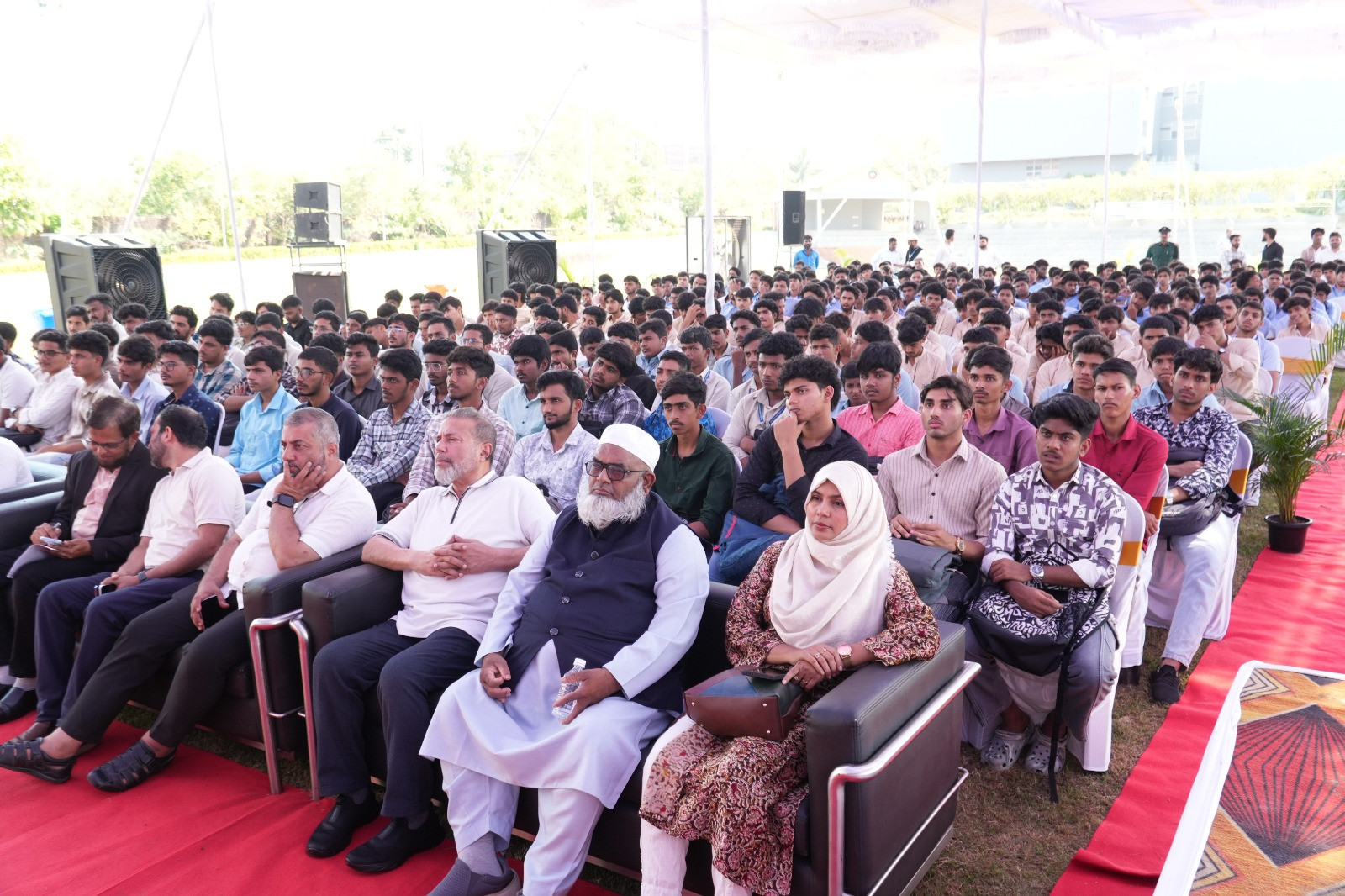
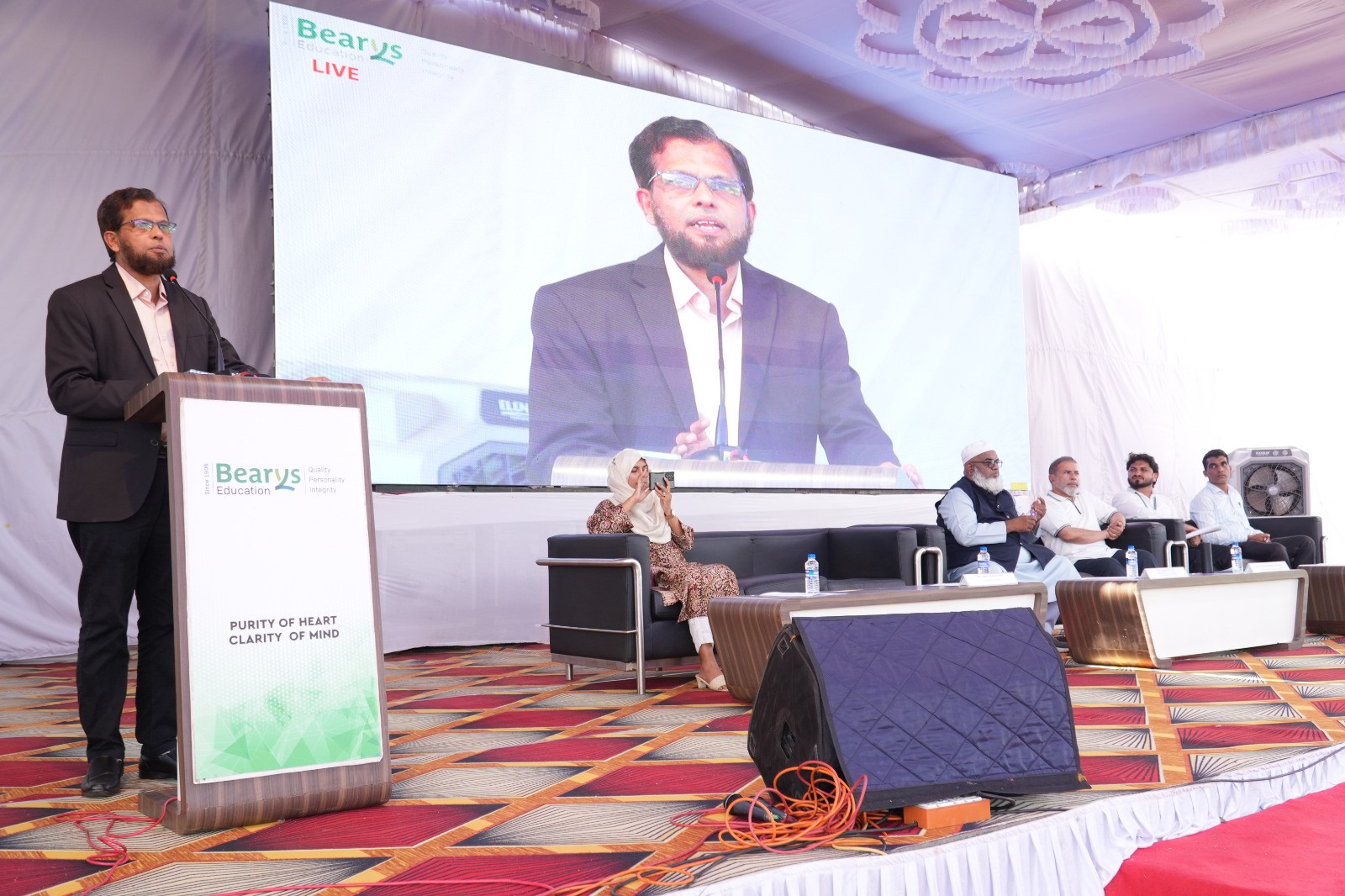
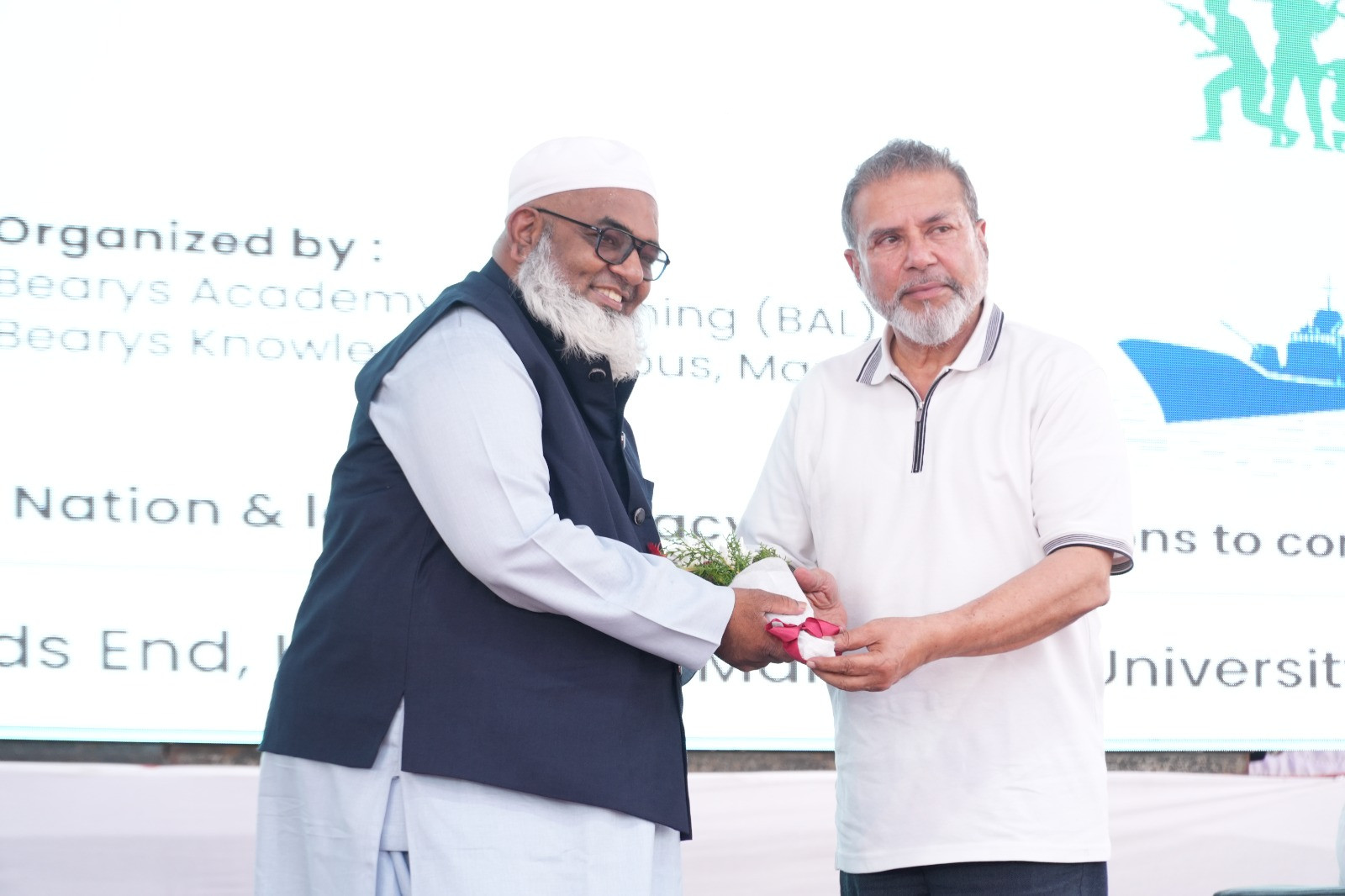
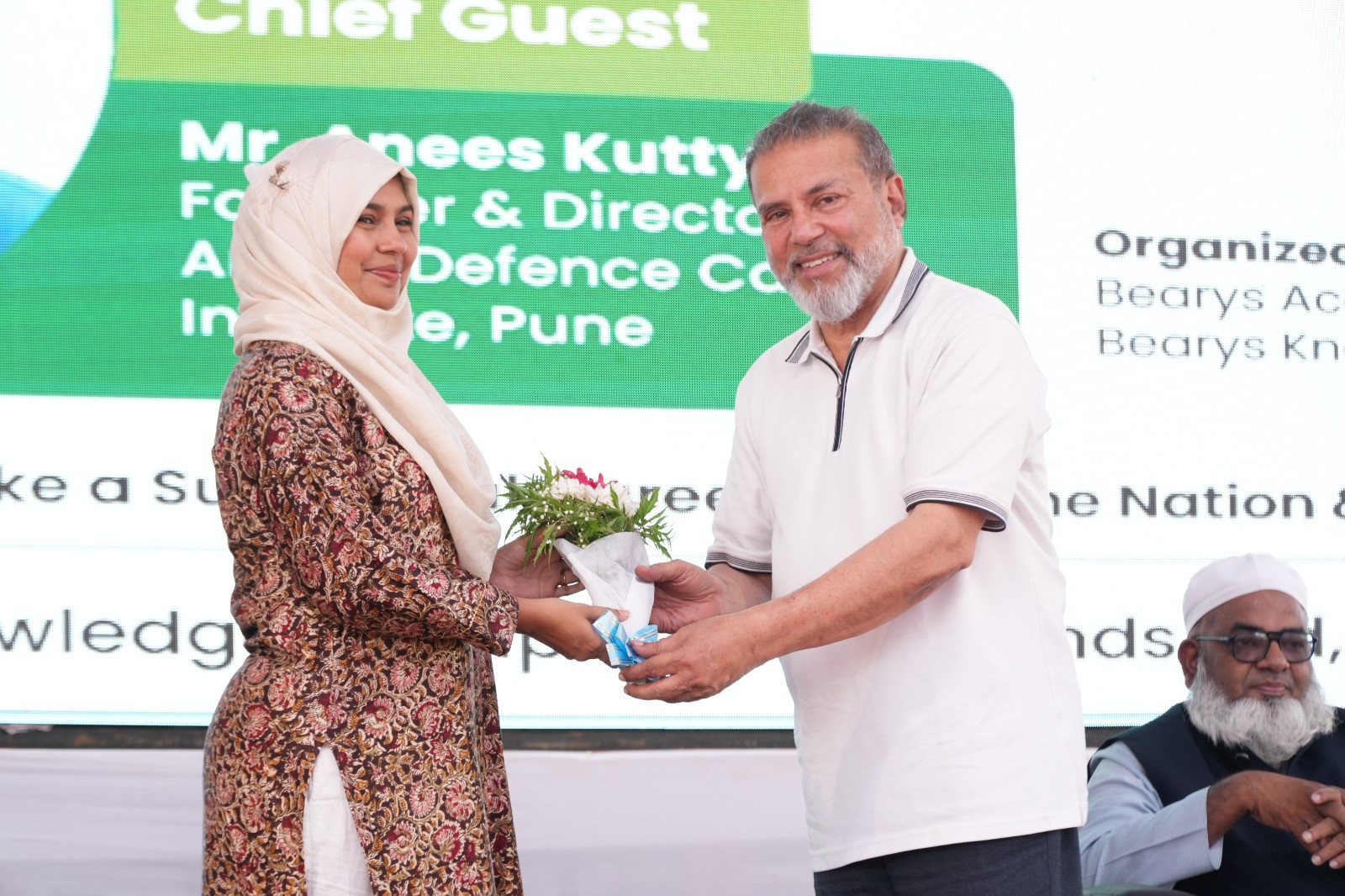
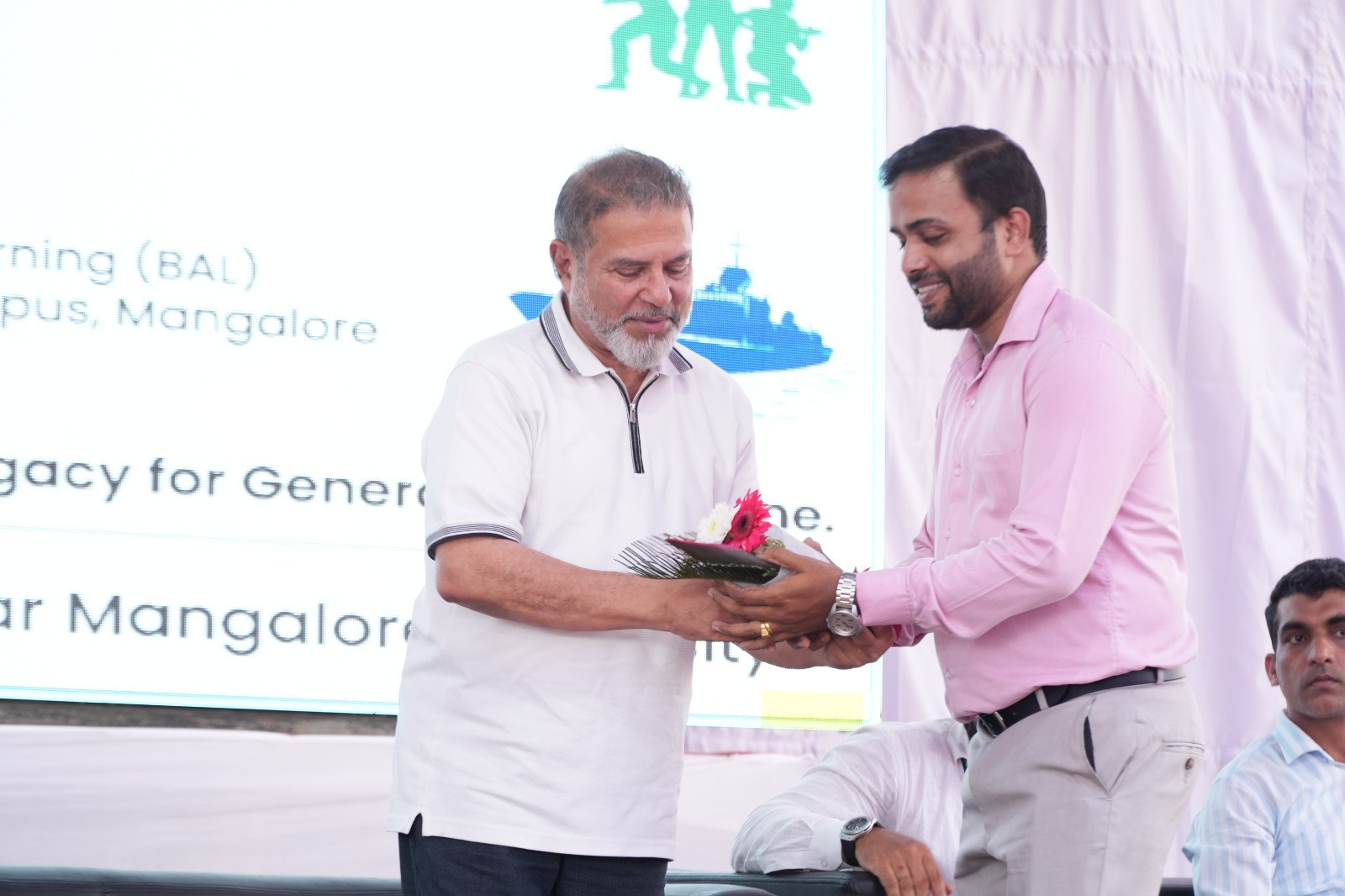
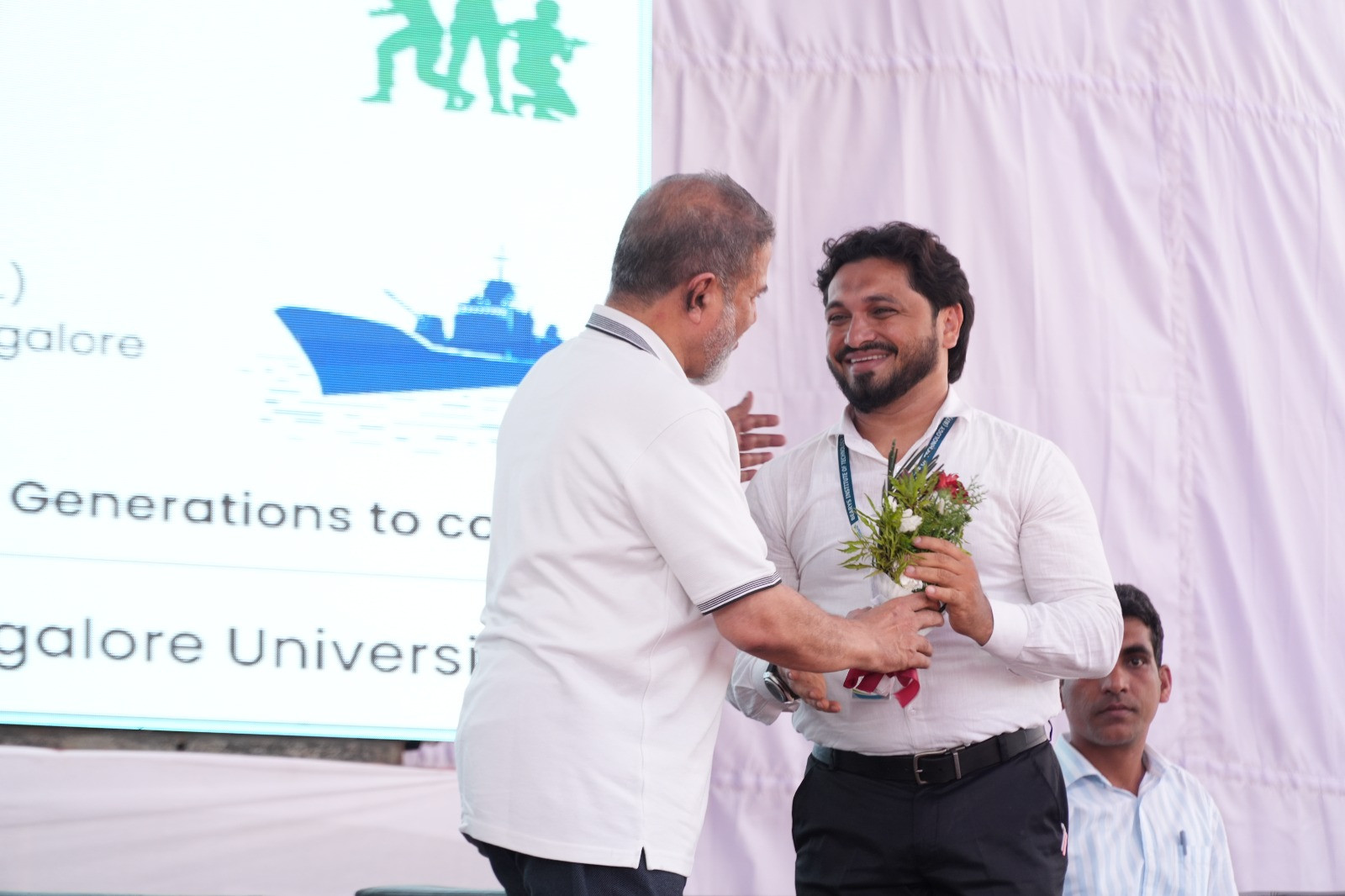
A career guidance session titled “Exploring Careers in Defence: Opportunities and Preparation” was held at Bearys Academy of Learning (BAL), Bearys Knowledge Campus, Innoli, on Sunday, October 12, 2025. The programme aimed to guide and motivate students from diverse academic streams to explore career opportunities in the Indian defence services.
The session was inaugurated by Syed Mohamed Beary, Chairman of Bearys Academy of Learning, who delivered the opening remarks. He highlighted the valuable work done by Anees Kutty, Founder and Director of Anees Defence Career Institute (ADCI), Pune, in mentoring and preparing youth for careers in the armed forces.
Beary observed that many young graduates from Mangaluru often seek employment in Gulf countries after completing their studies. Drawing a comparison between conventional jobs and defence careers, he said that serving in the armed forces brings immense pride not only to the individual but also to the entire family.
He further remarked that a majority of personnel in the Indian defence forces hail from northern parts of the country, and it is time for youth from southern India, particularly from Dakshina Kannada to take active interest in this sector. Citing the example of Kodagu, a region known for its significant representation in the armed forces, he urged students from the coastal belt to follow suit. He also encouraged female students to explore various roles and opportunities available in the defence sector.
The keynote session was conducted by Anees Kutty, who has over 36 years of experience as a Defence Career Counsellor. Through a detailed two-hour interactive presentation, he explained different career pathways in the defence sector, covering examinations such as NDA, CDS, AFCAT, and SSB, and discussed career prospects in premier institutions like ISRO, DRDO, Agniveer, RMS, RIMC, and Sainik Schools.
Kutty also elaborated on how various engineering specializations can help candidates qualify for technical and research roles within the defence services. He highlighted the scholarships and government-sponsored programmes available for aspiring candidates, emphasizing that both the government and the defence forces provide financial and institutional support for education and training before official recruitment.
He reminded students that success in the defence sector demands passion, consistency, and perseverance, noting that the preparation process is long and requires dedication and discipline.
In his concluding remarks and presidential address, Syed Mohamed Beary announced three major commitments for Bearys Academy of Learning: Establishment of a National Cadet Corps (NCC) unit at the campus, Appointment of a Colonel as campus administrator, who will also provide SSB training to students, Setting up of a Defence Career Counselling Centre within the campus to assist students aspiring for defence services.
The programme was hosted by Joyson Miranda.
Dr. Manjur Basha, Principal of Bearys Institute of Technology (BIT), Mangaluru, welcomed the gathering, while Abdul Latif, Principal of Bearys Pre-University College (BIPUC), proposed the vote of thanks.
Dr. Sadaf, Administrator of Anees Defence Career Institute, and Prof. Mohamed Sinan, Head of the Department of Computer Science and Engineering at BIT and the coordinator of the event, were present on the dais.
source: http://www.english.varthabharati.in / Vartha Bharati / Home> Karavali / by Vartha Bharati / October 12th, 2025
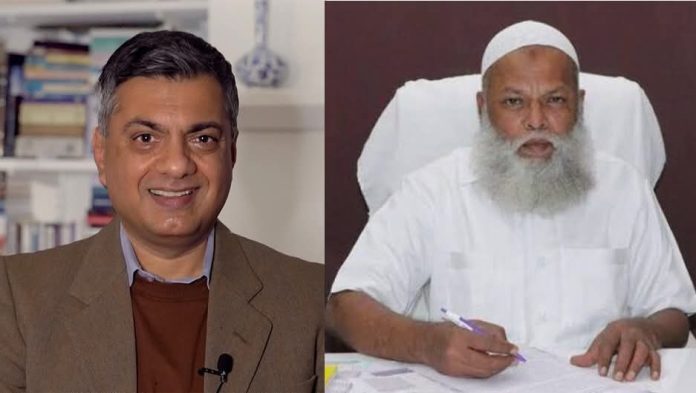
Prof. Faisal Devji (L) and Dr Abdul Qadeer to receive Sir Syed Excellence Awards
Aligarh:
Aligarh Muslim University (AMU) has announced the recipients of the 2025 Sir Syed Excellence Awards, which will be presented during the Sir Syed Day Commemorative Ceremony on October 17, marking the birth anniversary of AMU founder, Sir Syed Ahmad Khan.
Prof. Shafey Kidwai, Director, Sir Syed Academy, and convener of the jury informed that the International Sir Syed Excellence Award will be conferred upon Professor Faisal Devji, Beit Professor of Global and Imperial History, Balliol College, University of Oxford. Widely regarded as a leading scholar of South Asian studies, Islam, globalisation, and ethics, Prof. Devji holds a Ph.D. and M.A. in Intellectual History from the University of Chicago and a B.A. (Double Honours) in History and Anthropology from the University of British Columbia.
Born in Tanzania, Prof. Devji has taught at institutions, including Yale, Cornell, Harvard, and the University of Chicago. His acclaimed works include Waning Crescent: The Rise and Fall of Global Islam, Muslim Zion: Pakistan as a Political Idea, and The Impossible Indian: Gandhi and the Temptation of Violence. His influential essay Apologetic Modernity explores the 19th-century Muslim engagement with modernity, particularly through the lens of Sir Syed Ahmad Khan and the Aligarh Movement.
The National Sir Syed Excellence Award will be presented to Dr. Abdul Qadeer, Chairman of the Shaheen Group of Institutions, for his transformative contributions to education among marginalised communities. Founded in 1989, the group now educates over 20,000 students with a faculty of 500+ across 13 Indian states. It operates schools, PU and degree colleges, and offers coaching for NEET, JEE, UPSC, as well as runs Hifz-ul-Quran Plus and Madrasa Plus programmes.
The awards, carrying cash prizes of ₹2,00,000 (international) and ₹1,00,000 (national), recognise exceptional contributions in Sir Syed Studies, South Asian Studies, Urdu Literature, Medieval History, Social Reform, Communal Harmony, Journalism, Interfaith Dialogue, and related fields.
Awardees were selected by a distinguished jury chaired by Prof. Azarmi Dukht Safavi and comprising Prof. Anisur Rehman, Prof. A.R. Kidwai, Prof. Imtiaz Hasnain, and Prof. Shafey Kidwai, with final approval by AMU Vice Chancellor Prof. Naima Khatoon.
source: http://www.radiancenews.com / Radiance News / Home> Pride of the Nation> Awards> Latest News / by Radiance News Bureau / October 09th, 2025
The Maulana Afzal Hussain Ideal Teachers Award 2025 and Students’ Felicitation Programme were held here Sunday to celebrate dedicated educators and outstanding students.
Teachers play a pivotal role in shaping a nation’s future, and societies that honour their teachers set a benchmark for others to follow.
Reflecting this spirit, the All India Ideal Teachers Association (AIITA), which has been active in Mumbra since 2019, organised the event to recognise exemplary teachers for their service and commitment to education.
The award is named in the memory of Maulana Afzal Hussain, a distinguished educationist and author of several books. This year, the AIITA Mumbra Award Committee selected 26 teachers from various institutions for the honour. The awards, presented annually on World Teachers’ Day, cover multiple categories including Primary, Secondary, and Headmaster levels, from schools in Mumbra, Thane, and Mumbai Municipal Corporation areas.
The Award recipients at the level of private educational institutions included Khan Safia (Al-Ehsan School), Altaf Patel (Abdullah Patel School), Lubna Khot (Central Public School), Khan Sadaf (Rafiqah School), Qazi Alia (Dr. Asadullah School), Syed Rizwana (Mumbra Public School), Syed Feroza (National School), Sheikh Zaheer (Nice School), Zahida Chotani (Patel School), Ansari Nasreen (Sameeya English School), Rukhsanda Khan (Saadia School), Shabana Azmi (Shoaib School), and Sadiqa Sheikh (Saadia Primary School).
In the Mumbai Category, the Award recipients included Arshia Shah (Vakola Municipal School), Mehboob Makandar (Vanoba Bhave School), and Ismail Bagwan (Anjuman Khair-ul-Islam School),
In the Thane Municipal Corporation Category, the Award recipients included Fatima Naz (TMC 116), Halima Qazi (TMC 117), Tabassum Khan (TMC 124), Syed Sameena (TMC 125), and Sufyan Ansari (TMC 40),
Thane Headmaster Category, the Award recipients included Mansoori Tehzeeb (Sameeya School), Ansari Tasneem (TMC 13), Syed Sana (Leader School), and Sheikh Khairul-Nisa (Abdullah Patel School).
A posthumous award was also conferred upon Late Naheed Fatima Zainuddin Jamali Sahiba of Abdullah Patel School in recognition of her lifelong contribution to education.
The event was presided over by Advocate Jasim Sheikh, with Dr. Abdul Majid Ansari serving as the Chief Guest. Distinguished guests included Professor Javed Sheikh (JIH Local Ameer of Mumbra), Khan Najma (President, GIO Mumbra), and Ansari Nasir of Khidmat Khalq Trust.
In addition to teacher awards, students from 24 schools were felicitated for their academic achievements in the 10th and 12th board examinations.
The event, held at Sania Hall, witnessed an enthusiastic turnout of teachers, students, and community members. Members of AIITA Mumbra and the Markazi Talimi Board Mumbra played a key role in organising and ensuring the success of the programme.
source: http://www.radiancenews.com / Radiance News / Home> Pride of the Nation> Awards> Latest News / by Radiance News Bureau / October 07th, 2025
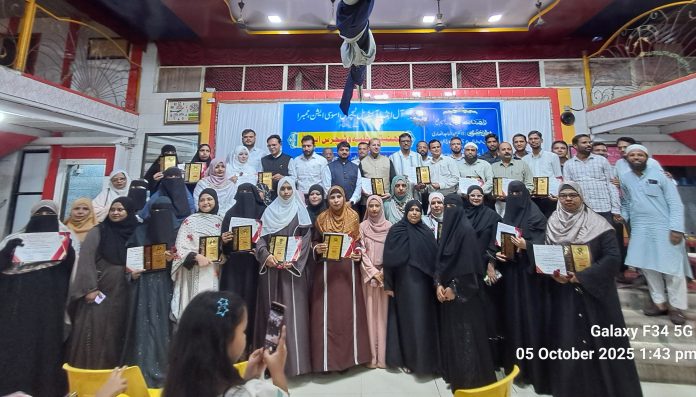
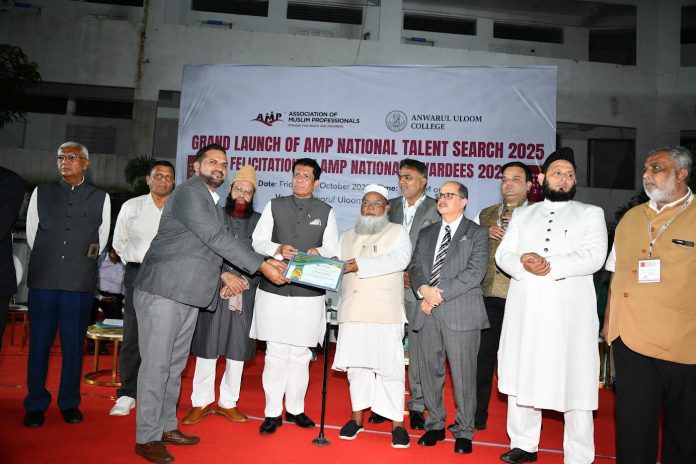
Dr Shahnawaz Ahmed Malik, Assistant Professor, Department of Law, Aligarh Muslim University Malappuram Centre, Kerala, has been conferred the AMP National Award for Educational Excellence 2025 by the Association of Muslim Professionals (AMP) in recognition of his distinguished contribution to legal education and institutional development.
The award was presented during the AMP National Awards Felicitation Ceremony 2025, held at Anwarul Uloom College, Hyderabad, in the presence of AMP President Aamir Idrisi and several eminent educationists and community leaders.
Dr. Malik, who has been associated with AMU Malappuram Centre since 2013, has played a key role in developing its Department of Law. He has established several academic and professional societies to promote advocacy skills among students and contributed to enhancing the Centre’s academic profile.
His teaching and research focus on Constitutional Law, Administrative Law, Human Rights, and Legal Theory. He has also served as a member of the AMU Court and Academic Council and currently holds the positions of Deputy Proctor and Coordinator, Department of Law, at the AMU Malappuram Centre.
source: http://www.radiancenews.com / Radiance News / Home> Pride of the Nation> Awards> Latest News / by Radiance News Bureau / October 11th, 2025