Prof. Tokeer Ahmad at the Department of Chemistry, Jamia Millia Islamia has been conferred with the prestigious Chemical Research Society of India (CRSI) Bronze Medal for the year 2025 at the 35th CRSI-ACS National Symposium in Chemistry & ACS Lectures held at IIT Gandhinagar from July 3-5, 2025. Prof. Ahmad has been awarded CRSI Medal in recognition of his impactful research contributions in Chemistry on Hydrogen Energy and Nanocatalysis.The CRSI Medal is the highest honor by CRSI and is among the top awards in Chemical Science given in recognition of outstanding contributions in Chemistry which have significant impact through leading research and high quality publications.
Prof. Ahmad delivered the CRSI Bronze Medal Lecture titled “Designing of Functional Heterostructures for Scalable H2 Production using Overall Catalysis” at the symposium.
Prof. Tokeer Ahmad, a Fellow of Royal Society of Chemistry (FRSC), has graduated from IIT Roorkee and holds a Ph.D. from IIT Delhi. His research interest includes the designing of functional heterostructures for green hydrogen energy, CO2RR & NRR for applications in climatic sustainable environment. Prof. Ahmad has supervised 16 PhD’s, published 228 research papers and three books with research citation of ~10,000, hindex of 59 and i10-index of 186. Prof. Ahmad is also the recipient of MRSI Medal, SMC Bronze Medal, ISCAS Medal, Inspired Teacher’s President of India Award, DST-DFG award, IIT Delhi Alumni Faculty Award, Distinguished Scientist Award, Dr. S. S. Deshpande National Award, Maulana Abul Kalam Azad Excellence Award of Education, Teacher’s Excellence Award and elected as Member of National Academy of Sciences India. Prof. Ahmad has figured in World Top 2% Scientists for consecutive five years since 2020 in both coveted lists including career long by Stanford University, USA. Vice-Chancellor, Jamia Millia Islamia, Prof. Mazhar Asif and Registrar JMI, Prof. Md. Mahtab Alam Rizvi congratulated Prof. Ahmad and expressed their happiness on his outstanding achievement bringing laurels to the university. Prof Ahmad said that he was honoured and elated at the recognition bestowed on him, especially, as it testifies to the extraordinary research work undertaken by him on the production of Green Hydrogen Energy. Prof. Ahmad thanked the team of hard working students, collaborators, mentors, friends and family members for the Medal Award.
The Chemical Research Society of India (CRSI) was established in 1999 as part of the 50th anniversary celebrations of the country’s independence. The main objectives of the CRSI are to recognize, promote and foster talent in Chemistry and Chemical Sciences and to improve the quality of Chemical Education as well as research in all branches of Chemistry. CRSI recognizes outstanding achievements in chemical research through awards, grants, and medals. The society has active collaboration with the Royal Society of Chemistry, American Chemical Society, Asian, German, and French Chemical Societies.
source: http://www.jmi.ac.in / Jamia Millia Islamia / by Office of Chief Public Relations Officer, JMI / July 10th, 2025
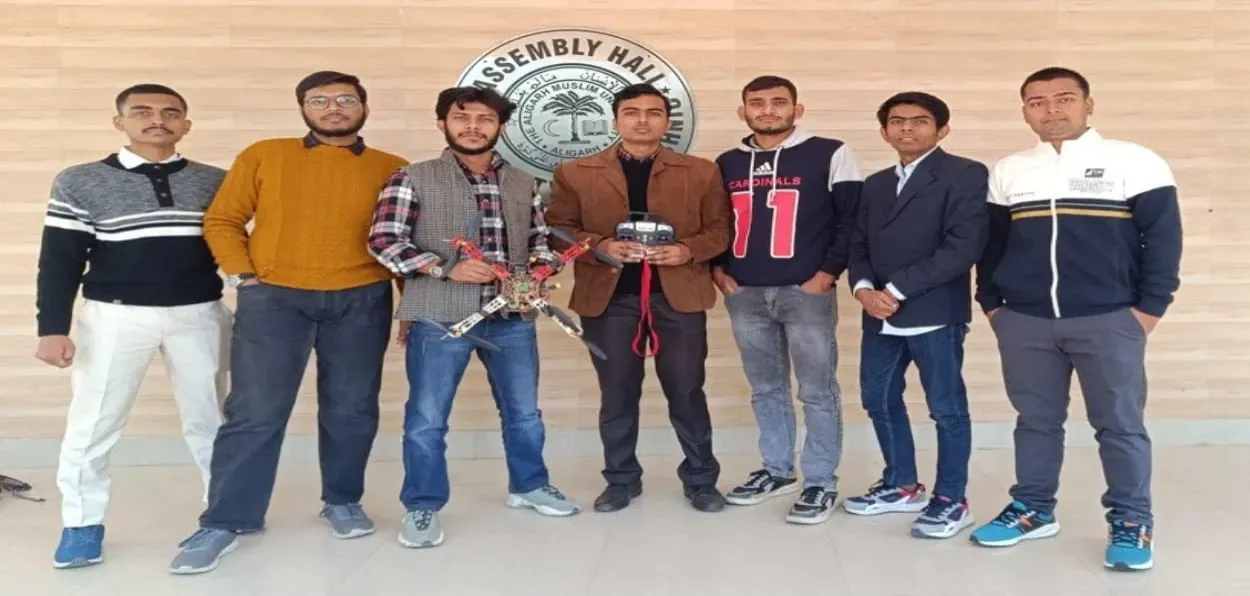
Students of AMU with their delivery drone prototype
Aligarh :
Showcasing creativity and technological ingenuity, a team of final-year students from the University Polytechnic, Faculty of Engineering and Technology, Aligarh Muslim University (AMU), has developed a Delivery Drone Prototype, a promising step towards autonomous aerial delivery systems.
Guided by former Principal of University Polytechnic, Prof. Arshad Umar and Dr. Tanveer Hasan, Associate Professor at the Polytechnic, the student team comprising Saubaan Ahmad Siddiqui, Ehtesham Ahmad, Shabab Khan, Ankit Tomar, Anas Khan, Muzaffar Hussain, and Omaan Ahmad Ansari successfully carried out six autonomous delivery missions within the university campus over a span of two months.
Equipped with real-time video streaming, autonomous navigation, gesture-controlled backup, and a custom dashboard to track flight data and delivery paths, the drone highlights the university’s commitment to hands-on, interdisciplinary learning.
This initiative is part of AMU’s larger vision to promote student-led innovation and applied research in emerging technologies. The project has received wide appreciation in academic circles for its relevance to real-world logistics, emergency response, and smart campus solutions.
Although this is a prototype for academic use, the team plans to enhance the system with AI-based object detection and an expanded operational range, reflecting the university’s emphasis on innovation-driven education and future-ready skills.
source: http://www.awazthevoice.in / Awaz, The Voice / Home> Stories / by Aasha Khosa, ATV / July 28th, 2025
How a series of breakfast conversations grew into an exhibition and a book.
On some mornings, Diba Siddiqi would sit down at the breakfast table in her parents’ home in Bengaluru, and record her father’s voice.
He would hold forth on everything under the sun – science, history, justice, conflict, photography, politics, poetry, philosophy, the evolution of language and silence. The musings continued well after the meal was over and an Olympus digital voice recorder Diba Siddiqi had placed nearby would capture her father’s thoughts.
The sheer range of topics wasn’t surprising. Obaid Siddiqi was one of India’s most eminent scientists whose pioneering work in the field of molecular biology and neurogenetics are well known.
Siddiqi was keen to have an account of her father’s stories in his own voice so that she could revisit them later. She had tried taking notes, but found the process distracting. She started using the digital recorder so that she could give him his full attention.
But the recordings, which started in 2007, ended in 2013 when the senior Siddiqi was killed in an accident while taking a stroll near his home. He was 81.
Immersed in history
Months later, Diba Siddiqi finally revisited the “breakfast monologues” as she called them.
She immersed herself in the stories her father had shared of growing up in eastern Uttar Pradesh in pre-Partition India and the sadness at how the Siddiqis lost track of family members who moved to Pakistan.
It wasn’t long before Siddiqi began to dig through old family photographs, many of them developed in darkrooms by her father and his siblings.
It didn’t stop at that. Diba Siddiqi’s mother, Asiya, is a distinguished historian, who has spent a large part of her life studying Mumbai’s past. Siddiqi began to delve into her mother’s life too.
The result is Rooh: The Enduring Spirit, an exhibition of old family photographs interspersed with new images Diba Siddiqi has taken of places that played an important part in her parents’ lives. A book of the same name is set to be released shortly.
Dominating figure
It’s obvious that Obaid Siddiqi was an overarching presence for his daughter. “My father was this colossal figure in my life,” said Siddiqi. “No language is adequate to express his continuing presence in my life. I still find myself quietly and unconsciously carrying on conversations with him.”
Born in Basti, Uttar Pradesh, in 1932, Obaid Siddiqi completed an MSc from Aligarh University before obtaining a doctorate from the University of Glasgow in Scotland. His family lived in Benares in two spells between 1932 and 1948 before finally settling down in Aligarh.
Preventive detention
The includes an account of the two years Obaid Siddiqi spent in jail from 1949 under preventive measures at a time when 30,000 communists were detained across country. Recalling his period of detention in the company of 13 Communist leaders, he said:
“So you see jail authorities, they used the criminals, who were called pukkas, to beat us up. They were prisoners who had served ten years, fifteen years, had life imprisonment… They acted like small unofficial wardens to control other prisoners. They were dressed to look like police. They beat up our friend Syed Ali badly, giving him galis, saying, ‘Pakistan se saala Pakistani Communist banta hai!’
However, Obaid Siddiqi could also recognise the benevolent side of the police officer who had beaten up the comrades, realising that human nature can never be categorised as entirely good or bad.
His parents and six siblings managed to send him letters during his imprisonment. His sisters arranged to smuggle letters in and out of jail while delivering home-cooked food to him once a week.
In 2014, Siddiqi visited Benares, where her father spent some time as a child. Waking at the crack of dawn every day, she walked around the ancient city, photographing the people and its streets.
Mumbai chronicler
Siddiqi also took many pictures in Mumbai, a city whose past her mother has written about extensively. One of Asiya Siddiqi’s celebrated works recreates the lives of people who went bankrupt in the 19th century. Roaming the bylanes of Mohammad Ali road and Dongri, in Mumbai, Siddiqui imagined that the ghosts of these people “and their descendants surely dwell in the neighbourhood I roamed in… The descendants of tailors, carpenters, blacksmiths, milk vendors, courtesans, dancing girls and prostitutes may continue to live and work here.”
Though the project is intensely personal, she believes it has broad appeal. She said she hoped viewers would let her work touch their mind and spirit and perhaps remind them of their own histories. “It is an expression of life that I have been a part of,” she said. “It has been about finding a voice in the images and bringing it together in one space.”
Rooh: The Enduring Spirit can be viewed at Bangalore’s 1 Shanthi Road gallery until February 11.
source: http://www.scroll.in / Scroll.in / Home> Photo Feature / by Zinnia Ray Chaudhuri / February 09th, 2016
Obaid Siddiqi, one of the most outstanding scientists of modern India, died in a freak accident in Bangalore on July 26. While he was out on a walk on July 21, a moped being driven by a young person of the neighbourhood rammed into him, and caused severe brain damage from which he could not recover.
He leaves behind his wife, Asiya Siddiqi, who is herself a very distinguished historian, and four gifted children: Yumna, whose area is English literature, Kaleem, who is a scientist, Diba, a promising photographer, and Imran, also a scientist whose work on seed-cloning has the potential to revolutionize agriculture in developing countries and questions the rush to Bt for raising yields.
But I want to talk not about the family that Obaid and Asiya raised but about the family of siblings and their spouses that surrounded Obaid, the larger family, as it were, to which he belonged. It was such a remarkable family, it so captured within itself all that is salutary in the development of modern India, that its individual members are worth recalling.
There were two sons, including Obaid, and five daughters, born to his parents. The youngest daughter, Imrana, married to the well-known social activist, Anubrata (Dunu) Roy, was a paediatrician at the All India Institute of Medical Sciences who turned to academic work in the social sciences and became one of the founders of the Centre for Social Medicine and Community Health at the Jawaharlal Nehru University. This centre, of which Binayak Sen was once a faculty member, remains to this day an unparalleled institution in India.
She was for decades our neighbour on the JNU campus. She was not just a close friend but one who epitomized what friendship should be, and it is through her that I came to know the remarkable Siddiqi family. Being a doctor in residence, in the early years of JNU when the campus had meagre medical facilities, she was the informal physician for every household, cheerfully available day and night; and she saw my family, especially my two children, through numerous medical emergencies. Because of her unbounded generosity, we called her “the Florence Nightingale of the JNU campus”; but that was unfair to her, since she was also a highly skilled medical practitioner, unlike Florence, and combined her expertise with a radical social philosophy.
One of her older sisters, Maimoona, was married to Ali Ashraf, a founder of the communist party in Bihar, and the first to translate the Communist Manifesto into Urdu. (Maulana Azad had earlier translated and published only some extracts in his newspaper.) Maimoona was herself a communist activist, and, together with her husband, worked at the party headquarters in Bombay bringing out its Urdu newspaper, and lived in the famous party commune set up by its general secretary, P.C. Joshi. In later years, she taught Urdu first at the Patna College and subsequently at the Aligarh Muslim University.
Ali Ashraf’s friend, Ziaul Hasan, also a very early member of the communist party in Bihar, married another of the Siddiqi sisters, Tahira, and also lived for long at the Bombay party commune while working for the party’s Urdu newspaper. B.T. Ranadive, then in ‘disgrace’ following the collapse of his 1948 line, was at the same commune and comrades were somewhat circumspect about socializing with him; but the Hasans struck up a deep friendship with him. Ziaul Hasan was then sent to Srinagar to work with Sheikh Abdullah, when the latter sought the help of the communists for carrying out land reforms in the state. Jammu and Kashmir, as is well-known, was the first state in India, even before Kerala and West Bengal, to implement radical land redistribution. He and his family lived with Imrana on the JNU campus for some years when he was working as a journalist on the staff of the Patriot newspaper, and my discussions with him on several evenings, when he would be reminiscing about the commune or berating me for my sectarian understanding, are a treasured memory.
Yet another of the sisters, Sayera, a highly distinguished economist who taught at the Aligarh Muslim University, was the first person, after the nationalist writers of the colonial period, to make an estimate, and a meticulous one at that, of the magnitude of “the drain of surplus” from India to Britain. A life-long communist, she married a fellow student against whom she had once taken disciplinary action as the All India Students Federation leader on the AMU campus. This fellow student, belonging to the AISF, was Irfan Habib, the famous historian and pre-eminent Marxist intellectual of the country.
The last sister, Shaista, was attached to the medical college at AMU and built from scratch its department of obstetrics and gynaecology. The other brother, Aslam, also belonged to the AMU faculty, to the department of engineering. He was asked to set up the university’s computer centre; he did so and served as its director for some time.
Obaid Siddiqi belonged to this family. All the traits that characterized the family, the generosity, the brilliance, the gentleness, the self-effacing commitment to work, the contempt for careerism, and the disdain for fame and status, were concentrated, as it were, in him. And he also shared the family’s social commitment and passion for effecting a revolutionary transformation in the country. Irfan Saheb once remarked to me that Obaid Siddiqi must have been the only Fellow of the Royal Society in its entire history who had spent time in jail for communist activities. That was during the “BTR period”, following the party’s Calcutta congress, when Obaid was an activist of the AISF at the AMU.
His passions included Urdu poetry (he was chancellor of the Urdu University at Hyderabad), Persian, and above all, music. He learned to play the sarod from Annapoorna Devi, and played it beautifully. He was meticulous about doing riyaz everyday, and later took lessons from the Dagar brothers who became his good friends.
I met Obaid Siddiqi occasionally on the JNU campus when he stayed overnight at Imrana’s place, having come for some meeting from Mumbai where he was then located at the Tata Institute of Fundamental Research. But I got to know him better when he came to deliver the Krishna Bharadwaj Memorial Lecture at the Centre for Economic Studies and Planning of JNU. The topic was “Do animals think?” and Obaid Siddiqi gave, in very simple language to a packed and overflowing audience, an account of his internationally acclaimed research into the neurology of the Drosophila fly. His answer to the provocative question of the title of the lecture was that while “thinking” was too ambitious a term to describe what animals did, several very elementary forms of it, suggesting a more developed consciousness beyond mere instinct, appeared to characterize them. The discussion that followed the lecture carried over into dinner and long afterwards into the night.
I met him a little more frequently when we both served on the research council of the National Institute of Science, Technology and Development Studies of the CSIR. But I got a chance for closer interaction at the convocation of the Kalyani University in 2003. By then he had moved to Bangalore where the TIFR was setting up an off-shoot for research on biology; he had been asked to head it and had already gathered around him a brilliant group of young researchers. Kalyani University was conferring an honorary doctorate on him, and on Sunil Gangopadhyay and Ganesh Pyne; and I had been asked to deliver the convocation address. We were lodged together at the same guest house for the event.
His acceptance speech was brief but extraordinarily illuminating. It was based on research work done at the Indian Statistical Institute, Calcutta, and highlighted the fact that the Indian population, barring small numbers inhabiting remote regions, was remarkably racially mixed, and hence far less diverse than commonly supposed. His interest in the area had possibly been stimulated by his radicalism, which approved a scientific finding that undermined any racial segregation of the population; but he referred only to the scientific finding itself.
Obaid Siddiqi was a compelling speaker, without flourishes, but with a solid command over facts and a meticulousness of reasoning that did not allow one’s attention to stray. His using the brief Kalyani speech to present what he thought was interesting rather than his own research is indicative of an attitude that values scientific advance over personal achievement, and sees knowledge as interconnected. He shared this perception of interconnectedness of knowledge with his friend, another great scientist from the subcontinent, Abdus Salam; it lifted him above the normal run of scientists into an outstanding intellectual. His death is a huge loss to the country.
_________________
The author is Professor Emeritus, Centre for Economic Studies, Jawaharlal Nehru University, New Delhi / Prabhat Patnaik The Author Is Professor Emeritus, Centre For Economic Studies, Jawaharlal Nehru University, New Delhi
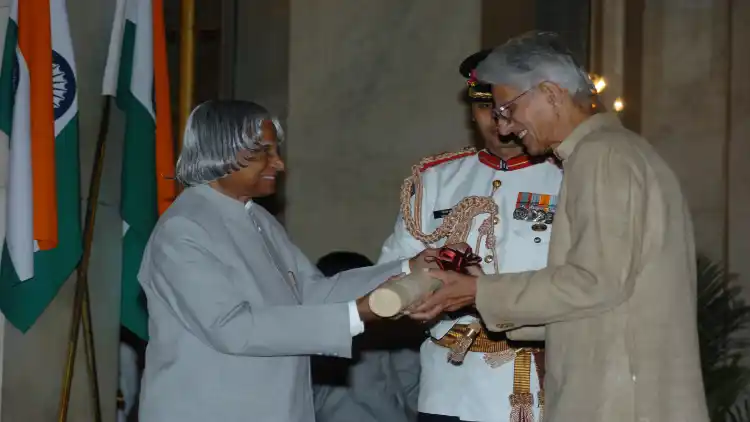
Obaid Siddiqui receiving Padma Vibhushan from the President
Genes and DNA are the words we hear frequently on our Televisions and other media. Genetic mapping has revolutionised the way humans understand organisms in general and themselves in particular. The past few decades have witnessed developments in biotechnology and genetics leading us to understand and treat diseases hitherto thought curable. Very few among us know that one of the important men who laid the foundation of this revolution was an Indian, Obaid Siddiqui.
Born on this day in 1932 in Basti, Uttar Pradesh, Obaid Siddiqui completed his Masters in Botany from Aligarh Muslim University (AMU) in 1953. Initially, he joined AMU as an agricultural scientist, after his Masters, and later moved to Indian Agriculture Research Institute (IARI), New Delhi. At IARI Siddiqui had prepared a testbed for wheat crossbreeds. But a devastating hail storm destroyed the crop and ruined his year-long labour. A frustrated Siddiqui, who had a keen interest in genetics, an emerging field at the time, wrote a letter to Professor Guido Pontecorvo at Glasgow asking him for a research opportunity with him. Pontecorvo accepted him and Siddiqui started his PhD at Glasgow on microbial systems – a paradigm shift from Botany.
During his PhD, Obaid made some path-breaking observations, which revolutionised the field of Genetics. Two very important observations made by him were:
His studies were the first reports of fine mapping of a gene.
He pointed out the concentration of mutational sites in a small part of genes.
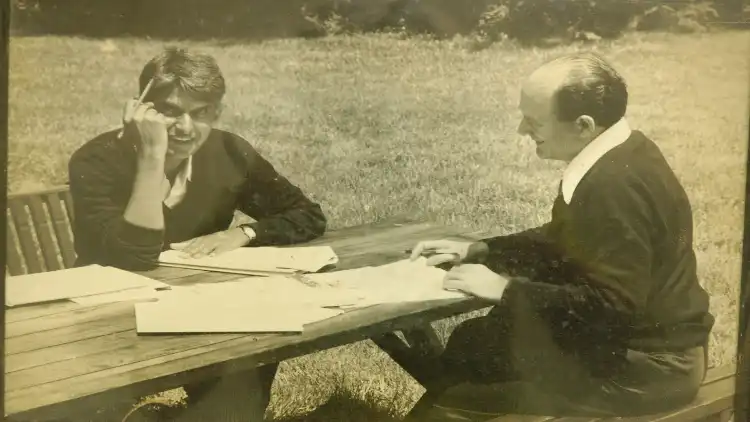
Obaid Siddiqui with Semour Benzer
So, when he submitted his PhD thesis in 1961 Siddiqui had already revolutionised the sciences in general and genetics in particular. Considering the fact that he shifted from Botany to a different field makes his achievement even more stellar.
The same year Siddiqui moved to Pennsylvania to work with Alan Garen as a postdoctoral fellow. Here, he discovered the suppressors of “nonsense” mutations. In simpler words, he discovered why a few mutations in a gene would not express themselves and remain suppressed. The discovery was a logical result of his earlier pioneering work in mapping of genes. Another important impact of this discovery was the finding of “nonsense” codons, the stop signal of genes. Har Gobind Khorana, Robert Holley, and Marshall Nirenberg received the 1968 Nobel prize for identifying “nonsense” codons and they personally acknowledged the role of Siddiqui in their research.
Siddiqui did not pursue his study of Codons further which got others a Nobel Prize because his heart was not in the USA. Siddiqui wanted to return to India to serve his motherland. This selfless patriot left the lucrative opportunities and told Alan Garen, in 1962, that he wanted to return to India.
Garen asked renowned physicist Leo Szilard to write to Homi Bhabha asking him to arrange a position for Siddiqui in India. Ignoring the opposition from fellow scientists in India, Bhabha showed confidence in Siddiqui and gave him the responsibility of establishing a molecular biology unit at Tata Institute of Fundamental Research (TIFR).
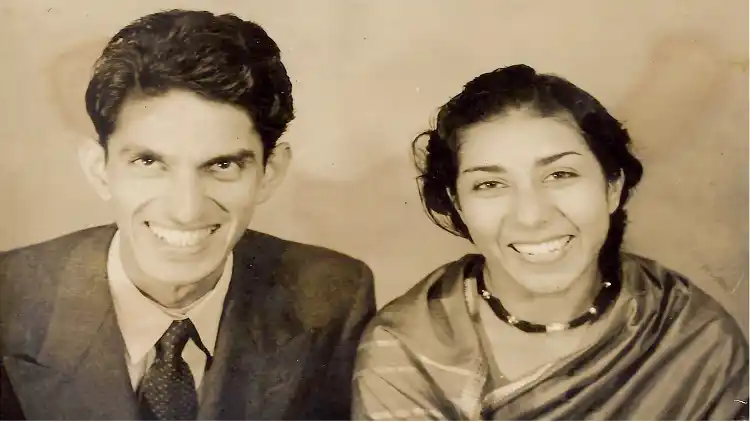
Obaid ASiddiqui with Wife Asiya Siddiqui
At TIFR, Siddiqui nurtured a younger crop of scientists and also brought Indians working in foreign labs back to India. With one of his students, P. Vijay Sarathy, Siddiqui showed that recombinant bacteria inherit DNA of bi-parental origin thus laying the foundation of principles of lateral gene transfer. In layman’s language his findings are the basis of the now well-known principle that genes pass from one generation to another.
With his other students like Kavita Arora and Veronica Rodrigues, Siddiqui showed that taste and smell of Drosophila have a genetic basis and thus opened a new field of chemosensory neurogenetics. These findings led others to research the role of genes on sensory perceptions, learning and memory.
Siddiqui was not a man who would compartmentalize his intellect to one branch of science. He contributed to fields as diverse as plants, Drosophila, bacteria, and genetics. He did not stop at research. He was an institution builder and established the National Centre for Biological Sciences in 1992 in Bangalore. Siddiqui was known for nurturing young minds by giving them the freedom to question.
Moreover, Siddiqui was a man who believed that sciences cannot operate in isolation of society. Scientists have a social responsibility and Siddiqui understood this. He stood for Human Rights, campaigned against communalisation and took part in social movements. Not only a music lover of Hindustani Music, Siddiqui was an established Sarod artist.
Obaid Siddiqui was awarded the second-highest civilian award, Padma Vibhusahan, by the Government of India. He was the true son of the soil who left lucrative offers in a foreign land to establish a research culture in India. His students are now serving the nation, which includes the present Principal Scientific Advisor of India, Professor Vijay Raghavan.
source: http://www.awazthevoice.in / Awaz, The Voice / Home> Stories / by Saquib Salim / July 26th, 2021
From rose syrup to mango panna, Indian Muslims continue the Mughal tradition of crafting cooling summer drinks originally developed by royal physicians.
New Delhi :
Muslims in India proudly carry forward the centuries-old tradition of crafting refreshing drinks that originated in the Mughal era, a time when royal physicians invented syrups not only for their enduring taste but also for immense health benefits.
Salma Hussain, a researcher who has studied Mughal food and drink habits for over fifty years, explained: “Most of the drinks were invented by the royal physicians, who sometimes prepared drinks for medicinal purposes and sometimes for a refreshing taste, and they were very popular.”
She shared how the art of making these drinks flourished under royal patronage, especially during the reign of Empress Noor Jahan, whose influence in the royal kitchen brought many innovations. “Noor Jahan had creative talent. Under her leadership, excellent syrups were developed. The food was also good, tasty. She especially supervised the royal kitchen,” she told Clarion India recently.
Salma recalled an interesting anecdote from the Mughal court: “Once Queen Noor Jahan was strolling in the garden. Rose flowers were in full bloom. Noor Jahan’s mother, Ismat Ara Begum, used to make perfumes from these flowers. Noor Jahan called the royal physician and said many medicines were made from flowers; why cannot a syrup be extracted from the roses? ‘Many people drink in the name of medicine, but you should make something that will relieve us from the heat and be refreshing, and we will also enjoy it.’”
This simple request from the queen gave birth to the now-famous rose syrup, a cooling drink cherished across the Indian subcontinent to this day.
According to Salma, syrups were not limited to rose alone. “Syrups started to be made from roots, like khus syrup; Panna from mango. Similarly, vine syrup came up. Pomegranate syrup was made by cooking sour and ripe fruit, both said to be very beneficial for the skin,” she said. These drinks were especially popular among the royals, famous for their passion for beauty and health.
Salma further highlighted how Indian Muslims and Mughal royalty took special care to combat the intense Indian heat. “The heat in India was extreme, like today’s heat. Kings also used to cool drinks. Emperor Akbar started ordering ice from the mountains.”
The knowledge of cooling drinks extended to using yoghurt, lemon, and various salts to make beverages like shikanji and lassi, which remain popular today.
“Rose syrup was made from flowers, custard from custard. Jamun syrup was made from fruits, vine syrup was made from mango syrup. Yoghurt was used a lot then. We learned how to make raita from it. They used to cool the yoghurt or mix it in water and make a drink,” she said.
She also pointed to the influence of neighbouring cultures: “A syrup came from Turkey, Aryan, which is the buttermilk we drink today. Almonds were used to make a lot of syrups. It is said that in Iran, almonds were put in hot water and savoured.”
Salma stressed the importance of these drinks beyond refreshment. “There are some unsubstantiated stories about drinks, but all of them seem appropriate, such as the first among the sages who made syrup; his name was Fitha Ghoras. Sage Fitha Ghoras was the first to give a medicinal drink the form of a syrup, like a decoction, etc. Over time, the trade in syrup gradually started and all kinds of syrups started being made.”
She also mentioned that in 1906, Hakim Abdul Majeed (founder of Hamdard) made the spirit-enhancing syrup. The same refreshing syrup is still alive, and we drink it to relieve the heat.
The purity and quality of ingredients were also important to the Mughals. Salma explained: “The water mixed in the syrup was from the Ganges, although the Yamuna River was closer to Delhi. Its water was not used because of the belief that it caused diseases.”
Water management was taken seriously: “The Mughals used to inspect water tanks. Special officers were assigned to procure and preserve the Ganges water.”
This careful tradition of preserving royal recipes and using pure ingredients continues in India’s Muslim communities, who keep the memory of Mughal cuisine alive through generations.
Local historian Ahmed Khan commented, “These drinks are not just a part of our culture, they connect us to our glorious past. They remind us of the wisdom of our ancestors and the care they took in making life enjoyable and healthy.”
As the summer sun blazes, families across the subcontinent continue to enjoy these time-honoured drinks, a tribute to the enduring legacy of the Mughal era and the Indian Muslim custodians who have preserved these traditions.
source: http://www.clarionindia.net / Clarion India / Home> Editor’s Pick> Indian Muslims / by Mohammed Bin Ismail / May 26th, 2025
Abdul Basith, a student from the Government Model Higher Primary School in Uppinangady, has been selected to represent India at an international science fair to be held in Japan.
Basith had earlier participated in the prestigious INSPIRE Awards MANAK competition, organised by the Department of Science and Technology, Government of India. He showcased his science model during the national-level exhibition held at the IIT campus in Delhi. Following this, he has now been chosen for the international-level “Sakura Science Fair” in Japan, providing him with a rare opportunity to present his innovation on a global platform.
The model developed by Basith is aimed at helping individuals with special needs, particularly those who have lost their hands. His innovation has been widely appreciated for its social relevance and practical utility.
Abdul Basith is the son of Ilyas Pasha, a resident of Kadavinabagilu. He is a Class 10 student of Tanveerul Islam Madrasa located at the Malik Dinar Juma Masjid and also serves as the General Secretary of SKSBV Tanveerul Islam Madrasa.
In recognition of his achievement, SKSBV Tanveerul Islam Madrasa, Uppinangady felicitated him at a special event.
source: http://www.english.varthabharati.in / Vartha Bharati / Home> Karavali / by Vartha Bharati / June 12th, 2025
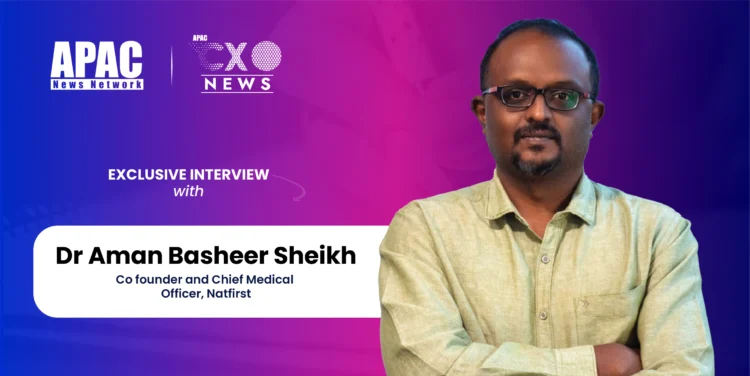
In an exclusive conversation with CXO News and APAC News Network, Dr Aman Basheer Sheikh, Co founder and Chief Medical Officer, Natfirst outlines how they are leveraging AI and data science to disrupt the health tech industry
NatFirst is the parent company of the TruthIn͏͏ app, India’s first consumer product intelligence app, which is the go-to source for understanding packaged food labels. It employs advanced AI,͏͏ including vision models and optical character recognition,͏͏ to͏͏ decode͏͏ product͏͏ labels͏͏ and͏͏ provides consumers with insights͏͏. It analyses the nutritional͏͏ content,͏͏ additives,͏͏ processing level and͏͏ ingredient͏͏ quality by decoding the information disclosed on food labels. A simple barcode scan allows users to access this information. At͏͏ the͏͏ heart͏͏ of͏͏ this͏͏ is͏͏ the͏͏ TruthIn͏͏ Rating͏͏ System,͏͏ which͏͏ translates͏͏ the data͏͏ from labels into͏͏ clear,͏͏ science-backed͏͏ health͏͏ scores.͏͏ These͏͏ insights͏͏ help͏͏ users͏͏ navigate͏͏ a͏͏ market͏͏ flooded͏͏ with͏͏ ultra-processed͏͏ foods͏͏ (UPFs)͏͏, ensuring͏͏ that they͏͏ can͏͏ confidently͏͏ distinguish͏͏ between͏͏ genuinely͏͏ healthy͏͏ options͏͏ and͏͏ deceptive marketing claims.
Natfirst comprises of a multi-disciplinary team of experienced doctors, nutritionists, and tech engineers. This team of experts has developed the TruthIn Rating System (TIRS) by studying best practices of global systems such as Nutri-Score, a nutrition labelling adopted by a few EU countries such as France, Belgium, Germany, Luxembourg, Netherlands, Spain and Switzerland. Other international systems studied include the Health Star Rating system used in Australia and NZ, and Nutri-Grade utilised in Singapore. It has also empanelled an advisory board of eminent multi-disciplinary experts who include, K. Sunitha Premalatha, MSC, RD, PHD, (Cancer Nutrition) and Padmashree awardee Dr Manjula Anagani MBBS, MD (Pathology), MD (Obstetrics & Gynecology), FICOG to ensure the TruthIn Rating methodology is as scientifically accurate as possible. Features in the TruthIn app such as the Match Meter help consumers access personalised guidance by aligning portion sizes with individual health goals, making choosing healthier products much easier.
The innovations͏͏ being developed at Natfirst coincide with the evolving needs of consumers and the demand for healthier, cleaner food products.͏͏ Unlike͏͏ the͏͏ USA or͏͏ EU,͏͏ India͏͏ lacks͏͏ a͏͏ centralized͏͏ database͏͏ of͏͏ packaged͏͏ food͏͏ products. This forced NatFirst͏͏ to build its product dataset͏͏s manually from͏͏ scratch which was a significant challenge but also differentiates Natfirst as one of the few startups in India with such an extensive database.͏͏ With millions of products circulating in the Indian market, the user base of TruthIn has also played an extremely vital͏͏ role in grassroots data͏͏ collection to͏͏ form͏͏ a͏͏ dynamic͏͏ database͏͏ of over͏͏ 16,000͏͏ products which is now set to grow exponentially.͏͏ In that sense, Natfirst is a pioneer in the Indian market with many industry firsts.
Natfirst has also differentiated itself by building a loyal community of users based on trust and consistently promotes its scientifically validated scoring system. Today its flagship product TruthIn, has more than 5 lakh downloads. The brand ambassador of TruthIn is Revant Himatsingka (Food Pharmer), a staunch promoter of scientifically validated information, who has embarked on a mission to educate the average Indian consumer on label literacy. The TruthIn Rating System (TIRS) was specifically designed to help consumers with the most accurate and validated information available to make healthier food choices.
Lastly, to accelerate the process of ensuring that consumers have access to transparent information about all the products, a feature innovation which is very technically challenging is currently being beta-tested. It will enable consumers to analyse products in real-time and TruthIn will become the first app globally to launch such a feature once it goes live.
The 2024 Healthy Snacking report showed that consumers In India are increasingly scrutinising labels. However, the findings of an ICMR NIN report highlighted͏͏ that͏͏ while͏͏ many͏͏ Indians͏͏ read͏͏ food labels,͏͏ they͏͏ rarely͏͏ look͏͏ beyond͏͏ manufacturing͏͏ and͏͏ expiry͏͏ dates—leaving͏͏ them͏͏ vulnerable͏͏ to͏͏ misinformation, unwanted additives͏͏ and͏͏ inaccurate claims.͏͏ This underscores the importance of tech-driven consumer-focused solutions like TruthIn to navigate hundreds of complex food labels that consumers encounter daily.
By analysing product labels͏͏ factoring in things like fats,͏͏ sugars,͏͏ salt,͏͏ chemical additives,͏͏ artificial flavourings, the͏͏ TruthIn͏͏ Rating͏͏ System͏͏ helps users understand their food better. The product rating system developed by TruthIn analyses a lot of complex information and distils it into a 0-5 score that is easily understandable and helps consumers save countless hours deciphering͏͏ complicated͏͏ labels.
An example of this is the flavoured͏͏ yoghurt category; which is very often͏͏ marketed͏͏ as͏͏ a healthy͏͏ snack. However, it may contain synthetic͏͏ colours such as e102, or͏͏ an excess of added sugar.͏͏ TruthIn͏͏ clearly lists all such information,͏͏ connects͏͏ it to͏͏ reputable͏͏ research,͏͏ and͏͏ offers͏͏ healthier alternatives.͏͏ By emphasising transparency, accuracy,͏͏ creation of simplified visuals and decoding complex jargon, TruthIn͏͏ empowers͏͏ consumers to cut͏͏ through any confusion while choosing products.
The importance of tech-driven tools such as TruthIn is becoming evident where over 11% of the population suffers from diabetes and 25% are classified as obese as per the ICMR. NatFirst͏͏ marries͏͏ cutting-edge͏͏ AI͏͏ with͏͏ the͏͏ insights͏͏ of͏͏ doctors,͏͏ nutritionists,͏͏ and͏͏ engineers͏͏ to͏͏ ensure͏͏ that͏͏ health͏͏ recommendations͏͏ are͏͏ both͏͏ scientifically͏͏ solid͏͏ and͏͏ easy͏͏ to͏͏ understand.͏͏ While͏͏ AI-driven͏͏ vision͏͏ models͏͏ decode͏͏ labels͏͏ in͏͏ real-time—exposing͏͏ harmful͏͏ additives͏͏ like͏͏ INS͏͏ 102,͏͏ a͏͏ coal-derived͏͏ dye͏͏ linked͏͏ to͏͏ hyperactivity—human͏͏ experts͏͏ validate͏͏ the͏͏ nutritional͏͏ frameworks͏͏ that͏͏ power͏͏ these͏͏ evaluations. The synergistic approach ensures the recommendations are accurate, easily understandable, and actionable. The nutritional framework under which the TruthIn Rating System (TIRS) has been developed by an expert team of nutritionists and doctors and output including the score is further validated by empanelled experts on an ongoing basis. This is the unique way in which TruthIn blend͏͏s human͏͏ expertise͏͏ and͏͏ AI͏͏ innovation͏͏ to help users͏͏ make͏͏ truly͏͏ informed͏͏ choices͏͏ tailored͏͏ to͏͏ their͏͏ unique͏͏ dietary requirements.
NatFirst͏͏ is͏͏ pushing͏͏ boundaries͏͏ by͏͏ developing͏͏ real-time͏͏ product͏͏ analysis͏͏ and͏͏ looking ahead integrating͏͏ it with Generative͏͏ AI͏͏ (GenAI)͏͏ for͏͏ conversational͏͏ interfaces is something we’re all looking forward to exploring.͏͏ GenAI will enhance the user experience by automating responses, providing instant feedback, and improving decision-making capabilities. This͏͏ will allow users to interact with it seamlessly for real-time guidance. This will solve for efficiency at scale enables͏͏ instant͏͏ insights͏͏ into͏͏ nutritional͏͏ content,͏͏ ingredient͏͏ implications,͏͏ and͏͏ personalized͏͏ dietary͏͏ recommendation. The tech architecture at Natfirst has been developed for quick category expansion to support the rapid addition of new product categories, ensuring timely updates to meet evolving user needs. Expanding͏͏ on the features of the MatchMeter͏͏ and͏͏ adding͏͏ more͏͏ nuanced͏͏ dietary͏͏ filters͏͏ will͏͏ help͏͏ users͏͏ navigate͏͏ the͏͏ explosive͏͏ growth͏͏ of͏͏ UPFs͏͏ and͏ aid consumers to make much more informed decisions.͏͏
By͏͏ staying͏͏ at͏͏ the͏͏ forefront͏͏ of͏͏ AI-driven͏͏ transparency,͏͏ NatFirst͏͏ aspires͏͏ to͏͏ set͏͏ new͏͏ industry͏͏ standards͏͏ and͏͏ guide͏͏ Indian͏͏ consumers͏͏ toward͏͏ healthier,͏͏ more͏͏ informed͏͏ choices. By focusing on these priorities, NatFirst will ensure it stays ahead of trends while remaining aligned with its vision of enabling healthier, more informed choices.
source: http://www.apacnewsnetwork.com / APAC Media / Home> Healthcare & Wellbeing> Interview / by Bhavya Bagga, APAC News Network / December 21st, 2024
Propeller Technologies’ Youth Innovator Programme is enabling children from different backgrounds to bond together over science
A student with a prototype of a robotic animal at Propeller Technologies, Tiruchi.
On this sunny Friday afternoon, the classrooms of Propeller Technologies in Tiruchi’s Karumandapam area is packed with dreamers and thinkers. Children from government and private schools are huddled around workstations, trying to create products that may one day change the world.
The Tiruchi-based edutech company has been conducting outreach programmes for school children in rural areas to increase awareness about STEM (science, technology, engineering and mathematics) concepts and their use in the real world.
Aided by the launch of Atal Tinkering Labs in schools, and a desire to make the city a hub for regional innovators, Propeller Technologies has teamed up with bigger educational and scientific institutions to actively promote STEM education through its Young Innovator Programme.
Students from private schools in Tiruchi — Montfort School, Kamala Niketan Montessori School, Sri Sivananda Balalaya, Alpha Wisdom Vidyashram and The Indian Public School — are collaborating with kids from Thiakesar Alai Higher Secondary School, Manapparai; Government Higher Secondary School, Thanjavur; Government Higher Secondary School, Manachanallur and Government Girls Higher Secondary School, Ariyalur, as part of the summer outreach programme.
“After interacting with thousands of students from government and private schools, we have realised that there is a wealth of talent among rural communities. And to ensure that promising rural candidates get an equal opportunity to grow, we have requested parents with children in city schools to sponsor them, and follow their progress alongside that of their own kids,” says Aashik Rahman, founder-CEO, Propeller Technologies. “Our in-house team of engineers will be mentoring the children in the projects.”
A student working on a project.
“I am part of a team designing robotic animals, and I got interested in this field through the Atal Tinkering Lab in our school,” says Lingesh Kumar, a 17-year-old student of Thiakesar Alai Higher Secondary School in Manapparai. The youngster, whose father runs a teashop, has been travelling 40 km from home everyday during vacations to work on creating a robotic dog.
With the extension of the programme to Saturdays, the students can keep working on their ideas on the weekends.
“Studying how animals move their limbs is crucial to understanding how they can be made mobile and agile. Our robotic dog could be a pet animal or a mechanical bodyguard for those living alone,” says Lingesh.
Eight-year-old S.N. Shayan, got inspired during the lockdown to start working on an autonomous delivery drone that could help people get medicines or food from nearby shops without human interaction.
“Our drone will be able to hold 200 grams of food and fly in the range of 25 km. We are still calculating how the load can be adjusted to the mechanism’s movement. It can be programmed for pre-set flight distance and destination, but we will also have a person monitoring the drone’s progress from the ground,” says the precocious Shayan, an alumnus of The Indian Public School.
R Boobathi Raj, 16, (Class 12, Thiakesar Alai Higher Secondary School) and A Aadhav, 13, (Class 8, Kamala Niketan Montessori School) are working on a hybrid e-bike that will run on both petrol and electrical charge. “The driver can shift fuel options according to their travel requirements on our bike. The main challenge is to find the space to fit in all the components in the chassis,” says Aadhav. “We are now actively looking for spare parts that can be used in our vehicle, on authorised online dealerships.”
Tutors at the academy say that the courses can be challenging on many levels, especially for children who have never owned or seen a computer. “The first few weeks are spent in orientation, literally from how to switch on the machine,” says Salman, one of the mentor-engineers. “Then to keep the interest levels high, we set aside some time for practicals before going on to the theoretical part of the project. The transformation you see in the students is rewarding in itself,” he adds.
source: http://www.thehindu.com / The Hindu / Home> Sci-Tech> Technology / by Nahla Nainar / June 23rd, 2022
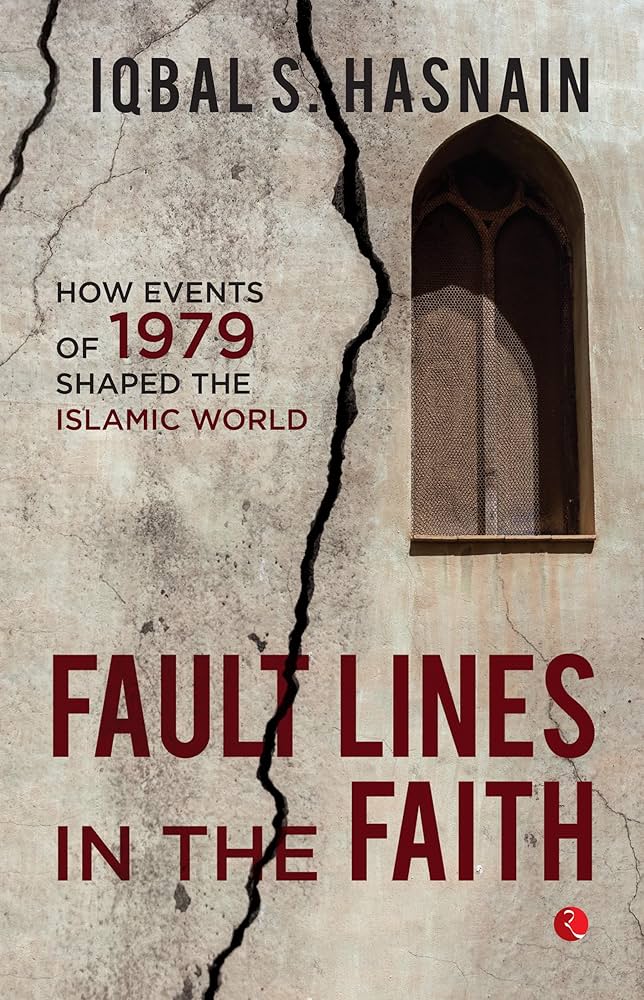
Padma Shri awardee Iqbal Syed Hasnain’s ‘Fault Lines in the Faith: How Events of 1979 Shaped the Islamic World’ was the topic of an animated discussion at Delhi’s IIC earlier this month.
The ‘Fault Lines in the Faith’ book discussion at IIC | Photo: Heena Fatima | thePrint
New Delhi:
A series of three momentous events irrevocably changed the social, religious, and political fabric of the Islamic world. And they all took place in 1979. This is the central argument of Padma Shri awardee Iqbal Syed Hasnain’s book Fault Lines in the Faith, which became the topic of a lively discussion among academics and history buffs at Delhi’s India International Centre on an early February evening.
Presiding over the panel discussion in IIC’s conference room, Hasnain, who is also an eminent glaciologist, elaborated on the three “fault lines” that sent shockwaves far beyond their immediate contexts.
First, the Islamic Revolution in Iran cleaved the Muslim world along sectarian lines with the establishment of the first Shia state. Second, the siege of Mecca ignited the conservative Sahwa (Islamic awakening) movement in Saudi Arabia, blending Muslim Brotherhood and Salafist ideologies. And third, the Soviet invasion of Afghanistan led to the birth of violent extremist groups like al-Qaeda and its offshoots.
“All these three pivotal points led to the surge of fundamentalist or Islamist jihad,” said Hasnain. He added that what began as a “normal struggle between invading forces and local communities” warped from nationalism to a violent ideological shift with devastating repercussions.
Iqbal S Hasnain | Photo: Twitter/@Rupa_Books
Hasnain further elaborated on the global impact of these events by sharing personal anecdotes from his time studying in the UK. He said he encountered strong anti-Western sentiment among students from Middle Eastern countries during his glaciology programme at the University of Manchester in the 1990s.
During Friday prayers in a large hall, he said, student speakers often delivered khutbahs (sermons) against Western culture and American exploitation of their regions, with some even advocating for jihad. As American involvement in the Middle East increased, especially with the invasions of Afghanistan and Iraq in the early 2000s, this hostility intensified.
pix: amazon.in
During the book discussion, audience members raised questions about Hasnain’s narrative. One participant, Sumanjeet Choudhary, a retired corporate executive, inquired why there wasn’t more opposition to jihadist activities despite Islam’s rich history and the presence of prominent leaders.
Hasnain countered this view with the example of Morocco’s King Mohammed VI, who has urged Moroccans worldwide to embrace tolerance and reject Islamist extremism.
“King Mohammed VI came out and he stopped the funding [of madrasas] from Saudi Arabia. He changed the whole narrative in the madrasas,” Hasnain said. He acknowledged, however, that while there is an ongoing debate within Muslim communities and their leadership about how to address extremism, it is “not very visible”.
Ripple effects
Hasnain’s book traces the rise of anti-pluralism, misogyny, and severe intolerance within the Arab world. The 1979 Shia Islamic Revolution in Iran, he said, shook the Sunni Arab world. In response, Saudi Arabia, fearing a Shiite revival, actively promoted puritanical Wahhabi Salafism, a strand of Islam that’s deeply hostile not only to Shias but also to Sunni Sufis. He, however, implicates the West as well. In February 1989, after nearly a decade of occupation, the Soviet army left Afghanistan, leaving behind a fractured nation, where tribal warlords and mujahideen groups engaged in an intense tussle for power. The US, having lost interest, “abandoned” the region, he added, leaving a vacuum for the likes of Osama bin Laden to fill.
Ultimately, Hasnain argues that the events of 1979 triggered a chain reaction, including 9/11, the US invasions of Afghanistan and Iraq, and the rise of al-Qaeda and ISIS. In 2021, in what seems like an eerie echo of the past, the US withdrew its troops from Afghanistan, leaving it with no democratic foundation and back in the grip of the Taliban.
When a participant asked about the impact of the 1979 events on India, Hasnain answered that the after-effects “were not limited to West Asia”, with radicalisation spreading to all corners of the world. “In India, to some extent, it was [mitigated] because India practiced a more moderate form of Islam , Hanafi Sufi Islam, which emphasised trade,” he added.
However, as more Indians went to work in Saudi Arabia, they were influenced by Salafi ideology, Hasnain said. For instance, those who’d grown up celebrating Eid-e-Milad (Prophet Muhammad’s birthday) stopped doing so after stints in Saudi Arabia, where Wahhabis do not observe such festivities.
One of the panel’s members was former Indian ambassador to Qatar KP Fabian. Chiming in, he said that it was important tomonitor developments in Muslim-majority countries, given India’s sizeable Muslim population. There may be political borders but “ideas come without a visa”, he pointed out, and vigilance is essential. He also claimed that Arab countries are keeping an eye on India’s Muslims. “They are watching us,” Fabian said. “They are also discreet.”
(Edited by Asavari Singh)
source: http://www.theprint.in / The Print / Home> Features> Around Town / by Heena Fatima / pix of book edited – source amazon.in / February 29th, 2024