The recipient of Padmashri award for communal harmony had earned the sobriquet of ‘Karnataka’s Kabir’
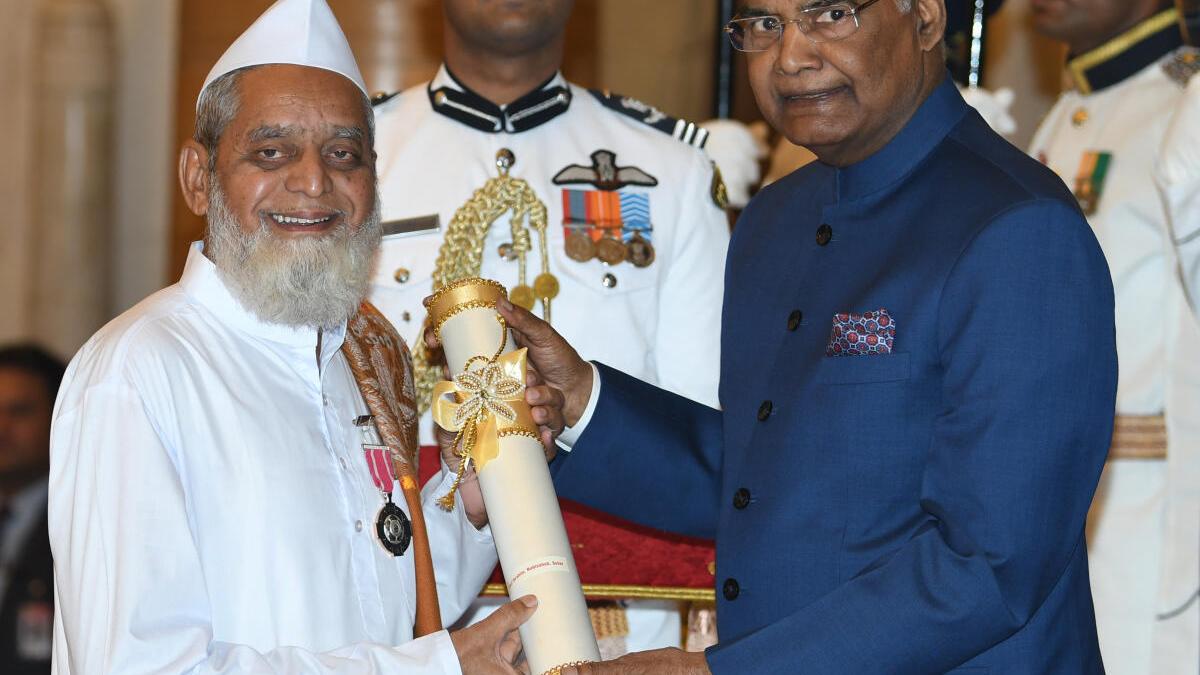
‘Karnataka’s Kabir’ Ibrahim Nabisaheb Sutar is presented the Padmashri award by President Ram Nath Kovind at Rashtrapati Bhawan, in New Delhi on April 2, 2018.
Ibrahim Sutar, polyglot folk singer, who toured India spreading the message of Hindu-Muslim unity, died in Mahalingpur in Bagalkot district on February 5. He suffered a massive heart attack around 6.30 in the morning. He died a few minutes later, family sources said. He was 82. He leaves behind his wife, son and two daughters.
The recipient of Padmashri award for communal harmony had earned the sobriquet of ‘Karnataka’s Kabir’.
The founder of ‘Bhavaikyate Bhajana Mela’ began his career as a Harikathe bhajan singer going around villages and towns. He regaled audiences with stories from Hindu and Islamic scriptures always leaving with a message of harmony, and need for ethics in personal life. He sang songs and gave lectures, quoting from multiple scriptures without the need to read from notes. He was equally well-versed in Kannada and Urdu.
In his later life, he emerged as a public speaker, visiting schools, colleges and Lingayat mutts to speak on vachana and dasa literature. He was honoured with the Karnataka Rajyotsava award in 1995, and the Padmashri in 2018.
Born in a poor weaver family in Mahalingpur, he dropped out of primary school to work as an assistant to a weaver. He developed a spiritual bent of mind early in life. He began attending lectures in the Sri Basavananda Swami mutt and participating in bhajans in Sadhu Maharaj temple. He was a member of the mosque committee that went around villages, asking the faithful to wake up early during the month of Ramzan. He studied Hindu and Islamic scriptures with equal zeal and developed a team of bhajan singers. The ‘Bhavaikyate Bhajana Mela’ performed across Karnataka and Maharashtra.
A routine performance was in the question–answer format interspersed with songs of dasa saints and vachanas . One of the team members came up with a question that sounded very ordinary, but had deep spiritual undertones, like: ‘Who is important in life – god or guru?’ Sutar used anecdotes from the Ramayana and Mahabharata, Islamic scriptures and stories from the life of prophets to give his opinion, that was directed at the audience, rather than the team member who kept asking questions.
source: http://www.thehindu.com / The Hindu / Home> News> India> Karnataka / by Special Correspondent / February 05th, 2022
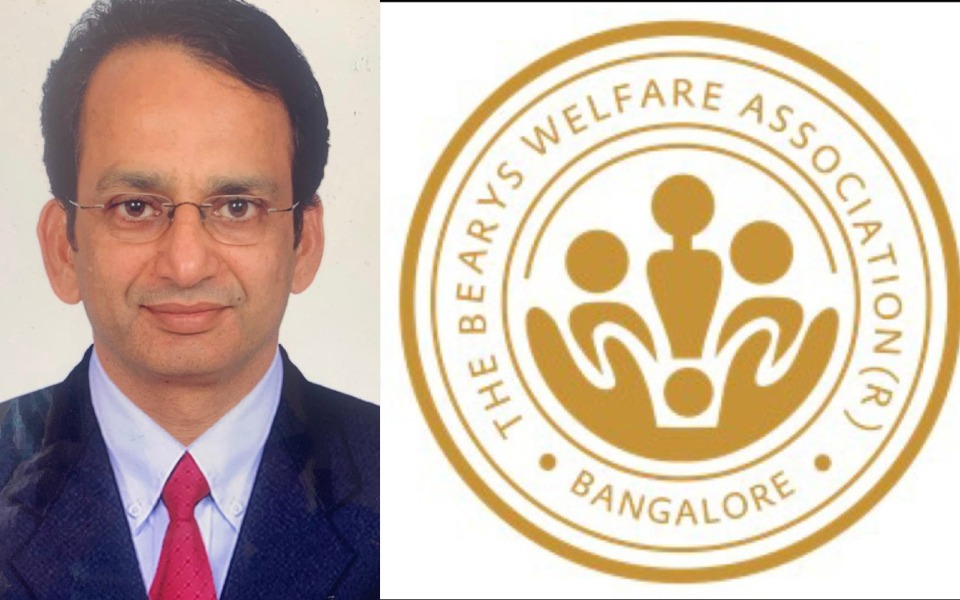
The Bearys Welfare Association, Bangalore, has announced its newly elected office bearers for the upcoming term, following a unanimous selection process. The appointments aim to strengthen the association’s ongoing welfare initiatives and community engagement activities.
Shamsudhin Adoor has been unanimously selected as the President, while Umar Haji B.M will serve as the Vice President. Waaheid Kayrkhan has been appointed as the General Secretary, with Mohammed Tasleel taking charge as the Joint Secretary. Mohammed Ashraf Kuchoor will serve as the Treasurer.
Ten individuals have been named as Executive Committee Members. They are: Ahmed Bava Bajal, Yusuf Perody, B.M. Haneef, Yusuf Mani, Abdul Khader Mustaq, Athuru Chaiyabba, Ashraf Kodi, Tanveer Ahmed, Mohammed Haneif, and Junaid P.K. The outgoing secretary, Mohammed Shareef T.K, will continue to serve as the Ex officio member of the committee.
Additionally, four senior members have been co-opted into the Executive Committee. These include G.A. Bawa, Ibrahim Goonadka, Siddiq Beary, and Hamzathullah Kuvenda.
In a structural update, the association has also incorporated a Governing Council into its bylaws. This council is intended to offer guidance and ensure the smooth functioning of the association. The members of the newly formed Governing Council are Syed Mohamed Beary, B.M. Farookh, Umar Teekay, Iqbal Ahmed, and Dr. Maqsood Ahmed.
source: http://www.english.varthabharati.in / Vartha Bharati / Home> Karnataka / by Vartha Bharati / August 03rd, 2025
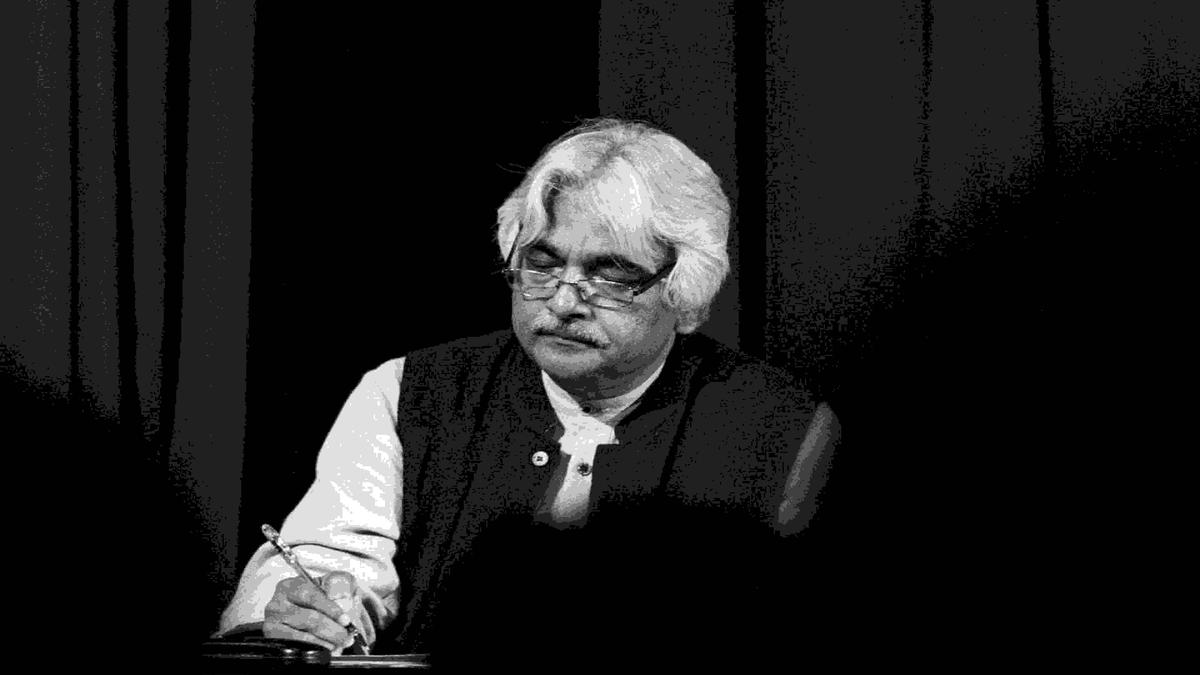
Chikkamagaluru, Senior litterateur of the district, Rahmat Tarikere, has been awarded the 2025 Rajyotsava Award. Born in 1959 in Samatala, Chikkamagaluru district, Rahmat Tarikere did his primary education in Samatala, Tarikere, Shivamogga, and Mysore.
————————————————————————————-
Kannada Prabha News, Chikkamagaluru
Senior writer of the district, Rahmat Tarikere, has been awarded the 2025 Rajyotsava Award.
Born in 1959 in Samatala, Chikkamagaluru district, Rahmat Tarikere completed his primary education in Samatala and later studied in Tarikere, Shivamogga, and Mysore.He secured first position in BA and received the Teenamsree Gold Medal, M.A. First rank and 7 gold medals. He pursued a teaching career and worked at Sahyadri and DVS College in Shivamogga, and Kannada Universities in Hampi from around 1984 to 2021.
He also served as a visiting professor at Stanford University, California (2023); and the University of Mysore. He has published several publications including Counterculture, The Path of the Sword, The Bloody Sutaka, Doormat, and Thought Path.
He has written research works on literary criticism, metaphysics, and cultural studies such as Karnataka Sufis, Karnataka Nath Panth, Karnataka Shakta Panth, Karnataka Moharram, Rajdharma, and Karnataka Guru Panth.
Apart from this, Rehmat Tarikere, who is a skilled craftsman in many genres such as Anuva and travelogue, has written Marudhogna Kicchu, Dharmaparikshe, Bahutva Karnataka (Thoughts); Andaman Dream, Kadali Hokku Bande, Jerusalem (Travelogue); Kadatsattu Nadu, Sanasangati, Hasuhokku (Column); With the Worldly Opponents, With the Law-abiding (Interview); Hitalajagattu (Essay); Furnace (Autobiography); Amirbai Karnataka (Biography): Colonial Consciousness and Liberation (Googi Thiango’s ”
For his literary cultivation, from Karnataka Sahitya Akademi, Kendra Sahitya Akademi (2010), GS Shivrudrappa, Hama Nayaka, P. Lankesh, Vasudeva Bhupalam, Sunithishetti, Veechikkaweeraiah, SG Sannaguddaiah, Kukke Subrahmanyashastri, Pradeep, Sandesh, Patil Puttappa, Prof. Karimuddin Memorial Awards.
He has created excellent works of travel in many places. Among them, his travels to Palestine, Turkey, Jordan, Israel, Egypt, Germany, Croatia, Estonia, Netherlands, Italy, Bhutan, Nepal, America, Iraq, Iran, and Saudi Arabia are notable.
————————————————————————
— Box–
I am very happy to have received the award. This award came with the cooperation of everyone, and this honor goes to Tarikere – Rahmat Tarikere
— 30 KCKM 5
source: http://www.kannadaprabha.in / Kannada Prabha / Home> Karnataka News / by Kannada Prabha News Network / October 31st, 2025
Theatre group Kathputliyan’s latest production is based on a Marathi play
Zafer Mohiuddin
Zafer Mohiuddin, founder of Kathputliyan theatre group, is known for his signature Urdu and Hindi plays. Most plays directed by him deal with serious subjects including the Partition and complicated human relationships.
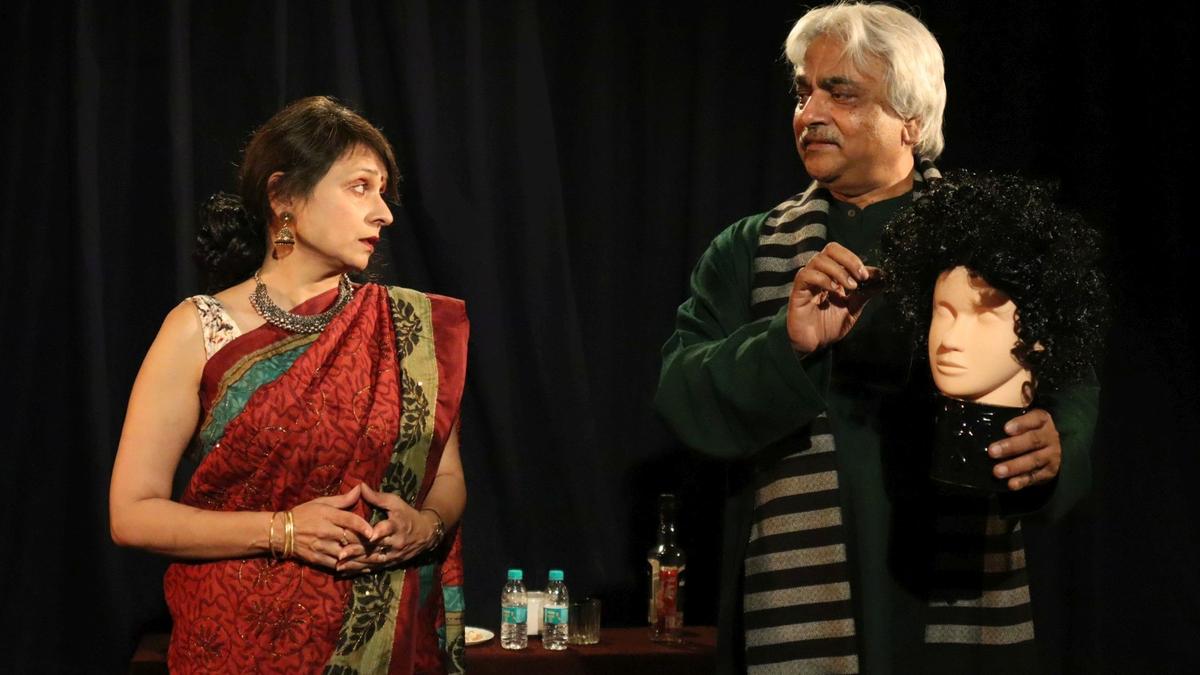
This time Zafer has directed a Hindi slapstick comedy, Pyaari Padosan. The play was originally written by a Marathi playwright, Suresh Khare. “It deals with the relationship between a husband, wife, and a new neighbour, which leads to misunderstandings and confusion between these characters, when the wife goes to visit her parents,” says Zafer. “We chose this play as it lends itself to comic situations.”
The architect-turned-playwright and director says, “I had not done a comedy for 20 years. This time, I decided to come up with a rib-tickler.”
The director has been a part of the theatre scene for over two decades and directed and acted in many plays. Besides this, he has also been part of Bikhre Bimbh with Arundhati Nag and written dialogues for the series Malgudi Days.
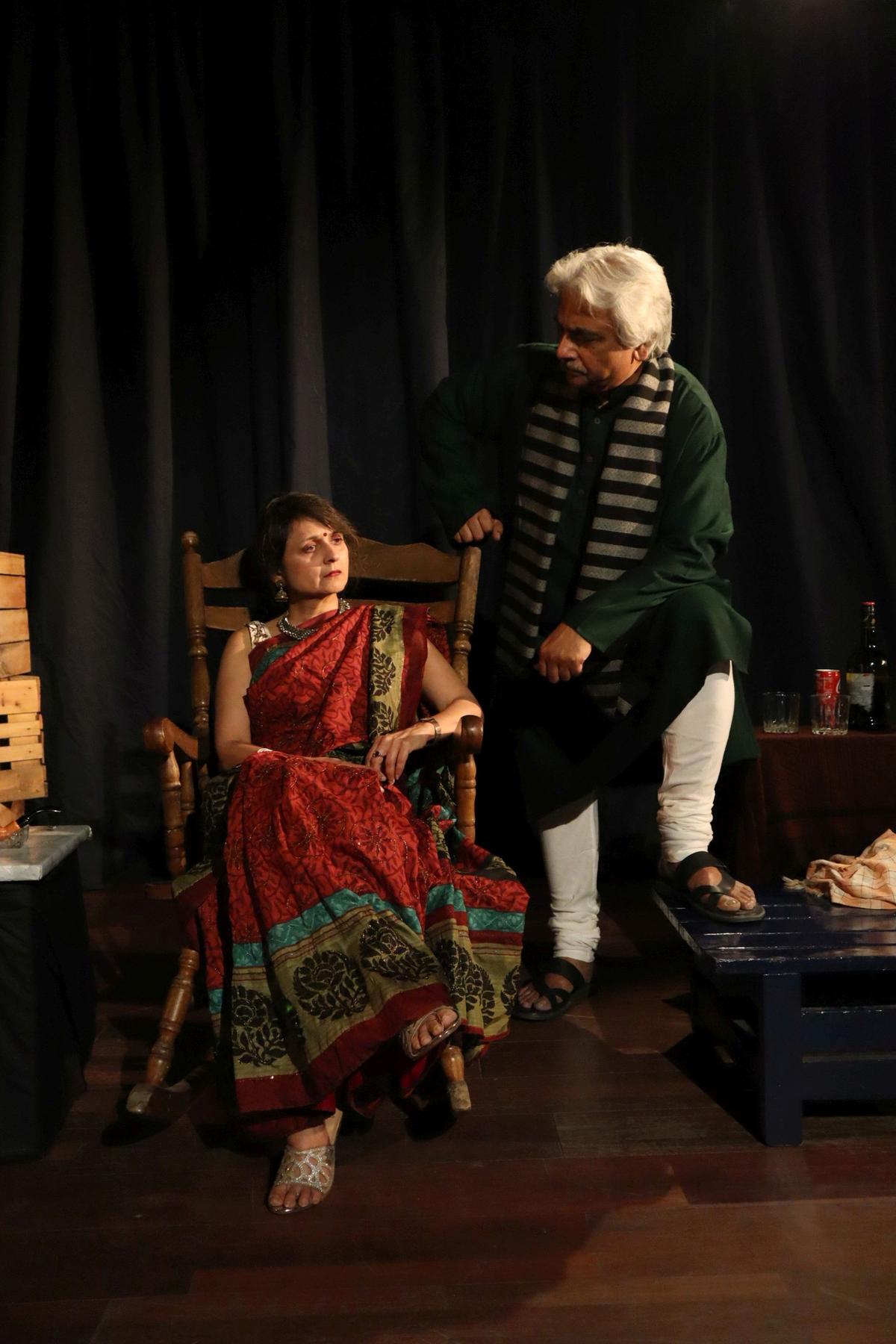
A still from the play
Zafer is thrilled that the theatre scene has come alive once again. “We were being suffocated within our four walls during the pandemic. Theatre groups have become active and people too have started venturing out to watch plays.”
Zafer says, “Most of us theatre practitioners, put in our own money into the production. We are still struggling for sponsorships. So, many of us work during the day so we can follow our passion for theatre during our free time. I only hope people and corporates will encourage theatre, classical music and dance. Without the right support, these arts will not be able to sustain themselves.”
Pyaari Padosan, will be staged on November 27 at 3.30pm and 7.30pm at Ranga Shankara. Tickets, ₹250, available on BookMyShow
source: http://www.thehindu.com / The Hindu / Home> Entertainment> Theatre / by Shilpa Anandraj / November 25th, 2022
Director Zafer Mohiuddin says the play is a conversation between the medium of theatre, film and television
Kavita Agarwal and Zafer Mohiuddin in stills from the play | Photo Credit: Special Arrangement
Kathputliyan Theatre Group (KTG) will stage, Ek Actor Ki Maut. Directed by theatre actor, director, playwright Zafer Mohiuddin, the play is originally written by Croatian writer, Miro Gavran and adapted to Hindi by Saurabh Srivastava.
“It is about two actors, Akshay and Ira, who develop a bond while rehearsing for a charity show,” says Zafer in his baritone, from Alliance Francaise. “Akshay is a struggling actor, while Ira is established with a successful career spanning 40 years. Akshay invites Ira to act in a play, and Ira reluctantly agrees. The play explores Ira’s love for theatre, and the emotions the two actors go through as they share aspects of their lives.”
Zafer plays Akshay while Kavita Agarwal plays Ira. “The play is also a conversation between the medium of theatre, film and television. And how many use theatre as a stepping stone for film. For instance, though NSD was started to propagate theatre, actors train there to seek a career in films. Ira is also guilty of the same while Akshay, however, believes in theatre.”
The play, says Zafer, posits the theory that an actor dies when he exits the stage.
Zafer started off as an architect, but discovered his passion for theatre and became a playwright. Though he has done voice overs, advertisements and films, Zafer has stayed deeply rooted in theatre since 1979, when he founded Kathputaliyaan Theatre Group
Ek Actor Ki Maut Zafer says is a serious play. “I travelled to Delhi recently and a visit to NSD is a must with every trip. This time, while I was there, I bought 20 plays and one book was this. The subject hit me so hard that I immediately contacted the playwright, sought his permission and we started working on this play.”
The theme engulfed Zafer. “It is an intense play with no form of stylisation, and a lot of dialogue. It is a serious discussion between two senior actors with long, meaningful, powerful silences that are crucial to the play.”
Zafer says the play was staged for an intimate audience and this is their first public show. Kavita has been with Kathputliyan for the past three years and has also worked with other theatre groups.
The play will be staged on March 24, 3.30pm and 7.30pm at Jagriti, Whitefield. Tickets on BookMyShow.
source: http://www.thehindu.com / The Hindu / Home> Entertainment> Theatre / by Shilpa Anandraj / March 20th, 2024
The primary objective of this tour is to elevate the aspirations of students enrolled in government high schools, encouraging them to envision grander ambitions and realise them.
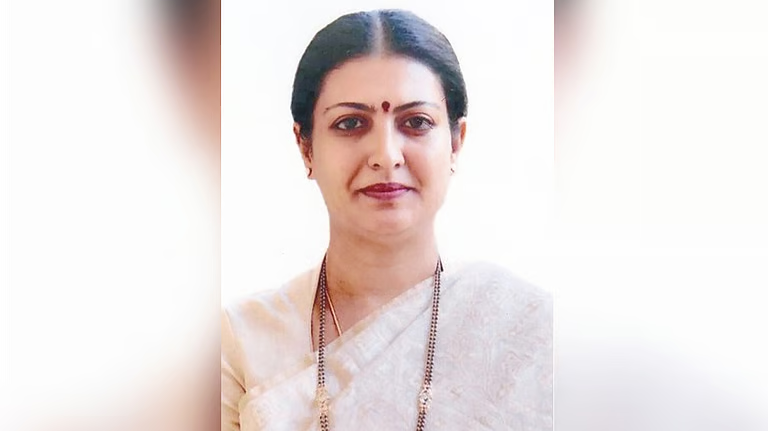
MP Prabha Mallikarjun (Photo | Express)
Davangere :
Nine SSLC toppers of government high schools in Davanagere parliamentary constituency, which encompasses Harihar, Honnali, Channagiri, Davanagere North and South, Jagaluru, Mayakonda and Harapanahalli, are set to embark on an educational excursion to New Delhi.
The primary objective of this tour is to elevate the aspirations of students enrolled in government high schools, encouraging them to envision grander ambitions and realise them.
Member of Parliament Dr Prabha Mallikarjun is committed to increasing the capacity of government schools, and this tour programme is a vital component of her initiative. She said a majority of students reside in rural areas, relying on government institutions for their educational pursuits. If influential people demonstrate their commitment to enhancing these students’ self-esteem, there will be no shortage of enrolment in these schools.
Strengthening government schools will indirectly lead to increased admissions, thereby unveiling the latent talents of the nation, Dr Prabha told the TNIE.
She added, “Initially, we intended to send eight top-performing SSLC students from government high schools; however, with two exceptional students identified in Honnali, we resolved to send both to New Delhi. All travel expenses, including airfare and accommodation, will be personally covered by me.”
“I am confident that witnessing these accomplished children will invigorate the current batch of SSLC students, motivating them to study diligently and excel in their examinations,” she added.
The students will take part in a five-day journey, visiting important landmarks such as India Gate, Kamal Mandir, Qutub Minar, Red Fort, Kartavya Path and Swamy Narayan Mandir. The nine students will be accompanied by both a male and a female teacher. They will depart from Hubbali Airport on Monday, said Dr Prabha.
The MP is personally overseeing the expedition of these children, insisting that while monetary rewards may fade from memory, an experience of this nature will remain etched in their minds forever.
The students are P Manjunath, Dhanush, K P Pavan Kumar, Jeshta B, Amrutha T M, Mizba Naz, Usha H, Latha H A and Yogeshwari J B, accompanied by teachers B Arun Kumar and K M Ningamma.
source: http://www.newindianexpress.com / The New Indian Express / Home> Karnataka / Express News Service / October 24th, 2025
The government of Karnataka’s department of Kannada and culture has announced the Karnataka Rajyotsava Awards for 2025–26, naming Zakaria Jokatte, founder of Al Muzain Company in Jubail, Saudi Arabia, and president of Mangaluru-based M Friends Charitable Trust, as the recipient in the Non-resident Kannadiga category.
Born on May 10, 1958, at Thokur in Jokatte, Zakaria is the eldest of five children of Haji B Shekuni and Katheejamma of Bajpeguttu. His journey from humble beginnings to international recognition is one of perseverance and determination. After discontinuing his schooling, he undertook various odd jobs — selling jaggery on streets, working as a welder, and even as a labourer carrying cement up to the 28th floor at construction sites abroad.
His years of hard work and sacrifice bore fruit when, in 2008, along with his eldest son Zaheer, he established Al Muzain Manpower Company in Jubail, Saudi Arabia, starting with just three employees. Through dedication and leadership, the company has now grown to employ 8,000 workers, with a goal of creating 10,000 jobs by 2027.
Following the success of Al Muzain, Zakaria expanded his entrepreneurial ventures, founding several other companies in Saudi Arabia, Bahrain, the UAE, Oman, Qatar, Kuwait, London, and India. He has also forayed into education by establishing an international institution in Al Khobar in collaboration with Yenepoya Group, and plans to set up a hospital and medical college in the near future. His upcoming projects include AI innovation initiatives and development ventures for the coastal region of Karnataka.
Currently residing in Bolar, Mangaluru, Zakaria lives with his wife Hazra Zakaria. His three sons — Zaheer, Nazir, and Zahid — are engaged in various business ventures abroad.
Zakaria serves as the chairman of M Friends Charitable Trust, Hidaya Foundation, and Zara Family Charity Trust. He is also associated as director, advisor, and sponsor with several organisations across Karnataka, working tirelessly for the welfare of thousands of underprivileged and needy individuals.
In recognition of his philanthropic contributions and entrepreneurial achievements, Zakaria Jokatte has received numerous national and international honours. His selection for the Karnataka Rajyotsava Award stands as a testament to his service, dedication, and pride as a global Kannadiga.
source: http://www.daijiworld.com / Daijiworld.com / Home> Karnataka / by Daijiworld Media Network – Mangaluru / October 30th, 2025
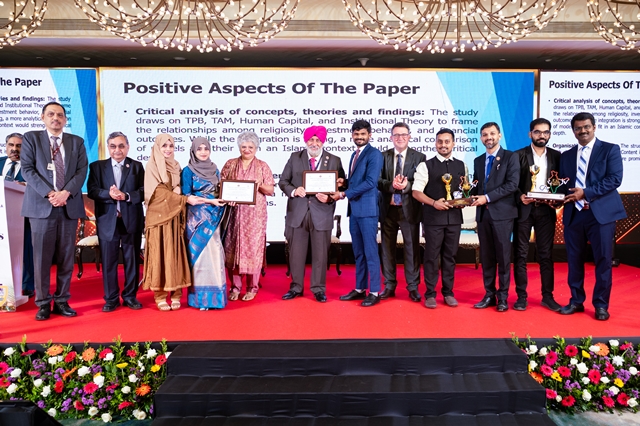
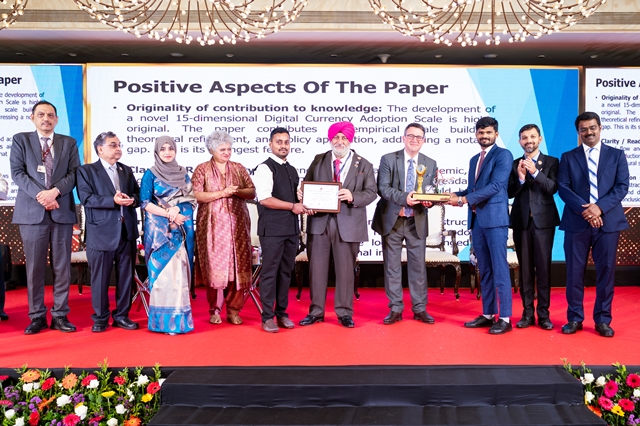
The Institute of Chartered Accountants of India (ICAI) hosted the prestigious International Research Awards 2025 at Novotel, Goa, to honour exceptional global contributions to academic and applied research. The event witnessed an overwhelming response, featuring 316 research submissions from 18 countries, representing a diverse range of disciplines and research domains.
The programme was presided over by CA Charanjot Singh Nanda, president of ICAI, and graced by John Turner, guest of honour and chairman of the jury, who also serves as the chief executive officer of XBRL International. In his address, Turner emphasized the importance of impactful and policy-oriented research in shaping the future of finance and governance, underscoring the role of academic institutions in driving evidence-based policy and innovation.
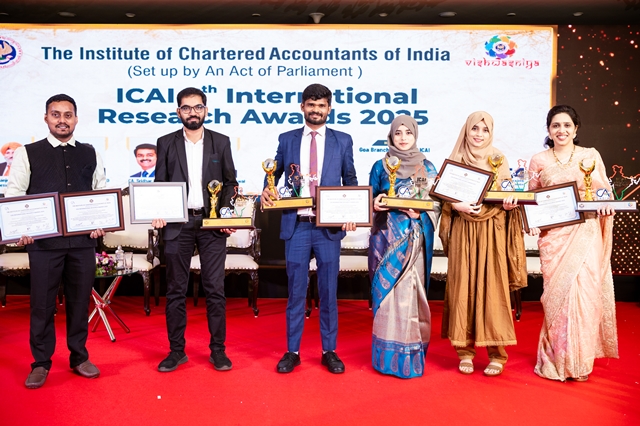
Among the sixteen globally recognized research papers, the YEN-REFINED, Yenepoya Institute of Arts, Science, Commerce and Management (YIASCM), Yenepoya (Deemed to be University), achieved an outstanding milestone by securing three awards in the finance category. This remarkable accomplishment highlights the university’s commitment to fostering a robust research culture and promoting excellence in financial and behavioural studies through its dedicated research center, YEN-REFINED – the Yenepoya Research Centre for Finance and Entrepreneurship Development.
The award-winning research papers from Yenepoya include ‘An Empirical Analysis of Stock Market Participation: From an Islamic Perspective’, which received the Gold Award, followed by two Silver Awards for the papers ‘Development and Validation of Social Inclusion Scale for Stock Market Participation’ and ‘Developing a Digital Currency Adoption Scale: A Validity and Reliability Study’.
The research team comprising Prof Niyaz Panakaje, coordinator of YEN-REFINED & MBA, Dr S M Riha Parvin, assistant professor, YEN-REFINED, Dr Abhinandan Kulal, research associate, YEN-REFINED, Mohammad Shahid, HOD, department of commerce, Dr Madhura, assistant professor, department of management, and Niha Sheikh, JRF, YEN-REFINED received the honours at the ceremony. Their collective achievement reflects the university’s growing contribution to global research on financial inclusion, digital innovation, and behavioural finance.
These prestigious awards mark a significant moment in YEN-REFINED academic journey, reaffirming its vision to promote interdisciplinary research, intellectual excellence, and international collaboration.
source: http://www.daijiworld.com / Daijiworld.com / Home> Top Stories / by Media Release / October 20th, 2025
The residents of these slums are prone to infection. Lack of water could cause dehydration in residents. Hence, we took up this initiative.”
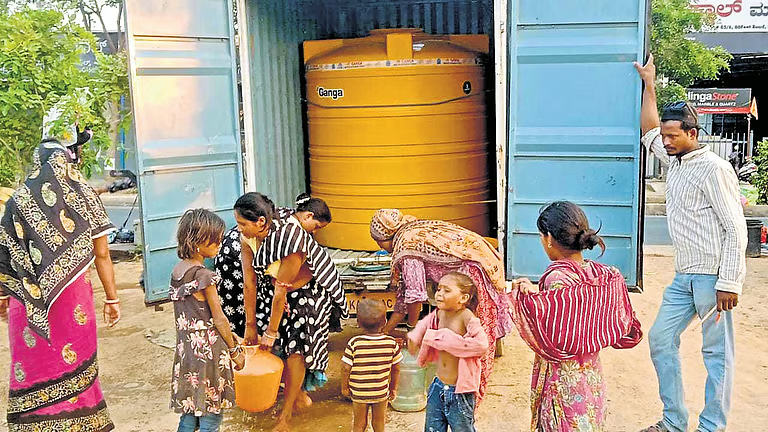
‘Active Bengaluru’ supplies water to a slum in North Bengaluru. It has come as a saviour to the residents of several slums in the city Photo | Express
Bengaluru :
‘Active Bengaluru’, a non-profit organisation, has come as a saviour to the residents of several slums in the city this summer. The organisation is supplying water to these residents to tide over this harsh summer.
‘Active Bengaluru’ is supplying 50,000 litres of water at the doorsteps of the residents of slums in North Bengaluru, including in areas like Thanisandra, Hegde Nagar, and Saraipalya, every alternate day.
Like other parts of the city, close to 6,000 public borewells in these areas have gone dry this year. Members of ‘Active Bengaluru’ supply water in four water tanks (2,500-litre capacity each) mounted on mini-tempos.
Speaking to The New Indian Express, Tauseef Ahmed, a volunteer with ‘Active Bengaluru’, said, “Under ‘Project Zam Zam’, the slum population in North Bengaluru is being supplied water free of charge. The project began in March, and till date, over 12 lakh litres of borewell water has been supplied. The residents of these slums are prone to infection. Lack of water could cause dehydration in residents. Hence, we took up this initiative.”
“The water is collected from good Samaritans from their borewells, and the same is then supplied to the slums. The residents have been told to call the emergency number of the NGO to place a request. Based on the number of calls received from an area, a vehicle is sent. In each tank, about four taps are fixed, and residents are asked to come in a queue and collect water,” said another member of ‘Active Bengaluru’.
“The NGO mostly deals with policy issues, women’s empowerment, health, and education. Shortage of water directly impacts the health and education of children. We decided to do our bit to address the same and joined hands to supply water to the needy,” said another member of the organisation.
source: http://www.newindianexpress.com / The New Indian Express / Home> Karnataka / by Mohammed Yacoob / April 23rd, 2024
India prides itself in recognising and celebrating “Unity in Diversity”, and to underline that great aspect Daijiworld Mangalore, after thousands of diverse articles and analyses, has enthralled readers for decades now. I would like to highlight, amidst the assortment of attractive information in this exclusive Special, a lesser-known history and ancient monument of our co-minority community of Mangalore, in two parts. The next part will be on other old historic monuments complementary and connected with Islam in Mangalore. There are always those who thirst to know the little-known history and geography too—for it is part and parcel of our Kudla roots, very ancient and very valuable.
Mangaluru, Kudla, Kodial, Maikala, Mangalapuram—this place of many names—no doubt is a place steeped in multifaceted ancient history. Temples, Churches, Mosques, and more exist which hold history and culture often unknown. Mangalore thrives on worship of the Gods, no doubt! At every nook and corner, historic Temples, Mosques, and Churches can be found. The history of Mangalore connects with different ancient regions, languages, faiths, and religions, multi-faceted and overlapping.
Taking a look at an ancient Mosque—probably the oldest in the region—in Bunder, the heart root of old Kudla/Mangaluru, is indeed very enriching and thrilling. The original roots of real old Mangalore run between Sharavu Ganapathi Temple in Kodialbail and Mangaladevi Temple in Bolar. The famed Muslim ruler of Mysore, Tipu Sultan, is known to have had a role in the development of Sharavu Ganapathi Temple, according to historians who have authored books on Tipu history—a strange dream while he camped nearby caused him to donate land for the temple.
Tuluva and local rulers are known to have protected Muslim/Arab traders in ancient times and have given them free passage through their kingdoms, much before Westerners were heard of in this area. Western rulers too established close trade and cultural ties with Muslim kingdoms and provided space for their lifestyle. It is evident that there has been much intercourse between cultures and beliefs for ages, creating a mosaic that is inseparable in and around Mangalore and beyond. A deeper look at the oldest Masjids of Mangalore and connected historic auxiliaries will enlighten the intricate mosaic.
Zeenath Baksh Masjid, Bunder, Mangalore
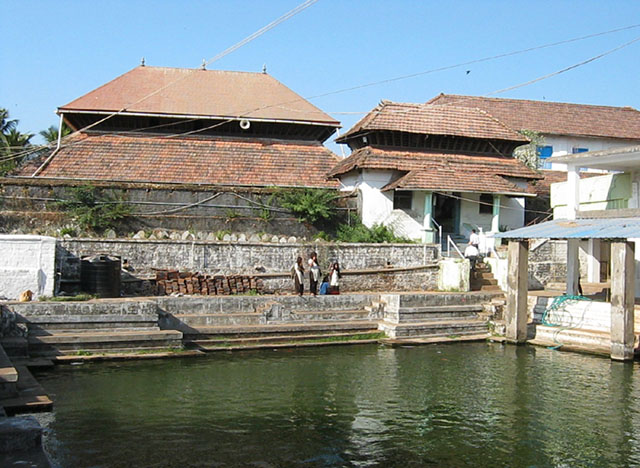
This historic mosque is referred to as “Juma Masjid” and “Beliye Palli”. It is right in the middle of ever-bustling Bunder, the old port of commerce locality sandwiched between Golikatte Road and Port Road, just a stone’s throw from the Gurpur river and North Wharf to its west. Here, a wide range of commodities and condiments were—and are still—traded. The area seems in chaos with old dilapidated buildings amid newer ones and narrow lanes choked with heavy traffic of all descriptions and gutters. One’s olfactory senses will be tested with multiple oriental aromas of spice, coffee, areca, pepper, cardamom, chilies, garlic, ginger, rice, pulses, onions, potatoes… and all kinds of condiments, retail and wholesale—and of course, rotting garbage.
A trader, M M Kini, opposite the mosque, is a licensed dealer in arms and ammunition—it is an old family business. This unique and antique mosque is around the corner from the Bunder Police Station and the famous old renovated Bombay Lucky Restaurant, well known to local folks. The Kanara Chamber of Commerce and Industry (KCCI) is located a few yards opposite.
Bunder, the old port of Mangalore since ancient times, is the backbone of history, communication, and commerce, with thriving seaports and even the Lakshadweep Islands with which it shares a long history. The multi-religious business people around are of a very friendly and easy-going enthusiastic nature. A visit here is like going back in time and also tripping over the new order of life and faith.
The Masjid Zeenath Baksh in Bunder is said to have been established in Mangalore in 644 A.D. It was first established in Mangalore by Habeeb bin Malik, and the first Qadhi (Qazi) appointed was Hazarath Moosa Bin Malik, son of Malik Bin Abdullah. This mosque was probably inaugurated on Friday, the 22nd of the month of Jumadil Awwal (fifth month of the Islamic calendar) in the year 22 of Hijra (644 A.D.).
That this sacred Masjid was established by the holy men of Arabia, who were said to be kith and kin of the “Sahabas” (associates) of Prophet Hazarath Mohammad Rasulallah, makes it about 1400 years old—about a thousand years before the Portuguese brought Christianity here.
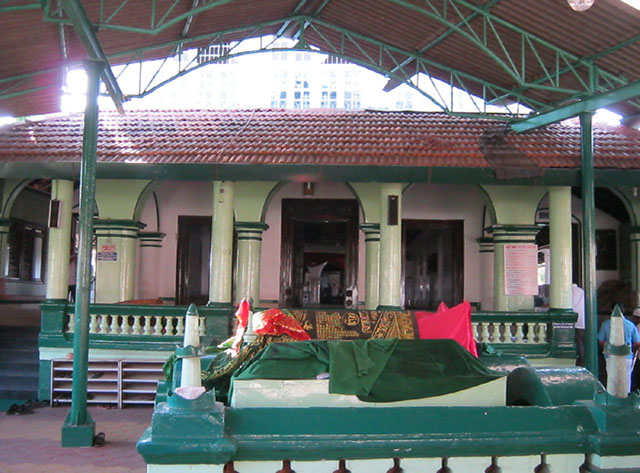
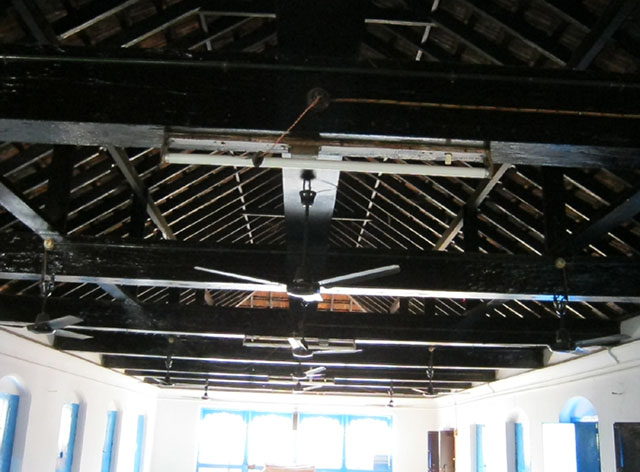
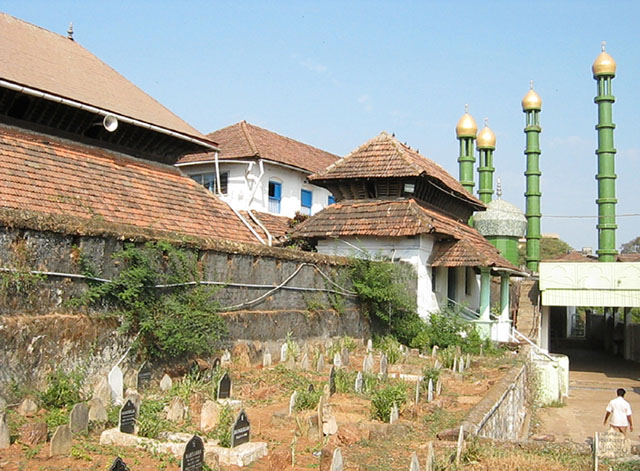
The Zeenath Baksh Mosque is indeed unique. The front portion (with a prayer hall on two levels) is no doubt added on in the 19th century (later too), and the tile roof has Basel Mission tiles. Another structure constructed later has four minarets and a typical dome and houses the 90-plus-year-old tomb of Hazrath Sheikuna Muhammed Moula Jalal Masthan Al Bhukhari, a saintly Khazi laid to rest here. Many young people come here to pray and find their lives changing with renewed goodness. Also, some of his kin’s tombs can be seen.
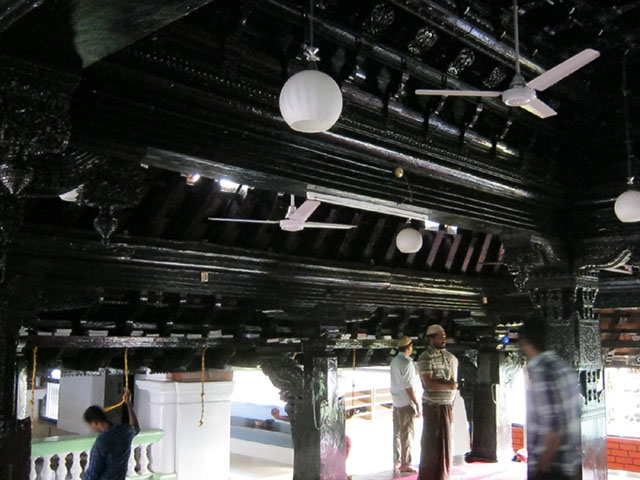
The inner ancient original mosque dates back centuries perhaps, and this old legend of a “Masjid” in the 1780s is said to have been refurbished and renovated systematically by the great Tiger of Mysore, Tipu Sultan, who is well known for such philanthropy. Anyone with a basic knowledge of layouts in the region cannot fail to recognise that this great monument, which spreads over a large area, has many characteristics of a temple—the large water tank (below ground level), the shape of the tiled roof (old Malabar), and the hand-carved woodwork (characteristically local).
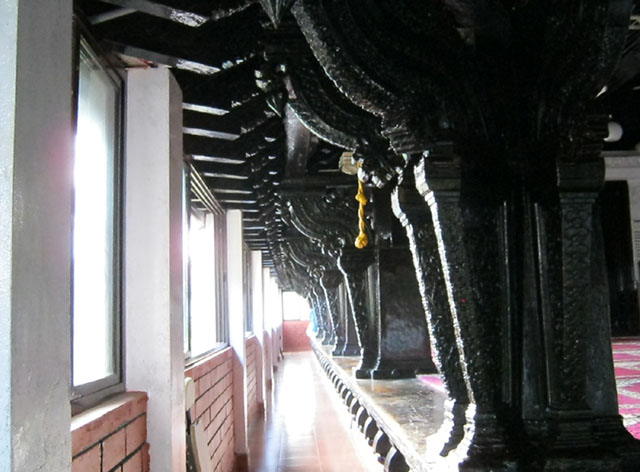
Tipu added beautifully carved bulky rosewood pillars and also a carved ceiling—the huge carved works are majestic. The mosque was renamed after Tipu’s daughter, Zeenat Baksh. The prayer hall is on a plinth with an open colonnade running around the building under heavy overhanging eaves with carvings. The renovation coexists in harmony with the older, more ancient staccato structure.
The water tank in the center of the premises has granite steps and provides water for the ablutions or ‘Wuzu’ prescribed before ‘Namaz’. This Juma Masjid is well frequented by devotees for regular five-times Namaz and to visit the tombs. There is also a burial ground that partly encircles the mosque. One can see men and women frequenting this holy place; on festival occasions, this mosque can hold about 2000 people for the Namaz or prayer assembly. During Ramadan fasting and festivals, the religious spirit is at a peak and exemplary.
Tipu Sultan has also built a Masjid at Mangalore 2 km away from this mosque. It is presently called “Idgah Masjid” at the top of the hill (now called Light House Hill, in the town center near Aloysius University gate). Muslims from all over the district gather here and offer prayers on festive days of Eid-ul-Fitr and so on. Subsequently, in 1920, Mangalore Bail family constructed a large assembly hall or Jamath Khana. There are a good number of Muslims in Mangalore, and their concentration in this area is phenomenal.
Present Activity of the Masjid:
Considering the needs of the economically weaker people of the community, the management committee of the mosque has made initiatives to extend free service in various ways for the needy people of the community. Funds are raised from benevolent donors of the community for the purpose of marriages, education, medical relief, shelter, and other social basics. Also, the management committee of this mosque looks after the burial of destitutes free of cost. Efforts are on by the leaders for establishing and running schools and colleges from KG to PG for the benefit of the wider community who are rapidly marching forward in all spheres of activity.
“He is the One GOD; the Creator, the Initiator, the Designer. To Him belong the most beautiful names. Glorifying Him is everything in the heavens and the earth. He is the Almighty, Most Wise.” (Quran, 59:24).
The current perception of Islam and the followers of religion and culture in Kanara and the coastal areas, in the light of new developments and issues that rule, calls for a closer look at the history and practice of Islam in this region. Muslim groups are generally labelled as “minority” and weak, but it must be clearly understood that the population is significantly strong, and their presence here can be traced back to the 7th century A.D., while Christianity is from the 16th century practically, though it is credibly said that Christianity landed in Kerala in the first century (53 A.D.), even before it reached Europe.
There are many facets that Muslims have dominated here for centuries and still do. Their sway is very significant and ancient and needs serious consideration of the rights and values guaranteed by tradition and the Indian Constitution. Islam is now an indelible part of this region, India, and the world over. They cannot be labelled as aliens and are part and parcel of the mainstream.
The Muslim community here, in view of all aspects, is a strong, rooted, and recognised community. It can be observed that the Muslim community’s progressive principles here are indeed very forward, and their outlook is advancing, influenced by the Middle East and Western standards and good education and industry. Many prominent properties and businesses are owned by them. Families are largely active; elders in the families are secure and cared for, and women seek good education. The entire community is enterprising, hard-working, cooperative, and presents a happier picture generally. Religion-wise, they are fervent and keep the tenets strong even in the face of hurdles. The world over, it is seen they are going from strength to strength, and leaderships have to be transparent.
(dated October 16th, 2025 / source : daijiworld.com / by Ivan Saldanha-Shet )
Islamic Monuments of Mangalore: Part 2 / October 23rd, 2025
Mangalore and coastal Karnataka is steeped in multifaceted History and colour, many sources have facilitated the common person of interest to be aware and enjoy the depth of information. Daijiworld has been very generous and it is appreciated. Hindu, Muslim, Christian ……..and many more allow interesting facts and figures in and around mangalore / Canara since ages and fascinates. In the previous episode (Part 1 of 2) we noted the arrival and monument of Islam at Bundar, the original area of Kudla or Mangaluru at present. The matter would not be complete if a brief look at ancient contemporary Islamic monuments are not highlighted. No history is the sole property of any one in particular and is not esoteric in practicality. So, we continue and hope it will round off the interest and study of this history, let us have observations and comments.
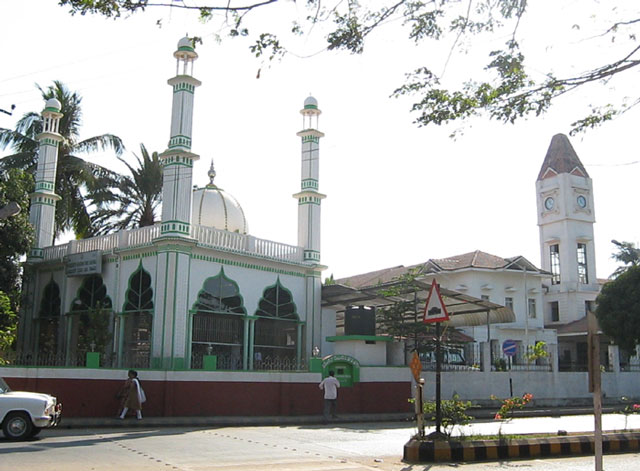
KUTCHI MEMON MASJID. BUNDER. Mangalore : This is another ancient Masjid just near and on the way to Zeenath Baksh Masjid right opposite to famed ‘Bombay Lucky Restaurant’; the ‘Kanara Chamber of Commerce and Industry (KCCI) is in the backyard of this Masjid. It is also referred to as ‘Katchi Palli’. It is a wonder that this Mosque is credited with many firsts. Traditionally each of these many Masjids in Mangalore have their own section of regular devotees. Reliable sources say that Kutchi Memon Masjid was basically constructed in 1839 and is now 174 years old going on to be 175 years. The force behind this sacred work were Patels from Kutch in North Gujarat, traders who settled in the area and were masters in the spice trade, they spoke Kutchi language and gradually were assimilated into the Kanara culture, the cause of this development are the historical sea routes to Mangalore from the Arabian Sea. To and fro activity is still very visible it appears.
The wonders at this religious center are : It was the first to get power supply and the fourth in Mangalore to be electrified in the British era, in 1930s , the first to use loud speakers for the ‘azaan’, call to pray and in Urdu, the first where the ‘qutba’ (Friday Sermon) was delivered in Urdu and so on.
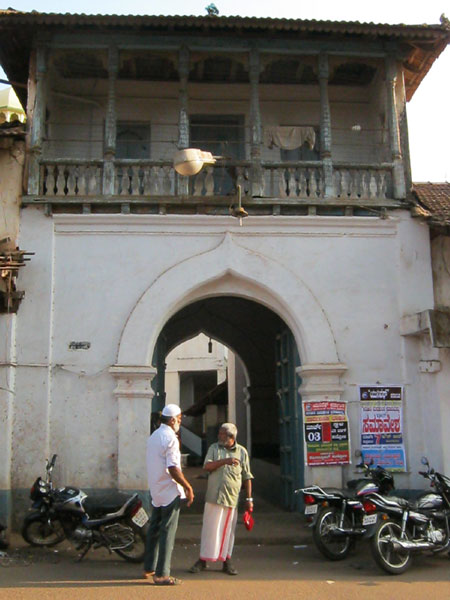
There has been development in the precincts of the masjid but the original structure on about 20-25 cents remains still very original. The new extension was first made in 1983 and plans to expand are ongoing. The unique gate way into the masjid has a picturesque oriental architecture. Indeed this area called Bunder is a wonder with many historic monuments still standing the test of time like sentinels spelling out the historical times gone by and hoping for better times for those who are to come.
Woman Saint’s Dargah in the Heart of M’lore : Hazrath Saidani Bibi Sahiba, the only dargah dedicated to a woman saint in Dakshina Kannada has become a refuge of hope without reference to religion, caste, creed or language. Located near A B Shetty circle, on the periphery of the prominent ‘Big Maidan’ (as it was then known) now, Nehru Maidan of Mangalore. This dargah (memorial tomb shrine) is visited by people of all faiths. Most of the people come here with a ‘harake’ (vow) as there is a strong belief that prayers are answered here. Hazrath Saidani Bibi, it is said, was a saintly lady, hailing from a ‘Fouji’ (Military) family during the regime of Tipu Sultan. She was buried in the military area (the present location of dargah on the edge of the City Police HQ – formerly the military barracks), though burial grounds were available, such was her reputation. People say that she was buried in the military area due to high respect and regard the local people of Mangalore particularly the warrior class had for her. Later, her close relatives were buried beside her. Now are seen three other tombs apart from that of Sayyadani Bibi in the dargah. Scores of people of all castes and creeds visit this place every day, giving alms to the poor that sit at this place, an accepted practice.
Another astonishing aspect of this dargah is that it is cared for and protected by retired or serving police officers of Mangalore. Hazrath Saidani Bibi Sahiba Dargah Management Committee is in the forefront of it’s maintenance. This dargah was frequently visited by the police staff and public, the tomb is adjacent to the police headquarters. In 1972, the then Dakshina Kannada SP K U Balakrishna Rau and the then Assistant SP H T Sangliana entrusted the administration of the dargah to Muslim police personnel. A committee was formed for the better administration of the dargah and in the year 1983 the old ‘Mazahar’ (tomb of the saint) was renovated. The dargah was built on land belonging to the Police department, and the property was later handed over to the Wakf Board. Indeed goodness knows no boundaries and so does harmony.
BEARY COMMUNITY IN MANGALORE: The origin of the ‘Beary’ Community is very ancient. It is known that there were many rich traders, from the Malabar coastal belt, connected with the traders of the Arab lands. Arab merchants have been visiting the coastal regions for business purposes even before the time of Muhammad (puh). Now most local Muslims in this region are part of the Beary Community.
The Beary (also known as Byari) is a community concentrated mostly along coastal Dakshina Kannada and Udupi districts in the Southern state of Karnataka. It is an ethnic group, having its own unique traditions and distinct cultural identity and language. The Beary community holds an important place as also Nawayaths of the Uttara Kannada district (who speak a type of Konkani). Bearys incorporate the local Tulu culture of undivided South Kanara and diverse traditions of the Moplahs of Malabar. The Beary community of Kanara or Tulunadu is one among the earliest Muslim inhabitants of the coast, with a clear history of more than 1350 plus years. Muslim Arab traders had a cordial relationship with the rulers of the western coastal belt of India. This is attested to also by the writing of Ibn Battuta, the intrepid North African traveller who passed through India in 1342AD. Lakshadweep too had connections with Mangalore since early times.
The word ‘Beary’ is said to be derived from the Tulu word ‘Byara’, which means trade or business. Since the major portion of the community was involved in business activities, particularly trading, the local Tulu speaking majority called them Beary or Byari, other reasons exist. According to the census of 1891, South Kanara in the Madras Presidency of British India had 92,449 Muslim businessmen consisting of 90,345 Bearys and 2,104 Nawayaths involved in business activities. The first Muslim missionaries to Mangalore can be traced to Malik Bin Deenar, an Arab trader said to be the kin of Sahabas (companions of Prophet Muhammad). He is said to have visited Malabar and landed near Manjeshwar on the northern Malabar coast, very close to Mangalore. He constructed the first Masjid in Kasargod, the Malik Dinar Masjid ( his shrine can still be seen).
Beary Language: Called ‘Beary Basse’ is spoken by the Muslim communities mainly along the Coastal Dakshina Kannada, Udupi and in some parts of Kasaragod district by the Bearys (Byaris). Beary is a language of mixed idioms, phonology and grammar of bothe Tulu and Malayalam. It is considered a dialect since Kannada alphabets are used in writing and is also known as ‘Mappila Bashe’ because of Bearys’ close contact with Mappilas of Malabar. Due to the intensive influence of Tulu for centuries, it is today considered as a language close to Tulu as well. Surrounded by the Tulu speaking community, the impact of Tulu on the phonological, morphological and syntactical structure of the dialect is evident. Beary Bashe can be related to Malayalam, Tulu or Perso-Arabic origin with Arabic influehttps://www.daijiworld.com/chan/exclusiveDisplay?articlesID=6784nce. ‘Beary Basse’ also has words related to Tamil and Malayalam.
The Bearys produced rich literary work using both Beary Bashe and Kannada language. The literature comprises Beary poetry, research articles on Bearys, historical analysis of Muslims, essays, stories and other fields of literature. “English-Kannada-Beary” dictionary is now available. The Bearys have also produced a number of magazines and periodicals from Mangalore and other places of the region. Some periodicals have become popular and a few of them have become a part of Beary history. Generally Kannada script is used to produce Beary literature which is quite popular and abundant in all possible forms. There is a lot of vergin content on electronic media too now, and the future is very bright.
(Part 2 concludes this history)
source: http://www.daijiworld.com / Daijiworld.com / Home> Karnataka / by Ivan Saldanha-Shet / part One October 16th and part Two October 23rd, 2025