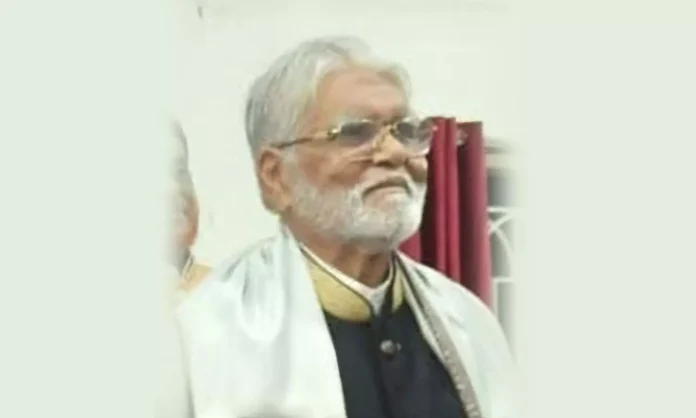
The Urdu literary world mourns the demise of one of its gentle giants, Azizuddin Aziz Belgaumi, the celebrated Na’at poet, ghazal writer, teacher, and literary guide, who returned to his Lord on the morning of Friday, November 28, shortly after the Fajr prayer in Bengaluru.
Azizuddin Aziz was not merely a poet; he was a custodian of spiritual emotion, a voice that blended devotion, beauty, and sincerity in every syllable.
He was renowned for his Na’ats – soulful, tender, and overflowing with love for Prophet Muhammad ﷺ. His unique style of recitation, coupled with his soothing voice, made his poetry beloved among Urdu lovers across the region and beyond.
His iconic Na’ats, including:
اہلِ ستم کے پتھر کھا کر گل برسانے والے ہم
دعوتِ ہدایت کی ایک حسیں شفق لے کر میرے مصطفیٰ آئے
had gone viral among Urdu audiences, each line steeped in deep reverence and spiritual longing.
On his final night in this world, he once again recited “Dawat-e-Hidayat ki ek haseen shafaq lekar mere Mustafa aaye” on special request at a mushaira organized by Idara-e-Adab-e-Islami Hind, Karnataka. The audience responded with extraordinary affection, as if witnessing a sacred farewell.
By the next morning, he left this world – a departure many lovingly regard as a sign of divine acceptance.
Azizuddin Aziz’s published works reflect his emotional depth and mastery of language. His poetry collections include:
حرف و صوت
سکون کے لمحوں کی تازگی
دل کے دامن پر
نقد و انتقاد
زنجیرِ دست و پا
ذکر میرے حبیب کا
These works capture the freshness of spiritual experience, the fragrance of emotion, and the honesty of a heart in constant remembrance.
Azizuddin Aziz worked with Doordarshan Bangalore Urdu, where he interviewed prominent literary personalities. His conversations reflected both scholarship and humility, making him a respected voice representing Urdu culture on national media.
He served for a time as a teacher and later as the Principal of Zubaida College, Shikaripur, shaping young minds with the same warmth and refinement that characterised his poetry.
As an educator, he was loved for his gentle discipline, cultured manner, and his ability to ignite a love for language among students.
He also served as editor of several literary magazines, contributing significantly to Karnataka’s Urdu literary landscape. His editorial vision was marked by sincerity, high standards, and a deep respect for classical tradition.
Early on November 28, he experienced severe chest pain at his residence in Bengaluru. Despite attempts to rush him to the hospital, he breathed his last at home. He leaves behind his wife, three sons, two daughters, and a large community of admirers, students, and peers.
May Allah accept every word of love he wrote for His Beloved Prophet ﷺ. May He grant Azizuddin Aziz a lofty place in Jannat-ul-Firdous, and grant patience, strength, and peace to his grieving family. His voice has returned to silence – but his Na’ats will continue to illuminate gatherings, his ghazals will continue to warm hearts, and his legacy will remain a torch of devotion and grace.
Inna lillahi wa inna ilayhi raji’un. Most certainly we belong to Allah, and most certainly we will return to Him.
source: http://www.radiancenews.com / Radiance News / Home> Focus> Obituary / by Radiance News Bureau / by Mohammed Talha Siddi Bapa / November 29th, 2025
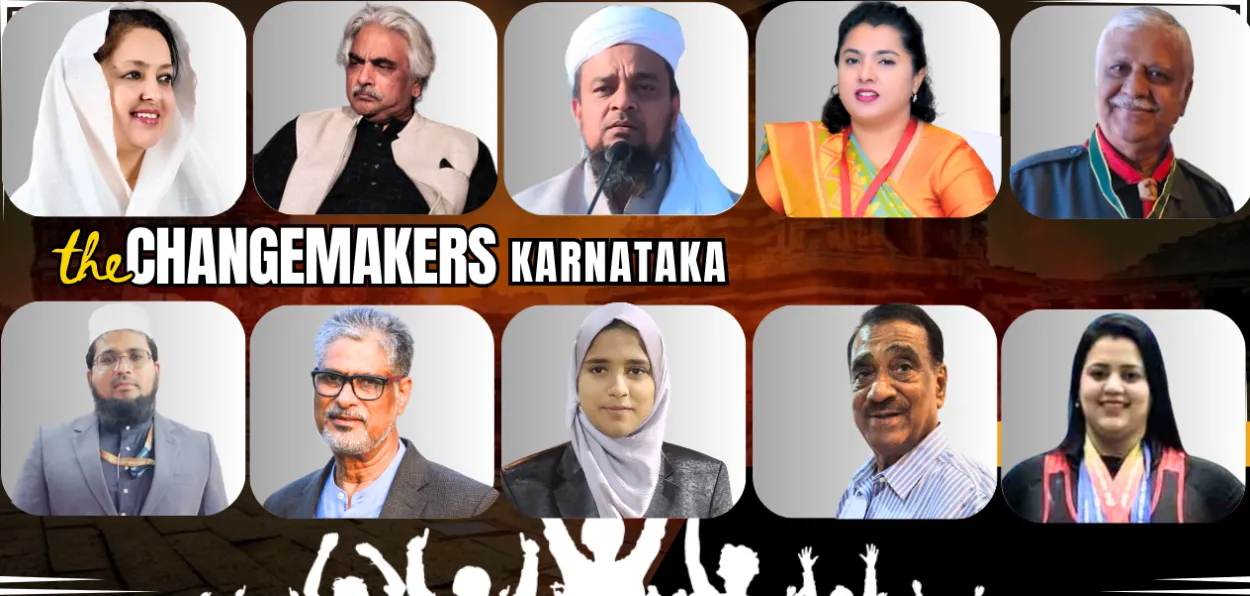
From the tech labs of Bengaluru to the coffee plantations of Coorg, from the ancient ruins of Hampi to the bustling streets of Mysore, Karnataka exudes energy. This is where India’s IT revolution was born, where classical arts thrive alongside cutting-edge innovations, and where every district tells a story of transformation.
Many Kannadigas have built empires and earned acclaim—but some went further. They didn’t just succeed; they became the Changemakers—individuals who shattered barriers, rewrote destinies, and ignited revolutions that ripple far beyond their own lives. Here are ten personalities of Karnataka whose courage and vision are reshaping the future:
Rifah Taskeen
A 15-year-old firecracker from Mysore started racing at age three in a custom car built by her ex-racer father, Tajuddin. By five, she was driving Mysore to Bengaluru; by seven, she was drifting in school shows and stealing Republic Day parades.
Fighting red tape and disbelief, she stormed past every “too young” barrier to claim seven world records (Golden, Elite, High Range, India, Asia, Worldwide & Wonder Books), mastering bikes, JCBs, cranes, buses, tippers, road rollers, and even flying a plane at eight.
Mysore’s cleanliness ambassador for five years and tuberculosis state warrior for four, she’s also a state-level boxing medalist and karate fighter. She’s drifted for Rahul Gandhi, flown with Sonia Gandhi’s blessings, and left global crowds speechless.
Self-funded, unstoppable, and dreaming of IAS wings after SSLC, Rifah doesn’t just break records; she rewrites what “impossible” means. Age is just a number.
Mushtaq Ahmed
A Bengaluru-born visionary landed in Dubai when it was still sand dunes and a dream. For 41 years as head of Dubai Police photography (until 2018), the retired 1st Warrant Officer framed an entire nation’s rise—capturing the Burj Khalifa’s skeleton, the Kaaba from a crane, Sheikh Mohammed’s 1979 wedding, and sacred Medina in rare reverence.
From helicopter shots above a bridgeless Dubai to standing beside Sheikh Zayed and global icons like Lata Mangeshkar and Mohammed Rafi, the 79-year-old chronicler turned fleeting moments into eternity. Honoured, hugged, and kissed on the forehead by Dubai Police upon retirement, Mushtaq’s lens didn’t just document history—it built it. His quiet mantra: “The best shot is yet to come.”
Tazaiyun Oomer
Tazaiyun Oomer was 13 when she fought through a crowd in Parliament House and got Indira Gandhi’s autograph, an electric moment that taught her leadership has no gender.
From a Kutchi Memon girl helping in her father’s textile shop, she grew into Bengaluru’s quiet revolution. In 1999, she founded Humane Touch Trust: 100+ corrective surgeries for disabled children, Al-Azhar School, 1,750 dignified mass weddings, 2,000+ Muslim women turned entrepreneurs, and yearly scholarships lifting nearly 300 girls into tech careers.
Recipient of the Sulthan Nari Shakti and Karnataka’s Rising Beyond the Ceiling awards, she proved compassion can shatter centuries-old barriers. Where tradition once whispered “a woman’s place,” Tazaiyun built schools, businesses, and futures. Her mantra: “Change begins the moment you decide to act.”
Mohammed Ali Khalid
Mohammed Ali Khalid, India’s Bronze Wolf Award recipient —the highest global honour in Scouting—has lived the Scout promise for over four decades with breathtaking sacrifice and impact.
Mohammed Ali Khalid stands as one of India’s most influential Scout leaders, a visionary whose four decades of service have shaped millions of young lives. From volunteering at the 1980s National Jamboree to becoming Additional Chief National Commissioner of Bharat Scouts and Guides, he has built global partnerships, led landmark events like the 2017 National Jamboree and the 2022 International Cultural Jamboree, and strengthened Scouting across the Asia-Pacific Region. A strategic thinker behind Vision 2013 and a respected global diplomat, Khalid’s selfless leadership, mentorship, and bridge-building continue to inspire generations—earning him the Bronze Wolf and global admiration.
Architect of Vision 2013 for Asia-Pacific, broker of WOSM’s global fee consensus, founder of SAANSO, and mentor to countless young leaders, Khalid turned India into Scouting’s most connected powerhouse. At 70, he still pushes for 20% membership growth and 50% youth representation worldwide.
Rahmath Tarikere
Rahmath Tarikere, born in 1959 in Tarikere’s syncretic lanes, grew up where Hindus and Muslims shared the same street and stories. The 1992 Babri demolition jolted him into action: he left pure literary criticism to unearth Karnataka’s living pluralistic traditions—Sufi saints, Nathpanthis, Shakta poets, and folk Moharram rituals that united communities for centuries.
Author of 30 books—including four Karnataka Sahitya Academy winners and the 2010 Kendra Sahitya Akademi winner Kattiyanchina Daari—he returned the national award in 2015 protesting intolerance and the murder of M.M. Kalburgi. A humble professor who insists “I am not a changemaker,” Tarikere quietly weaves pluralism into Karnataka’s soul, proving unity is not uniformity but a vibrant mosaic of differences.
Khudsiya Nazeer
Khudsiya Nazeer, the “Iron Lady of India,” was born 1987 in Bangarpet and lost her wrestler father at two. Raised in a conservative Muslim family amid depression and mockery, she turned pain into power.
Post-Caesarean, she deadlifted 300 kg to set a world record (2022), then stormed the global stage: three golds at Asia Pacific Masters 2023 (South Korea), silver in Athens, golds in Commonwealth (Australia) and Germany. The first Indian Muslim woman to win international weightlifting medals, she lifts drug-free while working full-time at KSRTC.
From burqa-clad walks guarded by police to Harvard’s stage, Khudsiya proves motherhood multiplies strength. Her mantra: educate, play sport, write your own destiny. This Iron Lady doesn’t just break records; she shatters every ceiling for women.
Fouzia Tarannum
Fouzia Tarannum, 2015-batch IAS (AIR 31), cracked UPSC on her first attempt from Bengaluru’s public libraries—no coaching, pure grit. From IRS gold-medallist to Karnataka cadre, she turned arid Kalaburagi into a national millet powerhouse with “Kalaburagi Rotti,” empowered thousands of SHG women, lifted districts to top SSLC ranks, revived gram panchayat libraries, and delivered India’s cleanest electoral rolls—earning the President’s Best Electoral Practices Award in 2025.
At 36, this quiet DC faced Islamophobic slurs yet answered only with work. Unfazed, empathetic, and fiercely people-centric, Fouzia proves bureaucracy can have a heart and a steel spine. She doesn’t shout change—she builds it, one roti, one vote, one woman at a time.
Zafer Mohiuddin
pix09
Zafer Mohiuddin, Raichur’s radio-struck boy who once ghostwrote love letters in school, turned a bus-ride compliment from R. Nagesh into a lifetime on stage. He quit UPSC and Air Force postings to found Kathputaliyaan Theatre Group (1988), wielding puppets and plays as weapons against taboo.
From translating Girish Karnad’s Tipu Sultan ke Khwaab (Theatre Olympics 2018) to shattering Urdu myths with Zaban Mili Hai Magar, his raw, Amitabh-like voice has roared in ten languages, narrated Swaraj Namah, and defended Urdu’s secular soul alongside Karnad.
In November 2025, Karnataka crowned him with the Rajyotsava Award—its highest honour—for four decades pulling society’s strings toward truth and harmony. The puppet master still refuses to cut his own.
Moulana Dr. Mohamed Maqsood Imran Rashadi
Moulana Dr. Mohamed Maqsood Imran Rashadi, Principal and Chief Imam of Bengaluru’s iconic Jamia Masjid, memorised the Quran in 18 months, earned a PhD in Urdu literature, and turned a struggling madrasa into a 100%-pass powerhouse for 400 underprivileged students.
From quietly removing provocative meat thrown to spark riots to defusing the 2025 “I Love Mohammed” banner crisis with one calm sermon, he prevents violence before it begins. He negotiates fair loudspeaker rules across faiths, hosts Hindu swamis for iftar, and, after the Pahalgam terror attack, thundered “Terror has no religion—we love Hindustan.”
A scholar who preaches in Tehran, meets Saudi royals, and still walks the KR Market uniting traders, Moulana Maqsood proves that unity is built by deeds, not banners. Bengaluru’s heartbeat of harmony beats in his voice.
Syed Nawaz Miftahi
Syed Nawaz Miftahi, fully sighted yet forever changed by the tear-filled Quranic recitations of blind children in Mumbai in 2011, vowed to become their light.
He mastered Braille, invented the “broken-rice touch” technique to awaken ageing fingers, and turned Sultan Shah Markaz, Madrasa-e-Noor (70 students), and daily phone classes into sanctuaries where the visually impaired recite flawless tajweed and complete multiple khatms every Ramazan.
From Hyderabad to Kashmir, his model now trains teachers who were once his students. In November 2025, he launched Umang Foundations—a residential beacon run by seven blind trustees and one fearless young sighted woman—where every visually impaired soul, of any faith, learns Quran, computers, and independence.
Nawaz doesn’t give sight; he proves the heart’s vision is brighter.
source: http://www.awazthevoice.in / Awaz, The Voice / Home> The Changemakers of Karnataka / by ATV / posted by Aasha Khosa / November 22nd, 2025
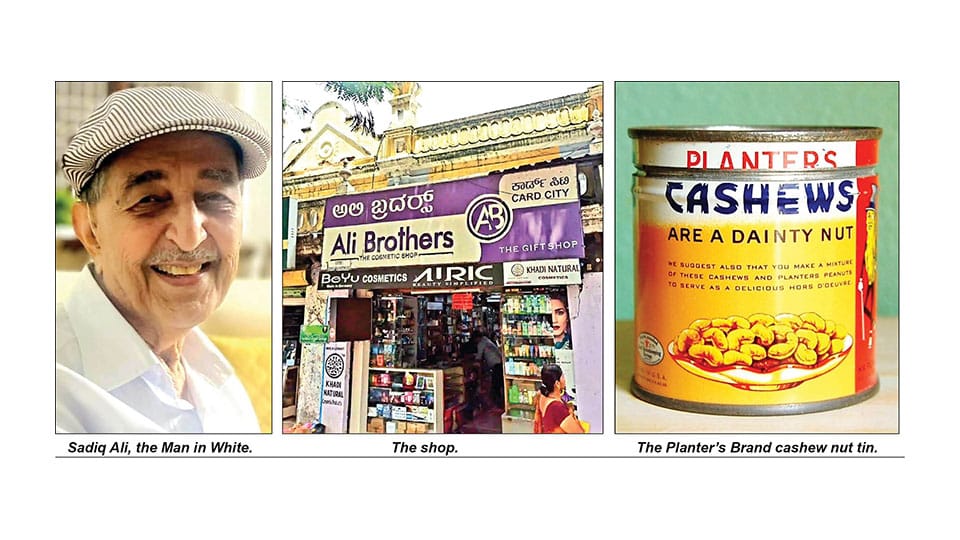
In the passing away of Mr. Sadiq Ali, the proprietor of Ali Brothers, last week, our city has perhaps lost one of its most long-standing icons, because his shop is one of the few shops that have stood almost unchanged, over the longest period of time, in the front façade of our iconic Devaraja Market building.
Out of the nearly seventy business establishments that stand in that row, only about a dozen still stand unchanged and because of my own long-standing familiarity with that place, I can name almost all of them and in the right order too. And, if I have got my observations right, while all the good old, surviving shop owners that I knew of there, slowly stopped showing up at their shops over the years, with the passage of time and passing away of their own good health, Mr. Sadiq Ali was the only shop owner there, who was present in his shop every day, the longest.
He once told me how his father had first started the shop in Mercara and later established the present shop here as a branch and how the original one was wound up later, due to the difficulty the family faced in managing it.
Although I stopped visiting his shop many years ago because of the severe parking problem in the Devaraja Market area, I used to meet Mr. Sadiq Ali quite regularly at the meetings of the Alumni Association of the St. Philomena’s College where we both studied, although two full decades apart. He would never miss any of these meetings and over the past many years, he would be proudly introduced as the oldest alumnus showing up at them!
Riding his trusted blue and white Lambretta, he would be among the first persons to make an appearance at the auditorium and be among the last ones to leave, after shaking hands with all the others there. A most humble and soft-spoken man, he was so soft-spoken that you had to strive hard to hear him. But he stood out most for his two very unique attributes that remained unchanged, all through his life; his attire and his smile. He was always dressed in pristine white and he could never be seen without his disarming smile!
As far as I am concerned, I can safely say that I have known him all my life and I say this because my mother must have carried me in her arms into his shop while I was an infant, until I began to walk in there myself, holding her or my dad’s hand. That is how old my association is, with the man I’m writing about today. He was so close to our family that just a few months ago, he had come home to meet my mother and spend some time with her.
Ali Brothers was the place where we, like most other Mysoreans then, used to do almost all their shopping for soaps, toiletries, cosmetics, chocolates, greeting cards and some condiments too. Being an agent for vehicle insurance, until the advent of online insurance, Mr. Sadiq Ali was the man who used to manage all our vehicle insurance renewals.
He was so meticulous that he would maintain a record of the renewal dates of all his customers’ vehicles and he would call them up well in time, to seek their consent for renewal, which he would do and then personally deliver the policies to them.
Until a very similar store, Mohan Bhandar came on the scene across the road, in the year 1963, all the goodies, dear to my heart then, could only be found at Ali Brothers and nowhere else and these included Cadbury’s chocolates, Parry’s toffees, Kissan jams and tomato sauce, Polson’s butter, corn flakes and most of all, the Planter’s and Cocktail brand of salted cashew-nuts that came in a sealed tin, that had to be opened with its own key, soldered on its top!
In a most interesting arrangement, this slotted key used to peel off a narrow band of metal from around the tin that would leave its top as a very useable lid after the can was opened.
We still have a couple of those cans lying around in our estate house, as relics and memories of the good old days, gone by. While my parents used to keep coins in one of them, in the other, I used to store my spare stock of the carefully selected, round pebbles for the omnipresent catapult, that I would always have around my neck. And mind you, at that time, this contraption was not just omnipresent but my most omnipotent weapon too!
At the end of the day, when it was time for me to be put to bed, my dad had to take it off my neck and place it under my pillow along with its red ammo bag, before tucking me in and beginning his reading of that day’s bedtime story, from my huge collection of Read Aloud series of story books, which I have carefully preserved to this day!
It is a different matter that my state of wakefulness would never ever last through the full story, which invariably had to be continued the next day!
Falling asleep was so easy then, while I was a child and I often ponder over this blissful time, during the times when I lie tossing in my bed, on the few occasions when sleep eludes me now.
That is when I am reminded of Shakespeare who in Henry IV, says; O sleep, O gentle sleep, Nature’s soft nurse, how have I frightened thee, that thou no more will weigh my eyelids down and steep my senses in forgetfulness?
e-mail: kjnmysore@rediffmail.com
source: http://www.starofmysore.com / Star of Mysore / Home> Columns, Over a cup of evening Tea / by Dr K Javeed Nayeem MD / November 16th, 2025
From A Dreamer’s World | Photo Credit: Special Arrangement
A brilliant blue fish glides in a patch of orange pumpkins, another lies still among lilac orchids hoping his camouflage allows him to blend in. These are a few finned beauties artist Shoeb Dastagir has depicted in his solo show A Dreamer’s World.
“I find fish quite calming and I can spend hours looking at them; that is why I began capturing them in my paintings,” says Shoeb, adding he spends a lot of time at the aquarium in Mysore Zoo. “I enjoy watching videos of aquatic life on my phone, too.”
He reels off their names — bumblebee goby, oscars and arowanas, tiger fish, a Brunei beauty and a shark — and how they are all a part of this show. “I am a Piscean, so no matter how hard life gets, fish are a calming refuge for me,” says the artist. “Fish are always calm, going about their lives despite the confines of their surroundings.”
Shoeb Dastagir | Photo Credit: Special Arrangement
He talks about his love for “sunny colours such as tangerine orange, avocado green, icy blue and buttery yellows”. All these hues and more are to be found in his works that exude a touch of whimsy and play out in a fantastical land where an astronaut steps around teacups, fish nestle between blue pea and pearls, and an old-model television sits atop a bouquet of yellow roses.
Though Shoeb draws his inspiration from the natural world, a lot of his art is birthed in his vivid imagination that fuel his compositions of poetry, prose and songs as well. According to his mother Ayesha Dastagir, all these creative interests lead Shoeb to produce bigger and detailed paintings. “One can see a lot of mystical characters apart from the animals and fish, of course. I believe it is his subconscious, sensitivity and imaginary fantasy world that combine to produce something new and different.”
Most of the works in A Dreamer’s World have been executed using pastels and watercolours on paper over the the greater part of a year. Though Shoeb used to paint with oils and canvas, this change in medium came about when he moved from Bengaluru to Mysore, and working on paper seemed a more viable option as space was a constraint at the new place.
From A Dreamer’s World | Photo Credit: Special Arrangement
The artist, who signs his works as Schoeb, his official name which is often misspelt, is currently working on a series of portraits.
The upcoming / current exhibition comprises 24 pieces on display apart from a few others which are a part of the series and are available for sale at the gallery.
A Dreamer’s world by Shoeb Dastagir will be on display at MKF Museum of Art, Bengaluru from November 8-19. Entry free, Mondays closed.
source: http://www.thehindu.com / The Hindu / Home> Entertainment> Art / by Ruth Dhanraj / November 06th, 2025
Saniya Samreen receiving a Gold Medal from Justice Dinesh Maheshwari, Chairperson of the Law Commission of India and former Judge of the Supreme Court, at the 9th Convocation of the Central University of Karnataka (CUK) held on Saturday. | Photo Credit: ARUN KULKARNI
Defying all odds, Saniya Samreen, daughter of a fruit vendor from Aland town in Kalaburagi district, bagged the Gold Medal in Master of Commerce (MCom) at the 9th convocation ceremony of the Central University of Karnataka (CUK) held on Saturday.
She received the medal from Justice Dinesh Maheshwari, Chairperson of the Law Commission of India and former Judge of the Supreme Court, in the presence of Vice-Chancellor Battu Satyanarayana, Registrar R.R. Biradar and Controller of Examinations Kota Sai Krishna, on Saturday.
Ms. Samreen, who completed her schooling and college education in Aland before joining CUK for her postgraduate studies, said that her achievement was a result of perseverance and family support.
“All of my achievements are the result of hard work, dedication, and the unwavering support and guidance from my family and mentors,” she with gratitude during her interaction with media representatives on the sidelines of the convocation.
Her father, Mr. Shamu Bagwan, earns his livelihood as a fruit vendor, while her mother, Mrs. Raziya Begum, is a homemaker. “My parents’ constant belief in me has been the driving force behind my success,” Saniya added.
Saniya, who has also qualified both the Karnataka State Eligibility Test (KSET) and the National Eligibility Test (NET) for assistant professor, said she wishes to build her career in academia.
“I aspire to contribute to the field of commerce through teaching and by shaping future professionals,” she said.
source: http://www.thehindu.com / The Hindu / Home> News> India> Karnataka / by The Hindu Bureau / November 08th, 2025
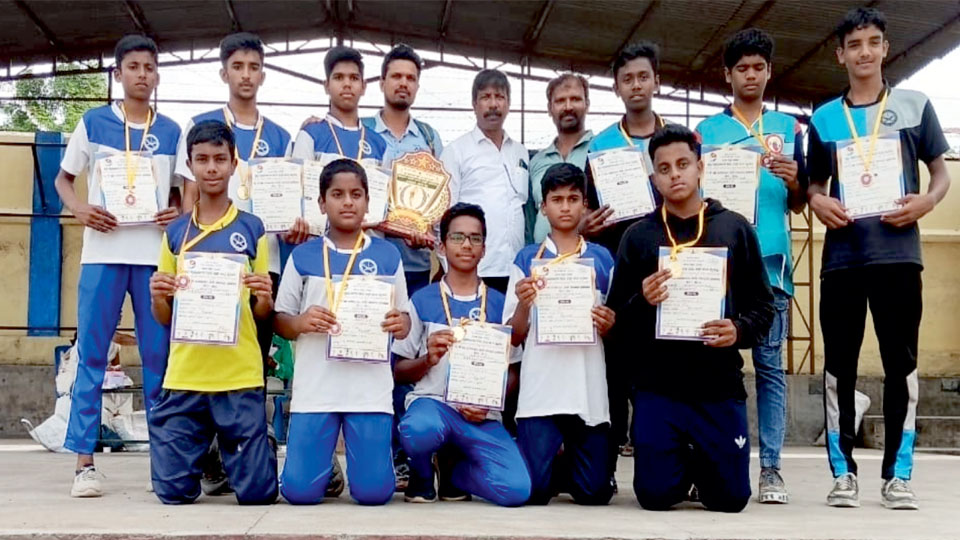
Boys team of Al-Kareem School won the Taluk-level U-17 Throwball Tournament for Boys organised at St. Philomena’s High School recently.
The team defeated Ramakrishna Ashram in the final match.
Members of the team included Mohammed Attaulla (Captain), Farhan Khan (Vice-Captain), Mohammed Junaid, Mohammed Nadeem, Afreed Ahmed Khan, SinnanShariff, Roshan Ali, Mohammed Toufiq, Zaid Ahmed and Zayan Ahmed.
source: http://www.starofmysore.com / Star of Mysore / Home> Sports / November 10th, 2025
Mangaluru, KARNATAKA / Kozhikode, KERALA / Dubai, U.A.E :
Shabana Faizal with her husband Faizal Kottikollon
New Delhi :
Mangalore-based Shabana Faizal has emerged as the youngest woman among India’s top 10 philanthropists, according to the EdelGive Hurun India Philanthropy List 2025.
She has donated ₹40 crore (approximately $1.5 billion) through the Faisal & Shabana Foundation to education, health, and social development.
Shabana Faisal’s journey from being raised in a small town in Mangalore to co-leading a global enterprise is about he hard work and ambition.
Her entrepreneurial journey began in 1995 as a retailer of unique, speciality and luxury products. After leading the company for eight successful years, she decided to team up with her husband, entrepreneur Faizal Kottikollon, and support him in running the world-class foundry, Emirates Techno Casting (ETC).
Shabana took charge of all human resources and administrative processes at ETC, where she created a significant impact in shaping the company’s business success.
In her role as Vice Chairperson of KEF Holdings, she is actively involved in guiding the business’s growth strategy across global markets. Deeply committed to social improvement, Shabana and her husband founded the Faizal & Shabana Foundation in 2007, with the vision of ‘Giving to Create Impact’.
At 53, Shabana’s work has placed her among some of the most influential women in India’s philanthropy world, including Rohini Nilekani, Kiran Mazumdar-Shaw and Bina Shah.
EdelGive Foundation, in collaboration with Hurun Research Institute, recently released the 12th edition of the EdelGive Hurun India Philanthropy List 2025.
The list honors India’s most generous individuals and families. Over the past three years, 191 philanthropists have donated a total of ₹10,380 crore, representing an 85% increase in contributions.
The education sector continues to lead as the top donor, receiving ₹4,166 crore from 107 donors.
Shabana is the mother of four children – Sophia, Sara, Zakaria, and Zarina – but continues to play an active role in business and philanthropy. Her work makes her one of India’s most influential female philanthropists, exemplifying how professional leadership and a commitment to giving can combine to create widespread social impact.
The EdelGive Hurun India Philanthropy List 2025 states that the top 25 donors contributed ₹50,000 crore in just five years, or an average of ₹46 crore per day. Mumbai leads in philanthropy, contributing 28% of total donations, followed by New Delhi and Bengaluru.
source: http://www.awazthevoice.in / Awaz, The Voice / Home / posted by Aasha Khosa / November 10th, 2025
Well-known Mangaluru-based entrepreneur and philanthropist Hashim Khan (45) passed away due to a heart attack in his native village in Uttar Pradesh on Tuesday.
Khan had travelled to his hometown to attend a family function when he reportedly suffered a massive cardiac arrest.
He is survived by his wife, three sons, and a daughter.
Having arrived in Mangaluru at a young age in search of work, Hashim Khan gradually built a successful business and earned wide respect in the city’s business circles. Beyond entrepreneurship, he was equally known for his acts of generosity and social commitment.
During the Covid-19 pandemic, Khan personally distributed food supplies and essential items to needy families, winning the admiration of many.
His untimely demise has left a deep void among the city’s business community and those who benefited from his charitable work.
source: http://www.daijiworld.com / Daijiworld.com / Home> Karnataka / by Daijiworld Media News Network – Mangaluru / November 05th, 2025
Amirbai Karnataki is one of the earliest Kannada singer-actress who made it big in Hindi cinema. She went to Bombay when women artistes were labelled ‘fallen’, but with grit and passion Amirbai became a star and sang 380 songs in 150 Kannada and Hindi films.
Amirbai’s tale is one of inspiration
For someone who didn’t belong to the gramophone generation but the golden period of radio, Lata Mangeshkar, Asha Bhonsle, Mukesh, and Rafi ruled our hearts and constituted our imagination of a film song. The same AIR, during a light music programme, had played “Ninnane Neneyuta Ratriya Kalede”. This, was a carbon copy of Lata’s memorable “Saari Saari Raat Teri Yaad Sataye”, but the voice was starkly different. It had a heavy nasal tone, and the flawless rendition had a simplicity to it. The charming song left an indelible mark and I felt I had to recover her voice from pages that were unknown to me.
Amirbai Karnataki was an unheard voice for the Seventies: she was long gone, and had faded into the archives of black and white era of early films. She was someone who lived on in personal memories of people who had known and heard her.
Amirbai Karnataki (1912-65), who sang 380 songs in 150 films, was an early singer and actress of Hindi cinema. This singer who sang the unforgettable “Main to pavan chali hoon bole papiha” and “Bairan Nindiya Kyon Nahi Aaye”, was born in Bijapur in Karnataka. During the 1930s Amirbai was a prominent name along with stars like Suraiyya, Shamshad Begum, Noor Jahan and Zohrabai Ambalewali.
When Lata Mangeshkar came on to the scene, many of these singers moved into the background and for the later generations they remained unknown.
Born into a family of artistes, Amirbai’s parents Ameenabi and Husensaab worked for a theatre company and even ran one for many years. Growing up years for Amirbai and her five siblings was filled with music and theatre, what with many of her uncles and aunts being top musicians and actors in theatre. She lost her father early and her uncle, Hatel Saheb took care of all the children.
During those years, Bijapur was part of Mumbai Presidency and the sangeet natak tradition in these parts was flourishing. The famous Balagandharva’s company and several other theatre companies camped at Bijapur; Amirbai and her sister Goharbai, trained as they were in classical music, impressed these companies with their singing and they began to not only sing for several of them, but also act.
As Rahmat Tarikere writes in his biography of Amirbai Karnataki, Amirbai moved from Bijapur to Mumbai, from theatre to films. But the exact date and nature of these movements and transitions are hard to tell. The story of Amirbai is a sum total of several happenings in a historical period as there are few definitive documents to lead us to any accurate picture. Painstakingly put together by the biographer, Tarikere says that when Amirbai reached Mumbai (it was perhaps the year of Alam Ara’s release, 1931), women who worked in films, theatre and music were still seen as “fallen”.
Women artistes were often ridiculed as “free women” and among the several women performers, Amirbai and her sister Goharbai too, tried to free women of this stigma. In fact, families not only disowned such women, but there were instances of women being killed for choosing the arts.
In fact, Rahmat Tarikere says that the kind of fight these women put up with the social circumstances of those days is no less significant than the freedom struggle itself. If women artistes, in the later years, earned fame and reputation, it was because of the sacrifices these women made. Ironically, two very popular films “Basant” and “Kismet” in which Amirbai acted deals with the plight of actresses.
Amirbai became a very reputed singer and actress of her times. She was highly paid, and even built a theatre Amir Talkies in Bijapur. She travelled the length and breadth of North Karnataka giving programmes related to theatre and cinema.
A singer who sang some of the finest love songs, had a very unhappy love life though. Tarikere writes how her husband, a Parsi actor who played villain in those days, Himalayavala, abused her physically and emotionally. She had to suffer several assaults from him and even separation became a painful affair. Unable to recover from the trauma, she went into oblivion for several years, and later Badri Kanchawala, with his love and care brought back peace into her life.
At the age of 55, Amirbai passed away; Karnataka had been unified by then and the rest of Karnataka hardly knew of her. Even the newspapers reported her death four days later. It was only later that people have slowly learnt of Amirbai’s greatness and how Gandhiji was immensely fond of her rendition of “Vaishnava Janato”.
source: http://www.thehindu.com / The Hindu / Home> Features> MetroPlus / by Deepa Ganesh / February 27th, 2015
Writer Bolwar Mahamad Kunhi talks about literature and fests.
Karnataka : Bengaluru : 30/10/2017 : Bolwar Mohammed kunhi during The Bengaluru Literature festival in Bengaluru on Sunday. Photo : Sudhakara Jain.
Bolwar Mahamad Kunhi, 66, is the only Indian writer conferred with two Central Sahitya Academy Awards (2010 & 2016) for creative prose in Kannada. He received the Atta Gallata Bangalore Lit Fest 2017 Award for Kannada for his overall contribution on the concluding day of the Lit Fest on Sunday. With 250 short stories and a host of novels, with several directed towards children behind him, Kunhi a recipient of the Karnataka Rajyothsava Award and Karnataka Sahitya Academy’s Lifetime Achievement Award says, “Young writers should regularly read what seniors write and get inspired to find their own words and voice.” Kunhi, who said every recognition is a moment of inspiration to writers, spoke to MetroPlus regarding his life and writing. Excerpts:
Do you think such literary fests are important for the growth of literature?
Yes. Such festivals also add their share to other ingredients required for a healthy literary growth, look at the buzz they create, have you ever seen this kind of an unprecedented crowd? I am not as aware of the present statistics of other languages. This is my uncorroborated research. In recent times Kannada literature has seen a huge number of publications, possibly surpassing that of any other Indian language. The number of literary events or the number of Jnanapeeth awardees we have could surpass those from any other language. This could be another reason some Kannada writers have achieved celebrity status.
Is literature the voice of society?
Literature always augurs well for society and provides wisdom to humanity. All religious books, which I consider part of literature, are works of wisdom which have had a great impact on humankind. Literature also taught civic sense to man who lived like a wild animal. The conversations and dialogues in such events also propagate the same wisdom.
After Chand Ali in ‘Swathantrayada Ota’ who is the next character in your work awaiting attention?
In the last two years I have been busy in understanding two important characters for different reasons. First to write 1000 couplets about Ambedkar and second to write a novel on the Prophet’s beloved wife, Ayesha. The second has gained more traction in the last few months. When I wrote the first ever historic novel on Prophet Muhammad Oidiri two years ago, it was well-received. But most of the characters in Odiri were male. The thoughts, words, actions, and the attitude was male. I always wondered if the women of that time had opinions of their own. Did they ever voice what they felt? Even in solitude? This is the subject of the proposed novel titled Umma (Mother) inspired by the life of Ayesha. I am not sure which one will be completed first.
After Gorur Ramaswamy Iyengar who wrote on Gandhiji, your book on the Mahatma received instant recognition. How important is it for today’s children to read about Gandhiji?
To guide our children in the right way we show them role models. It is a shame we are unable to give them contemporary examples to encourage and mould their personality. The examples that we provide from history or mythology seem too overwhelming for them. Historical characters are kept on a pedestal and are inaccessible. Gandhiji maybe one example which children can relate to since they read and learn about him a lot and he is the most recent of those examples! To these children my book attempts to show that Mahatma Gandhi was not an unachievable superhuman. He was a common, simple boy, who grew up like most of us, as a darling to his parents, went to school, studied prescribed text books and qualified as a lawyer. As a young man he fought for the downtrodden and stood for truth, non-violence and social justice. I tried to depict him as a common man who lived an uncommon life to become a Mahatma.
Do female characters get more importance in your novels?
I don’t think so. Being feminist writer is not an easy way to popularity. Though I was born in a male-dominated community, I was brought up with the love of various women in my early life – my mother, my sisters and my first teacher. They were the ones who tolerated my anger, frustration and ego and loved me unconditionally. That guilt might be the reason women are central to my work. I dedicated my first story collection to ‘Appi Bayi’, the teacher who taught me to write alphabets. The second one was to my mother who I buried with the same hands that I dedicated it to. Another work was to my elder sister and another to my two daughters. My mega novel is dedicated to my beloved. All of this could be due the same guilt. May be my work as an emotional man resonates with like-minded people and thus gets appreciated.
How was your experience writing the screenplay for ‘Munnudi’ and ‘Athithi’?
My writing is like a sculptor’s. It takes shape with time. I don’t believe in inspirations. Cinema, definitely is not my medium. I wrote the screenplay under the persuasion and for the love of my friends P. Sheshadri, who bagged nine National awards in a row and Dattanna, an inimitable character actor. I wrote what I felt for both movies and they incidentally won national awards. I cannot comment on what else I might be able to do in cinema, at least not now.
Can you talk about your initiation to writing considering you have no writers in the family?
I joined Syndicate Bank in Gulbarga after my B.Sc. Much later when I was associated with the Sahitya Academy I discovered that most members had masters degrees. It enthused me into getting an MA in Kannada in the 1980s.
My desire to write was another one of such self-imposed challenges. During a casual conversation while playing carrom with writer Arooru Lakshmana Seth in Gulbarga, I asked him how he was able to visualise and write so much. His said “non-writers like me cannot understand the process.” That comment propelled me into writing a short story and getting published in Navbharat which was the beginning.
source: http://www.thehindu.com / The Hindu / Home> Books> Authors / by Ranjani Govind / October 30th, 2017