While the origin of Mygurudu is unknown, it is believed that the word originated from ‘Mozhi Kurudu’, which means misleading with words.
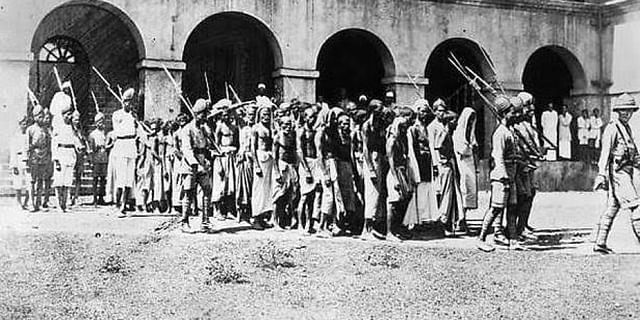
The 1921 revolt grew as an agitation against the feudal lords who aided the British. (Photo | Special Arrangement)
Kozhikode :
The centenary observations of the Malabar rebellion of 1921 are also becoming an occasion to retrieve many forgotten things part of local history. Mygurudu, the secret language that was prevalent in some parts of Malabar, is among them. For the coded language was used widely by the rebels to hoodwink the British during the rebellion.
While the origin of Mygurudu is unknown, it is believed that the word originated from ‘Mozhi Kurudu’, which means misleading with words. The language was developed by swapping Malayalam alphabets. For example, Malayalam alphabet ‘Aa’ is replaced by ‘Sa’ and ‘Eee’ by ‘See’.
In his book ‘Anglo-Mappila War 1921’, historian A K Kodoor recorded that the rebel leaders had instructed that all messages should be communicated through Mygurudu. He added that rebels’ meeting at Vellinezhi had decided to teach all group members the language, and that the Mappilas of Malabar used the secret language from 15th century AD when they were battling the Portuguese.
The Students Islamic Organisation (SIO) recently organised an exhibition ‘Al Jamia Mygurudu’ at the Al Jamia Al Islamia at Santhapuram near here. “The exhibition was part of a protest against the move from the Indian Council of Historical Research (ICHR) to delete the name of those who participated in the 1921 rebellion from the list of freedom fighters,” said Ayman M A, convener of the exhibition.
Dr Pramod Irumbuzhi, who has done extensive research on the language, said he first came to know about it when he was studying at the Calicut University. “I realised that some people can still speak the language. There will be around 500 people who can fluently speak Mygurudu in the seven districts of Malabar,” said Pramod, whose book on the subject has run into the fourth edition.
source: http://www.newindianexpress.com / The New Indian Express / Home> States> Kerala / by Express News Service / October 24th, 2021
The revolt of 1857-58 is largely considered and is widely seen as a ‘Popular Uprising’. The uprising had centres spread across North India as well as Central and Western India. The uprising in different centres had its own leaders. The most important names associated with the uprising that comes in one’s mind are those of the Indian soldier Mangal Pandey at Barrackpore, Rani Laxmibai at Jhansi, Veer Kunwar Singh at Arrah, Maulvi Ahmad Shah at Faizabad, Tantia Tope at Kanpur, Begum Hazrat Mahal at Lucknow.
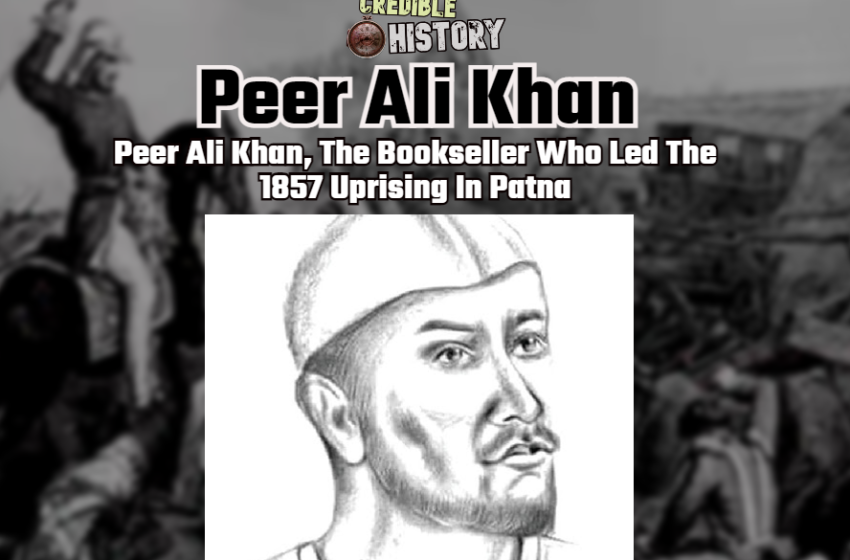
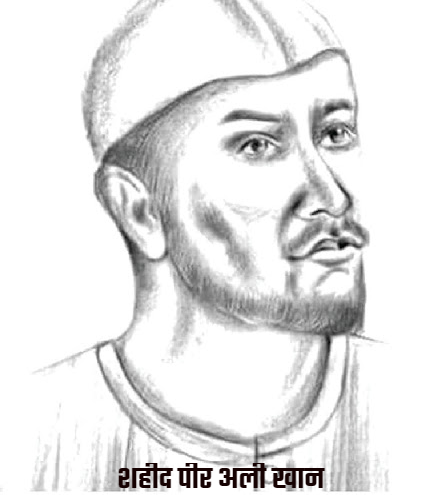
Peer Ali Khan
At the same time, there are many heroes who are largely unheard of or are often forgotten. One such name is that of Peer Ali Khan, a bookseller who led the uprising in Patna. Peer Ali Khan has been described as the “Chief Rebel of the city”[1] by William Tayler who was the Commissioner of Patna between 1855 and 1859.
Peer Ali Khan was born in Muhammadpur in Azamgarh district of Uttar Pradesh. Around the age of seven he ran away and arrived in Patna. In Patna he was provided shelter and refuge by a zamindar who brought him up along with his son and educated him.[2]Peer Ali Khan owned a bookshop in Patna. The bookshop became the meeting point for rebels and also a contact point for rebels and the disenchanted Indian soldiers in the British Army.
According to William Tayler:
“Peer Ali was a native of Lucknow, but had resided for many years at Patna; he was by trade, a Book-seller, and I strongly suspect that he may have originally established himself here, for the express purpose of carrying on the intrigues which issued in this abortive out-break.”[3]
Peer Ali secretly distributed important leaflets, pamphlets and coded messages to the rebels.
He regularly organised campaigns against the British, and became the leader of the July 1857 upsurge in Patna.
William Tayler in his narration of the events of 1857 in Patna says:
“Two days before the emeute at Patna, which will be described in a subsequent chapter, Ahmed Oollah’s father, Illahee Buksh, the blind man, whom I have above mentioned, sent a message to apprise me, that the leader of the Rebels, Peer Ali Khan, was collecting arms and men”.[4]
Uprising in Patna
The uprising in Patna took place on the 3rd of July 1857 and it was carried out by Peer Ali and the other rebels.
The rebels led by Peer Ali first attacked the house of a Roman Catholic priest in the heart of the city but the priest escaped. They then shot and killed Dr Lyell who was the principal assistant to an opium agent. When a reinforcement of British soldiers was sent to the scene of attack some of the rebels were shot and killed whereas others fled.
“The most serious affair at Patna, however, occurred about the close of the period to which this chapter more particularly relates. At about eight o’clock in the evening of the 3d of July, a body of Mohammedans, variously estimated from eighty to two hundred, assembled at the house of one of their number, one Peer Ali Khan, a book-seller, and proceeded thence to the Roman Catholic Church and mission-house in Patna, with two large green flags, a drum beating, and cries of ‘Ali! Ali!’ The priest, whom they probably intended to murder, fortunately escaped. They emerged into the street, reiterated their cries, and called on the populace to join them. Dr Lyell, principal assistant to the opium agent, immediately went to the spot, accompanied by nine Sikhs. He rode ahead of his support, was shot down by the rioters, and his body mangled and mutilated before the Sikhs could come up. A force of Sikhs and nujeebs speedily recovered the unfortunate gentleman’s body, killed some of the insurgents, and put the rest to flight.”[5]
In the aftermath of the attack, Peer Ali’s house was searched by the British, where they found and seized arms and a number of letters. He was designated as the leader of the upsurge by William Tayler.
William Tayler describes it as follows:
“Somewhat later in the day, the deputy Magistrate, Moula Buksh to whom the Magistrate had entrusted the investigation of the case, came to me in great triumph with some murderous looking arms and implements (among which was an English fencing mask) and a large packet of letters, all of which had been found in the house of Peer Ali Khan, the leader of the outbreak and Captain of the rebels;”[6]
“The letters discovered in his house serve to show, that, for several years past, he had been in correspondence with different parties, principally with one “Musee” ool “zuman”, a Lucknow man, who followed the same trade, and that he had, in communication with these parties, deliberately discussed and matured seditious plans against the British Government.”[7]
Thereafter, Peer Ali Khan and the other rebels were arrested and tried. Most of the rebels were hanged within hours of sentencing. Peer Ali who was believed to be the murderer of Dr Lyell was also handed death sentence for his overall role as the leader in the uprising of 3rd July 1857.
“….. numerous accomplices were seized during the next few days, and among them, after a short resistance, in which he was wounded, Peer Ali himself; ample evidence was, by the exertions of Moula Buksh, obtained, convicting these men of active participation in the outrage, 21 were hanged, 23 imprisoned.”[8]
He refused amnesty
After being sentenced to death, Peer Ali was offered amnesty in lieu of providing more evidence and information regarding the nature of the uprising, but nothing could break him. History therefore stands witness to the fact that this ordinary bookseller did not concede to the demands of the British and refused the amnesty. He accepted the gallows rather than a life of disgrace.
William Tayler goes on to note:
“After capital punishment had been pronounced upon him, I sent for him (as I generally did with such criminals) and questioned him in my private room, in hopes of eliciting some further information regarding the plot.
Heavily fettered, his soiled garments stained deeply with blood from a wound in his side, confronted with myself and several other English gentlemen, the last hope of life departed, not for a moment did he betray agitation, despondency, or fear.”[9]
Declining the pardon being offered, Peer Ali proclaimed:
“On being asked whether he could do anything to make it worth while to spare his life, he answered with supreme coolness and some contempt: “There are some cases in which it is good to save life, others in which it is better to lose it”. He then taunted me with the oppression I had exercised, and concluded his speech by saying, “You may hang me, or such as me, every day, but thousand will rise in my place, and your object will never be gained.””[10]
William Tayler seems to be in awe of Peer Ali and says:
“….. men, whose unconquerable fanaticism renders them dangerous enemies, and whose sternresolution entitles them, in some measure, to admiration and respect”.[11]
The Hanging
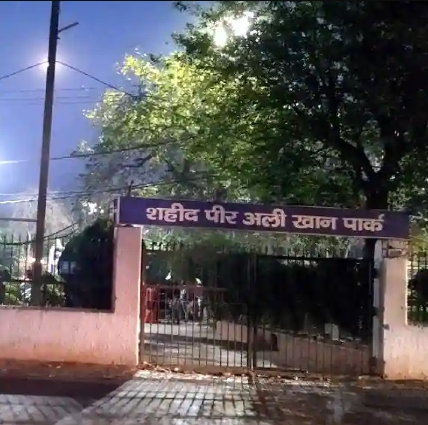
On 7th July 1857, Peer Ali was hanged in full public view in Patna. In present day Patna a children’s park opposite the DM’s office near Gandhi Maidan has been named the Shaheed Peer Ali Khan Park by the Govt. of Bihar to commemorate the sacrifice of this ordinary bookseller whose deeds made him extraordinary and memorable. The park is considered to be the place where Peer Ali was hanged in 1857.
Naming a park after a forgotten hero of the 1857 uprising goes a long way in making him and his contribution known to the people. Moreover, reading and writing about Peer Ali khan made me realize once again and ever more that our freedom is very hard earned. We cannot take it for granted. I and we all need to cherish it, nourish it and strengthen it.
[1] William Tayler, Our Crisis Or Three Months at Patna during the Insurrection of 1857, (2007 Reprint), Khuda Bakhsh Oriental Public Library, Patna, p.4
[3] William Tayler, Our Crisis Or Three Months at Patna during the Insurrection of 1857, (2007Reprint), Khuda Bakhsh Oriental Public Library, Patna, p.45
[4] William Tayler, Our Crisis Or Three Months at Patna during the Insurrection of 1857, (2007 Reprint), Khuda Bakhsh Oriental Public Library, Patna, p.30
[6]William Tayler, Our Crisis Or Three Months at Patna during the Insurrection of 1857, (2007 Reprint), Khuda Bakhsh Oriental Public Library, Patna, p.44
7William Tayler, Our Crisis Or Three Months at Patna during the Insurrection of 1857, (2007 Reprint), Khuda Bakhsh Oriental Public Library, Patna, p.45-46
8William Tayler, Our Crisis Or Three Months at Patna during the Insurrection of 1857, (2007 Reprint), Khuda Bakhsh Oriental Public Library, Patna, p.44
[9] William Tayler, Our Crisis Or Three Months at Patna during the Insurrection of 1857, (2007 Reprint), Khuda Bakhsh Oriental Public Library, Patna, p. 44
[10] William Tayler, Our Crisis Or Three Months at Patna during the Insurrection of 1857, (2007 Reprint), Khuda Bakhsh Oriental Public Library, Patna, p.44-45
[11] William Tayler, Our Crisis Or Three Months at Patna during the Insurrection of 1857, (2007 Reprint), Khuda Bakhsh Oriental Public Library, Patna, p. 45
source: http://www.thecrediblehistory.com / Credible History / Home> English> Freedom Movement> Others / by Kanupriya Gautam / October 20th, 2021
__________________
Kanupriya Gautam : Kanupriya has done her Master’s in Modern Indian History from University of Delhi and has deep Interest in History, Politics and Literature.
source: http://www.thecrediblehistory.com / Credible History / Home> English> Freedom Movement / by Kanupriya Gautam / October 20th, 2021
Shams Tabrez Qasmi, the CEO and the chief editor of Millattimes, has been honoured with “Amar Shaheed Molvi Baqar Award 2021”.
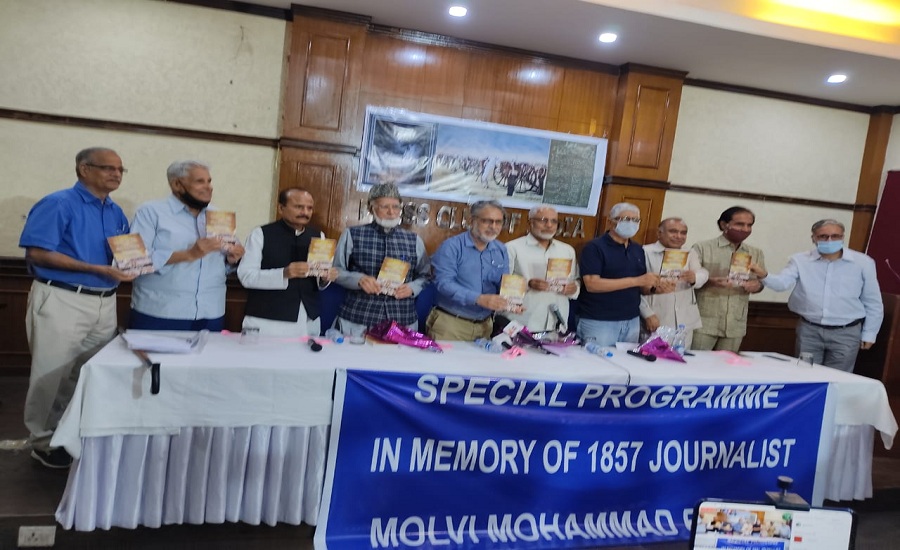
The award is in the memory of the martyr and celebrated Urdu journalist Molvi Muhammad Baqar (1780-1857). The award was conferred upon him on 16th September 2021 in a programme held at the premises of the Press Club of India (PCI), 1 Raisina Road, Near Kirshi Bhawan, New Delhi-1 in the presence of the office bearers of the PCI and a good number of the journalists.
The award was presented to Mr. Qasmi in the recognition and appreciation of his commitment, dedication and continuous efforts in the field of journalism.
Millattimes, from its day one, had been covering the issues ignored by the mainstream media, specially the issues of the minority communities and the other weaker sections of the society.
The Award was sponsored by Media 24×7 and Abdul Sattar Memorial Educational Society.
The programme, wherein the award was presented, was held from the Press Club of India (PCI) to commemorate the 164th death anniversary of the Martyr of the first War of Independence 1857 and the famous Urdu journalist Maulvi Muhammad Baqar.
It was addressed by a galaxy of journalists like Mr. Jai Shankar Gupta, Member of Press Club of India, Satish Jacob, former BBC journalist, Meem Afzal, ex-MP, Ismail Zafar Khan, SK Pande, Arvind Kumar Singh, Qurban Ali, Maroof Raza, Masoom Moradabadi and others, besides chief guest Prof. Azra Mosavi, a direct descendant of Maulvi Muhammad Baqar’s grand family from AMU, Aligarh.
Congratulations to Shams Tabrez Qazmi (@ShamsTabrezQ) & Swati Mathur (@SwatiMathurTOI) for winning the award for best journalist in commemoration 1857 martyr, journalist Molvi Mohammad Baqar. A special function for the 164th death anniversary of First War of Independence was held pic.twitter.com/oTsNRCTft9
The Press Club of India resolved in its meeting held on 6th September 2021, in the presence of its President, Mr. Umakant Lakhera, Secretary General Mr. Vinay Kumar and other members, like Mr. A. U. Asif, Press Club of India’s executive member, to commemorate the death anniversary of the Martyr of the first War of Independence 1857 and the famous Urdu journalist Maulvi Muhammad Baqar.
It was also decided that an award after his name will be presented to two journalists every year along with an amount of 21,000-00 Indian Rupees.
According to the resolution, this programme was held on 16th September 2021 and two dynamic, youth, budding and promising journalists: Maulvi Shams Tabrez Qasmi, a Darul Uloom Deoband Alumnus and the Chief Editor of Millattimes and Swati Mathur, a JNU Alumnus and a reporter with The Times of India were felicitated with the award named after him.
मिल्लत टाइम्स के चीफ एडिटर शम्स तबरेज़ का़समी (@ShamsTabrezQ) और टाइम्स ऑफ इंडिया की पत्रकार स्वाती माथुर (@SwatiMathur06) प्रेस क्लब ऑफ इंडिया की ओर से अमर शहीद मोलवी मुहम्मद बाकिर पुरस्कार से सम्मानित । pic.twitter.com/yUVVmsWdtO
The Press Club of India (PCI), as stated at its website, is basically a meeting point for the journalists. The idea to set up the Press Club of India was first conceived by eminent journalist and editor Mr Durga Das in the early 1930s. When he had visited London as the editor of the Associated Press of India, he had chance to visit the London Press Club as well. It became a motivator for him to replicate the model in Delhi.
Eventually the Press Club of India was founded on December 20, 1957 and incorporated as a company on March 10, 1958. Mr Durga Dass, the then Editor of The Hindustan Times was elected its first president and Mr D R Mankekar, a veteran journalist, became the first secretary general of the Club.
Now, it is an important and oldest body of the Indian journalists which is run by the elected President, Secretary general and members.
Moulvi Muhammad Baqar, a scholar, a journalist and an Indian independence activist, was born in 1780 in Delhi. He received his basic education from his father. For further studies, he got admission in Delhi College. Following his graduation, he was appointed as a teacher in Delhi College in 1828. He served as a teacher for six years.
Along with being one of the best editors, he was a successful reporter as well.
He launched a weekly newspaper namely “Dehli Urdu Akhbar” in 1835. It survived for almost 21 years and proved to be a milestone in the field of the Urdu Journalism. With the help of this weekly, he played a significant role in social issues. The weekly brought political awakening in masses and united them against the tyrant British rulers.
It is a fact that Maulavi Muhammad Baqar always advocated for the unity among the Muslims and Hindus as he thought that it is necessary to get rid of British rule.
He was arrested on 14th September 1857 for revolt. On 16th September 1857, he was tied to the mouth of a cannon. Then he was fired mercilessly by Major William SR Hudson.
Thus he became the first journalist to be executed following rebellion in 1857 by the then tyrant British government ruling over India.
Mr. Qasmi, who was felicitated with Amar Shaheed Molvi Baqar Award, is fond of learning, reading and writing from his early age. He has penned more than one thousand articles and essays on religious, social and political issues. He is one amongst the few journalist of the new generation taken seriously in India. He is known as a courageous, bold and fearless journalist.
Being a student in the DUD, he wrote columns for Weekly “Aalmi Sahara” and Daily “Azizul Hind”. It was an honour for him that on 6th December 2014, Dr. Aziz Burney published his article on Babri Masjid in his daily newspaper Azizul Hind as editorial.
When he reached capital city Delhi, he started his career as the editor of known New Agency: “INS”. In 2015, he was offered to write a column for the daily newspaper “Khabren”, New Delhi.
Mr. Qasmi launched a News Portal namely “Millattimes.com” in January 2016.
Officially it was inaugurated by Maulana Sayyid Muhammad Rabey Hasani Nadavi, President: All India Muslim Personal Law Board in Mumbai. Currently it is most read and visited Urdu news portal from India. Along with Urdu language, Millat Times is also providing its services in English and Hindi languages. Its YouTube Channel is also available, where the ignored issues by mainstream media are discussed.
He has interviewed several towering personalities like Mr. Iqbal Ahmad Ansari, ex-Chief Justice of Patna High Court and General Zamiruddin Shah, ex-VC of Aligarh Muslim University to let the viewers know their lives, services and views on several topics.
The area of his main interest is issues of Indian Muslims, current affairs of the Muslim World and the Middle East.
On this auspicious occasion, I congratulate Mr. Qasmi from the bottom of my heart! Congratulations! I hope Millattimes, as a media house, will continue offering its services and covering the issues, under Mr. Qasmi’s able leadership, which are commonly ignored by the mainstream media houses. ****
Email: qasmikhursheed@yahoo.co.in
source: http://www.millattimes.com / Millat Times / Home> Opinion / by Khursheed Alam Dawood Qasmi / Millat Times Staff / September 19th, 2021
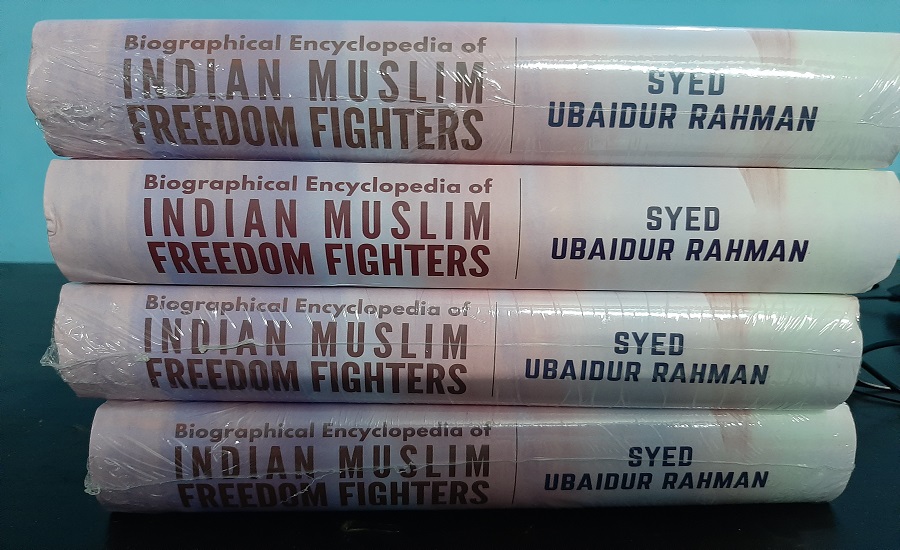
‘Biographical Encyclopedia of Indian Muslim Freedom Fighters’ is an exhaustive work that brings to the fore many unknown facets of the freedom movement beginning with Faraizi Movement to 1857 Mutiny and to later part of the freedom movement.
BE it 1857 Mutiny or the later freedom movements, Muslims have played leading role in all such efforts. British officials and historians have accused Muslims for the 1857 Ghadar. To be true, both British historians and officials have named Muslims as the most important rebels and termed the Mutiny as a sinister plot by Muslim ulema and mujahideen to reclaim their lost powerhouse in India.
Here are excerpts from a chapter on Imam Baksh Sahbai, a great scholar of his time:
Imam Bakhsh Sahbai was one of the most renowned scholars of the 19th century Mughal India. He was among the best scholars of the Persian language and had earned respect as poet and litterateur of the Persian language. At a time when Urdu had almost replaced Persian as lingua franca in much of north India, he was still one of the greatest supporters of the Persian language and spent all his resources in its propagation.
He authored more than thirty books on Persian and Urdu literature that includes three books that were part of the curriculum in the famed Delhi College. He was reportedly appointed a professor of the Persian language there. However, he had a tragic end when after the 1857 Mutiny he and his entire family, including his two sons, who were also renowned scholars in their respective fields, were hauled, taken to Yamuna and shot dead from point blank range. At least 21 members of his family were slaughtered in this most horrendous fashion.
Imam Bakhsh Sahbai was among the most respected scholars of the time and, therefore, every prince wanted to study under him. He was very close to Ghalib, Zauq, Mufti Sadruddin Azurdah, Fazle Haq Khairabadi and even the last Mughal Emperor Bahadur Shah Zafar. Many top scholars of the time were taught by him not just at Delhi College but also at his home. However, the slaughter of his family members including his two sons, and digging of his home by the British thugs had shocked the people of Delhi even during the worst phase of brutality. This digging of his house and the complete destruction of his library also destroyed much of his work. The destruction of his massive library that he had built over a period of decades must have been a huge loss for academia and scholarship. This is the reason that not much has survived on him.
Some twenty years after his macabre killing, when a Hindu disciple of Sahbai, Munshi Deen Dayal thought of collection and publication of his he couldn’t lay his hands on anything substantial. There was not much available on his life or work. Whatever he could gather, he published it in three volumes as Kulliyat-e-Sehbai.
Sahbai was born in the year 1805 in a respected family of Delhi. His father, Maulana Muhammad Bakhsh settled in Delhi from Thanesar, Punjab. Sahbai’s elder brother Hakim Peer Bakshi was a famed physician of his time. His early education was under Maulvi Abdullah Khan. Sehbai had two sons, Muhammad Abdul Aziz and Molwi Abdul Karim Soz. Both were accomplished scholars and well-known poets. Both were killed along with their father and other relatives after 1857 Mutiny.
While in the mid-19th century the power of Mughal Empire had diminished and its influence confined to the Old Delhi quarters, the capital of the Mughal empire still boasted a huge galaxy of scholars, poets and artists of all sorts. There is no denying the fact that the biggest draw of all were the poets and intellectuals. Altaf Husain Hali said that Ghalib, Zauq, Sahbai and Azurda made the capital one of the best places for the scholars and academics. “There gathered at this time in the capital, Delhi, a band of men so talented that their meetings and assemblies recalled the days of Akbar and Shah Jahan”, wrote Hali.
Hali, who had merely heard the stories of high standards of scholarship in Delhi, its great scholars and poets and great madrasas dotting the town, escaped Panipat and came on foot to Delhi. He eventually got admitted to one of the best madrasas of the town and started frequenting the classes of great scholars of his time before his family tracked him down eventually. However, much before that happened, he had got admission in ‘very spacious and beautiful’ madrasa of Husain Bakhsh and had begun his studies there. He says that he was witness to ‘this last brilliant glow of learning in Delhi, the thought of which now makes my heart crack with regret’.
William Dalrymple while describing the destruction and killing in Delhi in the aftermath of Mutiny says:
Worse still was the slaughter in Kucha Chelan, where an estimated 1,400 Delhiwallahs were cut down. Here Nawab Muhammad Ali Khan had attempted to resist the plundering and had shot dead three British soldiers who had climbed over his haveli wall and entered his zenana. Their companions went back to get the rest of their regiment, and returned with a field gun with which they blew the haveli apart.
Sahbai was respected by fellow scholars including Mughal Emperor Bahadur Shah Zafar, who himself was a top of the line poet and whose respect for scholars and poets was legendary. While Sahbai is not known to have directly fought in the 1857 Mutiny, however, what is known is that he was with Bahadur Shah Zafar and supported his revolt. This was the reason that the rampaging British forces, full of feeling of retribution and revenge were led to his home and the homes of other supporters of Mutiny. These spies were paid Rs 2 for every such input.
When after relentless killing and rapine the British and their allies got tired of killing and bayoneting the inhabitants, they marched forty survivors out to the river Yamuna, lined them up below the walls of the Fort, and shot them. Among the dead were some of top of the line scholars who would have been the pride of the place for any world class capital. While writing about this ghastly massacre Mirza Zahir Dehlavi says, “They were well-known and well-off people, men who were the pride of Delhi…They had had no parallels in their own day, nor will we ever see their like again.’
Mirza Zahir Dehlavi in his Dastan-e-Ghadar writes:
“For example, there was Miyan Amir Panja-kash, the great calligrapher, who had no one comparable to him on this earth. Then there was one of our greatest poets, Maulvi Imam Bakhsh Sahbai and his two sons, and Mir Niyaz Ali, the celebrated story teller of Kucha Chelan. About fourteen hundred people of that Muhalla were killed. Some were arrested and taken through the Rajghat gate to the river side and there they were shot. The bodies were all thrown into the river. Meanwhile, many of their women were so disturbed by what they saw that they left their homes with their children and jumped into the wells. For months afterwards, all the wells of Kucha Chelan were stacked with dead bodies. My pen refuses to describe this further.
“One of the survivors of Sahbai’s family was his nephew Qadir Ali who apparently lived with him in Delhi. He is reported to have told his escape to the Delhi historian Rashid ul-Khairi. “Delhi resembled a place of Judgment. A huge number of prisoners were being shot as hanging them was ‘tiresome’ for their killers.
As the soldiers readied their guns a Muslim officer came forward and told us that ‘your death is imminent. You will be shot to death immediately, so those people who know swimming should immediately jump in the river to survive.’ I knew swimming and was good at it, but Mamun Sahib [Sahbai] and his son, Maulana Soz, didn’t know how to swim. I was not ready to abandon Mamun Sahib and my cousins but he forced me to do so. Ultimately, I jumped in the river and swam away. I kept looking back, and after I had gone fifty or sixty yards, I heard the gunshots and saw the line of people falling dead”.
_______
Excerpted from: Biographical Encyclopedia of Indian Muslim Freedom Fighters by Syed Ubaidur Rahman; ISBN: 81-88869-51-1, PP 626 (Hard Bound), Price Rs 1195, Publisher: Global Media Publications, Tel: 9818327757
__________
source: http://www.clarionindia.net / Clarion India / Home> Books / by Syed Ubaidur Rahman / December 13th, 2021
“Today at about 2015hrs Srinagar Police received information about a terror crime incident at S.D Colony Batamaloo area of Srinagar. Senior police officers reached the terror crime spot,” police said in a statement.
A Jammu and Kashmir Police constable was shot dead by suspected militants in Srinagar on Sunday night – the latest in a string of terror-related killings in the Valley despite high security alert.
Police said militants fired at 29-year-old Tawseef Ahmad Wani at SD Colony in Batamaloo neighbourhood of Srinagar. He was immediately taken to the nearby SMHS hospital, where he succumbed to his injuries.
“Preliminary investigation has revealed that terrorists fired upon one police personnel… In this terror incident, he (Wani) had sustained grievous bullet injuries and was shifted to nearby hospital for the treatment, where he succumbed to his injuries and attained martyrdom.”
The National Conference the attack. “Unequivocally condemn the cowardly & dastardly attack on 29-year-old policeman in Batmaloo, Srinagar in which he lost his life… Our hearts go out to his family and friends at this time of grief,” the party tweeted.
The incident comes close on the heels of a series of attacks against civilians in the Valley. In October, at least 12 civilians, mostly migrant workers and those from the minority community, were killed in multiple militant attacks in Kashmir.
source: http://www.indianexpress.com / The Indian Express / Home> India / by Express News Service, Srinagar / November 08th, 2021
Juxtaposing the life of Begum Hazrat Mahal, who worked behind the scenes, with one of the most well-known heroes of the time, Rani Lakshmibai
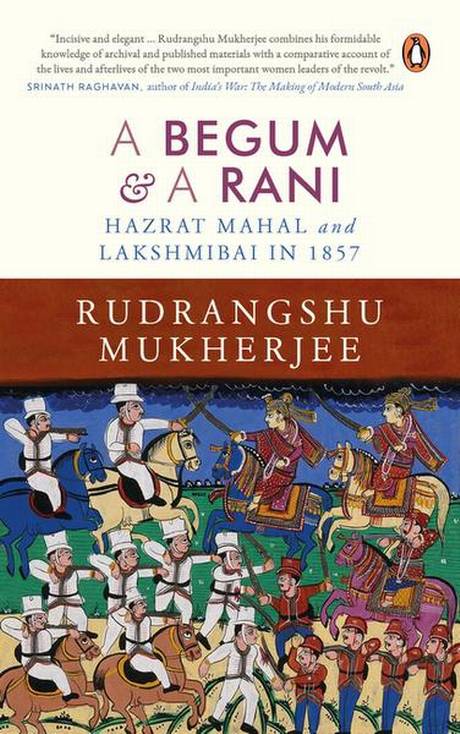
The villain in Rudrangshu Mukherjee’s A Begum & A Rani: Hazrat Mahal and Lakshmibai in 1857 is certainly the British, but it is also time and memory. Mukherjee places Begum Hazrat Mahal, an obscure figure who was integral to the mobilisation of the 1857 revolt — taught to students as “India’s first war of independence” — alongside Rani Lakshmibai, whose life has spurred not just biographies but hagiographies, calcified by myth and movies, the 2019 Kangana Ranaut shriek-historical, Manikarnika: The Queen of Jhansi, notwithstanding.
The book, divided into four parts — Origins, Rebellion, Leadership, Afterlife — is attempting two important correctives.
The first is to give Begum Hazrat Mahal of Awadh her rightful place in history. Daughter of an African slave, she was briefly married to Awadh’s king Wajid Ali Shah, then divorced and left behind in Awadh, as Shah moved to Calcutta after the British annexed Awadh in 1856. She helped mobilise the military and administration of Awadh, which became the war theatre’s centrepiece after Delhi was vanquished by the British. This story is also important to counter the narrative that the 1857 revolt was a pastiche of mindless and uncoordinated violence, because it was meticulously planned. Mukherjee quotes generously, indulgently, with page-long historical anecdotes which could have been paraphrased or woven into the narrative. There are too many anecdotal jolts for a seamless read.
Eventual move
The second objective is to inject some history into the hagiography of Rani Lakshmibai. Mukherjee notes how she wasn’t the ready rebel we think of today. That she even wrote to British officials asking for help, declaring her support to their regime, and it was only when she was pushed against circumstances that she eventually took to the battlefield with vigour, dying in it, memorialised by it.
This is a clever framing here that Mukherjee employs, because there isn’t enough information on Hazrat Mahal to carry an entire book by itself. There isn’t even an available description of how she looked. Her role in the rebellion is behind-the-scenes, and her obscurity is thus, double.
To resurrect her, by pairing her with the most coveted figure of the rebellion — Rani Lakshmibai — is thus necessary, because Mukherjee gets to not just tell their stories, demystified or dusted, but to speak to the larger villainy of historic memory — who gets written about and why?
Putting it in context
Mukherjee is a master of context, providing a sense of the time, even as he is hazy on the details of main events, recounting them as historical facts and not narrations, preferring a depth of detailing around the event over the grip of a historical plot. That said, a map would have been helpful to make sense of the geographic dump of names.
It must be noted, though, that Lakshmibai and Hazrat Mahal never met, and in the 140-page book, their paths, and the paths of their rebellion also don’t cross, as if they were happening in different times, different places.
Sometimes, as a result, the book feels disjointed — that the only reason for having these two stories together is not that they will tangle, but that through comparison, each one’s story deepens, darkens.
Placing these figures side by side, the urge to compare them comes but naturally. Mukherjee’s insistence on Hazrat Mahal’s oblivion comes short of calling her more important and interesting than Rani Lakshmibai. That Rani Lakshmibai fought on the battlefield while Hazrat Mahal fled to Nepal is enough to deify the former, and forget the latter, he finds unfair. That Lakshmibai and her son were receiving pensions from the British government, while Hazrat Mahal who died in obscurity and her son, both refused it, he finds telling. That history is besotted with blood, he finds tragic. That historians can puncture history’s myopia, he finds hopeful. Thus, this book.
A Begum & A Rani: Hazrat Mahal and Lakshmibai in 1857; Rudrangshu Mukherjee, Penguin Random House India, ₹699.
The writer is a critic with a weekly online newsletter titled prathyush.substack.com
source: http://www.thehindu.com / The Hindu / Home> Books> History> Reviews / by Prathyush Parsuraman / October 02nd, 2021
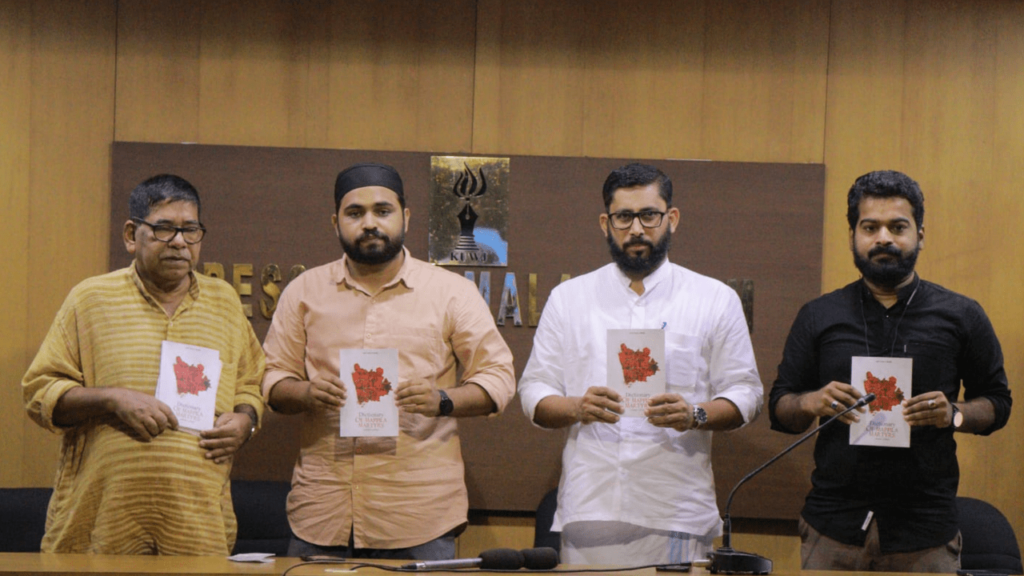
The 221 pages book released by SIO briefly introduces all the 387 Mappula leaders who fought British and Hindu feudal lords.
Following the Indian Council of Historical Research’s (ICHR) decision to remove the names of Mappila or Moplah leaders from the ‘Dictionary of Martyrs: India’s Freedom Struggle 1857-1947‘, the Students Islamic Organisation of India (SIO) Kerala unit released the ‘Dictionary Of Mappila Martyrs’ compiling the names of all the 387 martyrs.
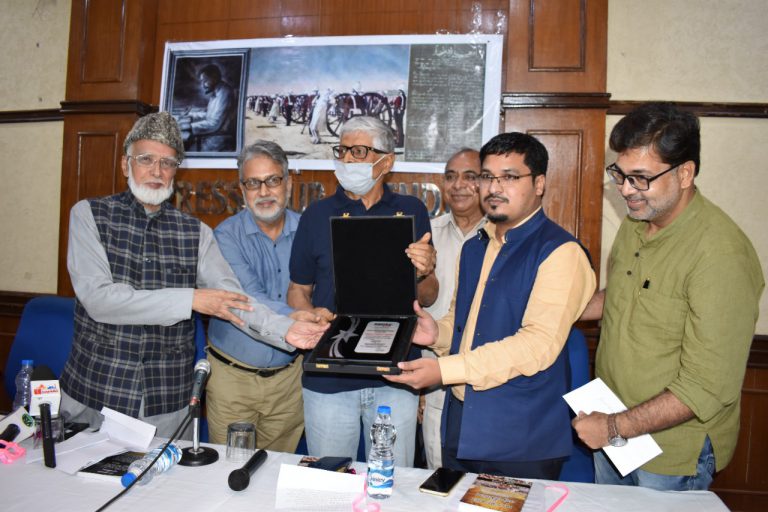
The book “Dictionary of Mappila Martyrs” was handed over by Amjad Ali E M, State President of SIO Kerala to Alavi Kakkadan, a prominent historian and chairman of Variyamkunnath Kunjahammad Haji Foundation of India. Abdul Hakeem Nadwi, State secretary of Jama’athe Islami Kerala, Rashad V P, State secretary of SIO Kerala, and Sahel Bas Joint Secretary of SIO Malappuram were present at the launch of the event at Press Club Malappuram on Monday.
Amjad Ali EM said that the Malabar Uprising of 1921, which is described by historians as the first mass-scale uprising against the British in southern India, discomforts Hindutva politics and therefore the dictionary released by the governing Sangh Parivar can’t include Malabar martyrs.
A three-member panel, which reviewed the entries in the fifth volume of the Dictionary of Martyrs: India’s Freedom Struggle 1857-1947, brought out by the ICHR, recommended the deletion of the names of Mappila martyrs, saying that the 1921 uprising against the British was never part of the independence struggle but a fundamentalist movement focused on religious conversion.
“The greatness of Variyan Kunnathu and Ali Musliyar lies in not getting into the good list of Sangh Parivar. And history will remember them for getting omitted from Sangh distorted history, therefore, to mention the names of the Mappila martyrs who were cut off by the ICHR is to express a strong stand against the Hindutva regime,” Amjad Ali said. Alavi Kakkadan, Abdul Hakeem Nadwi, Rashad V P, and Sahel Bas also expressed their opinions in the meet.
The 221 pages book released by SIO briefly introduces all the 387 Mappula leaders who fought British and Hindu feudal lords.
Was The Moplah Uprising Part Of Indian Freedom Struggle And Was It Anti-Hindu? / video source: thecognate.com
source: http://www.thecognate.com / The Cognate / Home> News / by The Cognate News Desk / September 14th, 2021
Masoom Muradabadi’s book was launched at the Press Club on Thursday by eminent journalists
The event was organised to launch the Hindi translation of journalist Masoom Muradabadi’s book on Maulvi Baqar.
New Delhi :
The Press Club of India on Thursday held a seminar to commemorate the death anniversary of Maulvi Mohammad Baqar, the first journalist who was executed by the British following the rebellion of 1857.
A Hindi translation of the book titled ‘1857 Ki Kranti Aur Urdu Patrkarita’ (The Revolution of 1957 and Urdu Journalism) authored by journalist Masoom Muradabadi was released at the seminar.
It chronicles the life of Baqar as a journalist and freedom fighter. Moreover, two journalists — Swati Mathur, a reporter with The Times of India, and Shams Tabrez Qasmi, the editor of popular news portal Millat Times — were also felicitated with an award named after Baqar.
A number of veteran journalists and writers spoke on the occasion paying tributes to the ‘first martyr journalist’. They described Baqar as an icon of Hindu-Muslim unity whose ideals are increasingly relevant in the present times.”
“Maulvi Muhammad Baqir was one of the great journalists who preferred martyrdom to collaboration with Britishers.” A U Asif, a senior journalist and member of Press Club’s managing committee, said. “He is the ideal and role model for the new generation of journalists.
Satish Jacob, a BBC veteran, said Baqar was a journalist who sacrificed his life for the sake of the nation. He described him a proponent of Hindu-Muslim unity.
Jacob said he is proud of the fact that he hails from old Delhi which gave birth to a person like Baqar. He said that Baqar had started an Imam Barah in the Kashmere gate area which is still functioning. The Imam Barah was built with the expressed goal of communal harmony, he added.
Noted journalist Meem Afzal, who has been a member of Parliament and India’s ambassador in four countries, lashed out at the current government for communal divide and accused it of obliterating the contributions of people like Baqar. He said that Baqar used his pen to fight for the idea of India.
Maroof Raza, another journalist, appealed for steps to find the original source and preserve the archives of ‘Delhi Urdu Akhbar’, the newspaper Baqar used to publish.
Jai Shanakar Gupta, senior journalist and a member of the Press Council of India, urged the government to get copies of the newspaper that Baqar edited from Britain where they are lying in a museum.
SQR Ilyas, journalist and president of the Welfare Party of India, said that the sacrifice of Baqar should inspire the present-day journalists to speak truth to power. He lauded the Press Club for commemorating Baqar.
Similar sentiments were echoed by Syed Aijaz Aslam, editor of Radiance Viewsweekly.
Mathur and Qasmi expressed their gratitude to the Press Club for felicitating them with the award. “This recognition in the form of an award in Maulvi Baqar’s name is a big thing for me, ” said Mathur.
Qasmi credited his whole team of Millat Times for the work that earned him the award.
source: http://www.clarionindia.net / Clarion / Home> Editor’ Pick / by Zafar Aafaq, Clarion India / September 16th, 2021
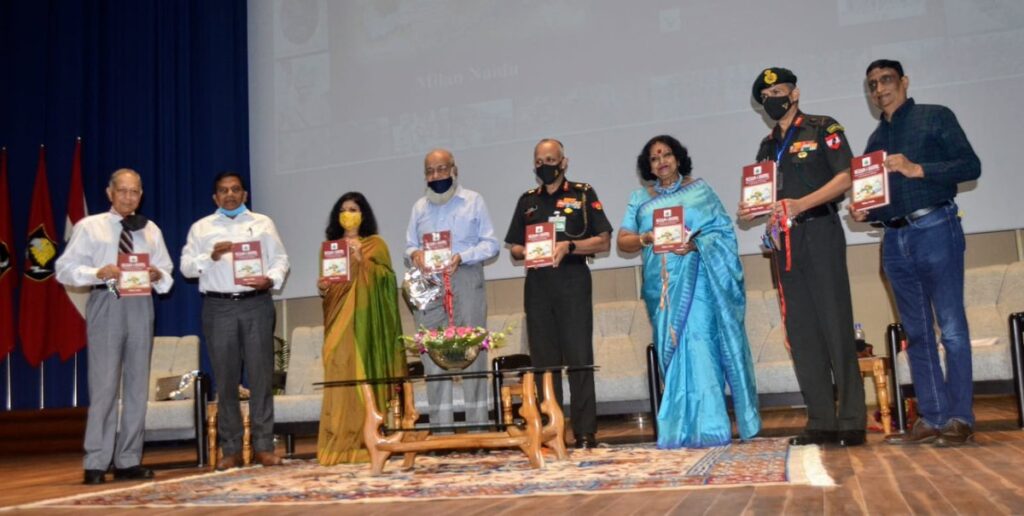
A book entitled “Nizaam-I-Bhopal”, highlighting the forgotten facets of Bhopal’s military history, penned by Lt. Gen. (Retd.) Milan Lalit Kumar Naidu, PVSM, AVSM YSM, the former Vice-Chief of Army Staff, was recently released.
The book was released by current Vice-Chief of Army Staff Lt. Gen. C. P. Mohanty at Dronachal, the headquarters of Sudarshan Chakra Corps, in Bhopal.
Lt. Gen. Naidu’s untiring efforts gave shape to his book “Nizaam-I-Bhopal”. It took five years of research, poring through Farsi (Persian) and Urdu records that led to the book.
It is only befitting that this wistful narrative is brought out by Bhopal’s very own son, Milan Naidu, who personifies that gentility, sophistication and aesthetic refinement to do justice to any literature to do with Bhopal. As a thoroughbred officer-and-a-gentleman with the highest military credentials and an illustrious career behind him only could have produced such an exquisite and masterful body of work “Nizaam-I-Bhopal”. The unforgiving ravages of time, circumstances and dominant instincts that governed its leadership from time-to-time, have been minutely analysed, explained and postulated for posterity. The rich, unsung and often unknown facets and tapestry of Bhopal’s military traditions, legacy and its continuing imprints are generously captured, documented and brought alive in this book.
In the book “Nizaam-I-Bhopal” Lt. Gen. Milan Naidu (Retd.) has charted the transformation story of rag-tag forces of the Indian princely states, from the 18th century to that modern Army. He has lucidly described the socio-economic-politico environment which existed in those times and analysed the evolution, rules, service conditions, ceremonials and battles fought by state forces, with special reference to Bhopal State.
The Book is a historical analysis of the Militaries of the Bhopal Princely State. Bhopal had the singular position in the comity of Princely States in British India, with a 175 years’ continuous line of Begums rulers. They were visionaries, educated and erudite. They displayed tremendous administrative ability, leadership qualities and diplomatic acumen, coupled with comparable skill at horse riding and arms. These Rulers set the tone of the Militaries and its motivation. The Bhopal Battalion, as part of the Indian Expeditionary Force, was the first non-Europeans to have disembarked at Marseilles in France to fight the War on foreign shores battling the weather and enemy alike.
A Bhopal battalion was even awarded one of only nine Victoria Crosses given out to Indian soldiers in Mesopotamia in the Great War. That same unit is part of Pakistan now. In the 1965 India-Pak war this battalion was awarded “Nishan-e-Haider”. The icing on the cake was that its Militaries were demobilized in a peaceful and a placid manner, to be absorbed by the Civvy Street in a symbiotic equation.
With such historical genesis and background of the State Forces, Lt. Gen. Naidu (Retd.) helps us to understand how much of our present Army developed its traditions, values and ethos; the singular character which it win the Kargil war despite the severe adversities.
This book is of true historical value, especially of the painstaking research, much from many primary sources, obtaining information from abroad (including Pakistan), interviewing progeny of the soldiers, and finally putting all of it in order.
The author’s observations on the governance and policies of the rulers help us to trace the developmental process of the state. How these issues impinged at various times on the States Forces is reflected subtly. Some of the anecdotes narrated in the book are hilarious and some quite poignant.
Kalim Akhtar, a historian and researcher says: “It is interesting to read how the Bhopal army collaborated with the British and fought the World Wars as well. It presents a true picture of history after years of research of Farsi (Persian) and Urdu records maintained in libraries, as far as the UK. It will be of great interest to lovers of history and especially those who love Bhopal.”
While Iram Khan, a housewife, in her comments about the book says: “It is well researched and attention grasping and would recommend it to anyone who has even a slight curiosity about the old world charm that the city of Bhopal still exudes”.
Meanwhile, the author of the book, Milan Naidu joined the National Defence Academy and was commissioned into the famed Rajput Regiment in 1967. He served for 41 years, holding several key positions – including worked as Military Attaché in Germany; Commanded 5th Battalion the Rajput Regiment in Sri Lanka; Commander of the Corps in Ladakh and GOC-in-C Army Training and Doctrine Command at Shimla before being made the Army Vice-Chief. He attended Canadian Forces Command and Staff College Course in Toronto. After retirement, he was appointed a member of the Armed Forces Tribunal at New Delhi.
His other assignments include: Working Chairperson of the Organising Committee for the Military World Games 2007; Member of the Executive Council of the Indian Golf Union; Chairperson of the Centre for Land Warfare Studies; Member of the Executive Council of the United Service Institution of India.
Lt. Gen. Naidu (Retd.) was born and brought up in Bhopal, the state capital of Madhya Pradesh. He did his schooling from Bhopal passing out X Class (Matric) from St Josephs Higher Secondary School, Bhopal in 1963. I may mention here that he was seven years senior to me in the school where I too studied in the sixties.
He did his M.Sc. in Defence Studies from Madras University in1984-85. Later on he did M. Phil in Defence Management in 1989-90. He completed Post Graduate Diploma in Environment and Ecology, Barkatullah University, Bhopal in 1996-97.
He won the Junior Small Bore in the National Shooting Championship in 1963. He was awarded ‘Shooting Blue’ in NDA.
source: http://www.maeeshat.in / maeeshat.in / Home> Books> Business / by Pervez Bari / August 02nd, 2021
The firing at the border of the two states was unprecedented. While the versions offered by the Assam and Mizoram chief ministers differ, Amit Shah’s failure to prevent the clash raises questions about the role of the Union home ministry.
Damaged security force vehicle at the site of the Mondays clashes at Lailapur on the Assam-Mizoram border, in Cachar district, Tuesday, July 27, 2021. Photo: PTI
New Delhi:
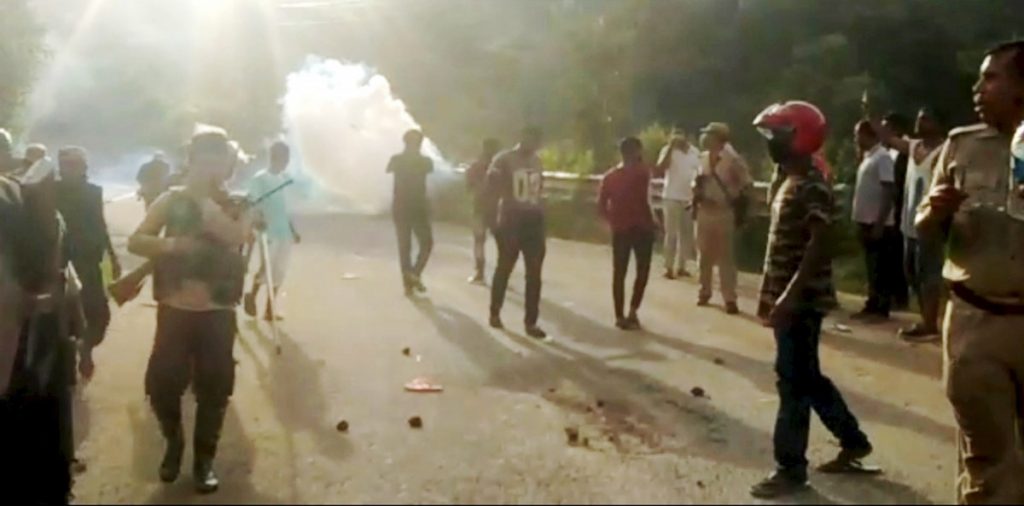
Visiting Shillong on July 24, Union home minister Amit Shah had grandly declared that the Narendra Modi government was keen to resolve all border disputes between north-eastern states. Barely 48 hours later, the Assam-Mizoram border witnessed a massive escalation of tension, ending in violence which claimed the lives of five Assam policemen. At least 42 Assam Police personnel were injured.
As violence broke out along the border town of Vairengte in Mizoram’s Kolasib district – which is adjacent to Lailapur in Assam’s Cachar district – at around 4.40 pm on July 26, so did a Twitter war of words between the chief ministers of the two states, Zoramthanga and Himanta Biswa Sarma.
Ironically both CMs, who are members of the BJP-led North East Democratic Alliance (NEDA), began tagging Shah, the Prime Minister’s Office (PMO) and Modi, as if expecting them to come to their rescue. Sarma uploaded video clips for people to “know how personnel of Mizoram police acted and escalated the issue” and purportedly showing “Mizoram Police and goons celebrating” after causing the death of Assam Police personnel.
Those who lost their lives in the skirmish were Assam Police sub-inspector Swapan Roy and constables Liton Suklabaidya, N. Hussain, Samsul ZamanBarbhuiya and M. H. Barbhuyia. Among the injured was the superintendent of police, Cachar, and the Inspector General of Police.
Sarma also accused Mizoram Police of using light machine guns (LMGs). He said the use of LMGs “speaks volumes about the intention and gravity of the situation.”
Police personnel during a clash at Assam-Mizoram border at Lailapur in Cachar district, Monday, July 26, 2021. Photo: PTI
Meeting and the border
The only problem with appealing to Shah is that the Union home minister has once again been found asleep at the wheel. For months now, North Block has received inputs of mounting tension on the Assam-Mizoram border. But Shah appears to have been oblivious to the gravity of the situation.
The fact that he met both Sarma and Zoramthanga in Shillong and yet was unable to forestall Monday’s deadly clash will reinforce the impression that Shah’s interests are primarily political and not administrative.
According to ANI, Zoramthanga, at the July 24 meeting with Shah and Sarma, had said that the areas claimed by Assam were used by Mizos for more than a 100 years. He had also alleged that Assam had started claiming those border areas because of its population growth due to a spike in the number of ‘migrants’ settling down in the Barak Valley.
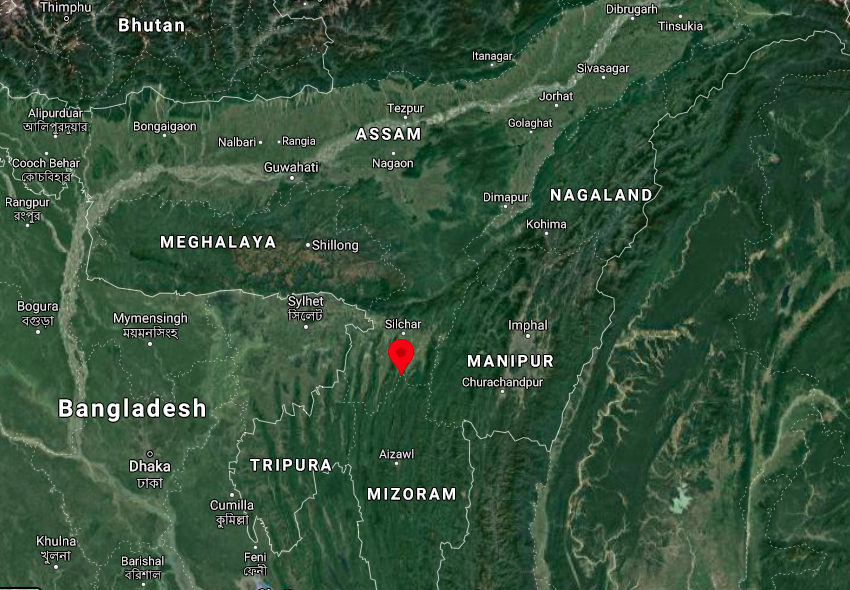
Three districts of Mizoram – Kolasib, Mamit and Aizawl – share the state’s 165 km boundary with three districts of Assam’s Barak Valley – Cachar, Hailkandi and Karimganj.
The Assam-Mizoram border. The marker is on Vairengte. Photo: Google Maps
A day after the violence, on July 27, Sarma, along with his trusted aides, minister Pijush Hazarika and MLA Ashok Singhal, along with local MLAs, visited the disturbed district of Cachar.
At a press meet in Silchar, Sarma said that for the past two months, there had been at least 12 to 13 attempts to occupy “Assam’s land in five sectors” along the inter-state border.
He said, “But I can assure people in Assam that not an inch has been ceded by Assam after May 10 (the day Sarma took over as Assam chief minister).”
“In the Shillong meeting, I had told Zoramthanga, ‘Let’s do a satellite mapping of the present border even if it is till May 10 (2021) and maintain the status quo and let the Central government decide on the permanent status,’ to which he agreed. But after the draft was readied, his government refused to sign on it.”
“I was on phone with Zoramthanga on July 26 from 11.30 am, till 4.40 pm when the firing began. I requested him to intervene and stop the violence. When the firing happened, I informed him and he said I am sorry about it. That was the last we spoke on phone.”
The Wire breaks down what led to the unprecedented firing involving the police forces of two neighbouring states on July 26.
What happened on July 26?
According to Assam chief minister Sarma, on July 25, his administration in Guwahati received input from the Silchar district forest officer about a road being constructed by Mizoram inside the inner line reserve forest on the border near Lailapur.
He said this led a delegation of Assam officials to visit the spot led by an IGP, the Cachar SP and the district commissioner on July 26. “They found that not only was a road being constructed inside the reserve forest (the road was stated to be going towards Renti Basti in Assam) by breaching the status quo and destroying the Inner Line reserve forest in the Lailapur area, but there was also a new armed outpost of the Mizoram Police.”
“The team requested that the outpost created next to the camp of a neutral force, the CRPF, be removed and status quo be maintained. While they were still in dialogue with the Mizoram police personnel, a number of civilians atop a hillock began to fire at them, leading to injuries and death of our personnel. I have video evidence with me to show that the civilians were armed. Now the question is, who gave arms to them?” he told reporters in Silchar on July 27.
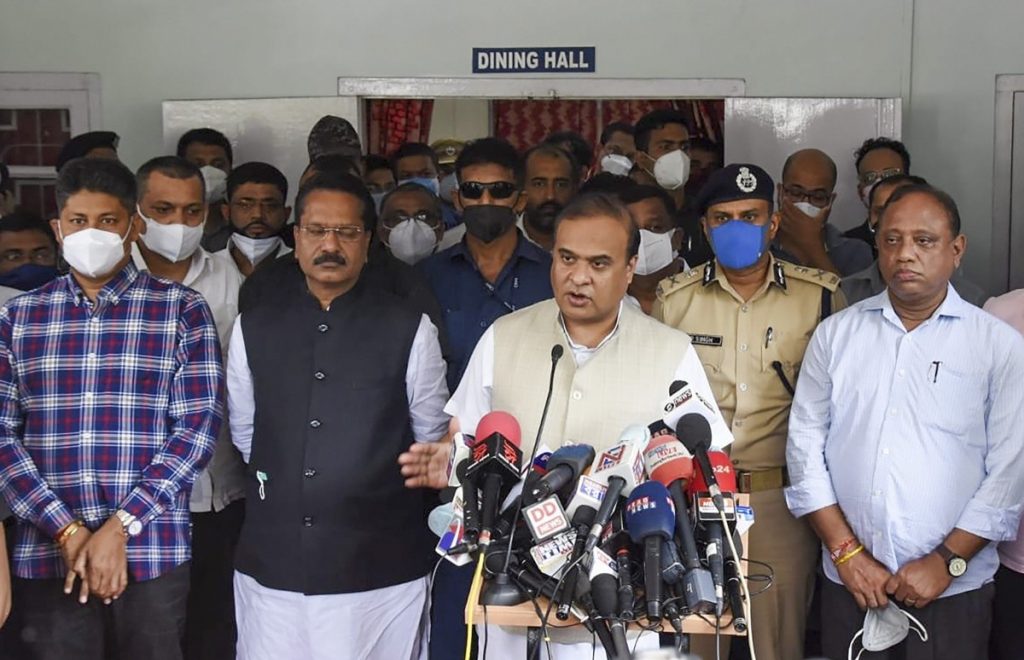
Assam Chief Minister Himanta Biswa Sarma interacts with media after visiting the police personnel injured in a clash at Assam-Mizoram border, at Silchar Medical College & Hospital. Photo: PTI/Twitter
In a statement issued on July 26, the Assam government accused Mizoram Police of supporting the civilian mob.
“The aggressive behaviour and posture of this mob along with the fact that they were brandishing weapons and wearing helmets is clearly seen in all available video footage. While the mob pelted stones on (at) the Assam officials and destroyed three vehicles including the DC’s car, the Mizoram Police simultaneously fired tea gas shells on (at) the delegation. The IGP was injured in this barrage.”
It further said, “In the afternoon, SP Kolasib along with two additional SP level officers held a discussion with the Assam delegation during which they were requested to control the mob and not let them take the law in their hands, thus disturbing peace.”
The Assam government statement said that though the Mizoram police personnel ostensibly went to speak to them, they soon said they cannot control the mob. “Horrifically, even while the SP Kolasib, was in talks with the Assam officers, the Mizoram Police opened fire on the Assam officials and civilians, who had by then gathered there (on the Assam side), from two dominating high features (hillocks) with automatic weapons including LMGs.”
However, according to a statement by Mizoram government, “around 200” Assam Police personnel led by an IGP came over to the Mizoram side (the Vairengte auto-rickshaw stand) at around 11.30 am and “forcibly crossed the duty post manned by CRPF personnel stationed there and overran a duty post manned by one section of Mizoram police personnel.”
The Mizoram statement said, “The Assam police also damaged several vehicles that were travelling along the national highway between Vairengte and Lailapur.”
Damaged security force vehicles at the site of the Mondays clashes at Lailapur on the Assam-Mizoram border, in Cachar district, Tuesday, July 27, 2021. Photo: PTI
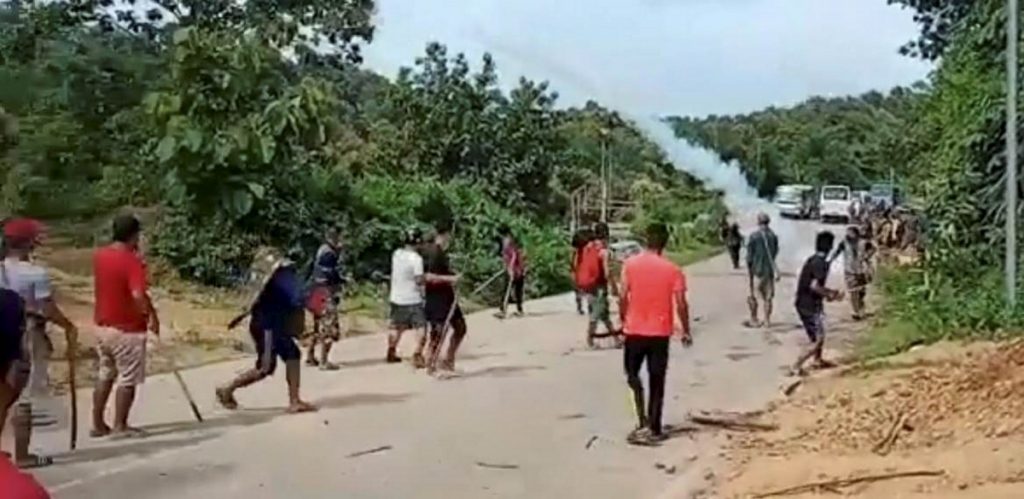
The statement said the residents of Vairangte town assembled after the violence occurred. Though a video shared by both the chief ministers featured civilians armed with sticks, the Mizoram government’s statement called them “unarmed” and stated that they were instead “assaulted by Assam Police with lathi charging…tear gas, thereby causing injuries to several civilians”.
The Mizoram government also accused the Assam Police of not only using tear gas on the Mizoram Police but also firing at them first. On Tuesday night, the state chief minister tweeted that one policeman from the state had been injured.
The government’s statement said, “Mizoram Police responded spontaneously by firing back at Assam Police in spite of the fact that the SP, Kolasib district, was still inside the CRPF duty camp negotiating with Assam Police authorities.”
Recent developments leading to the July 26 incident
As stated by Sarma, the situation on the Assam-Mizoram border has been particularly uneasy for the last two months.
As per news reports , early this month, around 25-30 people from Mizoram attempted to encroach into land inside Assam – leading to a number of blasts which were claimed to be IED explosions by the Assam Police. Reports said the Assam Police had claimed that these blasts took place in the Cachar district, and were engineered allegedly by “miscreants from Mizoram during an eviction drive” in Khulichera area.
The last instance of violence in the Lailapur and Vairangte area can be traced back to October 2020 when civilians on both sides had engaged in clashes. Around the same time, a similar pattern of violence was reported from Assam’s Karimganj side which is adjacent to Mamit district of Mizoram.
In February 2018 too, the Mizoram-Assam border, along Hailkhandi district, witnessed violence with Assam Police reportedly baton charging supporters of the powerful student body Mizo Zirlai Paul (MZP) who had protested the removal of a shed it had constructed. The Assam Police had called it an encroachment. Several journalists were also injured in that lathicharge.
In recent times, the border clash has only intensified.
What is the dispute?
The boundary dispute of Assam with states carved out of it after Independence is not new. Among those disputes, the one with Nagaland has led to large-scale violence and deaths for considerable time and the volatility of the situation along the Golaghat district of Assam continues. There was a clash between the Assam and Nagaland police on the border dispute in the 1980s, in the Merapani area of Assam’s Golaghat district.
The Assam-Mizoram border dispute has, however, never seen such an escalation before.
The basic premise of the dispute between Mizoram and Assam has been around two notifications dating back to the British era. Mizoram, before it became a Union Territory in 1972 and a state in 1986, was the Lushai Hills District of Assam.
Locals during a clash with police personnel at Assam-Mizoram border at Lailapur in Cachar district, Monday, July 26, 2021. Photo: PTI
While the Mizos acknowledge the colonial era notification issued in 1875 which separated the Lushai hills from the Cachar plains, because it was done after a discussion with the tribal chiefs, Assam acknowledges yet another British era notification issued in 1933 which demarcates the boundary between the Lushai hills and Manipur. Mizoram argues that the 1933 notification was issued without consulting the Mizos, and thus calls for the 1875 notification to be accepted instead – also because it was derived from the Bengal Frontier Regulation Act, 1873, based on which a non-Mizoram resident still needs an inner line permit to enter the state.
Speaking to reporters in Cachar on July 27, Assam chief minister Sarma addressed the issue, stating, “Mizoram was carved out of Assam. Earlier it was all Assam’s land. When the Union territory of Mizoram was created, a particular area was given away as the UT. The rest remained as Assam’s land. What was there in the British era is different.”
He also said, “If tomorrow the Centre decides to give certain areas to Mizoram from Assam, I will have to let it go because it is Centre’s prerogative to decide it but till then status quo has to be maintained.”
Most of the states “carved out” would dispute Sarma’s claim that their territory was “all Assam’s land”. After all, undivided Assam and other ‘provinces’ and territories in British India were demarcated by the colonial authorities for administrative and political purposes – often at the cost of trampling on the identity of the different ethnic groups they lumped together.
What is the present state of affairs?
According to the Assam government, its police have moved away from the outpost created by the Mizoram Police as per instructions issued by the Union Ministry of Home Affairs. “Our police is stationed a hundred metres away from the CRPF camp but the Mizoram Police has not vacated it yet,” Sarma told reporters.
Meanwhile, the Assam government has announced compensation of Rs 50 lakh and a government job each to the deceased’s families. The 42 police personnel injured in the July 26 violence will be given compensation of Rs one lakh each.
Sarma announced that the Assam Police personnel who are guarding the volatile border would be paid the salary of an additional month. He also said new companies of battalions comprising a total of 3,000 police personnel will be stationed along the border aside from the CRPF. Since the incident took place on land within “Assam’s jurisdiction”, the chief minister said an FIR would be filed which would lead to an inquiry into “who armed the civilians”.
The DGPs of Assam and Mizoram have been summoned by the Ministry of Home Affairs on July 29 to sort out the matter.
source: http://www.thewire.in / The Wire / Home> Politics / by The Wire Analysis / July 27th, 2021