Ishtiyaque, the eldest son of chef Imtiaz Qureshi, a Padma Shri awardee, has worked in various departments, from bakery to butchery.
Chef Ishtiyaque Qureshi preparing kebabs at the Jashn-e-Lucknow food festival in Delhi | Photo: Tina Das | ThePrint
New Delhi:
When he offered his guests a bowl of kheer, a traditional dessert made with thickened milk, chef Ishtiyaque Qureshi had a wicked twinkle in his eyes. He knew he would leave them flabbergasted when he revealed the key ingredient—garlic.
Not just the guests, but even other chefs had no clue that the pearly pods in the dessert were not almonds. The kheer was part of a delectable spread of Awadhi cuisine at the Jashn-e-Lucknow food festival at Delhi’s JW Marriott.
“When he (Ishtiyaque) asked me to taste it, I could never guess what it was. It has truly been quite the experience watching him work tirelessly from morning to night,” said Yashasvi Yadav, a management trainee at JW Marriott.
Yadav had been working closely with Ishtiyaque to prepare 23 dishes using 20 ingredients for the festival held between 21-23 February. With rajanigandha in vases, lanterns, and roses, the tables were set to complement the Awadhi cuisine.
From melt-in-the-mouth Kakori kebabs to the rich dum gosht biryani, and the experimental narangi chicken korma, the slow-cooked dishes had people going for multiple servings.
These dishes reflected the artistry of Ishtiyaque, the eldest son of chef Imtiaz Qureshi, a Padma Shri awardee. Ishtiyaque has been carving out a niche for himself—from opening the Kakori House restaurant in Mumbai to working as a consultant for several popular hotels in India, dabbling with the frozen food industry, and now starting the restaurant Murgori, which serves chicken Kakori kebabs.
Ishtiyaque was on his feet for 14 hours on the first day of the festival, in a kitchen shared with another food pop–up. “We made 23 dishes in just three stoves,” he said, smiling, as he talked to guests in detail about the dishes.
Deeply appreciative of his legacy, Ishtiyaque has, however, charted a course very different from his father, who spent his career with the ITC group.
Ishtiyaque has worked with various brands like The Leela, Kempinski, and InterContinental. He has also been instrumental in the makeover of several brands, including Aafreen, a fine–dining Indian restaurant of JW Marriott Pune.
Ishtiyaque learned from the best—his father—while working through school. “When I was 12, during school holidays, my father skilfully lured me to the Maurya operations. With the temptation of swimming in the pool and eating at the bakery, he put me in the kitchen,” said Ishtiyaque.
He worked in various departments, from bakery to butchery, and credits that hands-on training for building a solid foundation for his career.
Culinary artistry
The young boy didn’t want to cook; he wanted to join college instead. But with a big family to support, another earning member was necessary. He initially worked at ITC Maurya during the day while attending classes at Delhi’s Ram Lal Anand College in the evening.
Ishtiyaque later left for Jeddah, Saudi Arabia, in 1986 after his father helped him get a job there. Three years later, he returned home and interviewed with ITC’s then-chairman, YC Deveshwar, at ITC Maurya in Delhi. He soon found himself at the Dum Pukht restaurant in Mumbai, which was then part of the Sea Rock Hotel.
He also worked with legendary French chef Roger Moncourt, who was the executive chef at ITC Maurya in New Delhi. “I remember he removed beef and pork from the Indian restaurant,” said Ishtiyaque. This separation—which he also recently recommended at a new restaurant—helped increase the clientele for fine Indian dining.
This was around the time when Datta Samant’s trade union raised slogans like ‘Dilliwale murdabad’. Nevertheless, Ishtiyaque found his space, experimenting with slow-cooked delicacies and reviving age-old techniques that define Awadhi cuisine.
Over the years, he has also mastered techniques from the frozen food industry, blending science with culinary artistry—all while carrying forward his father’s legacy.
Food innovations
The father-son duo often cooked together, especially after doctors advised both parents to stop consuming red meat. This led to one of Ishtiyaque’s innovations—the chicken Kakori kebab.
“For three years, they never guessed it wasn’t made of mutton but chicken. That’s when I realised this is a great option for the market, for those who cannot or don’t want to consume red meat,” said Ishtiyaque.
His father always made sure to have dinner at home, where his mother would rustle up delicacies like aloo gosht, saag gosht, or meat cooked with seasonal vegetables. Ishtiyaque prefers home–cooked meals and staying in rather than travelling, even though work often keeps him on the move.
One dish that had people queuing up for second and third helpings was the narangi chicken korma. “While making the list of ingredients, the chef asked me to get oranges. Even the person in charge of the hotel’s vegetable and meat stock was curious why Awadhi food might need oranges,” said Yadav.
The result of Ishtiyaque’s experiment was a refreshing, aromatic stew. “To me, that is fusion food—when you marry one ingredient with another, instead of overpowering the dish or just laying a few strands of microgreens on a plate. That is just scamming,” said Ishtiyaque.
According to him, training chefs today isn’t what it used to be, as people no longer want to invest the same time or energy. The way his father worked and taught now feels like part of a bygone era.
“I was lucky that we could spend his last years together. He was charismatic and an extrovert. Even till the end, he wanted good food and was joking with the nurses,” said Ishtiyaque.
“But I will always be there for my guests,” he added, pausing briefly to speak to someone dining alone.
Ishtiyaque often cooked for his parents and was always eager to hear his father’s feedback. “He would suggest improvements, and sometimes my mother would be like, ‘Your son has cooked, let it be.’ But that is who he was. And I think like him and have the same kind of passion that he did,” he said.
(Edited by Aamaan Alam Khan)
source: http://www.theprint.in / The Print / Home> Features> Around Town / by Tina Das / March 02nd, 2025
His grandfather taught Gordon Ramsay the secrets of dum cuisine. Chef Zoheb Qureshi hails from what is considered as the First Family of food in India. His grandfather, Chef Imtiaz Qureshi, is one of the two chefs to receive a Padma Shri honour and his father, Gulam Qureshi has been the brand custodian at Dum Pukht, ITC Maurya, Delhi for the last 15 years.
Zoheb’s preparations exemplify the philosophy of Giza-e-Khusus meaning cooking delicious food while retaining its nutritive value. He has taken upon himself the daunting task of running the first chef-led online food delivery format in the country, Cross Border Kitchens. He says, “I am on a mission to make people taste what authentic Nehari or Mirch Baigan ka Salan is or what an original dum biryani tastes like.”
In a candid conversation, he talks more about himself and his work:
Your philosophy of food?
It’s a common ground offering people a universal experience. It brings people together belonging to varied cultures and beliefs.
Your fav cuisine?
Awadhi
Your idol?
My father – Gulam Qureshi
Your fav spice?
Cardamom
Your hot selling dish?
Awadhi Gosht Biryani
Lessons learnt in the kitchen?
Every day is a new day in the kitchen that teaches you something new. However, my evergreen lesson that I stand by daily is to never go to the cooking range without all the ingredients.
How do you like to de-stress?
Listening to music calms me down.
How do you define yourself?
Someone who’s forever eager to learn & unlearn.
What are you passionate about?
About different techniques in cooking and travelling to new places to learn about its food culture.
Last meal on earth, what would you choose?
Phirnee
Recipe: Murgh Rampur Biryani
Ingredients:
Chicken (50 gm) piece 400 gm
Basmati rice 250 gm
Brown onions 25 gm
Desi ghee 50 gm
Cloves 4
Cinnamon sticks 2
Bayleaf 1
Green cardamom 4-6
Cream 25 ml
Beaten curd 75 gm
Salt to taste
Yellow chilli powder 10 gm
Mace cardamom powder 15 gm
Ginger garlic paste 25 gm
Rose water 5 ml
Kevda water 5 ml
( screwpine)
Sweet ittar 1 drop
Slit green chillies 25 gm
Mint leaves 25 gm
Ginger julienne 10 gm
Royal cumin seeds 2 gm
Lemon juice 20 ml
Water ½ litre
Whole wheat flour dough
(for lining the lid) 100 gm
Process:
Step 1 : Cooking of chicken
Marinate the chicken with Biryani masala powder, hung curd, rose water, red chilli powder and cook in tandoor
Cook the chicken with jhol, yellow chilli powder, mace cardamom powder, saffron, ittar, kewra and rose water.
Step 2 : Boiling rice
Wash, soak basmati rice for 10 minutes. Boil water in a pan and add the wholespices, salt to taste and lemon juice.
Add the rice and cook till 2/3rd done.
Step 3 : Cooking on Dum
Layer the chicken. Add a mixture of ghee and cream.
Garnish with mint leaves, ginger juliennes, brown onions and saffron dissolved in water.
Line the lid with flour dough and seal the vessel.
Put the vessel on an iron griddle and cook for 15 minutes.
Once the biryani is cooked, serve it with raw onions, lemon, chutney and raita.
source: http://www.thepatriot.in / The Patriot / Home> Specials / by Sharmila Chand / October 04th, 2019
Address : ITC Windsor hotel, Vasanth Nagar, SEE MAP
The restaurant is shedding its colonial hangover by dropping “Jolly Nabobs” from its title and focussing on biryanis and kebabs.
Master Chef Ghulam Qureshi | Photo Credit: Special Arrangement
ITC Hotels’ Dum Pukht restaurant is an institution with a storied legacy. At ITC Windsor in Bengaluru, the restaurant was called Dum Pukht Jolly Nabobs; for the past 25 years, it was known for its Anglo-Indian and colonial-era dishes. Think mulligatawny soup, pomegranate chops, and forest officer’s pulao. But now, with a menu curated by Master Chef Gulam M Qureshi, they are harking back to the brand’s Lucknowi roots. The restaurant is dropping “Jolly Nabobs” from its name and introducing some classic Awadhi dishes. Over a leisurely lunch, Qureshi treats me to the new menu, delighting me with tales of nawabs and begums.
Chef Qureshi is the seventh generation chef from his family. He is the son-in-law of the pioneering chef Imtiaz Qureshi, who was awarded the Padma Shri for his contributions. The family has been cooking for the nawabs of Lucknow for 200 years. The chefs of Awadh invented the dum style of cooking and take great pride in their kebabs and biryanis.
The succulent Kakori kebabs
Our lunch begins with a selection of kebabs. The Kakori is, of course, legendary. Minced lamb, flavoured with cloves and cinnamon, are skewered and char grilled. Saffron completes the dish. The seekh nilofari kebabs are made of lotus stem and puffed lotus seeds. Spices like mace, green cardamom and herbs are used to add masala to the kebabs. We are also served the jumbo prawns cooked in the tandoor and then finished in a dum preparation. Flavoured with cheese and yoghurt, this dish is mild and delicate.
The highlight of the meal is the murgh khushk purdah. The main chicken dish is brought to the table in a platter that is topped with the baked pastry, then carved at the table by the team of chefs.
“My forefathers have been making this dish since the 1820s. The nawabs used to farm the poultry at home, because they were very particular about the quality. On the day of the feast, the chicken was marinated for five or six hours. It was then cooked in the dum with the purdah,” Qureshi shares.
Jaitoon ka tel or olive oil, imported from West Asia, makes the dish light and silky. Under the pastry, succulent pieces of chicken, along with chunks of onions, tomatoes and pineapples, are enveloped in a gravy, which has notes of mace and star anise. It pairs very well with the warqi parantha.
The specialty gucchi pulao
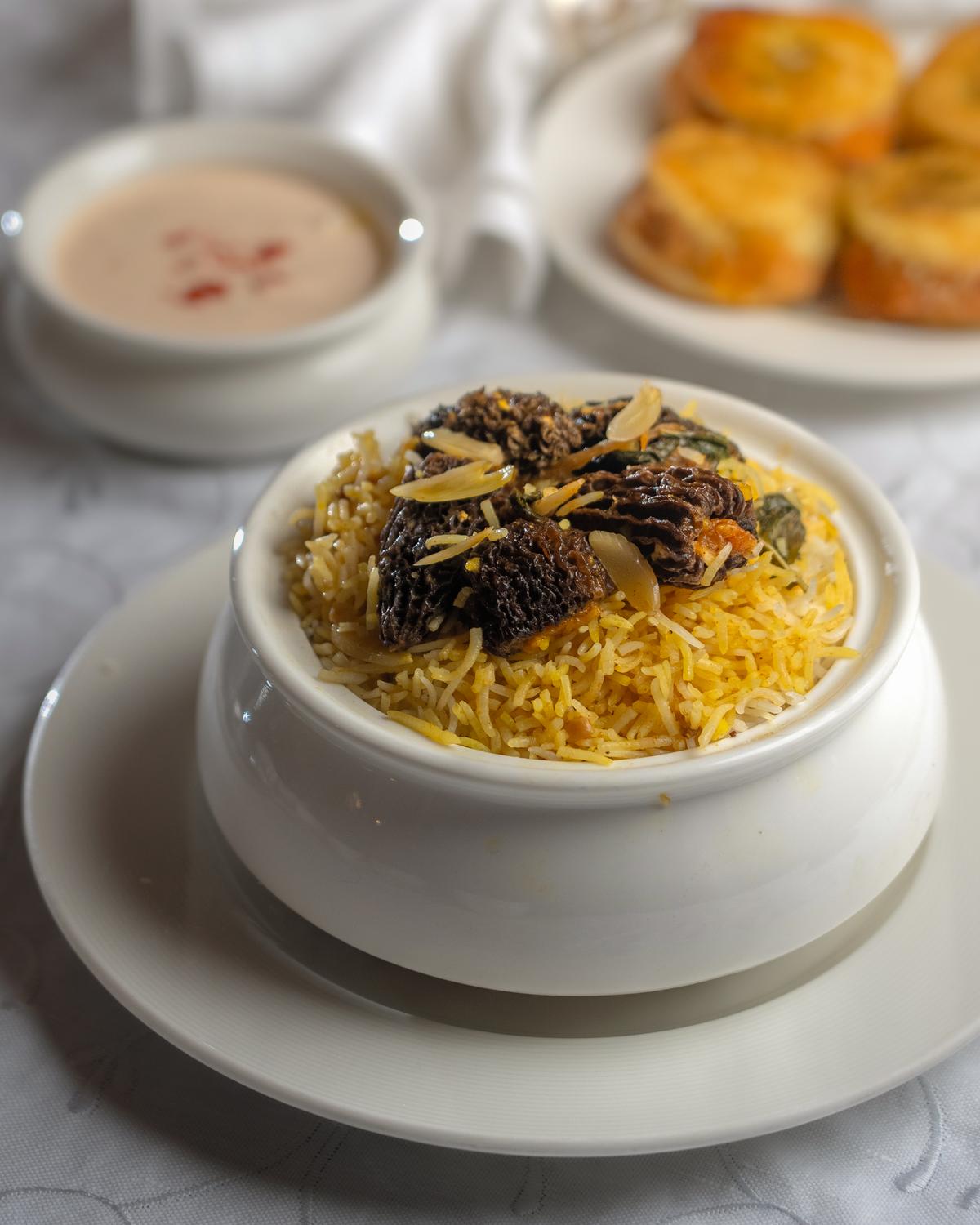
Try the gucchi pulao, made with morel mushrooms that are a delicacy from Kashmir. They are stuffed with cheese and cooked with basmati rice.
We end with shahi tukra and saffron rabri, topped with pistachios, almonds and a silver leaf. While the Anglo-Indian dishes may be missed, I won’t complain about the new direction taken by the restaurant because of the quality and authenticity of the dishes.
Cost for two ₹6,000. At ITC Windsor. For details, call 8061402610
source: http://www.thehindu.com / The Hindu / Home> Food> Dining / by Anagha Maareesha / June 17th, 2024
Clothed in layers of legend and folklore, Fatehpur Sikri, the city that Akbar built and made his capital, was an architectural marvel of medieval India. A journey back in time to explore its real historical importance.
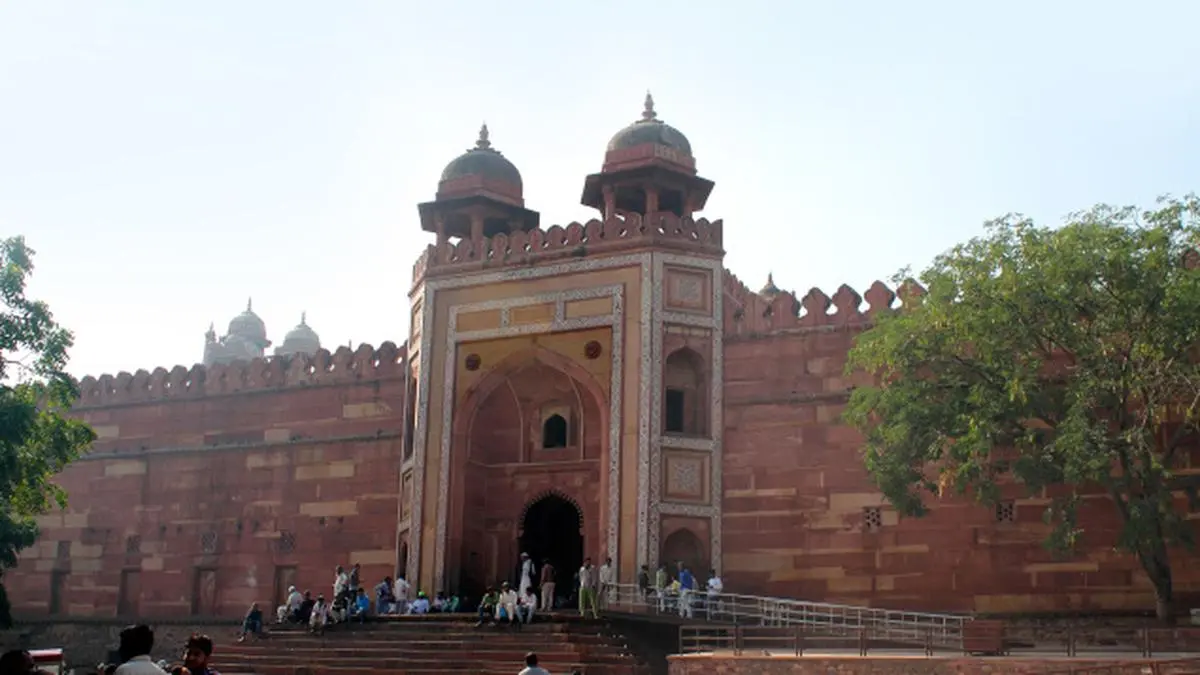
The Badshahi Darwaza through which Akbar entered the Masjid-Dargah complex.
LOCATED around 35 kilometres from Agra, the famous capital of the Mughals, and about 30 kilometres from Bharatpur, the heartland of the Jats, is one of the finest cities of medieval India, Fatehpur Sikri. Nestled on a ridge of the Vindhya mountain range, it represents a unique architectural experiment of the Mughals. Declared a World Heritage Site in 1986, it remains frozen in time and space. In its majesty and grandeur, Sikri is perhaps second to none, but it has always lived in the shadows of its world-famous neighbour, the Taj Mahal.
Connected with the life and times of the famous Mughal emperor Akbar and a crucial period in Indian history, Fatehpur Sikri is of great historical importance but remains one of the less-understood heritage complexes. The popular understandings of the site (and connected histories) are largely informed by guide culture and folk narratives. Some questions continue to haunt visitors. Why was the city built and abandoned within a span of just 14 years? Who was Jodha Bai? Did the Navratnas (“Nine Jewels”, talented and famed courtiers at Akbar’s court) really exist in an institutionalised form? Did the city decline because of shortage of water?
One area where the huge gap between the academic and popular understanding of the site gets reflected starkly is in the nomenclature and functionality of monuments. The nomenclature of the structures is informed by the occurrence of “matching”/“near matching” descriptions of events/anecdotes connected with Akbar in contemporary accounts—principally by Abul Fazl, Badauni and the Portuguese Jesuit missionary Monserrate. Archaeological findings and Mughal paintings also help us reconstruct the history of individual monuments. Two things complicate our understanding of the city and the monument complex. First, as the historian and expert on the site Nadeem Rezavi points out, the names of the structures on plaques put up by the administration are mostly taken from tourist guides of the 19th century who were often local residents with no professional training in archaeology or history. Second, the original architectural designs have, in some cases, been demolished or altered in the process of renovation and restoration.
Early History Though the city was built during Akbar’s time, the place has a history going further back in time. Archaeological findings from the region include painted grey ware sherds, beads and artefacts belonging to the Kushana and Sunga periods, besides pre-medieval rock shelters. A large number of Jaina sculptures (including one Shruti Sarasvati) were excavated around Birchhabili Tila on the eastern bank of the lake in 1999-2000. Sikri and Bayana came under the control of the Sikarwar Rajputs in the 12th century and there is evidence of fortifications built by them. According to one tradition, the word “sikri” comes from them. The region was subsequently taken over by the Delhi Sultans and the remains of mosques and tombs testify to the site being a flourishing township during the Sultanate period. The Mughal connection comes with Babar, who defeated Rana Sangram Singh at the Battle of Khanwa (located 16 km from Sikri). According to legend, he renamed the place “Shukri” (meaning “thanks”) to acknowledge the support of the local populace during the battle. It is said that after capturing Gujarat, Babar’s grandson Akbar built the commemorative monumental gateway called Buland Darwaza (The Lofty Gate) and changed the name from Sikri to Fatehpur, the “City of Victory”. Rezavi, however, prefers to call it Fathpur Sikri, connecting its nomenclature to the garden named Bagh-i Fath (The Garden of Victory) built by Babar. He says this connection later inspired Akbar to rename the area Fathpur or Fathabad.
According to chronicles, Akbar’s decision to build an imperial city was largely based on his reverence for Shaikh Salim Chishti, who had predicted that the heirless emperor would be blessed with three sons. Akbar shifted his pregnant queen to Sikri and later ordered the construction of the city. It is believed that the Rangamahal (which is now closed) was the place where the queen first resided. Under Akbar, this village became the cultural, commercial, and administrative centre of the empire. It is estimated that around 1580, the total population of this city was just short of a quarter million. Ralph Fitch, the English traveller who visited the city around 1585, wrote: “Agra and Fatehpore are two very great cities, either of them much greater than London and very populous.”
Situated strategically close to Agra Fort (located within a day’s march), the town was enclosed with walls, some 6 km long, from north to south-west and protected by a lake (now dry) on the western side. The planning of the city aligned with the contours of the ridge. The mosques, imperial palaces and offices, bureaucratic establishments, and nobles’ mansions were located on top of the ridge. The civic population and the gardens were located around the official zone below the ridge. Access to the city was controlled by a series of eight identical gates (prominent being the Agra and Ajmer Gates) which restricted movement from public spaces into imperial zones.
The Imperial Complex According to Monserrate, the imperial complex consisted of four great royal dwellings—the king’s palace, the palace of the queens, the princes’ quarters and a store house and magazine. The king’s palace, generally known as Daulatkhana (“Abode of Fortune”), was divided into the Daulatkhana-i-Khas (private/restricted space) and the Daulatkhana-i-Aam or the Diwan-i-Aam (Hall of General Audience).
The Diwan-i-Aam is possibly the place Abul Fazl describes as the site of an open court which lasted for four hours. The structure, as it stands now, consists of an extensive courtyard enclosed by cloisters of 114 bays and a centralised raised pavilion. Entry was through the northern gateway opening towards the Hauz-i-Shirin (Sweet Tank) and further to the Hathi Pol, the ceremonial entrance to the imperial complex. The original plan stands modified now, with the addition of a municipal-style garden and the creation of an opening in the wall of the courtyard for visitors entering from the Agra Gate side. The huge stone rings at the foot of the colonnade opposite the imperial pavilion were possibly used for inspection of animals from the royal stable or exhibiting captured war elephants rather than publicly trampling those condemned to death as the guides would say.
The Daulatkhana-i-Khas consists of the Diwan-i-Khas, the two-roomed Diwankhana-i-Khas, the Khwabgah, the Anup Talao, the Turkish Sultana’s Chamber and some minor structures. The Diwan-i-Khas, or “Jewel House”, is a square-shaped chamber with openings on all four sides. The interior has a richly carved pillar at the centre supporting a circular platform connected with four diagonal bridges emanating from four cardinal directions. This is a monument whose functionality is difficult to establish. Historians and scholars have variously identified it as a storehouse for imperial gems and jewels, with the emperor inspecting them from the suspended capital (S.A.A. Rizvi); a place where the emperor, enthroned in the central circular platform, listened to ministers seated at the corners (Y.D. Sharma) or to arguments from different religions—symbolising “Akbar’s Dominion over the Four Quarters” (Percy Brown); or, symbolically, of Akbar ceremonially occupying the axis of the world (represented by the column) in Hindu cosmology and, therefore, wielding supreme power (G.H.R. Tilotsan). Still others have tried to symbolically equate the emperor with a chakravartin sitting or a God-like Vishnu seated on a lotus, or like the sun domineering over all regions (Catherine Asher).
Next to the Jewel House is the so-called Aankh Michauli (literally, “blind man’s buff”—by implication, a place where Akbar played this game with the women of the harem), or the treasury, containing three large aiwan s (porticos). Like the Jewel House, this building also has concealed coffers and lockable doors in the thick walls. Historians have suggested that this was a part of the treasury where gold and silver coins were stored, while the copper coins were kept in the building behind this one which collapsed in 1894. To the south-west of the treasury stands a kiosk known as the “Astrologer’s Seat” modelled on a Cambay-style building, according to the art historian Ebba Koch. This was possibly the site from where the emperor watched the distribution of copper coins to subordinate officers and the needy.
The large red sandstone courtyard between the Diwan-i-Khas and the Anup Talao is known as the Pachisi—after the cruciform board on which this popular Indian board game was played. Local legend has it that the emperor played the game using slave girls as living pieces.
The Diwankhana-i-Khas, containing Akbar’s imperial chambers (Khalwatkada-i-Khas) and resting place (Khwabgah), was a restricted area. The Khalwatkada-i-Khas was also a place where learned discussions and, sometimes, official transactions took place. It had a projecting balcony where the emperor received royal guests such as Mirza Sulaiman of Badakshan. The lower walls of the rooms were hollow with sliding stone panels and were probably used to keep rare books and gifts. A large room behind this chamber contained a platform against the southern wall, with a window above it. Some historians think that the window was used for a practice Akbar instituted at Sikri—Jharokha Darshan, whereby the emperor showed himself to his subjects every day.
The Khwabgah is a beautiful chamber on the first floor of the Diwankhana-i-Khas. This is the place where Akbar rested and also had informal discussions. Badauni narrates the story of a Brahman named Devi who used to be pulled up on a charpai (traditional Indian cot) to instruct the emperor in the myths and legends of Hinduism. A cloistered passage from the west connected the Khwabgah with the principal Haramsara, the Panchmahal, “Mariam House” and the Hathi Pol. This offered a secret and unhindered passage to the emperor and the royal ladies from one palace to another.
The Anup Talao (literally “peerless pool”) has a central island linked by four bridges to its sides. To the north-east of the pool is a beautifully carved structure called Turkish Sultana’s Pavilion. It needs to be clarified that there was no one called Turkish Sultana in Akbar’s court. Further, it would have been impossible to have a zenana (female) pavilion/chamber within the mardana (male) section. The pavilion has beautiful carvings on brackets, pillars and pilasters, and gives the semblance of intricate woodwork rather than stone masonry. Rizvi identified this pavilion (and the cloistered verandah around it) with the Hujra-i-Anup Talao (the room of the Anup Talao)—which Badauni mentioned as a structure where the emperor used to hold religious discussions. In fact, he also mentions a cell which Akbar named Ibadatkhana (House of Worship). Through an insightful reading of Badauni (who talks about an Ibadatkhana with four aiwan s near the new palace), Abul Fazl and Nizamuddin Ahmad, and correlating them with Monserrate, Rezavi persuasively identifies the Ibadatkhana with what is now known as the Daftarkhana (Secretariat/Records Office). This was the place where Akbar’s famous religious discussions or disputations were held until around 1580. The Anup Talao is connected through a pillared verandah to a structure known as the Abdarkhana (again wrongly called the “Girl’s School”), where fruits, water, food and beverages were kept for the emperor.
Between the Daulatkhana and the Haramsara complex are located three intermediate structures: the Panchmahal, Mariam’s House and the “hospital”; the last two can even escape a visitor’s attention. The wall separating the Haramsara from this area was, unfortunately, removed during renovations carried out in the 19th century.
The Panchmahal is a four-storeyed, entirely columnar structure of diminishing sizes surmounted by a domed kiosk. It is screened on all floors except the ground. Interestingly, none of the columns on the first floor are alike (some circular, some octagonal) and they are ornamented with the typical Hindu bell and chain motifs. The building may have served a recreational purpose and offered a good panoramic view of the surroundings.
Mariam’s House is not named after a Portuguese queen called Marie as the guides would have us believe. The structure is also called Sunhara Makan, or “Painted House”, after the beautiful murals and gold-coloured paintings that once decorated it. Rizvi thought it belonged to the queen mother Mariam Zamani (Hamida Banu Begum). After a careful reading of Monserrate, however, Rezavi says it was some kind of a private dining chamber of Akbar. Mariam’s House was connected to the Abdarkhana, where food and beverages were laid out, through a private door. Further, its central hall had portraits of women and angels and the building was profusely painted with court scenes, elephant fights, polo games, and so on. Separated from the zenana Haramsara segment and located outside the mardana Daultakhana area, this may have been a special dining hall where the emperor could be joined by the women of the haram .
The structures that form the Haramsara complex (or Shabistan-i-Iqbal) include the principal Haramsara (the Imperial Haram), popularly known as Jodha Bai’s palace, and Birbal’s house. The former was the private zenana area where Akbar’s wives lived. Accessible through a single gate with a staggered entrance, the double-storeyed structure was once guarded by eunuchs. Its privacy was only partially disturbed by the jharokha windows on the first floor. The principal Haramsara consists of unconnected chambers and porticos on all four sides and a large square courtyard in the middle. The bases, columns and capitals in the central rooms have carvings inspired by Rajput traditions. The monotony of the red sandstone is broken by the azure blue tiles (originally found in Multan) on the ribbed roof of the upper rooms on the northern and southern pavilions.
It is important to clarify here popular misconceptions surrounding Jodha Bai. Her very existence is negated by several historians. Irfan Habib argued in an interview that a historical character called Jodha Bai did not exist. It’s true, he says, that Akbar married the eldest daughter of the Amber ruler Raja Bharmal, but her name is not mentioned anywhere and she was certainly not Jahangir’s mother. “The myth can be attributed to some guide who may have taken British officers around Fatehpur Sikri arbitrarily referring to various palaces as Todar Mal’s, Birbal’s or Jodha Bai’s.” Shireen Moosvi also clarifies that there is no mention of Jodha Bai in Akbarnama or other Mughal documents of the period.
Like Jodha Bai’s palace, “Birbal’s House” is also erroneously named. Rezavi says it is impossible for Birbal to have occupied the building—no male, not even a prince, was allowed to enter the female quarters. The corbels, exquisitely carved brackets, together with the chajja of this palace exhibit typical Hindu influences, while the pilasters have Islamic geometrical patterns. Birbal’s house was one of the earliest palaces to be constructed at Sikri (1571) and has a relatively independent character. It might have been used to house someone holding high esteem at Akbar’s court—probably the queen mother or the senior queens. The other ladies-in-waiting were presumably housed in the so-called Meena Bazar, which could have been the minor Haramsara. The Nagina Masjid (meant for the women of the Haramsara) and the beautiful small garden to the north also formed a part of the Haramsara complex.
Where did the princes stay? Rizvi and V.J.A. Flynn have identified the so-called Tansen Baradari (in front of Curzon’s Dak Bungalow) as Prince Salim’s quarters. On the basis of its vicinity to the Daulatkhana and the royal waterworks, Rezavi has identified the Hakim’s House with the princes’ quarters.
A number of offices and bureaucratic establishments were situated within and around the Daulatkhana complex, such as the departments dealing with kitchen, mints, tents and carpets, translations, paintings, arsenal, etc. The complex was also surrounded by rings of bureaucratic establishments, nobles’ houses, office-residences of bureaucrats and habitations of common people. Among the famous nobles’ houses, we may include what are popularly known as Abul Fazl Faizi House, Hakim’s House, Birbal’s House, Khan-i-Khanan’s House and Tansen Baradari. The presence of waterbodies—lakes, hammam s (public baths), baoli s (stepwells), tanks, garden channels and waterworks—indicates how availability of water was integral to the planning of the city. They served a variety of aesthetic, utilitarian and recreational purposes. Water was brought from the lake and supplied to the official/semi-official areas through a network of storage tanks and aqueducts. Fatehpur Sikri probably constitutes the largest surviving concentration of hammam s in Mughal India.
The Masjid-Dargah Complex
The other part of Sikri is the Masjid-Dargah complex (“private property part” as guides tell visitors), made famous because of the Sufi saint Salim Chishti. Belonging to one of the most influential Sufi sects in India, the Chishtis, he was a descendant of Fariduddin Ganj-i Shakar and had stayed in Mecca for some time before settling down in Sikri. It is said that the local quarrymen working on the ridge for the stone required to build the Agra Fort constructed a red sandstone mosque for the saint around 1565. This came to be known as the Stone Cutters’ Mosque. Akbar later built the Jami Masjid, conceived as one of the largest mosques of its times, and ascribed it to the saint. Legend has it that Akbar himself occasionally cleaned the floor of the mosque and called the azan . The mosque also played an important role in Akbar’s political ascendancy. It was here, in 1579, that Akbar read the khutba (recitation) to proclaim his sovereignty and also issued the mazhar (declaration) by which he arrogated substantive powers in religious matters. The mosque follows the traditional style of a central courtyard, with cloisters on three sides and the west side being the prayer hall or sanctuary. Divided into seven bays, the prayer hall is an arcade of pointed arches. The central dome is dwarfed by the central iwan while the lateral domes get somewhat blurred behind a row of chattri s.
Towards the end of his life, Salim Chishti moved from his house near the Stone Cutter’s Mosque to a new khanqah (hospice) near the Jami Masjid. The present tomb was built over the saint’s zawiya (meditation chamber) around 1580-81 and several additions accrued over a period of time. Known as “an architectural cameo”, the tomb is particularly known for its ornate brackets, chajja s (eaves) and the parapet. Adjoining the saint’s tomb is the Jamatkhana (also called the “Tomb of Islam Khan”), a red sandstone structure encircled by perforated stone screens. Its large dome is surrounded by 36 small-domed kiosks. Originally meant to be a common religious place for Chishti’s distinguished disciplines, it later became a tomb for his descendants. The Masjid-Dargah courtyard is crowned by the famous Buland Darwaza. Measuring 40 metres in height (add to that another 12 metres by way of stairs), it is an imposing structure with a huge arched iwan around a human-scaled doorway similar to the Badshahi Darwaza (emperor’s entrance) and the Masjid’s prayer hall entrance.
The architecture of Sikri
Irfan Habib says that Fatehpur Sikri was the nursery of Mughal architecture. Akbar’s reign not only saw the establishment of the Mughal Empire but the beginnings of a new style of architecture. It saw the amalgamation of the Timurid and Central Asian architectural styles with more indigenous ones of the Delhi Sultanate, Bengal, Rajputana, Malwa and Gujarat.
Two things need to be underscored here. First, Sikri presents a combination of the trabeate (of pillar and bean) and arcuate (using arches and domes) styles. Second, its colonnaded and flat-roofed structures drew inspiration from a Mughal campment and sometimes used the same fluid vocabulary. Rezavi says some buildings are similar in form to tents described in Ain-i-Akbari , with an added architectural feature—the central chambers are vaulted or domed from within but appear flat from the outside.
While accepting that Mughal campment did inspire the development of Fatehpur Sikri’s architecture, the art historian R. Nath says that it also represented an efflorescence in Indian art. He emphasises the role of regional and local influences which were systematically incorporated into classical imperial art. This could be seen in the use of indigenous forms and features in the plan and design of buildings —poli entrance, tibara-dalan , duchhatti rooms in the Raniwas (Haramsara) area; in the facades—arch and lintel entrance, bracket and eave compositions, jharokha windows and khaprel tile-roofs; and, in the superstructure—sloping khaprel , chhatri and chhaparkhat .
He says local idioms were introduced into the Mughal style of architecture by anonymous artisans drawn from areas annexed to the empire, particularly from the Malwa-Gujarat-Rajasthan region and especially from the Jamuna-Chambal region (Delhi, Agra, Fatehpur, Dholpur and Gwalior).
The use of malleable and locally available red sandstone served as some kind of a unifying agent. According to Ebba Koch, it glossed over stylistic clashes resulting from the amalgamation of various forms, besides imparting it the colour of the sovereign. It should be noted that the non-imperial structures were mostly built of rubble held together with lime and gypsum mortar and were covered with lime plaster.
The decline There are several theories regarding the decline of Fatehpur Sikri, the most important being that the city declined because of shortage of water. It is also commonly believed that the city was “abandoned” or “deserted” soon after Akbar left. According to a popular local myth, the waterbodies in the region dried up because of the curse of a dancer named Zarina who was falsely implicated in a case involving the theft of Jodha Bai’s golden bangles. Most guides taking visitors around the monument complex attribute the decline to scarcity of water. This has been systematically countered by historians working on the site. They say the city had enough water. Besides the lake, there were at least 13 step-wells and eight tanks, apart from several others spread across the city. Water was, therefore, not the reason for the decline. It was political expediency.
In July 1585, Akbar’s half-brother Mirza Hakim died in Kabul. The emperor also expected trouble from rivals in the north-west region, including the Shah of Persia and the Uzbek ruler of Badakshan. He, therefore, shifted his base to Lahore and ruled from there for the next 13 years. When he left Lahore in 1598, he came back to Agra instead of Fatehpur Sikri and the fortunes of this imperial city changed.
Rezavi says that Fatehpur Sikri’s “decline” has to be seen in terms of decline in the status of the city from an imperial capital to an ordinary town. It, however, continued to remain an important mercantile centre, flourishing in carpet-making and indigo-manufacturing. It also retained its imperial connection at least until the reign of Shah Jahan, the fifth Mughal Emperor. It has also survived as a pilgrimage centre for the disciples of Salim Chishti. Akbar himself visited the town in 1601 to pay a visit to Maryam Makani, the queen-mother who continued to live there. Both Jahangir and Shah Jahan took refuge in Sikri when Agra was hit by plague. Jahangir ordered the chaugan (polo) ground near the lake adjacent to the Hiran Minar to be enclosed and converted into a reserve for antelopes, while Shah Jahan (who made several visits to this place, including one encampment as the rebellious prince Khurram) got his own palace constructed outside Akbar’s after he became the emperor. Further, in 1719-20, the coronation ceremony of the captive king Muhammad Shah Rangila was also held in the city.
Misconceptions about Akbar and his court continue to haunt Fatehpur Sikri. In 2014-15, newspapers reported the district administration’s plans to install the statues of Akbar’s favourite navratna s at the monument complex. Historians strongly opposed this. It is true that several talented minds existed at Akbar’s court, counselling and helping him immensely in administering various matters. What is also true is that that the legends surrounding Akbar’s famed courtiers were born here. There is no textual evidence for any institutionalised existence of the navratna s in any contemporary Mughal source—a notion which remains embedded in popular imagination. As R. Nath says: “[T]here is no authentic list of nine jewels in any work of a contemporary historian.” The proposal was also opposed on the grounds that the 1958 Ancient Monuments Act did not permit the addition or deletion of any new structures within the complex.
Shashank Shekhar Sinha has taught history in undergraduate colleges in the University of Delhi.He now does independent research on issues relatingto culture and heritage.
source: http://www.frontline.thehindu.com / Frontline / Home> Arts & Culture> Heritage / by Shashank Shekhar Sinha / June 22nd, 2016
Lover of wildlife, celebrated hunter, sharp-shooter, tranquillising expert and more…
Dwindling forest covers, rampaging rogue elephants, man-eating tigers and man-animal conflict are all very frightening realities in today’s world, especially in our country. The Forest Departments across the country are faced with these huge challenges. In spite of their best efforts, the problems persist.
However, the solutions by a few who have grown up understanding wildlife like the back of their hand are hardly taken.
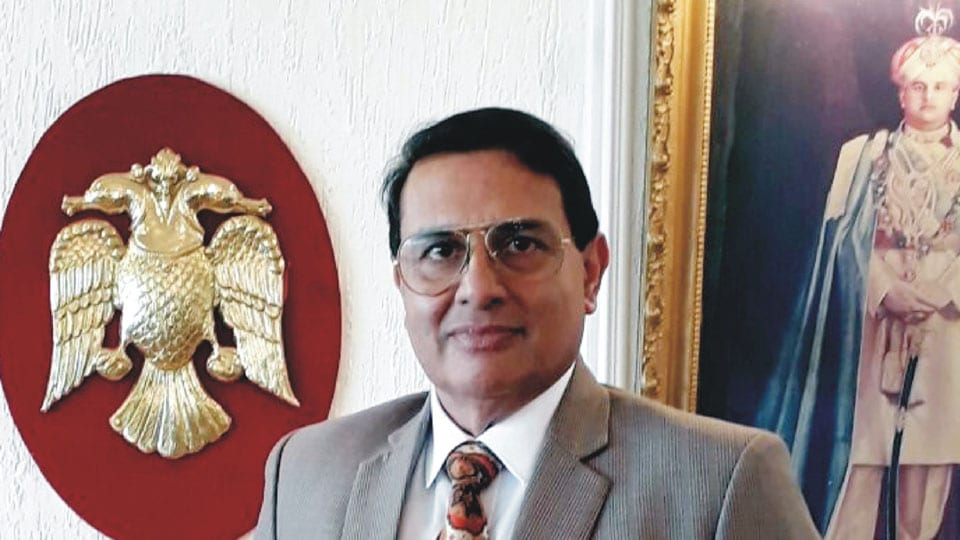
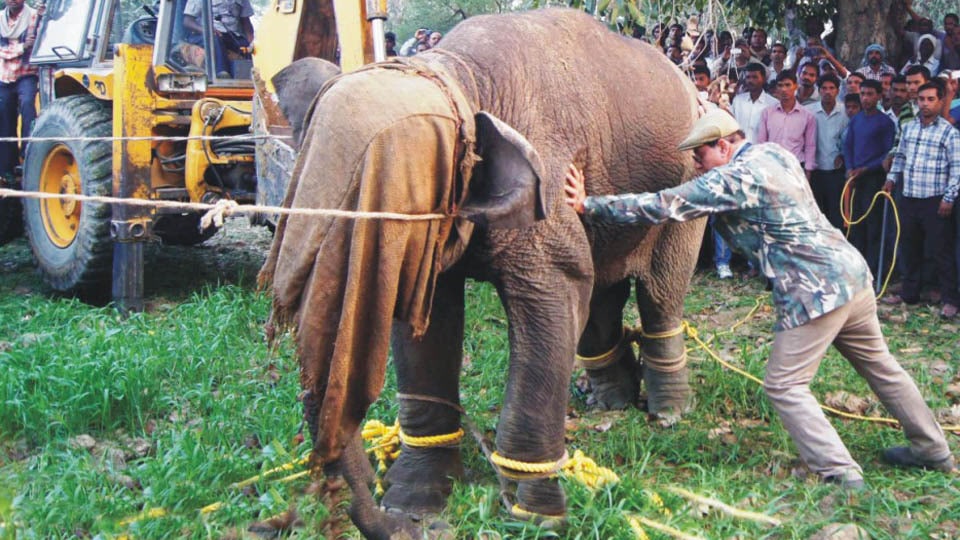
One such Wildlife Conservationist is Nawab Shafath Ali Khan from Hyderabad, who had been invited by the Jharkhand government last month to put down a rogue elephant that had killed 15 people. He is the most celebrated hunter and the only tranquillising and culling expert in the country.
He also runs a chain of resorts in Masinagudi, Tamil Nadu.
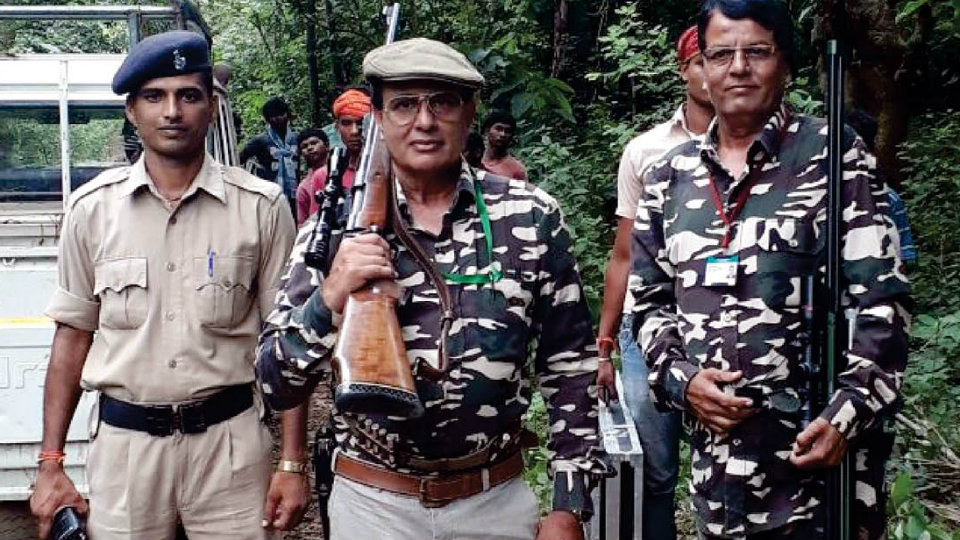
Star of Mysore Features Editor N. Niranjan Nikam travelled all the way to meet the Sharp-Shooter at his den in the midst of the jungle at the Safari Land Resorts in Masinagudi.
The Nawab opened his heart out for nearly two hours in this exclusive interview and spoke about royalty, how to manage forests, man-animal conflict, radio-collaring, culling, animal right activists and his anguish about the villagers and forest-dwellers. Excerpts…
Star of Mysore (SOM): You are not only a Nawab at heart but also a real Nawab from Hyderabad. How much of ‘Nawabipan’ is still there in you?
Nawab Shafath Ali Khan: Well, in well-bred horses the genes carry on in the blood. So I am a Nawab. But I devoted my life to the cause of poor Indians who suffer silently, like forest-dwellers, tribals, aborigines, having lost their lives and property to wild animals.
SOM: You are the most celebrated hunter in the country. Where did it all begin?
Shafath Ali Khan: Hunting was a family ritual. And my grandfather Nawab Sultan Ali Khan Bahadur was Advisor to the British Government on man-animal conflict. I grew up at a time when the Wildlife Protection Act came into being and from controlled hunting the transition to a total ban on hunting was introduced in the country. With the royalty and nobility hanging up their hunting rifles there was a vacuum of traditional knowledge of tracking animals that had generated over generations. I tried to fill this vacuum and worked for saving India’s wildlife as a Conservationist. Hunting is a tool of conservation and all advanced countries across the world are practicing and encouraging controlled hunting and their wildlife is growing.
SOM: You are the only authorised tranquillising expert and culling officer in the country. When there is a Forest Department, which has a rich history, what are the Officers doing?
Shafath Ali Khan: As I said, traditional knowledge acquired over generations cannot be found in textbooks. The art of reading pug marks, identifying it as a tiger or tigress just by seeing it or coming to conclusions about the height of an elephant by measuring the circumference of pad mark of the forefoot is traditional knowledge. Rulers had Shikaris who managed their forests with a vested interest of hunting. The rulers’ passion for hunting not only saved trees and grasslands but also kept a check on excess animal population. Unfortunately, after Independence forest management came into the hands of Officers who were bereft of ground realities. Large scale deforestation started and wildlife mismanagement reached its apex. Certain species grew in numbers beyond controllable figures like wild boar and blue bull. Across the country, tiger population reduced due to habitat destruction and revenge killings.
Large scale destruction is caused by elephant herds that have strayed considerable distances away from protected areas into agriculture fields. Neglected National Parks are overridden with noxious weeds like lantana and parthenium forcing our precious wildlife outside protected areas.
This is the crux of man-animal conflict that has frustrated farmers and forest-dwellers; giving them no option but to poison or electrocute elephants. According to project elephant figures, there were 15,700 elephants in the country in 1980 and today we have over 32,000. The forest cover on the other hand has reduced. The think-tanks who manage wildlife in the country did not plan this explosion in elephant population resulting in excessive man-animal conflict that we face today.
SOM: As a boy of 19 years you were in Mysore Race Club (MRC) as Assistant Secretary. How did this happen?
Shafath Ali Khan: My grandfather was India’s senior-most Handicapper (a person appointed to fix or assess a competitor’s handicap, especially in golf or horse-racing) and my father was Senior Stipendiary Steward and Secretary of Bangalore Turf Club (BTC).
High taxation on horse-racing was killing the industry and both BTC and MRC were finding it difficult to even pay salaries to their staff. My father Nawab Arshad Ali Khan started off-course betting between BTC and RWITC (Royal Western India Turf Club) in 1977 and this gave a new lease of life to the racing industry across the country.
Jawa motorcycle factory Founder Farookh Irani whom I always called Uncle Irani, Chairman of MRC, in consultation with my dad, started off-course betting between BTC and MRC and soon the fortunes of MRC blossomed. MRC was setting up photo-petrol cameras to record the races and I was sent, raw out of school, to Mysore to identify where the twin towers of the cameras had to be installed. I was already a National Champion in Equestrian sports and a top rider in the country. When I finished identifying the setting up of photo-petrol camera towers, having worked under Uncle Irani for a week, he decided to absorb me under MRC and I had the good fortune of learning from him. I was there for three years.
The crux of the man-animal conflict today is that old, weak and handicapped species are pushed out of the forest by the younger and stronger animals. These animals before they could create havoc were eliminated. The village folks were happy, revenge killing was never heard of and we didn’t have elephants straying into private lands like Hassan and Coorg like we are facing today.
Star of Mysore (SOM): The fight between humans and elephants, in other words man-animal conflict is resulting in shocking number of deaths. Planters in Kodagu are facing the heat with their crops being destroyed because of huge elephant menace there. What do you think can be done about this?
Nawab Shafath Ali Khan: The problem is not only in pockets of Karnataka but across the country. Any wild animal requires space. We cannot comprehend compressing them into smaller forest areas. With the number of elephants increasing in the country, the land to animal ratio has gone haywire. National Parks are not being de-weeded and cleared of noxious weeds; to provide enough fodder to the elephants and to restrain them within the parks. Hungry elephants are forced to stray out into agricultural lands for their survival.
Elephant is wise to the fact that nutritional value is found more in sugarcane, bananas, paddy and jackfruit compared to what it gets in barren government-controlled forests. So the Department is putting animals under tremendous pressure. This pressure is changing the metabolism of elephants making them aggressive, attacking people and raiding crops with impunity.
This man-made pressure on elephants and tigers have changed their psychological persona and they are also attacking humans. We have left the problems drift so much that it’s hard to find a win-win situation at this point of time. Anyway my thinking after spending 40 years in the field is that 70 per cent of our wild elephants are outside the forests. This is a very alarming figure. There is no shortage of fund as far as Forest Department is concerned. We are sitting on Rs. 35,000 crore of CAMPA (Compensation Afforestation Fund Management and Planning Authority) Funds. The States can utilise this money and have an elephant-proof trench all around government protected forests. All stray elephants outside this trench will be herded in or translocated.
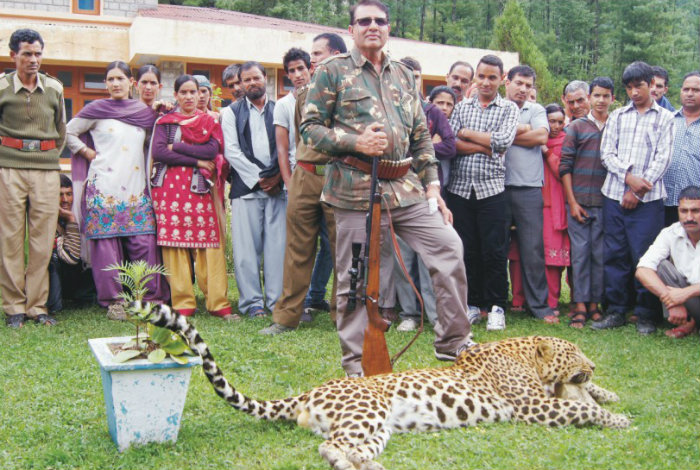
The carcass of the man-eating leopard stretched out on the lawns of Thunag Rest House in Himachal Pradesh.
Wildlife management and human habitations have to be compartmentalised. Solar powered borewells have to be erected every 5-km radius within the National Parks. Clean and sufficient drinking water should be provided to the animals. However, the hard decision that we need to take but from which we have drifted for decades is, how many animals can survive in the relatively small National Parks and buffer areas.
Excess animals sadly will have to be culled not only for their own survival but also to maintain a healthy forest. Overgrazing and over-browsing is casting tremendous pressure on our precious forests.
SOM: There is a story that late Srikantadatta Narasimharaja Wadiyar fell in love with the Land Rover you were driving and bought it. Is this true?
Shafath Ali Khan: Yes, it is true. We were all fond of cars and I had a Land Rover that I had maintained in immaculate condition. The Prince (as Srikantadatta Narasimharaja Wadiyar was called by many who were close to him) fell in love with it and wanted to buy it. But, I was reluctant to sell it. Soon, the Prince and the Princess (Pramoda Devi Wadiyar) came to attend my wedding and the Prince brought a Convertible Red Triumph Sports Car which he gifted to me at the wedding. Now, I had no option but give my Land Rover to him. He enjoyed the Land Rover and I and my wife, newly-married, thoroughly enjoyed the Convertible Sports Car. Prince was very close to me and I was one of the few who had access to the gun rack that was just beside his bedroom. I had the pleasure and honour of cleaning and repairing those beautiful rifles which belonged to the late Highness Jayachamaraja Wadiyar.
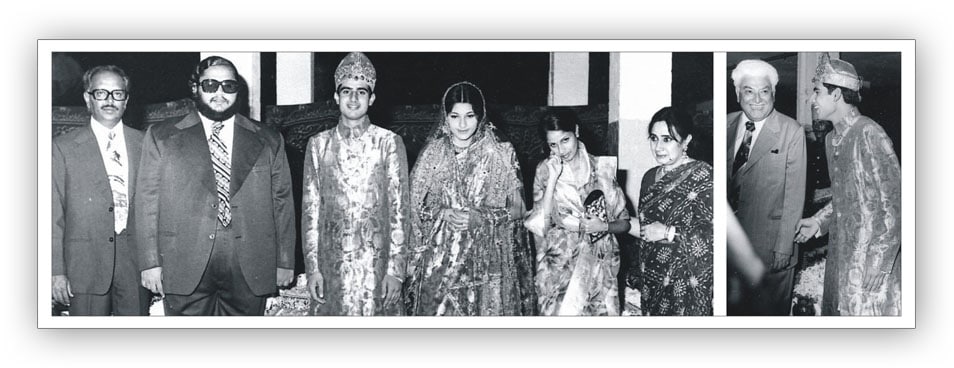
The young bridegroom Nawab Shafath Ali Khan (third from left) seen with (from left) late Sirdar K.B. Ramachandra Raj Urs, late Srikantadatta Narasimharaja Wadiyar, bride Begum Shaheen Khan, Pramoda Devi Wadiyar and the Nawab’s mother Begum Arshad Ali Khan at his wedding reception in Bangalore Turf Club (BTC) in 1976. Picture right shows Jawa Factory Founder F.K. Irani greeting Nawab Shafath Ali Khan at the wedding.
SOM: Isn’t there a contradiction when you say nobility indulged in hunting but they also protected forests?
Shafath Ali Khan: It was a paradox that controlled hunting that had a code and a strict set of rules where only males of deer were shot subsequent to the breeding season. Old rogue elephants and dying tigers beyond breeding age were painlessly shot using high-powered rifles in the hands of our expert shooters. Survival of the fittest is the law in the jungle.
The crux of the man-animal conflict today is that old, weak and handicapped species are pushed out of the forest by the younger and stronger animals. These animals before they could create havoc were eliminated. The village folks were happy, revenge killing was never heard of and we didn’t have elephants straying into private lands like Hassan and Coorg like we are facing today.
Wildlife management was much better balanced compared to what it is today. Across the world animal population have reduced or gone haywire wherever government imposed total ban on hunting.
Meet Nawab Shafath Ali Khan- 3 (September 08th, 2017)
When Star of Mysore Features Editor N. Niranjan Nikam travelled all the way to meet the Sharp-Shooter at his den in the midst of the jungle at the Safari Land Resorts in Masinagudi, Tamil Nadu, Nawab Shafath Ali Khan and his son Asghar Ali Khan, drove this writer in the jungle in their American Jeep M-38 A1, a 1952 model four-wheeler late in the evening and it was a hair-raising experience as the young driver at the wheel negotiated the tough, lovely, Blue Nilgiri Hills range.
Both of them are attuned to every sight and sound in the forest even as the Nawab spotted two elephants and a calf at quite a distance instinctively. Later, the Nawab sat in his unique restaurant and for nearly two hours spoke freely in this exclusive interview about royalty, how to manage forests, the officials in the department, man-animal conflict, his views on radio collaring, culling, animal right activists and his anguish about the forest-dwellers and the villagers living in the fringes of the forest.
Star of Mysore (SOM): How much of preparation goes when you shoot man-eating tigers and rogue elephants?
Nawab Shafath Ali Khan: Bascially physical fitness and mental alertness are the major factors. A hunter is a complete man. He knows how to repair his vehicle, stitch his shoes in the forest, carry out minor repair to his weapons and who could read the forest, pick up the slightest sound and check the direction of the wind. Patience has to be in abundance. I don’t remember how many nights I have spent on a tiny machan on a tree in freezing cold and rainy night.
Tracking rogue elephants one has to walk 10-20 kms a day and this can be quite taxing. Preparing for these operations has become a way of life for me. I live on the most wildlife rich area of the sub-continent where I see wild elephants, tiger, leopard and sloth bear in my morning and evening walk. This keeps my mind alert and greatly helps in dangerous and close encounters with dangerous beasts that I have to tranquillise or eliminate as per government orders.
When Star of Mysore Features Editor N. Niranjan Nikam travelled all the way to meet the Sharp-Shooter at his den in the midst of the jungle at the Safari Land Resorts in Masinagudi, Tamil Nadu, Nawab Shafath Ali Khan and his son Asghar Ali Khan, drove this writer in the jungle in their American Jeep M-38 A1, a 1952 model four-wheeler late in the evening and it was a hair-raising experience as the young driver at the wheel negotiated the tough, lovely, Blue Nilgiri Hills range. Both of them are attuned to every sight and sound in the forest even as the Nawab spotted two elephants and a calf at quite a distance instinctively. Later, the Nawab sat in his unique restaurant and for nearly two hours spoke freely in this exclusive interview about royalty, how to manage forests, the officials in the department, man-animal conflict, his views on radio collaring, culling, animal right activists and his anguish about the forest-dwellers and the villagers living in the fringes of the forest.
SOM: There is no scientific basis in culling and it is not very successful in Africa as you claim, criticise a few. How do you react to this?
Shafath Ali Khan: There is no place for sentiment and religious connotation in wildlife management. I have been asked this question in several national workshops that I have attended. But when I ask them for an alternate solution no doable common sense approach has come forth.
I basically don’t like culling or shooting. I am now an authorised tranquilliser and resource person for six States and run an NGO ‘Wild Life Tranquil Force.’
SOM: What do you do here in the NGO?
Shafath Ali Khan: We are training front-line forest staff and veterinarians of six States in the country. I don’t see any alternative to scientific culling as far as our country is concerned. As an advisor and culling officer to Forest Department of Bihar, I have conducted several experiments to arrest the exploding population of blue bulls. Bihar is a fertile State with Ganges and several rivers flowing. The Gangetic plains are rich in crops. Overpopulation of the blue bulls from the forest, which consist of only 5 percent has found its way into agricultural fields causing as much as 35 percent damage to the farmers.
If at all there is a substitute to culling, it would have been adopted long ago and population controlled. Today UP, Jharkhand, Haryana, Rajasthan, Gujarat, Maharashtra, and Uttarakhand are reeling under the problem of overpopulation of wild boar and blue bulls and no solution is in sight.
Animal right activists might have a vested interest. These organisations get funds from abroad and with politicians and muscle power they arm-twist the senior forest officers to do what they want them to do rather than what is in the interest of the country. They are often bulldozed to falling in line and let matters drift.
Don’t be surprised if the price of Dal becomes Rs. 600 a kg as blue bulls, antelopes deliver two calves annually and wild boar sow delivers anywhere up to 19 piglets in a span of three months. There are virtually no carnivores to control this population explosion outside the forest. So, what are we heading for is anyone’s guess.
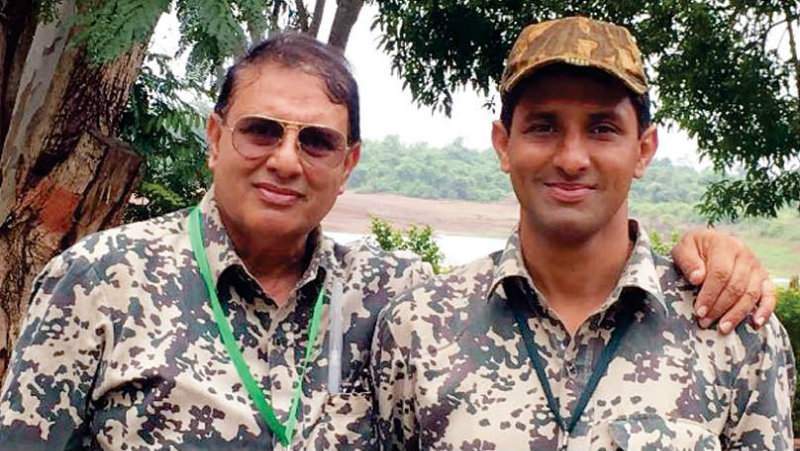
Shafath Ali Khan with his son Asghar Ali Khan.
SOM: As a wildlife conservationist, what is your view on radio collaring of tigers and other animals?
Shafath Ali Khan: In my opinion it is an utter failure. The reason why I say this is, it affects the breeding of tigers. Because when the tiger mounts a tigress, he starts biting on the top of her neck and it is a natural instinct. When the radio collar is there, the tiger bites into the radio collar and finds something hard and abnormal and it withdraws. I have seen this phenomenon physically.
In Siriska Tiger Reserve, when they introduced tigers with radio collar there was no breeding at all and I had predicted this 30 years ago.
Each radio collar weighs almost 1.5 Kgs and when a wild tiger is all of a sudden burdened with it then his entire movement and body language changes. This famous tiger Jay, which was tranquillised and radio collared, his home range, which was 38 sq. metres before the radio collaring, increased to 58 sq.mtrs.
SOM: Why is that?
Shafath Ali Khan: When you have something implanted in an animal, then its entire movement changes and it may come closer to human habitation also.
Also, the battery life which is supposed to last one year, never lasts that long. For instance, in this tiger Jay in Umed Sanctuary in Maharashtra, the battery ran out in two months and it disappeared. It was a pretty tiger and later it even died.
Then each radio collar costs about Rs. 3.5 lakh to Rs. 5 lakh and the cost involved in catching a wild tiger is another Rs. 5 lakh. With all this operation, it does not come cheap.
There is my own experience of a leopard that I tranquillised in Gundlupet in Muntipara village. This leopard had a radio collar, which had gone dead long time back. This animal entered a house and but for my early intervention, the girl living in that house would have been dead. It was a problematic leopard which was caught, radio collared and released and it again entered human habitation. The biggest problem of radio collaring is it gives the Forest Department a false sense of temerity to release the animal that should not be released. As a result the lives of villagers and poor forest dwellers are shackled.
SOM: Have you had any near-death-like experiences as a sharp-shooter in all these years?
Shafath Ali Khan: The most memorable day in my life was on Dec.17, 1976, when I was called by Van Ingen and Van Ingen (the famous taxidermists in the country) to shoot a rogue elephant that had killed 12 people. Since, late Uncle Joubert Van Ingen (who, at the age of 100, had written a foreword to the book ‘Man-Eaters And Wildlife Challenges’ by the Nawab. He dictated the foreword at one breath without a single mistake!) thought he was too old to trace the rogue elephant, he requested the Forest Department to invite me to shoot it at H.D. Kote. I traced the elephant and shot it and this incidence is rich in my memory.
The other near-death-like experience I can recall was just last month, on Aug. 11, 2017, when I was invited by the Jharkand Government to put down a rogue elephant that had killed 15 people and we tracked it for three days in most difficult terrain and thick impenetrable jungle, the rogue tusker turned around and came for us.
My two trackers fled leaving the Veterinarian Dr. Ajay Kumar and me. I saw the 10-foot tall tusker from hardly 10 metres coming for us like a railway engine with a loud trumpet. He raised his head to grab me with his trunk covering the forehead which is the only vital spot to shoot at that close range. A wrongly placed shot would have ended me in a fraction of a second. I took him at 9 metres and shot him in the mouth. The heavy bullet from .458 Magnum brought him to his knees. But he tried to get up in a fraction of a second. Working the bolt fast I fired the second shot in between the eyes and brought him down painlessly and death was instantaneous.
I often strive hard to see that the animal is put out with least pain and agony. Shooting, for me is the last option, when all other remedies have exhausted.
SOM: What about the experience of shooting a man-eating tiger?
Shafath Ali Khan: In July 2017, I was invited by the Maharashtra Government to tranquillise a man-eating tigress that had claimed four human lives. I darted from a distance of 15 metres when she was galloping away. But the most hair-raising incidence was shooting a man-eating tigress in 2009 in UP, where I tracked her for 35 days and nights and shot her when she charged from a distance of six metres.
SOM: Asghar Ali Khan, your son is also an authorised shooter. So, the family tradition continues?
Shafath Ali Khan: Asghar, is an authorised shooter and a crack shot. He has a .470 double rifle on his licence and helps me in dangerous tranquillising operation. But he along with my wife Shaheen keep the fire burning and looks after our chain of resorts in the Nilgiris. Often when a long drawn operation is coming to a conclusion, I summon him to join me as a backup.
SOM: Running Safari Land Resort must be a great experience for you and your family?
Shafath Ali Khan: Definitely yes. The very thought of living in a deep jungle arouses a sense of bliss within me. Forests and wildlife are very close to my heart. Riding in the jungle every morning is a thrill that I have no words to explain. Safari Land has given what no other luxurious Palace in the world can give us.
SOM: But are you related to the Nizam family of Hyderabad?
Shafath Ali Khan: Yes, yes. We are from the royal family of Hyderabad. We were equal to the Nizams, like you had the Maharajas and Ursus in Mysuru. The Nizam married into our family, our daughters were given in the Nizams family. So we were equals.
SOM: How long do you think you can carry this crusade of yours as a hunter and sharp- shooter?
Shafath Ali Khan: My priorities are no longer shooting. Having worked for several assignments for the past four decades, I have been involved in 24 dangerous operations and have culled thousands of animals. No one in the country has shot as many animals as I have done. My priority is not shooting or culling any more. My focus is to help those five crore people who are living in 1,87,000 villages and the forests across the country in most adverse conditions. Since I have worked, stayed and eaten with them, I know what it means by hunger.
Several interior villagers are living in a state of anarchy, in constant fear of wild elephants that raid the villages, break their huts, and eat away their rations. Women with infants in their arms run in the middle of the night to the next village 3 kms away. There is no one to wipe their tears. This is fresh in my mind from Jharkhand. I sometimes wonder whether the Constitutional rights, the right to life and liberty is guaranteed only for the elite and not my brothers and sisters who suffer in silence.
My passion now is to work for them, get them the due compensation, get the government to erect solar fencing to protect them. I don’t charge the government for service and time that I give. Tears of gratitude from underprivileged forest-dwellers when I shoot down a rogue elephant or a man-eating tiger, give me energy to work for them for another 100 years.
[Concluded]
source: http://www.starofmysore.com / Star of Mysore / Home> Feature Articles / by N Niranjan Nikam (3 part feature articles) / September 18th, 2017
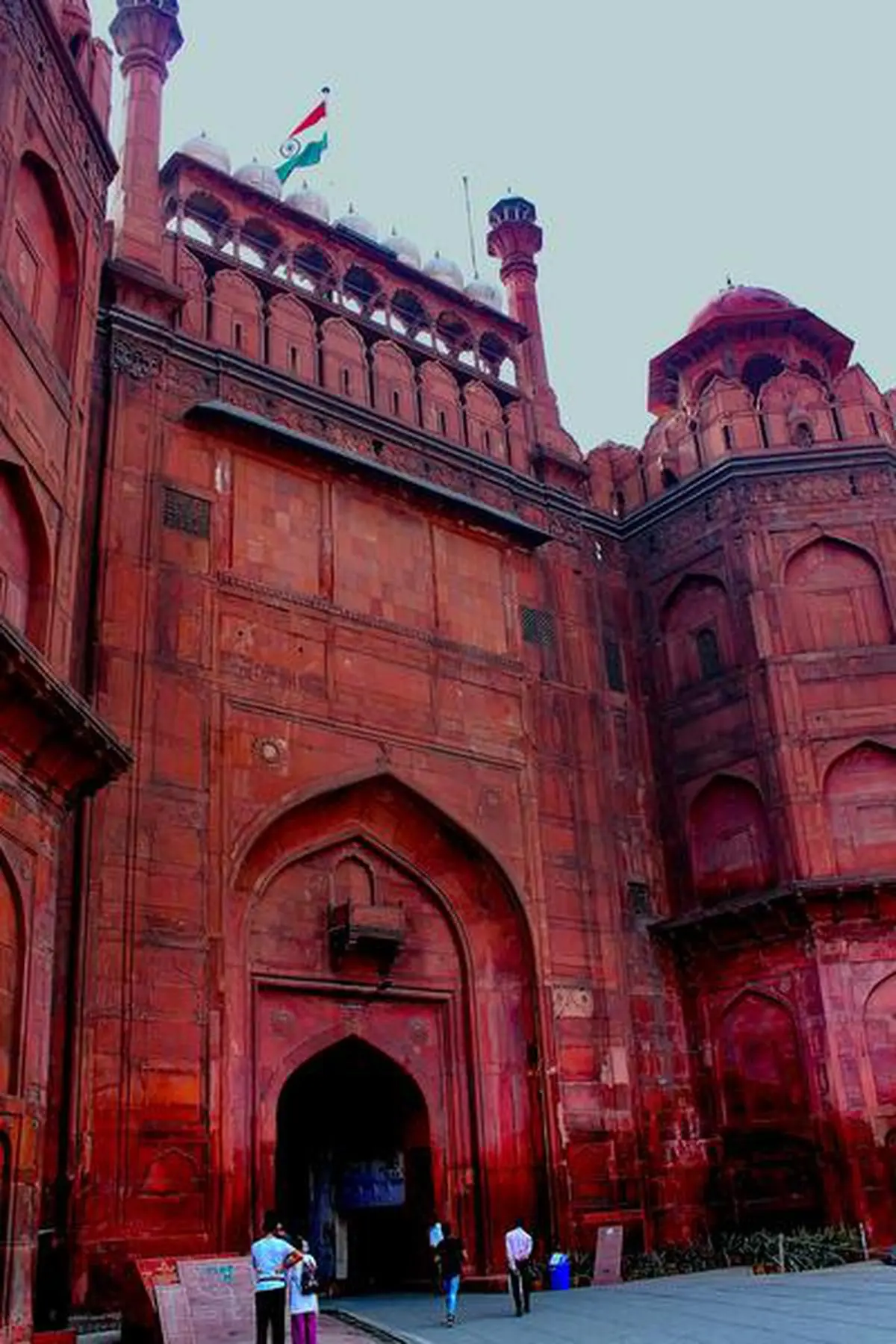
The Lahori Gate of the Red Fort that the Mughal emperor Shah Jahan built in Shahjahanabad, the new capital city he moved to from Agra in 1638, which is now know as Old Delhi.
ON the eastern edge of Delhi along the banks of the Yamuna river, which has shifted its course considerably today, and adjacent to the older Salimgarh Fort is situated the Lal Qila, or the Red Fort, one of the most iconic representations of India’s Independence Day celebrations. Declared a World Heritage Site in 2007, it was built by the fifth Mughal emperor Shah Jahan (regnal years 1628-1658) as the citadel of his new capital city, Shahjahanabad (literally the abode of Shah Jahan). Known by different names at different points of time such as Qila-i-Mubarak (the Fortunate Citadel), Qila-i-Shahjahanabad or Qila-i-Mualla (the Exalted Fort), the Red Fort represents the pinnacle of Mughal palace-fort building activity.
Shah Jahan constructed Shahjahanabad after he changed his capital from Agra to Delhi in 1638. The French traveller Francois Bernier said the scorching heat of Agra forced the emperor to look for a new capital. But there were clearly other deeper reasons. Delhi’s geographical location was more strategic for the control of the empire. Further, as the author of the 19th century biographical work Maasir al-Umara said: “Exalted sultans always had it in mind to cause the world to remember [them] by a permanent monument.” Agra had by then become a little too small for Shah Jahan’s grand and ambitious building plans. Overbuilding and encroachments had led to huge congestion in a city getting progressively eroded by the Yamuna. There had also been incidents of people getting killed/injured during processions/festivals. In 1639, Shah Jahan instructed his architects, engineers and astrologers to select a new site in a mild climate somewhere between Agra and Lahore.
The choice of Delhi was facilitated by many factors. It had been the capital and a centre of Muslim rule since the times of Qutbuddin Aibak until around 1506 when the Afghan ruler Sikandar Lodi (regnal years 1489-1517) shifted his capital to Agra. Later, Shah Jahan’s grandfather, the Mughal emperor Humayun, laid the foundations for a new capital called Dinpanah in the modern Purana Qila /Old Fort area. Delhi had also been an important religious-spiritual and pilgrimage centre housing tombs and graves of several holy men, including Nizamuddin Auliya, Qutbuddin Bakhtiyar Kaki and Nasiruddin Chirag Dehlavi. Hakim Maharat Khan Isfahani, writing in the early 18th century, says: “It was always the dar al mulk [seat of empire] of the great sultans and the centre of the circle of Islam [ markaz-i dairah Islam ].” The historian Swapna Liddle argues that the specific spot—the right bank of the Yamuna and south of the Salimgarh Fort, which Islam Shah Suri built in 1546—is regarded as auspicious in Hindu mythology. It was believed to have been blessed by Vishnu as a place where knowledge of the Vedas could be had by just taking a dip in the waters. It was called Nigambodhak , meaning that which makes known the knowledge of the Vedas. Nigambodh Ghat continues to be regarded as a holy site by Hindus.
Scholars have suggested various models to comprehend the city. The historian Stephen Blake argues that like many other capital cities, such as Istanbul, Isfahan (Persia), Tokyo and Peking, Shahjahanabad was also the “exemplar” of the sovereign city model—the “capital of the patrimonial-bureaucratic empire”, a type of state that characterised Asian empires from about 1400 to 1750. Others, such as E. Ehlers and Thomas Krafft, have characterised Shahjahanabad as an “imperial Islamic city”. An important factor to bear in mind is the way the Mughals, or for that matter even Hindus, viewed capital cities. The capital was an axis mundi —or the centre of the earth where the celestial and the mundane intersected. In the words of Muhammad Salih, an official historian of Shah Jahan’s reign: “Its four walls… enclosed the centre of the earth [ markaz-i khak ].” While the nature of the city continues to be debated, there is no doubt that it was one of the finest imperial capitals of the time. It had all the features of a great Mughal city: a palace-fort, enclosure walls, streets with squares, bazaars, mosques, gardens, imperial buildings, commercial neighbourhoods and industrial establishments, some within the palace-fort complex and some outside it.
On April 29, 1639, at a time determined by imperial astrologers, the subahdar (governor) of Delhi ordered the architects Ustad Ahmad and Ustad Hamid to begin the excavations for the new capital. After nine years, on April 19, 1648, Shah Jahan entered the Daulatkhana-i-Khas / Diwan-i-Khas (Hall of Special Audience) through the gate fronting the river.
The palace-fort was built at a cost of around one crore rupees, half of which was spent on the construction of the palaces within. It occupied the north-eastern edge of the new imperial city. Later, Shah Jahan also constructed a wall around the city, which Bernier found to be inadequate. The wall was punctuated by towers, bastions, gates and entryways. Of its 14 major gates, the important ones are the Mori, Lahori, Ajmeri, Turkomani, Kashmiri and Akbarabadi (later known as the Delhi Gate) Gates.
Fort wall and entrances The palace-fort complex together with the Salimgarh Fort occupies an area of 121 acres (one acre is 0.4 hectare). It is an irregular octagon with its two longer sides in the east and west. According to the art historian Percy Brown, most of it was laid out in squares and there was hardly an oblique line or curve in the entire scheme. The riverfront section contained important royal buildings. A water channel, called Nahar-i-behisht (Stream of Paradise), ran through these buildings. The fort complex was surrounded on three sides by a moat and by the Yamuna on the eastern side. The wall on the north-eastern side borders the Salimgarh Fort, which served as a prison during Mughal times. The wall of the palace-fort covers a perimeter of 2.41 kilometres. Along the river, it is 18 metres high and on the other sides it is 33.5 m high. The wall was built of red sandstone (hence the name Red Fort) brought upstream on the Yamuna from Fatehpur Sikri.
The archaeologist Y.D. Sharma pointed out that there were five grand entrance gates to the fort, only two of which are still in use: the imposing three-storey Lahori (facing the direction of Lahore) Gate and the Delhi Gate (facing Delhi). The latter, which Shah Jahan used to go to Jama Masjid, is similar in layout and appearance to the Lahori but is notable for the two life-sized stone elephants on either side of it. Aurangzeb, Shah Jahan’s son and successor, demolished the elephants, but the British Viceroy Lord Curzon had them restored in 1903. Lying under the Musamman Burj , the riverfronting octagonal tower, was a third gate that the emperor used as a private entrance.
The bazaars The fort was characterised by rectangular buildings laid out in a symmetrical arrangement with intersecting thoroughfares. There were two principal streets/thoroughfares, which also served as bazaars. They emanated from within the fort-palace but went beyond to the city. They intersected at right angles in the courtyard outside the Naqqar Khana (Drum House). The principal imperial street, running from east to west, began at the Rang Mahal (Palace of Colour) and ran through the Lahori Gate of the fort to Fatehpuri Masjid. This street was divided into three bazaars separated by two squares. The first, lying between the Lahori Gate and the chowk (square) of the Kotwali Chabutra (City Magistrate’s Platform), was called Urdu Bazar (Bazaar of the Royal Camp). The second part, commissioned by Shah Jahan’s daughter Jahanara Begum, extended from Kotwali Chabutra to the octagonal Chandni Chowk (Silver Square) and was called Ashrafi Bazar (Moneychangers’ Market) or Jauhari Bazar (Jewellers’ Bazaar). It had a hammam (bathhouse), a sarai (inn) and a garden (Bagh Sahibabad) near it. The final section, from Chandni Chowk to Fatehpuri Masjid, was called Fatehpuri Bazar . The Nahar-i-behisht , bordered by trees, ran down the middle of the bazaars.
The second street, in the north-south direction, stretched from the Akbarabadi Gate of the fort to the Akbarabadi Gate of the city and had a market that later came to be known as the Faiz Bazar (Bazaar of Plenty). As in the case of the first street, a stream from the Nahar-i-behisht ran down the middle of this bazaar. There was also a bazaar, a small one, that connected Jama Masjid and the palace-fort and it was inhabited by dancing girls, medicine men, jugglers, storytellers and astrologers.
The Lahori Gate remains the main public entrance to the palace-fort. The pointed arched entrance has kangura s (ornamental merlons) on the parapet and a row of dwarf chhatri s (canopy), each with a small marble dome. It is flanked by octagonal towers with sandstone domes and marble finials. Since 1947, Prime Ministers have made Independence Day speeches from the ramparts adjacent to this gate. Aurangzeb added barbicans to the Delhi and Lahori Gates and made the former the headquarters of the qiladar (fort commander). When Shah Jahan was imprisoned by Aurangzeb, he apparently wrote to his son from Agra saying: “You have made the fort a bride, and set a veil before her face.” The historian Percival Spear points out that Aurangzeb built the great wall in front of the Lahori Gate to save nobles the trouble of having to bow constantly as they walked the length of Chandni Chowk , which court etiquette required them to do when they were in the view of the emperor. Blake, however, says the wall was built to strengthen the outworks of the structure.
After entering the Lahori Gate, one comes to a vaulted arcade, or a covered bazaar ( Bazaar-i-Mussaqaf ). Blake says that establishing roofed bazaars was a common practice in Iran and West Asia but was unusual in India. This was a double-storey structure with arcaded shops at both levels, and there were shops on sides of the street too. Here, merchants of Delhi sold their goods to the nobles. In the middle of the bazaar is an octagonal court known as Chhatta Chowk with an open roof to allow in air and light. Going past the covered bazaar, one reaches the three-storey sandstone pavilion Naubat Khana (Music Gallery), or Naqqar Khana , where once ceremonial music was played five times a day and from where the arrival of the emperor and other dignitaries was announced. The Indian War Memorial Museum now occupies its upper storey. Between Naqqar Khana and Chhatta Chowk is an open square forecourt ( Jilau Khana ) on the sides of which were small rooms for officials connected with the daily guard. It is in the Jilau Khana that the people attending daily audience, ministers, bureaucrats, amirs and others waited. Only the princes could go beyond this point on their horses; all others had to dismount here.
The Naqqar Khana led to the rectangular Diwan-i-Aam (Hall of Public Audience) open on three sides with a courtyard in front. It is an arcaded structure consisting of nine engrailed arches supported by double columns made of sandstone. It has 27 bays, and the ceiling and the columns were originally decorated with gilded stucco work and hung with heavy curtains. Set against the centre of the eastern wall is a marble canopy known as the Nashiman-i-Zill-i-Ilahi (Seat of the Shadow of God). This canopy with fluted/baluster columns, inlays of precious stones and a Bengal-styled roof once stood over the emperor’s throne. Here he sat and listened to complaints and suggestions from the general populace and deliberated upon routine military, administrative and financial matters. A railing separated him and the common people. Below the throne was a marble dais decorated with semi-precious stones to be used by the wazir (prime minister). The wall behind the throne was ornamented with beautiful panels of pietra dura work, said to have been executed by the Florentine artist Austin de Bordeaux. The panel has beautiful flowers along with birds and animals. It also has a representation of the Greek god Orpheus playing the flute to animals, including a hare, a leopard and a lion. The art historian Ebba Koch says this symbolised the ideal rule of Shah Jahan “whose justice would make the lion lie down with the lamb and, in the human world, free the oppressed from their oppressors”.
The Diwan-i-Aam was sometimes used for state functions, and the courtyard behind it leads to the imperial apartments. In order from north to south, they are Mumtaz Mahal , Rang Mahal , Khas Mahal , Diwan-i-Khas , the hammam and Hira Mahal . Built along the Yamuna, these palaces now overlook the traffic-heavy Mahatma Gandhi Road. The eastern ramparts are flanked by two towers, Asad Burj (Lion Tower) and Shah Burj (Emperor’s Tower) respectively, on the south and north ends. Raised on a common marble platform, these were mostly open marble pavilions with perforated screens, inlaid with precious stones and decorated with moulded plaster and paintings. They had walled courtyards on the western side to give them privacy from the rest of the palace. The Nahar-i-behisht brought water from the river by way of a marble ramp that led into a lotus-shaped pool in the north-eastern building. From here, it filled the royal baths, ran through the Diwan-i-Khas and the emperor’s private chambers and beneath the marble trellis screen that carried the carving of the Mizan-i-Insaf (Scales of Justice), through the section reserved for the royal women.
Behind the Diwan-i-Aam and separated by a court is the Rang Mahal , a huge hall whose name is derived from its painted interior. It had a facade of five engrailed arches set on piers. The ceiling was originally built of silver and, in the words of Muhammad Salih, was “gilded and ornamented with golden flowers”. The central hall was divided into 15 bays formed by intersecting arches. The structure had two vaulted chambers on either end that were adorned with wedges of mirrors embedded in the ceiling. These apartments are popularly called Shish Mahal (House of Mirrors) because of the effect they produced.
Beyond this is the Mumtaz Mahal (Distinguished Palace), a building that now houses the Fort Archaeological Museum. It had a brightly coloured ceiling inlaid with gold and at four corners were reed houses ( khas khanas ). There was a large garden with a pool and a marble basin between this palace and the Diwan-i-Aam . Between the Mumtaz Mahal and the Asad Burj were living quarters for women of the imperial household. Small gardens laid around central pools dotted the courtyard.
Emperor’s living quarters Immediately north of the RangMahal were the emperor’s living quarters called the Khas Mahal (Special Palace). This composite palace consisted of three segments: a beautifully carved marble building inlaid with precious stones called the Aramgah or Khwabgah (Place of Sleep) flanked by the Tasbih Khana (Chamber for counting beads for private prayers) and the Tosha Khana (Robe Chamber). The Tasbih Khana was a set of three rooms facing the Diwan-i-Khas . This was separated from the central Khwabgah by a marble screen containing a representation of the Mizan-i-Insaf suspended over a crescent amidst stars and clouds. The Tosha Khana , also known as the Baithak (Meeting Hall), faced the Rang Mahal and had painted walls and ceiling and a perforated screen. The Musamman Burj , with its beautifully painted interior, protruded from the eastern wall of the Aramgah . It served as a place for the Jharoka Darshan (Balcony of Audience)—a practice borrowed from Hindus whereby the emperor appeared before his subjects every morning. In 1808, Akbar Shah II added a small balcony to this burj . It was from this balcony that King George V and Queen Mary appeared before the people of Delhi during the Durbar of 1911.
To the east of the Diwan-i-Aam and along the riverfront is the Diwan-i-Khas . The location of this hall, deep within the living quarters of the imperial family, indicated its special, private character. This rectangular chamber was a place for exclusive and private audience. Built of pure white marble, it was one of the most elegant buildings in the palace-fort. Its roof has pillared umbrellas at the corners. The chamber has engrailed or scalloped arches resting on a set of 32 piers with square shafts. The lower walls were studded with agate, pearl and other precious stones while the upper portion had fruits and flowers painted in colourful and intricate designs. Takht-i-Taus , the famous peacock throne with the Koh-i-Noor diamond embedded in its canopy once stood in the centre of the room on a wide marble platform. The Nahar-i-behisht flowed right through the middle of the hall, adding to the beauty of the place. The Diwan-i-Khas inspired the poet Amir Khusrau (1235-1325) so much that he left a quote in the building wall: “If there be a paradise on the earth, it is this, it is this, it is this.”
North of the Diwan-i-Khas lay the hammam , which was a three-storey structure built of marble. While one storey was used as a dressing room, the other two were for hot and cold water baths respectively. It was decorated with mosaic and pieces of glass and nicely painted. At the north-eastern corner of the palace-fort and along the riverfront, lay the Shah Burj .
North of the Diwan-i-Khas was the marble Moti Masjid (Pearl Mosque) built around 1659 for exclusive private use. This is the only building that Aurangzeb erected within the palace-fort and is now closed to the public. The northern sector of the imperial quarters was occupied by the gardens, primarily the Hayat Baksh Bagh (Life Bestowing Garden) and Mahtab Bagh (Moonlight Garden). The Hayat Baksh Bagh was a paradise garden with tanks, fountains, tunnels, pavilions and all the other structures typical of such gardens in the West Asian countries. It had a rectangular pool in the centre beside which stood an open summerhouse ( barahdari ). At the north and south ends of this garden stood two identical pavilions named after the monsoon months of the Hindu calendar: Sawan (fourth month) and Bhadaun (fifth month).
After Shah Jahan The fortunes of the fort started disintegrating after the death of Aurangzeb, a period that witnessed battles for succession, dissensions within the royalty, the rise of ambitious nobles, invasions from abroad and natural calamities. The palace-fort was a centre for artistic and cultural performances during some periods. Muhammad Shah, one of the later Mughals, patronised Urdu, Qawwali and music, particularly khyal . Paintings of Holi celebrations during his period are well known.
In 1739, Nadir Shah, the Turk ruler of Iran, crossed over Afghanistan and Punjab and defeated the Mughals at Karnal. In the subsequent display of power, his name was proclaimed as the sovereign in the khutba read in the mosques in Shahjahanabad. He also got Muhammad Shah to receive him at the fort where he symbolically returned the throne to the defeated emperor. On March 22, 1739, infuriated by attacks on his army, Nadir Shah ordered a massacre of citizens of Delhi and witnessed the barbarity sitting on the roof of Sunehri Masjid near Chandni Chowk . He also plundered the fort and the city and carried away a booty with an estimated value of 700 million rupees, including the Peacock Throne and the Koh-i-Noor .
The destroyed city and plundered empire was further weakened by the raids of the Marathas, the Sikhs, the Jats, the Gurjars, the Rohillas and the Afghans around the mid to later 19th century.
The historians Percival Spear and Amar Farooqui argue that the Mughal Empire as an imperial raj or a political entity ceased to exist in the 1750s. But the “imperial” aspect of the emperor and his distinctive social status as the foremost resident of Delhi ensured that his position remained central to the identity of the city even after British occupation. In 1803, Lord Lake defeated the Marathas near Patparganj and gained control of the Ganga-Yamuna plains and the Delhi-Agra region. The city became a part of the North-Western Provinces and was governed from Agra. A British Resident was stationed in Delhi. He started functioning from an office at Dara Shukoh’s Library on the right bank of the Yamuna close to the imperial palace.
Rebellion of 1857 The early decades of the 20th century, sometimes described as the “English Peace”, were also the period of the “Delhi Renaissance”, which was characterised by literary greats such as Ghalib, Momim, and Zauq; the intellectual endeavours of the faculty at the Delhi College and its English institute; and the coming of printing presses and newspapers. This was disrupted by one of the most serious challenges to the British colonial rule, the Rebellion of 1857.
The year 1857 witnessed armed revolts in parts of central and northern India, leading to a loss of British control over these regions. It began with a mutiny of sepoys but acquired a civil and popular character in parts of Upper India. The historian Eric Stokes says that the rebel sepoys showed a “centripetal impulse to congregate at Delhi”. The Red Fort thus emerged as a focus centre for the rebellion. Under pressure from the rebels and princes, the reluctant 82-year-old Mughal emperor, Bahadur Shah Zafar, became the titular leader of the rebellion, while Prince Mirza Mughal (commander-in-chief) and Jiwan Bakht ( wazir ), along with other princes and nobles, exercised the real power.
The palace-fort soon became the seat of new power and Bahadur Shah a symbol of the rebellion. There were attacks on Europeans, Christians and those connected with the British government. The British army waited for reinforcements from Ambala. Once the army started gaining control of the city, it went on an offensive against both Hindus and Muslims. The population of the city was driven out and took shelter around the Qutb and the Nizamuddin and could only re-enter the city the following year. Mosques were taken over. After September, the British forces unleashed a reign of terror that saw indiscriminate shootings, courts martial and summary hangings.
Bahadur Shah had escaped via the Yamuna and taken refuge in Humayun’s tomb. He was arrested along with three princes who were killed on the way back near the Delhi Gate by Major William Hodson. Bahadur Shah returned to the Red Fort as a prisoner of the British, was tried in the Diwan-i-Khas in 1858 and exiled to Rangoon, Burma (now Yangon, Myanmar), on October 7.
The fort complex also incurred the wrath of British officials. More than two-thirds of the inner structures were destroyed. Henceforth, the palace was to be used as quarters for the British garrison and the famed Diwan-i-Aam as a hospital. The buildings south of the Diwan-i-Khas were found to be “of little architectural interest” and were declared suitable for troops. Most of the jewels, precious stones and artworks of the Red Fort had been looted and stolen during Nadir Shah’s invasion and after the “Great Indian Rebellion” was suppressed. Several existing Mughal structures were demolished, including the harem courts and gardens to the west of Rang Mahal and the royal storerooms and kitchen to the north of Diwan-i-Aam and the Mahtab Bagh . British buildings such as army barracks, hospitals, bungalows, administrative buildings, sheds and godowns became a part of the palace-fort complex.
The rebellion ended the rule of the East India Company, and an Act passed in the British Parliament in August 1858 made Queen Victoria the sovereign head of British India. The office of Secretary of State was created to rule India. The new power dynamics were sought be cemented through imperial durbars held in 1877, 1903 and 1911. The author Pran Nevile says this was in keeping with the Indian tradition of the durbar, which celebrated the coronation of a new ruler to mark his/her sovereignty over his/her subjects. The third durbar also saw a surprise announcement from King George V of the transfer of the capital from Calcutta (now Kolkata) to Delhi. The next few decades were spent on building the last imperial city, New Delhi, also known as Lutyen’s Delhi.
The Red Fort became visible again in the years preceding Independence. The chambers within the baoli , or stepwell, believed to predate the Red Fort, were converted into a prison. It housed Colonel Shah Nawaz Khan, Colonel Prem Kumar Sahgal, and Colonel Gurbaksh Singh Dhillon during the Indian National Army (INA), or Azad Hind Fauj, trials in 1945-46. The massive nationwide campaign for their release reinforced the public perception of the former Mughal palace as the symbol of anti-colonial resistance. On August 16, 1947, Jawaharlal Nehru, the first Prime Minister of India, raised the Indian national flag above the Lahori Gate. Farooqui says that the act of replacing the British flag with India’s national flag—a day after the swearing-in of the first Cabinet—amounted to reclaiming this contested site for the nation.
After Independence, the Red Fort witnessed a few changes but continued to be used as a military cantonment. A large part of the palace-fort remained under the control of the Indian Army until 2004 when it was handed over to the Archaeological Survey of India for restoration.
Shashank Shekhar Sinha has taught history in undergraduate colleges at the University of Delhi. He does independent research on tribes, gender, violence, culture and heritage .
source: http://www.frontline.thehindu.com / Frontline / Home> Arts & Culture> Heritage> Agra Fort / by Shashank Shekhar Sinha / January 30th, 2019
The Agra Fort, a World Heritage Site, is the only fort in India to have been inhabited by all the early Mughal emperors.
The Amar Singh Gate of the Agra Fort is on the southern side of the fort complex and is its public entrance.
SITUATED on the right bank of the Yamuna river, very close to the iconic Taj Mahal, is the Agra Fort, also known as the Red Fort. Declared a World Heritage Site in 1983, it is the only fort in India that was inhabited by all the early Mughal emperors. The fort, therefore, provides a useful template not only for the development of Mughal and Indo-Islamic architecture but also the evolution of Mughal palace forts, polity and ideas of kingship. The fort’s palaces and pavilions inspired the Red Fort (Lal Qila) in Delhi and buildings in Fatehpur Sikri and Lahore. However, the history of the Agra Fort is not just connected with the Mughals—who held sway over the fort, certainly between Akbar and Aurangzeb—but also with Mahmud of Ghazni, the Rajputs, the Lodis, the Surs, the Marathas, the Jats, the Durranis and finally, the British, before the greater part of the complex was handed over to the Indian Army in 1947.
The fort complex
A poem written in 1134 C.E. by Masud ibn Saad Salman, a Persian poet, mentions that the fort of Agra was captured by Mahmud of Ghazni. Later, towards the second half of the 15th century, a Rajput king called Badal Singh constructed a brick fort at the site and called it Badalgarh fort. The fort gained prominence when the Sultan of Delhi Sikandar Lodi (regnal years 1489-1517) decided to shift his capital from Delhi to Agra. Thereafter, the Badalgarh fort became the residence for the Lodi sultans.
From the Lodis, the fort passed into the hands of the Mughals. After defeating Ibrahim Lodi at the First Battle of Panipat (1526), Babur (regnal years 1526-30), the first Mughal emperor, ordered his son Humayun to take charge of Agra and the fort’s treasures. Babur built some paradise gardens in Agra and a baoli (stepwell) within the fort complex. Humayun (regnal years 1530-40 and 1555-56) was crowned at the fort in 1530 but preferred to rule from Delhi. The Afghan chieftain Sher Shah defeated him at Bilgram in 1540, occupied the Agra Fort, and garrisoned it thoroughly. An exiled Humayun could recapture his throne only in 1555 but died soon afterwards.
With the arrival of Akbar (regnal years 1556-1605) in 1558, Agra’s and the fort’s fortunes changed completely. After staying in the Badalgarh fort for a few years, he decided to rebuild it as the site of his government, and the old brick fort gave way to a new one in red sandstone. Approximately 4,000 builders are said to have worked every day for eight years (1565-73) to complete this renovation task. The historian Michael Fisher points out that Akbar created his court complex within the existing fort, demonstrating his early architectural aesthetic—uniform red sandstone surfaces highlighted with white marble. A new citadel-city came into being. The Jesuit missionary Antonio Monserrate, who saw the fort complex in 1580, recorded that besides the emperor’s palace there were “mansions of his nobles, the magazines, the treasury, the arsenal, the stables of the cavalry, the shops and huts of drug-sellers, barbers, and all manner of common workmen”. Abul Fazl, Akbar’s court historian, records that 500 buildings were built there in the Bengali and Gujarati styles.
Akbar’s successor, Jahangir (regnal years 1605-27), used to visit Agra at regular intervals and even stayed in this fort. However, he focussed his efforts more on building forts and palaces in Lahore and Kashmir. The Agra Fort was modified considerably during the reign of Shah Jahan (regnal years 1628-58). Between 1628 and 1637, he destroyed many existing buildings, renovating some and constructing three new marble palace courtyards (alongside three mosques) according to his own architectural taste. Aurangzeb (regnal years 1658-1707) deposed Shah Jahan, his father, to take control of the fort and built two barbicans around the gates and on the riverside to strengthen its defences. When the British took over the fort in 1803, they destroyed many buildings to make way for military structures. The complex now has only around two dozen monuments left, mostly those built by Akbar and Shah Jahan.
Gates, palaces and courtyards
The fort has a semicircular shape and is surrounded by a broad deep moat. Its eastern side, some 725 metres long, faces the bank of the Yamuna. Spread over 94 acres (38 hectares) of land, the fort complex is enclosed by a double-battlemented wall of red sandstone punctuated at regular intervals by massive circular bastions. It has a circumference of almost 2.5 kilometres and its walls are around 21 m high. The fort has four gates, one on each side. Of these, the Delhi Gate (in the north) and the Amar Singh Gate (in the south, now the public entrance to the fort) are the most prominent ones. The other two gates are the Elephant Gate (Hathi Pol Gate) and the Khizri Gate (also known as the water gate because it opened on the eastern riverfront side where the ghats were located). R. Nath, a historian of Mughal architecture, points out that the Delhi and Amar Singh Gates are architecturally similar: both have a drawbridge, a crooked entrance with dangerous trap points and a steep rise.
Most buildings are concentrated in the south-eastern corner of the fort complex in a band-like succession of courtyards along the riverfront. Shah Jahan did not alter Akbar’s riverfront alignment in his building programme. The Yamuna, Nath says, provided a river frontage, a pleasing landscape and fresh air and a constant supply of water. After ascending the ramp through the Amar Singh Gate, one can see, on the eastern side, two courtyards of Akbar’s time: Jahangiri Mahal and Akbari Mahal. In the south to north direction, there are three courtyards that Shah Jahan rebuilt along the riverfront: the Anguri Bagh (Grape Garden), the Machli Bhawan (Fish House) and the Diwan-i-Aam (Hall of Public Audience). The overall symmetrical planning of imperial residences, the art historian Ebba Koch argues, became mandatory only during Shah Jahan’s reign. In Akbar’s time, the regular planning of large-scale residential architecture was deployed only in temporary Mughal camps. In the Agra Fort, she clarifies, the residential axis was met at an angle by the (broken) public axis formed by an open bazaar street stretching from the Hathi Pol Gate to the Diwan-i-Aam courtyard.
Nath says both Akbari Mahal and Jahangiri Mahal were built in the mid 1560s and formed a part of the original Bengali Mahal , which according to Abul Fazl was the newly constructed palace where Akbar seemingly moved in on May 11, 1569. Nath opines that the two palaces probably got separated and acquired their respective nomenclature through guidebooks written in the 19th century. The oldest red stone palace in the southern part of the fort complex became known as Akbari Mahal, and the stone palace in the northern part, where a monolithic granite bowl (7.62 m × 1.42 m) built by Jahangir in 1611 was discovered, became known as Jahangiri Mahal.
Both palaces have a crooked entrance and enclosing walls to ensure privacy and security. While Akbari Mahal is in a partly preserved state, Jahangiri Mahal is in reasonably good shape. Faced with finely carved red sandstone, Jahangiri Mahal, Nath tells us, presents a complex arrangement of verandas, courtyards, galleries and rooms and halls around a quadrangle. While historians agree that the palace represents an amalgamation of various architectural styles and techniques, they differ on the exact nature of these influences. Ebba Koch contends that it combines (a later altered) symmetrical Timurid ground plan patterned on the mausoleum of Khwaja Ahmad Yasawi, a famous Sufi poet and teacher, in Turkestan, which was built between 1394 and 1399 and has the elevation of an open courtyard building. Further, the building brings together various Transoxanian features, such as the veranda of the east front with its high slender columns, along with courtyard halls styled in the broader Gujarat-Malwa-Rajasthan tradition, which the Mughals learned from the early 16th century architecture of Raja Man Singh (a noble at Akbar’s court) of Gwalior. Nath maintains that the multi-storey arrangement of palaces around inner courts reflects the catuhsala (four-sided) plan of the elevation of the chowk (quadrangle), a part of ancient Indian residential architectural tradition.
The indigenous component, according to Nath, further manifests in the duchhati (double ceiling, one above the other) composition with a central, three-openings dalan ; double floor apartments on the sides; a whispering gallery around a hall; and a portal composition with jharokha (balcony) windows. Ebba Koch and Nath have different opinions on the architecture of the rooms, halls and ceiling inside the complex. Ebba Koch feels that most of the rooms are not trabeate (a form of architecture that uses horizontal beams, or lintels, as distinct from the arcuate style, which uses arches and vaults/domes) but are a veritable pattern book of the vaulting of the time: stucco domes with geometrical patterns and/or arch netting, ribbed domes, lotus domes carved in sandstone, pyramidal vaults with a cut top, coved ceilings, etc. To Nath, the dominant architecture is trabeate as evidenced by the pillars, beams and lintels, flat ceilings (sometimes ladao ceiling consisting of ribs and panels), chajja s (eaves) and chattri s (pavilions).
The historian William G. Klingelhofer says the striking architectural elements of Jahangiri Mahal include the innovative use of Timurid geometric designs, creative adaptations of Indian art forms such as makara (crocodile) and peacock brackets and various vault designs, and the inclusion of creatures from indigenous art tradition such as the hamsa (swan), the parrot and the elephant.
As far as the functionality of the palace is concerned, most scholars, including Ebba Koch and Nath, hold that it was primarily meant for imperial women and served as Akbar’s harem and residence. Klingelhofer, however, argues: “Architectural space and design seem to have been a flexible commodity in early Mughal building, adaptable to many and diverse purposes.” It is therefore not really important to understand the exact function of each space or for that matter which rooms were provided for the palace harem, the library, temple and audiences. The palace, he elaborates, served a much broader purpose; it “was constructed at the conceptual centre of a larger Agra scheme and was intended to serve as the primary architectural embodiment of the imperial seat”. Between the red sandstone Jahangiri Mahal and the white marble Khas Mahal (Special Palace) lies a palace called Shahjahani Mahal, though there is not enough evidence to claim that Shah Jahan built it. It has a hall, side rooms and an octagonal riverside pavilion. The brick mason and red sandstone construction was plastered in white stucco and painted in colourful floral designs. The so-called Somnath Gate is kept here in one of the rooms on the western side. The subterranean three-storey chambers below Jahangiri Mahal and the area lying to the north contain the phansighar (gallows) and Babur’s baoli.
Anguri Bagh
The Anguri Bagh complex is a three-layered architectural zone set in the harem complex: the upper riverfront terrace is occupied by the Khas Mahal flanked by two identical oblong pavilions; the intermediate layer is occupied by a scalloped, trefoiled tank; and the lower zone is occupied by the Anguri Bagh (one can see a grapevine on the lawns). The Khas Mahal is built along the lines of what Ebba Koch says is the favourite Mughal pavilion theme: the combination of an enclosed inner hall (now called tanabi khana or tambi khana ) with a pillared porch or veranda (the Mughal iwan ). The court historian Lahauri calls it Aramgah (bedchamber). The spacious inner hall has beautiful Yamuna-facing marble screens with glasswork while the white marble surface is beautifully painted in floral and stylised patterns. It also has a number of oblong niches in its wall meant possibly to hold portraits of emperors and princes. The exterior porch is made up of five nine-cusped arches (popularly known as the Shahjahani arches) supported on square piers and is three-aisles deep. It has a chajja , supported by beautifully carved and moulded brackets, projecting from all sides. There are two chattri s on the parapet on the riverside but not on the Anguri Bagh side. The marble building is secured on the north and south by thin marble curtains ( sarapada ) to ensure purdah, or seclusion.
The Khas Mahal is flanked by two identical buildings with gilded bangladar/bangla roofs (a curved circular roof and a chajja ): on the left (north) is the Bangla-i-Darshan (Imperial Viewing Pavilion), and on the right (south) lies the bangla of Jahanara, a pavilion that belonged to Shah Jahan’s daughter Jahanara. Bangladar was an architectural device used in buildings in the Bengal region. After Akbar annexed the Gaur kingdom, Nath says, many Bengali craftsmen dispersed to other regions, and some naturally sought patronage at the Mughal court. Both these pavilions were originally made in red sandstone but stuccoed with white shell-plaster later to give them the semblance of white marble. There are square rooms towards the side of the pavilions.
In the Bangla-i-Darshan, which has pillar brackets and lintel openings, the emperor made an appearance every morning to his subjects gathered below the fort. Ebba Koch points out that the bangla of Jahanara, with its multi-cusped Shahjahani arches, had no ceremonial function but indicated her status at the court and provided imperial symmetry. It formed a part of Jahanara’s apartments located towards the end of the southern wing, and the three courtyard wings and northern rooms of Jahangiri Mahal were adopted for her and other women.
The Anguri Bagh happens to be the only garden in the main palace complex. It is laid out in the form of a rectangular charbagh (fourfold garden) divided by marble walkways intersecting at the centre in a marble pool. Each quarter has geometrically drawn parterres. The garden is enclosed by two-storey living apartments formed of a modular sequence of open, pillared verandas and small enclosed rooms ( hujra s). Nath underscores that the water devices at the Anguri Bagh—tanks, fountains, waterfalls, candle niches and water channels—demonstrate how running and splashing water had become an integral part of Shahjahani architecture. Akbar, on the other hand, was more fond of hammam s (bathhouses). Water was supplied to the fort through well-laid-out water systems from the Khizri Gate and the overhead tanks in the Jahangiri Mahal complex.
‘Chain of justice’
Located between the Anguri Bagh and the adjoining Machli Bhawan is a spacious octagonal tower called the Muthamman Burj or Shah Burj (imperial/king’s tower). This housed the original jharokha from where Akbar and Jahangir appeared before the people every morning ( jharokha darshan ). The burj was also where Jahangir instituted his famous “chain of justice” in 1605 to redress the grievances of the people. The tower was rebuilt by Shah Jahan in white marble, profusely inlaid and roofed with a gilded copper dome. Five of its sides project outward towards the river and are rotated by a chajja supported by brackets. Pillars, brackets, and a railing/balustrade with jali work decorate the structure. On the western side, the tower leads to a dalan /hall with three alcoves and a shallow water basin sunk in the centre. The palace has deep ornamental niches along with dados (bas reliefs) inlaid in polychrome stones and carved plants. Ebba Koch mentions that this was where the emperor met his highest dignitaries and his sons in secret council and also worked with the court historians Qazwini and Lahauri on editing the official history of his reign. Shah Jahan was imprisoned in this burj by Aurangzeb and died there in full view of the Taj Mahal. His coffin was taken out of the door at the base of the tower and then transported on a boat over the Yamuna to the Taj where he was eventually buried.
To the west of the Muthamman Burj is the entrance to a group of basement rooms with waterfalls and pools called Shish Mahal (Mirror Palace, which Lahauri called tahkhana ) because the facade has mirror mosaic set in white stucco ( ayina bandi or ayina kari ). The structure (now closed to the public) has extra thick walls and ceilings to ensure coolness and a dim interior to allow for the play of light and mirrors. Nath argues that the art of glass mosaic was originally Byzantine and spread with Islam. The Mughals Indianised it by associating it with exquisite relief and incised stucco work, something lacking in the Byzantine glass art. Further, he elaborates, unlike the saintly figures and florals featured in Byzantine glass art, the Mughals used Persian motifs, floral and stylised.
The Machli Bhawan complex, lying north of the Anguri Bagh, contains the Hall of Private Audience (earlier known as the ghusl khana or bathhouse but popularly called the Diwan-i-Khas) and the hammam , which are both on the riverside terrace on the pattern of the riverfront gardens. Below, on the ground floor, were vaulted rooms housing government offices, including the treasury.
The Diwan-i-Khas, occupying the south-eastern corner of the complex, is a large pavilion meant for meetings of the private council, exclusive law court, musical performances or inspection of the work of artists employed by the emperor. According to Lahauri, it was built in 1635, around the same time when other buildings of the harem were being completed. The exterior is protected by a broad chajja supported by brackets. The chattri s, pinnacles and kangura s (merlons) that once adorned the building are now missing. This marble building has two halls with coved ceilings, both connected by three archways—the enclosed inner hall/ tanabi khana and the outer dalan /Mughal iwan. The outer hall, having double pillars, is beautifully inlaid with floral designs and carved dados similar to the Taj Mahal and multi-foiled niches. Lahauri describes the oblong inner hall as being ornamented with paintings and floral designs and adorned in gold.
Opposite the Diwan-i-Khas, on the northern side of the terrace, lies the hammam rebuilt and refashioned by Shah Jahan. Consisting of various rooms and halls, the structure was decorated among other things by inlay work on the dados and glass mosaic on the walls and arches. It had provisions for both cold water ( sard khanah ) and warm water ( garmkhanah ). The structure now lies in a ruined state and is closed to the public. Ebba Koch points out that parts of the hammam were taken down by Lord Hastings in 1815 and its pillars were scattered. The facing and some pillars, she mentions, were sold at an auction by Lord William Bentinck (Governor General from 1828 to 1835), giving rise to the rumour that he also wanted to take down and sell the Taj Mahal.
Along the riverfront, between the Diwan-i-Khas and the hammam lies Jahangir’s finely carved black throne, which was brought from Allahabad in 1610. The crack in the throne is attributed to the uprising of the Jats of Bharatpur who temporarily controlled the fort around 1765. (There is another white throne lying opposite the black one on the terrace.)
The ground-level courtyard is enclosed by two-storey-high arcaded wings with Shahjahani columns and multi-cusped arches. It contained government offices behind the arcaded galleries. The open court in the centre was used by the emperor to inspect his hunting animals—hounds, hawks and cheetahs—and horses working out. It was also used for animal fights. A marble seat with a baldachin projects from the centre of the southern wing. It is decorated by baluster columns and semicircular arches with a rich naturalistic acanthus decoration—inspired by European engravings—which Ebba Koch argues was of a type first used exclusively in the architecture framing the appearances of Shah Jahan.
Located in the middle of the eastern side of the fort is the spacious court known as the Diwan-i-Aam. According to Lahauri, a cloth tent and, later, a wooden hall were used for the purposes of Diwan-i-Aam before the present structure came into being under Shah Jahan.
The main audience hall is a rectangular, pillared building standing on a red sandstone plinth. It has four rows of pillars and pilasters on the north-south axis and 10 along the east-west alignment. The hall has double columns on all the three external sides (similar to the Chaunsath Khamba at Nizamuddin in Delhi, which is square in shape though). Resting on square bases, these pillars were once carved or stuccoed and the outlines of the bases, shafts, capitals and cusps were gilded. They support engrailed or nine-cusped Shahjahani arches. The emperor’s jharokha , or throne chamber, projects from the eastern wall of the hall. Its walls, pillars and even the ceiling have stylised floral designs in pietra dura inlay, which is characteristic of Shahjahani architecture. Ebba Koch says that the naturalistic plant decoration symbolically represented the bloom brought about by the just rule of Shah Jahan. The jharokha walls have china khana niches—possibly used to keep porcelain vessels—which the contemporary poet Kalim wrote was a tribute of China to the court of Shah Jahan. The hall has a flat roof and the exterior is protected by chajja s in turn supported by brackets. While the hall is made of red sandstone, it is white-plastered to give the effect of marble. The courtyard of the Diwan-i-Aam is surrounded by narrow galleries/ dalan s/verandas with multi-cusped arches. Shah Jahan held court at the Diwan-i-Aam twice a day and attended to administrative matters. All the courtiers and honoured visitors who assembled there, Fisher points out, “would stand deferentially with crossed arms in hierarchically arranged semicircles [separated by railings] centred on his throne, moving outward from highest to lowest”. The audience hall served a larger symbolic purpose that went beyond being a place where administrative matters were dealt with or foreign dignitaries were received; it also reinforced Shah Jahan’s position as the head of the spiritual domain.
On account of its 40 pillar sites, the Diwan-i-Aam was also known as Chihil Sutun (Forty-Pillared)—the name by which the ruins of Persepolis (in present-day Iran) were widely referred to then. By recreating the famous audience halls of the ancient kings of Iran, Ebba Koch argues, the Mughal emperor claimed the status of these kings, who were considered exemplary rulers in the Islamic world. However, unlike the original Iranian halls, she substantiates, those of the Mughals followed the plan of a mosque (the closest parallel could be the Pathar Masjid in Srinagar) with a wider aisle in the centre. While in the mosque the central aisle leads to the mihrab (the niche that shows the direction of Mecca), in the case of the Diwan-i-Aam, it leads to the emperor’s jharokha . Ebba Koch points out that the idea that Shah Jahan’s authority was not only worldly but also spiritual was further reinforced by the presence of a mosque right opposite the audience hall at the centre of the west wing. Nath puts forward a somewhat similar concept albeit rooted in Indian thought and philosophy—the 40-pillar sites made up of 27 bays, representing the 27 nakshatra s (constellations) denoting the incarnation of the jagat (universe) presided by the emperor sitting like a sun. The audience hall of the Agra Fort served as a model for those in the palaces of Lahore and Shahjahanabad.
Scholars are divided on whether or not Akbar built a mosque within the fort premises. There are, however, three surviving mosques built by Shah Jahan. Describing the Shahjahani mosques, Ebba Koch says they are of two main architectural types and both had already started becoming distinct during Jahangir’s time. To the first category belong the great city mosques, such as the Jami Masjid of Agra built by Jahanara in 1648, which has prayer halls with massive pishtaq s (having a high portal/facade gateway) surmounted by three or five domes and courtyards surrounded by continuous arcaded galleries with axial gates. To the second category belong smaller mosques, mostly with a direct imperial connection, which have an additive system of vaulted bays—they may have flat or coved ceilings, domes or even high bangla vaults—and could appear without pishtaq s and outer domes. Also unlike the first category, they do not have minarets, for example, the Moti Masjid (Pearl Mosque, 1647-53), the Mina Masjid (or Gem Mosque, completed in 1637, it was the emperor’s private mosque) and the Nagina Masjid (Jewel Mosque). The Nagina Masjid is covered by bangla vaults and chajja s, which, according to Ebba Koch, is the first time such a motif appears in a Mughal mosque.
Agra Fort after Akbar/Shah Jahan
Akbar’s fort was one of the strongest and most defensible structures of its times. Even rebellions carried out by his son Jahangir (1599) and grandson Shah Jahan (1622) failed to break through its defences. The complex took much of its current form during the reign of Shah Jahan, and it continued to remain his imperial residence even after 1638 when he shifted his capital to Delhi. Aurangzeb’s efforts to capture the fort with the help of military power and guns proved futile, and he finally succeeded in breaking its defences by cutting the water supply through the Khizri Gate side. A desperate Shah Jahan wrote:
“…Only yesterday, I was the master of nine hundred thousand troopers
and today I am in need of a pitcher of water…”
The emperor finally surrendered in 1658 and spent the rest of his life imprisoned in the fort. Agra began to lose much of its imperial charm after Shah Jahan’s death (1666) even though Aurangzeb continued to hold court at the fort. In 1666, during Aurangzeb’s reign, the Maratha king Shivaji visited Agra to meet the Mughal emperor in the Diwan-i-Khas. Aurangzeb’s death in 1707 threw both Mughal power and the imperial stronghold into disarray. The history of the Agra Fort, for most of the 18th century, remains a story of multiple sieges and pillage, and it changed hands many times, including those of the Jats and the Marathas. The Marathas gained control of the area south of Delhi after defeating the Mughals around the mid 18th century. After their loss to the Afghan and Rohilla forces led by Ahmad Shah Durrani at the Third Battle of Panipat (1761), the fort came under the control of the Durranis. The Marathas were able to regain control in 1785 under the reign of Mahadji Shinde. Subsequently, the Marathas lost to the British in the Second Anglo-Maratha War (1803) and with it the fort. Colluding with European officers working in the Maratha garrison, Lord Lake was able to breach the fort in the south-eastern side (Bengali Burj).
With the establishment of the British military garrison at the fort, many Mughal structures were pulled down to construct residential quarters, barracks, stores and so on. The grand courtyard of the Diwan-i-Aam, for example, was converted into an arsenal, and many buildings and pavilions were whitewashed and subdivided with mud partitions for the private use of officers.
It is interesting to note, however, that the British used the artefacts associated with the fort to play divisive politics. Nath says that the British deliberately planted the torso of a horse at the edge of the moat near the public entrance to perpetuate the escape story of Rao Amar Singh, a Rajput nobleman affiliated with the royal house of Marwar. Amar Singh killed Salabat Khan (one of Shah Jahan’s important officers) in front of a full court in 1644. It was popularly believed that he escaped the Mughals by jumping across the moat on his horse. The fact is, Nath says, that Amar Singh and his followers were killed while trying to escape. Thanks to this episode, however, the gate eventually became known as the Amar Singh Gate. A big statue of him stands at the traffic intersection in front of the fort. Another such artefact—now kept in a glass enclosure in the Shahjahani Palace but not related to the fort or the Mughals in any way—is the Somnath Gate, which was brought to India from Afghanistan in 1842. To enlist the support of Hindus, Governor General Lord Ellenborough made a speech on the occasion wherein he proclaimed that he had brought back the sandalwood gate taken away by Mahmud of Ghazni from the Somnath temple. A historical insult, he claimed, had been avenged after 800 years. It was soon discovered that the gate, made of deodar wood and carrying Islamic motifs, actually belonged to the tomb of Mahmud of Ghazni, a fact corroborated by the Arabic inscription on the structure. Thereafter, it was left abandoned in the Agra Fort.
The fort came under some conservation efforts towards the late 19th century with the involvement of the Public Works Department. Lord Curzon’s restoration campaign at the beginning of the 20th century saw many military structures being removed from the premises. Independence, however, brought the military back to the Agra Fort, and a large part of the complex, including the Khizri and Hathi Pol Gates, the Meena Bazaar and the Moti Masjid, remains under the control of the Indian Army and is inaccessible to the public. In recent decades, there has been a growing demand from archaeologists, historians, conservationists and heritage enthusiasts that the Army vacate the premises.
Shashank Shekhar Sinha has taught history in undergraduate colleges of the University of Delhi. He does independent research on tribes, gender, violence, culture and heritage .
source: http://www.frontline.thehindu.com / Frontline / Home> Arts & Culture> Heritage> Agra Fort / by Shashank Shekhar Sinha / January 30th, 2019
A short excursion through the towns of Bijapur, Gulbarga, Bidar and Yadgir in north-eastern Karnataka can turn into a marathon heritage walk with serendipitous sightings of monuments from the medieval era.
The Gulbarga fort and the Jama Masjid inside it.
SARMAST is said to have been the first Sufi to have come to the Deccan. He settled down in what is now the outskirts of Sagar village in Yadgir district of Karnataka. His grave is now venerated as a dargah. Rocky hillocks with generous splashes of greenery run along the road leading to Sagar from Gulbarga, a distance of 90 kilometres, belying the strong notion that all of the Hyderabad-Karnataka region is dry and dusty.
Tajuddin Dervish, the keeper of the holy grave, sat outside the arched entrance smoking a beedi. As we entered the dargah, we struck up a conversation with him about Sarmast. He recalled the legend, which must have got corroded by retellings over generation. In this tale, the necromancer Karmatgaar, who was up to mischief all the time, flew across the skies and disturbed the Sufi’s meditation. Enraged, Sarmast flung him across the Deccan plateau. In this fantastic tale, the goddess Yellamma (who is worshipped in the northern parts of Karnataka) also makes an appearance; her role is one of heroism. A temple supposedly dating back to the time of the incident is dedicated to her at Sagar.
If we link these hagiographical stories to actual events as the historian Richard M. Eaton has done in Sufis of Bijapur, 1300-1700: Social Roles of Sufis in Medieval India , it is certain that Sarmast was part of the raiding parties from the north sent by Alauddin Khalji (r. 1296-1316), who made forays into the Deccan and further south. The Deccan later became a part of the expanding Delhi Sultanate under the rule of the Tughlaqs. A bloody battle is supposed to have taken place at the site of Sarmast’s dargah, and many warriors were buried where they fell. The large circular area around the open grave of the saint is a medieval graveyard.
Unnamed tombs, locally called gumbad s, in various states of decrepitude and portions of walls with vestiges of fine carvings lie scattered around the area. Tomb raiders, probably lured by stories of treasures, have broken the graves inside these sepulchres. In the town of Sagar, there is a single-arched gateway so broad that an elephant can pass through it. A magnificent and well-maintained tomb on an imposing platform lies on the path a little ahead, next to a baoli (stepwell). None of these historical structures come under the purview of national or State-level archaeological conservation authorities.
The Bahmani sultanate
A few decades after the rulers from the north made forays into the Deccan, another Sufi saint, Sheikh Sirajuddin Junaydi (d. 1380), gained prominence. He blessed Alauddin Bahman Shah (r. 1347-1358), who broke away from the Tughlaq empire to establish the first independent Bahmani Sultanate in 1347, thereby inaugurating the rule of Muslim kings in the Deccan. While Junaydi’s tomb, marked by two imposing minarets, has flourished and is venerated to this day in Gulbarga, the tomb of Alauddin Bahman Shah is empty and the small compound in which it is situated is surrounded by illegal constructions.
Basavanappa, employed by the State Archaeological Department, guards the four Bahmani-era monuments. He said: “This is the man whose descendants built so many grand monuments. Guarding these gives us our daily bread and I have the responsibility of safeguarding his tomb.”
Alauddin Bahman Shah’s rule was brief. The moving of the capital from Daulatabad to Gulbarga, after severing links with the Delhi Sultanate, marked his reign. He also set up a dynasty that lasted two centuries (between 1347 and 1527) which, along with its legatee kingdoms, matched the Delhi Sultanate and later the Mughals in the splendour of their courts. At the centre of Gulbarga is the fort from where the Bahmanis ruled their vast empire which at its peak extended from Gujarat to Goa, all the way across modern-day Maharashtra, Karnataka, Telangana and Andhra Pradesh. While the Bahmanis constantly went to war with the Vijayanagara Empire, they also had deep cultural encounters with their neighbours.
The Bahmani kings ruled over a multi-ethnic and linguistically diverse empire whose citizens included indigenous residents, who spoke Marathi, Kannada and Telugu and other local languages, and migrants from north India. There was a regular stream of immigrants coming from Iran and Turkey to the royal cities via the sea route. African slaves, who rose up in the ranks, also played important roles in the matters of the Bahmani court.
The Bahmani Empire shifted its capital to Bidar in the 15th century, but an implosion was imminent because of differences between its ruling nobles. The waning empire gave birth to five independent sultanates that shone brilliantly in their maverick existences. They subsumed their differences and combined forces to defeat the Vijayanagara king at the Battle of Talikota (1565), but the sultanates were annexed by the Mughal Empire during the reign of Aurangzeb (r. 1658-1707), whose campaigns in the Deccan were to keep him occupied for half of his regnal period.
The Bahmani Sultanate and its splinter kingdoms have had a long impact on the culture and society of the Deccan. Magnificent architectural specimens of their reign can be seen in the entire region. Tombs, mosques, idgah s (prayer grounds), palaces and forts stud the entire area. These structures have a distinct style, which the architectural historian Helen Philon calls a “unique Deccan architectural vocabulary” in her book Gulbarga, Bidar, Bijapur . She says that this style is augmented by “building forms and decorative motifs introduced from Arabia and Persia, as well as from Turkey and Central Asia”.
A short excursion through Bijapur, Gulbarga and Bidar can turn into a heritage walk, marked by serendipitous sightings of monuments. While some of these edifices, such as the Gol Gumbaz, are fairly well known, there are others such as the royal necropolis of Ferozabad, around 30 kilometres from Gulbarga, which are known only to heritage enthusiasts.
One the most significant public works of the Bahmani kings was the karez system, in which water was supplied through tunnels from stepwells and other underground sources. Such tunnels supplied water to civilian settlements and the garrison inside the Bidar fort. The karez system is now being revived by Team Yuva, a Bidar-based non-governmental organisation led by Vinay Malge.
The Muslim kings also gave importance to landscape gardening and decorations. Local material such as basalt, granite and laterite have been used for buildings; lush gardens dominate the landscape around larger monuments. Vestiges of decorative motifs, murals and tile work can be seen in the monuments in Bidar.
A grand Jama Masjid is at the centre of the Gulbarga fort. It is a simple but imposing structure made even more stately because of the vacant space around it. There is a watchtower inside the fort on which a 29-foot cannon, said to be the longest in the world, is mounted.
Visitors are told that the Jama Masjid was the original congregational mosque of the Bahmani capital; actually, a large rectangular mosque in the crowded Shah Bazaar area of the city was the original Jama Masjid of Gulbarga. Prayers are held every Friday at this mosque, which is now known as the Shah Bazaar mosque. Visitors are allowed to go to the terrace, which is crowned with cupolas. This architectural style of domes on the terrace, mirroring the arches on the ceiling, can be found in prominent mosques from this era in the Deccan. Another historical site in Gulbarga that is worth seeing is the funerary complex, called the Haft Gumbad, of the Bahmani kings. Five rulers of the Bahmani dynasty until Feroz Shah Bahmani (r. 1397-1422) are buried at this site. The tombs, constructed over a period of a few decades, help one see the evolution of the architectural style. The early tombs have slightly sloping walls and are less distinguished, while the later tombs such as that of Feroz Shah, are larger, have a cleaner finish and are embellished with fine carvings.
Feroz Shah’s tomb reflects the king’s aesthetic sense as he was said to be a man of refined taste, was interested in local culture, and was also a polyglot who married the daughter of a Vijayanagara king. He built the city of Ferozabad. If one is visiting Ferozabad for the first time, one will get the feeling of discovering new things. The necropolis, which was inhabited briefly, can now be accessed only after passing through a village off the main road. The main entrance, which is through an arched gateway, is visible, although blocked. One must enter through an agricultural field. Ferozabad reveals itself little by little. It is a complete city with a fort, a palace, a mosque and royal residences, all of which are in ruins now. The apathy towards the upkeep of the architectural splendour of the region is evident from the poor maintenance of Ferozabad. Stone walls that formed part of the ramparts of the fort stand precariously on the ground. A tur dal field is being ploughed inside the premises of what was once the main mosque. The Bhima river glints some distance away. The city was abandoned towards the end of the 15th century after a deluge caused by the overflowing Bhima.
Shifting the capital to Bidar
A strange aspect of Feroz Shah’s tomb is that it has twin domes and separate chambers although only one of these was used for burial with the other lying vacant. Local legend has it that the second chamber was the designated burial space of Feroz Shah’s brother, Ahmed Shah (r. 1422-1436), who was not buried there. During the reign of Ahmed Shah, in 1432, the Bahmani capital shifted to Bidar, and Khwaja Hazrat Bandenawaz (d. 1422), the most well-known Sufi of the Deccan, is supposed to have been one of the causes for this. The Bahmani kings had close ties with Sufi saints, and Ahmed Shah continued the tradition but he was also considered a saint; the only king to be treated as such by his followers. His tomb in the funerary complex of Ashtur, just outside Bidar, is venerated by Muslims, who consider him to be a wali (friend of God), as well as by Hindus, who consider him to be an avatar of Allama Prabhu, a Vachana poet who lived before Basava. Ahmed Shah’s tomb has well-preserved murals and verses from the Quran. The resident caretaker at the tomb used a mirror to ingeniously cast splotches of reflected sunlight on the interior of the dome, which gave us an idea of the bright hues that are still intact.
The funerary complex of Ashtur is far more majestic than the Haft Gumbad. The tombs are bigger and more imposing and the well-maintained lawns add to the beauty of the location. Since the tombs must have been built at different times over a period spanning a century, each tomb has a different architectural style. One tomb that stands out is that of Humayun Shah (r. 1458-61). Lightning has damaged its dome, leaving only a portion of it intact. Visitors are told an apocryphal story of divine justice. Humayun Shah was such a cruel ruler that the word zaalim (tyrant) was affixed to his name. When this tyrant died, God in his infinite wisdom struck his tomb so that he would be exposed to sun and rain for eternity. As the influence of the dynasty waned and independent sultanates began to emerge, the tombs of its rulers also lost their magnificence. The tombs of the last two rulers remain poor cousins of the larger tombs at Ashtur, both in size and form.
From Ashtur, one can see the ramparts of the fort of Bidar, along the short drive to Bidar. This grand Bahmani era fort is surrounded by three moats and impressive bastions. The monuments of Bidar are in much better shape than those in Gulbarga. In the precincts of the fort, which has a massive gateway, are palaces and a mosque, an austere building with 16 arches crowned with a dome. Pathways run through gardens in the royal enclosure. Some of the best examples of exquisite woodwork (a hallmark of Hindu architecture) and mother-of-pearl inlays can be seen in Rangin Mahal, the palace inside the fort. Mahmud Gawan, a powerful prime minister in the Bahmani court, built a madrasa (theological school) bearing his name in 1472. The madrasa is located some distance away from the fort. There are remnants of turquoise tile work of Central Asian design on the tall minaret.
Adil Shahi dynasty
As the Bahmani Sultanate began to fall, it split into separate sultanates, the strongest of which was the Adil Shahi dynasty of Bijapur under Yusuf Adil Khan (r. 1490-1510).
“The period between accessions of Sultan Ali I (1558) to the death of Sultan Muhammad (1656) can be called the Golden Age of the Adil Shahis, as the kingdom flourished in all walks of life,” writes Abdul Gani Imaratwale, a historian based in Bijapur, in his book Studies in Medieval Bijapur . This is reflected by the grandeur of the monuments during this period.
Mohammed Adil Shah’s tomb, the Gol Gumbaz, is often featured on tourism brochures of the Karnataka Tourism Department. It would not be wrong to say that it is the grandest edifice in the modern State of Karnataka. The Gol Gumbaz is visible from many places in Bijapur and is overwhelming at close quarters because of its sheer size. Inside the large tomb, the cenotaph of Mohammed Adil Shah and his close family members can be seen, but these are replicas, with the original graves lying in an underground crypt. At the four corners of the room, steep and winding stairs that test the climber’s stamina lead up to the gallery. The vastness of this free-standing dome accentuates the acoustics within it. Schoolchildren can be seen clapping and yelling to hear the echo. Each burst of sound echoes several times making it difficult to stay there long enough to appreciate the engineering marvel.
The Ibrahim Rauza complex consisting of the tomb of Ibrahim II and a mosque is a delicately built structure and looks as if it has been laid out in front of visitors as they approach it from the garden. Bijapur has many other gems, such as the main congregational mosque, the Jama Masjid, which is an incomplete structure but is remarkable for its large and decorated mihrab (the prayer niche). The largest cannon in the world, the Malik-e-Maidan (lord of the field), which was truly a weapon of mass destruction in the medieval age, can also be found in Bijapur. A palace associated with the early Adil Shahis, the Chini Mahal, is now converted into a government office, and the throne room is now the treasury officer’s cabin.
The towns situated near Bijapur also have historical monuments. There is a 17th century mosque in Afzalpur built by Afzal Khan, a general who was killed by Chhatrapati Shivaji. This smart structure, ignored by archaeological authorities, is being maintained through the personal initiative of Maqsood Afzal, a descendant of the general.
This overview hardly does justice to the extensive architectural heritage in this part of Karnataka. These spectacular monuments do not figure in the itinerary of most tourists.
A wonderful monument like Ibrahim Rauza has only around 500 visitors in a day. In fact, some of the conservation authorities are not even aware of the necropolis of Ferozabad or the Afzal Khan mosque. Infrastructure essential for the growth of tourism is poor in the Hyderabad-Karnataka region. Information on the architectural sites in the region is limited. Efforts to get this heritage corridor recognised as a United Nations Educational, Scientific and Cultural Organisation (UNESCO) World Heritage Site have failed. Ayazuddin Patel, a Lalit Kala Akademi awardee based in Gulbarga, who has photographed the architecture of the region, laments: “We have been completely ignored and forgotten.” The Hyderabad-Karnataka region has been ignored by successive governments since Independence.
The Bahmani kingdom has receded into history although its rulers governed the Deccan for several centuries. This is partly due to the peripheral status of the Deccan and southern India in history writing in India. The long reign of the Bahmani Sultanate and its descendant sultanates has left behind another kind of legacy: a syncretic culture that is visible in harmonious communal relations, the participation of all communities at the shrines of various Sufi saints, and even during events that mark Muharram. The lingua franca of the region, Dakhni Urdu, is also a legacy of the Bahmanis. Many of these medieval rulers openly embraced non-Muslim practices and patronised local cultures, but a communal reading of history pits these kingdoms against the “Hindu” empire of Vijayanagara in a biased understanding of history.
Historians have often disproved this and have stressed aspects of mutual interpenetration and a fusion of cultures and practices (most recently in Power, Memory, Architecture: Contested Sites on India’s Deccan Plateau, 1300-1600 by Richard M. Eaton and Phillip B. Wagoner), but the religious reading of history continues in popular discourse. In February, a small attempt was made to celebrate the legacy of this regional history, with the district administration of Gulbarga deciding to hold a Bahmani and Rashtrakuta Utsav simultaneously. (The Rashtrakuta dynasty ruled this region between the eighth and 10th centuries.)
The Bharatiya Janata Party (BJP) instantly opposed this, with its Member of Parliament from Karnataka, Shobha Karandlaje, even tweeting: “Who is Bahamani Sulthans? Who killed lakhs of hindus, who burnt thousands of villages, who raped hindu women, who destroyed temples…. now congress celebrating thier festival… more dangerous” (sic). Considering that this was just a few months before elections to the Karnataka Assembly were to take place, the ruling Congress government quietly withdrew permission for the event. Needless to say, the inaugural edition of the Rashtrakuta Utsav was held in all its splendour. The BJP’s move of selectively opposing events on communal lines is part of its agenda. The partisan reading of history, where the history of Muslim rulers is ignored, will affect inter-religious relations.
Surreal experience
While Sarmast was the first Sufi of the Deccan, Bandenawaz, who was not averse to taking part occasionally in courtly intrigues, was the most well known. At his 15th century tomb in Gulbarga, the interiors of which have been garishly redecorated without any consideration to its architectural significance, Hindus and Muslims arrive in droves and bow in reverence before his grave.
Behind the tomb are a number of unmarked graves. A supplicant, his eyes closed, was ardently praying, with his head bent towards the direction of Bandenawaz’s tomb. Some things must not have changed at this place since the death of Bandenawaz in 1422. Walking through these lands where Sufis lived and kings ruled, where the detritus of empty tombs and unknown crypts can be found all over, one finds myth and fable combining with fact to create a surreal experience.
(In 2014, the names of Gulbarga and Bijapur were officially changed to Kalaburagi and Vijayapura respectively by the government of Karnataka. Yadgir, which was part of Gulbarga district, attained separate district status in 2009.)
source: http://www.frontline.thehindu.com / Frontline / Home> Arts & Culture> Heritage> Architecture / by Vikhar Ahmed Sayeed / Photographs Mohammed Ayazuddin Patel / October 20th, 2018
The myriad monuments of Bijapur, such as the Gol Gumbaz, the Jami Masjid, the Malik-e-Maidan and the Ibrahim Rauza, continue to evoke the grandeur of its past as the capital city of a sultanate that held sway for two centuries.
The Ibrahim Rauza contains the tomb of Ibrahim Adil Shah II (r. 1580-1627). The tomb and the mosque in the complex were built by Malik Sandal, the celebrated Abyssinian architect in the Adil Shahi Sultanate of Bijapur.
DURING the reigns of Ibrahim Adil Shah II (r. 1580-1627) and Mohammed Adil Shah (r. 1627-1656) over the Deccan Sultanate of Bijapur, there lived an architect of Abyssinian origin called Malik Sandal who, some historians aver, learnt his trade in Turkey before being lured to the lands of the Deccan. Among the many splendorous monuments that this architect designed is the Ibrahim Rauza, the tomb of Ibrahim Adil Shah II, which the architectural historian Helen Philon describes “as the most beautiful and splendid of all Adil Shahi funerary monuments”. Malik Sandal used the services of a guild of builders whom he trained, called the imaratwale (builders).
Almost four centuries after Malik Sandal’s time, a descendant of this guild of builders continues to live in the city of Bijapur (now Vijayapura). While he has abandoned the profession of his ancestors, Abdul Gani Imaratwale often wanders into monuments that his forebears must have built, laying one basaltic block over another. His wanderings are not nostalgic strolls but serious forays of a historian of the medieval Sultanate of Bijapur who teaches at the Anjuman Degree College in Vijayapura. Seeking a deeper understanding of the history of Bijapur, Imaratwale often finds himself staring for hours at something as obscure as the fish motifs that adorn many of the monuments in this grand city. Bijapur in its heyday, rivalled and, at times, surpassed its Mughal contemporaries such as Delhi, Agra and Lahore in magnificence.
Imaratwale, who has published several books on various aspects of medieval Bijapur, has now brought out his latest edited volume, Studies in Bijapur Sultanate . His co-editor in this work is Maqsood Afzal Jagirdar, who is the direct descendant of Afzal Khan (d. 1659), a powerful generalissimo of the Adil Shahis. Thus, the two editors of the volume, apart from being scholars, have primordial familial links with the history of the Adil Shahi Sultanate of Bijapur.
Studies in Bijapur Sultanate consists of 43 academic papers, of which 17 are from an academic seminar that took place in 1983 in Bijapur when Imaratwale was a young historian, while the remainder are the outputs of modern research. In the latter section, the majority of the papers are authored by Imaratwale, followed by Jagirdar. The work of a few more scholars complete the volume.
The inclusion of unpublished papers from the seminar of 1983 is an academic scoop of sorts as they add tremendously to our understanding of the history of this epoch. Scholars from New Delhi, Hyderabad, Pune, Kolhapur, Bangalore (now Bengaluru) and Mysore (now Mysuru) had made the journey to Bijapur to participate in this pathbreaking seminar. On the second day of the seminar, they were taken around Bijapur in horse-drawn tongas to see the Gol Gumbaz, Jama Masjid, the massive cannon called the Malik-e-Maidan and the Ibrahim Rauza. Many of these historians, who had spent most of their academic lives researching the Deccan and south India, have since passed away, making this exercise of publishing their papers even more precious.
The Bijapur Sultanate was founded in 1489 by the Persian migrant Yusuf Adil Khan (known as Shah in later histories) (r. 1489-1510), who was a protege of the Bahmani Prime Minister Mahmud Gawan. At the time, the almost 150-year-old Bahmani Sultanate that stretched across the northern Deccan was in its death throes because of internecine differences among the native and foreign components in its nobility. The execution of Mahmud Gawan in 1481 at the behest of Mohammed Shah III (r. 1463-1482), the last notable king of the Bahmani throne who ruled from Bidar, catalysed the breakneck speed at which this empire unravelled as governors of different provinces gradually assumed independent power.
Over the next two decades, the boundaries of the northern Deccan would have to be redrawn to account for the birth of five new principalities, or Sultanates, of the Deccan that emerged from the implosion of the Bahmani Empire. The Deccan Sultanates that emerged were Bijapur (the Adil Shahi Sultanate), Golconda (the Qutb Shahi Sultanate), Ahmednagar (the Nizam Shahi Sultanate), Bidar (the Barid Shahi Sultanate) and Berar (the Imad Shahi Sultanate). Of these five, the three Sultanates of Bijapur, Golconda and Ahmednagar survived as robust and strong states into the 17th century when the imperial ambitions of the Mughals snuffed them out forever. The last great Mughal, Aurangzeb (r. 1658-1707), personally led campaigns to the Deccan, vanquishing Bijapur and Golconda in 1686 and 1687 respectively, ending the era of the Deccan Sultanates. Thus, historians like S.K. Aruni argue that the Deccan Sultanates formidably “resisted the north Indian imperialism” of the Mughals. Nine Sultans ruled the Adil Shahi Sultanate of Bijapur over the two centuries of its independent existence between 1489 and 1686. They ruled over a linguistically diverse land from their headquarters of Bijapur that lay at the nebulous meeting point of the Kannada- and Marathi-speaking lands. Their reign would later extend into the Tamil-speaking areas of the deep south as well. Like the other Deccan Sultanates of Ahmednagar and Golconda, which were ruled by ardent Shiites (as opposed to the Sunni Mughals), Bijapur, too, had a Shiite orientation that manifested in its close relationship with the Shiite Safavid dynasty of Persia.
Here, it is important to mention that even though Yusuf Adil Shah was the first Muslim king in India to declare himself as Shiite, his descendants often vacillated between Shiism and the Sunni creed. These rulers also never imposed their Shiite creed on their fellow Muslims, which is vindicated by the fact that Shiites continue to remain a negligible minority among modern Muslims even in the city of Vijayapura. Sufi saints such as Sayyed Hashim Husaini Alvi (the full name of Hazrat Hashimpeer) were also patronised by the ruling clique.
Like the Bahmanis before them, the Sultans of Bijapur ruled over a variety of people. Among the nobility itself, the factional schism between the Afaqis (or the foreign component which Imaratwale prefers to call Gharibuddiyar ) and the Dakhnis (or the native component) that had been the bane of the Bahmani court continued to fester in the Bijapur court as well. There were also Habshis or the Abyssinians who were an important faction in the court as well. Among its non-Muslim population, the Bijapur rulers formed a tight patron-client relationship with the Maratha nobility, with at least one prominent historian of the medieval Deccan, P.M. Joshi, comparing this relationship to the one that existed between the Mughals and the Rajputs in Hindustan or north India.
Imaratwale lists some of the prominent Maratha families that served the Adil Shahis militarily. These include the “Nimbalkars of Phaltan, Ghatges of Maun, Manes of Muswar, Ghorpades of Mudhol, Dafles of Jath, Sawants of Wari, etc.”. Marathi-speaking brahmins also served Bijapur in its civil administrative work. This relationship dates back to the founder of the dynasty, Yusuf Adil Shah, who married a Maratha noblewoman, and before him to the Bahmanis who had built a close relationship with the Marathas.
Bijapur was often involved in wars with the empire of Vijayanagara, its powerful neighbour in the south. In direct confrontations such as the battles that took place in 1510 and 1520, Vijayanagara (that was ruled by Krishnadevaraya [r. 1510-1529] at the time) was able to trump Bijapur. In the chequerboard of the medieval Deccan, victories or losses were never permanent, which meant that Bijapur would often ally with Vijayanagara over the next few decades in conflicts with its sibling Sultanates, until a final breach in this fluctuating relationship led to the Battle of Talikota in 1565. Four (of the five) Deccan Sultanates, including Bijapur, set aside their squabbles to briefly ally in this ultimate battle, which sounded the death knell for Vijayanagara. Historians have argued that the confederation of Sultanates, while having the smaller army, gained an immense advantage because of their advances in artillery pioneered by engineers such as Fatehullah Shirazi who lived in Bijapur during the reign of Ali Adil Shah I (r. 1558-1579). Bijapur benefited tremendously from this battle as it paved the path for the southern expansion of its territory across the Tungabhadra river as they were able to defeat a number of vassals of Vijayanagara over the next century.
Moment of glory
The victory at Talikota also led to the commencement of a golden period for Bijapur which saw a flurry of construction as Hindu artisans from the defeated capital of Vijayanagara sought new patrons. Bijapur entered its moment of glory with the ascension of Ibrahim Adil Shah II in 1580, who ruled for almost 50 years and is considered the greatest Adil Shahi Sultan. Part of his reign coincided with the reign of the greatest Mughal king, Akbar (r. 1556-1605), and aspects of Ibrahim Adil Shah II’s personality were similar to those of Akbar as the Bijapur ruler also had an eclectic outlook and, some argue, tried to establish a syncretic religious creed on the lines of Din-i-Ilahi .
In fact, Ibrahim Adil Shah II was addressed as “Jagat Guru”, for, as an aesthete steeped in musical and literary pursuits, he was a devotee of Goddess Saraswati. In some of the farmans (royal edicts) issued during his rule, he is referred to as Az Puja Shri Saraswati . Ibrahim Adil Shah II’s own composition, the Kitab-e-Nauras , contains lavish praise of Saraswati. Ibrahim Adil Shah II was also more comfortable in Marathi, a consequence of the ruling dynasty’s close links with Maratha nobility and the status that the language had as the lingua franca, than with Persian, which he spoke with some difficulty. He also patronised poets in his court, including Mulla Zuhuri, who wrote: “If they make the elixir of mirth and pleasure/They make it from the holy dust of Bijapur”.
A Mughal envoy, Asad Baig, who visited Bijapur during the reign of Ibrahim Adil Shah II, describes it thus: “In one street [of the bazaar in Bijapur] were thousands of people drinking; and dancers, lovers and pleasure seekers assembled. None quarrelled or disputed with one another and this state of things was perpetual. Perhaps no other place in the world could present a more wonderful spectacle to the eye of the traveller.” On his return to the court of Akbar, he took along with him fabulous gifts, including tobacco and Chanchal, the favourite elephant of the Sultan, who was “accustomed to drinking two mans [one man is equal to 37.324 kilograms] of wine daily”.
Mohammed Adil Shah (r. 1627-1656) also displayed some of his father’s penchant for art, music and literature, apart from being a wise ruler. It is his remains that are interred in the Gol Gumbaz, the awe-inspiring mausoleum that has one of the largest free-standing domes in the world.
At its peak in the first half of the 17th century, the boundaries of the Bijapur Sultanate touched both the Arabian Sea and the Bay of Bengal. In the West, Bijapur traded with Persia, Arabia, East Africa and Europe through its entrepots of Chaul, Dabhol, Bhatkal and Goa (which it lost to the Portuguese in 1510). Leaving the eastern Deccan in the hands of its neighbour, the Sultanate of Golconda, Bijapur’s tentacle of power extended south and south-east across Bangalore, Mysore, Tanjore and Madurai. This vast swathe meant that it was the second largest kingdom in India at the time after the Mughal Empire. The territory of the Sultanate encompassed regions in the modern Indian States of Karnataka, Maharashtra, Goa, Telangana, Andhra Pradesh and Tamil Nadu.
Evan as Bijapur reached the apogee of its power, its clashes with the Mughals who had become its northern neighbour after gobbling up the Sultanate of Ahmednagar, and increasingly fractious wrangling with the Marathas who had coalesced under Shivaji’s leadership, restricted its power. The early rise of Shivaji, who became the first Chhatrapati of the Maratha Empire reigning between 1674 and 1680, can be indirectly attributed to the Adil Shahis. His father Shahji was one of the chief generals of the Bijapur army during the reign of Mohammed Adil Shah and Ali Adil Shah II (r. 1656-1672) and was even granted a string of titles and the jagir (landholding) of Bangalore for his services.
The decline of the Bijapur Sultanate set in after the ascension of Ali Adil Shah II, who was unable to complete the building of his own tomb (the incomplete structure is erroneously called Barakaman and was possibly conceived to be larger than the Gol Gumbaz), and continued under Sikandar Adil Shah (r. 1672-1686) who, after a year-long siege of Bijapur, was captured by Mughal forces in 1686 ending the saga of the Adil Shahis.
The Adil Shahis’ liberal religious policies, their broad outlook towards their subjects of various ethnicities, their patronage of art and literature also ensured that their reign engendered a unique Deccani culture in their territories, vestiges of which continue to linger on in modern Karnataka and Maharashtra. Their legacy in language can be seen in Dakhni Urdu, which continues to be spoken by Deccani and south Indian Muslims even to this day. In the implementation of justice, the “Adil Shahi kings preferred Hindu law for Hindu subjects and the Muslims were governed by Shariah .” The farmans of the Adil Shahis were in Persian but often appended by a translation in Marathi or Kannada. The historian and archaeologist Dr A. Sundara has demonstrated that the Deccani architectural style of the Adil Shahis even had an impact on temple architecture.
Imaratwale makes the important point that “Hindus enjoyed socio-religious freedom” during the Adil Shahi period. Many of the Persian histories written during the Adil Shahi period mention how the Hindu population celebrated festivals such as Ugadi, Holi, Deepavali and Dasara, and the rulers financially supported “annual fairs and the maintenance of religious places such as temples and mathas ”. The contemporary Persian histories that Imaratwale relies upon are valuable sources of Bijapur history. Chief among these is Tarikh-e-Farishtah of Muhammad Qasim Hindu Shah Astrabadi, who wrote this history under the patronage of Ibrahim Adil Shah II.
While modern Vijayapura, also the district headquarters, is a nondescript city, its myriad monuments continue to evoke the grandeur of its past. Both religious structures, be they tombs or mosques, and secular structures, such as forts, tanks, palaces, markets and gardens, still vie for the attention of the modern-day tourist. The detritus of majestic structures that survives in its suburbs and neighbouring towns and villages such as Afzalpur, Tikota, Kumatagi, Ainapur, Aliabad and Nauraspur, also beckon discerning visitors.
Abdul Gani Imaratwale can be contacted at dr.imaratwale@gmail.com
source: http://www.frontline.thehindu.com / Frontline / Home> Arts & Culture> Heritage / by Vikhar Ahmed Sayeed / July 09th, 2021
A secure inn for gem traders during the Adil Shahi era, Nawab Mustafa Khan Sarai houses prisoners today.
The interiors of the Nawab Mustafa Khan Sarai now known as Dargah Jail Photo | Express
Vijayapura :
Several historical remnants dot the landscape of Vijayapura, reflecting Bijapur’s glorious past. While Gol Gumbaz and Ibrahim Roza are some shining examples of Deccan Indo-Islamic architecture, there is another imposing structure of that bygone era, which is still alive and in use today.
With its formidable heightened walls built with large black stone over five acres of land; a narrow arched-entrance, flanked by small rooms for guards; and a grand courtyard, surrounded by rooms for accommodation, a large kitchen, and bathrooms, Nawab Mustafa Khan Sarai served as the most secure place of stay and rest for travellers and traders in precious gems for over four decades.
Nawab Mustafa Khan Sarai, translated as Nawab Mustafa Khan Inn, continues as a secure place of boarding even today, the only difference being that it’s no longer an inn. Located around 4 km from the central bus stand in Vijayapura city, this splendid monument houses hundreds of prisoners, since being converted into a jail during the British Raj.
Dargah Jail
Popularly known as Dargah Jail, owing to its proximity to the shrine (Dargah) of Sufi saint Hazrat Khwaja Ameen Chishti, the monument is a reminder of the architectural marvels sanctioned by the Adil Shahi dynasty that ruled the South-Western part of India during 1490-1686 CE. Specifically, the Bijapur Central Prison, which is historically Nawab Mustafa Khan Sarai, was built by Nawab Mustafa Khan in 1636 CE. Khan was appointed Commander-in-Chief during the reign of Sultan Mohammed Adil Shah, and proved himself to be an astute administrator.
Elucidating the need for such an inn or boarding house, historians cite the wealth and prestige of the Sultanate of Bijapur in the 17th century that called for such structures to be built.
“Since Bijapur had gained immense prosperity during the Adil Shahi period, hundreds of domestic and international travellers and traders started visiting it. At that time, a new suburb called Shahapur was commissioned, which had all modern facilities of the time. Since travellers traded in precious stones from across the globe, they needed a safe and secure place to stay in Bijapur. Considering the need, Mustafa Khan got the inn built in 1636 CE near Vijayapura city, which was located close to Shahapur then,” explains Dr Abdul Gani Imaratwale.
A painting Nawab Mustafa Khan
The veteran historian, who has written several books on Bijapur’s history, said the inn’s tall walls were designed to prevent intruders from entering the premises, protecting the resident traders and their priceless wares.
“To instil a sense of security among traders and travellers, Khan also got a verse of the Quran inscribed on a wall of the monument. The verse means – ‘Allah is assuring all those who have entered heaven they need not to be scared or carry any fear as they are now safe and secure because they are in the custody of Allah’. This verse is meant to reassure visitors that they are in a very safe and secure place,” Dr Imaratwale elaborates.
Further, he says the sultan had appointed guards, whose job was to keep the precious items of the traders in their custody and maintain a complete record. The visitors were charged some fee for the service.
Inn becomes prison
The inn continued to function for several years until the end of the Adil Shahi dynasty, and then it was captured by Mughal Emperor Aurangzeb in 1686 CE. Soon after, the traders stopped arriving, and the once bustling structure fell to ruin and disrepair, and remained deserted for another two centuries.
In 1885, the British, under whose control Bijapur was at that time as part of the Bombay Presidency, decided to convert the Sarai into a prison. Historical records suggest that the British wanted to build a prison, but first wished to explore the possibility of converting any monument into one, with some minor changes. The colonial authorities found the inn suitable, and decided to go ahead with turning it into a jail, allocating Rs 20,000. “The British found the monument best-suited for a prison, because of the high walls surrounding it. Also, it had rooms that could be converted into barracks for inmates,” Dr Imaratwale informs.
Today, the jail has 10 barracks, with each having a capacity to house around 40 inmates. There are around 500 prisoners (male and female, and convicts and undertrials) lodged here. In due course, more amenities have been added for the inmates. Security features such as CCTV cameras too have been installed.
In 1983, the jail was converted into a District Central Prison, where convicts began to be incarcerated. But over time, the authorities found the prison proving to be small to accommodate an increasing number of prisoners, prompting the government to construct a new high-tech jail on the city’s outskirts. Officials said that work on the new building is under way. Soon, the present jail will be shifted to a new facility. Till then, Dargah Jail will remain one of the oldest prisons in the country.
A symbol of piety
Besides constructing a ‘sarai’ or inn for travellers, Nawab Mustafa Khan also got a large mosque built in the central part of old Bijapur city. Located on Bari Kamaan (large arch) Road, the mosque is said to be built in 1639 CE, and later became popular as Nawab Masjid. It is still used regularly for prayers. Though a masjid committee is taking care of the Masjid, since it is listed as a ‘protected monument’ by the Archaeological Survey of India as it is an edifice of historical importance. Historians view the Masjid as a unique monument, constructed using only large stone slabs. Another striking feature is that it has no pillars, entirely standing on huge stone walls. The design of the inner arch, where the Imam leads the namaz, is said to have been derived from the historical Jama Masjid. The inner area can accommodate at least 200 worshippers, while an equal number of people can offer prayers in the outer area. The mosque also has a tank for ablution, which used to be full of water round the year in past, since it was connected via underground pipes to the Begum Talab, almost 3 km away.
source: http://www.newindianexpress.com / The New Indian Express / Home> Good News / by Firoz Rozindar / July 21st, 2024