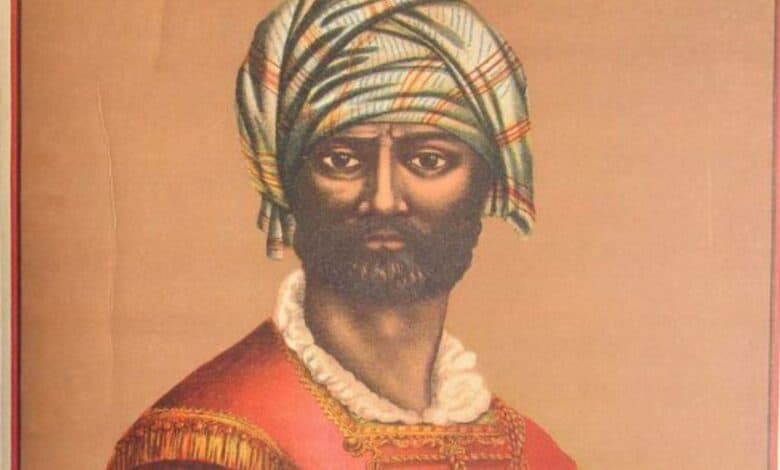
Tag Archives: Tipu Sultan – Freedom Fighter of India

Why We Need a Book About Muslims Who Fought for India’s Freedom

Mumbai, INDIA :

Can a stable and just democracy flourish on foundations of wilful amnesia and erasure?
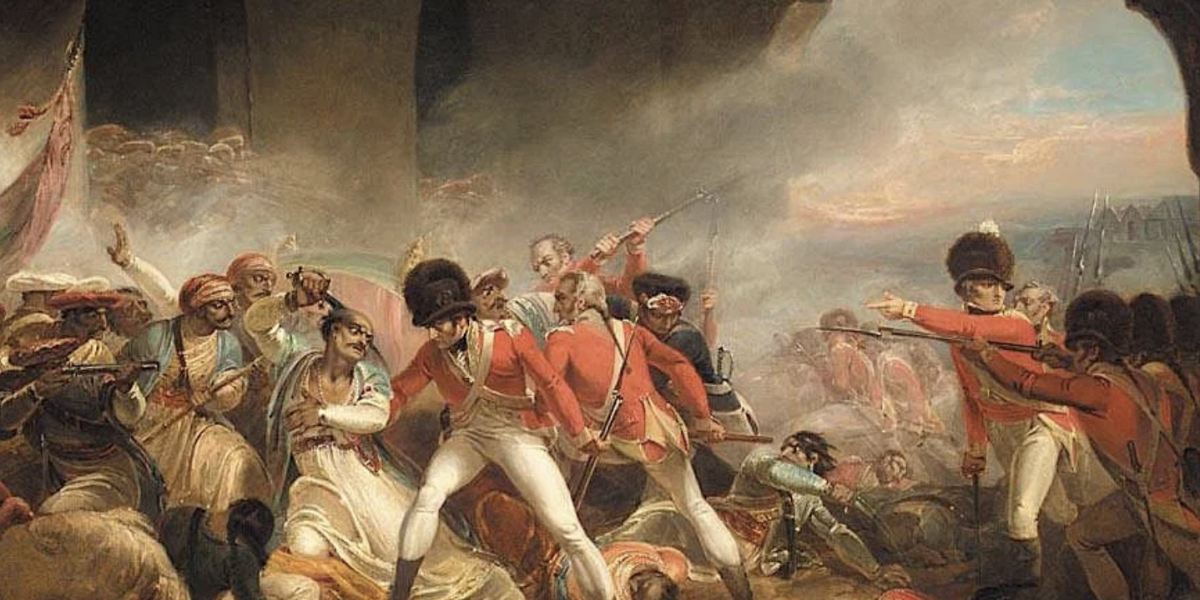
A c. 1800 painting showing the last stand of Tipu Sultan, ruler of Mysore in 1799 at the end of the Anglo-Mysore Wars with the East India Company. Photo: Henry Singleton/Public domain.

Many will ask why a book about Muslims who fought for India’s freedom? There’s no answer to such questions except another question. Had we been better memory keepers as a nation, could we have avoided the peak disinformation and stupidity which normalises reviling ordinary Muslims as outsiders, infiltrator and insurgents? 

Muslim Freedom Fighters of India is a two-volume biographical compilation by Salim Khan on less-known, mostly forgotten and hardly known Muslim figures. The books aim to clear the fog around Muslim freedom fighters whose names are heard of without them being extensively known and this requires us to understand why this fog exists. Written in an extremely readable and accessible format, these biographical accounts embed the historical figures in the context of their times, responding to unprecedented events with foresight, clarity and conviction that sealed their fate and shaped and the nation’s destiny.

 Whether we are reading about Generals of 1857 – Bakht Khan and Khan Bahadur Khan – or the Cambridge-educated Rampur scion Mohammad Ali Juahar of Khilafat moment and his fiery mother Bi Amma, the larger questions seething beneath the stories keep rising to surface. Who does a society and nation choose to remember and celebrate? Whose memories are deemed worthy of preserving? History is always shaped by those who control archives, narratives and memorialisation and hence memory. 

Reading about Tipu’s dazzling reign through the three Anglo Mysore wars where he proved superior to British forces, I was reminded of the controversy sparked by the late Girish Karnad’s suggestion of naming the Bengaluru airport after Tipu Sultan. Karnad had said, “It is true that Tipu Sultan was not born in Bengaluru, but he was a son of this soil and a freedom fighter. Had Tipu been a Hindu, he would have achieved the status of Shivaji, and the airport would have been named after him.” I recalled Karnad because his play Dreams of Tipu Sultan echoes the same theme that this two-volume tribute to erased, obscured and deliberately unremembered historical figures echoes: that when politics lays down who should be forgotten, remembering the erased becomes a duty, an affirmation and a political act. 

It is important to clarify that this is not a compilation of eulogies but well-researched fact based account of people who had the uncommon clarity to resist colonial domination even before the nationalistic narratives took shape. That they happened to be Muslims is important today because of the distortions that have obscured and erased them. But back then when they fought and resisted, they were simply rallying for the cause of their soil and their watan. From the earliest times they understood that freedom from foreign domination required Hindus and Muslims to put up a united front as in the war of 1857, the Khilafat movement, and the period between 1919 and 1924. Back then too, traitors cut across religious lines – Jagat Seth, Mir Jafar, and Ilahi Baksh.
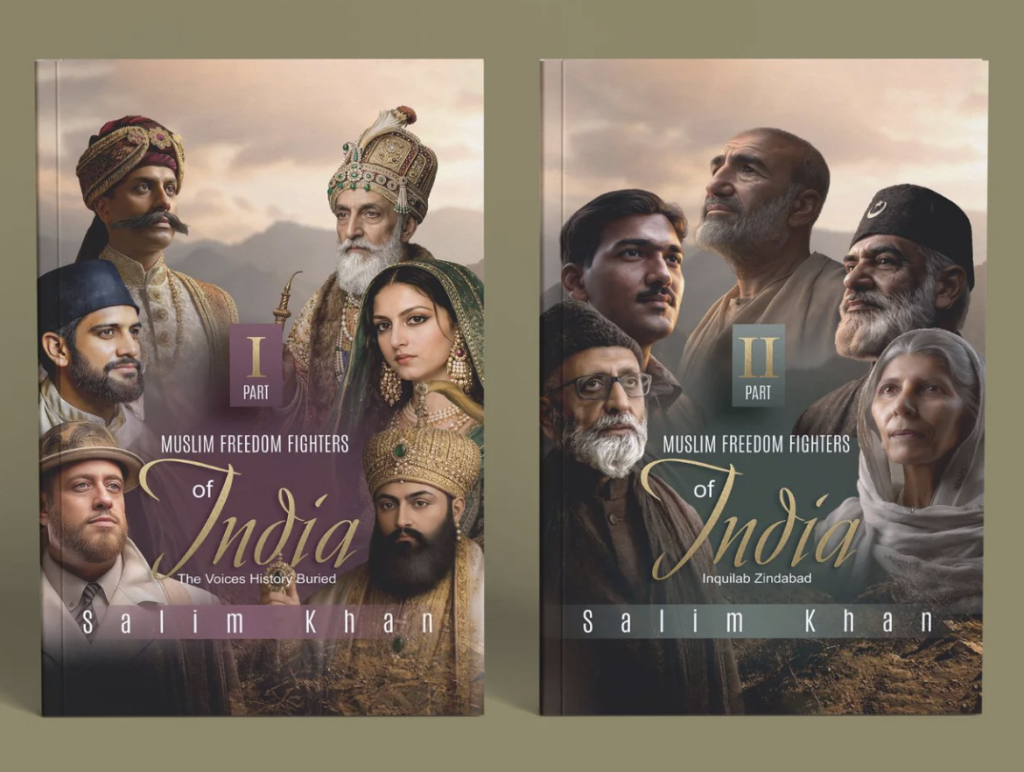
Muslim Freedom Fighters of India: Part 1 and Part 2’, Salim Khan, Qalam Aur Kaagaz Books.

From Siraj ud Daulah to Tipu to Shahzada Firoz Shah, the book shows how the fog around these personalities is not accidental but meticulously designed – initially by the colonial mind, then picked up by early nationalists and woven into simplistic narratives. The macabre dance of history further stifled Muslim voices. Cataclysmic events like the ‘end’ of the Mughal Dynasty in 1857 and the Partition in 1947 sundered clans, erased family histories, legacies crumbled with no one is around to defend and uphold them. Today, even people who don’t know history have heard of Lakshmi Bai, but many who read history may not have heard about Shahzada Firoz Shah, the Mughal Emperor’s grandson who in August 1857, led a band of armed soldiers to rally the rebels in Rohilkhand and Malwa and who fought alongside Tatia Tope and called for a united Hindu-Muslim front against the Company. 

The British understood the dangerous potential of popular memory and subverted any potential for memorialisation of hugely influential figures. No one knows if Shahzada Firoz died in battle or escaped to West Asia. The Maulavi Ahmadulla of Faizabad whose authority and fearlessness scared the British so much that they kept a reward on his head, was likewise interred in an unmarked grave. Knowing that even his memory could become a node to unite the rebels, the British saw to it that no commemoration was permitted or possible. Zafar, the last Mughal was exiled to Rangoon for the same reasons.

In her book, India, 5,000 years of history on the subcontinent, Audrey Truschke, elucidates how Muslim rulers like Nawab Siraj ud Daulah and Tipu Sultan to Zafar felt a responsibility for their subjects no matter what their religion. For example, Siraj ud Daulah actively intervened in times of famines and drought in Bengal. But after the British took over they did nothing to alleviate human suffering, so that 20% of Bengal’s population died in the famine of 1768 and the small-pox epidemic of 1769-70 following it. This had never happened during earlier episodes of failed harvests. Truschke says, British historians initiated the custom of categorising Indian rulers as tyrannical, effete and incompetent, reducing them to their religion and writing in terms of Hindu rulers and Muslim rulers. The British needed to demonise Muslim rulers who were their immediate predecessors in subcontinent so that they might look good by comparison, Truschke notes. It was a part of the colonial propaganda.

Another pattern Salim Khan’s compilation brings out is that from mid-18th century onwards, the first responders and the most committed crusaders resisting colonial domination – the kings, queens, princes, preachers, noblemen – were Muslims. Not only because the British had wrested from them the power they had wielded for centuries (howsoever fragmented or diluted it may have become); but also, because they were looked upon as leaders. In Awadh, for example, the Shia elite took it as their moral-ethical duty (see Chapter 7, volume I: Shia Ullema and Noblemen of Awadh

Even in the 20th century, Muslim freedom fighters like Hasrat Mohani of the Inquilaab Zindabad fame and Asfaqullah Khan of the Kakori conspiracy who was an icon for Bhagat Singh, remain in the shadows, seen only in a hazy half-light. Were their contributions any less or only less remembered? One of the most important projects post-Independence should have been to restore memory and affirmation to those whom the British put on the wrong side of history, no matter what their religion or caste. But we know this is not what happened.

Since the arrival of the political controversy over Tipu Sultan, we have entered in an era of deliberate distortion of history. The larger question that these accounts refrain from asking but that jumps to any thinking person’s mind is this: can a stable and just democracy flourish on foundations of wilful amnesia and erasure? Should the memory of Muslim freedom fighters be kept only by the Muslims? The heritage and memory of Indian Muslims needs to be reclaimed by them. But equally, these volumes are required reading for the casually miseducated, hopelessly disinformed or simply ignorant Hindus who have been stupefied into denying and distorting their composite history.

Varsha Tiwary is a Delhi-based writer and translator. She has recently published 1990, Aramganj a translation of the best-selling Hindi novel Rambhakt Rangbaz.
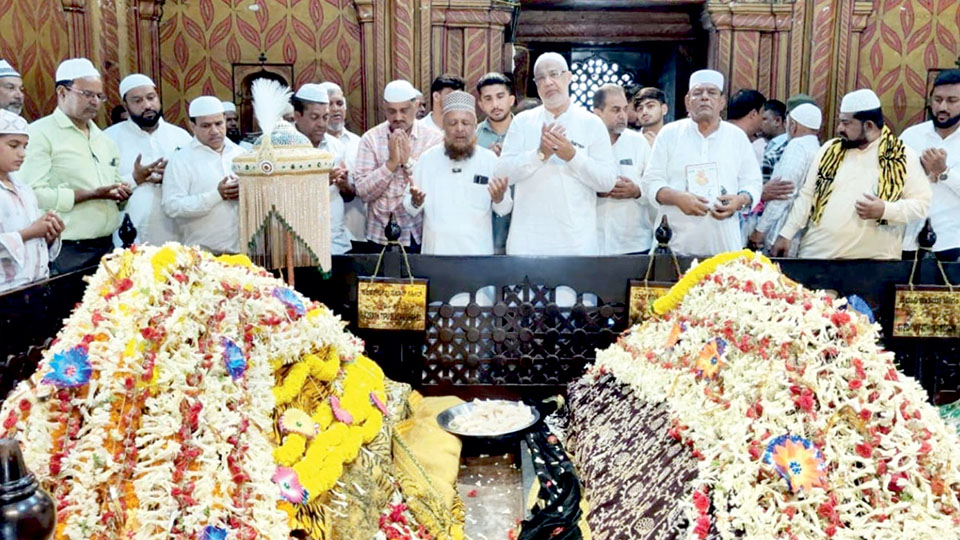
Tipu Sultan Martyr’s Day observed

Srirangapatna (Mysuru District), KARNATAKA :

MLA pays homage at Tipu Tomb, releases Urus Shariff invitation

Mysore/Mysuru:

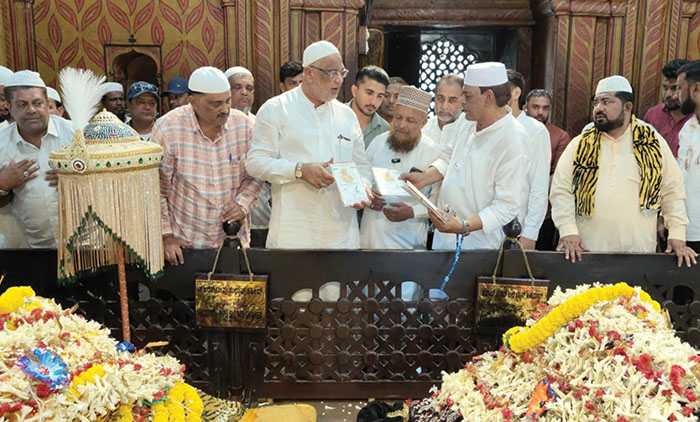
MLA Tanveer Sait, along with several others observed Tipu Sultan Martyr’s Day at a Fatha Khawni programme organised by Hazarath Tipu Sultan Shaheed Welfare and Urus Committee Secretary Afroz Pasha at Tipu Tomb (Gumbaz), Ganjam in Srirangapatna recently.

Hazarath Moulana Syed Inayathur Rehaman Razvi Saheb, Khateeb-o-Imam of Masjid Aqsa, Tipu Tomb, performed Fatha Khawni while Afroz Pasha and MLA Tanveer Sait spread the Flower Mat (Chadar) on the tombs of Tipu Sultan Shrine and his parents. Moulana Mohd. Inayath Ur Rehaman Razvi read Duwa supplications for the welfare of all.

Afroz Pasha distributed sweets (Tabruk) and felicitated the MLA by offering shawls.

Invitation, posters released

On the occasion, MLA Sait released the invitation and publicity posters of the 234th Annual Sandal Urus Shariff of Hazarath Tipu Sultan Shaheed.

The annual Sandal Urus Shariff will be celebrated on May 16 in city during which a public meeting will be held and a procession will be taken out. 

Industrialist M.F. Jamsheed, Senior Congress leader Syed Iqbal, Waseem, Radiulla Khan, Member of the College Development Council of    Government Girls’ Pre-University College Khwaja Mohammed Musheer Chishti, Syed Younus, Majeed Ahmed, Afroz  Khan and a host of devotees were present.

source: http://www.starofmysore.com / Star of Mysore / Home>News / May 08th, 2026

Urs-e-Sharieff of Hazarath Tipu Sultan Shaheed on May 16, 17

Srirangapatna, KARNATAKA :

The 234th Urs-e-Sharieff of Hazarath Tipu Sultan Shaheed, organised by Hazrath Tipu Sultan Shaheed Wakf Estate, Ganjam in Srirangapatna, will be held on May 16 and 17 at Gumbad-e-Shahi at Ganjam in Srirangapatna.

The Sandal procession will commence from Masjid-e-Ala in Srirangapatna at 3 pm on May 16 and will reach Gumbad-e-Shahi at 5 pm.

Special programmes will be held from 7 pm at Gumbad and will continue the whole night till next morning.

For details, contact Hazarath Tipu Sultan Shaheed Wakf Estate on Ph: 08236-252786 or Mob: 97390-58786, according to a press release.

source: http://www.starofmysore.com / Star of Mysore / Home>In Briefs / May 05th, 2026

Evaluating Indian Kings: Tipu Sultan Stood Against the British with Valour and Courage

Mysuru, KARNATAKA :

The half-baked propaganda of communal forces against the Tiger of Mysore is trying to divide communities

THE Tiger of Mysore (Sher-e-Mysore) Tipu Sultan often finds space in sections of the media, especially in Karnataka. There have been occasions of State-sponsored celebrations of his birth anniversary and the Bharatiya Janata Party (BJP) regularly creates obstacles to these celebrations, resulting in unnecessary ruckus. This time around, Tipu Sultan is in the news from Malegaon in Maharashtra.

The newly elected deputy mayor of Malegaon Shan-e-Hind Nihal Ahmad, put up the portrait of Tipu Sultan in her office, upsetting the Shinde group’s Shiv Sainiks and the BJP. These forces got the portrait removed with the intervention of the authorities. Some protests were also held.

Maharashtra Pradesh Congress Committee President Harshvardhan Sapkal got incensed and defended Tipu Sultan, claiming that the contribution of Tipu Sultan to Mysore is equivalent to that of Chhatrapati Shivaji Maharaj in Maharashtra.

But, Chief Minister Devendra Fadnavis did not like the idea of comparing Tipu Sultan and Shivaji Maharaj, as it was an insult to the latter. Following this absurd comment, the Congress office was pelted with stones by BJP workers and nearly seven people were injured in the ensuing mayhem.

The objection of the BJP to the statement from the Congress leader is that Tipu was a “mass murderer of Hindus” and he tried to convert Hindus to Islam. There are many other charges put against Tipu by Hindutva elements. Most of these try to project Tipu as anti-Hindu and a cruel king. This is far from the truth.

Lots of these myths are part of the communal narrative, accentuated by the British narratives, which are harsher against Tipu in particular. This is because he was one of the few rulers who fought against the British. Tipu had asked Nizam and the Peshwas to oppose the armies of the East India Company. He foresaw the dangers of British power entrenching in India.

Tipu’s administration was a mixed one, with many top officers being Hindus. Purnaiah served him as the Mir Miran (head of a department) and was crucial to his administration. Krishna Rao was his treasurer. Shamaiya Iyengar held a high-ranking ministerial position and Narsimha Iyengar held a position in the postal department. Tipu Sultan reportedly provided grants to the Sringeri Shankaracharya, including for the rebuilding of the temple and the installation of the Hindu goddess Sharada. He granted land and endowments to various temples throughout his kingdom. During his reign, the 10-day Dussehra celebrations were an integral part of the social life of Mysore.

In 1791, Maratha forces led by Raghunath Rao Patwardhan attacked and plundered the historic Sringeri Sharada Peetham, causing the Shankaracharya to flee. Upon learning of this, Tipu Sultan expressed deep anger, stating that those who committed such acts would face consequences, and promptly sent funds, gifts, and letters to restore the temple and reconsecrate the idol. The raid was part of the Third Anglo-Mysore War, during which Maratha forces caused significant destruction to the temple complex, including killing or wounding people and looting property.

Tipu Sultan, who frequently interacted with the Sringeri Jagadguru and addressed him with high respect, immediately ordered the Mysore administration to assist in the restoration, demonstrating his patronage of certain Hindu institutions. Evidence of this restoration is found in several letters in Kannada, preserved in the Sringeri monastery records, where Tipu requested the Jagadguru to pray for the prosperity of his kingdom.

Tipu Sultan was a staunch opponent of the British. There is an accusation against him that he persecuted some Hindu and Christian communities. The reason for this persecution, however, was purely political, not religious. About these persecutions, historian Kate Brittlebank says that “This was not a religious policy but one of chastisement”. The communities targeted by him were seen as disloyal to the State.

The communities Tipu targeted did not belong only to the Hindu stream. He also acted against some Muslim communities, like the Mahdavis. The reason was that these communities were supporting the British and were employed as horsemen in the East India Company’s armies. Another historian, Susan Bayly, says that Tipu Sultan’s attack on Hindus and Christians outside his state is to be seen on political grounds, as at the same time he had developed close relations with these communities within Mysore.

Sarfaraz Shaikh, in his book Sultan-E-Khudad has reproduced the ‘Manifesto of Tipu Sultan’ in which he declares that he would not discriminate on religious grounds and would protect his empire until his last breath. He had a great interest in rocket technology. This finds appreciative mention in Dr APJ Abdul Kalam’s book, Wings of Fire.

It is interesting to note that in the Rashtriya Swayamsevak Sangh’s series for children on Indian history, they had published a book on Tipu in the 1970s. BJP’s Yeddyurappa had adorned Tipu’s headgear to solicit votes in the 2010 elections in Karnataka. Then President, Ramnath Kovind, sent a eulogising message on the occasion of Tipu Jayanti (2017). He has an RSS background. He praised Tipu by saying that “Tipu Sultan died a heroic death fighting the British. He was also a pioneer in the development and use of Mysore rockets in warfare.”  Tipu – along with Rani Laxmi Bai – are also depicted as freedom fighters through drawings in Part XVI (page 144) of the original, hand-written and illustrated copy of the Indian Constitution.

Due to his policies, Tipu was popular among the people of Mysore. There are many folk songs, sung in villages, praising him. It is for this reason that one of our greatest playwrights, Girish Karnad, said that had Tipu been a Hindu, he would have the same status that Shivaji Maharaj has in Maharashtra. This is very close to what Sapkal stated, nothing extra.

This whole incident of opposing the portrait of Tipu in the Deputy Mayors’ office is one more instance of communal forces latching on to divisive politics. Kings should not be seen just by their religion; their policies towards people of different religions and people’s welfare should be the major criterion for evaluating them. Tipu stands very tall in this scale of religious tolerance. The half-baked propaganda of the communal forces is trying to divide communities.

A major tribute to Tipu was paid by Subhash Chandra Bose. He adopted Tipu’s ‘springing tiger’ as the insignia of Azad Hind Fauj, which fought against the British. The major contribution of Tipu was to forewarn the Indian rulers about the advancing threat of the East India Company, the British. It was for this that he bravely fought against the British and laid down his life in the fourth Anglo-Mysore War. The communal forces who are out to demonise Tipu belong to the ideology that did not even lift a little finger against the British rule.

source: http://www.clarionindia.net / Clarion India / Home> Opinion / by Prof Ram Punyani / February 18th, 2026

Tipu Sultan’s sons engineered the Vellore Mutiny

Srirangapatna (Mysore) KARNATAKA :

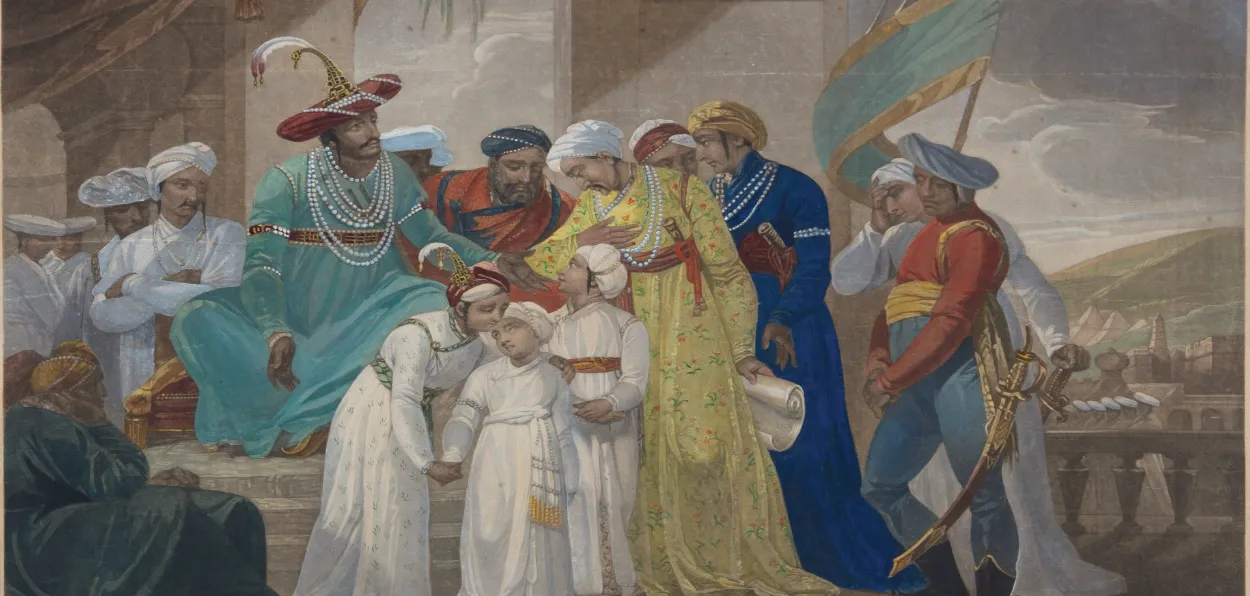
Tippoo Sultaun delivering to Gullum Alli Beg the Vakeel his sons who are taking leave of their brother previous to their departure from Seringapatam (1793) Painting by Henry Singleton

“The Christian drummers were seized, taken to the palace where Tippu’s sons were confined, and made to beat the “general” ; lights flashed in the palace, refreshments were brought out; a mob of sepoys called on the princes to place themselves at their head; Tippu’s own flag, green stripes on a red field, was nailed to the flagstaff. Prince Muizuddin (son of Tipu Sultan) ordered his horse to be saddled, and told off a party of sepoys to go and seize the principal hill fort; when that was captured and the dead body of Colonel Marriott, paymaster of stipends, brought before him, he promised he would mount his horse and ride through the native town proclaiming the restoration of the Mahommedan power.”

A Slice of History

This is the account by Colonel Alfred Keene of the night of 10 July 1806 at Vellore. The rising, popularly known as the Vellore mutiny, was a dress rehearsal of a sort of what would happen in May 1857 at Meerut.

Keene pointed out, “In the mutinies of Vellore and the greater one of 1857, two points of similarity stand out prominently. In each is the unreasoning fear of an attack on the institutions of religion and of caste; for the greased cartridges in the latter mutiny had as much to do with the outbreak as had the new head-dress in 1806, and the presence of the remnants of the Moghul Dynasty at Delhi acted in 1857 precisely as had the presence of Tippu’s family at Vellore in 1806.”

After the fall of Tipu Sultan in 1799, the English East India Company shifted his children to Vellore. In early 1806, the Commander-in-Chief ordered a new headgear and, the removal of beards, tilaks, earrings, or any mark of caste identity.

The Indian sepoys of the 2nd Battalion 4th regiment showed dissatisfaction in May 1806 and disobeyed the orders. These sepoys were tried in army court and 21 of them were found ‘guilty’. Of them, one Hindu leader and other Muslims were discharged from the duty and sentenced to receive 900 lashes each. The other 19 were not discharged but ordered  500 lashes each. The order was passed on 29 June and published to the army on 2 July 1806.

The wife of a serving English officer at Vellore, F. W. Blunt, wrote in a letter to her family in England, “Nine of the ringleaders, as they were called, were brought down to Madras and here passed publicly through the streets in irons, destined to receive the most dreadful military punishment…… The nine men in irons awaiting a most severe punishment was made use of by the sons of Tippoo, who have been kept prisoners in the Palace at Vellore since the taking of Seringapatam and served to ripen a design that had been long formed. A conspiracy was formed by the Sepoys to murder all the Europeans and take possession of that Fort.”

Tipu Sultan

On the night of 10 July 1806, Shaikh Kasim, a sepoy, led the English East India Company sepoys in starting a general massacre of the English troops.

Lt. Col. W. J. Wilson in ‘History of the Madras Army’ wrote, “The sepoys went away shortly afterward, and were heard to call out “Come out, Nawab, come out, Nawab, there is no fear.” This was supposed to be addressed to Futteh Hyder, the eldest of the four Mysore Princes.”

Of the 372 Englishmen present at Vellore, 128 were killed that night by the Indian sepoys. The English flag was replaced with the flag of Tipu Sultan, which was handed over by Moizuddin, the eldest son of Tipu. He was proclaimed the leader of the revolutionaries.

Though the immediate cause was the headgear and other orders, the revolt had been planned for a long time. Charles Macfarlane wrote, “The splendour which the sons of Tippoo were enabled, by the liberality of the Company, to keep up, attracted a continual influx of visitors, including all that came to Vellore from the countries which had once belonged to their father. Among these men were very many who had lost by the change which had taken place in Mysore, who hated the tranquillity which we had introduced into their country, and who longed for the old days of rapine and violence. It is believed that these desperadoes contributed to a regular conspiracy and facilitated the execution of the daring design.

It is said that the confederates intended that all who were brought to join in the insurrection should act upon a preconcerted plan, which had been digested and privately circulated by some of the turbulent Marawa chiefs; and that in connection with these desperadoes were some few Frenchmen, disguised as fakeers or dervishes, who went about the country inveighing everywhere against the English as robbers and tyrants. It is also stated that placards were fixed up within the mosques and Hindu temples, where Europeans never entered, to excite a general spirit of revolt among the whole native population of Madras.”

The English Government set up an enquiry commission headed by Major General Pater which submitted its report on 9 August 1806. The report said, “There are two principal causes which appear to us to have led to the mutiny. The late innovations in the dress and appearance of the sepoys, and the residence of the family of the late Tippoo Sultan at Vellore.”

Sir J. F. Cradock, the Commander-in-Chief, disagreed with these findings and argued in his submission that change in dress was a pretext and the real objective was to restore the rule of Tipu Sultan’s family. 

The Court of Directors after the investigation declared that the “immediate cause of the discontent among the sepoys was the introduction of certain innovations in their dress, which were offensive, and, as they held, degrading to them; and that the captive sons of the late Tippoo Sultan, with their adherents and abettors, took occasion, from the dissatisfaction of the sepoys, to instigate them to insurrection and revolt, with the view of effecting their liberation, and the restoration of the Mahomedan power.”

The mutiny was suppressed by noon on 10 July. Colonel Gillispie stationed at Arcot came to rescue the Englishmen at Vellore before 7 am. His forces, which also included Indian sepoys, killed more than 500 Indians in the fort within a few hours.

At least 15 English officers including, Colonel Fancourt, H.M.’s 34th regiment, commanding the garrison, Lieutenant-Colonel McKerras, Captain Willison and Lieutenants Winchip and Jolly of the 23rd, Captain Miller, Lieutenants O’Reilly, Smart, and Tichbourne of the 1st, and Lieutenants Eley and Popham of the 69th, Mr. Mann Deputy Commissary of Stores, Mr. Gill Conductor of Ordnance, Mr. Smith the Military Paymaster and Major Armstrong of the 16th N.I. were killed.

Among the captured sepoys, six were blown away with cannon guns, five were shot by firing squads, eight were hanged, and several others were transported for life. Out of the retainers of Mysore Princes, one was sentenced to death, two to transportation for life, one to imprisonment for life, and one to imprisonment for ten years. The sons of Tipu Sultan were sent to Kolkata with stricter vigilance.

Lord William Bentinck, Governor, and Sir J. F. Cradock, C-in-C, were removed from their respective offices by the Court of Directors.  

source: http://www.awazthevoice.in / Awaz, The Voice / Home> Stories / by Saquib Salim / July 10th, 2025

Rare prints from Tipu Sultan era acquired by city-based collector

Bengaluru, KARNATAKA :

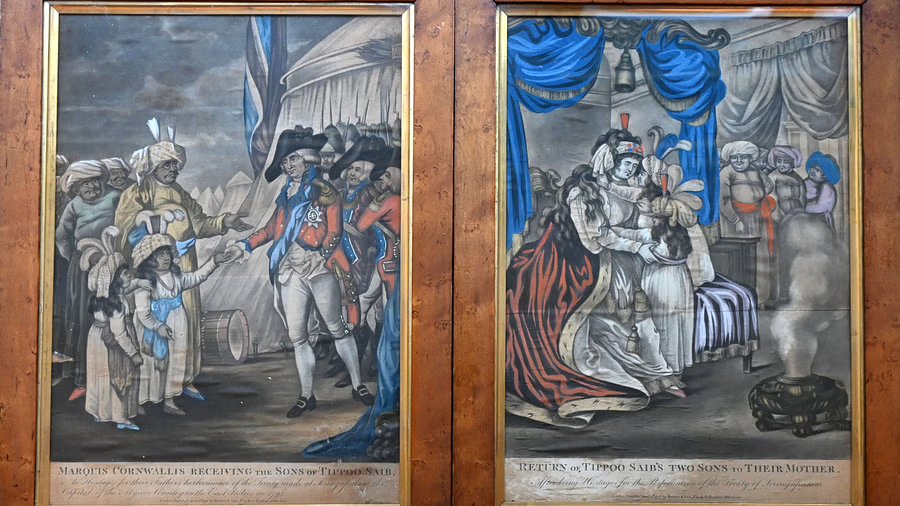
One print depicts Tipu’s two sons being taken hostage by Lord Charles Cornwallis, after the third Anglo-Mysore war in February 1792, and the other is a portrayal of their return to their mother.

The prints were made in 1796 by publisher Haines. / Credit: DH Photo/ B K Janardhan

A city-based art collector, Sunil Baboo, has recently acquired two rare prints of paintings from Tipu Sultan’s era. They capture significant moments in the history of the erstwhile Kingdom of Mysore.

One print depicts Tipu’s two sons being taken hostage by Lord Charles Cornwallis, after the third Anglo-Mysore war in February 1792, and the other is a portrayal of their return to their mother. 

History has it that Cornwallis laid out severe conditions Tipu had to adhere to in the Treaty of Seringapatam. He demanded that Tipu hand over his sons to British custody, until the king carried out all the demands he had agreed upon. 

“While there are multiple artworks depicting the moment of surrender, it is rare to come across one capturing the sons being returned to Tipu’s wife,” says 65-year-old Baboo, who has been collecting historic books, maps, aquatints and documents since 1982.

The creator of the paintings is unknown, but they were turned into prints in 1796 by publisher Haines. This was even before the defeat and death of Tipu during the fourth Anglo-Mysore war in 1799. “Many of these artists never set foot in India. They created these images based on what was described to them. While there was an artistic bent to them, it was more a way for them to document important events,” Baboo explains. Many of these prints were originally etchings and engravings that were coloured by hand, adds the Gangenahalli resident.

He learnt of the prints a few months ago, and was able to edge out some of the biggest auction houses like Bonhams, UK. “They were planning to auction them in June 2024, but I was able to procure them through my contacts,” he explains. Over the years, Baboo has built a wide network of collectors and auction houses that tip him off on new discoveries. Most of this category of prints are found in family collections of descendants of French and British soldiers of the colonial period. 

The prints, once discovered, are restored and framed. Baboo’s 16×14-inch prints came with a lot of archival tape and paper at the back of the frame. “Presumably to reinforce them. They can be kept in this condition for a long time,” he says. 

source: http://www.deccanherald.com / Deccan Herald / Home> India> Karnataka> Bengaluru / by Rashmi Rajagopal / January 24th, 2025

Sabhi ka khoon hai shamil yaha ki mitti me: Muslim Freedom Fighters of India

INDIA:

Uncover the remarkable contributions of Muslim freedom Fighters of India to fight for freedom from British colonial rule.

In present times, Indian Muslims find themselves subjected to demonization and unwarranted questioning of their patriotism. Communal elements seek to manipulate history by intentionally excluding Muslims and disseminating false propaganda against them through social media. The vital contributions and sacrifices made by Indian Muslims in the struggle for India’s freedom from British colonial rule are systematically obscured. However, a closer examination of history reveals that not only did Indian Muslims play an essential role in the freedom movement, but they also made significant sacrifices for the cause of anti-colonial nationalism.

Indian Muslims: Unveiling Their Crucial Role

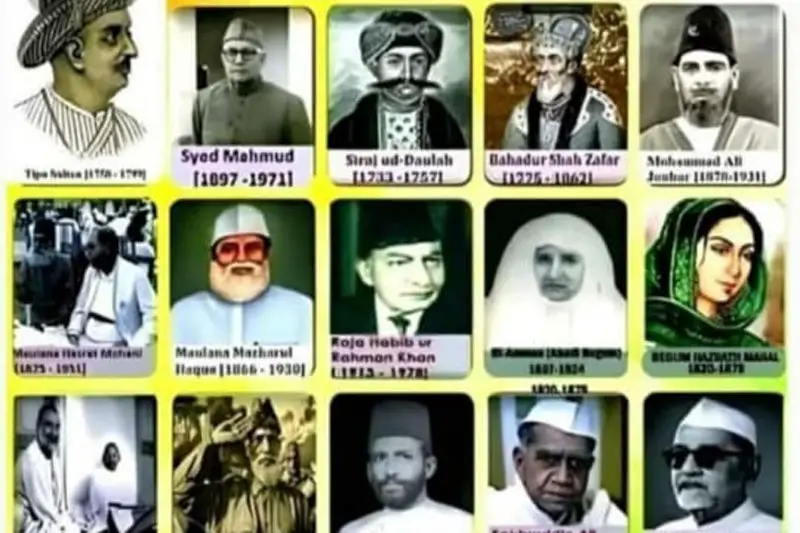
According to a report by the Milli Chronicle, the names of 95,300 freedom fighters are etched on the India Gate in Delhi, and remarkably, 61,945 of these names belong to Muslims, signifying that 65% of these brave individuals were Muslims. The significance of this statistic is eloquently captured by the renowned writer Mr. Kushwant Singh, who boldly states that the story of Indian freedom is etched in the blood of Muslims, emphasizing their disproportionately larger contribution to the struggle, considering their smaller population percentage.

Profiles of Courage: Muslim Freedom Fighters

The annals of history are adorned with the stories of Muslim freedom fighters who put their lives on the line to liberate India from the shackles of British oppression. These individuals, driven by an unwavering determination to secure their homeland’s independence, demonstrated exceptional courage and resilience.

Sultan Haidar Ali Salabat Jung: The First Freedom Fighter


   Sultan Haidar Ali, father of Tipu Sultan, pioneered the fight against British colonial forces. A secular leader, he united both Hindus and Muslims in his quest for freedom, although his efforts were eventually betrayed.

Tipu Sultan: A Trailblazer in Battle


   Son of India’s first freedom fighter Haider Ali, Tipu Sultan pioneered the use of iron-cased rockets, utilizing them effectively to defeat British forces in several historic battles over two decades.

Shaheed Ashfaqullah Khan: A Martyr’s Legacy


   Member of the Hindustan Republican Association (HRA), Ashfaqullah Khan paid the ultimate price for India’s freedom. Notable for his daring attacks on British government trains, his sacrifice remains etched in history.

Maulana Abul Kalam Azad: A Beacon of Unity


   Maulana Azad, a key leader in the anti-colonial nationalist movement, became the youngest President of the Indian National Congress. He rallied Hindus and Muslims alike against British oppression and launched Urdu Weekly Al-Hilal to expose British misrule.

Maulana Hasrat Mohani: Champion of Change

Mohani’s powerful Urdu speeches incited Indians to stand up against British rule. His unyielding spirit saw him arrested and jailed, but his impact on India’s fight for freedom remained profound.

Khan Abdul Ghaffar Khan: The Frontier Gandhi


   A pivotal figure in the Khilafat movement, Khan Abdul Ghaffar Khan established the Khudai Khitmatgars, promoting peace and unity. Jailed for 13 years by the British, his dedication was unwavering.

Sirajud Daula: Battling Against Betrayal


   The last Nawab of Bengal, Sirajud Daula, fought valiantly against British forces. Despite betrayal, he remained a symbol of resistance against British rule.

Vakkom Majeed: Courage Amidst Oppression


   Vakkom Majeed’s resilience during the Quit India movement earned him repeated jail terms, highlighting his unwavering commitment to India’s freedom.

Fazl-e-Huq Khairabadi: Life in Exile


   Sentenced to life in the notorious Kalapani jail on Andaman, Fazl-e-Huq Khairabadi continued his fight for freedom despite insurmountable odds.

Badruddin Tayabji: Founding the INC


    Badruddin Tyabji and Qamruddin Tyabji were instrumental in establishing the Indian National Congress (INC). Badruddin’s wife, Suraiya Tayabji, designed the present Indian flag.

Shah Nawaz Khan: A Triumphant Act


    Major of Azad Hind Force, Shah Nawaz Khan was the first to hoist the tricolor at the Red Fort, symbolizing India’s victorious struggle against British imperialism.

Barrister Saifuddin Kitchlew: A Voice for Justice


    Jailed for 14 years by the British for protesting against the Jallianwala Bagh massacre and the Rowlatt Acts, Kitchlew’s opposition to the two-nation theory set him apart.

Bakht Khan: A Gallant Defender


    Bakht Khan’s courageous defense against the British in Delhi, Bengal, and Lucknow showcased his unwavering dedication to India’s freedom.

Titu Mir: Bengali Rebel


    Titu Mir’s armed resistance against British colonial authorities exemplified his determination to free India from British rule.

Syed Ahmad Barelvi: Organizing Resistance


    Syed Ahmad Barelvi’s efforts in uniting native armies against the British from Delhi to Kabul showcased his strategic prowess.

Zain-ul-Abideen: INA Officer’s Patriotic Slogan


    Zain-ul-Abideen, an officer of the Indian National Army (INA), coined the iconic patriotic slogan “Jai Hind.”

Empowering Women in the Freedom Struggle

The fight for India’s freedom was not limited to men; several Muslim women also contributed significantly to the struggle.

Begum Hazrat Mahal: A Rebel Leader


   Rebelling against the British in 1857, Begum Hazrat Mahal seized control of Lucknow from British forces, showcasing her leadership and courage.

Surayya Tyabji: Designing India’s Flag


   Wife of freedom fighter Badruddin Tayyabji, Surayya Tyabji designed the Indian flag that we proudly hoist today.

Abadi Bano Begum: A Pioneer in Politics


   Abadi Bano Begum, known as Bi Amma, actively participated in politics, matching her male counterparts in the Indian National Movement. Her sons went on to become prominent leaders.

Azizan: A Warrior’s Spirit


   Azizan organized a battalion of warrior women, displaying her remarkable skill in the art of war and refusing to yield to British pressure.

A Timeless Legacy

The contributions and sacrifices of Indian Muslims in the fight against British colonialism are immeasurable. While recounting the names of every Muslim freedom fighter may be an impossible feat, their collective impact remains undeniable. The fact that many chose to remain in India underscores their deep-rooted connection to the land. Despite attempts to distort history, India will forever be the cherished home of its Muslim citizens.

Conclusion

Urdu poet Rahat Indori’s words,

“Sabhi ka khoon hai shamil yaha ki mitti me,

Kisi ke baap ka Hindustaan thodi hai,”

encapsulate the essence of Muslim Freedom Fighters of India’ unyielding commitment to their homeland. The sacrifices and contributions of Indian Muslims in the struggle for independence stand as a testament to their unwavering dedication and indomitable spirit. Their stories deserve to be acknowledged and celebrated, inspiring future generations to honor the diverse tapestry of individuals who fought for a free and united India.

source: http://www.munsifdaily.com / The Munsif Daily / Home> News> Indai> Pan India / by Munsif Web Desk / August 18th, 2023

India: Historians recall role of Muslims in freedom struggle

Coinciding 74th Independence Day on Aug. 15, scholars recollect help of Turkey to India’s national freedom struggle

Abdul Hameed Nomani, General secretary of the All India Muslim Majlis Mushawarat

New Delhi:

Celebrating country’s 74th Independence Day on Aug. 15, under the shadow of recent communal riots in capital Delhi and anti-citizenship law stir, many Indian scholars have called for recalling the role of Muslims during India’s freedom struggle.

Author and scholar Waseem Ahmed Saeed said over time, the contribution of Muslim freedom fighters in India has been forgotten.

In his book titled Kala Pani: Gumnam Mujahideen-e-Azadi 1857, Saeed said from the 1757 Battle of Plassey in Bengal, Tipu Sultan’s Seringapatam battle in South India in 1799 to the massive revolt in 1857 against the British was led by Muslims.

Saeed, who has authored a book on the subject in the Urdu language, said while India’s official history celebrates Udham Singh for killing Michael O’Dwyer, the lieutenant governor of Punjab in India, in revenge for the 1919 Jallianwala Bagh massacre in Amritsar, it does not recognize Sher Ali Afridi, who killed Lord Mayo, British viceroy and governor-general of India from 1869-1872.

Speaking to Anadolu Agency, many Muslim scholars and historians said the role of their ancestors in the freedom struggle has been overlooked.

According to Syed Jamaluddin, director of historical research projects at the Institute of Objective Studies, a think tank, there is no adequate coverage of the role of the Indian Muslims in the national movement.

“The contribution of Muslim revolutionaries, poets and writers is not known today. Similarly, little is known about the contribution of people like Ali Musliyar and Bi-Amma, who made significant contributions,” he told Anadolu Agency. He is currently editing a book on the Muslim role in India’s freedom struggle.

Saeed recalled in his book that it was the ruler of Bengal Siraj-ud-Daulah, who first fought and lost to the British in 1757, which became a cornerstone for the imperial power to colonize India.

He said that even after losing this battle, there were many rebellions led by Muslims until 1850.

Muslim revolts against British

Jamaluddin mentions the Fakir-Sannyasi rebellion, a joint revolt against colonial power by Muslim and Hindu ascetics, for preventing them from collecting religious tax from locals. It started in 1764 and continued until the 1850. He said the rebellion even spread its wings to southern India’s Madras (now Chennai) presidency.

But most prominent and popular movements that hit the British hard in the early 20th century in the subcontinent was the Reshmi-Rumaal Tehreek (Silk Cloth Movement) led by Maulana Ubaidullah Sindhi with the help of Turkey, Germany, and Afghanistan.

Speaking to Anadolu Agency, a prominent Muslim scholar Abdul Hameed Nomani said that despite his best efforts, Sindhi’s contribution has not been included in the official Indian history.

Along with an Indian prince Raja Mahender Pratap Singh, Sindhi, and Maulvi Barkatullah had established the exiled government of India in Afghanistan in 1915.

“The movement picked up around the same time when Subhash Chandra Bose [renowned Indian freedom fighter] was allying with Germany and Japan to oust the British from India. While Bose is celebrated nationwide, not much is known about Sindhi and his supporters,” said Nomani, who is also the general secretary of the All India Muslim Majlis Mushawarat, an umbrella group of prominent Muslim organizations.

It was named Silk Cloth Movement because Sindhi and other leaders used to send letters and directions to their cadres written on silk cloth.

Later, Sindhi went to Turkey and joined the country’s national struggle.

“The movement led to the formation of Indo-German-Turkish mission to encourage local tribes on the borders of Afghanistan to attack Britishers and their interests. While the key figures were arrested by the British, the movement remains a key event in the freedom history,” he added.

He said even though in 2011 the government released a postal stamp to commemorate Sindhi’s movement, there has been no vigor to record the sacrifice of Sindhi and his allies Mahmud Hasan and Husayn Ahmad.

“Only passing reference has been made about the role of Muslims in India’s national struggle,” rued Nomani.

source: http://www.aa.com.tr / Anadolu Agency / by Cheena Kapoor / August 14th, 2020

Hyder Ali: The ‘Napoleon of South India’

Devanahalli, Mysore, KARNATAKA :

Hyder Ali, who is famously known as ‘the Nepoleon of South India’ for his relentless fighting against the conspiracies of the East India Company and its henchmen and for checkmating the British ambitions of expansion in South India, was born in 1722 at Devanahalli village, Karnataka state. His father was Fateh Mohammad Ali and mother Mujidan Begum.

Though he did not have any formal learning, he received training in martial arts. Hyder Ali was sharp in intellect, strong in will, capable of  handling multiple tasks simultaneously and was brave at heart.

He had participated in Devanahalli war in 1749 as a young soldier of Mysore State. Recognizing his gallantry, Nanjaraj, the Minister of Mysore kingdom, honoured Hyder Ali with the title of ‘Khan’ and promoted him as the Chief of a battalion in the Mysore army.

They attacked Mysore several times with the help of the East India Company.

Though Hyder Ali suffered initial losses, he resisted them successfully and proved a virtual nightmare to East India Company. Even then, the British rulers provoked Hyder Ali again which led to the second Mysore war in July 1780. He went to the battlefield along with his son, Tipu Sultan.

While Hyder Ali captured the Arcot, his son Tipu defeated the East India Company troops and captured Kanjeevaram, which was about 50 miles from Madras. This sent shivers to Warren Hastings, the Governor General of East India Company.

He immediately sent additional troops from Culcutta, Madras with abundant funds under the control of his Commander General, Sir Eyre Coote. While fighting against the foreign enemy on one side, Hyder Ali and Tipu Sultan taught a befitting lesson to Malabar Nayars and chieftains, who revolted against him with the active support of Nizam of Hyderbad.

Hyder Ali, while leading his troops towards successive victories, fell ill and died in the battlefield on 7 December, 1782, near Narasingarayuni Peta village, which is now in Chitoor district of Andhra Pradesh.

source: http://www.siasat.com / The Siasat Daily / Home> Featured News / by Nihad Amani / August 22nd, 2020

Streetwise Kolkata: How Tollygunge is linked to Tipu Sultan

Kolkata, WEST BENGAL :

Decades before the birth of the city of Calcutta, the area that is now Tollygunge was a dense forest land called Russapugla with an abundance of mangrove trees.

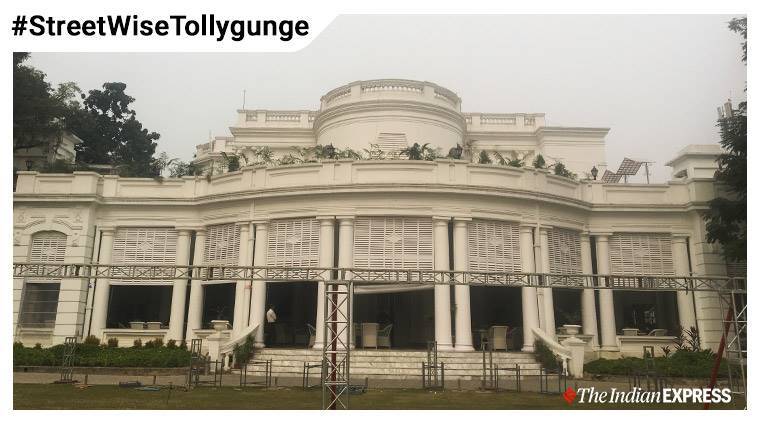
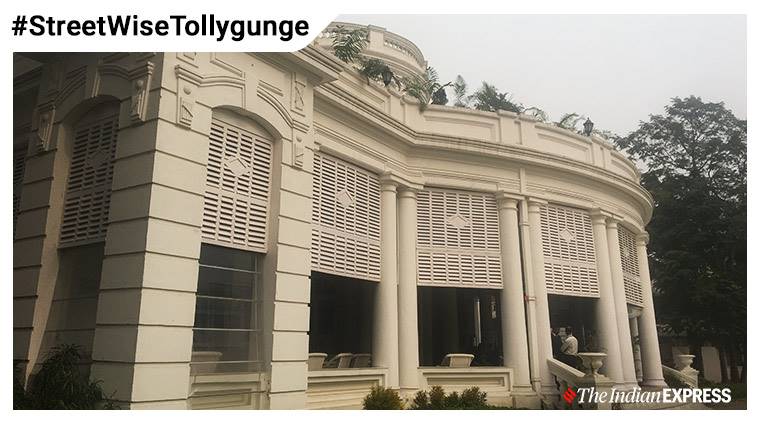
The clubhouse on the grounds of Tollygunge Club in Kolkata. The club is preparing for its New Year’s Eve party with stage equipment on its grounds. (Express photo: Neha Banka)
______________________

Most know Tollygunge as a neighbourhood in south Kolkata rather than the long stretch of road by the same name that cuts through a large swathe of the area.

Decades before the birth of the city of Calcutta, the area that is now Tollygunge was a dense forest land called Russapugla with an abundance of mangrove trees. Over the centuries, the land was cleared for settlement and urban planning but some traces of the forest can still be found in the expansive property belonging to Tollygunge Club and the Royal Calcutta Golf Club in the neighbourhood, some of the oldest social clubs in the city.

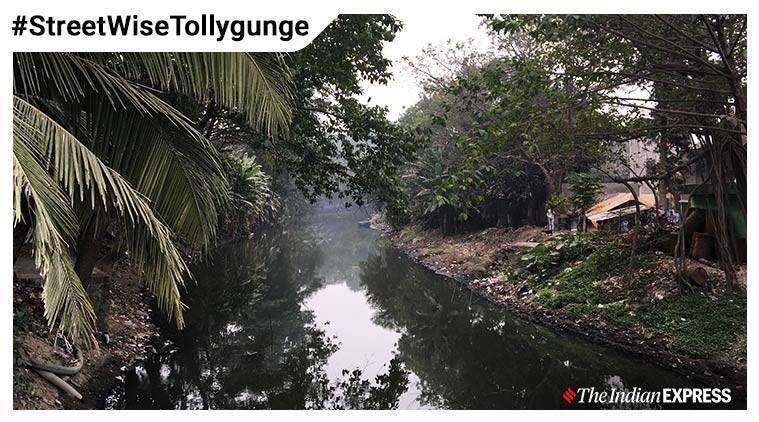
Tollygunge Club, established in 1895, derives its name from the neighbourhood of Tollygunge, that in turn got its name from William Tolly, a colonel in the British Army in 1767. Calcutta was a city of creeks, although many have been entirely or partially filled up. Today, few of those creeks remain, winding slowly across the city, trying to find their way into the Bay of Bengal, but one would have to search beneath cramped, illegal urban settlements and mounds of garbage to find them.

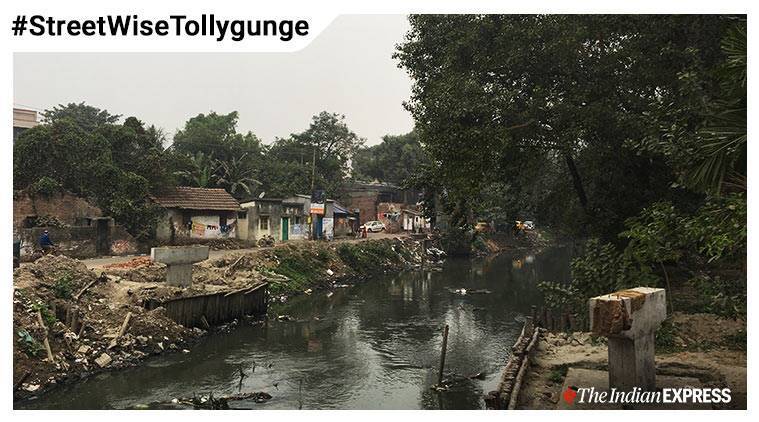
Tolly’s Nullah behind the grounds of Tollygunge Club in Kolkata. (Express photo: Neha Banka)
______________________

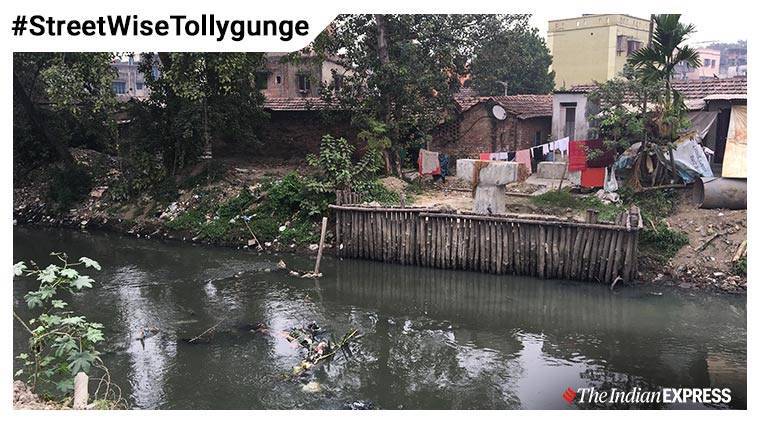
In the outer peripheries of the property that belongs to Tollygunge Club, a narrow creeks snakes past, as if conjoined to the boundaries of the club’s walls. On both banks of the creek, slums have developed over the years and garbage floats on the water, emanating a foul stench.

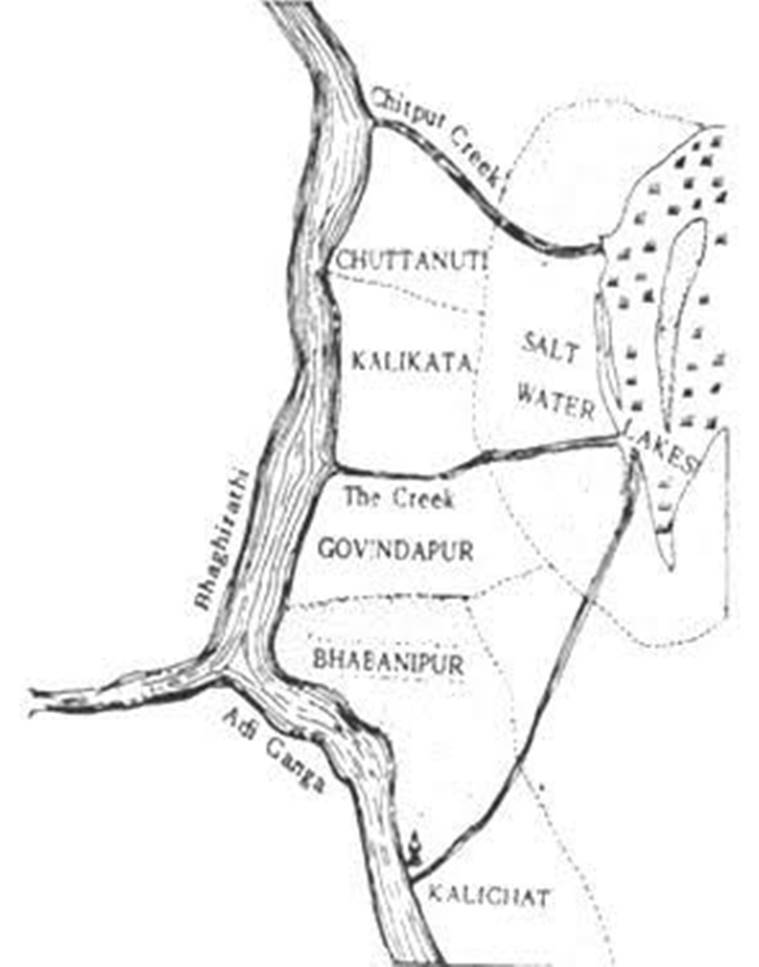
According to historian P Thankappan Nair, who has documented the city’s history extensively, this creek was originally called the Govindpur Creek. There is no historical documentation for why the creek was so named, but perhaps it acquired its name from that of the village of Govindapur, one of the three villages that went on to form the city of Calcutta. According to Nair, another name for this creek in Bengali was Adi Ganga or the original River Ganga that flows past the city.

This map is a conjecture map and shows the path of Adi Ganga. Tolly’s Canal is named ‘The Creek’ in this map and runs past Tollygunge when it was still the village of Govindapur. (Map credit: Chattopadhyay 1990/Jenia Mukherjee)
________________________

In 1775, Colonel Tolly wrote to Warren Hastings, the Governor-General of India, with a proposal of leading an excavation to connect the village of Balliaghat, now called the neighbourhood of Beliaghata, in the wetlands of the eastern fringes of the city, to the neighbourhood of Tollygunge through a waterway.

Slums have come up on both banks of Tolly’s Nullah. (Express photo: Neha Banka)
____________________

According to published letters in the Fort William-India House Correspondence Vol.7 (1773-1776), Tolly wrote to Hastings saying he can do the same on a contract with the East Indian Company or lend his services for Rs 80,000, along with a levy on tolls paid by boats passing through the creek for a period of 12 years. This plan was agreeable to the Company, and Tolly was directed to survey the land. This creek, 27 kilometres long, was then renamed Tolly’s Nullah after the colonel and opened for navigation in 1777.

After the opening of the Nullah, the neighbourhood became more developed and came to be known as Tollygunge. After Tolly’s death, his widow was unable to continue collecting the tolls and the maintenance of the waterways. The Company took over the management of the Nullah and auctioned its leasehold rights in March 1794 to an Englishman in the city, John Hooper Wilkinson. In 1804, the Bengal Government took control over the Nullah and the Collector of 24 Parganas was authorised to maintain it.

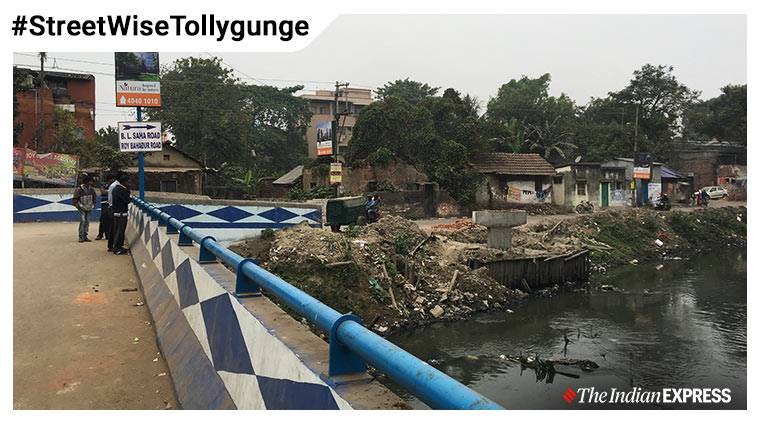
Passersby stand on a small bridge that connects the banks of Tolly’s Nullah. (Photo: Neha Banka)
__________________________

There is no document to independently verify this fact, but according to the Tollygunge Club archives, the premises of the club was originally an indigo plantation home of Richard Johnson, a merchant in the East India Company, set up in 1781.

Around 1806, the British dispatched Tipu Sultan’s family to Calcutta and gave them a living allowance. Tipu Sultan’s son Ghulam Mohammed Shah purchased the plantation grounds from Johnson to be used as a residence and the family spent a considerable amount of time in the neighbourhood.

After the family’s fortunes changed, they sold some portions of the plantation and leased out other sections to William Dixon Cruickshank, a Scottish banker, who was looking to build a sports club for the British that would also allow residential facilities and provide space for the British to socialise.

After the fortunes of Tipu Sultan’s family changed, they sold some portions of the plantation and leased out other sections to William Dixon Cruickshank, who was looking to build a sports
club for the British. (Express photo: Neha Banka)
___________________

Over time, Tipu Sultan’s family divested complete control of the estate and the lands came under the direct control of the Tollygunge Club, a name that the institution acquired because of the neighbourhood it was located in and because of the location of the creek that runs just behind its premises.

Over the decades, most of the open spaces in the club were converted into an 18-hole golf course and the forest land was cleared to make space for other structures and facilities inside the club premises.

Today, there are no signboards that indicate the location of the Tolly Nullah in the neighbourhood of Tollygunge. Haphazard modern construction has changed the facade of Tollygunge and to find the nullah, one would have to engage in a self-conducted walking tour using an old map of the city for guidance.

An offshoot of the main road in Tollygunge, a narrow lane, through which only one vehicle can pass at a time, is the only way to access the nullah these days. Slums occupy both banks of the waterway and an overwhelming sense of garbage permeates all around. Tollygunge Club itself has changed over the decades and its history can only be found in pockets.

Haphazard modern construction has changed the facade of Tollygunge and to find the nullah, one would have to engage in a self-conducted walking tour using an old map of the city for guidance. (Express photo: Neha Banka)
______________________

Although most of the dense forest has been cleared away over the years, jackals still roam its greens in the darkness of dusk and late into the night. On any given day, one can spot diverse species of birds on the club grounds, like kingfishers and cattle egret. Few city residents know of how the institution and its neighbourhood got its name and perhaps even fewer know of the existence of the waterway that lies beyond the high walls of the club.

source: http://www.indianexpress.com / The Indian Express / Home> Cities> Kolkata / by Neha Banka / Kolkata , December 27th, 2019