Valanchery Munnakkal (Malappuram District), KERALA /Aligarh, UTTAR PRADESH :
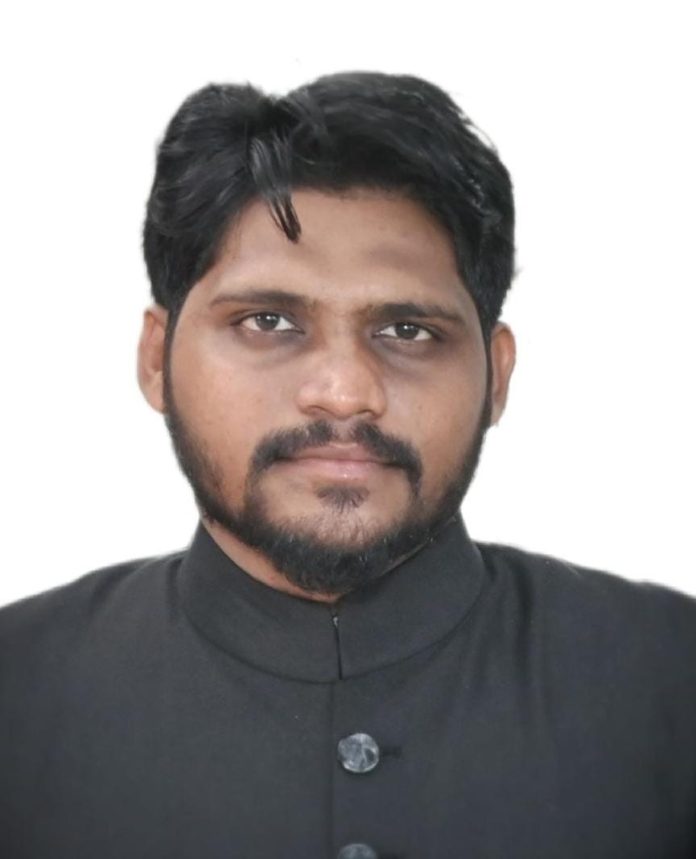
Dr Munawar Hanih, an ICSSR post-doctoral researcher under the mentorship of Professor T.N. Satheesan, Dean, Faculty of Arts, Aligarh Muslim University, has been selected for the 2023 Mahakavi Moinkutty Vaidyar Mappila Kala Akademi Literary Award
Aligarh:
Dr Munawar Hanih, an ICSSR post-doctoral researcher under the mentorship of Professor T.N. Satheesan, Dean, Faculty of Arts, Aligarh Muslim University, has been selected for the 2023 Mahakavi Moinkutty Vaidyar Mappila Kala Akademi Literary Award, instituted by the Mahakavi Moinkutty Vaidyar Smarakam under the Department of Culture, Government of Kerala.
He is being honoured for his scholarly work Malayala Sufi Kavitha, a significant contribution to the study of Mappila literature and arts.
The award will be presented at a ceremony in September 2025.
Dr Hanih holds an MA and PhD in Malayalam from AMU’s Department of Modern Indian Languages and has served as Assistant Professor of Malayalam at Sir Syed College, Taliparamba, Kerala.
source: http://www.radiancenews.com / Radiance News / Home> Pride of the Nation> Awards / by Radiance News Bureau / August 14th, 2025
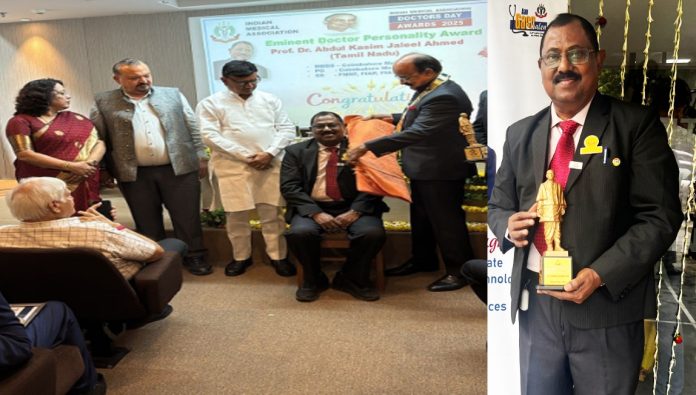
Yet another feather in the cap of paediatrician Dr Abdul Kasim Jaleel Ahamed as he was honoured with ‘Eminent Doctor Personality Award’ for the year 2025 at an event held at Indian Medical Association (IMA) headquartered in New Delhi. The occasion was during National Doctors Day
“Medicine cures diseases but only doctors can cure patients.” This thought-provoking quote of Swiss psychiatrist, psychotherapist, and psychologist Carl Gustav Jung is relevant in the context of noted paediatrician from Coimbatore Dr Abdul Kasim Jaleel Ahamed as he was honoured with ‘Eminent Doctor Personality Award’ for the year 2025 at an event held at Indian Medical Association (IMA) headquartered in New Delhi on the National Doctors Day event.
Indian Medical Association (IMA), the world’s largest association of doctors with over 4 lakh members and 1,800 branches across the country, held its prestigious national award ceremony in the nation’s capital on July 14, wherein scores of medical professionals in different categories were recognised with the honour by Chief Guest Dr Jitendra Goyal, Union Minister of Science and Technology besides the Guest of Honour Dr Anil Goyal, MLA from Delhi.
With over four decades of dedicated service, Dr Jaleel Ahamed carved a niche for himself in treating children at his Cloud One Smart Clinic at West Ponnurangam Road in RS Puram neighbourhood in Coimbatore city. No gainsaying the fact that the child specialist earned name and fame among the residents within and off the city. Noteworthy to mention, he earlier served as Chief Paediatrician and Neonatologist at Sri Ramakrishna Hospital for 34 years.
It is pertinent to point out that Holy Quran researcher, noted speaker, author and publisher Dr Ameer Althaf, in his book ‘Pettagam’ released in 2013 which is a compilation of 300 years history of Coimbatore Muslims, has a separate chapter on Dr A K Jaleel Ahamed.
He married the daughter of Sakkarai Mohamed Rowther, a philanthropist, who spared a considerable amount for charity even while running his transport company in the 1970s. Those were the days when the less privileged and poor waited in front of Jungle Beer Dargah, Jamesha Dargah and Five Corner mosque during Jumma Ki Raat and on Jumma day.
Dr Jaleel Ahamed taking a cue from his father-in-law is doing his mite continuing his tradition in reaching out to the poor and the needy. Not to be left behind, Dr Jaleel’s service to mankind fetched him accolades from several quarters from far and near while not to speak of the recent IMA Delhi’s ‘Eminent Doctor Personality Award’ at a function organised in connection with ‘National Doctors Day’.
Making heads turn, Dr Jaleel treated an 800-gram test-tube baby claimed to be the country’s first while serving at Sri Ramakrishna Hospital as Chief Paediatrician & Neonatologist, which was the talk of the town then. Interestingly, the baby whom he had treated grew to become a graduate bringing pride to the paediatrician for his noble gesture. This particular incident finds a place in the Pettagam book.
Significantly, he was instrumental in donning the role of Organising ChairPerson – State Neocon 2007 and 2014, Organising Committee Ooty Pedicon (State IAP Conference 2005), Organising Committee , Kongu Pedicon (State IAP Conference 2017 Coimbatore, Organising ChairPerson – South Neocon 2018 in Chennai besides Organising Chairperson – State Neocon 2019 in Madurai, Organised Various CME and Neonatal and Paediatric Workshops in Coimbatore and was State & South Zone Coordinator for IAP Presidential Action Plans.
To his credit, he has numerous awards, including Sr Paediatrician Award, IAPTNSC Senior Neonatologist Award, NNFTN Academic Excellence Award, IMA Community Service Award UG, PG at Coimbatore Medical College during 1976 to 1981,1983-1985 besides Fellowship in Neonatology & Paediatric medicine.
Moreover, he had attended various International, National and State level conferences, workshops, CME programmes in Neonatology at Germany, Norway, Singapore, Italy, UK, South Africa, Dubai, Malaysia, Netherland, Athens, and Alexandria.
Adding more to this, Dr Jaleel said that he was part of the International vaccine summit during 2004 at Thailand and submitted various papers, presentations in paediatrics and neonatology and was selected as a special invitee to attend surfactant replacement therapy during 2006, 2007 in Norway (Oslo), and Italy (Ancona) while not speak of his participation at ESPGHAN summit held in UK, Czech Republic., Geneva, Scotland Visited Marburg, Germany as an observer in neonatology and paediatric nephrology during 2005.
He obtained observer fellowship in neonatology during 2012 at Texas Children’s Hospital USA. The list is endless as he is armed with many recognitions across the globe.
Radiance takes pride in felicitating Dr Jaleel Ahamed for the IMA honour for his dedicated service to the needy.
[The author is former Indian Express and Deccan Chronicle chief]
source: http://www.radiancenews.com / Radiance News / Home> Focus> Pride of the Nation> Awards / by M Rafi Ahmed / July 22nd, 2025
The centuries-old Islamic educational centre, birthplace of the Urdu Qur’an translation, struggles to protect its legacy amid growing Hindu-led development projects.
New Delhi :
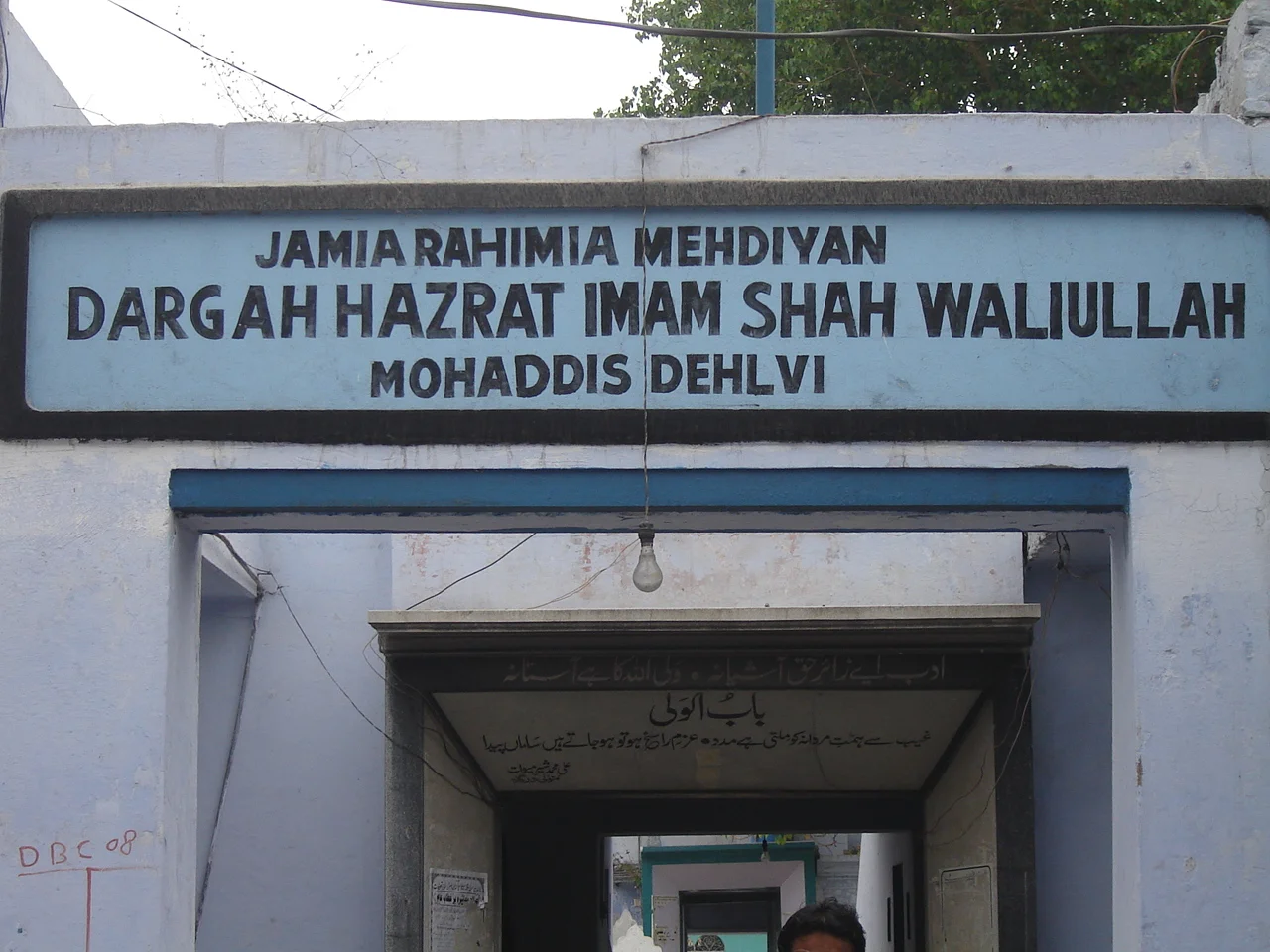
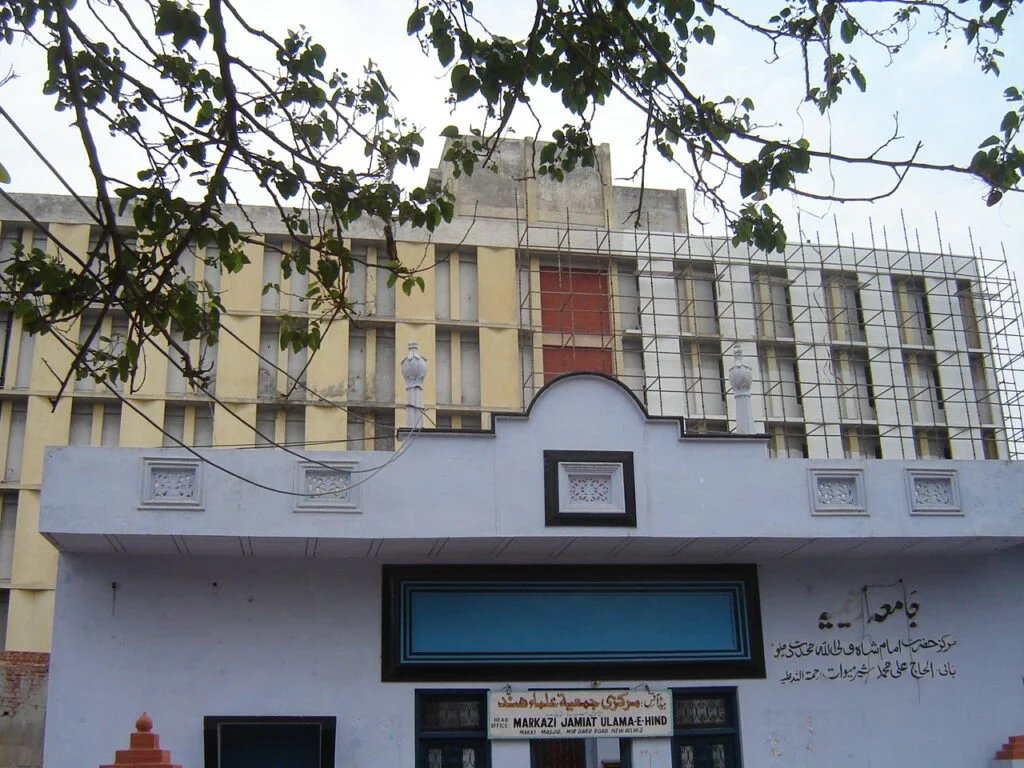
Hidden along the busy Bahadur Shah Zafar Highway, Mehdiyan — home to the revered Madrasa Rahimiya, also known as Jamia Rahimia — stands as one of Delhi’s oldest Islamic learning centres. Established by Shah Abdul Rahim, father of the famed scholar Shah Waliullah Muhaddith Dehlvi, this madrasa has for centuries served as a vital institution nurturing Islamic scholarship. However, today its existence is threatened by creeping urban development dominated by Hindu groups, threatening to erase a vital piece of Muslim heritage.
“Madrasa Rahimiya was not just a school; it was a movement to bring Muslims closer to the Qur’an’s true teachings,” explains Mufti Muhammad Sabir, a Hadith instructor at the madrasa. “But its history is being erased by those who prioritise development over our heritage.”
Madrasa Rahimiya holds a proud place in history, especially for pioneering the first Urdu translation of the Qur’an. In the late 1700s, Shah Abdul Qadir, a key scholar educated under his father and others, undertook the translation project at the Akbarabadi Mosque. This effort laid the foundation for making Islamic scripture accessible to millions of Urdu-speaking Muslims across India, who were otherwise unable to understand the original Arabic text.
“Shah Abdul Qadir’s translation was revolutionary, yet it faced strong opposition from scholars who considered translating the Qur’an sacrilegious,” says Maulana Sabir. “Despite this, his work endured and shaped generations.”
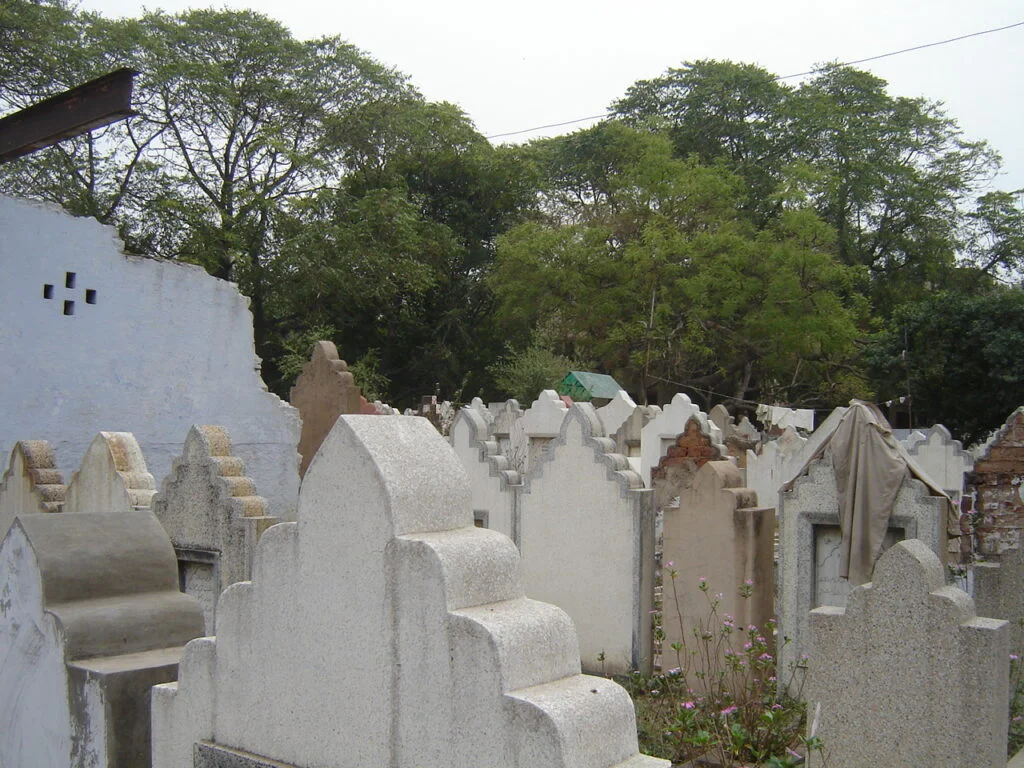
But this rich history has not been free from hardship. After the 1857 War of Independence, British colonial forces destroyed the Akbarabadi Mosque and shuttered the madrasa. The adjoining Mehdiyan cemetery, the resting place of Shah Waliullah and his family members, was drastically reduced. Historian Rana Safavi laments, “Mehdiyan was once a vast necropolis for saints and commoners alike. Now, much of it is lost to encroachment, with what remains used merely as a washing place.”
In the 1960s, Delhi’s expanding urban sprawl posed new threats. Plans to demolish Mehdiyan to build flats and houses were only halted because of the heroic resistance of Ali Muhammad, known locally as Sher-e-Mewat. “He lay down in front of bulldozers and even Pandit Nehru’s car to protect these sacred shrines,” recalls resident Bilal Ahmed. “He broke his leg but ensured our heritage survived.” Jawaharlal Nehru himself was moved by Ali Muhammad’s determination and ordered the preservation of these sites, which were later enclosed by a boundary wall.
Yet, the madrasa’s survival is once again at risk. Critics point out that the latest wave of urban planning, heavily influenced by Hindu groups, disproportionately targets Muslim heritage areas. Historian Zafar Khan asserts, “Hindu groups have long viewed places like Mehdiyan as obstacles to their vision of a ‘modern’ Delhi. This is not just about land — it’s an attempt to erase Muslim identity.”
Local Muslims feel the marginalisation acutely. “Our history is being systematically sidelined,” says Ayesha Begum, a teacher at Jamia Rahimia. “While Hindu temples receive government protection and funding, our sacred sites are neglected, ignored, or demolished.” She highlights the glaring lack of state support for the madrasa compared to the ample aid granted to Hindu religious institutions.
Despite the ongoing pressures, Madrasa Rahimiya endures as a symbol of resilience and faith. Its small mosque and student quarters continue to operate, preserving the teachings that Shah Waliullah and his predecessors established centuries ago.
“We teach the same Qur’an and Hadith that Shah Waliullah did,” says Mufti Sabir. “No matter the encroachment or neglect, that legacy will not disappear.”
The battle to save Mehdiyan reflects wider tensions in India, where Muslim cultural and religious heritage frequently confronts Hindu nationalist agendas. For now, the madrasa stands firm — a testament to Delhi’s Muslim scholars’ enduring spirit and their steadfast commitment to preserving Islamic knowledge and identity.
source: http://www.clarionindia.net / Clarion India / Home> Culture> Editor’s Pick> India / by Mohammed Bin Ismail / May 24th, 2025
With over 4,000 manuscripts and 25,000 books, Hazrat Pir Mohammad Shah Library is a sanctuary of knowledge and wisdom.
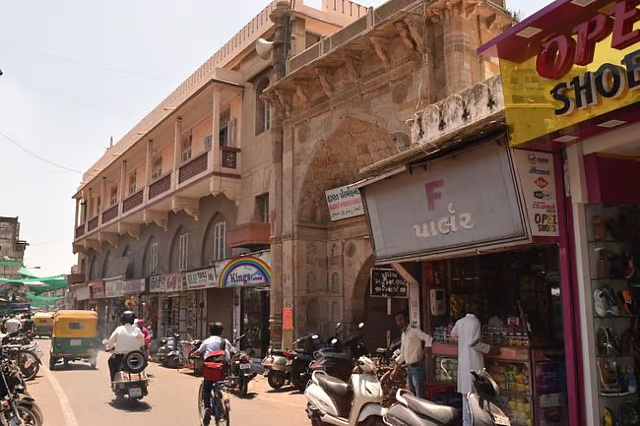
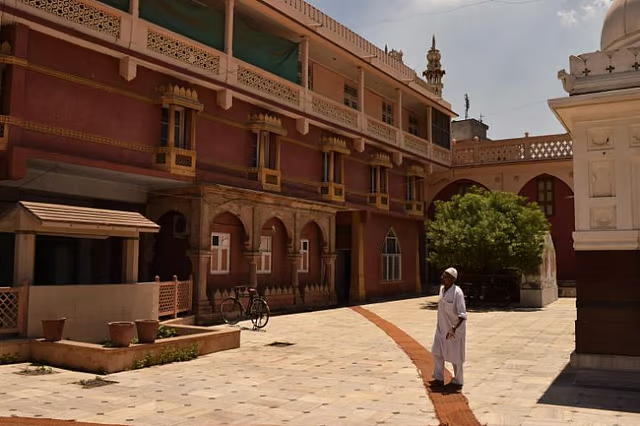
Stepping into the Hazrat Pir Mohammad Shah Library, the oldest library of the city, feels like entering a secret realm concealed within the narrow lanes of Pankora Naka, Ahmedabad. This hidden sanctuary of wisdom resides within the majestic tomb-shrine complex dedicated to the esteemed Pir Muhammad Shah.
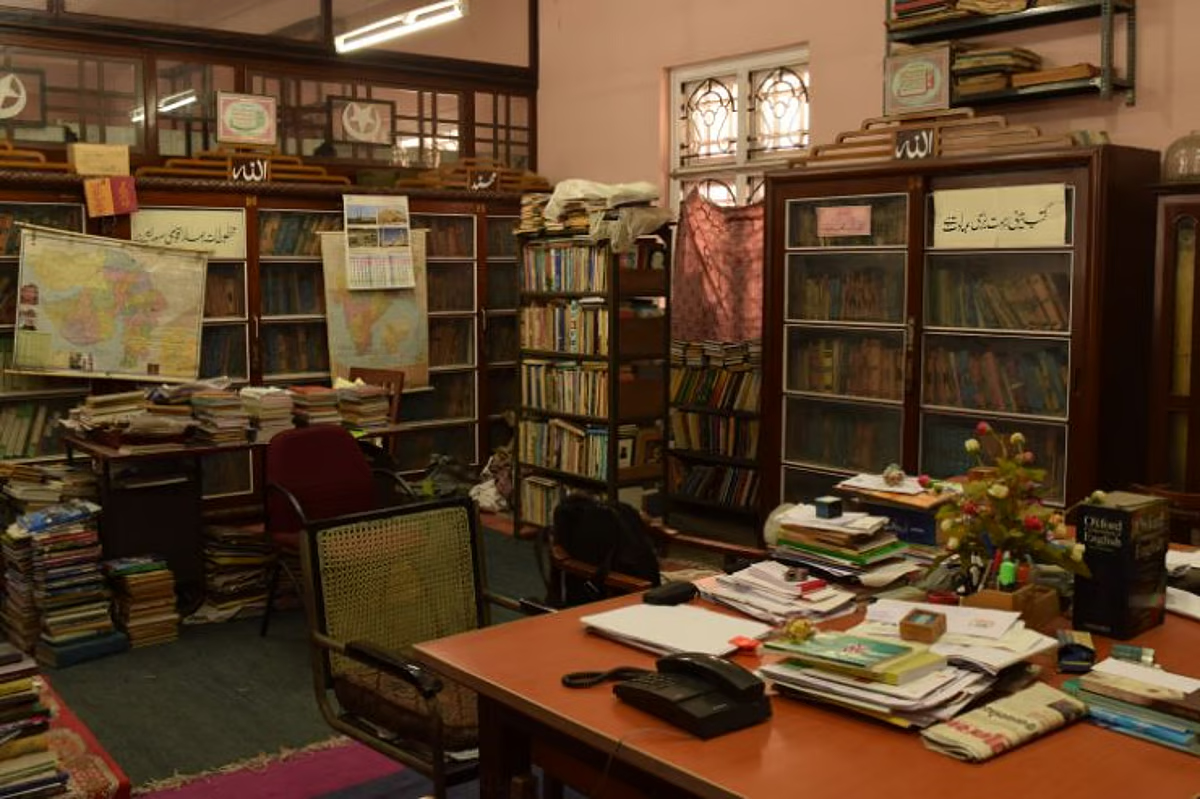
The library’s journey commenced over 250 years ago when Pir Mohammad Shah and his devoted disciples gathered a humble collection of 300 manuscripts. Now, this literary haven proudly safeguards an expansive repertoire of over 4,000 manuscripts, establishing its position as such largest collection in Western India. Moreover, it boasts an impressive assortment of over 25,000 books.
About Mohammad Shah
Let us delve deeper into the enigmatic figure of Mohammad Shah, the driving force behind the library. Born in Bijapur in 1688 AD, he embarked on a transformative journey to Mecca, where he immersed himself in the teachings of practical Sufism.
Eventually, he settled in Ahmedabad in 1711, where he would offer his daily prayers in the Jama Masjid and rest in the humble hut of a benevolent elderly woman. It is in this very location that the awe-inspiring mausoleum-mosque-library complex now stands.
A treasure trove of manuscripts and books
During his lifetime, Pir Muhammad Shah, along with his devoted disciples, amassed a treasure trove of manuscripts and books, encompassing a wealth of academic and spiritual wisdom. This invaluable collection finds its residence in the esteemed “kutubkhana”. The Pir himself was a gifted bilingual poet, penning abundant verses in Persian and Dakhani.
Today, the library stands as a testament to its illustrious past, harboring more than 4,000 manuscripts—the largest collection in Western India, alongside a rich trove of over 25,000 books. Its extensive catalog covers diverse subjects such as spirituality, Quran Knowledge, music, literature, history, geography, language, astronomy, astrology, agriculture, and more.
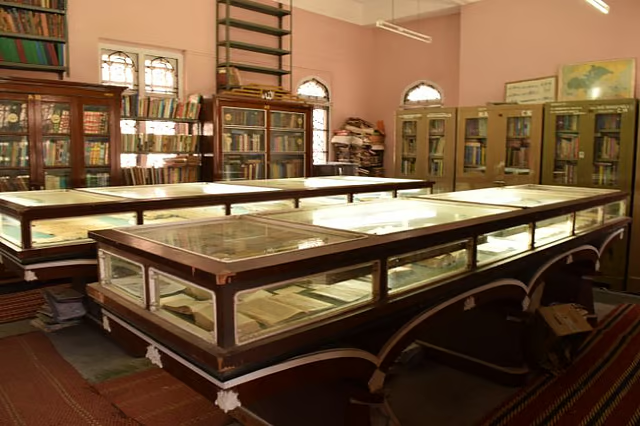
Within its hallowed halls, one can explore literature in Urdu, Gujarati, Arabi, Parsi, Hindi, and English. The library features a special chamber dedicated to ancient manuscripts, some dating back 800 years, as well as a display of Hazrat Pir Mohammad Shah’s personal belongings, carefully encased in glass to ensure their preservation.
Translations of sacred texts and unique manuscripts
The library’s treasures extend beyond its own collection, offering translations of sacred texts such as the Bible, Rigveda, and Geeta. Visitors are also privileged to behold unique manuscripts, including a handwritten Quran by the illustrious Mughal Emperor Aurangzeb.
This historic repository not only embodies a wealth of knowledge, wisdom, and heritage but also exudes an aura of serenity and tranquility. Explore the mosque, wander through the tranquil courtyard, lose yourself in the pages of ancient tomes, marvel at rare manuscripts, and surrender to the enchantment of bygone era. A captivating journey back in time awaits within these hallowed walls.
source: http://www.knocksense.com / Knock Sense / Home> Ahmedabad / by Zeal Jani / June 27th, 2023
The World Heritage City of Ahmedabad saw many revered men who silently documented the various tales the city’s monuments, structures and literature had to tell.
One such relentless pursuit was that of publisher, author and a keen student of the medieval history of Gujarat, Shahed Kalimi, who not just ran the nearly-century old Kalim Book Depot but also spent 20 years of voluntary service to set up the library at Sarkhej Roza.
A little over a month after he passed, Kalimi’s contributions to Ahmedabad’s heritage were remembered by academicians, renowned historians and heritage enthusiasts at a remembrance meeting organised in the city on Sunday.
Kalimi was the sole force behind revamping the library at one of the ASI-protected monuments of the Heritage City of Ahmedabad, Sarkhej Roza.
AS Saiyed, President of the Sarkhej Roza Committee, narrated Kalimi’s two decades of voluntary contribution at the Sarkhej Roza and lauded him for his dedication and perseverance. “Kalimi was instrumental in reviving the library at the Sarkhej Roza and setting up a publishing department at the Roza through which many books were translated and published under the aegis of the Sarkhej Roza Committee,” Saiyed said.
During his lifetime, Kalimi had translated nearly 50 books from Urdu, Persian and Arabic, into Gujarati, in a bid to bring forth the little pieces of history about Gujarat to the people here.
In fact, two of his last books – A Bird’s Eye View of Sarkhej Roza and Yaad-e-Ayyam, were released during the remembrance meet.
“Kalimi’s sole aim was to bring forth anecdotes of Gujarat’s history to the state. Being an ardent reader of history himself, he translated many books written about Gujarat and its history, Persian and Arabic to Gujarati. He has translated close to 50 works by now about various aspects of Ahmedabad and Gujarat which the state would have otherwise lost,” said Professor MH Bombaywala, curator and founder, Peer Mohammad Shah Library, one of the oldest in Ahmedabad who was present at the meeting.
Being an ardent enthusiast of medieval history of Gujarat, Kalimi turned his place of work – the Kalim Book Depot – around by diligently sourcing, procuring, even translating if needed to make history books available to people here.
Students of History and even architecture and design often frequented his book store, which was once upon a time, a fulcrum for intellectuals to gather and discuss new, radical ideas through expressions of poetry and Shayari.
The Kalim Book Depot will be a century old in 2026 and till date is known for rare books. “We have retailed the Urdu versions of Ramayana, Mahabharata and the Bhagavad Gita to people. Father used to procure a series of Urdu books from warehouses of libraries, book exhibitions, flea markets including the Gujari Bazar and wherever he travelled and patiently sorted them, to find the right kind of books for history students and later translate them,” said Mushir Kalimi, Shahed’s son.
“Father’s interest was not in the business but instead in letting the younger generation read and delve into the history about Gujarat to the people of Gujarat by translating works of authors from Persian, Arabic and Urdu languages. Therefore, if he realised someone’s interest in books, he would gift them a second book for free besides the ones they’ve bought,” said Mushir.
Kalimi was working on one of his last books just before he passed — Makbaras and Masjids of Ahmedabad. Mushir along with members of the Sarkhej Roza Committee are working towards publishing the book which will soon be out.
source: http://www.timesofindia.indiatimes.com / The Times of India / Home> News> City News> Ahmedabad News / by Niyati Parikh / TNN / March 28th, 2022
Chennai-based businessman pays homage to his deceased mother with Mughal-style funerary complex in Tiruvarur village.
A view of the marble mausoleum resembling Agra’s Taj Mahal built at Ammaiyappan in Tiruvarur. | Photo Credit: Special Arrangement
A near-replica of Agra’s Taj Mahal has been making news this week, as reports about the marble mausoleum built in Ammaiyappan village, Tiruvarur, by a son for his mother who passed away in 2020, have been going viral online.
“My four sisters and I were very young when we lost our father, a hardware merchant in Chennai. Our mother Jailani Biwi, who was just 36 then, brought us up single-handedly, and stayed by our side through thick and thin. After her demise at the age of 68 years in December 2020, we felt her presence should be an enduring one. So with my family’s consent, I decided to build this mausoleum for her on a one-acre plot in Ammaiyappan,” Amruddin Sheikh Dawood, told The Hindu .
Constructed over two years, the complex houses a mosque and madrassa (school for religious instruction), besides the grave of the deceased on 8,000 sq ft, and was built at a budget of nearly ₹5 crore.
Intricately carved trellis panels and water tanks are part of the edifice, bringing an exotic look to the structure in this rural setting.
Mr. Dawood, who is a rice merchant based out of Chennai, said that the resemblance to Taj Mahal was almost incidental. “We simply wanted a building that used elements of Mughal architecture, but the designer we consulted in Tiruchi suggested that our idea was very similar to that used in the famed monument, so we just went ahead,” he said.
“Since Taj Mahal was the inspiration, we felt that white Indian marble rather than granite, would be ideal. We sourced 80 tonnes of marble from Rajasthani quarries,” Mr. Dawood said.
North Indian artisans worked alongside local labourers to complete the building, which was formally inaugurated last week to visitors of all faiths.
Countering critics about the scope and budget of his dream project, Mr. Dawood said that the building was a symbol of the family’s love for their matriarch. “A mother’s affection is priceless, and in our family, she was the one who held us together all her life. This mausoleum is a humble gesture to show our respect for her, and also to inspire others to cherish their parents,” he said.
source: http://www.thehindu.com / The Hindu / Home> News> India> Tamil Nadu / by Nahla Nainar / June 13th, 2023
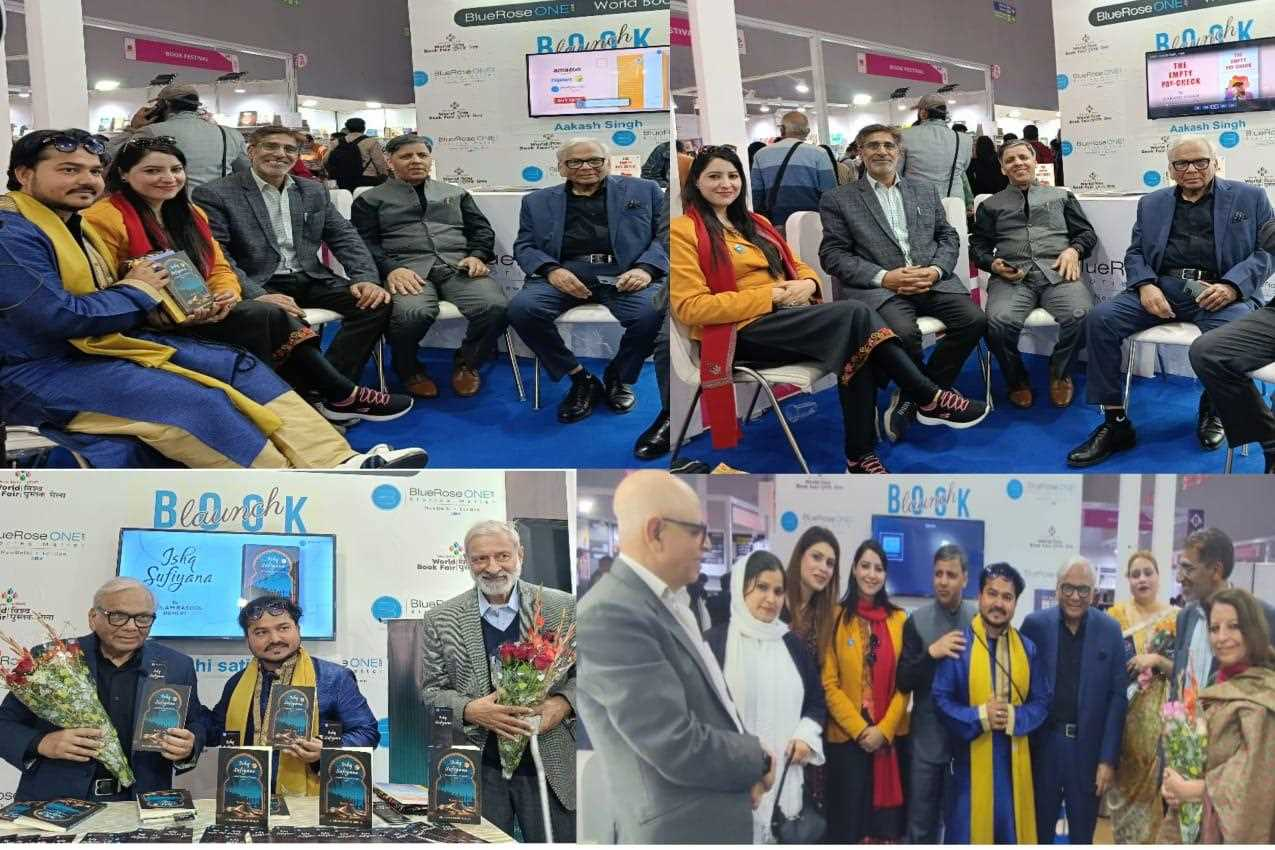
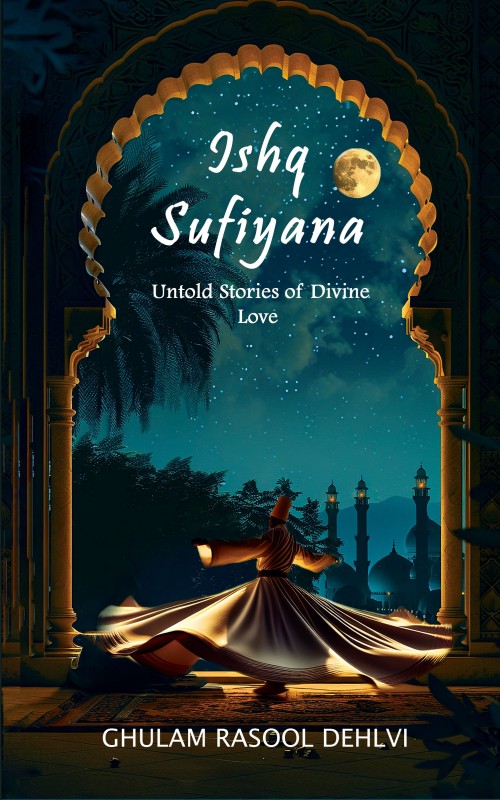
On the concluding day of the World Book Fair 2025, held in at Bharat Mandapam / Pragati Maidan New Delhi from February 1 to February 9, the book “Ishq Sufiyana: untold stories of divine love” by young writer and intellectual Ghulam Rasool Dehlvi was officially launched.
Ishq Sufiyana: Untold Stories of Divine Love / by Ghulam Rasool Dehlvi / image: blueroseone.com
The book launch ceremony took place at Stall No. 12 in Hall No. 6, with several distinguished personalities in attendance.
Notable figures present at the event included Kamlesh Sharma, former Secretary General of the Commonwealth and former Indian Ambassador to the United Nations (New York and Geneva), Padma Shri Professor Iqbal Hasnain, former Vice-Chancellor of Calicut University, Professor Madhu Khanna, former Director of the Department of Comparative Religions and Spirituality, Jamia Millia Islamia, Dr. Shahid Rasool, Dean of Academics at the Central University of Kashmir, Dr. Anita Benjamin, Founding Director of the Rashtriya Christian Mahasangh, Farooq Wani, Chief Editor of the daily Brighter Kashmir, Syed Abid Gowhar, renowned broadcaster and journalist from Jammu & Kashmir, Tasleema Akhtar, human rights activist, Tahmeena Rizvi, researcher, Dr. Rachika Arora, Syed Affan Yasawi, among others.
During this vibrant event, all the distinguished guests shared their thoughts about the book and its author. Ishq Sufiyana is a unique blend of reality and imagination. It creatively presents the real-life stories of thirty renowned Sufi saints of India.
The book among other Sufi intellects also highlights four revered saints and spiritual figures from the Kashmir Valley, Mir Syed Ali Hamdani (RA), Sheikh Noor-ud-Din Noorani (Nund Rishi) (RA), Sheikh Hamza Makhdum (RA) and Lal Ded (Lalla Arifa)
Additionally, Ishq Sufiyana includes a collection of narratives based on Sufism, ethics, and spirituality, many of which have been previously published in various newspapers and journals. The book aims to inspire seekers of all religions and spiritual traditions to dive into the ocean of divine love. The values and teachings of the personalities featured in the book remain relevant today, helping individuals grasp the depths of divine love that transcend worldly boundaries.
Ghulam Rasool Dehlvi is a well-known Sufi scholar, researcher, critic, speaker, and author based in Delhi. He is fluent in Urdu, Arabic, and Persian and is a trained scholar in Indo-Islamic traditions. He has received in-depth education and training in various spiritual orders, particularly the Naqshbandi, Qadiri, and Chishti Sufi traditions.
He has also undergone spiritual training and initiation under Turkish-origin Naqshbandi Sufi Sheikh Ashraf Effendi (Founder of Sufi Land, Germany). Pir Zia Inayat Khan (Global Head of the Inayati Chishti Sufi Order), American Sufi guide Pir Shabda Khan (Director, Sufism International, USA). He has studied under several esteemed Sufi scholars and spiritual elders in India. Recently, he was invited as a scholar-in-residence at the Bawa Muhaiyaddeen Fellowship (Philadelphia) and the Awliya Council of North America (New York, USA).
He has also served as an advisor on Islamic affairs for the National Security Council Secretariat, New Delhi.
Moreover, he has participated as a permanent representative of UN-affiliated NGOs at the United Nations Human Rights Council in Geneva, Switzerland.
The author is also an independent writer, poet, translator, and commentator.
source: http://www.brighterkashmir.com / Brighter Kashmir / Home> Breaking News / by Abid Gowhar / image of publication edited by blueroseone.com / February 12th, 2025
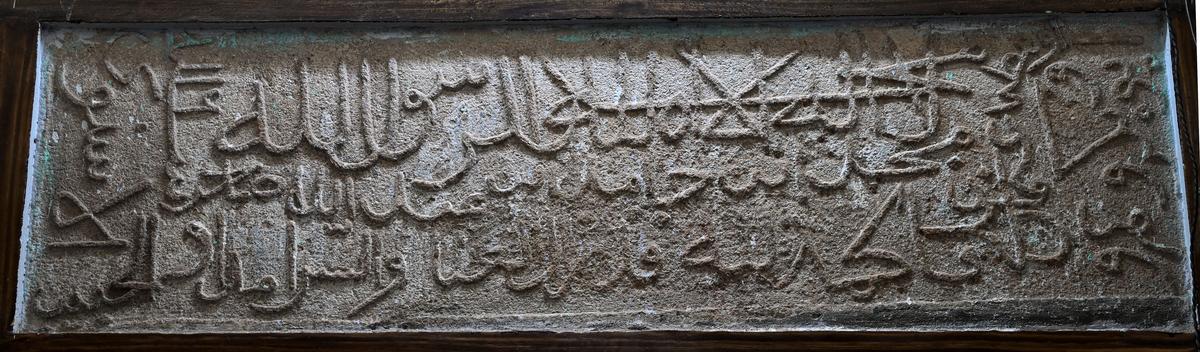
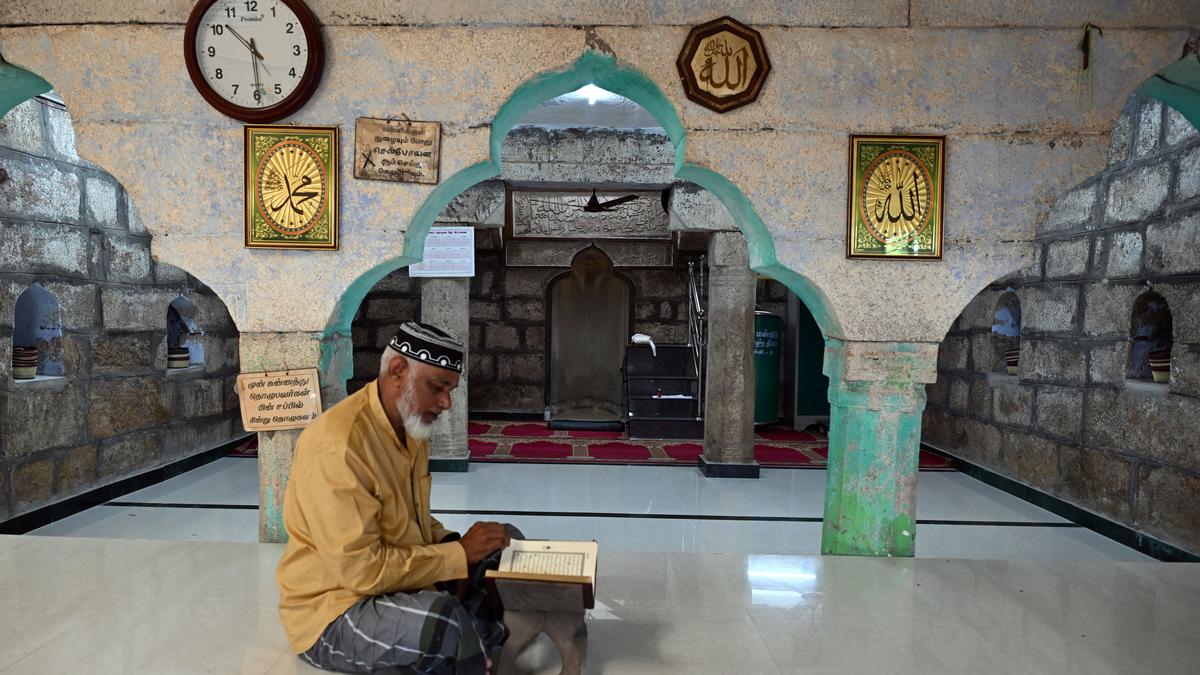
Makkah Masjid is among the oldest Islamic shrines in Tamil Nadu. An inscribed tablet dates the mosque back to the year 116 of the Al-Hijri calendar, corresponding to 734 A.D.
An inscription on the stone structure’s wall (background), dates the building to the Islamic (Hijri) year of 116, corresponding to 734 A.D. | Photo Credit: M. MOORTHY
The family of a cloth merchant has been taking care of the mosque for generations.
Tucked away next to a carpentry workshop on Tiruchi’s Fort Station Road is what is considered to be one of the oldest Islamic places of worship in Tamil Nadu: the Makkah Masjid that dates back to the year 116 of the Al-Hijri calendar, corresponding to 734 A.D.
A view of the prayer hall of Makkah Masjid in Fort Station Road, Tiruchi. It is considered to be among the oldest Islamic shrines in the country. | Photo Credit: M. MOORTHY
The family of M.G.A.R. Abdul Rahman, a cloth merchant in Tiruchi, has been taking care of the property for several generations.
The mosque’s age is validated by an inscribed stone tablet in Arabic above the ‘mihrab’ (the niche that indicates the ‘qibla’ or direction of prayer). The graves of Mohamed Ibrahim, Hazrat Haji Abdullah, Hazrat Haji Mohamed Anwar, Ahmed Kabir, and Tahira Biwi, thought to be pious Muslims of yore, are also to be found here. Two recently added minarets indicate the mosque’s presence in this quiet part of town.
Surrounded by thorny bushes
“Until the 1980s, the mosque was very different from what you see today,” A.R. Mohamed Ghouse, hereditary trustee, and one of Mr. Rahman’s 12 children, told The Hindu. “When my father was bequeathed this shrine, it was surrounded by thorny bushes and palm trees. There was no road access; people would walk single-file on a narrow pathway to reach the premises. Since this is a low-lying area, the building would be flooded during the rainy season. Before we got electricity connection in the 1980s, the place used to be lit up with oil lamps and hurricane lanterns. We have been maintaining the buildings with the help of generous donors from all faiths,” he said.
The Muslim community has had a long and harmonious presence in Tiruchi since ancient times. The Makkah Masjid is a stone’s throw away from Hazrat Thable Alam Badhusa Nathervali Dargah, the mausoleum dedicated to a nobleman of Turkish-Syrian lineage born as Sultan Mutahirruddin in 927 A.D., in Suharwardy, near Samarkand, who gave up his privileged life to spread the message of Islam in southern Asia. It is said the saint stayed on the Makkah Masjid premises before he settled in the present site.
Mosques endowed by the erstwhile Nawabs of Arcot are also an indelible part of Tiruchi’s landscape. Woraiyur, the capital of the Chola dynasty from the 2nd Century (now a suburb of Tiruchi), was already known to Arab traders. After the birth of Islam, Arab-Muslim missionaries began travelling to the region. Biographies of Muslim saints and the local traditions of the period reveal that Islam spread in the southern part of India in a largely peaceful and voluntary manner.
According to J. Raja Mohamad, historian and former curator of Pudukottai Government Museum, the Makkah Masjid could have been built for the Muslim settlement that emerged in the Tamil hinterland during the Pallava rule. “When I visited the mosque in the 1970s, it was hard to spot because of the overgrown bushes. It resembled a small ‘mandapam’ (hall), built in granite, with six Dravidian style pillars that are square at the base, octagonal in the middle, and square again. The ceiling was also made of granite slabs. Though it has become more modernised now, the trustees have retained most of the old building,” he said.
While Dravidian-style granite mosques are present elsewhere in Tamil Nadu, the Makkah Masjid may be the only shrine with a contemporary dated inscription in the State as well as in southern peninsular India, he added.
Caliphs named in inscription
In his 2004 book, Islamic Architecture in Tamil Nadu, supported by the Nehru Trust for Indian Collections at Victoria and Albert Museum, London, Mr. Mohamad writes, “According to the Arabic inscription in the rectangular granite slab above the ‘mihrab’, this mosque was built by one Mohamed Ibn Hameed Ibn Abdullah in Hijri 116 corresponding to 734 AD. The names of the four Caliphs (successors to Prophet Muhammad) — Abu Bakr, Umar, Uthman, and Ali — are also mentioned in the inscription, which has been accepted by scholars as belonging to the 8th Century AD.”
Maintaining the mosque has been a labour of love for the family trustees. “The prayers have never stopped in the Makkah Masjid even though we do not have a ‘mohalla’ (a neighbourhood congregation).
Approximately, 200 people attend the Friday prayers,” said A.R. Abdul Razak, 74, the eldest son of Rahman and the imam (who leads prayers) for the past 39 years.
The annual ‘Urs’ (festival) commemorating Mohamed Ibrahim and Tahira Bibi on the 28th day of the Islamic month of Rajab (now in its 1,329th year) at the dargah on the mosque’s campus is supported by people of many faiths, who donate generously towards the public feast.
Mr. Razak gave up his job as a ship cook in Switzerland in deference to his ailing father’s wish to officiate as the chief cleric of the mosque. “I underwent training in Quranic recitation and Islamic theology from scholars in Tiruchi before taking up this position,” he said.
An antique copy of The Holy Quran is among the oldest artefacts in the mosque.
To prevent flooding, the ground level was raised with truckloads of mud after road access was granted by Southern Railway in the 1980s. As a result, five of the eight steps of the prayer hall are now permanently below the ground. Several coats of whitewash were scrubbed away to reveal the original granite walls and inscriptions. Some of the stonework also contains fragments of Tamil writing from the 10th Century. “We have tried to maintain the premises to the best of our ability. We hope succeeding generations of our family will continue to take care of the Makkah Masjid,” said Mr. Ghouse.
source: http://www.thehindu.com / The Hindu / Home> News> India> Tamil Nadu / by Nahla Nainar / June 28th, 2024
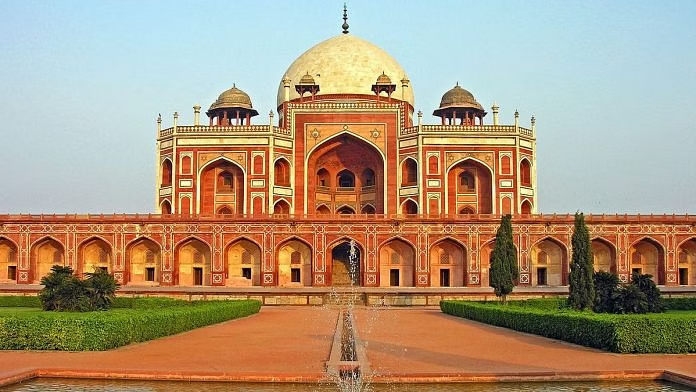
Humayun’s Tomb introduced India to the Persian style of a domed mausoleum set in the centre of a landscaped char-bagh garden.
Humayun’s Tomb, Delhi | Photo: Commons
Humayun’s first wife was a Persian from Khorasan and a daughter of Humayun’s maternal uncle. She was also called Haji Begum, probably because she had gone on the Haj to Mecca. During Humayun’s reign, she appears in history at the Battle of Chausa, where the harem was captured by Sher Khan. In all the chaos of battle, a boat carrying women capsized and her young daughter, Aqiqa Begum, was drowned. Bega Begum did not have any more children. Today she is remembered for the tomb of Humayun that she built in Delhi. After the death of her husband, when she decided to build the mausoleum, she was encouraged in her endeavour by her stepson Akbar, who was very fond of her.
Among all Humayun’s wives, Bega Begum lived a life of surprising independence. She went off to the Haj and came back with Arab craftsmen who worked at the tomb. This was much before Gulbadan Begum and Hamida Banu Begum went to Mecca during the reign of Akbar, their trip getting much more coverage in contemporary writing. Bega Begum did not join the harem in Agra but remained in Delhi, supervising the building work. An episode described by Gulbadan shows that she was a spirited woman who even spoke sharply to her husband when he did not visit her.
Among all Humayun’s wives, Bega Begum lived a life of surprising independence. She went off to the Haj and came back with Arab craftsmen who worked at the tomb. This was much before Gulbadan Begum and Hamida Banu Begum went to Mecca during the reign of Akbar, their trip getting much more coverage in contemporary writing. Bega Begum did not join the harem in Agra but remained in Delhi, supervising the building work. An episode described by Gulbadan shows that she was a spirited woman who even spoke sharply to her husband when he did not visit her.
Then Humayun replied, ‘It is a necessity laid on me to make them happy. Nevertheless, I am ashamed before them because I see them so rarely… I am an opium-eater. If there should be any delay in my comings and goings, do not be angry with me.’ However, Bega Begum was not reassured and said, ‘Your Majesty has carried matters to this point! What remedy have we? You are emperor. The excuse looked worse than the fault.’ Gulbadan ends her tale saying, ‘He made it up with her also.’
The contemporary historian Badauni writes that Akbar and Bega Begum were very close and he describes her as a ‘second mother to Akbar’. Once when the boy Akbar had a toothache, Bega Begum brought some medicine but Hamida was reluctant to give it to him. This was understandable since, in a harem that was often full of politics and jealousy, the mothers feared that their children could be poisoned. Abul Fazl quotes Akbar as saying, ‘As she knew what the state of feeling was, she [Bega Begum] in her love to me swallowed some of it without there being any order to that effect, and then rubbed the medicine on my teeth.’
Bega Begum would often travel to Agra to meet Akbar and she spent her allowance doing charity. The Jesuit Antoine de Monserrate wrote, with reluctant approval, of her good works, ‘Throughout her widowhood she devoted herself to prayer and to alms-giving. Indeed, she maintained five hundred poor people by her alms. Had she only been a Christian, hers would have been the life of a heroine.’
Bega Begum was the first of the Mughal women to become a builder, and many would follow to build mausoleums, mosques, madrasas, seminaries, bazaars and gardens. Humayun’s Tomb introduced India to the Persian style of a domed mausoleum set in the centre of a landscaped char-bagh garden, which would reach its peak with the Taj Mahal. Built near the dargah (mausoleum) of the Sufi saint Sheikh Nizamuddin Auliya, the mausoleum complex became the graveyard for many members of the dynasty. Bega Begum is buried in the mausoleum near her husband, and somewhere nearby is the grave of one of the most unfortunate princes of the dynasty – Dara Shukoh.
___________________________
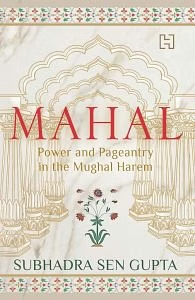
This excerpt from Mahal: Power and Pageantry in the Mughal Harem by Subhadra Sen Gupta has been published with permission from Hachette India. Hardback Rs 599.
_______________
source: http://www.theprint.in / The Print / Home> Page Turner> Book Excerpts / by Subhadra Sen Gupta / November 30th, 2019
Styangkung village, (Kargil) Ladakh , JAMMU KASHMIR & LADAKH :
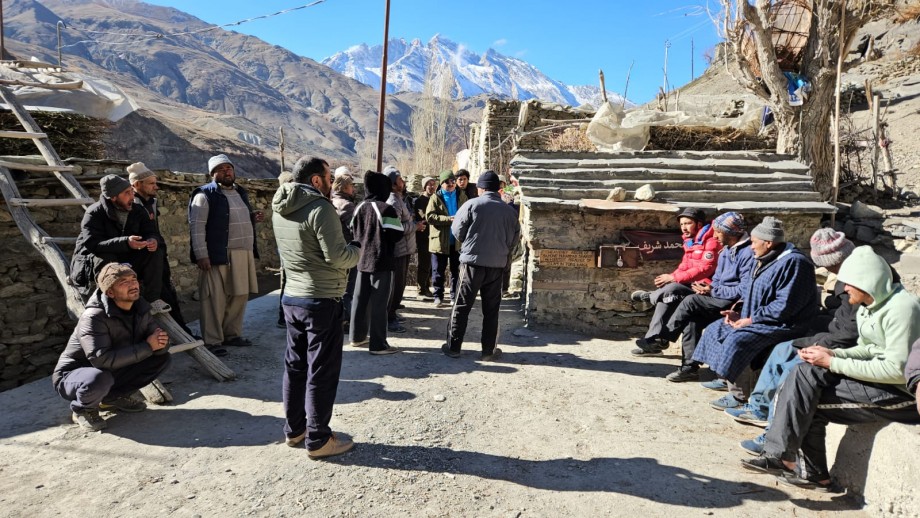
Abdul Gaffar Zargar, Chief Executive Officer of the Kargil Development Authority at Akhone Muhammad Shareef shrine at Styangkung village.
Kargil :
Embracing the preservation of cultural heritage and community empowerment, a significant initiative has been revealed for the revered shrine of Islamic preacher Akhone Muhammad Shareef in Styangkung village on December 26.
Abdul Gaffar Zargar, Chief Executive Officer of the Kargil Development Authority, announced the inclusion of the shrine in the Sustainable Development Program (SDP) for restoration, recognizing its status as a heritage site.
During his recent visit to the shrine, Zargar pledged comprehensive efforts to revive the shrine’s original essence, drawing from available historical records.
Historian Mohd Sadiq Hardassi expounded on Akhone Muhammad Shareef’s legacy and the profound contributions made by him and his descendants to Purig’s rich history. The briefing emphasised their historical influence on the region’s cultural, religious, and social dimensions.
Zargar emphasised that the village’s development will pave the way for sustainable progress among the local community. His commitment reflects a holistic approach aimed at improving livelihoods, fortifying infrastructure, and nurturing the overall well-being of the villagers, aligning with the broader vision of sustainable community growth.
The officials’ visit and subsequent commitments signify a promising stride toward safeguarding this priceless cultural legacy while nurturing comprehensive development within the Styangkung village community.
source: http://www.reachladakh.com / Reach Ladakh Bulletin / Home / by Reach Ladakh Correspondent (headline edited) / Kargil – December 27th, 2023