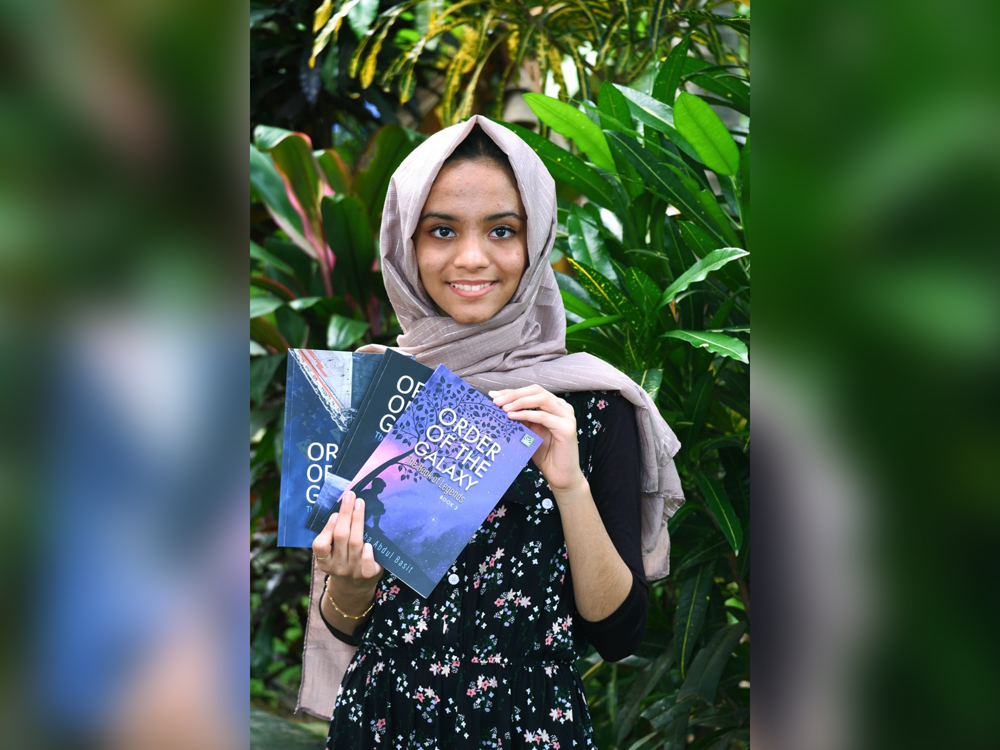
A Qatar-based 11-year-old student Laiba Abdul Basit has won the Guinness World Records as the youngest female person to publish a book series.
Laiba, hailing from the southern Indian state of Kerala, has accomplished this feat after her second book was published on August 29, 2021, while she was 10 years and 164 days old.
Laiba Abdul Basit surpassed the record of Ritaj Hussain Alhazmi of Saudi Arabia, who penned three novels before the age of 12 years 295 days.
Laiba published a three-book series called “Order of the Galaxy”, a fantasy story related to children’s fiction. The first book in this series titled “The War for The Stolen Boy” was published by Amazon and later by Lulu Online. The second book “The Snowflake of Life” was published by the Rome-based Tawasul International, while India-based Lipi Publications brought out the last book in the series, “The Book of Legends”. The second edition of her first and second books was also published by Lipi Publications.
A sixth grade student at the Olive International School, Doha, Laiba has been showing interest in reading and writing since the very young age. She started to write small stories and phrases on pieces of papers and used glue on walls of her house.
An ardent reader of fiction, science, religion, and biographies of prominent personalities, Laiba’s favourite authors include Enid Blyton, J K Rowling, Ann Frank, and Roald Dahl. Laiba inherited her passion for reading from her grandfathers, KM Abdur Raheem and Mohammed Parakkadavu, who were cultural and social activists in GCC. Support from her father Abdul Basit and mother Thasneem Mohammed has encouraged Laiba’s literary skills.
source: http://www.thepeninsulaqatar.com / The Peninsula Qatar /Home> General / July16th, 2022
There’s no stopping Jumaila Haris, a 38-year-old mother of three who is on a path-breaking journey of exploring and teaching heavy vehicle driving, reports Vishnuprasad K P.
Malappuram :
At 38, Jumaila Haris is on a mission to explore a new path. Well, not just to find a way forward in her life. Rather something that would break barriers and inspire women to unshackle themselves.
A mother of three, she recently obtained a heavy vehicle licence. Her next target is driving tanker lorries. And she wants to help fellow women improve their driving skills. The Marakkara resident has already set that process in motion in her area.
“I used to commute on private buses during my school days. The one thing that amazed me was the manner in which the mighty vehicles were controlled by the drivers. I made up my mind then that I would drive these big vehicles one day,” Jumaila says.
However, she had to wait two decades before her dream could be realised. “Some women believe marriage ends their freedom to strive towards their goals. But if you find a supportive life partner, marriage is not going to be a barrier in pursuing your dreams,” she says.
Putting her knowledge to good use, Jumaila has started helping other women gain the confidence required to take control of the steeringwheel in any condition. “Many women obtain driving licences after picking up the skills from a driving school. However, they won’t be able to drive through narrow roads, hilly areas, and roads that are chock-a-block. After completing training, they give me some fees that they are capable of providing. I am planning to help more such women,” she says.
She is set to apply with the motor vehicles department to acquire a licence to drive tanker lorries. “Driving tanker lorries will help me improve my skills further,” she says.Jumaila married Onathukkattil Haris in 2000. For the past six years, she has also been working as a volunteer at the palliative care centre under CH Centre, Marakkara.
She obtained a four-wheeler licence in 2009. “My husband was working in the Gulf. So I had to manage the family affairs mostly by myself. My driving skills helped me in many ways as I could move around on my own. I was also able to take the elderly people in my family to hospitals. Also, I doubled as a driver of the palliative centre when the regular driver went on leave,” she says.
Jumaila has three daughters, Fathima Rinsha, Fathima Gazal and Ayisha.
source: http://www.newindianexpress.com / The New Indian Express / Home> Good News / by Vishnuprasad KP, Express News Service / July 03rd, 2022
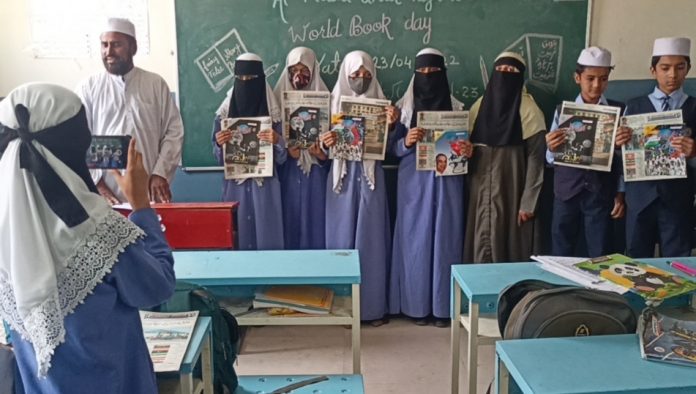
On World Book Day, the Maryam Mirza Mohilla (neighbourhood) library movement commemorated the occasion with zeal. Several book reading and distribution activities were held in city mosques and Urdu schools under the auspices of the Read & Lead Foundation.
The Foundation’s President, Mirza Abdul Qayyum Nadvi, announced the commencement of a “Book at Home, Book at Every Home” campaign at the event. He stated that the book-reading awareness campaign is only getting started because today’s young generation is losing interest in reading due to the introduction of new electronic gadgets, particularly smart phones
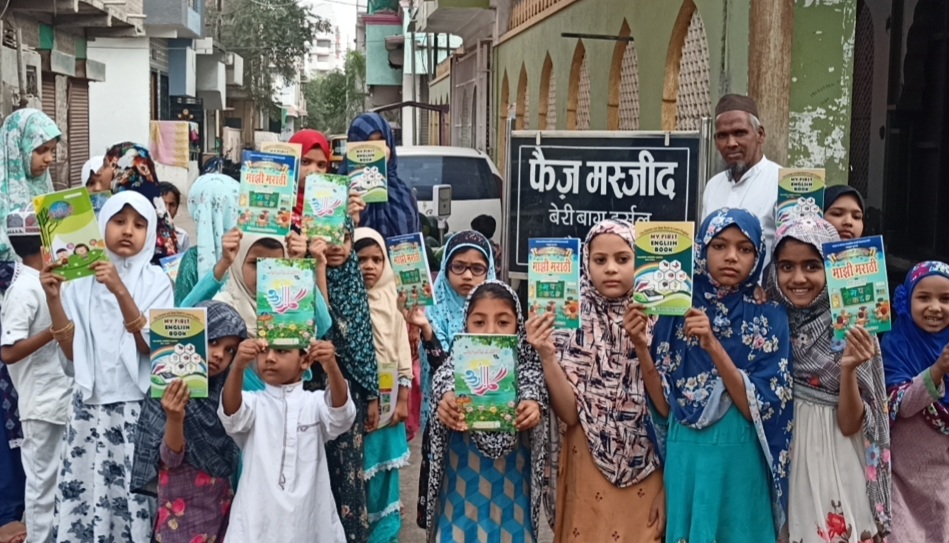
Urdu, Marathi, English books were distributed to the children members of Maulana Syed Abul Hassan Ali Nadvi Mohalla Library situated in Masjid Faiz Beri Bagh, Harsol area of Aurangabad.
It should be noted that for the past year in Aurangabad, 28 libraries have been working under the aegis of the Read & Lead Foundation in various sections of the city, slum mosques, Urdu schools, and neighbourhoods. More than 5,000 children are connected to these libraries.
It’s worth noting that eleven (11) of the 28 libraries are dedicated to children are located in mosques. Masjid Shadab Hina Nagar, Ahmadi Masjid, Shatabdi Nagar, Maulana Hasrat Mohani Mohalla Library, Misrarwadi, Qazi Iqbaluddin Mohalla Library, Bismillah Masjid, Madrasa Falah Darin Ghulam Mustafa, Sher Khan Pathan Mitra Mandal Library, Narey Village Mohalla Library and other places. In addition to this, Al-Huda Urdu High School Baijipura, Dr. APJ Abdul Kalam Mohalla Library Baijipura and other libraries celebrated World Book Day.
Maulana Sheikh Yusuf Nadvi, Imam of Masjid Faiz, where the Maulana Syed Abul Hassan Ali Nadvi Mohalla Library is located, stated that he would do everything in his power to ensure that the library benefits the children and women of the area as much as possible. After Friday prayers, he also declared the start of the door-to-door book drive.
Sheikh Nargis Fatima, Headmistress of Al-Huda Urdu High School, stated that her school’s students and instructors would be more active in the campaign and would offer all available assistance. Farhat Jahan, a school teacher, and other teachers took part in the presentation and offered their opinions..
Children’s monthly periodicals such as “Bachu ki Dunia,” “Umang,” “Taleemi inquilab,” “Majhi Marathi,” “Meri English Kitab,”,” “Gulzar Urdu,” and other books, magazines, and journals were distributed to members of the aforementioned libraries.
source: http://www.muslimmirror.com / Muslim Mirror / Home> Positive Story / by Special Correspondent / April 26th, 2022
Shabnam Riyaz, a Malayali qawwali singer, enthralled audience at the World of Women event underway at Kovalam Art and Craft Village.
Kochi:
Qawwali music imbibes the essence of Sufism. The ecsatcy that audience enjoy when the qawwals sing at a gathering is unexplainable. Although the genre has been traditionally male-dominated, Malayali playback singer turned qawwal Shabnam Riyaz is quite popular among the country’s Sufi singers. Recently, she performed at a qawwali concert in the ongoing World of Women (WoW) 2022 event at the Kovalam Art and Craft Village.
Her all-woman qawwali group Layali Sufiya showcased an energy-packed performance.
Shabnam says fusion helps audience relate more with the qawwali genre. Thrilled to be back on stage after the pandemic-induced lull, Shabnam, who is an ardent fan of Ustad Nusrat Fateh Ali Khan, says pure rendition of qawwali music is quite rare in Kerala, though it is common in northern India.
“Though I perform qawwali fusion for my audience, I focus more on traditional pieces. Most people hear Sufi music and think ghazals. Qawwali is an ecstatic form of music infused with divinity,” she says. Qawwalis often showcase vibrant, physically exhilerating performances, that many audience find bizzare. “I have seen many trolling popular Sufi singers, the Nooran sisters. But when you devote yourself to qawaali, it is hard to control your moves,” adds Shabnam who also offers Sufi music classes. She belives Sufi music was passed down to her from her great-grandfather, Vavaasan, a bhagavatar in Kollam who excelled in qawwalis.
The Ochira native has been living in Thiruvananthapuram for over a decade now and was the trainer for Khateeja, A R Rahman’s daughter.
According to Shabnam, there are very few qawwals still, because it is a strenuous style of singing. “After a performance, we may need at least three days of voice rest. Many girls who approached me lacked the stamina for it,” adds Shabnam whose dream is to create qawwali music using Carnatic compositions. She is the voice behind popular tracks like Vennila Chandanakinnam and Shukira.
source: http://www.newindianexpress.com / The New Indian Express / Home> Cities> Kochi / by Arya U R, Express News Service / March 12th, 2022
Calling it ‘The Tribute Run’, Sufiya Sufi is dedicating this challenge to the Bravehearts of the Indian Army.
Guinness record holder Sufiya takes on Siachen to Kargil run; to salute sacrifices of Indian Army.
New Delhi:
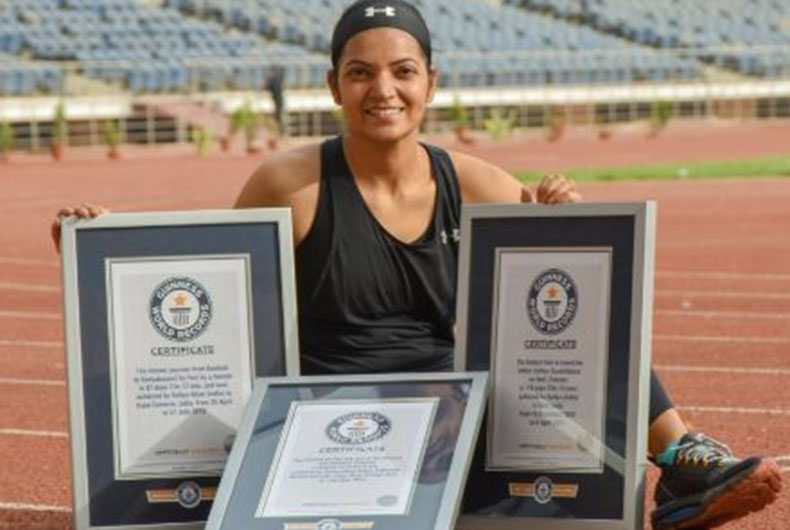
Indian Ultrarunner Sufiya Sufi ‘Runner’ is no stranger to challenges. After entering the Guinness Book of World Records for the third time earlier this year, Sufiya is now set for her next challenge — a run from Siachen Base to Kargil War Memorial.
Calling it ‘The Tribute Run’, she is dedicating this challenge to the Bravehearts of the Indian Army who have made unmatched sacrifices for our country. The 7-day-long expedition will begin at Siachen War Memorial on July 17 and conclude at Kargil War Memorial, on July 23, ahead of the 23rd Kargil Vijay Diwas.
During the 470 km long expedition, Sufiya will navigate through difficult terrain and hostile conditions. The run will begin at an altitude of 3400m, reaching up to 5359m at Khardung La with oxygen levels dropping 40 to 60 percent and temperature dipping much below zero degrees.
Commenting on her upcoming run, the Under Armour athlete said, “Ever since I have taken up the discipline, I have worked continuously towards pushing my limits and encouraging more people to take up running.
“My upcoming run is special and close to my heart and through this run, I want to pay tribute to the deeds of our soldiers and their selfless service to our nation.”
“As I prepare for this run, I have a great team, be it my coaches or Under Armour, who have supported and motivated me to take up every challenge including this expedition. I have put in the work training continuously for the past 6 months.”
In 2018, Sufiya took up running to break away from her aviation job, to relax and de-stress. Since then, she has entered the Guinness Book of records three times and has set several benchmarks for ultrarunning in India.
She holds the records for covering the Manali-Leh stretch on foot in the year 2022, the fastest time by a female to complete the Golden Quadrilateral in 2021, and the fastest woman to traverse from Kashmir to Kanyakumari in 2019. Sufiya has been an Under Armour Athlete since her first big achievement in 2020.
source: http://www.ummid.com / Ummid.com / Home> Life & Style / by IANS / June 28th, 2022
The photo-book ‘Har Shaam Shaheen Bagh’, comprising visual stories of resilience and resistance, isolates individuals from the image of the mass movement as was seen on prime-time news and press photographs.
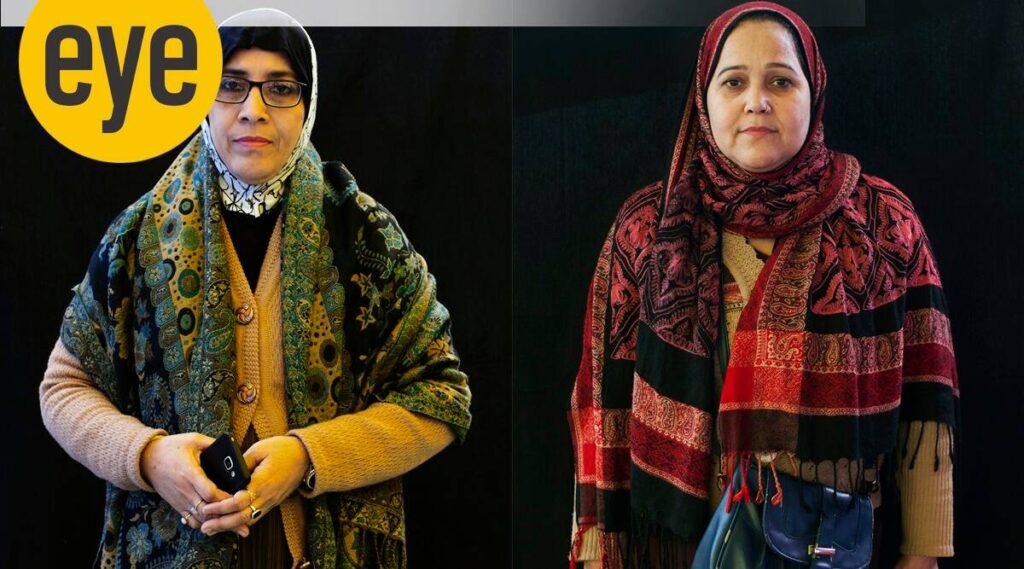
Portraits from Har Shaam Shaheen Bagh (Credit: Prarthna Singh)
Who is the perfect protester? We imagine raised fists, hurt faces, angry stances. We imagine climbing barricades, braving tear gas. If we go by this visual vocabulary, Har Shaam Shaheen Bagh (Every Evening Belongs to Shaheen Bagh) takes us by surprise. With over 150 portraits of non-violent protesters, the photo-book gently challenges the imagery of contemporary resistance movements.
Har Shaam Shaheen Bagh is Mumbai-based photographer Prarthna Singh’s first solo photo-book (she had earlier teamed up with the authors of Sar: The Essence of Indian Design in 2016). In December 2019, after the Delhi police reportedly assaulted students of Jamia Millia Islamia University who were challenging the Citizenship Amendment Act (CAA), a sit-in protest led by Muslim women started in Shaheen Bagh. Under a tent, with hundreds of women and children on any given day, the peaceful protest lasted for 100 days, until the pandemic struck.
Har Shaam Shaheen Bagh; By Prarthna Singh; 143 pages; Rs 3,300
Singh joined the anti-CAA protest in January 2020, spending most of her time on ground. Known for her women-centric narratives and portraiture work, she taps into her speciality to create portraits in an on-site photo studio, cobbled together with whatever was available at Shaheen Bagh. The result is these portraits of women, either looking directly at the camera or away, but always with a sense of pride. Poised and calm, the unnamed sitters indicate trust in the space, the purpose and the photographer.
Har Shaam Shaheen Bagh is Mumbai-based photographer Prarthna Singh’s first solo photo-book (she had earlier teamed up with the authors of Sar: The Essence of Indian Design in 2016).
Our collective memory of Shaheen Bagh, as is often the case with resistance movements, is of the masses, as seen on prime-time news and press photographs. Indeed, mass resistance movements give rise to the most recognisable images in the documented history of the world. Vulnerability and resilience coalesce into one defining moment — people standing up to power and confrontation, whether it’s one man blocking a row of tanks or a girl offering a flower to an armed soldier. Har Shaam Shaheen Bagh trades the monumental for the intimate, asking us to reconsider what we mean by “iconic”. It isolates individuals from the sea of faces, almost as if to say that a movement’s power lies not in numbers but in the will of its people.
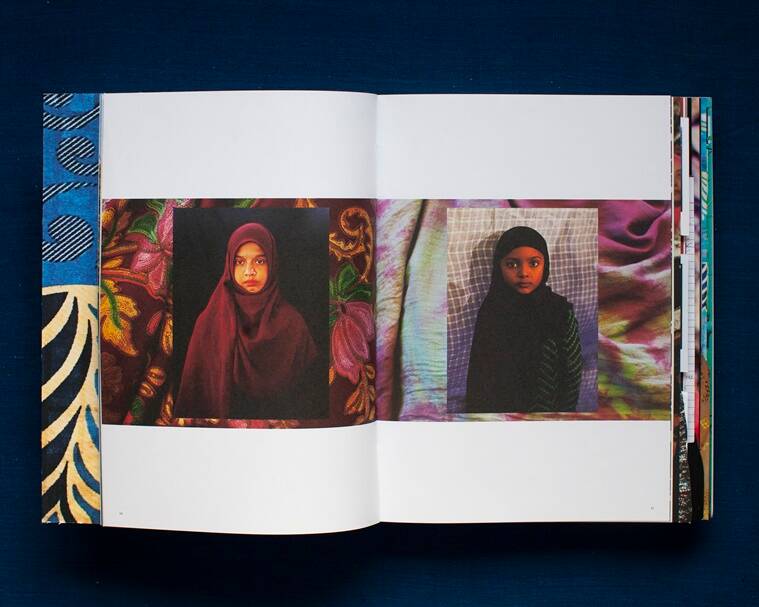
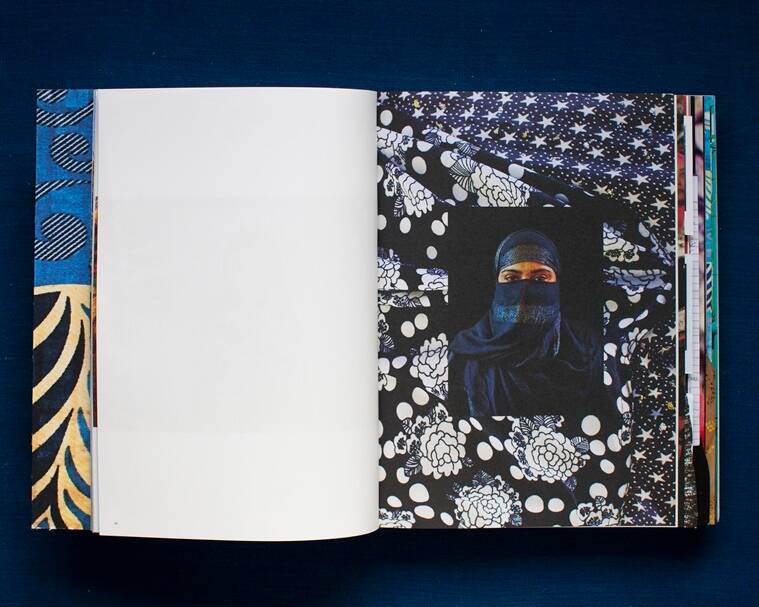
Har Shaam Shaheen Bagh takes the form of a personal diary or a scrapbook.
Har Shaam Shaheen Bagh takes the form of a personal diary or a scrapbook. It contains drawings, a painting by artist Sameer Kulavoor, whose company Bombay Duck Designs has also designed the book, verse and a letter from one of the protesters, available in Urdu, English and Hindi. Some pages are deliberately uneven, recalling the makeshift quality of the Shaheen Bagh tent. While the book’s cost makes it inaccessible to some socioeconomic groups, Singh has shared copies with the protesters. A portion of the book sales goes towards Jeevan Stambh, an NGO working on the rehabilitation of the victims of the Jahangirpuri demolition last month.
During the pandemic, the Delhi police cleared the Shaheen Bagh site, painting over its graffiti and dismantling its art installations. In a country that is determined to erase and rewrite its history, one could say that a photo-book on a citizen protest is as good as an act of protest itself.
source: http://www.indianexpress.com / The Indian Express / Home> Books & Literature / by Benita Fernando / New Delhi – May 21st, 2022
India’s Alfiya Pathan and Gitika produced sensational performances to win gold medals in the Elorda Cup in Kazakhstan on Monday.
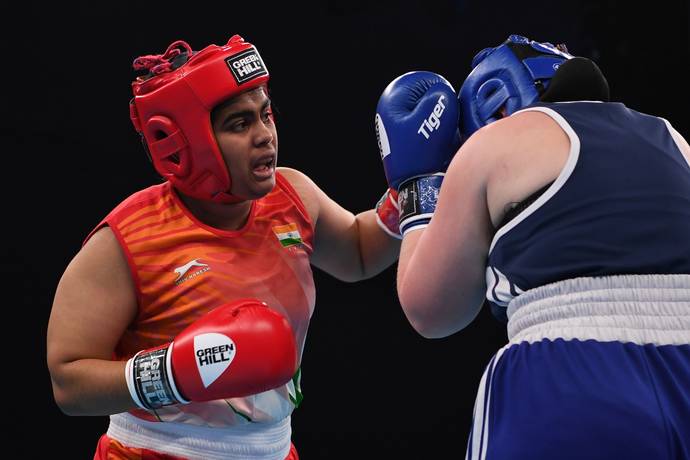
Alfiya in action. (File Photo) – SPECIAL ARRANGEMENT
India’s Alfiya Pathan and Gitika produced sensational performances to win gold medals in the Elorda Cup in Kazakhstan on Monday.
On the other hand, Gitika, who hails from Rohtak, handed the country first gold by winning an intense all-Indian final against Kalaivani wherein both the boxers started off with an aggressive intent and kept attacking each other. While they continued to exchange heavy punches, Gitika effortlessly shifted the gears as the bout progressed and did enough in the end to tilt the result in her favour.
“It was a great feeling to win a gold medal in the first senior international tournament. This is a start; I want to win more medals at the senior level in international competitions,” Gitika said after her win.
Meanwhile, the 2019 World Championships bronze medallist Jamuna gave her all against Uzbekistan’s Nigina Uktamova but ended up with a 0-5 loss in the 54kg final.
Alfiya and Gitika fetched themselves a prize money of USD 700 for their gold medal-winning feats while silver and bronze medal winners were awarded with USD 400 and USD 200 each respectively.
With the addition of two gold and as many silver medals on the final day, the Indian contingent also concluded their campaign with 14 medals, including 10 bronze, in the inaugural edition of the tournament.
Indian women boxers secured two gold, two silver and six bronze medals in the tournament which witnessed top players in action from strong boxing countries such as India, Uzbekistan, hosts Kazakhstan, Cuba, China and Mongolia.
Jyoti Gulia (52kg), Sakshi (54kg), Sonia Lather (57kg), Neema (63kg), Lalita (70kg) and Babita Bisht (81kg) were the six bronze medallists in the women’s category.
Among men, Kuldeep Kumar (48kg), Ananta Chopade (54kg), Sachin (57kg) and Jugnoo (92kg) claimed bronze medals.
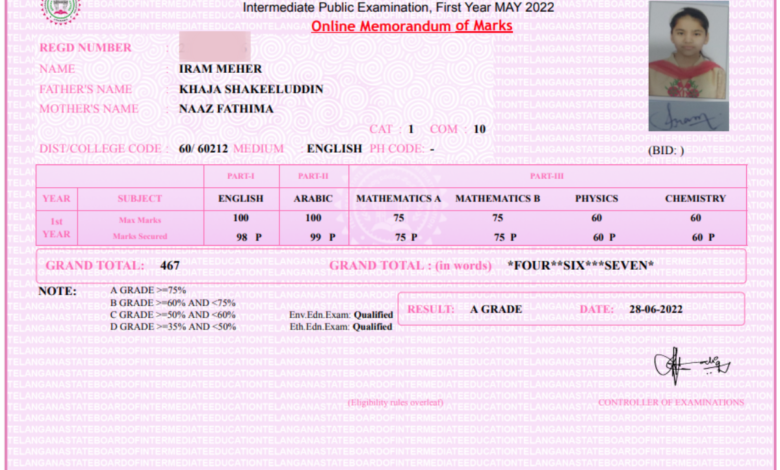
Iram Meher, is a first-year intermediate student who topped in the state by scoring all A’s in the subjects of Mathematics, Physics, and Chemistry.
Iram Meher Khaja Sahkeeluddin is a student at the St. Joseph’s Junior College in Hyderabad’s Tolichowki Branch. Meher’s first-year tests resulted in a 467 out of 470.
She received 75 out of 75 in maths scoring an A grade and the same in maths scoring a B, 60 out of 60 in physics, the same in chemistry, and 98 and 99 out of 100 in English and Arabic languages.
The TSBIE Intermediate First and Second Year Results 2022 were released at a press conference hosted by the Telangana State Education Board at 11 AM, on Tuesday. 63.32 percent of the overall number of students who took the TS Inter examinations in 2022 passed and were promoted from the first year, while 67.16 percent passed the second year.
Girls once again outperformed males in the Telangana Intermediate examinations, according to the board’s website, tsbie.cgg.gov.in, where students can also view their scorecards and TSBIE IPE scores memo.
source: http://www.siasat.com / The Siasat Daily / Home> News> Telangana / by News Desk / posted by Marziya Sharif / June 30th, 2022
Indian Journalist Rana Ayyub was awarded the International John Aubuchon 2022. She was honoured with the award by the National Press Club of Washington DC and the Aubuchon is the Club’s highest honor for press freedom.
National Press Club President Jen Judson and National Press Club Journalism Institute President Gil Klein said, “We are pleased to name Rana Ayyub the 2022 John Aubuchon Award International Honoree. Ms. Ayyub’s courage and skill in investigative work has been evident throughout her distinguished career and her criticism of the government has been met with an unwelcome assault on her rights and freedom of expression.”
Later, Ayyub, in her statement on Twitter, thanked the Press Club and said that “it is a testing time for journalism in India”.
She further added: “Huge honour to receive this award, the first ever for an Indian.”
Ayyub dedicated the award to her colleagues who are lying in different prisons across the country. “Dedicating this to my colleagues Mohd. Zubair, Siddique Kappan and Asif Sultan, incarcerated for speaking truth to power,” she said.
source: http://www.thekashmirlwalla.com / The Kashmir Walla / Home> News> South Asia / by News Desk / July 01st, 2022
The Delhi Youth Welfare Association works for the upliftment of underprivileged children in Old Delhi through many initiatives, including its Hazrat Shah Walliulah Public Library.
DYWA team with Capt Zoya and Heena Sodhi
On a hot Wednesday afternoon in June, Laxmi (14) and Ritika (11), residents of the walled city, braved the heat as they made their way through the crowded lanes of Old Delhi to arrive at a cramped quarter in Churiwalan, Jama Masjid. The dated signage and dilapidated environs may have served to put them off their mission, but they persevered. After all, they had it on the best possible authority––of their own older sister––that this was where they would receive school textbooks for the upcoming academic year.
These hardworking sisters are a few of the many girls and boys lining up outside the doors of the unassuming Hazrat Shah Waliullah Public Library, which distributes course books for children once a year, free of cost, to support them in their pursuit of education despite financial and other constraints.
In 1987, in the wake of curfew following religious tensions in Old Delhi, a group of young friends turned their energies towards the upliftment of destitute locals.
The library
They began by distributing rations, medicines, and scholarships to deserving widows and others in need, under the banner of the Delhi Youth Welfare Association (DYWA); but felt this action, though noble, did not make the desired difference to ground realities. Illiteracy due to poor financial conditions and the resultant lack of resources was a chronic problem that needed their immediate attention. Hence, they started sponsoring the education of deserving children, and opened the Hazrat Shah Waliullah Public Library, sometime in the 90s.
Muhammad Naeem, the President of the DYWA, has been associated with the organisation from the beginning. Narrating an incident that summarises the need for their organisation, he says, “Financial conditions are bad for the locals here. As soon as they clear their ninth standard exams, they want to move to Open University instead of going to school, so they can work and earn money. This is true for both boys and girls.”
Amidst this, the Hazrat Shah Waliullah Library strives to encourage a love of reading and learning–– an art that is swiftly being sidelined. SM Changezi, the General Secretary of DYWA and custodian of the library, wears his royal ascendancy from Chengez Khan with pride. However, he only displays it to the world through his passion for beautiful and rare old books.
The library’s vast collection includes a 100-year-old Quran with every page written in a different style, a copy of an illustrated Ramayana in Persian, and even one of the last copies of Bahadur Shah Zafar’s poetry, printed and sealed in the royal press while he was still in power.
About 50 percent of the books in the library are donated by locals who support the organisation, and the remaining are bought from the organisation’s funds.
With the increasing number of books, the association is now planning to open a second library in Haryana’s Nuh to cater to the local slums in the area. Apart from free course books, the DYWA sponsors the education of around 30 girls. To this effect, the DYWA collects and pays Rs 2.5-3 lakh per annum towards children’s fees, all from donations made by people who believe in the cause.
Other initiatives include inviting celebrated personalities originally from this area to speak to the children about making a success of their life. This happened recently when Air India pilot and social activist Captain Zoya Agarwal and Heena Sodhi Khera of women’s networking platform Queen’s Brigade, met the children for their course distribution ceremony.
Khera explains, “Capt Zoya shared her own experiences of being judged for her big ambitions. Yet, she achieved what she wanted and encouraged the kids to do so as well. The children were ecstatic and listened to her with rapt attention.”
source: http://www.newindianexpress.com / The New Indian Express / Home> Good News / by Noor Anand Chawla / June 24th, 2022