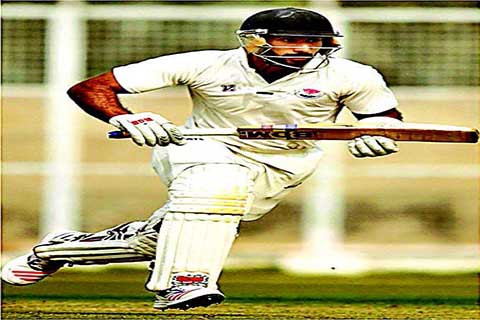
Talented young cricketer of J&K Ahmad Banday has scored another ton in England while playing in the T25 Wednesday Cricket League in Manchester England.
Having recently scored 173 run knock for Bury Cricket Club in Greater Manchester Cricket League, Banday on Wednesday turned up for Super Sixers in the T25 Wednesday League against Manchester Gladiators. Banday scored 146 run knock that included six sixes to lead his side to a dominating win. Batting first he helped Super Sixers post a total of 235 runs in allotted overs for the loss of six wickets. In reply Manchester Gladiators got all out for 150 run total.
To test his batting skills in tough conditions, Banday who was last year top run getter for J&K in Ranji trophy went to England this season. He joined Bury Cricket Club and Greater Manchester Cricket League. Initially struggling in batting, Banday finally found his touch and adjusted in the tough batting conditions. In the last match for Bury he scored mammoth ton of 173 runs. In the 12 matches he has scored 425 runs and also taken 22 wickets for his club.
“It is always good to score big hundreds and help team win. It is different league and different club. I play for Bury in Greater Manchester Cricket League and its matches are played only on Saturday’s while this T25 event is specifically played on Wednesday. To take full benefit of my stay in England and learn as much as I can, I opted to play in it,” said Banday.
“So far my stay in England has helped me in improving as batsman and I am confident that this new experience will help me in upcoming Ranji trophy season. I am looking forward to coming back to Kashmir and join my teammates for the preparation of the next season,” he added.
source: http://www.greaterkashmir.com / Greater Kashmir / Home> Sports / by Abid Khan, Srinagar / July 13th, 2018
In the morning I woke up to messages of hope and happiness as is usual on India’s (71st) Independence Day. Family groups were full of photographs of our younger children dressed in saffron and green, as they went to their schools to celebrate Independence Day.
We watched the speech of Prime Minister Narendra Modi from the Red Fort, and posted messages and stirring poems on Twitter and Facebook. There was so much happiness and bonhomie, when suddenly I got a link to a tweet from a friend:
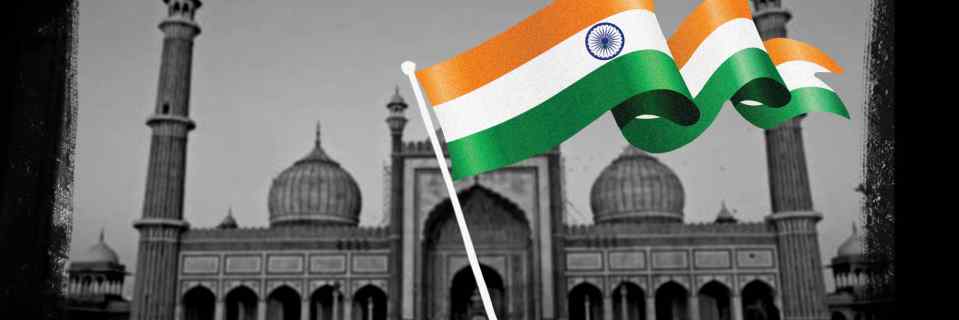
A bunch of people waving the flag in Delhi’s iconic Jama Masjid is hardly anything I should be upset about. In fact, the national flag on the historic Jama Masjid instills pride in me.
Why then, was I upset?
I was upset at the words that were deliberately aimed at hurting and demonising the community that prays in that mosque.
“71 साल बाद जामा मस्जिद दिल्ली की छाती पर चढ़कर हमने कार्यकर्ताओं के साथ राष्ट्रीय ध्वज फहराया, वन्दे मातरम”
“After 71 years, along with karyakartas (workers) I have climbed onto the ‘chest’ of Jama Masjid, and waved the national flag. Vande Mataram.”
Inherent to his speech is the message that the mosque, and by extension Muslims, have never hoisted the tricolour.
By the way, the call Madar e Watan Bharat ki Jai was given by Azimullah Khan in 1857, while fighting in the first war of Indian Independence. Honoring our motherland is not new to us. Perhaps Mr Singh (who tweeted the message) had missed this tweet by Sumer about flag hoisting at the Jama Masjid.
How Jama Masjid Area Celebrates I-Day
Mr Singh and his companions were 71 years too late, as the Indian Flag has been flying proudly in the hearts of every Indian, regardless of their religion. But yes, we fly the flag with love and respect, because we are Indians, not because we want to ‘otherise’ Indians.
Many flag-hoisting ceremonies were held in the Walled City. Flags were hoisted in homes, offices and public areas on 15 August.
As Abu Sufiyan, a resident of Old Delhi says, they came at noon, hoisted the flag, and left. No one objected or opposed them as flags were being hoisted everywhere. But he adds, “the enthusiasm with which Independence Day is celebrated in Old Delhi, where Red Fort is located, would be difficult to find anywhere else. They (Mr Singh and companions) may have climbed onto the steps of Jama Masjid after 71 years, but we have been hoisting the flag every year, in and around Jama Masjid.”
Sheeba Aslam Fehmi who runs the Walled City Café and Lounge at a little distance from the Jama Masjid, posted on her Facebook page this 15 August:
“We, living in and around Jama Masjid area, are used to several hoisting of the Tricolor on 15th August each year. Not only at the public spots like Azad Hind Hotel, right behind the main Gumbad of the Historic Jama Masjid, we have flags of all sizes on full mast at various establishments including all the schools, hotels, shops etc.
I just spoke to the local MLA Asim Ahmad Khan who has hoisted the Indian Flag at various spots in his constituency where Jama Masjid is located.
The celebrations and merry making is on since the day of full dress rehearsal only. Patriotic songs are played loudly in the narrow alleys of Jama Masjid.
If you want to witness the people’s celebration of the Independence day, come, take a stroll in the Jama Masjid bylanes.”
Ashok Mathur says, “I have been celebrating Independence Day since 11 AM today, and hanging over not one but many roof tops in the Pahari Imli and Matia Mahalarea of my Muslim friends flying kites, with music and fanfare, which started with the whole group singing the national anthem at the beginning… since I was a vegetarian among all others, someone quickly got kaddu ki sabji and chana from his home nearby… it was the tastiest kaddu that I have ever had… this is the spirit with which we live here.”
Role of Jama Masjid in India’s Freedom Struggle
Today, let’s examine the role of Jama Masjid in India’s Freedom Struggle.
As Hilal Ahmed, Assistant Professor, Centre for the Study of Developing Societies says, “The Red Fort and Jama Masjid have always been the symbols of political inspiration for Indian masses, irrespective of religion or caste, during the colonial period. Leaders from different backgrounds and ideologies used the mimbar (pulpit) of the mosque to deliver political messages. From Swami Shradhanand of the Arya Samaj to Gandhi, Nehru and Azad – leaders of all sects delivered speeches here.”
He adds:
It is worth noting that Jinnah never delivered any speech inside the Jama Masjid, though he participated in a procession of the League in 1946. Unfortunately the Hindu right-wing want to convert everything into ‘Hindu and Muslim’. Making Jama Masjid an anti Hindu/India symbol is part of this political campaign.
Hilal Ahmed, Assistant Professor, Centre for the Study of Developing Societies
1857 Uprising
The Jama Masjid has not only been a place for congregational prayers since the time it was built in 1650, but also a witness to India’s history. Since it had been such a symbol of togetherness and rebellion against British power in 1857, after the uprising, the British occupied the mosque and stopped people from offering prayers within its premises. Its gateways were guarded by British Indian troops to prevent entry.
The Jama Masjid was used as a mess, with horses tied along its corridors, with alcohol being freely consumed by the troops.
In the months of May-September, the sepoys and natives of India rose up against the East India Company, under the banner of Mughal Emperor Bahadur Shah Zafar. Fierce battles were fought in the summer and monsoon months of 1857, in and around the walled city of Shahjahanabad. Jama Masjid, as the centre of Shahjahanabad, was also central to this fight.
The mosque was the focal point for gatherings during the siege of Delhi in the 1857 Uprising.
It was on the walls of Jama Masjid that posters were put up by the forces who were trying to create a communal divide among India’s people. These were immediately taken down upon the then Mughal emperor Bahadur Shah Zafar’s orders. Maulvi Mohammad Baqar countered these posters in his newspaper The Delhi Urdu Akhbar, in which he said that Hindus and Muslims were ahl e watan (compatriots), and had been living together for a thousand years.
It was as a result of this that the British confiscated Jama Masjid and planned its demolition. It was only in 1862, following innumerable petitions by Muslims, that the British government returned the mosque to the original inhabitants.
Secular Nature of Jama Masjid
The nationalist movement and Hindu-Muslim unity took giant steps forward after World War I during the agitation against the Rowlatt Acts, and the Khilafat and the Non-Cooperation Movements. As if to declare before the world the principle of Hindu-Muslim unity in political action, Swami Shradhanand, a staunch Arya Samajist, was asked by Muslims to preach from the pulpit of the Jama Masjid at Delhi, while Dr Saifuddin Kitchlu, a Muslim, was given the keys to the Golden Temple, the Sikh shrine at Amritsar.
The entire country resounded with the cry of ‘Hindu-Muslim ki Jai’.
It was this mosque where, on 4 April 1919, Swami Shraddhanand, dressed in saffron robes, addressed the people gathered there, asking them to unite, saying that the need of the hour was Hindu-Muslim unity, against the common enemy, the British.
He started his speech with a Vedic mantra to which the congregation replied ‘Ameen’. He went on to exhort all Indians to purify their hearts with the ‘water of love’ of the motherland in ‘this national temple’, and become brothers and sisters.
I wish he would come back and again deliver a speech on unity only this time the common enemy is hatred and those who preach hatred.
It was in this mosque that Maulana Abul Kalam Azad delivered his historic speech in October 1947, which reminded them of their sacrifices for India, and exhorted them not to leave their motherland since the Prophet had said, ‘Allah had made the whole world a mosque’, and so the question of pure (Pak) and impure land does not arise.
In fact it was contrary to the ideals of Islam:
“Musalmano’n, my brothers,
Today you want to leave your motherland. Have you thought of the result of this step? … Close the door from which communalism has entered…”
(24 min onwards)
“Where are you going? And why are you going? Behold, the towers of this historic Masjid bend to ask you: lift up your gaze and see. The dome of this Shahjahani mosque asks you where you have lost the pages of your history. The sacred relics of your ancestors ask you, in whose care you are leaving them?”
“The sounds of ‘Allahu Akbar’ echoing from this mosque, ask you, on whose mercy are you leaving them? The walls and doorways of this mosque call out to you, again and again. O! those who are leaving, a time may come when you could lose your identity…
Don’t you remember that it was only yesterday that your caravans had performed ‘Wuzu; (Ablutions) on the banks of Jamuna. And today you are afraid to live here.
Remember that you have nourished Delhi with your blood.”
A simple study of literature written about the Freedom Struggle in the 19th and 20th centuries, will reveal that indeed not only Delhi, but India has been and is being nourished by the blood of Muslims. They are as much Indian as anyone else. 71 years ago, India was divided. I was not born then, but I am living now, and I will fight bigotry and hatred.
This Independence Day, let’s pledge to get freedom from hatred, bigotry and attempts to divide Indians on religious and sectarian lines.
Hindi hain hum watan hai Hindustan hamara.
(Rana Safvi is the founder and moderator of the popular #shair platform on Twitter, which is credited for reviving popular interest in Urdu poetry. She tweets@iamrana. This is an opinion piece and the views expressed are the author’s own. The Quint neither endorses nor is responsible for them.)
source: http://www.thequint.com / The Quint / Home> Big Story> Hot News> Videos / by Rana Safvi / August 15th, 2018
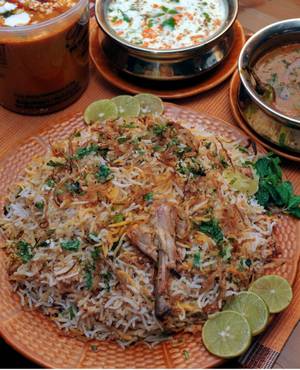
Royal spread:The ‘Khwan Nemat-e-Asafia’ lists 15 types of biryanis such as Biryani Rumi, Biryani Mahboobi, Biryani Nargis, Biryani Hazar Afreen.
The world knows them for fabulous jewels and splendid palaces. But not many know that the erstwhile Hyderabad rulers had a weakness for a rich diet as well.
Sample this: Biryani Dulhan, Yeqni Palou Shirazi, Khorma Murgh, Qhalia Chamkura, Kabab Gul Khatai. A ‘shahi’ spread any which way. If your mouth is doing a tango, you are not to be blamed.
Now, one can try out these dishes. Urdu daily Siasat has stumbled upon a dog-eared copy containing a list of 680 formulae used by the royal kitchenette of the 6{+t}{+h}Nizam, Mir Mahboob Ali Khan (1866 – 1911). The newspaper plans to publish the recipes in Urdu and English on art paper shortly. The book, titled Matbaqe Asafia, is expected to hit the market in the next two months.
“It will be in time for Ramzan, the month of fasting,” Siasat ’s Editor Zahed Ali Khan says.
Tell me what you eat and I will tell you what you are. A look at the recipes and the ingredients that go into making these sumptuous dishes give an inkling of the royal taste — cuisine that is never clichéd. Every formula differs from the other in the set of instructions and ingredients.
The ‘Khwan Nemat-e-Asafia’ lists 15 different types of biryanis such as Biryani Rumi, Biryani Mahboobi, Biryani Nargis, Biryani Hazar Afreen. As the name suggests, the ‘Dulhan Biryani’ is highly decorated with a fried banana in covering of ‘warq’ (silver foil).
Besides, there are 18 kinds of pulav , 16 of khichidi , 48 of do-pyaza , 21 variants of khorma , 45 of kabab and 29 types of naan . Besides, there are 25 varieties of chutneys (condiments) and 33 types of achaar . Apart from an assortment of spices and dry fruits, the ingredients also include a generous sprinkle of perfumes and sandal.
But some of the formulas could be a recipe for sickness, given the heavy doze of ‘pure ghee’ suggested. There are also some recipes, which, if tried now could land one in trouble. For instance, the book contains formulas for cooking animals which now attract provisions of the Wildlife Act. “But we don’t propose to include such recipes since they are banned now”, Mr. Khan says.
So gourmets, get ready for a royal repast.
Come Ramzan and the Siasat daily plans to publish a list of 680 formulae used by the royal kitchenette of the sixth Nizam, Mir Mahboob Ali Khan
source: http://www.thehindu.com / The Hindu / Home> National> Andhra Pradesh / by J.S. Ifthekhar / Hyderabad – May 13th, 2013
India’s contribution to the Allied war effort is nowhere more evident than in Britain’s greatest battle, fought in Imphal and Kohima
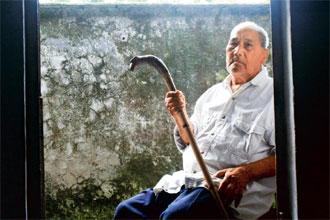
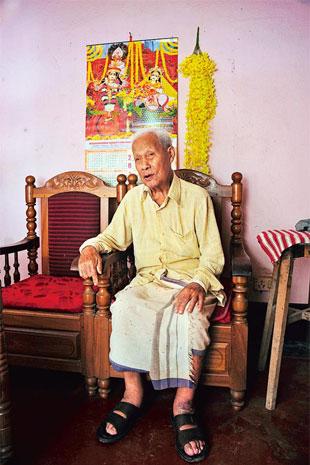
War veteran L. Achung Kom. Photo: Ratan Luwang/Mint
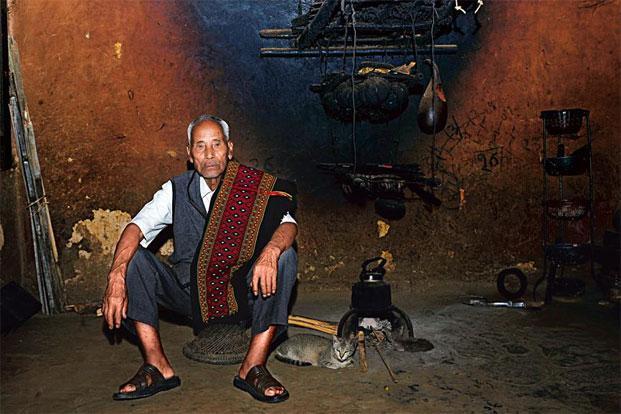
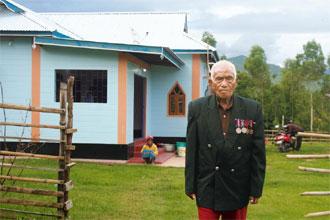
Sitting in a wooden chair on the verandah of his Manipur village home, 91-year-old Nehkhosong Singsit (Nehkhosong Kuki, according to army records) wasn’t expecting visitors when we walked in unannounced through the front gate, past a small lawn, and stood in front of his cheerful, sloping-roofed house.
As his daughter helps her father into a shirt, Singsit’s son, Paogin, a retired bank employee, narrates the fascination his father had for the army uniform; as a 19-year-old, Singsit enrolled in the British-commanded Assam Regiment in 1943.
Other than the need to earn a living, the promise of owning an army uniform was the prime motivation when army recruiters came prospecting to their village at the height of World War II. “Back then, people of our Kuki tribe would wear scanty clothes and my father felt a natural attraction for the army uniform. It stood out for him,” says Paogin.
Singsit would soon be called to action on the battle front when the British-led Allied forces faced a seemingly indomitable enemy in the Imperial Japanese army that was waiting to overrun Allied-held positions in Manipur and beyond.
Nehkhosong Singsit. Photo: Shamik Bag/Mint
As a sepoy, Singsit’s brief was to provide security to the British colonel who led the regiment of primarily Indian soldiers when the Japanese offensive began on 8 March 1944. The Japanese firing was relentless, and one of the bullets found its mark in his dear friend, sepoy Vaiphei. The Japanese began using his body as a shield, firing from behind him—a ploy that Singsit felt was both tactical as well as psychological.
“I saw my friend’s dead body getting ravaged by bullets. The disrespect shown to the dead was shocking,” says Singsit, his voice firm, though his body is now bent over by age. “The other motive of the Japanese was to demoralize us by exhibiting the dead body of someone belonging to our own land.”
In later months, after the Allied forces scored a hard-fought, decisive victory, Singsit would be charmed by Japanese prisoners of war held at Meiktila in Burma (now Myanmar) doing pencil-sketch portraits of his colleagues and him for an extra roti or bidi. War, he found out, can also be about conflicting emotions.
In the early 1940s in Manipur, a princely state yet to merge with an India then under British rule, the issue of land, and sense of belonging, was often defined ethnically by the locals.
Following his honourable discharge from the army in 1949, Singsit preserved the uniform as a treasured memorabilia of the “fierce” three months between March and July 1944, when the Allied forces clashed with the Japanese. But he had to burn the same uniform voluntarily a couple of decades later.
A violent anti-India secessionist movement led by the Mizo National Front (MNF) was brewing in neighbouring Mizoram in the mid-1960s and Mizo underground military recruiters often visited Manipur villages dominated by Kukis, with whom they shared a close bond. “The Indian Army had a strong presence in our area. I was afraid that if they raided my home and found the uniform they might have misunderstood me for a Mizo militant. I felt extremely sad burning the uniform, but the Indian Army personnel didn’t know, nor would they have cared about my role as an Indian soldier in World War II,” says Singsit.
Epic scale
Forty kilometres from Imphal, Singsit’s rural home is a short drive off what some refer to as “The Road of Bones”. Beyond the insistent beauty of the land of cloud-collected hills, meandering rivers and green fields, is the sobering backdrop of the dead. Around and away from the 138km stretch of road from Imphal in Manipur to Kohima in Nagaland is where around 70,000 soldiers and civilians committed their lives to the cause of world domination over those three tragic months. The battles fought in the tough terrain of Manipur and Nagaland and spread over a 600-mile (around 965km) area have since been recognized as among the biggest—and bloodiest—battles fought by Indian forces.
Seventy years on, when diplomats and participants from Britain, Japan, the US, Australia and India gathered in Imphal on 28 June to commemorate the Battle of Imphal/Kohima—declared in 2013 as Britain’s greatest battle by the country’s National Army Museum, over other notable battles like Waterloo and D Day/Normandy—the memory of the dead, and a prayer for peace, hung like a veil over the proceedings.
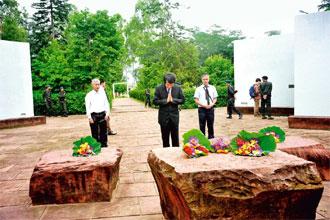
Y. Kawamura at the India Peace Memorial in Red Hill, Manipur. Photo: Ratan Luwang/Mint
Delegate followed delegate in remembering the thousands who lie interred at multiple cemeteries in the region, including those maintained by the Commonwealth War Graves Commission (CWGC) in Imphal and Kohima. In just two cemeteries in the two cities, over 2,500 Indian soldiers are named; many more lie in cemeteries and memorials spread across the region.
Y. Kawamura at the India Peace Memorial in Red Hill, Manipur
While Scott Furssedonn Wood , the British deputy high commissioner in Kolkata, spoke about the “epic” scale of the battle where 200,000 soldiers and airmen from Japan, Britain, India, the US, Australia, New Zealand, Africa and Canada fought in harsh conditions, others, like Kolkata-based US consul-general Helen LaFave, brought up the issue of missing American soldiers and the continuing search for them. Y. Kawamura, charge de’affairs and minister and deputy chief of mission, embassy of Japan, spoke of eternal peace.
At the extreme end of ferocity, Japanese and Allied troops engaged in almost hand-to-hand combat in the Battle of the Tennis Court, fought around the strategically positioned deputy commissioner’s bungalow in Kohima. The Battle of Kohima saw 4,064 British and Indian casualties, according to the CWGC.
In Manipur, casualty-heavy battles were fought at Nungshigum, where three squadrons of the Royal Indian Air Force supported artillery operations to flush out the Japanese; at Kanglatongbi, where a vastly outnumbered Allied unit held out determinedly against the enemy’s design to capture a supply depot; and at Sangshak, where, from 21-26 March 1944, the first battle of World War II was fought on Indian soil. The six-day battle saw the 2nd and 3rd Guerrilla Regiments of the Indian National Army (INA) fighting alongside the Japanese.
The Japanese army was known for its ruthlessness and innovative ways of thwarting the enemy, like mimicking bird calls and creating tools that relentlessly sent out the rat-tat-tat sound of machine-gun fire. “Often (Japanese) soldiers stood out in the open with their guns with total disregard to their own safety,” writes Arambam Angamba Singh, co-convener of the 70th anniversary of the Battle of Imphal event, in the official souvenir.
While a Reuters report on the Battle of Imphal/Kohima topping 2013’s Britain’s Greatest Battles poll describes the country’s forces in the World War II campaign spread over North-East India and Burma as what many consider “The Forgotten Army”, similar opinions have been voiced in India on the collective amnesia regarding the Indian contribution to the Allied war effort.
This is nowhere more apparent than in the list of surviving Manipuri World War II veterans maintained by the state’s Rajya Sainik Board, under the Union ministry of defence. The list reveals 626 Manipuri (mainly Kuki tribesmen) World War II survivor-soldiers right after the war ended in 1945; 17 are living. The Manipur state government led by chief minister Okram Ibobi Singh actively associated with the high-profile, 28 June commemorative event in Imphal, and officials of the co-organizer, Manipur Tourism Forum, expressed hope of benefiting from “war tourism”. But none of the Manipuri World War II veterans have reportedly received any pension or honorarium from the state government, though other states have done so, according to the secretary of the Sainik Board.
Seated across a small wooden table on the balcony of the Sainik Board office in Imphal, the secretary, retired army officer Sarat Singh, maintains a World War II dossier and deals with the daily travails facing the elderly war veterans and, more often, their widows. Many, it is reported, died in penury. On the day we meet, the secretary had shot off yet another letter to the Manipur government requesting the release of the monthly honorarium suggested by the Union government. “The state government is not law-bound to pay and it’s entirely up to them,” he says.
Since many of the Indian Allied forces personnel were recruited specifically to serve on the battle front during World War II, and were discharged after the war ended and they were no longer required, they were denied a pension. When the British too left India, the war veterans, especially in Manipur, remained beyond the pale of public consciousness and the state exchequer.
Yet there were stellar performances in the war theatre. Squadron leader K.K. Majumdar successfully flew the first bombing mission solo in Burma’s Toungoo, becoming the first Indian officer to receive a coveted award in World War II. In Imphal in May 1944, a message from Air Marshal Sir John Baldwin commended: “For the first time in India’s history, squadrons of fighters and dive bombers manned by Indian pilots have operated in strength against the enemy.” Abdul Hafiz, a Jemadar with the 9th Jat Regiment, posthumously wona Victoria Cross—Britain’s highest gallantry award—for his heroism in the Imphal battle.
Rows of graves of Indian Muslim casualties and lines of inscriptions on pillars with the names of Indian soldiers who were cremated mark the gracefully maintained World War IIcemeteries at places like Imphal and Keithelmanbi, stark testimony to the price paid. “I’m hoping still that the government will compensate the World War II veterans for their role,” says Singh.
Nobody’s men
At 95, Khupkolam Vaiphei knows he does not have much time left.
Khupkolam Vaiphei, 95, a former sepoy of the Assam Regiment who fought in the Battle of Imphal/Kohima. He lives in a village in Manipur’s Senapati district. Photo. Shamik Bag/Mint
Hard of hearing, the former sepoy of the Assam Regiment who was on the frontlines during a vicious battle against the Japanese forces in Manipur’s Jessami village, bristles with indignation when recounting the indifference displayed by successive political establishments. “During World War II, Indian public and leaders protested against the use of Indian Army personnel in the British war effort and demanded an assurance from the British that India will be given independence if we assisted in the war. Yet we have not received a single rupee since our discharge. We fought for the British, but did we not play a role for India?” he wonders aloud, his deep baritone resonating across the tin-roofed outer room of his house, atop a small hillock in Senapati district’s Phovaibi village.
Back then, Vaiphei’s emotions too were defined by the codes of Kuki community living. His weary, creased countenance seems to age a hint more when he remembers the night—after three whole days in trenches against non-stop Japanese firing—his closest childhood friend and fellow trooper, Lalneilam, was killed in a sniper attack. “From having our food to answering nature’s call, we did everything inside the trenches, such was the Japanese firepower. Lalneilam, though, went out but never returned.”
After over two gruelling months of fighting back, the Japanese started retreating. Vaiphei was among those who followed the enemy, wanting to push them back to Burma, from where they had come. On one occasion, they came across a bunker with Japanese soldiers inside. Two were captured. They had been holding two young Naga Angami girls hostage to serve them. While the British leader of Vaiphei’s battalion wanted to keep the two Japanese alive as prisoners of war, two Naga soldiers defied orders and killed them with their bayonets. “They couldn’t tolerate the insult and dishonour that their Naga sisters went through,” says Vaiphei.
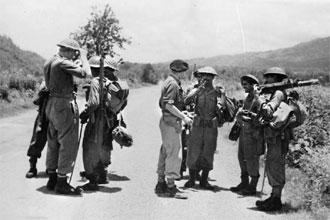
The two arms of the 14th Army during the Battle of Imphal/Kohima. Photo: Wikimedia Commons
This British victory was particularly significant because it was the first time the Japanese army faced defeat, says Hugo Slim , author and leading scholar at the Oxford Institute for Ethics, Law and Armed Conflict, University of Oxford, UK. He is the grandson of the much-feted Lieutenant General William Slim of the British 14th Army, which led the Allied counter-attack. “The Japanese were a brilliant army and considered invincible,” Slim adds on the sidelines of the Imphal commemoration, co-organized by the 2nd WW Imphal Campaign Foundation, which hosts excavation and trekking tours across Manipur’s known World War II battlegrounds. “This battle stopped the Japanese advance across Asia. The two empires clashed and soon afterwards the empires disappeared. It was a very long and complicated battle against an enemy that wouldn’t surrender and had to be fought till death,” Slim says.
Yet the Japanese campaign against British India, known as the U-go Operation and often viewed as a critical misadventure by the infamous commanding officer, Lieutenant General Renya Mutaguchi , had its share of Indian supporters. The small Manipur town of Moirang is one area where the Netaji Subhas Chandra Bose -led Azad Hind Fauj, or the Indian National Army (INA), backed by the Japanese army, set up a “liberated zone” within British-occupied India, hoisting the INA flag during the thick of the Japanese campaign on 14 April 1944.
As in many other conflict zones in Manipur and Nagaland, a little digging has turned up wartime effects like mortars, rifles, helmets and bullets in Moirang. The INA Museum here is a treasure trove for war enthusiasts. Some glass cases display Japanese and British grenades and bullets side by side, neutralized in the academic air of the museum.
L. Ibomcha. Ratan Luwang/Mint
Ninety-six-year-old L. lbomcha, a former deputy speaker of the Manipur assembly, was a supporter of the INA and, by extension, its collaborators, the Japanese army. Age has slurred his speech but it has not impaired his memory. As we gather in the drawing room of Ibomcha’s Moirang home, he says: “For three months Moirang was a peaceful and happy town under INA and Japanese occupation. I mobilized people and collected money and rations for the soldiers. Moirang got a taste of freedom three years before the rest of India,” he narrates.
A little away from Moirang, in the hilly village of Kom Keirap, L. Achung Kom, a villager who looks younger than the mid-90s he says his age is, waited expectantly for Japanese representatives at the Imphal event to grace his home. He looks a little dejected when we alight from our car.
As someone who had assisted the Japanese in 1944, he had, earlier in the day, greeted Kawamura in Japanese when the latter visited Red Hill, the site of a bloody face-off about 20km from Imphal. With both sides launching a vigorous air campaign, 1944 was the first time that Kom saw an aircraft flying over paddy fields.
“This year’s commemoration brought the memories back to the Manipuri psyche and the changes it made to Manipuri society. It catapulted Manipur from a 19th century civilization to a 20th century state,” Manipur governor V.K. Duggal says.
Kom aided the Japanese campaign, ferrying goods and procuring rations and local liquor for the military men. Till some years back, his kitchen still had half a mortar, used to grind food—it was taken away by local authorities. While he remembers the Japanese fondly as people who would keep their gaze down when local women passed by, he is not as enthusiastic recollecting a role he had to play. Digging graves, says Kom, was hard work. “Besides, I didn’t like the presence of the dead,” he adds.
In the battle-scarred plains and hill tracts of Manipur, the dead are buried deep but the mine of memories is just a scratch away.
source: http://www.livemint.com / Live Mint / Home> Leisure / by Shamik Bag / July 05th, 2014
His poetry reflected his passionate love for his country and his goal of total freedom from the British rule.
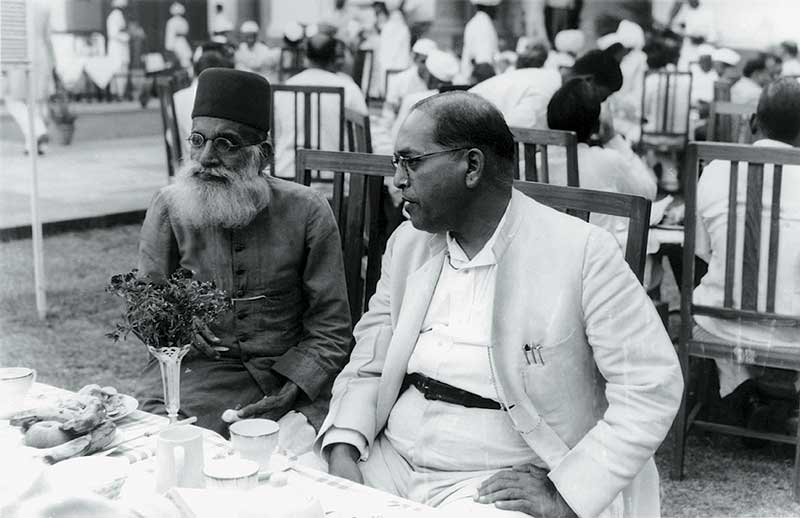
B.R. Ambedkar with Maulana Hasrat Mohani at Sardar Vallabhbhai Patel’s reception in 1949.
On our 72nd Independence day, let us remember the freedom fighter, revolutionary, the poet, the maulana, and the Krishna bhakt: Maulana Hasrat Mohani and celebrate the diversity of India in all its glory.
If the African-American Civil Rights Movement in the United States was fuelled by ‘We shall overcome’, in India that honour would go to ‘Inqilaab Zindabad’ coined by Hasrat Mohani (1875 – 1951). It became the chant of Indian revolutionaries.
Though Mohani is remembered today for his romantic ghazal Chupke chupke raat din, his poetry reflected his passionate love for his country and his goal of total freedom from the British rule. He along with Ram Prasad Bismil got the proposal for Poorna Swaraj (complete Independence) accepted by the Indian National Congress in 1921.
Rasm e jafa kaamyaab dekhiye kab tak rahe,
Hubb e watan mast e khwaab dekhiye kab tak rahe,
Daulat e Hindostan qabzah e aghyar mein
Be adad o be hisaab dekhiye kab tak rahe!
(How long will tyranny succeed, let us see
Till when will freedom be a dream*, let us see
Hindustan’s riches are in the clutches of plunderers
Till When will this continue, let us see.)
[*dream here alludes to awakening of Indians from their slumber]
Maulana Hasrat Mohani was a very complex but extremely interesting personality. He was born in a zamindar family in Mohan near Unnao (Uttar Pradesh) in 1875, and was named Fazlul Hasan. ‘Hasrat’ (longing) was his nom de plume or ‘takhallus’ and Mohani as he hailed from the village Mohan. His early education was in his village and he matriculated from Government High School, Fatehpur. He went on to join the Mohammedan Anglo Oriental College, Aligarh (now Aligarh Muslim University).
Hasrat Mohani was a very active participant in the freedom struggle and was jailed many times. A lot of his poetry is composed during his imprisonment.
Hasrat Mohan was an ardent supporter of Bal Gangadhar Tilak and when he died, the poet penned these lines:
Jab tak wo rahe dunyaa meN raha ham sab ke diloN par zor unka
ab rah ke bahisht meN nizd-i-khuda huro’N pe kareNge raj Tilak –
(As long as he stayed in this world he ruled our hearts
Now in Paradise, closer to God, the houris will be his court.)
Although Hasrat was a romantic poet, he was an active member of the Indian NationalCongress, the Muslim League and the Communist Party of India.
One of his popular verses is:
Gandhi ki tarah baith ke kaate’nge kyun charkh
Lenin ki tarah de’nge duniya ko hila hum
Why should we sit and spin yarn on the ‘charkha’
Like Lenin we will shake the world.
The revolutionary was also a romantic poet and today no ghazal mehfil is complete without a rendition of his evergreen couplet:
“Chupke Chupke raat din aansoo bahana yaad hai
Ham ko ab tak aashiqii kaa vo zamaanaa yaad hai”
(Shedding tears in silence, day and night, I remember
Those days of being in love, I still remember.)
His appeal across nations can be judged from these two stamps by India and Pakistan.
We often talk about his role in the Independence Movement, and his romantic ghazals but rarely do we talk of his devotion to Shri Krishna. According to Prof C.M. Naim, he wrote his first poem on Krishna in Urdu, when he was in Pune during Janmashthami in 1923.
Hasrat Mohani also wrote many verses in praise of Shri Krishna in Bhasha. He visited Brindaban as many times as he went for Hajj to Mecca (11 times) such was his devotion to Shri Krishna.
So while on the one hand, he wrote:
Mose cheR karat nandlāl
lie Thāre abīr gulāl
DhīTh bha’ī jin kī barjorī
auran par rang Dāl-Dāl
ham-huN jo de’ī lipTā’e-ke Hasrat
sārī ye chalbal nikāl
Nandlal keeps teasing me without end;
There he lurks, ready to pour colors on me.
Having safely sprayed others so many times,
He is now set in his bullying ways.
But what if I should embrace him, Hasrat,
Then squeeze him dry of his fancy tricks?
( verse and translation C M Naim’s article ‘the Maulana who loved Krishna )
On the other hand, he wrote innumerable naats and munajats in praise of Prophet Mohammed.
Khyaal e yaar ko dil se mita do Yaa Rasool Allah
Khird ko apna diwaana bana do Yaa Rasool Allah
Remove all thoughts of any other than you O Allah’s Prophet
Make my intellect, crazy for you O Allah’s Prophet
(The answer can be found in his Sufi leaning and learning. Sufism is the path of Bhakti, which has bound Hindus and Muslims together in a syncretic culture, which we call Ganga Jamuni.)
He was a disciple of Hazrat Shah Abdur Razzaq Farangi Mahalli in the Qadria Sufi Order. Sufism believes in losing oneself in the Beloved to achieve salvation and the love of Radha Krishna is a beautiful example of the same.
We can find the answer in the “Iintroductory note to Divan 7) where he refers to the god Krishna as Hazrat Srī Krishna ‘Alaihi-Rahma and claims that in doing so he is follow- ing the path of his spiritual mentors, particularly Hazrat Sayyad Abdur Razzaq Bansawi, whom he mentions.”
Hasrat’s poetry written near Makkah for pilgrimage:
ek khalish hoti hai mehsoos rag o jaan ke qareeb
Aan pahunche hai magar manzil e jaana’n ke qareeb
(A strange pain near my jugular vein I can feel
I have reached my destination near my Beloved)
The music we hear comes from one source, it’s just that we are unable to hear beyond the first few notes. Let’s pause and listen today. To my heart, to your heart and our beloved nation’s heart. I am sure they all want the same thing: peace, prosperity and glory of our great nation where we can live without fear and hatred.
Rana Safvi is an author, historian, blogger and is engaged in documenting of India’s Syncretic past.
source: http://www.newscentral24x7.com / News Central 24×7 / Home / by Rana Safvi / August 15th, 2018
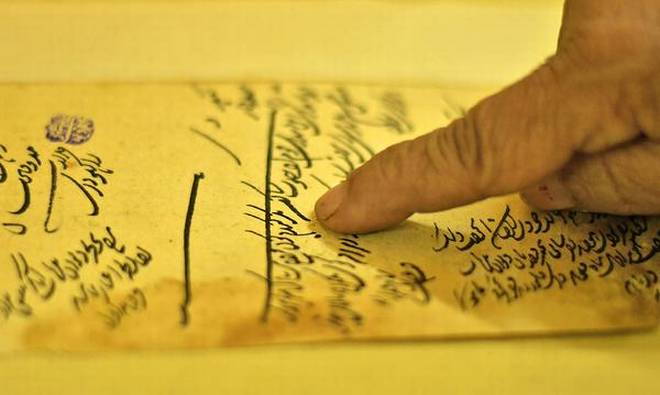
The king’s notes: The Yaddasht-i-Ahkam-i-Muqaddas with Aurangzeb’s imperial instructions. | Photo Credit: G. Ramakrishna
1.5 lakh indelible ink documents preserved in Hyderabad
Think Mughals and you think of Delhi and Agra. But few know that it is Hyderabadthat houses the largest collection of written communications of their reign.
The Telangana Archives and Research Institute holds a whopping 1.55 lakh documents — all on handmade paper — including 5,000 from the period of Shah Jahan (1628-1658) and another 1.5 lakh of Aurangzeb (1658-1707). No other archive in the country, not even the National Archives in New Delhi, boasts of such a collection: it gives a graphic picture of the mansabdari system, military administration and revenue machinery of the Mughals in the Deccan. Written in Persian in Shikasta script, cursive style, the documents are linked and arranged in chronological order — date, month and regnal year-wise.
Slew of orders
The documents include Farman (order of the emperor), Nishan (order of a member of the royal family), Yaddasht-i-Ahkam-i-Muqaddas (memorandum containing imperial orders), Parwana (orders issued by higher authorities), Siyaha-Huzur (proceedings of the provincial court), Roznamcha-i-Waqai (daily news report), Qabzul Wasil (bill payments) and Arz-o-Chihra (documents on personnel and horses).
Aurangzeb spent 13 years as the subedar of Deccan during the reign of Shah Jahan and had vast experience in political and other matters. Even after he ascended the throne on July 25, 1658, he continued to focus on the Deccan to check the activities of his rebellious son Mohammed Akbar and on conquering Bijapur and Golconda, which he did in 1687.
According to State Archives director Zareena Parveen, the accountant-general of the erstwhile Hyderabad State, Syed Muhibuddin, went to Aurangabad (the headquarters of the Mughals) for an inspection in 1916 when he discovered a large number of old documents lying in the vaults of Fort Ark.
He took keen interest in preserving them and reported the matter to Daftar-i-Diwani, the administrative wing of Hyderabad State, headed by the superintendent Syed Khurshid Ali. Steps were taken to shift them to Daftar-i-Diwani, which eventually became State Archives. The paper, made by Chinese professionals, has withstood the vagaries of time. The papers remain intact even after water seeped into the archives a few years ago. “In fact they became brighter as it washed away the acidic material that covered the indelible ink used by the Mughals,” said Ms. Parveen.
An expert in Persian herself, Ms. Parveen arranged the documents chronologically, deciphering the contents, and put them in non-acidic dockets.
The documents reveal Aurangzeb’s administrative skills. The Yaddasht-i-Ahkam-i-Muqaddas shows reports on recommendations of pay hikes for staff sent to the emperor, who also had spies to report on negligence, and actions against the government.
source: http://www.thehindu.com / The Hindu / Home> News> Cities> Hyderabad> Sunday Special / by M. Rajeev / Hyderabad – August 11th, 2018
The Washington, DC,-based Association of Indian Muslims of America honoured veteran South Asian American journalist Aziz Haniffa with the “Excellence in Leadership” award on Saturday.
Mr. Haniffa, a Sri Lankan American and Executive Editor of India Abroad, was recognised for his “Outstanding Leadership and Contribution to the Community and Indian American Journalism.”
The award was presented at an inter-faith celebration hosted by AIMA at the Turkish Community Center in Lanham, MD, on June 23.
In his speech accepting the award, Mr. Haniffa lauded the efforts of AIMA to a difference in the lives of the poor and needy in India, especially those of women and girl children in the areas of education and human development, leading to their overall empowerment.
source: http://www.sundaytimes.lk / The Sunday Times / Home / Sunday Times 2
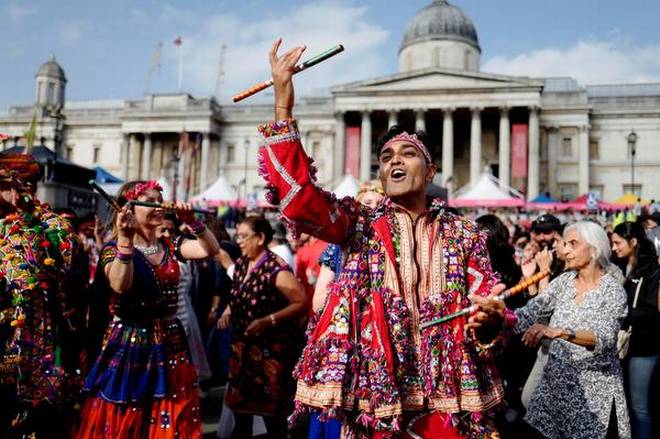
Diwali celebrations in Trafalgar Square. | Photo Credit: REUTERS
The 500-year-old history of Indians in London rubbishes notions of an ‘English’ England even during the Renaissance
With the Windrush scandal in a Brexit-torn Britain, thousands of British nationals of immigrant origins were denied basic welfare rights; many illegally deported. Protesters recently marched to the British Parliament. Protests against immigration bans and white nationalism in modern Britain date back to the 60s, when a new wave of immigrants began coming in from the Commonwealth countries, including the Caribbean, Africa, and Asia.
But the history of Asians — especially Indians — in London is staggeringly long, dating back to Elizabethan times. And, along with the history of other immigrant communities, their history squarely rubbishes the jingoist notions of England being purely ‘English’ even during the Renaissance or the Puritanical Movement.
Indians have lived and died in London since before the birth of Shakespeare. On March 22, 1550, Salamon Nurr — the Anglicised name of Suleman Noor — was buried at St. Margaret’s in Westminster. On December 28, 1613, another Indian, Samuel Munsur, married Jane Johnson at St. Nicholas Church in Deptford, about five miles from Shakespeare’s Globe Theatre in Southwark. More Indian betrothals, baptisms and burials followed. ‘Peter Pope,’ a lad from Bengal, was the first known Indian to be baptised in London, on December 22, 1616. He was brought to London in 1614 by Captain Best and handed over to Reverend Patrick Copland, the East India Company’s chaplain in Masulipatnam (now Machilipatnam in Andhra Pradesh). Copland instructed him in religion, so that Peter could administer the conversion of more Indians on his return.
The ‘Indian Caliban’
‘What have we here? A man or a fish?’ asks Trinculo, the Shakespearean fool in The Tempest (1610). ‘A strange fish! Were I in England now, as once I was, and had but this fish painted, not a holiday fool there but would give a piece of silver… When they will not give a doit to relieve a lame beggar, they will lay out ten to see a dead Indian.’
On Fenchurch Street where Peter — the Indian Caliban — was Anglicised, the entire political apparatus of England came to watch. Peter’s name was suggested by King James himself. The Archbishop of Canterbury blessed the baptism in the presence of the directors of the Companies and the members of the Privy Council. Peter’s entry into the London scene was a manifestation of the ‘boy stolen from an Indian King,’ that Shakespeare wrote about in A Midsummer Night’s Dream (1595). Peter returned to India in 1617, soon to be a forgotten character from an unsung history.
In 1720, an Indian youth of 16, was taken from Madras, shipped to London by Captain Dawes, and gifted to Mrs. Elizabeth Turner, who christened him ‘Julian’. Mrs. Turner forced him to dance and croon — as she deemed was suited to his custom — before guests. On August 8, 1724, Julian stole 20 guineas and set the house on fire. When arrested, he confessed to the theft. Julian was publicly executed at Tyburn Tree, but not before consenting to be baptised and rechristened as ‘John’ in a last ditch attempt to commute his death sentence.
Another Indian, ‘Catherine Bengall’, was purchased in Bengal at the age of 10, trafficked to London by one Suthern Davies, and gifted to his relative, Ann Suthern. She was baptised at St. James’s Church, Westminster, on November 26, 1745, and set free by the Sutherns. She then became the concubine of one William Lloyd, who left her pregnant and penniless in July 1746. She was sheltered at the local parish workhouse of St. Martin-in-the-Fields, where her son was born on September 22, 1746, and christened William, after his father. Soon after, either due to death or destitution, the names of Catherine and William faded from the annals of the East India Company, just as Shakespeare’s mythical sister — Virginia Woolf’s creation, Judith Shakespeare — had disappeared from London 150 years ago.
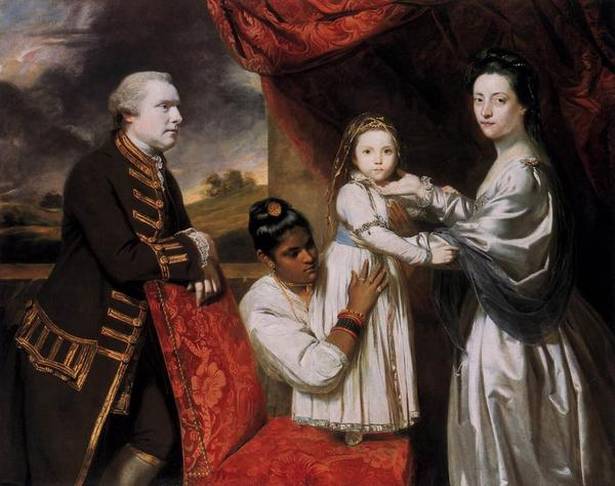
‘George Clive and his Family with an Indian Maid’, a painting by Joshua Reynolds, 1765. | Photo Credit: Wiki Commons
From the period between Peter’s baptism and John’s hanging, 15 burials and baptisms have surfaced from the various parish churches in London. Not all Indian converts to the Church of England were necessarily baptised, entailing that there may have been more Indians than registered in Christian records. That number was obviously much smaller than those Indians who did not convert at all.
Old records
Some of those who did convert, and whose names were recorded in the parishes of St. Botolphs Aldgate, St. Andrews Holborn, St Olave Hart Street, St. Edmund Lombard Street, or All Hallows Lombard Street, were: James, a servant of James Duppa, the beer-brewer; Phillip, an Indian born in Surat; Thomas, a servant of Lord Brooke; George, a servant of Robert Andrews; Trumbelo, a black Indian; Loreta, a female servant woman; Marck Anthony; Mary Alphabet, a servant of Mrs. Richardson; Joan Hill, a servant of Lt. General Hill; Daniel Mingoe, a servant of the Lady Ann Godwin; Francis Brewer, a servant of Thomas Rutter; Sarah Bamoo, a female servant; Titus Vespatian, a servant of Thomas Robinson; Thomas James Campbell, an Indian youth, and so on.
A few early examples of representations of Indians in London’s popular culture are Anthony van Dyck’s portrait (1633) of William Feilding, 1st Earl of Denbigh, saved in a forest by a turbaned Indian boy; Peter Lely’s portrait (1674) of Lady Charlotte Fitzroy being offered grapes by an Indian page; and Joshua Reynolds’ painting (1765) of George Clive and his Family with an Indian Maid, in London. Much before Charles II took the island of Bombay and a chest of tea for his dowry, in 1662, Indian servants had started working in London homes. The historian Michael H. Fisher, in his book, Indian Travellers and Settlers in Britain, 1600-1857 (2004), terms these fleets of Indians as ‘counterflows to colonialism’. During and after the Restoration, Indians in London remained in undocumented servitude. After 1657, it was easier to find them on the shores of England than on the Coromandel or the Malabar. The directors of East India Company decided that those returning to India needed an official licence, which cost £12 (about £1,500 in today’s currency). This left Indian labourers stranded in London, left to beg or offer themselves up for dockyard or domestic labour.
By the end of the 19th century, there were about 140,000 British Europeans in India. India’s population then was 330 million. According to Fisher, by the mid-19th century, thousands of Indian lascars, ayahs, scholars, soldiers, students, merchants and diplomats had travelled to Britain. Fisher suggests that the number of Indians in Britain around this time was 40,000, within a total population of about 30 million. If Fisher’s number is anything to go by, between the 19th and 20th centuries, about 0.15% of the British population was Indian. Around the same time, British Europeans accounted for less than 0.05% of the population in India. Arguably, the proportion of Indians living in Britain in the 19th century was thrice the proportion of Britons living in India. In the 1930s, Indian students accounted for 87% of all colonial students in British universities. By 1939, Indians — largely Sikhs — were conspicuous in every large British town.
The early history of the Indian diaspora in Britain is often restricted to Joseph Emin, Ihtishamuddin, or Sake Deen Mahomed — 18th century Indian travellers, diplomats, or entrepreneurs who reached London after the British conquest of Bengal. But to challenge the brute rhetoric, we need to cultivate deeper historical awareness about the Indians who lived in London nearly 500 years ago, rubbing shoulders with Shakespeare’s audiences.
The writer teaches English at O.P. Jindal Global University, and is author of The Purveyors of Destiny: A Cultural Biography of the Indian Railways.
source: http://www.thehindu.com / The Hindu / Home> Society / by Arup K. Chatterjee / August 04th, 2018
Dr. Shaik received business leadership icon award and was honored by Indian Business Professionals Council, Dubai – the award was given by His Excellency Dr. Thani Ahmed A l Zeyoudi, Minister of Climate Change & Environment and other Senior dignitaries from Indian Consulate.
For every hundred reasons, the world presented for women to sit behind without a dream, there came a thousand reasons as to why they must chase it. Dr. Nowhera Shaik, left no stones unturned whenever she got an opportunity to contribute her bit to the progress of civilization. However, what is commendable is that it was she who created these opportunities that acted as the stepping ladder to the top-shelf of empowerment, humanity and the ever-changing corporate world. Over time, she expanded her horizons and built herself a forte in several different paths of life. She is a businesswoman to look up to, founder and CEO of Heera Group, The National President of the All India Mahila Empowerment Party, an entrepreneur and most importantly a selfless philanthropist, who wakes up every day with the vision of progressing in the world of civilisation & learning to make a difference in the life of another individual.
Some of the awards and achievements of Dr. Nowhera Shaik:
1. Extraordinaire – Powerful Women Achiever by NexBrands – Brand Vision Summit 2017-2018
2. Stardust Achievers Award 2017
3. Gulfood Award – Best New Comer Brand 2016
4. Woman of Integrity and Purpose Award 2016
5. Fastest Growing Indian Company Excellence Award 2013
She also won the honorary award for ‘Best Transfer for Heera Gold Charted from UAE.’ Further, she grabbed the Antony Gold Bullion Company Limited U.K. award and the Tajir Gold Dust and Bar Ghana Limited award.
She was the proud receiver of several awards that were an evident reflection of her expertise in the world of business and her undying passion to help the people in need. With the kind of integration of knowledge and hard work, she put across, the growth of the firm was obvious.
Her selfless service to the society and her urge to ascend the ladders of corporate success and empowerment has led her to carve a path for several young women along with serving her own purpose.
About Dr. Nowhera Shaik
Ms. Shaik was born to Shaik Nanne Saheb and Shaik Bilkis in 1973. Ms. Shaikh has followed her father’s footstep from a very early age by supporting him in his business activities even during her school days. Mr. Shaikh Kolkar Madaar Saheb, grandfather of Ms. Shaikh was a successful businessman who started S.N.S. Transports in 1920 and found success in the wholesale business of vegetables, fruits, and textile products across the entire country. The high spiritual and religious cultural and business background was inherited by Ms. Nowhera Shaikh. In 1998, Ms. Shaik Nowhera started an Islamic School for girls at Tirupati Town in the name of ‘Madrasa Niswan’ (under a society registered with the Registration of Societies Act, AP, India, No: 386), with around 150 Students. Most of the students were very poor and could not even afford to buy books and uniform. She gave such poor children free education with lodging and boarding facilities.
An inspiration to many and the reason for several newfound smiles, Dr. Nowhera Shaik believes she’s only beginning her journey and that there is a long way to go before she sees the peak of it.
source: http://www.businesswireindia.com / Business Wire India / Home> New Detail / June 28th, 2018
Many Indian dishes can be traced back, indirectly, to a 16th-century, food-obsessed ruler named Babur.
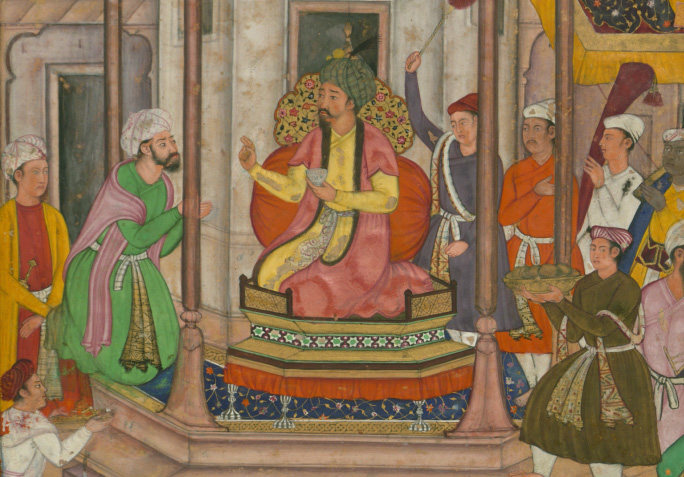
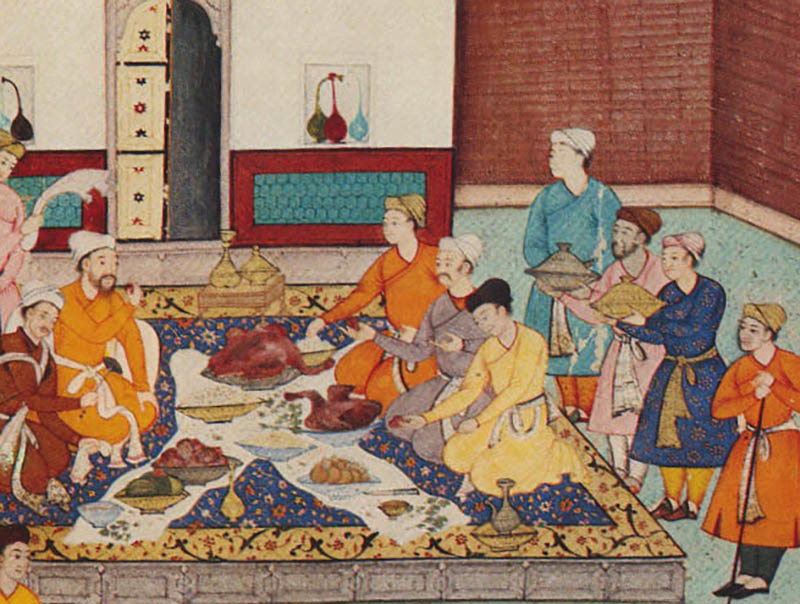
Babur Being Entertained in Ghazni, from the Baburnama, the memoirs of Ẓahīr al-din Muhammad. PUBLIC DOMAIN
ZAHIR AL-DIN MUHAMMAD, THE 16TH century Central Asian prince better known as Babur, is renowned for his fierce pedigree and proclivities. Descended from both Timur and Genghis Khan, he used military genius to overcome strife and exile, conquer northern India, and found the Moghul dynasty, which endured for over 300 years. He was a warlord who built towers of his enemies’ skulls on at least four occasions. Yet he was also a cultured man who wrote tomes on law and Sufi philosophy, collections of poetry, and a shockingly honest memoir, the Baburnama, in which he appears to us as one of the most complex and human figures of the early modern era.
Through the Baburnama, we learn that Babur was versed in courtly Persian speech and custom, yet nonetheless a populist who built strong ties with nomads and championed the vernacular Chagatai Turkic tongue in the arts. He was a pious man, but was also given to libertine escapades, including massive, wine-fueled parties.
But the first—and arguably one of the most culturally consequential—personal details he reveals is that he was a food snob. Babur loved the foods of his homeland and hated those he found when he had to reestablish himself in India, which to him was mostly a way station on the bloody road back to the melon patches of his youth. He didn’t just whinge about missing foods from home, though. He imported and glorified them in his new kingdom, laying the groundwork for his descendants to warp Indian cuisine so profoundly that they redefined that culinary tradition, as many know it worldwide, to this day.
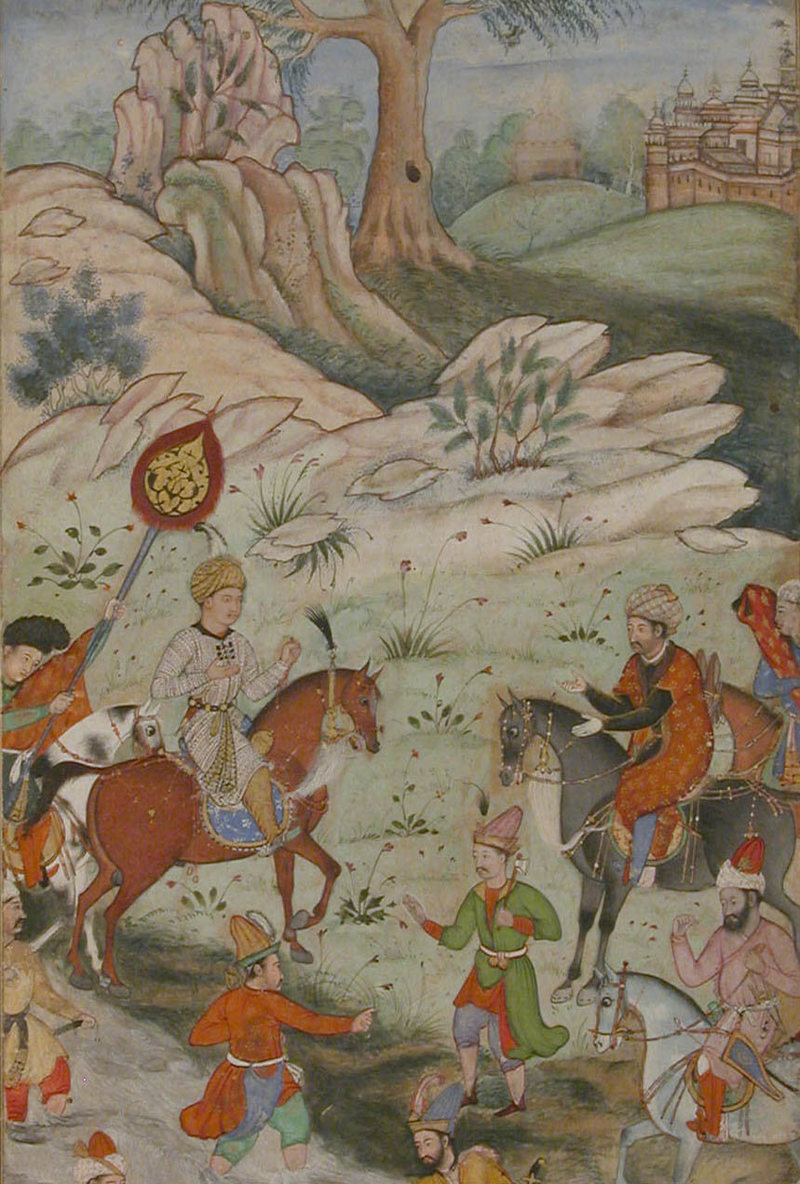
A depiction of Babur meeting Sultan ‘Ali Mirza near Samarqand, from the Baburnama. PUBLIC DOMAIN
The Baburnama opens with a description of Ferghana, a region now split between Kyrgyzstan, Tajikistan, and Uzbekistan, where Babur grew up. Known then and now as the breadbasket of Central Asia, it follows that Babur would touch on agriculture. But in introducing his hometown of Andijan, Babur opens with a note on the quality of its grapes and melons before turning his attention to its layout and fortifications. He then ducks back to praise its game meats, especially its pheasants, which “are so fat, that the report goes that four persons may dine on the broth of one of them and not be able to finish it.” Only then does he tell us of the people who live there.
Almost anytime he describes a place back home, he starts with vittles. Margilan is known for its dried apricots, pitted and stuffed with almonds. Khojand’s pomegranates are proverbially good, but they pale next to Margilan’s. And Kandbadam is tiny and insignificant, but it grows the best almonds in the region, so it’s worth mentioning.
“Early sections of his Baburnama,” writes Fabrizio Foschini, in a report on Afghanistani melons authored in 2011, “really sound like a consumer guide to the fruit markets of Central Asia.”
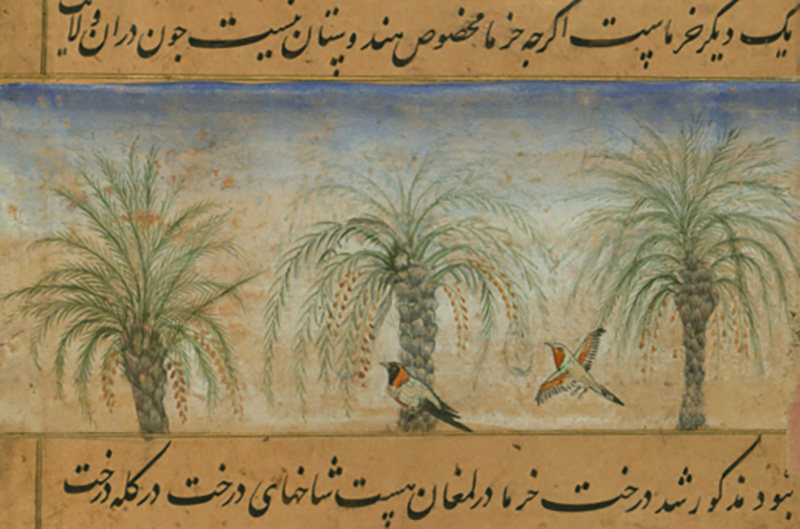
A detail of date trees illustrated in the Baburnama. PUBLIC DOMAIN
Babur doesn’t forget food once he gets into the meaty war stories, either. He breaks one narrative to note that the area around a castle he just besieged grew a unique melon with puckered yellow skin, apple-like seeds, and pulp as thick as four fingers.
The Baburnama is not solely concerned with food. The bulk of it is a painstaking record of families and feuds, and Babur dwells on other seemingly random details that tickled him, such as a courtier’s talent at leapfrog. Since we don’t have a similarly honest accounting from his peers, it’s hard to say whether Babur’s epicureanism was atypical.
Given the chaos he grew up in, though, it’s incredible that Babur could spare any thought for food. Thrust to power at age 11 (by the Gregorian calendar), in 1494, he had to navigate bloody infighting amongst his relatives. Known as the Timurid princes after their conqueror-ancestor Timur, they jockeyed against each other for regional control. Babur became an active participant in this Central Asian game of thrones—he seemed particularly obsessed with taking the regional cultural capital of Samarkand. While he seized it in 1497, he lost the city almost immediately, as well as Ferghana, and (a very long story short) spent the rest of his teenage years reclaiming or losing bits of territory, fleeing into exile with remote nomadic tribes, and trying to court new followers and surge back. Although he never stopped trying to reclaim Samarkand and his homeland, by 1504, at age 21, he’d effectively been forced out of the region for the rest of his life.
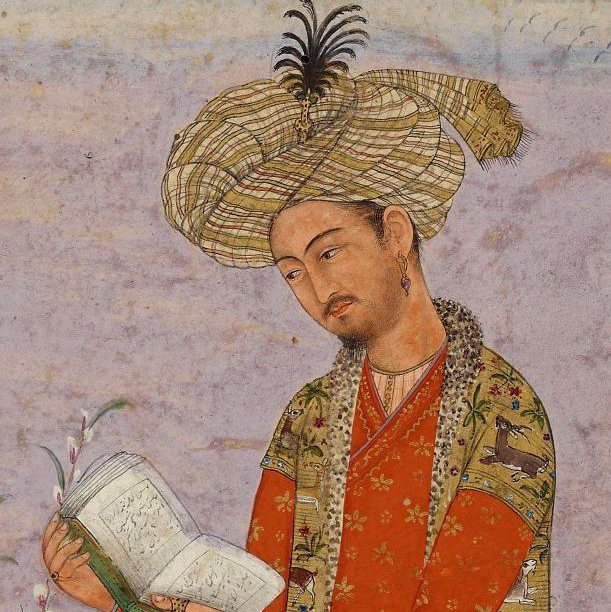
A portrait of Babur. PUBLIC DOMAIN
That year, he pulled off a fantastic feat of warlord jiujitsu, flipping a rival’s forces into his service and marching on Kabul, which was vulnerable after undergoing its own contentious power shift. Babur took the city, and, naturally, set to cultivating its produce scene. In and around the city, he built at least 10 grand gardens that included a fair number of fruiting plants.
While Babur’s writings suggest a personal obsession with food, it’s hard to disentangle this obsession from homesickness. There were also political reasons for him to pay so much attention to cuisine: Food snobbery was a standard way for a Timurid prince such as Babur to make his mark and prove his elite bona fides in a new land. “The Timurids, while ethnically Turkic, based their legitimacy to a large extent on their being champions of Persianate ‘high’ culture,” says Central Asian historian Richard Foltz, “which included taste in food.”
Kabul proved ill endowed to support a successful campaign back to Ferghana, though. So Babur turned his attention to neighboring India. He got a lucky break when a new king—an inept man who clearly had dissenters and rebels in his ranks—came to power in the northern Sultanate of Delhi. Babur struck at this weakness, invading the region through the early 1520s. Despite being outmanned by a ratio of perhaps five-to-one in his final standoff with the sultan, he usurped the throne in 1526.
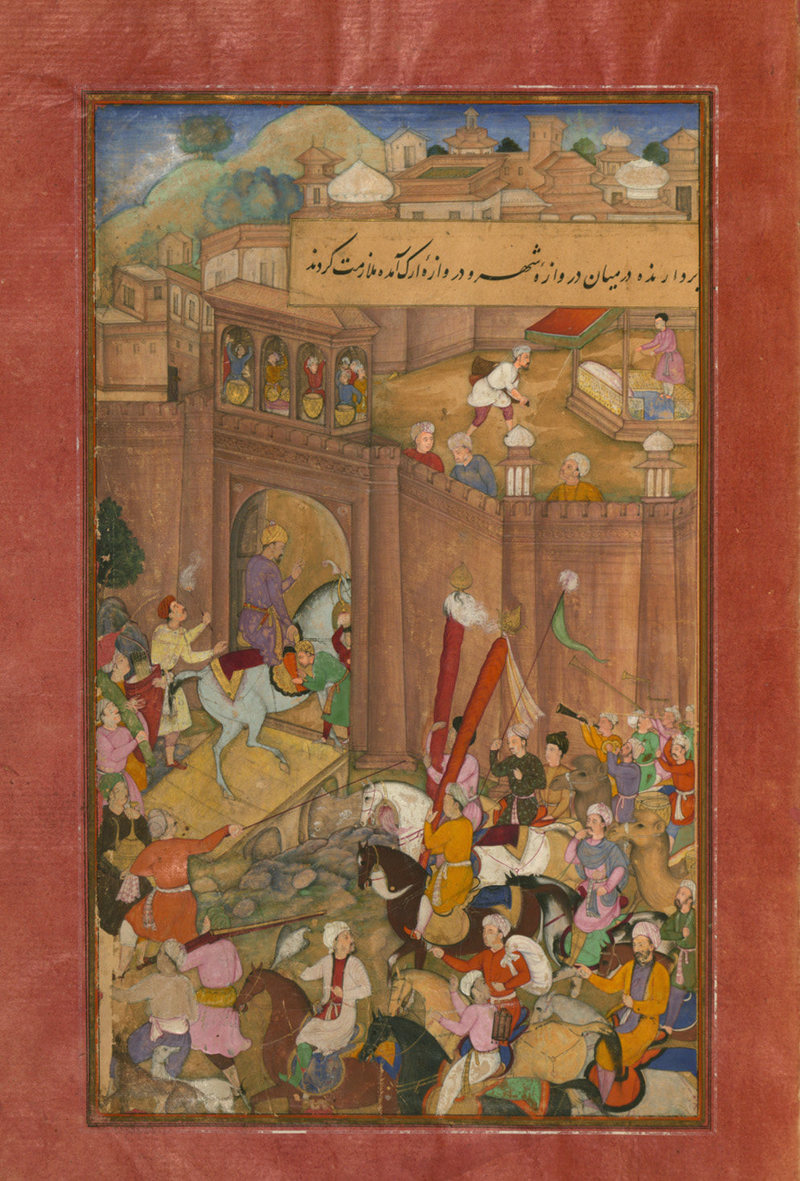
Babur entering Kabul. PUBLIC DOMAIN
According to Foltz, Central Asians mostly looked down on Indians, who were neither Muslims nor Persianate. Babur, his recent biographer Stephen Dale notes, was also still deeply homesick. These factors, and possibly personal tastes, led him to dismiss his new territory, and especially its food: “Hindustan is a country that has few pleasures to recommend it. … [There is] no good flesh, no grapes or muskmelons, no good fruits, no ice or cold water, no good bread or food in their bazaars.”
Babur shouldn’t have had time for food in India either. He spent the last four years of his life fighting local insurgencies and consolidating his power. In 1530, he died at the age of 48, in Agra, the north Indian city where his great-great grandson Shah Jahan (lived 1592–1666) would later build the Taj Mahal. But he wrote letters in those years expressing his desire to return home, or at least taste its grapes and melons. He describes receiving a melon from Kabul and weeping as he ate it. He planted Central Asian grapes and melons in India, which brought him some joy. He even asked local chefs to make Persianate food for him, although one of them tried to poison him.
By establishing supply chains that brought his native agriculture and cuisine to the region, Babur left a lasting legacy. “He probably played a role in bringing Central Asian influences into the elite, courtly Indian life,” says Elizabeth Collingham, a food historian who explored Babur’s life and influence in her history of curries .
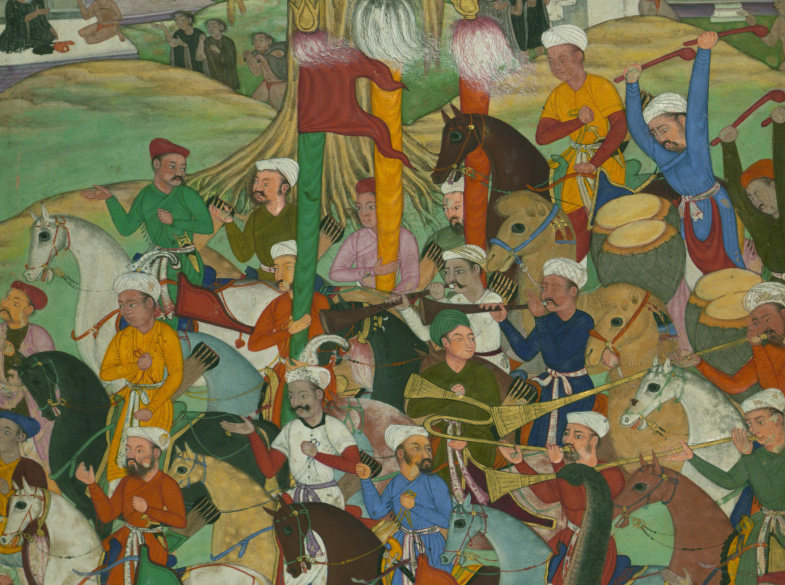
Babur, on the Way to Hindustan, Camping at Jam, from the Baburnama. PUBLIC DOMAIN
Granted, Babur was not the first Central Asian lord in what is now India. From 1206 to Babur’s day, five prior Central Asian dynasties ruled from Delhi. They too imported foods from home, cooked dishes they knew, and even did some fusion cooking. Trade and migration also meant there’d always been interplay between the regions, including culinary influence. Glimpses of this cultural mingling include the first mentions of samosas in the region’s written record—in accounts of those earlier medieval sultans’ feasts.
But according to Rukhsana Iftikhar, a historian of social life amongst the Mughals, the Persian word for “Mongols” by which Babur’s descendants came to be known, many of these dishes differed in style and flavor profile from the Persian-influenced Central Asian cuisine Babur preferred. They likely had not caught on with the general Indian population by the time Babur arrived, and few of them would sound familiar to fans of global Indian fare today.
Historians like Dale and Foltz chalk this up to the fact that previous dynasties—while they had some cultural influence—seemed to see India mostly as a piggy bank. They didn’t like to mix with local elites, and their culture was not grand or stable enough to invite mimicry and adaptation.
A banquet with roast goose. PUBLIC DOMAIN
Babur, by contrast, was more statesman than raider. His pedigree and strong connections to Iran also gave him and his descendants more cultural cachet, and those descendants mixed more readily with the local populace. And for over a century after his death, Mughal rulers continued to praise the same foods Babur praised and keep the caravans of his beloved Central Asian fruits and nuts flowing. Babur’s successor Humayun brought Persian cooks to Delhi, and Humayun’s son, Akbar, was notably cosmopolitan and curious in the kitchen. Later descendents were not as invested in Persianate culture and the foods of Ferghana as Babur. But either as a means of displaying their wealth or of brandishing the superiority of their heritage, they carried on the culinary trajectory Babur set up.
Babur’s descendants also spent lavishly on their kitchens, elevating food as a status symbol. But unlike Babur, they made it a point to round up chefs from around their Indian domains, a practice that invited fusion. The grandeur and duration of their courts, argues Collingham, led local elites to copy their Persianate and Central Asian motifs and augment their own kitchens, leading to parallel fusion work in places like Hyderabad, Kashmir, and Lucknow. Over the centuries, these innovations coalesced into Mughlai food, a stable cuisine common across, although not ubiquitous in, northern India by the early 20th century.
This cuisine was defined by, among other things, aromatic, creamy curries, often incorporating the nuts and dried fruits Babur adored. It includes many dishes familiar to Western diners today: Korma, a blend of Central Asian nuts and dairy with Persian and Indian spices. Rogan Josh, a slow-cooked, Persian-style meat spiced up in the kitchens of Kashmir. And tandoori grilling, facilitated by Mughal tweaks to said grills and to marinades and spicing styles.
These dishes became ubiquitous in the West, Collingham says, because haute Indian chefs have long viewed Mughlai cooking the same way Western cooks used to see Le Cordon Bleu. Indians who set up restaurants abroad made Mughlai food the template of Indian food in the U.S. and U.K.—to the chagrin of Indians who grew up eating many other cuisines that remain hard to find outside their homelands.
None of this was a conscious project for Babur. But by setting up shop in Agra and Delhi, he created a wave that shook the foundations of India, culinary and otherwise. His tastes indirectly fueled 300-plus years of kitchen innovation. It’s no Central Asian dynasty of skulls and melons. It’s something more widespread and enduring, if unexpected or unwanted.
Gastro Obscura covers the world’s most wondrous food and drink.
source: http://www.atlasobscura.com / Atlas Obscura / Home> Stories / by Mark Hay / November 15th, 2017