A three-day international seminar on Indo-Iranian Persian Literature organised by the Department of Persian began at the University of Kashmir in the auditorium of Ibn e Khuldun Alama Iqbal library on Thursday.
The theme of the seminar is “emergence of moral and ethical values in Indo-Iranian Persian literature and its relevance in modern times”.
The scholars and professors from different countries of the world have taken part in the 3-day seminar to present their research papers and to share their experiences with the students, various scholars and professors from the different states and different universities including Delhi, Lucknow has also participated.
The seminar was started with the recitation of Holy Quran by Dr Shanawazz shah followed by the naat by Syeda Mysooma.
Vice Chancellor Prof Khurshid Iqbal Andrabi presided over the seminar, addressed the guests and welcomed them with his warm speech.
In his presidential address, Prof Andrabi said that morals are the basic requirement of an individual, and is very fascinated by the beautiful culture, language of Iran.
Dr Jehangir Iqbal, Coordinator, Department of Persian, underlined the aims and objectives of the seminar and also highlighted the achievements of the department over the years.
Prof Shaief Hussain Qasmi delivered the keynote address.
Dr Ali Raza Ghazvey, Director literary Innovative center Academy of Art Tehran, Iran said: “it seems that we have entered a little Iran with the same culture that we are sharing with each other and the effect of Awraadi Fatah by Mir Syed Ali Hamadani ( rah) has kept the lost glory intact.”
Another guest and professor from the University of Kabul Afghanistan while presenting his research paper and sharing his experience with the students present there said: “we must look to the Persian language, not as an option but we must take it as the objective.”
Meanwhile, Arif Ayoubi who is a chairman Fakhhur Din Ali Ahmad committee said that the best students and scholars will be awarded the gold medals and some cash where they also would be helped and guided in future.
Now the next 2 days of the international seminar will be dedicated to the students and scholars from various faculties and universities to present their papers during these 2 days.
source: http://www.kashmirlife.net / Kashmir Life / Home> Kashmir Latest News / by KL News Network / June 21st, 2018
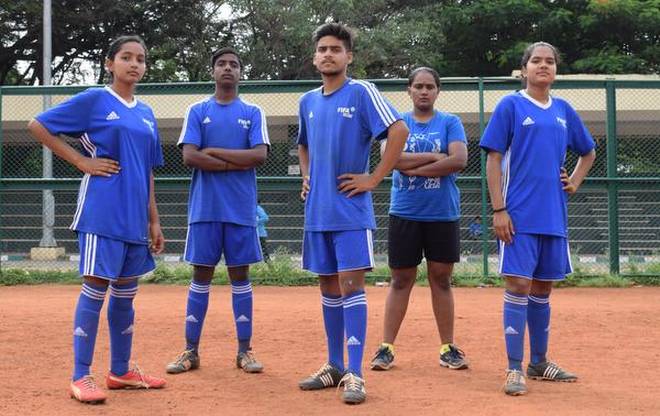
Amreen Taj, Vishnu R., Sandeep Akash P., Anitha Raju (trainer) and Manasa Yadav K. will be taking part in the Football for Hope Festival 2018 in Russia.
Four children from underprivileged communities have been selected to participate in the FIFA Football Fest
When 16-year-old Sandeep Akash, a resident of Byatarayanapura, told his mother that he had been selected to travel to Russia to play football and watch the FIFA World Cup, his mother dismissed it as a tall tale. She asked him not waste her time with silly jokes. It was only after his trainer called and assured his parents that their son had been selected to play football in Russia were they convinced.
Sandeep will be travelling to Russia along with three other teenagers — Amreen Taj, Manasa Yadav K. and Vishnu R. — to take part in the ‘Football For Hope Festival 2018’, an official event of the 2018 FIFA World Cup.
He is the first person in his family to be travelling abroad. His father, a painter by profession, encouraged him to pursue his interest in sports, but never thought that his son’s hobby would turn out to be this eventful.
The festival brings together children from various communities across the world, with a focus on social development. Around 48 teams will be participating in the programme from June 25 to July 5. Children will get to play football with their peers from various countries and will also attend leadership programmes. They will also get to watch one of the ongoing World Cup matches.
Sandeep and his friends, who were part of the NGO Dream A Dream’s after-school life skills programme, were chosen as delegates. They are the first in their families to get the opportunity to travel abroad. While Amreen and Vishnu’s fathers work as mechanics, Manasa’s father works as a driver.
The NGO is one of the two organisations selected from India by FIFA to take part in the event.
“We selected children with great potential who lacked avenues to exhibit their capabilities. We have been helping them work on their nutrition and fitness after the selection was done. For the last four months, the children have been practising for at least three hours every day, making time for football in their school schedule,” said Anitha Raju, trainer for the children and employee of Dream A Dream. These four children were shortlisted from 2,200 candidates across 28 schools in the city.
To play football was a big step for Amreen. “Usually, girls are not encouraged to take up a sport like football. Initially, everyone was sceptical. But after watching me, my brother and sister are very proud of me. I want to help more girls in my community take up this sport,” she said.
According to Sucheta Bhat, CEO of Dream A Dream, the football match that the children will be playing will have a set of unconventional rules (which the children themselves will come up with), with the primary aim of building leadership and cooperation. “This is the second consecutive time that our organisation has been selected,” she said.
All the four children said they want to pursue football training as a career and help more children from local communities realise their potential.
“It’s not only about the game. I have benefited by improving my communication skills and overall discipline,” said Vishnu.
Manasa said that she has gained focus in life. “Earlier, I used to be lazy. I see a huge transformation in myself. I want to pass on the benefit to more youngsters,” she said.
source: http://www.thehindu.com / The Hindu / Home> News> Cities> Bengaluru / June 20th, 2018
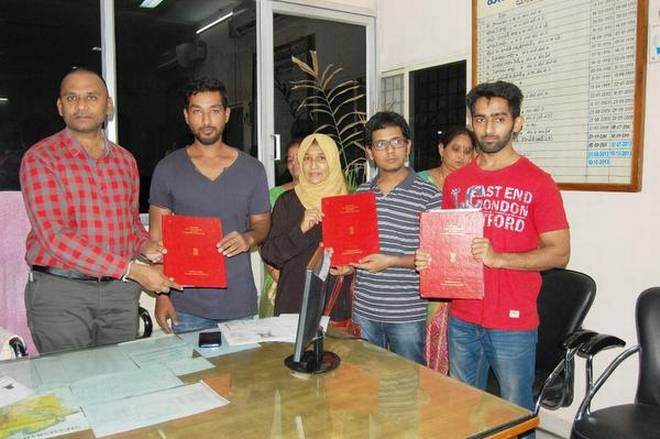
Revenue Divisional Officer T. Vinod Kumar handing over Indian citizenship documents to Sanan, Ruman and Saif at his office in Nizamabad on Tuesday.
The brothers, born to Indian mother and Pakistani father, applied for citizenship eight years back
Three Pakistani nationals – Mohammed Sanan, 29, his younger brothers Ruman, 27, and Saif, 25, were granted Indian citizenship by the Government of India. Revenue Divisional Officer T. Vinod Kumar handed over the citizenship copies to them in the presence of their mother Faiz Unnisa here on Tuesday.
After the perusal of their applications for citizenship, the Ministry of Home Affairs issued orders.
The orders were issued under Section 5(1)f of Citizenship Act-1955 on April 24 approving their appeal. The citizenship document copies No:243; 244; and 245 subsequently were sent to the district authorities.
They had applied for citizenship some eight years ago.
Ms. Faiz, daughter of late Hafeez Abdul Rehman and Samdani Begum, married Mohammed Abdul Nadeem Javed of Bahawalpur in Punjab province of Pakistan in 1988. After marriage, she moved to Pakistan, but did not give up her Indian citizenship. All her three sons were born there. After divorcing her Pakistani husband in 2004, she moved to Nizamabad along with her three sons and they have been staying here on a long term visa (LTV).
Refusing to reveal the details, Ms. Faiz and her children immediately left the RDO chambers after receiving the citizenship documents.
According to sources, she, along with her children and her siblings, has been running a private school in the old city for several years now. Meanwhile, Bharatiya Janata Party (BJP) activists arrived at the RDO office to stage a protest against giving citizenship to the trio. Realising that they had already left, they called off the protest.
When contacted, District Collector M. Ram Mohan Rao said the Government of India granted the citizenship to the three Pakistani nationals only after being convinced that there will not be any law and order problem with them. “I hope there will not be any problem from them, and or to them from anyone. Anyway, I will take the issue to the notice of the Commissioner of Police as regards their protection,” he told The Hindu.
source: http://www.thehindu.com / The Hindu / Home> News> Cities> Hyderabad / by Special Correspondent / Nizamabad , June 19th, 2018
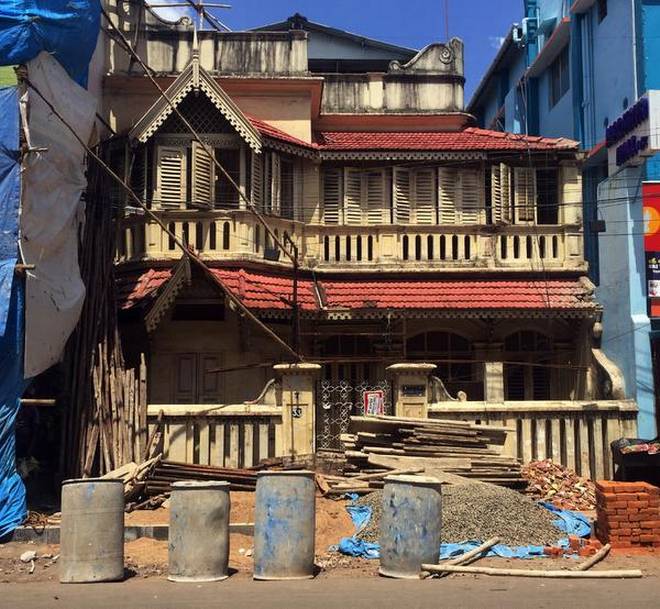
One of the projects taken up by the Triple O Studio
Any mention of Chennai’s architectural marvels instantly brings to mind large, red public structures built in the Indo-Saracenic architectural style. But, there is more to the city’s architectural history in its residential areas.
Madras Inherited, an initiative of a group of architects and volunteers, aims to unravel these hidden architectural gems through heritage walks and document the fast disappearing residential structures in the city.
Spearheaded by Triple O Studio, an architectural firm, Madras Inherited will focus on small residential buildings across the city that have gone unnoticed unlike public heritage structures. While Chennai has some of the finest Indo-Saracenic structures, it is also a confluence of many intriguing architectural styles that the group will research and map through a series of walks.
Tahaer Zoyab, architect and co-founder of Madras Inherited, said a project to document the old houses of Mylapore came as an eye-opener to the vanishing heritage in the city. “The character of the interior lanes is fast changing and we wanted to share the stories with people before residential buildings disappear and also document the rich legacy,” he said.
The team has so far documented architectural designs of about 50 houses in Mylapore. “We have traces of Neoclassical, Gothic and Art Deco styles in structures across the city. We can still find traditional vernacular architecture in some of the Agraharam houses of Mylapore, Tiruvanmiyur and Triplicane,” he said.
Classic example
George Town, one of the older settlements in the city, presents a classic example of a confluence of different styles. Dare House in Parrys Corner, for instance, is designed in the Art Deco style in which there is an emphasis on vertical lines and the distinct design of a ‘sunburst jaali’ for ventilation, Mr. Zoyab pointed out.
Such intricate details imbibed in residential and private building architecture will be documented and shared with heritage enthusiasts in the city. Madras Inherited will focus on cultural tourism and heritage education and management through a series of interactive events like photo walks in historical areas. The initiative will be launched on June 16 with a walk through the lanes of Royapettah, where participants will get to decode the architectural history of the area. The walk that starts at 6.30 a.m. will cost adults Rs. 700 and students Rs. 450. Participants get to take home a bag of custom-made souvenirs, ranging from coasters to bookmarks.
The locality has a range of styles from Agraharam houses, traces of Gothic design and Islamic-style houses. The proceeds from these walks will be used to fund the mapping and documentation of city’s heritage structures. There are plans to expand to areas like Periamet, Vepery and George Town after September.
For details on the walk, send an e-mail to mail@madrasinherited.in or contact +91-8939135048.
source: http://www.thehindu.com / The Hindu / Home> News> States> Tamil Nadu / by K. Lakshmi / Chennai – June 15th, 2018
Nellihudikeri Village, Siddapur (Kodagu Distrct), KARNATAKA :
Madikeri:
A farmer and a vintage car collector died after a tree branch fell on him at Nellihudikeri village near Siddapura in Kodagu district yesterday.
The deceased, 67-year-old P.C. Ahmed Kutti Haji, was working in his Mubarak Estate along with his son Ashraf at around 11.30 am. Due to heavy rain and wind, a branch of a banyan tree fell on Ahmed Kutti. He was immediately rushed to a hospital. But he succumbed to his injuries in the hospital. Kodagu Deputy Commissioner P.I. Sreevidya has announced Rs.5 lakh compensation to his family. She sent the cheque through the Tahsildar.
With his death, Kodagu has lost a collector of Vintage ‘beauties
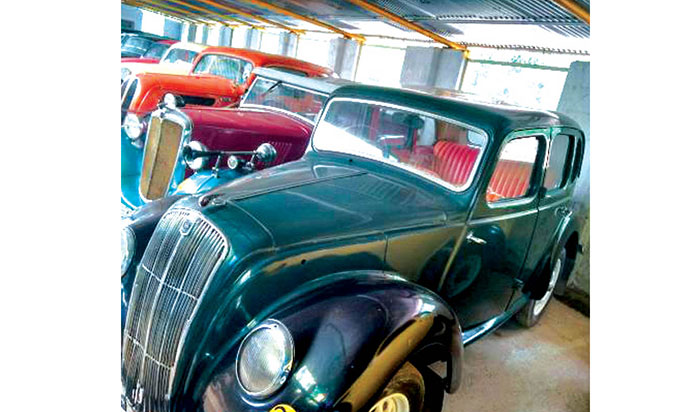
Ahmed Kutti Haji is a coffee planter and also an industrialist. He has a huge collection of vintage cars which he threw open to public. Collecting vintage cars was a hobby for Ahmed who has 86 of them and over 15 vintage petrol jeeps. Not to stop there, he also has 20 old two-wheelers, a 125-year-old bicycle and a 200-year-old bullock cart. The oldest car in the collection is 1925 model.
Normally vintage car collectors eye Bengaluru to add cars to their collection. Changing the trend, Ahmed focussed on old workshops in Kodagu and surrounding areas to hunt vintage ‘beauties.’ After picking them, Ahmed gave old cars a fresh coat of paint and tuned them to working condition.
Almost all foreign cars owned by Ahmed were manufactured between 1925 and 1965. Barring Dharmasthala, no other place in the State has such a wide collection of vintage cars.
With his death, Kodagu has lost a vintage automobile enthusiast.
source: http://www.starofmysore.com / Star of Mysore / Home> News /June 10th, 2018
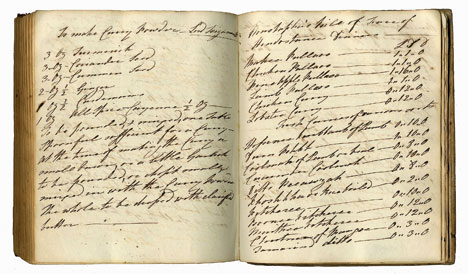
RICH DIET: A handwritten cookery manuscript containing a glimpse of the menu from England’s first Indian restaurant has sold for $11,344 (Rs 7.6 lakh) at a London book fair.
It refers to dishes like “pineapple pullaoo” and “chicken currey” from the Hindoostane Dinner and Hooka Smoking Club, opened in 1809 at Portman Square, London, by Sake Dean Mahomed, whose roots lay in Bihar.
“This is the first known record of a priced menu from Britain’s first Indian restaurant – at a time when printed menus were rarely available,” said Brian Lake of Jarndyce Antiquarian Booksellers in London, which sold the volume at the ABA Rare Book Fair to an American institution last month.
The manuscript, titled Receipt Book 1786 on the front, also contains handwritten recipes and receipts. It includes a two-page “bill of fare” from Hindoostane, listing 25 Indian dishes with prices.
These include makee pullaoo (1.1.0 pounds), pineapple pullaoo (1.16.0 pounds), chicken currey (0.12.0 pounds), lobster curry (0.12.0 pounds), coolmah of lamb or veal (0.8.0 pounds), together with breads, chutneys and other dishes.
It ends by noting that there are “various other dishes too numerous for insertion”.
Towards the end is a recipe “to make a curry powder”, attributed to Lord Teignmouth (1751-1834), who was governor-general of Bengal between 1793 and 1797 and later became a patron of Mahomed’s restaurant.
Mahomed went bankrupt in 1812, and the eatery struggled on as Hindostanee Coffee House under a new management before disappearing in 1833.
source: http://www.telegraphindia.com / The Telegraph,Calcutta,India / Home> India / PTI / June 04th, 2018
In the heart of Hazratganj, at the cut which turns into Lalbagh, stands a large bank. The cars and two-wheelers parked there spill onto the road. There are vendors, mechanics, and just people waiting to go back into the bank when the clerk beckons them. The atmosphere looks like any bland public sector office.
However, a few steps into the compound will lead you to a large colonial-era house. The exterior is yellowing, the plaster is coming off but the sheen of its wooden door frames is intact. The windows, too, retain the same glass, broken at several places but reflecting, literally, the charm of what the house must have seen through the years.
Called No. 2 Mall Road by the family that lived there and generations after it, the house did not belong to ordinary people. It was the abode of one of the finest writers Lucknow has produced.
Author Attia Hosain was born in that house in 1913 and lived there for the first 19 years of her life. Traces of the house are found in her only but much acclaimed novel, ‘Sunlight on a Broken Column’. It is also part of the Masters’ in English syllabus at Delhi University.
“The front part was my grandfather’s domain — a big study filled with books. Here he entertained visitors. The rear part of the house was my grandmother’s domain. Behind the house was a garden. There was a second house, called the small house, but in fact two stories high, and each of the children had their own rooms,” says Shama Habibullah, Attia’s daughter, now 75 years old. She is a filmmaker and lives in Mumbai. She spent a large part of her childhood there.
The house was sold to government in 1956. Attia’s older brother sold it because zamindari was abolished and no one had the means to maintain a house of that size. Besides, he was nominated for foreign service and had to leave India. “No matter how much we miss it, at that time, selling the house was the best solution and it was the right thing to do,” says Shama.
Eighty-six year-old Shahid Mushir Kidwai was born in No. 2 Mall Road in 1929. “I lived there for the first 10 years of his life. I used to go to La Martiniere College from there,” says Kidwai, the son of Attia’s eldest sister. Attia khala is special to him. “She loved me dearly. When my mother was carrying me, she felt it would be a daughter but Attia khala said she would have a son. When I was born, Attia khala was delighted.”
Kidwai vividly remembers Attia’s wedding in 1933. “Her husband Ali Bahadur Habibullah’s family lived across the street in Hazratganj. He was my aunt’s son. We used to have lot of fun running across both houses. It was a beautiful wedding.” Many characters in Attia’s stories are people Kidwai saw in his childhood. “From a servant we had to a pet dog, many have figured in her stories on some form or the other,” he says. Not only the family, but several homeless and destitute people lived in that house, that had exquisite Carrara marble floors. “After it was sold, whenever my mother, her siblings or their children passed by that side in Ganj, they never looked at the house. Such was the pain of losing it,” he says. “It is a period piece. It could have been a heritage building. Now, there is a garbage heap in front of it. People spit against the walls. It is sad,” says a family member.
Attia left India in 1947 when her husband was sent on an assignment to England. However, they never knew they wouldn’t come back. “The Partition of India was a major setback to her. She was distraught. She didn’t want to see the pain of partition in India. Hence, she stayed in Britain.
But Lucknow never left her,” says Shama. There is a poem, The City, by CP Cavafy. That best describes her bond with Lucknow, she says. The memories of Lucknow that Attia instilled in Shama are what brought Shama back to India. In the 1990s, when she was not in the best of heath, there were restrictions on her food. However, during a trip to Lucknow, she asked for kebabs and they did her no harm. Instead, she gained healthy weight and felt much better. “It wasn’t disease but the atmosphere that made her unwell. The atmosphere of Lucknow cured her,” says a member of the family.
Attia died in January 1998 in England.
In 2013, Shama and her brother filmmaker Waris Husein organized a small function to mark her centenary year. That was their last visit to Lucknow. There were films, book readings and recordings at the event. About the house, Shama says, “The house is a symbol of a Lucknow kept alive only in writings and memories. Attia took these memories to the world. She made the story of her displacement a story of everyone else.”
Attia’s works Phoenix Fled, 1953 Sunlight on a Broken Column, 1961 Cooking the Indian Way, 1967 Distant Traveller: New and Selected Fiction, 2013 (Chapters from an unfinished novel and unpublished stories)
The last work The last literary piece Attia created was not written but recorded by her. It was for a compilation called “Voices of the Crossing”. It was about the impact of Britain on writers from Asia. Due to ill-heath and failing eyesight, Attia recorded the chapter “Deep Roots” and it was transcribed and printed in big fonts for her to verify. She spoke of Partition in it. “This can be termed her last work,” says Shama
Shakespearean Urdu at BBC Attia was a born actor, Shama says. Working for the Urdu Service of BBC in England, Attia was once playing Lady Macbeth. The iconic dagger scene, Shama says, is one she can never forget. “Khoon, khoon”, she went. This was Shakespearean Urdu I was listening to on BBC.” She adds in the same breath that it was unfortunate that AIR, in 1995, could not record her when she visited Lucknow. “My mother and I went to AIR for a possible recording show but they said their tape recorder wasn’t working!”
source: http://www.timesofindia.indiatimes.com / The Times of India / Home> News> City News> Lucknow News / TNN / January 17th, 2016
Attia Hosain, writer: born Lucknow, India 20 October 1913; married Ali Bahadur Habibullah (one son, one daughter); died London 23 January 1998.
The people who came to see Attia Hosain honoured at a book launch a few weeks ago could have been forgiven for expecting a subdued and fragile old lady. After all, Hosain was 84, had had a long and turbulent life and for years had been in poor health. The launch demanded nothing of her but that she sit on stage as a sort of icon and accept the homage of her admirers, while her daughter – the film producer Shama Habibullah – read from one of her mother’s early World Service pieces.
But Hosain was not one to sit back passively letting encomiums wash over her. Despite her physical difficulties, she immediately engaged with her audience, vividly sharing her emotions and memories. Her indomitability and eloquence swept problems aside, with a degree of hauteur and a magnificent sense of style.
Those qualities must have stood her in good stead. She was born in 1913 into an aristocratic family in Lucknow – a city that is a byword for Muslim scholarship and culture. From her father she inherited a keen interest in politics and nationalism. From her mother’s family of poets and scholars she drew a rich knowledge of Urdu, Persian and Arabic. Her knowledge of English came from an English governess, and subsequently as one of the few Indian girls at an English medium school. She was the first woman from her background to take a degree at Lucknow University.
From early on she was a communicator, first through feature articles for Indian papers, the Pioneer and the Statesman, and membership of the radical Progressive Writers’ Movement. The fiction came later, as a result – she recently speculated – of politics and dislocation.
In 1947, when India was partitioned into India and Pakistan, Hosain was in London with her husband, who had been posted the year before to the High Commission. The division of the two countries and the separation of two religious communities caused her great pain. Immensely proud of her heritage as both a Muslim and an Indian, she chose to remain in England and bring up her daughter and son – now the film director Waris Hussein – on her own. The change brought her a career as a regular broadcaster with her own women’s programme on the BBC World Service and a new perspective.
But the sense of damaged cultural roots never fully died away. “Here I am, I have chosen to live in this country which has given me so much; but I cannot get out of my blood the fact that I had the blood of my ancestors for 800 years in another country.” It was that, she said in her last piece – to be published in an anthology later this year – that drove her to write.
In 1953, Chatto and Windus brought out her book of short stories Phoenix Fled. Eight years later came Sunlight on a Broken Column, an evocative and carefully detailed novel which traces, via the story of young Laila, a society in transition. It was over 20 years, however, before the book was widely recognised. Brought out of oblivion by Virago in their splendid Modern Classics in 1988, it re-established Attia Hosain in the public eye and gave her a platform which she embraced with zest.
– Naseem Khan
source: http://www.independent.co.uk / Independent / Home> News> Obituaries / by Naseem Khan / February 05th, 1998
Muslim women who were at the forefront of the nationalist and feminist discourse in the country, during and after the independence movement, were eventually overlooked or excluded from the mainstream narrative.
MWF exhibition featured 21 Muslim women who contributed to nation-building during and after the independence struggle. Credit: Khushboo Kumar
New Delhi:
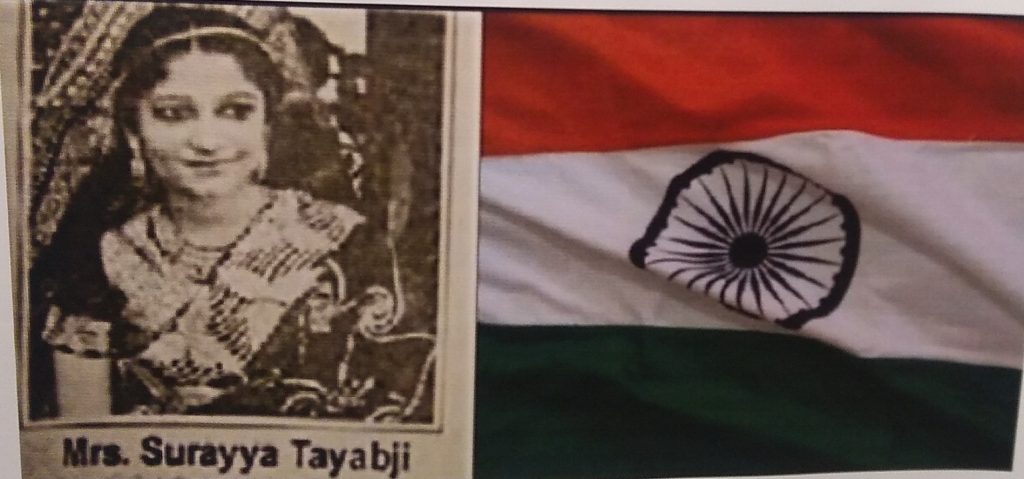
Most Indians today may not be aware that the national flag was designed by a Muslim woman, Surayya Tayabji, an active member of the Indian National Congress. Jawaharlal Nehru assigned this task to Tayabji, and it was her idea to replace the symbol of the charkha used and popularised by Mahatma Gandhi with that of Ashoka Chakra at the centre of the flag. Tayabji felt that the charkha, a symbol of the Congress party, might appear partisan.
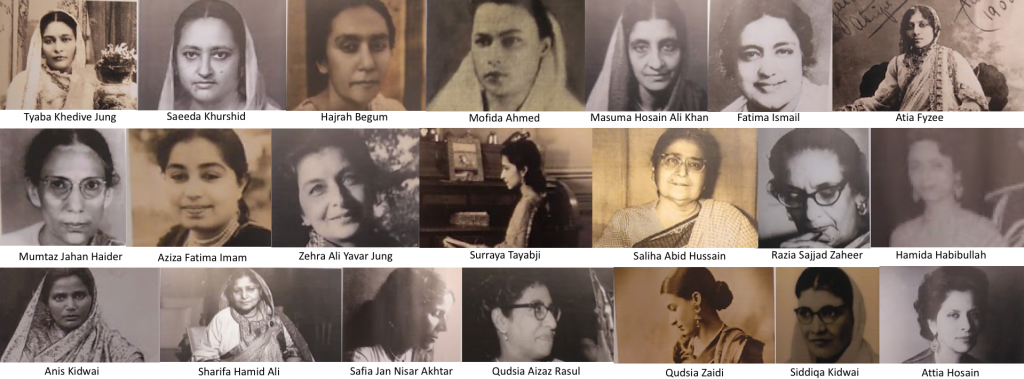
Narratives like this – often forgotten or lost in public memory – were the central theme of a colloquium that was organised by the Muslim Women’s Forum (MWF), an organisation engaged in the advocacy of Muslim women’s rights. Titled ‘Pathbreakers: The Twentieth Century Muslim Women of India’, the colloquium held in partnership with UN Women showcased the achievements of 21 Muslim women in various spheres of public life during and after the independence struggle.
Other women who featured in the exhibition included Saeeda Khurshid, Hamida Habibullah, Aziza Fatima Imam, Qudsia Zaidi, Mofida Ahmed, Zehra Ali Yavar Jung, Razia Sajjad Zaheer, Tyaba Khedive Jung, Atiya Fyzee, Sharifa Hamid Ali, Fathema Ismail, Masuma Hosain Ali Khan, Anis Kidwai, Hajrah Begum, Qudsia Aizaz Rasul, Mumtaz Jahan Haider, Siddiqa Kidwai, Attia Hosain, Saliha Abid Hussain and Safia Jan Nisar Akhtar.
The speakers participating in the discussion talked about the need to reclaim the lost narratives of Muslim women and take control of their representation.
Speaking on the occasion, Seema Mustafa, an Indian print and television journalist, pointed out that these women would not fit even the current stereotypical representation of hijab-clad, oppressed and orthodox Muslim women, who need a messiah to rescue them. Mustafa, in her keynote address, said that these women had broken barriers and challenged patriarchal order in their time; they followed Islam in its liberal spirit, refusing to be shackled by societal norms. Most of them abandoned the purdah system, she said.
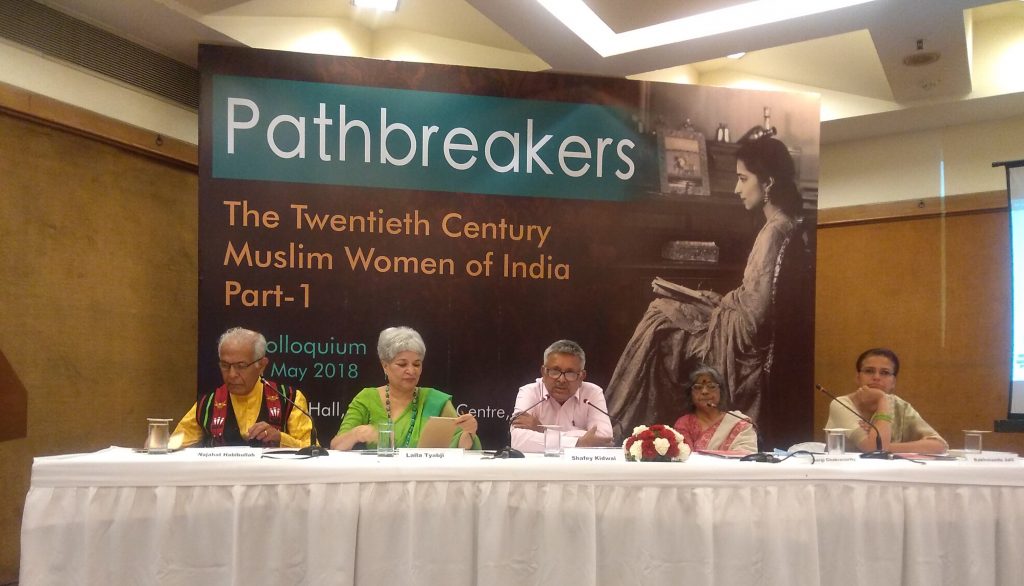
Speakers panel for the session ‘Recognising and Nurturing Pathbreakers’ at Muslim Women’s Forum colloquium. Credit: Khushboo Kumari
Stereotypes in modern India
The speakers insisted that the reality was and still is that Muslim women, just like women belonging to any other socio-cultural group in India, do not constitute a monolithic, homogenous entity. They come from diverse backgrounds and subscribe to varying ideologies. Muslim women have been and still are writers, teachers, artists, scientists, lawyers, educators, political workers, legislators in parliament and in assemblies. The speakers said clubbing them under the generic rubric of backwardness was a misrepresentation.
As the regular use of terms like triple talaq, halala and purdah has come to demonstrate subjugation of Muslim women, Islam has acquired the status of the most oppressive religion for women, the speakers said. Muslim women have become an object of pity.
Commenting on Islam and feminism, Farida Khan, former dean of education at Jamia Millia Islamia and former member of the National Commission for Minorities, pointed out that gender oppression is common to all religions. “Why should Islam have the burden of taking on feminism?” asked Khan. She further explained that Islam should be perceived and understood in the social and historical context of the day. Every religion has to and does evolve with time.
Referring to the exhibition, Khan said, “It makes me sad to think that you need to have an exhibition and you need to project these women in a country where they should be well known, where they should be part of the mainstream, where everybody should know their names and know the work they have done.”
Gargi Chakravartty, former associate professor of history in Maitreyi College and author, said, “Muslim women’s political and social contributions in the pre-independence period during the major Gandhian movements or in the field of spreading education, or in the sphere of literary activities, cannot be erased from history.” She shared many anecdotes that came up in her own research about largely unknown Muslim women who have extensively worked among the poor throughout the 20th century and still continue to do so.
An eminent speaker at the colloquium, Rakshanda Jalil, recently wrote a book A Rebel and Her Cause on the life of Rashid Jahan. Jalil spoke of the inspiring life of Jahan, who was a doctor, writer, political activist and member of the Communist Party of India.
Farah Naqvi, member of the Post-Sachar Evaluation Committee (Kundu Committee) 2013-2014, summed up the purpose of the colloquium and the exhibition. “This colloquium is a response. There is a nostalgia about it. But it is not just about the nostalgic nawabi Muslim. It has a political purpose, the colloquium, which is that you cannot allow any one strand of history to be obliterated from this country. Any strand. It could be Muslim women today. It could be someone else tomorrow,” Naqvi said.
Questioning if Muslim women needed to be forced into a separate constituency, Naqvi said it was indeed a tragedy that these women’s contributions were not a part of mainstream knowledge – and that reflected failure on the part of Indian historiography.
Naqvi also pointed out that the undercurrent of the entire exhibition was nation-building because they were “also responding to a moment when Muslims are repeatedly being told that they are ‘anti-national’”. She further explained that against such a background, the Muslim community in general should not take the bait of proving that they are ‘good’ nationalists. Instead they should take pride in the achievements they have made in their respective spheres of work – especially for those who stayed on in India after the Partition.
Wajahat Habibullah, India’s first chief information commissioner and the son of Hamida Habibullah, one of the 21 women featured in the exhibition, talked about Partition and how it divided his family. He said, “It is necessary to remember and nurture the memories of all those Muslim women who then very consciously, despite family pressure and contradictions within the family, opted clearly to be a part of India”.
Contribution to literature, politics and education
The exhibition showed how extensively Muslim women have contributed in the spheres of politics, literature, education and social work.
Many like Saeeda Khurshid, founder of the Muslim Women’s Forum, actively campaigned for the Congress party. Hamida Habibullah was the the president of the Mahila Congress. Few like Aziza Fatima Imam, Fathom Ismail, Anis Kidwai, Siddiqa Kidwai and Qudsia Aizaz Rasul were members of the parliament and legislative assemblies for years.
Rasul was also the only Muslim woman member of the constituent assembly.
Sharifa Hamid Ali founded the All India Women’s Conference (AIWC), with the likes of Sarojini Naidu, Rani Rajwade and Kamaladevi Chattopadhyay, and was involved in its work alongside others like Masuma Hosain Ali Khan and Hajrah Begum – who also founded the National Federation of Indian Women.
These women actively worked with the poor and marginalised sections of society, trying to improve their access to health and education.
Zehra Ali Yavar Jung, who was awarded the Padma Bhushan in 1973, worked to improve the condition of women detainees in Hyderabad’s prisons and presided over a women’s workshop that trained and provided employment to destitute women. Fathom Ismail helped in opening rehabilitation clinics for children suffering from polio. Anis Kidwai worked tirelessly in refugee camps after Partition.
Surayya Tayabji and the Indian national flag displayed at the MWF exhibition. Credit: Khushboo Kumari/The Wire
Mumtaz Jahan Haider, who was appointed the principal of the Aligarh Women’s College in 1937, worked for women’s education her entire life.
Sharifa propagated legal reforms for Muslim women, including raising the age of marriage and drafting a model marriage contract ‘nikahnama‘.
In the field of literature and arts, these women won multiple awards. Razia Sajjad Zaheer, the recipient of the Nehru Award and Uttar Pradesh State Sahitya Academy Award, wrote novels like Sar-e-Sham, Kante and Suman. Anis Kidwai recieved the Sahitya Kala Parishad Award.
Attia Hossain used to write for Pioneer, Statesman and Atlantic monthly and wrote several novels, most notably Sunlight on a Broken Column and a short story collection Phoenix Fled. Aliya Fyzee wrote Indian Music (1914), The Music of India (1925) and Sangeet of India (1942) with her husband.
Qudsia Zaidi wrote and translated books for children, with Chacha Chakkan ke Draamae among the most loved ones. She also founded Hindustani Theatre in 1954, the first urban professional theatre company in independent India.
Khushboo Kumari has a BTech in information technology and is pursuing an MBA in marketing from MICA, Ahmedabad. She is an intern at The Wire.
source: http://www.thewire.in / The Wire / Home> History> Religion> Women / by Khushboo Kumari / May 30th, 2018
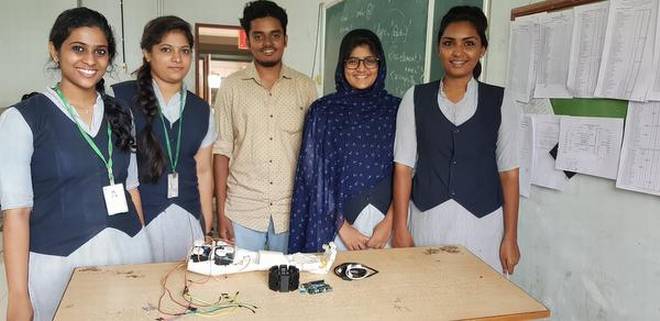
Students of Toc H Institute of Science and Technology, Arakunnam, with the Electromyography-controlled prosthetic arm that they developed.
It will meet the basic daily requirements of an amputee
Five engineering students of Toc H Institute of Science and Technologyat Arakunnam near here have come up with an Electromyography (EMG) controlled prosthetic arm.
The students – Mereena Baby, Aysha Zenab Kenza, Nikitha Sajan, Lakshmi Mohan, and Sharon Alex – are in the final year of their B.Tech Computer Science programme.
A release issued by the college claimed that the robotic arm would meet the basic daily requirements of an amputee, even though it lacked advanced features.
The prosthetic arm is priced at ₹2 lakh while those with advanced features cost anywhere between ₹15 lakh to ₹25 lakh, which is out of the reach of the common man, it said.
The students said that the Myo-armband interprets the electric signals produced as a result of the muscle movements and converts them into accurate hand gestures. They are then read by a micro-controller through a Bluetooth dongle.
Server motors
Based on those signals read, an appropriate number of server motors are rotated to move the prosthetic limb, they said.
The release said that the product could be made faster and easier by using advanced technologies such as artificial intelligence.
The students expressed the hope that they would get support from investors to take the product to users.
source: http://www.thehindu.com / The Hindu / Home> News> Cities> Kochi / by Special Correspondent / June 03rd, 2018