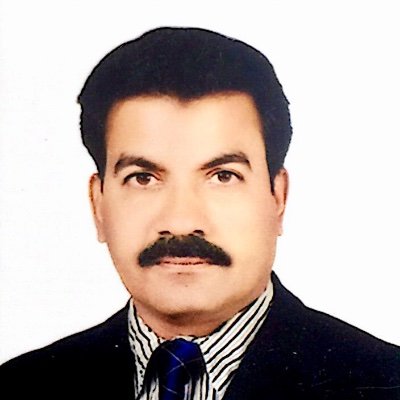
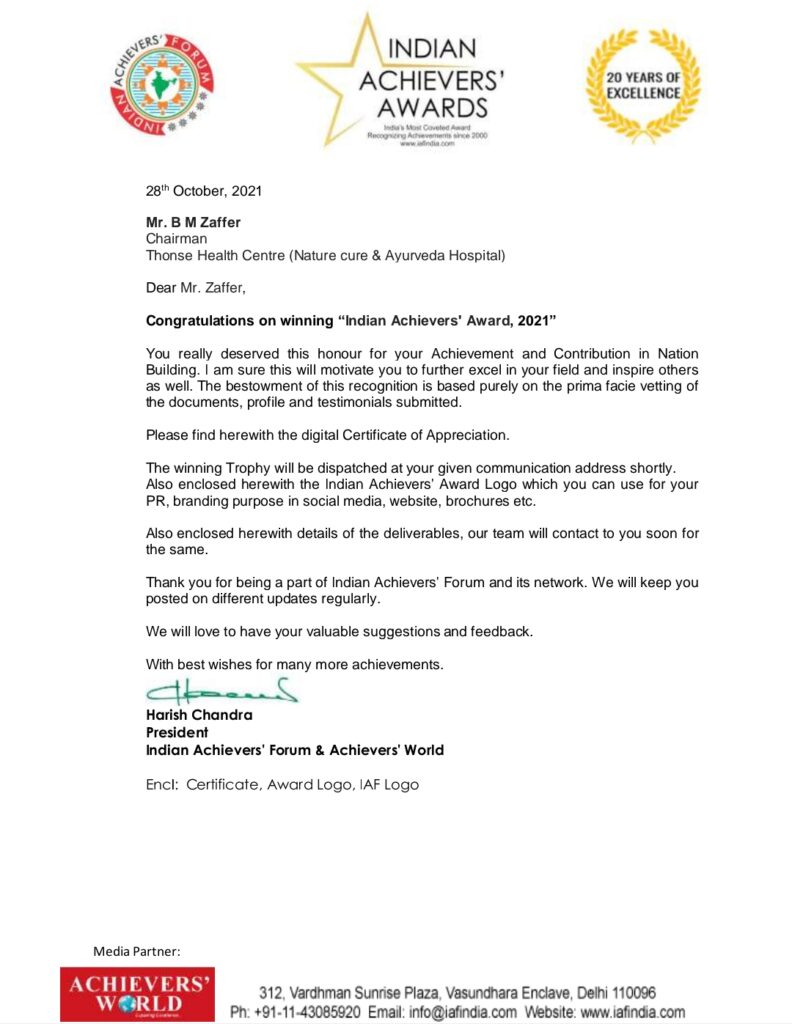
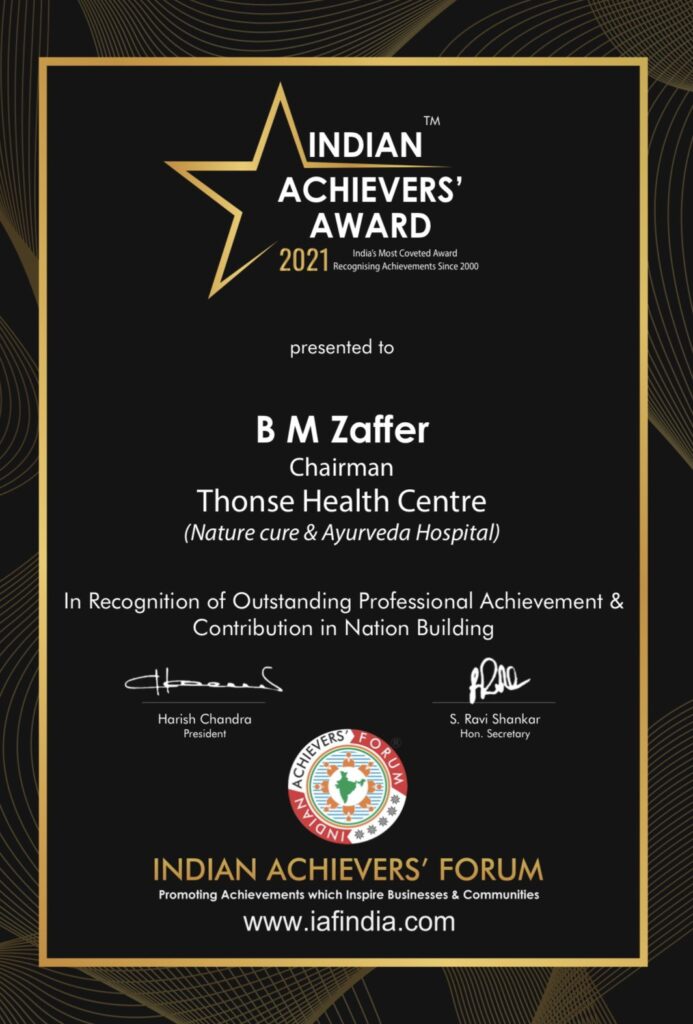
B M Zaffer Thonse Chairman Thonse Health Centre (Nature cure and Ayurveda hospital) has been selected for the prestigious Indian Achievers Award-2021 by the Indian Achievers’ Forum for his outstanding professional achievements and contributions in national building.
Zaffer is a known businessman from UAE and the award is given for recognizing his excellence in business, health sector and social activities.
Zaffer is the founder secretary of Qidmath Committee, Hoode and founder sports secretary of Young Men’s Association Kemmanu.
Zaffer is also the founder president of Thonse Cultural Association in UAE and president of Alumni Association of Government Urdu School Hoode.
He also established Nirmal Thonse, a NGO to protect nature and rendered service as honourary president in the same.
source: http://www.daijiworld.com / DaijiWorld.com / Home> Karnataka / by Media Release / November 03rd, 2021
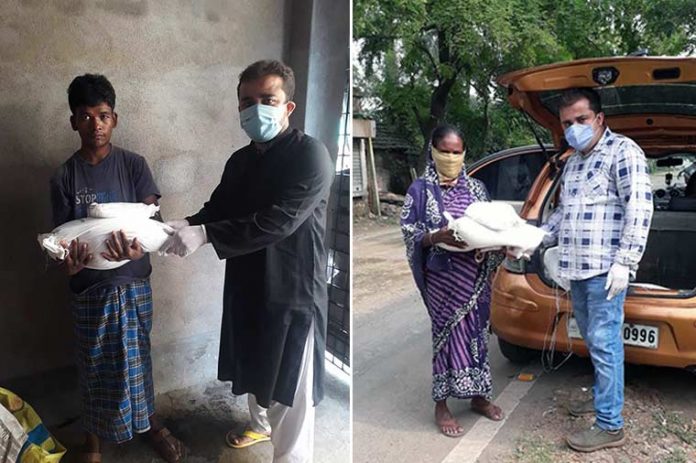
Thirty-two-year old Zeeshan Majeed from Kolkata, West Bengal has not only distributed food during the Covid-19 lockdown but also distributed masks, medicine and oxygen cylinders at times of crisis. For his noble work, he was featured as a Covid Warrior in IPL 2020. He is included among the Covid Warriors in the Limca Book of Records – 2020-22 as well.
Kolkata :
He has been feeding hungry people since he saw a child at a government hospital picking up food from a drain and eating it. Thirty-two-year old Zeeshan Majeed, a footwear manufacturer in Kolkata, started feeding 40 people with meals cooked by his mother once a week, but today more than 1500 people receive food daily from his Anti-Hunger Squad Foundation.
Zeeshan became a social activist after witnessing an accident on the street. It all began when he was on his way to work. He saw a young boy who had met with an accident and lay unconscious on the street near Sealdah railway station on April 15, 2018.
Something strange caught his attention, so he stopped to help. In the chaos, he spotted rag-pickers attempting to grab his mobile and laptop bag, which were lying scattered along with the motorcycle. He was a bit scared to help, but he recovered his courage and rushed the unconscious boy to the nearby Nil Ratan Sircar Medical College and Hospital.
At the hospital, he was shocked to notice the child. He later learned that many rural residents from deprived backgrounds in West Bengal travel to the capital city of Kolkata for treatment at the government hospitals. They arrive with their families and relatives. Some of these people can’t even afford to buy food, medication or accommodation. Most of them live on the streets for days and months.
Zeeshan went home with a heavy heart and recounted the story to his mother. He insisted on offering meals for the needy while he knew that her mother couldn’t possibly cook for this many people. “I asked if she could prepare meals for at least 40 people and I would take care of the rest. Her answer was yes. We decided that every Sunday my mother would prepare food and I would deliver it to people temporarily living on hospital premises or pavements,” Majeed told TwoCircles.net.
Starting a charity On May 20, 2018, he established the Anti-Hunger Squad Foundation, a charitable organisation. It started as a weekly event called ‘Dawat E Aam’ at NRS Hospital. Every week, the menu had a variety of dishes, such as simple hotchpotch, rice with vegetables, vegetable pulao, or rice with soya chunks curry. The menu consisted only of vegetarian meals since the recipients belong to diverse communities, which were served during the lunch hour.
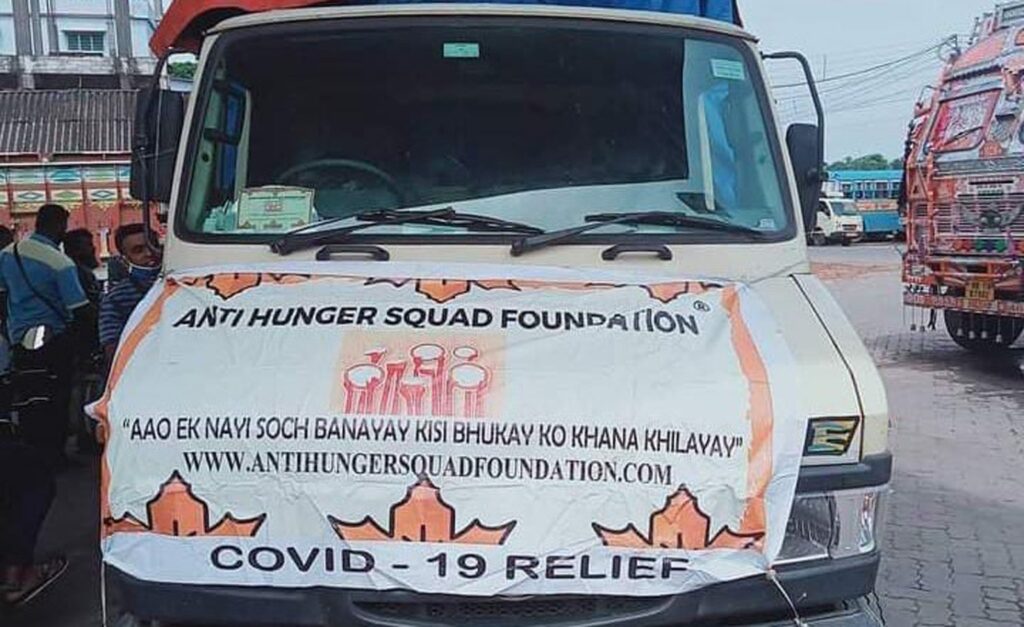
This vehicle carries Anti-Hunger Squad Foundation’s relief materials.
This weekly event has become a part of a daily routine since April 28, 2019, when he started receiving phone calls from different places. Helped by funds from friends, family and through social media, he launched the dinner service. He does not accept cash donations directly from his donors rather engages restaurant kitchens to prepare meals for donors, which he collects and distributes. It gets difficult for him to prepare lunch and dinner on his own, despite having a kitchen.
Covid warrior Among the people he has fed are women, children and the elderly. Whether they are beggars, slum dwellers, destitute or prostitutes, all have benefited from his food distribution services. The underprivileged received food standing in a row during the Covid-19 lockdown while the middle-class people felt shy and refused to queue. They suffered the most during the lockdown.
Zeeshan wanted to help them, so he created a ‘Secret Santa’ project for them with a helpline. On his social media platforms, he advertised that those in need of the ration kit could send him a text. Their ration kits would be delivered to their homes without revealing their identities.
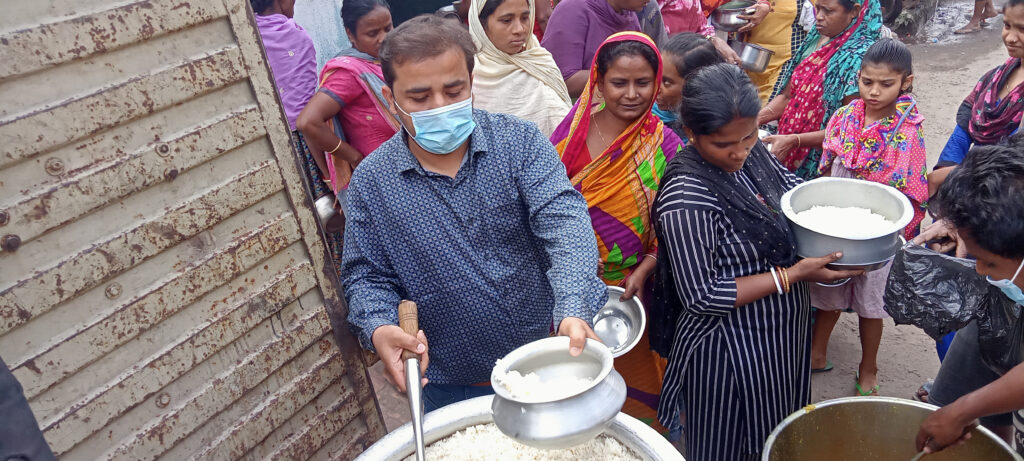
Zeeshan Majeed serving food to hungry people.
During the first lockdown, more than 1000 ration kits were distributed in Sonagachi, Kolkata’s sex-workers area. Ten kilograms of rice and five kilograms of pulses were included in the kits. Furthermore, the Anti-Hunger Squad Foundation distributed over 1200 kits each day under the Secret Santa project. Over 5000 people were helped.
This Samaritan from Kolkata has not only distributed food but also masks, medicine and oxygen cylinders at times of crisis. For his noble work, he was featured as a Covid Warrior in IPL 2020. He is included among the Covid Warriors in the Limca Book of Records – 2020-22 as well.
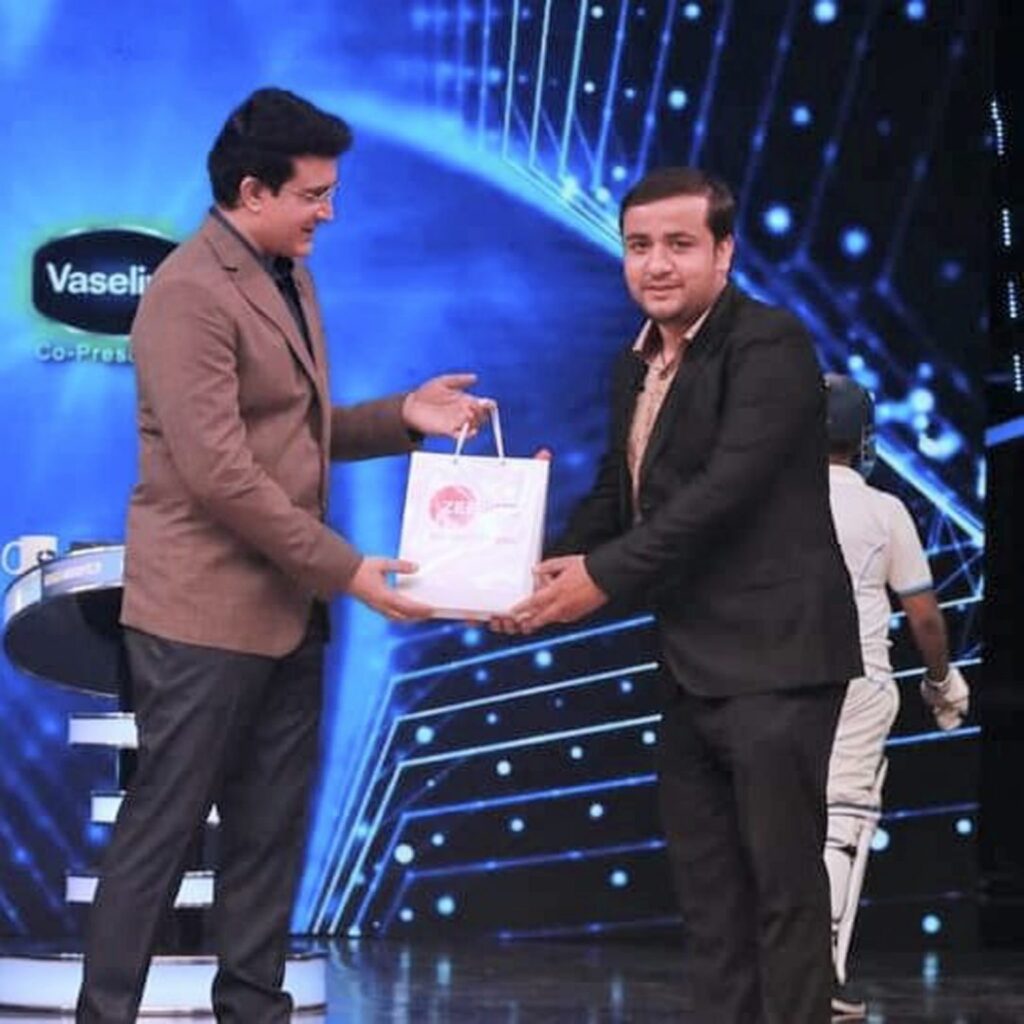
Former Indian Cricket Captain Sourav Gangulay presenting a gift hamper to Zeeshan Majeed.
“I always had two police guards with me during the Janata curfew or lockdown periods,” he said, acknowledging the maximum support he received from the Kolkata Police. “Their presence allowed me to distribute food properly while maintaining social distance with chalk marking, increasing sanitization awareness. Sometimes on the footpaths, beggars or physically challenged people would form a queue while some forlorn person would hand out disposable plates,” recalls Zeeshan, the owner of Golden Plastic, a footwear manufacturing company in Topsia.
His charitable foundation provided relief materials during natural disasters, such as floods or cyclones. He distributed food during the Amphan cyclone in May 2020 at Chandipur, Gosaba, Patharpratima, Basanti in Sundarban, as well as Harapur, Nalmuri, Bantala, Bhojerhat, Ghatakpukur in South 24-Parganas and other locations. When cyclone Yaas hit in May 2021, the food kits were also distributed to people in Mandarmuni, Purshottomnagar in East Midnapore and other Sundarban islands.
Zeeshan was born and brought up in Kolkata. He is the only son of Tarique Majeed and Nazli Tarique, who have four children. He finished his tenth standard in 2005 at Saifee Golden Jubilee English Public School and completed his 12th standard in 2007 from the same school. He graduated with a degree in commerce from Maulana Azad College in 2012, as well as an MBA degree in marketing from Sikkim Manipal University in 2015.
Zeeshan told TwoCircles.net, “Two days in my life are valuable—the day I was born and the day I discovered why I was born. Despite trying many things in life, including a job and a business, I never achieved satisfaction. That changed when I started distributing food.”
A Ballygunge resident, Zeeshan got married in October 2019. He plans to expand his charitable mission to the global level with this tagline – ‘Aao Ek Nayi Soch Banayay Kisi Bhukay Ko Khana Khilayay’ (Let’s think differently and help feed the hungry).
“I wish to serve people of the world. There are many people around the world who rarely get a square meal. If I have an opportunity, I will ensure that no one sleeps hungry,” he added.
Partho Burman is an award-winning independent journalist based in Kolkata. He writes inspirational, motivational and environmental stories. He tweets at @ParthoBurman.
source: http://www.twocirlces.net / TwoCircles.net / Home>Lead Story / by Partho Burman, TwoCircles.net / December 30th, 2021
He not only aims to bring medals for his country but also to help his community.
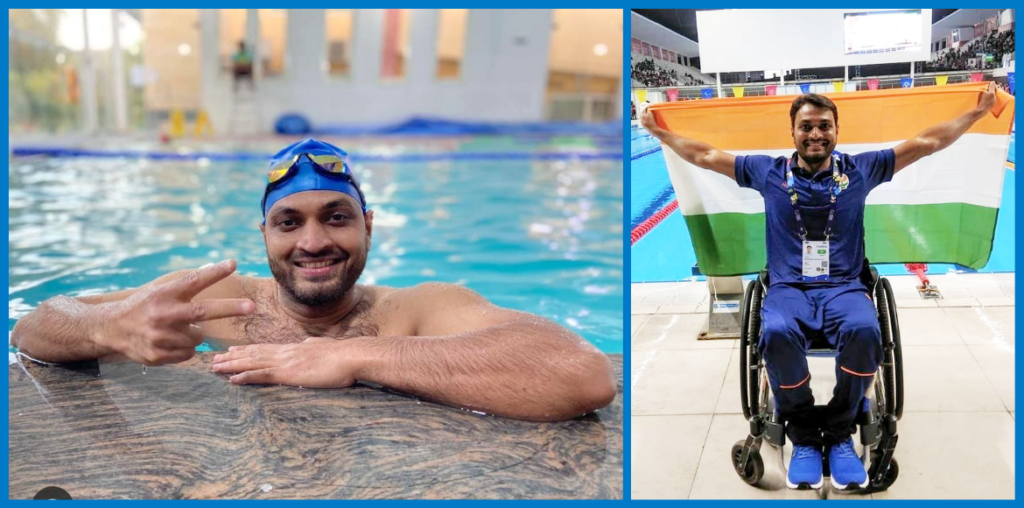
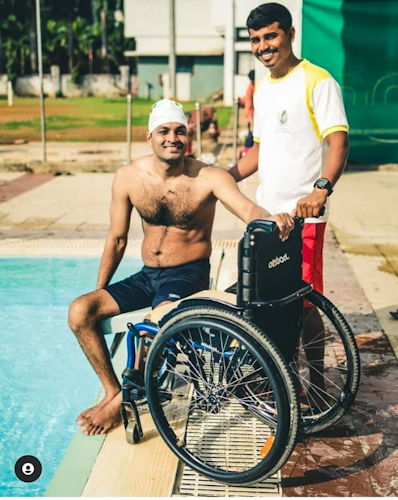
Now an established paraplegic swimmer with several accolades in his lap, Mohammad Shams Aalam Shaikh was born in a small village of Bihar.
This is the story of this champion who conquered the challenges thrown at him and went on to win four gold medals at the Indian Open Para Swimming Championship in 2018.
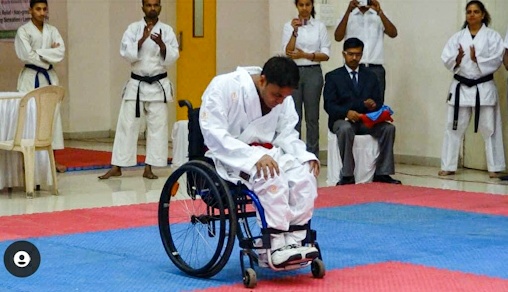
The village was surrounded by three rivers and thus, it was prone to floods. Naturally, Shams learned to swim when he was a kid. His grandfather was a wrestler, as told by his mother. As he grew up hearing the story of his grandfather, Shams always wanted to become a sportsperson. He was fond of martial arts and went on to get a black belt in Karate as he participated in Karate competitions nationally and internationally. Things were fairly well for him, he even completed his mechanical engineering and was all set for the corporate world.
However, in 2010, his life changed when he was diagnosed with a spinal tumour. Even after his surgery, there was not much improvement. As Shams got another checkup, he found out that the surgery was a failure and the tumour was still there. “Back then in 2010, I was going to represent my country in Asian games 2010 in Karate. But all my dreams shattered as the lower half of my body became ineffective. I became paraplegic,” recalled Shams. He lost sensations below his chest.
Shams got his disability certificate in 2012, which stated that he is 100 per cent disabled and it’s an eternal disability. “I didn’t want to spend the rest of my life crying about what has happened and now I want to move on. It took almost one and a half years for things to get back to normal,” said Shams.
In 2012, Shams went to a rehabilitation centre named Paraplegic Centre situated in Mumbai. At the centre, a doctor told him that swimming is good for the rejuvenation of the nervous system. Shams, who was already a Karate champion, also knew swimming very well. Unfortunately, he was told that he can’t swim, also if he does, the authorities will not take accountability if anything goes downhill.
It happened at the centre only that Shams met Raja Ram, also a differently-abled swimmer, who motivated Shams to pursue swimming. He started swimming, worked on his form and went on to win gold medals at state and national championships. While talking about the same, Shams said, “I never knew swimming would become my career. I won four gold medals in swimming and it gives me immense joy,” said Shams.
He further added, “After my disability, a lot has changed in my life. My perspective for people who have a disability has changed. I started the Parasport Association, Mumbai, which is now a registered body. It is a platform for people with disabilities to showcase their talent in sports.”
Credit: Supplied
He not only aims to bring medals for his country but also to help his community. He said, “Being featured in 300 most influential people in Asia 2020 by The New York Press News Agency is what makes me feel proud of myself. We are also working on making people with spinal cord injuries nationally registered with proper data. This will help our government and our society to recognise our problems and might even make things a little better.”
“We don’t have any qualified para swimmer coach in India, however, Raja Ram, who became my coach and mentor and is an International para swimmer, helped me to tackle technical issues and my physiotherapist helped me in gaining physical strength. Now, my father helps me in doing workouts,” said Shams.
Credit: Supplied
When we asked him about his opinion on Michael Phelps and him consuming 12,000 calories a day, he said, “Yes he consumes around 12,000 calories a day but it is not possible for me and I cannot compare myself with him since it is quite difficult for me and I have never counted how many calories I consume in a day.”
Credit: Supplied
According to Shams, in terms of techniques in swimming, there is no difference between a normal swimmer or para-swimmer. People like Shams who have severe disabilities do some things differently but there are not any major differences.
“I sometimes miss old Shams Aalam. But it is only sometimes, who I am today is a better version of myself,” said Shams.
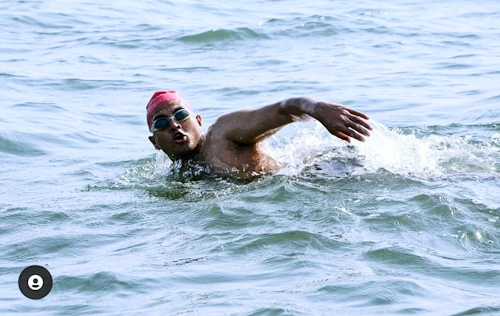
In 2017, Shams broke his own record by completing 8 km of open-sea swimming in 4 hours and 4 minutes. He came to be the world record holder for completing the longest distance of open-sea swimming by a paraplegic. “I am going through the worst time now since swimming pools are closed due to covid and I am not able to do swimming. I could not qualify this time for the Paralympics 2020 which I wanted to qualify for,” said Shams.
When Shams was 13 years old, he loved watching Bruce Lee on his television and often imitated him. In 2002, he started playing Karate and participated in Karate competitions without thinking about the outcomes. However, the older Shams never had the greater visions of what he would become. He is grateful and continuously pushes him to achieve much more.
source: http://www.cityspidey.com / City Spidey / Home> News / by Anjali Singh / August 13th, 2021
This is India’s first win at Centurion and the India skipper, recalling his team’s fantastic victory at Wanderers in the final Test in 2018, said that result instilled plenty of self-belief.
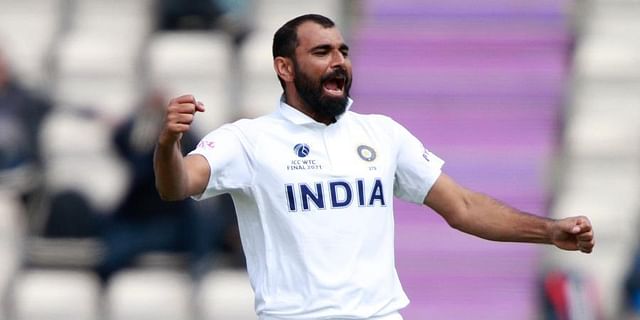
Mohammed Shami (Photo | AP)
Centurion :
Victorious Indian captain Virat Kohli on Thursday attributed the Test team’s fine results overseas in recent years to his pace attack and rated Mohammed Shami among the best three seamers in the world currently.
The formidable India pace unit destroyed a listless South Africa to fashion an emphatic 113-run win in the first Test here, setting the team on course for a maiden series victory in the country.
Kohli lavished rich praise on his colleagues after the team’s big win.
“Just the way these guys bowl together, it’s just a hallmark of our team getting a result from that position, not just in this game but also in the last two-three years,” Kohli said at the post-match presentation ceremony.
India were handed the advantage on the first day itself when centurion KL Rahul and Mayank Agarwal set it up with a big opening partnership, and Kohli said that partnership made a huge difference to the outcome of the match.
“The discipline that the batters showed. Winning the toss, batting first overseas is a tough challenge. Credit to Mayank and KL the way they set it up. We knew we were in pole position with anything over 300-320. We have a lot of belief in our bowling unit and knew the bowlers will get the job done,” Kohli pointed out.
This is India’s first win at Centurion and the India skipper, recalling his team’s fantastic victory at Wanderers in the final Test of the 2018 Test series, said that result from the past instilled plenty of self-belief.
“It’s a top start for us. We have to understand one day was washed out — shows how well we played. It’s always a difficult place to play against South Africa. We got so much confidence out of Johannesburg last time. It’s a ground we love playing at.”
The next match is scheduled to be played at Johannesburg from January 3-7.
Speaking about Shami, he said, “He is absolutely world class talent. For me he’s in the best three seamers in the world at the moment. His strong wrist, his seam position and his ability to hit a length consistently. Very, very happy for him to get 200 wickets and have an impactful performances.”
Pacer Jasprit Bumrah could not bowl a lot in the first innings and Kohli felt his team could have got a bigger lead in the first innings if that wasn’t the case.
“Spoke about it in the change room — the fact he didn’t bowl much in the first innings, it allowed South Africa to get around 40 more runs.”
South African skipper Dean Elgar, who top-scored for his side with a fighting 77, said there were few positives for his team but expressed his disappointment with the batters.
This is only the third instance when South Africa had been dismissed under 200 in each innings of a Test match at home since their re-admission in 1991.
“Obviously not a nice thing knowing we lost a Test here. Did a few things wrong. Lot of positives coming out that we can use in the next two. Always the nature here. Always going to be tough because the wicket’s playing slower (first morning),” Elgar said.
Kohli lavished rich praise on his colleagues after the team’s big win.
“Just the way these guys bowl together, it’s just a hallmark of our team getting a result from that position, not just in this game but also in the last two-three years,” Kohli said at the post-match presentation ceremony.
India were handed the advantage on the first day itself when centurion KL Rahul and Mayank Agarwal set it up with a big opening partnership, and Kohli said that partnership made a huge difference to the outcome of the match.
“The discipline that the batters showed. Winning the toss, batting first overseas is a tough challenge. Credit to Mayank and KL the way they set it up. We knew we were in pole position with anything over 300-320. We have a lot of belief in our bowling unit and knew the bowlers will get the job done,” Kohli pointed out.
This is India’s first win at Centurion and the India skipper, recalling his team’s fantastic victory at Wanderers in the final Test of the 2018 Test series, said that result from the past instilled plenty of self-belief.
“It’s a top start for us. We have to understand one day was washed out — shows how well we played. It’s always a difficult place to play against South Africa. We got so much confidence out of Johannesburg last time. It’s a ground we love playing at.”
The next match is scheduled to be played at Johannesburg from January 3-7.
Speaking about Shami, he said, “He is absolutely world class talent. For me he’s in the best three seamers in the world at the moment. His strong wrist, his seam position and his ability to hit a length consistently. Very, very happy for him to get 200 wickets and have an impactful performances.”
Pacer Jasprit Bumrah could not bowl a lot in the first innings and Kohli felt his team could have got a bigger lead in the first innings if that wasn’t the case.
“Spoke about it in the change room — the fact he didn’t bowl much in the first innings, it allowed South Africa to get around 40 more runs.”
South African skipper Dean Elgar, who top-scored for his side with a fighting 77, said there were few positives for his team but expressed his disappointment with the batters.
This is only the third instance when South Africa had been dismissed under 200 in each innings of a Test match at home since their re-admission in 1991.
“Obviously not a nice thing knowing we lost a Test here. Did a few things wrong. Lot of positives coming out that we can use in the next two. Always the nature here. Always going to be tough because the wicket’s playing slower (first morning),” Elgar said.
He added, “Indian openers did the fundamentals right. We didn’t quite execute the lengths well. After some good chats our bowlers executed the lengths and restricted India to what we thought was a par score. New ball is something you have to get through playing here. Can’t emphasise enough on the hard work our bowlers put in to get 20 wickets. Our batters let us down. I’d say the batting was the difference between the two sides. We’ll have a little sit-down with myself and the management to strategise. Didn’t do a lot of wrong things. Not all doom and gloom for us. We thrive under the pressure which is a positive for us.”
source: http://www.newindianexpress.com / The New Indian Express / Home> Sport> Cricket / by PTI / December 30th, 2021
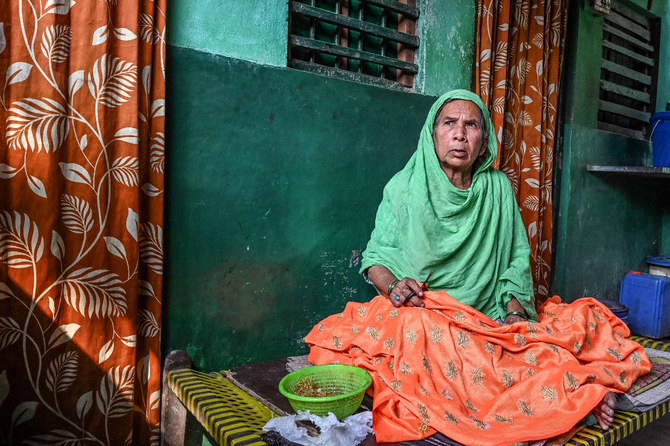
Sultana Begum works on a garment inside her house in Kolkata. (Photo by Dibyangshu Sarkar / AFP)
Sultana Begum’s case rests on her claim that her late husband’s lineage can be traced to Bahadur Shah Zafar, the last emperor to reign
After a massive rebellion blamed on an already frail Zafar in the 1850s, British forces executed 10 of the ruler’s surviving sons despite the royal family’s surrender
Kolkata :
A destitute Indian woman who claims she is heir to the dynasty that built the Taj Mahal has demanded ownership of an imposing palace once home to the Mughal emperors.
Sultana Begum lives in a cramped two-room hut nestled within a slum on the outskirts of Kolkata, surviving on a meagre pension. Among her modest possessions are records of her marriage to Mirza Mohammad Bedar Bakht, purported to be the great-grandson of India’s last Mughal ruler.
His death in 1980 left her struggling to survive, and she has spent the past decade petitioning authorities to recognize her royal status and compensate her accordingly.
“Can you imagine that the descendant of the emperors who built Taj Mahal now lives in desperate poverty?” the 68-year-old asked AFP.
Begum has lodged a court case seeking recognition that she is rightful owner of the imposing 17th-century Red Fort, a sprawling and pockmarked castle in New Delhi that was once the seat of Mughal power. “I hope the government will definitely give me justice,” she said. “When something belongs to someone, it should be returned.”
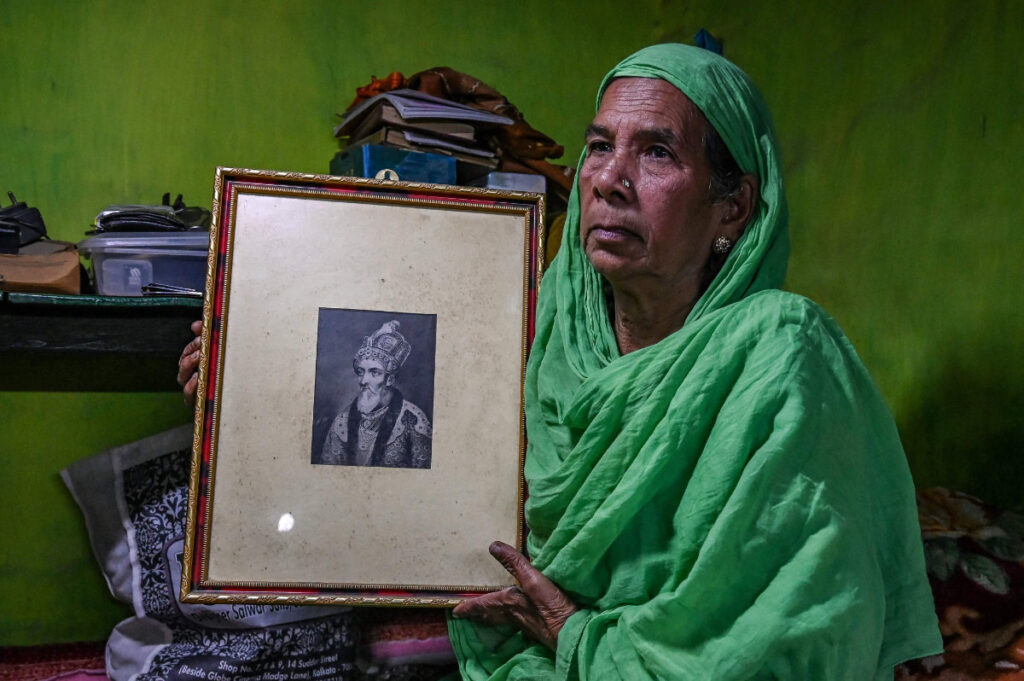
Sultana Begum reacts while holding a picture of last Mughal Emperor of India Bahadur Shah Zafar in her house in Kolkata. (Photo by Dibyangshu Sarkar / AFP)
Her case, supported by sympathetic campaigners, rests on her claim that her late husband’s lineage can be traced to Bahadur Shah Zafar, the last emperor to reign.
By the time of Zafar’s coronation in 1837, the Mughal empire had shrunk to the capital’s boundaries, after the conquest of India by the commercial venture of British merchants known as the East India Company.
A massive rebellion two decades later — now hailed as India’s first war of independence — saw mutinous soldiers declare the now frail 82-year-old as the leader of their insurrection. The emperor, who preferred penning poetry to waging war, knew the chaotic uprising was doomed and was a reluctant leader.
British forces surrounded Delhi within a month and ruthlessly crushed the revolt, executing all 10 of Zafar’s surviving sons despite the royal family’s surrender.
Zafar himself was exiled to neighboring Myanmar, traveling under guard in a bullock cart, and died penniless in captivity five years later.
Many of the Red Fort’s buildings were demolished in the years after the uprising and the complex fell into disrepair before colonial authorities ordered its renovation at the turn of the 20th century. It has since become a potent symbol of freedom from British rule.
India’s first Prime Minister Jawaharlal Nehru hoisted the national flag from the fort’s main gate to mark the first day of independence in August 1947, a solemn ritual now repeated annually by his successors.
Begum’s court case hinges on the argument that India’s government are the illegal occupants of the property, which she says should have been passed down to her.
The Delhi High Court rejected her petition last week as a “gross waste of time” — but did not rule on whether her claim to imperial ancestry was legitimate. Instead the court said her legal team had failed to justify why a similar case had not been brought by Zafar’s descendants in the 150 years since his exile.
Her lawyer Vivek More said the case would continue. “She has decided to file a plea before a higher bench of the court challenging the order,” he told AFP by phone.
Begum has endured a precarious life, even before she was widowed and forced to move into the slum she now calls home.
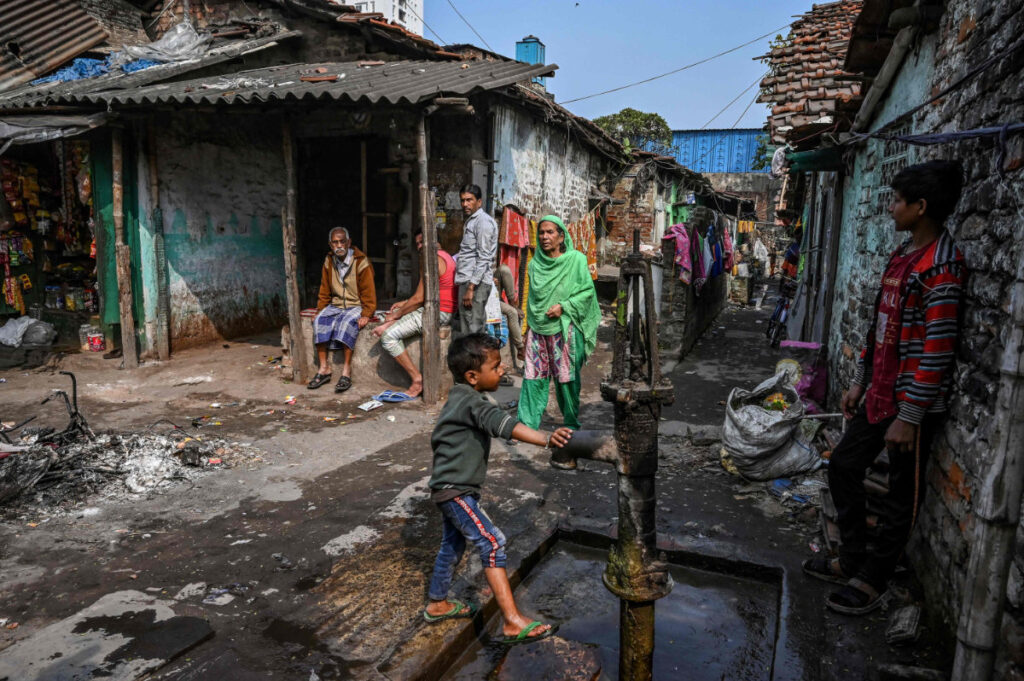
In this picture taken on December 22, 2201, Sultana Begun walks by an alley in the locality she lives in Kolkata. (Photo by Dibyangshu Sarkar / AFP)
Her husband — who she married in 1965 when she was just 14 — was 32 years her senior and earned some money as a soothsayer, but was unable to provide for their family. “Poverty, fear and lack of resources pushed him to the brink,” she added.
Begum lives with one of her grandchildren in a small shack, sharing a kitchen with neighbors and washing at a communal tap down the street.
For some years she ran a small tea shop near her home but it was demolished to allow the widening of a road, and she now survives on a pension of 6,000 rupees ($80) per month.
But she has not given up hope that authorities will recognize her as the rightful beneficiary of India’s imperial legacy, and of the Red Fort.
“I hope that today, tomorrow or in 10 years, I will get what I’m entitled to,” she said. “God willing, I will get it back… I’m certain justice will happen.”
source: http://www.arabnews.com /Arab News / Home> News / by AFP / December 30th, 2021
The book is a harrowing tale of a doctor’s ordeal and gives a compelling account of the tragic deaths of several children and the disturbing events that ensued.
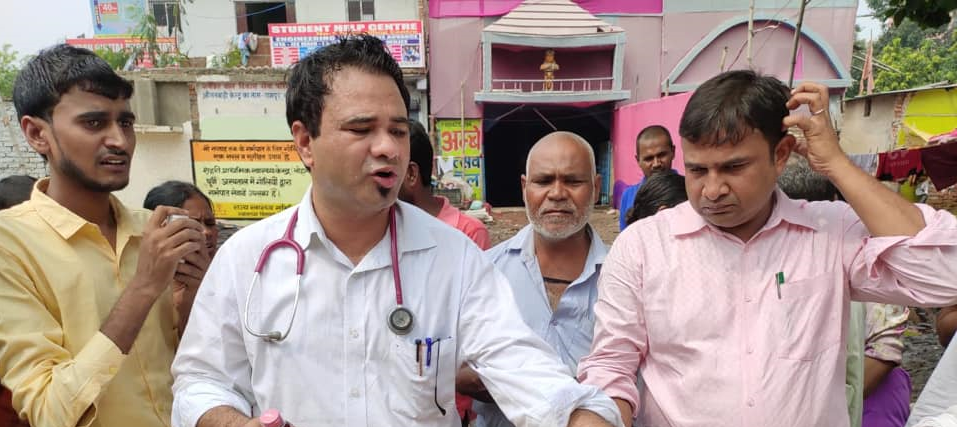
Dr Kafeel Khan at a medical camp. Photo: Facebook/drkafeelkhanofficial
Gorakhpur:
The 2017 oxygen shortage tragedy at Gorakhpur’s BRD Medical College that led to the deaths of more than a hundred children was not a random accident but the outcome of the administration’s apathetic and insensitive attitude towards government hospitals. The aftermath of the incident also exposed how the government machinery, instead of learning from such horrific accidents, works to suppress the truth, protect the culprits and punish those who try to expose the reality.
The reportage on the oxygen fiasco meanwhile rendered it synonymous with the identity of Dr Kafeel Khan, who was then an assistant professor in the hospital’s Department of Paediatrics. The incident and the ensuing fate of Khan was widely reported in the media.
But what actually happened and who were the real culprits? Were they shielded by the powers that be? Those who knew the truth have either kept mum on the issue or have sided with the government’s narrative. The government has made claims like, “The hospital did have an oxygen crisis but that’s not what killed the children”, “The children died because they were gravely ill”, “Children die of encephalitis in July and August every year” and that the government and its ministers or senior officials cannot to be blamed for the deaths as the college administration was negligent. Khan, the government said, was solely responsible because he failed to inform his seniors about the oxygen crisis and had committed medical negligence and used to practice privately.
Khan was sacked last month , four years following the incident. Two doctors and four employees of BRD Medical College, who were also accused of negligence, have been reinstated. R.K. Mishra, who was the principal of the college at the time of the deaths, and Ppharmacist Gajanand Jaiswal have retired after being reinstated. Little is known of the whereabouts of Manish Bhandari, the owner of Pushpa Sales, the oxygen supplier, ever since he was released from jail.
The government did not compensate the families of the children who died in the tragedy, claiming that their deaths were not caused by oxygen shortage.
The terrible incident is no longer talked about, except when it is brought up in conjunction with news related to Dr Kafeel Khan.
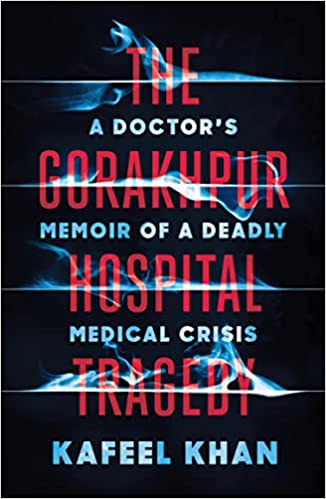
Kafeel Khan The Gorakhpur Hospital Tragedy: A Doctor’s Memoir of a Deadly Medical Crisis Pan Macmillan (December 2021)
Recently, Khan’s 300-page book titled The Gorakhpur Hospital Tragedy: A Doctor’s Memoir of a Deadly Medical Crisis was published by Pan Macmillan India, reinvigatoring a discussion on the deaths.
In the book, Khan describes a series of incidents beginning on the dreadful night when the hospital ran out of oxygen to the day of his arrest, subsequent imprisonment and his dismissal from service more than four years later. The book not only weaves together the scattered strands of information surrounding the oxygen shortage tragedy of the BRD Medical College on August 10, 2017 but also brings to the fore many new facts which remained unknown till now.
The oxygen fiasco was reported in both national and international media. While it is true that the incident remained in the news a long time afterwards, most of these speculations only went on to further mystify and blur the facts instead of providing clarity. The book tries to blow the lid off the attempts to conceal the truth behind the incident in a ‘calculated manner’ and uncovers the system’s attempts to make a doctor the scapegoat to cover up its failure.
The book also highlights various aspects of Khan’s personal life. We come to know that his father was an engineer in the irrigation department. Kafeel Khan was brought up in an open-minded atmosphere and spent his early days in a locality where residents hailed from different religious backgrounds. They celebrated Holi as zealously as Eid. On Diwali, he narrates, his family received many sweets from their Hindu neighbours which he would carry in his school tiffin for an entire week.
From his family, the story quickly progresses to the events of August 10, 2017. On the fateful night, Khan received a WhatsApp message on his mobile about depleting oxygen levels in the encephalitis ward. He was on leave that day as his sister was visiting the family from Oman and he wanted to spend time with her. But when he received the message, he decided to immediately go to the hospital. On his way, he kept calling his superiors at the medical college. While most of his calls went unanswered, those who did pick up failed to grasp the gravity of the situation and tried to pass the buck.
In his book, Khan gives telling details of the situation he witnessed in the ward that night and how he handled it. He describes the wailing and pleading parents while their children battled for life and the utter helplessness of the doctors, nurses and ward boys. There were 313 children admitted in the hospital’s pediatric and neonatal intensive care units that night. At 7:30 pm, the oxygen plant had run out of oxygen and the ventilators began sounding the warning beeps. As a contingency arrangement, 52 jumbo cylinders kept in the hospital reserve were installed, which were exhausted within four hours and the oxygen supply was completely cut off to the wards, including the encephalitis ward. By the time Khan reached the hospital, eight children had already died.
He and his colleagues immediately started giving oxygen from Ambu bags to the children on ventilator support. The condition of all the children in the ward was assessed and oxygen from Ambu bags was given to those who needed oxygen the most. A three-year-old girl’s condition deteriorated and despite the staff’s best efforts, could not be saved. The NICU witnessed similar chaotic scenes. The relatives of the patients, who had been informed about the lack of oxygen, were either yelling at the hospital staff or begging them to save their children.
Meanwhile Khan was faced with the dual challenge of treating the deteriorating condition of the children, on one hand, and arranging for oxygen cylinders on the other. A truck carrying a jumbo cylinder was on its way from Imperial Gas Limited in Faizabad but there was no sign of it until 1 am. Till then, no senior officer of the BRD Medical College had reached the hospital. In their absence, Khan decided to fetch three jumbo cylinders from a nearby hospital in his private vehicle. He then approached eight more hospitals for help, ferried as many cylinders as he could arrange and tried to replenish the oxygen supply. But it was not enough. The encephalitis ward was consuming 16 jumbo cylinders every 45 minutes. The truck that arrived from IGL Faizabad at 2 am brought only 50 cylinders. Kafeel arranged for a truck with the help of central oxygen operator Balwant, and sent an outsourced worker to the Khalilabad plant paying Rs 20,000 from his own pocket. The oxygen plant had agreed to supply jumbo cylinders at Rs 350 per cylinder.
Despite being informed of the urgent need for oxygen, a plant in Gida refused to supply oxygen saying that its contract with the college had been terminated and handed over to IGL Faizabad. It would supply oxygen only after the contract has been renewed, the plant said.
Despite Khan and his team’s night-long efforts to save the children and arrange cylinders, 23 children in the PICU and NICU and 18 adult patients in the medicine ward had succumbed by 10 am the next day.
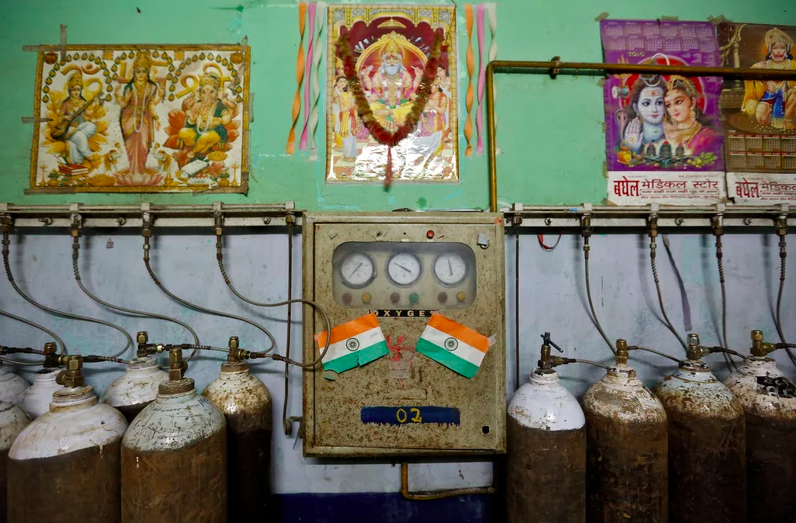
A room containing oxygen tanks is seen in the BRD Medical College and Hospital in Gorakhpur. Photo: Reuters
When there was a shortage of vehicles to cart the jumbo cylinders, Khan reached out to the Sashastra Seema Bal (SSB) stationed in the Fertilizer Campus on the morning of August 11 and contacted the DIG to provide a truck and cylinders. The SSB did not have jumbo cylinders, but they provided a truck and 12 jawans so that cylinders could be swiftly transported from the plant to the medical college.
According to the details in the book, on the afternoon of August 11, the then district magistrate Rajiv Rautela contacted Khan and after being apprised of the whole situation assured that oxygen would be provided. He asked the Gida plant, which had earlier refused to entertain Kafeel’s request, to supply oxygen. Later, 50 jumbo cylinders arrived from IGL Faizabad in two trips. Kafeel also contacted the chief medical officer and the additional director (health), urging them to help solve the crisis. One said he was in a meeting and the other asked Khan to contact the chief medical superintendent regarding the arrangement of cylinders. One of these officers later became part of the committee that was formed to investigate the tragedy.
In the afternoon, a professor from the Department of Paediatrics reached the ward followed by the head of the department and the chief medical superintendent of the Nehru Hospital. Together, they wrote a letter to the principal of the BRD Medical College, urging him to arrange medical oxygen.
By the evening of August 11, the news of children dying due to oxygen shortage had spread like wildfire and media persons began pouring in at the BRD Medical College. By then, a few local journalists and photographers had already reached the College and began reporting on the crisis. The district magistrate issued the first official statement about the incident in a press conference at 7:30 pm that day and announced the formation of a committee to investigate the deaths. This committee was asked to submit its report within 24 hours.
Initially, the reports in media and on social media hailed Kafeel as a hero for his efforts to muster up oxygen cylinders using his personal resources and save the lives of children. On August 12, the state health minister Siddharth Nath Singh and medical education minister Ashutosh Tandon reached the college. Singh, in a press conference, denied the death of any child due to lack of oxygen and made the insensitive ‘children die every year in August‘ remark. The statement was widely condemned.
On August 13, a tanker of liquid oxygen arrived at the hospital at 1 am and the supply was restored. Kafeel, who had tirelessly spent 48 hours on rigorous duty since August 10, finally returned home only to wake up to a fresh twist the next morning. A new tale had been spun and a fresh narrative was played out in the media.
In the morning, J.P. Nadda and chief minister Yogi Adityanath arrived at the BRD Medical College and Khan was summoned. He reached the hospital hoping to receive a pat on the back for his efforts but he was in for a rude shock and suddenly found himself in the crosshairs.
According to Khan, the moment he appeared before the chief minister, he said in a reprimanding tone, “Tu hai Dr Kafeel Khan?” (So, you are Dr Kafeel Khan?)
“Yes, Sir.”
“Tune cylinder ka arrangement kiya tha?” (Are you the one who arranged cylinders?)
“Yes, Sir.”
“Ye 4-5 cylinder la kar tu ne kitni jaan bacha li? Tu sochta hai cylinders ki vyvastha kar ke tu bohot bara hero ban gaya; dekhta hoon tujhe.” (How many lives did you save with a few cylinders? Do you think by arranging cylinders you became a hero? I will take care of you.)”
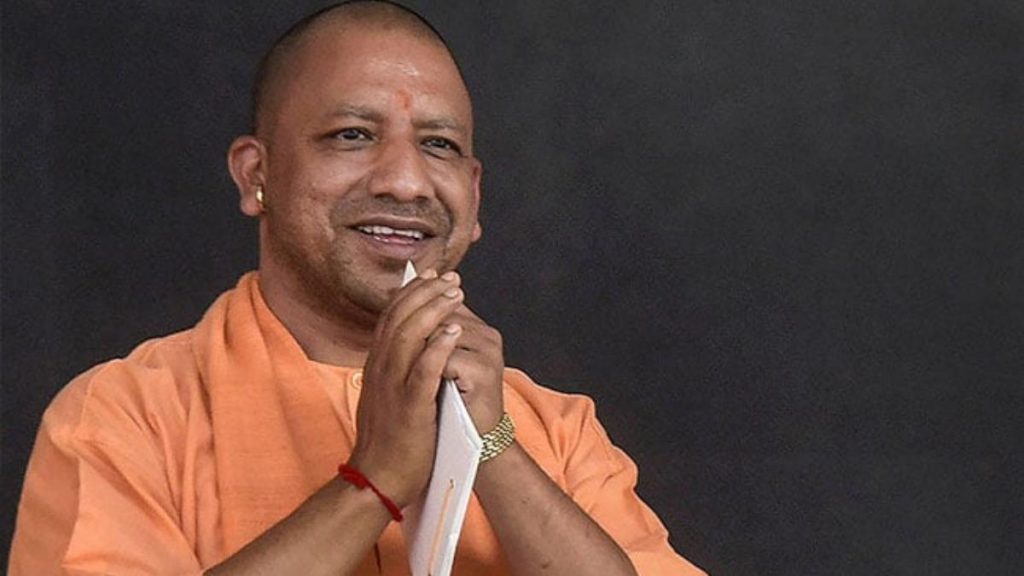
Uttar Pradesh chief minister Yogi Adityanath. Photo: PTI
Khan was suddenly the villain, accused of leaking the news of oxygen shortage to the media. However, when he tried to speak up and provide a clarification, senior officers stopped him from doing so.
In the press conference, the chief minister dismissed the claim that the children died owing to a dearth of oxygen. He announced the formation of a committee headed by the chief secretary to probe the incident and said that its report would be submitted in a week.
As soon as the press conference was over, media persons flocked the hospital of Khan’s wife. A mob also attacked the hospital and a showroom owned by Khan’s brother, pelting stones and vandalising them. On social media, Khan was vilified as an ‘oxygen thief’, and a ‘pawn of the opposition leaders’. The TV news channels began referring to him as the head of the paediatric department, the deputy principal, the superintendent of the hospital, blaming him entirely for the disaster.
Khan was advised to take leave until the turmoil subsided. On August 16, the report of the committee constituted by the DM was submitted, which did not fix the responsibility on Khan but also failed to mention, let alone laud Khan’s efforts to arrange oxygen cylinders at such a critical time.
Finally, on August 21, the report of the committee headed by the chief secretary came out and an FIR was lodged against nine people, including Khan and everyone was gradually arrested.
The police began raiding his house daily, making searches and harassing the family members. His sister’s house in Lucknow was also raided and his brother was taken into custody. He decided to surrender and finally did so at the Special Task Force office in Lucknow. The STF brought him to Gorakhpur and handed him over to the Gorakhpur police, who put him in jail.
The next few pages of the book record a horrendous account of Khan’s seven-month long stay in jail – an 800-prisoner facility with 1,897 prisoners in it.
In jail, he met several high-profile prisoners – Kaka, D. Ram, V. Singh, Shailesh, Vishwa and also ‘Mantriji’ who is serving a life sentence for the murder of a poetess. Most of them showed Khan kindness. Despite all the media propaganda, they treated him with respect for being a good Samaritan and responsible doctor who tried to save the lives of children. Khan writes that most of the undertrial prisoners spend long periods in jail in the hope of being freed or granted bail but 99% of them are met with disappointment as cases remain in limbo for years.
Khan also details a first-hand account of corruption inside the prison walls. Any prisoner can avail the facilities that he can afford. Under this covert system, rates are fixed for kachchi baithki and pakki baithki – levels of evading laborious chores in jail. Then there are rates of bidi, cigarette, vegetables, eggs, bottled water as well as meeting with relatives. To avail such luxuries, one has to keep one’s mouth shut – besides abiding by the other rules. Based on hierarchy of caste, religion, connections and nature of crime, the dark underbelly of the prison is governed by a handful prisoners.
While awaiting bail, Khan tried to piece together the episodes of the oxygen tragedy. From jail, he contacted everyone including Manish Bhandari, the director of Pushpa Sales, the college principal Mishra, and Dr Satish. Finally, he saw the whole picture. He learnt that both the Gida gas plant, which had refused to supply oxygen to the hospital despite being aware of the deaths of children, as well as IGL Faizabad with which the hospital had signed a contract in 2017, had close relations with the ruling party leaders. Also, Khan claims, Pushpa Sales had not only failed to pay the dues to the top officials of health and administration but also to line the pockets of various ministers, a matter which was brought up in several official meetings. Hence, the authorities behaved in a lackadaisical manner while the children were gasping for breath. Later, a hunt was launched for ‘a neck to fit the noose’ and a communal government found Khan as the perfect scapegoat, he says.
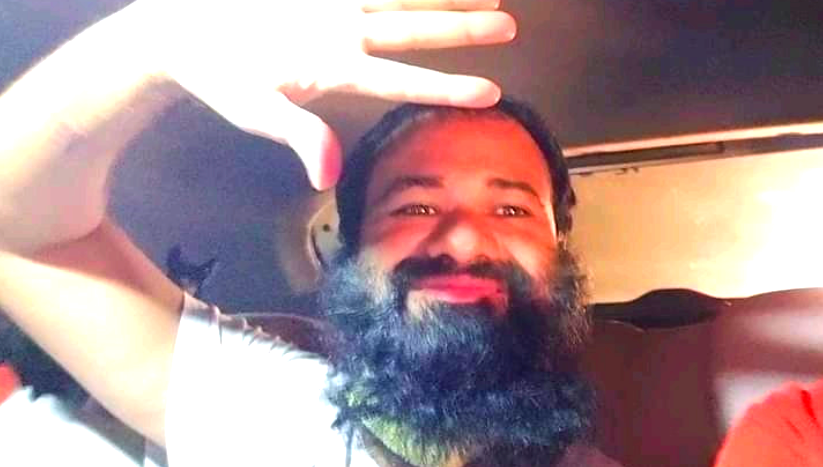
Dr Kafeel Khan, after his release from jail. Photo: @Saurabhsherry/Irfan Ghazi.
The final section of the book describes Khan’s ordeal after his release from jail, various charges levelled against him and his re-arrest. He was arrested from the Bahraich district hospital, where he had gone to investigate the death of children admitted for encephalitis. Later, charges under the National Security Act were slapped on him for a speech he had delivered during an anti-CAA-NRC protest at the Aligarh Muslim University. He was released after the Allahabad high court quashed the NSA charges.
However, despite getting a clean chit on two key charges in the departmental inquiry of the oxygen shortage incident, he was sacked. The book has several more details. An entire chapter is dedicated to his rural health campaign, under which he organised medical camps, especially creating awareness about encephalitis, locally known as chamki fever, in various flood-affected parts of Bihar and Assam.
source: http://www.thewire.in / The Wire / Home> Book> Rights / by Manoj Singh / December 19th, 2021
Chief Justice of India N V Ramana on Wednesday presented the annual ‘RedInk Awards for Excellence in Journalism’, instituted by the Mumbai Press Club, in a virtual event.
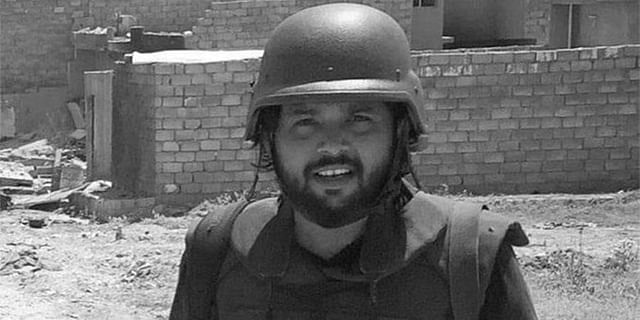
Reuters Chief photojournalist Danish Siddiqui was killed in clashes in Spin Boldak district in Kandahar, Afghanistan. (Photo | Twitter)
Mumbai :
Photojournalist Danish Siddiqui, who died during an assignment in Afghanistan, has been posthumously awarded as the ‘Journalist of the Year’ for 2020 by the Mumbai Press Club.
Chief Justice of India N V Ramana on Wednesday presented the annual ‘RedInk Awards for Excellence in Journalism’, instituted by the Mumbai Press Club, in a virtual event.
He presented the prestigious award to Siddiqui “for his spectrum of investigative and impactful news photography”.
Danish Siddiqui’s wife Frederike Siddiqui received the award.
“He was a man with a magical eye and was rightly regarded as one of the foremost photojournalists of this era.
If a picture can tell a thousand words, his photos were novels,” Chief Justice Ramana said while paying tributes to the scribe.
Senior journalist Prem Shankar Jha, 83, was bestowed with the lifetime achievement award “for his long and distinguished career of incisive and analytical writing”.
“His reputation for hard work, the highest ethical standards, and intellectual rigour are unparalleled in the field,” CJ Ramana said while congratulating Jha.
The Mumbai Press Club instituted The RedInk Awards a decade ago to recognise good investigative and feature writing and raise the bar of journalism in the country.
Apart from Siddiqui and Jha, variour other journalists were awarded in 12 categories as part of the 10th edition of the award event.
source: http://www.newindianexpress.com / The New Indian Express / Home> Nation / by PTI / December 30th, 2021
Khan achieved the rare feat recently by qualifying for the his second event — giant slalom — a month after booking his first Winter Olympics ticket in alpine skiing slalom category in an Olympic qualifier in Dubai.
Alpine skier Arif Mohammed Khan. (Twitter/jswsports)
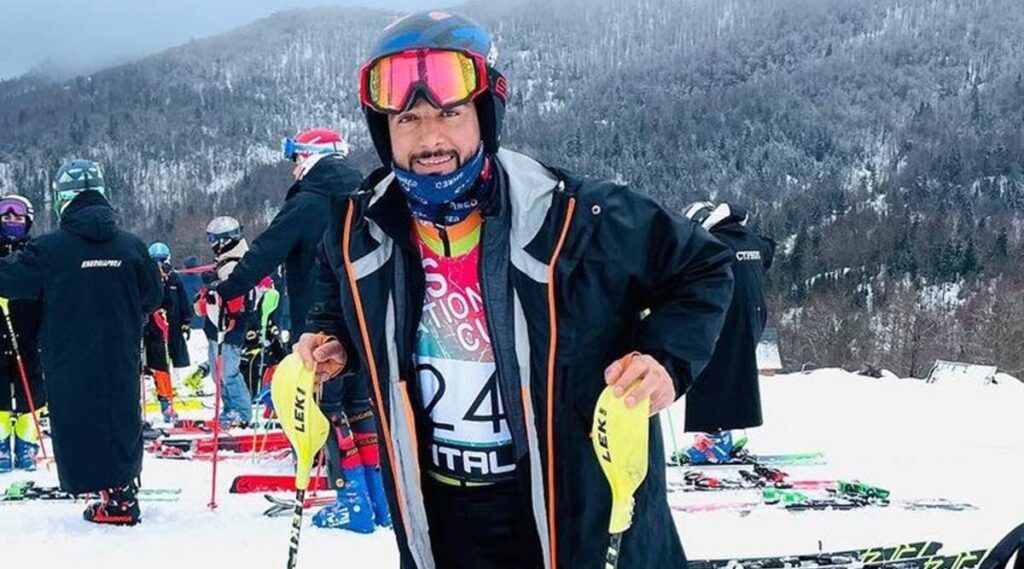
Jammu and Kashmir-based alpine skier Arif Mohammed Khan has become the first Indian athlete to qualify for two different events of the Winter Olympics, set to be held in Beijing from February 4, next year.
Khan achieved the rare feat recently by qualifying for his second event — giant slalom — a month after booking his first Winter Olympics ticket in alpine skiing slalom category in an Olympic qualifier in Dubai.
The news was confirmed by his promoter JSW Sports.
JSW-supported Alpine skier Arif Khan, who had earlier earned a provisional quota for the Slalom event at the 2022 Winter Olympics, has now qualified for the Giant Slalom event as well. ??#BetterEveryday ???? #Beijing2022pic.twitter.com/Ua6EfIRJ65
— JSW Sports (@jswsports) December 29, 2021
“JSW-supported Alpine skier Arif Khan who had earlier earned a provisional quota for the slalom event at the 2022 Winter Olympics, has now qualified for the giant slalom event as well.
“For the first time in history, an Indian will be competing in two different events at the Winter Olympics,” JSW Sports wrote in a facebook post on Wednesday night.
While India was represented by two athletes — Jagdish Singh (cross country skiing) and Shiva Keshavan (luge) — in the 2018 Winter Games, Khan is the only person to have qualified for the 2022 Winter Games so far.
Khan is a professional alpine skier from north Kashmir’s Tangmarg and has qualified for giant slalom event at Kolasin, Montenegro recently. He has represented India in more than 100 ski events held across the world and has been undergoing training in Europe for the most part of this year.
source: http://www.indianexpress.com / The Indian Express / Home> Sports / December 30th, 2021
Peter Gottschalk in his book Beyond Hindu and Muslim: Multiple identity in Narratives from Village India (2000) took a methodological leap to understand the multiple identities people carry in everyday lives. He carefully listened to the people talking about their local narratives regarding a fort; a temple dedicated to the ghost of a local Brahmin and a tomb that was probably associated with Bakhtiyar Khilji. While gathering the narratives of villagers of former Shahabad district of Western Bihar (during his fieldwork conducted in 1994-95) he tried to understand the significance of temporality and contextuality in assertion of identities.
Far beyond the monolithic religious binary of Hindus and Muslims, the identities get complicated with the presence of intertwined factors like class, caste, language, region, gender and nation. Not only that, the memory, context and existing narratives also shape the contemporary identities. For example, Gottschalk found lower caste Chamars claiming Hindu identity to establish their indigeneity against the Muslims, mostly considered as outsiders. But, similarly in the context of their exclusion from the upper caste village rituals, they assert their Chamar identity as opposed to both the religious groups.
Such assertion of identity becomes politically loaded through different means- mostly with the struggles for legitimate rights and in a few instances for establishing empathetic connection with the broader community. While working on Muslims’ presence in Jharkhand Andolon, what we encountered with is the assertion of a separate ‘Jharkhandi Muslim’ identity- sometimes it came as ‘Adivasi Muslim’, sometimes as ‘Moolvasi Muslims’. Whatever the lingual expressions be, the base of this identity assertion veers around their claims of being different from their North Indian coreligionists. Through the narratives and life sketch of different Andolonkaris, we learnt how this identity has shaped the presence of Muslims in Jharkhand Andolon. Jharkhandi Muslims in this context becomes both a constitutive and a derivative component of the broader statehood movement. To look into one without the other amounts to deliberate silencing of a politically effective assertion that had set forth the routes of the movement. This essay is thus an effort to find out the impact of this identity assertion in the Jharkhand statehood movement.
Muslims Kahan hai Jharkhand pe? – Story of A Composite Identity
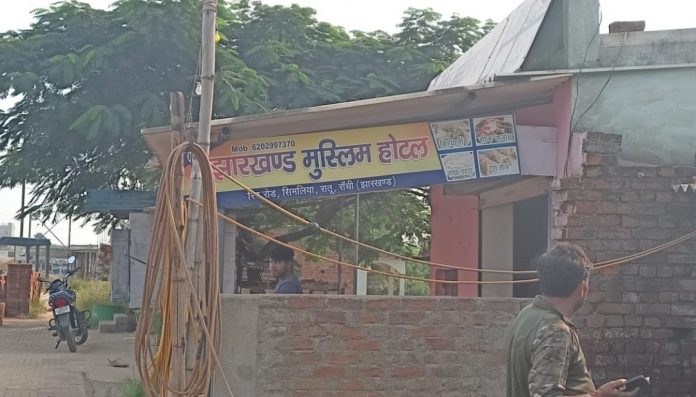
Jharkhand Muslim Hotel, Simlia village, near Ranchi
Around 20 kms west from Ranchi, as we reached Simalia to meet Padmashree awardee folk singer and poet Madhu Mansoori Hasmukh, we found a place named, “Jharkhandi Muslim Hotel”. Though it didn’t come as a surprise as the complexities of Muslim identities in Jharkhand have been our companion throughout, what unfolded gradually made us literally silent. Barely we entered Madhu Mansoori’s house, we met Masi Zama, a social activist who use to come to his place for mundane cordial visits. On being asked what my research focuses on, I casually said, “It’s mostly on the Muslims in Ranchi, their silencing… participation…and…”. I was immediately stopped. His displeasure was though not reflected through his voice, the words he chose were enough to make us understand that we made a statement that we were ought not to. “Muslims? Muslims kahan hai Jharkhand pe? (Where are Muslims in Jharkhand?)”- for a moment I felt my whole research purpose, its objectives are dismantled to the core. “Ye aap logo ke tarah jo log hai uske liye yahan pe Muslims ka aaj ye haal hai (It is the people like you who are responsible for the conditions of Muslims in Jharkhand). When constituent assembly debates were going on why nobody spoke of giving Adivasi status to the Muslims of this region? Yahan pe Muslims nahi hai (There is no Muslim in this region) We are Jharkhandi Muslims, Adivasi Muslims… Moolvasi Muslims”, we were told.
Understanding the gravity of the mistake as we were about to apologize, Madhu Mansoori, in his mid-70s entered the room. Without any ‘Salam-dua’ (Islamic ways of greetings like Assalam Aleikum Wa Rahamatullahi Wa Berakatahu) what he welcomed us with was a humble ‘Namaskar’. Already ashamed enough of our misconceptions, we greeted him back with a ‘Namaste’ and our conversation started. Madhu Mansoori claims himself as an Oraon Muslim. His ancestors, as he says perhaps got converted generations back. But it is the Oraon culture that drives his everyday lives. Throughout the interview whenever he referred to Muslims, he spoke off how the Munda-Oraon culture is intact within them. Islam has no conflict and doesn’t contradict their existing way of lives- rather it is a spiritual addition to the everyday beliefs and faiths.
These fundamental similarities rather embeddedness of faiths and practices into one another were explained to us later by Dr. Eliyas Majid, a Professor of History in Maulana Azad College, Ranchi. Explaining the Jharkhandi culture, he told us, “We have a ritual namely Madeikki Byebastha. It means helping one another in different things.” While in a capitalist set up, hiring laborers for mundane works is the norm, in Jharkhandi culture, as Dr. Majid said people come together to do neighbors’ works – whatever the nature of the work may be.
Another significant concept that Jharkhandi culture entails is of ‘Sahiya’ (friendship between any being or thing). “Koi bhi kisika Sahiya ho sakta hai. Ye zaroori nahi ke usko Insaan hona hai. Bachpan se jo aam, jamun ke paer pe hum khelte the wo bhi humara sahiya ho sakta hai. Hum logo me bahut sara ladki paer ke niche ghanto beithe rehte hai aur pooche to bolte hai Sahiya pass thi. (Anybody can become friend in our culture. It needs not to be human being. The mango, Jamun trees that we played underneath in our childhood could be our Sahiya. In our culture, women sometimes are found sitting beneath the tree for hours and on being asked where they have been- they respond- I was with my Sahiya)”, Dr. Majid continued.
The third and most interesting cultural attribute that he told us is called Gotiya’ (means brotherhood). For being brother in Jharkhandi culture, people need not to have blood relations. Any Oraon, Munda, Santhal can be Gotiya of a Muslim. All these three ideas explained to us by Dr. Majid significantly goes with the fundamentals of Islam. Helping others whereas is considered as Sunnat (Prophet’s (SWAS) way of life), the idea of recognizing every living being is in consonance with the belief of Islam that each and every being is created by Allah (SWT) and humans must behave with them in compassionate and empathetic manner. The idea of universal brotherhood (Gotiya) is also part and parcel of Islamic scriptures and commands. This comparison though is not intended to portray the similarities between Jharkhandi culture and Islamic fundamentals, rather it is just to show how Islamic fundamentals got melted into the Jharkhandi culture and paved the way for the construction of the identity known as ‘Jharkhandi Muslims’.
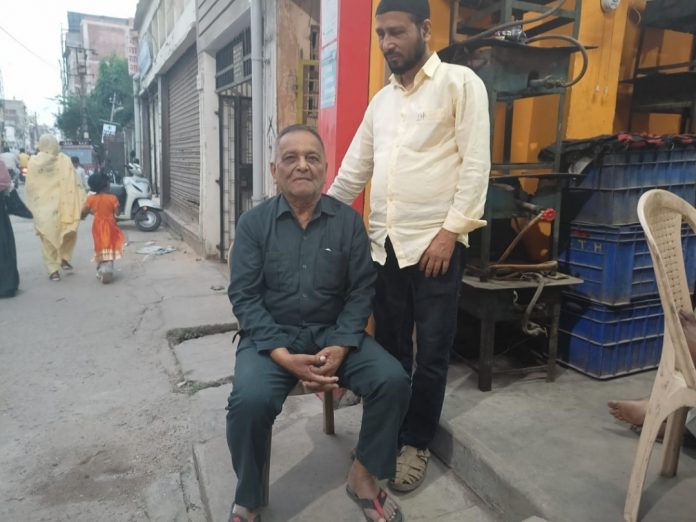
The cultural assertion of Jharkhandi Muslim identity whereas is rooted into the cultures of the land, the political assertion got its shape and voice through Jharkhand Andolon. Our encounter with Mohd. Faizi, a readymade garment seller near Upper Baazar took us through the terrains of this identity formation. Faizi made us walk in the roads where ‘Jharkhandi Manasikata (Jharkhandi Mentality)’ of Muslim foot-soldiers had to cross the paths of external political efforts and influences that were gathered to dismantle the ‘ekta’ (unity) of Jharkhandi Muslims.
Asghar Ali Engineer in his 1991 EPW paper ‘Remaking Indian Muslim Identity’ pointed out how ‘the assertion of religious identity’ could be a method for the ‘deprived communities in a backward society to obtain a greater share of power, government jobs and economic resources’. Similarly, assertion of Jharkhandi Muslim identity in the context of Jharkhand Andolon became a path to achieve the desired goals of statehood, to secure the rights of Minorities in the newly formed state and to ensure that ‘pehchan’ (recognition) of Jharkhandi Muslims remain intact without the imposition of homogenizing laws and regulations.
Personal is Political- Jharkhandi Manashikata & Instilled Mijaj
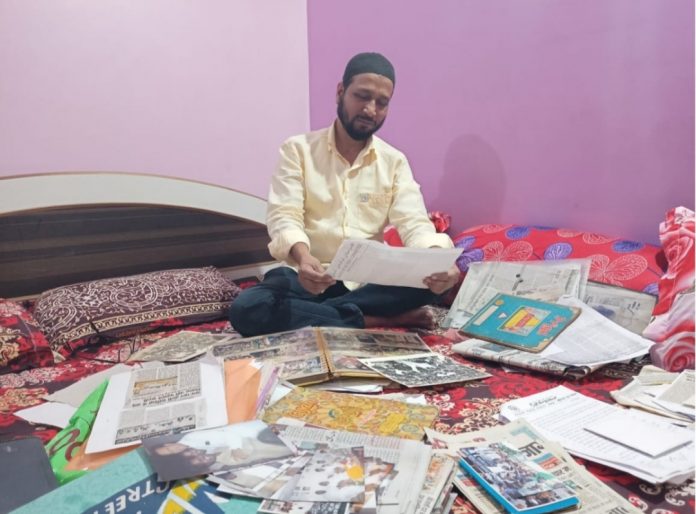
Mohd. Faizi looking back through the pages of own Archives
Mohd. Faizi was born in March, 1966 at Rain Mohalla, Tewari Street near Ranchi Main Road. Since childhood besides poverty another constant feature of Faizi’s life has been instilled ‘Jharkhandi Manasikta’ (Jharkhandi Mentality). Faizi’s father had a small (5ft/10ft) ‘Kapde ka gumti’ (an apparel stall) at footpath near Urdu Library. His childhood was filled with the stories of Jharkhand Andolon. Shared by his uncles, these stories instilled the dreams of separate Jharkhand in little Faizi’s mind. One of the stories was of an old woman who used to stay behind the Gel church (Evangelical) during the British Raj. Every day, ignoring the scorching heat, unbearable rain and all other obstacles she marched through the main road alone with a flag raising the slogan of ‘Jai Jharkhand, Jharkhand Prant Alag Karo’. The flag was nothing but a stick wrapped in a green cloth that became the bearer of Jharkhandi identity. She marched up to the Commissioner’s office and spending some time used to come back. Though there was no crowd behind her, the visual of her intermittent desire to have a separate state got reverberated through all those like Faizi’s uncles who later joined the movement in numbers.As people mocked at her, Faizi’s grandfather told them- “Yaad rakho ye mang jayes hai, aur ye aaj akeli nazar aarahai hai lekin ek waqt ayega jab iske peeche jan sailab hoge” (Keep it in mind that her claims her legit. Today, she is alone but day will come when hundreds will join her for the demands). Faizi not only witnessed the ‘Jan Sailab’ (Public uprising), rather he led it from the front and embraced it as a ‘farz’ (duty, mostly used for religious obligations) against all the odds coming in between him and his pledge to the separate state.
Mohd. Faizi with his uncle and undisputed Muslim leader of Jharkhand Andolon Tako Ansari (Sitting on the Chair)
In his early age only, Faizi saw his uncles Tako Ansari, Mohd. Farooq joining the statehood struggle through N E Horo’s Jharkhand Party. In Faizi’s words, ‘Mijaj to thaa hi (Mood was always there). Along with that the devotion of family members to the cause of Jharkhand made these aspirations grow”.
Faizi had few friends like Shamim and Saajid with whom he started attending the meetings of Sadan Vikas Parishad (SVP). At that time, Prof. Shahid Hasan was the general secretary of SVP. It was very early stage of his engagement into the movement. However, two specific incidents changed the way he looked into the world thereafter. Due to his father’s deteriorating health condition he had to leave his education at an early stage. Still, in 1985, he appeared for the board exam. Though he scored good numbers in subjects like English, Arabi and Farsi, his marks in science and mathematics didn’t let him qualify the boards. He got only 2 marks less than required to pass the exams. There were other students as well with whom similar things happened and they decided to go to Patna Examination Board office.
The reality of blatant discrimination had hit him in an inexplicable way. While he and his ‘Jharkhandi saathis’ (friends from Jharkhand) were told that nothing could be done and they started preparing for the next year, students from Bihar started filling the forms of colleges. Faizi then got to know that his ‘Bihari Saathis’ (Friends from Bihar) were told by the officials to apply for reviewing their copies and got the required grace marks whereas they were told, “Yahan pe kuch nahi ho sakta (Nothing can be done here)’. This instance not only made huge impact on Faizi’s mind rather it made him further believe that ‘Ye maang Jaees hai, aur inse in Bihario se chutkara milna chahiye’ (The claims of statehood are legitimate and we must get rid of Bihari officials).
While referring to the second incident Faizi was red in rage. Sipping a bit of water from the glass that was kept near his bed, he continued- “It was 1987. For the first time, anti-encroachment drive was going on in Ranchi. Police forces and officers came to our small Gumti and asked us to immediately vacate it. They threatened us that if we don’t move, they would trample it on and would even charge fine. We didn’t have money- so we started dismantling out only source of earning. And as I was putting down the asbestos, a small piece of brick fell near an Officer’s feet. It didn’t touch him at all but he started abusing me with ‘Maa ki gaali’ (Slangs referring to mother). I felt like immediately hitting them. But no, I couldn’t. My ailing father was standing there along with my little brothers. I silently listened to them but pledged that I would take revenge. If not from them at least from their viradari (their kind). It was our time to get rid of all these brutal Bihari officers and polices- We had to achieve statehood- We must- for the sake of our existence- for the sake of having a dignified life”- Faizi was trembling- silence clouded the moment- tears were visible with the determination that led him to become one of the most committed soldiers of Jharkhand Andolon.
During this phase, he led a group of 10-15 youths who participated in different social works. Meanwhile All Jharkhand Students’ Union (AJSU) had already been formed and movement got its required momentum. One day, when they were sitting near Urdu library, Ranchi Main Road, Zubair Ahmed (then the Ranchi town secretary of AJSU) came and asked them to join AJSU. Zubair even brought the founder president Prabhakar Tirkey and arranged a meeting with Faizi and his friends.
Within days, for his oratory skills and determination, he became very close to Tirkey and other CC members of the party. “Kyun ki itne sare adviasio me ek Muslim chehra, upar se accha bakta (Among so many Adivasis, a Muslim figure with good oratory skills)” made people like him and Zubair stand apart. Along with Zubair and other Muslim leaders/members they started gathering Muslim support for the movement. Though Muslims’ presence had always been there since the very early days of Jharkhand Andolon, its further expansion and visibility became their objective.
Political Assertion of Identity- Jharkhandi Muslims and Foundation of JMC
Since then, what drive Faizi throughout was his desire to achieve statehood and the recognition of ‘Jharkhandi Muslim’ identity. The assertion of this ‘Jharkhandi Muslim Identity’ led people like Faizi or Zubair to invest their lives for the cause of separate statehood where they would be considered in same manner as their ‘Adivasi saathis’, instead of their religious brethren of the other states.
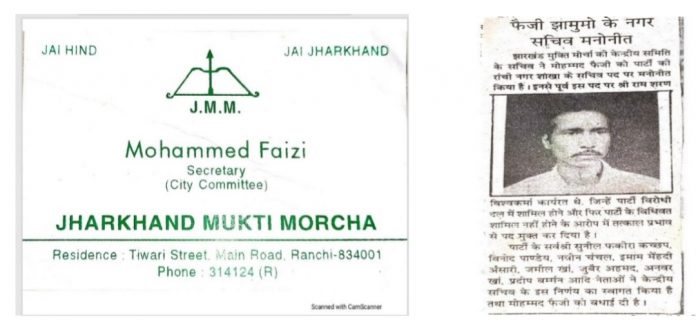
The JMM Visiting card of Faizi and News Cutout of Faizi inducted as Town Secretary, JMM
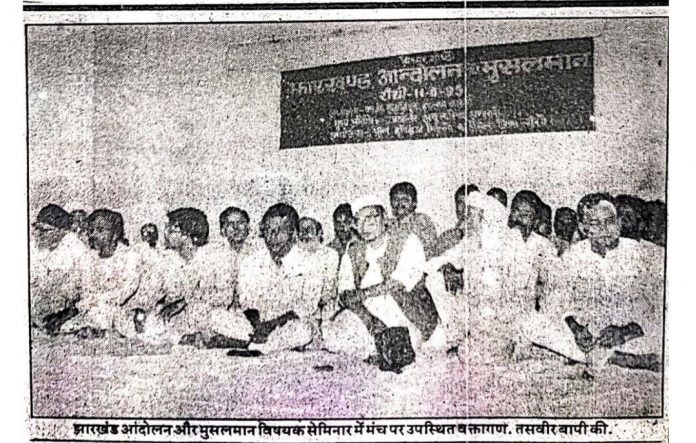
As soon as Faizi joined Jharkhand Mukti Morcha (JMM) in 1992 after a meeting with Prabhakar Tirkey and other leaders of AJSU (Tirkey faction) at Suleiman hotel, Lake Road, Ranchi, he got the chance to further work both for the statehood movement and the cause of separate Jharkhandi Muslim identity. The very next year in 1993, with the objectives of working for the social causes he founded Muslim Youth Forum. The organization though was not politically active, it could be called a social reform wing of the broader struggles for the Muslims in the state.Already Jharkhand Minority Front of Jharkhand Party was formed in 1988 and consequently in the next year Jharkhand Quami Tehrique (JQT) was founded. The founder president of All Jharkhand Students’ Union Prabhakar Tirkey in one of his articles in Prabhat Khabar titled ‘Jharkhandi Pehchan KeL iye Sanjida Rahe Musalman’ talked about the enormous participations of Muslims in the statehood struggle. His article even reflects what Mohd. Faizi has to say- “Jaise aapko pata hai Musalman bahut pehle se ye andolon me hai. lekin Musalman jo jude, kisi na kisi party se jude, aapna identity le kar ken ahi aye…Ab musalman ye tahriue ko aapne haat me bhi lenge aur tehrique chalayenge. (As you know Muslims have been part of this movement since very initial days. However, Muslims joined different parties and never came with their own identity. Now, it was the time for Muslims to lead the movement, to play the role of leaders not only the participants).On being questioned that why the Muslim identity became important at that stage, Faizi was more clear and vocal- “We have seen what has been the role of Muslims in Indian Independence. Even after that today Muslims are called ‘Gaddar’. Our histories have been deliberately eliminated. If we don’t create our own identity in this statehood struggle, people in coming days would definitely say that we had no role in the movement. We apprehended that in very early stage”. This was the reason why they not only fought rather as Faizi said, “We kept the documents as the evidence to prove that Muslims were no less in this movement and we made ‘barabar ki qurbani’ (equivalent sacrifices) like other communities”. Referring to ‘shahadat’ (martyrdom) of several Muslim leaders who died for the movement including Abdul Wahab Ansari, Qutubuddin Ansari, Murtuza Ansari, Mohd Zubair, Mohd Sayeed and Ashraf Khan, he implied, “Ye cheese Tarikh me jaana chahiye. Logo ko pata hona chahiye ki Musalman ye alag rajya ke liye kya kiye hai (It must be written in pages of histories. People must know what Muslims have done for the separate state).A Dr. Eliyas Majid had even mentioned in his book “Jharkhand Andolon aur Jharkhand Gomke Horo Saheb” that Muslims in the late 80’s needed their identities to be reflected on the grounds of the movements. On May 25, 1988 while presenting the working paper in the foundational Conference of Jharkhand Muslim Front (JMF), Dr. Majid said despite their participation and martyrdom, “Muslims utna hi cchipa hua hai, jitna Jharkhand Andolon ubhra hua hai” (Muslims are as much silenced as much the movement is vocal). His address majorly focused on two parts- firstly, the individual identity of Muslims and the political indifference toward their demands and secondly, the separate identity of Jharkhandi Muslims that share more cultural values with the Adivasi ‘saathis’ than their North Indian coreligionists. In words of Dr. Majid, “Jharkhand humara andolon hai, Jharkhand humare wajood se jura sawala hai” (Jharkhand is our movement, it is connected to our Entirety- our Entity).Even after this eternal connection with the movement, as Faizi says that Muslims were denied proper position in the histories of the struggle. “While writing the history of AJSU, people would talk about Suraj Singh Besra, Prabhakar Tirkey, Lalit Mahato, Mangal Singh Bobonga but nobody would mention Nazm Ansari, Farooq Azam, Zubair Ahmed or Mohd. Faizi. When JMM’s history would be drafted people would remember Shibu Soren, Suraj Mandal and Sailander Mahato but Prof. Abu Talib Ansari or Hazi Hussain Ansari would not be named”. His concerns later proved to be right as most of the accounts of Jharkhand movement hardly spoke of Muslim participation. They understood the fact that if only they would come up with separate organizations for Jharkhandi Muslims, it would be recorded in the pages of history.It was in early 1995 that the decision regarding the formation of Jharkhand Area Autonomous Council (JAAC) was taken. On the eve of it, Muslims of different Jharkhand ‘naamdhari’ (Jharkhand-named) parties came together to plan the formation of a specifically Jharkhandi Muslim platform that would talk about the condition of Muslims- that would ensure the constitutional rights of the community in the newly proposed state. During this period Qazi Mujahidul Islam of Imrat-e-Shariya was about to come to Ranchi. Hussain Qasim Kacchi, who used to be a keen patron of the movement asked Mohd. Faizi and his friends to meet Mujahidul Sahab. They planned a seminar on June 11, 1995 at Anjuman Plaza Hall, Ranchi Main Road to welcome Qazi Sahab. As there was no properly functioning Muslim front, they decided to use the banner of Qazi Sahab’s organization All India Milli Council.In Faizi’s words, “Banner didn’t matter to us, we had to do something to bring Jharkhandi Muslims together”. The title of the seminar was ‘Jharkhand Andolon aur Musalman’ (Jharkhand Movement and Muslims). Qazi Sahab while was the chief guest of the seminar, Prof. Abu Talib Ansari had presided over it. It was for the first time in the history of Jharkhand andolon that discussions happened in a public forum on participation of Muslims. Qazi Mujahidul Islam referred to the anti-racial movement in South Africa where Muslims stood by the colored people. This anecdote further worked as a spark as it not only echoes the ideals of Jharkhandi Muslims, rather it speaks directly to the fundamental tenets of Islam that commands its followers to join hands with the oppressed people of the world. He also called for an ‘umbrella’ organization that would accommodate all Jharkhandi Muslims.
Seminar at Anjuman Hall Plaza on Jharkhand Andolon aur Musalman
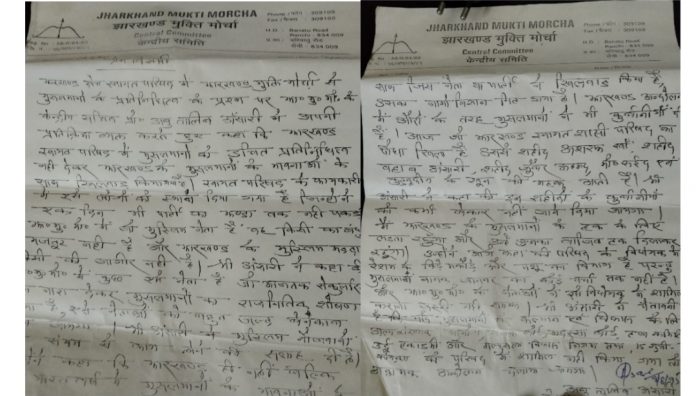
Following Qazi Sahab’s advice Muslim leaders of different Jharkhandi Parties called for a meeting on June 27, 1995 at Mohd. Faizi’s place. Around 252 representatives of different panchayats, social organizations and political parties attended the meeting and formed the Jharkhand Milli Council (JMC). As per the reports of Prabhat Khabar June 28, 1995, most of the leaders agreed to the contention that despite huge presence of Muslims in different Jharkhandi parties, they were not given due importance in decision making amounting to political silencing of Jharkhandi Muslims. So, the major objectives of JMC were to gain the recognition of Jharkhandi Muslim Identity (Moolvasi Muslim) along with claiming the legitimate political, economic, social and educational rights. To avoid the risk of catapulting another cult figure that the Jharkhandi parties had been the overwhelmed with, JMC decided to form a presidential council. Prof. Abu Talib Ansari whereas was declared the chief of the council, Farooq Alam, Mumtaz Khan, Prof. Khalik Ahmed and Salik Ahmed were the elected members. Nazm Ansari was projected as the Chief Secretary of the party and Mohd. Faizi, Sarfaraz Ahmed, Rafat Hussain, Abdul Moin Rizvi, Jameel Khan, Samnur Ansari, Mustaq Alam and Prof. Amin Ahmed became members of the secretariat. JMC pledged to not have any relation with the All India Milli Council, rather it decided to become a frontal organization for the Jharkhandi Muslims. Formation of JAAC- ‘Yahan Pe Muslim naam ka janwaar ka koi zikr nahi hai’Meanwhile, on July 30, 1995, Jharkhand Area Autonomous Council (JAAC) was formed and Shibu Soren became the chairman of the council. As anticipated earlier, almost negligible representations of Muslims in JAAC clearly made the fears of elimination legitimate. Protesting against the deliberate omissions of both Muslims and their causes Prof. Abu Talib Ansari wrote a press release on August 9, 1995. The release, however, could not see the light of the publication as Mohd. Faizi and other comrades restrained him from sending it to the press. As per Faizi, this declaration would have been considered as resignation of Prof. Ansari from JAAC leaving not even a single member in the council to voice the concerns of the Muslims. In the press release (collected from Mohd. Faizi) what we found was acute disgruntlement of Jharkhandi Muslims regarding the formation of JAAC. Prof. Ansari (then the Central Committee Secretary, JMM & Chief of Presidential Council, JMC) in the release said, “JAAC has played with the emotions of Jharkhandi Muslims by not giving them proportionate representations. There are few people in the council who didn’t even hold the party flag ever”.
Unpublished Press release of Prof. Abu Talib Ansari after the formation of JAAC in 1995
Mentioning that the Muslim leaders of JMM are not ‘kisi ka bandhua mazdoor’ (bonded laborers), he continued, “Jharkhand is nobody’s paternal property. There are leaders in JMM who have used the slogans of secularism to undermine the cause of Muslims. JAAC is the by-products of martyrdoms of leaders like Ashraf Khan, Wahab Ansari, Zubair Ahmed, Mohd. Sayeed and Qutubuddin. These ‘shahadat’ should not be forgotten if an inclusive Jharkhand state is to be imagined.
Though there were references to Silk, Animal Husbandry and other departments in the JAAC bill, there was no mention of Muslims (Yahan pe Muslim naam ka janwaar ka koi zikr nahi hai). Prof. Ansari categorically warned that if Minority Welfare & Development Council, Minority Commission, Waqf Board, Haj Committee, Madrassa Board, Urdu Academy and implementation of 15 points program are not considered in the council, there would be parallel movement of Jharkhandi Muslims across the territories of JAAC.
Claiming Adivasi Status- Kohl Jolha Bhai Bhai
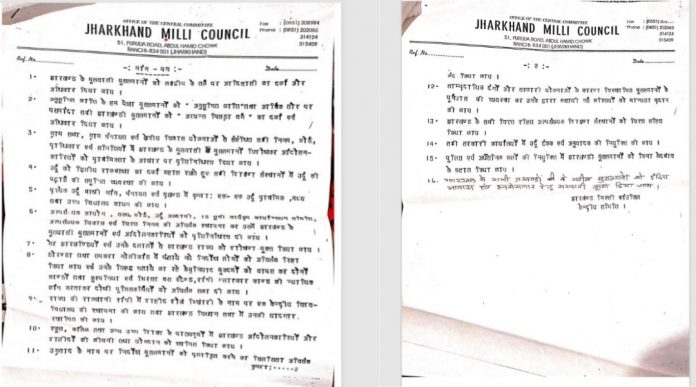
While JMC’s movements, processions and meetings across the territory of the proposed state continued with vigor, the major step of claiming their separate identity of Jharkhandi Muslims came on October 24, 1998 when the party leaders reached Delhi to submit petition to the then Prime Minister Atal Vihari Bajpayee. At Tal Katora stadium, New Delhi, JMC gave a protest call and was presided by Prof. Abu Talib Ansari. After the demonstrations, they submitted the petition containing the following key points-
First Draft of JMC Petition submitted to then the Prime Minister Atal Behari Bajpayee in 1998
1. The Moolvasi Muslims of Jharkhand must be given the Adivasi status and rights as available in Lakshadweep (As per Article 342 of Indian Constitution)
2. Like the Scheduled Caste and Scheduled Tribes, Pasmanda Jharkhandi Muslims must be given Economic and Political Rights
3. Jharkhandi/ Moolvasi Muslims and specifically those who have been part of Jharkhand Andolon must be given priorities in Gram Sabha, Gram Panchayats and any other developmental commissions and boards
4. Urdu must be retained as the second language and all of the educational institutions must have Urdu in its curriculum
5. In villages and towns Urdu schools must be opened for the development and retention of the language
6. Minority Welfare Commission, Waqf Board, Madrassa board, Haj committee, Urdu Academy need to be formed and Andolonkaris should be prioritized in these committees
7. Jharkhand should be free from the coercion of Non-Jharkhandis
8. A University under the name of revolutionary Sheikh Bhikhari must be founded in Ranchi. Jharkhand Legislative assembly also must have memorials of Bhikhari
9. In school curriculum, the lives and sacrifices of Jharkhand Andolonaris must be included
10. The trials of Muslim youths in the name of terrorism must be stopped
11. Places where the Muslim families had to resettle due to communal disturbances and riots must be given residential legitimacy
12. All the Government offices must recruit Urdu translators
13. Jharkhandi Muslims must be recruited in Security and Police forces without any discrimination
14. All the poor Jharkhandi Muslims should be given residential facilities through Indira Awas Yojana.
These claims clearly indicate the significance of ‘Moolvasi Muslim identity’. On one hand, it claims the status of Adivasis, on the other it demands to secure the rights of Minorities enshrined in the constitution. During our conversation, several times we found Faizi referring to incidents that show how Jharkhandi Muslims had been treated by Muslims of the other states. While being asked what was the positions of Muslims of other states (Northern India) vis-à-vis their struggles, Faizi lamented, “Koi samarthan nahi- birodh, birodh. Ye log nafrat kiya karte thee. Ye log yehi bat failaya karte the ki sara jo ye log Kohl ho geya hai. Ye log bolte the ki ye julus jalsa karke hariya daru kha ke so jaya karte hai. In logo ka hukumat karne ka mijaj ban gaya thaa. Aaj bhi ye log Jahan pe basenge chahenge ki wahan ki hakim hum ban jaye. (They never supported us. They told us that we have become Kohls. They have the perception that after Processions and meetings, we take hariya [a specific form of alcoholic drink made out of rice] and sleep. They got used to rule over us. Even now wherever they settle in, they want to become the owner of the place)”.
‘Arab ke sarjameen pe jaye toh hum jaye humari Jharkhandi Pehchan se’
Such emotion was reflected in actions of JMC even after the state of Jharkhand was formed. The demand of separate Haj Committee as mentioned earlier though was there since the formation of different Muslim Forums during Jharkhand Andolon, several Ulemas from Bihar said that for the first year (i.e. 2001) let the Jharkhandis be sent through Bihar Haj committee. Faizi and his comrades were not ready under any circumstances to have some compromises. “Itne jaddo-jehad ke baad jab alag rajya mila tabhi bhi hum jaye Haj karne Bihari pehchan se? Nahi! Hum chahte hai ki hum jab Arab ke sarjameen pe jaye toh hum jaye humara Jharkhandi Pehchan se (After so many struggles and fights we have got the separate state and still are we expected to go for Haj with Bihari identity? No! Never! We want when we will touch the land of Arab, we will have our Jharkhandi identity)”, Faizi’s words were reverberating in the room- the only thing that we could hear was the aspiration for separate Jharkhandi Muslim identity- even in the holy land of Islam where all other identities are subsumed by the broader identity of ‘ummat’.
On April 28, 2001, JMC submitted memorandum to then Minority Welfare Minister of Jharkhand Arjun Munda and asked him to form separate Haj Committee immediately. Under pressure the newly formed Jharkhand Government on July 2 declared the formation of separate Haj Committee in Jharkhand and Arjun Munda was made the president of 14 members’ council.
Faizi referred to another meeting of Momin Conference in late 90s in Irba where he further understood how Muslims of other states looked down upon them. The chief guest was from Bihar who not only continued comparing Jharkhandi Muslims with Kohl tribes rather he continued saying that Muslims in this state didn’t have manners of clothing and speaking. Only after the ‘Yalgar’ (attack) from the people of Bihar that they started learning the Islamic ethos. This savior complex of North Indian Muslims is what the Jharkhandi Muslims fought against.
Their opposition to the Ulemas from Bihar and Uttar Pradesh got reflected in the meeting of JMC on October 11, 2001. Under the chairmanship of Haji Akhtar Ansari, district president, JMC, this meeting unanimously took the decision of not letting the Muslim leaders of North to divide the unified Jharkhandi Muslim community. Such idea of united Jharkhandi Muslim identity though stands in contrast to the caste panchayats working at the mohalla level, it came several times in the words of Mohd. Faizi, Zubair Ahmed and other leaders as well that without the external interventions such ‘firqahs (sects and divisions)’ wouldn’t have much fodder to grow.
JMC continued its struggle for the rights of Jharkhandi Muslims and emphasized on the proper upholding of Article 29 & 30 of the Indian constitution. On one hand, the fight was against any sort of discrimination, on the other it was for gaining the recognition of a separate identity. Considering the backwardness of Muslims in terms of economic and educational qualifications, JMC submitted its petition to Arjun Munda, then the Minority Welfare Commission, on June 5, 2001 to provide the Jharkhandi Muslims with 20% reservation. JMC used the analogy of Karnataka’s Muslims as in late 90s they used to have 6% reservation within the cap of OBCs. However, the reservation of Muslims in Karnataka has different historical trajectories. Qazi Arshad Ali in his book ‘Karnataka Muslims & Electoral Politics’ mentioned that Muslims were given reservation as backward class back in 1921, according to the recommendations of Justice Miller committee that was appointed by Maharaja of Mysore. The context of Jharkhand was though totally different, the analogy of Karnataka was a point for them to show the possibility of using Other Backward Classes quota for overall development of Jharkhandi Muslims.
Against the Grains of Homogeneity
Till the date, though in an overwhelmingly communally polarizing situation, JMC is still working for the rights of the Jharkhandi Muslims. The lynching of Tabrez Ansari was the latest that made them sit together further to contemplate for what actually they devoted their lives- Is it the Jharkhand they hoped for? While we were about to wrap up the interview, Faizi asked his daughters to meet us. At a glance, we recognized Shireen Faizi who was one of the leading women faces during Anti-CAA movement in Ranchi. Faizi smiled at us- “Humara pura khandan hi Andolon se juda hua hai… Abhi bhi Jharkhandi Muslims ka koi bhi issue me pehla insaan jo raste pe ayega wo mere ghar se hi niklega…(My whole family is connected to movements. Still now, whenever Jharkhandi Muslims will fight for anything, the first person to come out of the house will be from our place)”- there was reflection of just pride that still helps him to sustain the struggles for existence.
At a time when Hinduization of Adivasis has become one of the major propagandas of the ruling Hindu rights, the nuanced ‘Adivasi Muslim’ identity must be further interrogated. Against the grain of religious homogenization where Muslims and Hindus, Muslims and Adivasis, Muslims and Dalits are pitted against each other as singular blocks, the assertion of ‘Jharkhandi Muslim’ identity becomes imperative at least to reclaim the Adivasi-Muslim unity in Jharkhand. For the survival of Indian democracy perhaps what we need the most is the recognition of heterogenous identities that have not been products of some decade-old propagated conflicts, rather have history of century old collaborations and bonhomie.
Authors:
Abhik Bhattacharya is a Doctoral Research Fellow, School of Liberal Studies, Ambedkar University, Delhi. He works on Silencing and Spatial segregation of Muslims in Ranchi
Arshad Raza Khan is the admin of Facebook page Muslims of Ranchi. He is also currently pursuing his M. Tech from Central University of Jharkhand
Ayan Tanweer is a Freelance photographer based in Ranchi. He is pursuing his M.B.A from ISB&M, Pune
source: http://www.muslimmirror.com / Muslim Mirror / Home> Must Read / by Abhik Bhattacharya, Arshad Raza Khan & Ayan Tasveer / October 28th, 2021
While the origin of Mygurudu is unknown, it is believed that the word originated from ‘Mozhi Kurudu’, which means misleading with words.
The 1921 revolt grew as an agitation against the feudal lords who aided the British. (Photo | Special Arrangement)
Kozhikode :
The centenary observations of the Malabar rebellion of 1921 are also becoming an occasion to retrieve many forgotten things part of local history. Mygurudu, the secret language that was prevalent in some parts of Malabar, is among them. For the coded language was used widely by the rebels to hoodwink the British during the rebellion.
While the origin of Mygurudu is unknown, it is believed that the word originated from ‘Mozhi Kurudu’, which means misleading with words. The language was developed by swapping Malayalam alphabets. For example, Malayalam alphabet ‘Aa’ is replaced by ‘Sa’ and ‘Eee’ by ‘See’.
In his book ‘Anglo-Mappila War 1921’, historian A K Kodoor recorded that the rebel leaders had instructed that all messages should be communicated through Mygurudu. He added that rebels’ meeting at Vellinezhi had decided to teach all group members the language, and that the Mappilas of Malabar used the secret language from 15th century AD when they were battling the Portuguese.
The Students Islamic Organisation (SIO) recently organised an exhibition ‘Al Jamia Mygurudu’ at the Al Jamia Al Islamia at Santhapuram near here. “The exhibition was part of a protest against the move from the Indian Council of Historical Research (ICHR) to delete the name of those who participated in the 1921 rebellion from the list of freedom fighters,” said Ayman M A, convener of the exhibition.
Dr Pramod Irumbuzhi, who has done extensive research on the language, said he first came to know about it when he was studying at the Calicut University. “I realised that some people can still speak the language. There will be around 500 people who can fluently speak Mygurudu in the seven districts of Malabar,” said Pramod, whose book on the subject has run into the fourth edition.
source: http://www.newindianexpress.com / The New Indian Express / Home> States> Kerala / by Express News Service / October 24th, 2021