Qaiser Nizami, singer and music composer from Kashmir
Qaiser Nizami has not only won the hearts and minds of music lovers across Kashmir but also is the only artist from Jammu and Kashmir to get international attention with his nomination for the prestigious Grammy award from the US in 2019.
He won the nomination for his song “Nazninay…” (O beauty), as a singer, musician, composer, and director. he is thus the only one from J&K to be nominated in the history of Grammys by the Recording Academy of the United States.
There is a long list of Grammy winners from India since its inception in 1959, including Ravi Shankar, Zubin Mehta, Zakir Hussain, A R Rahman, and; Shankar Mahadevan, who received the award for 2024 earlier this month.
Nizami’s nomination for the “Award for Voice” in 2019, led him to visit and perform in New York amid thin movement of people due to the Covid restrictions in 2020 to perform in the category of Kashmiri music and poetry for the “dying melody of Kashmir”.
Qaiser Nizami also had the opportunity to perform with Iranian and other groups, much to the appreciation from the organisers. “The shooting for our performances took place amid the deserted streets of New York that otherwise remain brisk with movement of people round the clock,” he recalls.
Poster of Grammy nominations
He performed in collaboration with Ehsan Matoori, Iranian Santoor player. and Alireza Ghorbani, Iranian Vocalist in “The Voices and Bridges” during his New York visit. “It was a rich experience to perform with the Iranian artists, as most of the musical instruments have come to Kashmir from Iran centuries ago”, he told Awaz-The Voice.
For the last four decades, Qaiser Nizami has been mesmerising the audience with his silky voice from AIR, Srinagar, and different kendras of Doordarshan like Srinagar, Delhi, and Bombay.
Not only as a singer of classical compositions, ghazals, Bhajans, and Sufi poetry in Kashmiri, Urdu, and Hindi, Nizami has also mastered Persian singing. He, however, laments that there are no listeners to some of these songs.
Qaiser has contributed as musical director to various productions of DD, Srinagar, which include “Shanti”, “Pehchan” and “Geath”.
He began his innings with Radio Kashmir, Srinagar (now AIR, Srinagar), as a child artist in 1985-86. Qaiser first participated in weekly Children’s and later musical programmes, singing Kashmiri poetry for the “Yuva Vani”, youth services Section by 1987. At the Doordarshan Kendra Srinagar, he was fully on the screen performing in the New Year programme of 1988.
Despite threats from terrorist organisations that sought to ban all kinds of entertainment including cinema and music, he was approved as an A grade artist by a national jury in 1993 and Top grade artist in 2019.
However, despite winning awards and accolades at the national and international levels, Qaiser Nizami is yet to be honoured by the J&K Government, though he has received appreciation and awards from the Chief Ministers and some institutions.
Qaiser Nizami and Iranian singer-composer Alireza Ghorbani
“Initially I was not inclined to music, but to cricket”, Qaiser Nizami told Awaz-The Voice. His father’s association with Radio Kashmir, Srinagar brought him closer to music. He was often found murmuring famous Urdu Ghazals.
His father, Mohammad Amin Nizami, popularly known as “Amin Bhai”, was co-presenting “Aap Ki Farmayish”, a weekly programme of Hindi film songs, when Radio was the only means of entertainment. “Amin Bhai”, having been in the company of musicians, singers, and other artists at the Radio Station also loved music and had a few musical instruments like Harmonium and Nai at home.
“I would try playing these instruments without proper guidance”. His father spotted his talent.
At the beginning of his career as a singer, Qaiser had the opportunity to get blessings and approval from the Santoor Maestro Padma Shri Bhajan Sopori, then associated with Radio Kashmir, Srinagar.
He was also lucky to get guidance from Asrar Hussain, Shahi Qawwaal of Dargah at Ajmer, who organised two weeks of “Mehfils” at the residence of Amin Bhai in Srinagar. Qaiser had also the blessings of Ustad Mohammad Ayub Khan Barelvi of Agra Gharana, who had also visited Srinagar in Qaiser’s early childhood.
Qaiser Nizami says the association with the maestros influenced his career.
source: http://www.awazthevoice.in / Awaz, The Voice / Home> Story / by Ehsan Fazili, Srinagar / March 01st, 2024
NEW DELHI—Zakat Centre India (ZCI) secretary Abdul Jabbar Siddiqui has highlighted the need to use Zakat collections for skill development and livelihood generation programmes for Muslims who are at the bottom of the labour force participation rate (LFPR) and worker population ratio (WPR) among various social and religious groups in India.
An analysis of the Periodic Labour Force Survey (PLFS) data for the period July 2022 to June 2023 says that WPR for Muslims for the survey period was 31.7 percent against national average of 42 percent. According to the PLFS data, WPR for Muslims fell from 35.5 in 2020-21 to 31.7 per cent in 2022-23. LFPR and WPR measures employment status among social and religious groups.
Based on these data, Mr Siddiqui says that only a little over 30 percent of Muslims in the age group above 15 per cent are employed getting regular salary and the whopping 70 percent of the Muslim population have no work at all. According to Mr. Siddiqui, this is one of the basic reasons for mass poverty among Muslims in India.
Mr. Siddiqui is not wrong. His observations are supported by Santosh Mehrotra, a professor of Economics in the Jawaharlal Nehru University (JNU). He says that among major religious groups, the labour force participation rate (LFPR) and WPR of only Muslims have declined. (LFPR is the share of population which is looking for work, and WPR is the share of the working age population that has work).
But Mehrotra has made a mistake in his analysis. Based on declining WPR, Mehrotra has concluded that “Muslims are not looking for work” which is not true. Nobody wants to live in poverty. Everybody has an innate desire to increase his/her income.
But there are certain obstacles that come in the way of Muslims getting absorbed in the job market.
In a video he circulated on the social media to create awareness among the educated members of the community, Mr Siddiqui, who is also associated with the Jamaat-e-Islami Hind (JIH), one of the prominent Muslim organisations in India, says that it is not that Muslims are not willing to work or not looking for work.
According to him, Muslims are willing to work but they don’t possess requisite skills and capital and also the knowledge required to get absorbed in the job market.
But even if one has knowledge and skill, one requires working capital for starting one’s own business and trade. According to Mr. Siddiqui, it is here that Zakat can play a vital role in providing capital to poor Muslims to set up their own businesses and become financially independent.
According to Mr. Siddiqui, Zakat money can be utilized in development of skill and generating livelihood activities for the poor Muslims. He said that if Zakat money is utilized properly, for example, to provide work to at least 80 percent of the Muslim population having no regular sources of income, the community can play a positive role in boosting national economy and bring happiness to the community, besides contributing to the gross domestic product (GDP) of the country.
Zakat Center India, according to Mr. Siddiqui, has been set up to make poverty-free Muslim community.
ZCI that began operations throughout the country in 2022 has so far impacted the lives of 6,000 people. Of the total money it spent since then, it spent 69.4 per cent on livelihood projects, making 1,058 persons financially self-reliant. The rest of the money was spent on developing skills and providing education, and ration to poor people.
Donations to ZCI can be made in its bank account: Zakat Center India, HDFC Bank, Account Number: 50200067009755, IFSC Code: HDFC0000365, Account Type: Current Account, Branch: Mehdipatnam Hyderabad.
source: http://www.indiatomorrow.net / India Tomorrow / Home> Economy> National Interview / Syed Khalique Ahmed / by admin indiatomorrow / March 28th, 2024
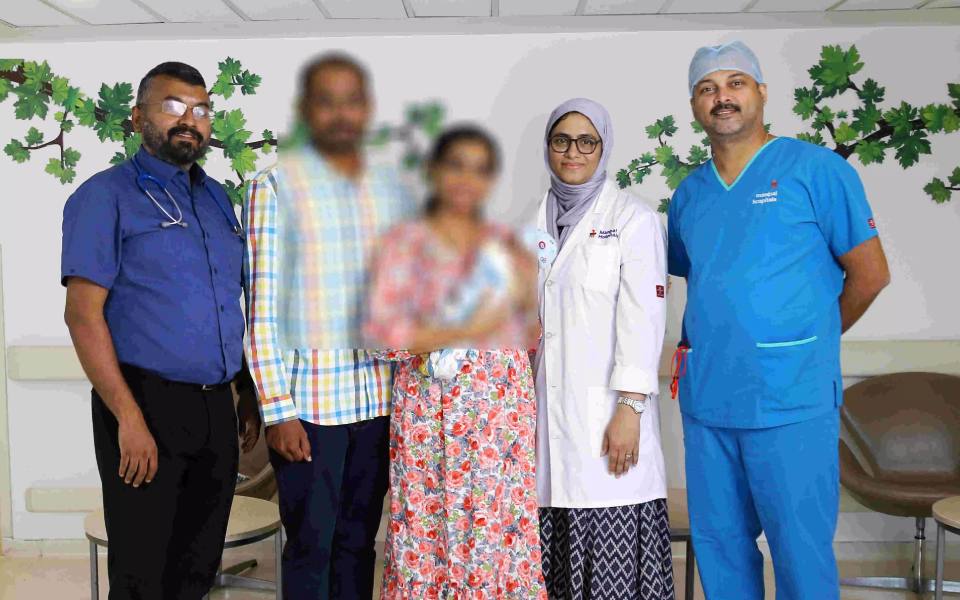
In a remarkable feat of medical expertise, a team of doctors, spearheaded by Dr. Sameena Haroon, Chief Physician of the Obstetrics and Gynecology Department at KMC Hospital in Mangalore, successfully performed a challenging delivery procedure, ultimately saving the lives of both mother and child.
The delivery, which employed the innovative “Intrauterine Transfusion” system, proved critical in addressing complications arising from blood group-related issues.
The patient, a 35-year-old woman from Pune, was admitted to KMC Hospital for her third delivery due to complications stemming from blood group incompatibility. With the timely intervention and meticulous care provided by the medical team, she was safely discharged from the hospital, marking a triumph over adversity.
Blood group incompatibility between parents, particularly when one is Rh-positive and the other is Rh-negative, often leads to complications in subsequent pregnancies. These complications arise from the development of antibodies in the mother’s bloodstream during pregnancy, posing risks to both mother and fetus. Dr. Sameena Haroon emphasized the impact of such blood group disparities on maternal and fetal health.
The patient’s medical history revealed a prior normal delivery four years ago, followed by complications during her second delivery, which tragically resulted in the demise of the infant within a year due to intracranial hemorrhage. Subsequent pregnancies posed heightened risks, necessitating vigilant monitoring and specialized care.
During the current pregnancy, complications emerged at the five-month mark, prompting intensive monitoring. At 30 weeks gestation, an Indirect Coombs Test (ICT) returned positive, indicating depleted iron levels in the blood—a critical concern necessitating immediate intervention to safeguard the fetus. Premature delivery posed risks, including jaundice and intracranial bleeding, underscoring the importance of delaying delivery until the optimal timeframe.
In response to the precarious situation, the medical team executed a challenging intrauterine transfusion procedure to replenish the fetus’s hemoglobin levels, thereby mitigating the risk of preterm birth. After two subsequent weeks, delivery at 35 weeks gestation alleviated concerns surrounding low hemoglobin levels in the infant, ensuring a safe outcome for both mother and child.
Dr. Sameena added that the baby was kept under observation and monitoring in NICU for over a week post-delivery where the child received further transfusions before being discharged subsequently.
Dr. Sameena Haroon expressed gratitude for the collaborative efforts of her colleagues, including Dr. Shami Shastri, Dr. Pundalik Baliga, and Dr Mario J Bukelo, whose expertise and teamwork were instrumental in achieving a successful delivery. Despite the complexities posed by the patient’s history of fetal loss, the utilization of modern medical advancements and the dedication of the medical team culminated in a positive outcome, with both mother and child discharged from the hospital in good health.
What is intrauterine blood transfusion?
Intrauterine blood transfusion is a complex medical procedure performed during pregnancy to address severe fetal anemia. Through the procedure, the baby in mother’s womb is transfused blood.
Before the procedure, the mother undergoes thorough assessments, including ultrasound scans and blood tests. Continuous ultrasound guidance is used throughout the procedure to visualize the fetus, placenta, and the specific blood vessels involved. A thin, specialized needle is carefully inserted through the mother’s abdomen and into the amniotic sac, guided by real-time ultrasound imaging. The goal is to reach the umbilical vein of the fetus.
Once the needle is correctly positioned, compatible blood is slowly transfused into the fetus through the umbilical vein. The amount of blood transfused is carefully controlled to avoid overloading the fetal circulation.
This successful delivery at KMC Hospital in Mangalore also marks a significant milestone in medical advancement within the region. The utilization of the “Intrauterine Transfusion” system, under the adept supervision of Dr. Sameena Haroon, signifies one of the pioneering instances of this rare procedure in Mangalore. Dr. Sameena’s leadership and expertise, coupled with the collaborative efforts of her medical team, have not only facilitated a positive outcome for the patient and her child but have also expanded the scope of obstetric care in the region.
source: http://www.english.varthabharati.in / Vartha Bharati / Home> Karavali / by Vartha Bharati / March 28th, 2024
Mumbai-born Firoz Merchant is well known for his jewelry business and above all human service in the UAE. Each year before Ramazan, he gets prisoners who are languishing in jails after serving their terms but unable to pay the fines imposed by the Courts on them freed from the UAE’s jails.
For this mission, he set up an organization called ‘The Forgotten Society’ in 2008. As per the society’s policy, a week ago Firoz Merchant handed over Rs 2.5 crore to the UAE government as the cumulative fine amount for the release of 900 prisoners.
Merchant had to drop out of school due to financial difficulties and he moved to UAE where he worked and gradually established his business.
Firoz Merchant says he does this to ensure that the prisoners can return to their homes before Ramazan. ‘The Forgotten Society’ arranges tickets for the air travel of prisoners. Firoz Merchant, 66, is the owner ‘Pure Gold Jewellers which he set up in Dubai in 1989. He claims to live up to the name of his business and sell only quality jewelry to his customers.
Firoz Merchant says after becoming a brand and enjoying a monopoly on the jewelry market of Dubai and later Abu Dhabi, he wants to expand globally with his new design jewelry.
Merchant being falicitated by Police for his services
All the exquisite gold-diamond designer jewelry of ‘Pure Gold Jewellers’ is available for sale online.
While selling designer jewelry, one day Firoz Merchant thought of freeing the prisoners lodged in various jails who don’t have a relative and resources to pay the fine imposed on them by the court as part of the punishment.
His organization also helps prisoners through various means.
Due to their efforts, 700 prisoners were released in 2019. This year, 900 prisoners were released a week ago. His initiative has helped more than 20,000 prisoners in the last few years. This year, he donated 1 million dirhams, or about Rs 2.5 crore, to the UAE government to get 900 prisoners released.
He says his target is to get 3,000 prisoners released in 2024. According to Firoz Merchant’s office, this is a message of humility, humanity, forgiveness, and kindness ahead of Ramazan. The Forgotten Society is busy organizing facilities and passage to home for the just-released prisoners.
Due to the efforts of Firoz Merchant, so far 495 prisoners have been released from Ajman jail, 170 from Fujairah, 121 from Dubai, 69 from Umm Al Quwain, and 28 from Ras Al Khaimah jail. He even paid off the debts of a few individuals.
Merchant, in collaboration with the Director Generals of Police of the central prisons of the UAE, has helped more than 20,000 prisoners over the years. His work is also getting praise from government officials.
Merchant said, “I am grateful for the cooperation of the (UAE) government. Forgotten Society believes that humanity has no limits. We do not discriminate in providing help to prisoners.”
Colonel Mohammed Youssef Al-Matrooshi of the UAE praised Merchant’s dedication to prisoner rehabilitation. According to the Colonel “Merchant’s quiet generosity provides real hope to those struggling to pay their fines.”
Firoz Merchant had paid 272,242 dollars to the UAE for the release of 700 prisoners in 2019. He said his “move is in line with the tolerance of the UAE.”
Merchants helped free prisoners from Afghanistan, Iraq, India, Pakistan, the Philippines, Russia, and Thailand.
Major General Sheikh Sultan bin Abdullah Al Nuaimi, Commander-in-Chief of Ajman Police, said that the release of the prisoners is a symbol of the solidarity of Pure Gold.
source: http://www.awazthevoice.in / Awaz, The Voice / Home> Story / by Malick Asghar Hashmi, New Delhi / March 27th, 2024
Bihar Diwas or Bihar Foundation Day celebrated on 22nd of March every year was organised earlier owing to the upcoming month of Ramadan, by the team of Heritage times a website dedicated to exploring the forgotten and lesser-known aspects of Indian history.
The event was organised in Government Tibbi College, Patna on 9 March 2024 by inviting political leaders and historians.
‘Making of Bihar’ a six-minute documentary, scripted by Md Umar Ashraf and edited by Shahrukh Dawar Khan, highlighting the history of Bihar was screened for the audience followed by talks by the historians.
Historian Professor Imtiaz Ahmed, while throwing light on the history of Bihar, said that Bihar is a land where great people like Emperors Ashoka, Sher Shah Suri and Sikh guru Guru Gobind Singh have been born. He also clarified that Bakhtiyar Khilji is not responsible for the fall of the Nalanda University as is being falsely believed.
Dr. Anant Ashutosh Dwivedi, known for documenting the glorious heritage scattered in the villages of Bihar and India said, “there are more than two thousand heritage villages in Bihar alone, whose history is thousands of years old and needs to be told.” Speaking about Ajanta, Ellora and Elephanta caves, he said that these caves are at par with Jehanabad and were inspired by Nagarjuna caves.
The founder of Heritage Times, Md Umar Ashraf, while talking about the establishment of modern Bihar, said that apart from Dr. Sachchidanand Sinha, many people made important contributions in establishing Bihar. These include people like Ali Imam, Mazhar Ul Haq, Nawab Sarfaraz Khan, Ganesh Dutt, Muhammad Fakhruddin, Mahesh Narayan, Nand Kishore Lal, Tej Narayan and many others. And the endeavour of Heritage Times has always been to bring to the forefront these contributions lest they be lost forever in the annals of history.
The chief guest of the event, Dr. Shakeel Ahmed, Former Union Minister and leader of Indian National Congress appreciated the work of Heritage Times and praised founder Omar Ashraf and his team for their efforts to restore history. He further said that the glory of the Bihar state will be restored just like its ancient glorious past during the reign of the Magadha Empire, if the ideas of the great men who laid the foundation of Bihar will be followed.
The event was presided over by Hakim Tanveer Alam, former principal of Tibbi College and moderated by Muhammad Zakaria and Muhammad Zeeshan Ul Islam Farooqui.
Many prominent personalities from different walks of fields such as scholars, academicians, sports-persons attended the event. Some of them were Intekhab Alam, Naqeeb Ekta, Mashkoor Ahmed, Rajiv Kumar, Umesh Kumar, Muhammad Sahil, Yusuf Jamil, National Karate Champion Zabir Ansari, Khurram Mallik and others.
source: http://www.twocircles.net / TwoCircles.net / Home> Art-Culture / by Syed Amjad Hussain / TCN News / March 10th, 2024
The December weather in Northern Kerala is humid and soakingly sizzling. Askar Vandithodi, a 33-year-old IT official by profession and loyal fan of football attends a peculiar Kerala version of football.
All passages to the make-shift stadium in Malappuram district are decorated with life-size posters of rival teams and players. The gallery is filled to the brim and spectators are hooting and cheering incessantly. The mud football ground in the middle is recently manicured and marked with fresh chalk powder. Here, two teams with seven players on each side are sweating out to ram through defenses and score goals.
After three years of Covid-induced shutdown, Sevens Football is back to ubiquitous vigour in Kerala from 2023.
Colonial genesis of Football rage
Northern parts of Kerala, known as the Malabar region, are well known for their football mania where football kicked off a psychological resistance against colonialism. Football was introduced by the British in Malabar when an armed battalion of Malabar Special Police was raised in the 19th century to deal with rebellious native Mappilas. Mappilas were an agrarian community predominantly living in North Kerala, part of the erstwhile Madras Presidency.
Watching the British play the game, some were inducted into the team as substitutes and rookies to balance the numbers of the teams. Awed by the intensity of the game and the cheap availability of sports gear, compared to polo and cricket, made football more popular.
After the devastating 1921 Mappila Rebellion, British employed the football to reach out to the aggrieved Mappila community, hostile towards the government for its violent reprisal of rebellion. According to eminent journalist and author V. Musaffar Ahmad, the British successfully made inroads into the wounded minds through football diplomacy. And thus the steady growth of football.
From ballboys to formidable rivals, soon Malabar football advanced. Oldtimers still revel in the memories of homegrown barefoot team thrashing the British in the 1940s.
Innovative, indigenous sports format
This football format is an ingenious innovation to suit the geographical and sports needs of the people. This style of football is conveniently modified according to local needs.
Seven-people strong rivals compete with each other, to reach the knock-out stage and to semi-final and final.
Around 50-60 Sevens Football tournaments are held every year in Kerala between November and April. Out of these, 15 to 20 tournaments are held under the banner of the Sevens Football Association.
Number of trophies won by clubs ( photo: Grace Mubashir)
The tournament period starts by the end of the paddy harvest and stretches into the onset of monsoon by June. Even though agriculture has lost its patrons in the region and only small tracts are cultivated, the timing of the tournaments is a nostalgic throwback to the agrarian connection the Sevens has in Kerala.
Typical mud ground is 35-40 meters in width and 55-60 meters in length. Unlike professional football, the offside trap rule is more lenient to give the match an attacking charm.
Along with legendary clubs, every year new clubs join the fray. Some clubs like Super Studio Malappuram, AL Madeena Cherppulessery, and FIFA Manjeri, have more than three decades of annual presence, courting them die-hard fan base.
“Footfalls will be huge when teams like Real FC Thennala and Al Madeena Cherppulasseri play. These teams have traditional fanbase due to successive impressive runs in recent years”, said Vandithodi.
‘Football is a religion’
The entire football festival is locally managed without any government support. Tournament committees are formed after deliberation and the local people wholeheartedly back the event from beginning to end.
The matches are not profit-oriented. Many tournaments are conducted to support the palliative and charity efforts of the locality.
Tournaments are local festivals of harmony and recreation. Here, football seeped into the inner fabric of people and is a hereditary trait coursing through the arteries of society and culture.
Religion and politics blur in the Sevens hysteria. “For the people of Kerala, especially in Malabar, football is a religion; a phalanx of icons from Maradona and Pele to Neymar and Messi are the gods”, noted sports journalist Jaffer Khan in his book documenting football history in Malabar.
Women greeting players at Koyappa tournament ( photo: Grace Mubashir)
Football culture is intrinsically imbued within the everyday lives of North Kerala people. From sandy beaches and laterite quarries to splashy water bodies to verdant fields football is a conspicuous sight. In summer, football is played on rough terrains whereas monsoon ushers drenching mud football.
The sheer excitement of chasing football cheering on the players or dishing out money for sports never wavers.
For buffs like Bava Ashraf, popularly known as Super Bava after the football club he founded in Malappuram, football engulfs the whole life. Started as a ferocious central back in the 1980s, Bava now runs Super Studio Malappuram Club, one of the most successful Sevens clubs in Kerala.
Football providing employment to locals
Seven Tournaments are local festivals with parallel economy. “Tournaments directly and indirectly employ a lot of people. Players, referees, gallery builders to live streamers to hawkers are part of this football grid. A fisherman or autorickshaw driver in the day, fastening laces in the night is a common sight here”, said Asker.
Furthermore, Sevens at night is relaxation. People after the hard toil of the day, rush to the grounds to get carried away in the wizardry of football.
Players before the start of the match ( photo: Grace Mubashir)
According to P.P Jihad, who manages a football team in Delhi named ‘Malabar Makhani’, the sheer physical intensity and swiftness of the Sevens format captivate the people. He equated Elevens to test matches, Nines to ODI, and Sevens to Twenty20.
A fan of the sport told Two Circles that their lives revolve around football. “From childhood, our life is woven around football. We run from the crack of dawn to the ground and spend there until darkness shrouds us. Then we chat and squabble about football. People from all generations mingle easily in the magic of football here” boasted Nifad, a Gen Z from Therattammal village.
Springboard for professional football career
Sevens Football is a prelude to a professional football career. Many past and present players of professional football were part of this local football festival. I.M Vijayan, star of Indian football chiseled his skills as a Sevens player for various teams, before making a foray into the national team. Former Indian players like U. Sharafali, Asif Saheer, and Noushad started their careers in the rough terrains of Sevens Football.
Players from abroad compete
Another major attraction of the game that draws many eyes and mints money at ticket counters is the glossy presence of foreign players, mainly from Nigeria, Ivory Coast, Ghana, and Senegal.
Players are scouted through agents and brought into Kerala on contracts. Some players are successful enough to carve out an everlasting niche in the lingering public football memory. Suhaib Hamza from Mannarkkad fondly remembered his childhood heroes Francis and Junior Francis who had a dreamy run between 2012 and 2018, playing for FIFA Manjeri.
According to Sevens Football Association rules only three foreign players can play in a match. “The playing prowess of foreign players adds romance to the events. Plus, it also improves the overall quality of the game” opined Asker.
In dire need of overhaul
Without government support and recognition by football associations, Sevens is in dire need of critical interventions.
“Football grows not seasonally. To have a vibrant football culture permanent stadiums are necessary. Around such stadiums, coaching academies could be opened to professionally train coming generations,” said Jihad.
Still, Sevens is the exclusive space of males, frowning the presence of women in galleries. Although some changes are visible through an increasing number of women spectators, this sport is still patriarchal entertainment as games are muscular.
Grace Mubashir is a freelance journalist based in Delhi, India.
source: http://www.twocircles.net / TwoCircles.net / Home> Arts & Culture / by Grace Mubashir, twocircles.net / March 24th, 2024
According to IISc Bengaluru , GATE 2024 result and toppers list will be published by today evening.
GATE 2024 Result Live:
After releasing the GATE 2024 result a day before, the Indian Institute of Science (IISc) Bengaluru Monday published the stream-wise list of GATE Toppers.
According to the GATE Toppers’ list released by the Indian Institute of Science (IISc) Bengaluru, Mohammed Shefin M.P. topped Humanities and Social Sciences (Sociology) stream with a GATE score of 1000/1000 and Gate Raw marks of 63/100.
On the other hand, Jesu Nazarene Roy topped the Humanities and Social Sciences (Linguistics) stream with a GATE Score of 1000/1000 and raw marks of 77.33.
Kundan Jaiswal topped Aerospace Engineering with a GATE score of 962 from 1,000. His raw marks are 86.33 out of 100.
Sanjeev C Achar topped Biomedical Engineering with a raw score of 54.33/100. He has achieved a GATE score of 1000.
Also among the toppers are Deepak and Bhanu Pratab Singh (Civil Engineering), Adarsh Rai (Chemical Engineering), Ayyagari Sathya Sai Srikar (Data Science and Artifical Intelligence), Raja Majhi (Electronics and Communication Engineering), Suraj Kumar Samal (Mechanical Engineering), Meenu Munjal (Textile Engineering and Fibre Science), Kumar Vishesh (Production and Industrial Engineering), Anurag Singh (Physics) and Prince Kumar (Naval Architecture and Marine Engineering).
12:30 PM: The Indian Institute of Science (IISc) Bengaluru has released the GATE 2024 result on its website and it is now ready for download.
Candidates should note that the GATE result is announced today. But, the scorecard will be published on March 23, 2024.
09:55 AM: The Indian Institute of Science (IISc) Bengaluru is set to release on the official website (gate2024.iisc.ac.in) the result of GATE 2024 along with the list of toppers, their rank, score and cut off marks.
According to IISc Bengaluru , GATE 2024 result and toppers list will be published by today evening.
Indian Institute of Science (IISc) Bengaluru on Friday released the GATE Final Answer Key. The Provisional Answer Key was released on Feb 21, 2024.
According to the GATE Schedule, GATE 2024 result is to be released on Saturday March 16, 2024.
Steps to check GATE Result
1. Click here to go to the official website: gate2024.iisc.ac.in. 2. Click on the link “16th March – Announcements of Results of GATE 2024”. 3. Log-in using Enrollment ID / Email Address and Password. 4. Download and take a printout.
GATE 2024 was held for 30 papers from February 3, 4, 10 and 11, 2024, according to Indian Institute of Science (IISc) in Online Mode.
Graduate Aptitude Test in Engineering (GATE) is a national examination conducted jointly by Indian Institute of Science (IISc) Bangalore and seven Indian Institutes of Technology (IITs) at Bombay, Delhi, Guwahati, Kanpur, Kharagpur, Madras and Roorkee on behalf of National Coordination Board (NCB)-GATE, Department of Higher Education, Ministry of Education (MoE), Government of India.
source: http://www.ummid.com / Ummid.com / Home> Education & Career / by Ummid.com News Network / March 18th, 2024
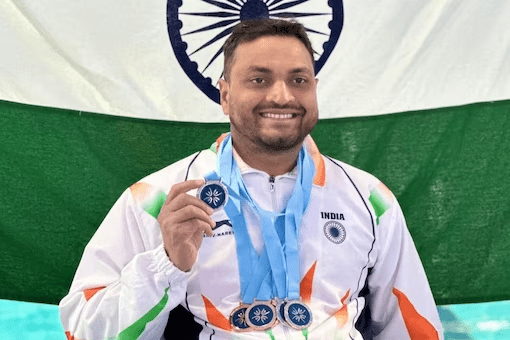
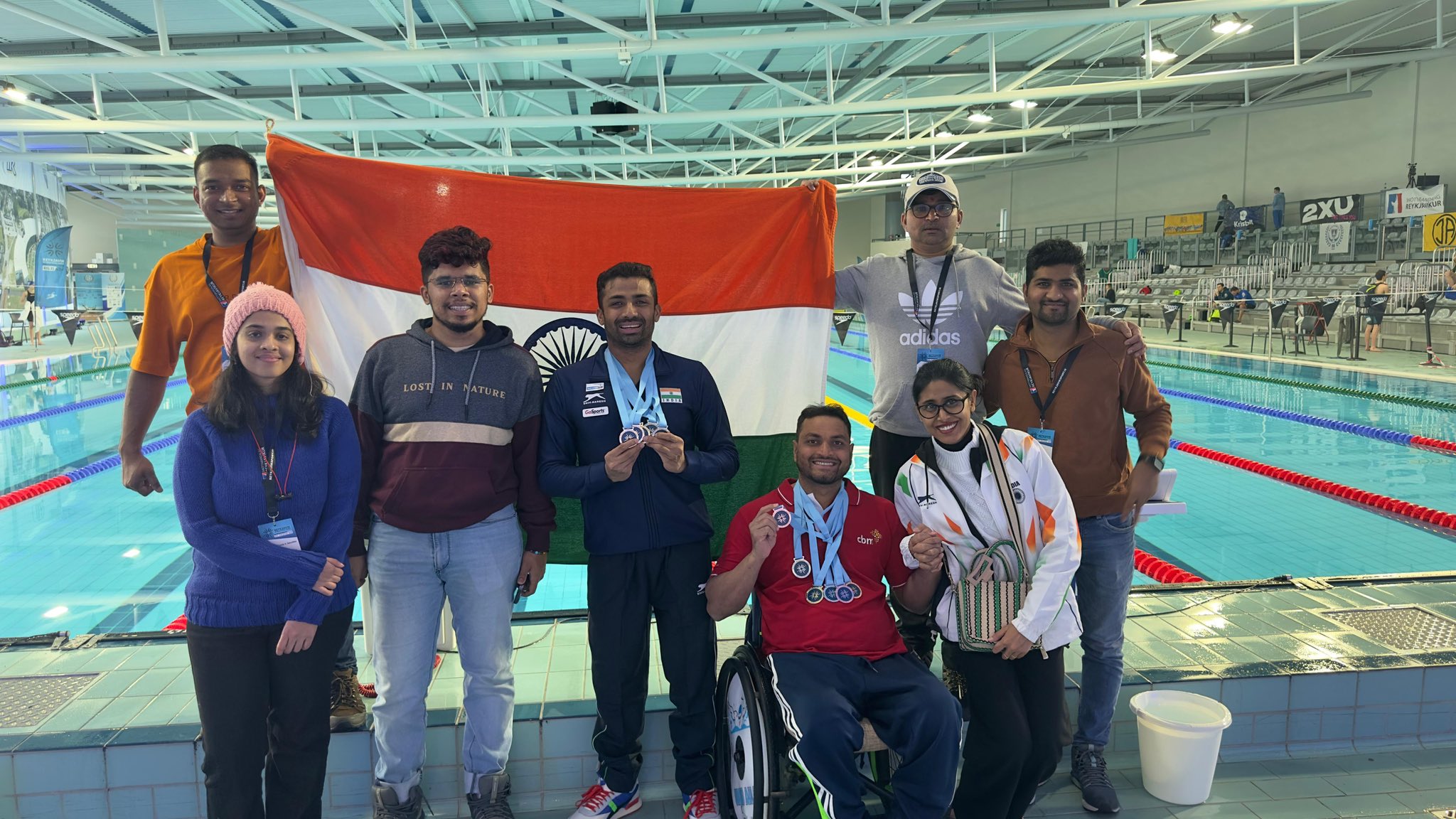
Mohammad Shams Aalam Shaikh won 6 gold medals at the Reykjavik International Games held at Laugardalslaug Iceland from 26-28 January 2024, whilst representing India.
Aalam has ranked no. 1 in men’s 100m butterfly stroke and men’s 50m breaststroke, according to World Para Swimming’s official world rankings for 2024.
In Iceland last month, Shams Alam won 6 medals, including one gold in 200m individual medley, one silver medal in 50m and 100m breaststroke and butterfly stroke, and three bronze medals in 50m and 100m backstroke and 100m butterfly stroke.
Aalam also broke Herojit Singh and Shreekant Desai’s time records in 100m butterfly and 100m backstroke, respectively.
In his interview with TOI, Alam seemed confident that he’d qualify for the Paris Paralympic Games 2024 by meeting the Paralympic time requirements soon enough. He will also be participating in the National Paralympic Games scheduled in March this year, in Gwalior.
“I am yet to reach the Paralympic qualification mark with my timings at Reykjavik but I am confident that I will get enough opportunities to secure a berth at the Paris Games. The National Games will be my next shot at the Paris quota,” Aalam said in his interview with the Times of India.
Mohammad Shams Aalam is a 37-year-old, paraplegic swimmer, who holds the world record in the longest open sea swimming by a paraplegic individual.
Born in Bihar, Alam was interested in sports as a child, particularly karate and swimming. However, after a spinal cord injury in 2010, Alam took up professional swimming and even went on to represent India at the Asia Para Games in 2018.
source: http://www.maktoobmedia.com / Maktoob Media / Home> East India / by Maktoob Staff / February 27th, 2024
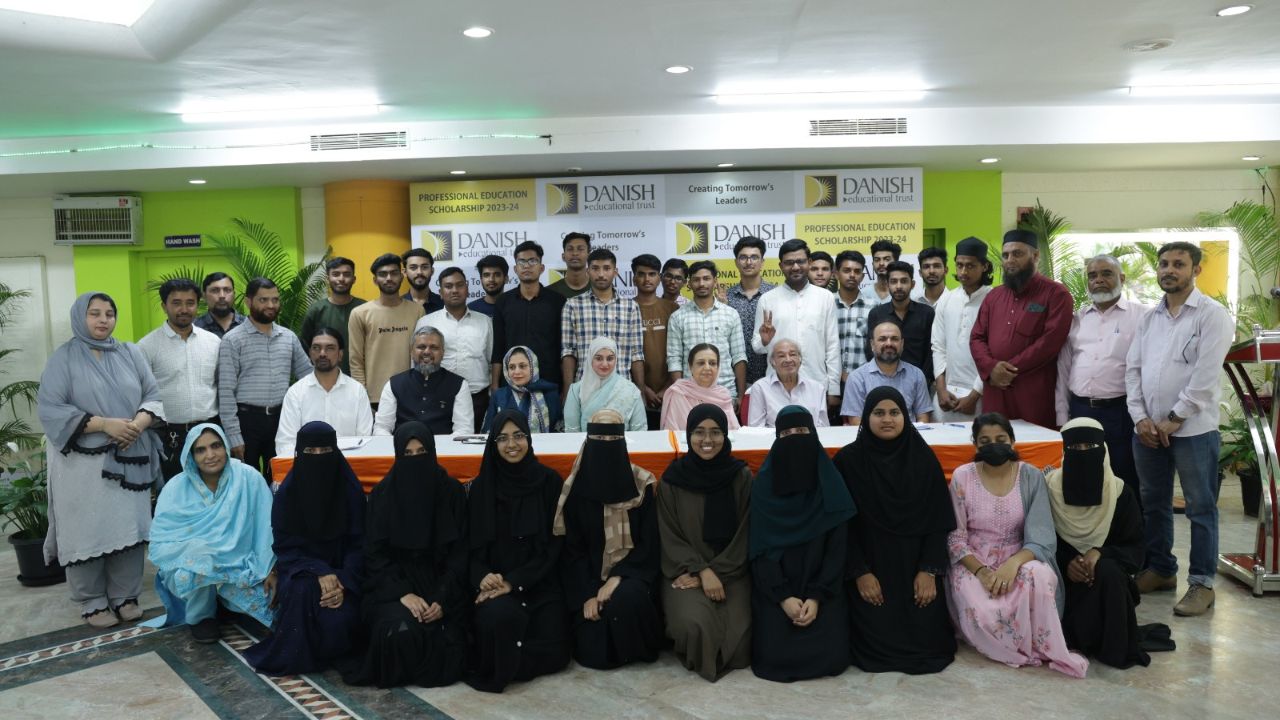
In a bid to bolster access to professional education for economically disadvantaged students, Bengaluru-based Danish Education Trust (R) awarded scholarships to 624 students pursuing professional education across Karnataka with a total scholarship amount of Rs. 1,60,00,000/- for the academic year 2023-24. The Trust selected students through an online application process at www.danishtrust.in.
The scholarship recipients are pursuing various professional courses, including Engineering, MBBS, Law, Journalism, Pharmacy, BUMS, BAMS, BHMS, Veterinary Science, Agriculture, and B.Ed, and are from economically underprivileged backgrounds.
Danish Educational Trust (R) was established in March 2006 by a group of concerned citizens led by philanthropist Mrs. Husna Sheriff, with the belief that education is the seed for development and progress. Since its inception, the Trust has continued its scholarship scheme for poor and needy students pursuing higher education.
Over the years, the Trust has sponsored the education of more than 4000 students, and this year’s scholarship program is another step in empowering young minds to achieve their educational dreams.
Expressing her pride in the trust’s achievements, Mrs. Husna Sheriff emphasized the importance of empowering young minds through education. “We firmly believe in providing a platform for students to thrive academically, regardless of their socioeconomic background. By investing in their future, we are sowing the seeds for a brighter tomorrow,” she remarked.
Looking ahead, Danish Educational Trust envisions expanding its reach further, with plans to increase the scholarship amount to Rs. 1.8 crore and support over 750 students in the upcoming academic year 2024-25. Such ambitions underscore the trust’s unwavering dedication to fostering equitable access to education and nurturing the leaders of tomorrow.
source: http://www.thecognate.com / The Cognate / Home> Education / by Shaik Zakeer Hussain / March 14th, 2024
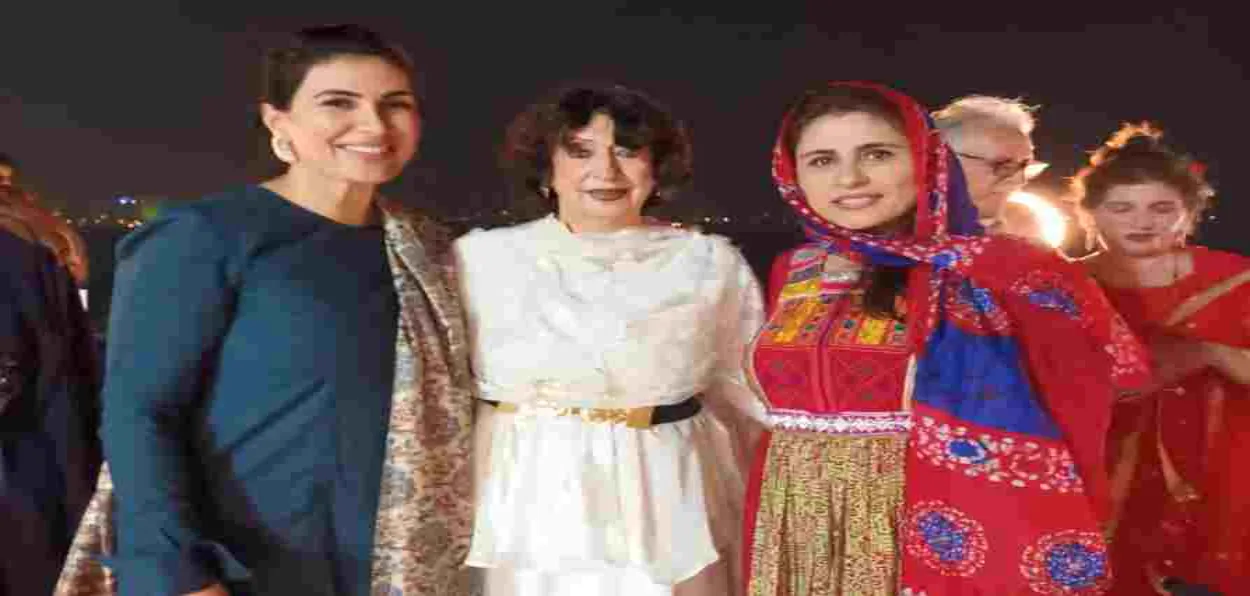
Dr Zeenat Shaukat Ali (In white dress) Counsel General of Afghanistan in Mumbai
Caught in the panoramic whirl of life, there are thousands of affluent ladies one interacts or brushes shoulders with, but Dr. Zeenat Shaukat Ali shines out amongst many with her warm charming smile, down-to-earth nature, while showering pearls of knowledge. Born in an affluent home in Mumbai, she holds no superficial airs and graces. When someone mentioned to her that she should get the Padma Shri award for her remarkable service, she replied, “My greatest reward is when my students run up to me telling me they never forgot what I taught them in class.”
She told me, “Even you, asking me for an interview is like a reward for my service to the nation.” She said that during her daughter’s birthday party when she was in Dubai, a girl came up to her daughter and asked her, “Are you Zeenat’s daughter? You look just like her”, and when she replied, “Yes’, the girl said, “Let me tell you what she taught me I have never forgotten!”
Dr. Zeenat Shaukat Ali is a former professor of Islamic studies at St. Xavier’s College in Mumbai, fluent in English, and a seasoned speaker during debates on leading television channels and also heads the World Institute of Islamic Studies for Dialogue, Organization of Mediation and Gender Justice. She is clear on her religion: “I follow Prophet Muhammad’s teachings and no sects made by humans, these are all here to divide us.”
On Women’s International Day, speaking to Awaz-the Voice about Indian Muslim women, she said with a sigh of relief, “Indian Muslim women have a stronger and larger voice today than earlier, cutting across all sects and today, we have a long way, hundreds of Muslims contributed to India and I think all-around whole education is the answer to all problems. Women should be given a key role in the decision-making process, and be able to implement laws for the nation.
There are 33% seats for women in parliament. Ilm in Arabic means knowledge and there are 800 plus verses upholding ilm or knowledge and it’s derivatives. There are hundreds of verses in the Quran elucidating scientific facts. In Indian society, we see that the Parsees are highly educated and have become the best doctors, and lawyers, excelling in all spheres because they proficiently educated themselves.
Dr Zeenat Shaukat Ali participating in an interfaith conference
“We are no longer the India of a hundred years back. With education, we can get rid of misogyny, and inequality, giving equal respect and equal understanding to each other. On a flight back to Mumbai, I watched Sri Devi’s excellent movie, English Vinglish and one line that stood out was the aspect of respect where she said, “Teach me, don’t make fun of me, and don’t take it for granted that I will only sit in the kitchen and make ladoos …”
Dr. Zeenat Shaukat Ali on reminiscing about her early life said, “My interest in studying the Quran began early, around the age of 16 when I was trying to understand a paragraph (ruku) a day in depth to try and comprehend its meaning, and very often, I would be the only girl sitting among all the wise spiritual white-haired Maulanas some even in their 80s, learning from them. With their help, I began to understand the message of compassion, peace, and harmony. My prayers also began at that age and continue to date.
At a young age, she looked up to her excellent teachers who were like father figures and sculptured her thinking to analyze as she went into research. “Dr NS Gorekar was my teacher of Islamic Studies and my Ph.D guide and Professor Kamran taught me how when one goes deep into relics, where the finishing steps are like jewelled stones and thesis is like a manuscript which should never be discussed with anyone or they would steal your thoughts!”
Her childhood home was always buzzing with activity, guests filling the home with visitations, while house helpers hurried around in their daily tasks. Lunchtimes were blissfully wonderful for Zeenat Ali when her father’s friends visited, Dr. Shukri and Maulana Abdul Rahman who were both very knowledgeable and the young Zeenat could pour out all her questions quenching her thirst for deeper spiritual understanding. Her spare time was immersed in activities visiting the club and libraries. Her favourite sports were badminton and horse riding and a day was never too long for her and she spent more time in libraries than in clubs, though!
Fortune smiled on her with her happy family life, with one brother and being the only daughter always felt the warm arms of her parents embrace her equally. In this close-knit family, they shared everything and were like the best of friends. “There was a gender parity in our household,” she says. While her brother went on to study engineering and business management, she went on to study English Literature and delve deeper into Islamic Studies. Both parents, Gulam Ali and Sheereen were advocates of intellectual secularism. Traditionally, every Friday, her father gave the queues of poor people outside their homes a delicious meal. Good works were an integral part of her family’s faith and her great-grandfather and his dear brother opened an orphanage in Pune giving solace to hundreds of children. She also received personal care from her grandmother as she was growing up.
Dr Zeenat Shaukat Ali with a Minister in Azerbaijan
Her mother was anxious to see her well settled in marriage at a young age, but her father and grandmother opposed an early marriage wanting her to only get married after her education. When the day of a suitor arrived, her future husband Shaukat Ali was informed that he could only marry her if he allowed her to complete her graduation, to which he readily agreed and in fact, encouraged her to pursue her higher gradution after marriage in the 1980s.
While her mother was a great source of inspiration, it was her father, Zeenat Shaukat Ali says, who stood as a powerful influence in her life, always urging her to study more, taking a keen interest in her subjects, and asking her questions about the subjects in her class, discuss enriching topics with her and always spurred her on for higher graduation. Her taught her the concept of humanity drawing her into the world of all people as one, where he had friends from all religions, Hindus, Parsees, Sikhs, Christians, Jains, Buddhists, and others and he looked at all people as humanity.
She grew up with Muslim cooks crafting delicacies who skillfully knew the art of laying out an elaborate meal on a dining table, Hindu and Christian domestic workers and maids rich in their traditions and beliefs and all were respected. She specially mentions Abdul the cook who made her beloved cheese sandwiches with hot tea, so she could concentrate on her work without interruptions.
The school was all about sharing tiffins as constantly hungry students generously shared each other’s lunch boxes. “Those were happy days in St Xavier with long animated discussions in the college canteen and festival seasons were times of sharing and visiting Hindus, Christians, Jains, Muslims, Parsees, and others alike.”
When she got married, her Christian maid, Rosy Fernandez helped to bring up her three children amidst her very hectic schedule. Rosy had her method of praying as did the other house helpers and she says, “We learned the art of humanity.”
Dr Zeenat Shaukat Ali at St Xavier’s Alumuni meet
Her husband and three children (two daughters and a son) used to tell her that her quest for knowledge was insatiable and likened it to taking a “deep dive into the ocean to touch the ocean floor,” meaning, she always had to dig deeper and was never satisfied with just bright glimmers of knowledge and also went to the roots of William Shakespeare’s literature, which in themselves were always complicated. Her husband, Shaukat Ali was a remarkable sportsman, a great businessman, and a wood connoisseur who at parties would often delve into a rich conversation on any type of furniture wood, being an interior designer, he was artistic and loved flowers, music, and took a profound interest in Zeenat’s writing, even though at times, he fell asleep in the middle of it, she says with a laugh. When her father suddenly died of a heart attack, it was a shock to her and Dr. Zeenat found her comfort in the pristine purity of the Quran she grew up with.
She said, “After the sudden loss of my Father, it was my husband who said I should take up my PhD seriously instead of dropping tears.” With eyes filled with tears and a choked voice, she said that her husband and her mother both passed away in 2018 and it was a particularly difficult time for her.
She says, “I matured bit by bit as I was doing my thesis until I realized the ideas and values of Islam had to be brought out as there was an alarming deafening silence from our scholars, very disappointing as they also have a responsibility to bring the right representation of Islam to the nation.”
Her husband and three children (two daughters and a son) used to tell her that her quest for knowledge was insatiable and likened it to taking a “deep dive into the ocean to touch the ocean floor,” meaning, she always had to dig deeper and was never satisfied with just bright glimmers of knowledge and also went to the roots of William Shakespeare’s literature, which in themselves were always complicated. Her husband, Shaukat Ali was a remarkable sportsman, a great businessman, and a wood connoisseur who would often in parties delve into a rich conversation on any type of furniture wood, being an interior designer, he was artistic and loved flowers, music, and took a profound interest in Zeenat’s writing, even though at times, he fell asleep in the middle of it, she says with a laugh. When her father suddenly died of a heart attack, it was a shock to her and Dr. Zeenat found her comfort in the pristine purity of the Quran she grew up with.
She said, “After the sudden loss of my Father, it was my husband who said I should take up my PhD seriously instead of dropping tears.” With eyes filled with tears and a choked voice, she said that her husband and her mother both passed away in 2018 and it was a particularly difficult time for her.
Dr. Zeenat Shaukat Ali receiving an award
She says, “I matured bit by bit as I was doing my thesis until I realized the ideas and values of Islam had to be brought out as there was an alarming deafening silence from our scholars, very disappointing as they also have a responsibility to bring the right representation of Islam to the nation.”
A recent book entitled “I Am ?” a Hinduja Foundation Publication brought out by Mr. Gopichand Hinduja and Mr. Ashok Hinduja is the result of Mr. Gopichand Hinduja’s inspiration. In the Introduction of “Why this Book ?” Mr Gopichand Hinduja, a great spiritualist states that he wanted an “l state to bring all virtuous teachings of all the important religions of the world that have influenced and shaped humanity in a single book to share their oneness.”
A Par Excellence Message has been penned by Sheikh Al Nahyan, Minister of Tolerance and Coexistence, UAE as Dedication to Humanity” where the message of the book is “dedicated to those who want to explore their life beyond the known and visible,” she said,” It was an honour for me when I was invited to write the conclusion to the book. It was to be on the commonalities existing among religions. I titled the chapter “Connecting the Magical Dots in the Infinite Cosmos” where I wrote, “We are all like a beautiful rainbow, where all colours stand together yet remain distinct to form the exquisite rainbow. We say similar things at different times, in different languages but have to stand together to form the rainbow. Our commonness lies in our humanity, to be compassionate, to care for each other.” She added, “A Chart of the Commonalities has been drawn up and affixed at the end of the book.”
Achieving powerful landmarks, invited all over the world as a delegate, she is an integral part of many organizations. She is the Founder and Director-General, of Wisdom Foundation, founded in 2006 in Mumbai, a registered body that has many national and international advisors which focus on Gandhian values of nonviolence, and humanitarian service.
She bagged the Vijaya Shree National Award for Education Enriching Human Life and Outstanding Attainment in 1997-98. She spearheads an innovative peace initiative in the city. With over three years of existence, the program features a cricket match at the Brabourne Stadium, involving teams comprised of Muslim, Hindu, and Christian clerics, deliberately not segregated along religious lines. Additionally, Ali leads the World Institute of Islamic Studies for Dialogue, Organization of Mediation, and Gender Justice. She actively participated in the International Higher Education Interfaith Leadership Forum.
She has attended very important, excellent Conferences in Doha, Qatar organized by the Ministry of Foreign Affairs on Interfaith Dialogue in 1922 and 23 where interfaith scholars and dignitaries around the world were invited. In 2022, she attended an Excellent International Conference in Azerbaijan on Dialogue and Preservation of Cultural Sites.
Also known as an activist and author of several books, she has made a powerful impact with her writings. Her famous book The Empowerment of Women in Islam With Special Reference to Marriage & Divorce, was highly felicitated by great leaders in India.
Justice A. M. Ahmadi, Chief Justice Supreme Court of India said, “The author in her book seeks to knock on the doors of Islamic Jurisprudence to secure gender justice for Muslim Women. It is path-breaking in the sense that it is a bold endeavour to show how social reform can be introduced into the Muslim society through traditional strategies…”
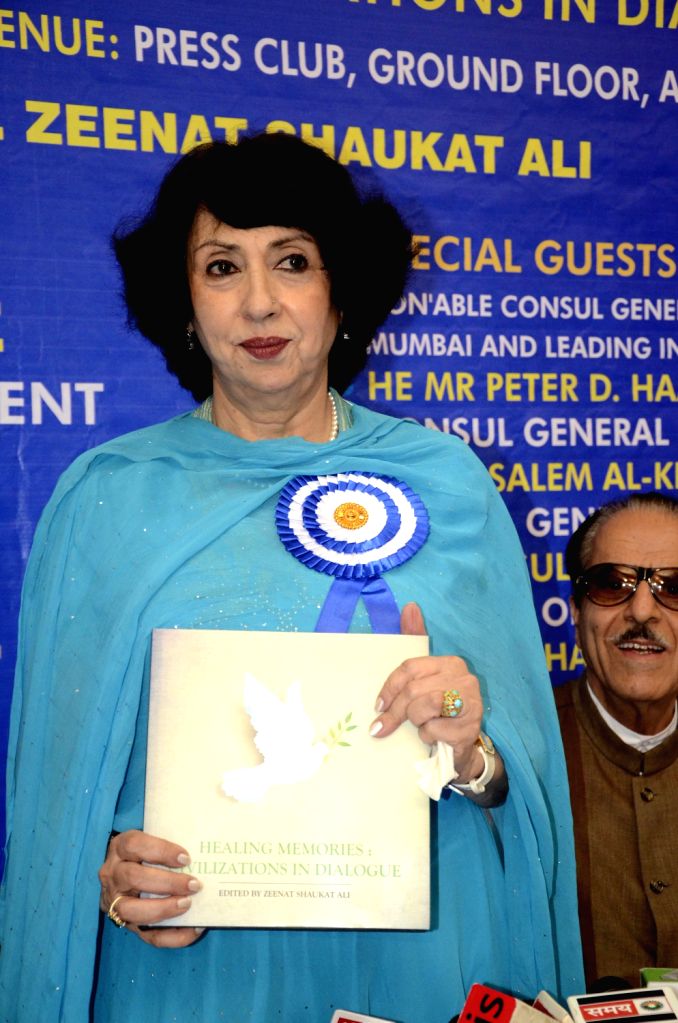
Dr Zeenat Shaukat Ali Presenting her book I AM to Sheikh Al Nahyan, Minister of Tolerance and Coexistence of the UAE
Achieving powerful landmarks, invited all over the world as a delegate, she is an integral part of many organizations. She is the Founder and Director-General, of Wisdom Foundation, founded in 2006 in Mumbai, a registered body that has many national and international advisors which focus on Gandhian values of nonviolence, and humanitarian service.
She bagged the Vijaya Shree National Award for Education Enriching Human Life and Outstanding Attainment in 1997-98. She spearheads an innovative peace initiative in the city. With over three years of existence, the program features a cricket match at the Brabourne Stadium, involving teams comprised of Muslim, Hindu, and Christian clerics, deliberately not segregated along religious lines. Additionally, Ali leads the World Institute of Islamic Studies for Dialogue, Organization of Mediation, and Gender Justice. She actively participated in the International Higher Education Interfaith Leadership Forum.
She has attended very important, excellent Conferences in Doha, Qatar organized by the Ministry of Foreign Affairs on Interfaith Dialogue in 1922 and 23 where interfaith scholars and dignitaries around the world were invited. In 2022, she attended an Excellent International Conference in Azerbaijan on Dialogue and Preservation of Cultural Sites.
Also known as an activist and author of several books, she has made a powerful impact with her writings. Her famous book The Empowerment of Women in Islam With Special Reference to Marriage & Divorce, was highly felicitated by great leaders in India. Justice A. M. Ahmadi, Chief Justice Supreme Court of India said, “The author in her book seeks to knock on the doors of Islamic Jurisprudence to secure gender justice for Muslim Women. It is path-breaking in the sense that it is a bold endeavour to show how social reform can be introduced into the Muslim society through traditional strategies…”
M Hidayatullah, Former Chief Justice and Vice President of India said, “This is a treatise of Marriage and Divorce in Islam…written in a scholarly way, it will keep these difficult subjects alive for lawyers, teachers, and students. I wholeheartedly recommend the book.”
The Implementation of a Uniform Civil Code, Winning the Peace: A Quest/edited by Dr. Zeenat Shaukat Ali, contributor Shaukat Ali. She wrote Healing Memories – Civilizations in Dialogue; The Legacy of India – Pluralism, Tolerance and Peaceful Coexistence, and many other erudite thesis papers.
Among her cherished mentors are Father Simon D’ Souza who had been teaching at St. Xaviers College Mumbai and serving as in-charge Principal for a while, and Raymond Bodin from UNESCO, among many others. She also says, “I pray to Allah with my hands folded.”
She explained that the phrase Vasudhaiva Kutumbakam from Hinduism which means “The World Is One Family” is similar to the words of Prophet Muhammad who said” All creatures form the family of God and he is best loved by God who best loves his creatures”.
Jesus taught similar ideologies to love all people, as did Buddha and other religions. Unfortunately, religion over time has been manipulated for political gains. Islam means peace comes from Salam.
She expressed, “One of the people who were dear to me was Father John Misquitta SJ, Principal of St Xavier’s when I began to teach, who loved my thesis. He was dynamic, encouraging he believed in academic excellence like all other principals. Fr John Correia-Afonso, Director of the Heras Institute of Indian History and Culture, St Xaviers College was a distinguished renowned historian who invited me to join the Heras Institute. He was an exceptional person – a legend who guided many a student. He was a great instructor and teacher who inspired many academicians, including me.”
“The whole world of Islam where Muslim majorities prevail are now re-thinking issues so it’s time for us now that our Ulema, our learned, our scholars should not drown themselves in silence or should not give misleading misinformation, where Islam is teaching you to preserve life. If you kill one person, it is as if you have killed all mankind Surah 5:33, so we have to bring these to life not only in words but in our actions…”
Reiterating that learning and knowledge were an essential part of their lives as Islam teaches “Whoever follows a path to seek knowledge, Allah will make the path to Jannah (Paradise) easy for them.’ it was incredible that her grandmother at the age of 70 was learning to read and write Urdu,” Zeenat Ali said that similar to her male counterpart, every woman is morally and religiously obligated to pursue knowledge, enhance her intellect, broaden her perspective, nurture her talents, and subsequently utilize her potential for the betterment of both her soul and her society.
She shares special nuggets of gold with Indian Muslim women today, and on Women’s International Day, with this message, “Have a wonderful vision for your country and your family. Educate yourself to the fullest, endeavour to be the best in the world, and be part of nation-building. Be compassionate and caring. Dream big! Know that you are beautiful in the heart and the soul, you are an achiever, you are a doer, you can do it and you will make a difference!”
Rita Farhat Mukand is an independent writer
source: http://www.awazthevoice.in / Awaz, The Voice / Home> Stories / by Rita Farhat Mukund / March 08th, 2024