Tag Archives: Azimullah Khan coined the slogan ‘Madar e Watan Bharat Ki Jai’

Maulvi Liaquat Ali Qadri (1817–1892): A Stalwart of India’s Freedom Struggle

Mehndauri Village (Chail Pargana, Allahabad District), UTTAR PRADESH :
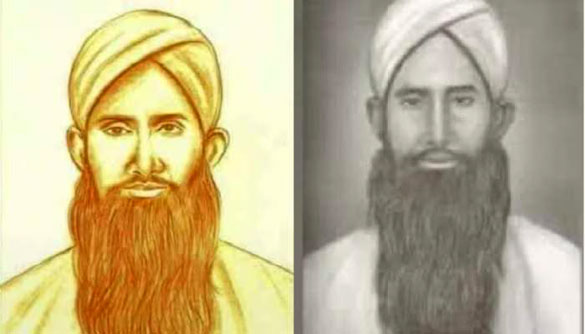
Maulvi Liaquat Ali Qadri, a religious scholar, led the 1857 Allahabad rebellion, uniting communities against British oppression. Declaring jihad, he fought for India’s freedom, faced exile, and died in Kala Pani in 1892, leaving a lasting legacy.

Main Points:

1.    Maulvi Liaquat Ali Qadri (1817–1892), born in Allahabad, was a revered religious scholar and freedom fighter.

2.    He led the 1857 rebellion in Allahabad, uniting Hindus and Muslims against British rule.

3.    Declared jihad, organized public gatherings, and hoisted Bahadur Shah Zafar’s flag.

4.    Fought British oppression, faced exile, and continued guerrilla warfare.

5.    Sentenced to life in Kala Pani; died in 1892.

———-

Maulvi Liaquat Ali Qadri was born on October 15, 1817, in the village of Mehndauri, Chail Pargana, Allahabad district, to Syed Meer Ali and Aamna Bibi. He was a revered religious figure of his time, embodying the spirit of both spiritual and national liberation. During that era, Islamic scholars viewed the country’s independence and religious freedom as inseparable causes. This conviction led a significant number of religious scholars to participate in the Indian Rebellion of 1857, many of whom attained martyrdom in their fight for freedom.

Maulvi Liaquat Ali was a simple man deeply connected to the struggles of the common people in his region. He was acutely aware of the hardships faced by the masses under British colonial rule. Alongside his profound religious knowledge, he harbored an intense passion for liberating his country from the shackles of foreign oppression. Leading a life of piety and integrity, he consistently advised others to uphold honesty, empathy, and mutual support in times of distress. He considered it the duty of every Indian to strive for the nation’s independence.

The Rebellion in Allahabad

Following widespread looting and arson, Allahabad fell under the control of the rebel Indian forces. Maulvi Liaquat Ali, accompanied by a large number of his followers, threw himself into the struggle against British rule. Seizing the opportunity, he declared jihad against the British, galvanizing thousands to join the fight. Under his leadership, the people of Allahabad (now Prayagraj) united to drive the British out of the city. Maulvi Liaquat Ali delivered a powerful message of unity to both Hindus and Muslims from a public platform in Allahabad. In his sermon, he emphasized, “We are all one. Together, we must confront the foreigners.” With this spirit of unity, he proclaimed the establishment of an independent government in the region and hoisted the flag of Bahadur Shah Zafar, the last Mughal emperor.

The British were not only plundering India’s wealth but also subjecting its people to relentless oppression. Beyond economic exploitation, Christian missionaries, backed by colonial authorities, were attacking India’s religious traditions and sacred texts. They propagated Christianity while attempting to demean Hindu and Muslim scriptures.

Unable to tolerate these affronts, Maulvi Liaquat Ali organized a massive public gathering on June 7, 1857, at Khusro Bagh in Allahabad. The event drew a large number of patriotic Hindus and Muslims. In a fiery speech, he condemned the British for their atrocities, including looting, arson, and desecration of holy texts. Declaring that such oppressors could not be tolerated, he called for jihad against the “sinners.” His impassioned address stirred the hearts of the audience, who were already exasperated by the British’s sacrilegious actions.

Under his leadership, a week-long uprising against the British began on June 9, 1857. Rebels set fire to British bungalows, inflicted casualties, and damaged government property. The widespread unrest created panic among the colonial authorities. However, the British retaliated with heavy shelling and arson, driven by a desire for vengeance. Entire settlements were razed, forcing residents to flee their homes. Maulvi Liaquat Ali, too, was compelled to leave Allahabad and sought refuge in Kanpur.

A Champion of Communal Harmony

Maulvi Liaquat Ali was a firm advocate of Hindu-Muslim unity and cooperation, despite his opposition to Christian missionaries, whose actions, fuelled by colonial arrogance, insulted Indian religions and scriptures. He was among the few leaders who demonstrated through their revolutionary actions that they were fully aware of the socio-political realities of their time. The British, he believed, were not only exploiting India’s resources but also undermining its social fabric. He tirelessly worked to counter their divisive tactics, raising his voice for the dignity of women, religious communities, and the upper classes, earning widespread admiration for his efforts.

Despite his religious persona, Maulvi Liaquat Ali was always ready to take risks for the sake of his country and faith. He never feared for his life or shied away from potential losses. His revolutionary activities were driven by a singular goal: to free India from British rule and rid the sacred land of their oppressive presence. When a Muslim shrine, Bakhtiar Bakhtiyar, and the Telegraph Band were seized by the British, Muslim youths fought to protect them, resulting in losses on both sides. Clashes between Indian rebels and British forces continued across various regions, making it increasingly difficult for the British to maintain their grip on India.

A Lifelong Struggle for Freedom

Maulvi Liaquat Ali swore to dedicate his life to the cause of India’s independence. After leaving Allahabad, he moved to Muzaffarnagar, a stronghold of the freedom struggle, where he joined other revolutionaries. His authority was such that no orders were issued without his approval. Whenever British forces attempted to suppress the rebellion, Maulvi Liaquat Ali, alongside another freedom fighter, Azimullah, embarked on a perilous journey on foot toward Gujarat. Despite facing numerous hardships along the way, they reached their destination and launched guerrilla warfare against the British. For years, their tactics kept the colonial administration on edge.

According to Rakesh Verma, technical assistant at the Regional Archives, “Administrative records written in Urdu titled Naksha Bagiyan Kotwali Allahabad, listing police constables who forcibly took their salaries for May and June 1857 and participated in the revolt, including Hanuman Prasad, Imdad Ali, Ashraf Ali, etc. were hung by Major Henry Court on July 14, 1857,” (From the HT)

The British resorted to various conspiracies to capture him, but Maulvi Liaquat Ali’s stature among freedom fighters only grew. He continued to plan large- and small-scale operations against the British, opening new fronts in the fight for independence.

Imprisonment and Legacy

Ultimately, the Allahabad court sentenced Maulvi Liaquat Ali to life imprisonment in the Andaman Islands, infamously known as “Kala Pani.” Enduring the harsh conditions of imprisonment, this brave son of India passed away on May 17, 1892, bidding farewell to his beloved homeland and the world.

Maulvi Liaquat Ali Qadri’s sacrifices for India’s freedom struggle remain an enduring legacy. His contributions must be remembered and celebrated as an inspiration for future generations, reflecting the indomitable spirit of a man who fought tirelessly for his country’s liberation.

References:

https://www.hindustantimes.com/cities/others/maulvi-liaquat-ali-to-mass-killings-hanging-of-cops-1857-revolt-in-allahabad-101749063190844.html

Bhatnagar, A. P. (2009). Maulvi Liaqat Ali: Icon of 1857 uprising at Allahabad. Shubhi Publications.

https://timesofindia.indiatimes.com/india/unsung-heroes-of-the-freedom-struggle-maulvi-liaqat-ali/articleshow/93492245.cms

Khan, K. M. (2019). Jang-e Azadi aur Musalman. Pharos Media.

https://www.qaumiawaz.com/social/maulvi-liaquat-ali-the-pioneer-of-the-war-of-independence-special-offer-on-the-occasion-of-the-anniversary-shahid-siddiqui-ali

source: http://www.newageislam.com / New Age Islam / Home> Islamic Personalities / by Sahil Rizvi / August 05th, 2025
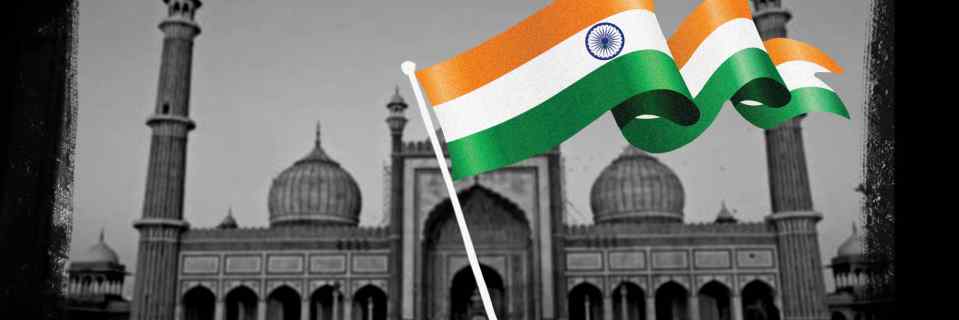
What Indian Muslims Did and are Doing to ‘Set India Free’

NEW DELHI :

(Photo: Arnica Kala / The Quint)

In the morning I woke up to messages of hope and happiness as is usual on India’s (71st) Independence Day. Family groups were full of photographs of our younger children dressed in saffron and green, as they went to their schools to celebrate Independence Day.

We watched the speech of Prime Minister Narendra Modi from the Red Fort, and posted messages and stirring poems on Twitter and Facebook. There was so much happiness and bonhomie, when suddenly I got a link to a tweet from a friend:

A bunch of people waving the flag in Delhi’s iconic Jama Masjid is hardly anything I should be upset about. In fact, the national flag on the historic Jama Masjid instills pride in me.

Why then, was I upset?

I was upset at the words that were deliberately aimed at hurting and demonising the community that prays in that mosque.

“71 साल बाद जामा मस्जिद दिल्ली की छाती पर चढ़कर हमने कार्यकर्ताओं के साथ राष्ट्रीय ध्वज फहराया, वन्दे मातरम”

“After 71 years, along with karyakartas (workers) I have climbed onto the ‘chest’ of Jama Masjid, and waved the national flag. Vande Mataram.”

Inherent to his speech is the message that the mosque, and by extension Muslims, have never hoisted the tricolour.

By the way, the call Madar e Watan Bharat ki Jai was given by Azimullah Khan in 1857, while fighting in the first war of Indian Independence. Honoring our motherland is not new to us. Perhaps Mr Singh (who tweeted the message) had missed this tweet by Sumer about flag hoisting at the Jama Masjid.

How Jama Masjid Area Celebrates I-Day

Mr Singh and his companions were 71 years too late, as the Indian Flag has been flying proudly in the hearts of every Indian, regardless of their religion. But yes, we fly the flag with love and respect, because we are Indians, not because we want to ‘otherise’ Indians.

Many flag-hoisting ceremonies were held in the Walled City. Flags were hoisted in homes, offices and public areas on 15 August.

As Abu Sufiyan, a resident of Old Delhi says, they came at noon, hoisted the flag, and left. No one objected or opposed them as flags were being hoisted everywhere. But he adds, “the enthusiasm with which Independence Day is celebrated in Old Delhi, where Red Fort is located, would be difficult to find anywhere else. They (Mr Singh and companions) may have climbed onto the steps of Jama Masjid after 71 years, but we have been hoisting the flag every year, in and around Jama Masjid.”

Sheeba Aslam Fehmi who runs the Walled City Café and Lounge at a little distance from the Jama Masjid, posted on her Facebook page  this 15 August:

“We, living in and around Jama Masjid area, are used to several hoisting of the Tricolor on 15th August each year. Not only at the public spots like Azad Hind Hotel, right behind the main Gumbad of the Historic Jama Masjid, we have flags of all sizes on full mast at various establishments including all the schools, hotels, shops etc.

I just spoke to the local MLA Asim Ahmad Khan who has hoisted the Indian Flag at various spots in his constituency where Jama Masjid is located.

The celebrations and merry making is on since the day of full dress rehearsal only. Patriotic songs are played loudly in the narrow alleys of Jama Masjid.

If you want to witness the people’s celebration of the Independence day, come, take a stroll in the Jama Masjid bylanes.”

Ashok Mathur says, “I have been celebrating Independence Day since 11 AM today, and hanging over not one but many roof tops in the Pahari Imli and Matia Mahalarea of my Muslim friends flying kites, with music and fanfare, which started with the whole group singing the national anthem at the beginning… since I was a vegetarian among all others, someone quickly got kaddu ki sabji and chana from his home nearby… it was the tastiest kaddu that I have ever had… this is the spirit with which we live here.”

Role of Jama Masjid in India’s Freedom Struggle

Today, let’s examine the role of Jama Masjid in India’s Freedom Struggle.

As Hilal Ahmed, Assistant Professor, Centre for the Study of Developing Societies says, “The Red Fort and Jama Masjid have always been the symbols of political inspiration for Indian masses, irrespective of religion or caste, during the colonial period. Leaders from different backgrounds and ideologies used the mimbar (pulpit) of the mosque to deliver political messages. From Swami Shradhanand of the Arya Samaj to Gandhi, Nehru and Azad – leaders of all sects delivered speeches here.”

He adds:

It is worth noting that Jinnah never delivered any speech inside the Jama Masjid, though he participated in a procession of the League in 1946. Unfortunately the Hindu right-wing want to convert everything into ‘Hindu and Muslim’. Making Jama Masjid an anti Hindu/India symbol is part of this political campaign.
Hilal Ahmed, Assistant Professor, Centre for the Study of Developing Societies 

1857 Uprising

The Jama Masjid has not only been a place for congregational prayers since the time it was built in 1650, but also a witness to India’s history. Since it had been such a symbol of togetherness and rebellion against British power in 1857, after the uprising, the British occupied the mosque and stopped people from offering prayers within its premises. Its gateways were guarded by British Indian troops to prevent entry.

The Jama Masjid was used as a mess, with horses tied along its corridors, with alcohol being freely consumed by the troops.

In the months of May-September, the sepoys and natives of India rose up against the East India Company, under the banner of Mughal Emperor Bahadur Shah Zafar. Fierce battles were fought in the summer and monsoon months of 1857, in and around the walled city of Shahjahanabad. Jama Masjid, as the centre of Shahjahanabad, was also central to this fight.

The mosque was the focal point for gatherings during the siege of Delhi in the 1857 Uprising.

It was on the walls of Jama Masjid that posters were put up by the forces who were trying to create a communal divide among India’s people. These were immediately taken down upon the then Mughal emperor Bahadur Shah Zafar’s orders. Maulvi Mohammad Baqar countered these posters in his newspaper The Delhi Urdu Akhbar, in which he said that Hindus and Muslims were ahl e watan (compatriots), and had been living together for a thousand years.

It was as a result of this that the British confiscated Jama Masjid and planned its demolition. It was only in 1862, following innumerable petitions by Muslims, that the British government returned the mosque to the original inhabitants.

Secular Nature of Jama Masjid

The nationalist movement and Hindu-Muslim unity took giant steps forward after World War I during the agitation against the Rowlatt Acts, and the Khilafat and the Non-Cooperation Movements. As if to declare before the world the principle of Hindu-Muslim unity in political action, Swami Shradhanand, a staunch Arya Samajist, was asked by Muslims to preach from the pulpit of the Jama Masjid at Delhi, while Dr Saifuddin Kitchlu, a Muslim, was given the keys to the Golden Temple, the Sikh shrine at Amritsar.

The entire country resounded with the cry of ‘Hindu-Muslim ki Jai’.

It was this mosque where, on 4 April 1919, Swami Shraddhanand, dressed in saffron robes, addressed the people gathered there, asking them to unite, saying that the need of the hour was Hindu-Muslim unity, against the common enemy, the British.

He started his speech with a Vedic mantra to which the congregation replied ‘Ameen’. He went on to exhort all Indians to purify their hearts with the ‘water of love’ of the motherland in ‘this national temple’, and become brothers and sisters.

I wish he would come back and again deliver a speech on unity only this time the common enemy is hatred and those who preach hatred.

It was in this mosque that Maulana Abul Kalam Azad delivered his historic speech in October 1947, which reminded them of their sacrifices for India, and exhorted them not to leave their motherland since the Prophet had said, ‘Allah had made the whole world a mosque’, and so the question of pure (Pak) and impure land does not arise.

In fact it was contrary to the ideals of Islam:

“Musalmano’n, my brothers,
Today you want to leave your motherland. Have you thought of the result of this step? … Close the door from which communalism has entered…”

(24 min onwards)

“Where are you going? And why are you going? Behold, the towers of this historic Masjid bend to ask you: lift up your gaze and see. The dome of this Shahjahani mosque asks you where you have lost the pages of your history. The sacred relics of your ancestors ask you, in whose care you are leaving them?”

“The sounds of ‘Allahu Akbar’ echoing from this mosque, ask you, on whose mercy are you leaving them? The walls and doorways of this mosque call out to you, again and again. O! those who are leaving, a time may come when you could lose your identity…

Don’t you remember that it was only yesterday that your caravans had performed ‘Wuzu; (Ablutions) on the banks of Jamuna. And today you are afraid to live here.

Remember that you have nourished Delhi with your blood.”

A simple study of literature written about the Freedom Struggle in the 19th and 20th centuries, will reveal that indeed not only Delhi, but India has been and is being nourished by the blood of Muslims. They are as much Indian as anyone else. 71 years ago, India was divided. I was not born then, but I am living now, and I will fight bigotry and hatred.

This Independence Day, let’s pledge to get freedom from hatred, bigotry and attempts to divide Indians on religious and sectarian lines.

Hindi hain hum watan hai Hindustan hamara.

(Rana Safvi is the founder and moderator of the popular #shair platform on Twitter, which is credited for reviving popular interest in Urdu poetry. She tweets @iamrana. This is an opinion piece and the views expressed are the author’s own. The Quint neither endorses nor is responsible for them.)

source: http://www.thequint.com / The Quint / Home> Big Story> Hot News> Videos / by Rana Safvi / August 15th, 2018