Tag Archives: Book ‘The Great Uprising of 1857’ – by Prof. Z.H. Jafri

Maulvi Liaquat Ali Qadri (1817–1892): A Stalwart of India’s Freedom Struggle

Mehndauri Village (Chail Pargana, Allahabad District), UTTAR PRADESH :
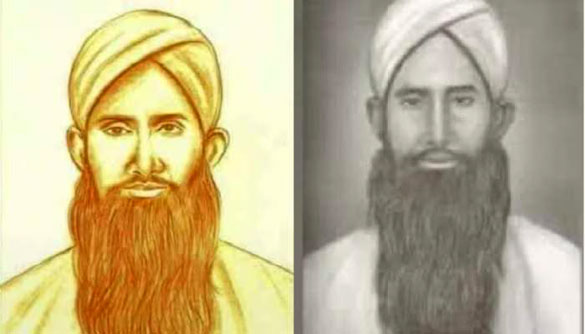
Maulvi Liaquat Ali Qadri, a religious scholar, led the 1857 Allahabad rebellion, uniting communities against British oppression. Declaring jihad, he fought for India’s freedom, faced exile, and died in Kala Pani in 1892, leaving a lasting legacy.

Main Points:

1.    Maulvi Liaquat Ali Qadri (1817–1892), born in Allahabad, was a revered religious scholar and freedom fighter.

2.    He led the 1857 rebellion in Allahabad, uniting Hindus and Muslims against British rule.

3.    Declared jihad, organized public gatherings, and hoisted Bahadur Shah Zafar’s flag.

4.    Fought British oppression, faced exile, and continued guerrilla warfare.

5.    Sentenced to life in Kala Pani; died in 1892.

———-

Maulvi Liaquat Ali Qadri was born on October 15, 1817, in the village of Mehndauri, Chail Pargana, Allahabad district, to Syed Meer Ali and Aamna Bibi. He was a revered religious figure of his time, embodying the spirit of both spiritual and national liberation. During that era, Islamic scholars viewed the country’s independence and religious freedom as inseparable causes. This conviction led a significant number of religious scholars to participate in the Indian Rebellion of 1857, many of whom attained martyrdom in their fight for freedom.

Maulvi Liaquat Ali was a simple man deeply connected to the struggles of the common people in his region. He was acutely aware of the hardships faced by the masses under British colonial rule. Alongside his profound religious knowledge, he harbored an intense passion for liberating his country from the shackles of foreign oppression. Leading a life of piety and integrity, he consistently advised others to uphold honesty, empathy, and mutual support in times of distress. He considered it the duty of every Indian to strive for the nation’s independence.

The Rebellion in Allahabad

Following widespread looting and arson, Allahabad fell under the control of the rebel Indian forces. Maulvi Liaquat Ali, accompanied by a large number of his followers, threw himself into the struggle against British rule. Seizing the opportunity, he declared jihad against the British, galvanizing thousands to join the fight. Under his leadership, the people of Allahabad (now Prayagraj) united to drive the British out of the city. Maulvi Liaquat Ali delivered a powerful message of unity to both Hindus and Muslims from a public platform in Allahabad. In his sermon, he emphasized, “We are all one. Together, we must confront the foreigners.” With this spirit of unity, he proclaimed the establishment of an independent government in the region and hoisted the flag of Bahadur Shah Zafar, the last Mughal emperor.

The British were not only plundering India’s wealth but also subjecting its people to relentless oppression. Beyond economic exploitation, Christian missionaries, backed by colonial authorities, were attacking India’s religious traditions and sacred texts. They propagated Christianity while attempting to demean Hindu and Muslim scriptures.

Unable to tolerate these affronts, Maulvi Liaquat Ali organized a massive public gathering on June 7, 1857, at Khusro Bagh in Allahabad. The event drew a large number of patriotic Hindus and Muslims. In a fiery speech, he condemned the British for their atrocities, including looting, arson, and desecration of holy texts. Declaring that such oppressors could not be tolerated, he called for jihad against the “sinners.” His impassioned address stirred the hearts of the audience, who were already exasperated by the British’s sacrilegious actions.

Under his leadership, a week-long uprising against the British began on June 9, 1857. Rebels set fire to British bungalows, inflicted casualties, and damaged government property. The widespread unrest created panic among the colonial authorities. However, the British retaliated with heavy shelling and arson, driven by a desire for vengeance. Entire settlements were razed, forcing residents to flee their homes. Maulvi Liaquat Ali, too, was compelled to leave Allahabad and sought refuge in Kanpur.

A Champion of Communal Harmony

Maulvi Liaquat Ali was a firm advocate of Hindu-Muslim unity and cooperation, despite his opposition to Christian missionaries, whose actions, fuelled by colonial arrogance, insulted Indian religions and scriptures. He was among the few leaders who demonstrated through their revolutionary actions that they were fully aware of the socio-political realities of their time. The British, he believed, were not only exploiting India’s resources but also undermining its social fabric. He tirelessly worked to counter their divisive tactics, raising his voice for the dignity of women, religious communities, and the upper classes, earning widespread admiration for his efforts.

Despite his religious persona, Maulvi Liaquat Ali was always ready to take risks for the sake of his country and faith. He never feared for his life or shied away from potential losses. His revolutionary activities were driven by a singular goal: to free India from British rule and rid the sacred land of their oppressive presence. When a Muslim shrine, Bakhtiar Bakhtiyar, and the Telegraph Band were seized by the British, Muslim youths fought to protect them, resulting in losses on both sides. Clashes between Indian rebels and British forces continued across various regions, making it increasingly difficult for the British to maintain their grip on India.

A Lifelong Struggle for Freedom

Maulvi Liaquat Ali swore to dedicate his life to the cause of India’s independence. After leaving Allahabad, he moved to Muzaffarnagar, a stronghold of the freedom struggle, where he joined other revolutionaries. His authority was such that no orders were issued without his approval. Whenever British forces attempted to suppress the rebellion, Maulvi Liaquat Ali, alongside another freedom fighter, Azimullah, embarked on a perilous journey on foot toward Gujarat. Despite facing numerous hardships along the way, they reached their destination and launched guerrilla warfare against the British. For years, their tactics kept the colonial administration on edge.

According to Rakesh Verma, technical assistant at the Regional Archives, “Administrative records written in Urdu titled Naksha Bagiyan Kotwali Allahabad, listing police constables who forcibly took their salaries for May and June 1857 and participated in the revolt, including Hanuman Prasad, Imdad Ali, Ashraf Ali, etc. were hung by Major Henry Court on July 14, 1857,” (From the HT)

The British resorted to various conspiracies to capture him, but Maulvi Liaquat Ali’s stature among freedom fighters only grew. He continued to plan large- and small-scale operations against the British, opening new fronts in the fight for independence.

Imprisonment and Legacy

Ultimately, the Allahabad court sentenced Maulvi Liaquat Ali to life imprisonment in the Andaman Islands, infamously known as “Kala Pani.” Enduring the harsh conditions of imprisonment, this brave son of India passed away on May 17, 1892, bidding farewell to his beloved homeland and the world.

Maulvi Liaquat Ali Qadri’s sacrifices for India’s freedom struggle remain an enduring legacy. His contributions must be remembered and celebrated as an inspiration for future generations, reflecting the indomitable spirit of a man who fought tirelessly for his country’s liberation.

References:

https://www.hindustantimes.com/cities/others/maulvi-liaquat-ali-to-mass-killings-hanging-of-cops-1857-revolt-in-allahabad-101749063190844.html

Bhatnagar, A. P. (2009). Maulvi Liaqat Ali: Icon of 1857 uprising at Allahabad. Shubhi Publications.

https://timesofindia.indiatimes.com/india/unsung-heroes-of-the-freedom-struggle-maulvi-liaqat-ali/articleshow/93492245.cms

Khan, K. M. (2019). Jang-e Azadi aur Musalman. Pharos Media.

https://www.qaumiawaz.com/social/maulvi-liaquat-ali-the-pioneer-of-the-war-of-independence-special-offer-on-the-occasion-of-the-anniversary-shahid-siddiqui-ali

source: http://www.newageislam.com / New Age Islam / Home> Islamic Personalities / by Sahil Rizvi / August 05th, 2025
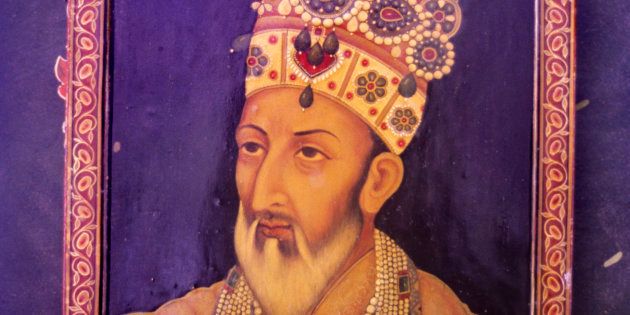
How Bahadur Shah Kept His Hindu And Muslim Subjects United [Book Excerpt]

‘Dastan-e-Ghadar: The Tale of the Mutiny’ by Zahir Dehlvi offers insights that are particularly relevant today.

NDIAPICTURES VIA GETTY IMAGES Miniature of Bahadur Shah Zafar.
NDIAPICTURES VIA GETTY IMAGES
Miniature of Bahadur Shah Zafar.

Butkhano’n mein jab gaya main kenchkar qashqa Zafar

Bol utha woh but, ‘Brahmin yeh nahin to kaun hai?’

(When Zafar went to the temple with a tilak on my forehead

The idol exclaimed, ‘If not a Brahmin then who is he?’)

—Bahadur Shah Zafar

Abu Zafar Sirajuddin Mohammed Bahadur Shah, better known by his pen name Bahadur Shah Zafar, was the son of Akbar Shah II and his Rajput wife Lal Bai.

He inherited an empire that was his only in name as the British writ ran through it. He was their pensioner. The British Resident in Delhi was responsible for everything that happened in Delhi as well as in the Qila.

Bahadur Shah Zafar [foresaw] trouble and banned cow-slaughter in the areas he nominally controlled… Bakr-Eid passed peacefully in 1857 thanks to the wise decisions of the emperor.

However, along with his empire he also inherited the national outlook of his ancestor Akbar and father Akbar Shah II. He believed in the wisdom that all his subjects were his children, and in fact his last prayer when he left the Qila after the fall of Delhi on the night of 16th September 1857 was:

“Khuda, the Hindus and Muslims of India are my children. Please keep them safe and don’t let them suffer for my deeds at the hands of the British.”

(Related by his daughter Kulsum Zamani Begum who saw him praying on his musalla the night he left it. This has been included in the story “Shahzadi ki Bipta” in the book Begumat ke Aansu which comprises eyewitness accounts recorded by Khwaja Hasan Nizami.)

The Hindu men and women who came to bathe in the River Yamuna every dawn would participate eagerly in the jharokha darshan when the emperor appeared before his subjects in the balcony of the Musamman Burj in the Qila every morning. Only after that would they go home and eat.

Bahadur Shah Zafar condemned the actions of maulvis who tried to divide the populace on religious lines:

Kaho mullah se kiya hum se rindo’n ko padhega

Ki hum Lahaul padh ke teri taqreer sunte hain

(Ask the mullah what can he teach one, so drunk in love

I hear his speeches with a disclaimer on my lips)

Akbar Shah II, who started the Phoolwaalon ki Sair , would offer pankhas both at Qutub Sahib’s dargah and Yogmaya temple in Mehrauli. Bahadur Shah Zafar went to the extent that he would not go to the dargah if for some reason he couldn’t visit the temple the previous day.

The Indian society of the 19th century was living quite happily and in communal harmony, bar a few incidents here and there. When Bahadur Shah Zafar was exiled there was a palpable sense of loss amongst the Hindus and Muslims alike; they felt as if they had lost their father.

Nowhere is this emotion more emphasized as in an anecdote described by Zahir Dehlvi in Dastan-e-Ghadar*.

“Once, some Hindus, along with officers of the British government, hatched a plot to throw all the butchers slaughtering cows out of the city. The British government gave orders stating that these butchers should take their shops out of the city. They had all the shops within the city closed.

When the butchers realized that they had no choice but to obey and lose their means of livelihood, they banded together, took their wives, children and possessions, and came and camped on the riverbank under the jharokha. From there, they appealed to the king, asking ‘How can we leave our city and go away?’

The cherisher of subjects, the emperor, heard their petition and gave the order that his tent be pitched alongside theirs on the riverbank.

‘Whatever is the state of my subjects is my state,’ he said.

As per the decree of their emperor, the servants immediately took the imperial paraphernalia and installed it on the bank of the river.

As soon as the British Resident heard the news, he came running to the emperor and respectfully asked, ‘Huzoor, what are you doing? All the people of the city will come and stand here with you.’

Badshah Salamat replied, ‘I am wherever my subjects are. My subjects are my children and I can’t be separated from them. Has flesh ever been separated from the fingernail? Today, the butchers have been given orders to leave the city; tomorrow, it will be some other community; the day after, it will be another one, and these orders will continue. Slowly, the entire city will be emptied. If the intention of the British government is to empty the city, then tell me so in plain words. I will take all my people and go and live in Khwaja Sahib. Since you have control over the city (Shahjahanabad), you can do whatever you will.’

The Resident was taken aback. ‘Huzoor, don’t even think of such an action. I will redress the complaints of these people immediately and settle them in the city. Huzoor, please have your camp removed from here.’

The Resident gave orders for the butchers to go back to their houses and ply their trade within the city as before. The tent of the emperor was removed.”

Bahadur Shah was equal in his treatment of his subjects and did the same for the ghosis or herdmen of Shahjahanabad when they were faced with a similar situation. Zahir Dehlvi in Dastan-e-Ghadar* writes:

“Once the British government gave orders to the herdsmen to take their family and cattle and leave the city and go and settle outside the city. There was a tumult in the entire city and once again the ghosi (herdsmen/milkmen) along with their families and cattle came and camped on the Reti.

Once again the Emperor, Raiyyat Panaah (shelter of the subjects) was so distraught by the cries of the children and the distress of the cattlemen the emperor gave orders for his tent to be pitched alongside theirs so he could share their sorrow. Once again the Resident came and pleaded with the Emperor and gave orders revoking the previous ones so that the herdsmen could go back to their original quarters in the city.

This time the Emperor told the Resident, ‘Look in my presence do not exile my subjects from their houses. After me you will be in control and can devastate the city (eeint se eeint baja dena).’

That is what was done (after the Emperor).”

On 12th May 1857 when the Indian soldiers who had risen up against the British crowned Bahadur Shah Zafar as the Emperor of India he issued the following decree:

“To all the Hindus and Muslims of India, taking my duty by the people into consideration at this hour, I have decided to stand by my people… It is the imperative duty of Hindus and Mussalmans to join the revolt against the Englishmen. They should work and be guided by their leaders in their towns and should take steps to restore order in the country. It is the bounden duty of all people that they should, as far as possible, copy out this Firman and display it at all important places in the towns. But before doing so, they should get themselves armed and declare war on the English.”

During the Uprising of 1857 the British tried their best to disrupt the Hindu-Muslim unity that was very apparent amongst those they called “baghi” or rebels.

Colonel Keith Young, Judge-Advocate General of the Indian Army who was present with the British forces on the ridge in Delhi regularly sent letters to his wife in the safety of Simla. This wife published them later as “Delhi—1857; the siege, assault, and capture as given in the diary and correspondence of the late Colonel Keith Young’.

On 29th July 1857 he wrote to her:

“Camp, Delhi Cantonments, Wednesday, 29th July:

Hodson just now came into our tent and interrupted my writing this. He tells me that a letter has just come in from the city confirming what we had before heard of the dissensions going on, and they seem likely to terminate in something serious at the Festival of the Eed, as some of the Mahomedan fanatics have declared their fixed intention of killing a cow as customary on that day at the Jumma Musjid. It is hoped that they will religiously adhere to their determination, and there is then sure to be a row between the Mahomedans and Hindoos.”

Colonel Keith Young to his wife. Camp, Delhi Cantonments, Thursday, 30th July:

“All is quiet in camp, and the mutineers must, I should hope— as we all believe—be quarrelling amongst themselves, and unable to agree to come out and attack us again. The Eed, we trust, will bring matters to a crisis with them, and be the day for a grand row between the Hindoos and Mahomedans.”

Camp, Delhi Cantonments, Sunday, 2nd August:

“Our hopes of a grand row in the city yesterday at the Eed Festival have not, apparently, been fulfilled—at least the only newsletter received from the city alludes to nothing of the kind. The King had issued strict orders against killing cows, or even goats, in the city, and this, if acted upon, must have satisfied the Hindoos; and instead of fighting amongst themselves they all joined together to make a vigorous attack to destroy us and utterly sweep us from the face of the earth, when it was arranged that the King should perform his evening prayers in our camp!”

Bahadur Shah Zafar had foreseen this trouble and banned cow-slaughter in the areas he nominally controlled. In The Great Uprising of 1857, Prof Z.H. Jafri cites that they found several documents in the Mutiny Papers in the National Archives, New Delhi by Bahadur Shah Zafar and Bakht Khan, the commander in chief of the Indian forces, asking the people to desist from cow-slaughter and to the kotwal to capture the cows from the houses of people who might go ahead with such sacrifices. There is evidence to support the fact that the police officers took these orders very seriously and thus prevented any sacrifice of cows by them, which could have led to the trouble that Young, and his colleagues were so eagerly anticipating.

Bakr-Eid passed peacefully in 1857 thanks to the wise decisions of the emperor.

The fallout of the First war of Indian Independence was the well-documented policy of divide and rule adopted by the British, which tried to create disharmony between Hindus and Muslims. The two communities fought together again in the freedom struggle leading up to Independence in 1947, but the partition of India and subsequent riots and murder show that the British did succeed to a great extent.

* Book excerpt from ‘Dastan-e-Ghadar : The Tale of the Mutiny ‘ by Zahir Dehlvi, translated from Urdu by Rana Safvi, Penguin Random House.

source: http://www.huffingtonpost.in / HuffPost / Home> The Blog / by Rana Safvi / May 18th, 2017