Tag Archives: Freedom Fighter

Portrait of a journalist as a national icon

Mumbai, MAHARASHTRA :

Inquilab and Mid-Day founder Abdul Hamid Ansari is an inspiration not just for journalists but millions of youngsters … A special report by Siraj Ali Quadri.

Indian journalist and Muslim nationalist Abdul Hamid Ansari founded Inquilab, an Urdu daily in Mumbai in l937. The newspaper soon became a landmark in Urdu journalism which caught the attention of Muhammad Ali Jinnah, the founder of Pakistan. But when Jinnah asked Ansari to come to Karachi to publish the newspaper in the new country, Ansari said that he would prefer to live in India like the many million Muslims who would rather stay in the country than join Jinnah. Those who joined Jinnah undoubtedly left everything behind. Some flourished while others got established. But that’s another story, which has never ended since l947.
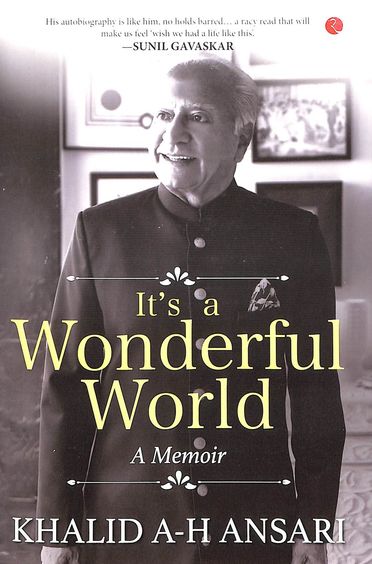
Today’s story is about the veteran journalist, publisher and businessman Khalid A.H. Ansari, son of Abdul Hameed. After passing out from St. Xavier’s in Mumbai, Khalid did his master’s at Stanford University in the US.

Khalid returned to Mumbai to establish Sportsweek, a weekly sports magazine, which became a huge success soon after its launch. The magazine’s immediate success can be attributed to the fact that its founder was himself an excellent sportsman and did a great job with the magazine, in addition to his father’s paper Inquilab.

Meanwhile, the idea came to launch India’s first daily tabloid, Mid-Day, which he modelled in many ways after the English tabloids from Fleet Street. During the planning phase of their new venture, he spent hours discussing it with staff and mulled over its format to ensure success, especially since there were already two eveningers in Mumbai, one by The Times of India and the other by the Indian Express. Both suffered from a lack of innovation to attract large numbers of readers. So when Mid-Day appeared with a new face and content, the two old ones just collapsed. Although the ToI eveninger protested the pace of time for a while, it eventually perished as it had already become obsolete.

Mid-Day became a resounding success, with many comparing it to the British Daily Mirror and Daily Mail. However, being an Indian tabloid, it was much quieter and a whole lot more civilized, without the British fondness for nudity and sex, and nonsensical stories of stupidity.

Khalid was helped by his wife, Rukaya. She was very active on the administrative side and contributed to the editorial content and layout, which helped the paper sustain itself in the demanding market of Mumbai. She knew what was going on in the office and in the newspaper that was fast becoming India’s flagship eveninger.
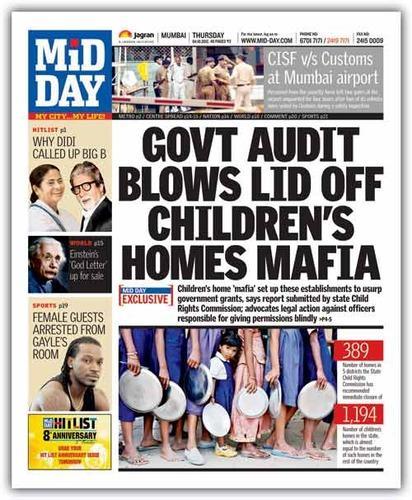
Meanwhile, Khalid accepted an offer to become editor-in-chief of the Dubai-based Khaleej Times, and handed over the paper to his son, Tariq. After a few years in Dubai, Khalid returned to Mumbai and launched Mid-Day in Bangalore and Delhi and a regional Gujarati version for millions of Gujaratis in the country.

He has been involved in various programmes with the Indian government during conferences in Delhi and New York, launching and editing newspapers, and was awarded the Padma Shri in 2001 while continuing to play and write about his old passion, cricket.
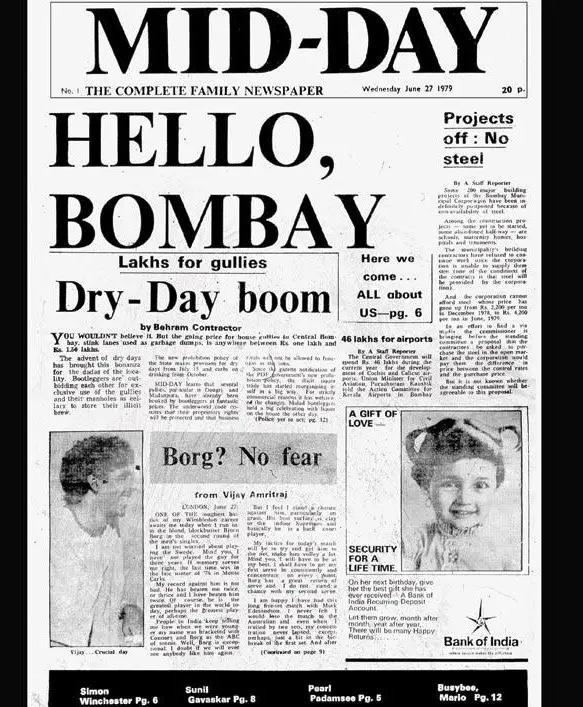
Writing about his eveninger, Khalid says, “Mid-Day is a light-hearted, easy-to-read, entertaining, and ‘naughty’ paper that now has a new purpose which is to make work fun. Gives young professionals an entertaining newsbreak. The focus is on young, urban, mobile professionals across India and the company is leaving no stone unturned to engage with them. Today’s workplace’s fast-paced work style and crazy deadlines are full of stress and pressure. Mid-Day as a brand believes in spreading the message of reducing stress and making work fun.”

“What’s on, a host of addictive, fun sections like Hit List Crosswords, Horoscopes, and Fun at Work ensure that the newspaper remains a welcome diversion for young professionals,” he adds.

Khalid’s Sportsweek later was shut down with the television boom making it hard to garner advertisements and interest. Khalid has also published his memoir (It’s A Wonderful World) and continues to inspire a stream of journalists apart from various generations to keep the boat afloat and touch new heights.

 (The Author is Journalist & associated with Dainik Bhaskar)

source: http://www.asianlite.com / Asian Lite / Home / by Siraj Ali Quadri / October 10th, 2022
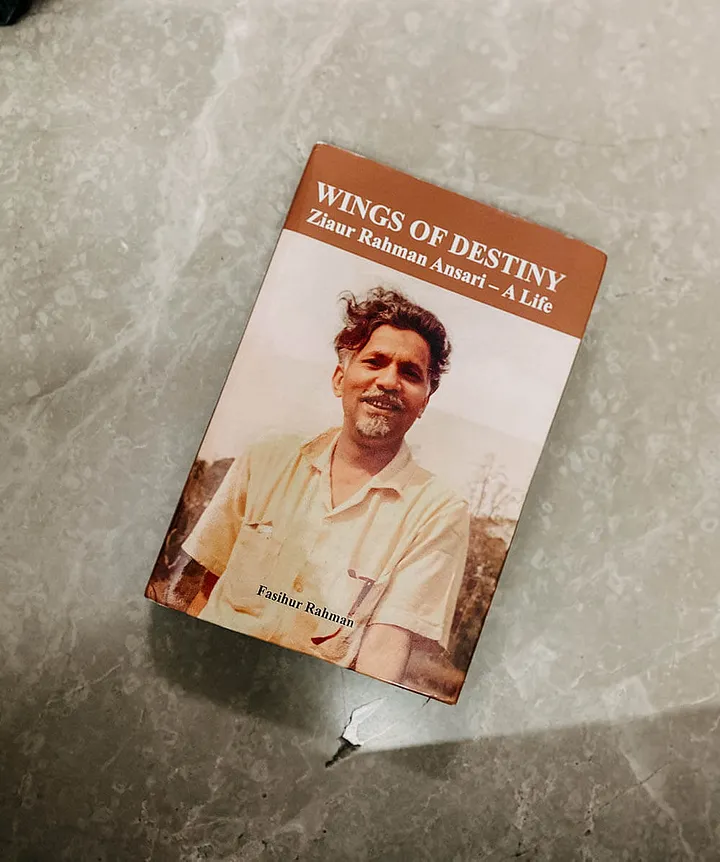
Book Review of ‘Wings of Destiny — Ziaur Rahman Ansari — A life’ by Fasihur Rahman

UTTAR PRADESH / NEW DELHI :

Ziaur Ansari was a prominent political figure, having served as the Union minister in the council of 2 Prime ministers Indira and Rajiv Gandhi. Wings of Destiny written by his son Fasihur Rahman is an ode to his entire political career spanning more than three decades and highlights the stalwart’s remarkable, inspirational life as well as clears the air around the controversies surrounding him.

When the truth stands coy in a corner, visible and yet under the pretence of being unknown and unacknowledged, you know that something somewhere is unfair.

Indeed, many times in life, there comes a threshold where one needs to understand and realize that truth which is the most supreme of all, can be an eye opener, as well as a beautiful and also a terrible thing, many a time. Terrible because there may be more to the situation than what meets the eye.

Yes, we all know and have read about the countless hardships that all of us underwent during the Indian freedom struggle. But, surely not all has come to light as far as the involvement of all parties, be it left or right is concerned. Yes, Muslims too were an integral part of the struggle towards Independence, their contribution being extremely indispensable. A prominent figure among them is Ziaur Rahman Ansari who served as Union minister from 1973 to 1977 and from 1980 to 1989 during the council of two Prime Ministers -Indira Gandhi and Rajiv Gandhi, this book which is written by his nephew Fasihur Rahman is a memoir cum biographical sketch of Ziaur Ansari’s life.

Ziaur Ansari was primarily in the spotlight in the year 1985, when he participated in a debate on a private Member Bill related to the SC judgement on the Shah Bano case, which to date remains one of the most debated issues in India as well as abroad. Having been often misquoted, misinterpreted and improperly perceived, Fasihur has taken it upon himself to finally take the opportunity to tell the world the true story behind Ziaur’s life.

The book which began with giving an ancestral account of Ansari primarily spoke about his father Habibur Rahman Ansari’s invaluable contribution to the freedom movement. What followed was the journey through Ziaur Rahman’s pursuit of politics which was turbulent and spanned a period of almost three decades, showing how he contested 9 elections.

Ziaur, not only being a man of strong ethics and politics, nevertheless was a man with a passion for fine arts, poetry, literature and music too. Ziaur was also inspired by Abul Kalam Azad’s legacy which was one of the cores of Rahman’s life. The hardships suffered by the Ulamas aka the religious scholars after the Mutiny of 1857 have also been explored by Fasihur here highlighting the true role of Darul Uloom Deoband in the Indian freedom struggle. I, for once, was amazed by this one since like mentioned earlier, I realized that many religious scholars, many freedom fighters have remained unsung, unacknowledged in their role in the struggle against the British rule for reasons which were, are and perhaps will always be something we shall never be able to comprehend fully. Racism, unfortunately, in the most erred way possible, nevertheless, Fasihur has brought forth a lot of undeciphered and unknown details forward.

Have you ever known or read about the famous Shah Bano case and the subsequent judgement of 1985? Well, the book explores the same in its entirety giving us Ziaur’s intervention in the Parliamentary debate on the SC judgement.

Ziaur Rahman was the president for a tenure of almost three decades at the All India Momin conference. The book provides a complete walk through the evolution, historical significance, mandate, and contribution of the conference in the complete socio-economic upliftment of the Muslim artisans. It also highlights their contribution to the freedom movement in India.

The last two years of Ziaur’s life were traumatic as Amyotrophic Lateral Sclerosis, an incurable neurological disorder, marked them. Characterized by loss of speech this is one of the most painful possible diseases and indeed Ziaur’s pain and anguish must have been sheer agony.

Lagate ho jigar pe teer par hum kuch nahi kehte. Zabaan hote hue ye bezabaani dekhte jao…

This Urdu couplet which was used by Ziaur himself to express the trauma of the condition he was reduced to was something that shook me personally, making me fathom and realize the kind of inability and pain the disease might have led him to. It was heartbreaking to read the complete scenario, especially since Fasihur has revealed how even being the prominent voice he had been, Ziaur was unable to speed track the path to going abroad and procuring the treatment which would have cured him.

A brilliantly written book, this one is a memoir you surely should not miss. Fasihur Rahman is impeccable in detail, immaculate in expression, not shying away from portraying facts as well as refraining from giving any kind of a judgmental tonality to any of the data he has provided. A crisp narration, this one will give you a lot of detail especially as it delves into pre as well as post-independence happenings and thus will be of interest as well as use to readers and historians too alike.

source: http://www.booxoul.medium.com / Medium.com / Home> Booxoul / December 14th, 2022

Remembering Shaikh Mushir Husain Kidwai (1878-1937)

Gadia (Barabanki District), UTTAR PRADESH :

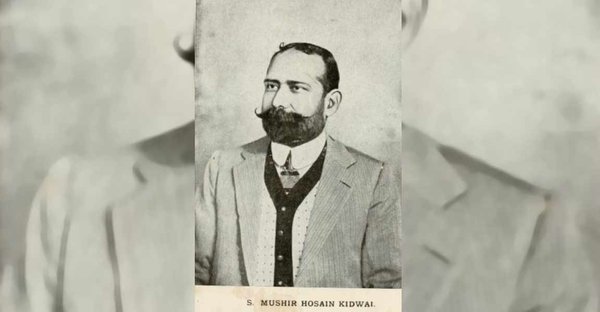
Photo Credit: Islam and Socialism, London, 1913.

Shaikh Mushir Husain Kidwai (1878-1937) was a multifaceted personality — an Islamic scholar, writer, lawyer, politician, and freedom fighter. Born on August 17, 1878, in Gadia, District Barabanki (UP), he came from a Zamindar family of Gadia, Awadh (UP).

After completing his education in Lucknow, he went to England where he passed the bar exam. He started his practice at the Allahabad High Court in 1921 and became a consultant to the British Indian Association and also held the post of Senior Judge at the Lucknow Bench.

He was one of the active leaders of the Khilafat and Non-cooperation Movement and was the Joint Secretary of Anjuman-e-Islam London, a branch of the Pan Islamic Society.

In early 1913, he formulated a scheme for the establishment of a society for the protection of the Haramain Sharifain along with Maulana Abdul Bari Firangi Mahli so that these holy places would not be attacked by non-Muslims during the First World War. This scheme was first published in Maulana Abul Kalam Azad’s Al-Hilal on 30 April 1913. In this regard, Maulana Abdul Bari and his colleagues founded the “Anjuman Khuddam-e-Kaaba” on May 6, 1913, with Mushir Husain Kidwai as its Secretary.

He wrote a pamphlet entitled “Future of Muslim State”, which was published by the Central Islamic Society of London in 1921, in which he wrote that Turkish exploitation and disintegration would destroy the Muslim World. He also published a manifesto in London which was widely circulated in support of Turkey.

In March 1920, he also signed a manifesto with Maulana Abdul Bari, Maulana Azad and Maulana Shaukat Ali, which was drawn up in the background of the conspiracy to dismember Turkey.

In May 1920, he presided over the Awadh Khilafat Congress at Faizabad.

Sultan Abdul Hamid II awarded him Order of Osmaniah for his outstanding contribution to Pan-Islamic causes.

He was a member of the All India Muslim League meeting, which was a member of the Commission of Inquiry into the causes and events of the Mopla Rebellion, which was constituted by the Muslim League in December 1921.

In May 1926, he was also a member of a committee formed by the League whose purpose was to draw up a scheme for a constitution for India.

He participated as a distinguished delegate in the Nationalist Muslim Conference at Lucknow on July 20, 1930. He was a member of the Central Legislative Assembly four times (1924, 1930, 1935 and 1936) and was elected unopposed each time.

He was also a prolific political writer, both in English and Urdu, and his articles on Islam, Khilafat, Socialism, and politics of the Subcontinent appeared in several English and Urdu periodicals of that time. He also authored several books on Islam, Khilafat and politics. Some of them are:

  1. Swaraj and How to obtain it
  2. Pan-Islamism and Bolshevism
  3. Islam and Socialism
  4. Islam and Woman
  5. Taleem-e Niswan
  6. Duniya ke teen shohdae Salasa.

He passed away on 27th December 1937.

source: http://www.milligazette.com / The Mili Gazette / Home> News> History / by The Milli Gazette Online / by Dr Asad Faisal Farooqui, Aligarh / November 22nd, 2024