NEW DELHI :
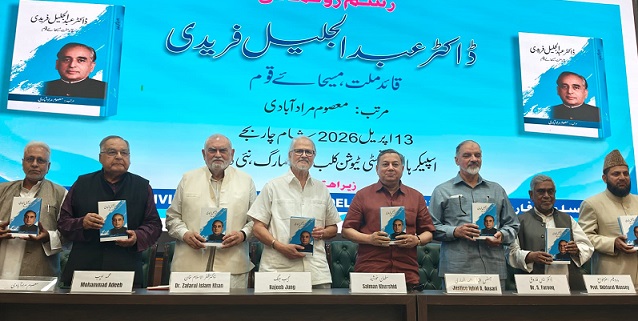
An impressive book launch ceremony was held at Constitution Club here to mark the release of a new book titled ”ڈاکٹر عبد الجلیل فریدی: قائدِ ملت، مسیحائے قوم“ “Dr. Abdul Jalil Faridi: Leader of the Community, Healer of the Nation,” compiled by senior journalist and author Masoom Moradabadi. The event was organized in collaboration with the Indian Muslims for Civil Rights.
The function was presided over by former Member of Parliament Mohammad Adeeb, while former Lieutenant Governor of Delhi Najeeb Jung attended as the chief guest. The book was formally released by Zafarul Islam Khan, President of the All India Muslim Majlis-e-Mushawarat, along with other distinguished dignitaries.
Among the guests of honour were former Chief Information Commissioner Wajahat Habibullah, former Chief Justice of Patna High Court Justice Iqbal Ahmed Ansari, Member of Parliament Maulana Mohibbullah Nadvi, Padma Shri awardee Akhtarul Wasey, and Dr. S. Farooq. The programme commenced with a recitation from the Holy Quran by Maulana Mohibbullah Nadvi.
Conducting the proceedings, Masoom Moradabadi noted that biographical writing has long been his passion and that he has authored sketches of hundreds of personalities. He explained that while substantial material on Dr. Faridi already existed, the book aims to present fresh insights by drawing upon extensive research conducted across multiple libraries. The work brings together Dr. Faridi’s speeches, writings, and ideas, including an Urdu translation of his historic address delivered at the National Integration Council.
Moradabadi highlighted that nearly 150 pages of the book are devoted to a comprehensive account of Dr. Faridi’s vision, mission, struggles, and contributions.
Speaking on the occasion, Zafarul Islam Khan recalled that during his childhood, Dr. Faridi was widely regarded as one of India’s foremost specialists in tuberculosis, who dedicated his life to the service of the nation and the community. Referring to the early days of the Majlis-e-Mushawarat, he noted Dr. Faridi’s prominent role and his consistent advocacy for strengthening the collective position of Muslims as a community.
In his address, Najeeb Jung reflected on the challenges faced by Muslim leadership in post-Independence India, stating that their political dependence on the ruling establishment often constrained their ability to speak freely. He observed that while leaders engaged with riot-affected areas and participated in various commissions, they struggled to effectively articulate community concerns. According to Jung, Dr. Faridi recognized this gap and stressed the need for an independent organization capable of engaging the government without fear.
In his presidential remarks, Mohammad Adeeb stated that independent India has yet to witness a leader of Dr. Faridi’s stature. He expressed regret that such a significant figure has largely been forgotten and congratulated Masoom Moradabadi for compiling the book, expressing hope that it would usher in a renewed interest in the life and legacy of Dr. Faridi.
Prof. Akhtarul Wasey shared his personal experiences of learning directly from Dr. Faridi, emphasizing that he taught the importance of presenting Muslim concerns as national issues rather than sectional ones.
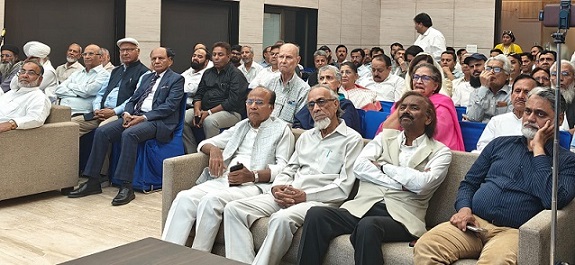
Other speakers, including Justice Iqbal Ahmed Ansari, Wajahat Habibullah, and Dr. S. Farooq, also shared their views. The event was attended by several prominent personalities, including M. Afzal, Qurban Ali, Saleem Qidwai, Khalid Siddiqui, Shabih Ahmad, Imran Qidwai, Dr. Zaheer Ahmad, Prof. Mohsin Usmani, Prof. Khalid Mahmood, and Dr. Syed Ahmad Khan, among others.
source: http://www.theindianawaaz.com / The Indian Awaaz / Home> Books> Qaumi Awaaz /by Staff Reporter, Indian Awaaz / April 13th, 2026