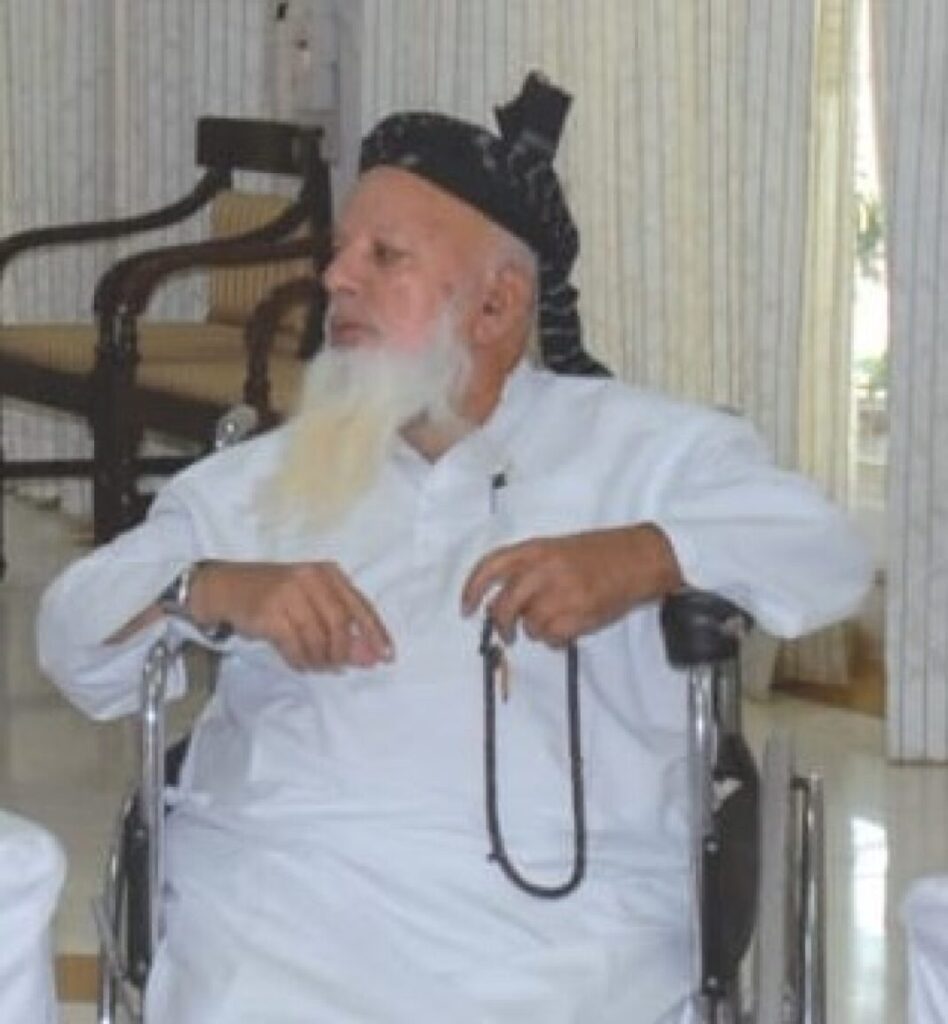
Deoband, UTTAR PRADESH :
With scarcity of good ulama, the passing away of Maulana Muhammad Salim Qasmi, rector of Al-Jamia Al-Islamia Darul Uloom Waqf, Deoband, has sent a sense of gloom across India.
People have written obituaries describing his death as the loss of the last chain in the golden series of Khanwada-e-Qasmiyat, a metaphor used to describe the great legacy whose history got prominence with establishment of Darul Uloom in Deoband in 1867 against the backdrop of persistent British onslaught on Indians on the one hand and its ugly design to kill ulama in large numbers on the other hand, to mitigate the impact of resistance against the Colonial power.
Maulana Salim Qasmi was a witness to the British cruelty on Indians and the Indian ulama during the eventful years if Independence. He had lived those times as a young student of India’s most prominent madrasa that had been a great centre of anti-British movements like the Silk Letter Movement.
Being the great-grandson of Maulana Muhammad Qasim Nanautwi, Salim Qasmi knew well the role he had to play to live up to the reputation and expectations both of his family and its followers and admirers spread over countries and continents. He rightly did so. His demise thus has rightly been described as the end of that golden chain. However, as there are others from the same family trying to carry forward both the academic and social and historical legacy, will they be able to do justice with that, only time will tell.
Muhammad Salim was born on 8 January, 1926 at Deoband and received primary education from many teachers. He completed his studies in 1948 from Darul Uloom Deoband where his teachers included great luminaries like Maulana Hussain Ahmad Madani, Maulana Aizaz Ali, Allama Ibrahim Balyawi, Maulana Syed Fakhrul Hasan Moradabadi.
He is said to be the last surviving disciple of Maulana Ashraf Ali Thanwi from whom he studied Mizan, an important book of Arabic grammar. Soon after passing out, he was appointed a teacher there. However, later, due to a serious conflict and crisis then in Darul Uloom, he along with some other colleagues, decided to stay away from it and established Darul Uloom Waqf which he nurtured till his last breath. Besides looking after its administrative affairs as a rector, he also taught Bukhari Sharif, the well-known book of hadith. Earlier, he had taught Muslim Sharif, another important book of hadith.
Some of the key positions he held at the time of his death are as follows:
Chief Rector, Al-Jamia Al-Islamia Darul Uloom Waqf, Deoband,
Vice-President, All India Muslim Personal Law Board,
Member, Aligarh Muslim University Court,
Member of Advisory Board and Managing Committee, Darul Uloom Nadwatul Ulama,
Member of Advisory Board, Mazahir Uloom Waqf, Saharanpur,
Permanent Member of the Fiqh Council, Al-Azhar,Cairo,
President, All India Muslim Majlis-e-Mushawarat (before two fractions of it finally united),
Patron, Kul Hind Rabta-e-Masajid,
Patron, Islamic Fiqh Academy, India.
About his written contribution to the domain of knowledge, the website of Darul Uloom Waqf Deoband mentions that besides being:
… one of the top speakers of ulama, his articles and writings are also much admired. Some of the books are worthy to be mentioned here like (1) Mabaadi al-Tarbiyat al-Islami (Arabic), (2) Jaiza Tarjama Quran Karim, (3) Taajdar-e-Arz-e-Haram ka Paigham, (4) Mardaan-e-Ghaazi, (5) Ek Azeem Tarikhi Khidmat, (6) Safar Nama-e-Burma.
(7) The book Khutbat-e-Khatibul Islam (a collection of his speeches) has been published in 5 volumes. Moreover, there are many articles and scripts awaiting publication.
Formally, Maulana received bai’at (a reformative and self-actualization method historically in vogue for quite long as an Islamic tradition in certain schools of thought) at the hand of Maulana Shah Abdul Qadir Raipuri. However, he received much of the training from his glorious father, Qari Muhammad Tayyib (d. 17 July, 1983)
A remarkable trait of his personality was to maintain the dignity of a true aalim (religious scholar) by not partaking in sectarian lines as is the wont of some Ulama. He was therefore respected among all sections of Muslims and his views were very well received. Maulana Salim did not create the binary division of education between religious and modern. He believed that ‘the source of all streams of knowledge is one’.
In recognition of his services to the domain of knowledge and ideas Maulana Salim was honoured with many awards, some of which are as follows:
Nishan-e-Imtiyaz (Mark of Distinction) from the Government of Egypt for being a distinguished aalim of the Indian Sub-Continent,
Imam Muhammad Qasim Nanotwi Award,
Shah Waliullah Award.
Prominent leaders and ulama from different countries have expressed grief over the demise of Maulana Salim Qasmi. In her telephonic message, External Affairs Minister Sushma Swaraj said that Maulana Salim’s love for education was amazing. Outside the country he worked as an exemplary ambassador of education. Congress President Rahul Gandhi said Maulana Salim Qasmi illuminated the world through education and he would touch people through simplicity. Samajwadi Party chief, Mulayam Singh Yadav said that Maulana never asked anything for himself. He was a crown prince of education whose absence would be felt long.
Former Justice of Pakistan’s Shariah Court, Mufti Taqi Usmani described Maulana Salim Qasmi as an ocean of knowledge. His death is a huge loss to the Islamic world. The simplicity with which he lived is rare, he said adding, “His service in the field of education is a golden chapter”.
Member of Parliament and AIUDF President Maulana Badruddin Ajmal Qasmi termed the demise of Maulana Salim Qasmi as ‘end of an era’ whose enumerable services are worth to be written in golden words. Senior leaders Ahmad Patel, Ghulam Nabi Azad, Syed Shahnawaz Hussain and others also sent their condolence messages.
Maulana Syed Rabey Hasani Nadwi, President of All India Muslim Personal Law Board, who had closely worked with Maulana Salim Qasmi and had also been his classmate at Darul Uloom Deoaband, wrote an article in which he stated that Maulana Salim Sahab had acquired many of the qualities of his father Qari Tayyib Sahab and his great grandfather Maulana Qasim Nanautwi. He worked in a similar way from whom different sections of ummah benefitted. His death therefore has caused concerns about the void in the ummah and in religious circles.
Maulana Arshad Madani described Maulana Salim Qasmi’s death as a loss which does not seem to be filled in near future. “Whenever there is a crisis he would be remembered’ he said. The responsibility to protect the institution that he established falls on all of us.
Prof Humayun Murad said that Maulana knew well how to avoid confrontation and find peaceful and constructive ways. Darul Uloom Waqf Deoband is its living example.
Maulana Muhammad Sayeedi, nazim, Mazahir Uloom Waqf said, “In the passing away of Maulana Salim Qasmi, Mazahir Uloom has been deprived of one of its true guide and patron”. He was its member since 1988. Mufti Muzaffar Husain would trust him a lot and his suggestions were highly helpful.
As against the commonly held opinion of ulama who do not tire of speaking about the division of knowledge between religious and modern or worldly, Maulana Salim Qasmi, in June 2013, had in a public programme, very categorically said that all the available forms of knowledge are from Allah. There is nothing as religious and worldly knowledge.
Maulana Qasmi said that the division of knowledge (between religious and worldly) is a political creation because all streams of knowledge flow from God. He then asked heads of madrasas to invite people of other faiths to their madrasas and exchange views and, share their problems with them also.
As I write this obituary, his soft-spoken words remind me of the sincerity with which he would draw the attention of the people to real issues and to the approaches that need to be adopted to find their solution.
Maulana Salim Qasmi was among the important personalities who had set up the Darul Uloom Waqf. His colleagues Maulana Muhammad Nayeem Deobandi died a little over a decade ago on 23 August, 2007, Shaikhul Hadith Maulana Syed Anzar Shah Kashmiri died 10 years ago on 26 April, 2008, Mufti Khursheed Alam died on 7 February, 2012, while Maulana Salim’s younger brother Maulana Muhammad Aslam Qasmi, an outstanding orator, died about five months ago on 13 November, 2017. Finally, this great son of the great Khanwada-e-Qasmiyat passed away on 14 April, 2018. He is survived by four sons and two daughters.
May the Almighty grant him an exalted place in Jannah!
The author is a PhD Fellow at the Academy of International Studies, Jamia Millia Islamia and is also doing an online program “Contending Modernities” of the University of Notre Dame, USA.
source: http://www.twocircles.net / TwoCircles.net / Home> Articles> Indian Muslim> Lead Story / by Manzar Imam for TwoCircles.net / April 28th, 2018