Tag Archives: Mumtaz Mahal

How Taj Mahal and Aligarh’s Jama Masjid – Built 250 Years Apart – Share a Calligrapher

Agra / Aligarh, UTTAR PRADESH :

The imposing walls of both the Taj Mahal and Aligarh Muslim University’s Jama Masjid have Quranic verses crafted onto white marbles in black paint.
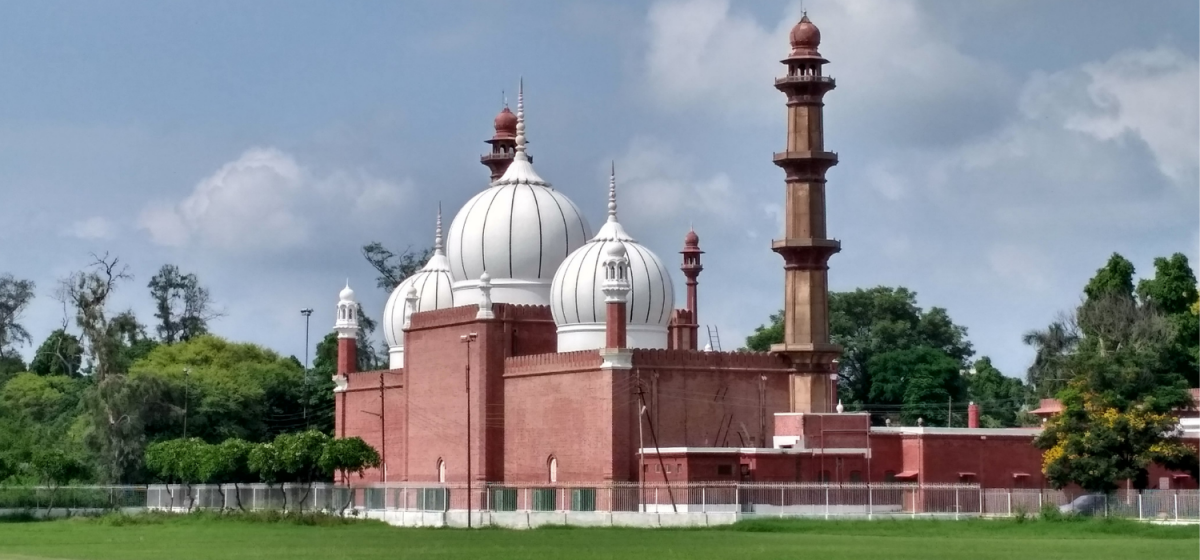
Jama Masjid on Aligarh Muslim University campus. Photo: Author provided.

Constructed nearly 250 years apart, the Taj Mahal in Agra and Jama Masjid at the Aligarh Muslim University (AMU) have an interesting connection.

The construction of the Taj Mahal began in 1632 and was completed in 1653, while the construction of Jama Masjid at AMU began in 1879 and was completed in 1915.

While the Taj Mahal, which is the tomb of Mughal emperor Shahjahan and his wife Mumtaz Mahal, attracts millions of visitors every year, AMU’s Jama Masjid is the main mosque of the university. AMU’s Jama Masjid is, perhaps, the last enduring symbol of the Mughals, constructed when the Mughals lost their kingdom during British rule.

A surprising connection

As one enters the Taj Mahal, beautiful calligraphy adorns all four corners. Several verses from the Holy Quran crafted in black calligraphy on white marble can be seen. This is a unique form of calligraphy, and expert artisans from Persia were involved in creating it. Similar calligraphy can be seem inscribed at the tomb of Mughal King Akbar at Sikandra, Agra, and also at the AMU Jama Masjid.
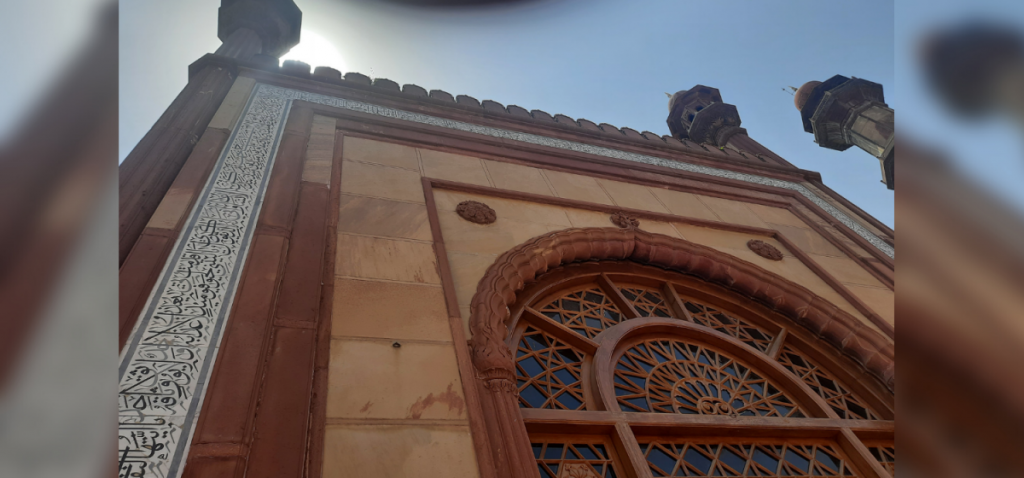
A closer look at the white marble with Quranic verses in black colour adorning the walls of Jama Masjid in Aligarh Muslim University. Photo: Special arrangement.

In fact, it is believed that the artisan responsible for the calligraphy at the Taj Mahal also brought his expertise to AMU’s Jama Masjid.

Since there is a difference of nearly 250 years between the construction of both architectural wonders, it is interesting to study how this was possible.

During Shah Jahan’s regime, several buildings were constructed, including the Taj Mahal and Delhi’s historic Jama Masjid. The calligraphist used was the same.

Professor Nadeem Ali Rezavi of the Centre of Advanced Studies, Department of History, Aligarh Muslim University, says that the master calligraphist in most of the buildings constructed during Shah Jahan’s regime is the same person.

“His name was Abdul Haq, and later due to his craftsmanship, his rank was elevated. He was given the title of Amanat Khan. In fact, he even signed the bands on this calligraphy with dates,” says Rezavi.

Still, there is a gap of over two centuries between these two buildings, Taj Mahal and AMU’s Jama Masjid.

The connection between the two monuments becomes clear with the involvement of Akbarabadi, one of Shah Jahan’s queens. Her original name was Aiza-un-Nisa. She, in 1650, commissioned the construction of a mosque situated in Daryaganj, Delhi, during the same period. In that mosque, Quranic calligraphy was done by the same artisan in black paint on white marble. This was around the same time as when the Taj Mahal was built.

After nearly two centuries, the Daryaganj mosque was demolished by the Britishers following the 1857 revolt. This was when Britishers gained control over the Red Fort, and the last Mughal emperor Bahadur Shah Zafar was sent in exile to Rangoon. They destroyed many buildings which were supposed to have harboured the rebels. At the site of the destroyed Akbarabadi Mosque, a park was developed and came to be known as Edward Park in 1911, which is now called Subhash Park.

During the same period, Sir Syed Ahmed Khan, the founder of the Mohammadan Anglo Oriental College (which later became AMU) felt the oppression against Muslims after the revolt. He nurtured the idea of setting up an educational institution to try and uplift the community.

A visionary man, Sir Syed had the taste for collecting things, particularly artefacts which had archaeological and historical importance. He was aware of the demolition of the Akbarabadi Mosque in Delhi.

As per the AMU Gazette, the scraps generated at the demolished Akbarabadi mosque were sold to a dealer and later purchased by Sahabzada Suleman Jah Bahadur. These remains were thus sold after over 200 years. These were presented to Sir Syed Ahmed Khan, who planned to use them in the Jama Masjid of the educational institution.
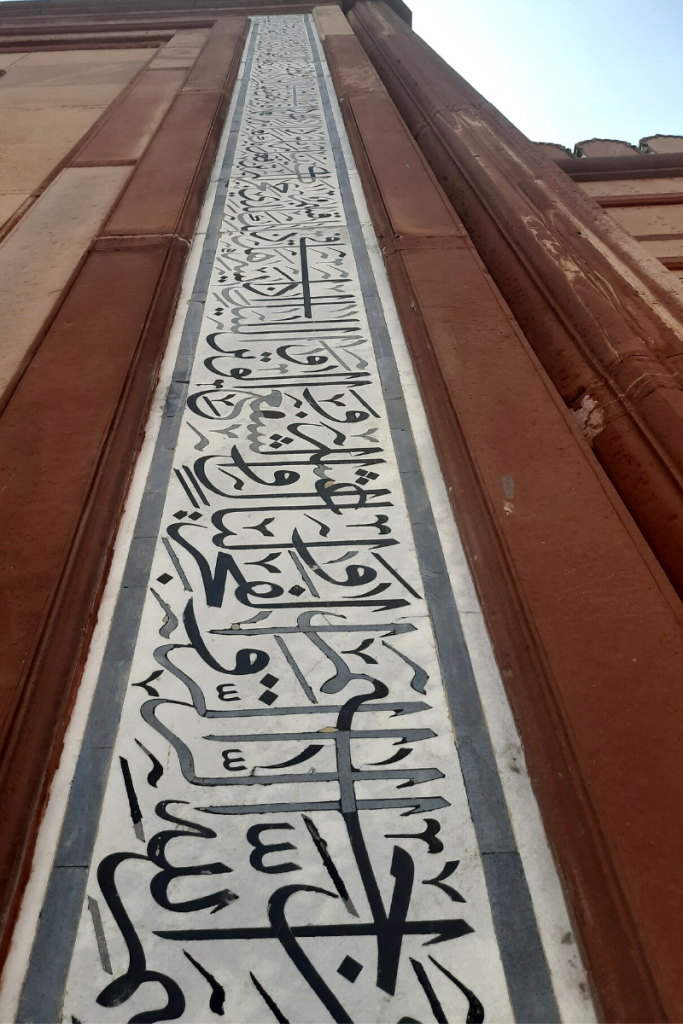
A closer look at the white marble with Quranic verses in black colour adorning the walls of Jama Masjid in Aligarh Muslim University. Photo: Special arrangement.

The white marbles with black calligraphy now present in the Jama Masjid of AMU depict Surah Fajr from the Holy Quran. Thus centuries apart, the two buildings carry the work of the same artisan.

“Even if you compare, it is the same thing and the only difference is in the scale. The artisans are the same who have shown their skills in the construction of the Taj Mahal,” says Prof. Rezavi.

Thus AMU’s Jama Masjid is, perhaps, the last enduring symbol of the Mughals, constructed when the Mughals lost their kingdom during the British rule. On the other hand, the domes of AMU’s Jama Masjid employed techniques of the Mughal era: they are “true domes” as they were built using lime mortar and vousseurs (wedge cornered stones/bricks).

“It is a brick structure, guava-shaped, carrying white marble with black stripes. This is the last true dome. After this, the particular technology faded out, and the buildings constructed after them have concrete domes,” said Rezavi.

Later, in 2016, AMU authorities began the conservation of the Jama Masjid. Now revived at the cost of Rs 90 lakh, the Jama Masjid has a Hauz in the courtyard, three domes, seven arches and two lofty minarets cornered by a Cricket Pavilion at its rear end. Sir Syed, the founder of the institution, was also buried in the same compound.

Faisal Fareed is a senior Lucknow-based journalist. 

This article went live on June fifth, two thousand twenty one, at zero minutes past seven in the morning.

source: http://www.thewire.in / The Wire / Home> History / by Faisal Fareed / June 05th, 2021
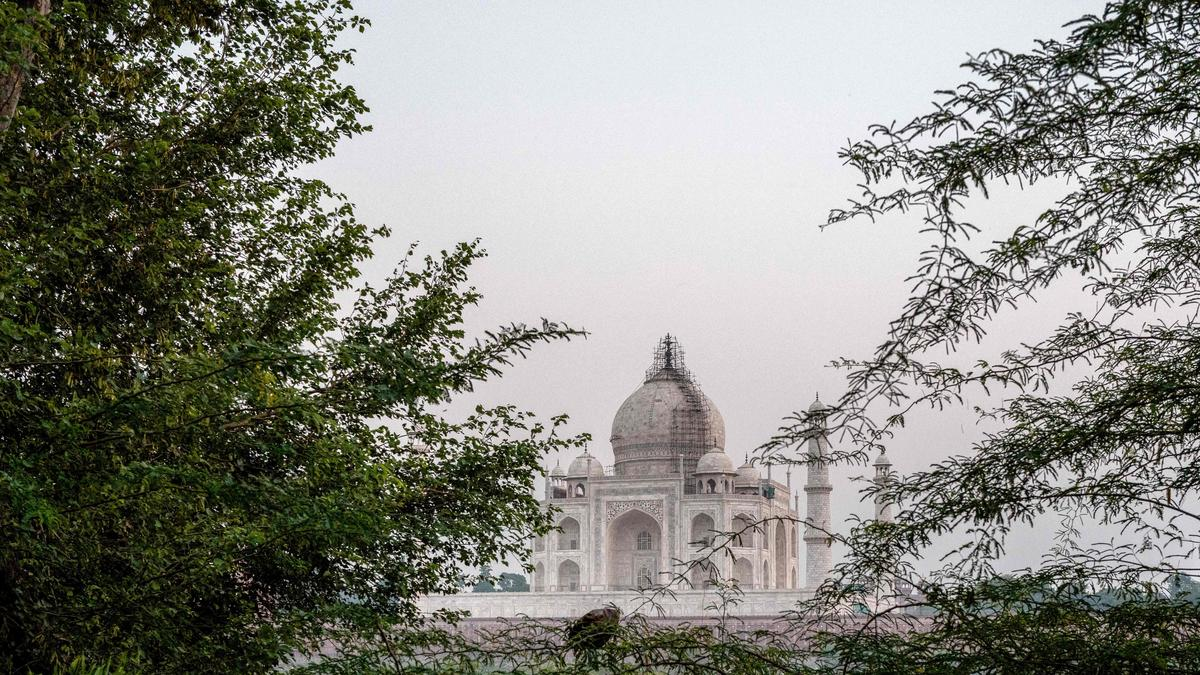
The actual Taj story: how a monument’s history has been warped

Agra, UTTAR PRADESH :

Tushar Goel’s film, ‘The Taj Story’, has reignited controversy over the Taj Mahal’s origins, claiming it is a Hindu temple rather than a mausoleum built by Mughal emperor Shah Jahan. The film’s debut highlights debates about the interplay of history and ideology in contemporary India.

Scaffoldings are pictured as restoration work goes on at the dome of the Taj Mahal in Agra on October 17. | Photo Credit: AFP

A little over 60 years ago, Purushottam Nagesh Oak slept and dreamt. He woke up and claimed that the Taj Mahal in Agra was actually a Hindu palace going back all the way to 4th century. Friends of Mr. Oak, an English teacher-turned-lawyer-turned-journalist but never a historian, told him that the Taj Mahal couldn’t have been a fourth century structure as the technology employed in building the Taj in the 17th century didn’t exist back then. The fantasist turned a pragmatist, and Oak brought his argument forward by a few centuries. The Taj was now claimed to be a Hindu temple. This was in 1989. He wrote articles and a book too, but found no support from historians. Even the Supreme Court dismissed his claims as “a bee in his bonnet” in 2000.

But post-2014, history is like a revolving door, you enter and exit at your ease and pleasure. You pick and choose, you circumvent and invent. Dress it up as a movie and claim you are looking at history anew. That is how we get a movie like Tushar Amrish Goel’s The Taj Story, starring former BJP MP Paresh Rawal; just like we had The Kashmir Files and The Bengal Files, starring Anupam Kher and Mithun Chakraborty, all ideological partners of the Bharatiya Janata Party (BJP).

With The Taj Story, Goel goes where no historian has gone. Proof, evidence and knowledge amount for nothing as the director makes a case for the Mughal monument being actually a Hindu temple, much like the BJP leader Sangeet Som who called it alternately a Shiva temple and a monument built by a man who incarcerated his father. Mr. Som obviously couldn’t make out a Shah Jahan from an Aurangzeb and hence got mixed up. Much like Oak, oops, Goel, who sees no difference between history and mythology, facts and fantasy.

Recorded history

Talking of facts, the Taj Mahal was built by the Mughal emperor Shah Jahan after his favourite wife Arjumand Bano Begum breathed her last after bearing the last of their 14 children. Its chief architect was Ustad Ahmed Lahori. The land for her last resting place was procured from Mirza Raja Jai Singh of Amber who had inherited it from Raja Man Singh, a celebrated general of Akbar, who was Shah Jahan’s grandfather. Shah Jahan compensated Jai Singh with four havelis from the royal property for the massive haveli in which rests Mumtaz Mahal. His firman to Jai Singh, the latter’s agreement and the Mughal emperor’s subsequent letter of granting him four havelis in lieu of one, are all part of history; unlike the claim of The Taj Story which talks in terms of a massacre and genocide of the locals for fulfilling the wishes of an emperor and his consort!

The work on the tomb started in 1632 with the finest craftsmen from across the country and West Asia. The chief mason was Mohammed Hanif from Baghdad who earned ₹1000 a month for his efforts. The pinnacle was built by Qayam Khan of Lahore and its Quranic inscriptions were done by Amanat Khan Shirazi. The mosaic work was done by local Hindu workers. Above all, some 20,000 workmen toiled for 22 years to build the monument to love. Its white marble came from Jaipur, lapis lazuli from Sri Lanka, crystal from China and coral from Arabia. The monument uses the double dome technique, previously seen only in the Humayun’s tomb in Delhi, and never seen in the country before the arrivals of the Turks.

Not the first time

Over the years, many have tried to appropriate credit for its beauty and majesty. In the 17th century, it was claimed by many in the West that the architect of the Taj was Venetian Geronimo Veroneo, a jeweller by profession. Then came the claim by Mughal Beg in Tarikh-e-Taj Mahal that it was designed by Muhammad Effendi, an architect supposedly sent by the Sultan of Turkey. Effendi though was as much an architect as Oak was a historian. In the mid 19th century it was claimed that the monument was the result of the genius of Frenchman Austin de Bordeaux, a jeweller. However, Austin died in 1632, the year the work on the Taj began. With his death all claims of Austin being the Taj’s architect were buried. And facts began to be raised.

As for fantasy, well there is Goel’s film, never mind its claim of presenting the “untold history of the Taj Mahal”. The film, replete with stereotypes of kohl-lined, skullcap-donning Muslims aims at building a nation’s memory on unreasoned mythology, far removed from the well argued debates of history. Much like Oak’s view that Christianity was nothing but Krishan-Niti. Not game for any ridiculous claims in an insipid film which opened with a mere 14% attendance in the first show? Watch M. Sadiq’s 1963-saga Taj Mahal. Sure, you would remember its song, ‘Jo wada kiya woh nibhana padega’, penned by Sahir Ludhianvi and sung with much love by Mohammad Rafi and Lata Mangeshkar. Sadiq’s film with Pradip Kumar and Bina Rai in the lead cast, made no effort at replacing history with mythology.

source: http://www.thehindu.com / The Hindu / Home> Entertainment> Movies> In the limelight / by Zia Us Salam / November 07th, 2025

Jahanara Begum: The Forgotten Mughal Princess Who Designed Chandni Chowk

DELHI :

She was one of the most powerful women of medieval India, a Mughal princess like no other. And yet, her extraordinary story remains lost in the pages of history.

In an unassuming part of India’s capital city, amidst winding alleys lined with attar and chadar sellers, lies the 800-year-old dargah of Hazrat Nizamuddin Auliya—one of the most revered saints in Sufism. From dusk to dawn, thousands of devotees throng this bustling complex to pay their respects.

Yet, few know that Delhi’s most famous Sufi shrine is also home to the tomb of one of the most powerful women of medieval India, Jahanara Begum.

A writer, poet, painter and the architect of Delhi’s famous Chandni Chowk, Jahanara was a Mughal princess like no other.

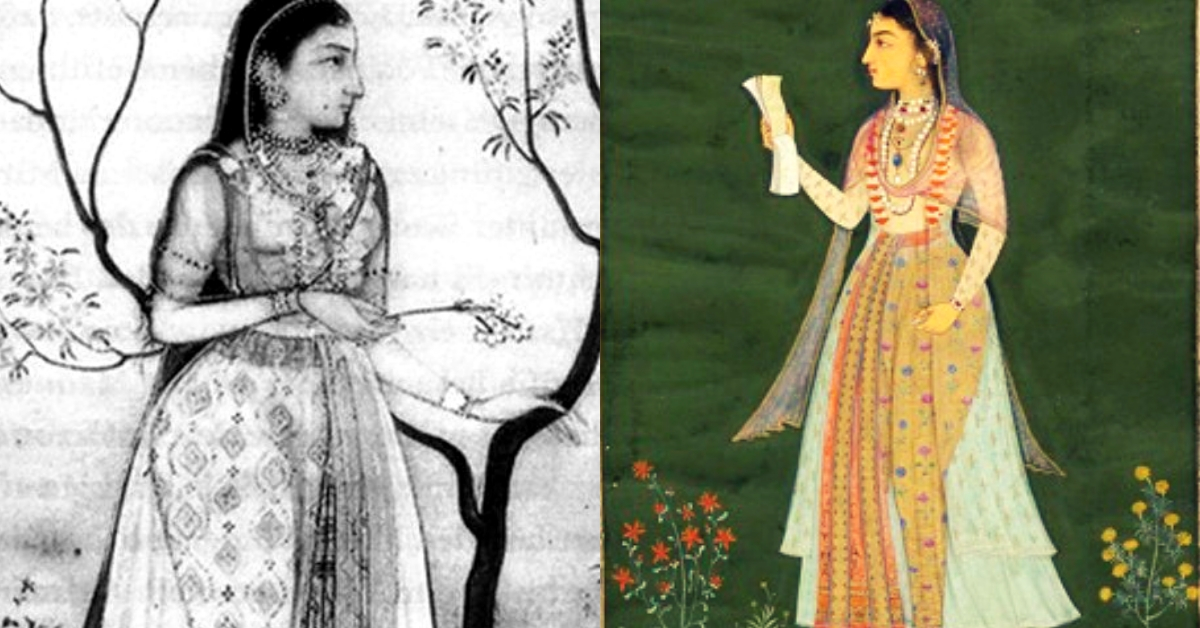
Portraits of Jahanara Begum. Source: Wikimedia Commons

This is her story.

The eldest child of Emperor Shah Jahan and his favourite wife, Mumtaz Mahal, Jahanara was born in Ajmer in 1614. Growing up in one of the richest and most splendid empires in the world, the young princess spent her childhood in opulent palaces, humming with family feuds, battle intrigues, royal bequests and harem politics.

As such, she was well-versed in statecraft by the time she was a teenager.

Soon after, Jahanara was appointed Begum Sahib (Princess of Princesses) by her doting parents. She would often spend her evenings playing chess with Shah Jahan, understanding the workings of the royal household, and helping her father plan the reconstruction of other palaces.

As French traveller and physician François Bernier writes in his memoirs, Travels in the Mogul Empire  ,

“Shah Jahan reposed unbounded confidence in his favourite child; she watched over his safety, and so cautiously observant, that no dish was permitted to appear upon the royal table which had not been prepared under her superintendence.”

Jahanara was also especially close to Dara Shikoh, Shah Jahan’s eldest son and her favourite brother. The two shared a love of poetry, painting, classic literature and Sufism.

In fact, she also wrote many books, including a biography of Ajmer’s Sufi saint Khwaja Moinuddin Chishti, displaying her flair for prose.

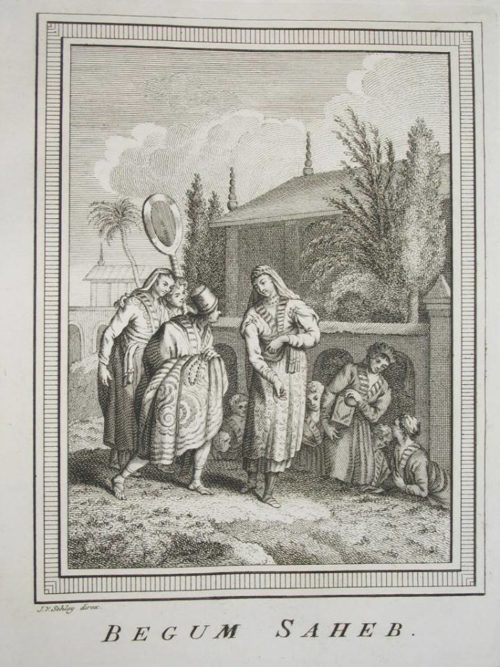
The Begum Sahib. Source: Royal India Families/Facebook

But tragedy struck the young princess’s life with the untimely demise of her beloved mother, Mumtaz, in 1631. At the tender age of 17, she was entrusted with the charge of the Imperial Seal and made Malika-e-Hindustan Padshah Begum—the First Lady of the Indian Empire—by the shattered Emperor, whose grief kept him away from his royal duties.

It was only on Jahanara’s behest that the inconsolable Shah Jahan came out of mourning.

In the years to follow, she became her father’s closest confidante and advisor. Highly educated and skilled in diplomatic dealings, her word became so powerful that it could change the fortunes of people. Her favour was much sought-after by foreign emissaries.

In 1654, Shah Jahan attacked Raja Prithvichand of Srinagar. Despairing of success in the battle, the Raja sent a plea for mercy to Jahanara. The Princess asked him to send his son, Medini Singh, as a sign of his loyalty to the Mughal Empire, thereby getting him a pardon from the Emperor.

The following year, when Aurangzeb was the viceroy of the Deccan, he was bent on annexing Golconda, ruled by Abdul Qutb Shah. The Golconda ruler wrote an arzdast(royal request) to the Princess, who intervened on his behalf. Qutb Shah was pardoned by Shah Jahan (against Aurangzeb’s wishes) and secured his safety on payment of tax.

Interestingly, Jahanara was also one of the few Mughal women who owned a ship and traded as an independent entity.

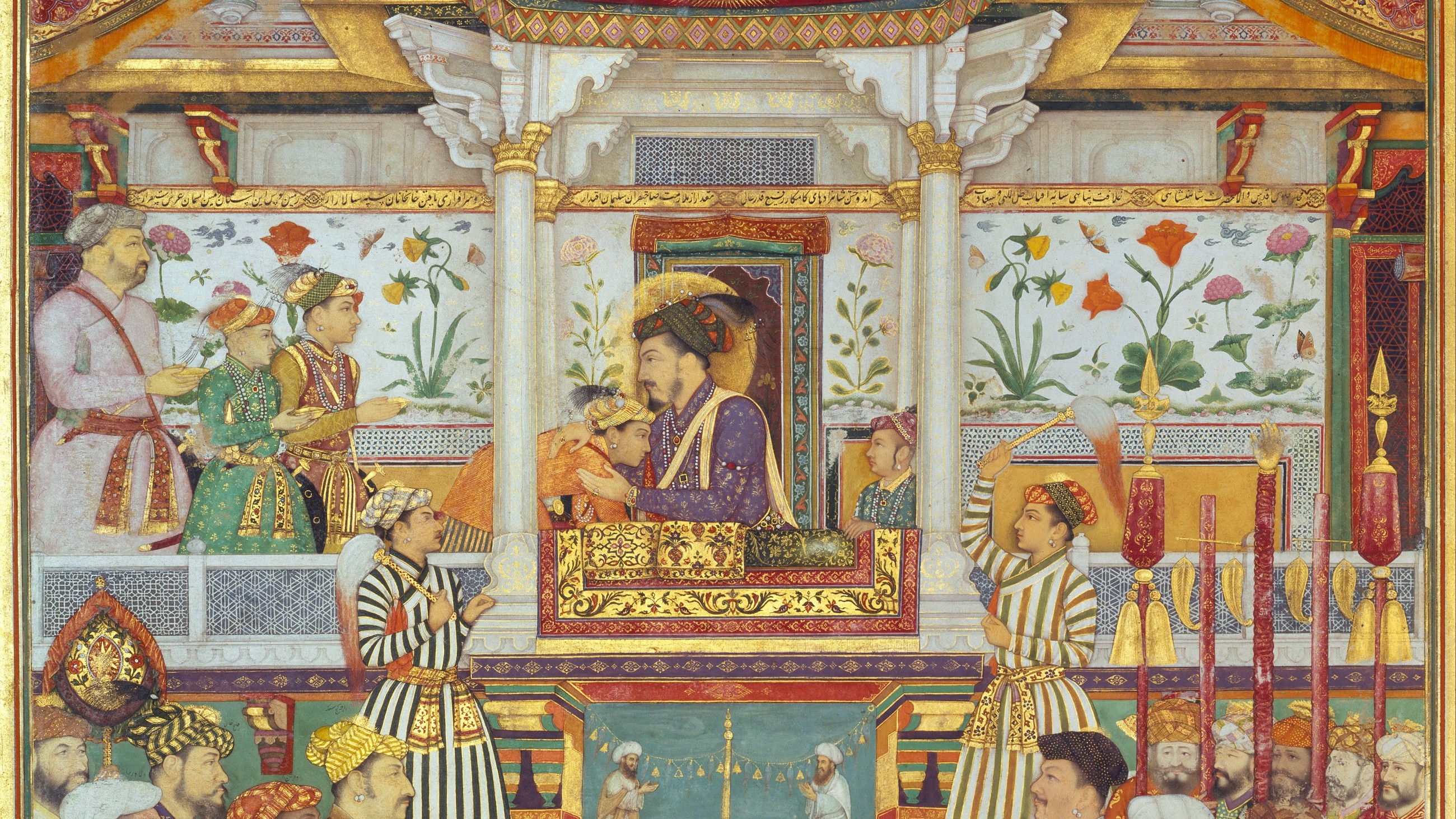
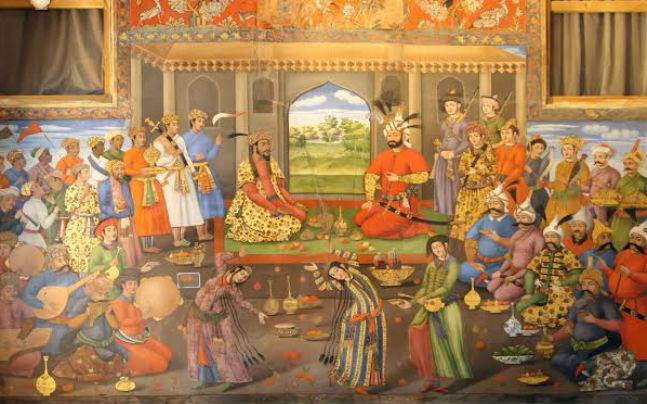
Padshahnama plate 10 : Shah Jahan receives his three eldest sons and Asaf Khan during his accession ceremonies (8 March 1628). Source: Wikimedia Commons

Named ‘Sahibi’ after its owner, Jahanara’s ship would carry the goods made at herkarkhanas (factories) and dock at her very own port in Surat; its revenue and the colossal profits she made via trade significantly boosted her annual income of three million rupees!

In his book Storia Do Mogor, Italian traveller Niccolao Manucci writes, “Jahanara was loved by all, and lived in a state of magnificence.” The book is considered to be one of the most detailed accounts of Shah Jahan’s court.

But Jahanara’s political and economic clout failed to have an impact on the bitter war of succession between her brothers, Dara Shikoh and Aurangzeb. She made several attempts to mediate between them, but as Ira Mukhoty writes in her book Daughters of The Sun , she had “underestimated the corrosive loathing that Aurangzeb has for Dara, whom he blames for his father’s cold criticism throughout his career”.

Aurangzeb ultimately killed Dara Shikoh and placed an ill Shah Jahan under house arrest in Agra Fort’s Muthamman Burj (Jasmine Tower). Faithful to her father, Jahanara set aside her lucrative trade and luxurious lifestyle to accompany him into imprisonment.

A constant presence beside Shah Jahan in his exile, she took care of him for eight years, till he breathed his last in 1666.

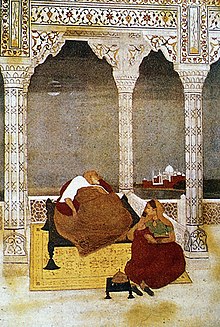
“The Passing of Shah Jahan” (1902), a painting by Abanindranath Tagore. At the foot of the bed is Jahanara Begum, the daughter of Shah Jahan; the Taj Mahal is in the background. Source: Wikimedia Commons

It says much for her stature in the Mughal court that after Shah Jahan’s death, Aurangzeb restored her title of Padshah Begum and gave her a pension along with the new title of Sahibat al-Zamani (Lady of the Age)—befitting for a woman who was ahead of her time.

Unlike other royal Mughal princesses, she was also allowed to live in her own mansion outside the confines of the Agra Fort.

“Jahanara establishes herself in the city as the most influential woman patron[s] of literature and poetry. She collects rare and beautiful book[s], and her library is peerless. She donates money to charity, especially Sufi dargahs, and carries on a genteel diplomacy with minor rajas who come to her with grievances and gifts,” writes Ira Mukhoty in her book.

Spending her last years in the pursuit of her artistic and humanitarian passions, Jahanara passed away in 1681 at the age of 67 but not before she etched her mark in the annals of history in a manner that would have made her father proud.

She commissioned several architectural spectacles, mosques, inns and public gardens across the Mughal empire.

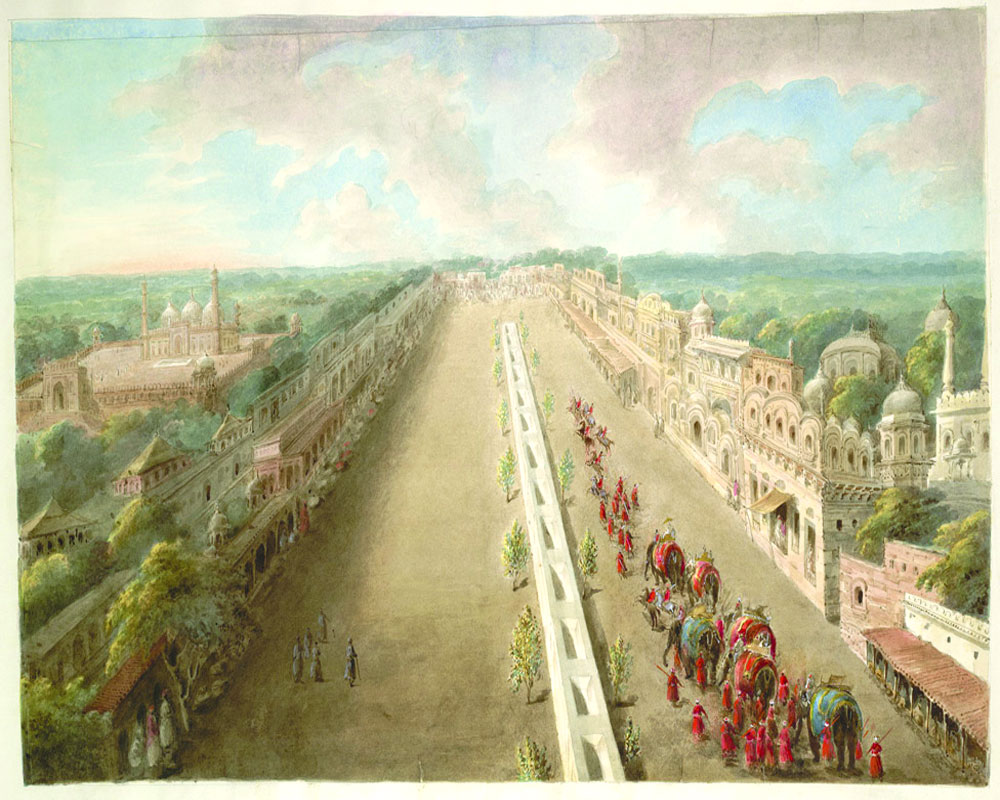
But she is best remembered as the architect of Old Delhi’s legendary bazaar, Chandni Chowk—which translates to ‘Moonlit Intersection’.

Water colour of Chandni Chowk in Delhi from ‘Views by Seeta Ram from Delhi to Tughlikabad Vol. VII’. Source: British Library

In his book  Shahjahanabad : The Soverign City in Mughal India , Stephen Blake writes,

“The chowk was an octagon with sides of one hundred yards and a large pool in its center. To the north, Jahanara built a caravansarai (roadside inn) and a garden and, to the south, a bath. On certain nights, the moonlight reflected pale and silvery from the central pool and gave to the area the name Chandni Chawk (Silver or Moonlight Square). This name slowly displaced all others until the entire bazaar, from the Lahori Gate to the Fatehpuri Masjid, became known as Chandni Chawk.”

Today, many of Chandni Chowk’s ancient buildings have been torn down, as its lanes brim with new shops and colliding crowds. And yet, somehow it manages to invoke the spirit with which Jahanara lived—the same spirit that helped her survive and thrive amidst betrayals and tragedies.

Interestingly, Jahanara’s resting place in the Nizamuddin Dargah is of her own choosing, just like her character.

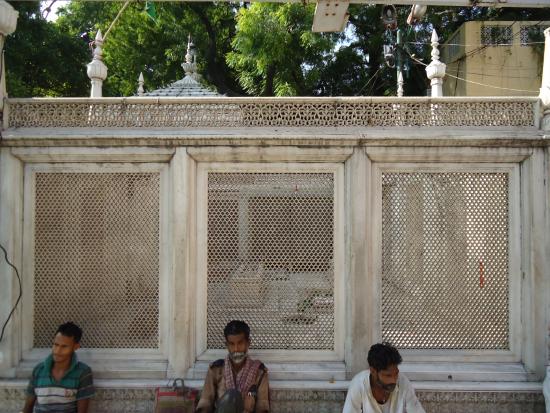
Jahanara’s tomb at the Nizamuddin Dargah. Source

Unlike the giant mausoleums built for her parents, she rests in a simple marble tomb open to the sky, inscribed with her own couplet in Persian:

Baghair subza na poshad kase mazar mara, (Let no one cover my grave except with green grass,)
Ki qabr posh ghariban hamin gayah bas-ast. (For this very grass suffices as a tomb cover for the poor.

Perhaps it is poetic justice that green vines grow on the grave of this extraordinary princess of India.

(Edited by Shruti Singhal)

source: http://www.thebetterindia.com / The Better India / Home> History> Women / by Sanchari Pal / May 24th, 2019

The great women behind the Mughal empire

INDIA :

Most people know of this hierarchy but how much do we know of the women behind this great dynasty?

Mughal empire
Mughal empire

The Mughal Empire (1526-1707) was established by Babur defeating Ibrahim Lodi in the First Battle of Panipat. His reign went on for four years (1526-1530). His successor was his son, Humayun. Then arrived Akbar, followed by his son Jahangir, followed by Shah Jahan, and the, the last great Mughal ruler– Aurangzeb.

Most people know of this hierarchy but how much do we know of the women behind this great dynasty?

Here’s a list to educate you about the same!


source: http://www.indiatoday.in / India Today / Home> News> Education Today> GK & Current Affairs> History / by India Today Web / New Delhi – May 06th, 2016

Shahjahan’s urs from April 2

Agra, UTTAR PRADESH :

The urs of Mughal emperor Shahjahan will be observed at the historic Taj Mahal for three days from April 2 next. Entry into Taj Mahal will be free for visitors after noon on April 2 and 3 while it will be free for the entire day on April 4.

Lakhs of  devotees will throng the 17th century monument during the three-day event and will pay homage at the graves of Shahjahan and his wife Mumtaz, in whose memory the Taj Mahal was built.

On the last day, a ‘saptrangi chadar’ (multi-coloured bedsheet ) will be offered at the graves as part of a ritual. Sandalwood powder will be sprinkled on the grave too.

The urs of the Mughal king Shahjahan is celebrated on the 25, 26 and 27th day of Rajab, which falls of April 2, 3 and 4.

The Shahjahan urs committee will meet here on March 8 to decide on the arrangement and preparation to be made for the urs.

Officials said that a notification was issued by the ASI on the urs of Shahjahan. The administration will prepare a fool proof strategy to ensure full security to devotees attending the urs.

source: http://www.dailypioneer.com / The Pioneer / Home> State Editions> Lucknow / by PNS, Lucknow / March 06th, 2019

Shah Jahan’s birth anniversary celebrations to begin from tomorrow

Agra, UTTAR PRADESH :

Mughal emperor Shah Jahan’s Urs (birth anniversary) celebrations are to begin from May 3. This is the only time of the year when the graves of the royal couple at Taj Mahal are opened to the public. An 870m multi-colour chadar, representing different religions, will be laid on the grave of the emperor. Entry to the white marble mausoleum Taj Mahal will be free for three days.

While on May 3 and 4 tourists entry will be free from 2pm to sunset. On the last day, May 5, entry will be free throughout the day. This will be Shah Jahan’s 361st birth anniversary celebrations which will begin with the washing of the graves of the emperor and his queen Mumtaz Mahal.

Every year Khuddam-e-roza (traditional caretakers of the Taj) committee offers a long multi-colour chadar, representing different faiths of the country, at the grave during Urs. Last year it was 810 metre. And this has been increased to 870 metre this year and will be offered on May 5, last day of the event. The unique thing about this offering is that the chadar is made by stitching pieces of cloths presented to the committee by people from different religions on fulfillment of their wishes. Moreover, the chadar starts its journey every year from a religious site, be it a temple, church or mosque.

According to committee member it is the seventh generation which is offering the chadar at the Mughal emperor’s grave. The occasion of urs is chosen to spread message of communal harmony in the society.

Syed Munawwar Ali, president of Taj Mahal Masjid Intezamiya committee, said: “Following the age-old tradition, shehnai and qawwali sessions will be held on all the three days at the royal gate.”

A meeting of senior officials of CISF, UP police, district administration and Archaeological of Survey of India was held to discuss the arrangements made for the annual celebration.

source: http://www.timesofindia.indiatimes.com / The Times of India / News Home> City> Agra / TNN / May 02nd, 2016