Tag Archives: Muslim Craftspersons of India

Ikram Hussain’s brass carvings fascinated PM Modi

Moradabad, UTTAR PRADESH :
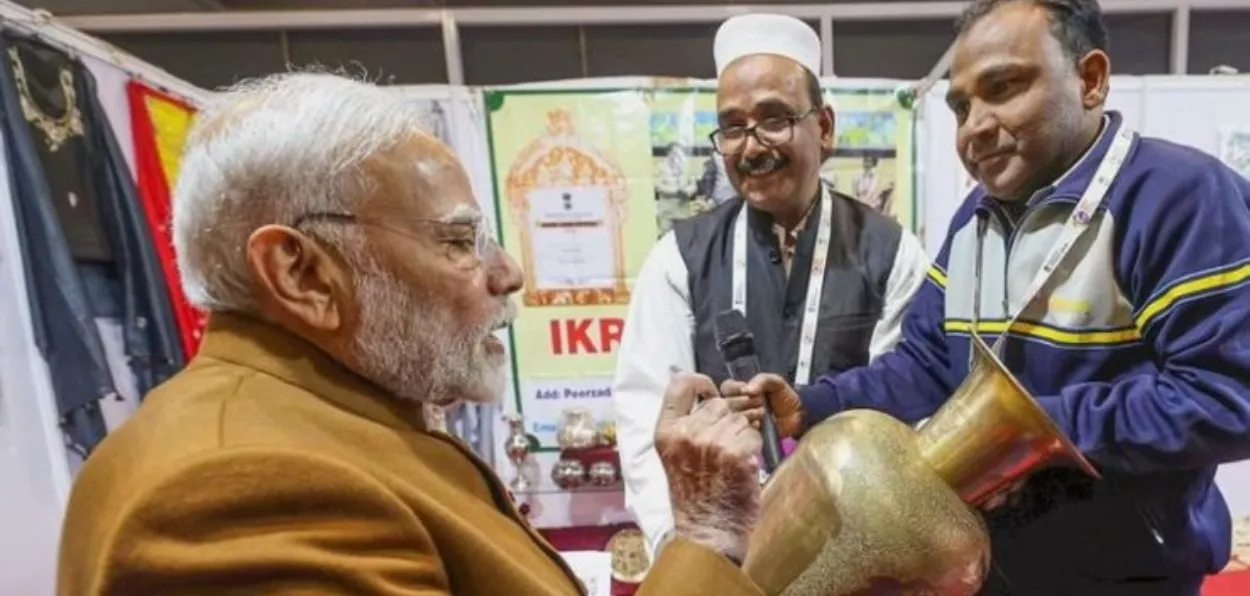
Ikram Hussain (wearing a cap) with Prime Minister Narendra Modi at Bharat Mandapam, New Delhi

Ikram Hussain was 15 years old when the manager of the Eidgah Gurdwara in Moradabad, UP, asked him to engrave his mother’s name on an aluminium plate. The young boy had never gone to school but had picked up the skill of metal carving from his father. The young boy felt embarrassed and told the manager that he must write the name for him since he was illiterate.

He engraved the name beautifully onto the plate and received Rs 10 for this work. This amount gave him confidence, and he decided to pursue his work seriously.
Today, Ikram Hussain, 61, from Moradabad, Uttar Pradesh, is a national award winner. None other than Prime Minister Narendra Modi praised him for his art.

One of the glorious moments of his life was when Prime Minister Narendra Modi was impressed and moved by his beautiful carvings at the The 12th Grameen Bharat Mahotsav  at Bharat Mandapam, New Delhi last year.

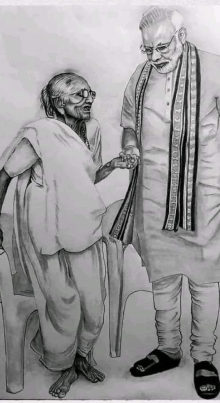
Ikram was carving a piece depicting Prime Minister with his late mother on a 3-feet brass jar. Prime Minister intently watched his carvings and patted him for his work and dedication. He displayed this work at the festival.

Moradabad, known as the “Brass City,” is renowned for its exquisite brass artefacts. Ikram Hussain says he could not study due to financial constraints at home. However, he never lost hope.
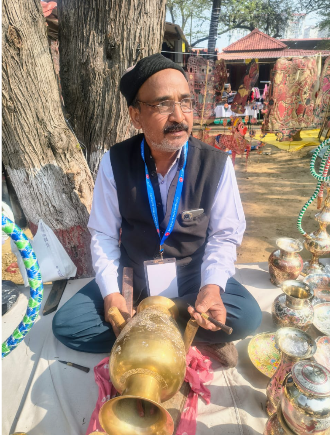
At a young age, he began assisting his grandfather and father in their brass engraving work. His father, Haji Abdul Hamid, and his uncle, Razak Medal winner Haji Ghulam Nabi, were well-known brass engravers in Moradabad. Ikram started learning this art at the tender age of seven.

Even today, his eyes well up with tears when asked why he couldn’t complete his studies. He explains that his family’s financial situation was extremely precarious. To help support the family, he had to leave school and start working.

The family worked day and night, yet they could barely earn five to seven rupees a week. Even that amount was hard to come by those days. Despite this, Ikram never let his circumstances become a weakness.

While working, he meticulously learned the intricacies of engraving. His hard work and dedication resulted in him gradually mastering the art of working with brass to the point where he could accurately engrave the likeness of any person’s face.

His engravings display emotion, depth, and lifelike detail. This is why his art has equally impressed people from all communities—Hindus, Muslims, Sikhs, and Christians alike.

His hard work paid off, and in 2004, he received an award from the Uttar Pradesh government for his outstanding carving skills. He also received a cash prize of 5,000 rupees.

At that time, five thousand rupees was a considerable sum of money. Ikram recounts that when he went to deposit the check at the bank, the bank manager even offered him tea. This recognition was like a dream come true for him. There was an atmosphere of joy in his family, and his morale was boosted manifold.

Today, Ikram Hussain is recipient of honours and awards from various parts of the country.

He runs his company, which he started with a bank loan. This craftsman, who once earned just five rupees a week, is now providing jobs and training to many.

Ikram Hussain’s story is not just a success story of a craftsman, but an example of struggle, perseverance, and self-confidence. He proved that with determination and hard work, a lack of formal education cannot be an obstacle to success.

The master craftsman is recognised throughout the country for his art and social message. The demand for his brass products is high, and his business is worth millions.

The Bihar government has hired him to train the artisans. He trained more than 400 artisans at the Upendra Maharathi Shilp Anudan Sansthan.

Ikram Hussain inherited his passion for this art form, as his father also trained people in the same craft. His exceptional carvings have earned him a place in the Guinness Book of World Records.
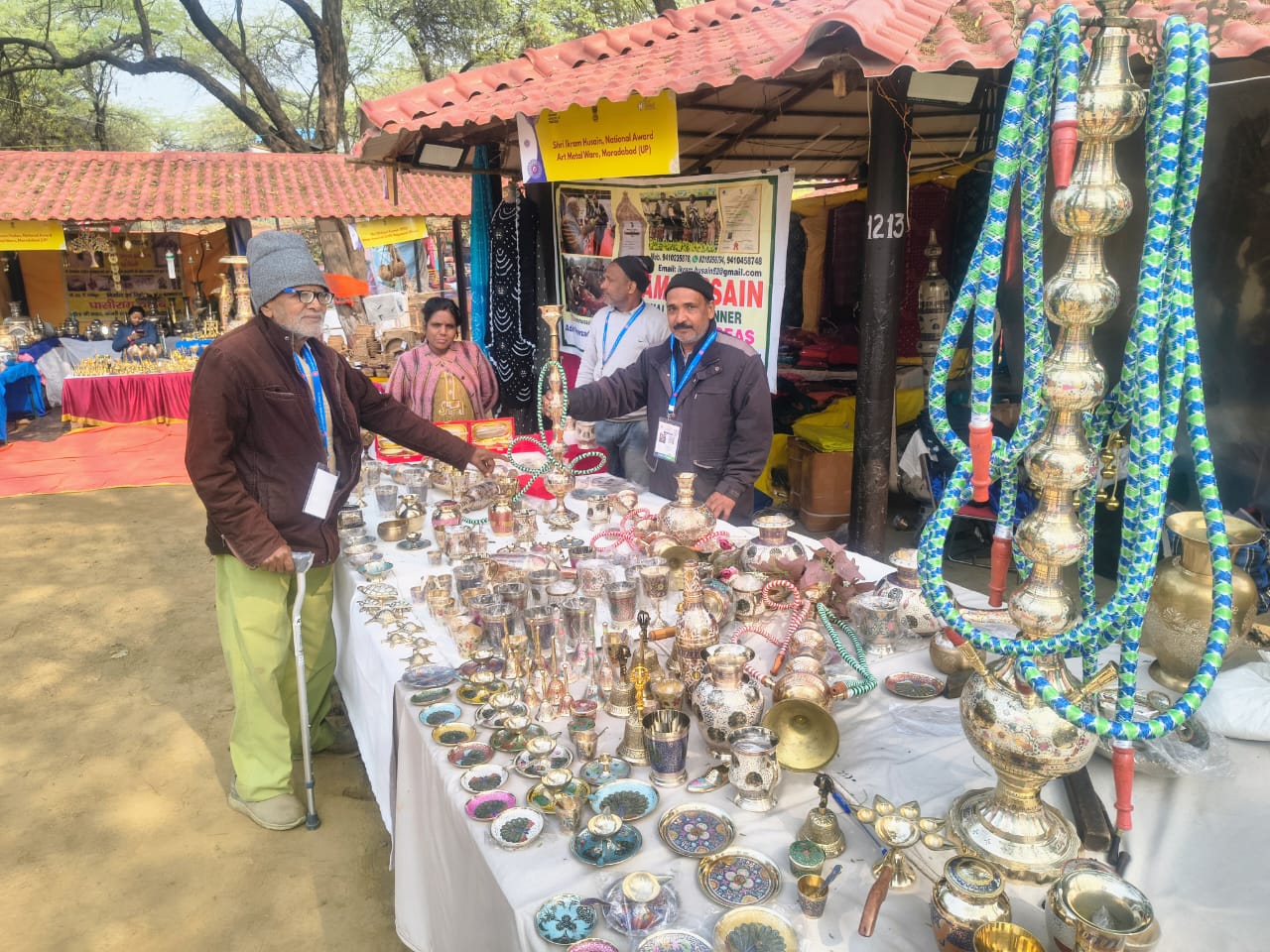
Ikram Hussain at his stall at the Surajkund Festival

Craftsman Ikram Hussain has conveyed a message of communal harmony by engraving symbols of Hindu, Muslim, Sikh, and Christian religions on his brass products.

He was honoured with a National Award in 2022 for his art and for promoting brotherhood in society.

Ikram Hussain believes that all religions are part of the same family and that we should rise above caste and creed to strengthen love and brotherhood. “We are all flowers of the same branch, only our colours are different. We should promote love and brotherhood, not hatred.”

His carving of the Ram Temple on a vase and his work on a 40-inch vase at the Golden Temple can be seen up close at the Lucknow Museum.

He has received numerous awards, including the State Award Second from Uttar Pradesh, the Bhim Rao Ambedkar Award, the Dr Ram Manohar Lohia State Award, the National Award Second from Union Minister Piyush Goyal, two honours from the Assam government, and an honour from the Prime Minister.

Overall, he has received 20 national and international awards. His work and contributions have also earned him a place in the Guinness Book of World Records.

source: http://www.awazthevoice.in / Awaz, The Voice / Home> Stories / by Dayaram Vashisth / February 05th, 2026
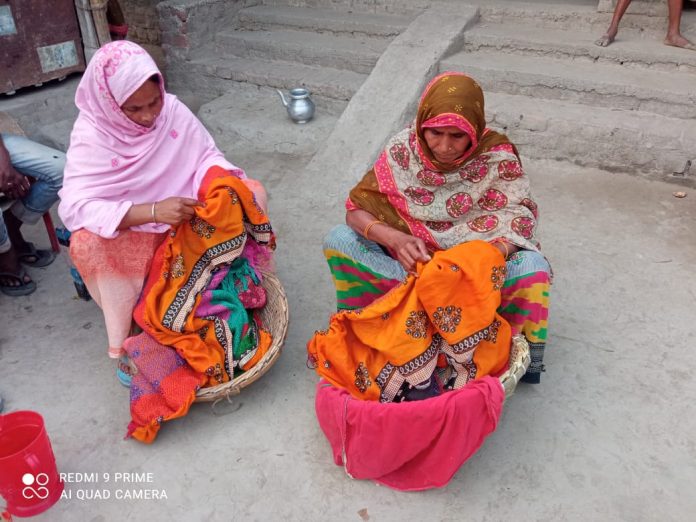
For many rural women in Bihar, Kheta embroidery work aims to boost livelihood

Seemanchal, BIHAR :

Rural women of Bihar engaged in doing Kheta embroidery work. | Picture by author arrangement

Kheta is said to be a 500-year-old quilting heirloom practised exclusively by Shershahabdi women. Today, Kheta embroidery work is getting popular among non-Shershahabdi people with many women formerly associated with making Beedis taking to Kheta work to earn a decent livelihood.

Bihar :

Razia Khatoon of Kishanganj district of Bihar is getting 45 days of training in Kheta embroidery work. The training will be completed on May 14 and is done under Project Samarth, a scheme for capacity building in the textile sector carried out by the government of India. Earlier, she would make Beedi (plant leaf cigarettes) as a livelihood. She said Kheta has given her a chance to get rid of the health hazards that making Beedi brings on.

For several workers like Razia, the Kheta embroidery work, after acquiring proper training, is expected to be an alternate livelihood instead of the hazardous Beedi rolling job.

Believed to be a 500-year-old quilting heirloom practised exclusively by Shershahabdi women, today the Kheta embroidery work is getting popular among non-Shershahabdi people. Earlier, the intricate embroidery work was done on the layers of pre-used print Sarees and chequered Lungis etc, however, today the use of new clothes for making Khetas is widely done. 

“Shershahabdi is a term used for Muslims of the Seemanchal area of Bihar who were settled in the region by emperor Shershah Suri. They are said to be ethnic Pashtuns mixed with local Surjapuris,” Ashraful Haque, a Shershahabdi, who co-ordinates with the Kheta weavers, told TwoCircles.net.

“Kheta is so intricate and organised that officials from Delhi first refused to believe it as a handcraft. When a live demo was done, they were immensely impressed. After the efforts of the local member of parliament Dr Mohammad Jawed, who raised this question of Kheta in the Parliament, we have got this opportunity to train our women not only in making more vibrant Khetas but also make them aware of its marketability,” he said. 

To make Kheta embroidery work as a source of income, the artwork is being introduced in new forms with the use of new clothes. This embroidery work is now done on bedsheets, notebook covers, bags, pillow covers, mufflers, table clothes and handkerchiefs etc. 

As of now, seventy thousand workers are believed to be associated with this artwork.

Noticeably, unlike other embroidery works, Kheta avoids figurative depictions which are considered to be forbidden in Muslim culture. The colours used for Kheta are generally bright like red, green, yellow, blue, and purple.  

Razia, 24, is a Shershabadi woman, and like every other Shershahabadi female, she knew a bit of Kheta. 

She expressed her happiness in learning new designs and colour patterns of Kheta. She used to earn around 1$ per day by Beedi making. She now hopes to double her income by part-time Kheta making. 

More than the money she is happy as she considers Kheta work as “Izzat wala kam (a respectful job.)” 

Another trainee Rulekha Khatoon’s husband is a migrant labourer. Khatoon is 25-years-old and is doing Kheta work regularly for the last six years. She learnt the technique from her mother and grandmothers. “Earlier we used to make Kheta only for family purposes like dowry and gifts etc. This training showed us that we can sell our work too. I hope to earn Rs. 3000-4000 per month with the work of 3-4 hours,” she said. 

47-year-old Tajgara Khatoon is a top trainer of Kheta. She told TwoCircles.net, “A needle and some threads are required to do wonders in Kheta embroidery but not without great painstaking concentration. Shershahabdi women learnt it naturally but this training is giving them a wider range of patterns.”

Inderjit De and Saumya Pande of Zameen Astar Foundation write in their paper on Kheta embroidery, “The term Kheta stands for straight running stitches in the local dialect and refers to both embroidery and the product. In its similarity to the word, Khet meaning farm, the term Kheta may resemble the meticulous lines of the paddy fields.” 

According to the website  involved in the promotion and marketing of Kheta, “the array of designs offered by Kheta resonates with ripples of water, materials used in building make-shift huts, flowers, dry fruits, leaves, among many more.”

Yuman Hussain is the executive director of Azad India Foundation  which is actively involved in promoting Kheta and arranging training for workers. 

Yuman told TwoCirles.net that the “training helps in benchmarking the skill level and understanding the quality control. It formalizes the knowledge transfer and helps in keeping the next generation interested in continuing the quilting practice.” 

The training also provides the trainees with an artisan card with benefits like insurance and access to participate in different exhibitions.

“On average, a Kheta artisan can make 4 to 6 quilts (96″ x 60″ size) in a year. They can earn anything between Rs 10000 to Rs 30000 per year depending on how many quilts they are making, sizes of quilts, the skill level of quilting etc,” she said. 

Yuman rued that even though most Shershabadi women know how to make Kheta, the supply of skilled artisans is less. “The work needs to be done on both sides to build awareness in the market and a supply chain base for these quality quilted Khetas,” she added. 

Sami Ahmad is a journalist based in Patna, Bihar. He tweets at  @samipkb

source: http://www.twocircles.net / TwoCircles.net / Home> Lead Story / by Sami Ahmad, TwoCircles.net / May 05th, 2022

Madhya Pradesh: Rashida Be Khatri, a woman Bagh print artist wins national merit certificate

Bagh Village ( Dhar District), MADHYA PRADESH :

Rashida Be Khatri, a craftsperson of Bagh Print, has been selected for national merit certificate for 2018 by Union Ministry of Textiles.

article-image

Bhopal :

Rashida Be Khatri, a craftsperson of Bagh Print, has been selected for national merit certificate for 2018 by Union Ministry of Textiles.

She has been selected for Bagh handblock print bedcover. In the bed cover; she has done fine work using natural dyes. Rashida has been working in the field for more than 30 years in Bagh village in Dhar district of the state.

She is the only woman to have been received two state-level awards in 2012 and 2014. She is wife of late master craftsman Abdul Kader. Rashida did not lose hope after death of her husband on May 12, 2019. She took care of her sons Arif, Hamid and Ali as well as the craft. Her sons are also working under her guidance to promote the craft.

Her designs are inspired by ancient monuments of Dhar district including Mandu Nilkanth besides Taj Mahal, Red Fort, Agra Fort etc.

source: http://www.freepressjournal.in / The Free Press Journal / Home / by Staff Reporter / October 31st, 2021