In a move that has sparked widespread outrage across Gujarat, a local BJP corporator has filed an objection to the voter registration of legendary folk artist and Padma Shri awardee, Mir Hajibhai Kasambhai, popularly known as “Haji Ramkadu.”
The controversy erupted just 48 hours after the Central Government announced the prestigious Padma Shri for the artist’s lifelong contribution to the arts. During the ongoing Voter Revision Program (SIR), BJP Corporator Sanjay Jamnadas Manvar submitted a Form 7 application, seeking the removal of the name “Hajibhai Rathod” from the electoral roll in Ward No. 8.
A Question of Identity or “Incorrect Motives”?
The artist, who has played dholak in over 3,000 charity programs for cattle welfare and 1,000 stage shows, expressed deep hurt over the move.
“They tried to remove my name from voter list, I have received award. I am very upset with this. I have lived in Ward No. 8 for over 60 years. Both the State and Central governments have honoured my work. What is lacking in my identity that an objection has been raised against my name?” Haji Ramkadu asked, calling for the government to ensure such incidents do not recur.
Defending his actions, Corporator Sanjay Manvar clarified that his objection was not a personal attack on the legend. “Hajibhai is the pride of the nation. My objection was regarding the surname ‘Rathod’ listed in the rolls, whereas his official name is Mir Hajibhai Kasambhai. To avoid confusion and potential misuse of dual identity cards, I requested a correction,” Manvar stated, adding that the artist is “like family.”
Political Firestorm
The opposition has been quick to seize the moment. A Congress spokesperson slammed the BJP-led administration and the Election Commission, labelling the incident “the height of malpractice.”
“On one hand, the government honours a man with the Padma Shri, and on the other, their own corporator tries to strike his name from the voter list,” the spokesperson said. “If a national icon like Haji Ramkadu is being played with, what must be the plight of the common citizen?”
The Legacy of Haji Ramkadu
Mir Hajibhai Kasambhai is a household name in the world of Bhajan, Santvani, Ghazal, and Qawwali. Known for his unique style of playing the Dholak, he has dedicated his life to spiritual and social causes. The announcement of his Padma Shri on the eve of Republic Day was celebrated as a victory for traditional Gujarati folk art-a celebration now clouded by this local electoral dispute.
As the Election Commission reviews the application, the citizens of Junagadh wait to see if this “clerical correction” will be settled amicably or continue to fuel political tensions.
source: http://www.ndtv.com / NDTV / Home> News> India News / by Saurabh Vaktania (headline edited) / January 28th, 2025
The World Heritage City of Ahmedabad saw many revered men who silently documented the various tales the city’s monuments, structures and literature had to tell.
One such relentless pursuit was that of publisher, author and a keen student of the medieval history of Gujarat, Shahed Kalimi, who not just ran the nearly-century old Kalim Book Depot but also spent 20 years of voluntary service to set up the library at Sarkhej Roza.
A little over a month after he passed, Kalimi’s contributions to Ahmedabad’s heritage were remembered by academicians, renowned historians and heritage enthusiasts at a remembrance meeting organised in the city on Sunday.
Kalimi was the sole force behind revamping the library at one of the ASI-protected monuments of the Heritage City of Ahmedabad, Sarkhej Roza.
AS Saiyed, President of the Sarkhej Roza Committee, narrated Kalimi’s two decades of voluntary contribution at the Sarkhej Roza and lauded him for his dedication and perseverance. “Kalimi was instrumental in reviving the library at the Sarkhej Roza and setting up a publishing department at the Roza through which many books were translated and published under the aegis of the Sarkhej Roza Committee,” Saiyed said.
During his lifetime, Kalimi had translated nearly 50 books from Urdu, Persian and Arabic, into Gujarati, in a bid to bring forth the little pieces of history about Gujarat to the people here.
In fact, two of his last books – A Bird’s Eye View of Sarkhej Roza and Yaad-e-Ayyam, were released during the remembrance meet.
“Kalimi’s sole aim was to bring forth anecdotes of Gujarat’s history to the state. Being an ardent reader of history himself, he translated many books written about Gujarat and its history, Persian and Arabic to Gujarati. He has translated close to 50 works by now about various aspects of Ahmedabad and Gujarat which the state would have otherwise lost,” said Professor MH Bombaywala, curator and founder, Peer Mohammad Shah Library, one of the oldest in Ahmedabad who was present at the meeting.
Being an ardent enthusiast of medieval history of Gujarat, Kalimi turned his place of work – the Kalim Book Depot – around by diligently sourcing, procuring, even translating if needed to make history books available to people here.
Students of History and even architecture and design often frequented his book store, which was once upon a time, a fulcrum for intellectuals to gather and discuss new, radical ideas through expressions of poetry and Shayari.
The Kalim Book Depot will be a century old in 2026 and till date is known for rare books. “We have retailed the Urdu versions of Ramayana, Mahabharata and the Bhagavad Gita to people. Father used to procure a series of Urdu books from warehouses of libraries, book exhibitions, flea markets including the Gujari Bazar and wherever he travelled and patiently sorted them, to find the right kind of books for history students and later translate them,” said Mushir Kalimi, Shahed’s son.
“Father’s interest was not in the business but instead in letting the younger generation read and delve into the history about Gujarat to the people of Gujarat by translating works of authors from Persian, Arabic and Urdu languages. Therefore, if he realised someone’s interest in books, he would gift them a second book for free besides the ones they’ve bought,” said Mushir.
Kalimi was working on one of his last books just before he passed — Makbaras and Masjids of Ahmedabad. Mushir along with members of the Sarkhej Roza Committee are working towards publishing the book which will soon be out.
source: http://www.timesofindia.indiatimes.com / The Times of India / Home> News> City News> Ahmedabad News / by Niyati Parikh / TNN / March 28th, 2022
During the months of lockdown last year, NSS units in colleges across Gujarat mobilized resources for food, masks, sanitation.
More than 5,000 student volunteers associated with NSS units in universities carried out COVID relief projects during the initial phase of lockdown
New Delhi :
The risk of contracting a life-threatening virus and the lockdown did not discourage Shaikh Afzal, a final year student of LD Engineering College, Ahmedabad from stepping out to collect food grain for the people in need.
A volunteer with the government-led National Service Scheme, in his case the NSS unit of Gujarat Technological University, Afzal felt the need to be on the ground despite the inhibitions of his family members. While the country was under a nation-wide lockdown in March last year, volunteers like Afzal risked their lives to help migrant workers stranded for days without supplies.
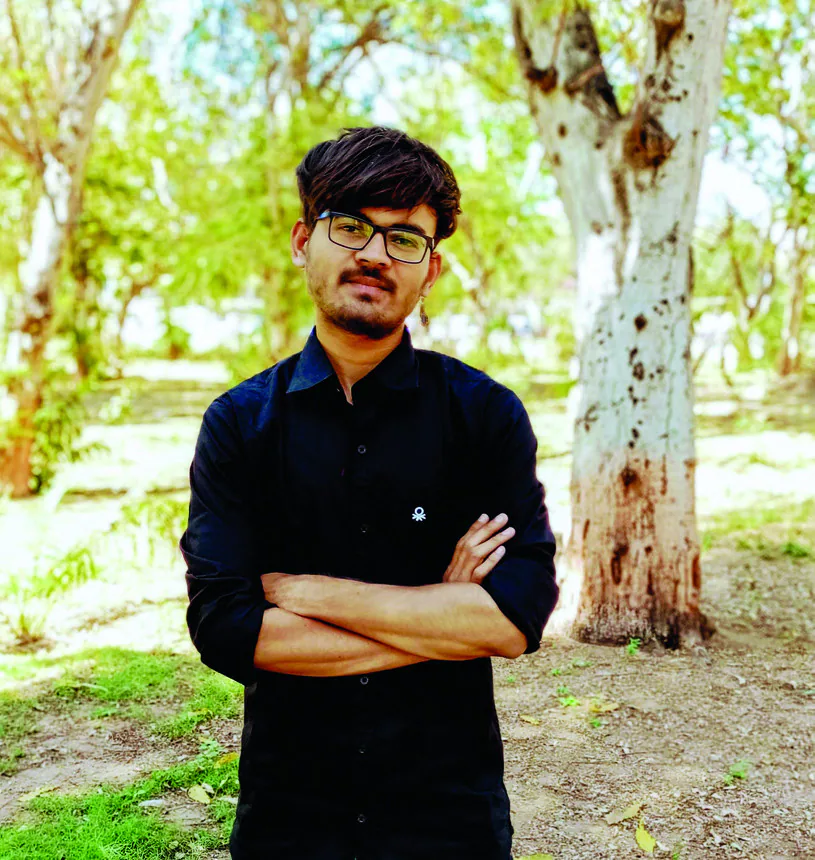
“I have faced a shortage of food for days at home during the lockdown and I understood their situation. They have extremely limited means. I decided to help them despite the risks,” said Afzal who resides with his 70-year-old grandmother and five other family members. He spent two months distributing food kits in various parts of Ahmedabad.
Soon after the central government announced the countrywide shutdown to control the spread of the coronavirus, a wide range of problems emerged, especially for the working class. The lockdown was extended for nearly four more months. Having lost their jobs, thousands of migrant workers attempted to leave major cities for home. In the absence of food reserves, many were pushed into starvation and others struggled to make ends meet.
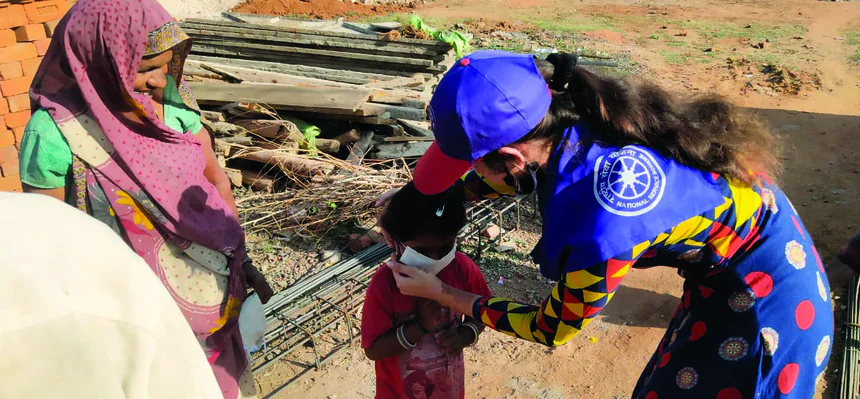
Like Afzal, more than 5,000 student volunteers associated with NSS units in universities across Gujarat carried out COVID relief projects during the initial phase of lockdown. From providing masks, hand sanitizers and dry ration kits, to managing large crowds along with the police, students participated in several measures.
Prompt relief in Ahmedabad
Ahmedabad, one of the major cities employing daily wage workers and construction workers from bordering states, experienced food shortages amid the extended lockdown. NSS units in various colleges kicked into action to provide ground relief.
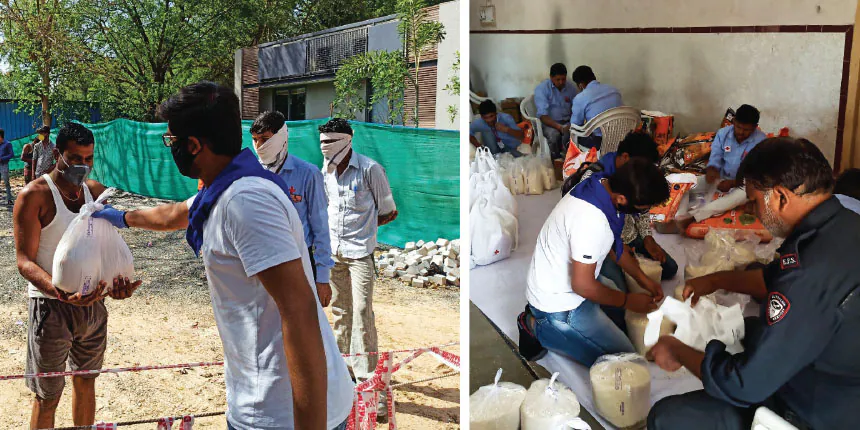
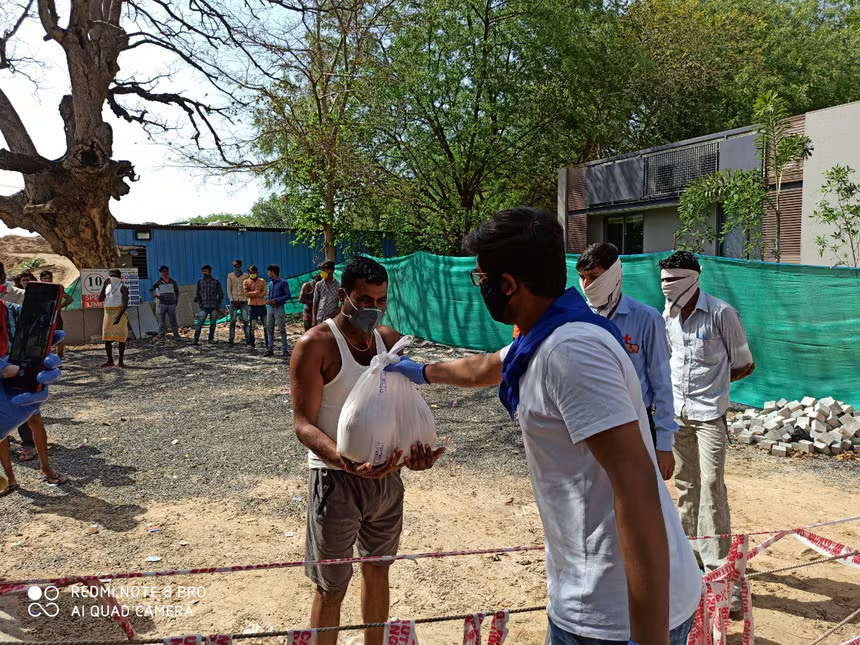
Along with Afzal, a team of 15 NSS and National Cadet Corps (NCC) volunteers in coordination with Ahmedabad’s district magistrate’s office conducted an extensive COVID relief drive. The team under the leadership of Chaitanya Sanghvi, the college’s NSS program officer, raised Rs. 3.69 lakh in donations from teachers and students’ parents to arrange for food kits. The volunteers distributed more than 12,500 kits in two months.
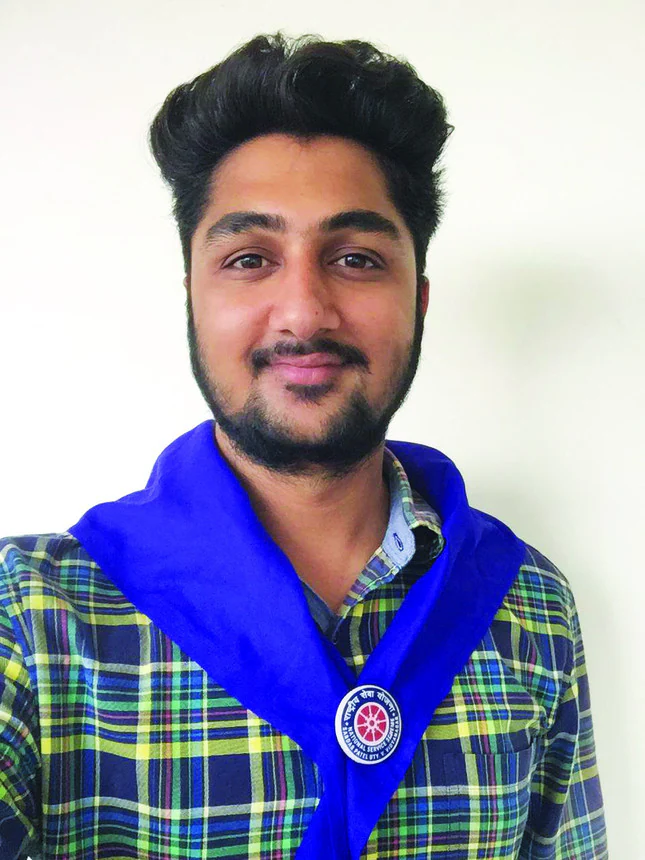
“A lot of parents were concerned about their [students’] health but my personal assurance that COVID safety measures will be taken while helping others made them feel confident,” said Sanghvi. “The students were given training by the GIDM [Gujarat Institute of Disaster Management] on how to respond to various challenges on the field,” he added.
Student of LD Engineering College, Ahmedabad distributing ration kits
Each day, for nearly two months, the team distributed 500 kits that sustained families of four for at least 10 days. On several occasions, the team members recalled being overwhelmed by the gravity of the situation on the ground. “Every day we would find a new challenge before us. We had to be cautious about our own safety while maintaining safe distance among those who came to collect the kits. The chaos escalated at times and we had to call the local police to maintain order,” said Deval Naika, a final-year mechanical engineering student.
The relief work began with 16 volunteers but the group expanded into a large team of 100 students after the initial phase of the project ended in success. The students were asked to work on the field in rotation. The effort, according to Sanghvi, helped families that were severely starved amid the lockdown. “I remember providing a food kit to a migrant worker’s family of 12 members. They told me that they were going to eat solid food after 12 days of starvation. There were small kids delighted at the sight of food. I will never forget that day,” recalled Sanghvi.
The team, in a tie-up with the Indian Red Cross Society, also conducted a blood donation drive for thalassemia major patients who were facing a shortage of blood supply during the lockdown. To allay the fear of blood donors, the team remotely reached out to the willing donors on mobile donation vans in various parts of Ahmedabad.
Porda village, Anand
Another NSS volunteer, Kishan Nileshkumar Dave, studying in Natubhai V. Patel College of Pure and Applied Sciences, Vallabh Vidyanagar, managed to provide relief to 100 families in his village, Porda, in Anand district. The volunteers carried out a multifaceted relief drive which included the distribution of food, masks, sanitizing common gathering areas and distribution of Ayurvedic immunity boosters.
Dave and his group of 10 volunteers started a fundraiser to provide relief to the families struggling without any financial help in the period of lockdown. With the help of the village sarpanch and some of its well-heeled families, Dave managed to collect enough funds to feed the hungry for more than a month.
“The money was utilized to cook food and deliver to each villager in need. We also maintained meticulous records of people who require urgent help and avoided missing out on anyone who needed attention,” said Dave. This group also served food to the policemen and health-workers on COVID-19 duty.
The team also engaged local tailors to sew 2,100 masks to be distributed in the community. In this way, they supplied masks to 920 families of the village and surrounding areas.
The volunteers also prepared herbal tonic under the supervision of the Ayurvedic Aushadhi Kendra of a nearby village, Aradi, and distributed it in Porda and the surrounding areas. Around 1,500 villagers received the immunity booster.
In addition, Dave also conducted a sanitization drive for 20 days. “Providing food and masks was not enough, we also used a sprayer machine and fogging machine provided by the Gram Panchayat and sanitized all the streets, milk collection centres, banks, and other areas of the village,” said Dave. Close to 900 houses of the village were sanitized. The volunteers also raised awareness among the villagers about the significance of personal hygiene, wearing the mask, washing hands frequently, and maintaining social distance.
As the lockdown caused huge losses for the farmers, this group brought vegetables from the village farmers and sold them at fair price to the villagers and residents of slum areas of the village like Indira Nagari. While some group members sold the vegetables, others helped maintain social distancing among the buyers.
Food delivery on national highway
With education institutions shut for months, many students had left the college campuses. They planned to contribute from home. Several NSS volunteers of Vishwakarma Engineering College, Ahmedabad, stepped up to help the migrant workers heading home along the National Highway eight. “Our NSS volunteers living close to the NH provided home-cooked food whenever possible to several families traveling on foot. Since the lockdown was sudden, it was difficult to provide funds. Therefore, each student utilised their own resources,” said Shiza Sheikh, a second-year student of electronics and communication.
At the beginning of COVID-19 lockdown, to meet the sudden rise in demand of masks, the students also distributed 1,500 hand-stitched masks from unused cloth they found at home and distributed it in various parts of Gujarat. “Even though students were scattered throughout the state, the NSS volunteers of our college were determined to help people who were in need. The students learned how to make masks through YouTube videos or by learning stitching from their parents,” Sheikh added.
source: http://www.news.careers360.com / News Careers360 / Home / by R Radhika / April 24th, 2021
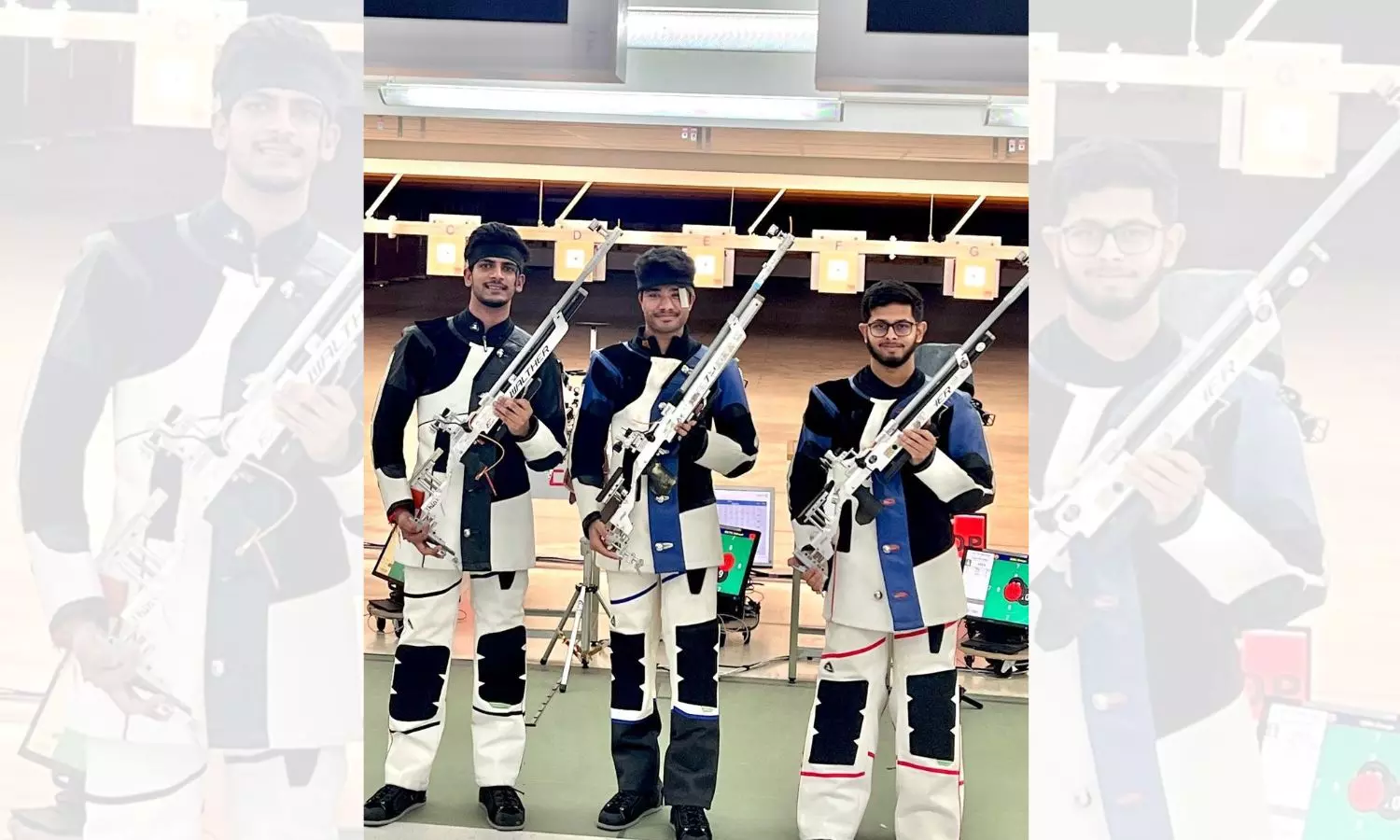
World Deaf Shooting Championship: Dhanush breaks world records as India sweeps men’s air rifle event (Photo: X) / (L to R) Shourya Saini, Dhanush Srikanth (Centre) and Mohammed Murtaza Vania
New Delhi :
India dominated the men’s 10m air rifle event on day two of the second World Deaf Shooting Championship in Hanover, Germany, with Dhanush Srikanth, Shourya Saini, and Mohammed Murtaza Vania making a clean sweep of the medals.
Dhanush set two world records in a single day, first by scoring 632.7 in the qualification round, followed by a stunning 251.7 in the final.
His performance left Shourya, who secured the silver with a score of 249.9, trailing by a significant margin.
Mohammed Murtaza Vania claimed the bronze with a score of 226.2.
In addition to their success in the men’s event, India also shone bright in the women’s category with Mahit Sandhu and Natasha Joshi winning silver and bronze respectively, adding to the country’s medals tally.
The Indian contingent had already secured four medals on the first day of the competition, including one gold, two silver and a bronze.
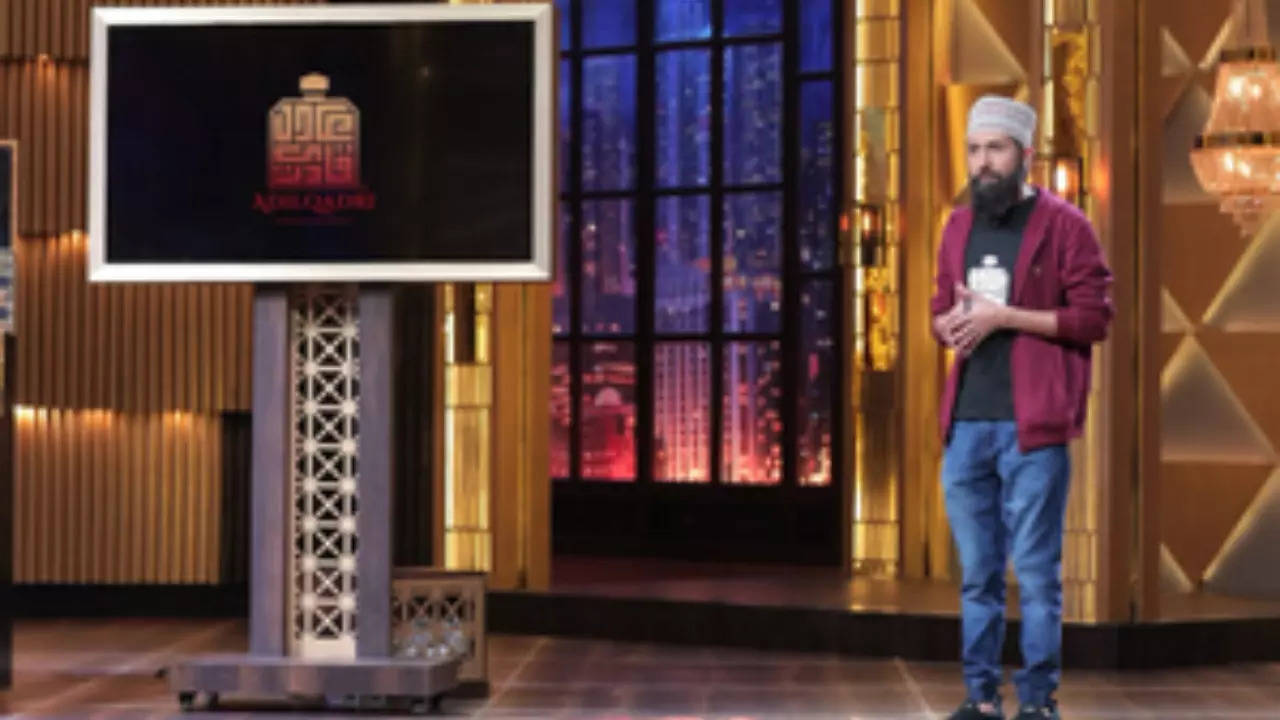
The season three of the business reality show ‘Shark Tank India’ will see a self-made entrepreneur Adil Qadri, who has introduced the Sharks to a desi way of using attars.
Despite failing school in fourth grade due to asthma, Adil’s business has processed a whopping 10 lakh orders, averaging 3,000 per day.
From a software repairer to an SEO expert, he’s now the face of a brand that’s putting Bilimora on the map. Indeed, Adil proceeded to establish a business, defying the odds posed by his asthma.
His brand ‘ADILQADRI’ introduces a new way of using attars, emphasising long-lasting effects and premium packaging. However, Rs 6 crore debt sparks conflict among the Sharks.
Talking about his experience on ‘Shark Tank India’, Adil Qadri (Founder and CEO) said: “Appearing on Shark Tank India with our brand ADILQADRI was a whirlwind, a roller coaster of emotions and opportunities. The intense pitch sharpened my ability to face sharks’ questions and honed my strategic thinking.”
“Their feedback provided invaluable insights for refining my business model. The experience underscored the importance of composure in high-stakes situations, molding me into a resilient and articulate entrepreneur,” he added.
‘Shark Tank India 3’ will soon air on Sony LIV.
–IANS / sp/prw
source: http://www.bhaskarlive.in / Bhaskar Live / Home> Entertainment / by IANS / January 18th, 2024
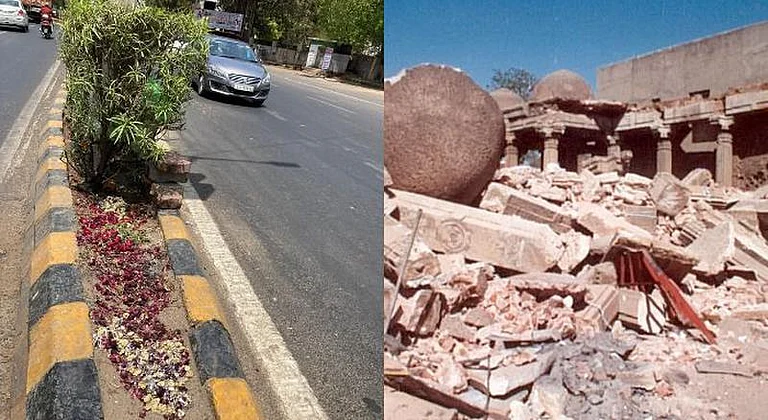
Amidst the busy roads of Gujarat that have thousands of cars passing by every day, there lies a neglected divider that holds reverence for many. A petal-strewn corner on a broken divider signifies the tomb of an Amdavadi poet credited for the advent of Urdu poetry that gave rise to a league of poets like Zauq, Mir, and Mirza Ghalib.
The poet in question is none other than the father of Urdu poetry, Wali Muhammad Wali, whose contribution towards uplifting Urdu poetry to being at par with its Persian counterpart is considered indispensable.
Challenging the notion that elite poetry can only be Persian, Wali opened up a world of poetic possibilities for Urdu poets and his influence can be seen in a piece penned by the Poet Meer Taqi Meer as a tribute to the Urdu Chaucer.
Khugar nahin kuch yun hi hum Rikhta-goi kay/ Mashooq jo apna tha, bashinda-e-Dakhan tha”
(It isn’t casually that I began dabbling in Urdu/I picked it from my lover, a native of the Deccan).
The poetic legend who died 300 years ago was buried in his family graveyard in Ahmedabad after his demise. Post Independence, Wali’s grave was separated from the graveyard and found itself situated in the middle of the road.
While the death and origins of Wani might be disputed, the razing of his grave has been linked to the communal past of Gujarat. Destroyed during the Gujarat violence of 2002, Wali’s grave was part of the riot that saw thousands murdered and the demolition of many significant Muslim shrines and Dargahs. Eliminating any and all signs of the Dargah, roads were built overnight and the atrocities of communal violence were swept under the layers of tar and repairs that ensued.
A Twitter user recently went searching for the shrine and impressively remarked on the presence of the Urdu poet’s legacy that remains etched in the mind of locals. Street vendors, shoemakers, and locals seem happy to guide and give precise directions to the grave for those looking to visit the shrine. Once an ornate shrine, the grave now portrays a sad picture of desolation and jarring neglect that can be blamed on the political powerplay as well as the ‘divide and rule’ ideologies that plague the nation.
One cannot miss the imprint of Wali’s work on Urdu poetry. It remains immortal in the hearts of people and keeps the light of consciousness alive.
source: http://www.homegrown.co.in / Homegrown / Home> #HGExplore / by Riya Sharma / August 08th, 2022
Also present at the event were Gujarat Congress MLAs Amit Chavda and Imran Khedawala, former Congress MLA Gyasuddin Shaikh, AMC leader of Opposition Shehzadkhan Pathan, and late Congress Rajya Sabha MP Ahmed Patel’s daughter Mumtaz Patel.
Arnazbanu Sipahi from Mehsana at the IMCR event on Saturday. (Express File Photo)
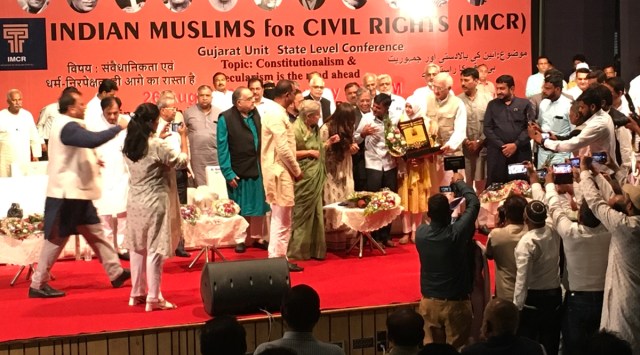
The Indian Muslims for Civil Rights’ (IMCR) Gujarat unit on Saturday felicitated 15-year-old Arnazbanu Sipahi from Mehsana, who was not called for a felicitation ceremony by her school despite holding the first position in the Class X board exams at her school, on Independence Day.
A former student of K T Patel High School, who had topped her school in Class X state board exams in March, Sipahi has now shifted to a nearby grant-in-aid school for her Class XI studies.
K T Patel High School principal has maintained that the August 15 award ceremony was organised by the school staffers and the school would felicitate Sipahi instead on January 26, next year.
Speaking to The Indian Express , Mehsana District Education Officer A K Modhpatel had earlier said, “I had checked with the school and learnt that the August 15 award ceremony for first three toppers from Class X and XII was organised by the teachers. They had collected funds to motivate school students. The girl and those who were not studying in the school (when the felicitation ceremony was held on August 15), will be awarded on January 26.”
Maintaining that she was “wronged” by the school, the IMCR – at a state-level conference on constitutionalism and secularism held in Ahmedabad – called Sipahi on stage to felicitate her in the presence of a host of Muslim leaders. Azam Baig, national general secretary (organisational) of IMCR, announced that he would personally fund Sipahi’s education, including higher studies.
Handing her a plaque and a flower bouquet on stage were former IMCR trustee and Congress leader Salman Khurshid, former member of Planning Commi-ssion, Syeda Saiyidain Hameed, as well as Samajwadi Party MLA Abu Azmi, among others.
Addressing the conference on the topic of ‘constitutionalism and secularism and the way forward’, Hameed cited Arnazbanu’s “experience” and the recent viral purported video of a Muslim boy being hit by his classmates upon being goaded by their teacher at a Muzaffarnagar school, as “examples where children are being discriminated against (on religious lines).” “We have to build a common front… work in an organised way (to counter the polarisation)… The Gujarat riots’ blueprint, which is now being attempted to be implemented elsewhere in India, we must not let it succeed.”
K Rehman Khan, former deputy chairman of Rajya Sabha , urged Muslims to be “givers” and not “seekers”, emphasising that they must empower themselves and “saving the Constitution should be the first priority”. “Only if the Constitution and secularism is saved, can we live a life of dignity,” Khan added.
Former Union minister Salman Khurshid said that “it is not acceptable that rule of law is replaced by rule of bulldozer”. He added that the “public must understand that what is happening today at someone else’s household can also happen at your household”. “We want that the majority speaks for the minority and the minority speaks for the majority,” Khurshid said.
Also present at the event were Gujarat Congress MLAs Amit Chavda and Imran Khedawala, former Congress MLA Gyasuddin Shaikh, AMC leader of Opposition Shehzadkhan Pathan, and late Congress Rajya Sabha MP Ahmed Patel’s daughter Mumtaz Patel.
source: http://www.indianexpress.com / The Indian Express / Home> News> Cities> Ahmedabad / by Express News Service, Ahmedabad (headline edited) / August 27th, 2023
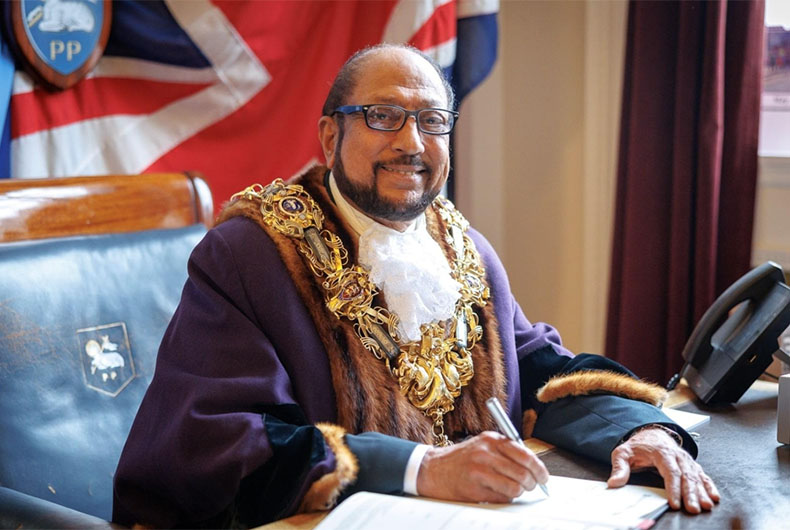
The city of Preston in the UK has elected Gujarat-born Yakub Patel as its first Indian-origin Muslim Mayor for 2023-24 following the completion of Councillor Neil Darby’s term in office.
In his new role, Patel will chair council meetings, and act as ceremonial head representing the city at engagements throughout their year in office.
“I am honoured and delighted to become the Mayor of Preston, a city I am proud to call my home. I hope to make positive differences to the communities that I serve and also provide additional support through my Mayoral charities for the coming year,” Patel said.
Prior to his new role, Patel has been serving as the city’s Deputy Mayor since May 2022.
The long serving councillor has been undertaking civic duties and hosted the visit of the Royal Family in summer alongside the then Mayor.
“…It gives me great pleasure to be handing over the chains of office to the Mayor-elect, Councillor Yakub Patel. The last year has been the most outstanding experience of my life and it has been a huge honour to have been the Mayor of our fabulous city,” Preston’s outgoing Mayor Darby wrote in a tweet.
Birth and Migration to UK
Born in Bharuch, Gujarat, Patel graduated from M S University of Baroda with a degree in BA and MA in English Literature. He came to the UK in June 1976 and started his career in 1979 with Preston Corporation.
Patel also held roles as a Revenue Inspector, Traffic Inspector, Assistant Chief, Chief Inspector and Operations Manager before he retired on July 4, 2009.
Political Career
He has been involved in politics since the age of 10 when he started canvassing and delivering leaflets for his late father, who was a strong supporter and a member of the Congress party.
He was first elected as a Labour Party councillor for Avenham Ward in 1995 and was the first Muslim councillor in the history of Preston City Council.
In addition, Patel was also elected as a Lancashire County Councillor for Preston West Division during 2001-2009.
The new Mayor is also an active member of the local community and serves as a co-opted member for Preston Jamea Mosque and Preston Muslim Burial Society.
He is a school governor for Frenchwood Community Primary School. Rosemere Cancer, Preston Domestic Violence Services and Emmaus will be Patel’s Mayoral Charities for 2023-24.
source: http://www.ummid.com / Ummid.com / Home> United Kingdom / by IANS / May 23rd, 2023
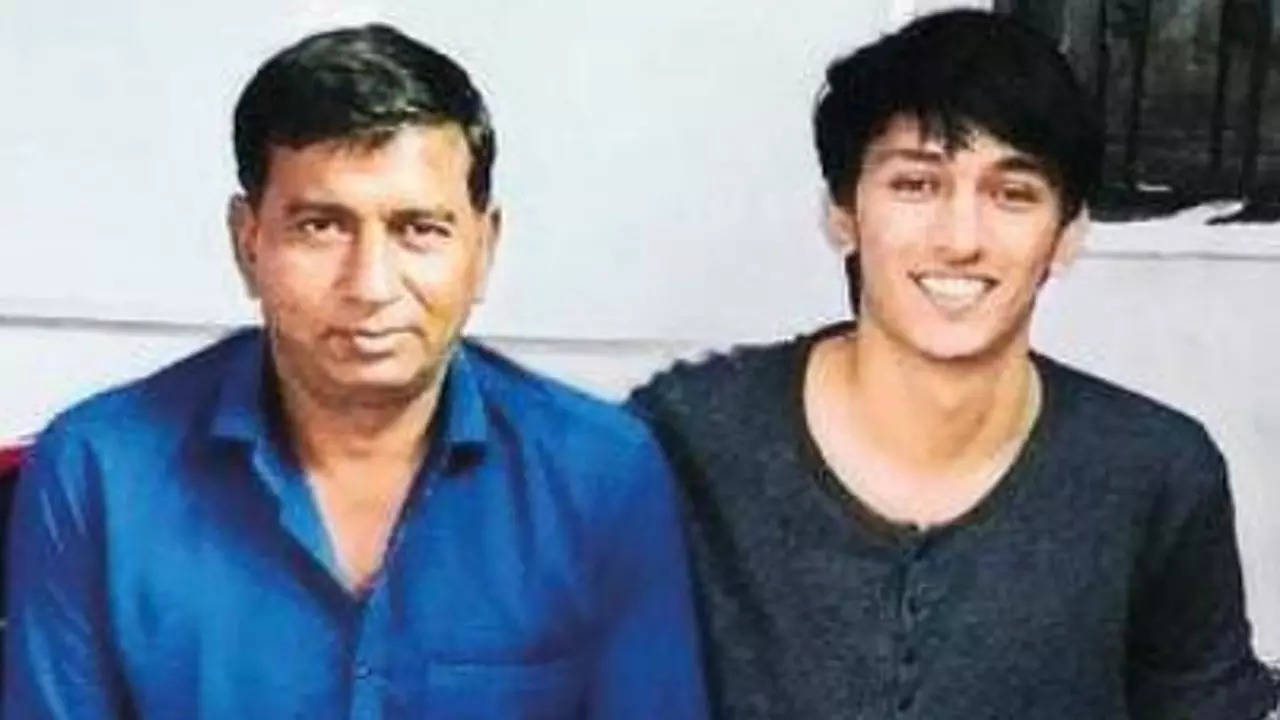
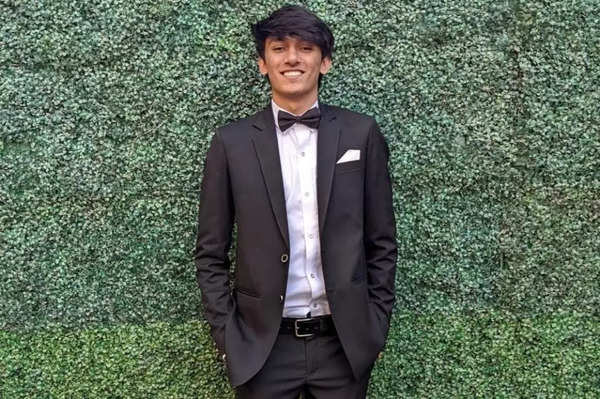
Razin Mansuri, 22, son of an air conditioner repairman and a resident of Ahmedabad, had scored 96.2 percentile in the Common Admission Test ((CAT) 2021 and was eligible for admission in IIM-Udaipur.
But Mansuri was not satisfied with his results so he decided to give it another shot and his efforts paid off as Mansuri scored 99.78 percentile making his chances for an admission in IIM-Ahmedabad or IIM-Bangalore quite high.
Mansuri completed his engineering in IT from Ahmedabad University in May this year. His father earns about 25,000 per month. Razin, his father Irfan Mansuri, mother Sabiha, and his younger brother Rehan live in a one-bedroom house in Juhapura.
Razin Mansuri
As my family’s economic condition is weak, right from high school I have mostly studied on scholarships. After completing high school from CN Vidyalaya, I took admission in Ahmedabad University and completed engineering in IT. I again got a scholarship in AU as my performance was good,” Mansuri told TOI. He said that after he completed engineering he was offered jobs with a Rs 6 lakh annual salary. “I did not take the offer as my dream was to get admission in IIM, preferably in IIM-A or IIM-B.
I started preparing for CAT and took the test in 2021. However, as I did not take any coaching I got 96.20 percentile. I was not satisfied with the result and decided to take the exam again in 2022,” Mansuri said.
He added that he enrolled for a coaching class for CAT 2022 as it charged him only half the fees. “It is an exceptional achievement given his family background and financial struggles. I am sure he will be a great student for any top IIM,” said Satish Kumar, head of the coaching class where Mansuri trained.
Once I pass out from IIM, I want to give back to society what I received from it. I want to help as many students as I can in their education,” Mansuri said.
source: http://www.timesofindia.indiatimes.com / The Times of India / Home> News> City News> Ahmedabad News / by Bharat Yagnik / TNN / December 22nd, 2022
‘People feel it is lucky to have tea here. There is something charming, something random about this place which makes it cool,’ said Ritu, a student.
People eat at a vegetarian restaurant ‘Lucky Tea Stall’ built on a graveyard, in Ahmedabad. (Photo | PTI)
Ahmedabad:
To the outsider, the idea of an eatery built on a Muslim graveyard, run by a Muslim, serving pure vegetarian food and frequented by all communities seems an anomaly.
Not so for its customers though, many who believe that Lucky is actually lucky for them.
Like Sagar Bhatt, a devout Hindu and a resident of Dariapur, who makes it a point to stop by for a cuppa every morning after visiting the temple.
“It feels auspicious to have tea at this place. There is something special about this place,” Bhatt, sporting a red ’tilak’ on his forehead, told PTI while pointing to a grave.
On one wall is a painting by M F Husain, showing an oasis, camels and a ‘kalma’ – ‘La Ilaha Illallah Muhammadur Rasul Allah’ (There is only one God and he is Allah, and Muhammad is his prophet).
“It is the only tea shop boasting a Husain painting,” said a proud Abdul Rajak Mansury, who operates the tea stall.
Every night, the painting by one of India’s most valued artists is taken off the wall and kept away safely.
The six-decade shop in what is essentially a Muslim-dominated area is a common person’s eating joint, he said.
As the campaign hots up, the tea stall in Old Ahmedabad’s Jamalpur-Khadia is also an oasis of calm, far removed from the din and aggression of the Gujarat assembly election being held in two phases on December 1 and 5.
While the Congress has fielded Imran Khedawala, its sitting MLA, the Aam Aadmi Party has given a ticket to Haroon Bhai Nagori and the BJP is fielding a Hindu candidate, Bhushan Bhatt.
The AIMIM is also contesting the seat with Sabir Kabliwala in the fray.
Talk of ‘dhandha’ (business) supersedes ‘dharam’ (religion) at Lucky – so popular that the traffic light point is also called Lucky Chowk.
It is at the centre of several colleges and offices, and a big hit with students and office-goers.
According to Bhatt, a small-time construction contractor, economic issues and issues impacting his business matter more than religious sentiments.
“Sir, I am following my religion but from the government, I expect to further improve the economy so that my business flourishes. For us Gujaratis Dhandha sab se pehle (business comes first),” he said.
On the menu is the perennial favourite ‘bun maska’ and a range of Chinese and Indian dishes. No eggs are used.
College students Ritu and Tanya said the place is cool. “People feel it is lucky to have tea here. There is something charming, something random about this place which makes it cool,” said Ritu, a third year commerce student.
The first-time voter said better jobs and better business environment are bigger issues for her as a student and daughter of a businessman.
Tanya, studying chartered accountancy, agreed. “The business environment in maru Gujarat (my Gujarat) is its USP, it should not be get disturbed at any cost.”
Lucky started on a handcart under a neem tree, and expanded and developed around the graveyard as business grew, said Mansury.
The 26 graves have grills around them.
The staff clean them everyday and place fresh flowers on them.
Some people put ‘chadars’ on the graves seeking fulfilment of their wishes.
Representing the best of a syncretic India, may many more Luckys flourish and thrive, hope its customers.
source: http://www.newindianexpress.com / The New Indian Express / Home> Nation / by PTI / November 23rd, 2022