Aligarh, UTTAR PRADESH :
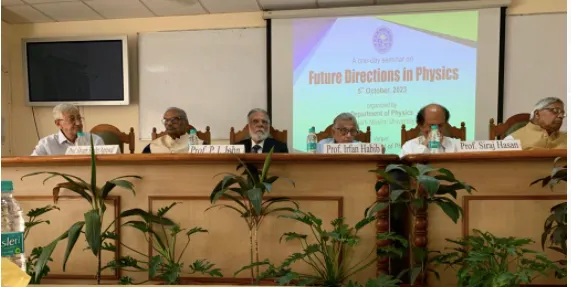
We celebrated the 100th birth anniversary of Prof Rais Ahmed, the former head of the Physics Department, Aligarh Muslim University and the person to whom I owe a great deal for starting me off on my career path in plasma physics research.
A one-day memorial cum seminar on Future directions in Physics was held at the University on 5th October 2023 Venue. Prof. Irfan Habib, Prof. of History, AMU, Prof. Siraj Hasan (Former Director, Indian Institute of Astrophysics), Prof. Naresh Dadhich (Former Director, IUCAA), Prof. S. K. Singh (Former VC, HNBU), Prof. Wasi Haider and Prof. Shyam Sunder Agrawal (Director General, KIIT Group of Institutions) spoke on the occasion. I spoke about my association with him and the future of Plasma Physics and Thermonuclear Fusion Research in India.
It was a forenoon in July 1964 when I first met Prof Rais Ahmed, who had become the Head of the Department that very year. I had travelled from Kerala seeking an opportunity to do research. He asked me a few questions on Physics, and I suppose I answered them reasonably well. But then he wanted to know why I wanted to pursue research.
I had rather romantic ideas like research leading to new knowledge and our responsibility to seek pure knowledge etc. It was clear that he did not take me seriously as he went on to say that science is what drives social transformation by changing our perception of our relationship with nature. Another observation was about science leading to technology which improves the quality of life.
Our conversation covered many things. I suppose he was gauging my mind and trying to find what kind of person I was. If it was a test, I passed it as he said that I could join for research. He made sure that I had no preference for Nuclear Physics or Spectroscopy, the areas of ongoing work in the department. He talked to me about Plasma Physics as an emerging field and about the work which was going on in Harwell and Oxford on Thermonuclear Fusion Research.
I did not know about Plasma Physics even at an elementary level. However, I was willing to learn and was asked to talk to Prof. D C Sarkar about the thesis work in more detail. I went through an intense learning programme, primarily reading Physical Review and Review of Scientific Instruments. There was no previous laboratory I could walk into and start work and I had to start from scratch. Looking back, I was taking an enormous risk as I had to build an entire laboratory for me to start the thesis work.
I rigged up a Radiofrequency generator with Japanese power tubes scavenged from the Electrical Engineering Department. Prof Venkateswarlu’s lab was full of microwave equipment, which Rais Sab allowed me to borrow. With all this, I set up an experiment and after a struggle of five years, put together a thesis which got me a degree. Almost immediately he gave me a regular job as a lecturer in the department as some vacancies were due to be filled.
As the Head of the Department, he did much to expand research and teaching in Physics in new areas. As Director of Academic Programmes, he organized the Semester System designed to update courses and provide more rigorous instruction to students. He made an alliance with Uppsala University in Sweden for faculty members to do research there. He arranged for PhD scholars to start teaching postgraduate students.
I recalled my interaction with university life during my eight years there. At first, Aligarh gave me a culture shock. My inability to comprehend Urdu was the first barrier to appreciating the culture. The exalted forms of addressing, and the too formal and exaggerated ‘Tehzeeb’, the gestural ‘adaabs’ strewn around were all alien. The food, though delicious, was completely unfamiliar. But the campus was a dream with beautiful buildings, stately halls, verdant lawns, and lush gardens. The library gave me all the books I wanted to read. The accommodation I got at the Sulaiman Hall was quite adequate. The students from central Travancore preferred this. There was a South Indian mess catering our preferred food. Tea at the Paradise restaurant with friends was fun.
Rais Ahmed had interests ranging from his specialization in Electronics to varied areas of science and education. He published over 100 papers on Electronic Circuit Analysis. Analogue Computers. Speech Recognition and Production, and Creative Teaching of Physics. The work he started in the 1970s on speech perception would eventually become an important branch of artificial intelligence and machine recognition of speech.
I recall a symposium he had organized on higher education, where we were asked to be volunteers to help the organization. The attendees were all academics from Universities and IITs and I was fortunate to listen to many of them. The remarkable skill with which Rais Sab generated consensus on many issues which were debated was an eye-opener for me.
In a department seminar, when his student Moonis Ali spoke on the design of an analogue computer system, some of us, ridiculed the idea calling it a paper machine. Rais Sab defended the presentation vigorously, saying that new ideas were what drove science forward and that they had as much importance in science as building new instruments.
His remarkable organizational skills were brought to bear at the prestigious Annual Meeting on High Energy and Nuclear Physics, sponsored by the Department of Atomic Energy. Prof Roy Daniel from TIFR was the coordinator of the meeting, and his being from Kerala, we used to chat about the preparations for the meeting. The participants included bigwigs like Vikram Sarabhai, Prof M G K Menon and Dr Raja Ramanna. The meeting was hailed as very successful thanks to the planning and preparations led by Rais Saheb.
All of us in the department rejoiced when he was made a member of the Science Advisory Committee to the PM, then Mrs Gandhi. After each meeting, he would call all of us to the lawn near the workshop to convey to us the flavour of the meeting. We had the vicarious pleasure of being informed about the thinking in the places of power.
He would call me occasionally to his office to find out how I was doing. In one of these meetings, he advised me to read journals other than those dedicated to pure physics. He cited the Bulletin of Atomic Scientists as an example.
Rais Sab had an abiding faith in Scientific Socialism and felt strongly about the increasing global dominance of the multinationals and about what he saw as a retreat by India from its independent position both in the Economic and Intellectual fields. He had a strong belief that human capital, in the form of expanding knowledge and scientific spirit, held the key to India’s salvation. For this ideal, he worked tirelessly both as an individual and in administrative capacities.
In the 1950’s he was an energetic organizer of the Association of Scientific Workers of India. Once when I asked him about the ethics of unionizing scientific workers, he defended it by saying that collective bargaining need not be about wages and working conditions only. Professional bodies of scientists had a role in influencing public policy.
After I left Aligarh in 1972 to join the Physical Research Laboratory in Ahmedabad, I had occasional interactions with him. He made me a member of the UGC Committee to visit Marathwada University to make an academic assessment. He funded my proposal to have an orientation programme for university teachers in the emerging field of Plasma Physics.
I had an exciting and eventful life contributing to Plasma Physics in India, right from its inception at the Physical Research Laboratory, during the Plasma Physics Programme and its eventual transformation to the Institute for Plasma Research and when India became a proud partner in the ITER project of building the world’s first Thermonuclear fusion reactor in France. I owe a debt of gratitude to Rais Saheb for initiating me into the research path, which made all this possible.
source: http://www.john-pucadyil.medium.com / Medium.com / Home / by John Pucadyil / October 06th, 2023