Tag Archives: Sahir Ludhianvi

The actual Taj story: how a monument’s history has been warped

Agra, UTTAR PRADESH :

Tushar Goel’s film, ‘The Taj Story’, has reignited controversy over the Taj Mahal’s origins, claiming it is a Hindu temple rather than a mausoleum built by Mughal emperor Shah Jahan. The film’s debut highlights debates about the interplay of history and ideology in contemporary India.
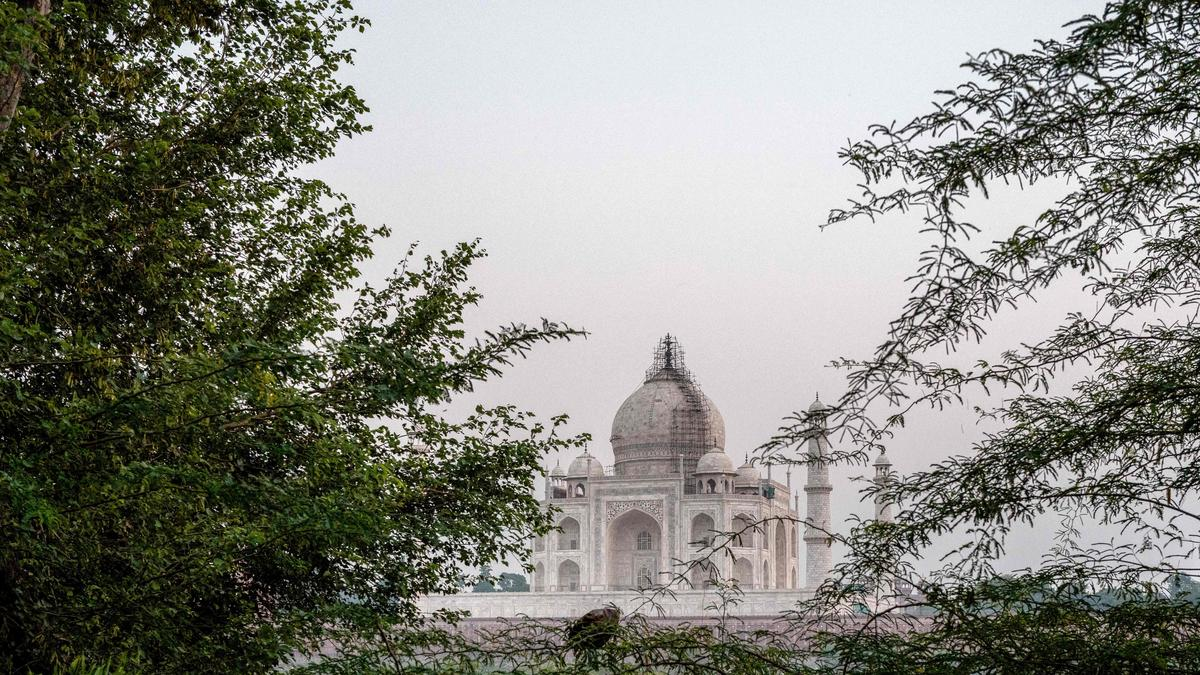
Scaffoldings are pictured as restoration work goes on at the dome of the Taj Mahal in Agra on October 17. | Photo Credit: AFP

A little over 60 years ago, Purushottam Nagesh Oak slept and dreamt. He woke up and claimed that the Taj Mahal in Agra was actually a Hindu palace going back all the way to 4th century. Friends of Mr. Oak, an English teacher-turned-lawyer-turned-journalist but never a historian, told him that the Taj Mahal couldn’t have been a fourth century structure as the technology employed in building the Taj in the 17th century didn’t exist back then. The fantasist turned a pragmatist, and Oak brought his argument forward by a few centuries. The Taj was now claimed to be a Hindu temple. This was in 1989. He wrote articles and a book too, but found no support from historians. Even the Supreme Court dismissed his claims as “a bee in his bonnet” in 2000.

But post-2014, history is like a revolving door, you enter and exit at your ease and pleasure. You pick and choose, you circumvent and invent. Dress it up as a movie and claim you are looking at history anew. That is how we get a movie like Tushar Amrish Goel’s The Taj Story, starring former BJP MP Paresh Rawal; just like we had The Kashmir Files and The Bengal Files, starring Anupam Kher and Mithun Chakraborty, all ideological partners of the Bharatiya Janata Party (BJP).

With The Taj Story, Goel goes where no historian has gone. Proof, evidence and knowledge amount for nothing as the director makes a case for the Mughal monument being actually a Hindu temple, much like the BJP leader Sangeet Som who called it alternately a Shiva temple and a monument built by a man who incarcerated his father. Mr. Som obviously couldn’t make out a Shah Jahan from an Aurangzeb and hence got mixed up. Much like Oak, oops, Goel, who sees no difference between history and mythology, facts and fantasy.

Recorded history

Talking of facts, the Taj Mahal was built by the Mughal emperor Shah Jahan after his favourite wife Arjumand Bano Begum breathed her last after bearing the last of their 14 children. Its chief architect was Ustad Ahmed Lahori. The land for her last resting place was procured from Mirza Raja Jai Singh of Amber who had inherited it from Raja Man Singh, a celebrated general of Akbar, who was Shah Jahan’s grandfather. Shah Jahan compensated Jai Singh with four havelis from the royal property for the massive haveli in which rests Mumtaz Mahal. His firman to Jai Singh, the latter’s agreement and the Mughal emperor’s subsequent letter of granting him four havelis in lieu of one, are all part of history; unlike the claim of The Taj Story which talks in terms of a massacre and genocide of the locals for fulfilling the wishes of an emperor and his consort!

The work on the tomb started in 1632 with the finest craftsmen from across the country and West Asia. The chief mason was Mohammed Hanif from Baghdad who earned ₹1000 a month for his efforts. The pinnacle was built by Qayam Khan of Lahore and its Quranic inscriptions were done by Amanat Khan Shirazi. The mosaic work was done by local Hindu workers. Above all, some 20,000 workmen toiled for 22 years to build the monument to love. Its white marble came from Jaipur, lapis lazuli from Sri Lanka, crystal from China and coral from Arabia. The monument uses the double dome technique, previously seen only in the Humayun’s tomb in Delhi, and never seen in the country before the arrivals of the Turks.

Not the first time

Over the years, many have tried to appropriate credit for its beauty and majesty. In the 17th century, it was claimed by many in the West that the architect of the Taj was Venetian Geronimo Veroneo, a jeweller by profession. Then came the claim by Mughal Beg in Tarikh-e-Taj Mahal that it was designed by Muhammad Effendi, an architect supposedly sent by the Sultan of Turkey. Effendi though was as much an architect as Oak was a historian. In the mid 19th century it was claimed that the monument was the result of the genius of Frenchman Austin de Bordeaux, a jeweller. However, Austin died in 1632, the year the work on the Taj began. With his death all claims of Austin being the Taj’s architect were buried. And facts began to be raised.

As for fantasy, well there is Goel’s film, never mind its claim of presenting the “untold history of the Taj Mahal”. The film, replete with stereotypes of kohl-lined, skullcap-donning Muslims aims at building a nation’s memory on unreasoned mythology, far removed from the well argued debates of history. Much like Oak’s view that Christianity was nothing but Krishan-Niti. Not game for any ridiculous claims in an insipid film which opened with a mere 14% attendance in the first show? Watch M. Sadiq’s 1963-saga Taj Mahal. Sure, you would remember its song, ‘Jo wada kiya woh nibhana padega’, penned by Sahir Ludhianvi and sung with much love by Mohammad Rafi and Lata Mangeshkar. Sadiq’s film with Pradip Kumar and Bina Rai in the lead cast, made no effort at replacing history with mythology.

source: http://www.thehindu.com / The Hindu / Home> Entertainment> Movies> In the limelight / by Zia Us Salam / November 07th, 2025
In 1962 Mohammed Rafi cheered troops on China border

Mumbai, MAHARASHTRA /ALL INDIA :

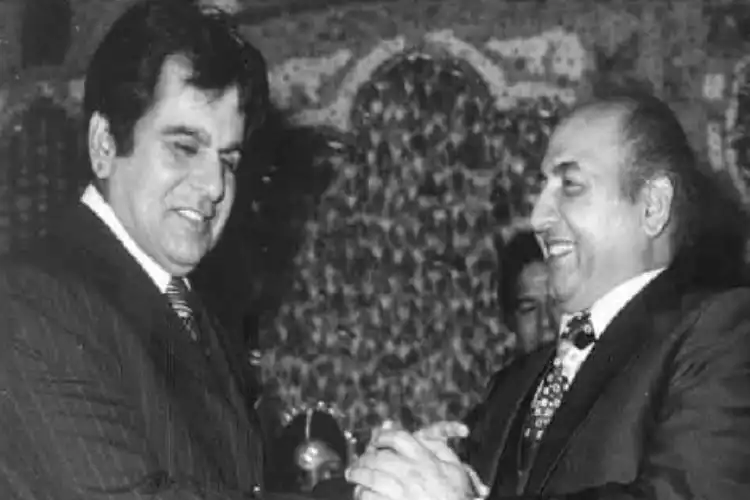
Mohammad Rafi and Dilip Kumar

Contrary to the popular notion that wars are fought by the armies alone, the whole nation including Bollywood personalities and leading artists get involved in the national efforts to fight the enemy.

The Chinese invasion in October 1962 was a shocking moment for India. Traditionally, India had supported China at every international forum for at least half a century. The invasion was the least expected from China and India was not at all prepared for it. Prime Minister Jawaharlal Nehru urged the nation to stand united in that hour of emergency and in response Indians donated generously to the National Defence Fund.

The film industry did not lag. Film Industry’s war efforts were led by legendary filmmaker Mehboob, singer Mohammed Rafi and music composer Mohammed Zahur Khayyam Hashmi (Khayyam).

In less than a week they collaborated to produce two music videos, which were to be played in film theaters, on the radio, and on the roadsides to raise funds for the war.

One of those two songs, “Awaz do hum ek hain…”, by Jaan Nisar Akhtar is now a popular political slogan in India. On Nehru’s call to the nation, Jaan Nissar Akhtar wrote the song to which music was given by Khayyam and the voice by Mohammad Rafi. The song is an invocation to Indians to unite in the face of an invader became a national passion and remains so till today.

The song starts with:

ek hai apni zameen, ek hai apna gagan

ek hai apna jahaan, ek hai apna watan

apne sabhi sukh ek hai, apne sabhi gham ek hai

Aawaz do ham ek hai

(We have a common earth, we have a common sky

We have a common world, we have a common motherland

All our joys are common, all our sorrows are common

Say it aloud that we are one!)

The powerful lyrics were turned into a national rage by the soulful singing of Rafi. Jago watan khatre me hai, sara chaman khatre me hai (wake up our motherland is under threat, whole garden is under siege) and dushman se nafrat farz hau, ghar ki hifazat farz hai (hating your enemy is a duty, to guard your home is a duty), aroused patriotic emotions among millions of Indians. The song asks the youth to join the army and fight the aggressor.

The song was picturized on Rajendra Kumar, Sunil Dutt, Raj Kumar, and Kamal Jeet.

Another song produced along with this was written by Sahir Ludhianvi, “watan ki abroo khatre main hai…” (dignity of the nation is under threat). It was also produced by Mehboob and sung by Mohammed Rafi. The song specifically points to the Panchsheel pact and other friendly gestures made by India towards China. It says,

Wo jinko saadgi mein hamne

Aankhon par bithhaaya thha

Wo jinko bhai kehkar

Hamne seene se lagaaya thha

Wo jinki gardanon mein haar

Baahon ka pehnaaya thha

Ab unki gardanon ke waaste

Talwaar ho jaao

(The people we honoured because of our innocence

The people we embraced and called brothers

The people we received with love

Now, do become swords for their throats)

The song also points toward the internal threats at the time of war.

Khabar rakhna koi gaddaar

Saazish kar nahin paaye ae

Nazar rakhna koi zaalim

Tijori bhar nahin paaye ae

(Be vigilant that no traitor conspires against the nation

Be vigilant that nobody makes money out of our war efforts)

The song was picturized on Dilip Kumar, Rajendra Kumar, Raj Kumar, and Kamal Jeet in a video produced by Mehboob.

Lorries with speakers would roam around playing these songs and prompting people to donate generously. It is said that when one such procession reached the house of Shammi Kapoor his wife actor Geeta Bali started crying. She rushed inside her house and told Shammi that she needed to do something for the nation. Geeta took all her jewelry, even the pieces she wore, and gave it away for war.

Rafi felt that singing in the safety of Mumbai was a disgrace in the line of his national duty. He discussed with Dilip Kumar and urged PM Nehru to send them to the border. What would they do there? Rafi felt that his songs could boost the morale of Indian soldiers and the presence of Dilip Kumar would assure the troops that the whole nation is standing behind them.

It was a dangerous mission. It was unprecedented for the artists to perform at the war front. In the cold, Rafi and Dilip reached the war frontier. He sang songs, interacted with soldiers, and boosted their morale. Dilip Kumar later recalled, “needless to say he was the star attraction with the jawans and the young newly commissioned officers”.

After the war ended with a ceasefire the collected funds were used to recover the economy and modernizing the Army.

On 27 January 1963, Mehboob organized an event in Delhi where he invited.all the prominent film stars to perform in the presence of President S Radhakrishnan and PM Jawaharlal Nehru. The event is often remembered for the rendition of “Aey mere watan ke logo…” by Lata Mangeshkar and Mohammad Rafi sang two songs. One was written by Shakeel Badayuni and its music was composed by Naushad, “Apni azadi ko hum hargiz mita sakte nahi.” The song was later adapted into the film Leader and the other was “Kar chale hum fida….” written by Kaifi Azmi and composed by Madan Mohan, which was later adopted in Haqeeqat, a movie based on the India-China war.

The fact that Rafi went to the war frontier and stayed there for a few days to play what turned out to be a big morale booster for the troops remains an unprecedented manifestation of one’s sense of responsibility towards his country.

source: http://www.awazthevoice.in / Awaz, The Voice / Home> Culture / by Saquib Salim / December 24th, 2022