Tag Archives: Shams Ur Rehman Alavi

Padshah of Urdu; People mourn death of Shemsur Rehman Faruqi

Prayagraj (formerly Allahabad), UTTAR PRADESH :
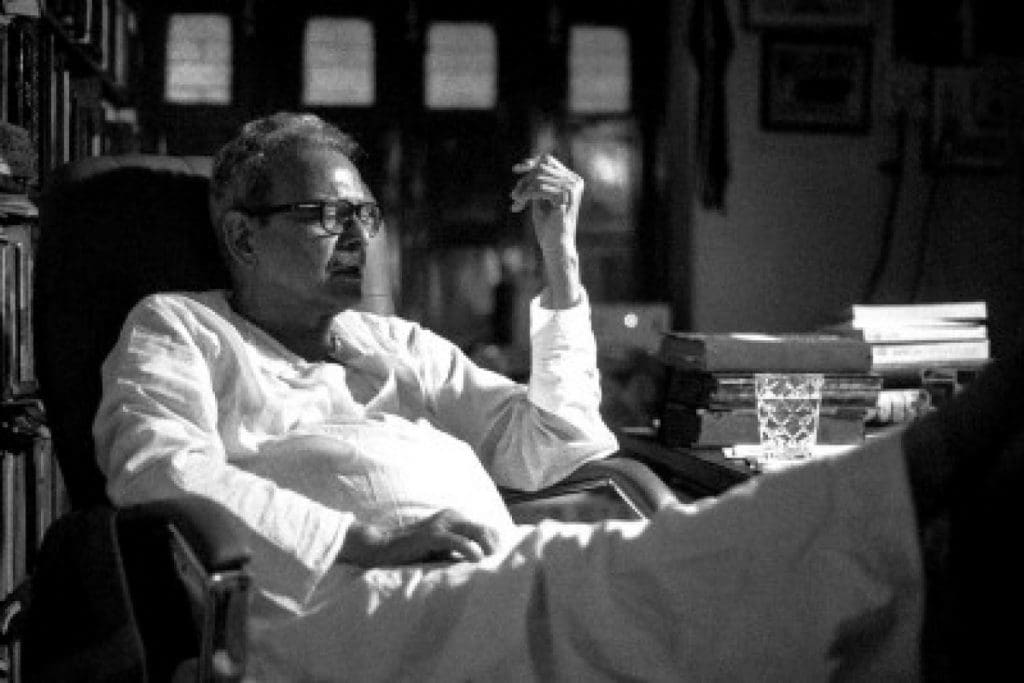
Legendary Urdu poet and critic Shamsur Rahman Faruqi passed away on Friday at his Allahabad home, a month after recovering from COVID-19.

His daughter Mehr Farooqi tweeted about her father’s demise: “We reached Allahabad and father transitioned peacefully,” she wrote.

“It’s not just the world of Urdu, I feel I’ve been orphaned again,” historian Rana Safvi sent her condolences.

Writer and historian William Dalrymple took to Twitter to mourn the demise of Faruqi, calling him “one of the last great Padshahs of the Urdu literary world.”

Sanjiv Saraf, the founder of Urdu festival Jashn-e-Rekhta, also condoled the death of “the century’s most iconic figure in the realm of Urdu literature”.

“His demise has left us bereaved as an entire generation of literature lovers mourn this loss. I extend heartfelt condolences to his family and loved ones,” Saraf said.

“Shamsur Rehman Farooqui’s demise is a big loss to the world of scholarship, and adab. His work built many bridges across India’s diverse traditions. He was immensely valuable to us in so many ways and will be sorely missed, ” said CPIM general secretary Sitaram Yechury.

“Am just gutted. Shamsur Rehman Faaroqui saheb has passed away. Innalillahi wa inna ilayhi rajeeon. May allah grant him jannat..aameen,” wrote journalist Rana Ayyub.

“His modernist style had irked the traditionalists and contemporaries in the sixties, seventies. But he wasn’t just a critic and theorist, whenever he took to fiction, he created magic. And, his Allahabad home had been the nucleus of Urdu literary world, for over half-a-century,” wrote journalist Shamsur Rehman Alavi in a condolence note.

Legendary

A profile of his on Caravan Magazine alluded to his immense and immeasurable contribution to Urdu literature.

Shemsur Rehman began writing in 1960. Initially he worked for the Indian postal service (1960–1968), and then as a chief postmaster-general and member of the Postal Services Board, New Delhi until 1994. He was also editor of his literary magazine Shabkhoon and part-time professor at the South Asia Regional Studies Center at the University of Pennsylvania.

An expert in classical prosody and ‘ilm-e bayan (the science of poetic discourse), he has contributed to modern literary discourse with a profundity rarely seen in contemporary Urdu critics. His most recent books, The Mirror of Beauty (translated into English from the Urdu Kai Chaand The Sar-e-Aasmaan in 2006), and The Sun That Rose From The Earth (Penguin India, 2014), have been highly critically acclaimed. He is the recipient of numerous honors and awards. Most recently he was awarded the prestigious Saraswati Samman for his work She`r-e Shor-Angez, a four-volume study of the eighteenth-century poet Mir Taqi Mir.

He was awarded the Saraswati Samman, an Indian literary award, in 1996. The Government of India awarded him the civilian honour of Padma Shri in 2009.

source: http://www.maktoobmedia.com / Maktoob Media / Home> India / by Maktoob Staff / September 25th, 2020

Wakeel Najeeb: Prolific author who leads the Urdu literary caravan in Vidarbha

Nagpur, MAHARASHTRA :

When he is not writing a novel, he writes stories for children. And, when he is not penning these stories, he may compose poetry for a change of taste or suddenly come up with a  book on personalities of his city.

Wakeel Najeeb is not just among the most prominent authors, he is the most prolific writer in the region. For people interested in Urdu litrature across the country, when the conversation shifts to this region, it’s his name that instantly comes to minds.

And a visit to Nagpur is incomplete until one meets him. In the serpentine lanes near his house, ask anyone–an elderly man or a young boy, everyone knows him and can guide you about the address or directly take you to his house.

Th writer is at the centre of Urdu literary activities in Nagpur. On my visit to the town, I tried to locate his house and almost everyone I came across on way, was ready to take me to his place. Apart from novels, he has several collections of stories and short-stories, poems and two travelogues to his name. Also, there is a collection of plays and hold your breath–20 novels.

He is among the few authors who have focused on writing for the children. Many of his novels are for children apart from nazms and stories. Though he started his literary journey with ‘afsana’ [short story], he got more fame because of writing for children as he also gets published in the magazines across India.

“Somehow a label was put on me that I write stories for children and a I am writer exclusively for kids, though I have collections of short stories and have written fiction, not just for children”, he explains. Of course, Najeeb, has written extensively and also writes critical pieces, essays and articles.

His most recent work is a book, ‘Meri Basti, Mere Log’. The book contains his write-ups on interesting personalities he saw around him as he grew up and others in his city. The profiles include people from diverse fields–wrestlers to clerics and writers to sufis. Already hundreds of copies of the book have been sold.

“Frankly, I do my best to publicize my books. When I write, my aim is to make people aware about the book. You see this, he points towards the banner outside his house, which announces publication of his book. People come to know, arrive and buy”, he further says.

That’s a far cry from the writers who bemoan lack of readers or rue that there books are not being sold. Born on July 1, 1946, Wakeel Najeeb, studied at the local Urdu school. He went on to become a teacher and retired as principal of Islamia School. He is socially active, associated with institutions, literary groups and attends their meets. And, literally holds the literary fort in the region.

source: http://ww.newsbits.in / Newsbits.in / Home> Special / by Shams Ur Rehman Alavi, Bhopal / December 22nd, 2021

Bookshop owner who is more interested in collecting books than selling them: Unique Urdu bookshop in Lucknow

Rohtas, BIHAR / Lucknow, UTTAR PRADESH :

Lucknow :

Every city in India has many iconic bookshops and Lucknow too has a few. However, in recent years, a bookshop has drawn attention of book lovers because of the variety and collection of books, particularly, in Urdu.

This bookshop has drawn readers from other states and cities too and people buy from him online as well. But the most unique aspect about this bookshop is that the passion of the owner who has been running it purely for the love of books.

Imagine, you go and find a good book and want to buy it. The bookshop owner appears sad that you chose the particular book. “I have just one copy of this book and I want to keep it”, says the man, who owns this shop. Or going to the extent of telling the visitor that they can take a look and buy from any shop elsewhere or telling the location or suggesting how to get a particular book.

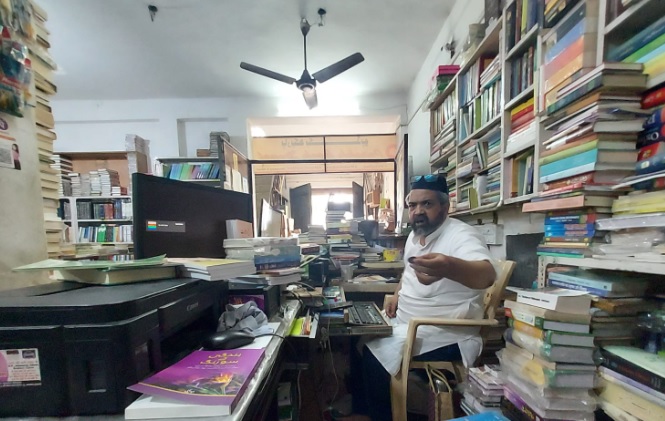
But first about the uniqueness of the bookshop. Unlike other Urdu bookshops, the owner Shahood Ul Hasan Khan keeps a very wide range of books. It’s not limited to a few publishers but he keeps books of all publications and also ensures that books ranging from all the topics are available in Urdu, ensuring a collection.

From literature to language, and law politics to philosophy, history to Islam, Hindusim and other religions, fiction, non fiction, other than books in English and Hindi too, everything is available under one roof. He tries to put on display maximum books of all variety in his shop. 

“I wanted to be among books, own them and have them around me”, he says. That’s the reason he started the bookshop even though people are always suggesting that he should switch to some other business. “It’s true that I put lot of money, because it’s my hobby and passion. However, it is not a very lucrative business.

He gets lot of unwanted advices and people have finally reconciled that he would not switch to anything else, except, keeping himself amid books. People and relatives keep advising that I should give this big space to someone and the rent would be more than my current earnings, but this is my passion”, says Khan, 42, who started Parekh Book Depot, and has totally dedicated himself in this work.

“I do it for the sake of books, not for profit. I always wanted to do this and hence I am happy doing what I do”, he further adds. In a city that has iconic Danish Mahal in Aminabad and many other bookshops, the emergence of Parekh Book Depot and it’s growing popularity, has drawn attention of people.

Urdu readers who come to Lucknow, try to take time out of their schedule and visit the place, as they know they might get a surprise, a rare book that was not available for long, translation of a famous English or French book or latest ones that have just been out of printing press.

As I select the books and am about to pay, he tells me that I can get these books online or from another particular place too. When I asked him why was he not keen on selling it and giving me the suggestion, he said that, ‘this set of books is not an ordinary one and we don’t know when it again gets printed and comes to market, hence, I am having a hitch and can feel that I am losing something.

At least, the set of books was with me till now”, Shahood Ul Hasan says. It was subsequently that I spoke to him and he told me about his life and his passion that has earlier been described in the report. Hailing from Rohtas in Bihar, he had come to Lucknow as an infant. He studied in the famous Nadwatul Ulema and his bookshop is also close to the gate of the seminary in Lucknow.

Many bookshops are selling just religious texts or literature. Also, there are different models. But he has shown a way, how a bookshop can thrive in an era when people keep ruing about lack of readership. “I am happy that I make enough to run my household. What else do I wish for?”.

One thing is sure, he has put in efforts and money but his passion has resulted in this bookshop emerging as an institution. It is remarkable that he opened the bookshop in 2016, and within a couple of years, it was too well known and in direct contact with readers who get details on their Whatsapp accounts about news books’ arrival and then order them through post as well.

source: http://www.newsbits.in / NewsBits.in / Home> Special / by Shams Ur Rehman Alavi / July 11th, 2023

Haidargarh Basoda: The princely state that survived for two centuries in Central India

Haidargarh-Basoda (Vidisha District) , MADHYA PRADESH :

Bhopal :

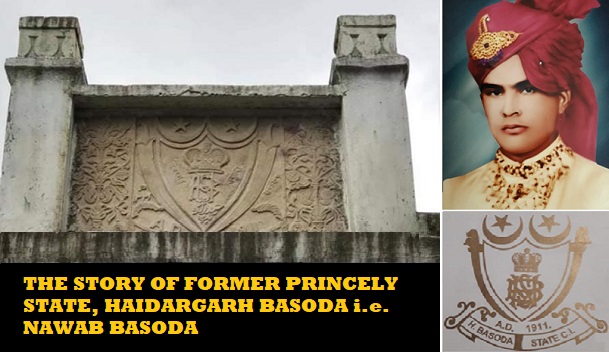
Once it was a princely state, today it’s a dot on the map of Madhya Pradesh. Haidargarh-Basoda, a principality, remained in existence for nearly two centuries in the centre of India.

It was also known as Nawab Basoda and is known for its unique history. However, after independence when the state merged and lost its identity, not even made a district and relegated to the status of a town, the place lost focus and its heritage and traditions could not be properly documented.

However, it’s well known in history that Nawab Diler Khan was the founder of the State that later got divided into Haidargarh Basoda, Kurwai and Muhammadgarh. The original princely state* had come into being in the year 1713 AD, [and was later carved into three separate states]. Mughal power was weakening after nearly 190 years.

It was during the reign of Emperor Farrukhsiyar, the great grandson of Aurangzeb, that Nawab Diler Khan managed to establish his principality in this region. The death of Nawab Diler Khan is recorded in the year 1732. After him, it was his son Nawab Izzat Khan who succeeded.

However, Nawab Izzat Khan and his younger brother Ahsan Ullah Khan had the territory divided. The latter, Nawab Ahsan Ulla Khan also divided his state into two parts, one of which was known as Haidagarh Basoda or Nawab Basoda. The Basoda state came into being in early 1750s. 

After Nawab Ahsan Ulla Khan’s death in 1790, his son Nawab Wakaullah Khan remained the chieftain but he died five years later. His wife was regent and the minor son Nawab Asud Ali Khan became the ruler when he attained the rightful age. It was during this period that the first war of independence or mutiny [as British termed it] took place. 

Nawab Asud Ali Khan passed away in 1864. He was succeeded by his son Nawab Omar Ali Khan who was an author and a traveller. He went across the world and wrote about his visits. He passed away in 1895. He was succeeded by his son Nawab Mohammad Haidar Ali Khan.

It was during this period that the state became known as Haidargarh. Then, Nawab Masood Ali Khan became Nawab and after a three year stint, state got merged when India became independent. The title remained. After 1971, privy purses were abolished. He passed away in 1976.

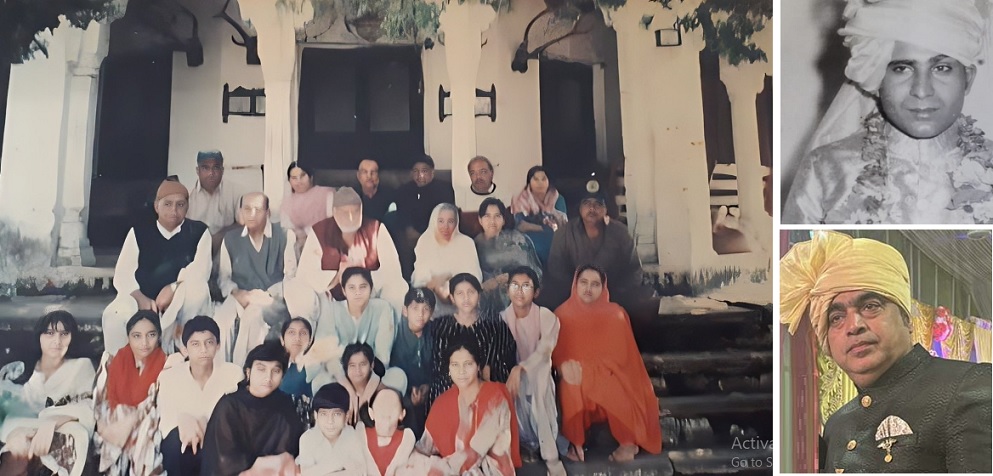
“After our grandfather Nawab Masood Ali Khan, his son Nawab Kiswhar Ali Khan succeeded him”, says Siddiq Ali Khan, a descendant of the family. ‘My father Anwar Ali Khan is the younger brother of Kishwar Ali Khan”, he further says. How the family coped with the state was merged?

“Most of the members of our clan took care of the lands. Apart from this, some of us are in different professions”, says Khan, who lives in Bhopal. “We had agrarian land and hence the family got engaged in it, though some took jobs and became doctors, engineers. One of our uncles, Bakhtiyar Ali Khan, studied in Cambridge school in Bhopal. My father has also been in politics”, Siddiq Ali Khan, further adds.

The Haidargarh Basoda state [now Haidergarh] was spread over an area of over 103 sq km i.e. 40 sq miles. Now, it is located near Gyaraspur town in Vidisha district adjoining Bhopal. Haidargarh, now spelt Haidergarh Basoda, is a civic body. The fort and the family’s ancestral palace still stand as testimony to the fact that this small panchayat was once was a principality with a rich history. 

[*Originally Nawab Diler Khan established a state in 1713 AD that was later carved into three separate states and Basoda came into being in 1753]

source: http://www.newsbits.in / NEWS Bits / Home> Heritage / by Shams Ur Rehman Alavi / February 15th, 2023

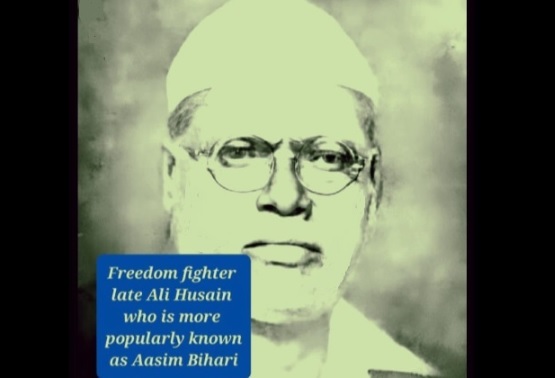
Aasim Bihari: Freedom fighter who led movements, battled for downtrodden all his life

BIHAR :

Ali Husain Aasim Bihari who was a freedom fighter, big leader, organised workers in Bihar & Bengal, brought out newspapers, formed multiple organisations.

He, led Momin Ansari community, and all his life fought for workers’ rights. Suffered a lot in process and his family also lived in challenging circumstances.

Hailing from Bihar Sharif, Nalanda, he had to shift to Kolkata to earn a living and it was here that he began involved in freedom movement and started an unprecedented political and social journey despite financial constraints.

Aasim Bihari left a huge legacy but led a tough life. His family bore consequences of his immense passion for awakening the masses, at the cost of his own health and finances. He opposed partition of India and worked for uplift of downtrodden. He passed away in independent India and was buried in Allahabad.

I don’t think it is easy to write about his missionary zeal and his sacrifices without getting tears in eyes. He faced personal tragedies, the death of his brother, the lack of money that caused hardships to his daughter, the suffering of his wife and entire family. 

He was ailing and couldn’t be treated. He had declined the post of minister, also refused to take a princely sum, luring offer from a major political party, and his integrity for the cause was unquestionable.

In a life of constant struggle. Aasim Bihari formed organisations, led agitations, ran campaign to release nationalist leaders from jails after Jallianwalabagh massacre by sending letters from people of all parts of country to Queen & Viceroy. Brought out journals, weavers were organised amd turned into a political force.

Born in 1889 [1890*], he passed away in 1953. From Jamiatul Momineen, his lifelong fight for rights, awareness, awakening and education among masses, continued.

CM recently released book on him and it has been decided to add a chapter on his life in school textbook.

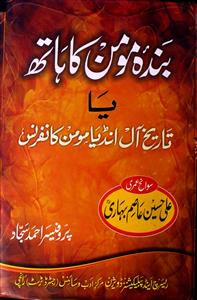
Book ‘Banda e Momin Ka Hath’ by Prof Ahmad Sajjad , pic: rekhta.org

[There is slight variation in references about his year of birth. However, the date of birth is April 15.]

source: http://www.anindianmuslim.com / Indscribe / Home / by Shams ur Rehman Alavi (image of book cover edited – source: rekhta.org) / June 22nd, 2023

Winners of 3rd National NGO Awards . 86 NGOs & 100 Changemakers honoured with 3rd AMP National Awards for Social Excellence 2023!

NEW DELHI :

Lifetime Achievement Award presented to Late Zaheeruddin Ali Khan, renowned Managing Editor, The Siasat Daily, for his immense contribution in the welfare of the people of the country, especially, States of A.P. & Telangana.

Winners of 3rd AMP National Awards for Social Excellence (NASE) 2023 were announced, on the evening of Independence Day, 15th August 2023, in an eagerly awaited function graced by honourable guests and a large gathering of participants from across India. 

A memorable event to announce the awards and felicitate a few awardees present, was held at Hakeem Abdul Hameed Auditorium, Jamia Hamdard, Hamdard Nagar, New Delhi. 

86 National & State level NGOs were awarded with Best NGO Awards. 100 inspiring individuals were given Changemaker Awards. 

Following are the NGOs (in alphabetical order) who were given the Best NGO Award;

  1. Ajmal Foundation, Assam
  2. All India Educational Movement (AIEM), Delhi
  3. All India Payam E Insaniyat Forum, Uttar Pradesh
  4. Daya Rehabilitation Trust Thanal, Kerala
  5. Miles2Smile Foundation, Delhi
  6. Manappat Foundation, Kerala
  7. M S Education Academy, Telangana

Apart from NGOs, 100 individuals were honoured with the AMP NASE Change Maker Awards.

These are the individuals who went beyond their personal and social limitations and made a difference in the lives of the underprivileged. Some of the notable Change Makers who have been honoured are;

  1. Shams Ur Rehman Alavi
  2. Firdouse Qutb Wani
  3. Aqueel Khan
  4. Dr. Faruk G Patel
  5. Asad Ashraf
  6. Dr Sana Ali Khan
  7. Faiqa Saulat Khan
  8. Mohammad Anas

The Lifetime Achievement Award was presented to Late Zaheeruddin Ali Khan, renowned Managing Editor, The Siasat Daily, for his immense contribution in the welfare of the people of the country, especially, States of A.P. & Telangana. 

The Omar Khatani Special Award was given to Business & Employment Bureau (BEB), Jamia Hamdard.

For more details of award list and certificate
www.ampindia.org/AMP_National_NGO_Award_2023

Shri Tariq Anwar, Former Minister of State, Agriculture & Food Processing, Govt. of India, was the Chief Guest at the event. He said “It should be appreciated that AMP has been working in areas of Education and Empowerment of those who have been left behind in comparison to other sections of the Society. In conjunction with politicians, the NGOs can help to bring a positive and significant change in the Society.”

Guest of Honor, Prof. Akhtarul Wasey, Former President, Maulana Azad University, Jodhpur, congratulated AMP for organising the event at Jamia Hamdard which has been at the forefront of Social Development and Education. He said, “Within 15 years AMP has done significant work for the development of the Community and has managed to successfully changed the taali & gaali culture to that of serving the Society.”

Aamir Edresy, President, AMP, presented the Keynote address, wherein he mentioned that AMP believes in Collaboration and since its inception has been working with multiple organisations. He mentioned that through its NGO Connect project, AMP is connected with social organisations in each District of India, through which it implements its social welfare projects and also helps in their capacity building. He further said that these Awards are a small way of appreciating their efforts and helping to motivate them to do better.

Dr. Shahid Akhtar, Professor, Jamia Millia Islamia & Member, National Commission for Minority Educational Institutions (NCMEI), Govt. of India, said “AMP deserves the appreciation for rewarding & motivating various organisation & individuals for their work. We will work together with AMP for guiding Minority Institutions to register with NCMEI so that they get the benefits of Government’s education policies.”
 
Farooq Siddiqui, AMP NGO Connect Project Head, hosted the event very successfully and announced the awards for various categories at the National & State level. While addressing the gathering he said “We have successfully reached out to 6000+ NGOs in a short span of  3 years and associated with them on multiple AMP projects. These include Job Fairs & Job Drives, National Talent Search (NTS), Career Guidance Seminars (CGS), IndiaZakat.com and others.”

Prof. Mohammad Afshar Alam, Vice Chancellor, Jamia Hamdard welcomed the Guests and the participants.  Shaukat Mufti, Executive Secretary, Business & Employment Bureau (BEB), Jamia Hamdard, presented the vote of thanks.

The 9-member jury which selected the winners were led by A. R. Khan, Retd. IAS Officer & President A. R. Welfare Foundation and U. Nisar Ahmed, Retd. IPS Officer & Chairman National Centre for Research & Development. Mirza Mobin Beg, Sr. AMP Member was In-charge & Jury Co-ordinator for AMP NASE Awards 2023.

source: http://www.ampindia.org / Association of Muslim Professionals (AMP) /Home / August 15th, 2023