Deoband, UTTAR PRADESH / DELHI :
It was a hot, restless afternoon in New Delhi – the kind where the sun presses down with such fury that even the breeze seems to hide. The air was thick with chants, placards, and purpose. Students from across the capital’s universities had gathered in protest – a voice of defiance against the rising wave of mob lynchings sweeping through India, backed by extremist ideologies. Amid the sea of young faces, I noticed a small group that stood out. They were not university students in jeans and t-shirts, but madrasa students in simple white kurtas and skullcaps, holding banners of peace and justice.
They had come all the way from Deoband, a quiet town that has long been a lighthouse of Islamic learning, to stand shoulder to shoulder with victims’ families. Among them was a young scholar whose calm presence carried a certain gravity: Moulana Mehdi Hasan Aini Qasmi.
Our meeting was brief, just a few words exchanged, a handshake perhaps, but something about him stayed with me. I didn’t know then that this quiet madrasa graduate would one day become the face of a remarkable educational revolution in India.
The Seeds of Brotherhood
Two years later, in 2018, the Students Islamic Organisation of India (SIO) held its grand All India Conference in New Delhi, themed “Reclaiming Dignity | Designing the Future.” Among the audience of fiery youth and intellectuals, Mehdi Hasan was invited as a representative of madrasa students – being the President of the Abna-e-Madaris (Old Boys’ Association of Deoband).
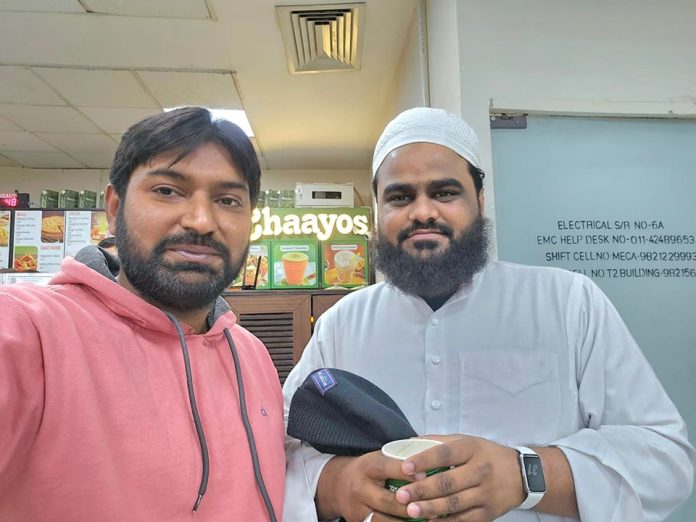
When he spoke, his words carried the depth of tradition and the urgency of modern times. After the session, we found ourselves in a long conversation about faith, education, and the future of Muslim youth. That day, a brotherhood was born – one that would travel far beyond Delhi’s conference halls.
Soon, he invited me to Deoband. What began as a visit turned into a revelation. We walked through the majestic gates of Darul Uloom Deoband, met students immersed in their studies, and discussed the evolving role of Islamic education in a rapidly changing India. It was there I saw the spark – Mehdi’s vision was clear: to bridge the gap between traditional Islamic scholarship and the demands of modern society.
From Streets to Seminars
Between 2019 and 2020, our journey turned into a mission. Together, we travelled across India – from the quiet corners of Tripura to the bustling lanes of Telangana – addressing crowds, organising awareness drives, and speaking against hate, Islamophobia, and discrimination.
Then came the storm – COVID-19. India went silent. The streets emptied. Institutions shut their doors. But we refused to stop. Our activism simply changed form. While the world was locked down, we were reaching out – distributing relief, helping stranded students, and connecting youth through virtual spaces.
One late-night discussion during those months became the turning point.
“If people have time,” I said thoughtfully, “why can’t we bring madrasa education online? Why can’t we empower teachers who have no income now? Why can’t we teach our youth skills to survive?”
That one why became a revolution.
Over the next two years, the spark spread like wildfire. Under Mehdi’s leadership, IIAD organised over ten national workshops across India, reaching thousands of students from Aurangabad to Delhi. These workshops covered topics far beyond theology – from Education to Entrepreneurship and Islamic Thought to Social Leadership.
One such event, the Aurangabad Education Expo, became a milestone in connecting madrasa students with mainstream educational opportunities. Through these sessions, IIAD began to carve a new narrative for Islamic learning – one that embraced progress without compromising on principles.
The Birth of an Idea
Our first online programme, “Education to Entrepreneurship,” was meant to be a small initiative – a bridge between learning and livelihood. But the response was beyond imagination. Hundreds of madrasa students and teachers joined from every corner of India.
We realised we had touched a nerve – there was a hunger for knowledge, a thirst for relevance. In 2022, we organised an offline workshop in Bidar at Shaheen Group of Institutions for madrasa students. To our surprise, several attendees were already running small businesses – many of whom had attended our first online sessions back in 2020.
One night, Moulana Mehdi and I sat in deep conversation till Fajr. The sky turned from ink to gold as we reached a decision that would change everything: to start a full-fledged online institute for Islamic education and leadership and the name finalised was “India Islamic Academy Deoband” and now it is a brand in Madaris Circles.
But Mehdi had already taken the first step. Before our official launch, he had begun teaching small groups online – offering a Basic Islamic Foundation Course (3 months) and an Advanced Islamic Studies Course (6 months). Within weeks, the response exploded. Students from across India – and even abroad – joined.
And then, in 2021, the dream took shape.
Multi-Dimensional Mehdi
Many madrasa teachers benefited from IIAD’s programmes and became self-sustained, empowered to teach and earn through digital platforms. Watching this transformation unfold, I became deeply impressed by Moulana Mehdi Hasan’s multifaceted personality.
As a student, he had marched with his friends in protests; later, he organised them. As a social activist, he raised his voice fearlessly and even faced police cases. Through his advocacy work within Muslim organisations, he united madrasa youth under a shared purpose – to stand up for justice, particularly during the anti-CAA movement, where he became a leading voice representing madrasa student unions.
During the pandemic, the COVID-19 crisis his alumni group at Darul Uloom Deoband established a help-desk that handled thousands of calls, distributed oxygen cylinders and fought misinformation – reinforcing his role as a frontline community leader, he turned compassion into action as a social worker, extending relief to the needy.
As a writer and journalist, he penned articles and books that shaped public discourse in Urdu media. And as an entrepreneur, he became the very example he urged others to follow – transforming his vision for empowering madrasa students into a thriving digital institution.
The Rise of IIAD – India Islamic Academy Deoband
The official launch of India Islamic Academy Deoband (IIAD) was not just the founding of an institution; it was the dawn of a new era. For the first time, a madrasa-based initiative had embraced technology to take classical Islamic education to every home.
The story of IIAD began in 2017, when a vision was realised – to bridge authentic Islamic scholarship with modern accessibility. What started as a modest initiative soon blossomed into a movement that redefined faith-based learning for the digital era.
By 2019, IIAD proudly celebrated the first wave of scholars graduating from its inaugural Aalim programme, ready to serve their communities with knowledge and integrity. The academy’s turning point came in 2021, when it launched its Global Digital Campus – a state-of-the-art online learning platform that connected students and scholars across continents.
And by 2024, that vision had grown into a vibrant global community – a growing Ummah of over 5,000 students from diverse countries, all united by the pursuit of knowledge and purpose.
The journey of IIAD stands as a testament to how faith, when paired with foresight and innovation, can transform education and empower generations.
What began with few offline and online courses soon expanded into a vast ecosystem. Today, IIAD offers 15 specialised courses – blending Islamic scholarship with modern subjects like media, leadership, and entrepreneurship. The courses are taught in Urdu and English.
From the official website, one can see how IIAD evolved with a clear mission – to empower the next generation of Muslim scholars, entrepreneurs, and thought leaders. The vision was simple yet revolutionary: “To make Islamic learning accessible, practical, and globally relevant.”
But Mehdi’s ambition didn’t stop there.
The Expanding Vision
He founded the Abna-e-Madaris Educational Trust, a platform that supports social and educational initiatives across India. Through it, he organised relief programmes, training sessions, and mentorship circles for youth.
He also launched Deoband Dastak, an online Urdu news portal that amplifies the voices of the unheard and highlights stories of reform within the madrasa ecosystem. His pen became his sword – through articles, opinions, and books – shaping discourse and reclaiming narratives.
Now, as IIAD moves forward, the academy is preparing to launch a course on Artificial Intelligence for Madrasa Students and a Crash Course on Entrepreneurship, opening doors that were once unimaginable in traditional settings.
To further strengthen academic and intellectual pursuits, Moulana Mehdi established another pioneering platform – the Deoband Educational and Research Foundation (DERF). The foundation aims to promote rigorous scholarship, interfaith dialogue, and academic research rooted in Islamic tradition while engaging contemporary challenges. Through DERF, Mehdi envisions nurturing a new generation of Muslim researchers who can think critically, write powerfully, and contribute meaningfully to global discourse.
A Bridge Between Two Worlds
What makes Moulana Mehdi Hasan Aini Qasmi truly remarkable is not merely what he built – but what he bridged.
For centuries, madrasa and modern education were seen as parallel lines – never meeting. But through his courage, vision, and relentless work, Mehdi made them intersect. He became the bridge, connecting heritage with progress, theology with technology, tradition with transformation.
From joining protests as a young activist to leading educational innovation as an entrepreneur, his journey is not just a personal success story; it is a blueprint for a generation.
Today, when I see students from humble madrasa backgrounds speaking about startups, media literacy, and AI ethics, I see his reflection in every one of them.
He has proven that change doesn’t always come from power or privilege. Sometimes, it begins with a simple idea shared between two friends – on a sleepless night – under a sky just beginning to brighten.
Humanitarian Impact
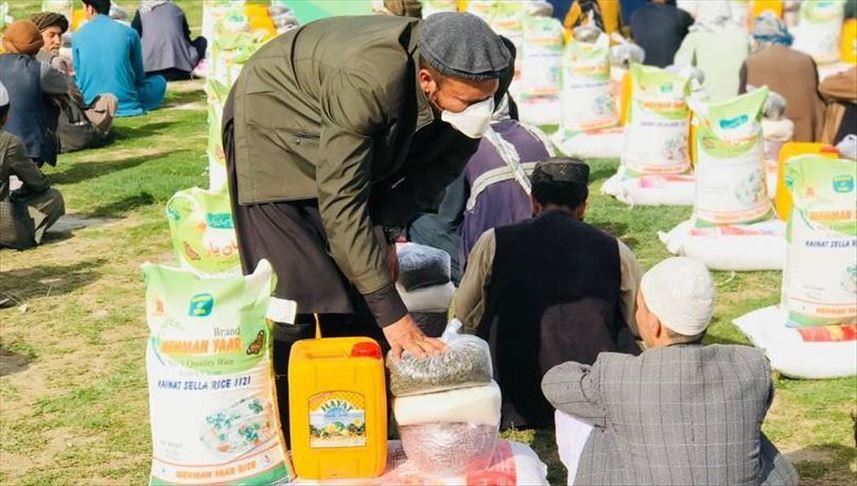
Beyond education and activism, Mehdi Hasan’s compassion flows into the heart of social service. Through his initiatives and trusts, hundreds of struggling families found hope. 300 families had their kitchens lit through ration kits during Ramadan-ul-Mubarak; 100 families were gifted festive joy on Eid al-Fitr; and 50 Imams and Mu’azzins were honoured with Eid gifts. During Eid al-Adha, 200 households were provided Qurbani meat and essentials, while 15 destitute women received full maternity care with dignity.
Each month, 15 orphaned madrasa students are sponsored, 50 talented youth receive scholarships, and teachers of five Makatib-e-Qurani are paid regular salaries, ensuring that the flame of knowledge never dims.
Even during disasters, his team reached out, sending 100 blankets and supplies to flood victims in Punjab, a testament to his unshakeable belief that service to humanity is service to faith.
And that, perhaps, is the story of Moulana Mehdi Hasan Aini Qasmi – a madrasa graduate who dreamed beyond walls, taught beyond classrooms, and built bridges where there were once only divides.
source: http://www.radiancenews.com / Radiance News / Home> Entrepreneurship> Features> Focus / by Syed Azharuddin / October 23rd, 2025