Kalaburagi, KARNATAKA :
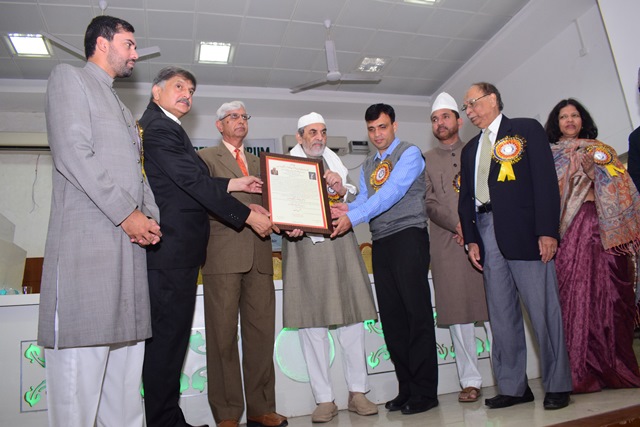
Mohsin E Millat Award being presented to Dr. Syed Shah Khusro Hussaini by Prof. Shakeel Samdani
Aligarh :
Dr. Syed Shah Khusro Hussaini, Founder and Chancellor, Khaja Bandanawaz University was conferred with “Mohsin-E-Millat Award” by Sir Syed Awareness Forum (SAF) during a function which was attended by many prominent personalities from the field of education at University Polytechnic Auditorium, Aligarh Muslim University (AMU).
During the occasion a seminar on “Modern Education and Muslims” was also organised by the Forum.
Addressing the seminar Dr. Syed Shah Khusro Hussaini said that education is necessary for Muslims throughout the world. He said that, Islam is a modern religion and if the principles of Islam are followed honestly, then everyone can achieve success in their lives. He further said that he is the admirer of Sir Syed Ahmad Khan and he is trying his best to carry forward the mission of Sir Syed by establishing a university. He appealed to the Muslims to focus on education as it is the key to success. In the last he said that division on the basis of school of thought is causing harm to the Muslims. It should be avoided by them.
Presiding over the seminar, Prof. Mohd. Hanif Beg, Pro Vice Chancellor, AMU said that in today’s world it is very important to discuss on the issues of education. He congratulated the SAF for organizing the seminar on modern education. He further said that Sir Syed has always given importance to modern education. At the end he requested the students to work hard for civil services and judicial examinations.
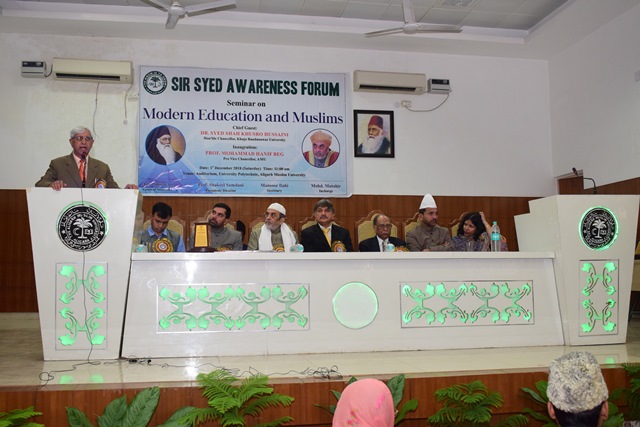
Prof. M H Beg, PVC, AMU delivering Speech sitting IPS Abdul Hamid, Dr. Khusro Hussaini, Prof. Shakeel Samdani, Prof. Pathan and others
Guest of Honor, Mr. Abdul Hamid, IPS and Registrar, AMU said that today Muslims are lagging behind in the field of modern education. Sachar Committee report has confirmed that the educational status of Muslims in India is lower than Scheduled Castes and Scheduled Tribes. He said that higher education is the only solution of this problem. He requested the students of AMU to focus on their education and keep themselves away from unnecessary activities. At the last he congratulated Prof. Shakeel Samdani, President SAF for organizing a wonderful seminar on a very important topic.
President of the forum, Prof. Shakeel Samdani, while delivering his speech, said that Muslims have dominated the world in the field of education, science, literature, etc for about 600 years and this was only possible because they focused more on education and research. He congratulated the South India for carrying forward the mission of Sir Syed Ahmad Khan. South Indian Muslims have established much more education institutions as compared to Muslims of North India. He further said that Dr. Khusro Hussaini has established 24 educational institutions and the most important among them is the Khaja Banda Nawaz University. He said that the work of Dr. Hussaini is appreciable as he has helped the poor sections of the society by establishing educational institutions. At the last he said that it is the pleasure of SAF that Dr. Hussaini has accepted the Mohsin-E-Millat Award.
Principal of Abdullah College, Prof. Naima Gulrez said that North India is lagging behind in establishing educational institutions as compared to South India. She gave the example of Parsis that although they are numerically less in population but they are one of the most prosperous community in the country. It is because they are educationally advanced and they focus very much over modern education. She expressed her sorrow about the condition of Muslim women in the society.
Vice Chancellor of Khaja Banda Nawaz University, Prof. Abdul Jaleel Khan Pathan congratulated SAF for conferring ‘Mohsin-E-Millat Award’ on Dr. Hussaini. He said that it is the need of hour to carry forward the mission of Sir Syed and to provide quality education to Muslims.
Dr. Mohib Ul Haque, said that the time has come for Muslims to focus on modern education if they want to succeed. He congratulated Prof. Shakeel Samdani and SAF for their contribution in establishing Tipu Sultan Block at AMU.
Anjum Tabassum Lashkri (Karnataka) and Mr. Tariq Hussain, AMU were felicitated with “SAF Excellence Award”. Ayesha Samdani conducted the seminar and Mansoor Ilahi proposed the vote of thanks. Sarah Samdani also spoke on this occasion. Poetess Rehana Shaheen recited a Nazm on Sir Syed.
Wajahat Jilani welcomed the guests and Aman highlighted the objectives of the Forum.
On this ocassion, Mr. Syed Ali Hussaini, Pro Chancellor of Khaja Banda Nawaz University, Mr. Haider Pasha Qadri, Sajjada Nasheen, Dr. Moinuddin, Superintendent, KBN Medical College, Gulbarga, and Maulana Syed Abdur Rasheed were present.
Seminar was made a great success with the tireless work and efforts of Adv. Shoeb Ali, General Secretary, SAF, Dr. Haider Ali, Abdullah Samdani, Mohd. Muthair, Hunain Khalid, Danish Iqbal, Sarim Ali, Hamza Noman Masood, Saad Asad, Pawan Varshney, Himanshu Singh, Ajay Singh, Hamda, Kashif Sultan, Ayesha Farheen, Razia Chauhan, Talat Anjum, Rubia, Fauzia, Faiz, Adeel Shervani, etc.
Many prominent figures who attended the program include Prof. Tariq Chattari, Chairman, Dept. of Urdu, Prof. Humayun Murad, Dr. Iqbal Siddiqui, Prof. Zafar M. Nomani, Prof. Kamil, Prof. Khalid Azam, Prof. Ashar Ansari, Prof. Mujeeb Ansari, Prof. K. Khalil Ahmad, Prof. Shakeel Ahmed, Dr. Nazar Abbas, Dr. Ayesha Munira, Dr. Raihan Akhtar, Dr. Rahat Abrar, Dr. Masood Anwar (Shahjahanpur), Dr. Yameen Ansari (Delhi), Syed Ikram Ul Haq (Hapur), Dr. Raghib, Dr Wasim Ali, Mohd Nasir, Dr. Kalimullah, Dr. Rahmat Ullah, Dr. Qaiser Ansari, Dr. Obaid Iqbal Asim, Dr. Iqbal Hadi, Dr. Naseem Ahmad Khan, Dr. Ali Nawaz Zaidi, Dr. Zafar Ahmad, Dr. Mohsin Khan, Adv. Khan Wajahatullah, Rabab Khan, Dr Zeba Azmat, Dr Tabassum Chaudhary, Huzaifa Amir, Secretary, AMUSU, Khalid Masood, Ex President, AMUSU, Raas Masood Khan, Court Member and a large number of students were also present in the seminar.
source: http://www.muslimmirror.com / Muslim Mirror / Home> Exclusive Reports> Indian Muslims / by Muslim Mirror Networks / December 10th, 2018