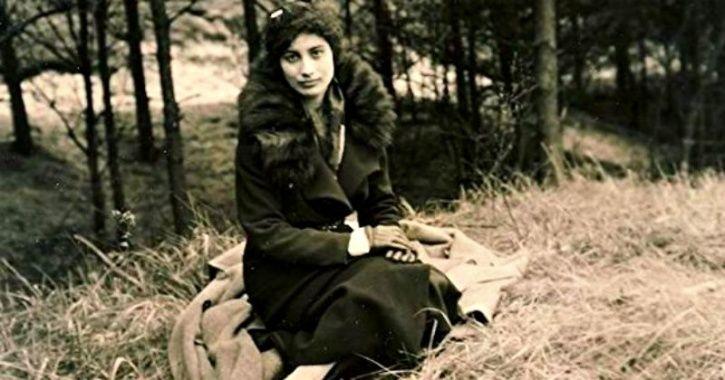
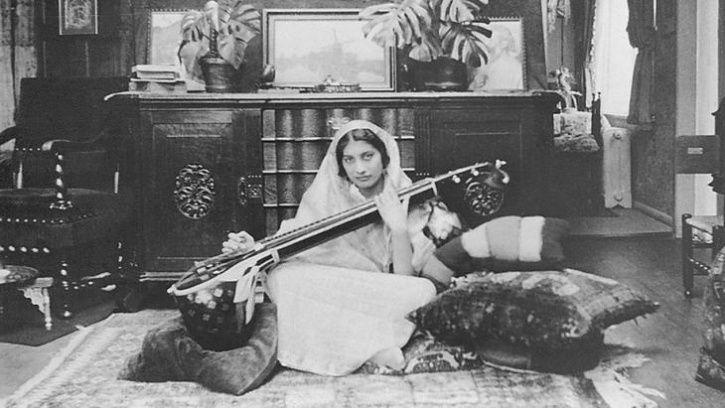
British Indian World War II spy Noor Inayat Khan may be the next face of British currency. A campaign for the same is gaining momentum wherein people are demanding the spy to be featured on a redesigned 50-pound currency note.
The Bank of England had recently announced plans for a new polymer version of the large denomination note to go into print from 2020 and indicated that it would invite public nominations for potential characters to appear on the new note.
An online petition in favour of the campaign has already garnered over 1,200 signatures by Wednesday, calling for Khan, a descendant of Tipu Sultan and daughter of Indian Sufi saint Hazrat Inayat Khan, to be considered as the first ethnic minority British woman to be honoured on the currency.
“I am absolutely delighted that the story of Noor Inayat Khan has inspired so many people and that she has become an icon. Noor was an extraordinary war heroine,” said Shrabani Basu, the author of Khan’s biography ‘Spy Princess’ and founder-chair of the Noor Inayat Khan Memorial Trust.
The trust was set up in 2010 to campaign for a memorial in honour of the war-time spy, who had been recruited by Britain’s Special Operations Executive (SOE) and infiltrated beyond enemy lines before being captured and killed by the Nazis in 1944, aged only 30.
Khan’s memorial bust now has a permanent home at Gordon Square in central London, with the trust also lobbying for a commemorative blue plaque to mark the house nearby where she spent time with her family.
“I am very happy to support the campaign for Noor Inayat Khan on the 50-pound note. It is a way of keeping her memory alive and taking this story to the next generation. It will certainly make a big statement internationally because Noor was someone who believed in breaking down barriers,” Basu said.
The campaign has found the backing of prominent political leaders, historians and academics in the UK, with many taking to social media to voice their support.
“The new 50-pound note could have anyone on it. I’m backing Noor Inayat Khan. She volunteered for SOE, served bravely as an agent in occupied Europe, was eventually captured and murdered. A Muslim, a woman, a hero of WWII. This would celebrate her courage and all SOE,” said Conservative Party MP Tom Tugendhat, who is currently leading the UK Parliament’s Global Britain and India Inquiry.
“Just returned from both East Africa and the Western Front and am more than ever aware of the shared service and sacrifice of men and women of many backgrounds. I would love to see Noor Inayat Khan on the new 50-pound note,” said Melvyn Roffe, Principal at George Watson’s College in Edinburgh.
Noor Inayat Khan, born in Moscow to an Indian father and American mother, was raised in Paris and Britain. As a Sufi, she believed in non-violence and also supported the Indian independence struggle.
But she felt compelled to join the British war effort against fascism and went on to become the first female radio operator to be infiltrated into Nazi-occupied France before she was captured, tortured and killed at the Dachau concentration camp in Nazi Germany.
“In this age, when we see a rise in anti-semitism, anti-Muslim hatred and intolerance, it is important that we continue to build bridges and show positive contributions from Britain’s ethnic and religious minorities, not least one of World War II’s almost forgotten heroes, a British Muslim woman,” said social activist Zehra Zaidi in the online petition she started to campaign for Khan as the face of the new banknote.
The 50-pound currency will be the final redesigned note to go into circulation after notes in the denomination of 5 and 10 have already been reissued in polymer. The new 20-pound polymer note will go into circulation from 2020 when the 50-pound is set to go into print to be circulated later.
“The bank will announce a character selection process for the new 50-pound note in due course, which will seek nominations from the public for potential characters to appear on the new note,” the Bank of England said.
With Inputs From PTI
source: http://www.indiatimes.com / India Times / Home> News> India / October 18th, 2018
Over 1000 war rockets of Tipu era have just been found in a fort in Karanataka. Tipu Sultan was the first warrior in history to have used rockets in his warfare against the British.
Recall Tipu Jayanthi celebrated by the Karnataka Government under Siddaramaiah and the violent opposition it evoked from the BJP and Hindutva forces who overlooked Tipu Sultan’s fierce fight against British rule and only focused on his Islamic identity. An Union Minister publicly refused to participate in the Tipu Jayanti celebrations.
The fanatical opposition to Tipu Sultan by BJP and its top leadership has been so intense that it did not even accept the speech of President of India Ramnath Kovind who while addressing the Karnataka Assembly appreciated Tipu Sultan, among others, and flagged his pioneering role in employing the first ever rocket in the history of warfare against the British.
In their blind opposition to Tipu Sultan just because he was a Muslim, the BJP leaders of Karnataka did not hesitate even to diminish the dignity of the President of India by refusing to acknowledge his speech and dismissing it as as a draft prepared by the then Karnataka Government. Even Prime Minister Narendra Modi while campaigning for BJP candidates in the Karnataka elections sarcastically said that the Congress Government was celebrating the Jayanti of “Sultans”.
Let us be mindful of the fact that a sketch of Tipu Sultan finds a prominent and place in the calligraphed copy of the Constitution where the sketch of Lord Ram, Akbar and other outstanding figures of Indian mythology and history occupy a hallowed place.
It is not that President Kovind is the first President of our Republic who invoked Tipu Sultan’s glorious legacy. Earlier President K. R. Narayanan in his speech delivered at the banquet hosted by the President of the French Republic, Jacques Chirac, on April 17, 2000 in Paris referred to the correspondence exchanged between Tipu Sultan and Napoleon Bonaparte for the purpose of forming a grand alliance to defeat the British and throw them out of India.
In an appendix of the publication, The Sword of Tipu Sultan, authored by Bhagwan Gidwani, there is a text of letter written by Napoleon to Tipu Sultan bringing out the strategic affinity and understanding between India and France in the late 18th century.
Napoleon wrote in the letter to Tipu Sultan : “You have already been informed of my arrival on the borders of the Red Sea, with an innumerable and invincible Army, full of the desire of delivering you from the iron yoke of England.”
Before the letter could reach Tipu Sultan, the British intelligence succeeded in intercepting it. Then President Narayanan in his aforementioned banquet speech rsaid: “…Napoleon’s demarche perhaps underlined the strategic affinity that links India and France and the responsibility we hold in creating a more equal and democratic inter-national order in the multipolar world.”
It is all the more significant to note that the concept of ” creating a more equal and democratic inter-national order in the multipolar world ” was taken up by Narayanan by invoking Tipu Sultan along with Napoleon who is a national hero for the French. I recall that the leadership of France deeply appreciated this speech and thanked the then Indian President for contextualizing the strategic dialogue started between the two countries in the 21st Century by referring to the strategic understanding forged in the 17th Century.
Abdul Kalam in his writings published before he became President of India had outlined Tipu Sultans stellar contributions as the first warrior in history of warfare for having used rockets against the British who were completely on the defensive. The account given by President Kalam of the rockets used by Tipu Sultan in his war against Britishers makes a fascinating read and the younger generation should be educated about it. He also refers to the Royal Artillery Museum, London that has exhibited the rockets used by Tipu Sultan with the claim the he became the first warrior to do so.
It is rather fascinating to note that the French Revolution and its ideals deeply impacted Tipu Sultan and he celebrated the Revolution with great fervour. Possibly he was the first monarch in India who remained wedded to the enduring ideals of the Revolution- liberty, equality and fraternity- and planted a tree in Srirangapatnam to commemorate it. He enlisted himself as a member of the Jacobin Club which constituted one of the prominent political formations of the Revolution proclaiming egalitarianism and affirming a social order informed by liberty, equality and fraternity.
His strategic vision encompassed in its scope a modern navy which he founded in 1796 and set up two dockyards where ships could be used and equipped with necessary facilities for conducting warfare. It greatly supplemented his military capability based on his land based armoury and armed forces.
His critical understanding that a strong economy could sustain a strong military paved the way for him to take manifold measures to augment and expand trade and commerce and set up a chain of industries. His farsightedness in understanding the danger posed by the advancing British forces in the 18th century stood him out as an unparalleled leader with a firm grasp over military and strategic affairs. British historians have recorded his accomplishments with admiration. And recorded the fact that the conditions of the peasants of Mysore were far better than their status in the British provinces of that era.
Historians have recorded that Tipu Sultan liberally gave grants to numerous Hindu shrines and respected the faith of others. Such a legacy rooted in respecting all religions makes Tipu Sultan relevant for our contemporary period which is witnessing majoritarian tendencies.
He relentlessly fought against British occupation and aggression and eventually attained martyrdom. His heroism and bravery to fight against colonial subjugation constitutes an important portion of Indian history. It is important to celebrate that legacy and enrich it.
Jawaharlal Nehru in his Discovery Of India wrote “Haider Ali and Tipu Sultan .. inflicted a severe defeat on the British and came near to breaking the power of the East India Company.” Such a glorious phase of Tipu Sultan who almost broke the power of the East India Company and who remained wedded to ideals of French revolution inspires India of twenty first century. We need to immortalize it by affirming its enduring value which is far above party politics and ideological rivalry.
As the twenty first century India faces threat from Hindutva forces engaged in lynching people and polarizing them in the name of cow protection, love jihad and religion we need to reinvigorate the legacy based on liberty, equality and fraternity which remained at the heart of the French Revolution, guided Tipu Sultan and inspired our freedom fighters and the framers of our Constitution to shape the destiny of India based on progressive values.
(S.N.Sahu served as Officer on Special Duty to late President of India K.R.Narayanan and also as Director in Prime Minister’s Office under Manmohan Singh).
source: http://www.thecitizen.in / The Citizen / Home / by S.N. Sahu / July 30th, 2018
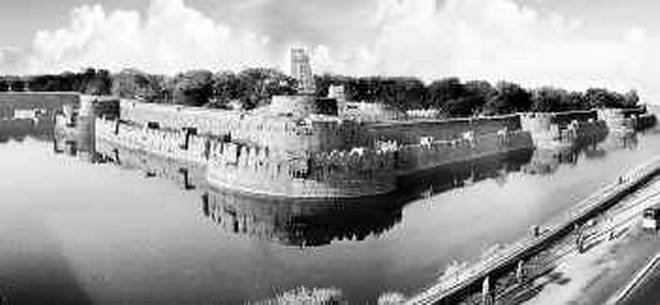
Site of awakening: The Vellore fort today. Photo: Curator, Government Museum, Vellore
Though it preceded the First War of Independence by almost 50 years, not much is known of this brief act of valour by the sepoys of the Vellore fort.
In the late-18th Century, the fakeers played a key role in spreading the message of unity amongst Indians and the need to throw out the British.
AT three, in the stealth of the dawn, on July 10, 1806, when it was still very quiet and the calm enveloped the Vellore fort, the doors of the native barracks suddenly flung open. Five hundred brave Indian sepoys were on the threshold of a mutiny they had so carefully plotted. Armed with muskets, they tiptoed out, dragging in their midst two heavily muffled six-pounder guns. They reached the European barracks, briefly halted, lifted the muskets to their shoulders and waited expectantly. The signal they anticipated was issued presently. It was at once fire works that shattered the still and the quiet. Windows and glass crashed while the English inmates woke up to their peril. Either they were killed in their beds whilst in deep slumber or were put down while running out in night robes trying to make sense of the pandemonium that had broken out so suddenly.
Losing direction
The Vellore War of Independence against the East India Company occupation was now well on its bloody course with all the trappings of romance associated with mutinies manifesting itself on that fateful morning. Underdogs defying authority, secretive planning, courage against intimidating authority, bravery and fearlessness towards death – all moved by a deep sense of right being on their side. By the time the smoke cleared and the guns became quiet by 5 a.m., about 15 British officers and about 100 English soldiers had been killed.
Col. Fancourt, the Commander of the Fort and Garrison was the first to be shot. Jamaidar Shaik Cossim, one of the principal leaders of the rebellion, had arranged to hoist Tipu’s Mysore flag over the fort signalling that the fort had been taken over. As the flag was fluttering proudly, the course of the mutiny floundered and lost its sense of direction and purpose.
Some of the sepoys started looting the houses of the Europeans, whilst others were busy abusing sepoys who did not take part in the mutiny. Yet others were conducting inconclusive discussions with Tipu’s sons, who were held captive within the fort, to come out openly and lead. Tipu’s princes hesitated and vacillated.
Though this rebellion preceded the First War of Independence (Sepoy Mutiny of 1857) by over 50 years, it has not been given the importance and significance it deserves as a determined early attempt to throw out imperialism and alien rule from Indian soil. We will take a brief pause from the fast-paced events of that fiery morning and analyse the causes for and significance of this rebellion before coming back to July 10, 1806 once again to complete our story.
Key influence
At the time of the Mutiny, the Vellore fort was station to the following Infantry Military units.
Battalions of the 69th Regiment and 23rd Regiment with 1,500 native troops and about 370 white officers and men present inside.
And great dissatisfaction was brewing amongst the Indian troops on various counts. And this had a good deal to do with the Fakeer Movement of the late 18th Century.
These fakeers were mystic mendicants (at times doubling up as mercenaries!) commanding the respect and affection of both Hindus and Muslims. In large numbers, they went from town to town conducting discourses, prayers and even puppet shows. They played a key role in spreading the message of unity amongst Indians and the need to throw out the British. They often got in touch with sepoys and native officers and instigated them to rebel. Their methods were secretive and the appeal powerful. These fakeers fanned all over the South and hence one can see that in the early 19th Century, there were several rebellions in the South.
The Chittoor polygors fighting the British between 1804 and 1805, the Travancore Mutiny in the same period and the Madurai outbreak of 1804 are examples to cite.
The famous valiant Wayanad hero, Pazhassi Raja gave the English anxious times till his capture and death in 1805. There was a ground swell of nationalism and a strong undercurrent of hope. And the fakeers sure had a significant role to play. Cantonments from Wallajahbad to Palayamkottai had been caught up in this freedom fervour.
The fakeers had a simple and enduring message: “we are many and they are few”.Like the gunpowder in the cartridge that needs a spark to ignite, the spark for the Vellore uprising came in the form of new uniform regulation announced by John Cradock in March 1806.
Cradock was the Commander-in-Chief the Madras Army. A new cap was prescribed in place of the turban and caste markings on the face were prohibited. The beard was to go. The hair over the upper lip was to be regulated and the wearing of earrings abolished. The troops saw this as the first step to Europeanisation and conversion to Christianity. Hindu and Muslim soldiers resented the regulations. Muslim soldiers expressed solidarity with Hindu sepoys who despised the use of cow leather in the new cap prescribed in the revised uniform regulation issued by the office of Cradock. Hindus and Muslims together rose as one in the name of religion and liberty.
Yet another factor that helped shape events in Vellore was the presence of Tipu’s family in the fort. They were confined and housed in the palaces and mahals formerly of the Nawabs of Arcot which lay within the precincts of the fort. After his heroic death on May 4, 1799, Tipu’s 12 sons and six of his eight daughters were brought to Vellore along with a retinue of servants and the party totalled 1,378.
In Vellore town itself a number of people had settled down following Tipu’s heirs. A certain Lt. Col. Marriott (pay master of Stipends) and his brother Capt. Marriott (the assistant paymaster) were in charge of the privileged prisoners.
Ironic twist
The presence of Tipu’s princes undoubtedly inspired the sepoys. Ironically, the princes perhaps did not provide decisive and inspiring leadership to the uprising.
Prince Moiz-ud-Deen is reported to have conducted some parleys with the leader of the uprising and Prince Fettah Hyder offered support in the early phase of the planning, albeit not too openly. Prince Moiz is said to have met key leaders like Subedar Noor Mohamed, Subedar Shaik Hossain and Jamaidar Shaik Cossim prior to July 10.
After assuming control of the fort, when Sheik Cossim and the others asked the princes to come out and openly lead them, the princes were insisting that they see the body of Lt. Col. Marriott first. This response did not help the course of the uprising which was already beginning to lack organisation.At that point and at about 9.30 am on July 10, 1806, Col. Gillespie of the 19th Dragoons, commanding the Cavalry Cantonment 16 miles away at Arcot, reached Vellore to put down the Mutiny. One Major Coates of the 23rd Regiment had earlier dispatched a letter through an officer at around 6 a.m. to the Arcot Cavalry unit seeking help. Gillespie arrived with an advance force. Lt. Col. Kennedy from the same cavalry reached a little later with heavy guns.
Swift end
The dislocated mutineers did not regroup in proper defence. The gates were blasted open by the 19th Dragoons and they stormed in. The rebelling native sepoys were mercilessly hounded and killed. It is reported that around 800 of them were found dead at the fort alone. More lives were evidently lost. By 2 p.m. in the afternoon the rebellion had not only been completely silenced but had come to be a brief pale memory of heroism – a flicker that was sadly extinguished.
As was expected, the British ordered a Court of inquiry into the events. It was also considered risky to keep the Tipu’s family in Vellore, so close to the seat of their former glory. They were taken and resettled in faraway Calcutta. The news of the Vellore War of Independence had sent shockwaves in England. The Governor, William Bentinck and Commander-in-Chief of the Madras Army, Sir John Cradock both were recalled on this count.
Historians should do more to research this not so well documented act of heroism, to inquire into questions like the impact of this event on the 1857 great rebellion.
Commemorating this unique rebellion, the State Government on the Bicentennial Anniversary held a function on July 10, 2006 with the Chief Minister participating and releasing a special volume on the Vellore uprising.
Voluntary groups and students are planning cycle rallies to Vellore to take home to the people of India the message of sacrifice behind these sepoys who dared to rebel so that we may live in a free country.
source: http://www.thehindu.com / The Hindu / Home> Features> Sunday Magazine / by A. Rangarajan / August 06th, 2006
Could the Tiger’s position — now behind a glass case, its crank handle inaccessible to the public — be an apology for the disrespect permitted in East India House?
The artefact sitting in V&A was iconic, identifiable and far away from home
The day I saw Tipu’s Tiger behind its glass case at the Victoria and Albert Museum in London was a day of significance. That morning, after months of being cooped up in Oxford, some friends and I took the train to Marylebone and found the absence of dreaming spires refreshing to say the least. At noon, a friend from India was waiting for me on the other side of the busy Camden High Street. As we hugged amidst the crush of gliding Londoners, her muffled exclamation might have been: ‘It’s so crazy we’re meeting here of all places, so far from home.’
That phrase would be borrowed by me on two separate occasions during the day. In the evening, I stood before Julian Barnes at the Royal Institution and told him how I had read ‘A Short History of Hairdressing’ over and over again to teach myself the ‘architecture’ of a short story. I felt a potent urge then to parrot my friend. It was ‘crazy’ to see and hear Barnes in the flesh, so far from my bedroom in Kolkata, the only other place he had seemed real and, dare I say, attainable through his prose and through the material object, that is, his books in my hands, the only feasible rendezvous with the man.
I had never thought then it would happen: to have someone I studied so minutely sit before me and confess he didn’t think as highly of his short prose as I did.
Iconic meeting
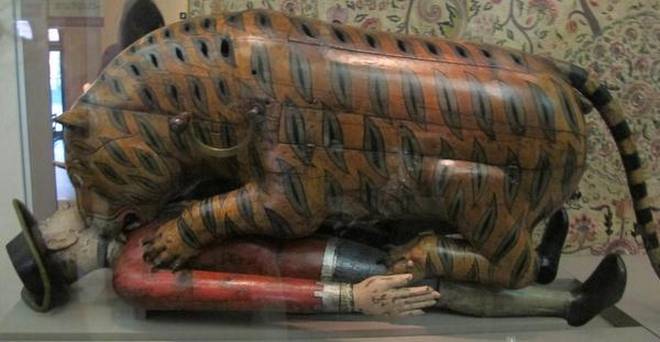
The second occasion I was inclined to echo her words that day was when I stood in the South Asia section of the V&A before Tipu’s Tiger, which had always been relegated to the Did You Know section of our history books. It was not exactly like meeting an old friend or a revered author, but it bore all the characteristics of such a meeting. Like Barnes and my Kolkata friend, it was instantly iconic, identifiable from a distance, and a ready reminder of my distance from India. In fact, standing before the wooden automaton, slightly disconcerted, I addressed it and thought: ‘You are so far away from home.’
The possible inspiration for the mechanical figure seems fitting to some. Hector Munro Jr, whose father defeated Tipu’s father Hyder Ali in the Second Anglo-Mysore War in 1781, was mauled by a royal Bengal tiger at Saugor Island in 1792 and died from the injuries. This must have seemed like divine intervention to Tipu, a wrong set right. The carved and painted, almost life-size, wooden musical automaton was created for the Sultan, whose personal emblem was a tiger and whose hatred of the British was well-known.
The last laugh
With the fall, however, of Seringapatam and the execution of Tipu in the Fourth Mysore War of 1799, the Tiger travelled from the music room of Tipu’s summer palace to the Company’s East India House at Leadenhall Street in London, where the public was given access to view and play with it.
Its wooden body with a keyboard embedded in the flank was thrown open to the English masses who came in and played ‘God Save the King’ and ‘Rule, Brittania!’ upon it. If Tipu thought he had been mocking the Englishmen with the Tiger, they were now having the last laugh.
I deal with issues of empire and post-colonial anxiety almost on a daily basis, especially in a place like Oxford, especially on a course called World Literatures in English. Of course, when I first saw it, I silently demanded a restoration of the tiger to its previous owner, to its previous nation. My anger at seeing the Tiger in an English museum, so far away from home, was justifiable. The Tiger was not borrowed. Nor was it touring, as it had to New York’s MoMA in the 50s. Instead, it was a ‘permanent’ acquisition at the V&A.
Of collaborations
For every Indian schoolchild, the Tiger, just an artefact but nonetheless awe-inspiring, was not an affordable train or flight away, like Fatehpur Sikri or Sher Shah’s tomb.
For me, the Tiger’s distance from my home was a reiteration of the national and racial distinctions not only of the Anglo-Mysore variety, but also of the Jadavpur-Oxford type that I faced every day. Besides dodging questions like ‘If you’re from India, how’s your English so good?’ for the past few months, I had had to clarify to a white friend who subsisted on the chic-ideal of Zadie Smith that India has Bengalis too, and no, I did not have relatives in Brick Lane, not that I knew of anyway.
Seeing Tipu’s Tiger that day catalysed a recollection of an afternoon in 2016 in the Victoria Memorial Hall with Thomas Daniell and his nephew William. Their tranquil scenes of India, while in stark contrast to the ferocity of the Tiger, do something interesting.
The English hands of the Daniells reproduce the Indian hands of the architects behind the buildings and locations they sketch. Their canvas becomes a surface of Anglo-Indian collaboration, similar to how it is conjectured that the mechanics of the Tiger have an Indo-French history.
This recollection, and the subsequent contemplation on collaboration, made me think of several works of restoration that the V&A carried out upon the Tiger, especially after the bombing of London in World War II. Could this act of restoration be seen as an act of reparation? Could the Tiger’s position — now behind a glass case, its crank handle inaccessible to the public — be an apology for the disrespect permitted in East India House?
The Tiger, so far from home, is an icon that reminds me of a past based on plunder and pillage by the nation it sits in. Yet, its 18th century splendour has weathered war and wear so well. Do present acts of safekeeping obliterate the violent history of its, for want of a better word, theft?
I am persuaded to wonder if the Tiger is now a collaboration between Tipu’s Mysore craftsmen and its modern conservationists in England and if I should be thankful for the restoration. Are the acquisition and conservation of an Indian object in a British museum and the works of British painters displayed in a Calcutta museum an instance of transnational collaboration and exchange? But in the case of Tipu’s Tiger, this then also begs the question: how long is too long before we forget that what is ‘acquired’ is what was once ‘removed’ from its home?
The writer, a Felix Scholar, is studying World Literatures in English at Oxford
source: http://www.thehindu.com / The Hindu / Home> Society> History & Culture / by Rohit Chakraborty / May 05th, 2018
The freedom movement of India was not the sole agenda of a particular political party but it had moved aam aadmi in the form of masses in his/her own capacity. The history of Indian national movement would be biased and incomplete without the presentation of the actual role of Indian Muslims in it, right from the revolt of 1857 to the day of Independence in 1947.
Shoulder to shoulder they fought with the other communities for the Independence of India. The contribution of Muslim poets, revolutionaries and writers is not known today. Instead of secular historiography, it has been communalised. Courtesy: Mapsofindia.com
The Muslims and other minorities never envisaged India as adopted land because Muslims of India have not come from outside but are the converts to Islam and have deep feeling sense of belonging to this country and therefore contributed to the cultural, economic, intellectual and spiritual progress throughout the ages.
The role, significance and uprising of Indians against British imperialists can be seen since mid of 18th century in the form of Battle of Palashi (Plassey), June 23, 1757. It was Nawab Siraj-ud-Daulah who first awakened Indian rulers and gave a call to oppose the British. He, however, lost the battle and was executed at the young age of 24. This was soon followed by the great Tipu Sultan, who was killed by Lord Wellesley during the fourth Anglo-Mysore war in 1799.
The contribution of Muslim revolutionaries can be witnessed from the first half of 19th century. The Faraizi and the Wahhabi Movements had disturbed the pace of British plan in the initial stages of its expansion in India. The Wahabi movement of Syed Ahmed Barelvi was the most organised one. He appealed to all Hindus and Muslims to overthrow the British and thus he was killed in 1831 at Balakot.
The number of Muslims executed only in Delhi during 1857-58 was 27,000. During this revolt, Asghari Begum (mother of Qazi Abdur Rahim, the revolutionary of Thana Bhawan, Muzaffarnagar) fought against the British and was burnt alive when defeated. It was estimated that about 225 Muslim women gave their lives in the revolt.
Similarly, barely is known about the contribution of Muhammad Ashfaq Ullah Khan of Shahjehanpur who conspired and looted the British treasury at Kakori (Lucknow) to cripple the administration and who, when asked for his last will, before execution, desired: “No desire is left except one that someone may put a little soil of my motherland in my winding sheet.”
Likewise, the present generation does not know about Khan Abdul Gaffar Khan, a great nationalist who had passed 45 years of his 95-years of life in jail for the freedom of India and thus awarded ‘Bharat Ratna’ in 1987. Barkatullah and Syed Rehmat Shah of Ghadar Party sacrificed their lives. Umar Subhani, an industrialist and a millionaire of Bombay who, then, presented a blank cheque to Gandhiji for Congress expenses and who ultimately sacrificed his life for the cause of Independence. Maulana Hasrat Mohani, with his poetry, infused zeal of freedom in young hearts.
Maulana Abul Kalam Azad, at the age of 35, became the youngest person to serve as the President of the Indian National Congress. He was the icon of Hindu-Muslim unity as well as espousing secularism and socialism. Raj Mohan Gandhi in his book ‘Understanding Muslim Minds’ mentioned that Maulana went straight to Congress office just after the funeral procession of his wife, Zuleikha Begum and led Quit India Movement.
Manmohan Kaur in her book entitled as ‘Women In India’s Freedom Movement’ makes reference to only Begum Hazrat Mahel and Bi-Amma out of the hundreds of women who fought the battle of freedom along with their men folk against the British Raj. The history of the Indian national movement would be incomplete without mentioning the heartily services of Abadi Begum (mother of Maulana Muhammad Ali), Amjadi Begum (wife of Maulana Muhammad Ali), Amina Tyabji (wife of Abbas Tyabji), Begum Sakina Luqmani (wife of Dr Luqmani and daughter of Badruddin Tyabji), Nishat-un-Nisa (Begum Hasrat Mohani), Saadat Bano Kitchlew (wife of Dr Saifuddin Kichlew), Zulekha Begum (wife of Maulana Azad), Mehr Taj (daughter of Khan Abdul Ghaffar Khan), Zubaida Begum Daoodi (wife of Shafi Daoodi, the reputed nationalist of Bihar) and many others.
Santimoy Ray’s ‘Freedom Movement And Indian Muslims’ challenges the many prejudices that generate bias and hatred against the Indian Muslims, particularly their contentions role in Indian freedom movement.
This shows the great sacrifices they made to oust the British rule in all the national uprisings from Sanyasi Movement to Independence, finally led to the withdrawal of British from India in 1947. It is such a pity that their roles in the struggle for freedom has not been adequately presented in the Indian history. The comprehensive study about the role of Muslims struggle for freedom is essential to help eradicating prejudices and many misconceptions against the Muslims grown in the absence of fair historiography.
I’m recalling some of the beautiful lines of Faiz Ahmed Faiz …
Ye daagh daagh ujaalaa, ye shab-gaziida sahar,
Vo intizaar thaa jis-kaa, ye vo sahar to nahiiN,
Ye vo sahar to nahiiN jis-kii aarzu lekar
Chale the yaar ke mil-ja`egi kahiiN na kahiN
Falak ke dasht meN taroN kii aakhiri manzil,
KahiN to hogaa shab-e sust mauj kaa sahil,
KahiN to jaake rukegaa safiina-e-gham-e-dil.
Abhii chiraagh-e-sar-e-rah ko kuchh khabar hii nahiiN;
Abhii giraanii-e-shab meN kamii nahiiN aa’ii,
Najaat-e-diidaa-o-dil ki ghaRii nahiiN aa’ii;
Chale-chalo ke vo manzil abhii nahiiN aa’ii.
Meaning:
This stain-covered daybreak, this night-bitten dawn,
This is not that dawn of which there was expectation;
This is not that dawn with longing for which
The friends set out, (convinced) that somewhere there we met with,
In the desert of the sky, the final destination of the stars!
Somewhere there would be the shore of the sluggish wave of night,
Somewhere would go and halt the boat of the grief of pain.
The lamp beside the road has still come no lessening,
The hour of the deliverance of eye and heart has not arrived.
Come, come on, for that goal has still not arrived.
(Author is currently preparing for civil service examinations.)
source: http://www.twocircles.net / TwoCircles.net / Home> Articles> Indian Muslim / by Shaik Amer Arafath / August 14th, 2015
`Masjid-e-Meraj Bada Makan’ is tucked away in a nondescript lane on Lalbagh Main Road. Nothing about the structure or its adjoining dargah (now under renovation) seems `historic’. But then, first impressions can be misleading.
The story goes back to 1753, says the mosque’s secretary Abdul Shukur. Hyder Ali decided to take the blessings of a fakir in Salem before the battle of Tiruchinapally against the British. It is said he was shocked when the saint Attaullah Shah Shuttari forbade him from fighting. The commander went ahead nevertheless, a move that resulted in defeat, grave physical injury and loss of lives.
Hyder Ali then requested Shuttari to become his pir (spiritual guide). Pointing to a brickwalled home opposite the mosque, Shukur says, “Hyder Ali built this bada makan (large home) for the fakir and it continues to be occupied by his descendants.“ Local residents and historians believe Shuttari had a greater role to play.
Syed Suleiman Ali Shuttari, the eighth-generation descendent of Attaullah Shah Shuttari, says people from far and wide visited his illustrious ancestor. They travelled in bullock-carts and stayed put in the grounds next to the mosque, waiting for the saint to finish his prayers. During one of his visits, Hyder Ali was pained to see people wait in the blistering heat. So, he commissioned the making of Lalbagh in 1760.
“Lalbagh was originally planned over 30 acres of land here, before Tipu Sultan and the British planned it across the 240 acres that we see today ,“ says Mansoor Ali, founder, Bengaluru By Foot. Mosque members go a step further to claim that Lalbagh was named after Haider Ali’s mother Lal Bi.
Popular narratives of history , however, say Hyder Ali was inspired by the Mughal gardens in Delhi and so had Lalbagh built. The horticulture department website suggests that Lalbagh derives its name from the red roses that bloom year-round in the botanical garden. After Shuttari’s death in the the 1770s, a dargah was built on his grave. Hyder Ali himself passed away in 1782.
The place also has an old well, said to be 30feet deep. Popularly known as Bada Makan Ki Boudi, it was apparently built by Haji Nasiruddin, a district commissioner and a follower of Shuttari. His great-grandson Shabaz Shariff said that Nasiruddin spent `200 to build the well. “It never dries out. In fact, it was among the only sources of water during the famine of 1876,“ he says. Though the well is locked, it continues to supply water to the mosque and the local community .
source: http://www.economictimes.indiatimes.com / The Economic Times / ET Home> Magazines> Panache / by Divya Shekhar, ET Bureau / July 13th, 2017
Tipu Sultan, the `Tiger of Mysore’, born Fateh Ali Sahab Tipu in 1750 at a place now part of Bengaluru, was never in Calcutta. But our city has two masjids in his name as descendants of his descendants live in our city. Last year, the government of Karnataka decided that November 10 will be annually celebrated as Tipu Sultan Jayanti. This attracted foolish objections from those who never learned from history but want to rewrite it and rip up the country’s social fabric. As Stephen Hawking succinctly puts it, “We spend a great deal of time studying history , which, let’s face it, is mostly the history of stupidity.”Tipu Sultan, the powerful ruler in south India during the 18th century , when the British themselves were taking over India in their empire-building frenzy , was a formidable opponent to their imperialistic ambitions.Unfortunately , he died on the battle field in 1799, one of the first Indian rulers to do that. However, he had also signed a treaty with the British seven years earlier by which he ceded half his kingdom and unable to pay the colonists some `300 lakh, had to accept his two minor sons being exiled to Calcutta.Although they were returned to their family two years later, a `mutiny’ in 1806 resulted in the entire family and entourage of about 300 people literally being shipped off to Calcutta. This included Tipu’s 11th son, Prince Ghulam Mohammed Anwar Shah. Ghulam Mohammed is remembered today , if at all, by the name of the road that skirts around the Royal Calcutta Golf Club (RCGC) and arrives at the Golf Green area.
The family was settled in hutments on marshy tracts of land in Russapugla, the area which now houses Tollygunge Club and RCGC, initially liv ing in penurious conditions.However, Ghulam Mohammed Shah was enterprising. He scrounged and saved the stipend he received from the British and built up his finances through judicious investments, later acquiring the lands they were settled in and setting up the Prince Golam Mohammed Trust in 1872. He built the famous Tipu Sultan Shahi Masjid located at the junction of Dharmatala Street and Chowringhee in honour of his father in 1832. A decade later he built the twin of that mosque in Tollygunge at the crossing of Prince Anwar Shah and Deshpran Sasmal Roads. The Trust started by him is considered to be one of the richest Muslim trusts in the country , their revenues earned mostly from the ownership of multiple properties stretching from south to central Calcutta. It is said the land on which the Lower Circular Road Christian cemetery is located was acquired from Tipu Sultan’s son in 1840.That explains the small mosque in an enclosed area at the rear of the cemetery .
It is fun to extrapolate that despite the political and social conflicts raging in the nation at that time, the Tipu Sultan Shahi Masjid, one of the lesser known heritage attractions of Calcutta, along with the Sacred Heart Church, a short walk down Dharmatala Street, as its contemporary neighbour, are rather obvious examples of this city’s plurality and cosmopolitan nature.Tollygunge, not yet known as Tollygunge, would be called that after Colonel William Tolly dredged the Gobindapur Creek in 1773 and reconnected Calcutta Port with the Matla and Bidyadhari rivers. He was also permitted to levy a tax on ships plying to and from today’s Bangladesh and built a market there, a ganj. The area was thereafter known as Tollygunge. In due course, Prince Ghulam became the owner of almost all the land.
The first hole of Tolly Club’s golf links is named after Tipu Sultan and for someone who never even set foot in this city, his legacy here is quite something to wonder at. George Orwell said, “The most effective way to destroy people is to deny and obliterate their own understanding of their history .” Rewriting the history of a country to fit a particular political mould is an attempt to do exactly that and it shall fail because those doing so are in denial. Tipu Sultan was many things to many people. He was probably what many monarchs were at that time, benevolent and violent, fighting valiant battles to retain his lands and his people, harsh and despotic, heroic and innovative, patriotic and tyrannical, and a whole lot more. He, nevertheless, will be a significant character in our history, if for no other reason but that he was where he was, when he was.
One of the ways someone like Tipu Sultan will live on in history is because of music.He featured in folk songs of the period as he did in English ballads of the time. The English songs were of course all derogatory and cursed the Indians in various ways, while being full of self-praise and odes to British military valour.Perhaps there is still time for someone to do what Francis James Child did in the 1800s, collecting Scottish and English ballads and transcribing them to text and notation. The wealth of folk music in India would give us, what could only be an amazing take on the history of our country .
— PATRICK SL GHOSE
source: http://www.timesofindia.indiatimes.com / The Times of India / News> City News> Kolkata News / by Patrick SL Ghose / TNN / November 06th, 2017
An extract from Kate Brittlebank’s Tiger: The Life of Tipu Sultan.
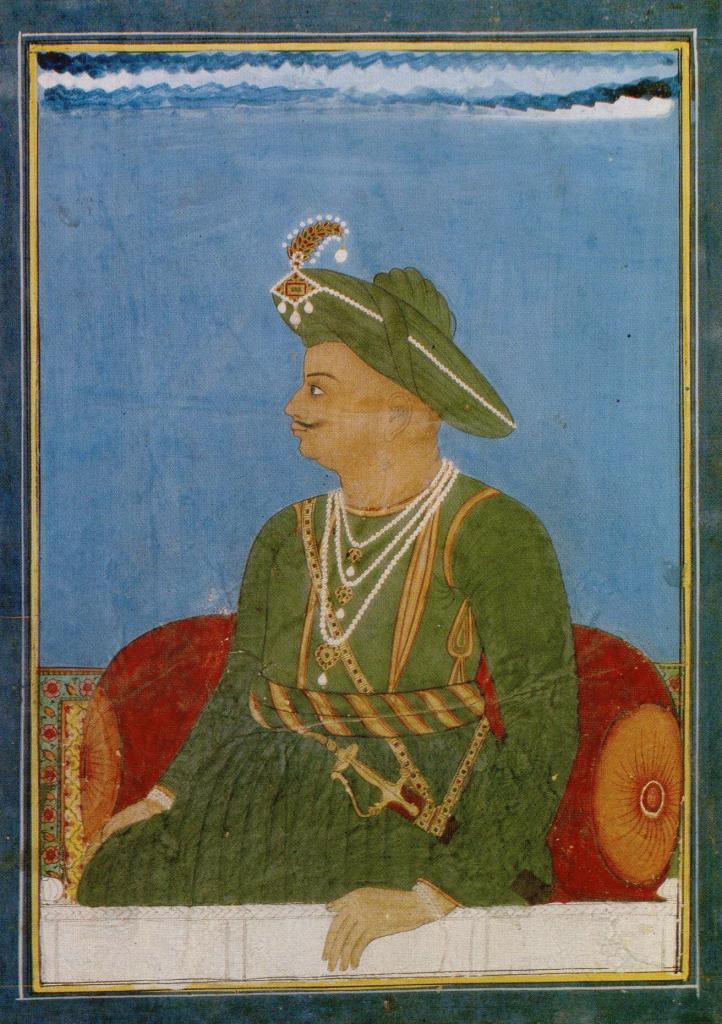
Tipu Sultan. Credit: Wikimedia Commons
The Karnataka government’s decision to celebrate the birth anniversary of Tipu Sultan has once against created a controversy, with the BJP and the RSS as well as local groups in Kodagu district opposing the move. A rally against the proposed celebration is planned in Bangalore on Tuesday. Last year, the government’s decision led to large-scale violence; this year, a case was filed against the move, but the court’s declined to interfere, calling it a policy decision. At the same time, the judges asked what the rationale was to hold such a celebration.
Was Tipu Sultan (1750-1799) a hero or a villain and was he, as is claimed, against Hindus? Some scholars have contested these views. In this excerpt from her book Tiger: The Life of Tipu Sultan, historian Kate Brittlebank gives a more nuanced and holistic view of the man and the monarch, who, she says, was a product of his times.
Kate Brittlebank Tiger: The Life of Tipu Sultan Juggernaut, 2016
It was also important, if Tipu were to retain power, that he tap into the south’s shared sacred landscape, and it is in this light that we should read his patronage of religious institutions, which was widespread. For centuries, kings had associated themselves with the sacred sites of the region, the most significant being the river Kaveri, the Ganges of the south. Rising in the hills of Kodagu, the river wends its way across the Mysore plateau and down onto the plains of Tamil Nadu. Its entire length is dotted with religious landmarks, small and large. For south Indian kings the Kaveri was not only the source of life-giving water but also of divine power. Along the river are three islands, formed where the water divides: from east to west, they are Srirangam, Sivasamudram and Srirangapattana. These are the places where Vishnu sleeps upon the great serpent Sesha, when he is known as Sri Ranganatha, and on the islands are temples dedicated to the deity. The most magnificent is at Srirangam but all were recipients of past royal patronage; in 1610, Raja Wodeyar transferred his capital to Srirangapattana from Mysore after seizing the island from the Vijayanagara viceroy, Tirumala.
Given that the island of Srirangapattana was such a significant repository of divine power, Tipu would have been foolhardy to transfer his capital elsewhere. He continued the Wodeyars’ patronage of the Sri Ranganatha temple, alongside which stood his main palace, and erected a Friday mosque. Haidar’s tomb stood at the other end of the island, near the sangam, next to which Tipu built another, smaller mosque. Put simply, lordly benefaction, one of the defining characteristics of Indian kingship, was pragmatic in purpose. Along with their magnificent displays of power and wealth, kings were expected to be conspicuously pious. They made land grants, donated precious artefacts and mediated in religious disputes. In return, they could expect support for the legitimacy of their rule and prayers for the security and prosperity of the realm. Tipu behaved no differently: his generosity to temples, Sufi dargahs and mosques, as well as the great Math at Sringeri, are well documented, primarily through inscriptions and institutional records.
An idea of the number of Tipu’s religious endowments across his realm can be gained by looking at in‘am registers held in the Kozhikode Archives in Kerala. The records show that Tipu authorised sixty-seven grants of rent-free land, primarily to temples and mosques, solely for the taluks of Calicut, Ernad, Bettathnad and Chowghat. If we extrapolate that figure across the entire realm, it is clear that his patronage of such institutions was extensive. We know of several temples that hold objects donated by Tipu – the Sri Ranganatha temple at the capital received silver vessels, the Nanjundeshwara temple at Nanjangud has a jadeite linga said to have been installed on Tipu’s orders, and inscriptions record that he gave elephants and silver vessels to the Narayanaswami temple in Melukote.
The Sringeri Math, with which Tipu maintained a close relationship, received gifts of valuable cloths and shawls, a silver palanquin and a pair of silver fly whisks. The importance of the Math to south Indian and Deccani rulers – both Hindu and Muslim – since its foundation in the eighth century, is demonstrated by the fact that it holds more than 200 copperplate grants and sanads, the earliest dating from the Ganga dynasty (c. 250–1000 ce). Tipu referred to the Math’s Swami as the Jagadguru and, after the Marathas had raided the Math in 1792, he wrote in a letter that the culprits would ‘suffer the consequences of their misdeeds at no distant date in the Kali age’, concluding that ‘treachery to gurus will undoubtedly result in the destruction of the line of descent’.
The political nature of religious patronage was also the rationale behind acts of destruction. All across India, whenever a king conquered another, he signalled his victory by either seizing or destroying the religious sites with close ties to his victim – and it made no difference if conqueror and conquered were co-religionists. Just as Shaivite and Vaishnava dynasties in south India patronised mosques, dargahs and churches, they did not hesitate to capture the temples of their enemies and seize or destroy the images. The Cholas seized temple images from the Calukyas; and Vijayanagara’s Krishnadevaraya, to celebrate his defeat of the Gajapati king, removed an image of Balakrishna from Udayagiri to the capital. We can see this process in operation with Tipu’s demolition of the Varahaswami temple at Srirangapattana; after his death, the Wodeyars, in a statement of their own ‘victory’, relocated the ruined temple’s image to Mysore town, which once again was serving as their capital. If Tipu’s actions had been driven by religious rather than political motivation, he would not have allowed the Sri Ranganatha temple to continue to flourish within sight of his palace. It was the Wodeyars’ direct association with Vishnu’s boar incarnation that led to Tipu’s demolition of the Varaha temple. Nor were Christians exempt from such treatment – the Venkataramana temple in Nagar (formerly Haidarnagar/Bednur) possesses a bell cast in Amsterdam in 1713. The presence of this oddity in a Hindu place of worship is due to Tipu’s removal of it from a church in Malabar.
Similarly, Tipu did not discriminate against particular religious groups on the basis of their faith – indeed, his diwan or chief minister, Purnaiya, was a Hindu. As we have already seen, Tipu suspected the Kanara Christians of treachery and being in league with the British; the Nairs and the Kodavas, too, were punished for intriguing against him. And if there should be any doubt about what lay behind the treatment of such groups, the expulsion of the Mahdevis from Mysore in 1794 confirms the political character of such acts. This tight-knit Muslim community of several thousand mainly served in Tipu’s army as horse soldiers, under the command of their own officers. That Tipu was in no way prejudiced against this sect is demonstrated by the fact that one of his four vakils to Istanbul, Ja‘far Khan, was a Mahdevi; even so, he too was expelled in 1794. The stated reason for the community’s expulsion was their refusal to obey Tipu’s command to keep certain celebrations low-key – they were prone to noisy bouts of praying – as the festivities that year coincided with the return of the hostage princes from Madras. The more likely reason, however, was that Tipu suspected the Mahdevis of treason, with their festival disobedience merely the trigger for the order that they leave the kingdom. Interestingly, during the Fourth Anglo-Mysore War, many of them served under Arthur Wellesley as irregular horse, although it is not clear if this was a consequence of Tipu’s treatment of them, or if Tipu had been correct in his original assumption of their disloyalty.
Excerpted with the permission of Juggernaut Books from Tiger: The Life of Tipu Sultan by Kate Brittlebank, available in bookstores and on the Juggernaut app
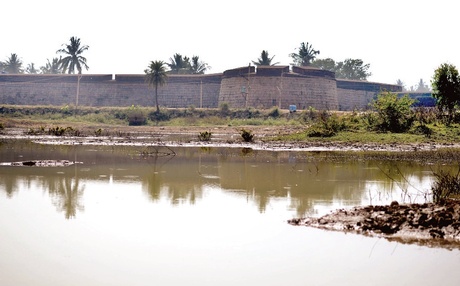
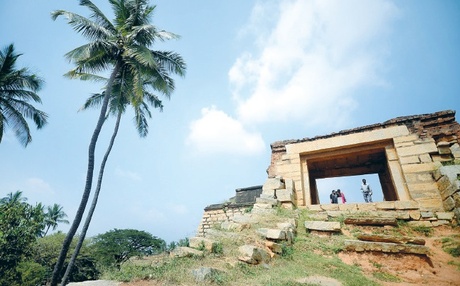
The Devannahalli fort, which stands 35 kms away from Bengaluru, is older than the city itself by 37 years.
The fort has been occupied by different dynasties over time. It was built in 1501 by Kempegowda’s ancestor, Malla Baire Gowda. But in 1747, in a battle led by Nanjarajaiah, the dalwai of Mysore, the clan lost it to the Wadiyar dynasty. Marathas later claimed it and lost it back to the Mysore state, in a siege led by Hyder Ali in 1746.
Arun Prasad, from Discover Bangalore Project, says that though Hyder captured the fort, it was his son Tipu Sultan who was responsible for modelling and building the Pulkad fort.
The town surrounding the fort was meant to be a a centre of learning and arts. “The Devannahalli town was supposed to be a place for learned artisans and intellectuals to inhabit,” says Prasad.
Devannahalli was a town typical of the time, with protected farmlands and fields. A lake, behind the fort and seen from the bastions, was meant to serve the needs of the inhabitants.
Today, the lake is dried up and is a sad sight to notice. Prasad blames it on poor urban planning. Earlier, a highway used to pass through the western part of the town. Now, a road has been built, which passes over the lake. A good portion of the lake was used up for it.
“The lake has always been rain-fed. But the new road cut the lake away from the adjoining canals and channels,” says Prasad. “The rain water could not flow in and the lake dried up. The vast area of 400-500 kms metres has only weeds and little water due to rains. You can also spot some tattered measurement devices, which was a failed attempt to study the level of water in the lake.”
Pics: Pushkar V
Bastions
Built on a higher ground, the bastions were used to keep a watch out for the enemy. The fort is 30 to 35 feet high and bastions, along the fort, are placed at equal distance from each other. “The bastions have well protected chambers, used by soldiers. The gun points are holes in the wall which can still be seen today. They are built from lime and brick. The holes were used to keep guns during the war,” adds Prasad.
Tipu’s Birthplace
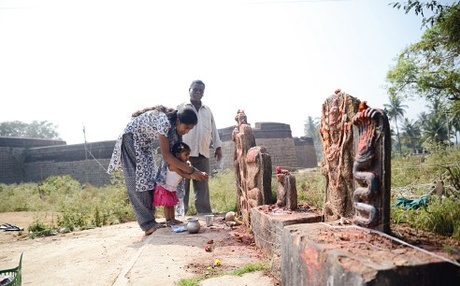
South-west of the fort, there is memorial with a board, which proclaims that Tipu was born here. A six-foot-tall enclosure marks the spot.
When Tipu was born in 1750, his father Hyder Ali was engrossed in a battle. His mother, Fatima Fakhr-Un-Nisa, was secretly ushered into a carriage to give birth at the fort, as it was considered a safe place. However, she ended up giving birth inside the vehicle, right outside the fort. The monument is built over this birth spot.
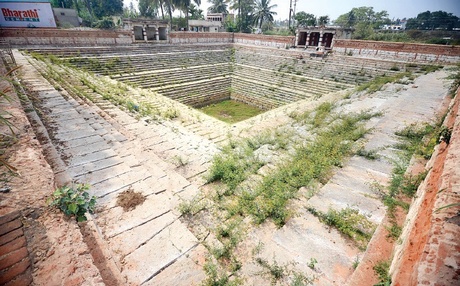
A pond was built under the administration of Purnaiah, the then Dewan of Mysore. It is a beautiful pond with the stones and excavations intact. “The water is used for rituals and festivals,” says Prasad. “People take baths here as well.”
Pics: Pushkar V
Temples
Inside the Devannahalli fort, there is the Venugopalswamy temple. The temple, which was built in the Vijaynagara style, has several depictions from the Ramayana on the walls. “At the entrance, the two horsemen are believed to belong to the Western Ganga dynasty (which ruled 350 and 1000 AD),” said Prasad.
There are sculptures of seamstresses, as you enter, from the same era. The north and south walls have sculptures showing Rishyasringa being brought from a forest to Ayodhya accompanied by dancing girls. There is also a scene of Vishwamitra caught in a an archery battle with Rama. The south wall has ten incarnations of Lord Krishna and Rama’s father performing a sacrifice.
Pics: Pushkar V
The fort gate and the fort walls are crumbling and there are scribblings on the walls. There is no security at the entrance and anyone can walk in. The commercial establishments all around have failed to preserve the authenticity of the past. “An ASI (Archeological Survey of India) office is located at the entrance, which is always closed and does not provide much information,” says Prasad. “The fort area needs to be protected by ASI and does not come under the corporation. The northern gate is crumbling as well.”
How it Began
Refugees on the run from Kancheepuram settled down near the Nandi Hills. Legend has it that Rana Baire Gowda, their leader, was told in a dream that he had to build a settlement in this region. This family goes by the name of Morasu Wokkalu. His son Malla Baire Gowda founded Devanahalli. Kempegowda also belongs to this family.
source: http://www.newindianexpress.com / The New Indian Express / Home> Cities> Bengaluru / by Seema Prasad / January 28th, 2016
The Sangeen Jame Masjid at Taramandalpet in Bengaluru.— Photo: Bhagya Prakash k
Bengaluru, KARNATAKA :
In the congested old market area of the city, where vehicles and pedestrians jostle for space on narrow lanes, lies a tale of Tipu Sultan’s ingenuity that time seems to have forgotten.
It is in this small clearing, now flanked by a sprawling masjid, that thousands of workers had gathered nearly 300 years ago to cut metal, roll gunpowder into barrels and attach sharp metallic pieces to make the once-feared ‘Bangalore Rockets’.
All that remains now of this ingenious machinery that sustained Tipu Sultan through four wars against the British is the name assumed by the few buildings in the area — Taramandalpet , or roughly, the market of the constellation of stars, a name that refers to the pattern of mid-air explosions of these rockets that then rained shrapnel on an unsuspecting enemy.
Residents — primarily shopkeepers and staff of the masjid and madrassa — seem unaware of the place’s rich history that once fuelled Indian rocketry.
“Workers would prepare these rockets that proved very effective against the British. This would then be transported to the armoury at K.R. Market, which still exists,” says Suresh Moona, a historian.
The entire street was a sort of military laboratory, a fact seen in the unearthing of two cannons during the metro construction work between 2012 and 2015.
Much of these signs, however, have disappeared. Activists point out this irony: while the government announced celebrations of the Mysuru King’s birth anniversary — which ended in violent protests — recently, symbols of the Sultan in Bengaluru and even his birthplace near the swanky International Airport on the outskirts continue to fade away.
Syed Shafiullah, vice-president of the Tipu Sultan Publicity Committee, says: “One armoury that we saw is now just piles of thrash and shops. It is a shame that all of it is going. We have been persuading the government to preserve these areas, or at least, to highlight it. It should be a pride that the technology of the British army came from Karnataka,” he says.
source: http://www.thehindu.com / The Hindu / Home> National / by Staff Reporter / Bengaluru – December 27th, 2015