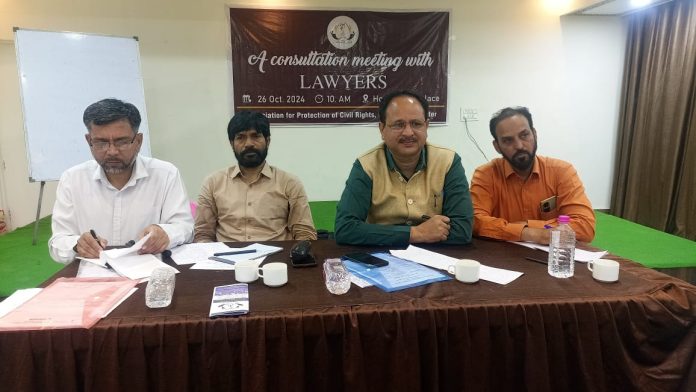
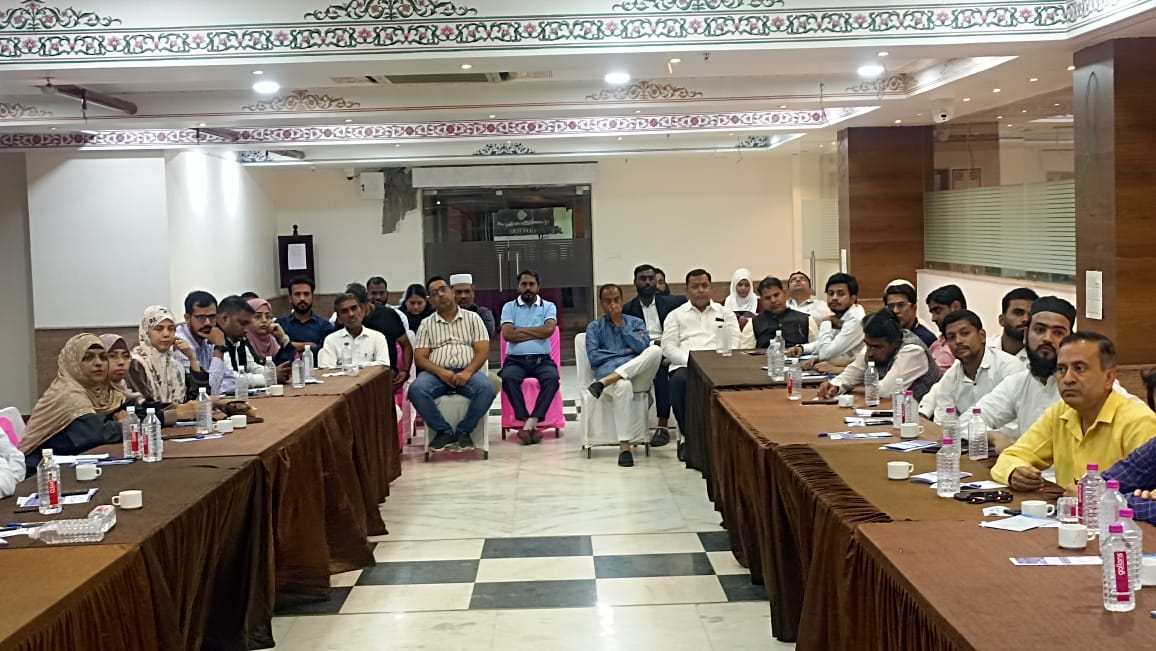
The Association for Protection of Civil Rights (APCR) organised a gathering titled “Consultation with Lawyers” at Hotel Arco Palace here Saturday. Around 50 advocates from across the state attended.
Syed Saadat Ali, APCR State President, urged the audience to prioritise helping the vulnerable, stating, “Until you assist those in need, you are not fully honouring your profession.”
He emphasised APCR’s ongoing commitment to supporting the weak.
APCR Vice President, Advocate Kaleem Ahmed, highlighted the challenge that victims’ families often face in conveying accurate information to authorities.
“It is our responsibility to assist these families by presenting the facts accurately to the administration and government, ensuring justice is served,” he said.
Advocate Munazir Islam, APCR Joint Secretary, addressed the concerning rise of “bulldozer culture” in Rajasthan, following trends seen in UP and MP. He called on advocates to remain informed and find solutions to counter this trend, noting APCR’s intervention in bulldozer cases in Udaipur, Jahazpur, and Bhilwara. He referenced a Supreme Court ruling on an APCR (Rashid Khan) petition, which stated that no home, whether owned by a criminal or not, should be subject to demolition without due process.
APCR General Secretary Muzammil Islam Rizvi, who moderated the event, introduced APCR’s initiatives in Rajasthan, highlighting its efforts to organise legal programmes, volunteer initiatives, seminars, and campaigns to promote legal awareness among the public. The meeting provided a platform for advocates to discuss their role in advancing justice and protecting civil rights, particularly concerning the increasing use of demolition machinery to enforce property laws.
source: http://www.radiancenews.com / Radiance News / Home> Latest News> Report / by Raheem Khan, Radiance News Bureau / October 28th, 2024
Pookkarathara (Edappal Panchayat, Malappuram District), KERALA :
Edappal:
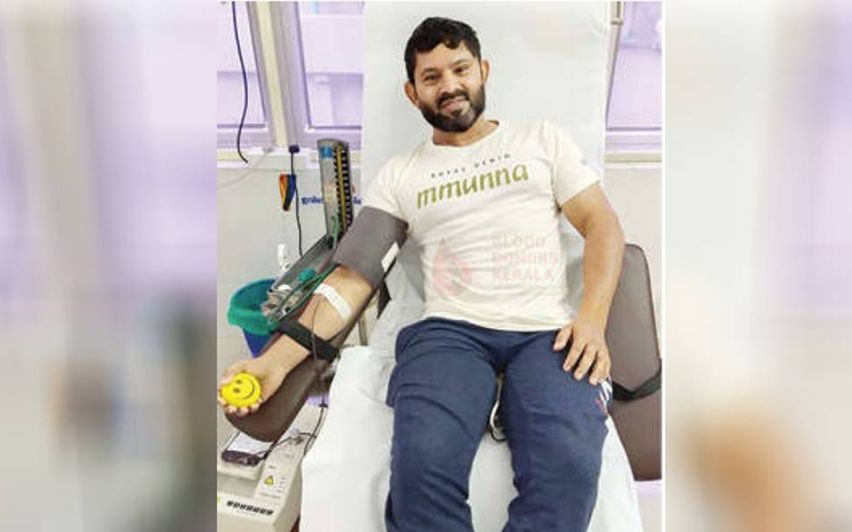
Pookkarathara native Alimon is only 50 years old and he had already donated blood for 58 people till now. He has dedicated his life for saving lives of others through frequent blood donations.
Alimon started showing interest in blood donations at the age of 15. Though he could not donate blood at that age, he used to collect the name and details of the donors and help others in need to contact them.
His father late Muhammed was a teacher at Pookkarathara AMLP school and he encouraged Ali in all his efforts. After 18, he started donating blood. He would reach the place at once when O+ve blood was required. He used to donate blood every three months except the three years he spent abroad.
Alimon is a member in the advisory committee of Blood Donors Kerala and he had received the felicitation letter of the state government for donating blood maximum number of times.
source: http://www.english.mathrubhumi.com / Mathrubhumi.com / Home> News> Kerala / by Unni Shukapuram / October 01t, 2021
In an effort to unite Bhatkallis residing in Dubai and other parts of the United Arab Emirates, the “AUZ Blast Edition 2” cricket tournament is set to commence in Dubai on October 26, 2024. The tournament is being organized by the Dubai-based Bhatkal companies, AUZ real estate and Nuha General Trading.
Providing details to the media, Ismail Mohtisham, the media coordinator of the organizing committee, explained that the purpose of the tournament is to bring together young cricket enthusiasts and players who are working in different parts of Dubai and the UAE, and to provide them with a platform to showcase their talent and take their skills to new heights.
The spectacular cricket event will not only serve as a source of entertainment for the cricket fans of Coastal Karnataka living in the UAE but will also offer young players from Bhatkal and surrounding areas an opportunity to demonstrate their abilities on a prominent stage.
The auction for the players will be held on October 6, with the first match scheduled for October 26.
Mohtisham further shared that eight teams will participate in the tournament, with a total of 220 players registering their interest. Each team will consist of 16 players, including three guest players.
The winning team will be awarded a trophy along with a cash prize of AED 10,999, while the runner-up team will receive a trophy and AED 6,999. Individual performances will also be recognized, with a Man of the Match award for each game and the prestigious Man of the Tournament award for the best overall performance.
“The tournament format will feature eight teams divided into two groups, with each team playing three league matches,” Mohtisham added. “The top four teams will qualify for the playoffs, promising plenty of excitement and competition.”
In addition to the thrilling cricket matches, fans can look forward to an exciting atmosphere with snacks and gift hampers on offer, ensuring a memorable experience for everyone attending the AUZ Blast Edition 2.
All matches will be held at Al Batayah Stadium in Sharjah.
It is important to note that Sundays are official holidays in Dubai and the UAE, while most companies have half-day holidays on Saturdays.
According to the schedule, the tournament will kick off on the evening of Saturday, October 26, with the opening ceremony, followed by the first match at 9:30 PM. On Sunday, October 27, the first match will be played at 10:00 AM, the second at 2:00 PM, and the third at 5:30 PM. For the next two weeks, on November 3 and November 10, four matches will be held on Sundays. On Saturday, November 16, two matches will take place, and on Sunday, November 17, the second semi-final and the final match will be played.
source: http://www.sahilonline.com / Sahil Online / Home> Gulf News / by IG Bhatkal / S O News Service / October 04th, 2024
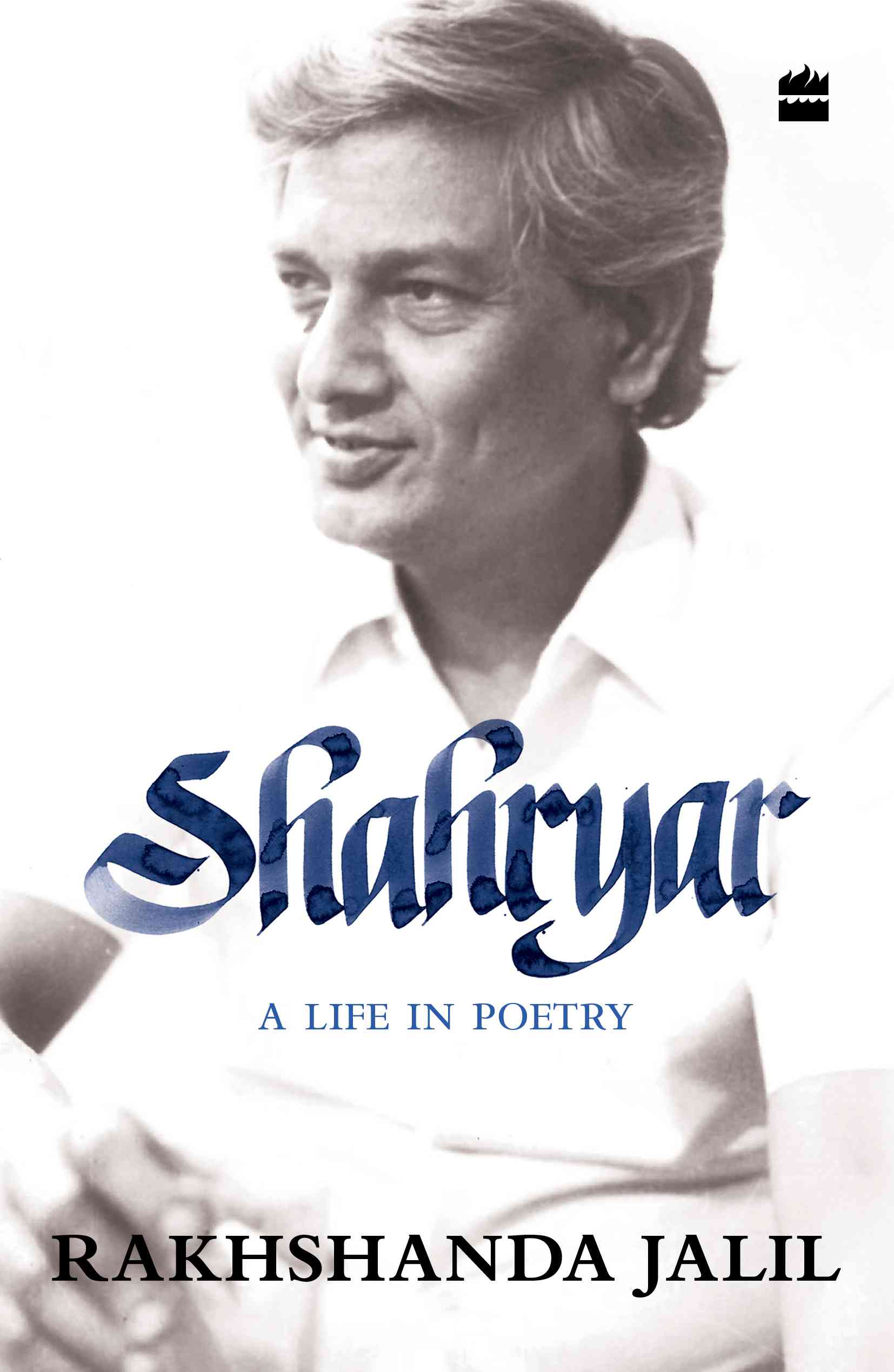
A new biography examines the life and work of one of the most acclaimed modern Urdu poets.
The Call of Unknown Destinations
Phir kahin khwaab-o haqiqat ka tasadum hoga Phir koi manzil-e benaam bulati hai hamein
Once again, a conflict between dreams and reality will rage somewhere Once again, some nameless destination calls out to me
Naya Din Naya Azaab
Sard shakhon pe os ke qatre Hain abhi mehv khwaab aur sooraj Rath pe apne sawaar aata hai
A New Day A New Calamity
Drops of dew on cold branches Are still immersed in their dreams when the sun Comes riding on his chariot
A new kind of poetry began to be written under the influence of the progressives. It loosened the hold of tradition and opened the way to new subjects and styles. From the 1940s new experiments were being conducted in Hindi prose and poetry and the Urdu writer was neither unaware nor unaffected by them; it was much the same in Hindi. Despite the jingoistic nationalism that projected the cause of Hindi and the zeal with which language chauvinists promoted one language along with its literature and respective literary culture, at the expense of the other, there were still some spaces where Urdu and Hindi writers met and interacted.
Aligarh, with its robust Urdu and Hindi departments, had healthy interactions between their respective faculty and several common platforms where writers and teachers of both languages met and exchanged ideas. In fact, the microcosm of Aligarh reflected the situation at the pan-Indian level, that is, of concurrent movements in Hindi and Urdu which prove that the ideas that propelled these movements were collective and widespread rather than unique and localised to individual languages and their respective literary cultures. And, if not mirror images, the Urdu and Hindi literary landscape displayed sufficient similarities to point to a commonality of concerns and inspirations in the years leading up to the 1960s when Shahryar begins to find his poetic voice.
The publication of a slim volume of Hindi poetry, TaarSaptak (1943), opened the door to a new wave of experimentation (prayogvaad) which, in turn, laid the foundation of the nayi kavita (new poetry).
Taar Saptak contained the poetry of seven young poets: Agyeya, Muktibodh, Shamsher, Raghuvir Sahay, Sarveshwar Dayal Saxena, Kedarnath Singh and Kunwar Narain. All seven were firm in their belief that (i) they belonged to no “school” of poetry, (ii) they were merely fellow travellers along the same road, who had differing opinions and worldviews, and (iii) they had not reached a destination or arrived at any grand conclusion; the journey was their destination.
In fact, Agyeya, the compiler of the anthology, went so far as to say that his fellow contributors consider “poetry a subject of experimentation” and that they were “explorers of new ways”. This “new” poetry turned out to be new in both form and content. The Saptak poets – and others who came under their mesmeric, insistent spell – were caught up with the need to convey a deeply-felt, intensely personal, emotional experience.
This resulted in the evolution of startlingly new metaphors and images, radical experiments in form and content, new rhythms and sound patterns that were meant to reflect harsh new truths and the deliberate use of laconic, abstruse even occasionally dense images and ideas. The entire process – spanning close to two decades – bore spectacular fruit by the 1960s.
Elucidating the commonality between the concerns of the Hindi and Urdu poets of the 1960s, especially those who came in the immediate aftermath of the progressive upsurge, Manglesh Dabral, Hindi writer and poet, notes:
“In fact, poetry, both in Urdu and Hindi, of and after the 1960s carries the melancholy, irony and sadness of its time with a ‘pessimism of the mind and an optimism of the heart’, as famously put by the Italian Marxist philosopher Antonio Gramsci.”
The waning of the progressive movement coincided with several other factors that plagued the body politic all through the 1950s and 1960s: disillusionment with the fruits of independence, simmering communal tensions, rampant corruption and unemployment, increasing scepticism about the very idea of freedom, in fact, a fast-eroding faith in any form of organised belief system be it religious, political or intellectual. The nayikavita in Hindi and the jadeed shairi in Urdu were the result of this manthan or churning in the post-1947 India.
While acknowledging Shahryar’s closeness to the Hindi department in Aligarh, especially its most charismatic teacher Kunwar Pal Singh, Prem Kumar, who taught at a college in the City, Ravindra Bhramar, who was a distinguished poet and teacher in the Department of Hindi, and Neeraj, the pre-eminent Hindi poet of Aligarh who, no matter where he worked, always returned home to his perch in the city, the eminent Urdu critic Gopi Chand Narang however feels Shahryar possibly benefitted more from early models of modernist poetry available in Urdu itself, such as Majeed Amjad, Nasir Kazmi, Muneer Niyazi and the young Turks of the “new wave”. Then there were the French models, the symbolists who had influenced NM Rashid and whose influence was plentifully available in Urdu through some spectacular and image-laden poetry, as well as Ezra Pound and TS Eliot.
Narang mentions the small leftist group lead by Maqsood Rizvi and the influence of Munibur Rehman, poet and teacher, on an entire generation of young men at Aligarh. Shahryar was at the fringes of almost all “left” activity in Aligarh – from his student days, as well as when he was a member of the staff and then again post-retirement till his death. The campus leftists regarded him as a fellow traveller – as one sympathetic to their cause if not exactly one of them, technically speaking, that is. Narang puts it well when he says, succinctly enough, “Shahryar’s urge was inner and his own”.
Poetry, Shahryar believed, must necessarily have an element of music. Without music there can be no poetry and like music, poetry too must follow some rules and principles. Above all, like music, poetry must have rigour.
While it is easy to say that poetry, and music, come naturally to those who are gifted, Shahryar maintained that even the gifted must follow certain rules and regulations if they are to be true to their gift. Mere practice is not sufficient to become proficient as a poet. For a seed to sprout, the soil it is planted in must also be fertile. Also, any seed will not sprout in any soil – no matter how much you may plough it or water it or add nutrients. It might appear as though anybody with any imagination can produce a creative work, but that is not so. Everyone cannot marshal the ideas produced by their imagination, organise them into a coherent and meaningful manner and present them in a way that is pleasing or new. Nor can everyone gather together scattered ideas and thoughts in a way that is startling. The primary function of any art form is to surprise; it is the most magical effect that art can produce.
Shahryar held tradition in great regard. Possibly because he had come through the rigour of a formal and exhaustive education – including a PhD under the exacting early supervision of a teacher such as Ale Ahmad Suroor as well as the guidance of a scholar such as Azmi – that too at a university such as Aligarh’s whose Urdu department boasted some of the finest academicians and greatest connoisseurs of urdu zubaan and tehzeeb. Unlike many of his contemporaries in the new wave of poetry that came in the wake of the progressive upsurge, Shahryar was never one to cock a snook at the centuries-old legacy that the modern Urdu poet had ready access to. He believed that tradition could teach the nuts and bolts of poetry and especially the ghazal, for the tools of Urdu poetry have remained largely unchanged while the outer appearance has changed as has its vocabulary. The manner of crafting a ghazal – a bit like “pouring” ideas into a mould or wine in a bottle – has remained largely the same since the genre of the ghazal was first perfected by masters such as Mir and Sauda.
Like cooking, which Shahryar enjoyed enormously, poetry too was a matter of getting the ingredients right. The metaphors, symbols, abstractions need to be in the right proportion; excess or want can make all the difference between magical and mundane. And just as in cooking, there is that indefinable element called haath ka maza (its literal translation “the taste of the cook’s hand” does not come close to doing justice to its meaning), so also with poetry. The form of the ghazal does not allow much deviation and the vocabulary too is constrained by metre and rhyme; yet, within these time-honoured constraints, the master ghazal-go can produce magic when the reader exclaims with wonder at something that touches his/her heart. Ghalib expressed it best when he said:
Dekhna taqreer ki lazzat ki jo uss ne kaha Maine yeh jaana ke goya yeh bhi mere dil main hai
Look at the deliciousness of speech that when [s]he spoke I felt as though this too lies within my heart
Good poetry can indeed make the reader feel “I could have said this” or “This is exactly how I feel”. And when that threshold is reached, Shahryar believed, the real aesthetic experience happens which is essentially a mystical communication between the writer and the reader or the reciter and the listener.
Shahryar was averse to extreme topicality in poetry. For literature to pass the test of time, he believed, it must contain something within it that would live beyond the here and now. In this he differed from the progressives, especially the more ideologically-driven progressives, who wrote on intensely topical subjects and whose works acquired the tag of waqti adab (topical literature).
As Shahryar said in an interview, it is not important how many poems are written on Korea; instead, what is important is how many good poems we remember being written on Korea. The undue importance being given to mauzu (topic) and maqsadiyat (purposiveness), he believed, was one of the reasons for the decline of the progressive movement:
“Purposive literature must necessarily contain the known and familiar; it has no scope for new experiments. It must have common thoughts, common feelings, and so on. Naturally, therefore, it can only accommodate general things about people, not individuals.”
Making his own position vis-à-vis art and life amply clear, Shahryar was at pains to establish the importance of life in the centuries-old Art vs Life debate – Adabbarai Adab (Art for Art’s Sake) and Adab barai Zindagi (Art for Life’s Sake):
“I believe in having respect and regard for all forms of Art on the express condition that Life – in all its myriad glory – must be present in Art. If such a situation arises whereby I am forced to choose between Life and Art, I will choose Life. Poetry is nothing more than this for me…With the coming of the English we Hindustanis discovered that literature holds a mirror to society and a valuable tool for social change. And ever since then we have all, in our own way, been doing this work. Every now and then some of us have declined to – and declined most vociferously – to perform this role.”
Among his seniors, Shahryar has acknowledged the influence of Faiz Ahmad Faiz, Miraji, Muneer Niyazi, Akhtarul Iman; but among his contemporaries his own poetry was likely to have commonalities with Zafar Iqbal, Nasir Kazmi, Ahmad Mushtaq, Muhammad Alvi, Salim Ahmad because they had possibly read and been influenced by the same sort of people he had. In India, he regarded the ghazals of Hasan Naim, Khalilur Rehman Azmi and Shaz Tamkanat as being among the finest – both in terms of technique and content.
However, Gopi Chand Narang offers us another way of seeing Shahryar and viewing him alongside his contemporaries. For one, he doesn’t believe one should necessarily go by how a poet assesses himself with regard to his peers. In his opinion, a poet’s views about himself can be discussed but should not be taken at face value. Narang goes on to say how “all poets, including Ghalib or Mir, try to play safe … they may exaggerate or deconstruct. There is always a crisscross of influences…”
Narang is also willing to speculate that since Azmi was the earliest mentor, his must have been the earliest influence on Shahryar’s poetry and it is possible that Shahryar chose to list Shaz Tamkanat and Hasan Naim rather than Azmi as the two were indeed current in those days and he might even have liked their works. But Narang himself is of the opinion that there is no trace of either Tamkanat or Naim in Shahryar; the two score in terms of craft but little else, whereas Shahryar “speaks in his own voice, an authentic voice. There is no trace of even Mir or Ghalib what to speak of Tamkanat.” Though Narang goes on to concede, “there may be a bit of Nasir Kazmi or Muneer Niyazi…They were the poets of their age. Muneer in his own natural way of wonder and awe viz a viz the onslaught of urban culture and Nasir Kazmi, via Firaq Gorakhpuri, rediscovered the painful and lonesome voice of Mir.”
But Shahryar’s creativity, Narang insists, was his own. Even if he wanted, Shahryar could not go the way of Nasir Kazmi or Muneer Niyazi. Shahryar interacted with them just as he did with his other contemporaries and fellow poets at mushairas and nashists but “once he had found his voice he was content and hardly looked around.” (emphasis mine.)
So, was Shahryar a progressive? Or was he modernist? This question has vexed many, for while he started writing poetry and gaining recognition as a poet when the modernist movement was gaining momentum, Shahryar himself was at pains to establish his socialist-Marxist credentials.
We have already established that when it came to the crunch, in a debate on Art for Art’s Sake vs Art for Life’s Sake, Shahryar could not have aligned himself with the former. Asked if poetry can afford to be wilfully self-referential, his answer was equally unequivocal: “There can be no poetry without the self.” But he was also quick to clarify:
“At the same time, no one can be expected to be interested in the purely personal details of other people’s lives, in the joys and sorrows of others. Some poets have tried to do that, for instance Akhtar Shirani wrote poetry that was intensely romantic yet extremely personal. But that has never appealed to me. I have a Marxist world view. I believe in the social and political commitment of literature. You may not always find direct references to my worldview in my poetry. But you will find them in the oblique and the symbolic.”
Asked if poetry must necessarily have a social commitment, a framework within which it must be located and a frame of reference that is accessible to all its readers, Shahryar’s answer became more general. All good poets, be it Iqbal or Faiz, he said, speak of the world, to the world. And then he tossed a “googly” at me when I was least expecting it by declaring: “In some respects, Faiz is a greater poet than Iqbal precisely because he is more human, more interested in all humanity and not one community or group.” This one seemingly offhand statement, possibly made on the spur of the moment, seems to contain the kernel of Shahryar’s own poetic vision and holds the key to understanding his perception of a poet’s role in society.
Excerpted with permission from Shahryar: A Life in Poetry, by Rakhshanda Jalil, HarperCollins India.
source: http://www.scroll.in / Scroll.in / Home> Book Excerpt / by Rakshanda Jalil / August 24th, 2018
Rahim was a linguist, who spoke some Portuguese and wrote extensively in Braj, Sanskrit, Arabic and Persian.
Rahiman gali hai sakri, dujo nahi thaharahi Apu ahai to Hari nahi, Hari to aapun nahi
The alley is narrow, Rahim, it won’t take both of us If I go, the lord can’t; and if the lord does I can not
Poet, statesman, soldier, one of Akbar’s navratna or Nine Jewels, an early-day proponent of a secular all-embracing all-encompassing culture of inclusiveness that has been “native” to this land long before the proponents of Akhand Bharat became clamorous, founding father of the movement to popularise the people’s language as the language of poetic and creative expression instead of the high-brow Persian and Turkish of the Mughal court, and patron saint of modern-day translators – Abdur Rahim Khan-e-Khanan was all this and much more.
The son of Bairam Khan – Akbar’s uncle, tutor and regent after Humayun’s death – Abdur Rahim Khan-e-Khanan (1556-1627) not only accompanied Akbar on his military expeditions, most notably the one to Gujarat, but also became Mir Ard, the one who heard the thousands of applications addressed to the emperor. More importantly, he is also the Rahim Das that most of us have encountered in Hindi textbooks in school along with the famous triumvirate of medieval Bhakta poets, Sur, Tulsi and Kabir.
Clearly a man of many parts, it is difficult to reconcile the bhakta Rahim Das – the Servant of Rahim (one of the 99 names name for Allah) – and the aesthete-courtier-military strategist seen in many gilded Mughal-era paintings. Yet, such a man existed. He lies buried in a vast and crumbling mausoleum on Mathura Road (once part of the Mughal Grand Trunk Road) at the mouth of Nizamuddin East in Delhi, in a grand edifice built by Rahim for his wife, making it the first Mughal tomb of its kind built for a lady.
Its proximity to the dargah of Hazrat Nizamuddin Aulia, the thirteenth-century Sufi saint, makes it part of a cluster of over 100 monuments, mostly mausoleums and mosques, that together comprise the densest ensemble of medieval monuments anywhere in India. The Aga Khan Trust for Culture (AKTC), having successfully undertaken repair and renovation work on Humayun’s Tomb and several other monuments in its vicinity, has now turned its attention to Rahim’s Tomb as part of its Nizamuddin Urban Renewal initiative. While the conservation work being undertaken by the AKTC, in collaboration with the Inter Globe Foundation, is of great architectural significance laying out as it is a blueprint for conservation projects elsewhere in India, the intention to revisit Rahim’s legacy is equally laudable.
On February 9, 1956, a function was organised by the Ministry of Communications to celebrate the 400th birth anniversary of Rahim Das. After this token sarkari felicitation of a man who strove to achieve the synthesis of Urdu and Hindi, the Rahiman of countless sweet and sage pronouncements was promptly consigned to the rubbish heap of history and his tomb, despite its vantage location on one of Delhi’s busiest roads, rendered practically invisible.
Few have ventured inside its sprawling grounds (at some point “protected” by a tall fence built by the ASI and a five-rupee ticket) or marvelled at its perfect proportions. Originally faced with red sandstone relieved by the use of buff sandstone and marble, most of its finery was stripped for the construction of Safdarjung’s tomb a century later. Yet, neither neglect nor pillage can rob it of its solemn grandeur – befitting the brilliant poet-statesman who lies buried here.
The poetry
The fact that three great poets lie within a bare kilometre of each other – Rahim on Mathura Road, and Amir Khuro and Mirza Ghalib close beside Hazrat Nizamuddin’s dargah –all of them among the greatest votaries of inclusiveness and multiculturalism, needs some attention. While the curtain of forgetfulness occasionally parts and the qawwali, geet and ghazal of Khusro and Ghalib make themselves heard, Rahim and his marvellous poetry have been largely neglected. It is laudable, therefore, that the conservation project has included within its ambit the documenting of Rahim’s contribution to culture; a compilation of his dohas (two-line pithy couplets) is in the works as is an edited volume of essays focusing on his multi-dimensional personality.
A poet and a patron of men of learning, Rahim was a bit of a linguist himself. He spoke some Portuguese (the first Jesuit mission had already reached Akbar’s court) and wrote extensively in Braj, Sanskrit, Arabic and Persian. He translated Babur’s autobiography Baburnama from Turkish to Persian.
Abdur Rahim was barely four years of age when his father Bairam Khan was assassinated. He, however, grew up into a fine young man under the fostering care of Akbar who later gave him the title of Mirza and made him commander of Five Thousand with the title Khan-e-Khanan. He was appointed tutor to Prince Salim and one of his daughters was given in marriage to Prince Daniyal. After Akbar’s death, he served under Jehangir for 21 years.
However, for all his loyalty, he was seen as a threat by Jehangir and treated shabbily. Jehangir ordered the killing of two of his sons at the Khooni Darwaza on the trumped-up charge that they were traitors. In this he was supported by Mirza Raja Man Singh and Mirza Aziz Kokaltash, son of Akbar’s wet-nurse, Maham Anagah. The bodies of the Khan-e-Khanan’s sons were left to rot and eaten by birds of prey, thus providing yet another leaf in the macabre history of Khooni Darwaza.
Coming to his poetry, Rahim wrote for every occasion. Here’s something on the need to must preserve every drop of water, for, a single drop saved inside the oyster’s shell, forms a pearl:
Rahiman pani rakhiye bin pani sab soon, Pani gaye na ubare moti manus ehoon.
On the innate goodness of character that remains untainted, like the chandan tree that retains its purity despite the poisonous snakes twined around it:
Jo Rahim uttam prakrati, ka kar sakat kusang, Chandan vish vyapat nahin, lipitay rahey bhujang.
On the transience of both ill and good fortune:
Rahiman vipida ho bhali jo thoray din hoye, Hit anhit eeh jagat mein, jaan paday sab koi.
On placating, time and time again, those who are good at heart:
Ruthay sujan manaiye jo ruthay sau baar, Rahiman phir phir poiye jo tootay tootay sau baar.
On the Small vs Big debate and the use of a needle when a sword is not required:
Rahiman dekh badein ko laghu na dijiye daar, Jahan kaam awai sui, kahan karey talwar.
On birds flying off from a drying lake to seek another perch, but what of the poor wingless fish:
Sar sookhe, pachchi ure aure saran samae, Deen meen bin pachch ke, kahu Rahim kahan jaye?
On using obviously “Hindu” imagery despite being a Muslim when declaring the only way to achieve salvation is through unconditional surrender to Ram (the all pervading consciousness):
Gahi sarnagati Ram ki, bhavsagar ki naav Rahiman jagat udhar ko, aur na kachhu upaiy
And the most famous of them all, on the thread of love, that once snapped, forever bears a knot:
Rahiman dhaga prem ka, mat todu chatkai, Tootey phir se na milay, milay gaanth padi jai.
The mausoleum
While it would be certainly be worthwhile to revisit the dohas, chaupais and kabits written by him that transcend their time and age and speak so eloquently of the co-mingling of cultures, it just might be equally worthwhile to drop by and visit his tomb, see the conservation work that is in progress. Watch the layers of grime and neglect being scraped away by a team of dedicated conservationists to reveal glowing, gleaming incised plasterwork. While large parts of the monument itself are cordoned off at present owing to the ongoing conservation, the parts that peep out from behind the scaffoldings nevertheless present an imposing sight.
A massive square edifice rises from a high platform faced by arched cells on all sides. Unlike Humayun’s Tomb, its predecessor and early prototype of the garden-tomb so dearly loved by the Mughals, the plan here is a plain square instead of octagonal.
The charbagh pattern, too, is here though simpler with paths instead of water channels. The lofty double-storied mausoleum rises from the centre of what was once a Mughal garden reduced to a patch of mangy grass over the years but with some handsome old trees still remaining. There is a high deeply recessed central arch on each side and several shallow arches on the flanks in each storey.
The interior of the tomb chamber has remains of beautifully incised designs in plaster and traces of paint work – all of which are being faithfully and painstakingly restored to its original colours. Four chhatris are strategically placed at the corners of the central dome giving it a perfectly balanced look, unlike, say, Safdarjung’s tomb which suffers from a peculiarly compressed and elongated look.
The platform has shallow octagonal tanks connected by narrow drains – possibly for allowing rainwater to drain off. With the near-cannibalistic stripping of the marble and red sandstone from its facade to ornament other monuments in the vicinity and rampant pilferage and looting of its parapets and lattices, the tomb looks scarred and gouged, yet venerable. It is said that, along with Humayun’s tomb, it provided the prototype for Shahjahan’s architects to work on the spectacular Taj Mahal.
One hopes the “model conservation project” will bring a new lease of life to this grand monument to one of India’s ablest sons; in the process if it draws attention to his poetry one can only rejoice. For, surely it is time for Rahim to step out from the shadows of long-forgotten Hindi textbooks and take his rightful place among the great poets of Hindustan.
source: http://www.scroll.in / Scroll.in / Home> Literary History / by Rakshanda Jalil / August 27th, 2016
Dr. Afreen Mubeen Sheikh, a native of Mangaluru has made her hometown proud when she recently won the SHE Award in Dubai for her dedicated service to her profession and for contributing to the cause of women empowerment in UAE.
Dr Afreen is an alumnus of K S Hegde Medical Academy where she pursued her MBBS. She later did her Diploma in Obstetrics and Gynaecology from the Royal College of Physicians of Ireland.
Dr Afreen is a mentor and coach for foreign medical graduates seeking medical licensure in the UAE. She is a women’s health consultant in Mamahood, Dubai. Her expertise and guidance have empowered countless mothers to make informed decisions about their health and well-being. She has also successfully founded a women’s modest fashion brand by name ’Hayaa by Afreen’ in Dubai and also has a popular blog page by name ’The Whitecoat Mama’ on Instagram.
She uses the platform to raise awareness about women’s health and Gulf medical exams. She’s not only a respected medical professional and social media influencer but also a brand ambassador for several renowned brands in the UAE. Dr Afreen’s inspiring journey and her achievements were featured in a popular Dubai magazine ’Xpatzhub’ in October.
Dr Afreen is married to Dr Mohammad Mubeen who is a Paediatric Intensivist.
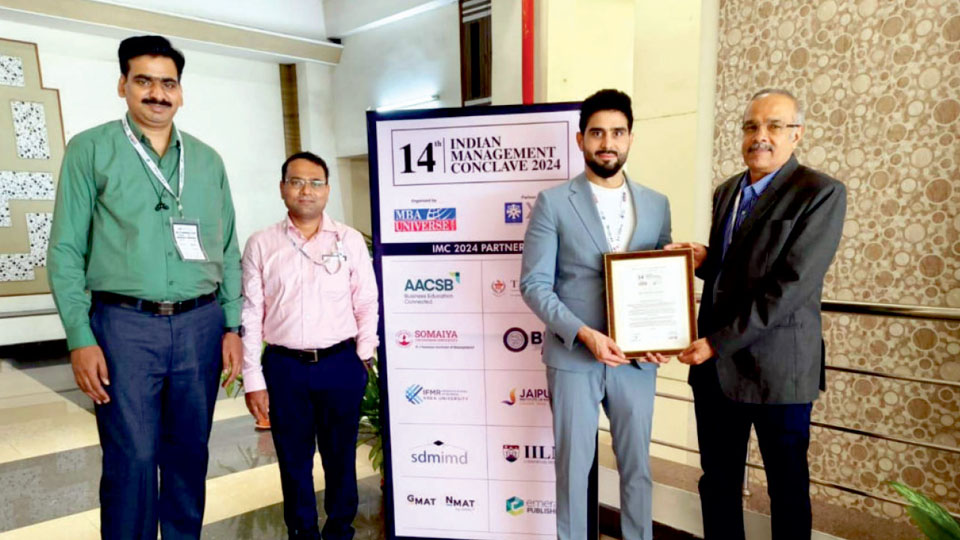
SDM-IMD alumnus Feroze Azeez seen with Dr. S. N. Prasad, Director, SDM-IMD, Dr. S. Saibaba, Faculty-Marketing and Gururaj, Manager – Admissions.
Feroze Azeez, Deputy CEO of Anand Rathi Wealth Ltd., and an alumnus of SDM-IMD, Mysuru, has received the IMC Young Alumni Award for his professional achievements at the India Management Conclave by MBAUniverse held at XLRI, Jamshedpur last month.
The previous awardees include top achievers from the IIMs, XLRI, SPJIMR etc.
Feroze Azeez is the son of A.K. Azeez and Rukhsana Azeez of Mysuru.
source: http://www.starofmysore.com / Star of Mysore / Home> Photo News / October 23rd, 2024
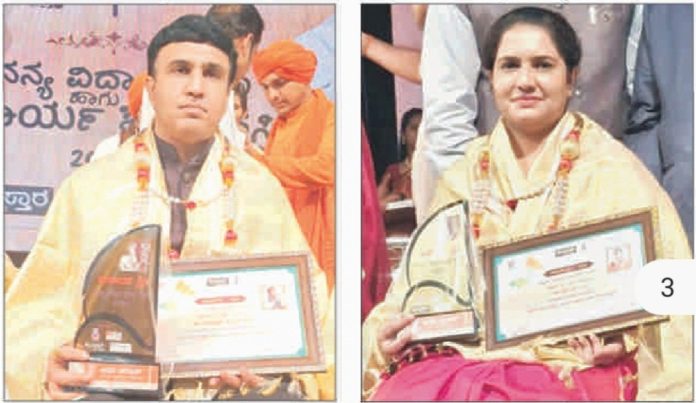
Under the auspices of Media Study Centre and with the cooperation of Vistara TV and Basaveshwara Parishad, Dr. Mohammed Farooq Pasha, Asst. Prof. Department of Commerce and Management Kengeri and Dr. Fazilath Uzma from Microbiology and Food Technology Department of Bangalore University were awarded with Acharya Shri 2024 in recognition of their services in their respective fields.
Deputy Commissioner of Police (Traffic) Bengaluru South Shiv Prakash Devraju, renowned cardiologist Mahantesh R Chantimath, President of Basava Parishad Uma Devi, former MP Prof. I.G. Sanadi and others were present on the occasion.
Dr. Farooq has authored more 50 books for pre-university and degree courses in Commerce. Dr. Fazilath is a senior research fellow at Bangalore University and has written 11 books on the subject.
source: http://www.radiancenews.com / Radiance News / Home> Pride of the Nation> Awards> Latest News / by Mohammed Atherulla Shariff, (headline edited) , Radiance News Bureau / October 28th, 2024
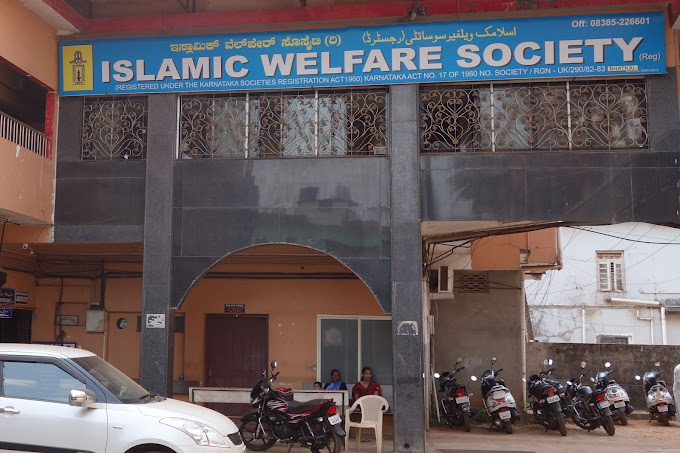
The Islamic Welfare Society in the coastal town of Bhatkal, on the shores of the Arabian Sea, has anchored the lives of lakhs of people within 40 years of its establishment. Registered under the Karnataka Societies Act, IWS provides interest-free Loans to people irrespective of religion, caste and creed. Around 15% of the beneficiaries are non-Muslims.
Loans worth around thirteen crore rupees were disbursed to more than 4800 marginalised persons last year for business, agriculture, education, house repair, medical treatment, marriage, etc. In the initial two months of the current financial year around 2200 people were provided with loans to the tune of 3 crore 42 lakhs.
During the tsunami of demonetization, the IWS rescued around 33 thousand people by offering loans amounting to 35 crores (2017-2019). Another disastrous wave of Covid-19 and the Lockdown gave a heavy blow to weaker sections. The IWS helped around 18 thousand badly-hit people, providing loans amounting to 31 crores (2019-2021).
Custodian, mentor
The Bhatkal Society acts as a custodian too. Various Masjids and NGOs keep their deposit for safety purposes with the Society.
The Society educates petty businessmen and small-time artisans to manage their funds. Pigmy deposit is an effective mode to promote saving habits. Society’s pigmy collectors procure around 1 lakh rupees daily to the needy at their door steps. With a pre and free consent of the depositors these funds are channelized as Interest Free Loans to needy persons. This brings spiritual solace to the depositors.
Systematic distribution of Zakat
The Society has got arrangements for collection and distribution of Zakath fund in an organized manner. Around 550 families of Bhatkal are benefitted through this Scheme. Deserving people in and around Bhatkal are provided with monthly pension of rupees 500, 300 and 200 per month out of the total sanctioned amount for the whole year. It is deposited in their accounts with the Society. The persons concerned withdraw the amount from their accounts as and when needed.
Monthly provision
Some philanthropists wish to help the poor with monthly provision, through the Society. Thirty poor families are provided with ration kits, costing rupees 1500, 1000 and 800. Some people deposit their Zakat amount along with a list of beneficiaries, concealing their identity with beneficiaries, and that amount is distributed accordingly.
Whereas many people deposit their Zakat amount in the Zakat Fund of the Society only and its distribution is left to the discretion of the Society.
Some others contribute particularly to medical needs of the poor. At an average five persons are benefited under this head every month. Even accident victims and people facing health emergencies are helped after confirmation from reliable sources.
Another utilization of our Zakat Fund is education. Poor students of Govt. schools in and around Bhatkal are provided with their essential needs. About 700 deserving students take advantage of this scheme annually. The Society is undertaking distribution of Zakat silently.
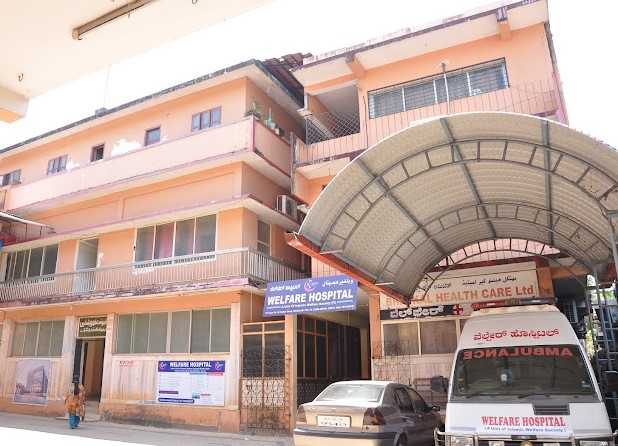
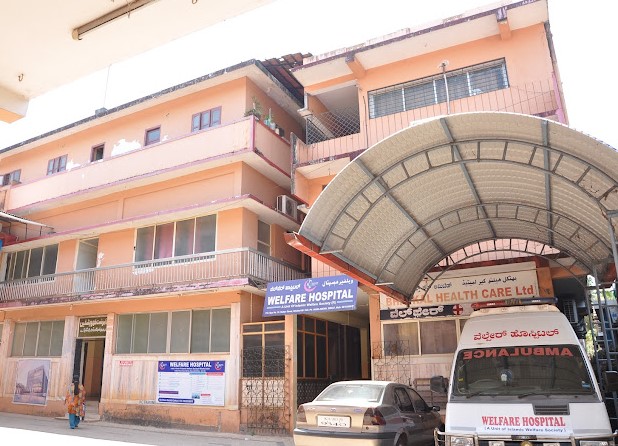
Public health is a very vast field in social work. The Society has recently started its work on public health front too, running a hospital under the name of Welfare Hospital. Frequent traveling of people to the nearby Mangalore city for minor health problems has come down to a good extent.
source: http://www.radiancenews.com / Radiance News / Home> Features> Focus / by Mohammed Atherulla Shariff, Radiance News Bureau / July 13th, 2024
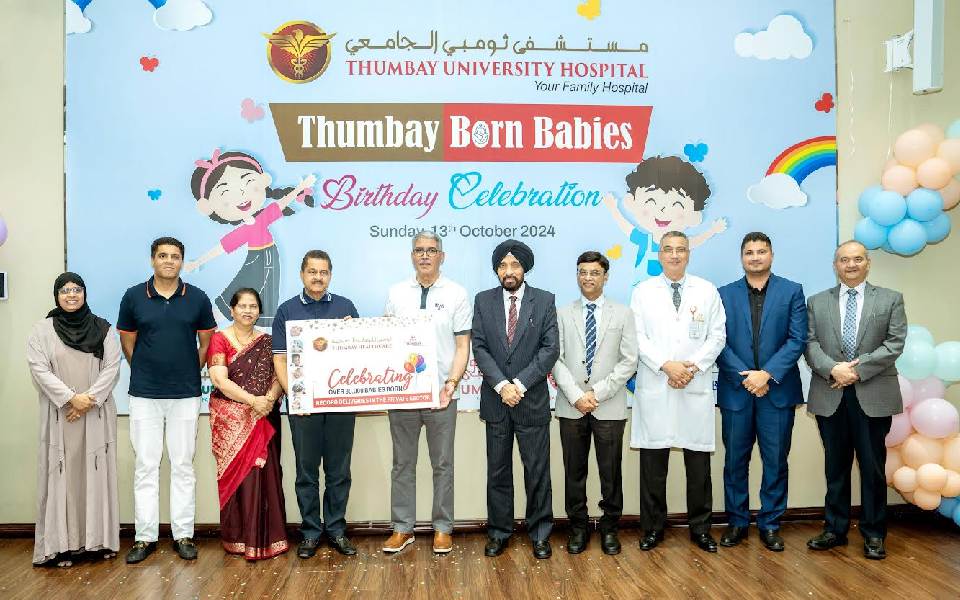
In honor of its achievement of over 90,000 deliveries, Thumbay University Hospital, UAE’s largest private academic hospital owned and managed by Thumbay Group, hosted a special event.
The festive occasion took place at the Thumbay Medicity (Al Jurf, Ajman), offering an evening filled with joy, laughter, and memorable experiences for the attendees present.
Since the first delivery in January 2003, Thumbay Healthcare has successfully conducted over 90,000 deliveries, significantly contributing to its growth and establishing itself as the UAE’s most sought-after family hospital for maternity care. The Obstetrics and Gynecology (OBG) department serves approximately 35,000 patients annually and is equipped with 10 state-of-theart labor and delivery rooms, a dedicated OBG emergency unit, and specialized operating theatres. Additionally, there is a postnatal ward with private rooms for new mothers, ensuring a comfortable and supportive environment during their recovery.
The event was graced by the presence of Chief Guest Dr. Thumbay Moideen, Founder President of Thumbay Group, along with Akbar Moideen Thumbay, Vice President of Thumbay Healthcare.
The celebration featured various activities designed to engage both children and adults. Highlights included balloon twisting, magic shows, face painting, and a best-dressed babies’ contest, with three winners announced. The event culminated in a cake-cutting ceremony that signified the growth and joy shared by infants and their families over the years.
Attendees also had the chance to participate in a raffle draw, with five winners receiving surprise gifts aimed at enhancing their parenting experience. A dedicated photo booth was available for families to create personalized keepsakes. Additionally, parents received vouchers for a health check-up valued at AED 3,499, available for AED 399, as well as a free dental consultation.
“As we commemorate the remarkable achievement of 90,000 deliveries within our hospital family, we recognize the profound honor of being part of these significant milestones in the lives of so many. It is a privilege to support the early development of each child, who represents the hope for a healthier and brighter future. Together with their families, we take pride in witnessing the growth, milestones, and vast potential that these new lives will contribute to our community. This milestone reaffirms our commitment to providing exceptional care and nurturing the next generation, ensuring that every child has the opportunity to thrive,” said Akbar Moideen Thumbay, Vice President of Thumbay Healthcare.
The hospital also offers an affordable maternity package, further enhancing its commitment to accessible and quality care for families. Maternity package at Thumbay University Hospital includes consultations with specialist gynecologists, free delivery booking, and antenatal classes. Priced at AED 5,499 for normal deliveries and AED 8,999 for C-section deliveries, the package is designed to diagnose, monitor, and prevent health issues, promoting healthier lifestyles for expectant mothers.
source: http://www.english.varthabharati.in / Vartha Bharati / Home> Gulf / by Vartha Bharati / October 16th, 2024