Kerala Muslim Jamat president Kanthapuram A.P. Aboobacker Musliar (right) releasing the autobiography of Madin Academy chairman Syed Ibrahim Khaleel Bukhari (middle) by giving a copy to Yemeni scholar Habib Umar bin Hafiz at Markaz, Karanthoor, on Monday. | Photo Credit: SPECIAL ARRANGEMENT
Sunni spiritual leader and Madin Academy chairman Syed Ibrahim Khaleel Bukhari has published his autobiography, The life so far.
Releasing the book, Kerala Muslim Jamat president Kanthapuram A.P. Aboobacker Musliar said on Monday that the life story of Mr. Bukhari embodied a significant lesson on how an individual could transform crises into opportunities and turn despair into hope.
According to Mr. Kanthapuram, the experiences Mr. Bukhari gained through his extensive travels and intense trials would ultimately benefit society at large.
Renowned Islamic scholar Habib Umar bin Hafiz from Yemen received the first copy of the book.
Mr. Kanthapuram said that the story of Mr. Bukhari’s growth from Kadalundi coastal village to a respected Muslim leader was, in many ways, a reflection of the history and development of the Sunni movement he led.
“His [Mr. Bukhari’s] growth has been distinct from other Muslim leaders of Kerala. There are many things that set him apart from the rest,” said Mr. Kanthapuram, attributing his swift rise to prominence within the community to his ability to innovate and implement projects that benefitted marginalised groups.
Umar Mahmood Hussain Samrai from Baghdad, Sheikh Rahmatullah Tirmidhi from Tashkent, Sheikh Bilal Halakh from California, Sheikh Rilwan Ibrahim from Russia, Habib Jindal bin Noufal from Indonesia, Markaz director C. Mohammed Faizy, Haj Committee chairman Husain Saqafi Chullikkode, and Markaz Knowledge City managing director Abdul Hakeem Azhari were present.
source: http://www.thehindu.com / The Hindu / Home> News> India> Kerala / by The Hindu Bureau, Malappuram / February 18th, 2025
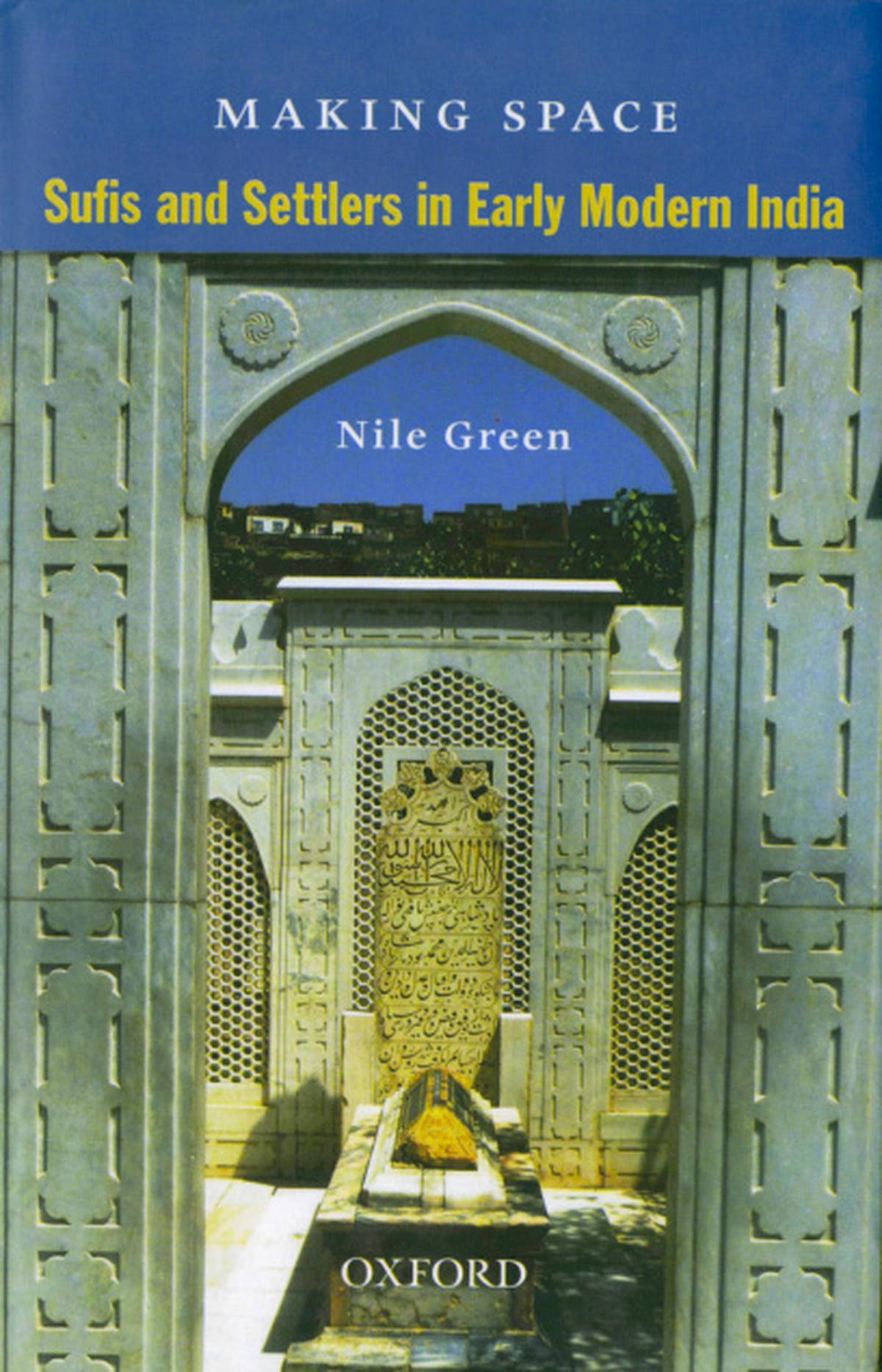
Chennai: 13/03/2012: The Hindu: oeb: Book Review Column: Title: Making Space, Sufis and Settlers in Early Modern India. Author: Nile Green.
Sufism (tasawwuf in Arabic), the esoteric physiognomy of Islam, is probably the only school of thought which has remained above suspicion in the post 9/11 Islamophobic onslaught. And if any reason could be attributed to this unimpeachability it is its inherent pacifism. Although Sufism has several etymological denotations the simplest and best explanation was given by Al-Hujwiri, the famous 11th century mystic of Lahore. In his renowned treatise, Kashf al-mahjub Hujwiri quotes a Prophetic tradition to define a Sufi as the one who adopts safa (purity) and gives up kadar (impurity). Such straightforward renditions have contributed to the immense popularity of Sufism across the globe. In India too it is believed that a huge percentage of Muslims have historically been the adherents of the inclusive Sufi traditions.
It is this Sufi history which happens to be the theme of Prof. Nile Green’s latest tome Making Space wherein he explores the role of itinerant “saints” and “blessed men” in the emergence of Muslim communities in early modern India. Most of these saints, according to Green, sought refuge in India after the sacking of “the great Sufi cradle of Khurasan” by the Mongols, and the mass persecution of Iranian Sufis under the Safavids. Green’s thesis is that Sufi shrines serve as “gates through time” (dargah means gateway) where the past is recounted in narrative and rendered visible in architecture and ritual, and therefore, have been crucial to the making of Muslim space on Indian soil.
These dargahs, or “the death spaces” as Green calls them, helped define Muslim identity by linking community to territory and territory to hagiographic texts of memory known as tazkirat . In other words, a mausoleum that immortalised a saint was kept alive through the stories and rituals that surrounded it, and the resulting “architectural embodiment of collective memory” helped create a Muslim space by acting as a bridge between the past and present.
Interestingly, Green does not go into the “intellectualized doctrinal abstraction” of Sufism. He confines his research to a dispassionate analysis of the historical role of the Sufis as social actors — both during their lifetime and after their death — in the creation of Muslim settlements in India.
But he does mention quoting Hujwiri that Sufism should not be talked about in a different breath from Islamic law or the study of Hadith. For, to the likes of Hujwiri the notion of a discrete ‘Sufism’ at even a step’s removal from ‘Islam’ would have been “a troubling and unfamiliar idea.”
Rise of shrine cults
And, even while treating them as purely historical events Green drops enough hints to suggest that most of the rituals that have come to be associated with the shrines today did not have the approval of the buried Sufis. For instance, he speaks of how “shrine cults” rose to a high degree of importance a few centuries after Hujwiri’s death. Even today many shrines in India are said to facilitate the exorcism of jinns in clear violation of the teachings of the very saints in whose name it is done.
Green feels that such commemorative rituals extolling the miraculous powers of the buried saints were meant to attract the more material forms of investment required to maintain and preserve the sacred space. This argument is substantiated by the huge monetary contributions some South Asian Muslim shrines regularly get, the most recent example being the donation of a million dollars by the President of Pakistan to the Ajmer dargah.
A substantial part of Green’s research is devoted to the Mughal imperial expansion into the Deccan (1640-1690) and their policy of co-option and creation of Sufi shrine complexes in south India which was continued by Aurangzeb’s successors, the Nizams. Green recounts the story of how Aurangzeb himself came to be buried at the shrine of Zaynuddin Shirazi (d.1369) in Khuldabad on the advice of Sufi Shah Nur as expiation for killing Sarmad, the free thinker and close associate of Dara Shukoh. Mention is also made of the migration of Sufis to Arcot where they were patronised by the Nawabs of Carnatic especially Sadatullah Khan and Muhammad Shah who built shrines in their honour.
One of the most significant findings of Making Space is the absence of communal overtones in the Sufi narratives. Extracting from the works of leading Deccan litterateurs, Azad Bilgrami and Sabzawari, Green highlights the presence of numerous Yogis at the shrines in Khuldabad and says that if at all there was rivalry during those times it was not between Hindu and Muslim power centres but between the Muslim saints and the sultans. The saints refused to bow down to the kings.
In short, Making Space is a chef-d’oeuvre which expertly weaves together various aspects of Muslim cultural history to produce a coherent account of how Muslims carved out a space for themselves in India. It is essential reading for anyone who has a dispassionate interest in the ethno-history of early modern India.
MAKING SPACE — Sufis and Settlers in Early Modern India: Nile Green; Oxford University Press, YMCA Library Building, Jai Singh Road, New Delhi-110001. Rs. 795.
source: http://www.thehindu.com / The Hindu / Home> Books / by A Faizur Rahman / April 23rd, 2012
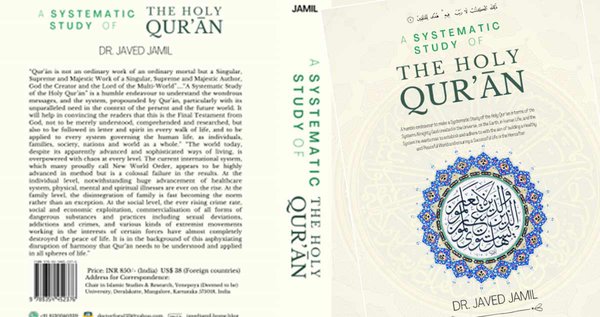
Review of Dr. Javed Jamil’s book “A Systematic Study of the Holy Qur’ān”
Dr. Javed Jamil has already earned wide acclaim for his innovative and holistic approach on the world affairs and for his concept of Applied Islamics, which implies examining the scientific theories, international ideologies and developments in the light of Islamic principles and presenting Islamic Paradigms/Models/Definitions/Concepts/Programmes in different areas of knowledge in Natural Sciences, Social Sciences as well as Health Sciences. His books like “Muslims Most Civilised, Yet Not Enough?”, “Muslim Vision of Secular India: Destination and Roadmap”, “Justice Imprisoned”, “Economics First or Health First?” have brought a new approach based on the facts and figures, which have not only highlighted the failure of the modern systems in creating a healthy and peaceful world but have also successfully countered the propaganda by Western and other forces against Islam. His latest book, “A Systematic Study of the Holy Qur’ān” may well become his most applauded work in coming times because of, (using the title of the Foreword by Former Vice Chancellor of University of Hyderabad, Padamshri Prof. E Hasnain,) its “Unique Insight into the Wondrous Verses of the Holy Qur’ān”. It will be worthwhile here to quote a passage from the Foreword:
“What attracted my attention at the very outset was the caption on the cover of the book. The book describes Qur’ān as “a humble endeavour to make a Systematic Study of the Holy Qur’an in terms of the Systems Almighty God created in the Universe, on the Earth, in Human Life, and the System He wants man to establish and adhere to with the aim of building a Healthy and Peaceful World and ensuring a Successful Life in the Hereafter”. This is a categorical confirmation of the fact that, in Qur’ān there are a very large number of verses, which describe the Creation and Functioning of the Universe as a whole and the Functioning of the Earth, including its flora and fauna. There is absolutely no doubt that, if human beings have to establish on earth the kind of harmonious functioning existing in the universe, they have no option but to follow God’s injunctions in full. The particles of the universe, the stars, the planets and all other celestial bodies follow the Laws of Nature created by God with unimaginable precision. If God gave us human beings certain flexibility, we should endeavour to work only within the boundaries prescribed by Qur’ān. Moreover. the system that God has directed through His Final Book and Final Prophet (SAW) needs to be established not only in the lives of the people, but in the world as a whole, including the legal, social, political and administrative levels.
By just viewing the list of contents of the book, one can have an idea of the holistic nature of the work. It has five major parts: Iman (Realization with Commitment), Philosophy, Constitution, Systems and History of Confrontation between the Right and Wrong. The chapter on Iman covers Qur’ānic view of God/Allah with His Creation and Governing of the universe , the role of Prophets, especially the Last Prophet Muhammad (PBUH), the Books of God, Hereafter, Executive Angels and Predestination. Part 2 on Philosophy covers Philosophical issues related to Qur’ānic position of Monotheism, life, different religions, human nature, etc. Chapter 3 on Constitution covers Fundamental Rights, Fundamental Duties and Fundamental Prohibitions, Civil and Criminal Laws. Part 4 on Systems of Governance include Social, Political, Economic, Moral, Spiritual and Health Protective Systems and the Part 5 on History of Confrontation between the Right and Wrong compiles the stories of Prophets from Adam (AS) to Muhammad (SAW).
The book presents Islam as a Holistic System for Health, Security and Peace for mankind in this world as well as Hereafter, and effectively counters modern ideologies based on the supremacy of Economics. His arguments are highly convincing, as they are accompanied with facts and figures. He argues that while the modern constitutional systems are two-dimensional based on Fundamental Rights and Duties, while ignoring prohibitions altogether, Qur’ānic system of governance is Three-Dimensional with equal emphasis on Rights, Duties and Prohibitions. He lambastes the concept of Freedom of Choice, which is being used by the market forces to exploit the human susceptibilities at the huge cost of life and peace, resulting in tens of millions of deaths due to Alcohol, Sexual corruptions (including Homosexuality, Promiscuity and Prostitution), Gambling, Suicides, Pork, etc.
In each chapter, first a well thought and crafted article is presented followed by the compilation of the Qur’ānic verses related to that subject. The verses are followed by notes wherever necessary, providing huge information. In the first chapter on “The Supreme Being”, the components of the universe and their functioning in accordance with God’s designs are presented, and a full-blown picture of the physical State (Mulk) of universe created and governed by Head of State, Almighty God/Allah, through a unique system of the Laws of Nature (Umoor) has been developed. The arguments in Theoretical Physics about the universe being created without God have also been countered in a unique manner. The author has translated “Samaawaat” as “Cosmic Tiers” and has shown their positioning in terms of the structure of the universe. For example, Sky of the earth (atmosphere, clouds, protective roof) is the First Cosmic Tier, Solar System (Samaa-al dunyaa) the Second, Galaxy (Milky Way being ours) the Third, Cluster and Supercluster being the next in order and so on. Terms like Najam, Kawaakib, Shihab-at-Thaqib, Najm-ath-thaqib, Tariq, Samaa- dhaatil burooj, dhaatil-raj’a etc have been explained. The author notes that further researches will more specifically point out the exact positioning of these Samaawaat. When the terms Sajda, Tasbeeh, Hamd etc, are used in relation to the physical components of the universe, their existence being only physical, these terms also indicate their different physical movements like rotation on their own axis or around other objects in compliance of the Laws of Nature created and implemented by God, the Lord of the Universe. Human Sajdahs, Tasbehs and Hamd of course have physical, biological, mental, spiritual and social dimensions as well.
But the author clarifies that instead of studying Qur’ān in the light of Sciences, modern sciences and ideologies have to be studied in the light of Qur’ānic positions. Sciences can be in an evolving phase but Qur’ān is the Word of God, with absolute facts. It is another matter, due to our immense paucity of knowledge about the facts of the vast universe; more often than not we cannot fully understand their meaning.
In the chapter on different systems, he has presented alternative Islamic paradigms/models of Economic, Political, Social, Moral, Spiritual and Health protective systems of Islam, with critical review of the modern systems prevalent at the international level. He argues that the primary aim of Islamic Prohibitions and Permissions is to ensure highest standards of physical, mental, social, spiritual health and family peace and crimeless society, free of all forms of exploitation. Following these injunctions with total commitment to God, Last Prophet and Last Testament Quran will also ensure a Blissful life in Paradise after death.
The chapter on History becomes doubly interesting, as it also uses the excerpts from Torah, Evangel (Injil) and Psalms (Zabur) to explain in detail the lives and achievements of the Prophets/Ambassadors of God.
The book has used many terms, which are different from the traditional ones, but they add to the advanced understanding of the Holy Qur’an in exploring the functioning of the universe, life on earth and human existence. The basic argument according to the author which comes out from the study of Qur’an is that if the unimaginably vast universe is functioning with impeccable harmony for billions of years, it is because each and every particle and area of the universe is following with utmost precision the Laws of Nature, Biological and other laws created by God, and if the mankind has to have a peaceful and harmonious existence, they have no option but to follow the Laws sent through His Ambassadors by God, Qur’an being the Final Constitution for all times to come till the Doomsday.
The cover is attractive and the printing of the book is of good quality. Over-all, it is a must-read book for all Muslims, especially the students, scholars and analysts, and has the potential to revolutionise the future studies of Qur’an and Islam, with their application in every field of the human existence – individual and collective, internal and external. It will be worthwhile to conclude this review by quoting a few paragraphs from the book:
“The world today, despite its apparently advanced and sophisticated ways of living, is overpowered with chaos at every level. The current international system, which many proudly call New World Order, appears to be highly advanced in method but is a colossal failure in the results. At the individual level, notwithstanding huge advancement of healthcare system, physical, mental and spiritual illnesses are ever on the rise. At the family level, the disintegration of family is fast becoming the norm rather than an exception. At the social level, the ever rising crime rate, social and economic exploitation, commercialisation of all forms of dangerous substances and practices including sexual deviations, addictions and crimes, and various kinds of extremist movements working in the interests of certain forces have almost completely destroyed the peace of life. It is in the background of this asphyxiating disruption of harmony that Qur’ān needs to be understood and applied in all spheres of life.”
“True Version of Anthropic Principle says that (1) It is God Who created the universe ultimately leading to the creation of man; (2) God controlled the whole process of creation; (3) the creation of man was not an unintended coincidence but an intended act of God; (4) the purpose of man is not simply describing the beauty of the universe, but to attain the Realization that this harmonious universe has been created, and is being governed by God; and (5) man has to submit to the System of existence perfected through His Ambassadors and Testaments, and govern the Earth in accordance with the Divine commands.”
“In short, the message of Qur’ān, the Final Document of Peace, is unequivocal. Anything good, healthy and desirable in terms of health, peace and tranquillity, has to be promoted, and anything unhealthy and undesirable has to be discouraged. Both, short term and long terms benefits are allowed; but if short term benefits seriously endanger the long term benefits, long term benefits have to be preferred. All possible means within the ambit of Islam are to be availed for achieving the goal. The goal, however, cannot be achieved with perfection, unless there is unity of mankind; and mankind cannot unite unless it submits to One God, imitates One Prophet, follows One Book and faces One Direction. This is the real meaning of Wahdat (Unity), which is central to all the Islamic systems of affairs. Wahdat of God means, in effect, the Wahdat of mankind.” “Islam’s agenda, as shown by the Quran and Prophet (SAW), is to establish Natural and Just Word Order. The agenda of the present world is to establish and sustain New World Order. It has led to the development of a strange kind of world, which appears to be paradise from outside, but as one enters it, one finds nothing but hell. We are living in a world where, thanks to the designs of merchants, immorality reigns. The globe of New World Order is therefore rapidly developing into nothing but a fireball of chaos.It is in the backdrop of this universal disharmony that Islam, in its final form established by the Last Prophet (SAW), has to play its role. We have to challenge New World Order and establish Natural Just World Order, in accordance with the principles laid down by the Book of God and the life of the Prophet (SAW).”
Price: INR 850/- Outside India: US$ 38, for copies WhatsApp on: +918130340339, Email: doctorforu123#yahoo.com
source: http://www.milligazette.com / The Milli Gazette / Home> News> Books / by J Ali / March 24th, 2021
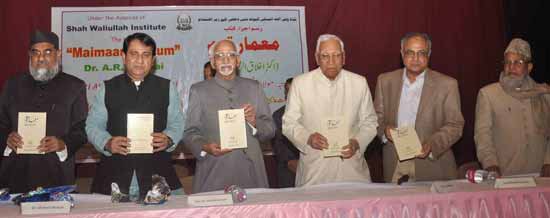
Vice President Hamid Ansari released here on 21 November a book on the life and services of Akhlaqur Rahman Kidwai, the veteran Congress leader who honorably served the country in various capacities like Rajya Sabha MP, chairman of Union Public Service Commission and governor of the states of Bihar, Orissa, Haryana and Punjab.
The book “Me’mar-e Qaum” [Builder of a nation], is authored by Mufti Ataur Rahman Qasmi and published by Shah Waliullah Institute.
The book release was held at the India Islamic Cultural Centre. Vice President Hamid Ansari said that services of Kidwai cannot be forgotten by the people of the country. He said Kidwai enjoys serving people, an spirit rarely found in people these days. He helped many. One of his historic initiatives was to start Mewat Development Board.
While speaking during the function, AR Kidwai said his character has been shaped by Jamia Millia Islamia which he joined in 1924 as a student of class 2. He was fortunate to get the attention of an educationist like Dr Zakir Husain.
The function was chaired by the former Union minister and the present general secretary of Congress Party, Shakil Ahmad who said that the services of AR Kidwai are such that one yearns to emulate him. He said that a characteristic of Kidwai is that he never exhibits his work.
Ataur Rahman Qasmi, the author of the book, said that Kidwai added to the stature of any post he held. He never compromised on his principles. These days it is rare to find such servants of the people.
The function was attended by a sizeable number of Delhi elite which bore witness to the popularity of Kidwai who is now leading a private life after offering an example of how Muslims can selflessly serve the country with honesty and dignity.
source: http://www.milligazettec.com / The Milli Gazette / Home> News> Special Report / by The Milli Gazette / November 26th, 2013
The award-winning Bengali author talks about his books, development of minority communities, Kolkata Book Fair, social media, and more.
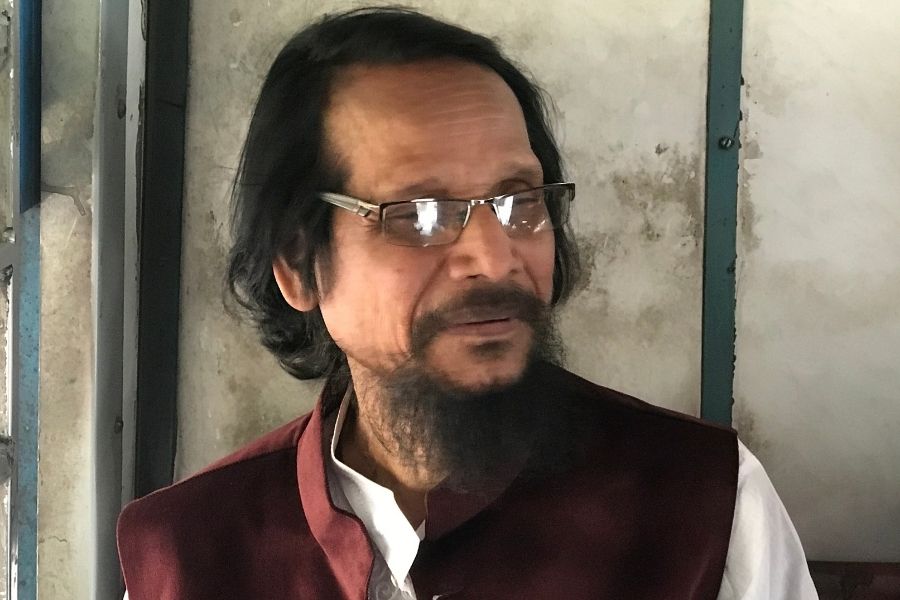
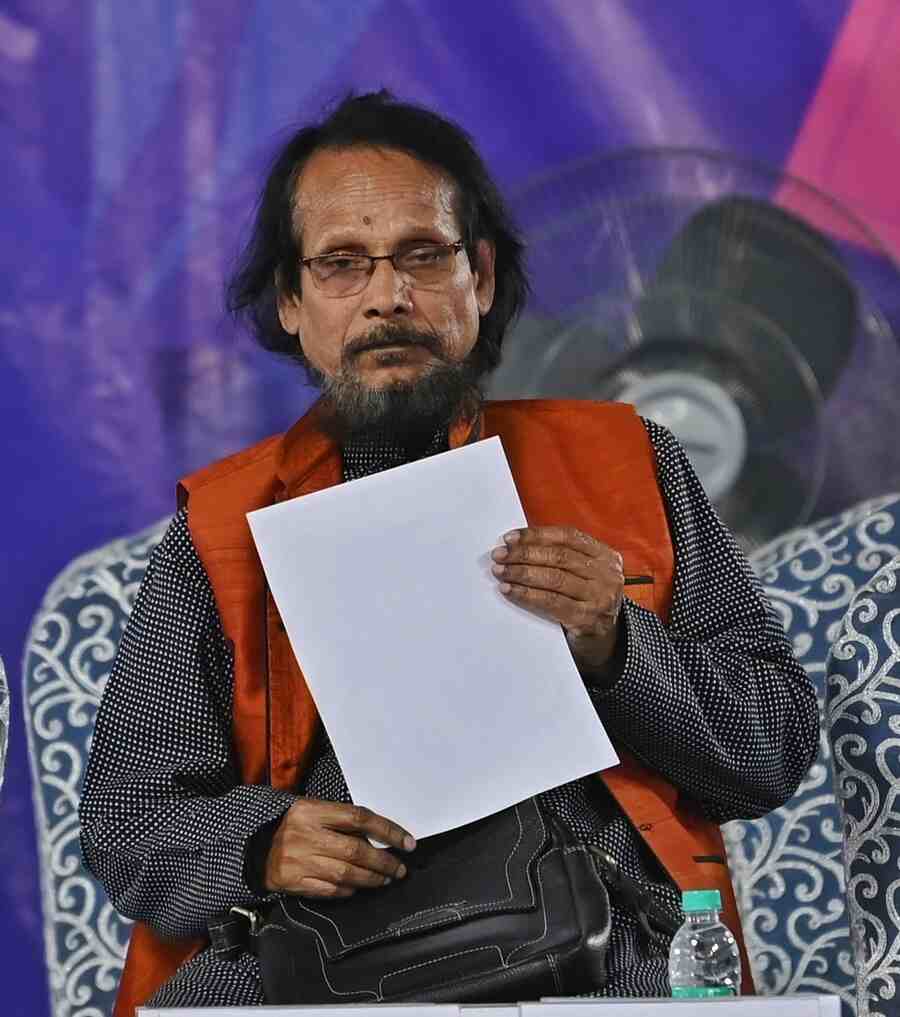
Abul Bashar — the author of ‘Agnibalaka’ and several other popular titles — is one of the prominent voices documenting the lives of minority communities in Bengal / Wikimedia Commons
Born in Murshidabad at a time when the zilla’s literacy rate was 12.9 per cent, it was an uphill battle for Abul Bashar to not just educate himself but also to live his dream of becoming an author.
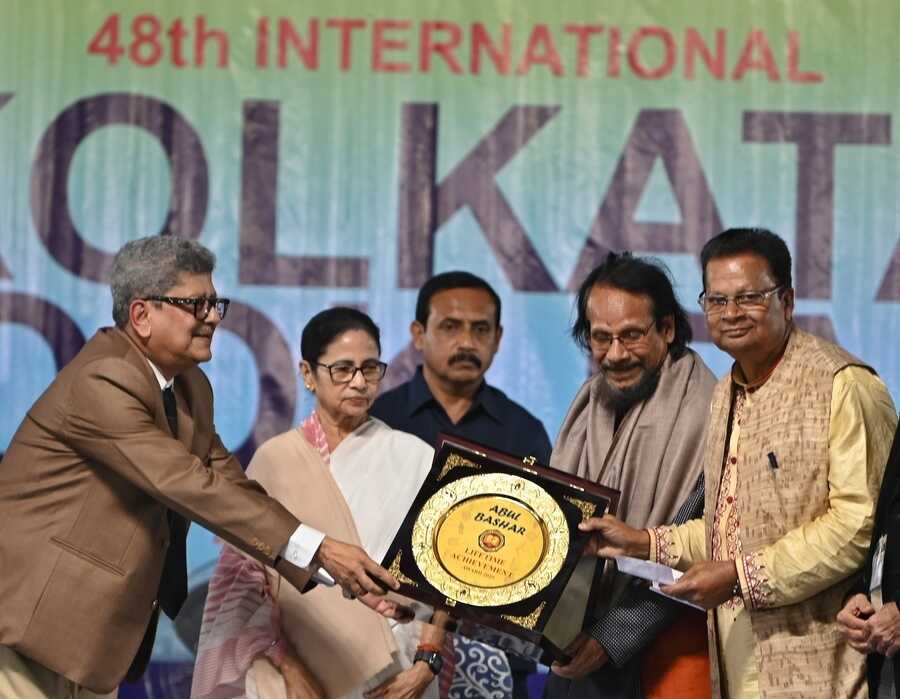
With 40 books to his name, including popular titles such as Agnibalaka, Marusvarga, Jol, Mati, Aguner Upakkhayan, and Dharmer Grahon, Bashar has documented the lives and issues of minority communities and socio-religious matters through his works. A recipient of top honours such as the Ananda Puraskar and Banga Bhushan, he was awarded the Guild Lifetime Literary Award in 2025 at the 48th International Kolkata Book Fair.
My Kolkata met Bashar at the boi mela for a conversation, discussing India’s evolution, the status of the Bengali Muslims, his career as an author, and more. Edited excerpts follow.
My Kolkata: India celebrated its 76th Republic Day this year. You were born in 1951. As an author who has been documenting the growth of society in his works, how do you see India’s evolution?
Abul Bashar: One thing that has been catching my attention is that the culture that comprises both Hindus and Muslims is in a state of dialectics and adjustment with the ‘Indian culture’. We have imbibed the virtues of Indian society, but there are a few aspects of Bengali society that do not marry well with the Indian society. This concerns me, because this is not how it was earlier. The incidents around the Babri Masjid and the Ram Mandir have changed the political diaspora of India.
It is now a global situation and not just confined to India. It is prevalent in the subcontinent that religious minorities are under attack. Civilisation is under threat, but this is not how it is supposed to be. The Indian Constitution speaks about equality towards minority communities, their representation in the power structure of the society, and a homogeneity of culture. These were the ideals of Rabindranath Tagore and Mahatma Gandhi. The lack of homogeneity in the culture is worrying me. Of course, the extent varies from place to place, but there are a few incidents that happen that make me feel imperiled.
In this country, the constitutional rights and duties of people from all walks of life are directly and intrinsically involved with the idea of democracy. India is a pluralist country where diverse religious identities and cultures cohabit in an interesting milieu, but this fabric is facing a push back.
You have written extensively on Bengali Muslims. What do you think of their current socio-religious status?
More than the religious identity, the Muslim community continues to be backward in terms of financial independence, and I give more importance to financial independence. One of the primary tenets of India is the growth of any backward community — be it among Hindus, Muslims, or any other community. The Constitution aims towards that.
The financial backwardness of the Muslim community has affected the education of modernism. It is difficult for a financially backward community to become modern. The State, thus, has to fulfill its responsibility towards removing this roadblock so that a symbiosis between community and modernism takes place.
I have not only written about the Muslim community, but also about the Hindu community. My novel, Maruswarga, can be termed — ekjon Bangali lekhoker Ihudi upanyash (a Bengali writer’s Jewish novel). My work is extensively based on various mythologies and the folk culture of Bengal, focusing on the baul-fakirs. There is a unique amalgamation of Buddhism and Islam in the bauls, which was evident through the life of Lalon Shah. My thoughts revolve around these aspects, and I want comprehensive development of the Muslim society through cultural amalgamation.
Through my books, I have addressed the religious superstitions and other roadblocks that can cause hindrance to the development of society.
Abul Bashar was conferred the Guild Lifetime Achievement Award by chief minister of West Bengal, Mamata Banerjee, on January 28 at the inauguration of the 48th International Kolkata Book Fair / My Kolkata
Do you think awards and accolades you have received have made it easier for your voice to reach society?
No, absolutely not. In my initial days as an author, I found that the readerbase of my genre of writing in West Bengal was very constricted because I belonged from a backward society. I have had a readerbase in Bangladesh since the inception of my career. Here [in West Bengal], it has taken time, but a community of people who read my kind of writings have developed. My thought process, and my novels that are based on mythology have found an academic discourse, and a doctoral candidate from Murshidabad, did his PhD on my work at Jadavpur University.
What surprised me was that a member of the society that created barriers for me and refused to accept my words did a doctoral thesis on the mythical treatment in my literature as an academic discourse. Society has evolved, and the environment of the present times is removing roadblocks, making way for an educated middle-income strata that is progressive and free thinking.
From Agnibalaka to Bhor Poati Tara — how do you see your evolution as an author?
It is a journey that I made, I would say. I have been influenced by several thoughts at different points in my life. I was an activist of Leftist politics that was different from today’s times. Leftist politics was known as the politics of sacrifice. Agnibalaka’s protagonists, if you notice, are characters who do not conform to societal norms. They are free thinkers and are characters who have imbibed Marxism in order to elevate their lives. They are the voices of dissent against stigmas and stereotypes of society.
Agnibalaka is a political novel in which dialectical materialism among various stratas of the society as well as the dialectics in interpersonal relationships between two political parties is shown. The conflict between the social strata during the 19-month long Emergency period in India, and how Marxism could be brought into praxis — Agnibalaka is an experimentation on that.
However, I do not share the same thoughts today, and by this I mean that it has been removed from my life in some ways. I have not removed it from my life, but the ideology is gradually vanishing on a global scale. It is possible that my experiments or observations are incorrect, but in today’s time, this is how I see it.
When the world starts facing a situation like today in reference to Marxism, existentialism takes its course, and becomes a replacement and anti thesis for Marxism. Everyone is in a state of endangerment, and the very thought that society that was created for its residents, is now in oblivion. Social norms were made for the development of people, but development is not entirely dependent on norms. An excessive emphasis on following social norms has given rise to conflict between man and society. This was the reason behind the two World Wars. This has also given birth to existentialist literature, as well as poets like Jibanananda Das and Michael Madhusudan Dutta.
Abul Bashar at the Kolkata Book Fair, 2025 / My Kolkata
The Kolkata International Book Fair is one of the largest book fairs in the world. In a day and age when social media has diminished attention spans, how do you see the importance of book fairs?
Social media is not a replacement for books. There is no conflict between gadgets that we use on a regular basis versus books. Gadgets like phones are essential to attain information and gain knowledge, but literature is not just information. When we speak of literature, we usually refer to the written. But what about oral literature, which is a significant part of Bengali literature? The works of Lalon Shah, for instance, are originally songs and are kabya sahitya (poetry). Another example is Rabindrasangeet — a youngster, who is engrossed in his or her phone, is also a listener of Rabindranath Tagore’s music.
There is a trough and crest when it comes to readership, but eradicating books from our lives will never be possible — just like classical music, songs like Kaa Karu Sajni, or verses of Kabir. We have to increase our habit of reading because that will increase our creativity and strengthen our culture as well as inter-personal relationships. There is evolution in the publishing industry with the digitisation of books, which has increased the readerbase. And because of book fairs, there is a boost in the number of bibliophiles.
What is your next work?
I intend to go back to my zilla (Murshidabad) to work on a piece that would complete an unfinished novel.
source: http://www.telegraphindia.com / The Telegraph Online / Home> My Kolkata / by Pooja Mitra / February 02nd, 2025
Zillur Rahman, a professor, poet and hakim, has established a museum-cum-library in Aligarh to preserve books and artefacts that tell the story of Delhi of yore.
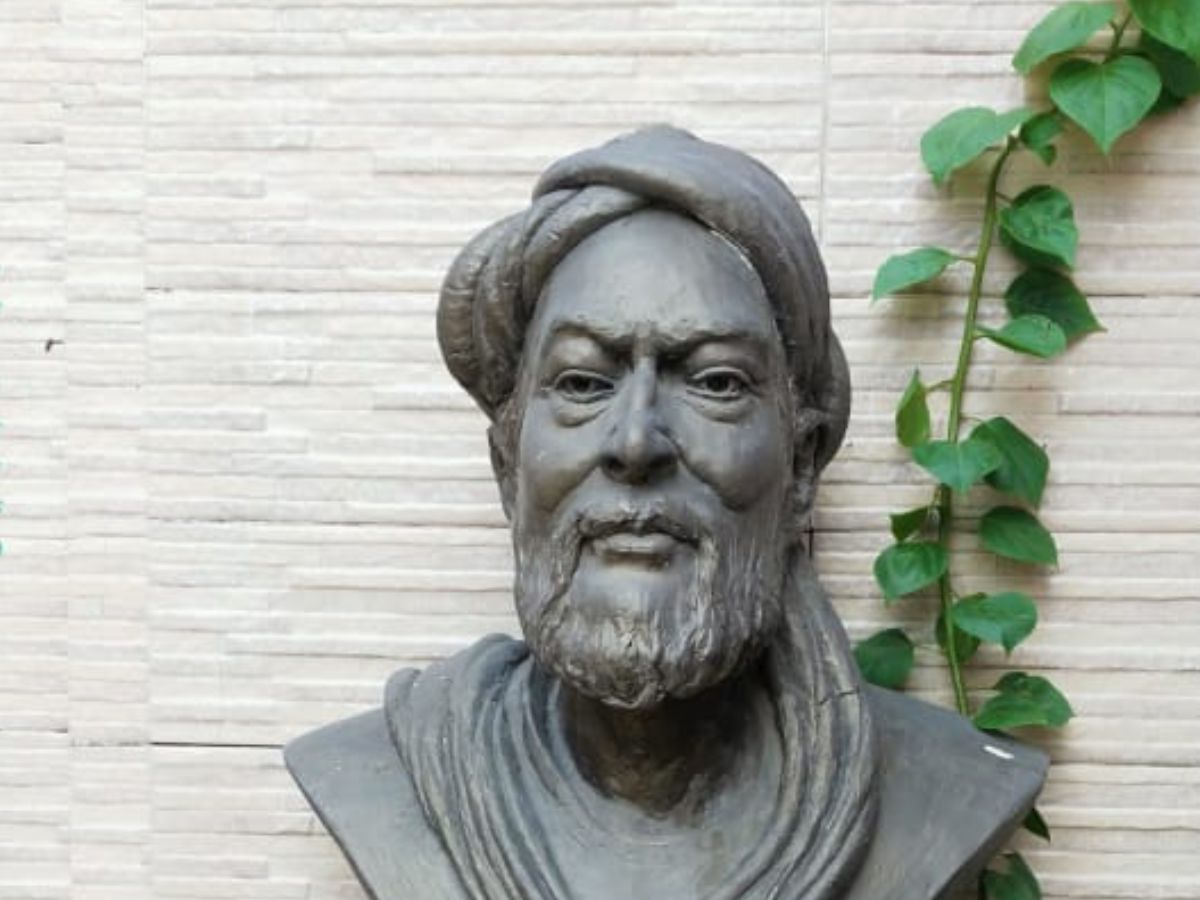
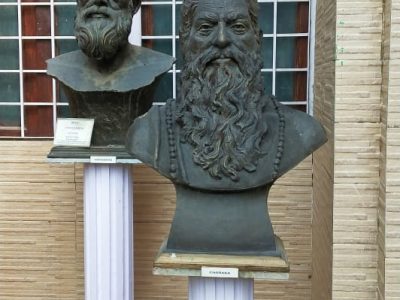
PIONEER: A bust of Ibn Sina, a physician and philosopher, who lived over a thousand years ago, at the Ibn Sina Academy in Aligarh
Nestled in the heart of the city of Aligarh, Uttar Pradesh, is Ibn Sina Academy of Medieval Medicine and Sciences, named after famous scholar of philosophy and medicine Abu Ali Ibn Sina (980 -1037), who lived over a thousand years ago.
Located at Tijara House, the non-profit, non-government and non-political academy was established in the year 2000 by Professor Syed Hakim Zillur Rahman, an academic and a litterateur from Aligarh.
A one of its kind museum and library, it was aimed at encouraging and promoting researches and studies in medieval sciences, especially Ibn-Sina’s, as well as arts, culture, poetry among other subjects.
Notably, Ministry of Ayush, Government of India gave accreditation to the academy in 2004 and promoted it as a Centre of Excellence in 2008. The professor had a mammoth personal library that he had established in 1960s. After Ibn Sina Academy was born, the library became a part of it.
The specialty of this museum lies in its varied collection that includes sofas, crockery, jewels, armours, stamps, mirrors, outfits of princesses, queens and kings as well as turbans worn during battles by historical legends.
The Zillur Rahman Library houses 32,000 rare books and magazines, 1,100 manuscripts apart from paintings, sketches, citations, artefacts and much more.
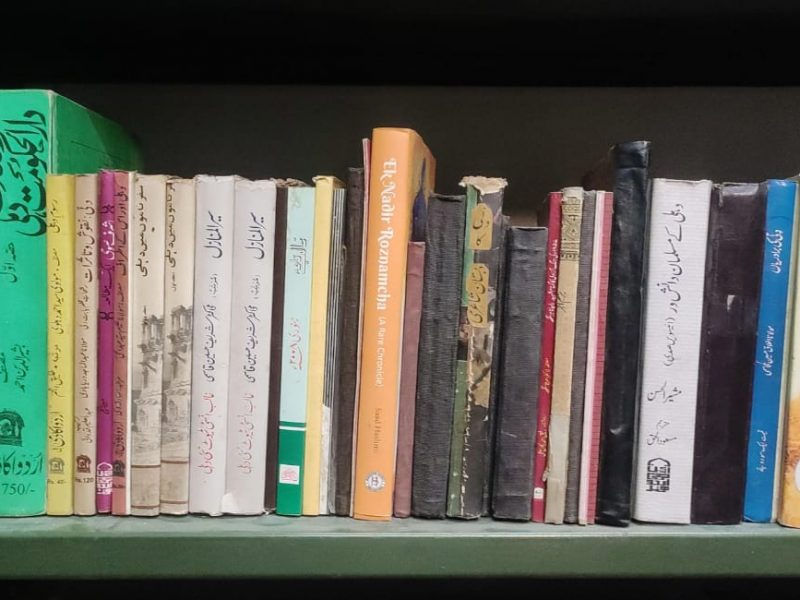
RARE: A collection of books on Delhi
The Delhi connection
There are 7,500 books on Delhi of yore in the library, including on poet Iqbal, dictionaries as old as 150 years, authentic diwaan on Ameer Khusrau, books dating back to 1893, on and by the last Mughal emperor Bahadur Shah Zafar, British Raj–Victorian Era with pictures in lithographs and more.
But considering Delhi is dry without the ‘zikr’ (mention) of the poetic legacy of Asadullah Khan ‘Ghalib’, the library has dedicated a special space for the poet: “Ghalib Study Centre”.
A galaxy in itself, this part has 1,350 rare books in Urdu, Persian, English and Hindi on Ghalib apart from several special issues in different magazines (called risala in Urdu) which are now available only in this museum.
For instance, an important old publication called Sooraj (meaning sun) had special Ghalib edition.
One of the books has illustrations of most of the ghazals he had penned, while in his own Deewan (collection of his authentic shayri) there, Ghalib’s original ghazals had no pictures or illustrations.
MASTERPIECE: The translation of the book written by Hakim Zillur Rahman
One of the most important collections here is a book by renowned author Shakeel ur Rahman called Mirza Ghalib aur Mughaliyaat, which has illustrations from Muraqqa-i-Chughtai, an illustrated selection of Ghalib’s work by AR Chughtai, a renowned artist of early last century. The illustrations are based on an important topic or issue that the poet raised in his couplet (sher).
Rare books with names like Jihad-e-Ghalib, Ghalib Satrung, Soz-e-Ghalib, his letters in Persian and many more ornate the archive.
Additionally, a book called Naqsh-e-Rung from Pakistan which was brought to India by scholar Urdu litterateur and poet professor (late) Shamsur Rehman Farooqui enriches the book shelves.
Tehqeeq-nama Ghalib, Ghalib’s ghazal in Persian called Ghazaliayat-e-Farsi, Ghalib, few rare and special issues of magazines like Shama, Nuqoosh, Hunoon, Taar-e-Nau, film magazines, Al-Ilm, Shayar, Kaarvaan with special edition on Ghalib are the other charms.
A rare pocket-sized edition on Ghalib is a popular one.
Travels to Delhi
Another section on Delhi consists of travels and trips done in Delhi by the authors, travellers and poets of old times. Rare books like Safarnama Dehli and Sair-ul-Manazir provide an inside view of Delhi in the 18th century.
LEGEND: Bust of a renowned Indian physician Charaka at the academy in a section dedicated to physicians and medicinal plants
Also, over 200 rare books on Delhi’s poets (shayars) in Urdu and important personalities form another gallery here. For instance, there is Aslam Parvez’s award-winning book on Bahadur Shah Zafar, and his another one called Meri Dilli. There is also a book on Hamare Zamane Ki Dehli, Charagh-e-Dilli, Dilli Wale by famous author Salauddin, Aalam mein intekhab-e-Delhi among others.
Rare and significant books on personalities include those on Hakim Ajmal Khan, Sir Ross Masood, former India President Zakir Hussain, Sir Syed Ahmad Khan, Raja Mahendra Pratap and many more.
An entire unit is also devoted to all the journals that came out of Delhi during the War for Independence “and those from late 17th century to beginning of 19th century. The Delhi College was established in 1824, with it, all these journals rose to a great height. These form an enticing collection in the museum,” apprises Aftab Najmi, the coordinator and convener at Ibn Sina Academy.
On enquiring why such a large collection in Urdu finds space here, Professor Rahman adds, “Our own language and culture is much better described only in Urdu and Persian. So, it was very important to have a different section on Urdu to give a peep into what Delhi was in olden times.”
However, countless notable oldest books in English and Hindi on Delhi also enrich the collection on the Capital.
A legacy himself
Professor Zillur Rahman has 56 books to his credit. The subjects are related to Tib (Unani medicine) and Urdu literature. His books on medical sciences with oldest references (100 to 200 years old) are immensely popular. He is also a poet and an ardent admirer of Urdu poets of yore. He has also edited Diwan-e-Ghalib and many books on Urdu shayri. So far, 11 books have been written on him by students from different parts of India and globe in Arabic, Urdu and English. There are two academies, in Meerut and Bhopal, named in his honour. A part of the library has books on Zillur Rahman’s own family and their contribution to academics, medicine, poetry and culture.
For the next generation
On why he decided to make such a rare museum and library under one roof, Rahman says, “I was just a teacher at AMU. I had no money like businessmen to construct roads and hospitals so I decided to build this museum and library to help those who want to study but have neither books nor a place for the same. I want the current generation to know that books on all our glorious histories and personalities were penned in Urdu before 1947.
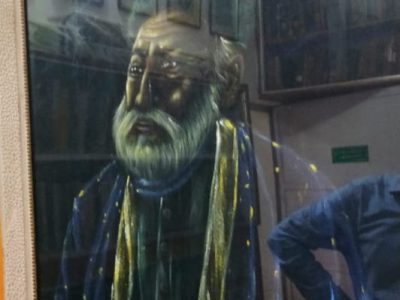
ICONIC: A portrait of Mirza Ghalib at the library, which boasts of rare works on the Delhi-based poet
“So, our generation has to know Urdu to understand their buzurgs (elders) and what charismatic works they had done. Our current generation, which doesn’t know Urdu, is like a blackboard. Anyone can write anything on it and it doesn’t impact them because they are so ignorant of legacies of their own language.”
Professor Rahman has travelled abroad 44 times. He visited Greece, including its capital Athens, Samarkand and Bukhara in Uzbekistan, Spain, Turkey, Germany and other countries.
“I went to Iran 11 times to gather books and study how it has preserved its arts and culture, literature, medicine and environment,” he says adding that children of every country know their mother tongue and can read and write in it.
“India’s children, especially the new Muslim community, is ignorant of its own legacy in Urdu.”
The Ibn Sina Academy has a tremendous collection of Islamic sciences and Islamic medicines. The professor has procured them from across the globe.
“Some are bought, some gifted and some requested and begged for. Hamaare 3,200 hazaar kitaabon mein, Ghalib ka collection jo hamaare paas hai vo duniya mein kisi ke paas nahi hai (No one in the world has the rare collection on Ghalib that we have among our 32,000 books). Even Delhi’s own Ghalib Institute and Ghalib Academy visit us and take photocopies of the rare material they require. We have made our academy work on Delhi’s poets, littérateurs, historical buildings and monuments,” he adds.
Most books, he adds, are from Iran, Samarkand and Bukhara.
“The richest in education, philosophy, medicine and culture is Uzbekistan but it could not present it to the world, the way Iran did.”
Why Delhi in Aligarh?
Why Delhi forms a special section at his library, has its reasons.
“Delhi was always the capital of India, be it during the Mughal, British eras or post-Independence period. So, it has always been not only a melting pot of cultures but also an abode for the best of poets, authors and travellers. The number of academics, authors, sufis, litterateurs, shayars (poets), lovers of arts and music and academic institutions that Delhi had, no other capital in the world has it till date,” he reasons with pride.
To know Delhi better, he suggests books penned by the renowned Dehlvi family.
For instance, there is Dilli jo aik shahar thaa by Shahid Ahmad Dehlvi, who was born in Delhi in 1902.
He wrote extensively on vanishing culture of Delhi which was a symbol of Indo-Muslim culture ruined by violence and blood of the War of Independence. Post Independence, he went to Pakistan and died in 1967.
Waqyaat-e-Darool Hukoomat in three volumes by Bashiruddin Ahmad Dehlvi published from Urdu Academy, Delhi in 1990, and books on 1857 revolution are also there in the academy.
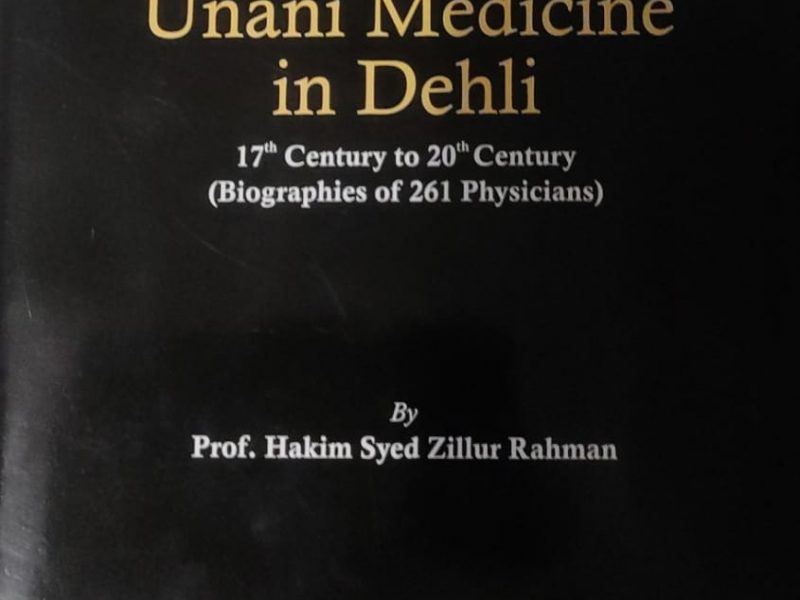
Delhi just got richer by another book by Zillur Rahman — Dilli aur Tibbi Unani which has just come out in Urdu. It is translated in English by Toronto-based Zakaria Virk, titled ‘History of Unani Medicine in Delhi – 17th Century to 20th Century – Biographies of 261 physicians’.
source: http://www.thepatriot.in / The Patriot / Home> Delhi NCR / by Rana Siddiqui Zaman, Delhi NCR / November 15th, 2023
At The Hindu Lit for Life 2025, Amal Allana speaks about her father Ebrahim Alkazi, who led the modern theatre movement in India with an extraordinary vision.
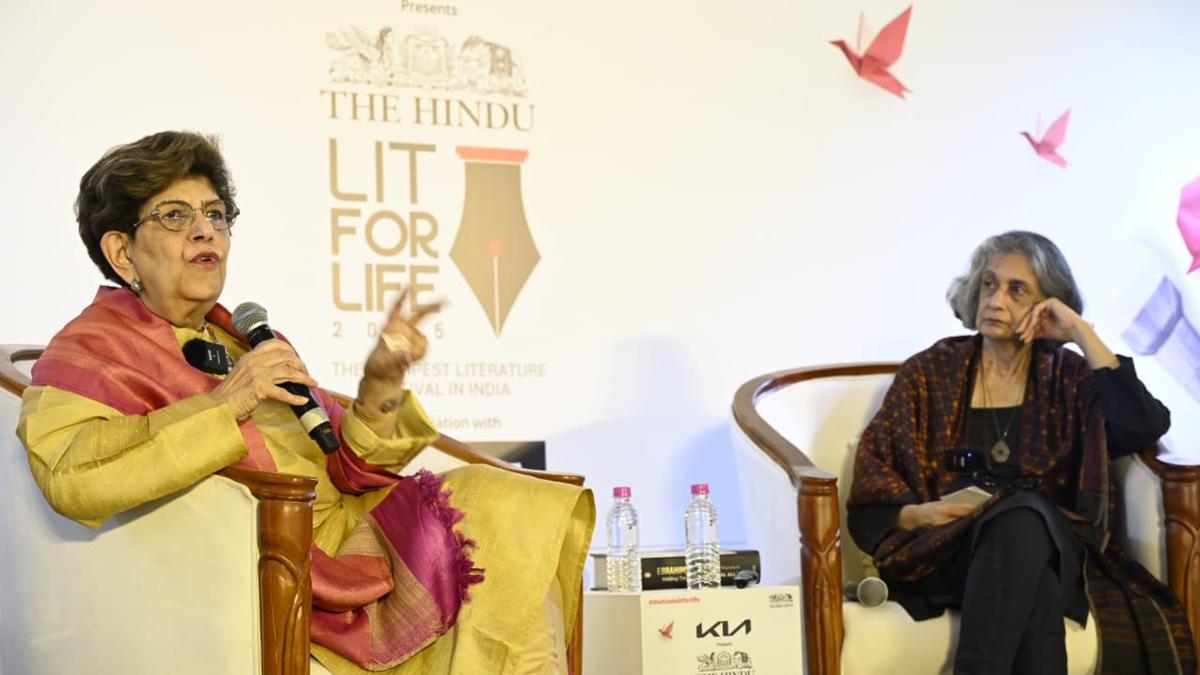
Amal Allana in conversation with Ritu Menon at The Hindu Lit for Life 2025. | Photo Credit: R. Ragu
Theatre director Amal Allana, who recently released a riveting biography of her father Ebrahim Alkazi: Holding Time Captive gave a racy account of Alkazi’s revolutionary contributions to arts and culture in the creative landscape that was emerging in pre-independence India into the later decades.
She said the title of her book was apt as she found the words scribbled by her father in his notes that read ‘I wish I could live longer to hold time captive.’
A six-minute documentary on Alkazi charting the journey of his quest for a liberal approach to the arts in the Indian sub-Continent preceded Amal Allana’s conversation with Ritu Menon at The Hindu Lit for Life session on the second day.
Setting the narrative in Bombay of the 1940s when Alkazi came as the son of a migrant trader from Saudi Arabia, Amal spoke about how his innovative ideas from the young age of 22 coupled with daring new experimental projects transformed the theatre movements pan-India and later led to the establishment of the National School of Drama in Delhi in the 1960s. It was the time when creative history was under-researched and Alkazi strode the stage with arrogance, resoluteness, and brilliance.
As the daughter, Amal brought a personal perspective to the intangible landscape of Alkazi’s passions as she step-by-step unfolded the layers of his cultural, artistic and nationalistic identity. “His pedagogical skills took form as a response to the social and political life. He introduced language in theatre and nationalised it,” she said.
With Sultan Padamsee (elder brother of filmmaker Alyque Padmasee) and other independent-minded creative individuals, he broke boundaries and embraced the radical and precarious theatre life. They were all progressives and reinforcing each other. Amal narrated how Alkazi went overseas to study modern theatre and took Nissim Ezekiel along. He had the disposition of taking people along with and their idea of total theatre included all forms of arts feeding into one another.
“So with music, lights, costumes, literature, discussions and brochures he created dramatic experiences translating, producing and directing plays from the Western pantheon,” Amal said and added Alkazi was particularly influenced by Tagore’s concept of Santiniketan integrating liberalism with fine arts.
Not only was Alkazi interested in training a body of thinking actors but he also trained audiences to appreciate modernity in theatre, she said.
The Hindu Lit for Life event is presented by KIA India and is in association with Christ University. Associate Partners: LIC, RR Donnelley, Blue Star, Brigade Group, NITTE Deemed-to-be University, PROchure, Singer, Chennai Port Authority & Kamarajar Port Ltd, Uttarakhand Tourism, Vajiram and Ravi, Indian Bank, Akshayakalpa and ICFAI Group. Realty Partner: Casagrand. Bookstore Partner: Crossword. Food Partner: Wow Momo, Beverage Partner: Beachville, Radio Partner: Big FM, TV Partner: Puthiya Thalaimurai Gift Partner: Anand Prakash. Supported by: US Consulate, Chennai, Water Partner: Repute
source: http://www.thehindu.com / The Hindu / Home> Lit for Life / by Soma Basu / January 19th, 2025
If published, Amir Rizvi’s work would be the largest set of lexicons
When this monumental work sees the light of the day, Urdu readers will have the largest ever set of lexicons — six dictionaries spread over nearly 4000 pages are awaiting publication. Only, Syed Jafar Amir Rizvi doesn’t have the wherewithal to publish them.
A nuclear scientist by profession and a linguistic buff by passion, Amir has slogged for ten years to write the dictionaries on subjects which are totally new to Urdu language. Having accomplished the task, he is desperately looking for a sponsor to publish his works. His talks with the National Council for Promotion of Urdu Language (NCPUL) and the Maulana Azad National Urdu University in this connection have remained unfruitful.
Lexicography runs in his genes. His grandfather, Syed Tasaduqh Hussain Rizvi, authored the Loghat-e-Kishwari , way back in 1886; that still remains a popular reference point in Urdu. But what triggered Amir’s interest is Gossamer Years’ the tenth century classic of a Japanese writer, presented by his daughter. So impressed was he with the book that he wanted to translate it in Urdu. But when he sat down to translate he couldn’t get appropriate words in Urdu. “It was then that I decided to compile a comprehensive dictionary,” says Amir who served in the Department of Energy, US.
After retirement in 2007 he devoted his time and energy to writing seven dictionaries – Farhang-e-Amir, Farhang-e-Mauzoee (thematic dictionary), Farhang-e-Mutaradif and Mutazad (dictionary of synonyms and antonyms), Farhang-e-Qafia (rhyming dictionary), Urdu Lugath ki Tareekh (history of Urdu lexicography) and Farhang-e-Lisaan (linguistic dictionary). Of these only Farhang-e-Amir has been published; the rest await publication.
Salient features
What is unique about Amir’s lexicons is their encyclopaedic range. They not only provide information related to language and literature but are also a treasure trove of words for students and research scholars. For instance the thematic dictionary is a thesaurus in four languages – Urdu, Persian, Arabic, English. So one can find the meaning of a word in four languages at once. With more than one lakh words, the 1100-page lexicon is structured subject-wise.
Amir has fulfilled a long-felt need for a thesaurus in Urdu with a 2000 page dictionary. “Its benefits will be known once you start using it”, he says.
The Farhang-e-Qafia is also exceptional; it could be of immense help to poets in search of appropriate rhyming words. “Such a dictionary simply doesn’t exist in Urdu”, says Shujat Ali Rashid, a Urdu writer.
Apart from this, Amir has also penned Urdu and English poetry under the title Milak-e-Shairi and Distant Song, and has authored a Hand Book of Nuclear Science and Engineering on design and construction of nuclear power plants. What worries this 80-plus writer is the fate of his lexicons. He wants them published during his lifetime. Will someone come forward to help him?
source: http://www.thehindu.com / The Hindu / Home> Todays Paper> Features> Friday Review / by J S Ifthekhar / December 07th, 2018
Tasneem Fathima Khaleel has had a successful career in academia. However, quite remarkably, she came back to where she started – teaching. M A Siraj reports.
Few people end their careers where they first began; Professor Tasneem Fathima Khaleel is among those few. “I am excited about the opportunity to finish my career in the classroom. And, with a little help, I will be teaching in a new state-of-the-art…facility,” says Tasneem, the first-ever woman to have obtained a doctorate in the State of Mysore in 1970. Prior to returning as a professor of Botany, she served as the dean of faculty at College of Arts & Sciences for a decade at the Montana State University at Billings (MUSB).
Paving a new path
Tasneem has been teaching Botany in the United States for over 40 years and has received many awards for her teaching and research. She has headed, or has been a member on as many as 23 different academic bodies or advisory councils in the US. For her contribution to research, with nearly 50 research publications on subjects ranging from cyto-embriology to plant reproduction, she was awarded the ‘Outstanding Research Award’ in 1995 by the Montana Research Academy and has also won the Faculty Excellence Award five times.
The year 2014 was a special year for Tasneem – she had the rare honour of an award being named after her, for mentoring at the MUSB. Reno Charette, director for American-Indian Education, was adjudged the winner of the first ‘Prof Tasneem Fathima Khaleel Award for Mentoring’.
Tasneem studied in Bengaluru, before heading to the US in 1975 after marriage. An alumna of Central College, Bengaluru, she has coveted every opportunity to visit her ‘City of Gardens’ – which she ruefully admits is more a part of nostalgia rather than reality.
A passionate researcher, she recalls that very few women could be seen in higher studies in those days. Only a couple of them were pursuing PhD while she was registered in Bangalore University as well as teaching biology as an assistant professor at the University of Agricultural Sciences at Hebbal between 1968 and 1975. Her study of ‘Flora at the GKVK Campus’ and ‘Weeds in Karnataka’ are still quoted as seminal works.
Writing her own destiny
Tasneem had finished her BSc and MSc by the time she was barely 19 years old. Wanting to be a teacher, she had put in her application, but was rejected, as the dean told her, “You look like a school girl, how would the students take you seriously?”
Instead, he directed her to register for a PhD programme, which had just been started in the Bangalore University. The Doctorate took longer than usual to complete because there was lack of guidance and direction, and the programme had several fits and starts.
Finally, at 26 when she got her her doctorate, she was being looked as ‘a confirmed spinster’ in her own cultural surroundings. Marriage was nowhere on her mental radar. It took her brother several sittings to convince her of getting married.
Tasneem travelled a long and twisted path – one shaped by her culture and her drive to excel, to become the distinguished professor that she is today. For most Americans who had only preliminary idea of Islam, a woman with covered head and such drive for excellence and perseverance was a combination of incongruities. “Women have rights in Islam. Muslim women didn’t even have to fight for those rights. The religion has given them those rights,” she says.
Dr Stn Waitr, her successor, says, “Dean Khaleel has raised the level of rigour, excellence and success in the College of Arts & Sciences to a standard that should serve as a model for the entire institution.” Interestingly, Tasneem even built a herbarium at the MUSB, which has around 17,000 specimens and is currently engaged in digitising it. She recalls with pride that she was the most productive member on the faculty of science at the MSU, which has nearly 22,000 students today in two campuses. Tasneem’s most significant discovery was the finding of mammalian steroids in plants, which she says, are responsible for sex expression in plants.
Author of four books, 10 external and 17 internal grants at the MSUB, Tasneem is excited about beginning her teaching career once again. “It had never ended. I had maintained a room in my department building, even while I headed the faculty,” she says.
source: http://www.deccanherald.com / Deccan Herald / Home> Content / by M.A. Siraj / June 26th, 2015
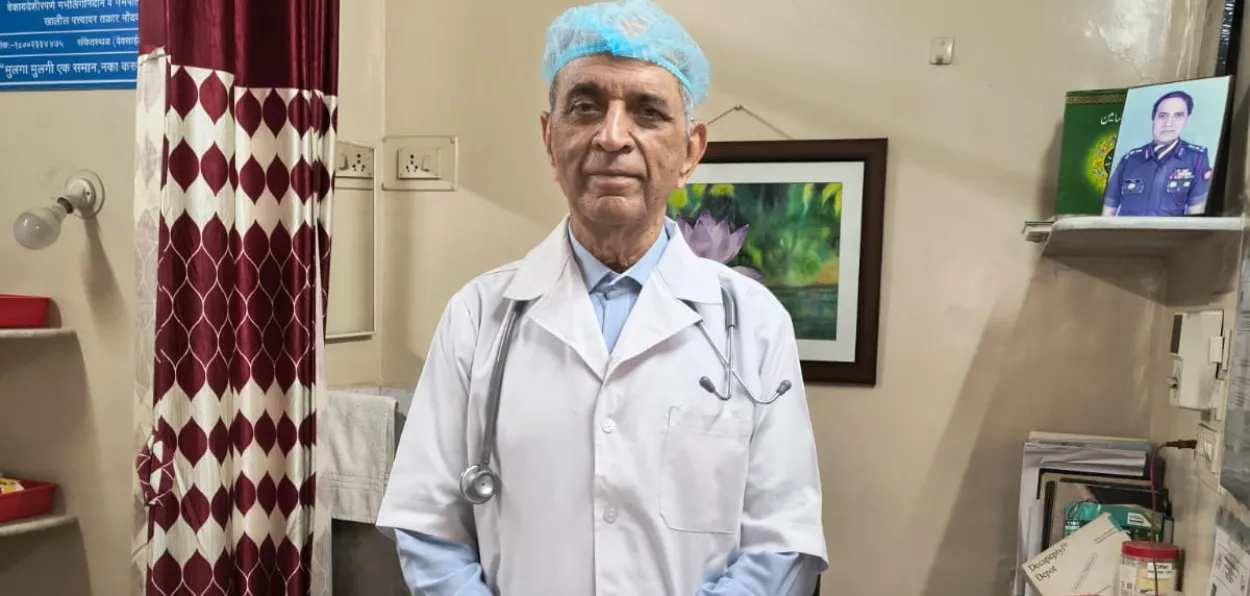
These slogans are painted at vantage points inside cantonments or army units. However, if you want to see how a soldier always lives up to these adages, meet Brigadier (retired) Dr. Mukhtar Alam, who lives in Pune, Maharashtra.
“Youth are the future of India and after serving my country I am now serving them,” says (Prof) Brigadier Dr. Mukhtar Alam, 80, Chairman, Department of Gynaecology, Ruby Hall Hospital, Pune.
Serving the Army for 35 years as a Professor in the Armed Forces Medical College, he became the Chief Consultant of Gynecology.
He is often called the father of the AFMC for his contribution to the development of this chain of prestigious Medical colleges run by the Military. As a student of the AFMC, Pune, he won 7 gold medals in MBBS and MD and became the first topper from AFMC in Pune University.
A multifaceted personality, Dr. Mukhtar Alam has been awarded the State Sahitya Akademi Award for 2013 by the Government of Maharashtra. He has published 21 books in Hindi, English, Urdu, and Marathi so far.
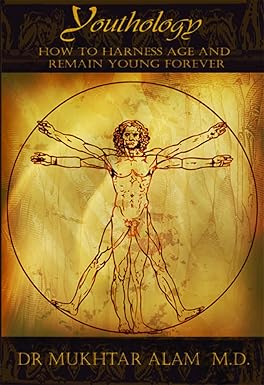
His book Youthology: How to Harness Age and Remain Young published by Power Publishers is a rage among the new generation.
His book seeks to connect man’s secret desire to attain eternal youth with amazing discoveries in the field of medicine and nutritional science and multidimensional explorations into the realm of Physiology.
Brig. Mukhtar Alam’s book
Speaking with Awaz-the Voice, Prof Brig (retd) Mukhtar Alam said that he has done extensive research in modern fields of endoscopy and oncology. He contributed to the medical world through his breakthrough work in assisted reproductive techniques at the Royal Postgraduate Medical College, University of London in the 1980s. His work has been recognized and published in medical journals around the world.
Brigadier Dr. Mukhtar Alam’s social work involves helping the youth. He said that he often visits the schools nearby and helps poor children in their education through scholarships. He also provides them with school uniforms and books.
He says that he does not want to be remembered and spoken of like a politician.
Brigadier Dr. Mukhtar Alam offers scholarships to students who score 80 percent marks. Already students whom he helped are busy studying for degrees like B.Tech. He remembers someone being the daughter of a barber and the son of a watchman, whom he could help and all are doing fine in life.
In literature, Dr. Mukhtar Alam is interested in spiritualism, philosophy, and humanism – elements that unite humans.
Some of his awarded works are: “ Majmuan Mazameen Quran Majeed ” in Urdu and “ Quran Majeed Ka Kavya Saar ” in Hindi, i.e. translation of the Quran in the form of poetry so that a common Indian person can understand the Quran in his Urdu/Hindi language.
Dr. Mukhtar Alam has published more than 50 research papers in national/international medical journals and has authored 21 books.
Brig. Mukhtar Alam
Dr Mukhtar Alam said, “Negativity is never a choice. It is a self-chosen suicidal tendency. Hatred cannot be eradicated by hatred. It can only be eradicated by love. Our nation is like a family. It demands a bond of love, compassion, and sacrifices to respect and celebrate diversity. We must be inclusive in our outlook, abilities, and disposition.”
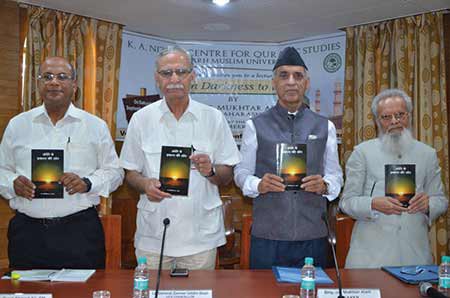
Brig. Mukhtar Alam delivers motivational lectures in educational institutions. Speaking on “From Darkness to Light” at Aligarh Muslim University on 17 September 2016, Brig Alam emphasized the need to acquire knowledge and get rid of the darkness of ignorance.
He said knowledge, which is acquired as a result of educational pursuits, is the only way to pull society out of the mire of illiteracy and backwardness. He said only “truthfulness, determination, commitment and hard work can take a person from darkness to light”.
Dr. Mukhtar Alam is Professor and HOD (Academics) at Ruby Hall Hospital (Research & Referral), Pune, and Director of Dr. Brig. Alam’s Clinic and Infertility Treatment and Research Centre, Parmar Park, Wanowrie, Pune.
On religion, Brig. Alam said that “the goal of Islam is to eliminate the darkness of ignorance from the human world and it never approves of “hatred, anger and barbarism”. He said that Islam is a religion of peace and love and compassion towards all is the only way of life for a true follower of this religion.”
Brig Alam’s book being released at AMU
Discipline is one of the most important personality traits in everyone’s life. It refers to a set of rules and regulations that must be followed while going through any task or activity. It is a way of being honest, hardworking, and motivated while accomplishing a task.
Brigadier Alam said that the spiritualism is a prsonal journey, which introduces us to our true nature. It is a path to experience the eternal truth within by moving away from the outside world. Seek peace and balance within yourself every day. Consider meditation, sadhana and self-reflection as a part of your life. Keep your thoughts pure and fill your actions with service and love.
Remember, every event in life brings a purpose. Every intangible thing is a means to improve the soul. Have faith in God and complete your journey with devotion, patience, and documentation. This journey is the path to bliss and liberation.
Brigadier Dr. Mukhtar Alam believes that all the youth should follow the path of spirituality only then they will be able to achieve the right goal in their life.
Brig. Alam said, “Let us together build an India that enlightens the world through its spiritual richness and human diversity. India is humanity and humanity is India. Let us present ourselves before the global fraternity as a symbol and pinnacle of peace and religious harmony. Spirituality is the real strength of India.”
source: http://www.awazthevoice.in / Awaz, The Voice / Home> Stories / by Onika Maheshwari, New Delhi / January 09th, 2025