Category Archives: Books (incl.Biographies – w.e.f.01 jan 2018 )

Lexicographer nonpareil

Hyderabad, TELANGANA / U.S.A :

If published, Amir Rizvi’s work would be the largest set of lexicons

When this monumental work sees the light of the day, Urdu readers will have the largest ever set of lexicons — six dictionaries spread over nearly 4000 pages are awaiting publication. Only, Syed Jafar Amir Rizvi doesn’t have the wherewithal to publish them.

A nuclear scientist by profession and a linguistic buff by passion, Amir has slogged for ten years to write the dictionaries on subjects which are totally new to Urdu language. Having accomplished the task, he is desperately looking for a sponsor to publish his works. His talks with the National Council for Promotion of Urdu Language (NCPUL) and the Maulana Azad National Urdu University in this connection have remained unfruitful.

Lexicography runs in his genes. His grandfather, Syed Tasaduqh Hussain Rizvi, authored the Loghat-e-Kishwari , way back in 1886; that still remains a popular reference point in Urdu. But what triggered Amir’s interest is Gossamer Years’ the tenth century classic of a Japanese writer, presented by his daughter. So impressed was he with the book that he wanted to translate it in Urdu. But when he sat down to translate he couldn’t get appropriate words in Urdu. “It was then that I decided to compile a comprehensive dictionary,” says Amir who served in the Department of Energy, US.

After retirement in 2007 he devoted his time and energy to writing seven dictionaries – Farhang-e-Amir, Farhang-e-Mauzoee (thematic dictionary), Farhang-e-Mutaradif and Mutazad (dictionary of synonyms and antonyms), Farhang-e-Qafia (rhyming dictionary), Urdu Lugath ki Tareekh (history of Urdu lexicography) and Farhang-e-Lisaan (linguistic dictionary). Of these only Farhang-e-Amir has been published; the rest await publication.

Salient features

What is unique about Amir’s lexicons is their encyclopaedic range. They not only provide information related to language and literature but are also a treasure trove of words for students and research scholars. For instance the thematic dictionary is a thesaurus in four languages – Urdu, Persian, Arabic, English. So one can find the meaning of a word in four languages at once. With more than one lakh words, the 1100-page lexicon is structured subject-wise.

Amir has fulfilled a long-felt need for a thesaurus in Urdu with a 2000 page dictionary. “Its benefits will be known once you start using it”, he says.

The Farhang-e-Qafia is also exceptional; it could be of immense help to poets in search of appropriate rhyming words. “Such a dictionary simply doesn’t exist in Urdu”, says Shujat Ali Rashid, a Urdu writer.

Apart from this, Amir has also penned Urdu and English poetry under the title Milak-e-Shairi and Distant Song, and has authored a Hand Book of Nuclear Science and Engineering on design and construction of nuclear power plants. What worries this 80-plus writer is the fate of his lexicons. He wants them published during his lifetime. Will someone come forward to help him?

source: http://www.thehindu.com / The Hindu / Home> Todays Paper> Features> Friday Review / by J S Ifthekhar / December 07th, 2018

For the love of teaching

Bengaluru, KARNATAKA / Billings (Montana), USA :

A Full circle

Tasneem Fathima Khaleel

Tasneem Fathima Khaleel has had a successful career in academia. However, quite remarkably, she came back to where she started – teaching. M A Siraj reports.

Few people end their careers where they first began; Professor Tasneem Fathima Khaleel is among those few. “I am excited about the opportunity to finish my career in the classroom. And, with a little help, I will be teaching in a new state-of-the-art…facility,” says Tasneem, the first-ever woman to have obtained a doctorate in the State of Mysore in 1970. Prior to returning as a professor of Botany, she served as the dean of faculty at College of Arts & Sciences for a decade at the Montana State University at Billings (MUSB).

Paving a new path

Tasneem has been teaching Botany in the United States for over 40 years and has received many awards for her teaching and research. She has headed, or has been a member on as many as 23 different academic bodies or advisory councils in the US. For her contribution to research, with nearly 50 research publications on subjects ranging from cyto-embriology to plant reproduction, she was awarded the ‘Outstanding Research Award’ in 1995 by the Montana Research Academy and has also won the Faculty Excellence Award five times.

The year 2014 was a special year for Tasneem – she had the rare honour of an award being named after her, for mentoring at the MUSB. Reno Charette, director for American-Indian Education, was adjudged the winner of the first ‘Prof Tasneem Fathima Khaleel Award for Mentoring’.

Tasneem studied in Bengaluru, before heading to the US in 1975 after marriage. An alumna of Central College, Bengaluru, she has coveted every opportunity to visit her ‘City of Gardens’ – which she ruefully admits is more a part of nostalgia rather than reality.

A passionate researcher, she recalls that very few women could be seen in higher studies in those days. Only a couple of them were pursuing PhD while she was registered in Bangalore University as well as teaching biology as an assistant professor at the University of Agricultural Sciences at Hebbal between 1968 and 1975. Her study of ‘Flora at the GKVK Campus’ and ‘Weeds in Karnataka’ are still quoted as seminal works.

Writing her own destiny

Tasneem had finished her BSc and MSc by the time she was barely 19 years old. Wanting to be a teacher, she had put in her application, but was rejected, as the dean told her, “You look like a school girl, how would the students take you seriously?”

Instead, he directed her to register for a PhD programme, which had just been started in the Bangalore University. The Doctorate took longer than usual to complete because there was lack of guidance and direction, and the programme had several fits and starts.

Finally, at 26 when she got her her doctorate, she was being looked as ‘a confirmed spinster’ in her own cultural surroundings. Marriage was nowhere on her mental radar. It took her brother several sittings to convince her of getting married.

Tasneem travelled a long and twisted path – one shaped by her culture and her drive to excel, to become the distinguished professor that she is today. For most Americans who had only preliminary idea of Islam, a woman with covered head and such drive for excellence and perseverance was a combination of incongruities. “Women have rights in Islam. Muslim women didn’t even have to fight for those rights. The religion has given them those rights,” she says.

Dr Stn Waitr, her successor, says, “Dean Khaleel has raised the level of rigour, excellence and success in the College of Arts & Sciences to a standard that should serve as a model for the entire institution.” Interestingly, Tasneem even built a herbarium at the MUSB, which has around 17,000 specimens and is currently engaged in digitising it. She recalls with pride that she was the most productive member on the faculty of science at the MSU, which has nearly 22,000 students today in two campuses. Tasneem’s most significant discovery was the finding of mammalian steroids in plants, which she says, are responsible for sex expression in plants.

Author of four books, 10 external and 17 internal grants at the MSUB, Tasneem is excited about beginning her teaching career once again. “It had never ended. I had maintained a room in my department building, even while I headed the faculty,” she says.

source: http://www.deccanherald.com / Deccan Herald / Home> Content / by M.A. Siraj / June 26th, 2015

Veteran Brig. Mukhtar Alam keeps a soldier in him alive to serve India

Pune, MAHARASHTRA :

Prof Brig (retd) Mukhtar Alam

A soldier is always on duty

Duty unto death

Veer Bhogyo Vasundhra

These slogans are painted at vantage points inside cantonments or army units. However, if you want to see how a soldier always lives up to these adages, meet Brigadier (retired) Dr. Mukhtar Alam, who lives in Pune, Maharashtra.

“Youth are the future of India and after serving my country I am now serving them,” says (Prof) Brigadier Dr. Mukhtar Alam, 80, Chairman, Department of Gynaecology, Ruby Hall Hospital, Pune.

Serving the Army for 35 years as a Professor in the Armed Forces Medical College, he became the Chief Consultant of Gynecology.

He is often called the father of the AFMC for his contribution to the development of this chain of prestigious Medical colleges run by the Military. As a student of the AFMC, Pune, he won 7 gold medals in MBBS and MD and became the first topper from AFMC in Pune University.

A multifaceted personality, Dr. Mukhtar Alam has been awarded the State Sahitya Akademi Award for 2013 by the Government of Maharashtra. He has published 21 books in Hindi, English, Urdu, and Marathi so far.

His book Youthology: How to Harness Age and Remain Young published by Power Publishers is a rage among the new generation.

His book seeks to connect man’s secret desire to attain eternal youth with amazing discoveries in the field of medicine and nutritional science and multidimensional explorations into the realm of Physiology.

Brig. Mukhtar Alam’s book

Speaking with Awaz-the Voice, Prof Brig (retd) Mukhtar Alam said that he has done extensive research in modern fields of endoscopy and oncology. He contributed to the medical world through his breakthrough work in assisted reproductive techniques at the Royal Postgraduate Medical College, University of London in the 1980s. His work has been recognized and published in medical journals around the world.  

Brigadier Dr. Mukhtar Alam’s social work involves helping the youth. He said that he often visits the schools nearby and helps poor children in their education through scholarships. He also provides them with school uniforms and books.

He says that he does not want to be remembered and spoken of like a politician.

Brigadier Dr. Mukhtar Alam offers scholarships to students who score 80 percent marks. Already students whom he helped are busy studying for degrees like B.Tech. He remembers someone being the daughter of a barber and the son of a watchman, whom he could help and all are doing fine in life.

In literature, Dr. Mukhtar Alam is interested in spiritualism, philosophy, and humanism – elements that unite humans.

Some of his awarded works are: “ Majmuan Mazameen Quran Majeed ” in Urdu and “ Quran Majeed Ka Kavya Saar ” in Hindi, i.e. translation of the Quran in the form of poetry so that a common Indian person can understand the Quran in his Urdu/Hindi language.

Dr. Mukhtar Alam has published more than 50 research papers in national/international medical journals and has authored 21 books.  

Brig. Mukhtar Alam

Dr Mukhtar Alam said, “Negativity is never a choice. It is a self-chosen suicidal tendency. Hatred cannot be eradicated by hatred. It can only be eradicated by love. Our nation is like a family. It demands a bond of love, compassion, and sacrifices to respect and celebrate diversity. We must be inclusive in our outlook, abilities, and disposition.”

Brig. Mukhtar Alam delivers motivational lectures in educational institutions. Speaking on “From Darkness to Light” at Aligarh Muslim University on 17 September 2016, Brig Alam emphasized the need to acquire knowledge and get rid of the darkness of ignorance.

He said knowledge, which is acquired as a result of educational pursuits, is the only way to pull society out of the mire of illiteracy and backwardness. He said only “truthfulness, determination, commitment and hard work can take a person from darkness to light”.

Dr. Mukhtar Alam is Professor and HOD (Academics) at Ruby Hall Hospital (Research & Referral), Pune, and Director of Dr. Brig. Alam’s Clinic and Infertility Treatment and Research Centre, Parmar Park, Wanowrie, Pune.

On religion, Brig. Alam said that “the goal of Islam is to eliminate the darkness of ignorance from the human world and it never approves of “hatred, anger and barbarism”. He said that Islam is a religion of peace and love and compassion towards all is the only way of life for a true follower of this religion.”

Brig Alam’s book being released at AMU

Discipline is one of the most important personality traits in everyone’s life. It refers to a set of rules and regulations that must be followed while going through any task or activity. It is a way of being honest, hardworking, and motivated while accomplishing a task.

Brigadier Alam said that the spiritualism is a prsonal journey, which introduces us to our true nature. It is a path to experience the eternal truth within by moving away from the outside world. Seek peace and balance within yourself every day. Consider meditation, sadhana and self-reflection as a part of your life. Keep your thoughts pure and fill your actions with service and love.

Remember, every event in life brings a purpose. Every intangible thing is a means to improve the soul. Have faith in God and complete your journey with devotion, patience, and documentation. This journey is the path to bliss and liberation.

Brigadier Dr. Mukhtar Alam believes that all the youth should follow the path of spirituality only then they will be able to achieve the right goal in their life.

Brig. Alam said, “Let us together build an India that enlightens the world through its spiritual richness and human diversity. India is humanity and humanity is India. Let us present ourselves before the global fraternity as a symbol and pinnacle of peace and religious harmony. Spirituality is the real strength of India.”

source: http://www.awazthevoice.in / Awaz, The Voice / Home> Stories / by Onika Maheshwari, New Delhi / January 09th, 2025

Hyderabad’s Dr. Abid Moiz Bags Delhi Urdu Academy Award for Excellence in Science Literature

Hyderabad, TELANGANA :

Hyderabad:

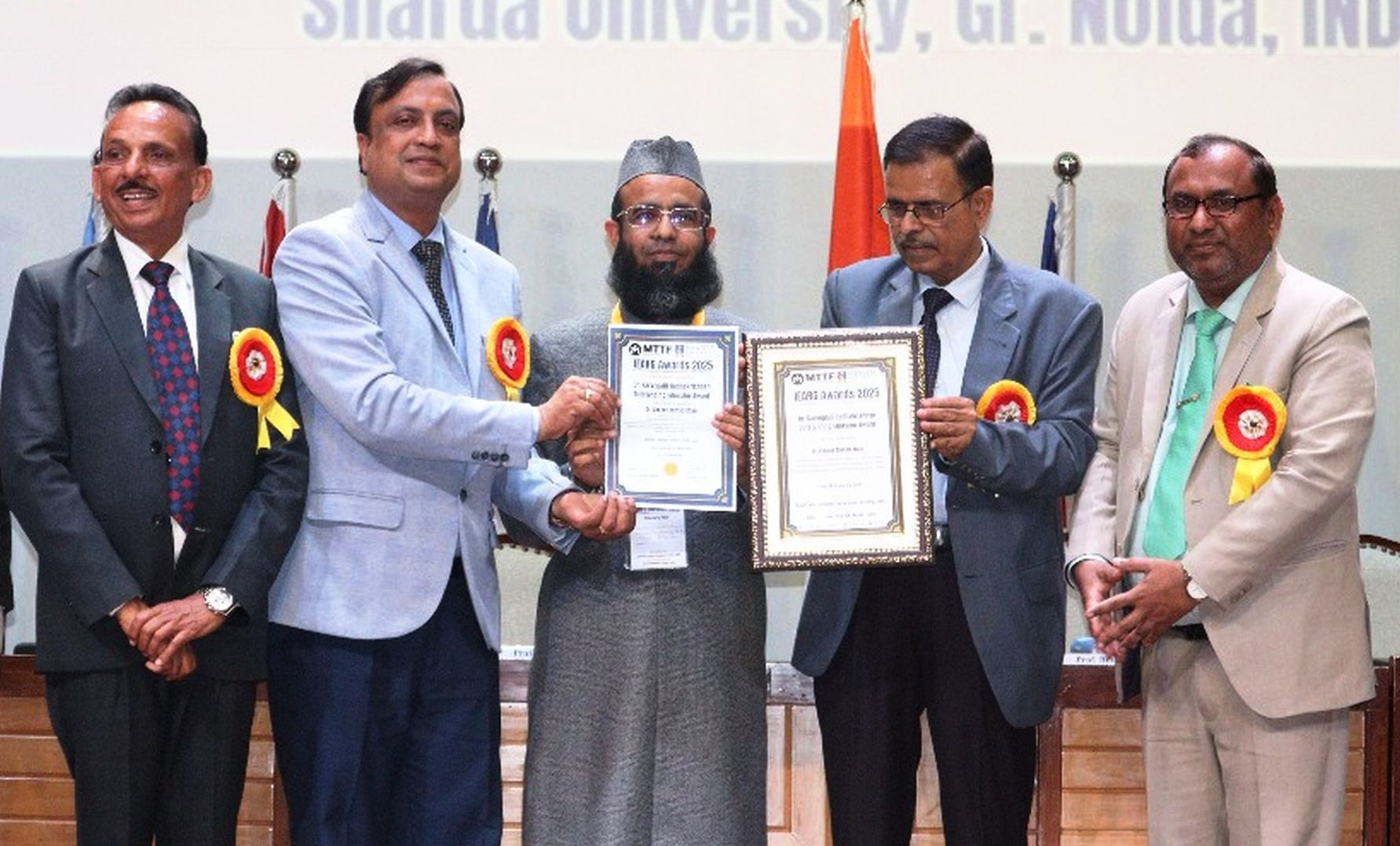
Renowned Hyderabad-based writer and doctor, Dr. Abid Moiz, has been conferred the prestigious Delhi Urdu Academy Award for his outstanding contributions to science literature in Urdu. He is the only recipient from South India to receive this recognition for 2023-24, which includes a cash prize of ₹2 lakh.

As per Siyasat daily, Dr. Moiz’s ground-breaking work has made scientific concepts more accessible to Urdu-speaking audiences, fostering a deeper appreciation for science within the community. Known for his unique ability to merge science with literature, he has authored 23 science books and 17 humour and satire books, carving a distinct niche in the Urdu literature.

Dr. Moiz’s journey into science writing began with Diabetes Ke Saath Saath (Living with Diabetes), aimed at promoting health awareness. His repertoire includes books like Chiknai Aur Hamari Sehat (Fats and Our Health), Cholesterol Kam Kijiye (Reduce Cholesterol), Namak Kam Karen (Reduce Salt), and Ramzan Aur Hamari Sehat (Ramzan and Our Health). These books focus on health management and dietary choices, blending scientific knowledge with simple language and engaging graphics.

Dr. Moiz’s works, such as Motapa (Obesity) and Tarkari aur Phal Khayen (Eat Vegetables and Fruits), emphasise balanced nutrition and healthy living, solidifying his legacy as a visionary in the underrepresented genre of Urdu science literature.

In addition to his literary contributions, Dr. Moiz serves on the advisory board of Science Urdu, a popular science monthly magazine edited by Dr. Aslam Parvez, former Vice-Chancellor of Maulana Azad National Urdu University. His involvement underscores his commitment to promoting scientific awareness among Urdu readers.

The Delhi Urdu Academy also honoured several other luminaries this year, including Javed Akhtar for promoting Urdu, Taha Naseem for children’s literature, Anee Aazmi for drama, Prof. Ahmed Mahfooz for research and criticism, and Rakshanda Roohi for prose.

Previously, Dr. Moiz received Lifetime Achievement Award from the Telangana State Urdu Academy in 2019 for his sustained contributions to Urdu literature and science writing.

Dr. Moiz’s achievements exemplify how science and literature can harmoniously coexist, even in languages traditionally associated with arts and culture. By simplifying complex scientific ideas, he continues to empower readers and enrich the legacy of Urdu literature.

source: http://www.radiancenews.com / Radiance News / Home>Pride of the Nation> Awards> Latest News / by Radiance News Bureau / January 09th, 2025

Scholar, Writer Prof. Muzaffar Assadi passes away at 63

Shirva, UDUPI District / Mysuru / KARNATAKA :

Prof. Muzaffar Assadi

Bengaluru:

Senior scholar, thinker, and writer, Prof. Muzaffar Hussain Assadi, who served as the Acting Vice-Chancellor and Dean of the Political Science Department at Mysore University, passed away late Friday night at a private hospital in Bengaluru. He was 63 years old.

Prof. Muzaffar Assadi conducted extensive studies on the lives and lifestyles of tribal communities.

He served as the chairperson of a committee appointed to address the displacement of tribal populations. His research and contributions spanned areas such as agricultural studies, globalization, Gandhian philosophy, political sociology, democratic theories, social movements, comparative governance, Indian politics, human rights, and global political theories, earning him significant recognition.

Hailing from Shirva in Udupi district, Dr. Muzaffar Assadi completed his postgraduate degree from Mangalore University, followed by an M.Phil. and Ph.D. from Jawaharlal Nehru University (JNU), New Delhi.

He later pursued a Rockefeller Fellowship and Post-Doctoral studies at the University of Chicago.

He authored 11 books during his illustrious career.

As the chairperson of the High Court Committee on Tribal Displacement, he submitted an impactful report.

His notable works include Multifaceted Feminist Narratives and Movements in Karnataka, Asmita, among others.

Previously, he served as the Special Officer of the newly established Raichur University.

Prof. Assadi received numerous honors, including the Karnataka Sahitya Academy Award.

source: http://www.english.varthabharati.in / Vartha Bharati / Home> Karnataka / by Vartha Bharati / January 04th, 2025

She was the first woman builder in Mughal rule and gave Delhi Humayun’s Tomb

DELHI :

Humayun’s Tomb introduced India to the Persian style of a domed mausoleum set in the centre of a landscaped char-bagh garden.

Humayun’s Tomb, Delhi | Photo: Commons

Humayun’s first wife was a Persian from Khorasan and a daughter of Humayun’s maternal uncle. She was also called Haji Begum, probably because she had gone on the Haj to Mecca. During Humayun’s reign, she appears in history at the Battle of Chausa, where the harem was captured by Sher Khan. In all the chaos of battle, a boat carrying women capsized and her young daughter, Aqiqa Begum, was drowned. Bega Begum did not have any more children. Today she is remembered for the tomb of Humayun that she built in Delhi. After the death of her husband, when she decided to build the mausoleum, she was encouraged in her endeavour by her stepson Akbar, who was very fond of her.

Among all Humayun’s wives, Bega Begum lived a life of surprising independence. She went off to the Haj and came back with Arab craftsmen who worked at the tomb. This was much before Gulbadan Begum and Hamida Banu Begum went to Mecca during the reign of Akbar, their trip getting much more coverage in contemporary writing. Bega Begum did not join the harem in Agra but remained in Delhi, supervising the building work. An episode described by Gulbadan shows that she was a spirited woman who even spoke sharply to her husband when he did not visit her.

Among all Humayun’s wives, Bega Begum lived a life of surprising independence. She went off to the Haj and came back with Arab craftsmen who worked at the tomb. This was much before Gulbadan Begum and Hamida Banu Begum went to Mecca during the reign of Akbar, their trip getting much more coverage in contemporary writing. Bega Begum did not join the harem in Agra but remained in Delhi, supervising the building work. An episode described by Gulbadan shows that she was a spirited woman who even spoke sharply to her husband when he did not visit her.

Then Humayun replied, ‘It is a necessity laid on me to make them happy. Nevertheless, I am ashamed before them because I see them so rarely… I am an opium-eater. If there should be any delay in my comings and goings, do not be angry with me.’ However, Bega Begum was not reassured and said, ‘Your Majesty has carried matters to this point! What remedy have we? You are emperor. The excuse looked worse than the fault.’ Gulbadan ends her tale saying, ‘He made it up with her also.’

The contemporary historian Badauni writes that Akbar and Bega Begum were very close and he describes her as a ‘second mother to Akbar’. Once when the boy Akbar had a toothache, Bega Begum brought some medicine but Hamida was reluctant to give it to him. This was understandable since, in a harem that was often full of politics and jealousy, the mothers feared that their children could be poisoned. Abul Fazl quotes Akbar as saying, ‘As she knew what the state of feeling was, she [Bega Begum] in her love to me swallowed some of it without there being any order to that effect, and then rubbed the medicine on my teeth.’

Bega Begum would often travel to Agra to meet Akbar and she spent her allowance doing charity. The Jesuit Antoine de Monserrate wrote, with reluctant approval, of her good works, ‘Throughout her widowhood she devoted herself to prayer and to alms-giving. Indeed, she maintained five hundred poor people by her alms. Had she only been a Christian, hers would have been the life of a heroine.’

Bega Begum was the first of the Mughal women to become a builder, and many would follow to build mausoleums, mosques, madrasas, seminaries, bazaars and gardens. Humayun’s Tomb introduced India to the Persian style of a domed mausoleum set in the centre of a landscaped char-bagh garden, which would reach its peak with the Taj Mahal. Built near the dargah (mausoleum) of the Sufi saint Sheikh Nizamuddin Auliya, the mausoleum complex became the graveyard for many members of the dynasty. Bega Begum is buried in the mausoleum near her husband, and somewhere nearby is the grave of one of the most unfortunate princes of the dynasty – Dara Shukoh.

___________________________

This excerpt from Mahal: Power and Pageantry in the Mughal Harem by Subhadra Sen Gupta has been published with permission from Hachette India. Hardback Rs 599.

_______________

source: http://www.theprint.in / The Print / Home> Page Turner> Book Excerpts / by Subhadra Sen Gupta / November 30th, 2019

Syed Ahmad Khan’s book on Delhi and its ruins would ‘numb’ other writers, said Mirza Ghalib

DELHI :

Asar-us-Sanadid was published in 1847. Yet, Syed Ahmad Khan distresses over the ‘recent’ increase in Delhi’s population.

Ruins of Feroz Shah Kotla in Delhi | Commons

Delhi is introduced, interpreted, and celebrated all the time through walks, performances, talks and articles. But not many realise that the person who began telling the stories of Delhi was a young man in his 20s named Syed Ahmad Khan. Two centuries after he was born, his work Asar-us-Sanadid can now enjoy a wider readership because of its translation into English by Rana Safvi in 2018.

Syed Ahmad Khan was not the first writer to describe Delhi, but when he compiled his notes on the ‘remains of the great’ (asar-us-sanadid) into a book, he chose to write not in Farsi but in the accessible Urdu — making him a pioneer. Another first was that it appeared as a book rather than as a manuscript because his brother had just installed a new Urdu printing press in Delhi. Khan’s qualifications to write were not that of a narrow specialist. In those happy days, when education was not one fixed menu, he had studied science, mathematics, Farsi and Urdu. In his 20s, living in his family home in Shahjahanabad (present-day Old Delhi), Khan was a junior official in the East India Company, helping his brother publish an Urdu newspaper, and translating Farsi manuscripts.

Asar-us-Sanadid was published in 1847, and had a quality of eagerness explained by Khan learning the subject as he went along. Khan went to great lengths to transcribe inscriptions (‘He is climbing up with such enthusiasm/That people think he has some work in the sky’ was an affectionate comment about his swinging round the Qutub Minar in an improvised basket-and-poles contraption to read the inscriptions on the higher storeys). The artists’ drawings for the book were based on his own sketches.

There are very few extant copies of the original edition. The better-known second edition, published in 1854, bears the blue pencil marks of the Collector A.A. Roberts, who did a hatchet-job, reducing it by a half, adhering to chronology, giving British scientists a role in the Jantar Mantar project, removing all the poets and artists, and making it an altogether dull book.

Sights, sounds and silences

To Khan, historic architecture was not just patrons, materials, form and function. It was part of a continuous culture, nourished by new infusions. Political history, the overlapping cities and forts, the increasingly sophisticated elements in architecture – these became four-dimensional by reading mosques, dargahs and mazhars as sacred spaces, calm with the presence of mystics and scholars long departed. They were to be experienced in silence, reading the inscriptions, not listening to the patter of a guide. He delineates the complementarity of a vibrant urban culture —music, poetry, dance — and animated bazaars, the tranquil atmosphere of the countryside, fields and hills dotted with ruins. “The charm of the Delhi scene,” as historian Percival Spear would describe it a century later.

In a sentence that sounds startlingly contemporary, Syed Ahmad Khan is distressed by the “recent” increase in the city’s population, making it — and also the bracing hills of Mehrauli — unpleasantly congested. But he insists that “in spite of all these factors, the climate of Delhi is still a thousand times better than that of other cities.” The magnificent Mughal fort (remember that he was writing well before 1857) is described in the second chapter; Shahjahanabad in the third; the artists, poets and musicians in the fourth (the section captioned, charmingly, ‘The nightingale-like sweetly-singing people of Shahjahanabad on the outskirts of Paradise’).

Shining light on Delhi for other historians 

It was a challenging task. Delhi’s landscape was not easy to read in the complete absence of any older accounts or images. There was overlap, modification (particularly in the Qutub Minar area), vandalism (of poet Abdul Rahim Khan-I-Khana’s tomb by the ruler of Awadh). As a teenager, Syed Ahmad Khan was interested in astronomy, so his distress over the neglect of Jantar Mantar is understandable. He would have liked to spend more time studying it: “I will need a separate book to describe the workmanship, use and effectiveness of these instruments.”

Mirza Ghalib, in the ‘Foreword’, describes his friend’s book as one that would “numb the hands of other writers.” Khan’s meticulous account of buildings, even those in ruins, became the template for later books in English. “He who undertakes to write the archaeology of Delhi must constantly seek for light in the pages of Syed Ahmed Khan’s interesting work on that subject,” wrote Carr Stephen in The Archaeology and Monumental Remains of Delhi (1876).

More than 20 years lapsed between Asar-us-Sanadid’s second edition and Stephen’s book. A world separated the two publications. Khan, posted in Bijnor (in present-day Uttar Pradesh), was not caught in the trauma of 1857 (the Great Revolt). Some of the poets he had listed in Asar-us-Sanadid — like Ghalib — sought relief by writing laments to their ravaged city. His own reaction was different. With a sense of grief at seeing an efficient machine derailed, Khan would write Asbab-e-Baghawat-e-Hind (The Causes of the Indian Rebellion) to understand what had gone wrong. His bond with Delhi was severed. He went on to become a distinguished public figure in north India, remembered today for the institution he founded, the Aligarh Muslim University.

Hopefully, reading Asar-us-Sanadid now will return the young Syed Ahmad Khan to us. The past is in many ways a foreign country, and to walk with a guide through towns of the past is an invigorating exercise.

This article is the first of an eight-part series on Reading A City with Saha Sutra on www.sahapedia.org, an open online resource on the arts, cultures and heritage of India. Read the series here.

Dr Narayani Gupta writes on urban history, particularly that of Delhi. Views are personal.

source: http://www.theprint.in / The Print / Home> Opinion> Sahapedia / by Narayani Gupta / December 01st, 2019

The Indian Contingent: The Forgotten Muslim Soldiers of Dunkirk

INDIA :

May 28, 1940: Major Akbar Khan of the Royal Indian Army Service Corps marches at the head of 299 soldiers along the beach at Dunkirk—the only Indians in the BEF in France and the only ones at Dunkirk.

These men of the Indian Army, carrying their disabled imam, find their way to the East Mole and embark for England in the dead of night. On reaching Dover, they borrowed brass trays and started playing Punjabi folk music, upon which even “many British spectators joined in the dance.”

Where had they come from and why were they in France?

And what happened to them after that?

Ghee Bowman reveals in full, for the first time, the story of these soldiers, from their arrival in France on December 26, 1939 to their return at war’s end to an India on the verge of partition.

It is one of the war’s hidden stories that casts fresh light on Britain and its empire.

source: http;//www.goodreads.com / GoodReads / by Ghee Bowman / 1st published May 21st, 2020

Tracing Persian link to Chennai’s past

Hyderabad, TELANGANA / Bengaluru, KARNATAKA :

Syeda Mirza pens the legacy of Aly Asker, the man who put the city on India’s horse racing map and built iconic colonial bungalows

Bengaluru : 

Once a quaint lane that housed colonial bungalows, Ali Asker Road (situated between Cunningham Road and Infantry Road) may now be a bustling street with commercial outlets, only retaining some of the old-world charm. But the street comes with a rich history, which Syeda Mirza (Aly Asker was her husband’s great-grandfather) is trying to re-tell through the story of Aly Asker in her first book, Agha Aly Asker. 

Having heard of stories – Aly Asker leaving his homeland, Shiraz, as a 16-year-old to come to India in 1824 to trade Persian and Arab horses, building 100 bungalows around High Grounds, Cantonment, and Richmond Town, at the behest of Sir Mark Cubbon – Mirza felt the need to highlight his contribution to Bengaluru and Mysuru, which she had heard from elders. “A great-uncle of my husband had compiled some history and anecdotes which also came handy,” says Mirza, who is in her 80s. She adds that his legacy lingers in the family to this day among her grandchildren, with her grandson, equestrian Fouaad Mirza, getting prepared for the Tokyo Olympics.   

Her book also mentions the key role that Aly Asker played in saving the then Mysuru state from being annexed by the British, with their policy at that time stating that if there was no direct heir, the state would be annexed.

“Here, Aly Asker played a crucial role in convincing Sir Cubbon and Krishna Raja Wadiyar-III about an adoption, but sadly it’s not remembered. Everyone in the family knows about it though,” says Mirza, who started work on the book 18 years ago, and completed it within 2-3 years. The manuscript, though, was in hibernation ever since.  

While information was aplenty, the challenge lay in authenticating it. “It was like a thread, one thing led to another. But then again, everything was a family legend,” she says.

With Aly Asker being a historical figure, making a mark in the history of the city, they were particular that the information was verified. This meant going through several archives and hours of research, which was done by historians. “We kept getting bits and pieces and had to keep changing it. My three children did a lot of leg work to look up the records,” says Mirza, who got some information from unexpected sources, including the Ooty Library.    

pix: ink-and-feathers.blogspot.com

Mirza, now keen to bring out a cookery book, decided to self- publish the book (printing 500 copies), to ensure that the story was told the way she wanted to. “I didn’t want anything changed. I’ve written it for my grandchildren,” says Mirza, who is currently working on translating the book into Urdu, and getting it translated into Kannada.

With several books having been written on Sir Mirza Ismail, the grandson of Aly Asker, and Diwan of Mysore, Mirza hopes this book on Aly Asker will highlight his history as well. 

source: http://www.newindianexpress.com / The New Indian Express / Home> Bengaluru / by Vidya Iyengar / pix added: as above / January 14th, 2020

Galaxy of stars descend at launch of Kirmani’s autobiography ‘Stumped: Life Behind And Beyond The Twenty-Two Yards’

Bengaluru, KARNATAKA :

Syed Kirmani, an ODI World Cup winner with India in 1983, speaks during the launch of his autobiography, in Bengaluru. | Photo Credit: PTI

The cricket universe was represented by Kapil Dev, Rahul Dravid, V.V.S. Laxman, Anil Kumble, Brijesh Patel, E.A.S. Prasanna, B.S. Chandrasekhar and many of Kirmani’s State teammates.

A galaxy of stars descended at the M. Chinnaswamy Stadium on Sunday for the launch of ‘Stumped: Life Behind And Beyond The Twenty-Two Yards’ by Syed Kirmani, the autobiography of one of India’s finest wicketkeepers.

The cricket universe was represented by Kapil Dev, Rahul Dravid, V.V.S. Laxman, Anil Kumble, Brijesh Patel, E.A.S. Prasanna, B.S. Chandrasekhar and many of Kirmani’s State teammates.

Infosys co-founder N.R. Narayana Murthy and Karnataka Deputy Chief Minister D. K. Shivakumar were also in attendance.

Deputy Chief Minister D. K. Shivakumar during the launch of  ‘Stumped, Life Behind And Beyond The Twenty-Two Yards ‘ with Krimani (right). | Photo Credit: The Hindu

Former cricketer Sunil Gavaskar, badminton stalwart Prakash Padukone and actor Jackie Shroff sent their well wishes through video messages. The book is co-authored by Debashish Sengupta and Dakshesh Pathak.

Kirmani’s famous partnership with Kapil Dev against Zimbabwe in the 1983 World Cup, where the duo rescued India from a precarious 17 for five, was a favourite memory among speakers on the stage.

Kapil spoke about the first time he met Kirmani, who incidentally celebrated his 75th birthday on Sunday.

Kirmani’s famous partnership with Kapil Dev (right) against Zimbabwe in the 1983 World Cup, where the duo rescued India from a precarious 17 for five, was a favourite memory among speakers on the stage.  | Photo Credit: PTI

“I was in an under-19 camp when Syed Kirmani, Bishan Singh Bedi and others returned to India after being bloodied and bruised on a tour to the West Indies. I worked up the courage to approach Kirmani. The first autograph I ever received in my life was from the great ‘Kiri bhai’ and G.R. Viswanath,” Kapil said.

“I remember what Kirmani wrote when signing the autograph. He wrote ‘Hope to see tons of runs and tons of wickets from you’. That was most kind of him. I also spent a few hours with him, where he taught me so much about the sport and beyond,” Kapil said.

source: http://www.sportstar.thehindu.com / The Hindu / Home> Cricket / by Ashwin Achal / December 29th, 2024