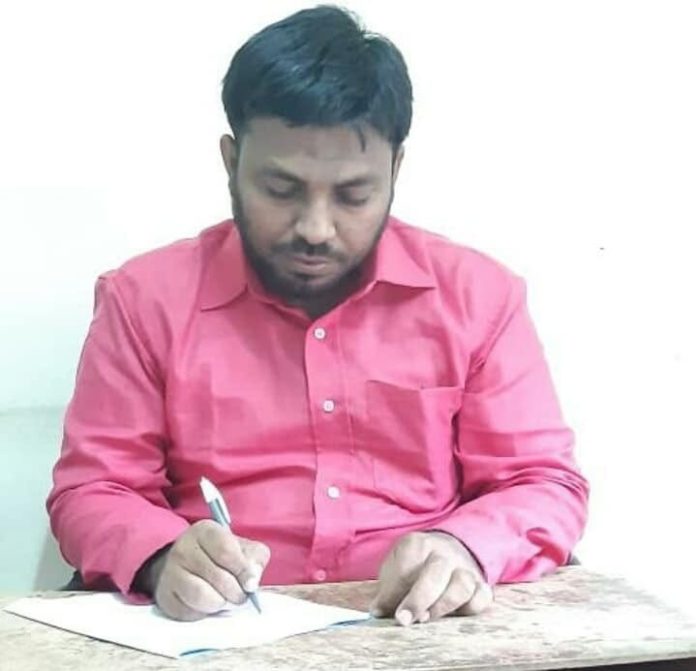
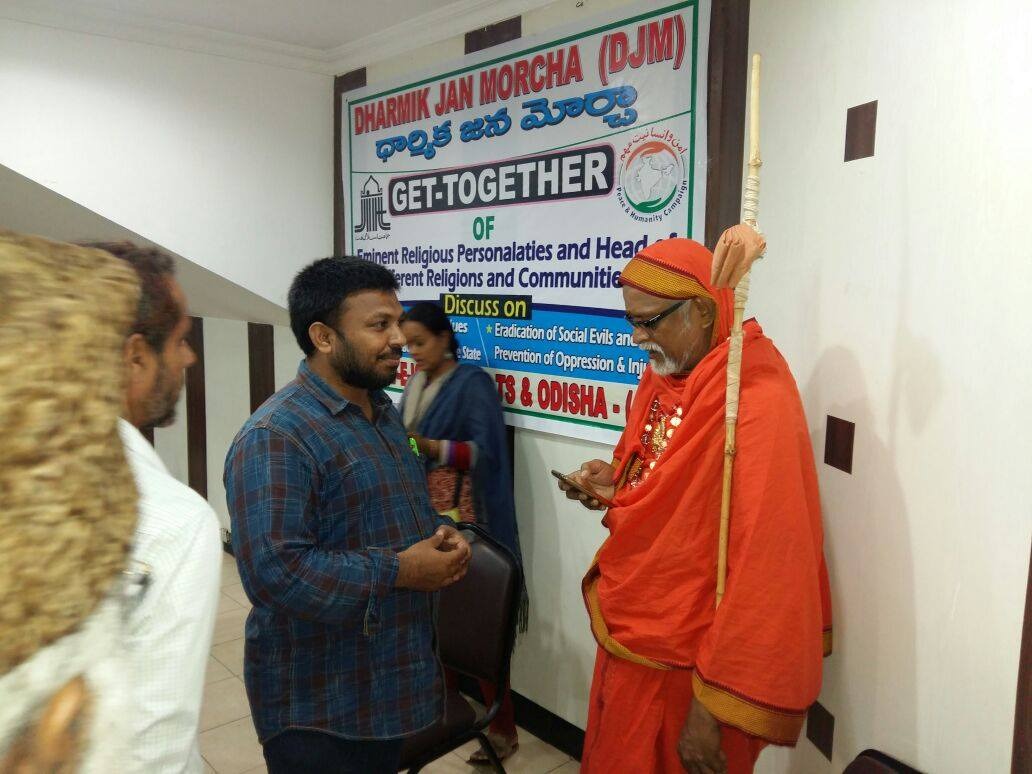
From a small-town reporter in Sathupally to a voice of conscience in the city, Mohammad Mujahid’s journey is a lyrical testament to the power of the written word in an age of discord.
Hyderabad:
In a world increasingly divided by invisible walls, Mohammad Mujahid is a man busy building bridges. His tools aren’t mortar and stone, but the elegant curves of the Telugu script and an unwavering belief in the human spirit.
What began two decades ago as a young man’s quest for truth in the dusty lanes of Khammam district has today blossomed into a significant literary movement – one that seeks to replace prejudice with poetry and fear with understanding.
The Genesis of a Vision
The spark for Mujahid’s odyssey was a profound spiritual mandate. Inspired by the Prophet Muhammad’s ﷺ exhortation – “Convey from me, even if it is a single word” – Mujahid didn’t just find a career; he found a calling.
Starting in 2000 as a contributor for the Eenadu daily, he realised early on that the greatest distance between two communities is often a lack of shared language. He chose to bridge this gap by bringing the essence of Islamic thought to the Telugu masses, stripping away the dense layers of Urdu and Arabic to reveal universal truths in a tongue that felt like home to millions.
Mujahid’s writing is characterised by a rare “soul-to-soul” connection. He doesn’t just inform; he heals.
The Myth-Buster: Through seminal works like ‘Islam Velugu’ (The Light of Islam) and ‘Islam Jeevana Tarangalu’ (The Rhythms of Islamic Life), he has acted as a literary surgeon, delicately removing the tumours of misconception and Islamophobia that often plague social discourse.
The Gardener of Souls: His work ‘Balavanam’ (The Children’s Garden) is perhaps his most tender contribution. It is an investment in the future, teaching children that values like kindness, honesty, and empathy are the true universal languages.
The Social Poet: When the journalist in him meets the poet, the result is a stinging yet hopeful commentary on contemporary issues. His verses don’t just rhyme; they reason.
A Chorus of Approval
It is rare for a writer to find equal resonance among religious scholars and secular literary icons. Mujahid has achieved exactly that.
The legendary Jnanpith Awardee C. Narayana Reddy (CiNaRe) once found his style captivating, while the eminent Qur’an translator Sheikh Hamidullah Sharif saw in him a powerful ally for truth. From historians like Syed Naseer Ahamed to veteran editors like Ejaz Aslam, the consensus is clear: Mujahid’s pen is a social necessity.
For Mujahid, the journey is far from over. He remains a man on a mission, driven by the philosophy that silence in the face of social decay is complicity.
“The message of peace isn’t the property of a religion; it is the inheritance of humanity,” he often says. In his modest workspace, the scratching of his pen continues to be a defiant sound against the noise of hate.
At a time when the fabric of society feels frayed, Mohammad Mujahid reminds us that a single individual, armed with an honest pen and a heart full of harmony, can still rewrite the story of a nation. His life is not just a biography; it is a blueprint for coexistence.
source: http://www.radiancenews.com / Radiance News / Home> Features> Focus / by Saad Mohsin / January 14th, 2026
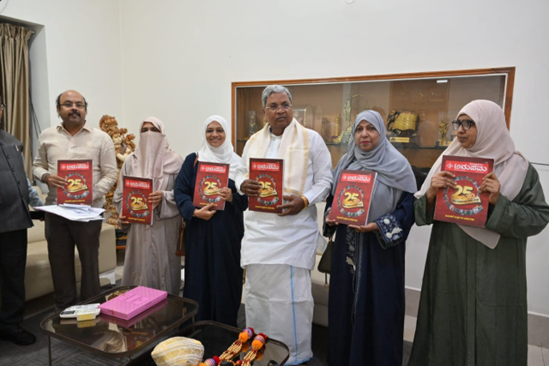
Anupama, the state’s only women’s monthly Kannada magazine run entirely by Muslim women, has completed 25 years. To mark this milestone, Chief Minister Siddaramaiah released a special silver jubilee issue, reflecting on its 25-year journey of success, in Bengaluru on Thursday.
Speaking at the event, the Chief Minister congratulated the team, saying, “There are only a handful of Muslim women in journalism. In such a scenario, it is highly commendable that the Anupama Women’s Monthly, run by women from the Muslim community and has successfully completed 25 years.”
Shahnaz M., the editor of Anupama, also spoke at the occasion. “The implementation of the ‘Guarantee’ schemes for women in the state has brought about significant changes in their lives. On behalf of the Anupama team and all women, I extend my gratitude to the government led by CM Siddaramaiah for their commitment to women’s development,” she stated.
The event was attended by Naseer Ahmed (Political Secretary to the CM), MLA Dr. Yathindra Siddaramaiah, BMTC Vice-Chairman Niket Raj Maurya, and Anupama’s sub-editors Samina Uppinangady, Sajida Momin, and Kulsum Abubakkar. Other notable attendees included S.M. Muthalib, Faisal Ismail, and Saleem Bolangadi.
source: http://www.radiancenews.com / Radiance News / Home> Latest News> Report/ by Radiance News Bureau / January 10th, 2026
Tehmina Punvani (second from left) with Salman Khurshid and Manish Tewari releasing the Book
Tehmina Punvani offered a rare glimpse into her grandmother’s life. Her grandmother, Begum Qudsia Rasul, was no ordinary woman; she was the only Muslim woman in the Constituent Assembly that drafted India’s Constitution in 1949.
The occasion was the launch of Begum Qudsia Rasul’s book, 24 years after her death.
Tehmina Punvani, a lawyer, is the daughter of Begum Qudsia’s daughter.
Speaking at the book launch in Delhi, Tehmina said, “For the world, she was a fearless political figure, but for me, she was my Ammijan, gentle, grounded and unwavering in her integrity.”
Punvani recalled the period when a fatwa was issued against Rasool for entering public life. While the family felt fear, Rasul was composed.
“If my conscience is clear, no decree can frighten me,’ she would say,” Punvani recounted, drawing applause from the audience.
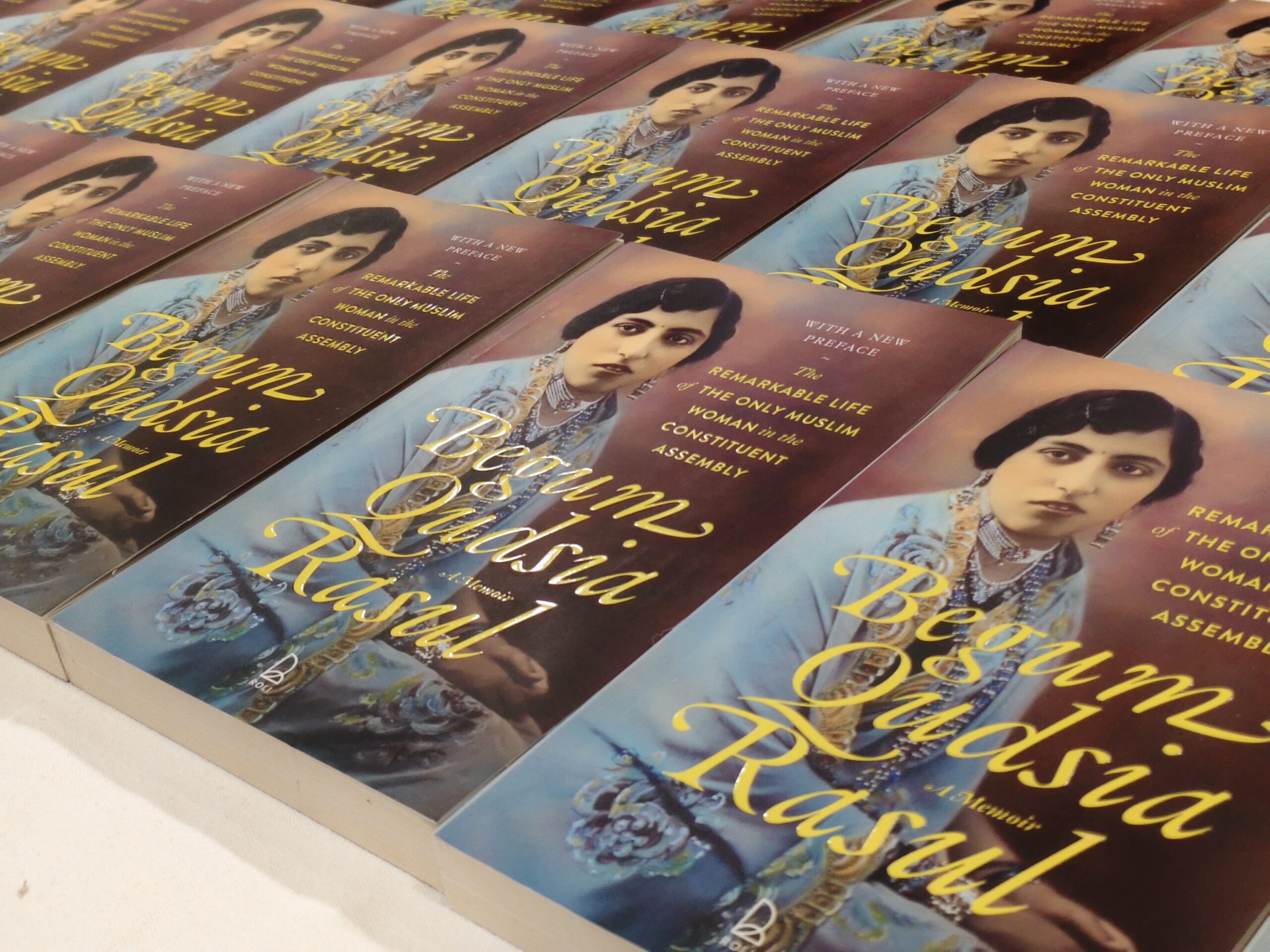
The book, Begum Qudsia Rasul – The Remarkable Life Of The Only Muslim Woman In the Constituent Assembly, is a relaunch of her autobiography “From Purdah to Parliament: The Memoirs of a Muslim Woman in Indian Politics” on the life and political legacy of this remarkable Muslim woman leader of India.
The Book Begum Qudsia Rasul – The Remarkable Life Of The Only Muslim Woman In the Constituent Assembly
The event brought together journalists, lawyers, and political leaders to revisit the contributions of a woman forgotten in mainstream historical narratives.
Moderated by journalist Nidhi Razdan, the panel featured Salman Khurshid, Indira Jaising, Manish Tewari, and senior lawyer Tehmina Punvani.
Begum Qudsia Rasul, born in 1909, was the only Muslim woman in India’s Constituent Assembly. A trailblazing politician, she opposed religious reservations, championed minority rights, and promoted women’s hockey.
Elected to the Rajya Sabha and Uttar Pradesh Assembly, she received the Padma Bhushan in 2000.
Besides being the only Muslim woman in the 1946 Constituent Assembly, she fought for minority equality and opposed religious reservations.
Qudsia Begum was also elected to the UP Assembly, Rajya Sabha and served as a minister.
She is credited with promoting women’s hockey, and a Hockey Cup is named after her. She was a trailblazing woman for giving up purdah. Besides her autobiography, she has authored a travelogue, Our Bapu, a book on Mahatama Gandhi and Hayat-e-Qudsi, about Bhopal’s Begums.
Tehmina said that despite her political stature, Rasul stayed close to the grassroots. “She met women daily, listened to their concerns, and worked for them without fanfare. Activism, for her, was a duty, not an identity.”
Other speakers highlighted Rasul’s exceptional resilience in an era when Muslim women faced social barriers.
Former Union Minister Salman Khurshid explained that Qudsia had won from a general seat to the United Province Assembly despite many technical hurdles. “It was an extraordinary act of courage,” he said.
Congress MP Manish Tewari underlined the democratic significance of her public life: “Her presence in the Constituent Assembly reflected India’s openness at a time of enormous political and social turbulence.”
Noted lawyer Indira Jaising praised Rasul’s moral clarity and empathetic leadership, calling her “a rare combination of conviction and humility.”
Speakers were unanimous in calling for acknowledging Begum Qudsia Rasul’s contributions and a prominent place for her in India’s political history.
Rolli Books has published this book.
source: http://www.awazthevoice.in / Awaz, The Voice / Home / by Aasha Khosa, ATV / December 11th, 2025
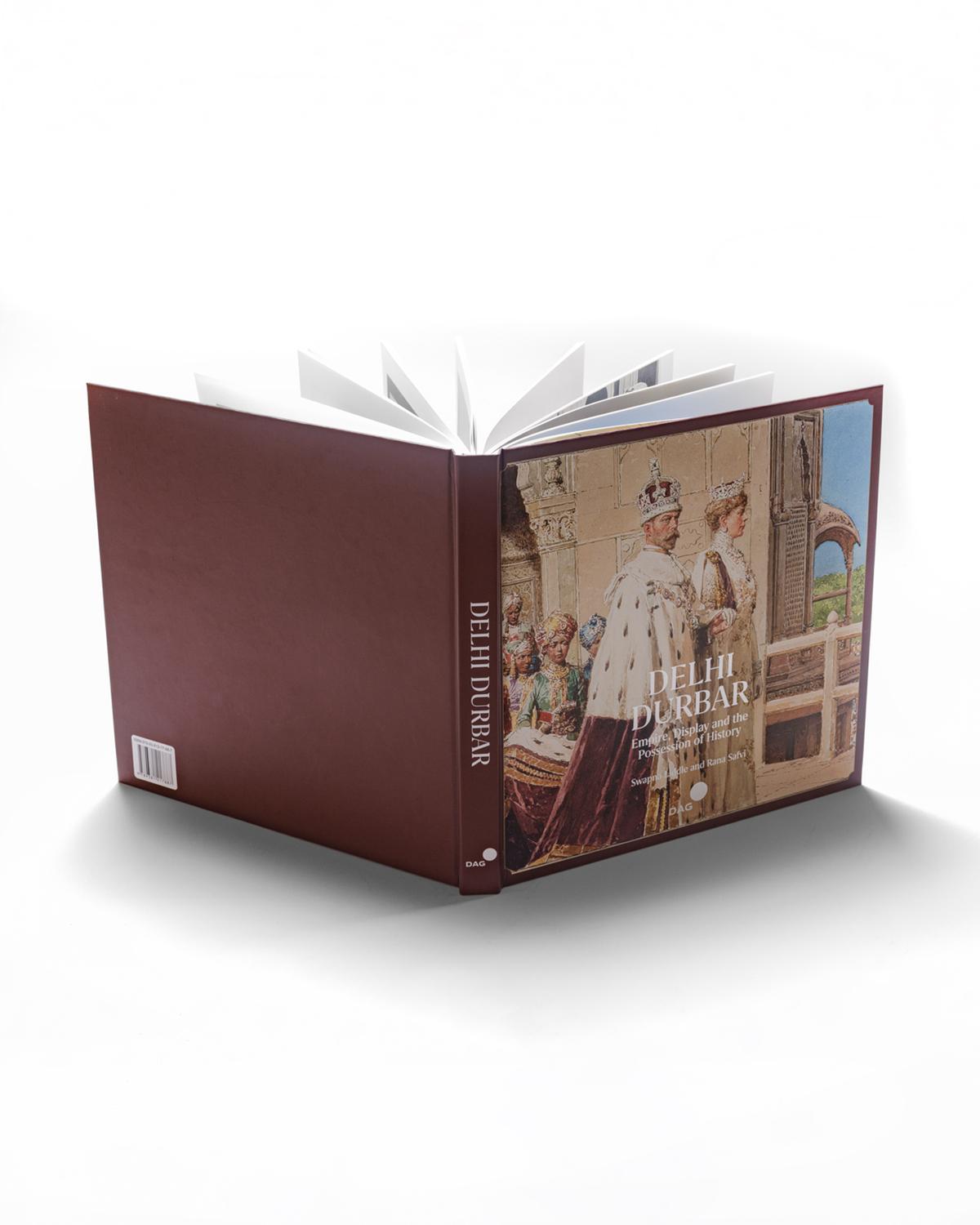
Curated by noted historians Rana Safvi and Swapna Liddle, DAG also launched a book, Delhi Durbar: Empire, Display and the Possession of History, co-authored by the duo.
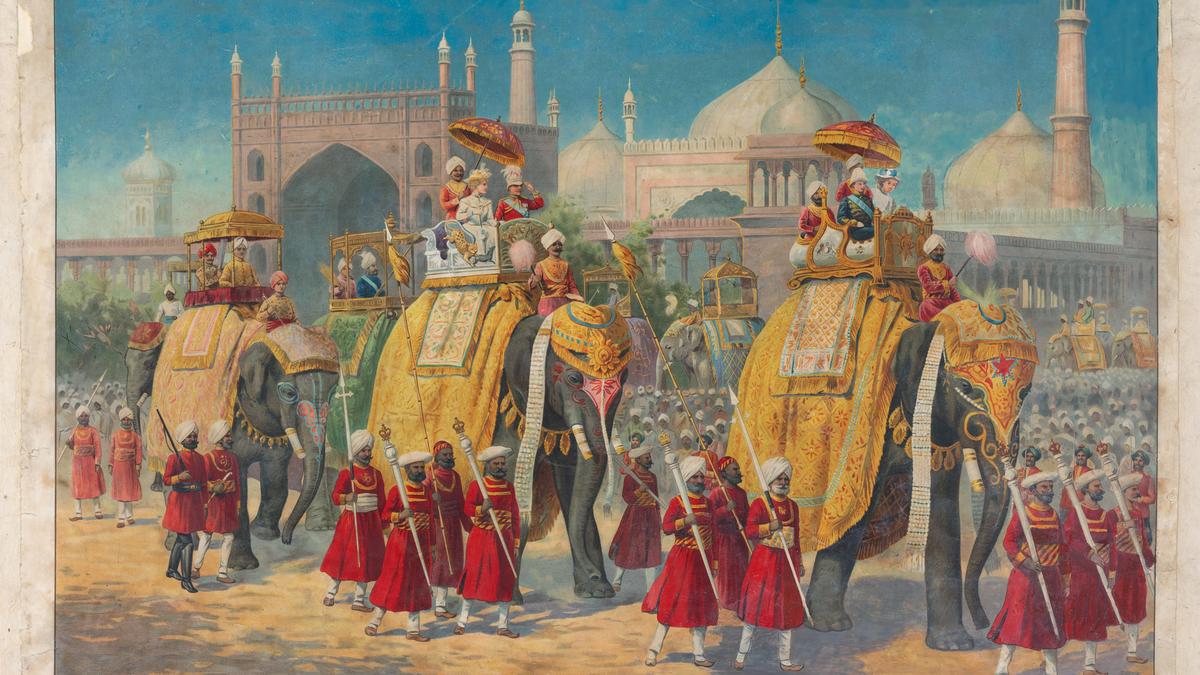
The Imperial Durbar (1903) | Photo Credit: Special Arrangement
In an important contribution to a facet of Delhi’s rich history, DAG is hosting an exhibition drawn from its archives of the city’s resplendent durbars. Curated by noted historians Rana Safvi and Swapna Liddle, DAG also launched a book, Delhi Durbar: Empire, Display and the Possession of History, co-authored by the duo.
“The British Delhi Durbars have been the subject of much recent scholarly study and re-evaluation,” writes Ashish Anand, the CEO and managing director of DAG. “The objects in this exhibition bring them materially present, through works by some of the leading artists and photographers of the period.” The essays give readers an insight into the city that was. We also get rare visuals of Delhi, its monuments, and its three durbars — all of which were landmarks in British-ruled India.
Safvi speaks to Magazine about the project. Excerpts:
Companion of the Most Eminent Order of the Indian Empire | Photo Credit: Special Arrangement
Question: Can you shed some light on the DAG project?
Answer: This exhibition was conceived by Giles Tillotson, senior vice president – exhibitions at DAG. It is the first exhibition that has been drawn from the DAG archives.
Q: With all the attention on the Central Vista project and the new Parliament, how important is it to revisit Delhi’s history?
A: Every ruler negotiates his/ her idea of kingship. If we read the history of Delhi, kings starting with the Tomara dynasty built cities and citadels to perpetuate their memory. While the Mughal city of Shahjahanabad played a pivotal role in the three Delhi durbars, the last one saw King George announce the shifting of the British capital from Calcutta to Delhi. He also laid the foundation for a new city. This is known today as Lutyens’ Delhi.
Q: The book talks of three durbars. How different were each?
A: While all three durbars were unique, there was a thread of continuity. They were all held in the Coronation Park in Delhi and close to the Ridge where the British had fought the Indian forces in the Uprising of 1857. [They] appropriated some Mughal symbols in a bid for continuity and so that Indians could relate to them.
The first durbar, held just 20 years after the Uprising, was called the Imperial Assemblage and was meant to announce the assumption of the title of Kaiser-e-Hind by Queen Victoria with pomp and splendour. It was also meant to legitimise and popularise British rule, using many of the idioms of the Mughal empire, including the word ‘durbar’, which Indians were familiar with.
The second, held in 1903, was to celebrate the coronation of King Edward VII. This durbar envisaged by the viceroy Lord Curzon was a grandiose event with the viceroy and 48 Indian princes riding on elephants through the city in a ceremonial procession. An art exhibition was conceived by Lord Curzon, in his own words, to ‘show that India can still imagine and create, and do’.
The third durbar of 1911 was the first in which the British monarch himself was present with his consort Queen Mary. It announced the reversal of the highly unpopular partition of Bengal and was also used to announce the shifting of the imperial capital in India from Calcutta to Delhi.
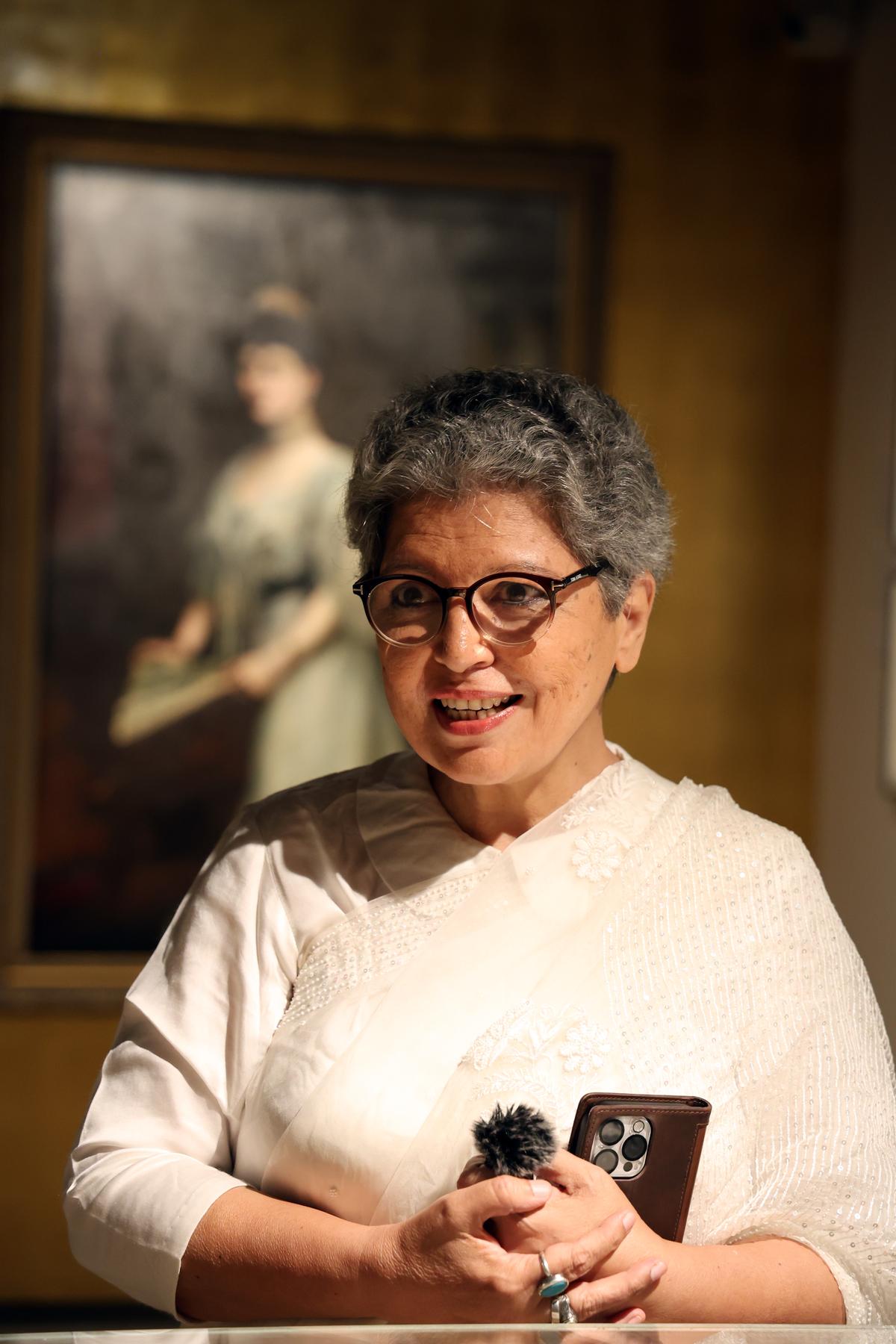
Historian Rana Safvi | Photo Credit: Special Arrangement
Q: The historic Jama Masjid was under British occupation for almost five years after the Uprising of 1857. Why and how did it become a vantage point for the durbar in 1903?
A: After the fall of Delhi, Jama Masjid was confiscated by the British; it was used as a mess and horses were tied along its corridors. In 1862, it was returned to Muslims for worship. The Jama Masjid has always been a symbol of Mughal magnificence and of Muslim togetherness.
Q: Can you elaborate on the demolition of Masjid Akbarabadi during the Uprising? It doesn’t always find a place in our textbooks…
A: When the city of Shahjahanabadwas being built, members of royalty as well as nobility were encouraged to build and add to it. Three mosques were built by three wives of Mughal emperor Shah Jahan. Fatehpuri Begum built the Fatehpuri mosque, Sirhindi Begum the Sirhindi mosque and Akbarabadi Begum the Akbarabadi mosque.
After the fall of Delhi, when the British army was victorious, the city and its people were punished for their ‘rebellion’. While many notables of Shahjahanabadwere killed or driven out of the city, the monuments and buildings were taken over. Fatehpuri mosque’s compound and galleries were auctioned and bought by Lala Chunnamal Ki Haveli and Akbarabadi Masjid was demolished. There is a beautiful description of Akbarabadi mosque in Syed Ahmed Khan’s Asar-us-Sanadid.
Delhi Durbar: Empire, Display and the Possession of History | Photo Credit: Special Arrangement
Q: Does the Coronation Durbar of 1911 mean the British had accepted the primary place of Delhi in India’s history?
A: Delhi’s importance can be seen from the fact that all three durbars were held here. Delhi was associated with Indraprastha, the legendary capital of the Pandavas, and was the city from where the Tomaras, Delhi Sultans and the Mughals ruled. Delhi’s grand history and traditions were used in the durbars. In the 1911 durbar, King-Emperor George V and Queen Mary even gave a jharokha darshan from the Red Fort’s Musamman Burj to Indians in the Mughal tradition.
ziya.salam@thehindu.co.in
source: http://www.thehindu.com / The Hindu / Home> Entertainment> Art / by Zia Us Salam / September 29th, 2023
Muslims not affiliated to political parties have very little chance of making it to public life.
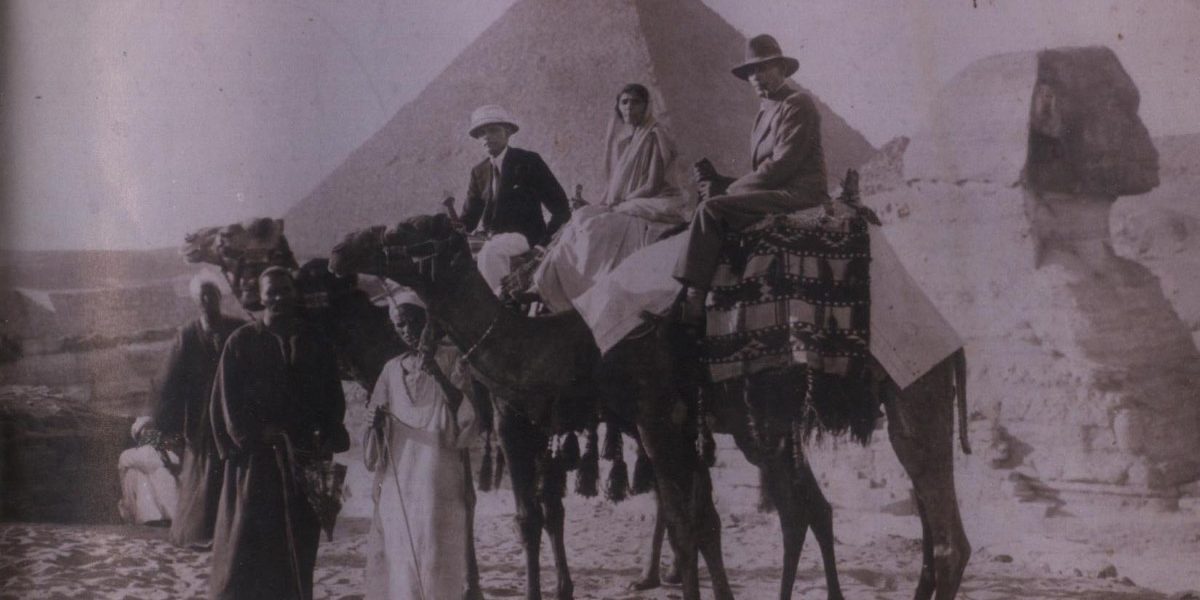
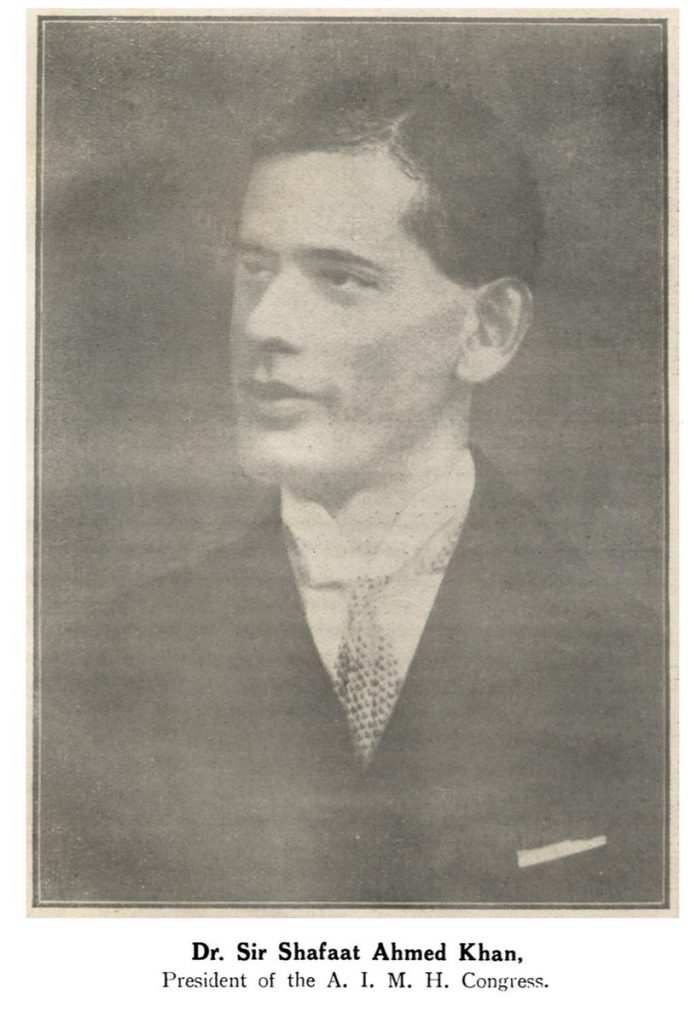
Sir Shafaat Ahmed (left) in Egypt with Jinnah and his sister Fatima.
On September 2, 1946, members of the Interim Government took oath in Delhi. The Interim Government was formed to facilitate the transfer of power from the British to Indians, and consisted entirely of Indians, except for the Viceroy and the commander-in-chief. The plan was for it to have a total of 14 members which was to include five Hindus, five Muslims, and one member each from the Scheduled Caste, Parsi, Sikh and Christian communities, but before it finally took office, there was much debate and politicking, some of its acrimonious, about its composition and structure.
Only 12 positions were finally filled: Jawaharlal Nehru, Sardar Patel, Rajendra Prasad, C. Rajagopalchari, Sarat Chandra Bose, Dr John Matthai, Sardar Baldev Singh, Jagjivan Ram, C.H. Bhabha, Asaf Ali, Syed Ali Zaheer and Sir Shafaat Ahmed. Mohammed Ali Jinnah, who had broken away from the Congress, stayed away as he wanted the Muslim members to be only from the Muslim League. One of the names he objected to was that of Sir Shafaat Ahmed Khan, a scholar politician.
His appointment offers an example of how to the political trajectory of ‘independent’ – i.e. non-politically affiliated – Muslims in India has been fraught with strife.
The inclusion of these three Muslims undermined Jinnah’s constant demand that all Muslim members of the Interim Government should be from the League. “The Viceroy only added insult to injury by nominating three Muslims who, he knows, do not command either the respect or the confidence of Muslim India,” said Jinnah after Viceroy Wavell’s announcement. The inclusion of Sir Shafaat had particularly riled the Muslim League because he had left it over fundamental differences. While in the League, he had defended it publicly but also disagreed on many issues – the final parting came when the League asked that titles given by the British be returned, and Sir Shafaat disagreed strongly.
On the evening of August 24, 1946, as Sir Shafaat was returning from his walk, he was attacked by two youngsters near Darbhanga House (which now houses a school) in Shimla. He received deep wounds on his head, chest and neck. The incident happened just a few hours after Wavell announced on radio that Sir Shafaat would be a member of the Executive Council. This was a rare and outrageous physical attack on a high-ranking Muslim, and is also a telling statement on the precarious position of the independent Muslim.
Jinnah’s notion of non-League Muslim leaders as lacking respect among Muslims was central to his self-declared position as the sole spokesman of the community. He also argued that even the Congress be not allowed to nominate a Muslim, a condition that was never accepted by the British. The attack on Sir Shafaat Ahmed was reflective of the rather restricted space in the political firmament for Muslims who were not in either the Congress or the Muslim League camp. Two more Muslim leaders could have been inducted in the Interim Government (to take the total number of Muslims to five), but the questions of acceptability and legitimacy of any non-League, non-Congress Muslim prevented that.
‘Congress Moslem’
Reporting on the tussle over the composition of the Interim Government, newspaper reports would describe the Muslim members as either “Congress Moslem”, “non-League Moslem”. For, as the formation of the Interim Government shows, there was hardly any scope for the ‘Muslim’ equivalent of a C.H. Bhabha, who was a businessman, or the Sikh leader Sardar Baldev Singh, both independent of political affiliations, a situation which continues even now.
Discussing the problems facing the composition of the Executive Council with Leo Amery, the secretary of state for India, Viceroy Wavell on June 20, 1945 wrote from Delhi: “The main difficulty is likely to arise over non-League Moslems if Congress insist on putting forward Moslem names. There would also be difficulty in inclusion of non-League non-Congress Moslems.” This is very similar to independent Muslim political actors/formations, not aligned with big parties, struggling to gain legitimacy or patronage.
Sir Shafaat’s inclusion may indicate that there was a scope for a non-Congress non-League Muslim, but it was predicated by the non-participation of Jinnah’s League. On October 26, 1946, three members – Sarat Bose, Sir Shafaat and Syed Zaheer – resigned to make way for the Muslim League, after Jinnah agreed to join the Interim Government.
This brief elevation to a top public office was the highpoint in the political career of Sir Shafaat. In January 1947, there were talks of appointing him as India’s high commissioner to Canada, but it never happened. He had been a member of the UP Legislative Council in the 1920s, part of the Muslim delegation to the Round Table conference and also was India’s high commissioner to South Africa from 1941 to 1944.
Sir Shafaat’s entry to politics was through academia, and not through the popular routes of law or journalism. He is perhaps best remembered as a historian who played a role in the establishment of the Indian History Congress and presided over its first meeting in June 1935 in Pune. As chairman of the Modern Indian History at University of Allahabad he started the Journal of Indian History in 1924. He also taught at University of Madras and Aligarh Muslim University.
He died in Shimla in July 1947, having fallen ill two months earlier. Reporting his death the Congress-supporting Bombay Chronicle noted: “During the greater part of his public career, Dr Shafaat Ahmed Khan, an eminent professor of History and a politician, belonged to a school of thought and activity which quite rightly did not find favour with nationalist India and the Congress. That is why the news of his inclusion in the first Interim Cabinet was received with surprise rather than satisfaction.”
This characterisation of his appointment by the Bombay Chronicle as a “surprise rather than satisfaction” was at odds with the official Congress stand, but was still more charitable than the views of those who placed a greater importance on the joint participation of the Congress and the League in the Interim government. Reflective of the wider mood of the period, Sir Chimanlal Setalvad, for example, termed Sir Shafaat’s inclusion as “unfortunate” and “provocative” to the Muslim League, signifying that the idea of a representative national government during the high politics of Partition could only include Muslims from the League and the Congress.
Muslim representation today
It is only in retrospect that we can assess the figure of Sir Shafaat in the context of the idea of Muslim representation, which requires moving away from the dominant narratives of Congress-Muslim League matrix in the years leading to Partition. It seems that the restrictive bracketing of the nature of Muslim representation is not new, and has a tradition of being inherently inimical to independent voices and movements. It has now taken a much uglier turn.
In colonial India, there was a strong Muslim political presence in Punjab and Bengal, which has continued post-Independence in the form of IUML, MIM and other regional parties. But the story of the national level since then has been different. In independent India, Muslims voted largely for the Congress, which also gave a platform to community leaders. But now with the Congress’s electoral losses, the political sphere has shrunk.
In the current Lok Sabha (like the previous one) too, the ruling Bharatiya Janata Party (BJP) does not have a single Muslim. As the dominant political party, this situation raises a larger existential question on the conception of a Muslim politician itself.
The recent rhetoric of ‘UPSC jihad’, implying the infiltration of the civil services by Muslims, further shows the discomfort in certain sections of the Indian society over Muslims holding positions in public life. Whether it is bureaucracy or politics, it is clear that a narrative of hate and fear, driven by a dangerous construction of undesirability of Muslims in high offices seems to be the driving impulse.
The percentage of Muslim bureaucrats in India has been historically low, and the community’s shrinking political representation in Parliament brings to focus the vexed issue of Muslim representation and shows that walking the political terrain for Muslims has been difficult without patronage from established parties.
Danish Khan is a UK-based journalist and a doctoral candidate at University of Oxford.
source: http://www.thewire.in / The Wire / Home> Analysis> History / by Danish Khan / September 02nd, 2020
The cities created in the Deccan by Muslim leaders introduced the concept of public space to the Indian world.
Photograph of Aurangabad from the Allardyce Collection: Album of views and portraits in Berar and Hyderabad, taken by an unknown photographer in the 1860s. This view is of the Kham River, the city lies along its right bank. Photo: Public domain/Wikipedia.
When India specialists examine what Islam has brought to the country, they often focus on cultural aspects such as language, poetry, music, painting, culinary arts, or spirituality. They rarely consider the urban dimension.
Certainly, historians and geographers readily examine how what the Marçais brothers called “the Islamic city” spread throughout India, but mainly to see it as an exogenous institution, even an enclave sheltering an elite that came from outside and was cut off from society. Pratyush Shankar’s recent book covers this dimension, of course, but goes further.
In History of Urban Form of India, a work based on the analysis of 42 Indian cities, the author distinguishes three types of cities – which form the three parts of the book: ancient cities, medieval cities, and cities produced by the modern state.
Ancient cities, apart from those of the Indus civilisation, are mainly epitomised in the “temple cities” of southern India. While medieval cities follow several different patterns, Pratyush Shankar distinguishes above all between merchant cities – typical of Gujarat – those of the Himalayas (whose form is conditioned by the terrain), and those built by Muslims in the Deccan.
Comparing them proves very useful in understanding Islam’s contribution to the Indian civilisation – something Pratyush Shankar helps us to do, without attempting it himself – thanks to his morphological approach to the city: he is interested only in the form of the city, not in its local mode of governance or its relationship with the state.
All Indian cities inherited a significant part of their form or structure from the caste system. Pratyush Shankar points out in the introduction that the “Caste system had a huge impact in determining the location and formation of neighbourhood clusters that were inward looking (in cases of Jodhpur and Udaipur) and the possibility to shut off from the city by controlling the gates (Pols of Ahmedabad)”.
History of Urban Form of India: From Beginning till 1900’s, Pratyush Shankar, OUP, 2024.
The caste logic is naturally at work in the “temple city”:
“The idea of using a Brahmin settlement (with a temple) for creating a surplus economy was central to the birth of cities in South India. This was legitimized through the Brahminical ideology of the Brahmin-Kshatriya coalition expressed through Vedic and puranic religion”.
And naturally, the “temple city” is “divided into various sectors based on function differentiation that was represented through various caste-based housing. The caste system was strictly observed and manifested itself in the planning of these urban centers”.
The cities built by Muslim leaders from the 14th century onwards in the Deccan did not escape the caste system – especially since distinguishing between Hindu and Islamic cities constitutes “a very simplistic binary” that does not reflect a much more complex reality. But these medieval cities of the Deccan added something new to the urban form that had prevailed in the country until then. This innovation did not take place within the city, but outside – and still, that was a key element of the city dynamics: not far from the city walls, but well outside the city itself, Sufi saints settled in an almost systematic manner. They deliberately distanced themselves from the city to show their detachment from material things and live in peace. At the same time, the inhabitants revered them: “People would leave the material city behind to spend a day at the sacred Sufi sites and return by evening”.
After their death, these saints were buried in the very place where they stood, and a mausoleum called “Dargah” was built around their tomb, the size of which varied according to the popularity of the saint.
What Pratyush Shankar does not say is that throughout society, Sufi saints were attributed with considerable powers, even beyond death: many devotees continued to visit the Dargah centuries after the saint’s death to ask him to grant their wishes (whether it be to have a child, to be cured of an illness, or to pass exams). This votive logic, due to its transactional nature, transcends social barriers of all kinds: Hindus, Christians, Sikhs, etc. worship Sufi saints, people from all walks of life, from the elite to the lower castes, rub shoulders at the Dargah and, finally, even in the Holy of Holies, women and men are admitted on an equal footing. But Pratyush Shankar assumes that the reader what I have mentioned above when he concludes:
“The unique contribution of the Deccan cities was perhaps not so much in any extraordinary formation within, but rather in the development of the prominent district of the Sufi saints and the suburbs. Sufi saints were popular amongst the masses and provided the much-needed counterpoint to the state. If the city represented the material world of trade, commerce, and power, the suburban precincts of Sufi tombs were just the opposite; a sacred and spiritual space with frugal infrastructure which is out there in the lap of nature. Over the centuries, this typology took firm root as these complexes of tombs became public places that were frequented by city dwellers like a pilgrimage out of the city, as they often lay just outside the fort walls of the city”.
The word is out: “public space”!
The cities created in the Deccan by Muslim leaders in the 14th century introduced the concept of public space to the Indian world, which had ignored it until then due to the deep cleavages that divided society along lines of religion, caste, and gender. This is a contribution of Islam to India that some would call paradoxical, given that the image of this religion, today, is often dominated by the idea of segregation, even exclusion. But before Islam entered India, such open spaces did not exist in the country.
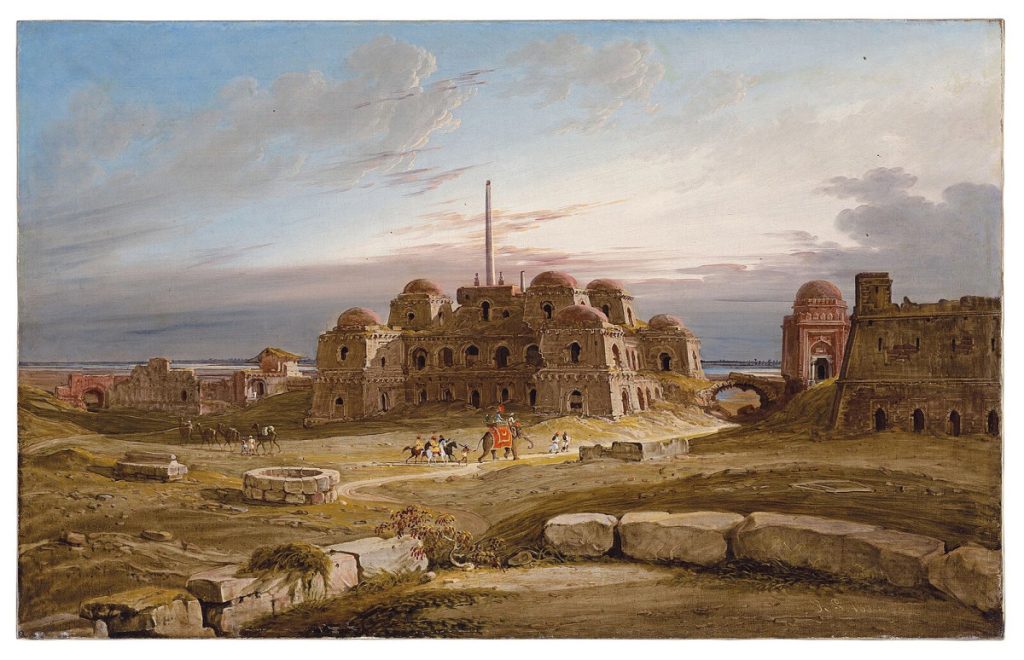
View of the Feroz Shah Kotla, Delhi, 1830, 1843 (oil on canvas) by Colonel Robert Smith (fl.1880-90). Photo: Wikimedia Commons.
Certainly, ascetics established their ashrams out of cities – like Ramana Maharshi’s cave above Tiruvannamalai – but his followers did not disturb him there, and when they did, they interacted with him on the mode of the guru-shishya parampara, whereas around the Dargah, one would find play grounds as well as picnic sites.
In his book, Pratyush Shankar confines this contribution to the Deccan, but it is tempting to argue that the innovation he points to can be found throughout India. In the north too, Sufi saints settled on the outskirts of cities – did Nizamuddin not choose to live far from Delhi? – and their mausoleums still offer the image of a public space open to all. This is even more striking when the Dargah is still surrounded by greenery, even though it has been incorporated into the city, such as Sarkhej Roza in Ahmedabad or Feroz Shah Kotla in Delhi, where Anand Taneja has clearly shown that people from all walks of life still gather today, as befits a public space!
Christophe Jaffrelot is Senior Research Fellow at CERI-Sciences Po/CNRS, Paris, Professor of Indian Politics and Sociology at King’s College London, Non resident Scholar at the Carnegie Endowment for International Peace and Chair of the British Association for South Asian Studies.
source: http://www.thewire.in / The Wire / Home> English> Opinion> Urban / by Christophe Jaffrelot / October 18th, 2025
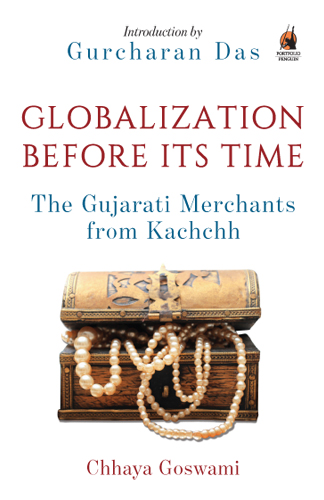
By recreating a whole world around a group of traders in western India, Chhaya Goswami’s Globalization before Its Time is business history as it should be.
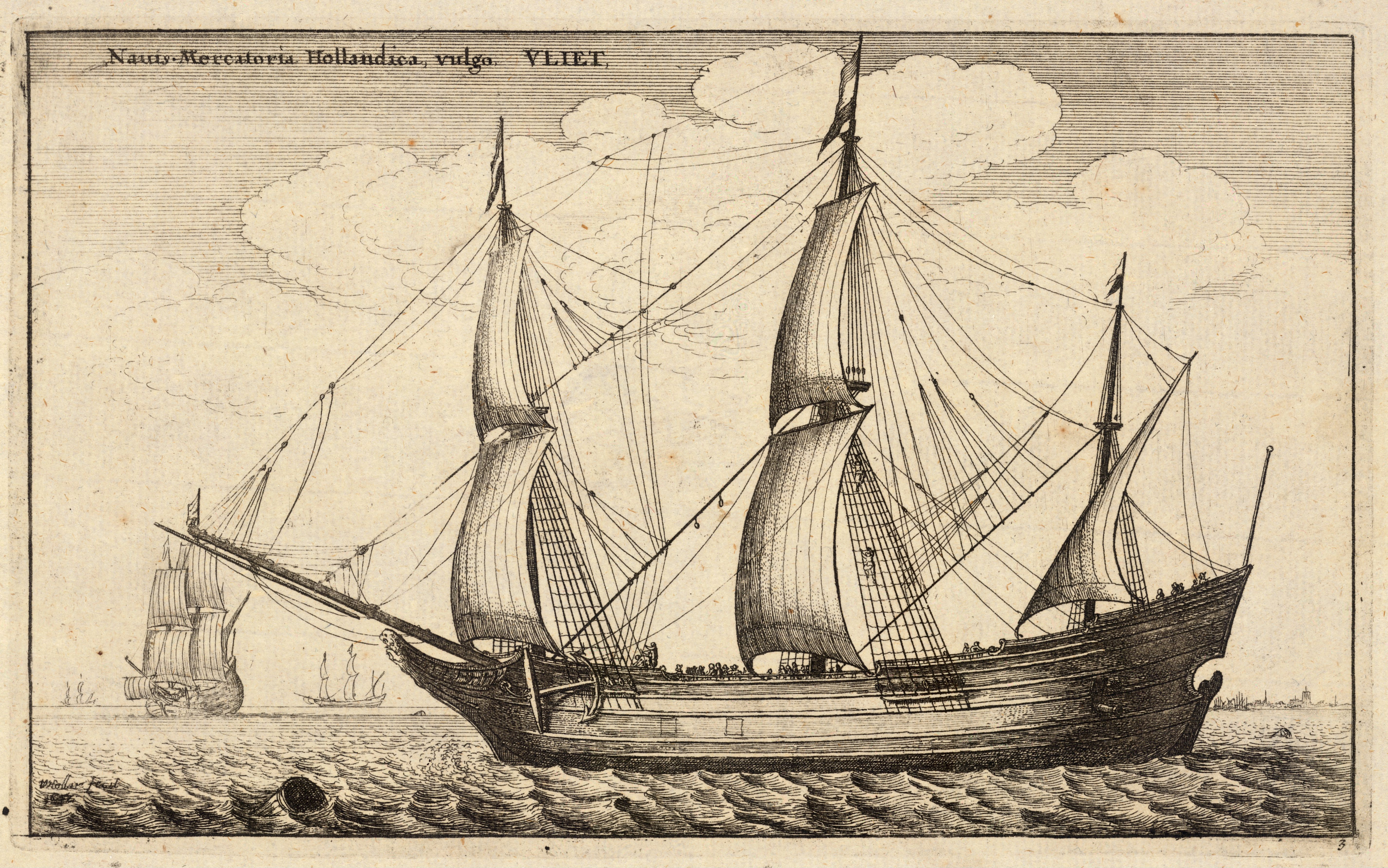
A Dutch trading ship from the late 17th-century. Credit: Wikimedia
The Arabian Sea has a special place in Indian business history. For centuries the cities and settlements on the Arabian Sea littoral traded with each other, exchanging Indian textiles for horse, armaments, pearls and ivory. In turn, some of the textiles were passed on to the Atlantic slave trade in Africa as a medium of exchange, or sent overland to European markets. Coastal merchants indigenous to the region bordering the sea engaged in this business and developed sophisticated systems of banking and shipbuilding to support the mercantile enterprise. The Hindu and Muslim traders of Kachchh were examples of such groups of people.
In the 17th century, the Arabian Sea trade flourished thanks to the control that three powerful empires – the Ottoman in Turkey, the Safavid in Iran and the Mughal in India – exercised on some of the key seaports, and regular transactions amongst them. This was also the time when the European merchant companies established themselves in the Indian Ocean trade, even though the Portuguese had arrived in this world somewhat earlier. In the second half of the eighteenth century, the Mughal empire had almost collapsed and its access to the Arabian Sea ports had long come to an end. Europeans were in the ascendance.
What happened to the indigenous traders and bankers during this period of transition? Two contending stories exist on this question. The first says that they lost ground to the Europeans while their patrons lost political power. The second says that the indigenous traders found partnerships and agency with the Europeans lucrative, and as their fortunes flourished, the Europeans gained in political power. Both stories overstate the Europeans’ commercial prowess and understate the Indians’ capacity to shape the course of history.
Chhaya Goswami’s book is a corrective to such biased histories. It shows that the Kachchhi traders did gain from European trade, and withstood well the decline of empires, but they could do so thanks to their own resources, which included well-developed institutions of commerce and banking, knowledge of the seas, shipping, and shipbuilding, past history of collaborating with political actors, and access to both maritime and overland trading routes.
The book is divided into four chapters, each one of substantial length. Chapter one explores the special characteristics of Kachchh that make it a “land of entrepreneurs”. Chapters two and three describe Kachchhi traders’ activities in Muscat and Zanzibar respectively, and chapter four deals with some of the prominent firms in the maritime trade, and how a few of them extended their operations beyond the southwest Asia region.
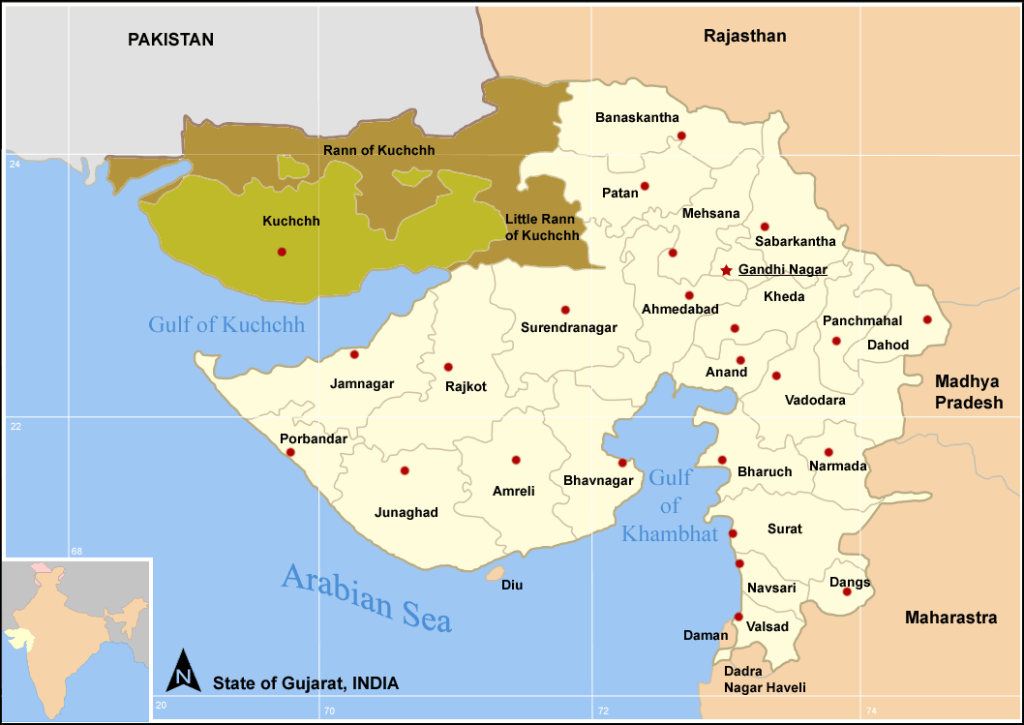
Why Kachchh? What is special about the region that it should produce so many merchant groups? The convenient location of the region on a navigable part of the eastern Arabian Sea, as well as the Mandvi port, of course, supplies a part of the answer.
Another part of the answer has to do with politics. The western coastal regions were ruled by small states that depended heavily on income from trade. This dependence was due to the poor agricultural conditions in the region. In turn, these states, though nominally vassals of the Mughals, could exercise a great deal of independence in policy. They used their freedom to create a model of rule where merchants and bankers had a prominent place, not only during warfare, the all-too-common palace intrigues or disasters, but also in normal times. Merchants and bankers helped the business of governance by collecting taxes, revenue farming, making loans, and taking part in administration, whereas the states helped them by offering lucrative contracts and implicitly recognising their laws and practices.
But the political and geographical environment explains little unless we also consider the social and institutional basis of entrepreneurship in the region. The merchant groups in question were ready to establish diaspora networks in port cities around the Arabian Sea. They conducted extensive and complicated financial operations including bill and insurance, and their bills were acceptable to the distant trading points thanks to the diaspora network.
The book shows in interesting detail how Vaishnavite temples and monasteries became effectively banks, clearing houses, and guarantors of reputation. Community law had great force. The merchants had considerable interest in shipbuilding, which in turn encouraged timber trade. In banking, trading, shipbuilding, and navigation, master-apprentice hierarchies were highly developed, showing how much skills were valued and how skills formed.
The book is well-researched and builds on the author’s deep knowledge of vernacular sources and the regional context. It is business history as business history should be, that is, it succeeds in recreating a whole world around a group of traders, and fills an important gap in Indian economic history scholarship.
One wishes, at the same time, that the author had tried to place the Kachchhi traders more firmly in debates on the 18th century economic transition in southern Asia, and attempted some comparative discussion of trading ‘firms’ in Kachchh and elsewhere in the world. Surely the Europeans operated in the same world, with a very different model of a firm. Did the difference matter to institutional and political change? But, perhaps wisely, Goswami’s book steers clear of dry historiography. Instead, it keeps in mind its readers – who will no doubt find the material presented fascinating and the quality of the narrative superb.
Tirthankar Roy is a professor at the London School of Economics and Political Science.
source: http://www.thewire.in / The Wire / Home> English> Books / by Tirthankar Roy / July 04th, 2016
The Urdu literary world mourns the demise of one of its gentle giants, Azizuddin Aziz Belgaumi, the celebrated Na’at poet, ghazal writer, teacher, and literary guide, who returned to his Lord on the morning of Friday, November 28, shortly after the Fajr prayer in Bengaluru.
Azizuddin Aziz was not merely a poet; he was a custodian of spiritual emotion, a voice that blended devotion, beauty, and sincerity in every syllable.
He was renowned for his Na’ats – soulful, tender, and overflowing with love for Prophet Muhammad ﷺ. His unique style of recitation, coupled with his soothing voice, made his poetry beloved among Urdu lovers across the region and beyond.
His iconic Na’ats, including:
اہلِ ستم کے پتھر کھا کر گل برسانے والے ہم
دعوتِ ہدایت کی ایک حسیں شفق لے کر میرے مصطفیٰ آئے
had gone viral among Urdu audiences, each line steeped in deep reverence and spiritual longing.
On his final night in this world, he once again recited “Dawat-e-Hidayat ki ek haseen shafaq lekar mere Mustafa aaye” on special request at a mushaira organized by Idara-e-Adab-e-Islami Hind, Karnataka. The audience responded with extraordinary affection, as if witnessing a sacred farewell.
By the next morning, he left this world – a departure many lovingly regard as a sign of divine acceptance.
Azizuddin Aziz’s published works reflect his emotional depth and mastery of language. His poetry collections include:
حرف و صوت
سکون کے لمحوں کی تازگی
دل کے دامن پر
نقد و انتقاد
زنجیرِ دست و پا
ذکر میرے حبیب کا
These works capture the freshness of spiritual experience, the fragrance of emotion, and the honesty of a heart in constant remembrance.
Azizuddin Aziz worked with Doordarshan Bangalore Urdu, where he interviewed prominent literary personalities. His conversations reflected both scholarship and humility, making him a respected voice representing Urdu culture on national media.
He served for a time as a teacher and later as the Principal of Zubaida College, Shikaripur, shaping young minds with the same warmth and refinement that characterised his poetry.
As an educator, he was loved for his gentle discipline, cultured manner, and his ability to ignite a love for language among students.
He also served as editor of several literary magazines, contributing significantly to Karnataka’s Urdu literary landscape. His editorial vision was marked by sincerity, high standards, and a deep respect for classical tradition.
Early on November 28, he experienced severe chest pain at his residence in Bengaluru. Despite attempts to rush him to the hospital, he breathed his last at home. He leaves behind his wife, three sons, two daughters, and a large community of admirers, students, and peers.
May Allah accept every word of love he wrote for His Beloved Prophet ﷺ. May He grant Azizuddin Aziz a lofty place in Jannat-ul-Firdous, and grant patience, strength, and peace to his grieving family. His voice has returned to silence – but his Na’ats will continue to illuminate gatherings, his ghazals will continue to warm hearts, and his legacy will remain a torch of devotion and grace.
Inna lillahi wa inna ilayhi raji’un. Most certainly we belong to Allah, and most certainly we will return to Him.
source: http://www.radiancenews.com / Radiance News / Home> Focus> Obituary / by Radiance News Bureau / by Mohammed Talha Siddi Bapa / November 29th, 2025
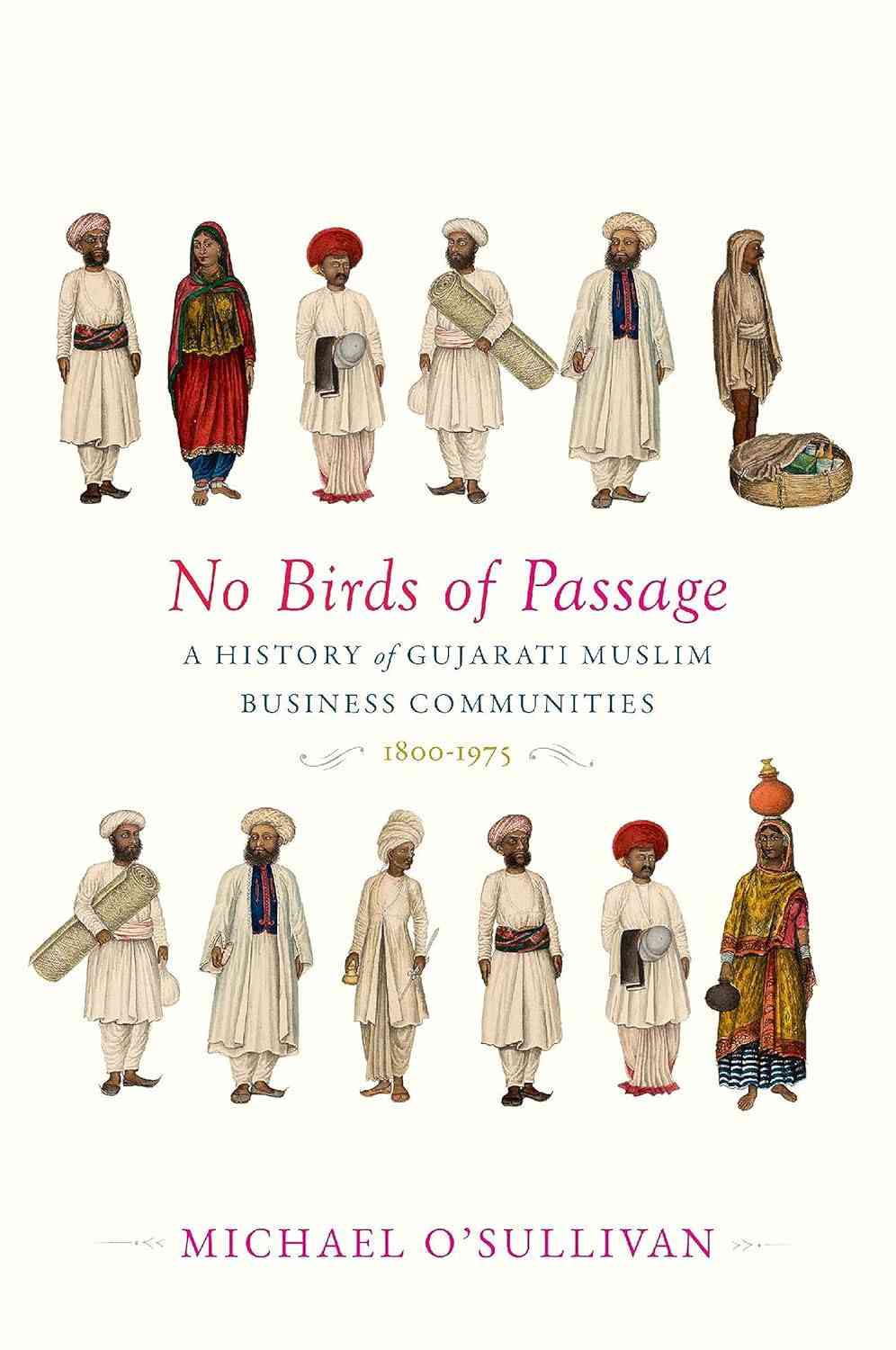
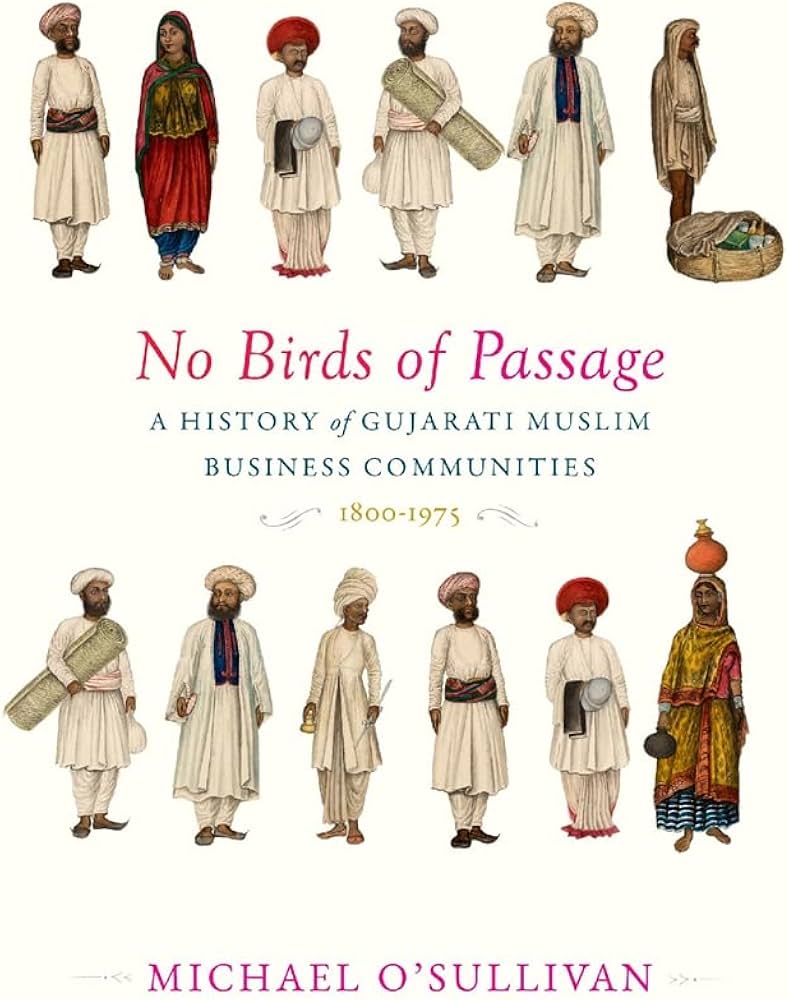
An excerpt from ‘No Birds of Passage: A History of Gujarati Muslim Business Communities, 1800-1975,’ by Michael O’Sullivan.
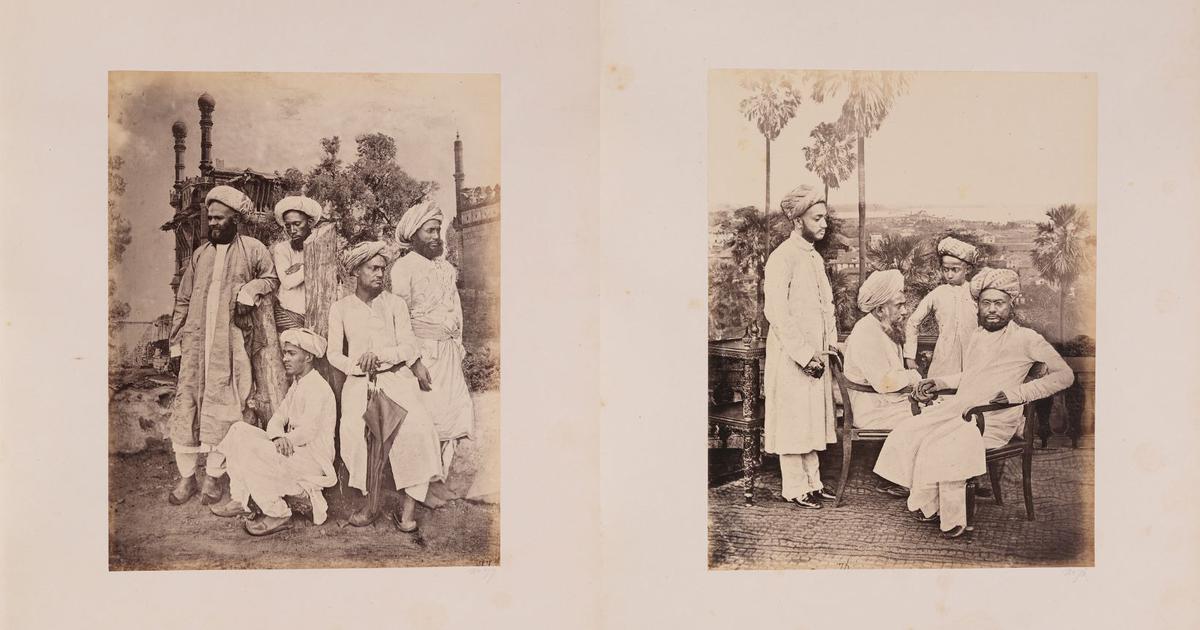
The Memons (left) and the Khojas of Gujarati Muslim community in the 1800s. | Southern Methodist University / Wikimedia Commons.
The fracturing of Mughal power over the course of the 18th century had assorted regional effects throughout the subcontinent, ushering in a volatile mixture of market expansion and rapid political turnover. As historians writing on late Mughal North India have shown, the weakening of central Mughal power fostered the conditions for an assortment of parvenu entrepreneurs and social groups to vie for abundant, albeit hotly contested, political and mercantile resources.6 Although conforming to patterns seen elsewhere on the subcontinent, Western India was arguably an exceptional case, for there a matrix of corporate merchant power, state fiscalism, and political polycentrism coalesced (and persisted, albeit to a lesser degree, after the colonial conquest), with few parallels in other parts of South Asia.
At the risk of oversimplification, while in the second half of the 18th century, the Mughal successor states in the north, south, and east of the subcontinent tended to be expansive entities covering large tracts of territory, in Western India the political map was far more disjointed. Alongside the heavies like the Afghans, the Marathas, the Sikhs, and the British East India Company stood innumerable smaller potentates of Rajput origin whose dynasties survived until the end of colonial rule as princes under British suzerainty. Beneath these potentates were the smaller caste combines, able to flex their corporate muscles in the face of grasping state power.
To be sure, such groups were scattered across India – for example, in the Gangetic Plain, where Hindu and Muslim corporate groups arose throughout the “rurban” landscape, which was segmented by a hierarchy of markets and occupational structures. These groups were of a piece with the Bohras, Khojas, and Memons in that they never acquired the capacity to seize political power outright but nonetheless were highly active players in the theatre of politics. What these Hindu and Muslim corporate combine in interior North India lacked was not only access to transregional export markets via a presence in overseas shipping. They also lacked the middle power eventually afforded to the Gujarati Muslim commercial castes by way of Western India’s idiosyncratic incorporation into frameworks of company rule.
Even before the cementing of company hegemony, the corporate power that Indian merchant communities acquired in eighteenth-century Western India was conspicuous but disconnected. In Surat the preeminent trading entrepôt of the region before Bombay’s rise in the early 19th century, corporate merchant bodies were pivotal to the functioning of the state taxation system from the late seventeenth century onward. But even in Surat corporate power did not mutate into a single merchant assembly arrayed against state authority, and merchants showed no willingness to emancipate themselves entirely from the boundaries of community. Yet the divide between merchant and state power remained porous into the 1830s. This porousness stemmed from a phenomenon that historians have identified as portfolio capitalism, whereby entrepreneurs blended interests in trade, revenue collection, and kingmaking. The conditions of portfolio capitalism permitted individual entrepreneurs and the corporate bodies to which they belonged by dint of caste origin to shape the flight path of political fortunes. The permeable political/mercantile divide intrinsic to portfolio capitalism persisted throughout the first half of the 19th century, until formal colonialism eventually drew a definitive wedge between the political and mercantile spheres. Gujarati Muslim middle power emerged within the interstices of that wedge.
In spite, or perhaps because of, its political fragmentation and volatility, eighteenth-century Greater Gujarat has often been framed as one of the select regions of India that possessed the “sprouts” of a dynamic mercantile capitalism in the precolonial period. Some historians assert that its pre-1800 economic indicators may have even rivalled southern England and southern China in the period before the so-called Great Divergence gathered pace.
None of that preempted Surat, from enduring considerable commercial setbacks in the early decades of the eighteenth century. Muslim-owned shipping is said to have especially suffered, but with the demise of late Mughal-era merchant dynasties, new Indian corporate groups came to the fore, among them the Bohras, Khojas, and Memons. While the latter two groups were still outside circuits of British East India Company rule, the Bohras relied heavily on British ships for freighting to ports in Western Asia, a partnership that foreshadowed a deeper relationship to come. Moreover, regional textile networks – and the broader global “cotton sphere” – continued to serve as a link between Greater Gujarat and various parts of Afro-Eurasia into the 20th century, even in the face of de-industrializing trends in the first half of the nineteenth century. Surviving examples of these textiles, such as a late 19th-century silk garment produced by Memon women, reveal a level of artisanal sophistication which surely contributed to the perpetuation of Gujarati Muslim economic prowess.
Just like the textiles they trafficked, the Bohras, Khojas, and Memons were in no sense secluded to Greater Gujarat in the late eighteenth century. Over centuries of sultanate and Mughal rule they had extended their footprint throughout considerable portions of Central and Western India. By the late eighteenth century, traces of these three groups can be found as far east as Ujjain, as far west as Karachi, as far south as Poona, and as far north as Udaipur. In other words, even within the subcontinent they were scattered throughout Baluchistan, Greater Gujarat, Rajasthan, and Sindh. They thus inhabited a territory that was, by the reckoning of an Indian lexicographer in the 1840s, larger than Great Britain and Ireland, with their shared mother tongues serving as the principal language of business in Central and Western India.
Even if these groups operated across a swath of territories, the problem is locating them in this medley of dissonant sovereignties and attending to their specific trajectories. Unfortunately, so far as is known, source material for these centuries has not survived. Still, one can safely surmise that these groups became part of the increasingly differentiated fabric of Muslim life in Gujarat, which revolved around the twin poles of Sufi orders and sultanic authority.
The Bohra, Khoja, and Memon commercial profile was not exclusively maritime in its contours but operated along the dividing line between agriculture and trade. In a telling case, a Kachchhi Memon jamaat was founded in Bhuj in 1799. Bhuj is thirty-odd miles inland from the port of Mandvi, and the decision of the Memons to settle there is a reminder that they did not merely hug the coasts of Western India but also operated in the hinterland. Nonetheless, the ability of Bohra, Khoja, and Memon ship captains to maintain their overseas presence – even amid the partial decline of Indian shipping from the mid-eighteenth century onward – was fundamental to the preservation of their precarious economic position in the transition to colonial rule. It meant that the Gujarati Muslim commercial castes were present, albeit in small numbers, in Jeddah, Madagascar, Mocha, Mozambique, Muscat, and Zanzibar by 1800.
A Gujarati pilot’s map from around 1750 betrays familiarity with the leading commercial entrepôts of the western Indian Ocean, well before formal colonial conquest.21 British East India Company and Dutch East India Company sources from the eighteenth century reveal passing interactions with Bohras and Khojas. This intimacy with overseas trade was consequential in facilitating Gujarati-Muslim interactions with the bricolage of political authorities jostling for supremacy in Western India. But it also partially insulated these groups from the recurring cycles of economic depression that beset agricultural production in colonial India throughout the 19th and early 20th centuries.
For all their commonalities, it is best to attend to the finer points of each community. The Memons materialise on only rare occasions. Community traditions of later centuries state that the Memons moved out of Sindh to the Kathiawar Peninsula in the early 15th century. From a supposedly once unified community of Lohana Hindus four umbrella Memon communities emerged in the wake of their conversion to Islam in this period: the Kachchhi (Cutchi), the Halai, the Surti (Surati), and the Sindhi. As they migrated, each developed its own incipient corporate identity based on geographic origin.
In the late 18th century, Memons began to attain influence over upstart political authorities. An illuminating and representative example comes from the early history of the Dhoraji Memon jamaat. According to community traditions, in the early 18th century, a Memon merchant named Abd al-Rahman settled in Dhoraji. There he was granted worship and trading rights by the Darbar Haloji of Gondal. Some of Abd al-Rahman’s descendants stayed in Dhoraji, while others migrated to Bantva, about thirty-two miles away, which became another haven for Memons. By 1780 the population of Memons in Dhoraji had reached critical mass, compelling one Adamji, a grandson of Abd al-Rahman, to establish a Dhoraji Memon jamaat. Eventually, the Dhoraji Memon jamaat became a vehicle for local Memons to voice their grievances with the local darbar (royal court) and to combat what they regarded as the arbitrary power of the mahajans, essentially a guild of Hindu moneylenders.
Perturbed both by the taxation policies of the darbar and the influence of the mahajans, the leaders of the Dhoraji Memon jamaat decided to migrate as a group in response to these taxation measures. They ended up travelling to Junagadh, which was only some seventeen miles away but was governed by another ruler. In time, however, the Dhoraji Memon jamaat was attracted back to Dhoraji by the local ruler, whose revenue had been hard hit by the Memon exodus, and he had decided to reextend privileges. Dhoraji, though witness to occasional scenes of tension between the Memons and local authorities, would be a center of Halai Memon corporate power in Greater Gujarat until 1947. The example of the Dhoraji Memon jamaat was repeated among Memons across Western India in the transition from Mughal to colonial rule.
Excerpted with permission from No Birds of Passage: A History of Gujarati Muslim Business Communities, 1800-1975, Michael O’Sullivan, Harvard University Press.
source: http://www.scroll.in / Scroll.in / Home> Book Excerpt / by Michael O’Sullivan / September 02nd, 2024
Michael O’Sullivan’s groundbreaking intervention in what is a much longer debate on Islam’s tryst with Western capitalism is his study of the ‘jamaat’ through the analytical category of the ‘corporation’
Bohri havelis in Sidhpur, Gujarat / Stock Photographer
Book:No Birds of Passage : A History of Gujarati Muslim Business Communities, 1800-1975
Author: Michael O’Sullivan / Published by: Harvard / Price: Rs 799
pix: amazon.in
A sleepy pilgrim town called Sidhpur in the Patan district of Gujarat has now become a major site of global tourist attraction. Tucked away in a corner of the old precincts of the town is a spectacular residential enclave of the Dawoodi Bohras, a trading community that flourished in the region from the 1890s to the 1930s. The Bohras built elegant mansions made of wood and stone with stuccoed facades, ornate pilasters, trellised balconies and gabled roofs. These Victorian-style row houses are now completely empty. Apart from being a rare visual treat in an otherwise crumbling town, these empty mansions bear witness to a remarkably rich history of the community recorded in this book that studies the Dawoodi Bohras, along with Khojas and Memons, as a distinctive group of closely-knit endogamous mercantile castes that enjoyed a spectacular record of success in both regional and maritime trade from the early 18th century onwards.
The Khojas, Memons and Bohras lived in the region identified by Michael O’Sullivan as “Greater Gujarat” that included Kutch, Kathiawar, Rajasthan and Lower Sind. Their community narratives described them as descendants of formerly Hindu trading castes who were converted to Islam by Shia missionaries in the 13th century. Their names were derived on conversion, with Bohra derived from ‘vohra’ or trader, Khoja from ‘khwaja’, and Memon from ‘mumin’. It must be noted here that the Memons were the only Sunni group among the three.
The three collectively constitute 1% of the Muslim population of South Asia today. But since the third decade of the 19th century, they acquired an economic prominence vastly disproportionate to their numbers. This was largely because their trading activities, first, in the regional and global cotton textile circuits and, later, in the opium networks, made them active participants in the complex circuits of trade and finance that birthed 18th-century capitalism and a new Indian Ocean economy. They occupied what were deemed to be the interstitial spaces or the ‘middle-power’ among the Dutch, the French and the British mercantile companies. They used their political clout to extend their trading activities with proselytising initiatives in the port cities of Southeast Asia and East Africa.
The largest groups among them lived and operated from Surat but many migrated to Aden, Yemen, China, Malaya, Singapore, Japan and Zanzibar. They spoke Urdu and Gujarati with equal ease. Their fortunes grew steadily from about the 1830s up to the Great War, but the Depression that followed broke their businesses and eroded the wealth they had accrued over decades. They were unable to cope with endemic market shocks, litigations, and the complex web of obligations that sustained their trans-imperial businesses in Asia and Africa. This was also a time when the rising tide of anti-colonial nationalism and swadeshi on the one hand and the emergence of a distinctive Muslim politics on the other challenged these groups to recalibrate their relationships with the colonial State, mainstream Islam and non-Muslim communities at large. O’Sullivan charts the ebbs and the flows of the economic fortunes of these groups by focusing on the complex social, economic and religious bonds that held them together through their jamaats, or a kinship of believers. The jamaats came to define the ‘life-worlds’ of these communities in three distinctive ways: as economic entities that acted as depositories of individual capital and collective assets, as legal entities that acted as arbiters in conflicts among colonial law, customary practice and Islamic jurisprudence and, finally, as social entities that regulated the personal lives of members through decisions on marriage, inheritance and succession as wells as on the terms of participation in anti-colonial and pan-Islamic politics.
The author’s groundbreaking intervention in what is a much longer debate on Islam’s tryst with Western capitalism is his study of the jamaat through the analytical category of the ‘corporation’. He concedes this is contentious terrain, but argues compellingly that the legal, social and economic character of the jamaat in all these communities has a story to tell not only about the entanglements of caste, community and capital in non-Western contexts but also about the plural, heterogenous lives of South Asian Islam and its volatile relations with colonial and post-colonial States as both beneficiary and victim.
This is an audacious scholarly conversation between received categories of classical political economy and South Asian Islam that is likely to provoke debate among specialists in the field. For the general student of history however, it is a book that demands close attention for its outstanding contributions to the craft, both in its expansive approach toward the archive as in its deft interweaving of religion, culture and politics within the complex terrain of capitalist enterprise and law. The structure, prose and narrative richness of the book are likely to ensure a life for it outside the scholarly niche of economic history.
source: http://www.telegraphindia.com / The Telegraph Online / Home> Culture> Books / by Madhumita Mazumdar / book pix edited, source: amazon.in / December 08th, 2022