Category Archives: Books (incl.Biographies – w.e.f.01 jan 2018 )

Azizuddin Aziz Belgaumi (رحمہ اللہ): A Voice of Love, Light, and Prophetic Praise Falls Silent

Bengaluru, KARNATAKA :

The Urdu literary world mourns the demise of one of its gentle giants, Azizuddin Aziz Belgaumi, the celebrated Na’at poet, ghazal writer, teacher, and literary guide, who returned to his Lord on the morning of Friday, November 28, shortly after the Fajr prayer in Bengaluru.

Azizuddin Aziz was not merely a poet; he was a custodian of spiritual emotion, a voice that blended devotion, beauty, and sincerity in every syllable.

He was renowned for his Na’ats – soulful, tender, and overflowing with love for Prophet Muhammad ﷺ. His unique style of recitation, coupled with his soothing voice, made his poetry beloved among Urdu lovers across the region and beyond.

His iconic Na’ats, including:

  • اہلِ ستم کے پتھر کھا کر گل برسانے والے ہم
  • دعوتِ ہدایت کی ایک حسیں شفق لے کر میرے مصطفیٰ آئے

had gone viral among Urdu audiences, each line steeped in deep reverence and spiritual longing.

On his final night in this world, he once again recited “Dawat-e-Hidayat ki ek haseen shafaq lekar mere Mustafa aaye” on special request at a mushaira organized by Idara-e-Adab-e-Islami Hind, Karnataka. The audience responded with extraordinary affection, as if witnessing a sacred farewell.

By the next morning, he left this world – a departure many lovingly regard as a sign of divine acceptance.

Azizuddin Aziz’s published works reflect his emotional depth and mastery of language. His poetry collections include:

  • حرف و صوت
  • سکون کے لمحوں کی تازگی
  • دل کے دامن پر
  • نقد و انتقاد
  • زنجیرِ دست و پا
  • ذکر میرے حبیب کا

These works capture the freshness of spiritual experience, the fragrance of emotion, and the honesty of a heart in constant remembrance.

Azizuddin Aziz worked with Doordarshan Bangalore Urdu, where he interviewed prominent literary personalities. His conversations reflected both scholarship and humility, making him a respected voice representing Urdu culture on national media.

He served for a time as a teacher and later as the Principal of Zubaida College, Shikaripur, shaping young minds with the same warmth and refinement that characterised his poetry.

As an educator, he was loved for his gentle discipline, cultured manner, and his ability to ignite a love for language among students.

He also served as editor of several literary magazines, contributing significantly to Karnataka’s Urdu literary landscape. His editorial vision was marked by sincerity, high standards, and a deep respect for classical tradition.

Early on November 28, he experienced severe chest pain at his residence in Bengaluru. Despite attempts to rush him to the hospital, he breathed his last at home. He leaves behind his wife, three sons, two daughters, and a large community of admirers, students, and peers.

May Allah accept every word of love he wrote for His Beloved Prophet ﷺ. May He grant Azizuddin Aziz a lofty place in Jannat-ul-Firdous, and grant patience, strength, and peace to his grieving family. His voice has returned to silence – but his Na’ats will continue to illuminate gatherings, his ghazals will continue to warm hearts, and his legacy will remain a torch of devotion and grace.

Inna lillahi wa inna ilayhi raji’un. Most certainly we belong to Allah, and most certainly we will return to Him.

source: http://www.radiancenews.com / Radiance News / Home> Focus> Obituary / by Radiance News Bureau / by Mohammed Talha Siddi Bapa / November 29th, 2025

How the Bohra, Khoja, and Memon communities of Gujarati Muslims became formidable at business

GUJARAT :

An excerpt from ‘No Birds of Passage: A History of Gujarati Muslim Business Communities, 1800-1975,’ by Michael O’Sullivan.

The Memons (left) and the Khojas of Gujarati Muslim community in the 1800s. | Southern Methodist University / Wikimedia Commons.

The fracturing of Mughal power over the course of the 18th century had assorted regional effects throughout the subcontinent, ushering in a volatile mixture of market expansion and rapid political turnover. As historians writing on late Mughal North India have shown, the weakening of central Mughal power fostered the conditions for an assortment of parvenu entrepreneurs and social groups to vie for abundant, albeit hotly contested, political and mercantile resources.6 Although conforming to patterns seen elsewhere on the subcontinent, Western India was arguably an exceptional case, for there a matrix of corporate merchant power, state fiscalism, and political polycentrism coalesced (and persisted, albeit to a lesser degree, after the colonial conquest), with few parallels in other parts of South Asia.

At the risk of oversimplification, while in the second half of the 18th century, the Mughal successor states in the north, south, and east of the subcontinent tended to be expansive entities covering large tracts of territory, in Western India the political map was far more disjointed. Alongside the heavies like the Afghans, the Marathas, the Sikhs, and the British East India Company stood innumerable smaller potentates of Rajput origin whose dynasties survived until the end of colonial rule as princes under British suzerainty. Beneath these potentates were the smaller caste combines, able to flex their corporate muscles in the face of grasping state power.

To be sure, such groups were scattered across India – for example, in the Gangetic Plain, where Hindu and Muslim corporate groups arose throughout the “rurban” landscape, which was segmented by a hierarchy of markets and occupational structures. These groups were of a piece with the Bohras, Khojas, and Memons in that they never acquired the capacity to seize political power outright but nonetheless were highly active players in the theatre of politics. What these Hindu and Muslim corporate combine in interior North India lacked was not only access to transregional export markets via a presence in overseas shipping. They also lacked the middle power eventually afforded to the Gujarati Muslim commercial castes by way of Western India’s idiosyncratic incorporation into frameworks of company rule.

Even before the cementing of company hegemony, the corporate power that Indian merchant communities acquired in eighteenth-century Western India was conspicuous but disconnected. In Surat the preeminent trading entrepôt of the region before Bombay’s rise in the early 19th century, corporate merchant bodies were pivotal to the functioning of the state taxation system from the late seventeenth century onward. But even in Surat corporate power did not mutate into a single merchant assembly arrayed against state authority, and merchants showed no willingness to emancipate themselves entirely from the boundaries of community. Yet the divide between merchant and state power remained porous into the 1830s. This porousness stemmed from a phenomenon that historians have identified as portfolio capitalism, whereby entrepreneurs blended interests in trade, revenue collection, and kingmaking. The conditions of portfolio capitalism permitted individual entrepreneurs and the corporate bodies to which they belonged by dint of caste origin to shape the flight path of political fortunes. The permeable political/mercantile divide intrinsic to portfolio capitalism persisted throughout the first half of the 19th century, until formal colonialism eventually drew a definitive wedge between the political and mercantile spheres. Gujarati Muslim middle power emerged within the interstices of that wedge.

In spite, or perhaps because of, its political fragmentation and volatility, eighteenth-century Greater Gujarat has often been framed as one of the select regions of India that possessed the “sprouts” of a dynamic mercantile capitalism in the precolonial period. Some historians assert that its pre-1800 economic indicators may have even rivalled southern England and southern China in the period before the so-called Great Divergence gathered pace.

None of that preempted Surat, from enduring considerable commercial setbacks in the early decades of the eighteenth century. Muslim-owned shipping is said to have especially suffered, but with the demise of late Mughal-era merchant dynasties, new Indian corporate groups came to the fore, among them the Bohras, Khojas, and Memons. While the latter two groups were still outside circuits of British East India Company rule, the Bohras relied heavily on British ships for freighting to ports in Western Asia, a partnership that foreshadowed a deeper relationship to come. Moreover, regional textile networks – and the broader global “cotton sphere” – continued to serve as a link between Greater Gujarat and various parts of Afro-Eurasia into the 20th century, even in the face of de-industrializing trends in the first half of the nineteenth century. Surviving examples of these textiles, such as a late 19th-century silk garment produced by Memon women, reveal a level of artisanal sophistication which surely contributed to the perpetuation of Gujarati Muslim economic prowess.

Just like the textiles they trafficked, the Bohras, Khojas, and Memons were in no sense secluded to Greater Gujarat in the late eighteenth century. Over centuries of sultanate and Mughal rule they had extended their footprint throughout considerable portions of Central and Western India. By the late eighteenth century, traces of these three groups can be found as far east as Ujjain, as far west as Karachi, as far south as Poona, and as far north as Udaipur. In other words, even within the subcontinent they were scattered throughout Baluchistan, Greater Gujarat, Rajasthan, and Sindh. They thus inhabited a territory that was, by the reckoning of an Indian lexicographer in the 1840s, larger than Great Britain and Ireland, with their shared mother tongues serving as the principal language of business in Central and Western India.

Even if these groups operated across a swath of territories, the problem is locating them in this medley of dissonant sovereignties and attending to their specific trajectories. Unfortunately, so far as is known, source material for these centuries has not survived. Still, one can safely surmise that these groups became part of the increasingly differentiated fabric of Muslim life in Gujarat, which revolved around the twin poles of Sufi orders and sultanic authority.

The Bohra, Khoja, and Memon commercial profile was not exclusively maritime in its contours but operated along the dividing line between agriculture and trade. In a telling case, a Kachchhi Memon jamaat was founded in Bhuj in 1799. Bhuj is thirty-odd miles inland from the port of Mandvi, and the decision of the Memons to settle there is a reminder that they did not merely hug the coasts of Western India but also operated in the hinterland. Nonetheless, the ability of Bohra, Khoja, and Memon ship captains to maintain their overseas presence – even amid the partial decline of Indian shipping from the mid-eighteenth century onward – was fundamental to the preservation of their precarious economic position in the transition to colonial rule. It meant that the Gujarati Muslim commercial castes were present, albeit in small numbers, in Jeddah, Madagascar, Mocha, Mozambique, Muscat, and Zanzibar by 1800.

A Gujarati pilot’s map from around 1750 betrays familiarity with the leading commercial entrepôts of the western Indian Ocean, well before formal colonial conquest.21 British East India Company and Dutch East India Company sources from the eighteenth century reveal passing interactions with Bohras and Khojas. This intimacy with overseas trade was consequential in facilitating Gujarati-Muslim interactions with the bricolage of political authorities jostling for supremacy in Western India. But it also partially insulated these groups from the recurring cycles of economic depression that beset agricultural production in colonial India throughout the 19th and early 20th centuries.

For all their commonalities, it is best to attend to the finer points of each community. The Memons materialise on only rare occasions. Community traditions of later centuries state that the Memons moved out of Sindh to the Kathiawar Peninsula in the early 15th century. From a supposedly once unified community of Lohana Hindus four umbrella Memon communities emerged in the wake of their conversion to Islam in this period: the Kachchhi (Cutchi), the Halai, the Surti (Surati), and the Sindhi. As they migrated, each developed its own incipient corporate identity based on geographic origin.

In the late 18th century, Memons began to attain influence over upstart political authorities. An illuminating and representative example comes from the early history of the Dhoraji Memon jamaat. According to community traditions, in the early 18th century, a Memon merchant named Abd al-Rahman settled in Dhoraji. There he was granted worship and trading rights by the Darbar Haloji of Gondal. Some of Abd al-Rahman’s descendants stayed in Dhoraji, while others migrated to Bantva, about thirty-two miles away, which became another haven for Memons. By 1780 the population of Memons in Dhoraji had reached critical mass, compelling one Adamji, a grandson of Abd al-Rahman, to establish a Dhoraji Memon jamaat. Eventually, the Dhoraji Memon jamaat became a vehicle for local Memons to voice their grievances with the local darbar (royal court) and to combat what they regarded as the arbitrary power of the mahajans, essentially a guild of Hindu moneylenders.

Perturbed both by the taxation policies of the darbar and the influence of the mahajans, the leaders of the Dhoraji Memon jamaat decided to migrate as a group in response to these taxation measures. They ended up travelling to Junagadh, which was only some seventeen miles away but was governed by another ruler. In time, however, the Dhoraji Memon jamaat was attracted back to Dhoraji by the local ruler, whose revenue had been hard hit by the Memon exodus, and he had decided to reextend privileges. Dhoraji, though witness to occasional scenes of tension between the Memons and local authorities, would be a center of Halai Memon corporate power in Greater Gujarat until 1947. The example of the Dhoraji Memon jamaat was repeated among Memons across Western India in the transition from Mughal to colonial rule.

Excerpted with permission from No Birds of Passage: A History of Gujarati Muslim Business Communities, 1800-1975, Michael O’Sullivan, Harvard University Press.

source: http://www.scroll.in / Scroll.in / Home> Book Excerpt / by Michael O’Sullivan / September 02nd, 2024


A scholarly perspective

GUJARAT :

Michael O’Sullivan’s groundbreaking intervention in what is a much longer debate on Islam’s tryst with Western capitalism is his study of the ‘jamaat’ through the analytical category of the ‘corporation’

Bohri havelis in Sidhpur, Gujarat / Stock Photographer

Book: No Birds of Passage : A History of Gujarati Muslim Business Communities, 1800-1975

Author: Michael O’Sullivan / Published by: Harvard / Price: Rs 799

pix: amazon.in

A sleepy pilgrim town called Sidhpur in the Patan district of Gujarat has now become a major site of global tourist attraction. Tucked away in a corner of the old precincts of the town is a spectacular residential enclave of the Dawoodi Bohras, a trading community that flourished in the region from the 1890s to the 1930s. The Bohras built elegant mansions made of wood and stone with stuccoed facades, ornate pilasters, trellised balconies and gabled roofs. These Victorian-style row houses are now completely empty. Apart from being a rare visual treat in an otherwise crumbling town, these empty mansions bear witness to a remarkably rich history of the community recorded in this book that studies the Dawoodi Bohras, along with Khojas and Memons, as a distinctive group of closely-knit endogamous mercantile castes that enjoyed a spectacular record of success in both regional and maritime trade from the early 18th century onwards.

The Khojas, Memons and Bohras lived in the region identified by Michael O’Sullivan as “Greater Gujarat” that included Kutch, Kathiawar, Rajasthan and Lower Sind. Their community narratives described them as descendants of formerly Hindu trading castes who were converted to Islam by Shia missionaries in the 13th century. Their names were derived on conversion, with Bohra derived from ‘vohra’ or trader, Khoja from ‘khwaja’, and Memon from ‘mumin’. It must be noted here that the Memons were the only Sunni group among the three.

The three collectively constitute 1% of the Muslim population of South Asia today. But since the third decade of the 19th century, they acquired an economic prominence vastly disproportionate to their numbers. This was largely because their trading activities, first, in the regional and global cotton textile circuits and, later, in the opium networks, made them active participants in the complex circuits of trade and finance that birthed 18th-century capitalism and a new Indian Ocean economy. They occupied what were deemed to be the interstitial spaces or the ‘middle-power’ among the Dutch, the French and the British mercantile companies. They used their political clout to extend their trading activities with proselytising initiatives in the port cities of Southeast Asia and East Africa.

The largest groups among them lived and operated from Surat but many migrated to Aden, Yemen, China, Malaya, Singapore, Japan and Zanzibar. They spoke Urdu and Gujarati with equal ease. Their fortunes grew steadily from about the 1830s up to the Great War, but the Depression that followed broke their businesses and eroded the wealth they had accrued over decades. They were unable to cope with endemic market shocks, litigations, and the complex web of obligations that sustained their trans-imperial businesses in Asia and Africa. This was also a time when the rising tide of anti-colonial nationalism and swadeshi on the one hand and the emergence of a distinctive Muslim politics on the other challenged these groups to recalibrate their relationships with the colonial State, mainstream Islam and non-Muslim communities at large. O’Sullivan charts the ebbs and the flows of the economic fortunes of these groups by focusing on the complex social, economic and religious bonds that held them together through their jamaats, or a kinship of believers. The jamaats came to define the ‘life-worlds’ of these communities in three distinctive ways: as economic entities that acted as depositories of individual capital and collective assets, as legal entities that acted as arbiters in conflicts among colonial law, customary practice and Islamic jurisprudence and, finally, as social entities that regulated the personal lives of members through decisions on marriage, inheritance and succession as wells as on the terms of participation in anti-colonial and pan-Islamic politics.

The author’s groundbreaking intervention in what is a much longer debate on Islam’s tryst with Western capitalism is his study of the jamaat through the analytical category of the ‘corporation’. He concedes this is contentious terrain, but argues compellingly that the legal, social and economic character of the jamaat in all these communities has a story to tell not only about the entanglements of caste, community and capital in non-Western contexts but also about the plural, heterogenous lives of South Asian Islam and its volatile relations with colonial and post-colonial States as both beneficiary and victim.

This is an audacious scholarly conversation between received categories of classical political economy and South Asian Islam that is likely to provoke debate among specialists in the field. For the general student of history however, it is a book that demands close attention for its outstanding contributions to the craft, both in its expansive approach toward the archive as in its deft interweaving of religion, culture and politics within the complex terrain of capitalist enterprise and law. The structure, prose and narrative richness of the book are likely to ensure a life for it outside the scholarly niche of economic history.

source: http://www.telegraphindia.com / The Telegraph Online / Home> Culture> Books / by Madhumita Mazumdar / book pix edited, source: amazon.in / December 08th, 2022

History of 1921 Malabar revolt is being decolonised. British reduced it to Hindu-Muslim clash

KERALA :

The Malabar Resistance of 1921 is a deeply contested historical event that was born out of the crackdown against the Khilafat movement. The book ‘Musaliar King’ has tried to decolonise it.

KP Fabian with Abbas Panakkal’s book Musaliar King | Special arrangement

New Delhi: 

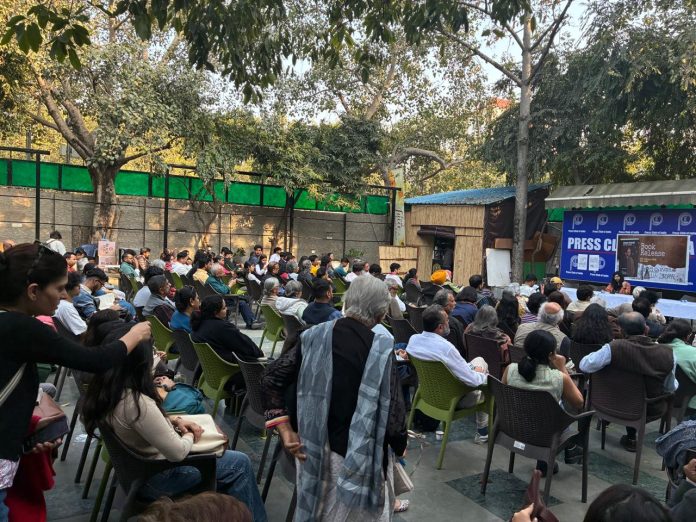
On a mission to decolonise the narrative around the Malabar resistance of 1921, author Abbas Panakkal has relied on oral histories, and other accounts in Ottoman, French, Australian, and Indian libraries. A recent gathering of academics at the India International Centre saw a passionate discussion on the book Musaliar King: Decolonial Historiography of Malabar’s Resistance

Star-studded panelists of academics and scholars, including former diplomat KP Fabian, Padma Shri Syed Iqbal Hasnain, dean of Jamia Hamdard, Saleena Basheer, Pallavi Raghavan, professor at Ashoka University and professor Syed Jaffri Hussain of Delhi University critiqued and added layers of historical context to Panakkal’s work. 

The Malabar Resistance of 1921 is a deeply contested historical event that was born out of the crackdown against the Khilafat movement, and saw an uprising of peasants against the landlords who were primarily Hindus and enjoyed British support. The British historiography reduces the rebellion to a Hindu-Muslim clash, and the resistance hasn’t found a place in the national conversation of revolts against the British colonists.

The author maintains that the peasantry contained both Hindus as well as Muslims and that Muslim houses were also targeted.

In 2021, RSS National Executive Committee member Ram Madhav had said that the Malabar Rebellion was the first manifestation of the ‘Talibani’ thought in India. In the same year, there were also Right-wing protests against celebrating the centenary anniversary of the revolt.

The Hindu Right maintains that the ‘uprising’ or ‘revolt’ was a communal incident, and takes offence to declare one of the leaders of the rebellion Variyamkunnath Kunjahammed Haji as a martyr. 

“Historians rely on repositories to provide evidence for accounts. In this project, my repository was also my family, neighbours, and village. When I grew up and learned English, I understood that the British version of the history of the Malabar rebellion was very different from what I had grown up hearing. The popular history was very different from the personal story of the people of this region,” Panakkal said, addressing an audience of academics, students, and historians.

“This book is not just research of 3-4 years, these are stories that I grew up hearing. I have to tell the story of my native place. It is my obligation,” he said. 

Panelists discussing Malabar rebellion of 1921 | Special arrangement

Oral history or nationalistic take? 

Growing up,  Panakkal said he had met and acquainted himself with Hindu and Muslim families who maintained an oral history of how Muslims and Hindus both rescued each other during the uprising. He added that the Malabar region, especially Tirurangadi, has a lot of communal peace.

Dr Syed Iqbal Hasnain said that the Malabar or Moplah revolt was an uprising against the British that was “woven with the threads of unity binding Hindu and Muslim to safeguard the throne of Hindu king Zamorin of Calicut.” 

“Muslim communities thrived under the patronage of Hindu kings, who they considered protectors who ensured the preservation of Islamic law and culture,” Hasnain said. 

Saleena Basheer, while commending Panakkal’s work, didn’t hold back on her critique of the book, which she said could be non-accessible to people who don’t have a lot of awareness about the revolt. She also questioned if the book was over-reliant on oral histories. 

“Does the book deconstruct colonial narratives or does it ignore them in favour of nationalistic storytelling,” Basheer asked.

The academics also wondered how radical the decolonial approach could be, as British versions of history are sometimes the only version of historical accounts available in the pre-Partition era, and have to be relied on by historians while writing about history.

Syed Jaffri Hussain, who has written extensively on the revolt of 1857, said the British version of events has to be challenged. He also praised Panakkal’s work. “Indian rebels like Bahadur Shah Zafar, Jhansi ki rani, Rana Beni Madho Singh are described as badmash, this needs to be read between the lines,” Hussain said about British repositories, adding that such language was never used for Australian rebels or Irish convicts.

The British left but their mentality has stayed with us,” he added. 

Hussain maintained that Moplah rebellion oral history needed to be urgently recorded. 

“What is accepted by us as an oral history in the realm of Dalit history, women’s history, should also be accepted in terms of Moplah history,” said Hussain.

(Edited by Ratan Priya)

source: http://www.theprint.in / The Print / Home> Features> Around Town / by Shubhangi Misra / February 19th, 2025

Frontline Launches The Noorani Records Honouring the Legacy of A.G. Noorani

MAHARASHTRA / Chennai, TAMIL NADU :

Chennai:

The Hindu Group’s Frontline magazine has launched The Noorani Records, a collection of essays by the late lawyer and constitutional expert A.G. Noorani (1930–2024). The book was released at The Hindu’s head office in Chennai on November 11. N. Ram, Director of The Hindu Publishing Group, presented the first copies to retired Madras High Court judges Justice K. Chandru and Justice Prabha Sridevan.

Justice Chandru praised Noorani’s ability to explain complex legal and political ideas in simple language that appealed to both experts and lay readers. Citing Noorani’s writings on the Rashtriya Swayamsevak Sangh (RSS) and Mahatma Gandhi, he urged that such essays be introduced to students to counter historical distortion and promote constitutional awareness. He also recalled Noorani’s detailed account of the trial of the Ali brothers during the Khilafat Movement, which reflected Hindu–Muslim unity.

Justice Sridevan remarked that Noorani’s work could inspire reflection and change among readers. She said his clarity of thought and disciplined writing offered valuable lessons for young lawyers.

N. Ram described Noorani as a passionate journalist and an uncompromising voice in legal and political commentary. He recalled that Noorani preferred handwriting his articles, ensuring precision and punctuality in his contributions to Frontline. Editor Vaishna Roy called him an erudite jurist whose essays combined intellectual depth with accessibility.

pix: thehindu.com

The book, released on the first anniversary of Noorani’s passing, compiles some of his finest columns for Frontline. It is available for purchase through The Hindu’s online bookstore.

source: http://www.radiancenews.com / Radiance News / Home> Latest News> Report / by Radiance News Bureau / November 13th, 2025

Historian Abbas Panakkal’s latest book redefines Jihad

KERALA :

In the Western view, Jihad is depicted within a framework of communal hostility and destruction, but in the documents of Malabar it is a word of interfaith harmony and peaceful coexistence, Abbas said.

Author of the book ‘Hindu Amir of Muslims: Indigenised Islam from the Indian Ocean Littoral of Malabar’ Abbas Panakkal.Photo | Special Arrangement

Kozhikode :

Contradicting popular narratives put forth by extremist Islamic organisations and the West that portray Jihad as a violent aggression on non-Muslims to establish the supremacy of Islam, is a one originating in Kerala that describes the unified efforts of Muslims and non-Muslims to protect a Hindu king.

Historian Abbas Panakkal’s intriguingly titled book Hindu Amir of Muslims: Indigenised Islam from the Indian Ocean Littoral of Malabar counters the argument that a non-Muslim cannot be the Amir of Muslims, quoting the works of Islamic scholars such as Sheikh Zainuddin Makhdoom and Qazi Muhammad. Some Muslim organisations assert that a true believer should at least strive mentally to establish an Islamic rule, otherwise his/her Islam will remain incomplete.

Abbas argues that Islamic scholars around the sixteenth century had called for Jihad against the Portuguese when the intruders locked horns with the Zamorins. In the Western view, Jihad is depicted within a framework of communal hostility and destruction, but in the documents of Malabar it is a word of interfaith harmony and peaceful coexistence, Abbas said.

“Qazi Muhammad’s poem Fat’hul Mubin narrates an incident during the attack on Chaliyam fort, built by the Portuguese. Zamorin was the ruler and the Muslims had taken a vow to sacrifice their life in the fight for the king. On hearing this, the Hindus felt sad and said that Muslims should not let Muslims die as they are the minority. Finally, they decided to fight together,” Abbas said.

The Qazi conducted prayers for the king and requested all Muslims to pray for the non-Muslim sovereign. He criticised Muslim kings, who signed treaties with the Portuguese and supported their cruelties, the book says.

“Here, jihad was declared to support the local ruler, irrespective of his religion. It was not to crown a Muslim ruler or to turn a Darul Harb into a Darul Islam. Within the Kingdom of Zamorin the Jihad became a tool of accord and interreligious cohabitation,” the book says.

Abbas quotes an incident narrated in Fat’hul Mubin to show the camaraderie between Hindus and Muslims during the siege of the Chaliyam fort.

Zamorin’s mother wrote a letter to the Muslim leaders seeking their intervention and important warriors of the times including Kunjali Marakkar, Umar Anthabi and Abdul Azeez gathered at a mosque in Kozhikode along with the officials of Zamorin to discuss the war strategies.

Tufat al-Mujahidin by Sheikh Zainuddin Makhdoom II, written in the sixteenth century, narrates the privileges enjoyed by Muslims under the rule of Zamorin. Proper burial was given to the bodies of Muslim offenders as per the Islamic custom while the bodies of non-Muslim criminals were left to be consumed by wild animals, says the book.

“Non-Muslim rulers actively supported the construction of mosques and the organization of religious observances, and the state provided funding for the salaries of qazis (judges) and other religious officials, such as mu’addins (callers to prayer). In this pluralistic context, where Muslims enjoyed considerable freedom and leniency,” the book said.

source: http://www.newindianexpress.com / The New Indian Express / Home> Kerala / by MP Prashanth /August 06th, 2025

In the run-up to Independence, a little-known resistance in the Malabar region

KERALA :

A new book sheds light on the ‘Malabar Revolt’ in a region which had a history of Muslims and Hindus collaboratively persevering in their resistance against colonial forces. Other books explore its links to the Khilafat movement and why it is more than a peasant uprising.

Moplah prisoners go on trial in Calicut | Photo Credit: Getty Images

Growing up in Delhi, one had only a limited idea about the resistance movement in the Malabar region. The popular history books tended to treat it at best as a little outpost of the freedom movement. Noted historian Bipan Chandra in India’s Struggle for Independence (Penguin) dubbed it as a peasant movement.

“In August 1921, peasant discontent erupted in the Malabar district of Kerala. Here, Mappila tenants rebelled. Their grievances related to lack of any security of tenure, renewal fees, high rents…the impetus for resistance had first come from the Malabar District Congress Conference at Manjeri in April 1920,” Chandra writes. Sumit Sarkar too, confined himself to calling it an “anti-landlord revolt” in his book, Modern India (1885-1947), published by Pearson. There have been noises about the association with the Khilafat movement in academic circles, though. Just as there are historians who see it merely from a communal prism. A holistic picture had failed to emerge.

Enlightening exploration

Some belated but well-deserved attention on the resistance movement has come courtesy Abbas Panakkal’s Musaliar King: Decolonial Historiography of Malabar’s Resistance (Bloomsbury). Starting off as an exploratory exercise on the 75th anniversary of the movement, Panakkal’s venture transforms into an enlightening journey.

Early in the book, the author writes, “The socio-geographical landscape of our community underwent profound transformations in the wake of the cataclysmic events of 1921-22. This epoch witnessed a staggering loss of lives, the forced displacement of families… The old mosque of Tirurangadi emerged as a veritable repository of memories and narratives, a historical bastion of ideological resistance against the British colonial apparatus.” Fittingly, it was on the commemoration of the 75th anniversary of the 1921 resistance that Panakkal started his exploration, speaking to the family members of those directly involved.

Among them was Muhammed Ali Musaliar, grandson of Ali Musaliar, a luminary of the 1921 struggle. The British referred to Ali Musaliar as a king; the locals regarded him as a community and spiritual leader, calling him Musaliar Uppapa. Indeed, if Musaliar was a ‘king’, Malabar was his ‘kingdom’.

Incidentally, the term Malabar is derived from the vernacular Mala, signifying hill, and the affix originating from the Arabic word barr, which means the source of all goodness. The region had a long tradition of anti-colonial resistance dating back to the 16th century. “Muslims and Hindus collaboratively persevered in their resistance against colonial forces,” writes Panakkal.

This strong anti-colonial stance had unforeseen consequences. The British, with not a little help from some Indian officials, sought to undermine the movement. Among them was C. Gopalan Nair, Malabar district deputy collector, who “unabashedly deployed his literary prowess in favour of the British cause”. Observes Panakkal: “The usage of terms such as Malabar Revolt and Moplah Rebellion to delineate these struggles is emblematic of this issue. Revolt itself is a term crafted by colonial administration, characterising violent actions against a recognised government or ruler.”

‘Peaceful coexistence’

There were others, though, whose hearts beat for the locals, luminaries who either linked the resistance to the Khilafat movement or, in isolation, read it as an agrarian struggle. Among them were Saumyendranath Tagore, who regarded it as “an organic and spontaneous ‘uprising’ of the Malabar peasantry against British imperial rule” and E.M.S. Namboodiripad, who too “didn’t discount the role played by agrarian discontent”. There was a common thread: the oppression and exploitation meted out by colonial officials and landlords was no less severe upon the Hindu peasants as they were on their Muslim counterparts. Writes Panakkal, “The Malabar narrative heralded a rare phenomenon: the harmonious convergence of Hindus and Muslims. This coalition was underpinned by a shared objective — to oust the oppressor — and a collective aspiration for a peaceful coexistence in the region.”

It is something with which even R.N. Hitchcock, police superintendent of Malabar, agreed. As written by N.P. Chekkutty in Mappila and Comrades: A Century of Communist-Muslim Relations (Other Books). “Hitchcock also reveals that Hindus were involved in the rebellion, at least in some parts of the affected areas. ‘The Hindus took an active part only in the extreme south-eastern area of the Valluvanad taluk and in small numbers for a concise time. They were then responsible for much property damage’.” In his persuasively argued book, with much of the focus on the post-resistance time in the late 1930s and 40s, Chekkutty also talks of the rebels not harming any substantial section of the local population before going on to document the failure of the Congress to retain local Muslim support after the resistance movement. It was a vacuum which both the Communist Party of India and the All India Muslim League attempted to fill.

The Khilafat angle

Interestingly, against this background of common cause transcending the confines of faith came the pan-Islamist Khilafat movement. Things became even more ironic as Malabar’s historical tapestry of anti-colonial resistance “had been woven with threads of unity binding Muslims and non-Muslims in a shared ‘jihad’ to safeguard the throne of the Hindu king, the Zamorin of Calicut,” as analysed by Panakkal. Khilafat, Non-Cooperation, Mappila, with seemingly disparate social elements, all fused to bring about a strong anti-colonial movement.

Indeed, here both the communities enjoyed a rare camaraderie, and there was a happy collective involvement even in religiously significant events like the nercha and utsavam. During the latter, Muslim families returned with bags full of jaggery candies, much like Ali Musaliar used to do for Amina, his daughter. Sums up Panakkal: “The experience of Muslims and Islam in South India is different from the experience in North India, and this is not trivial.”

source: http://www.thehindu.com / The Hindu / Home> Books> Bibliography / by Ziya Us Salam / September 18th, 2025

Prof. Z.M. Khan Honoured with IOS Lifetime Achievement Award

DELHI :

Renowned Scholar and Former Jamia Dean Recognized for Five Decades of Academic and Social Contributions

In a grand ceremony held in the capital, the Institute of Objective Studies (IOS) conferred the prestigious IOS Lifetime Achievement Award upon Professor Zahoor Mohammad Khan (Z.M. Khan)— an eminent scholar, researcher, author, and former Dean of Social Sciences at Jamia Millia Islamia.

Prof. Khan, who also served as the former Secretary General of IOS, was presented with a citation, memento, and a cash prize of ₹1 lakh in recognition of his outstanding services to education, research, and social development.

Prof. Khan’s illustrious career spans over five decades, marked by his multifaceted roles as an academician, researcher, author, and institution builder. He has authored eight books and dozens of research papers, contributing significantly to the study of political science and sociology in India. During his 23-year tenure as Secretary General of IOS, the institution evolved from a modest initiative into a nationally respected think tank. He also played a pivotal role in launching the IOS Scholarship Programme, which has supported numerous students and researchers over the years.

The IOS Lifetime Achievement Award, instituted in 2007, aims to recognize individuals, organizations, or voluntary groups who have rendered exceptional service to the nation and society, irrespective of religion, caste, or creed.

Previous recipients of this distinguished award include former Chief Justice of India A.M. Ahmadi, Dr. A.R. Kidwai, Prof. B. Sheikh Ali, A.G. Noorani,, Prof. Akhtarul Wasey, Prof. Mohsin Usmani Nadwi Maulana Hakim Abdulllah Mughaisi, and K. Rahman Khan, among others. Prof. Khan’s inclusion in this eminent list was greeted with enthusiastic applause from the audience.

Expressing his gratitude upon receiving the honour, Prof. Z.M. Khan said, Faith in God and the spirit of service are the most precious blessings one can receive. Faith brings with it a sense of responsibility and accountability to the Creator — that is the greatest reward of life. He also acknowledged the crucial role of institutions such as Delhi University, Jawaharlal Nehru University, Jamia Millia Islamia, and the Institute of Objective Studiesin shaping his academic journey.

The ceremony was chaired by Prof. M. Afzal Wani, Chairman of IOS, and graced by Justice Zakiullah Khan (former Judge, Allahabad High Court) as the chief guest.

Distinguished guests included Prof. Akhtarul Wasey (Jamia Millia Islamia & former Vice Chancellor, Maulana Azad University, Jodhpur), Prof. M. Akhtar Siddiqui, Mr. M. Afzal (former MP), and Prof. Furqan Ahmad.

The event began with a recitation from the Holy Quran by Dr. Nighat Husain Nadwi, a welcome address by IOS Secretary General Mohammad Alam, and was conducted by Prof. Hasina Hashia Vice Chairperson of IOS, who also delivered the vote of thanks.

The event not only celebrated Prof. Khan’s extraordinary contributions but also reaffirmed IOS’s commitment to honouring individuals who have significantly influenced India’s intellectual and moral landscape.

source: http://www.radiancenews.com / Radiance News / Home> Latest News> Report / by Radiance News Bureau / November 07th, 2025

Zeenath Sajida, a forgotten Deccan icon, revisited through careful translation

Hyderabad, TELANGANA :

What sets Zeenath Sajida’s creative repertoire apart is its reach, stretching well beyond the domestic concerns and romantic themes one might stereotypically associate with a female writer in mid-twentieth-century Hyderabad.

Image of Zeenath Sajida’s book, translated by Nazia Akhtar

Can humorous essays and fictional stories by a single writer paint a holistically authentic portrait of the Deccan? Particularly when filtered through an urban, middle-class, academic lens?

And what happens when that prose is resurrected for an English-reading audience? Translation demands fluency across traditions, sensitivity to historical currents, and an intuitive grasp of possibilities.

The Deccan Sun, a selection of Zeenath Sajida’s Urdu writings, represents exactly this kind of sustained care. Translated and curated by Professor Nazia Akhtar, this collection brings together nine satirical essays and five short stories that offer bundles of pleasure and provocation. 


Hyderabad’s Zeenath apa

A prolific Urdu Professor at Osmania University and a literary icon shaped by the leftist wave that turned many youngsters of princely Hyderabad toward rebellion, the mere mention of Zeenath Sajida still evokes a smile among a fading generation of the city’s progressives.

She produced works of considerable intellectual ambition, including A History of Telugu Literature, written in 1960.

But what sets her creative repertoire apart is its reach, stretching well beyond the domestic concerns and romantic themes one might stereotypically associate with a female writer in mid-twentieth-century Hyderabad. Her questions span the practical and the metaphysical: from work-life balance to memory and ageing. This breadth, alongside her engagement with gender, establishes Sajida as a crystallising force within Deccan literature.

Sadly, Sajida’s writings have suffered critical neglect.

Until now, only a single essay of hers had found life in English—thanks to Nazia Akhtar’s earlier offering, Bibi’s Room. The book also contained tantalising glimpses of Sajida’s inimitable biographical sketch of Makhdoom Mohiuddin, the celebrated poet she exalts and irreverently mocks, even branding him a lapoot (scoundrel). Originally delivered at a gathering in Hyderabad’s Urdu Hall, the event was jokingly dubbed Jashn-e-Makhdoom: part tribute, part roast of a comrade. The sketch hinted at the easy cosmopolitanism that once threaded through the city’s cultural circles.

But those were just glimpses.

The Deccan Sun finally delivers, showcasing Sajida’s full creative range. More importantly, the collection corrects reductive narratives that have long confined Hyderabadi women’s stories to tales of exploitation. It provides crucial cultural clues and gives interior lives the breathing space that more documentary modes often flatten or omit altogether.


Ox at an oil press

Sajida’s central tension seems to revolve around competing hungers: the quiet solitude for reading and writing versus the public acknowledgement of her labour. This struggle animates the essay I Got Myself a Job, where she likens the drudgery of a stagnant workplace to “an ox circling in an oilpress”, grimly awaiting holidays that arrive only upon the death of eminent people. This rage at invisibility, whether in households or intellectual circles, surfaces through observations about poets jealous of Makhdoom’s fame. It’s a pain that resonates universally, yet cuts especially deep for women navigating careers within constrictive social structures.

The satirical method at play follows a deceptively simple pattern. First, open with bland, widely held assertions and then excavate them through unflinching personal experience until readers question her true position. Is she earnest or sarcastic? In If I Were a Man, the writer begins by wondering how delightful male privilege might be. Then she chips away at heroic masculinity, and in the process, exposes revolutionaries for what they truly are. 

And that is aimless poseurs marching under the banner of self-respect. The game becomes clear: there’s zero intention of being a man. Her worldview remains stubbornly intact and cheerful as ever.

No one is spared in the collection’s funniest piece, From Storeroom to Museum, be it a famous king, his moustache, historians who invent their own history, or doctors “in whose name graveyards thrive”. 

Even the qazis and the rigid interpretations of Islamic law they uphold come under fire. Writing as a Muslim woman in post-Razakar Hyderabad, when her community faced suspicion and strain, turning satire inward and choosing stark honesty over protective silence was no small risk.

Naturally, such wit and honesty carry complications well beyond fatwas.

In Building a House,  Sajida wryly catches herself making classist remarks—about servants using her soap when she’s away or taking advantage of her generosity. She knows their innocence is something she ought to celebrate. Still, resisting those barbs proves difficult because their exploitation stings!

Though the translator suggests a self-deprecating tone, the humour feels more defiant than apologetic. Comparing stories with essays reveals Sajida’s evolution. The stories, chosen from Jal Tarang (published in 1947 when she was just 24!), infantilise the titular characters’ desires without retribution, while the essays own those same longings with fierce pride. They embrace her job, gender, and sartorial choices, laughing in the face of absurdity.

My Hens embodies this mature confidence with perfect clarity. Against family objections, the narrator acquires chickens and endures subsequent chaos. These birds become emblems of unruly desire, pushing back against blanket resistance. 

She recoils in disgust when some are slaughtered. Nonetheless, the ending is satisfying as she’s already anticipating her next trip to the market. Nothing deters her from wanting. The searing rage and humour intertwine to yield a stance that is utterly assured.


Chasing fireflies

The short stories reveal a younger Sajida, one who is still finding her artistic footing. Where the essays crackle with precision, the stories sometimes drown in ornamental excess, mirroring preoccupations of mid-1900s Urdu readers. The translator’s admission about reducing repetitions confirms the original’s verbosity. Even so, young Sajida possessed remarkable instincts for imagery. In The Stranger, memories become “moments flitting like fireflies on a dark night” before melodrama takes over, chasing those fireflies to a dead end. 

Formally, Bibi stands apart, approaching the analytical brilliance of Chekhov’s The Darling—both protagonists transform recurring domestic episodes. Here, Sajida demonstrates her architectural sense, building tension through careful structural pacing. Each section shifts the emotional register while maintaining the same configuration. What begins as amorous banter gradually sours into genuine bitterness, yet paradoxically, the acts of care deepen. The story rewards multiple readings, revealing omissions and callbacks that initially escape one’s notice. 


Does loneliness lick or feed on us?

Translations inevitably create friction. Most readers prize smooth prose that overlooks the translator’s labour, but Nazia’s occasional bumps through deliberate references (Hatim TaiAlif Laila) gently remind us that we are entering a world rooted in another language.

The friction becomes sharper when comparing languages head-on. Professor Shagufta Shaheen’s lively Urdu reading of the story What Time Is It? shows how even a thoughtful rendering of a dramatic line—“loneliness feeds on them like termites”—dilutes its original menace: “tanhai unhe deemak ki tarah chaat rahi hai”. Though it lands smoothly, feed can’t quite match the threat of that slow, intimate licking (chaat). Likewise, scoundrel misses the mischievous warmth of the Dakhni lapoot. English’s imperfect lens will always create such distortions. Yet receiving anything from the previously inaccessible feels miraculous.

The translator didn’t just convert Urdu into English; she collated specific pieces from Sajida’s larger corpus, provided context, secured publication, and built literary networks across years, believing in its relevance. Such cultural stewardship enables conversations that couldn’t have existed otherwise.

Nazia amplifies the Deccan sun’s raging flame like oil feeding a lamp, letting us moths finally gather around it in ecstatic circles.

Surya Bulusu, a Researcher and Software Engineer at Avanti Fellows, is working on open-source tech for government school systems. He lives in Mumbai, but has spent several years in Hyderabad. His write-ups can be accessed on his blog.

Views expressed are the author’s own.

source: http://www.thenewsminute.com / The News Minute / Home> Telangana / by Surya Bulusu / July 18th, 2025

She was the love song

Bilgi Town (Bijapur District), KARNATAKA :

Amirbai Karnataki is one of the earliest Kannada singer-actress who made it big in Hindi cinema. She went to Bombay when women artistes were labelled ‘fallen’, but with grit and passion Amirbai became a star and sang 380 songs in 150 Kannada and Hindi films.

Amirbai’s tale is one of inspiration

For someone who didn’t belong to the gramophone generation but the golden period of radio, Lata Mangeshkar, Asha Bhonsle, Mukesh, and Rafi ruled our hearts and constituted our imagination of a film song. The same AIR, during a light music programme, had played “Ninnane Neneyuta Ratriya Kalede”. This, was a carbon copy of Lata’s memorable “Saari Saari Raat Teri Yaad Sataye”, but the voice was starkly different. It had a heavy nasal tone, and the flawless rendition had a simplicity to it. The charming song left an indelible mark and I felt I had to recover her voice from pages that were unknown to me.

Amirbai Karnataki was an unheard voice for the Seventies: she was long gone, and had faded into the archives of black and white era of early films. She was someone who lived on in personal memories of people who had known and heard her.

Amirbai Karnataki (1912-65), who sang 380 songs in 150 films, was an early singer and actress of Hindi cinema. This singer who sang the unforgettable “Main to pavan chali hoon bole papiha” and “Bairan Nindiya Kyon Nahi Aaye”, was born in Bijapur in Karnataka. During the 1930s Amirbai was a prominent name along with stars like Suraiyya, Shamshad Begum, Noor Jahan and Zohrabai Ambalewali.

When Lata Mangeshkar came on to the scene, many of these singers moved into the background and for the later generations they remained unknown.

Born into a family of artistes, Amirbai’s parents Ameenabi and Husensaab worked for a theatre company and even ran one for many years. Growing up years for Amirbai and her five siblings was filled with music and theatre, what with many of her uncles and aunts being top musicians and actors in theatre. She lost her father early and her uncle, Hatel Saheb took care of all the children.

During those years, Bijapur was part of Mumbai Presidency and the sangeet natak tradition in these parts was flourishing. The famous Balagandharva’s company and several other theatre companies camped at Bijapur; Amirbai and her sister Goharbai, trained as they were in classical music, impressed these companies with their singing and they began to not only sing for several of them, but also act.

As Rahmat Tarikere writes in his biography of Amirbai Karnataki, Amirbai moved from Bijapur to Mumbai, from theatre to films. But the exact date and nature of these movements and transitions are hard to tell. The story of Amirbai is a sum total of several happenings in a historical period as there are few definitive documents to lead us to any accurate picture. Painstakingly put together by the biographer, Tarikere says that when Amirbai reached Mumbai (it was perhaps the year of Alam Ara’s release, 1931), women who worked in films, theatre and music were still seen as “fallen”.

Women artistes were often ridiculed as “free women” and among the several women performers, Amirbai and her sister Goharbai too, tried to free women of this stigma. In fact, families not only disowned such women, but there were instances of women being killed for choosing the arts.

In fact, Rahmat Tarikere says that the kind of fight these women put up with the social circumstances of those days is no less significant than the freedom struggle itself. If women artistes, in the later years, earned fame and reputation, it was because of the sacrifices these women made. Ironically, two very popular films “Basant” and “Kismet” in which Amirbai acted deals with the plight of actresses.

Amirbai became a very reputed singer and actress of her times. She was highly paid, and even built a theatre Amir Talkies in Bijapur. She travelled the length and breadth of North Karnataka giving programmes related to theatre and cinema.

A singer who sang some of the finest love songs, had a very unhappy love life though. Tarikere writes how her husband, a Parsi actor who played villain in those days, Himalayavala, abused her physically and emotionally. She had to suffer several assaults from him and even separation became a painful affair. Unable to recover from the trauma, she went into oblivion for several years, and later Badri Kanchawala, with his love and care brought back peace into her life.

At the age of 55, Amirbai passed away; Karnataka had been unified by then and the rest of Karnataka hardly knew of her. Even the newspapers reported her death four days later. It was only later that people have slowly learnt of Amirbai’s greatness and how Gandhiji was immensely fond of her rendition of “Vaishnava Janato”.

source: http://www.thehindu.com / The Hindu / Home> Features> MetroPlus / by Deepa Ganesh / February 27th, 2015