The Malabar Resistance of 1921 is a deeply contested historical event that was born out of the crackdown against the Khilafat movement. The book ‘Musaliar King’ has tried to decolonise it.
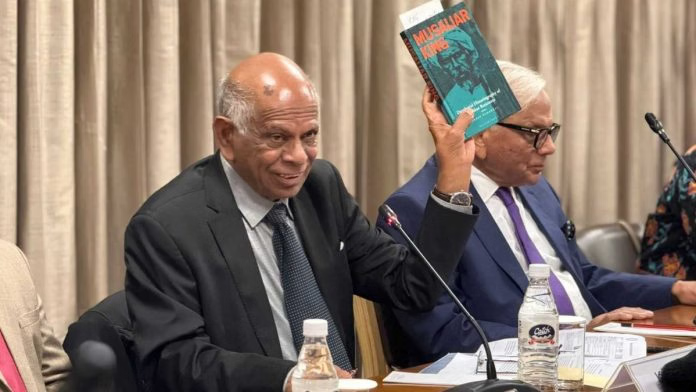
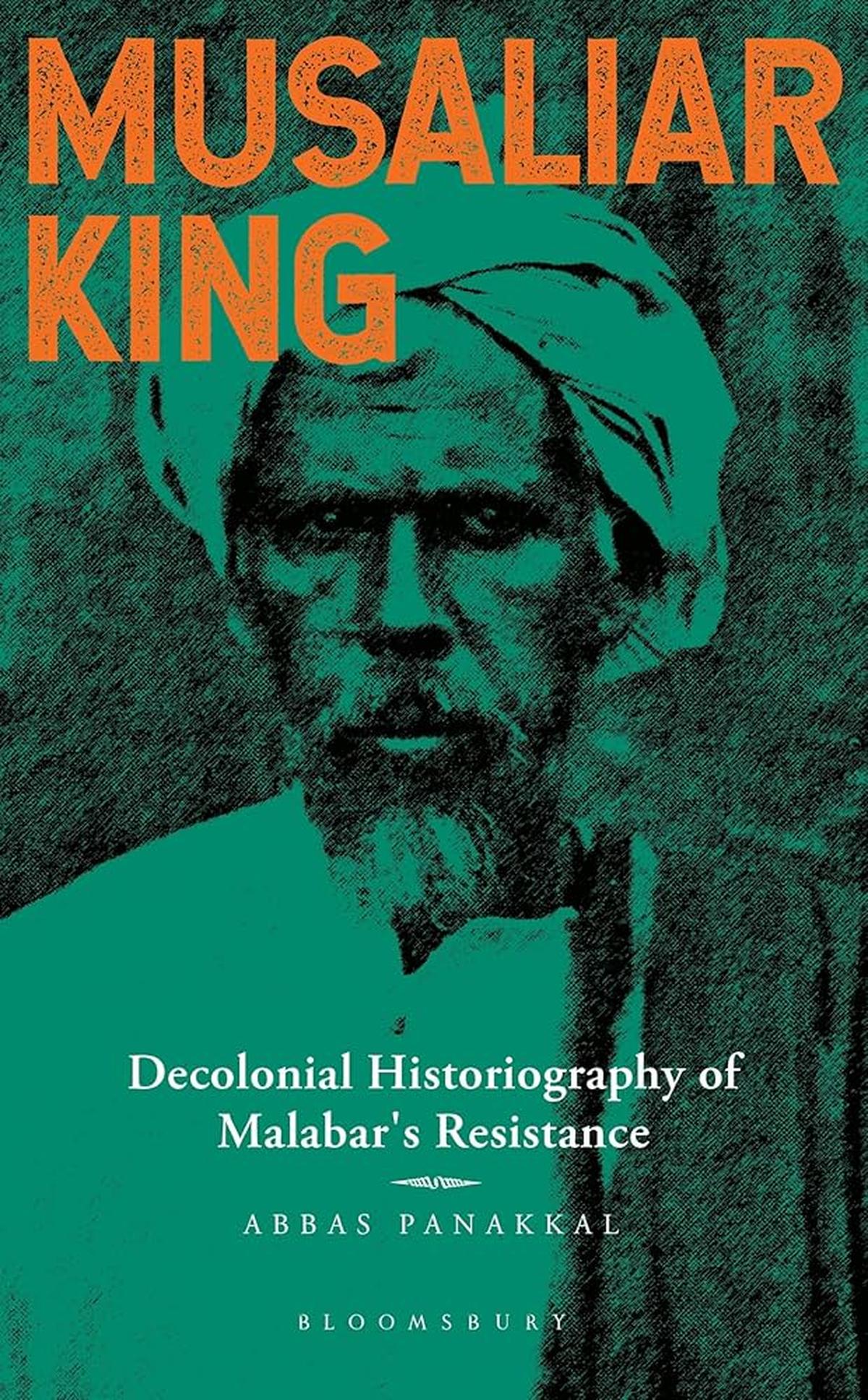
KP Fabian with Abbas Panakkal’s book Musaliar King | Special arrangement
New Delhi:
On a mission to decolonise the narrative around the Malabar resistance of 1921, author Abbas Panakkal has relied on oral histories, and other accounts in Ottoman, French, Australian, and Indian libraries. A recent gathering of academics at the India International Centre saw a passionate discussion on the book Musaliar King: Decolonial Historiography of Malabar’s Resistance.
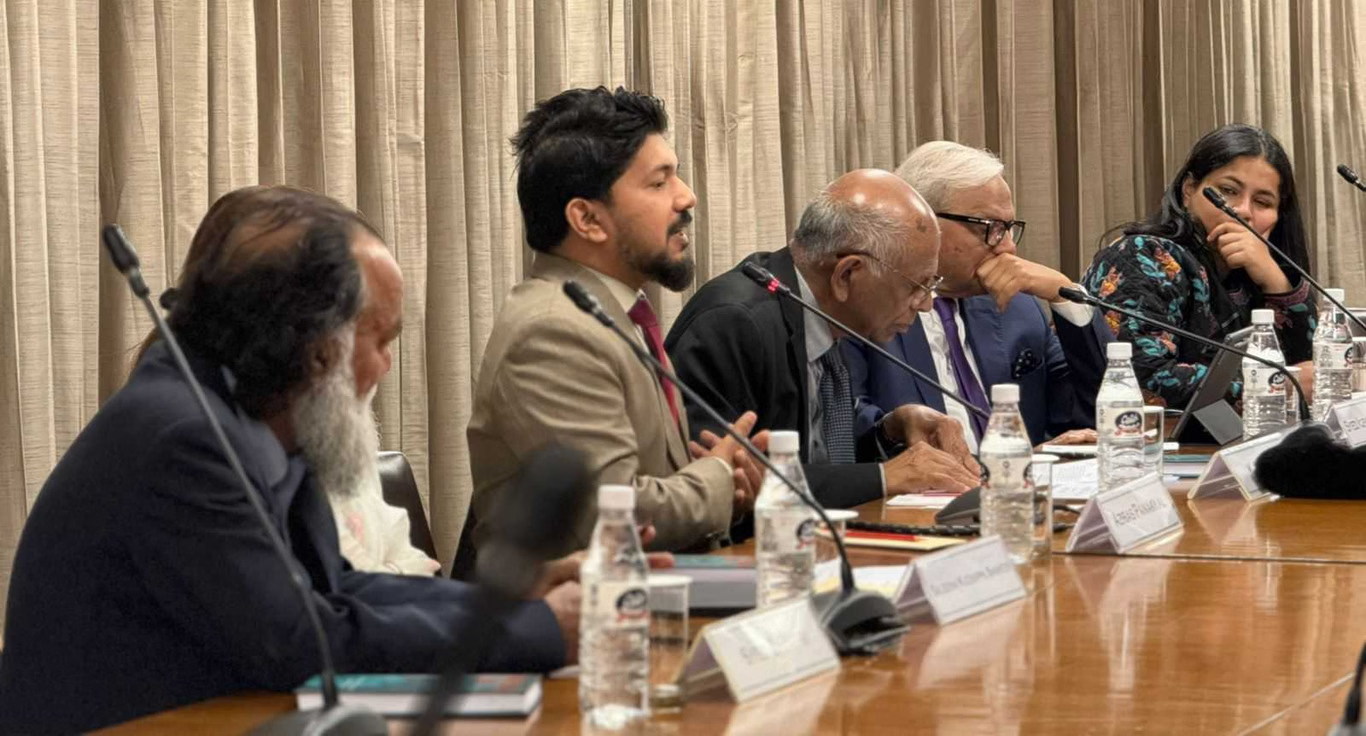
Star-studded panelists of academics and scholars, including former diplomat KP Fabian, Padma Shri Syed Iqbal Hasnain, dean of Jamia Hamdard, Saleena Basheer, Pallavi Raghavan, professor at Ashoka University and professor Syed Jaffri Hussain of Delhi University critiqued and added layers of historical context to Panakkal’s work.
The Malabar Resistance of 1921 is a deeply contested historical event that was born out of the crackdown against the Khilafat movement, and saw an uprising of peasants against the landlords who were primarily Hindus and enjoyed British support. The British historiography reduces the rebellion to a Hindu-Muslim clash, and the resistance hasn’t found a place in the national conversation of revolts against the British colonists.
The author maintains that the peasantry contained both Hindus as well as Muslims and that Muslim houses were also targeted.
In 2021, RSS National Executive Committee member Ram Madhav had said that the Malabar Rebellion was the first manifestation of the ‘Talibani’ thought in India. In the same year, there were also Right-wing protests against celebrating the centenary anniversary of the revolt.
The Hindu Right maintains that the ‘uprising’ or ‘revolt’ was a communal incident, and takes offence to declare one of the leaders of the rebellion Variyamkunnath Kunjahammed Haji as a martyr.
“Historians rely on repositories to provide evidence for accounts. In this project, my repository was also my family, neighbours, and village. When I grew up and learned English, I understood that the British version of the history of the Malabar rebellion was very different from what I had grown up hearing. The popular history was very different from the personal story of the people of this region,” Panakkal said, addressing an audience of academics, students, and historians.
“This book is not just research of 3-4 years, these are stories that I grew up hearing. I have to tell the story of my native place. It is my obligation,” he said.
Panelists discussing Malabar rebellion of 1921 | Special arrangement
Oral history or nationalistic take?
Growing up, Panakkal said he had met and acquainted himself with Hindu and Muslim families who maintained an oral history of how Muslims and Hindus both rescued each other during the uprising. He added that the Malabar region, especially Tirurangadi, has a lot of communal peace.
Dr Syed Iqbal Hasnain said that the Malabar or Moplah revolt was an uprising against the British that was “woven with the threads of unity binding Hindu and Muslim to safeguard the throne of Hindu king Zamorin of Calicut.”
“Muslim communities thrived under the patronage of Hindu kings, who they considered protectors who ensured the preservation of Islamic law and culture,” Hasnain said.
Saleena Basheer, while commending Panakkal’s work, didn’t hold back on her critique of the book, which she said could be non-accessible to people who don’t have a lot of awareness about the revolt. She also questioned if the book was over-reliant on oral histories.
“Does the book deconstruct colonial narratives or does it ignore them in favour of nationalistic storytelling,” Basheer asked.
The academics also wondered how radical the decolonial approach could be, as British versions of history are sometimes the only version of historical accounts available in the pre-Partition era, and have to be relied on by historians while writing about history.
Syed Jaffri Hussain, who has written extensively on the revolt of 1857, said the British version of events has to be challenged. He also praised Panakkal’s work. “Indian rebels like Bahadur Shah Zafar, Jhansi ki rani, Rana Beni Madho Singh are described as badmash, this needs to be read between the lines,” Hussain said about British repositories, adding that such language was never used for Australian rebels or Irish convicts.
The British left but their mentality has stayed with us,” he added.
Hussain maintained that Moplah rebellion oral history needed to be urgently recorded.
“What is accepted by us as an oral history in the realm of Dalit history, women’s history, should also be accepted in terms of Moplah history,” said Hussain.
(Edited by Ratan Priya)
source: http://www.theprint.in / The Print / Home> Features> Around Town / by Shubhangi Misra / February 19th, 2025
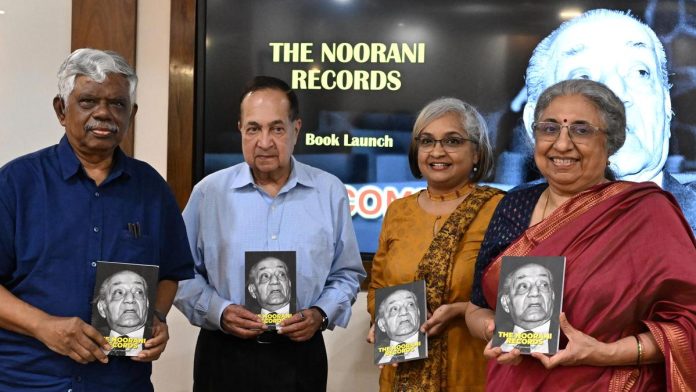
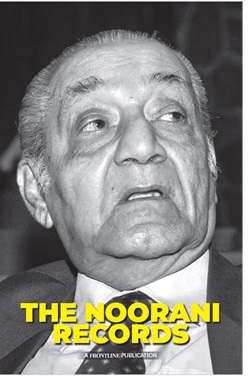
The Hindu Group’s Frontline magazine has launched The Noorani Records, a collection of essays by the late lawyer and constitutional expert A.G. Noorani (1930–2024). The book was released at The Hindu’s head office in Chennai on November 11. N. Ram, Director of The Hindu Publishing Group, presented the first copies to retired Madras High Court judges Justice K. Chandru and Justice Prabha Sridevan.
Justice Chandru praised Noorani’s ability to explain complex legal and political ideas in simple language that appealed to both experts and lay readers. Citing Noorani’s writings on the Rashtriya Swayamsevak Sangh (RSS) and Mahatma Gandhi, he urged that such essays be introduced to students to counter historical distortion and promote constitutional awareness. He also recalled Noorani’s detailed account of the trial of the Ali brothers during the Khilafat Movement, which reflected Hindu–Muslim unity.
Justice Sridevan remarked that Noorani’s work could inspire reflection and change among readers. She said his clarity of thought and disciplined writing offered valuable lessons for young lawyers.
N. Ram described Noorani as a passionate journalist and an uncompromising voice in legal and political commentary. He recalled that Noorani preferred handwriting his articles, ensuring precision and punctuality in his contributions to Frontline. Editor Vaishna Roy called him an erudite jurist whose essays combined intellectual depth with accessibility.
pix: thehindu.com
The book, released on the first anniversary of Noorani’s passing, compiles some of his finest columns for Frontline. It is available for purchase through The Hindu’s online bookstore.
source: http://www.radiancenews.com / Radiance News / Home> Latest News> Report / by Radiance News Bureau / November 13th, 2025
In the Western view, Jihad is depicted within a framework of communal hostility and destruction, but in the documents of Malabar it is a word of interfaith harmony and peaceful coexistence, Abbas said.
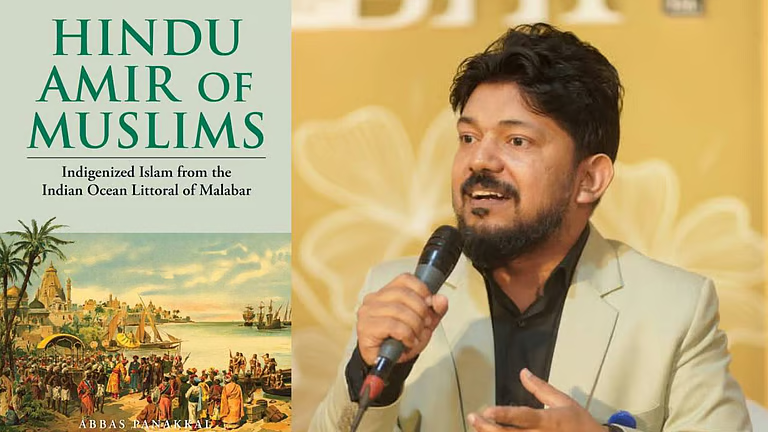
Author of the book ‘Hindu Amir of Muslims: Indigenised Islam from the Indian Ocean Littoral of Malabar’ Abbas Panakkal.Photo | Special Arrangement
Kozhikode :
Contradicting popular narratives put forth by extremist Islamic organisations and the West that portray Jihad as a violent aggression on non-Muslims to establish the supremacy of Islam, is a one originating in Kerala that describes the unified efforts of Muslims and non-Muslims to protect a Hindu king.
Historian Abbas Panakkal’s intriguingly titled book Hindu Amir of Muslims: Indigenised Islam from the Indian Ocean Littoral of Malabar counters the argument that a non-Muslim cannot be the Amir of Muslims, quoting the works of Islamic scholars such as Sheikh Zainuddin Makhdoom and Qazi Muhammad. Some Muslim organisations assert that a true believer should at least strive mentally to establish an Islamic rule, otherwise his/her Islam will remain incomplete.
Abbas argues that Islamic scholars around the sixteenth century had called for Jihad against the Portuguese when the intruders locked horns with the Zamorins. In the Western view, Jihad is depicted within a framework of communal hostility and destruction, but in the documents of Malabar it is a word of interfaith harmony and peaceful coexistence, Abbas said.
“Qazi Muhammad’s poem Fat’hul Mubin narrates an incident during the attack on Chaliyam fort, built by the Portuguese. Zamorin was the ruler and the Muslims had taken a vow to sacrifice their life in the fight for the king. On hearing this, the Hindus felt sad and said that Muslims should not let Muslims die as they are the minority. Finally, they decided to fight together,” Abbas said.
The Qazi conducted prayers for the king and requested all Muslims to pray for the non-Muslim sovereign. He criticised Muslim kings, who signed treaties with the Portuguese and supported their cruelties, the book says.
“Here, jihad was declared to support the local ruler, irrespective of his religion. It was not to crown a Muslim ruler or to turn a Darul Harb into a Darul Islam. Within the Kingdom of Zamorin the Jihad became a tool of accord and interreligious cohabitation,” the book says.
Abbas quotes an incident narrated in Fat’hul Mubin to show the camaraderie between Hindus and Muslims during the siege of the Chaliyam fort.
Zamorin’s mother wrote a letter to the Muslim leaders seeking their intervention and important warriors of the times including Kunjali Marakkar, Umar Anthabi and Abdul Azeez gathered at a mosque in Kozhikode along with the officials of Zamorin to discuss the war strategies.
Tufat al-Mujahidin by Sheikh Zainuddin Makhdoom II, written in the sixteenth century, narrates the privileges enjoyed by Muslims under the rule of Zamorin. Proper burial was given to the bodies of Muslim offenders as per the Islamic custom while the bodies of non-Muslim criminals were left to be consumed by wild animals, says the book.
“Non-Muslim rulers actively supported the construction of mosques and the organization of religious observances, and the state provided funding for the salaries of qazis (judges) and other religious officials, such as mu’addins (callers to prayer). In this pluralistic context, where Muslims enjoyed considerable freedom and leniency,” the book said.
source: http://www.newindianexpress.com / The New Indian Express / Home> Kerala / by MP Prashanth /August 06th, 2025
A new book sheds light on the ‘Malabar Revolt’ in a region which had a history of Muslims and Hindus collaboratively persevering in their resistance against colonial forces. Other books explore its links to the Khilafat movement and why it is more than a peasant uprising.
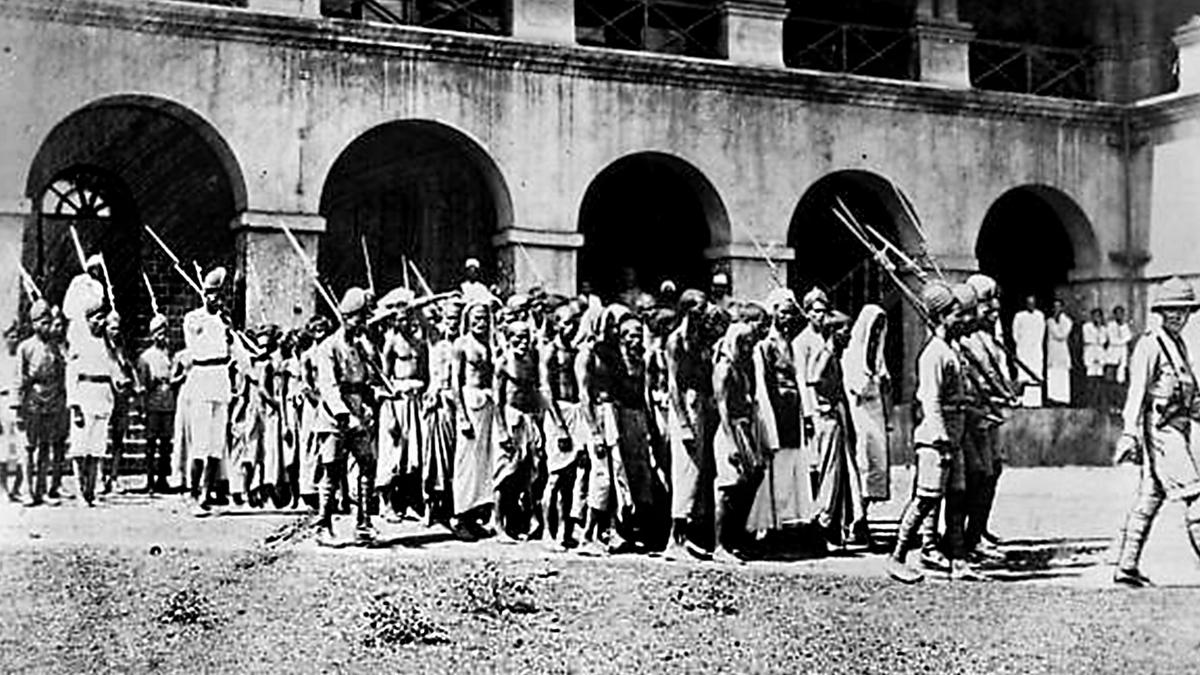
Moplah prisoners go on trial in Calicut | Photo Credit: Getty Images
Growing up in Delhi, one had only a limited idea about the resistance movement in the Malabar region. The popular history books tended to treat it at best as a little outpost of the freedom movement. Noted historian Bipan Chandra in India’s Struggle for Independence (Penguin) dubbed it as a peasant movement.
“In August 1921, peasant discontent erupted in the Malabar district of Kerala. Here, Mappila tenants rebelled. Their grievances related to lack of any security of tenure, renewal fees, high rents…the impetus for resistance had first come from the Malabar District Congress Conference at Manjeri in April 1920,” Chandra writes. Sumit Sarkar too, confined himself to calling it an “anti-landlord revolt” in his book, Modern India (1885-1947), published by Pearson. There have been noises about the association with the Khilafat movement in academic circles, though. Just as there are historians who see it merely from a communal prism. A holistic picture had failed to emerge.
Enlightening exploration
Some belated but well-deserved attention on the resistance movement has come courtesy Abbas Panakkal’s Musaliar King: Decolonial Historiography of Malabar’s Resistance (Bloomsbury). Starting off as an exploratory exercise on the 75th anniversary of the movement, Panakkal’s venture transforms into an enlightening journey.
Early in the book, the author writes, “The socio-geographical landscape of our community underwent profound transformations in the wake of the cataclysmic events of 1921-22. This epoch witnessed a staggering loss of lives, the forced displacement of families… The old mosque of Tirurangadi emerged as a veritable repository of memories and narratives, a historical bastion of ideological resistance against the British colonial apparatus.” Fittingly, it was on the commemoration of the 75th anniversary of the 1921 resistance that Panakkal started his exploration, speaking to the family members of those directly involved.
Among them was Muhammed Ali Musaliar, grandson of Ali Musaliar, a luminary of the 1921 struggle. The British referred to Ali Musaliar as a king; the locals regarded him as a community and spiritual leader, calling him Musaliar Uppapa. Indeed, if Musaliar was a ‘king’, Malabar was his ‘kingdom’.
Incidentally, the term Malabar is derived from the vernacular Mala, signifying hill, and the affix originating from the Arabic word barr, which means the source of all goodness. The region had a long tradition of anti-colonial resistance dating back to the 16th century. “Muslims and Hindus collaboratively persevered in their resistance against colonial forces,” writes Panakkal.
This strong anti-colonial stance had unforeseen consequences. The British, with not a little help from some Indian officials, sought to undermine the movement. Among them was C. Gopalan Nair, Malabar district deputy collector, who “unabashedly deployed his literary prowess in favour of the British cause”. Observes Panakkal: “The usage of terms such as Malabar Revolt and Moplah Rebellion to delineate these struggles is emblematic of this issue. Revolt itself is a term crafted by colonial administration, characterising violent actions against a recognised government or ruler.”
‘Peaceful coexistence’
There were others, though, whose hearts beat for the locals, luminaries who either linked the resistance to the Khilafat movement or, in isolation, read it as an agrarian struggle. Among them were Saumyendranath Tagore, who regarded it as “an organic and spontaneous ‘uprising’ of the Malabar peasantry against British imperial rule” and E.M.S. Namboodiripad, who too “didn’t discount the role played by agrarian discontent”. There was a common thread: the oppression and exploitation meted out by colonial officials and landlords was no less severe upon the Hindu peasants as they were on their Muslim counterparts. Writes Panakkal, “The Malabar narrative heralded a rare phenomenon: the harmonious convergence of Hindus and Muslims. This coalition was underpinned by a shared objective — to oust the oppressor — and a collective aspiration for a peaceful coexistence in the region.”
It is something with which even R.N. Hitchcock, police superintendent of Malabar, agreed. As written by N.P. Chekkutty in Mappila and Comrades: A Century of Communist-Muslim Relations (Other Books). “Hitchcock also reveals that Hindus were involved in the rebellion, at least in some parts of the affected areas. ‘The Hindus took an active part only in the extreme south-eastern area of the Valluvanad taluk and in small numbers for a concise time. They were then responsible for much property damage’.” In his persuasively argued book, with much of the focus on the post-resistance time in the late 1930s and 40s, Chekkutty also talks of the rebels not harming any substantial section of the local population before going on to document the failure of the Congress to retain local Muslim support after the resistance movement. It was a vacuum which both the Communist Party of India and the All India Muslim League attempted to fill.
The Khilafat angle
Interestingly, against this background of common cause transcending the confines of faith came the pan-Islamist Khilafat movement. Things became even more ironic as Malabar’s historical tapestry of anti-colonial resistance “had been woven with threads of unity binding Muslims and non-Muslims in a shared ‘jihad’ to safeguard the throne of the Hindu king, the Zamorin of Calicut,” as analysed by Panakkal. Khilafat, Non-Cooperation, Mappila, with seemingly disparate social elements, all fused to bring about a strong anti-colonial movement.
Indeed, here both the communities enjoyed a rare camaraderie, and there was a happy collective involvement even in religiously significant events like the nercha and utsavam. During the latter, Muslim families returned with bags full of jaggery candies, much like Ali Musaliar used to do for Amina, his daughter. Sums up Panakkal: “The experience of Muslims and Islam in South India is different from the experience in North India, and this is not trivial.”
source: http://www.thehindu.com / The Hindu / Home> Books> Bibliography / by Ziya Us Salam / September 18th, 2025
Renowned Scholar and Former Jamia Dean Recognized for Five Decades of Academic and Social Contributions
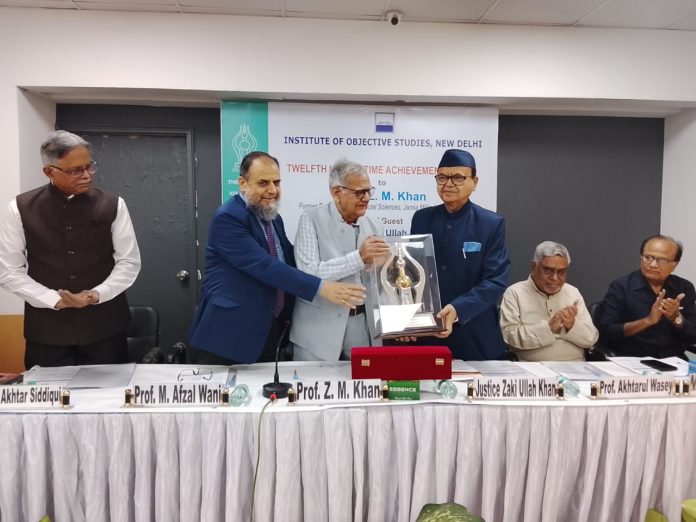
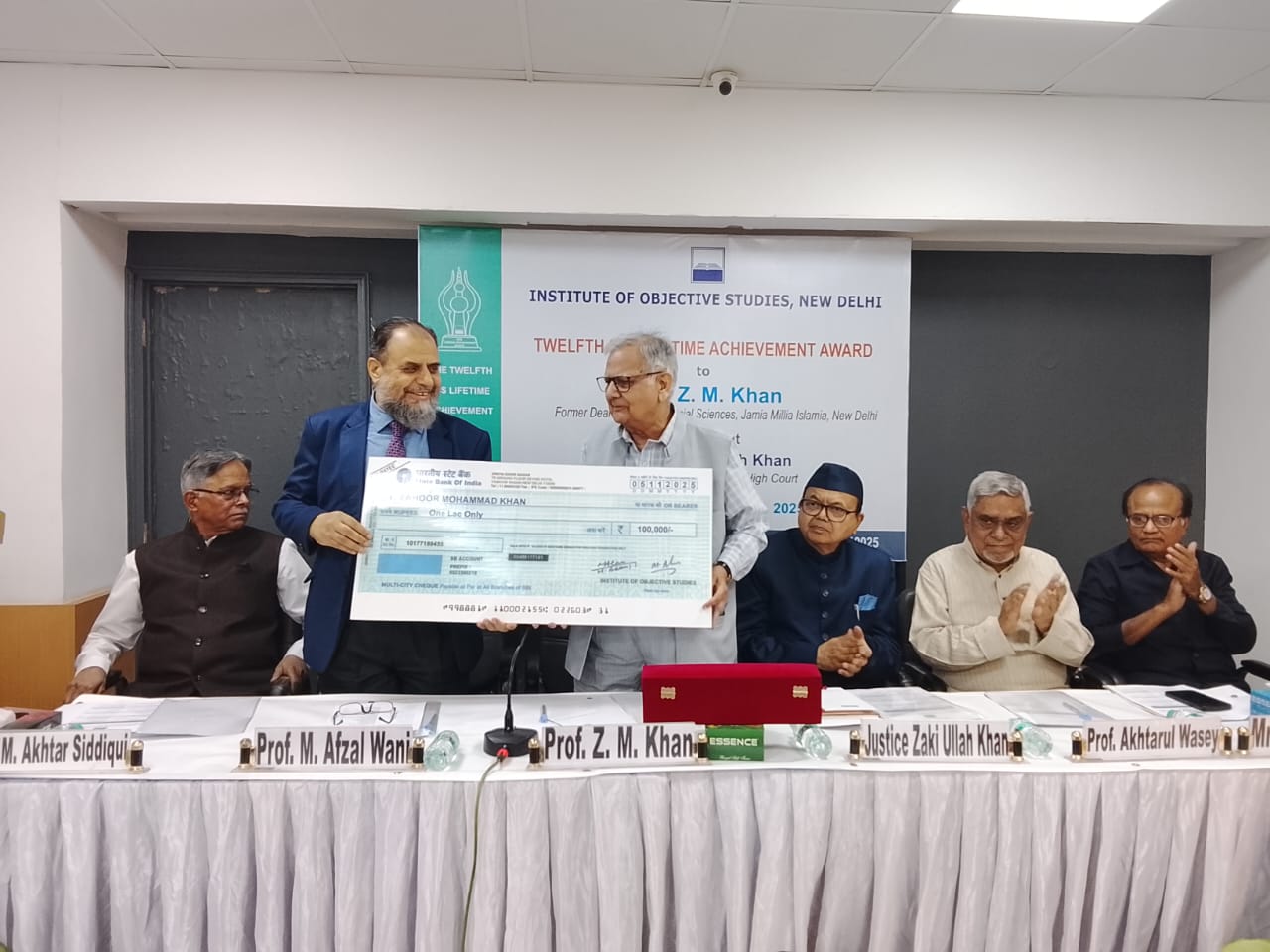
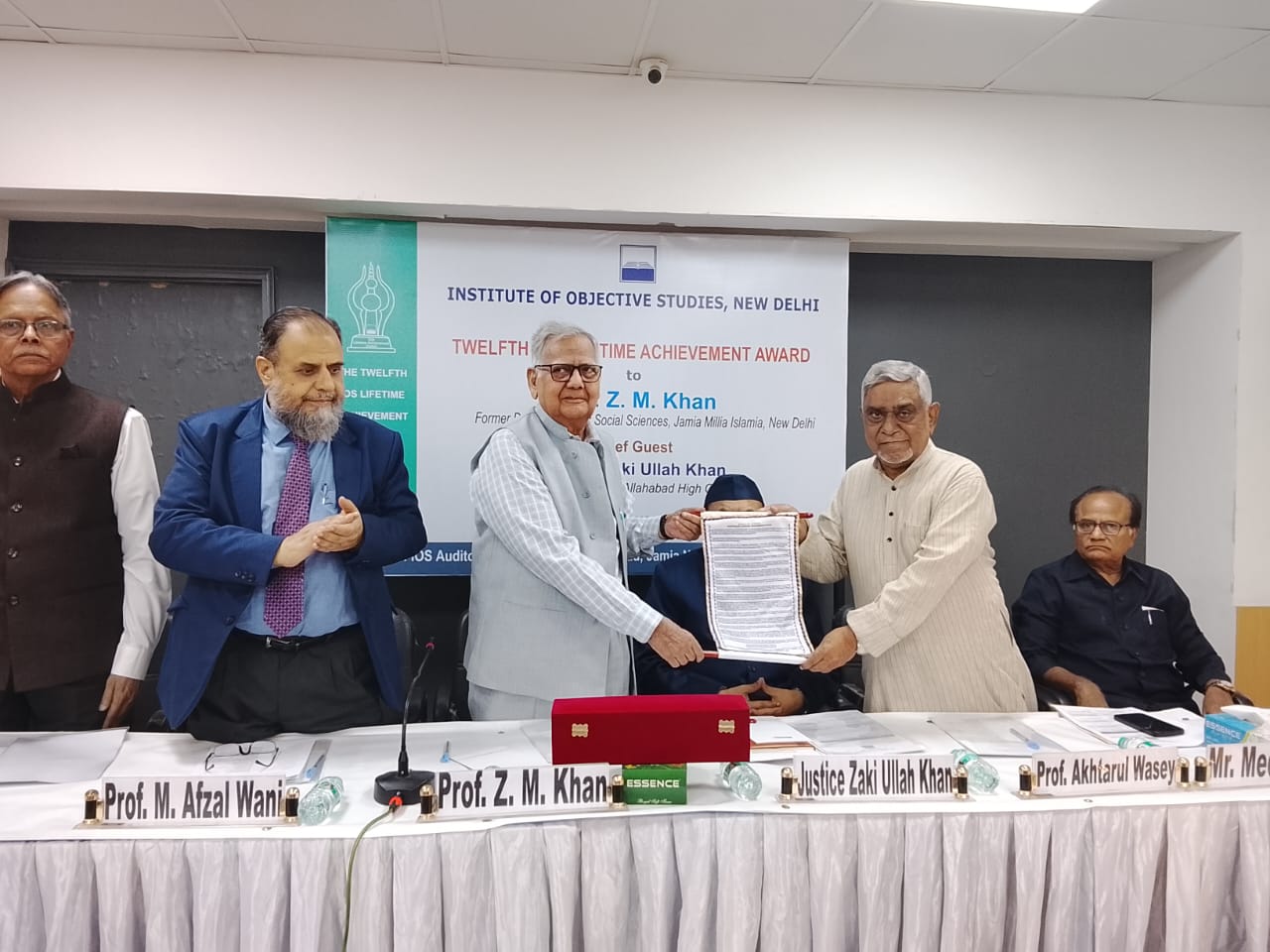
In a grand ceremony held in the capital, the Institute of Objective Studies (IOS) conferred the prestigious IOS Lifetime Achievement Award upon Professor Zahoor Mohammad Khan (Z.M. Khan)— an eminent scholar, researcher, author, and former Dean of Social Sciences at Jamia Millia Islamia.
Prof. Khan, who also served as the former Secretary General of IOS, was presented with a citation, memento, and a cash prize of ₹1 lakh in recognition of his outstanding services to education, research, and social development.
Prof. Khan’s illustrious career spans over five decades, marked by his multifaceted roles as an academician, researcher, author, and institution builder. He has authored eight books and dozens of research papers, contributing significantly to the study of political science and sociology in India. During his 23-year tenure as Secretary General of IOS, the institution evolved from a modest initiative into a nationally respected think tank. He also played a pivotal role in launching the IOS Scholarship Programme, which has supported numerous students and researchers over the years.
The IOS Lifetime Achievement Award, instituted in 2007, aims to recognize individuals, organizations, or voluntary groups who have rendered exceptional service to the nation and society, irrespective of religion, caste, or creed.
Previous recipients of this distinguished award include former Chief Justice of India A.M. Ahmadi, Dr. A.R. Kidwai, Prof. B. Sheikh Ali, A.G. Noorani,, Prof. Akhtarul Wasey, Prof. Mohsin Usmani Nadwi Maulana Hakim Abdulllah Mughaisi, and K. Rahman Khan, among others. Prof. Khan’s inclusion in this eminent list was greeted with enthusiastic applause from the audience.
Expressing his gratitude upon receiving the honour, Prof. Z.M. Khan said, Faith in God and the spirit of service are the most precious blessings one can receive. Faith brings with it a sense of responsibility and accountability to the Creator — that is the greatest reward of life. He also acknowledged the crucial role of institutions such as Delhi University, Jawaharlal Nehru University, Jamia Millia Islamia, and the Institute of Objective Studiesin shaping his academic journey.
The ceremony was chaired by Prof. M. Afzal Wani, Chairman of IOS, and graced by Justice Zakiullah Khan (former Judge, Allahabad High Court) as the chief guest.
Distinguished guests included Prof. Akhtarul Wasey (Jamia Millia Islamia & former Vice Chancellor, Maulana Azad University, Jodhpur), Prof. M. Akhtar Siddiqui, Mr. M. Afzal (former MP), and Prof. Furqan Ahmad.
The event began with a recitation from the Holy Quran by Dr. Nighat Husain Nadwi, a welcome address by IOS Secretary General Mohammad Alam, and was conducted by Prof. Hasina Hashia Vice Chairperson of IOS, who also delivered the vote of thanks.
The event not only celebrated Prof. Khan’s extraordinary contributions but also reaffirmed IOS’s commitment to honouring individuals who have significantly influenced India’s intellectual and moral landscape.
source: http://www.radiancenews.com / Radiance News / Home> Latest News> Report / by Radiance News Bureau / November 07th, 2025
What sets Zeenath Sajida’s creative repertoire apart is its reach, stretching well beyond the domestic concerns and romantic themes one might stereotypically associate with a female writer in mid-twentieth-century Hyderabad.
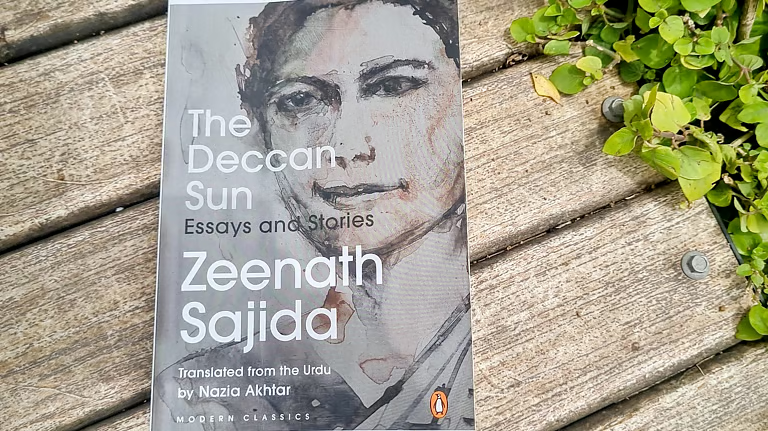
Image of Zeenath Sajida’s book, translated by Nazia Akhtar
Can humorous essays and fictional stories by a single writer paint a holistically authentic portrait of the Deccan? Particularly when filtered through an urban, middle-class, academic lens?
And what happens when that prose is resurrected for an English-reading audience? Translation demands fluency across traditions, sensitivity to historical currents, and an intuitive grasp of possibilities.
The Deccan Sun, a selection of Zeenath Sajida’s Urdu writings, represents exactly this kind of sustained care. Translated and curated by Professor Nazia Akhtar, this collection brings together nine satirical essays and five short stories that offer bundles of pleasure and provocation.
Hyderabad’s Zeenath apa
A prolific Urdu Professor at Osmania University and a literary icon shaped by the leftist wave that turned many youngsters of princely Hyderabad toward rebellion, the mere mention of Zeenath Sajida still evokes a smile among a fading generation of the city’s progressives.
She produced works of considerable intellectual ambition, including A History of Telugu Literature, written in 1960.
But what sets her creative repertoire apart is its reach, stretching well beyond the domestic concerns and romantic themes one might stereotypically associate with a female writer in mid-twentieth-century Hyderabad. Her questions span the practical and the metaphysical: from work-life balance to memory and ageing. This breadth, alongside her engagement with gender, establishes Sajida as a crystallising force within Deccan literature.
Sadly, Sajida’s writings have suffered critical neglect.
Until now, only a single essay of hers had found life in English—thanks to Nazia Akhtar’s earlier offering, Bibi’s Room. The book also contained tantalising glimpses of Sajida’s inimitable biographical sketch of Makhdoom Mohiuddin, the celebrated poet she exalts and irreverently mocks, even branding him a lapoot (scoundrel). Originally delivered at a gathering in Hyderabad’s Urdu Hall, the event was jokingly dubbed Jashn-e-Makhdoom: part tribute, part roast of a comrade. The sketch hinted at the easy cosmopolitanism that once threaded through the city’s cultural circles.
But those were just glimpses.
The Deccan Sun finally delivers, showcasing Sajida’s full creative range. More importantly, the collection corrects reductive narratives that have long confined Hyderabadi women’s stories to tales of exploitation. It provides crucial cultural clues and gives interior lives the breathing space that more documentary modes often flatten or omit altogether.
Ox at an oil press
Sajida’s central tension seems to revolve around competing hungers: the quiet solitude for reading and writing versus the public acknowledgement of her labour. This struggle animates the essay I Got Myself a Job, where she likens the drudgery of a stagnant workplace to “an ox circling in an oilpress”, grimly awaiting holidays that arrive only upon the death of eminent people. This rage at invisibility, whether in households or intellectual circles, surfaces through observations about poets jealous of Makhdoom’s fame. It’s a pain that resonates universally, yet cuts especially deep for women navigating careers within constrictive social structures.
The satirical method at play follows a deceptively simple pattern. First, open with bland, widely held assertions and then excavate them through unflinching personal experience until readers question her true position. Is she earnest or sarcastic? In If I Were a Man, the writer begins by wondering how delightful male privilege might be. Then she chips away at heroic masculinity, and in the process, exposes revolutionaries for what they truly are.
And that is aimless poseurs marching under the banner of self-respect. The game becomes clear: there’s zero intention of being a man. Her worldview remains stubbornly intact and cheerful as ever.
No one is spared in the collection’s funniest piece, From Storeroom to Museum, be it a famous king, his moustache, historians who invent their own history, or doctors “in whose name graveyards thrive”.
Even the qazis and the rigid interpretations of Islamic law they uphold come under fire. Writing as a Muslim woman in post-Razakar Hyderabad, when her community faced suspicion and strain, turning satire inward and choosing stark honesty over protective silence was no small risk.
Naturally, such wit and honesty carry complications well beyond fatwas.
In Building a House, Sajida wryly catches herself making classist remarks—about servants using her soap when she’s away or taking advantage of her generosity. She knows their innocence is something she ought to celebrate. Still, resisting those barbs proves difficult because their exploitation stings!
Though the translator suggests a self-deprecating tone, the humour feels more defiant than apologetic. Comparing stories with essays reveals Sajida’s evolution. The stories, chosen from Jal Tarang (published in 1947 when she was just 24!), infantilise the titular characters’ desires without retribution, while the essays own those same longings with fierce pride. They embrace her job, gender, and sartorial choices, laughing in the face of absurdity.
My Hens embodies this mature confidence with perfect clarity. Against family objections, the narrator acquires chickens and endures subsequent chaos. These birds become emblems of unruly desire, pushing back against blanket resistance.
She recoils in disgust when some are slaughtered. Nonetheless, the ending is satisfying as she’s already anticipating her next trip to the market. Nothing deters her from wanting. The searing rage and humour intertwine to yield a stance that is utterly assured.
Chasing fireflies
The short stories reveal a younger Sajida, one who is still finding her artistic footing. Where the essays crackle with precision, the stories sometimes drown in ornamental excess, mirroring preoccupations of mid-1900s Urdu readers. The translator’s admission about reducing repetitions confirms the original’s verbosity. Even so, young Sajida possessed remarkable instincts for imagery. In The Stranger, memories become “moments flitting like fireflies on a dark night” before melodrama takes over, chasing those fireflies to a dead end.
Formally, Bibi stands apart, approaching the analytical brilliance of Chekhov’s The Darling—both protagonists transform recurring domestic episodes. Here, Sajida demonstrates her architectural sense, building tension through careful structural pacing. Each section shifts the emotional register while maintaining the same configuration. What begins as amorous banter gradually sours into genuine bitterness, yet paradoxically, the acts of care deepen. The story rewards multiple readings, revealing omissions and callbacks that initially escape one’s notice.
Does loneliness lick or feed on us?
Translations inevitably create friction. Most readers prize smooth prose that overlooks the translator’s labour, but Nazia’s occasional bumps through deliberate references (Hatim Tai, Alif Laila) gently remind us that we are entering a world rooted in another language.
The friction becomes sharper when comparing languages head-on. Professor Shagufta Shaheen’s lively Urdu reading of the story What Time Is It? shows how even a thoughtful rendering of a dramatic line—“loneliness feeds on them like termites”—dilutes its original menace: “tanhai unhe deemak ki tarah chaat rahi hai”. Though it lands smoothly, feed can’t quite match the threat of that slow, intimate licking (chaat). Likewise, scoundrel misses the mischievous warmth of the Dakhni lapoot. English’s imperfect lens will always create such distortions. Yet receiving anything from the previously inaccessible feels miraculous.
The translator didn’t just convert Urdu into English; she collated specific pieces from Sajida’s larger corpus, provided context, secured publication, and built literary networks across years, believing in its relevance. Such cultural stewardship enables conversations that couldn’t have existed otherwise.
Nazia amplifies the Deccan sun’s raging flame like oil feeding a lamp, letting us moths finally gather around it in ecstatic circles.
Surya Bulusu, a Researcher and Software Engineer at Avanti Fellows, is working on open-source tech for government school systems. He lives in Mumbai, but has spent several years in Hyderabad. His write-ups can be accessed on his blog.
Views expressed are the author’s own.
source: http://www.thenewsminute.com / The News Minute / Home> Telangana / by Surya Bulusu / July 18th, 2025
Amirbai Karnataki is one of the earliest Kannada singer-actress who made it big in Hindi cinema. She went to Bombay when women artistes were labelled ‘fallen’, but with grit and passion Amirbai became a star and sang 380 songs in 150 Kannada and Hindi films.
Amirbai’s tale is one of inspiration
For someone who didn’t belong to the gramophone generation but the golden period of radio, Lata Mangeshkar, Asha Bhonsle, Mukesh, and Rafi ruled our hearts and constituted our imagination of a film song. The same AIR, during a light music programme, had played “Ninnane Neneyuta Ratriya Kalede”. This, was a carbon copy of Lata’s memorable “Saari Saari Raat Teri Yaad Sataye”, but the voice was starkly different. It had a heavy nasal tone, and the flawless rendition had a simplicity to it. The charming song left an indelible mark and I felt I had to recover her voice from pages that were unknown to me.
Amirbai Karnataki was an unheard voice for the Seventies: she was long gone, and had faded into the archives of black and white era of early films. She was someone who lived on in personal memories of people who had known and heard her.
Amirbai Karnataki (1912-65), who sang 380 songs in 150 films, was an early singer and actress of Hindi cinema. This singer who sang the unforgettable “Main to pavan chali hoon bole papiha” and “Bairan Nindiya Kyon Nahi Aaye”, was born in Bijapur in Karnataka. During the 1930s Amirbai was a prominent name along with stars like Suraiyya, Shamshad Begum, Noor Jahan and Zohrabai Ambalewali.
When Lata Mangeshkar came on to the scene, many of these singers moved into the background and for the later generations they remained unknown.
Born into a family of artistes, Amirbai’s parents Ameenabi and Husensaab worked for a theatre company and even ran one for many years. Growing up years for Amirbai and her five siblings was filled with music and theatre, what with many of her uncles and aunts being top musicians and actors in theatre. She lost her father early and her uncle, Hatel Saheb took care of all the children.
During those years, Bijapur was part of Mumbai Presidency and the sangeet natak tradition in these parts was flourishing. The famous Balagandharva’s company and several other theatre companies camped at Bijapur; Amirbai and her sister Goharbai, trained as they were in classical music, impressed these companies with their singing and they began to not only sing for several of them, but also act.
As Rahmat Tarikere writes in his biography of Amirbai Karnataki, Amirbai moved from Bijapur to Mumbai, from theatre to films. But the exact date and nature of these movements and transitions are hard to tell. The story of Amirbai is a sum total of several happenings in a historical period as there are few definitive documents to lead us to any accurate picture. Painstakingly put together by the biographer, Tarikere says that when Amirbai reached Mumbai (it was perhaps the year of Alam Ara’s release, 1931), women who worked in films, theatre and music were still seen as “fallen”.
Women artistes were often ridiculed as “free women” and among the several women performers, Amirbai and her sister Goharbai too, tried to free women of this stigma. In fact, families not only disowned such women, but there were instances of women being killed for choosing the arts.
In fact, Rahmat Tarikere says that the kind of fight these women put up with the social circumstances of those days is no less significant than the freedom struggle itself. If women artistes, in the later years, earned fame and reputation, it was because of the sacrifices these women made. Ironically, two very popular films “Basant” and “Kismet” in which Amirbai acted deals with the plight of actresses.
Amirbai became a very reputed singer and actress of her times. She was highly paid, and even built a theatre Amir Talkies in Bijapur. She travelled the length and breadth of North Karnataka giving programmes related to theatre and cinema.
A singer who sang some of the finest love songs, had a very unhappy love life though. Tarikere writes how her husband, a Parsi actor who played villain in those days, Himalayavala, abused her physically and emotionally. She had to suffer several assaults from him and even separation became a painful affair. Unable to recover from the trauma, she went into oblivion for several years, and later Badri Kanchawala, with his love and care brought back peace into her life.
At the age of 55, Amirbai passed away; Karnataka had been unified by then and the rest of Karnataka hardly knew of her. Even the newspapers reported her death four days later. It was only later that people have slowly learnt of Amirbai’s greatness and how Gandhiji was immensely fond of her rendition of “Vaishnava Janato”.
source: http://www.thehindu.com / The Hindu / Home> Features> MetroPlus / by Deepa Ganesh / February 27th, 2015
Writer Bolwar Mahamad Kunhi talks about literature and fests.
Karnataka : Bengaluru : 30/10/2017 : Bolwar Mohammed kunhi during The Bengaluru Literature festival in Bengaluru on Sunday. Photo : Sudhakara Jain.
Bolwar Mahamad Kunhi, 66, is the only Indian writer conferred with two Central Sahitya Academy Awards (2010 & 2016) for creative prose in Kannada. He received the Atta Gallata Bangalore Lit Fest 2017 Award for Kannada for his overall contribution on the concluding day of the Lit Fest on Sunday. With 250 short stories and a host of novels, with several directed towards children behind him, Kunhi a recipient of the Karnataka Rajyothsava Award and Karnataka Sahitya Academy’s Lifetime Achievement Award says, “Young writers should regularly read what seniors write and get inspired to find their own words and voice.” Kunhi, who said every recognition is a moment of inspiration to writers, spoke to MetroPlus regarding his life and writing. Excerpts:
Do you think such literary fests are important for the growth of literature?
Yes. Such festivals also add their share to other ingredients required for a healthy literary growth, look at the buzz they create, have you ever seen this kind of an unprecedented crowd? I am not as aware of the present statistics of other languages. This is my uncorroborated research. In recent times Kannada literature has seen a huge number of publications, possibly surpassing that of any other Indian language. The number of literary events or the number of Jnanapeeth awardees we have could surpass those from any other language. This could be another reason some Kannada writers have achieved celebrity status.
Is literature the voice of society?
Literature always augurs well for society and provides wisdom to humanity. All religious books, which I consider part of literature, are works of wisdom which have had a great impact on humankind. Literature also taught civic sense to man who lived like a wild animal. The conversations and dialogues in such events also propagate the same wisdom.
After Chand Ali in ‘Swathantrayada Ota’ who is the next character in your work awaiting attention?
In the last two years I have been busy in understanding two important characters for different reasons. First to write 1000 couplets about Ambedkar and second to write a novel on the Prophet’s beloved wife, Ayesha. The second has gained more traction in the last few months. When I wrote the first ever historic novel on Prophet Muhammad Oidiri two years ago, it was well-received. But most of the characters in Odiri were male. The thoughts, words, actions, and the attitude was male. I always wondered if the women of that time had opinions of their own. Did they ever voice what they felt? Even in solitude? This is the subject of the proposed novel titled Umma (Mother) inspired by the life of Ayesha. I am not sure which one will be completed first.
After Gorur Ramaswamy Iyengar who wrote on Gandhiji, your book on the Mahatma received instant recognition. How important is it for today’s children to read about Gandhiji?
To guide our children in the right way we show them role models. It is a shame we are unable to give them contemporary examples to encourage and mould their personality. The examples that we provide from history or mythology seem too overwhelming for them. Historical characters are kept on a pedestal and are inaccessible. Gandhiji maybe one example which children can relate to since they read and learn about him a lot and he is the most recent of those examples! To these children my book attempts to show that Mahatma Gandhi was not an unachievable superhuman. He was a common, simple boy, who grew up like most of us, as a darling to his parents, went to school, studied prescribed text books and qualified as a lawyer. As a young man he fought for the downtrodden and stood for truth, non-violence and social justice. I tried to depict him as a common man who lived an uncommon life to become a Mahatma.
Do female characters get more importance in your novels?
I don’t think so. Being feminist writer is not an easy way to popularity. Though I was born in a male-dominated community, I was brought up with the love of various women in my early life – my mother, my sisters and my first teacher. They were the ones who tolerated my anger, frustration and ego and loved me unconditionally. That guilt might be the reason women are central to my work. I dedicated my first story collection to ‘Appi Bayi’, the teacher who taught me to write alphabets. The second one was to my mother who I buried with the same hands that I dedicated it to. Another work was to my elder sister and another to my two daughters. My mega novel is dedicated to my beloved. All of this could be due the same guilt. May be my work as an emotional man resonates with like-minded people and thus gets appreciated.
How was your experience writing the screenplay for ‘Munnudi’ and ‘Athithi’?
My writing is like a sculptor’s. It takes shape with time. I don’t believe in inspirations. Cinema, definitely is not my medium. I wrote the screenplay under the persuasion and for the love of my friends P. Sheshadri, who bagged nine National awards in a row and Dattanna, an inimitable character actor. I wrote what I felt for both movies and they incidentally won national awards. I cannot comment on what else I might be able to do in cinema, at least not now.
Can you talk about your initiation to writing considering you have no writers in the family?
I joined Syndicate Bank in Gulbarga after my B.Sc. Much later when I was associated with the Sahitya Academy I discovered that most members had masters degrees. It enthused me into getting an MA in Kannada in the 1980s.
My desire to write was another one of such self-imposed challenges. During a casual conversation while playing carrom with writer Arooru Lakshmana Seth in Gulbarga, I asked him how he was able to visualise and write so much. His said “non-writers like me cannot understand the process.” That comment propelled me into writing a short story and getting published in Navbharat which was the beginning.
source: http://www.thehindu.com / The Hindu / Home> Books> Authors / by Ranjani Govind / October 30th, 2017
Professor Ghulam Muhammad, widely known by his pen name Marghoob Banihali, was an illustrious scholar, poet, and cultural historian whose literary and academic contributions have left an indelible mark on the landscape of Kashmiri literature and thought.
Born on 5th March 1937 at Bankoot, Banihal, in the erstwhile princely state of Jammu and Kashmir, he emerged as a multidimensional personality whose erudition encompassed not only Kashmiri language and literature but also Persian, Urdu, and English.
Marghoob Banihali’s journey, marked by personal loss, intellectual rigor, and literary innovation, reflects the resilience of a scholar deeply rooted in his cultural milieu yet transcending regional boundaries in his vision.
He passed away on 27th April 2021 at his residence in Srinagar, leaving behind a rich legacy of scholarship, poetry, and cultural reflection. The formative years of Marghoob Banihali were fraught with challenges. He lost his mother at the tender age of eight and his father when he was merely fourteen. The successive losses not only plunged his family into economic hardship but also exposed the young boy to the harsh realities of life at an early age. The family’s business suffered a severe blow, forcing Marghoob to traverse arduous paths—both literal and metaphorical—toward education and personal growth. In March 1954, he undertook a challenging journey to Islamabad to appear for his matriculation examination, traveling around seventy kilometers through snow-clad mountainous terrain. These early experiences of adversity instilled in him resilience, humility, and a deep understanding of human struggles, qualities that would later find expression in his literary and scholarly endeavors.
Marghoob Banihali received his early education under several prominent Kashmiri educators who shaped his intellectual and literary sensibilities. Among these were Haji Ghulam Ahmad Shah, who later became his father-in-law, Hakim Muhammad Hafiz Allah of Rawalpora, Srinagar, and Molvi Ghulam Muhiuddin Kirmani of Pattan Baramulla, who advised him to adopt the pen name “Marghoob.”
Another significant influence in his formative years was Master Ghulam Nabi Geeri, a member of his own family, who provided guidance and support during his early scholarly pursuits. Despite financial constraints, Marghoob pursued his education in a private mode, simultaneously embarking on a teaching career that would span decades. He eventually completed his Masters in Persian and went on to earn a PhD in the same field, laying the foundation for a distinguished academic career.
Professionally, Marghoob Banihali held diverse roles that reflect his commitment to education and literature. He served as headmaster and vice-principal at higher secondary schools and as a Tehsil Education Officer (TEO) before joining the University of Kashmir in 1969 as a lecturer in the Persian Department. His tenure at the university spanned over three decades, during which he contributed to the Department of Kashmiri, the Central Asian Studies Department, and the Iqbal Institute. He retired in 1997 as the Head of the Department of Kashmiri, leaving behind a legacy of mentorship, scholarship, and administrative excellence.
Marghoob Banihali’s literary oeuvre is vast and varied, reflecting his erudition, spiritual depth, and commitment to human values. His writings primarily focus on Islamic subjects, communal harmony, and ethical and cultural reflections. He authored over fifty books in Kashmiri, Urdu, Persian, and English, covering poetry, literary criticism, cultural history, and translations. His first poetic collection, Partavistan, earned him the Sahitya Akademi Award for Kashmiri literature in 1979 and the state Sahitya Akademi Award in 1977, establishing him as a prominent voice in contemporary Kashmiri poetry. His works transcend mere literary expression; they engage deeply with the cultural, spiritual, and philosophical dimensions of Kashmiri society.
Among his notable works is Marghoob Theory, published in English in 1982, which offers a systematic proposal for the improvement and modernization of the Kashmiri script. This work has been lauded by scholars such as Prof. Syed Maqbool, former Director of the Centre for Central Asian Studies, who described it as a scientifically viable and practical method that preserves the connection of Kashmiri with its source languages while making it more accessible to the Kashmiri-speaking populace.
Similarly, Prof. Nazir Ahmad Malik, a distinguished linguist, recognized the significance of this contribution for the development and preservation of Kashmiri language and literature.
Another seminal work, Kashir Bale Apare (1989), provides a detailed account of Kashmiri culture, language, and literature as prevalent in the Pir Panchal region. Through meticulous research, Marghoob Banihali chronicled the evolution of Kashmiri literature, highlighting its linguistic and cultural heritage.
His translations further enriched Kashmiri literary resources; in 1975, he translated Kalilah wa Dimnah into Kashmiri, introducing the classic collection of fables to a broader audience.
He also translated the monograph on the “Nightingale of India” (Bulbul Hind), Sarojini Naidu, thereby familiarizing Kashmiri readers with the Bengali poet Qazi Nazrul Islam. Marghoob Banihali’s engagement with historical and cultural scholarship is exemplified in Qadeem Kashur: Some Glittering Milestones of Ancient Kashmiri (with Special Reference to Shaikhul Alam), published by the Central Institute of Indian Languages, Mysore, in 2001.
This work provides the cultural and linguistic background of Shaikhul Alam’s poetry, situating it within the broader historical and intellectual traditions of Kashmir.
Similarly, his scholarly inquiry into Iqbal’s thought culminated in Kalam Iqbal kay Ruhani, Fikri wa Fani Sarchasmay (2006), a critical exploration of Iqbal’s philosophical, spiritual, and literary dimensions.
He also authored Ikhliqiat Marghoob (2005) and Khas Ihsan, poetic collections that address Islamic themes such as Tawhid, Risalah, and Akhirat, blending devotional fervor with literary sophistication.
His translation of the rare manuscript Noor Namah of Baba Naseebuddin Ghazi into Urdu (published in 2013) further attests to his dedication to preserving and disseminating Kashmir’s spiritual and literary heritage.
“Professor Marghoob Banihali was a cultural beacon of Kashmir, revered in literary and social circles for bridging the region’s historical, linguistic, spiritual, and literary traditions with contemporary scholarship. His work, including his writings, teachings, and translations, deeply engaged with Islamic thought, human values, and communal harmony. Banihali significantly contributed to the Kashmiri language through the Marghoob Theory and rejuvenated Sufi poetic traditions. As a poet, scholar, teacher, and humanist, his legacy is a testament to the power of knowledge and devotion to culture, faith, and humanity, making him a jewel in the crown of Kashmiri literature.”
Marghoob Banihali’s scholarship was not confined to the written word; he was a dedicated teacher and mentor, particularly in the study of Persian poetry of Iqbal.
Associated closely with Aali Ahmad Saroor, whose monumental works on Iqbal he studied and taught, Marghoob enabled research scholars at the Iqbal Institute of Philosophy and Culture to engage with Iqbal’s Persian poetry critically and independently.
By teaching the fundamentals of Persian language and literary analysis, he empowered a generation of scholars to navigate complex texts and philosophical concepts with confidence. In the foreword to Adam Gharay Iqbal (Iqbal’s Humanistic Philosophy), Professor Abdul Haq aptly observed: “Prof Marghoob is a knowledgeable person and a thinker as well. He is truthful, sincere, and honest in thinking, and practical in dealings. His multidimensional personality, combined with his erudition in Urdu, Persian, and Kashmiri literature, provides students and teachers ample guidance.”
A prominent dimension of Marghoob Banihali’s personality was his humility, nobility, and spiritual inclination. Mir Ghulam Rasool Nazki affectionately called him “mahboobi” (my beloved), while Akhtar Mohiuddin described him as an Islamic poet and writer endowed with pure nature (salim al-tabah).
Yusuf Taing, a renowned literary critic, noted that Marghoob Banihali’s poetry, whether in ghazal, naat, nazm, rubai, or manqabat, consistently reflects a profound love for the Prophet Muhammad (SAW), serving as a versified biography of the Prophet and reviving the spiritual essence of Kashmir’s Sufi poetic tradition.
Through works such as Tohfai Tawhid (2017), he rejuvenated the age-old legacy of Kashmiri Sufi poetry, imbuing it with tawhidic thought and devotional depth.
Professor Marghoob was a vital link between Kashmir and Jammu, belonging to the distinguished line of Pir Panchal poets and literary figures, including Kamghar Kashtwari, Rasa Javeedani, Nishat Kashtwari, Janbaz Kashtwari, Bashir Badrwahi, Shahbaz Rajourwi, and Manshur Banhali.
He was described by Bahar Ahmad Bahar as “a movement, a history, and a trendsetter,” and Prof. Ghulam Mohiuddin Hajni famously likened him to “a jewel coming from the sky-rocketing mountains of Pir Panchal.” Mohan Lal Aash extolled him as “a diamond carved out from the high rocks of Pir Panchal,” recognizing his deep understanding of global literary trends, mastery over expression, and devotion to the Rishi philosophy of Hazrat-e-Alamdari in Kashmir. Prof. Waheed-u-Din Malik, former Vice Chancellor of the University of Kashmir, hailed him as “a brilliant scholar of oriental languages, a sincere Kashmiri who undertook the arduous task of bringing out the best of Kashmiri culture and language through creative writings.”
One of Professor Marghoob Banihali’s seminal contributions to Kashmiri linguistics is the Marghoob Theory, a concise yet powerful work in English that chronicles the birth and evolution of the Kashmiri language and proposes a practical framework for its script reform. This work, consisting of around 100 pages, received praise from scholars and linguists alike for its scientific approach, practical applicability, and preservation of linguistic heritage. It has been recognized as a landmark achievement in Kashmiri language studies, providing a bridge between tradition and modernity in the realm of script and literacy.
Throughout his life, Marghoob Banihali exemplified the qualities of a consummate scholar, poet, and humanist. His multidimensional personality combined erudition, humility, devotion, and a profound sense of social and cultural responsibility. He engaged deeply with the literary and spiritual heritage of Kashmir while extending his intellectual reach to encompass Persian, Urdu, and English literature. His literary output, comprising over fifty books, reflects a commitment to ethical values, spiritual insight, and cultural preservation. His translations, critical studies, and original works enriched the literary corpus of Kashmir and created pathways for future scholars to explore the region’s rich literary and philosophical traditions.
Marghoob Banihali’s contributions were recognized with numerous accolades, including the prestigious Sahitya Akademi Award in 1979 for Partavistan, the state Sahitya Akademi Award in 1977, and the Ghalib Award from the President of India in 2008.
Beyond awards, his enduring legacy lies in the generations of students, scholars, and readers he inspired, the rejuvenation of Kashmiri Sufi poetic traditions, and the preservation and propagation of the Kashmiri language and culture.
Professor Marghoob Banihali’s life exemplifies resilience in the face of adversity, intellectual curiosity, and unwavering dedication to cultural and spiritual values. His scholarly rigor, poetic genius, and commitment to education rendered him a guiding light in Kashmir’s literary and academic spheres. The impact of his work continues through his sons, particularly Prof. Mushtaq Marghoob, who carry forward his philanthropic and intellectual legacy, ensuring that the torch of knowledge and cultural enrichment remains alight.
In conclusion, Professor Marghoob Banihali was not merely a literary figure or an academic; he was a cultural beacon whose life and work bridged the historical, linguistic, spiritual, and literary traditions of Kashmir with contemporary scholarship. His writings, teachings, and translations reflect a deep engagement with Islamic thought, human values, and communal harmony, while his humility, sincerity, and spiritual devotion rendered him a revered personality in both literary and social circles. He rejuvenated the rich Sufi poetic traditions of Kashmir, contributed to the evolution of the Kashmiri language through the Marghoob Theory, and inspired generations of scholars and poets. As a poet, scholar, teacher, and humanist, Marghoob Banihali remains a jewel in the crown of Kashmiri literature, a legacy that will endure for generations to come. His life is a testament to the power of knowledge, perseverance, and devotion to culture, faith, and humanity. May his soul rest in peace.
(The author a veteran academician is a former Professor and Head Department of Islamic Studies, Kashmir University. The views, opinions and conclusions expressed in this article are those of the author and aren’t necessarily in accord with the views of “Kashmir Horizon”) hamidnaseem@gmail.com
source: http://www.thekashmirhorizon.com / The Kashmir Horizon / Home> Opinion / by Prof. Hamid Naseem Rafiabadi / October 28th, 2025
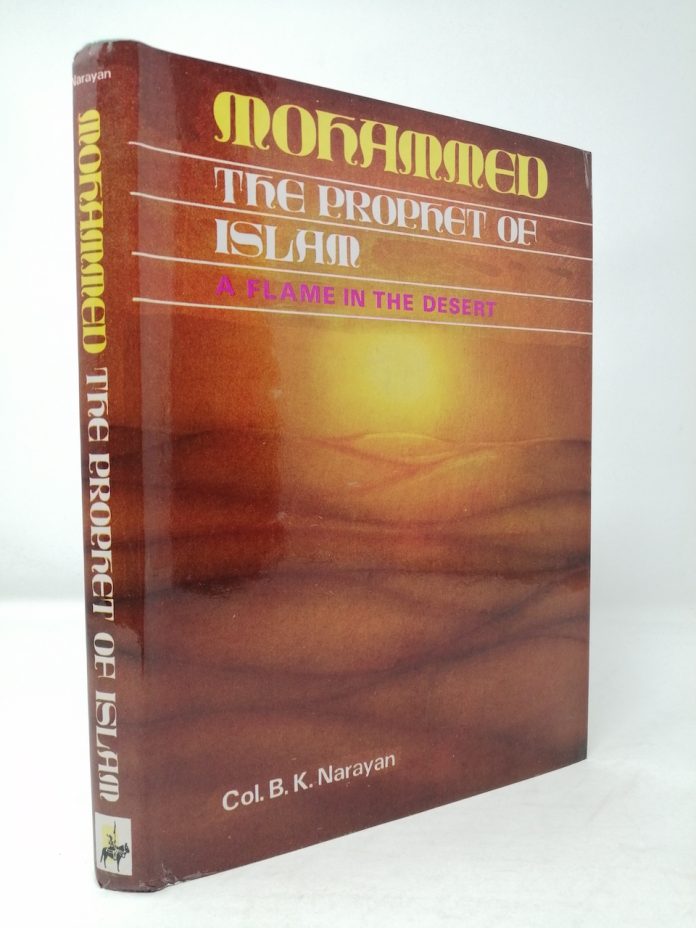
Muhammad: The Prophet of Islam, authored by Colonel B.K. Narayan
In 1978, a rare and remarkable book was published in Delhi – Muhammad: The Prophet of Islam, authored by Colonel B.K. Narayan, a retired officer of the Indian Army and former military attaché at the Indian Embassy. Known for his distinguished service during the 1971-72 India-Pakistan war as an infantry commander, he was also a man of deep intellectual curiosity and cultural sensitivity. Muhammad: The Prophet of Islam, published by Lancers Publishers, Delhi, stands as one of his most significant contributions beyond his military career – a comprehensive English-language biography of the Prophet Muhammad ﷺ.
More than a mere historical account, the book presents a deep and insightful reflection on the life and legacy of the Prophet Muhammad ﷺ, highlighting the enduring relevance of his moral and spiritual example.
Colonel Narayan’s profound admiration for the Prophet’s ﷺ character and achievements moved him to write a full-length English-language biography – a rare undertaking for a non-Muslim author, particularly one from a military background. His unique perspective offers readers a fresh and unbiased narrative rooted in historical context, moral analysis, and intellectual sincerity. His work stands as a bridge between cultures, illuminating the universal values embodied by the Prophet ﷺ.
In addition to this work, Colonel Narayan authored several other important books on the Arab world and geopolitical events of his time, including: The Fourth Arab-Israeli War (1974), Anwar al-Sadat: Man with a Mission (1977), Lessons and Consequences of the October War (1977), General J.N. Chaudhry: An Autobiography (1978, as narrated to him).
Spanning 205 pages, Muhammad: The Prophet of Islam is thoughtfully organised into three distinct sections, each offering a deeper understanding of the Prophet’s ﷺ life, message, and lasting influence.
Section One explores the life and mission of the Prophet Muhammad ﷺ, presented across 12 well-structured chapters. Colonel Narayan opens with an insightful overview of the socio-political conditions in Arabia before the Prophet’s birth. The narrative then follows key events and milestones throughout the Prophet’s life, offering a clear and compelling account of his journey and legacy. Topics covered include:
The state of Arabia before the advent of Islam,
The commercial significance of Makkah,
The Prophet’s ﷺbirth, early life, and journey to Syria,
His marriage to Hazrat Khadijah (RA),
The commencement of Prophethood, and
The Hijrah (migration) to Madinah.
Colonel Narayan meticulously discusses Key milestones such as the first revelation, the Prophet’s ﷺ interactions with Jews, Christians, polytheists, and hypocrites following his migration. The section also covers major expeditions and battles, the opposition from Jewish tribes, and strategic responses led by the Prophet ﷺ. Further discussions include the Kaaba’s history, types of revelation, and miracles of the Prophet ﷺ by the will of Allah. The book also examines the Prophet’s ﷺ battles, diplomacy, and social reforms.
This section concludes with the passing (Wafat) of the Prophet Muhammad ﷺ. A unique feature of this section is its inclusion of illustrative materials – historical photographs and maps, such as Jeddah Airport, the Black Stone (Hajr-e-Aswad), Bab-e- Kaaba, the mountainous terrain surrounding Makkah, and pilgrims clothed in the traditional white garments of Ihram. These visuals not only enhance the reader’s understanding but also offer a deeper emotional connection to the sacred geography of Islam. This part of the book extends from page 1 to 146.
Part Two focuses on the Sayings of the Prophet – the Hadith. Spanning pages 149 to 174, this section features English translations of over 100 carefully selected Hadiths, offering insight into the Prophet’s guidance across various aspects of life. The Hadiths are thoughtfully arranged under a wide range of themes, including belief and worship, justice and business ethics, the management of anger, responses to illness and poverty, the importance of guarding one’s tongue, the virtues of patience, mercy, repentance, and the sanctity of human life. Together, they reflect the profound moral and spiritual wisdom that continues to inspire and guide countless lives. Colonel Narayan expresses deep admiration for the enduring relevance and lucidity of these teachings, noting their ability to convey profound truths with striking simplicity. He writes:
“They are capsules of wisdom, simple, direct, and effective.”
Part Three centres on the noble wives and esteemed companions of the Prophet Muhammad ﷺ. The final section introduces the 11 noble wives of the Prophet Muhammad ﷺ – Khadijah, Aisha, Hafsa, Zainab, Zainab bint Jahsh, Safiyyah, Umm Habiba, Juwayriya, Rayhana, Maymunah, and Maria (may Allah be pleased with them all). The author praises their outstanding virtues – piety, sincerity, and loyalty – and he underscores the profound influence each of these noble women had on shaping the moral, spiritual, and social foundations of the early Islamic community. The author emphasises the social and moral significance of these marriages. He writes:
“The text reveals the circumstances under which these marriages were contracted and the benefits which accrued to society through them. All the wives of the Prophet made a distinct impact on society, by virtue of their piety, devotion, and dedication to the Prophet and the faith.”
In addition, this section offers concise biographies of the four Rightly Guided Caliphs – Abu Bakr, Umar, Uthman, and Ali (may Allah be pleased with them all) – highlighting their pivotal roles and contributions in the development of the early Muslim community.
A standout feature of this book is the author’s consistent focus on the humanistic portrayal of the Prophet Muhammad’s ﷺ humanity. Narayan emphasises that the Prophet ﷺ never laid claim to supernatural powers, yet through his character, wisdom, and unwavering commitment to justice, he transformed a fragmented, tribal society into a cohesive and ethically grounded civilization. He observes:
“To judge the greatness of his actions appropriately, one has to transport oneself to those days, and judge what Meccan society was before him and what it became after him.”
Commenting on the Prophet’s eloquence, Narayan writes:
“The Prophet was brief in his conversation and every word which he used had a specific purpose. Nothing could be added to his speech and nothing could be deleted from it.”
Colonel Narayan also notes the significance of the Prophet’s ﷺ oratory in an age when eloquence was revered. Drawing parallels with earlier prophets, he writes that while prophet Moses was given miraculous powers suited to his time; Jesus was given healing abilities, the Prophet Muhammad ﷺ, who lived in an age of eloquence and oratory, was gifted with unparalleled eloquence – a form of divine expression perfectly attuned to his time.
The book ends with a well-curated bibliography, citing sources such as Majmu‘ah Sirat al-Rasul by Ahmad Baraniq, Mishkat al-Masabih, Mohammedanism by H.A.R. Gibb, and Muhammad by Maxime Rodinson.
What distinguishes this book from many other Seerahs (biographies of the Prophet) is its remarkably balanced tone – reverent yet scholarly, empathetic yet analytical. At the same time, his deep respect for the Prophet Muhammad ﷺ and the Islamic worldview imbues the narrative with sincerity and insight.
Colonel B.K. Narayan’s Muhammad: The Prophet of Islam stands as an exceptional work – one that bridges faith, history, and scholarship. It offers a rich, respectful portrayal of the Prophet’s ﷺ life. In his portrayal of the Prophet’s ﷺ virtues – honesty, compassion, eloquence, restraint, and humility – the author invites readers of all backgrounds to reflect on timeless values. His unbiased presentation serves as a bridge between cultures, beliefs, and histories.
At a time when interfaith dialogue is more important than ever, Muhammad: The Prophet of Islam serves as a remarkable testament to respectful dialogue across religious and cultural lines. Written by a decorated Hindu military officer, the book represents not only a literary and historical contribution but also a moral undertaking – one that resonates far beyond its pages.
For those seeking a thoughtful, accessible, and historically rich account of the life of Prophet Muhammad ﷺ, Colonel B.K. Narayan’s biography remains a valuable and rare contribution.
source: www.radiancenews.com / Radiance News / Home> Features> Focus / by Dr Syed Wahauddinj Hashmi, Hyderabad / October 31st, 2025