Category Archives: Books (incl.Biographies – w.e.f.01 jan 2018 )

Of Muslim scholars and a glorious literary tradition

TAMIL NADU :

TamilBookCoversMPOs15jan2018

Umarupulavar, Kunangudi Masthan Sahib, Seiku Thampi Pavalar are popular names in the field of classical Tamil literature

Uraiyur Pitchai Ibrahim Rauther was an intriguing combination of a dry fish merchant and Tamil scholar.

His expertise is illustrated by the fact that towards the end of the 19th century, the management of Bishop Heber College in Tiruchi appointed him an honorary professor and among his students was the legendary Navalar Mu. Venkatasamy Naatar.

Writer and cultural historian Po. Velsamy, who posted some details about Ibrahim Rauther on Facebook, said he was an authority on the Tholkappiyam and great scholars such as Venkatasamy Naatar and Ra. Ragava Iyengar learned from him because till 1930, there was no one with expertise on the Porulathikaram of Tholkappiyam.

“Since the smell of dry fish on Rauther was overpowering, his students had to hold their noses even as they received lessons on the Tholkappiyam. But we have not been able get more details about Rauther, who died in 1908,” said Mr. Velsamy, who added that Rauther was a student Uraiyur Muthuveera Ubathiyayar and author of the Muthuveeriyam, a work based on the Tholkappiyam.

The Muslim community has had a glorious association with the Tamil language since the 12th century. Umarupulavar, the author of Seerapuranam, and Kunangudi Masthan Sahib are among the names to reckon with in the field of classical Tamil literature.

Sadhavathani Seiku Thampi Pavalar of Edalakudi in Kanniyakumari district is another well-known name in the Tamil literary world in modern times.

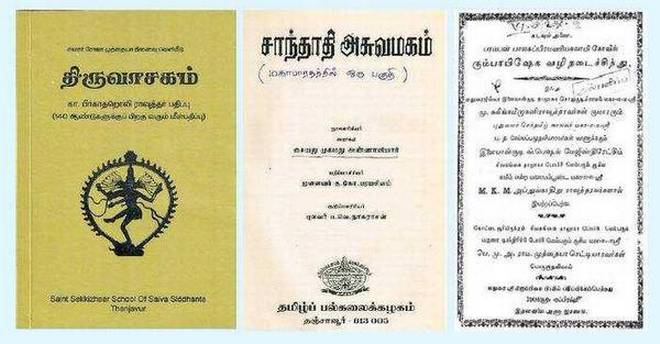
It was K. Peerkaderoli Rauther who published the Thiruvachagam in 1868. “The Sivapuranam in the Thiruvachagam is normally described as an agaval, but Rauther cited the Tholkappiyam to prove that it was a kalivenba,” said Mr. Velsamy.

Muslim scholars also worked extensively on Hindu epics and Athirampattinam Syed Mohamed Annaviyar rendered into Tamil the 14th chapter of the Mahabharata as Santhathi Asuvamagam.

Republished by the Thanjavur Tamil University, the book, comprising 4,104 verses, narrates the story of the Aswametha yagna performed by Dharma as per the advice of Vyasa after the war. “Santham means peace and asuvam refers to a horse. Magam means yagna,” explained Mr. Velsamy.

18 puranas

Annaviyar also rendered as ammanai (a type of verse) all the 18 puranas of the Hindus.

“Annaviyar and his descendants were scholars and even ran a publishing house. They wrote and published the Mahabharatha ammanai, Subramaniar Prasanna Pathigam, Aswametha Yagam, Ali Nama and Nooru Nama. Islamic scholars were experts in the sindhus, a genre in Tamil, and as many as 63 sindhus were published in the early 20th century,” said cultural historian Kombai S. Anwar.

When M.V. Ramanujachariyar, a colleague of U. Ve. Saminatha Iyer at the Kumbakonam Government Arts College, translated Vyasa’s Mahabharatha into Tamil, financial assistance came from many quarters, including two Muslims in Aduthurai, one of whom was a goat skin merchant. These contributions have been mentioned by Ramanujachariyar in the preface.

An interesting sindhu penned by M.K.M. Abdukathiru Rauther was performed when a kumbabhisekam was conducted at the Thiruvanmiyur Pamban Subramaniaswamy Temple. The title of the work is Pamban Balasubramaniaswamy Kovil Kumbabhiseka Vazhinadi Sindhu.

source: http://www.thehindu.com / The Hindu / Home> News> States> Tamil Nadu / by B. Kolappan / Chennai – January 01st, 2018
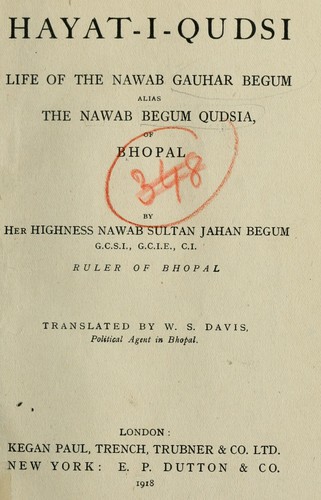
Hayat-i-Qudsi, life of the Nawab Gauhar Begum alias the Nawab Begum Qudsia of Bhopal

Bhopal, MADHYA PRADESH :

Hayat-i-Qudsi, life of the Nawab Gauhar Begum alias the Nawab Begum Qudsia of Bhopal
COVER of the book by Sultan Jahan Begam, Nawab of Bhopal, 1858-1930
Publication date : 1918
Publisher : London Paul, Trench, Trubne
Digitizing sponsor : Univesity of Toronto 
Contributor : Robarts – University of Toronto
Language : English 
source:  https://archive.org/details/hayatiqudsilifeo00sult

The abiding fame of Faizabad

Faizabad, UTTTAR  PRADESH :

EPITOMISING SYNCRETIC CULTURE Begum Akhtar

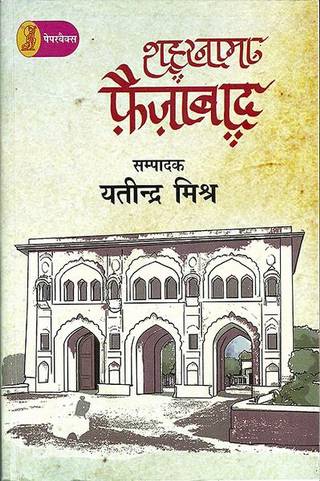
“Shaharnama Faizabad” offers detailed information about the social and cultural life of the historic town

Although Faizabad had acquired prominence during the reign of the early Nawabs of Awadh, it lost some of its lustre when, soon after taking over the reins of the kingdom in 1775, Nawab Asif-ud-Daula shifted the capital from Faizabad to Lucknow.

Yet, it continued to enjoy a lot of influence until the last Nawab Wajid Ali Shah was deposed and banished to Matia Burz near Calcutta (now Kolkata). It was so because of its famed Begums who wielded considerable political and financial clout. However, in the last century, a Begum of a different kind brought the town national recognition when, at the end of every gramophone recording, she would proudly announce: “Mera naam Akhtari Bai Faizabad”. For most of her performing career, Begum Akhtar was known as Akhtari Bai Faizabadi and she truly represented the refined composite culture of Faizabad that abuts the Hindu holy town of Ayodhya.

Last year, Vani Prakashan had brought out an excellent book on Lucknow that offered scholarly research along with useful touristic information. Titled ‘The Other Lucknow: An Ethnographic Portrait of a City of Undying Memories and Nostalgia’, it was edited by Nadeem Hasnain and was based on a research project sponsored and funded by the Ayodhya Shodh Sansthan (Ayodhya Research Institute), an autonomous organisation of the Uttar Pradesh government’s Department of Culture.

FaizabadBookMPOs13jan2018

It’s a matter of rejoicing that this year, Vani Prakashan has published a companion volume on Faizabad with the help of the same Ayodhya Shodh Sansthan. The fact that this volume is in Hindi and it offers very detailed information about the historic town, its social and cultural life, and places of religious and cultural significance would warm the cockles of everybody’s heart. Hindi writer Yatindra Mishra, who recently won the President’s Golden Lotus award for his biography of Lata Mangeshkar, has edited this 640-page tome titled “Shaharnama Faizabad” (A Chronicle of Faizabad). A scion of the erstwhile ruling family of Ayodhya, Mishra’s love for Faizabad is evident in the care and fastidiousness with which he has performed this daunting task with the help of many experts including historians Salim Kidwai, Madhu Trivedi and Yogesh Pravin, Islamic culture scholar Mirza Shahab Shah and Kosala Museum’s Deshraj Upadhyaya, to name only a few. Mishra has not only edited the book but has also contributed a large number of detailed comments on the Faizabad region’s history and culture, making use of painstakingly done research into archival material and other sources.

The book is divided into five sections and opens with the history of Faizabad and the way its architecture and culture took shape under the Nawabs. After Nawab Saadat Khan ‘Burhan-ul-Mulk’ was awarded the Suba of Awadh by the Mughal Emperor, he built a temporary fort called Qila Mubarak near Lakshman Ghat in Ayodhya. After some time, he built a cantonment at a distance of five kms from Qila Mubarak and it was known as Bangla. During the reign of Nawab Mansur Ali Khan ‘Safdarjung’, Bangla acquired the name of Faizabad. This section also tells us a very interesting fact about the royal emblem of the Nawabs as it depicted fish (considered to be auspicious) along with the bow and arrow of Ram, the presiding deity of the adjoining Ayodhya. Detailed information about the arts, architecture, music, jewellery and ornaments, and prominent Nawabs and Begums and their Hindu and Muslim courtiers has been provided in this opening section.

The second section is one of the most interesting and valuable parts of this book as it deals with the events and heroes of the great revolt of 1857, often described as the First War of Indian independence.

Ripple effect

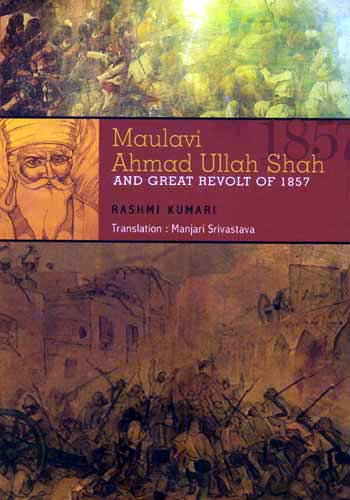
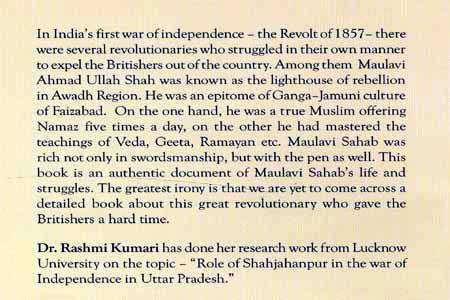
As is well known, the deposition of Nawab Wajid Ali Shah had also played an important role in spreading anger and anguish among the sepoys who hailed from the Awadh region in considerably large numbers. Mangal Pandey belonged to village Dugvan-Rahimpur of Tehsil Sadar in Faizabad district. We also come to know about Maulavi Ahmad Ullah Shah alias Danka Shah who, as early as in February 1857, had started condemning foreign rule in his public speeches. He was imprisoned and sentenced to death. Faizabad remained independent till January 6, 1858 and was defeated by the Nepalese army that attacked its forces and subdued them.

While the third section gives detailed descriptions of important religious places belonging to all the religions present in the region, the fourth section offers invaluable historical information about the writers, poets, courtesans, high-brow as well as folk musicians, folk art, village fairs as well as local festivals, bazaars and traditional haats, instruments and their makers, journalists, newspapers, magazines and printing presses of the region. It’s a fairly long list and offers a glimpse into the cultural richness of Faizabad.

The fifth and final section deals with prominent social workers, sportspersons, educational institutions and public libraries, thus completing a full circle. It’s not possible to discuss such a voluminous book in any detail here. Suffice it to say that those who are interested in knowing the history and culture of Awadh cannot afford to ignore this work.

source: http://www.thehindu.com / The Hindu / Home> Books / by Kuldeep Kumar / June 16th, 2017

Maulavi Ahmad Ullah Shah and great revolt of 1857

Arcot, MADRAS (now TAMIL NADU ) /  Faizabad, UTTAR PRADESH :

BookAhmedalluhMPOsJAN13mpos2018

BookAhmedalluh02MPOsJAN13mpos2018

source: http://www.nbtindia.gov.in / National Book Trust, India / Home> Books> National Biography

Laurels for the bravehearted prince

Surat, GUJARAT  /  London, UNITED KINGDOM  / Mumbai, MAHARASHTRA  :

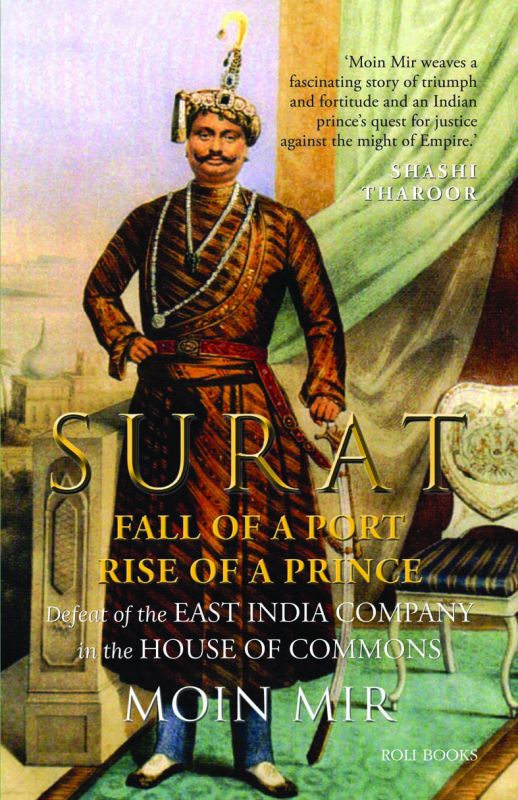
The book “Surat” by Moin Mir begins with a truth that will send a chill down anyone’s spine.

Moin Mir
Moin Mir

Breaking all the shackles and bending, actually, even defying all the ‘rules’, the prince of Surat, Meer Jafar Ali Khan fought a battle all by himself. And win he did!

The book “Surat” by Moin Mir begins with a truth that will send a chill down anyone’s spine. “It is about how the East India Company took control of the great port city, Surat. They violated a treaty with the Nawab of Surat which stated that his family would be secure from generation to generation by stopping the family’s income, usurping the palaces, estates, jewellery and all that was part of the private estates of the Nawab, leaving the infant granddaughters of the last Nawab on the brink of destitution. In a counter attack Meer Jafar Ali Khan, father of the two infant girls stood to defy an empire and expose the corrupt practices of the Company in Victorian England. Spearheading a legal offensive that would shatter the Company’s reputation, Khan’s campaign for justice generated great heat and debate in British Parliament. Fighting against all odds this prince won it all back for his daughters and found true love” says Mir.

SURAT FALL OF A PORT, RISE OF A PRINCE by Moin Mir, Roli Books, pp. 250, Rs 495

“Two things that inspired me to write this, one that the lead character was a fathr on a quest to fight for justice in 1844 by planting himself there and defying an empire on its own soil.

The second reason to write this book was the city of Surat which was an important port. I wanted people to know that how this thriving maritime port was brought down by the English East India Company,” he adds.

Wanting to release the book on Meer Jafar Ali Khan’s 200th birth anniversary, Mir thought that 2017, was the right time to release it. The message he wants to give is that it is a story of a man who believed in his cause.  “It’s a story of a city, an individual, a father and an Indian man in London in 1844. That is rare. And not just being an Indian in London but fighting the empire on their home turf. What are the chances of you winning? Zero! As the empire was at the peak of its power,” he signs off.

source: http://www.asianage.com / The Asian Age / Home> Books / by Kavi Bhandari / January 03rd, 2018

Learn photography online in nine Indian languages

Lovedale, Nilgiris (Ooty) , TAMIL NADU :

IqbalMohamed01MPOs07jan2018

Language is no barrier to learning the nuances of photography at the Light and Life Academy

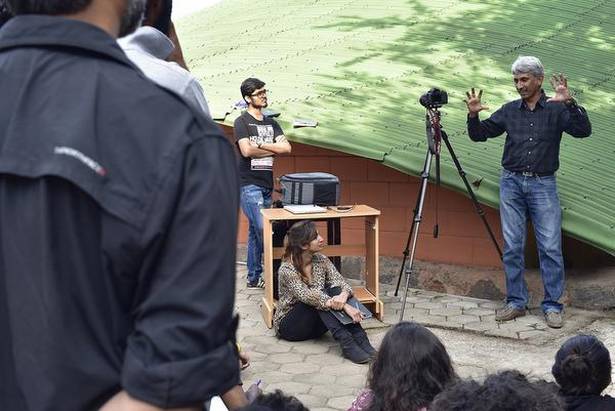
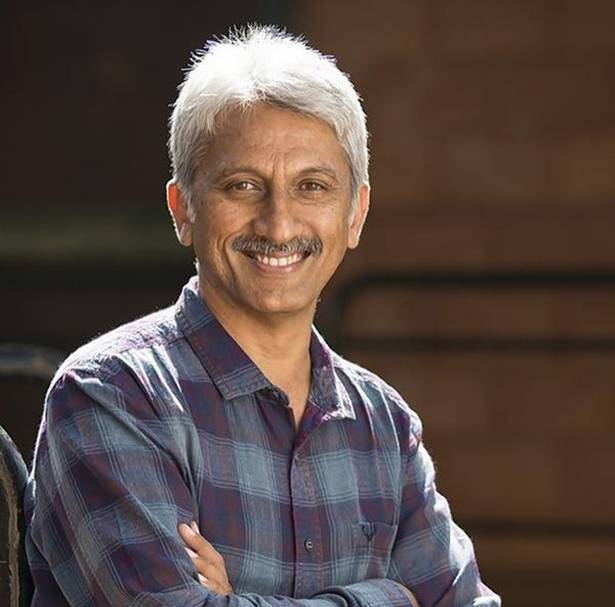
It is 6 am, and I watch Iqbal Mohamed quietly set up his camera in front of the big glass windows in his living room and wait for the sun to rise. We are at the Light and Life Academy (LLA) in Lovedale in the Nilgiris, and I learn that he does this every morning. “No two sunrise is the same,” he offers by way of explanation. Mohamed doesn’t say very much. He prefers to let his photographs do the talking, laughs his more vocal wife Anuradha.

The photographer founded LLA in 2001 as a full-facility photography institute. The inspiration was his alma mater, the Brooks Institute California. He worked in Hollywood with some of the biggest names in photography, and in India, winning considerable acclaim, before setting up his school. LLA, which maintains high standards of professionalism and excellence, has added immensely to the pool of talented photographers in the country. And the alumni have now helped him realise another dream — to set up an online course called ‘Get Creative with Photography’.

Seamless lessons

IqbalMohamed02MPOs07jan2018

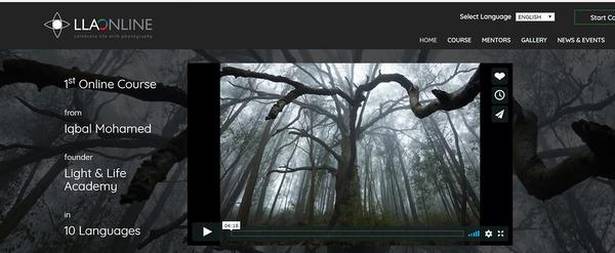
They want to reach out to more people who take pictures as a serious hobby, says Anuradha. “But we did not want it to become just another random photography course. Mohamed’s book, Portrait & Function Photography, in eight Indian languages, was enthusiastically received, and that made us think of an online programme that was serious, structured and professional,” she adds. LLA online was born after three long years of hard work. The programme is available in English and nine Indian languages (Tamil, Telugu, Malayalam, Kannada, Hindi, Marathi, Gujarati, Oriya and Bengali). “Prahlad Kakar advised us on how to create the video tutorials, all shot in campus, and make them not just informative, but also entertaining,” she says.

I click on the online programme to see how it looks, and the screen fills up with a haunting photograph of trees. Even to my unprofessional eye it is a stunning image. It is one of Mohamed’s photographs.

Nattily dressed LLA alumni present the lessons. Each one is an acclaimed photographer, says Anuradha, with considerable pride. “Without them, this course would not have been possible.” These include Shaheen Thaha (celebrity, fashion and architecture), Mihir Hardikar (food and beverages), Ajit SN (automobile and underwater), Punya Arora (editorial and underwater fashion), Satish Kumar (automobile) and Ankit Gupta (architecture and travel).

Getting into the details

IqbalMohamed03MPOs07jan2018

The online tutorial begins with clear, concise and simply-worded instructions. Then comes the fun part. I ask Anuradha if can see/hear the lesson in Bengali. I follow it up with a class in Tamil, Hindi and Kannada! The dubbing is perfect and as someone who has only taken pictures on her mobile phone, even I can understand everything. ‘Getting Ready & Exposure’ is the first lesson, followed by ‘Shutter’, and two sessions each on ‘Lenses and Apertures’, four sessions on ‘Light’, a lesson on ‘Colour’, and finally one on ‘Composition’.

Each of the modules explains the concepts and is supported by images. At the end of each class, an assignment is given that the students have to complete and upload in a week. Their homework is critiqued by mentors and peers, and only then can they proceed to the next class. If required, they are allowed to re-shoot. “This way they share ideas and learn from each others’ mistakes,” explains Anuradha, who emphasises that a strict protocol and system is followed and those signing up for the course have to be committed. There is no skipping lessons.

Offline vs online

IqbalMohamed04MPOs07jan2018

Online students have access to more than 500 stunning photographs by over 90 LLA alumni to give them an idea of what they can do with their cameras. Mohamed oversees their work and comments when necessary. The first set of students have already completed two assignments and the results have been promising, says Anuradha. Once they get feedback, they will launch other programmes, she adds.

Prahalad Muralidharan, CEO of LLA Online, explains that it was challenging to replicate the successful methods of their full-time courses on to the online platform. “After brainstorming and countless revisions, we finally found a way to do it. With peer-group interaction, an online forum and professional feedback, LLA Online is as close as it gets to LLA in terms of learning on an online platform!” he says.

The course includes 10 sessions over 10 weeks. The fee is ₹10,000. The full time courses at LLA can go up to ₹6,65,000. Details: llaonline.in or call: 97511-51999

source: http://www.thehindu.com / The Hindu / Home> Life & Style / by Pankiaja Srinivasan / January 05th, 2018

Interaction with author of ‘Talat Mahmood – The Velvet Voice’

It will be held at 4.30 p.m. on Saturday

The Manipal University Press will hold the ‘Author Meets Readers’ event ‘From the Horse’s Mouth’ with Manek Premchand — author of the book ‘Talat Mahmood – The Velvet Voice’ — at the AC Seminar Hall on the MIT campus here at 4.30 p.m. on Saturday.

According to a press release issued by Manipal University here on Thursday, Mr. Premchand will share his thoughts and feelings in a conversation with Manipal Centre for Philosophy and Humanities faculty member Gayathri Prabhu.

A film will be screened and that will be followed by a music programme with Premchand and a few others singing Talat Mahmood’s songs.

source: http://www.thehindu.com / The Hindu / Home> National> Karnataka / by Special Correspondent / Manipal – September 25th, 2015

How I survived Haj stampede in 2006

Mysuru, KARNATAKA / NEW DELHI :

A.K. Pasha
A.K. Pasha

People usually hurry to reach Mina creating tremendous risk for themselves and others. It’s during this ritual that chaos is triggered.

I went for Haj pilgrimage with my wife in December-January 2006. During the journey, we noticed that the Gulf region was unstable owing to the trial of the deposed Iraqi dictator Saddam Hussein in Baghdad and emotions were running high among the Arabs. The political fever in the region also spread among Haj pilgrims. Emotions and arguments add to the atmospherics of Haj. One can imagine the energy and excitement of a pilgrimage in which millions of people from diverse linguistic, ethnic and racial backgrounds are united by religion.

Our delegation was special as we were being accompanied by former Chief Justice of India A.M. Ahmadi and other dignitaries from different parts of India. But from the beginning of the journey, I saw that arrangements on the ground were not quite right. The Saudi officials gave out instructions only in Arabic, though most of the pilgrims were unfamiliar with the language.

Countries that send the largest number of pilgrims are from South and Southeast Asia like Indonesia, Pakistan, Bangladesh, Afghanistan and India. People from this region speak many languages. Special attention is needed for the elderly, many of whom undertake foreign travel for the first time and, therefore, are quite disoriented and find it difficult to adjust to sudden orders yelled out in Arabic by policemen.

Also, the Saudi rules aim at segregation of men and women which creates a lot of problems for first-time travellers from our region. Often families which are separated by the Saudi police have to endure hardship, which is multiplied because neither the pilgrims nor the police can understand each other.

The process of Haj starts from Mina where one has to begin early after a prayer, followed by the circumambulation of the holy mosque Kaaba. The pilgrimage ends at Mina following the ritual of ‘Stoning the Shaitan.’ This last ritual at Mina needs to be completed before sunset and people usually hurry to reach Mina creating tremendous risk for themselves and others. It’s during this ritual that chaos is triggered.

On January 12, as we were returning to Mina for the last ritual of Haj, we saw the big stampede from a distance as waves of people collided. Dust and fear enveloped us. Our group stopped midway out of fear and went back to Mecca.

Next morning, we started early at 3 a.m. for the dash to Mina. On the way, we saw huge piles of shoes, clothes, and water bottles left behind by the stampede victims being loaded onto the trucks by the police. Officials informed us that around 350 people had died in the stampede and hundreds more were injured. The possessions of the pilgrims left behind made me suspicious of the official account.

The road to Mina which is where the stampedes often happen is very risky as it’s the only one for the journey to Mina and for returning to Mecca. I am told that the Saudi government has created an alternative route for the pilgrims returning to Mecca but that route is longer and many pilgrims continue to return by the old, shorter and narrow route which puts them at risk.

Year after year, stampedes have taken place on the same route near Mina, yet the Saudi authorities have failed to do anything to reduce the risk.

The occasion of Haj brings more than three million pilgrims to Mecca. A number of factors can trigger a crisis and a stampede on the ground where the crowd is united by religion and divided by political sentiments of the Arab countries. Sabotage is often suspected when such tragedies take place.

The Saudi government should also be open to learning from other countries where a large number of pilgrims congregate, for example in India’s Kumbh Melas and in the Vatican where authorities take care of the linguistic differences while managing people. There is no harm in learning from others.

Prof. Pasha teaches West Asian politics in JNU.

(As told to Kallol Bhattacherjee)

source: http://www.thehindu.com / The Hindu / Home> National / by Prof. A.K. Pasha / September 26th, 2015

Karim Khan’s biography released

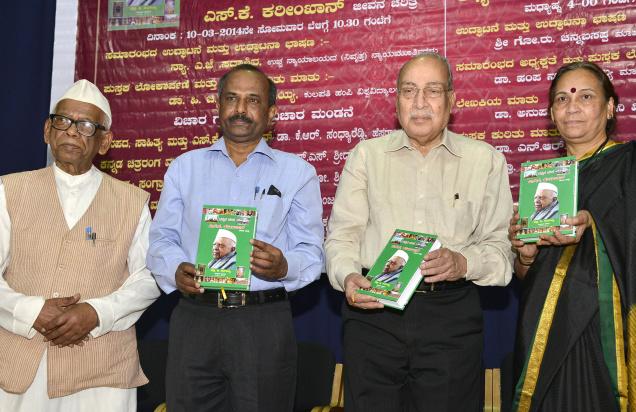
(From left) D. Boralingaiah, Vice-Chancellor, Kannada University, Hampi; A.J. Sadashiva, former judge, Karnataka High Court; and K.R. Sandhya Reddy, writer, releasing a book on Karim Khan in Bangalore on Monday. / Photo: K. Murali Kumar

‘Kannadada Santa Karim Khan Jeevana Charitre’ is written by the late D. Lingaiah

A biography on the late Kannada folk poet and scholar Karim Khan will provide an account of the entire 20th century, H.C. Boralingaiah, Vice-Chancellor, Kannada University, Hampi, has said.

He was speaking at the release of Karim Khan’s biography Kannadada SantaKarim Khan Jeevana Charitre at Kannada Sahitya Parishat on Monday.

Mr. Boralingaiah said the story of Karim Khan, a Gandhian, was also the story of the creative success of the Gandhian path before Independence.

“In an era of unbridled growth and development post-Independence, we have forgotten Gandhi and this book can be an excuse to introspect on the path we have taken,” he said.

Mr. Boralingaiah also recounted his interaction with Karim Khan when the two worked together at the Janapada Academy in the late 80s. “Despite the criticism he came under over his appointment to head the Academy at a ripe old age of 83, Karim Khan worked tirelessly for three years and did foundational work in the field of folk arts, along H. L. Nage Gowda, another scholar in the field,” Mr. Boralingaiah said.

A.J. Sadashiva, retired judge, Karnataka High Court, who inaugurated the function, said that in his limited interaction with him, Karim Khan came across as a polymath and a great humanitarian.

“He was a man who believed there was not much of a difference between man and God and if one strove hard, man could reach that holy state. His life was a journey in the direction,” he said.

The biography is written by the late D. Lingaiah. It is published by Godhooli publications.

source: http://www.thehindu.com / The Hindu / Home> News> National> Karnataka / by Staff Reporter / Bangalore – March 11th, 2014