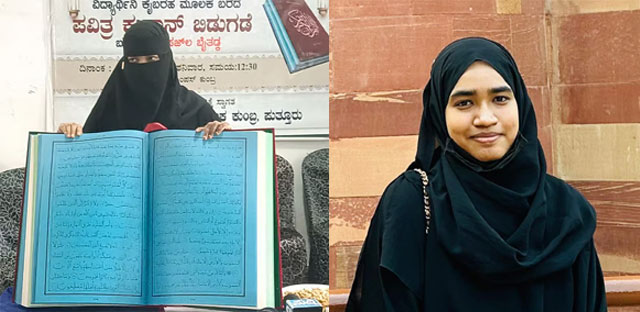
A remarkable achievement by a student from Kumbra’s Markazul Huda Women’s College has drawn attention, as she meticulously handwritten the entire Quran using an ink pen.
The achiever, Fathima Sajla Ismail, a BCom student, hails from Baitadka in Kaniyur village of Kadaba taluk and is the daughter of Ismail and Zahra Jasmine. She dedicated nearly five years to this extraordinary work, beginning in January 2021 and completing it in August 2025.
For the handwritten manuscript, Sajla used white, light blue, and light green papers, along with a black ink pen. The Quran consists of 604 pages, bound with a red and gold-coloured protective cover, and weighs about 14 kg.
“Writing a single page would take me around four hours. On some days, I managed to write two pages in eight hours. In total, I completed the work in 302 days, spending 2,416 hours,” shared Sajla.
The unveiling of the handwritten copy and recognition of her achievement took place at Markazul Huda Women’s College in Kumbra.
The manuscript was officially released by Yaseen Sakhafi Al Azhari, a Mudarris from Markaz Knowledge City, Kerala.
source: http://www.daijiworld.com / Daijiworld.com / Home> Top Stories / by DaijiWorld Media Network – Kadaba (headline and name edited) / August 18th, 2025
The Assamese version of Maulana Abul Kalam Azad’s Tarjuman Al Quran, Volume-I Al Fatiha, translated by Komoruzzaman Ahmed, was released here yesterday by educationist and former vice chancellor of Rajib Gandhi University, Arunachal Pradesh, Dr A C Bhagabati.
Maulana Azad, besides being a well-known political figure, is a scholar of Islamic learning and Quran. He had translated the Quran into Urdu with commentary as Tarjuman Al Quran to help the common people understand the holy book, as it was understood by the people during Prophet Mohammad’s lifetime.
The book had originally been translated to English by Dr. Syed Abdul Latif during the life time of Maulana Azad. The book, released on June 2, is an Assamese translation of the main Volume-I, Al Fatiha of the Tarjuman Al Quran, where Maulana Azad presented the main principles of the Quran by analyzing each of the Seven Sentences of Sura Al Fatiha in detail.
The meeting was presided over by film-maker Abdul Majid.
The welcome address was made by Wasbir Hussain, author and journalist.
Addressing the meeting, Dr Ayesha Ashraf Ahmed, author and former professor of Shillong College talked about the core philosophy of the Quran. Author Ahmed also addressed the gathering.
source: http://www.assamtribune.com / The Assam Tribune / Home> Archives / by Staff Reporter / September 15th, 2010
Hazrat Maulana Ghiyas Ahmad Rashadi Sahib, President of Safah Bait-ul-Mal and Manbar-Mihrab Foundation, was felicitated for his completion of the Tafsir al-Quran by Qari Muhammad Abdul Rahman Shahid Sahib and his brothers.
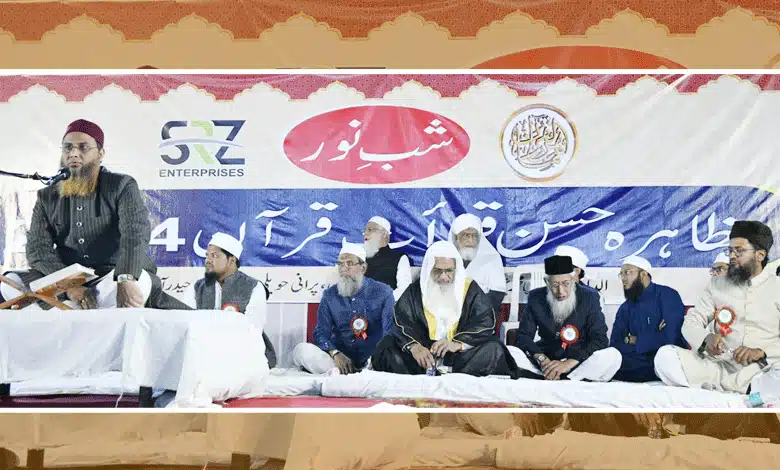
On the evening of December 31, 2024, a grand “Shab-e-Noor” Quranic Recitation event was held at the vast Dar-ul-Shifa Football Ground in the city. The event was presided over by Ustaad-ul-Qura’ Hazrat Maulana Qari Muhammad Ali Khan Sahib (may his blessings last) with the patronage of Mufti Hafiz Sadiq Mohiuddin Sahib (may his blessings last). The event featured renowned internationally acclaimed Qaris from the city, who presented their recitations.
Hazrat Maulana Jafar Pasha Sahib, Hazrat Maulana Hassan Farooq Sahib, respected Mir Zulfiqar Sahib (Charminar MLA), and respected Riyaz-ul-Hassan Afandi Sahib (MLC) participated as distinguished guests.
The Qaris presented their remarkable recitations until 2 AM, with a large crowd of both common people and elites in attendance.
Hazrat Maulana Ghiyas Ahmad Rashadi Sahib, President of Safah Bait-ul-Mal and Manbar-Mihrab Foundation, was felicitated for his completion of the Tafsir al-Quran by Qari Muhammad Abdul Rahman Shahid Sahib and his brothers.
The program concluded with a special prayer from Ustaad-ul-Qura’ Hazrat Maulana Qari Muhammad Ali Khan Sahib.
source: http://www.munsifdaily.com / Munsif News 24×7 / Home> Hyderabad / by Syed Mubashir / January 01st, 2025
The centuries-old Islamic educational centre, birthplace of the Urdu Qur’an translation, struggles to protect its legacy amid growing Hindu-led development projects.
New Delhi :
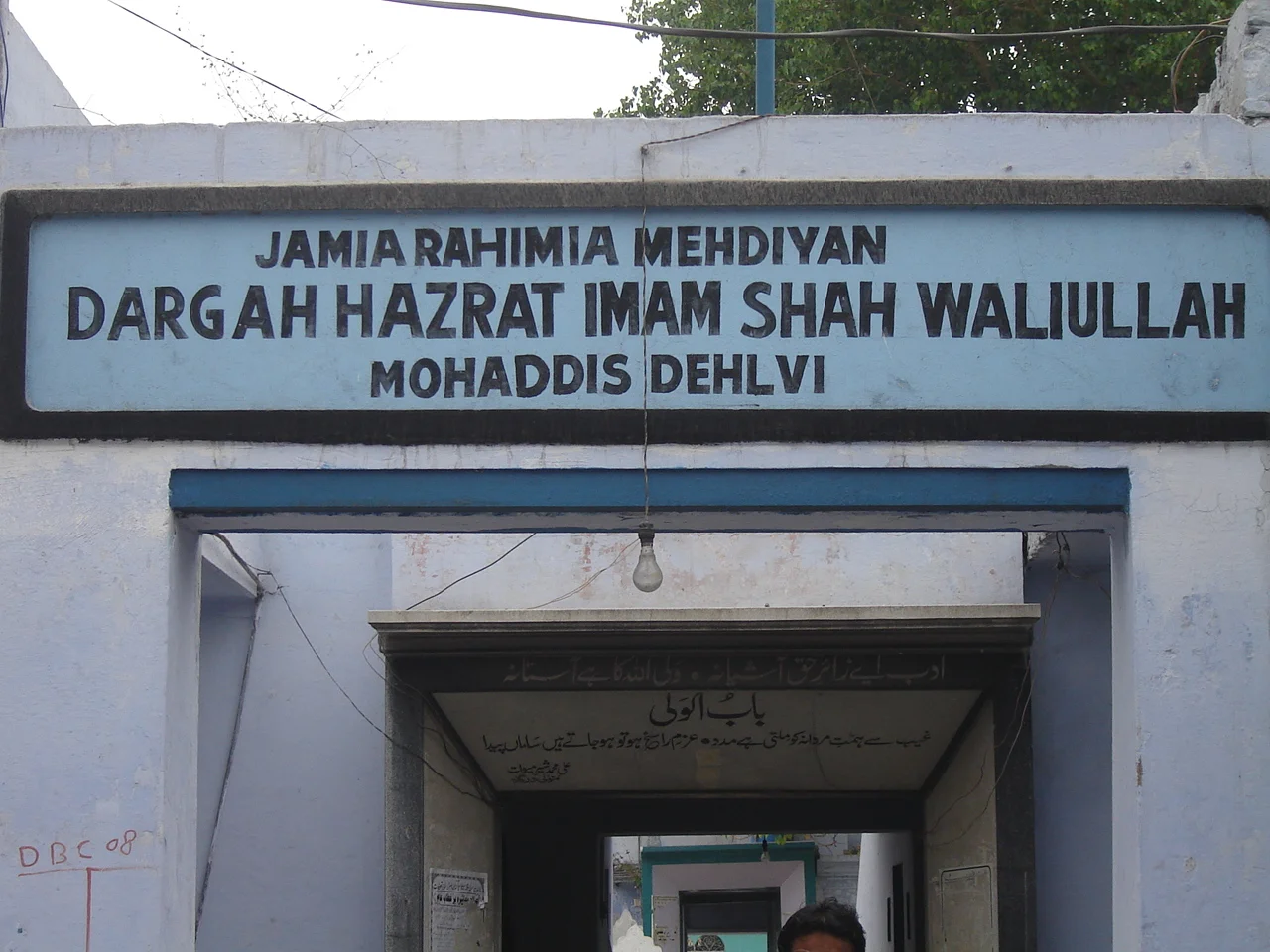
Hidden along the busy Bahadur Shah Zafar Highway, Mehdiyan — home to the revered Madrasa Rahimiya, also known as Jamia Rahimia — stands as one of Delhi’s oldest Islamic learning centres. Established by Shah Abdul Rahim, father of the famed scholar Shah Waliullah Muhaddith Dehlvi, this madrasa has for centuries served as a vital institution nurturing Islamic scholarship. However, today its existence is threatened by creeping urban development dominated by Hindu groups, threatening to erase a vital piece of Muslim heritage.
“Madrasa Rahimiya was not just a school; it was a movement to bring Muslims closer to the Qur’an’s true teachings,” explains Mufti Muhammad Sabir, a Hadith instructor at the madrasa. “But its history is being erased by those who prioritise development over our heritage.”
Madrasa Rahimiya holds a proud place in history, especially for pioneering the first Urdu translation of the Qur’an. In the late 1700s, Shah Abdul Qadir, a key scholar educated under his father and others, undertook the translation project at the Akbarabadi Mosque. This effort laid the foundation for making Islamic scripture accessible to millions of Urdu-speaking Muslims across India, who were otherwise unable to understand the original Arabic text.
“Shah Abdul Qadir’s translation was revolutionary, yet it faced strong opposition from scholars who considered translating the Qur’an sacrilegious,” says Maulana Sabir. “Despite this, his work endured and shaped generations.”
But this rich history has not been free from hardship. After the 1857 War of Independence, British colonial forces destroyed the Akbarabadi Mosque and shuttered the madrasa. The adjoining Mehdiyan cemetery, the resting place of Shah Waliullah and his family members, was drastically reduced. Historian Rana Safavi laments, “Mehdiyan was once a vast necropolis for saints and commoners alike. Now, much of it is lost to encroachment, with what remains used merely as a washing place.”
In the 1960s, Delhi’s expanding urban sprawl posed new threats. Plans to demolish Mehdiyan to build flats and houses were only halted because of the heroic resistance of Ali Muhammad, known locally as Sher-e-Mewat. “He lay down in front of bulldozers and even Pandit Nehru’s car to protect these sacred shrines,” recalls resident Bilal Ahmed. “He broke his leg but ensured our heritage survived.” Jawaharlal Nehru himself was moved by Ali Muhammad’s determination and ordered the preservation of these sites, which were later enclosed by a boundary wall.
Yet, the madrasa’s survival is once again at risk. Critics point out that the latest wave of urban planning, heavily influenced by Hindu groups, disproportionately targets Muslim heritage areas. Historian Zafar Khan asserts, “Hindu groups have long viewed places like Mehdiyan as obstacles to their vision of a ‘modern’ Delhi. This is not just about land — it’s an attempt to erase Muslim identity.”
Local Muslims feel the marginalisation acutely. “Our history is being systematically sidelined,” says Ayesha Begum, a teacher at Jamia Rahimia. “While Hindu temples receive government protection and funding, our sacred sites are neglected, ignored, or demolished.” She highlights the glaring lack of state support for the madrasa compared to the ample aid granted to Hindu religious institutions.
Despite the ongoing pressures, Madrasa Rahimiya endures as a symbol of resilience and faith. Its small mosque and student quarters continue to operate, preserving the teachings that Shah Waliullah and his predecessors established centuries ago.
“We teach the same Qur’an and Hadith that Shah Waliullah did,” says Mufti Sabir. “No matter the encroachment or neglect, that legacy will not disappear.”
The battle to save Mehdiyan reflects wider tensions in India, where Muslim cultural and religious heritage frequently confronts Hindu nationalist agendas. For now, the madrasa stands firm — a testament to Delhi’s Muslim scholars’ enduring spirit and their steadfast commitment to preserving Islamic knowledge and identity.
source: http://www.clarionindia.net / Clarion India / Home> Culture> Editor’s Pick> India / by Mohammed Bin Ismail / May 24th, 2025
Unlike the majority of Muslim youths from Assam who pass out from Darul Uloom Deoband, an Islamic university and seminary in Uttar Pradesh, who often end up joining mosques, madrassas, and other institutions to teach the holy Quran and other Islamic practices, Maulana Nurul Amin Qasimi choose a different path.
He launched a mission to remove misconceptions about Islam and the Muslim community. He has been preaching Islam in the right form with exceptional and innovative thoughts across Assam.
Many videos of Maulana Nurul Amin Qasimi have already received widespread attention on social media. In these videos, Maulavi is seen explaining the importance of education to the Muslims, the essence of Islam, and translating various verses of the Quran into local Assamese languages for easy understanding of the people.
He has been rendering his inspiring speeches at mosques, Edgars, madrassas, public functions, and other influential platforms.
Maulana Nurul Amin Qasimi during a social campaign
Maulana Nurul Amin Qasimi has recently published the Assamese interpretation and translation of the Holy Quran for Assamese readers. He has also launched the Assamese translation of the Holy Quran in audio format with his voice-over as many people do not read books nowadays due to lack of time.
He has also founded the Islamic Research and Study Center in central Assam’s Tezpur town with a few young men who had received Islamic education with progressive thoughts for society.
Maulana Nurul Amin Qasimi received his primary education from Sootea Higher Secondary School in central Assam’s Sonitpur district and then enrolled himself in Khutaktia Dini Alia Madrasa in Lakhimpur district for Islamic education. After studying there for six years, he enrolled in HojaiJalalia Madrassa. He passed his high school leaving certificate examination or Class 10 final exam in general education while studying at a madrassa in Jalalia Madrasa in Hojai.
After four years of study, he received the rest of his Islamic education at Darul Uloom Deoband Madrasa in Uttar Pradesh. After completing his Islamic education, he started teaching at Markazul Ma-Arif in central Assam’s Hojai district.
While teaching, Qasimi successfully passed his higher secondary examination or Class 12 final exam in general education. He then graduated from Ruphi College and obtained his postgraduate degree from Gauhati University. He is now studying for his PhD at Gauhati University.
In an interview with Awaz-The Voice, Maulana Nurul Amin Qasimi said: “We are Assamese Muslims and we live as Assamese Muslims. There is sometimes confusion about Islam and it is because of some Muslim people that others develop misunderstandings about Islam. Some followers of Islam misinterpret the religion because of their lack of knowledge.
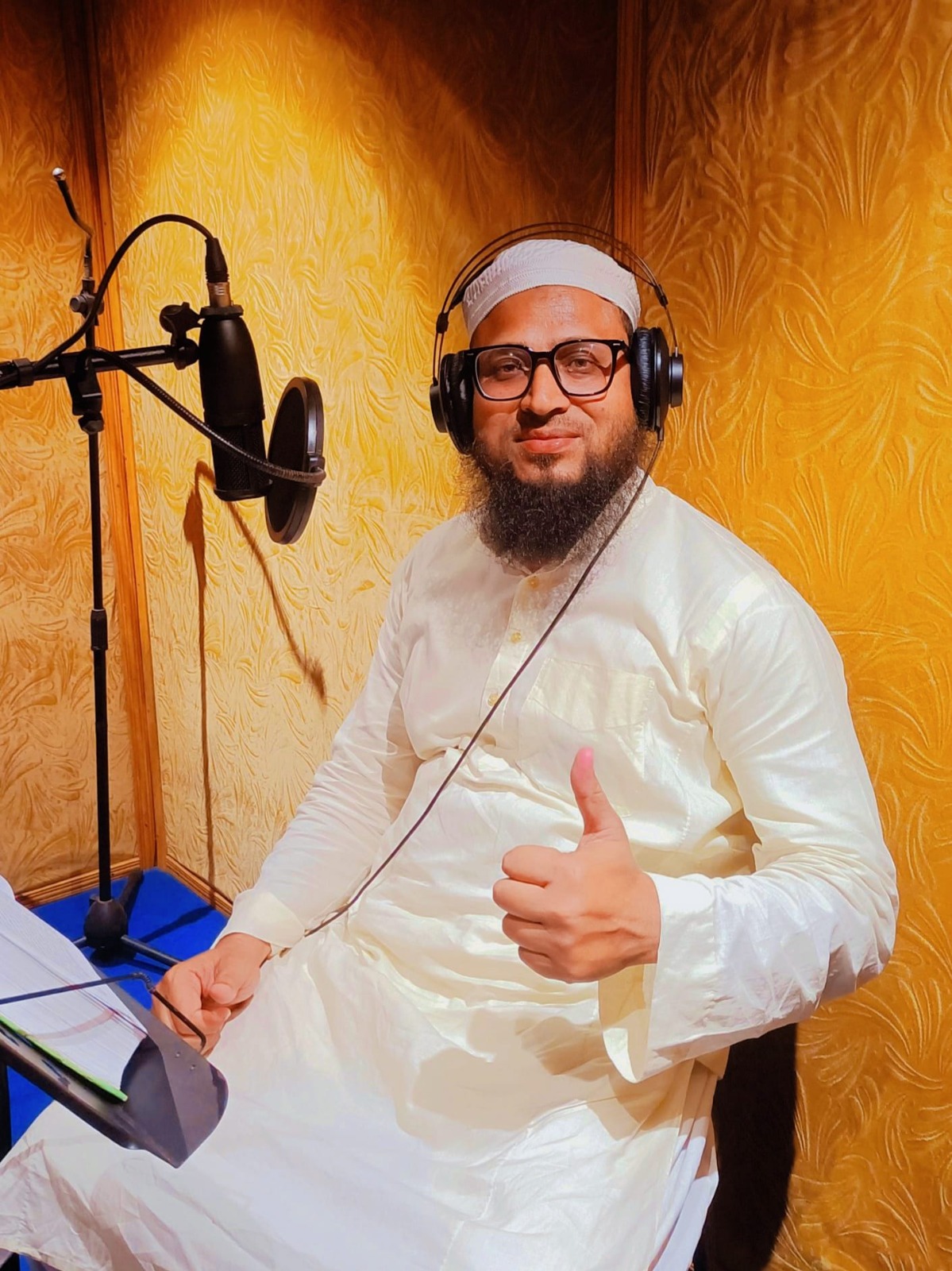
Maulana Nurul Amin Qasmi recording Holy Quran in Assamese
“I felt the need to enlighten people about the Holy Quran and the true words of Prophet Mohammad. We must present Islam in its true form in our local language. That is why I am making this effort. The Holy Books are in Arabic so it is our responsibility to explain it to everyone in our language.”
When Muslims congregate for the mandatory Jumma Namaz (Friday prayers), the Imam (head priest) gives a sermon called khutbah. He speaks about the principles of Islam, one’s duty towards society, the call for good deeds, respect for other religions, etc. Since the khutbah is rendered in the Arabic language in many mosques, it is difficult for the locals to understand the true meaning of these verses.
“I thought that if the messages of peace, humanity, or statements in khutbah were explained in the simple local language that people could understand, they would benefit and the misconceptions about Islam removed. There are ideological differences over reciting khutbah in Arabic. Some say that it should be explained in the mother tongue. But, according to our Islamic law, since the tradition of reciting the khutbah in Arabic has been going on since the time of the Prophet, it has not changed in some places,” the imam said.
Maulana Nurul Amin Qasimi said it’s important to learn modern general education along with Islamic education. “Muslim society is quite backward in education. In Muslim society, Maulanas or Ulemas are respected and considered religious leaders. So, if Ulemas advise on education, I think everyone will follow them and derive benefits. Our religious leaders have a lot to do in this regard. These matters get less importance in religious congregations. It is compulsory to take the basic education of Islam, but we should also be educated to be good citizens and individuals ready for the future,” he said.
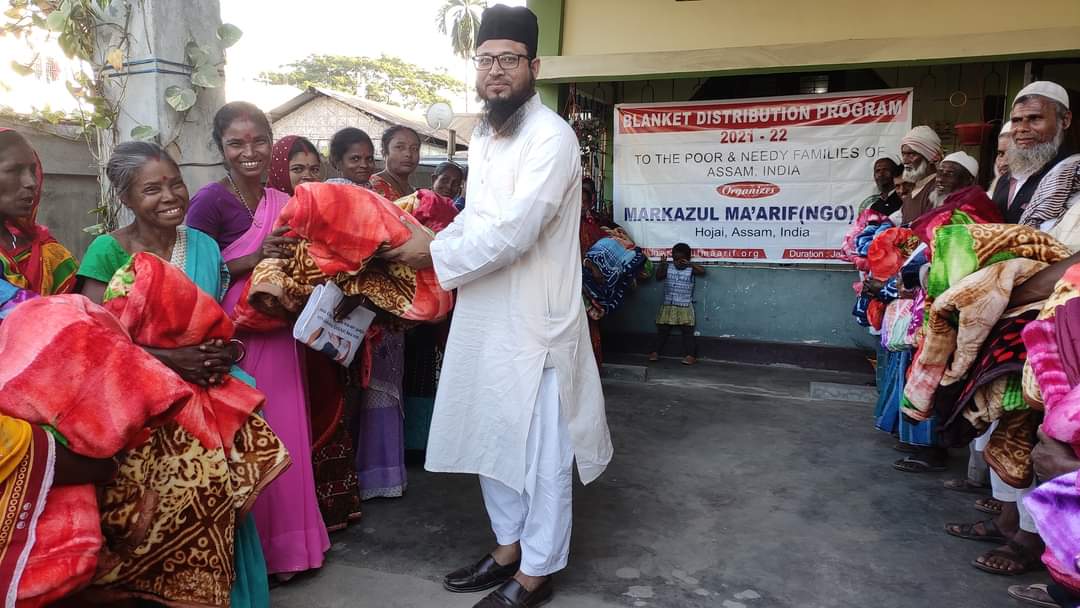
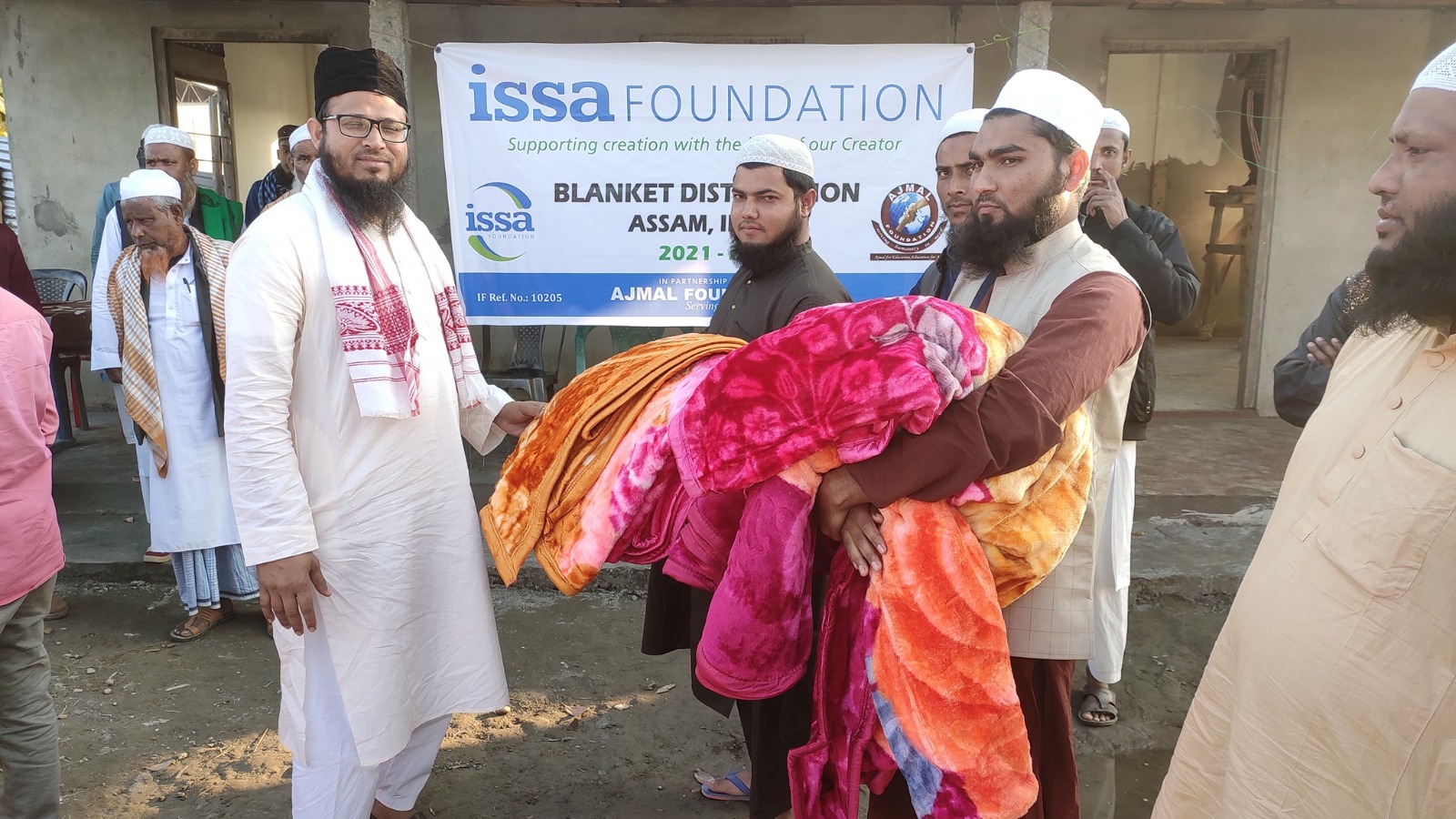
Maulana Nurul Amin Qasimi Distributing blankets
Maulana Nurul Amin Qasimi has been consistently speaking along the same lines in all the religious gatherings he is invited to. “Our Prophet Mohammad commanded us to go up to China for education. The first word of the Holy Quran is Ikra (read). Since our Prophet has allowed us to go to China for education, but, there is no scope for Islamic education in China. So our Prophet has, at the same time, laid special emphasis on IT and modern education besides Islamic education. Now only 4% of Muslim children study in madrassa.
“Not all Muslim children study in madrassa and not all need to study. The 4% must become Maulanas or Hafizs because they will have to uphold the religion in the future. We must educate the remaining 96% of the students’ modern education and establish them as good members of society,” he said.
Apart from the children studying in madrassas or receiving modern education, the Maulana said it is also necessary to think about school dropouts. He said the Muslim community could be rescued from its present condition only through education.
source: http://www.awazthevoice.in / Awaz, The Voice / Home> Stories / by Daulat Rahman, Guwahati / June 15th, 2025
Former NTC official Ameer Althaf, who played with numbers as accounts manager at the central government organisation had a passion for penning books.
And his creativity came to the fore with his maiden book on 300 year long history of Coimbatore Muslims in 2014.
Taking the next step, Ameer took up intensive research on Holy Quran. His seven year effort bore fruits with his four part book ‘Athaatchigal Thirukkuran Kalai Kalanjiam’ which has lots of interesting info which he collected during his indepth study visiting universities in Mecca, Medina and Malaysia. No doubt, this creative work is his magnum opus. Moreover, this book is a must in the book shelf of every household.
Retired apex court judge F M Ibrahim Kalifullah and former Madras High Court judge K N Basha will release the book in the presence of leading luminaries of Coimbatore and experts in their chosen domain from across the globe.
The event sponsored by Dhaanish Ahmed Institute of Technology (DAIT) and Al Azhar Educational Trust is to be held at Podanur Thendral Mahal on Oct 20 evening.
Interestingly, Ameer’s research papers on Holy Quran were presented and published in global forum like Umma-al Qura University in Mecca, King Fahad University in Madina, University Malaya, Islamic Science University Malaysia besides universities in Istanbul, Jordan, Qatar, Mali.
His four decade central government service and three decade research on Holy Quran made him go places across the globe. Significantly, he became to be known as International Holy Quran researcher.
Others who are part of the event includes Moulavi Alhaj M A Abdur Rahim, president, Coimbatore-Nilgiris-Tirupur district Jamathul Ulema Sabai, Moulavi Alhaj M A Mohammed Imdhadi, president, Coimbatore city Jamathul Ulema Sabai, social activist Aloor Shanavas, Coimbatore district United Jamaath president Alhaj A R Basheer Ahamed, Tamil Nadu Haj organisors association president Alhaj A Mohamed Rafeek, Iqra Educational Trust president Alhaj H E Iqbal Sait, Project Manager in Kuwait Haji M A Azad will address the audience at the book release event.
Himayathul Muslimeen Sunnath Jamaath, Podanur secretary Haji KTS Riyas Kapoor will propose the vote of thanks.
Other dignitaries who will speak at the event include Holy Quran translator Prof Mohamed Khan baqavi, TN state Jamathul Ulema deputy general secretary Moulavi Alhaj K M Ilyas Riyaji, Chennai Anna Salai Makkah Masjid chief imam Moulana M Mohammed Mansoor Kasimi, Madras University HoD Arabic, Persian and Urdu Dr A Zakir Hussain Baqavi and senior network consultant, Abudhabi Dr Mohamed Ibrahim.
source: http://wwwkovaimetro.in / Kovai Metro / Home> Coimbatore / by Shefa Rafi / October 13th, 2019
In the serene, mountainous terrain of Bhalesa in Jammu and Kashmir’s Doda district, where life flows gently with nature, a remarkable tale of faith and perseverance has emerged — one that is touching hearts across the country, reported the Chenab Times.
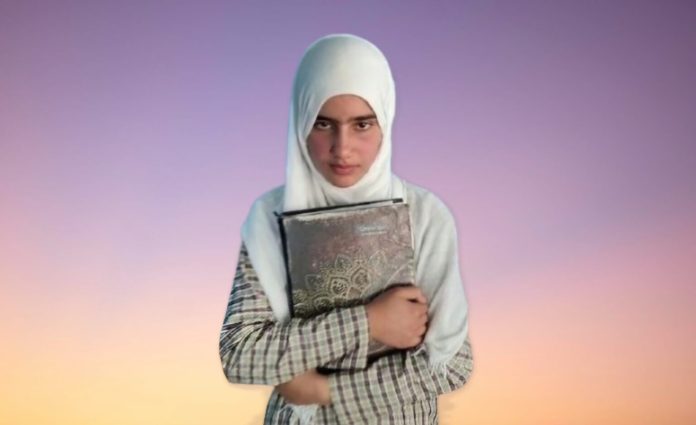
Mavish Arif, a 16-year-old Class 10 student from the remote village of Batara Gawalo, has achieved an extraordinary spiritual milestone: she has handwritten the entire Quran Sharif. What makes her achievement even more awe-inspiring is that Mavish was born deaf and mute.
In a world consumed by distractions and noise, Mavish’s silent journey of devotion speaks volumes. Over a span of nine months, without any formal guidance or assistance, she meticulously copied the Quran from start to finish, line by line, in the solitude of her home. Her determination, fueled by a deep spiritual purpose, astonished not only her family but the entire region.
Her parents, emotional and proud, shared how she immersed herself in this divine task, refusing help — not out of pride, but from an unwavering sense of purpose. Her days were spent absorbed in transcription, her hands speaking the language her voice could not.
This self-motivated act of worship, especially by a differently-abled young girl, has been hailed as unprecedented by local educators and scholars. Her school, Government Girls Higher Secondary School in Gandoh, has quietly supported her, and its principal, Mr. Ajeet Singh, expressed deep admiration:
“Mavish may be unable to speak, but her actions have roared louder than words. She has become a role model not just for students but for our entire community.”
The villagers of Bhalesa are united in pride and joy. Elders, neighbours, and teachers alike see her as a symbol of unwavering focus in a world that too often celebrates superficiality.
“In today’s time, when goals are often fleeting and attention is short-lived, this girl’s devotion is a lesson in spiritual resilience for all of us,” shared one elder.
Despite limited resources and geographical isolation, Mavish’s story radiates with spiritual brilliance and personal triumph. Her journey is not just a personal achievement, but a beacon of hope and inspiration for the entire nation.
Without uttering a word, Mavish Arif has etched a legacy — not just on paper, but deep in the hearts of everyone who learns of her devotion. Her story is one of faith, fortitude, and the silent strength of a pure soul on a sacred mission.
source: http://www.radiancenews.com / Radiance News / Home> Latest News> Markers of Excellence / by Radiance News Bureau / June 06th, 2025
With over 4,000 manuscripts and 25,000 books, Hazrat Pir Mohammad Shah Library is a sanctuary of knowledge and wisdom.
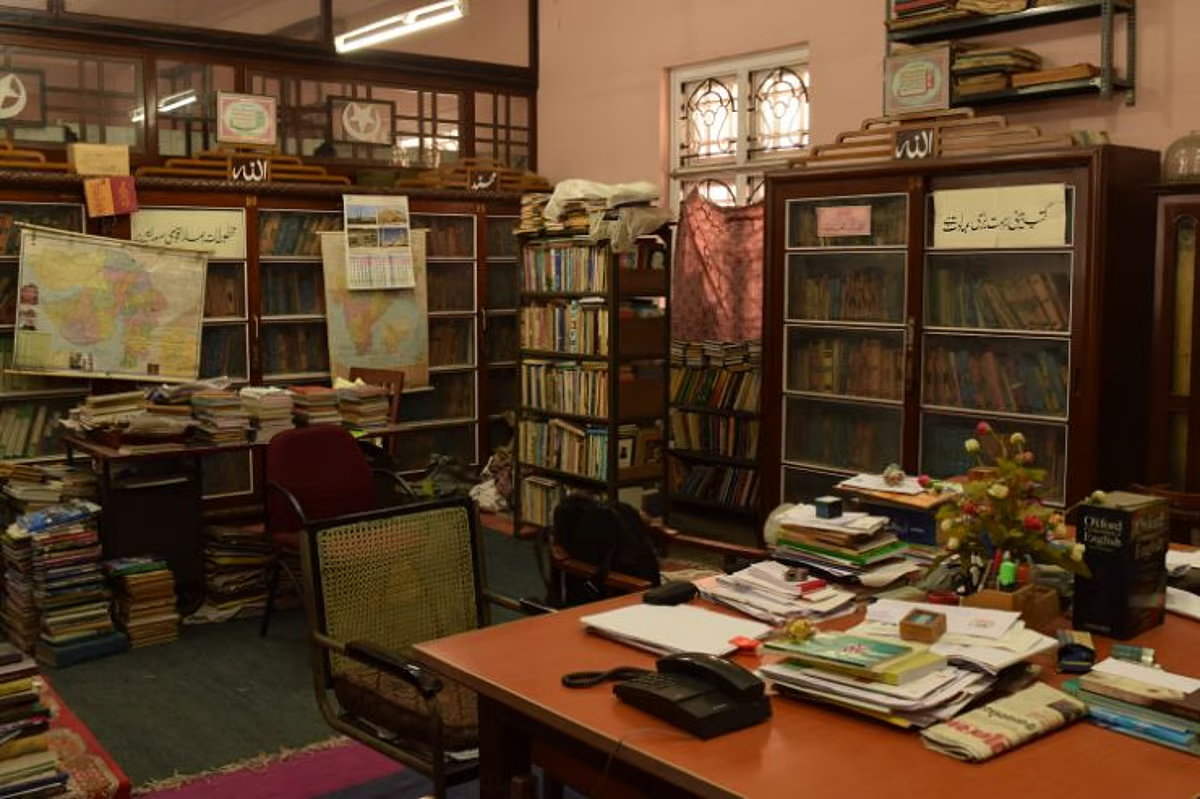
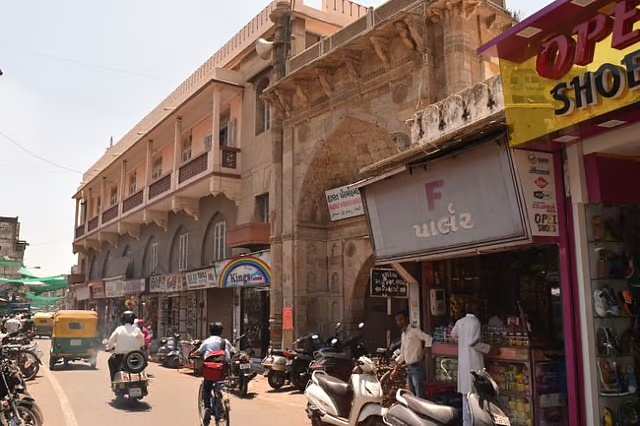
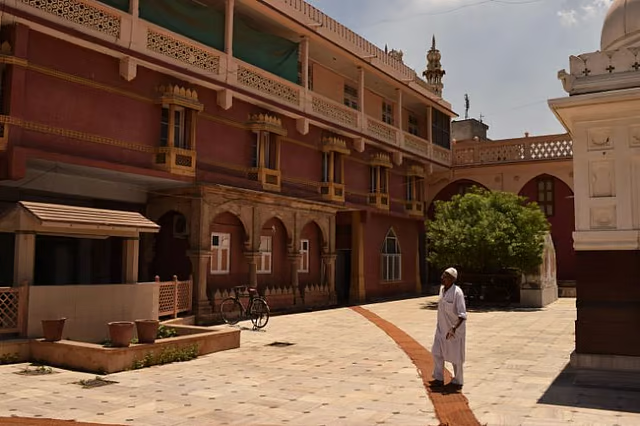
Stepping into the Hazrat Pir Mohammad Shah Library, the oldest library of the city, feels like entering a secret realm concealed within the narrow lanes of Pankora Naka, Ahmedabad. This hidden sanctuary of wisdom resides within the majestic tomb-shrine complex dedicated to the esteemed Pir Muhammad Shah.
The library’s journey commenced over 250 years ago when Pir Mohammad Shah and his devoted disciples gathered a humble collection of 300 manuscripts. Now, this literary haven proudly safeguards an expansive repertoire of over 4,000 manuscripts, establishing its position as such largest collection in Western India. Moreover, it boasts an impressive assortment of over 25,000 books.
About Mohammad Shah
Let us delve deeper into the enigmatic figure of Mohammad Shah, the driving force behind the library. Born in Bijapur in 1688 AD, he embarked on a transformative journey to Mecca, where he immersed himself in the teachings of practical Sufism.
Eventually, he settled in Ahmedabad in 1711, where he would offer his daily prayers in the Jama Masjid and rest in the humble hut of a benevolent elderly woman. It is in this very location that the awe-inspiring mausoleum-mosque-library complex now stands.
A treasure trove of manuscripts and books
During his lifetime, Pir Muhammad Shah, along with his devoted disciples, amassed a treasure trove of manuscripts and books, encompassing a wealth of academic and spiritual wisdom. This invaluable collection finds its residence in the esteemed “kutubkhana”. The Pir himself was a gifted bilingual poet, penning abundant verses in Persian and Dakhani.
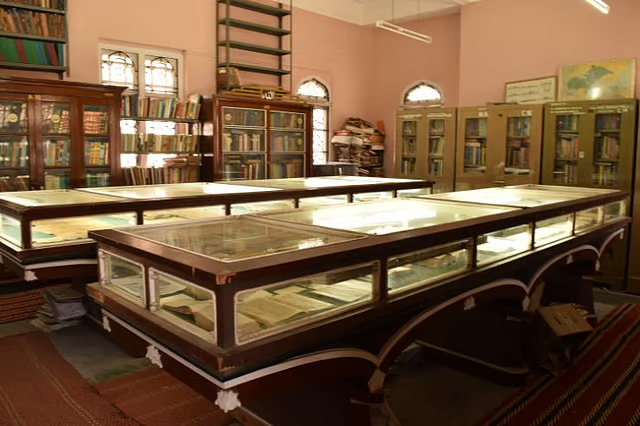
Today, the library stands as a testament to its illustrious past, harboring more than 4,000 manuscripts—the largest collection in Western India, alongside a rich trove of over 25,000 books. Its extensive catalog covers diverse subjects such as spirituality, Quran Knowledge, music, literature, history, geography, language, astronomy, astrology, agriculture, and more.
Within its hallowed halls, one can explore literature in Urdu, Gujarati, Arabi, Parsi, Hindi, and English. The library features a special chamber dedicated to ancient manuscripts, some dating back 800 years, as well as a display of Hazrat Pir Mohammad Shah’s personal belongings, carefully encased in glass to ensure their preservation.
Translations of sacred texts and unique manuscripts
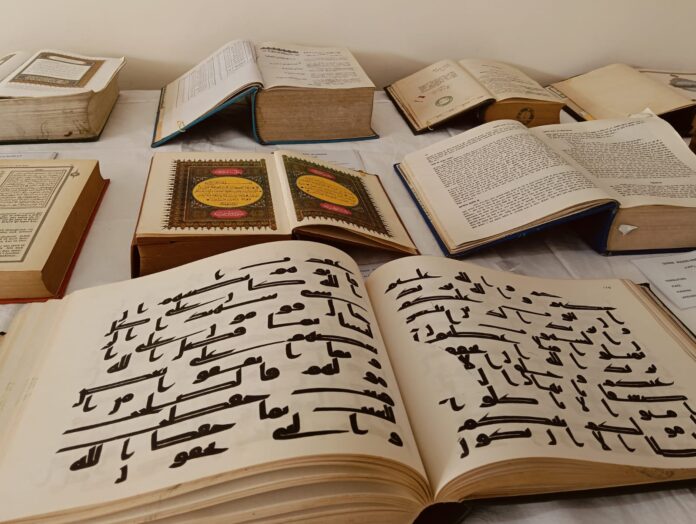
The library’s treasures extend beyond its own collection, offering translations of sacred texts such as the Bible, Rigveda, and Geeta. Visitors are also privileged to behold unique manuscripts, including a handwritten Quran by the illustrious Mughal Emperor Aurangzeb.
This historic repository not only embodies a wealth of knowledge, wisdom, and heritage but also exudes an aura of serenity and tranquility. Explore the mosque, wander through the tranquil courtyard, lose yourself in the pages of ancient tomes, marvel at rare manuscripts, and surrender to the enchantment of bygone era. A captivating journey back in time awaits within these hallowed walls.
source: http://www.knocksense.com / Knock Sense / Home> Ahmedabad / by Zeal Jani / June 27th, 2023
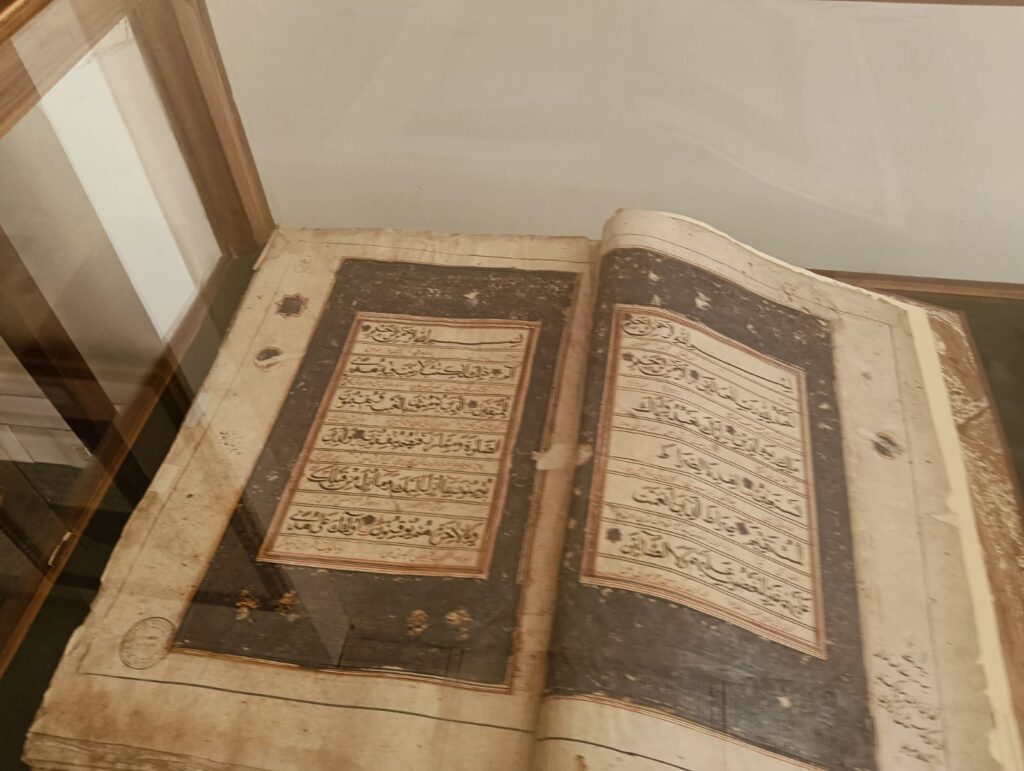
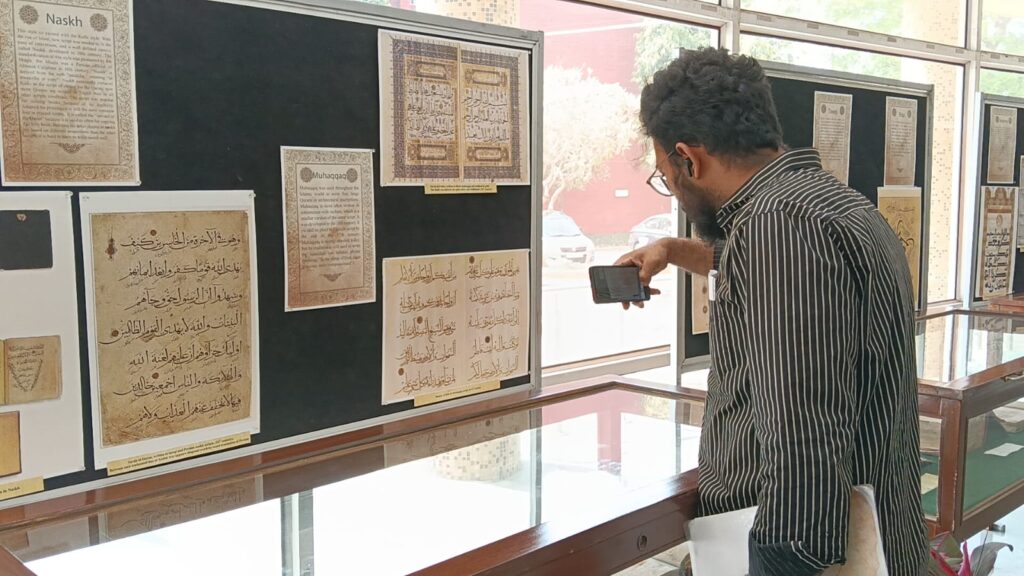
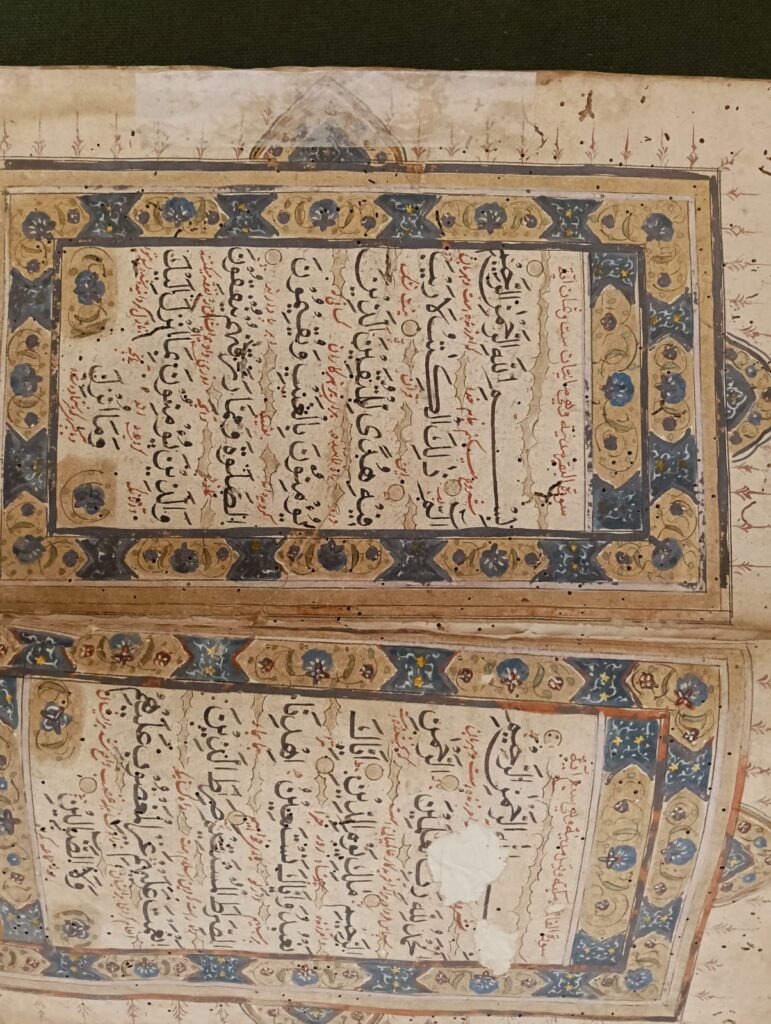
Jamia Millia Islamia has launched a special week-long exhibition showcasing rare and ancient Quran manuscripts at its Dr. Zakir Husain Library during the holy month of Ramadan. The exhibition, titled “Muqaddas Quran,” was inaugurated by Professor Mazhar Asif Sheikh-ul-Jamia and features a diverse collection of calligraphy spanning from the 15th to the early 20th century.
Through meticulously crafted posters, the exhibition traces the development of Islamic calligraphy from the 7th to the 14th century, offering a comprehensive visual exploration of how Quranic calligraphy evolved over time.
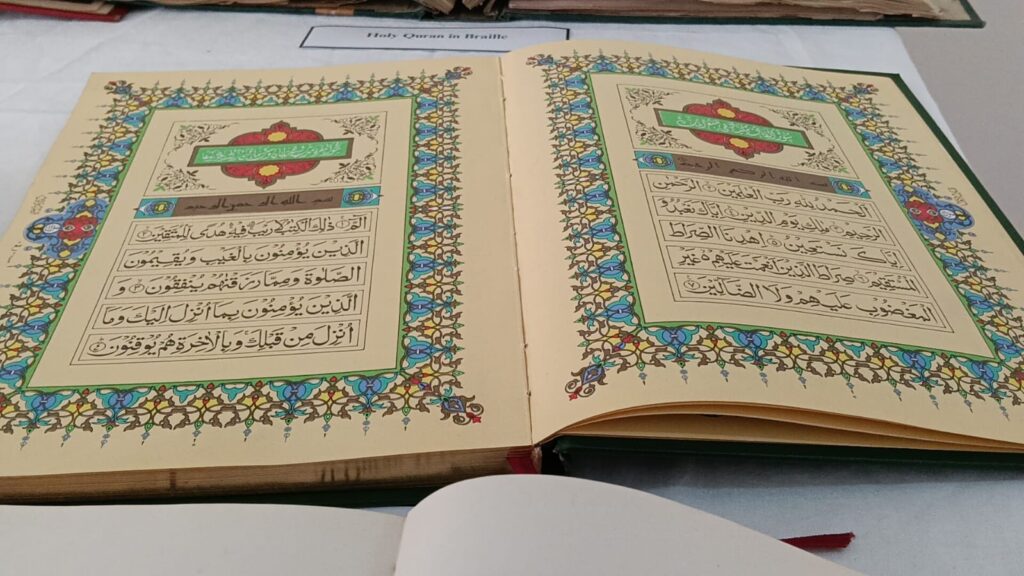
Alongside the manuscripts, the exhibition presents an impressive collection of printed Qurans in various national and regional languages, including Malayalam, Kannada, Hindi, Urdu, Tamil, and Bengali. The display also includes translations in foreign languages such as Chinese, Japanese, German, Turkish, Russian, English, Spanish, Albanian, Myanmar (Burmese), and Persian. A special Quran in Braille was also featured, emphasizing the importance of inclusivity and ensuring that visually impaired individuals can access the sacred text.
Professor Mazhar Asif, Sheikh-ul-Jamia(Vice Chancellor )of Jamia Millia Islamia, expressed his satisfaction with the exhibition, saying, “It is a privilege for the university to open its rare collection during the holy month of Ramadan, allowing people to benefit from the teachings, knowledge, and moral values of the Quran. The Quran promotes helping the poor, equality, and justice, and by presenting this exhibition to the public, we aim to encourage accountability, bringing people from darkness to light.”
The exhibition also showcases rare Arabic manuscripts, including Tafseer Baizawi and Tafseer of Ibn Abbas, both from the 16th century. Additionally, books in eleven foreign languages and six regional translations illustrate the rich diversity of Jamia’s collection.
Professor Asif highlighted the rarity of the Japanese translation of the Quran, which was produced by the Islamic Society of Koshikawa in Tokyo, calling it an extremely rare edition globally.
Professor Mohammad Mahtab Alam Razvi, Registrar of Jamia Millia Islamia, emphasized the significance of the exhibition. “This collection reflects our rich heritage of Quranic manuscripts and printed copies from the 15th century to the early 20th century, including small Quranic manuscripts. With thirty-five rare handwritten manuscripts and twenty-seven printed translations, the exhibition offers valuable insights into the evolution of Quranic script.”
Dr. Lucas S. Nigrale, who also participated in the event, spoke about the importance of such exhibitions during Ramadan, a time for reflection, devotion, and learning. “This exhibition shines a light on the Quran’s timeless wisdom and universal message,” Dr. Nigrale said, expressing hopes for future exhibitions that further promote awareness and cultural dialogue at the university. The Dr. Zakir Husain Library holds a total of 2,243 Quranic manuscripts.
The exhibition serves as an important platform for enhancing public understanding of the Quran’s linguistic, intellectual, and literary traditions. It highlights the eternal teachings of the Quran in a contemporary context, fostering greater cultural and educational dialogue.
source: http://www.indiatomorrow.net / India Tomorrow / Home> Education / by Mohammad Akram / March 30th, 2025
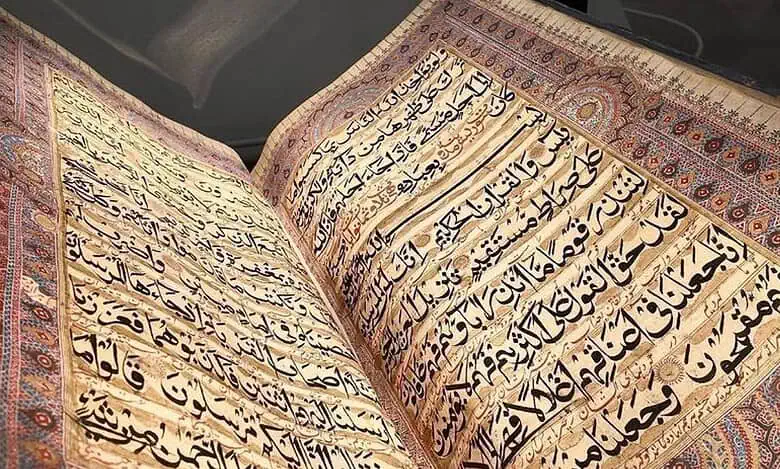
Indian calligrapher Ghulam Mohiuddin transcribed this manuscript.
pix: SPA
Jeddah:
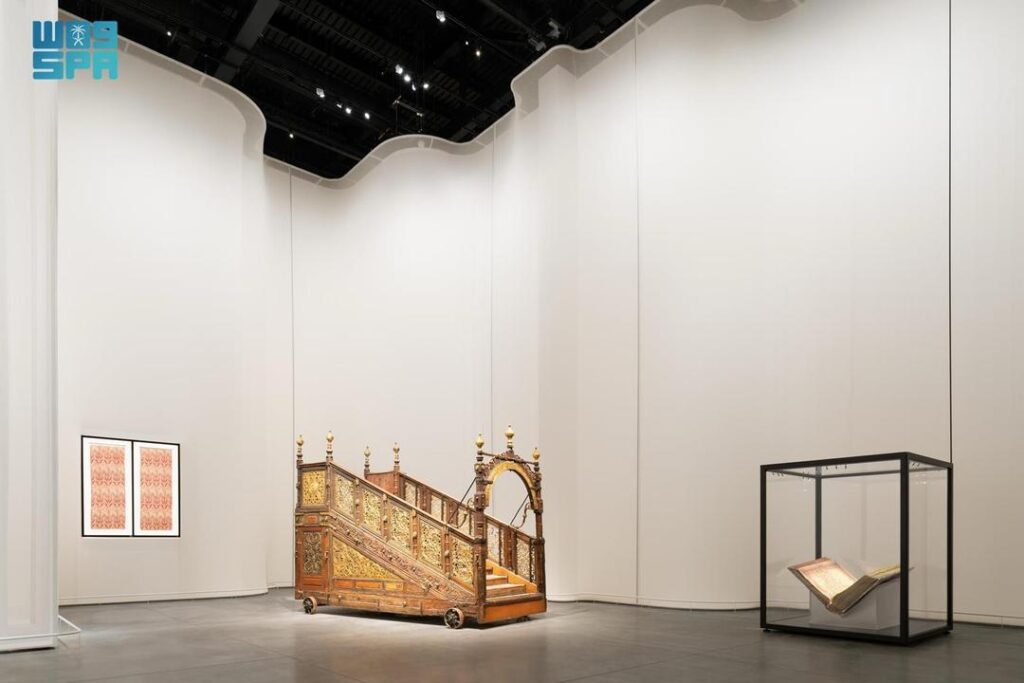
A two-century-old Quran manuscript, transcribed in India, is now on display at the Islamic Arts Biennale at the Western Hajj Terminal of King Abdulaziz International Airport in Jeddah, Saudi Arabia.
Indian calligrapher Ghulam Mohiuddin transcribed this monumental Quran manuscript on the 6th of Muharram, 1240 AH (August 31, 1824 AD) in northern India. It was designated as a waqf (endowment) for the Prophet’s Mosque in Madinah, reflecting India’s deep historical ties to Islamic art and heritage.
Measuring an extraordinary 139.7 × 77.5 cm, the manuscript is embellished with gold, deep-colored pigments, and a cover originally encrusted with rubies, emeralds, turquoise, and peridot, making it one of the rarest Quran copies on display, the Saudi Press Agency (SPA) reported.
The text is written in black Naskh script, with a Persian translation in red Nastaliq, showcasing the Indo-Persian calligraphic style of the era.
Historical records indicate that the manuscript arrived in Madinah in the mid-13th century AH and was initially placed near Bab As-Salam before being moved to the mosque’s treasury during restoration in 1273 AH (1857 AD).
In 1302 AH (1884 AD), it was rebound by Hajj Yusuf bin Hajj Masoom Nemankani, a scholar and manuscript expert from Uzbekistan who later settled in Madinah.
Now preserved at the King Abdulaziz Complex for Endowment Libraries in Madinah, this rare Indian-transcribed Quran is a key attraction at the Biennale, celebrating India’s historical ties with the Islamic world and its legacy of artistic excellence.
source: http://www.siasat.com / The Siasat Daily / Home> News> Middle East / by Sakina Fatima, X / March 12th, 2025