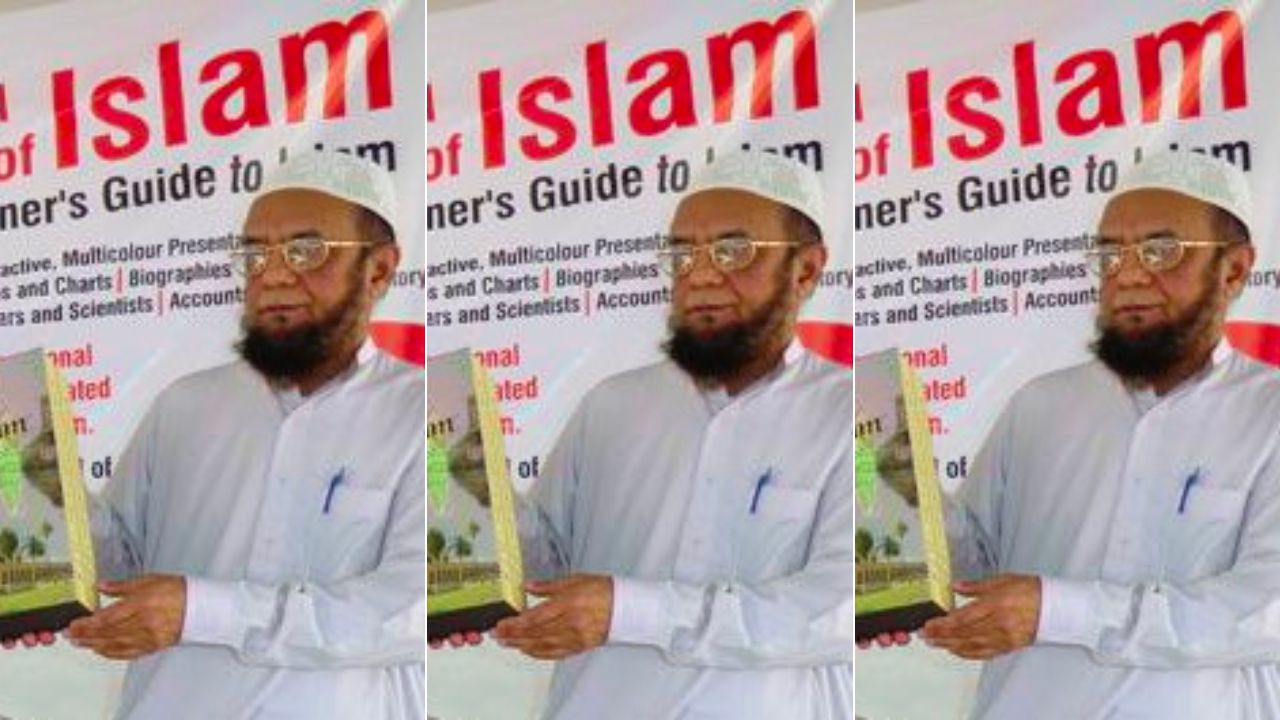
Renowned Islamic scholar, writer, and editor Syed Iqbal Zaheer passed away on Thursday, April 2, 2026, in the United Arab Emirates.
He was widely regarded as a significant contemporary voice in Islamic scholarship, known for his extensive writings, intellectual depth, and commitment to presenting Islam in an accessible yet authentic manner. His passing marks the end of a decades-long contribution to Islamic literature, education, and thought.
Born in 1944 in Hyderabad, India, Syed Iqbal Zaheer was trained as an engineer but went on to establish himself as a prolific author and researcher in Islamic studies. Over the years, he became particularly known for his ability to bridge classical Islamic scholarship with modern intellectual inquiry.
Among his most notable works is Tafsir Ishraq al-Ma‘ani, a fourteen-volume English commentary on the Qur’an, considered one of the most comprehensive original English tafsir works. He was also the author of An Educational Encyclopedia of Islam, a widely regarded reference work aimed at making Islamic knowledge accessible to both adults and children.
In addition to his books, he served for over three decades as the editor of Young Muslim Digest, an English-language Islamic monthly that reached readers across several countries. More than just a magazine, it became a formative intellectual space for generations of young Muslims, many of whom encountered Islamic thought, identity, and contemporary issues through its pages. Its widely read “Letters to the Editor” section, in particular, stood out for its candid, thoughtful, and often deeply nuanced responses, addressing complex personal and theological questions with clarity and balance. Through his editorials, Syed Iqbal Zaheer demonstrated remarkable intellectual depth, engaging with modern challenges while remaining firmly rooted in classical scholarship. For many readers, the magazine was not merely informative but transformative.
Despite his influence, Syed Iqbal Zaheer was known for maintaining a low public profile. He rarely appeared in public or media, preferring to focus on writing, research, and teaching. Those who knew him often highlighted his humility and his emphasis on sincerity in seeking knowledge.
Throughout his life, he remained dedicated to the study of the Qur’an, Arabic language, and Islamic sciences, encouraging generations of readers to pursue knowledge with depth and discipline.
His death has prompted an outpouring of condolences from students, readers, and members of the wider Muslim community, many of whom credit his works for shaping their understanding of Islam.
Syed Iqbal Zaheer is survived by his family and leaves behind a rich intellectual legacy that continues to benefit readers around the world.
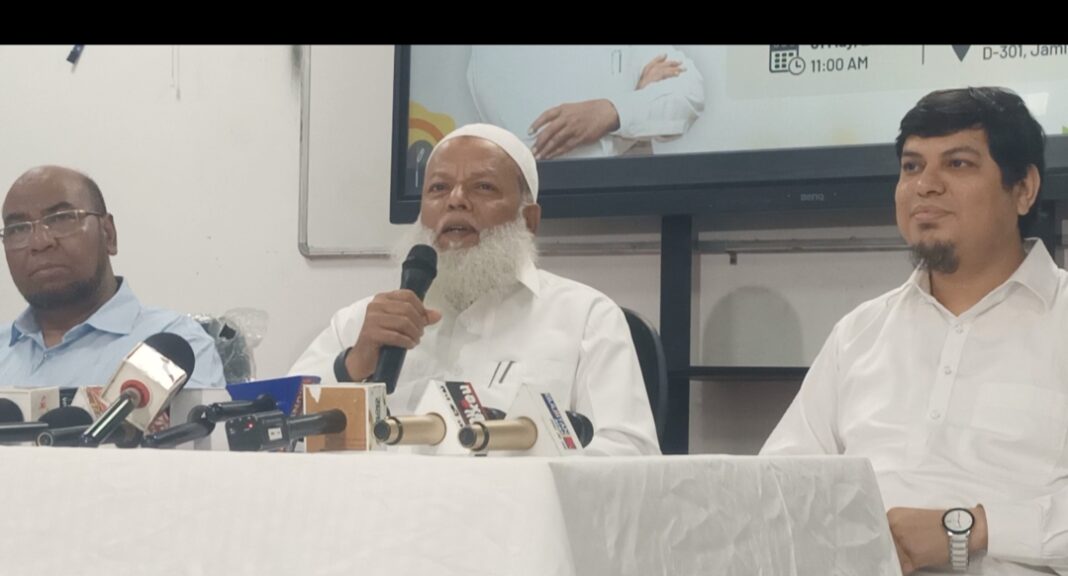
Chairman of Shaheen Group of Institutions Dr Abdul Qadeer (Centre) speaking to mediapersons at Shaheen Grouop’s office in Delhi on Friday(May 1, 2026).
New Delhi :
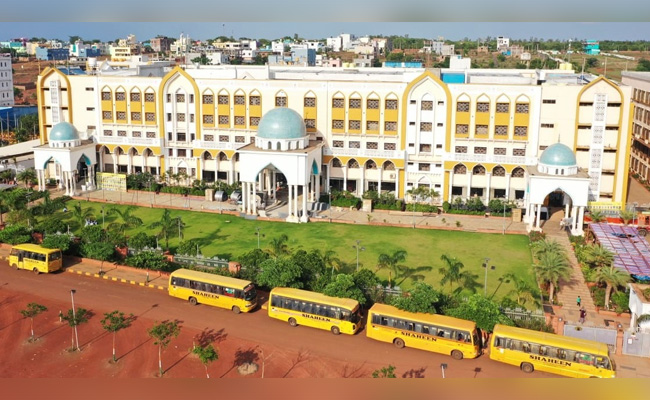
Dr Abdul Qadeer, founder and chairman of Shaheen Group of Institutions, on Friday announced a series of academic initiatives aimed at promoting inclusive, affordable, and future-oriented education for students from diverse social and economic backgrounds.
Addressing media persons at the Delhi branch of the institution, he said the organisation remains committed to combining academic excellence with social transformation and global educational opportunities.
He formally introduced its flagship programmes covering mainstream education, professional coaching, international schooling, and overseas medical education.
Dr. Qadeer highlighted the role of education in empowering underprivileged communities and integrating students into the mainstream educational system. He said the institution’s programmes are designed to provide personalised learning, mentorship, and structured academic support to help students compete at national and international levels.
One of the major initiatives discussed during the press conference was the “Madrasa Plus” programme. The programme seeks to integrate Madrasa students into formal education through a specialised teaching model featuring a 1:6 teacher-student ratio. According to the institution, the programme has achieved nearly 80 percent success in Class X examinations. It is currently being implemented in more than 100 Madrasas in collaboration with the Government of Karnataka. Officials said the initiative has enabled thousands of students to continue their education within the mainstream system while preserving their religious and cultural identity.
The institution also introduced its “5-Year Integrated Graduation Programme”, which combines higher secondary education with undergraduate studies and Islamic learning. Under the programme, students can pursue undergraduate courses such as BA, BCom, and BCA alongside Alimiyath studies. The programme also includes Hifz support, structured residential facilities, and personalised mentoring aimed at ensuring balanced academic and personal development.
Another major academic initiative announced was the “Pre Plus Two”, a three-year pre-NEET and JEE foundation programme designed for students who have either passed or failed Class X examinations. The programme begins with an Academic Intensive Care Unit (AICU), which focuses on strengthening students’ fundamentals in Mathematics, Science, and Languages through personalised instruction. This is followed by a comprehensive NCERT-based curriculum integrated with NEET and JEE coaching, continuous testing, and mentoring support.
Dr. Qadeer said the programme is intended to help students rebuild confidence and prepare systematically for competitive examinations. He added that many students from disadvantaged educational backgrounds often require individual attention and conceptual clarity, which the programme seeks to provide.
The institution also highlighted its “MBBS Abroad Programme”, aimed at students aspiring to pursue medical education overseas at affordable costs. Under the programme, students can study medicine in countries such as Kyrgyzstan and Tajikistan at an estimated cost of around Rs 28.8 lakh. The institution stated that the programme provides hostel accommodation, food, hospital facilities within the same campus, separate residential arrangements for boys and girls, and complete academic guidance to ensure a secure and supportive environment for students studying abroad.
Another key announcement was related to the Shaheen Australian International School, which offers education through the globally recognised WACE curriculum. The school focuses on inquiry-based learning, critical thinking, and student-centric teaching methods. According to the institution, the school aims to prepare students for international academic and professional opportunities through globally aligned educational practices and value-based learning.
Dr. Qadeer also spoke about the expansion of the institution in the national capital through Shaheen Academy Delhi. He said the Delhi centre will focus particularly on NEET preparation and will follow Shaheen’s established academic model based on discipline, conceptual understanding, and continuous mentorship.
He added that the academy aims to support students from diverse backgrounds and provide them with structured guidance, holistic development, and opportunities to excel in competitive examinations. The expansion, he said, is part of the institution’s broader mission to make quality education accessible across different parts of the country.
The press conference concluded with an interaction between the management and media representatives, during which officials reiterated the institution’s commitment to educational inclusion, skill development, and creating opportunities for socially and economically marginalised students.
source: http://www.indiatomorrow.net / India Tomorrow / Home> Education / by India Tomorrow / May 01st, 2026
Shaheen Group of Institutions has announced free education for students across Karnataka who have secured 95 per cent and above marks in the SSLC examinations.
The announcement was made by Dr. Abdul Qadeer, Chairman of the institution, as part of an initiative aimed at encouraging academic excellence and supporting deserving students.
According to the institution, eligible students from across the state will be provided free education for both First Year and Second Year PUC at Shaheen institutions.
The initiative is expected to benefit a large number of meritorious students by helping them continue higher education without financial burden.
In addition, Dr. Abdul Qadeer announced special scholarships for Kannada medium students and those studying in government schools, recognising their efforts and encouraging them to pursue further studies.
Speaking on the occasion, he said the initiative reflects Shaheen’s continued commitment to inclusive education and merit-based support, ensuring that talented students from all backgrounds receive opportunities to progress.
source: http://www.english.varthabharati.in / Vartha Bharati / Home> Karnataka / by Vartha Bharati / April 25th, 2026
Bhatkal (Uttara Kannada District / Karavali) / Benglauru, KARNATAKA :
Bengaluru:
Bhatkal Muslim Jamaat Bangalore (BMJB), in collaboration with HHS HMS Bangalore, will organise a blood donation camp in the city on May 2 and 3.
The camp will be held from 9:30 am to 4:30 pm at HHS HMS Blood Bank, located on Cubbonpet Main Road.
Organisers said the initiative aims to support the blood bank and serve the community by encouraging voluntary blood donation. They have appealed to people to take part in the camp and contribute towards saving lives.
source: http://www.english.varthabharati.in / Vartha Bharati / Home> Karnataka / by Vartha Bharati / May 01st, 2026
Kasaragod District Kannada Journalists Welfare Association has selected Vartha Bharati journalist Samshuddeen Yenmoor for its annual ‘Dattinidhi Award’.
The association, which has been working for nearly two decades to promote the Kannada language, culture and the welfare of journalists in Kerala, presents this award with sponsorship from Dubai-based entrepreneur James Mendonca.
The award includes a cash prize, citation and memento. It will be presented at a function scheduled on May 16, 2026, at 9:00 am at the Hall of Subbayyakatte Aided Higher Primary School in Kasaragod district.
The programme will be held under the chairmanship of Shivananda Tagadur, State President of Karnataka Union of Working Journalists.
Among those expected to attend are Karnataka Legislative Assembly Deputy Speaker Rudrappa Lamani, Minister N.S. Boseraju, Manjeshwar MLA A.K.M. Ashraf, Chief Minister’s Media Advisor K.V. Prabhakar and Karnataka Border Area Development Authority Chairman Somanna Bevinamarad, among others.
The details were shared in a statement issued by association president Ravi Naikap.
source: http://www.english.varthabharati.in / Vartha Bharati / Home>Karavali / by Vartha Bharati / April 30th, 2026
Rs 1 crore to be provided for Beary community hall in Kodagu: Speaker U T Khader
Madikeri:
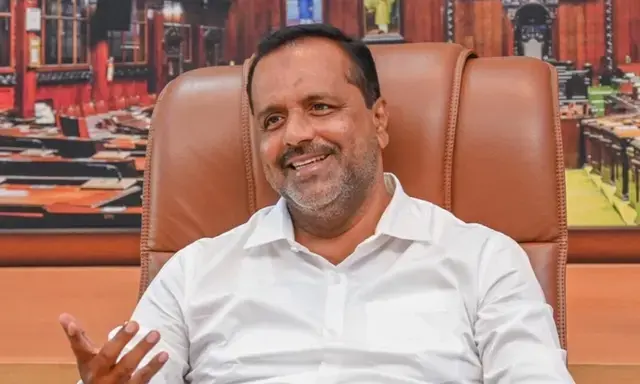
Karnataka Legislative Assembly Speaker U T Khader said that Rs 1 crore will be allocated for the construction of a Beary community hall in Kodagu district, and directed officials to identify suitable land for the project.
He was speaking after inaugurating the first Kodagu District Beary Literary Conference organised by the Karnataka Beary Sahitya Academy in association with the Kodagu Bearys Welfare Trust.
The event was presided over by B A Shamshuddin. Khader said the grant of Rs 1 crore would be facilitated with the support of local MLA Mantar Gowda and Virajpet MLA as well as Chief Minister’s legal advisor A S Ponnanna.
Highlighting the cultural importance of the community, he said Beary culture, literature and traditions have a distinct history and called for efforts to preserve and promote them.
He said the literary conference would help encourage discussions, strengthen the Beary language, and guide the community towards development. It would also help educate youth about Beary literature, culture and history, and provide a platform for exchange of ideas.
Khader also stressed the importance of learning and respecting all languages, stating that in a globally connected world, multilingualism promotes harmony.
Speaking on the occasion, MLA Mantar Gowda assured that funds would be released once land is identified for the construction of the community hall.
source: http://www.msn.com / MSN / Home / by Newspoint / April 2026
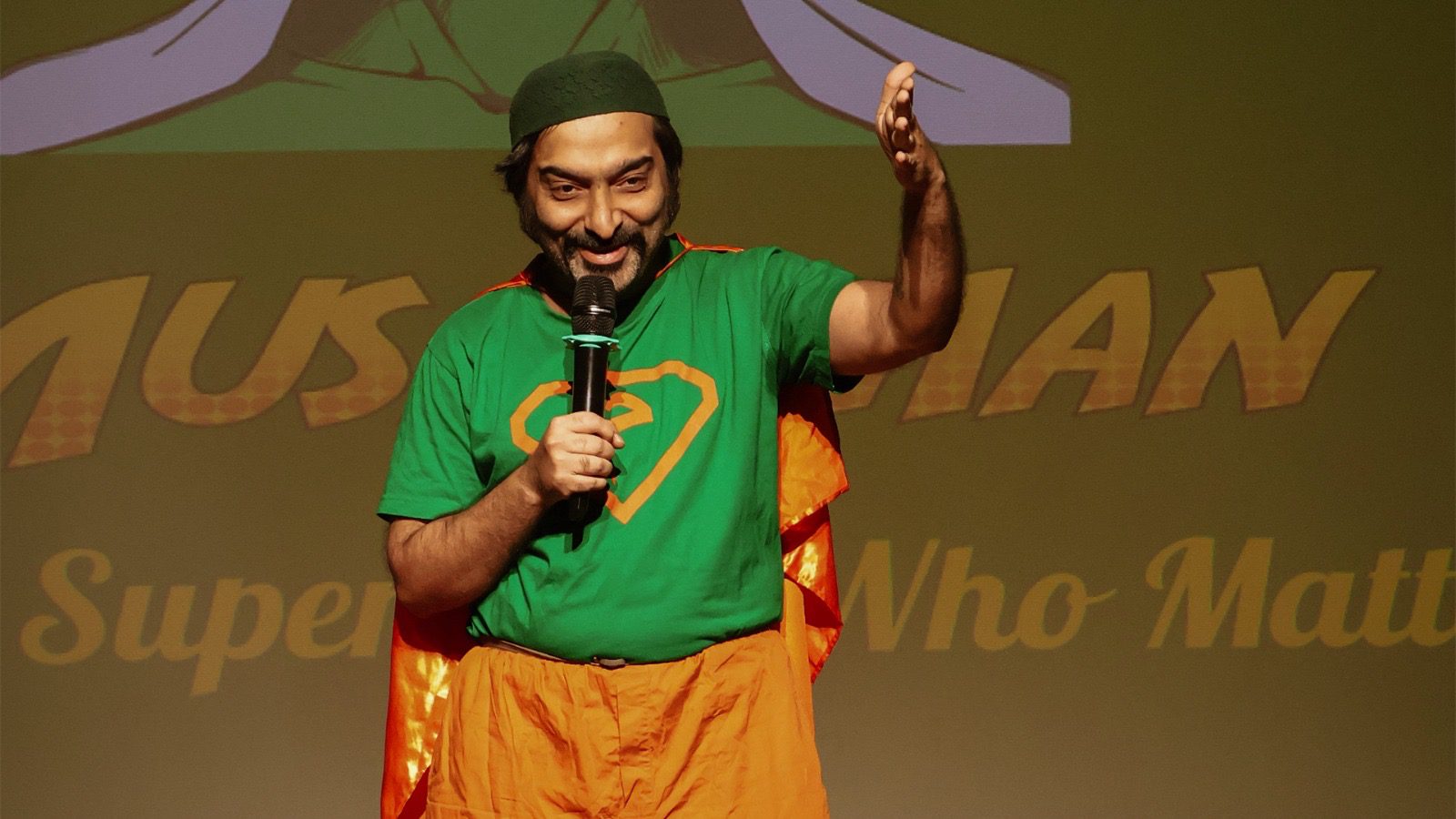
A non-violent Muslim superhero in a violent world: In conversation with Falah Faisal, creator of Musalman
In an increasingly polarised media landscape, Musalman has emerged as a work that blends satire, journalism, and modern mythology. Created by Bangalore-based comic book writer and stand-up comic Falah Faisal, the series has now taken a definitive step into print with the launch of its Graphic Novel in March 2026. Published by Yoda Press, the book carries forward a project that began in 2017 and has since grown into a sharp form of political commentary, using humour and cinematic visual storytelling to question dominant narratives and imagine a way forward.
The Musalman Universe, as described on its official website, is a satirical superhero world built around a non-violent, skullcape-wearing hero navigating a nation marked by Islamophobia and everyday absurdities. At its center is Musalman, a cricketer-turned-superhero who chooses reason and dialogue over violence, reframing what heroism looks like.
The world around him expands through a range of disruptive characters: Starwoman, an astronaut fused with the spirit of David Bowie after a space accident, whose connection to Musalman is rooted in childhood; Musalman X, emerging from Chicago and inspired by Malcolm X, who imagines a global network of Muslim superheroes; Begum Badass, a burqa-clad vigilante shaped by personal loss who turns to martial skill and deception in pursuit of justice; and Falahdeen, also known as Harami No. 1, a stoner anti-hero who discovers a genie in his bong and operates as a chaotic, irreverent counterforce within the narrative. Presiding over this world is Taana Shah, the dictatorial ruler of Antim Pradesh, driven by a prophecy that foretells his downfall at Musalman’s hands, making him not just an antagonist, but a figure shaped by fear, control, and the inevitability of fate.
To understand when Musalman stopped being just an idea and became a necessity, Falah Faisal traces its origins back to September 11, 2017. “At the time, it was sporadic, something I returned to occasionally. That urgency only emerged later, during the CAA protests, when the political climate sharpened my awareness of who was suffering, who was being oppressed, and what was at stake. When the protests gave way to lockdown and people were confined indoors, the need for expression only intensified. It was then that Musalman became essential.”
The way he approaches comics cannot be separated from his filmmaking background. Musalman, in his mind, was always a film first. Like Martin Scorsese suggests about cinema, learning comes from watching and absorbing how stories are constructed. For him, comics operate similarly. Each narrative plays out as moving images in his head, broken down frame by frame, with transitions that often feel distinctly cinematic. The question of whether Musalman is a political act is, for him, inseparable from another: it is also a form of journalism. Having studied and practiced journalism, he now sees the comic as an alternative to mainstream avenues that feel increasingly closed. Drawing from Hunter S. Thompson, he treats it as Gonzo Journalism, documenting reality through fiction, where truth can sometimes emerge more sharply than through facts alone. Humour, then, becomes more than a tool; it becomes survival. In a climate where one can feel constantly targeted, laughter functions as a form of resistance. Refusing to take oppressive forces seriously and laughing in their faces is, for him, a form of rebellion.
If there is one thing he refuses to do, it is censor himself. “The work must be put out exactly as I see it, without dilution or fear,” he says. At the same time, he is conscious of the conversations the comic might provoke, especially among those who disagree with it. “Art, for me, should function as a bridge.” Falah’s influences remain foundational. He puts it,“If the character’s beginnings lay in satire or something closer to irreverent humour, they were shaped early on by influences like South Park. Over time, however, the work evolved into something more pointed, a form of political commentary that reacts to the world in real time. It became a way of interpreting reality and imagining a way forward through it. It remains satire, but also, in his words, a vision for a better world. Alan Moore’s Watchmen and V for Vendetta shaped my understanding of flawed heroes and enduring ideas. Early works borrowed from these influences before evolving into something more personal. Drawing on Grant Morrison’s idea that there is no “us and them,” only “us,” I hope readers begin to question what they have been told, particularly by mass media. The contradictions are already there in everyday life; the work simply brings them into focus.”
But can satire still function when reality itself feels absurd? He acknowledges the difficulty. He observes,“Sometimes the fictionalised versions of real figures behave more sensibly in his comics than their real-world counterparts, such as his character Arnab Cowswamy, drawn from the TV anchor whose on-screen histrionics are legendary. In that sense, the comic becomes a way of restoring coherence to an increasingly chaotic reality.” Humour remains central, not just for commentary, but for connection. It softens difficult truths, makes them easier to engage with, and, at a personal level, “helps stay sane”, he says. Yet he is aware that humour can also be risky. Anything that speaks truth to power, especially in a political context, carries consequences. And still, he insists, that risk is necessary.
The Musalman character itself is designed to challenge expectations. He explains, “Musalman is non-violent, choosing humour and dialogue over confrontation. Even his origin complicates identity, as he is revealed to be a descendant of Ram, embodying both Hindu and Muslim lineages. In doing so, the character questions the idea of fixed identities and counters narratives that frame communities as outsiders.” When it comes to building characters, especially in a genre as saturated as superhero fiction, he sees limitations as well as possibilities. Most powers, he believes, have already been explored over the past century, which is why many of his characters are amalgamations of existing archetypes. “Musalman himself carries shades of Superman, but the real innovation lies elsewhere. The villains are not just individuals but representations of systems and ideas. Drawing from mythology and real life ensures they remain complex rather than caricatured. Figures like Taana Shah embody authoritarian ideologies, while characters like Chairman Maose critique corporate entities such as The Walt Disney Company and Marvel Cinematic Universe. Together, they map a world shaped by both political and corporate power,” he adds.
Is Musalman a person or a symbol? “For me, Musalman is an idea, and ideas are bulletproof. Even if the creator were silenced, the character could endure. I imagine him as a beacon, a lighthouse for those who feel alienated, offering a sense of belonging”, says Falah. For Musalman himself, the greatest fear is not defeat but ineffectiveness, the inability to intervene in real-world crises. Falahexplains, “This tension feeds into a larger ambition: the creation of a modern mythology. Influenced by Joseph Campbell and The Hero with a Thousand Faces, I seek to bring together elements from multiple traditions, Hinduism, Islam, Christianity, and Judaism, into a shared narrative. The aim is not to erase differences but to reveal the common ground that already exists between them.” His storytelling process reflects this approach. To him each story is part of a jigsaw puzzle he’s putting together piece by piece, and only he sees the larger picture. Once finished, you’d have to step back to marvel at how it all came together.
Despite its possibilities, he observes that comics are undervalued in India. Yet their strengths, he argues, are unique. As he puts it, “unlike film, comics allow the reader to control time, to linger, revisit, and interpret at their own pace. They also enable expansive storytelling without the constraints of budget.” Even without financial limitations, he would continue working in comics, seeing them as the foundation of visual storytelling.
That visual freedom is realised through his collaboration with his illustrator. The collaboration with his illustrator, Spud, began in November 2019 at a meetup for illustrators and comic writers in Bangalore organised by Sumit Kumar from Bakermax. As introductions went around, he mentioned that he created Musalman, prompting a loud laugh from across the room. Curious, he later sought Spud out and, after seeing his sketchbooks filled with detailed drawings, felt an immediate fit. What followed has been a close collaboration, with Spud’s visual interpretations not only shaping the comic but also pushing the writing to evolve. Over time, the partnership became one of mutual growth.
In the world of Musalman, there’s a character who carries the creator’s name, Falahdeen. For Falah Faisal, Falahdeen operates as a counterpoint to Musalman. If Musalman represents the superego, Falahdeen embodies the id—the space of impulse, desire, and immediate gratification. He draws from his own inner world, shaping the character out of his deepest anxieties and desires, but allowing those instincts to play out more freely. “In the story, he finds a genie and wastes his first two wishes on Everlasting Joints. For the third, he’s given a trial period where he can wish for anything and undo it if he wants. But the genie always gives him the worst possible version of whatever he wishes for. If he becomes a rockstar, his music antagonises the right wing and they come after him. If he legalises weed, it leads to corporate control and manipulation. It’s always the worst version of the desire,” he says, describing the character as one that exists in the tension between impulse and consequence. Over time, however, he adds that he has begun to approach Falahdeen with a certain softness, allowing the character a more compassionate arc.
Audience responses have continually reshaped his understanding of the work. From a nine-year-old who painted a Musalman’s Meem symbol on his T-shirt to meet him, to older readers who have followed the series from the beginning, the range has been unexpected. His work has resonated across generations. This also raises the question of responsibility. “In a deeply polarised world, I hope Musalman can reflect a more inclusive past, one where communities coexisted more fluidly, and offer that vision to younger readers,” he says.
Musalman, for Falah Faisal, remains an ongoing inquiry. When asked about his idea of success, he moves away from conventional metrics. “It is not measured in likes, shares, or sales, but in those rare moments when fiction seems to echo reality, when ideas spill beyond the page and into the world. Success might also take the form of a feature film adaptation or the possibility of influencing real political change. Ultimately, it lies in endurance, in the idea continuing to exist, resonate, and shape the world in small, unexpected ways,” he concludes.
source: http://www.maktoobmedia.com / Maktoob Media / Home> Literature> Bookshelf> Features / by Ashika N / April 09th, 2026
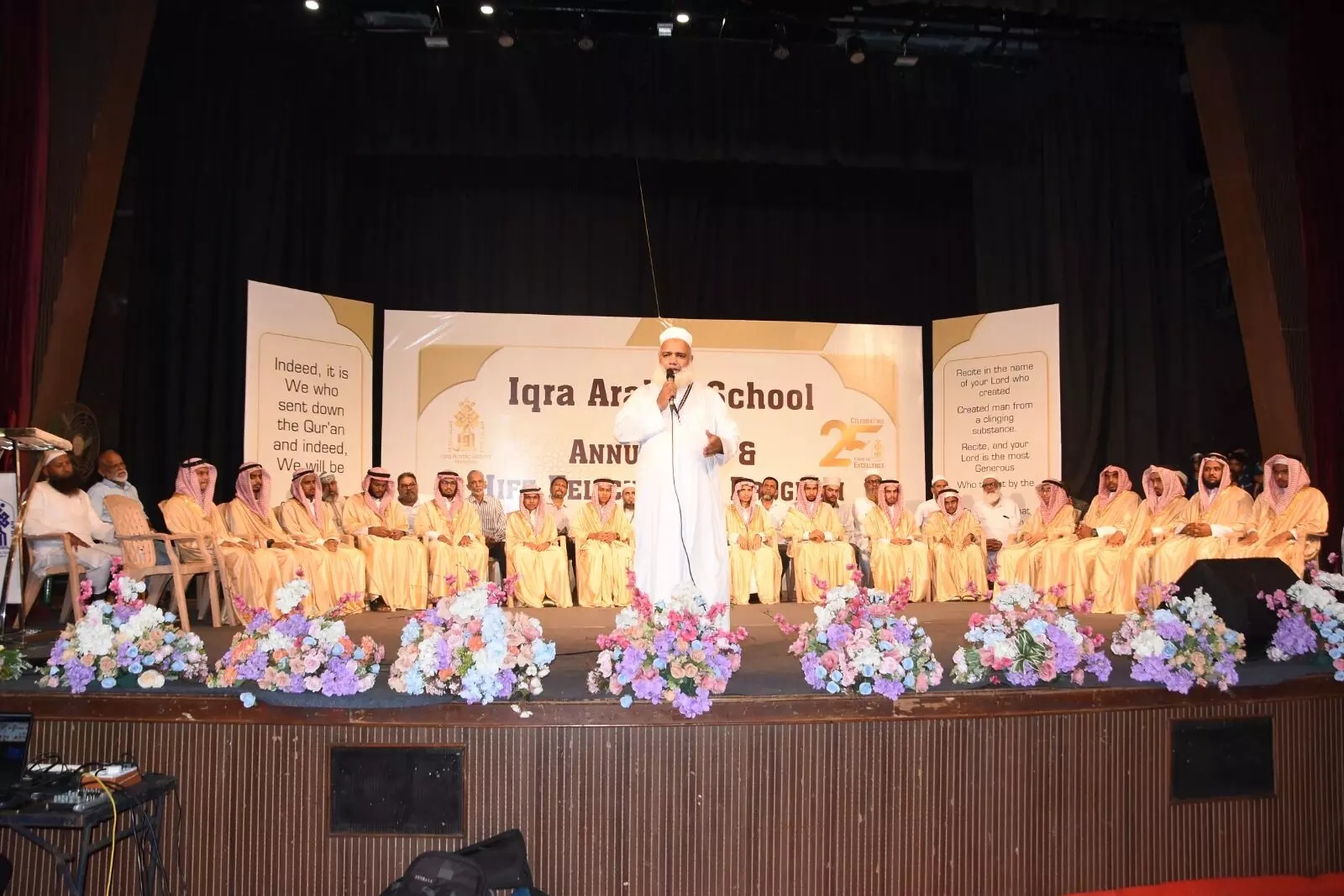
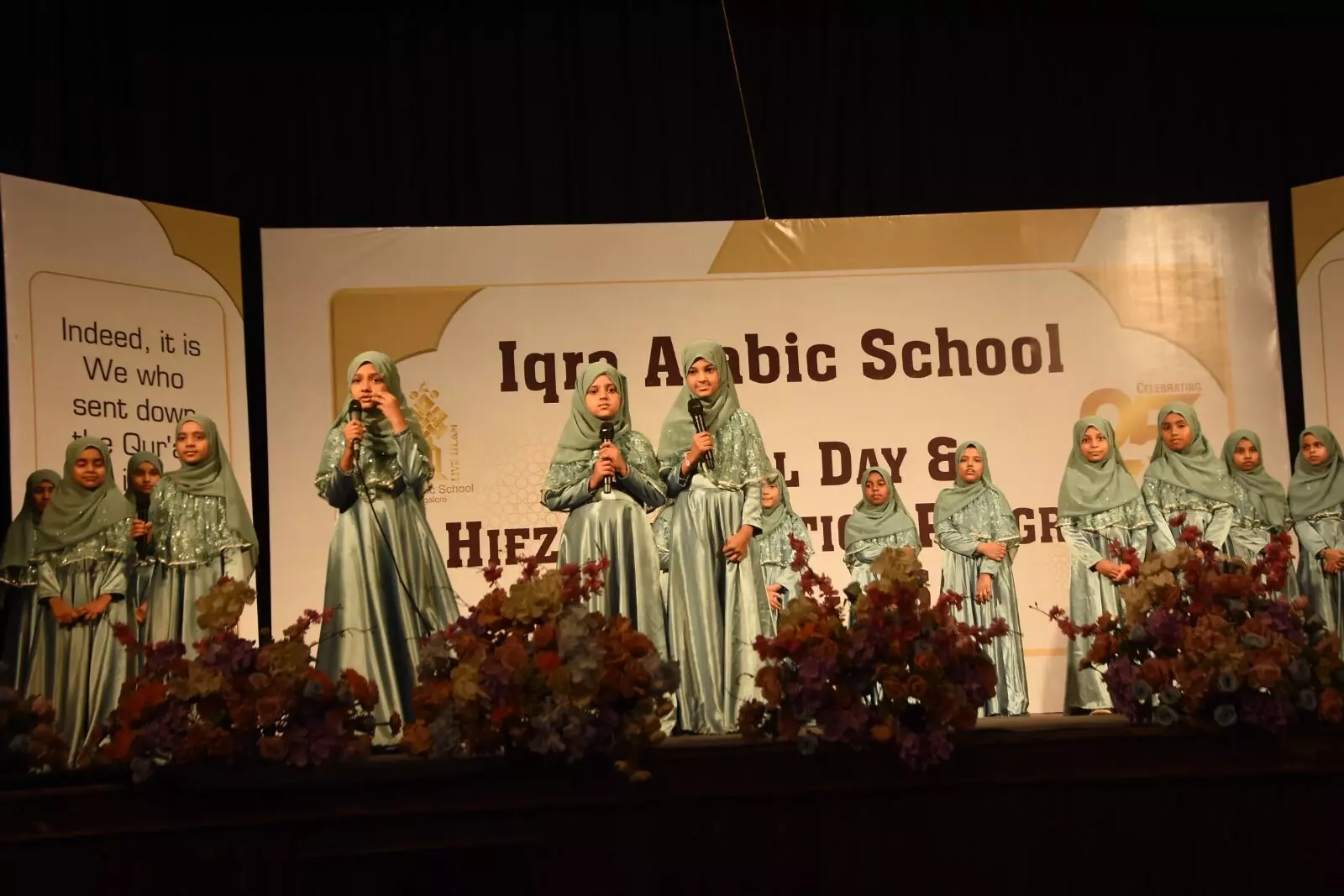
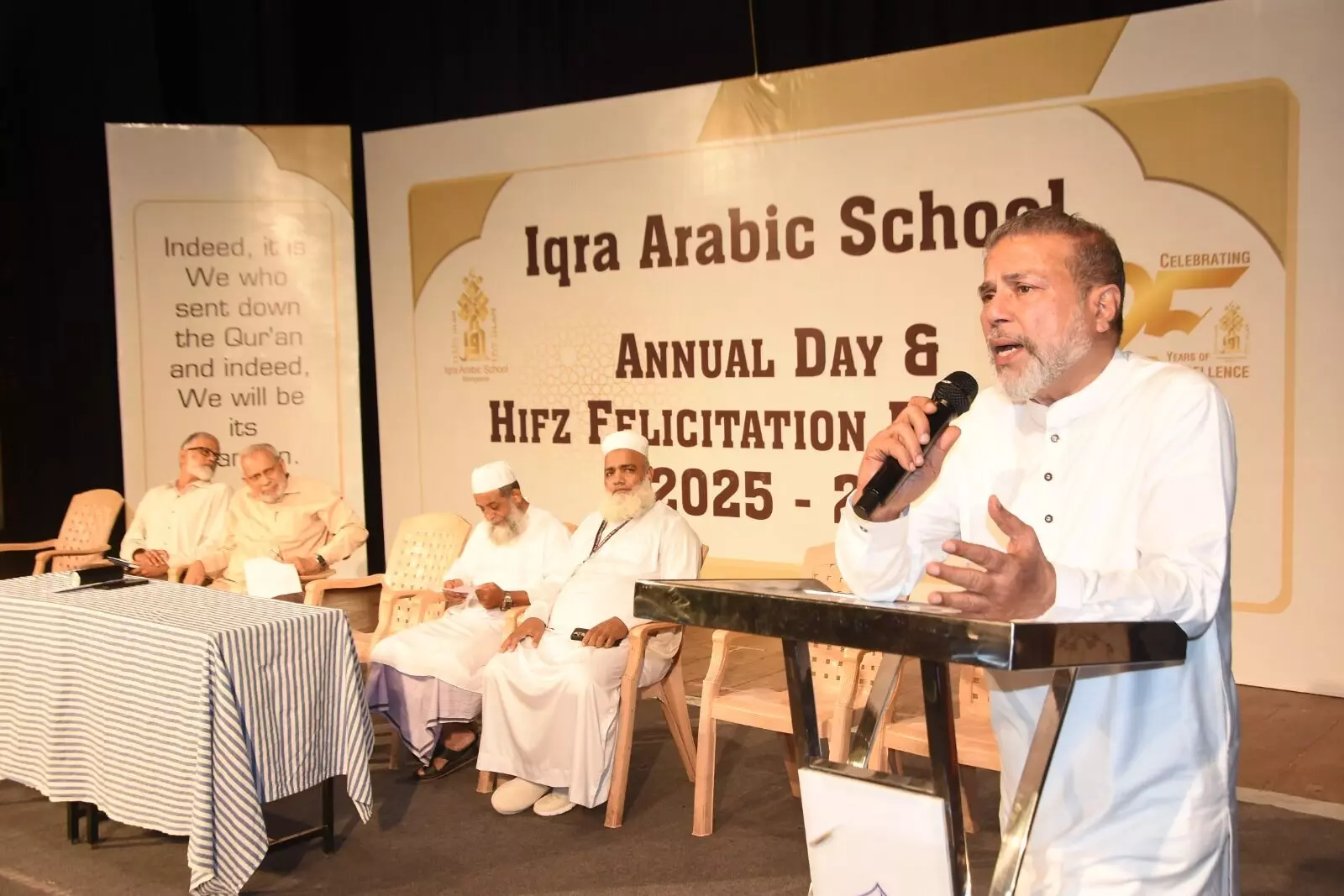
“The aim of Iqra is to create leaders for the community,” said Syed Mohamed Beary while presiding over the Annual Day 2026 and Hifz felicitation programme of Iqra Arabic School, highlighting the institution’s focus on leadership and long-term community development.
Presiding over the event, Syed Mohamed Beary, Chairman of the Moulana Abul Hasan Ali Nadwi Educational and Charitable Trust, Mangaluru, spoke at length about the journey of the institution since its launch in 2000. He recalled the early days of the school and said it was started with a clear vision to serve the community through education rooted in values. He expressed pride in how the institution has grown over the years, both in strength and in its role within the community.
He said Iqra Arabic School was not built only to provide basic education, but to nurture individuals who can take responsibility and guide society. According to him, the institution has consistently worked towards shaping students into capable leaders who can face present-day challenges while staying connected to their roots. He stressed that the focus has always been on building character along with knowledge.
The programme was compered by Moulana Farhan Nadwi, who introduced the vision of the institution and said the school strives to prepare leaders and scholars who can respond to modern challenges faced by the community.
Chief guest Moulana Maqbool Kobatte, Principal, Jamia Islamia Bhatkal, congratulated the students and their parents for completing the memorisation of the Qur’an. He said these Huffaz are part of Allah’s promise of preserving the Qur’an until the Day of Judgement. He described the Qur’an as a guide for life and said while recitation is important, it is equally necessary to practise its teachings. He also noted that in the race for worldly success, people are moving away from values such as humanity, brotherhood and unity.
Taha Mateen, Chairman and Managing Director of ACURA Speciality Hospital, said the community should not forget its Islamic roots and history. He recited lines of poetry by Iqbal: “Kabhi ae nawjawaan Muslim tadabbur bhi kiya tu ne, wo kya gardu tha tu jiska hai ek toota hua taara.” He stressed the need to understand the Qur’an and recognise its importance, and urged students to continue learning across different fields without stopping at any stage. He congratulated the students, parents and the management.
Dr. C P Habeeb Rahman, Chairman and Managing Director of Unity Health Complex, Mangaluru said there is a need for introspection within the Muslim community to understand what has gone wrong and why it has fallen behind despite contributing to global civilisation. He also spoke about the lack of leadership within the community.
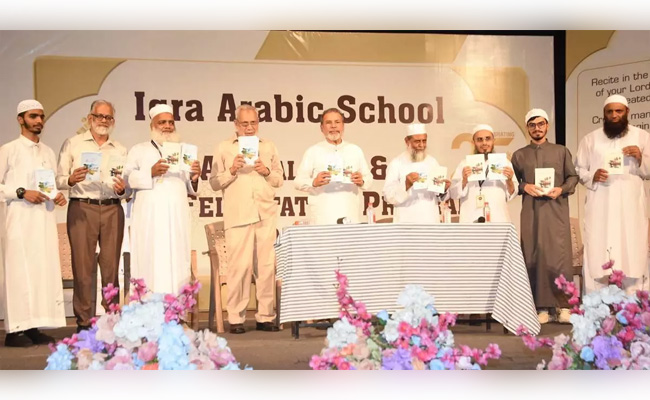
Students presented cultural programmes based on Islamic teachings during the event. Two of the books authored by the students of the institution were also released during the event.
A total of 18 students who completed Hifz this year were felicitated and presented with mementos by the guests. The programme concluded with a vote of thanks by Moulana Salim Khalifa, the principal of the institution.
source: http://www.english.varthabharati.in / Vartha Bharati / Home> Karavali / by Vartha Bharati / April 21st, 2026
A teenager rescued a 10-year-old boy who was being swept away by strong waves at Someshwara Beach, police said on Sunday.
The incident occurred on Saturday evening.
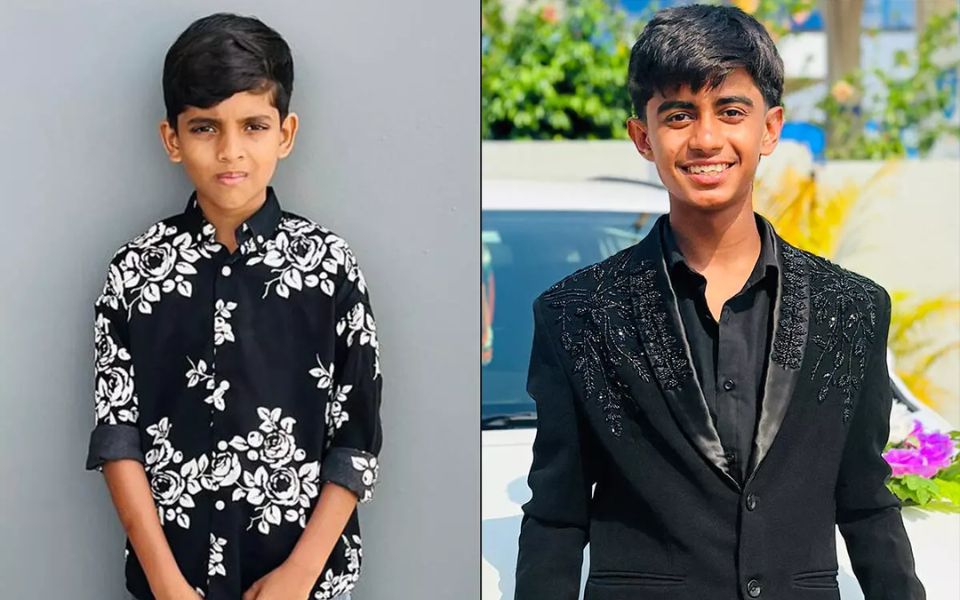
According to officials, Muhammad Arshaman (10), a resident of Vitla Megginapete, had come to the beach with his family when he was caught in a strong current. Noticing the situation, Muhammad Ismail Faiz (16), son of Ashraf from Mudipu, immediately jumped into the sea to rescue him.
Faiz battled the waves for about 10 minutes before managing to bring the boy to safety.
Following the rescue, Faiz became exhausted and briefly lost consciousness. He was later admitted to a private hospital in the city and is recovering.
Arshaman is also reported to be out of danger, police said.
Faiz recently passed the SSLC examination and secured second place in a state-level karate competition.
Both Arshaman and Faiz are relatives and had visited the beach with their families when the incident occurred.
Local swimmers also assisted in the rescue after being alerted.
Faiz said that he knew how to swim, which gave him the confidence to attempt the rescue.
source: http://www.english.varthabharati.in / Vartha Bharati / Home> Karavali / by Vartha Bharati / April 26th, 2026
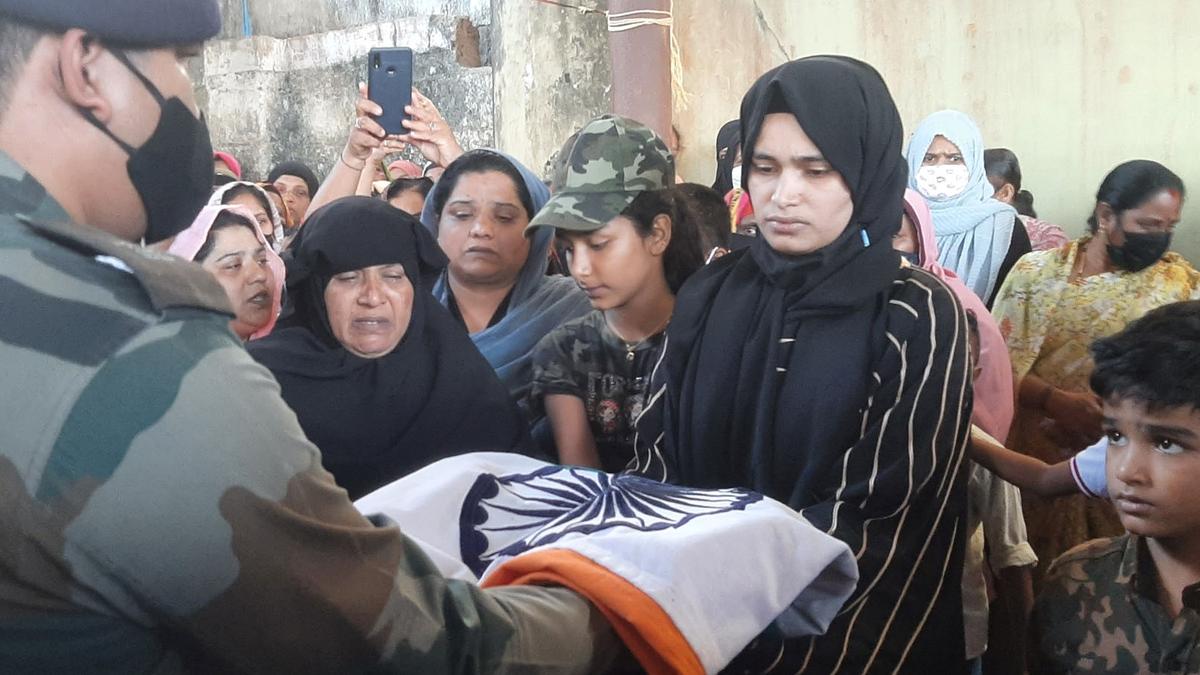
Army personnel handing over the tricolour to the wife of Hawaldar Althaf Ahmed, who died in Kashmir on February 22. | Photo Credit: Special Arrangement
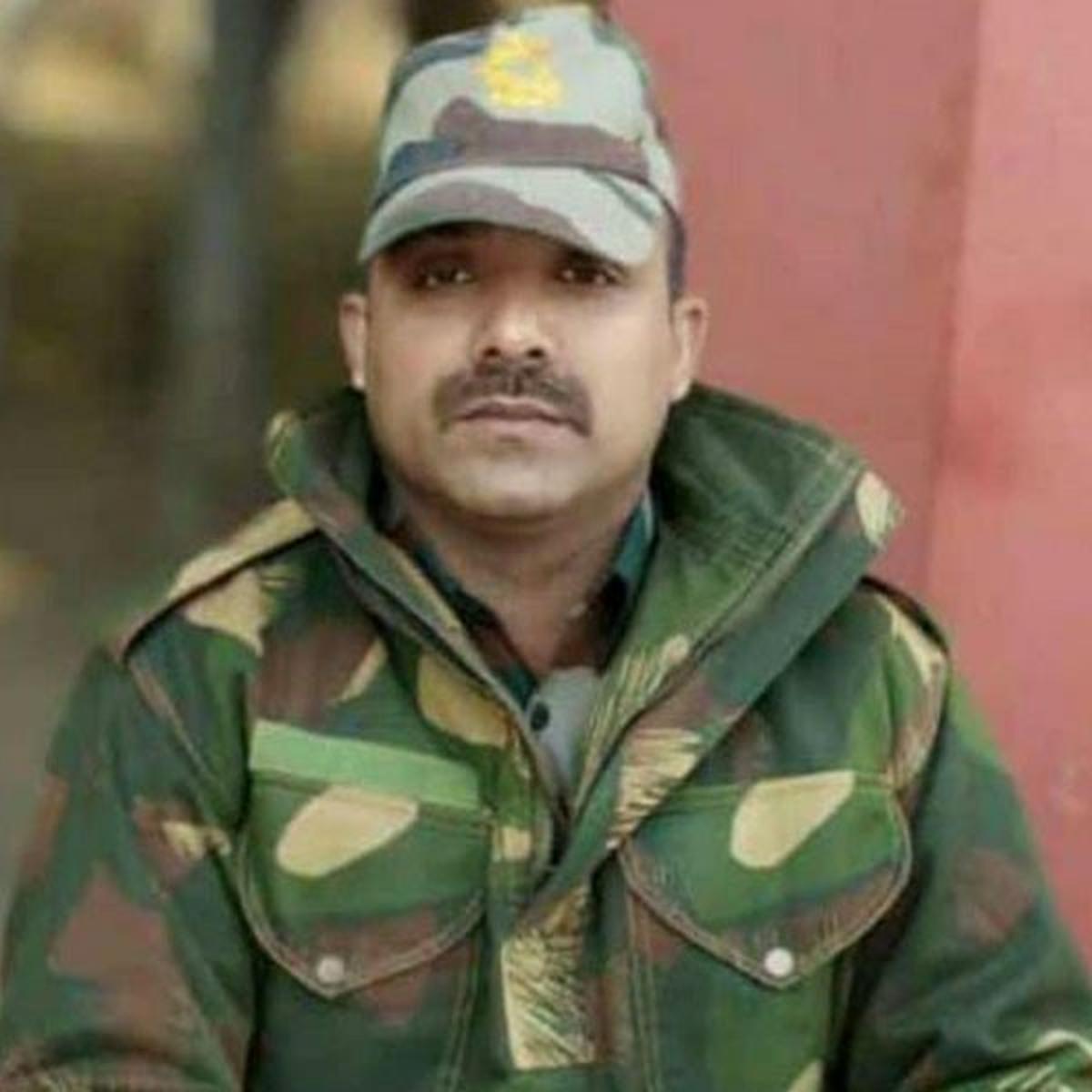
Althaf Ahmed | Photo Credit: Special Arrangement
The last rites of 37-year-old Indian Army Hawildar Althaf Ahmed, who died in a blizzard while on duty in Kashmir, were performed in his native in Meenupete in Kodagu district’s Virajpet taluk with state honours on Saturday.
The body of Althaf Ahmed, who had died on February 22, arrived in his native in Kodagu early on Saturday as its departure by air from Srinagar was delayed owing to bad weather. The body was kept at Eidgah Maidan in Meenupete for the public to pay their last respects before it was laid to rest at the burial ground as per Islamic rituals.
Virajpet MLA K.G. Bopaiah, MLCs Suja Kushalappa and Veena Achaiah, besides Deputy Commissioner B.C. Satish, Kodagu Superintendent of Police M.A. Aiyappa and other senior officials of the district administration were among the large number of people, who paid their last respects.
According to sources, Althaf Ahmed grew up in Meenupete and completed his SSLC in St Anne’s School in Virajpet and Pre University Education at the Virajpet Government Junior College. He later joined the Army Ordnance Corps (AOC) regiment. He had been serving the Army in various places since the last 19 years.
While guarding the border in Kashmir, Althaf Ahmed was caught in a blizzard on February 22 and died.
After the ceremonial gun salute during the funeral of the martyred solider, Army personnel handed over handed over the tricolour that draped Althaf Ahmed’s body and his uniform to his wife and two children. He leaves behind his mother, wife, a son and a daughter.
source: http://www.thehindu.com / The Hindu / Home> News> India> Karnataka / by Special Correspondent / February 26th, 2022