Former Jammu and Kashmir chief minister and National Conference vice president Omar Abdullah condemned the attack.
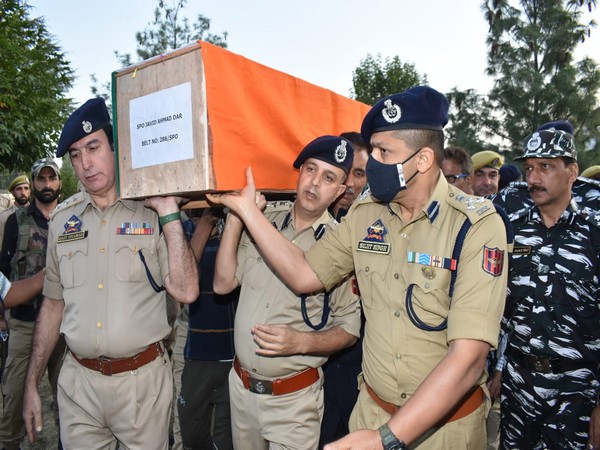
Wreath laying ceremony held for SPO Javaid Ahmad (Image/ANI)
Srinagar :
A policeman was killed and a CRPF personnel injured when militants attacked a security forces team in Pulwama district of Jammu and Kashmir on Sunday, police said.
The attack took place in Pinglana area of the south Kashmir district.
“Terrorists fired upon a joint Naka party of CRPF & Police at Pinglana, Pulwama. In this terror attack, 01 Police personnel got martyred & 01 CRPF personnel got injured,” Kashmir Zone Police said in a tweet.
The police said reinforcements were rushed to the area and a search operation was launched.
A police spokesman identified the slain policeman as Javid Ahmad Dar.
He said the injured CRPF personnel was evacuated to a hospital for treatment.
Senior police officers along with reinforcement reached the terror crime spot, the spokesman added.
“We pay our rich tributes to the martyr for his supreme sacrifices made in the line of duty. We standby the family of the martyr at this crucial juncture and pray for the speedy recovery of the injured personnel,” the spokesperson said.
Police has registered a case, the investigation is in progress and officers are working to establish the full circumstances of this terror crime, he said.
The area has been cordoned off and a search is going on there, he added.
Meanwhile, former Jammu and Kashmir chief minister and National Conference (NC) vice president Omar Abdullah condemned the attack.
“While condemning this attack I send my condolences to the family of the J&K police personnel who laid down his life in the line of duty today. I also send my best wishes for the speedy recovery of the injured CRPF personnel,” Abdullah wrote on Twitter.
The Peoples Conference too condemned the attack.
“We strongly condemn the militant attack upon the joint naka party of Police & CRPF at Pinglana (Pulwama) in which 1 Police personnel lost his life & 1 CRPF personnel got injured. Heartfelt condolences & sympathies with the family of the deceased and prayers for the injured,” it said in a tweet.
source: http://www.newindianexpress.com / The New Indian Express / Home> Nation / by PTI / October 02nd, 2022 / (image edited by ANI )
Nine soldiers from the Indian Army’s Force K6 died in the area after fighting with the British in World War I and II.
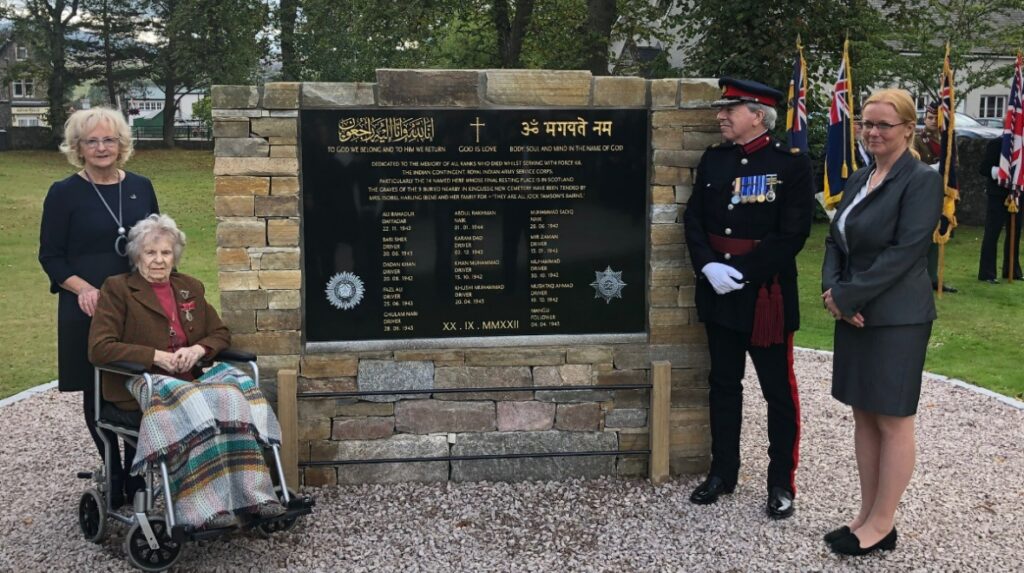
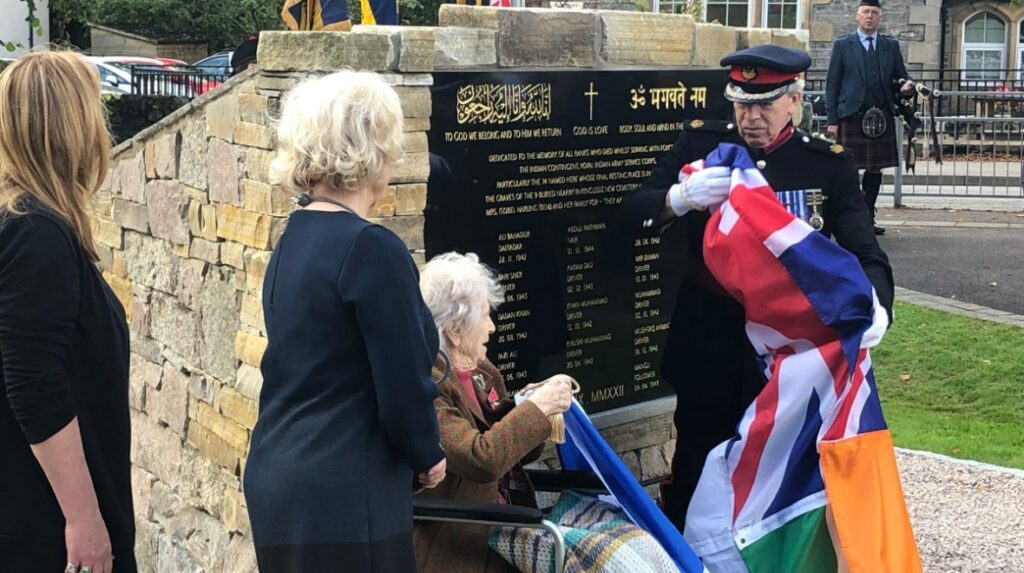
Monument: The memorial to the nine soldiers has been unveiled in Kingussie.
A memorial has been unveiled to commemorate a band of war heroes who served with the Indian Army and perished in the Scottish Highlands.
Nine soldiers were buried at a cemetery in Kingussie. The new monument stands prominently in the centre of the town.
People came from all corners of the UK for a pilgrimage to honour the men.
The Indian Army’s Force K6 was a transport unit that used mules to deliver vital supplies to frontline troops. It was despatched to various UK destinations.
The nine soldiers who died during training in the Cairngorms are remembered on the new stone-built tribute.
Among those attending the unveiling was 99-year-old Isobel Harling from Kingussie who had served in the Navy.
Isobel Harling tended the men’s graves for more than 70 years.
She tended the men’s graves for seven decades, influenced by kindly people who had done the same for her brother after he was shot down in Belgium.
Nasim Azad of the Muslim Council of Scotland, who travelled from Edinburgh for the ceremony, was thrilled to have met Isobel.
Ms Azad said: “She decided to take it upon herself to care for them with love but for no return – no return – for 70 years.
“For 70 years she took care of those graves, so it’s an absolute honour to have met such a wonderful, wonderful lady.”
Also attending the multi-faith event was Asif Hassan Sheikh of the Scottish Ahlul Bayt Society.
He said: “Thank you Scotland for looking after these sons who served so faithfully and gave their lives for the cause.”
Puneet Dwivedi of Hindus In Scotland said: “It’s very important to recognise the efforts of the soldier who gave their life for world peace.
“And I’m really impressed with Highland Council and the community here who built this memorial.”
He added: “It’s a changing world and this shows that all colours of people are the same and they’re honoured for their work.”
Memorial project officer Heather Taylor said: “The design was based on pulling together several aspects of faith, hope and charity – the charity that Isobel has shown, the hope that we have for the future tomorrow and the faiths that are represented here today.
“We’ve got an Islamic inscription from the Qur’an. We’ve got a Christian inscription and we’ve also got representation from the Hindu faith as well – all brought together under Isobel’s guidance.”
The men laid to rest at Kingussie New Cemetery are Ali Bahadur, Bari Sher, Dadan Khan, Fazl Ali, Khan Muhammad, Khushi Muhamm, Muhammad, Muhammad Sadiq and Mushtaq Ahmad.
The black granite stone monument is the UK’s first permanent memorial to all ranks of Force K6. It was engraved and adorned with gold leaf by Inverness monument makers Andrew Stewart and Son Ltd.
Craftsman Marc Bruce from Aviemore chose Indian sandstone and mixed shades of locally sourced Cairngorm granite.
Kingussie’s Am Fasgadh Regeneration Company was awarded £20,706 through a Highland Council investment programme to put towards the match-funded Force K6 memorial project.
Isobel Harling was awarded a British Empire Medal for her dedication.
Force K6 came from across India including the country now known as Pakistan.
They arrived in France in 1939 – with their mules – to provide animal transport for the Allies.
During Hitler’s infamous ‘Blitzkrieg’ one company was captured in Gerardmer. The others were evacuated with the British Expeditionary Force from Dunkirk and other ports.
After postings in England and Wales most of the companies ultimately arrived in the Highlands.
The 51st Highland Division remained with the French 9th Army to attempt to deny and delay Rommel’s advancing troops from further gains.
From June 1942 they had several camps in Badenoch and Strathspey from where they supported winter warfare training in the Cairngorm mountains.
The soldiers were popular in the local communities, helping on farms, playing with children, sharing cultural cuisine and demonstrating their flair for horsemanship.
After postings to other locations in the Highlands, they returned to India by early 1944.
Fourteen of the Force K6 men died in Scotland.
For outstanding duty in France, members of Force K6 received an MBE, an Indian Order of Merit, three Indian Distinguished Service Medals and one mention in despatch.
The British Indian Army contributed 1.5 million servicemen in World War I. A total of 74,000 died and up to 100,000 were injured.
In World War II, there were 2.5million service personnel – 87,000 of whom died and up to 150,000 were injured.
The soldiers were Hindu, Muslim, Sikh, Gurkhas, and Indian Christians.
source: http://www.news.stv.tv / STV News / Home> News> Highlands & Islands / by Iain Ramage / September 21st, 2022
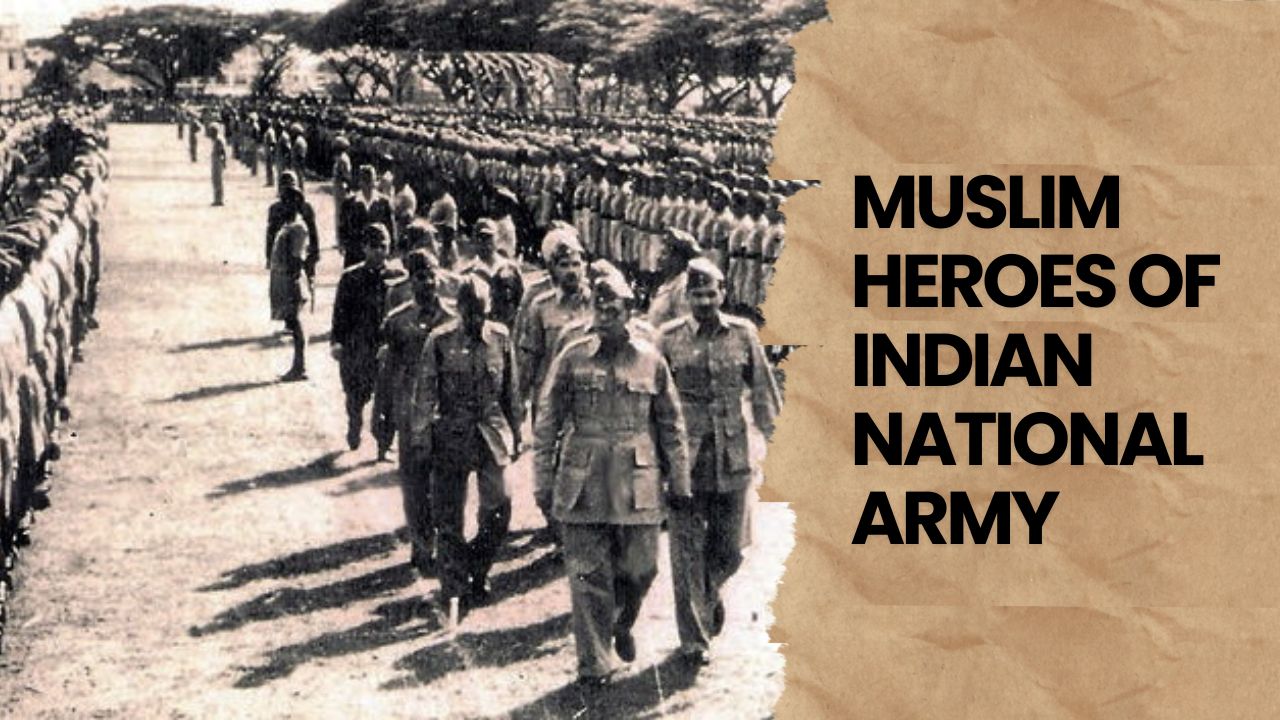
On this day, 80 years ago, in 1942, Rash Behari Bose founded the Indian National Army (INA) also known as the Azad Hind Fauj, which he later handed over to Subhash Chandra Bose. Rash Behari Bose continued to serve as the INA’s supreme advisor under Subhash Chandra Bose.
The Muslims of India, especially those settled in Rangoon and surrounding areas gave their lives and fortunes to the INA for the sake of the freedom of India. The efforts by Muslim soldiers and the business community at times made Subhash Chandra Bose praise them in unprecedented words. It’s a well-documented fact that numerous Muslim troops and officers are said to have received from Netaji the Tamgha-e-Sardar-e-Jang, Tamgha-e-Vir-e-Hind, Tamgha-e-Bahaduri, Tamgha-e-Shatru Nash, Senad-e-Bahaduri, and other decorations.
Following is the list of 12 such people who became legends due to their contribution and struggle in the INA.
Captain Abbas Ali
Freedom Fighter Captain Abbas Ali was born in Bulandshahar district of Uttar Pradesh on January 3, 1920. Abbas fought for the liberation of our country as a captain in the Indian National Army. Capt. Abbas was inspired by the speech of Subhas Chandra Bose in 1943 and decided to commit his life to our country’s freedom. Abbas was detained by the British Army and given a life sentence. But after India became independent, the death penalty was revoked. Captain Abbas Ali breathed his last on 11 October 2014 at Aligarh.
Abdul Habeeb Yusuf Marfani
Memon Abdul Habeeb Yusuf Marfani was a freedom fighter and businessman from the Dhoraji town of Saurashtra, Gujarat. On July 9, 1944, when Subhas Chandra Bose founded INA in Rangoon, Marfani was the first to come forward to contribute financially to the Azad Hind Bank. Soon, the box swelled with contributions from Indian expats in Rangoon and Singapore. Yusuf Marfani was so close to Netaji that he gave Rs 1 crore in cash and Rs 3 lakh in jewellery in 1944, which would be worth almost Rs 800 crore today.
Abid Hasan Safrani
Zain Al-Abdin Hasan was born to an anti-colonist family in Hyderabad on 11th April 1911. He became acquainted with Subhas Chandra Bose when the latter was addressing a meeting of Indian prisoners of war In Germany. Abid became Bose’s close aide and was given the title of a Major in the INA. On the suggestion of Abid, the INA adopted “Jai Hind” as its slogan. After independence, he joined the Civil Service in 1948 and retired as the Ambassador to Denmark in 1969. Aged 73, He passed away in 1984 in his hometown.
M.K.M Ameer Hamza
M.K.M. Ameer Hamza also known as Hamza “Bhai” was born on 22 January 1918 at Ramanathapuram, Tamil Nadu. Ameer Hamza was a member of Subhas Chandra Bose’s Indian National Army and a liberation fighter from Tamil Nadu. As a teenager, he travelled to Burma for trade and there he supported and donated millions of Rupees to INA. The British government detained and questioned him for supporting Netaji’s Army. In his final years, he suffered from poverty and struggled. On January 1, 2016, Ameer Hamza passed away.
General Shah Nawaz Khan
Azad Hind Fauj officer Shah Nawaz Khan was born in Rawalpindi, British India. He joined the INA after the arrival of Subhash Chandra Bose in South-East Asia. Shah Nawaz led the INA troops into North-Eastern India, capturing Kohima and Imphal, which were thereafter held by the INA under Japanese authority. He also created history by being the first Indian to hoist the Tricolor at Red Fort after taking down the flag of the British Empire. Post-independence Shah Nawaz was active in politics, elected four times Lok Sabha from Meerut.
Major General Mohammed Zaman Kiani
Major General Mohammed Zaman Kiani served in the British Indian Army before transferring to the Indian National Army (INA), under the command of Subhas Chandra Bose, where he oversaw the 1st Division. After graduating from the Indian Military Academy with the Sword of Honor, he enlisted in the Punjab regiment. His efforts to the Azad Hind were eventually recognised, and the Indian government posthumously gave him the Netaji Medal. He died on June 4, 1981.
Colonel Nizamuddin
Nizamuddin, whose birth name was Saifuddin, was born in 1901 in the village of Dhakwan (in the current Uttar Pradesh district of Azamgarh. Saifuddin left his house when he was in his early 20s and sailed from Calcutta to the metropolis to join the British army. While he was serving in the colonial army He overheard a British army general urging white soldiers to let the Indian sepoys die but to save the donkeys to carry food for the rest of the force. He shot the officer out of rage at the callousness and injustice of the comments and then fled to Singapore. Nizamuddin was employed as a driver of Subhash Bose, driving the leader everywhere. He also battled alongside Netaji in the forests of Burma between 1943 and 1944 against the British Army (now Myanmar). He was shot three times in 1943 after jumping in front of him (Netaji) and saving his life. He was given the nickname of “colonel” lovingly by Netaji himself.
Colonel Habib ur Rahman
Colonel Habib ur Rahman who co-founded Azad Hind Fauj alongside General Mohan Singh was put in command of the Administration branch at the organization’s headquarters. He oversaw a mission to Burma. Netaji was given the position of Officer in Charge of the Training School after taking over the command of the Azad Hind Fauj. He also took his oath as a minister on October 21, 1943, the day Azad Hind Sarkar was established. Later, he was also named the Deputy Chief of Army Staff, and on August 18, 1945, he accompanied Netaji on his last known trip.
Colonel Inayatullah Hasan
General Mohan Singh named Inayatullah Hasan as the director of Azad Hind Radio. He created well-known nationalistic radio plays that compelled All India Radio to air a competing storyline in India. Later, Netaji named him the head of the training division, where he instructed citizens, including women and children, in the use of weapons.
Colonel Shaukat Ali Malik
The first national flag to fly over free Indian land was flown by Colonel Shaukat Ali Malik. At Moirang in Manipur on April 14, 1944, Malik, the commander of the Bahadur Group of the Azad Hind Fauj, raised the flag. Moirang was the first region in India to be taken over by the INA and the first location on the Indian subcontinent that the Azad Hind Government controlled. Malik received the Sardar-e-Jung for leading his soldiers in this capture. After establishing a civilian administration, intelligence agents were dispatched inside enemy territory. One of the highest military honours of Azad Hind Fauj, the Tamgha-e-Sardar-e-Jang, was bestowed upon him by Netaji.
Colonel Mehaboob Ahmad
The connection between Azad Hind Sarkar and Azad Hind Fauj was Colonel Mehaboob Ahmad. He served as Major General Shahanwaz Khan’s counsellor throughout the campaigns in Arakan and Imphal
Karim Ghani
Before Netaji arrived from Germany, Karim Ghani, a Tamil journalist who resided in Burma, served as the leader of the Indian Independence League. He took an oath to serve as one of the six advisors when Azad Hind Sarkar was established. Karim Ghani served as Dr Ba Maw’s parliamentary secretary in Burma prior to the Second World War. He served as the manager of “The Muslim Publishing House,” the editor of the Malayalam daily Malayan Nanban, and the editor of the Malay edition of Dawn, under the name Sinaran, as president of the All Malaya Muslim Missionary Society (AMMMS) and a representative in a number of other organisations, Ghani was also active in the Muslim League.
Written by Talha Hussain Gulbargavi for Kalam Research Foundation.
source: http://www.thecognate.com / The Cognate / Home> History / by Talha Hussain Gulbargavi / September 02nd, 2022
Published by the Popular Front of India, “The Unsung Heroes of Indian Freedom Struggle” features the heroes and heroines who gave their blood and sweat for the country’s freedom, in brief but comprehensive illustrated biographies.
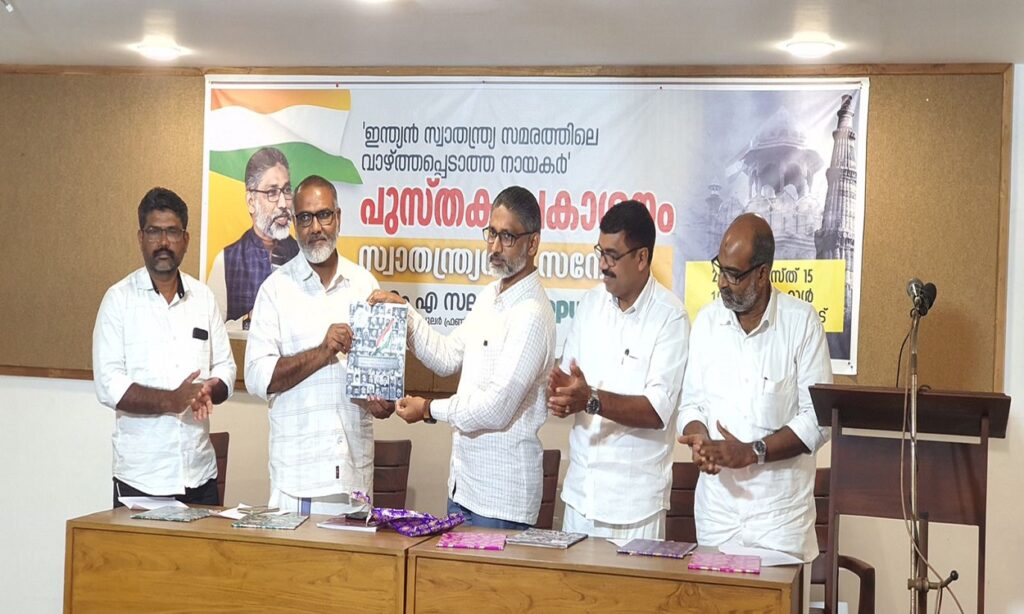
The book “The Unsung Heroes of Indian Freedom Struggle”, being released at a function in Kerala.
A book on lesser-known freedom fighters was released on August 15 in Kozhikode, Kerala.
The book features 75 heroes and heroines from the history of the Indian anti-colonial struggle, who gave their blood and sweat for the country’s freedom, in brief but comprehensive illustrated biographies.
Named “The Unsung Heroes of Indian Freedom Struggle”, the book, a befitting tribute to the 75th anniversary of India’s independence, was published by the Popular Front of India national committee as part of the organisation’s celebration of the 75 years of Independence.
Releasing the book at a function at IOS Hall, Meenchantha, Kozhikode, Popular Front of India Chairman O M A Salam said that the celebration of Independence Day should be about commemorating the legendary history of our forefathers who achieved freedom with their life and blood.
“It is not just a ritual to be performed. Celebration of the Independence Day should convey a message to society,” he contended.
Pointing out the attempts being made to distort the freedom struggle are rampant, he said, “Even the freedom fighters are being deliberately forgotten and erased from history through discrimination. At this stage, people must unite to reclaim the true freedom that we have lost.”
Expressing his deep anguish at the state of the nation, he said, “Even as India is growing, there is concern about the path the country is taking. The Sangh Parivar is trying to commemorate the partition of India as the entire country is celebrating Independence. The RSS says that Gandhi was behind the partition of India, and the BJP says that Mohammad Jinnah and Jawaharlal Nehru were behind the partition.”
He called on society should be vigilant against such sinister moves that spoil the spirit of the Independence Day celebrations.
Salam concluded his speech by extending Independence Day greetings to all countrymen.
Kerala state leaders Abdul Hameed, A Abdul Sathar, S Nizar, P K Abdul Latheef and K K Kabeer also addressed the gathering.
source: http://www.clarionindia.net / Clarion India / Home> India> Spotlight / by Clarion India / August 20th, 2022
“The Musalmans of India are, and have been for many years, a source of chronic danger to the British Power in India.” – W W Hunter, an English official posted in India, in his famous book ‘The Indian Musalmans’, published in 1871.
After 1947, Indian scholars wrote a ‘nationalist’ history of the Indian freedom struggle and for unknown reasons, they excluded Muslims. For the last seven decades, we have been reading a history of the Indian Freedom Struggle that has largely overlooked the contribution of Muslims. The generations brought up over this narrative believe that either the Indian Muslims were pro-British or aloof from the freedom struggle.
Such falsehoods propagated in the name of history should be challenged.
The British imperialism in India was resisted by the Indians right from its outset and the Muslims were the flag bearers of this resistance. The British took over Bengal administratively and economically after defeating the royal armies at the Battle of Plassey (1757) and the Battle of Buxar (1764). With their win over the Nawab of Bengal, the British started exploiting the Indians of Bengal province in an unprecedented fashion. Their ruthless loot resulted in a famine in 1770, which accounted for the deaths of one-third of the total population of Bengal.
No wonder the first popular national resistance to foreign colonial rule arose in Bengal. A united front of Hindu Sanyasis and Muslim Fakirs rose up in arms against the British. The man who led this fight was, Majnu Shah, a Muslim sufi from Kanpur (Uttar Pradesh). Majnu was a devotee of Shah Madar, Kanpur, and took up the cause of poor peasants on the advice of another Sufi saint, Hamiduddin. Almost 2000 Fakirs and Sanyasis, under his command, would loot the treasures of the British and British-backed landlords to distribute the money and food among poor exploited masses. From 1763 till his death in 1786, Majnu was the most dangerous threat to the British Empire in India. Fakir and Sanyasi forces killed several officers and soldiers of the British in guerrilla wars. After his death, Musa Shah took up the leadership of the movement. Hindu Sanyasi leaders, like Bhawani Pathak, were also there and fought alongside but the colonial records considered Majnu as the most threatening leader because under him Hindus and Muslims fought a united war. The ruthless British suppressed this movement a few years after the death of Majnu but the spirit of nationalism could not be killed.
The suppression of the movement led by Fakirs in Bengal did not mean that they accepted defeat. Fakirs changed their strategy and joined Marathas and other anti-British forces at the turn of the 18th century. The first major mutiny by the Indian sepoys of the English East India Company Army in 1806 at Vellore, which is said to be the inspiration behind 1857, was planned by Holkars, sons of Tipu Sultan and brother of Nizam of Hyderabad with the help of Fakirs. In every cantonment in South India, Fakirs propagated the message of nationalism through religious sermons, songs and puppet shows. When the revolt broke out at several places including Vellore the Indian revolutionaries were led by Fakirs like Shaikh Adam, Peerzada, Abdullah Khan, Nabi Shah, and Rustam Ali. Scholar Perumal Chinnian writes, “the Southern conspiracy was supported by Fakirs and other religious mendicants. The conspiracy was established in all the army stations by them.”
Within a few years, the British faced another challenge in the form of three distinct movements led by Syed Ahmad Barelvi, Haji Shariatullah and Titu Mir respectively.
Born in Uttar Pradesh, Syed Ahmad toured a large part of the country and gained followers in Bihar, Bengal, and Maharashtra. His followers took up arms against the British and its allies in the areas adjacent to Afghanistan. The movement posed a challenge to the British for decades. The British painted the movement as a work of religious fanaticism while in reality, Syed Ahmad tried to forge an alliance with Marathas against the foreign rulers. After he died in 1831, Enayat Ali and Wilayat Ali, both from Patna, took up the leadership of the movement. The wars they led in the frontier region caused the death of thousands of soldiers of the British army.
Haji Shariatullah and his son Dudu Miyan took up arms in Bengal to resist the tyranny of rich landlords. They led peasants to revolt against the indigo planters and other British agents. The movement they led is known as Faraizi movement.
Titu Mir also led a movement of poor masses against the British-backed landlords. He formed his army and set up a popular administration. In 1831, Titu was killed during a battle with the British. Hundreds of his supporters were arrested and hanged, including his deputy, Ghulam Masum.
Meanwhile, the Movement started by Syed Ahmad remained a grave danger to British rule in India. Enayat Ali, Wilayat Ali, Karamat Ali, Zainuddin, Farhat Husain, and others led an armed struggle against the British. In Patna, as soon as the news of the revolt of 1857 reached, all the prominent leaders were arrested before they could act. Still, Pir Ali launched a revolt in Patna. Though not a part of the larger movement himself the British believed that he had their support. Pir Ali, Waris Ali, and other Muslim revolutionaries were executed in Bihar during the revolt of 1857.
The First War of the National Independence of 1857 had a long history of planning behind it. In 1838, the English government arrested Mubariz ud-Daula for plotting a nationwide revolt against the foreign rule. The investigations revealed that Raja Ranjit Singh, Gaekwars, Satara, Jodhpur, Bhopal, Patiala, Rohilla Pathans, and several nawabs, rajas and zamindars had agreed upon the plan. Raja Ranjit Singh had actually sent his troops to help Mubariz and contacted Persian and French powers for help. The plan, because of a few traitors leaked out, Mubariz was imprisoned where he died in 1854 and the revolt took place two decades later.
The role of Muslims in 1857 is no secret. The unity of Hindus and Muslims in 1857 threatened the British like never before and they resorted to a policy of divide and rule after that. Maulvi Ahmadullah Shah of Faizabad, Fazl-e-Haq of Khairabadi, Imdadullah Muhajir Makki of Muzaffarnagar, and Azimullah Khan, an associate of Nana Saheb, were prominent in propagating the need of taking up the arms against the colonial rule. For years before 1857, they were propagating these ideas among sepoys as well as civilians.
In Bihar, Kunwar Singh was leading the revolt of 1857. Zulfiqar was one of his most trusted comrades with whom Kunwar was discussing every plan. After liberating Arrah the civil government installed by Kunwar had his most trusted allies and there were several Muslims. The government had “Shaikh Ghulam Yahea as Magistrate. Shaikh Muhammad Azimuddin, an inhabitant of Milky Tola in the town of Arrah, was appointed Jamadar (treasurer) of the eastern thana: Turab Ali and Khadim Ali, sons of Dewan Shaikh Afzal, were made Kotwals (Police officers in charge of a city)”
The revolt did not succeed. Bahadur Shah was exiled to Burma, several were hanged and many more were transported for life to Andamans. But, the zeal for freedom did not die.
In 1863, tribals in North West Frontier Province stormed the British territories and entered into a war. The British, though registered a victory, had to face one of the stiffest military challenges. They lost more than a thousand of its English soldiers. Intelligence reports pointed towards a financier in Ambala. The man was Jafar Thanesri. During the raid police found several letters which established him as the principal financier of the war in NWFP. He channelled money, men and arms from different parts of the country to the war front. Yahya Ali of Patna and nine others were also charged for waging the war against the Queen. What followed was a series of arrests and trials across India.
People were arrested in Ambala, Patna, Malda and Rajmahal. Ahmadullah, Yahya Ali, Jafar, Ibrahim Mandal, Rafique Mandal and others were arrested and transported to Andamans. These revolutionaries celebrated martyrdom over life, hence the British decided not to hang them but to send them to the Andamans. In 1869, Amir Khan and Hashmat Khan were arrested in Kolkata. Norman, the Chief Justice, sentenced them to the Andamans. The sentence was avenged by Abdullah by assassinating Norman in 1871 and after a few months Sher Ali killed the viceroy, Lord Mayo, in the Andamans.
Bipin Chandra Pal, in his autobiography, credited these trials and killings as an important influence on his political career. Another famous revolutionary, Trailokya Chakravarty, noted, “the Muslim revolutionary brothers gave us practical lessons of unbending audacity and inflexible will and also advice to learn from their mistakes”.
In Maharashtra, Ibrahim Khan, a Rohilla leader, and Balwant Phadke launched a guerilla war against the British. They provided a tough resistance through the 1860s and 70s, and threatened the British in south India.
Meanwhile, in 1885, Indian National Congress (INC) was formed to voice the apprehensions of the emerging educated middle class. Badruddin Tayyabji and Rahmatullah Siani were two of the earliest members and presidents of Congress. Later on, M.A Ansari, Hakim Ajmal Khan, Hasrat Mohani, Abul Kalam Azad, and others remained associated with the largest political outfit of India.
In 1907, peasants in Punjab started agitation against the canal colonies. Along with Lala Lajpat Rai and Sardar Ajit Singh, Syed Hyder Raza was one of its prominent leaders. The movement is seen as a precursor to later Ghadar movement.
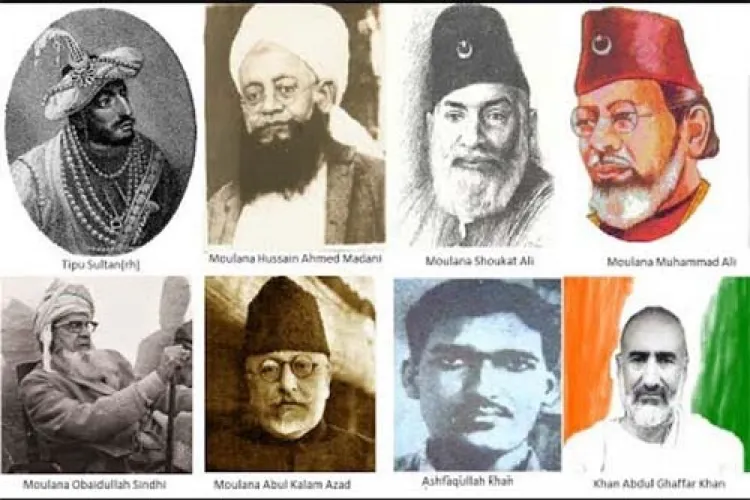
During the First World War (1914 – 18), the British intercepted three letters written on silk cloth. The letters were written by Maulana Ubaidullah Sindhi to Maulana Mahmood Hasan and pointed towards a global plan to overthrow the British rule in India. Ubaidullah was named as one of the most dangerous Indians for the British in the Rowlatt Committee Report. He formed armed groups, preached anti-British ideas and formed a provisional government in Kabul. The Prime Minister of the government was Maulana Barkatullah. The government had to have an army as well, which would attack India to free it. But, the plan failed because of the leaked silk letters and the end of the World War. The plan was called Silk Letter Movement and 59 freedom fighters, mostly Muslims, were charged for waging the war against the Empire. Maulana Abul Kalam Azad, Abdul Bari Firangi Mahli, Ubaidullah Sindhi, Maulana Mahmood, Husain Ahmad Madni and M.A Ansari were few of them. Maulana Mahmood and Madni were arrested in Makkah and imprisoned in Malta.
Maulana Abul Kalam Azad, who is often seen as a token Muslim in a largely Hindu dominated Congress, was a freedom fighter whom the British feared. His name occurred in different CID reports for planning armed revolutions. At least 1700 freedom fighters took oath to die for the cause of freedom as members of Hizbullah, a revolutionary organisation formed by Azad. Al-Hilal, a paper edited and published by him, was banned for propagating the revolutionary nationalist ideas. Azad established Darul Irshad, a madarsa, to popularise the anti colonial ideas. For his organization, Hizbullah, Jalaluddin and Abdur Razzak were prominent recruiters, who also united Hindu and Muslim revolutionaries of Bengal. No wonder, Azad was jailed many times and was the President of INC when the Quit India Resolution of 1942 was passed.
The Silk Letter Movement was not the only resistance movement during the World War. Ghadar Movement was another movement in which several Muslims took part and attained martyrdom. Rehmat Ali was hanged in Lahore for trying to instigate mutiny among soldiers. The efforts bore fruit in Singapore, when, in February, 1915, 5th Light Infantry consisting mostly Muslims from Punjab revolted. The soldiers captured Singapore for a few days. The revolutionaries were later defeated, captured and shot dead.
Another misconception prevalent among Indians is that the Bengali revolutionaries were Hindus. Interestingly, the revolutionary organizations with Hindu religious overtones, like Jugantar and Anushilan had many active Muslim members. Sirajul Haq, Hamidul Haq, Abdul Momin, Maksuddin Ahmad, Maulvi Ghayasuddin, Nasiruddin, Razia Khatun, Abdul Kader, Wali Nawaz, Ismail, Zahiruddin, Chand Miyan, Altaf Ali, Alimuddin, and Fazlul Kader Chowdhury were few of the Bengali Muslim revolutionaries who took up arms along with Hindus. Many of them were sent to Andamans or killed.
After the World War, the British introduced a draconian Rowlatt Act. The Indians protested against the act and many leaders were arrested. At Jallianwala Bagh people were massacred when they were protesting against the arrest of Saifuddin Kitchlew. The proportion of Muslims killed at Jallianwala was quite high. Around this time, 1919 onwards, Abdul Bari Firangimahli, Mazharul Haque, Zakir Husain, Mohammad Ali, and Shaukat Ali emerged as the mass leaders. Women like Bi Amma, Amjadi Begum, and Nishat al-Nisa also jumped into the freedom struggle.
In Tamil Nadu, Abdul Rahim organised the workers during the 1930s against the oppressive colonial rule. V. M Abdullah, Sharif Brothers, and Abdul Sattar were other prominent Muslim leaders in South India who led nationalist movements and braved torture and imprisonments.
Khan Abdul Ghaffar Khan led pathans posed a non-violent challenge to the British. In 1930, the British fired upon a crowd protesting against the arrest of Ghaffar Khan at Qissa Khwani Bazar, Peshawar. Hundreds of pathans laid their lives for the service of the motherland.
Faqir of Ipi, Mirza Ali Khan, and Pir of Pagaro, Sibghatullah, raised their armies in the 1930s in Waziristan and Sindh respectively to fight the British during the World War. In a larger scheme of things, Subhas Chandra Bose and Axis Powers allied with their armies in order to liberate India.
In 1941, Netaji Subhas Chandra Bose escaped from house arrest. The man who played an important role in the escape was Mian Akbar Shah. Netaji reached Berlin and formed a Free India Legion. Abid Hasan, became his confidant here and served as secretary. Abid was his only associate who accompanied him on a famous submarine journey from Germany to Japan. In 1943, Netaji formed Azad Hind Sarkar and Azad Hind Fauj. Here several Muslims like, Lt. Col. Aziz Ahmad, Lt. Col. M.K Kiani, Lt. Col. Ehsan Qadir, Lt. Col. Shah Nawaz, Karim Ghani, and D.M Khan became ministers with important portfolios. Azad Hind Fauj faced reverses in war and its soldiers were taken prisoners by the British. Rashid Ali’s imprisonment became a symbol of Hindu Muslim unity when Hindus and Muslims across the political affiliations came out on Kolkata road demanding his, and other Azad Hind Fauj soldiers, release in 1946. The police fired upon the protesters killing dozens of Indians. Elsewhere, in Mumbai and Karachi, the Royal Navy revolted in support of Azad Hind Fauj. Anwar Husain was one of the prominent martyrs of this revolt as Colonel Khan led the soldiers in revolt at Mumbai port.
India gained independence on 15 August, 1947. It was a costly affair. The cost was the Indian lives. The lives we paid were neither Hindu, nor Muslim. The lives belonged to the Indians. Those who laid their lives were Indians first, and Hindus or Muslims later. Here again, Muslim leaders like Allah Bux Somroo, K. A. Hamied, Faqir of Ipi, Abdul Qayyum Ansari, Abul Kalam Azad and others fought against the divisive communal politics of Muslim League to stop the partition. Tragically, more than seven decades later people have forgotten this important aspect of our freedom struggle and try to divide this great struggle along petty sectarian lines.
(The article is an updated version of an article published last year.)
source: http://www.awazthevoice.in / Awaz, The Voice / Home> Culture / by Saquib Salim / August 15th, 2022
Indians and other historians have either tried to whitewash the revolutionary movements for freedom or presented these as disjointed localised efforts.
Even the largest movement of Azad Hind Fauj led by Netaji Subhas Chandra Bose has been narrated in a staggered manner and an episodial manner like the battle of Burma (Mayanmar) and the battle of Imphal. The picture thus presented is of an army fighting at a frontier with no support elsewhere. This history needs to be revisited.
In 1930, Sayyid Sibghatullah Shah Al-Rashidi called Pir of Pagaro, a Muslim Saint from Sindh with a huge following, was arrested by the British Government for ‘creating disturbances’. He was accused of instigating anti-colonial feelings among his followers known as ‘Hurs’ (literally meaning free). The decision to send him to a prison away from Sindh rather shaped this anti-colonial Muslim saint into a nationalist revolutionary.
In the Bengal hail, he met several revolutionaries and realised that what he had experienced in his area was the same being experienced by others. He understood that British colonialism was destroying the nation and Hindu-Muslim unity was the only weapon to fight them.
From the prison, he started preaching nationalist messages. Sarah F. D. Ansari of the University of London in her book Sufi Saints and State Power: The Pirs of Sind, 1843 – 1947, writes, “messages strongly coloured with a radical nationalist tinge were smuggled out in the form of notes written in the margins and between the lines of books and magazines. They condemned the British for treating ‘Indians like donkeys’, loading them down with ‘England’s burdens’, and pointed out that the only reason why the British were able to rule over 300,000,000 people was that Indians were ‘cowards’.”
In 1936, when he returned to his seat at Khairpur in Sindh, Pir of Pagaro had turned a revolutionary.
He started establishing links with revolutionary leaders of Bengal as well as those living in Europe, especially Germany. He started inviting Congress leadership to his area and organise Hindu-Muslim unity meetings. We must keep in mind that it was 1938 and Subhas Chandra Bose was the President of Congress. Unsurprisingly when Subhas formed Forward Bloc after his famous differences with Mahatma Gandhi, Pir of Pagaro asked his followers to back Forward Bloc and denounced the stand of Congress.
In 1939, the centuries-old Hindu-Muslim unity of Sindh was severely shattered over the Manzilgah mosque dispute and the riots that followed. Pir of Pagaro ordered his large following of armed followers known as ‘ghazis’ to save Hindus from the Muslim fanatics. Sarah F. D. Ansari writes, “In his newspaper, the Pir-jo-Goth Gazette, he (Pir of Pagaro) called for Hindu-Muslim unity: ‘My forefathers’, he wrote, ‘treated Hindus and Muslims alike as a sacred trust. The same is my principle . .. Allah is the same as Parmatma, though with different names. I will be happy when I see temples and mosques together with only a wall dividing them and everyone [worshipping] according to their rights so that no one may have a grievance against the other’. In a similar vein, he denounced the Hindu Sabha and the Muslim League as divisive communal movements. Only when Hindus and Muslims combined would ‘peace . . . be achieved and satanic deeds . . . stopped’: Indians had to be ‘national minded’ and regard India as a country which belonged to all its inhabitants.”
An intelligence report dated October 1940 says, “Pir of Bharchundi is not liked by the Pir Pagaro, who disrespected the Pir of Bharchundi and sent him away from his ‘Kot’ when the Pir of Bharchundi last visited the Pir Pagaro… the reason for such treatment of the Pir to the Pir of Bharchundi was that the Pir of Bharchundi would not assist in getting the murderers of Hindus arrested.”
It further says, “Pir Pagaro has won great sympathy of the Hindus.” Sarah also points out how the Pir came out in support of a Muslim man’s right, who had earlier converted into Islam from Hinduism, to reconvert into Hinduism. “
Another intelligence report noted that Pir of Pagaro has enlisted at least 6,000 militants to fight with an oath to die for the cause. These militants were called ghazis. Ghazis had paraded and displayed their military skills in front of him during his visits to Jaisalmer and Jodhpur as well. The nationwide presence was a threat for the British. The report further noted, “the Pir was renewing his contacts with terrorists (terrorists was a term used by the English for revolutionaries) who had been in prison along with him in Bengal. His visits to Calcutta (Kolkata) were, it is said, performed for no other reason.”
The British apprehension was not wrong. Pir Pagaro had contacts with Bengali revolutionaries and Subhas. If Subhas raised an army on Eastern Front, Pir of Pagaro raised another on the Western Front. An intelligence report from 1941 noted, “He (Pir of Pagaro) has got his electric plant and radio set at which he and his followers hear Hindustani programs from Germany and then spread the German news in the villages which has a disquieting effect on the local people.” The report also pointed out that “the villainous activities of the Pir and his growing contempt of authority are becoming a byword throughout India”.
Pir of Pagaro was running an independent government in that region of Sindh with the help of his militia. The British Government arrested him in Karachi on the pretext of holding talks with him. His ghazis would not stop and kept attacking the British infrastructure. They were so much feared that the Legislative Assembly members did not want their names to become public for voting in favour of an act against Hurs (followers of Pir of Pagaro).
Sarah notes, “The level of fear which existed in Sind at the time even inside the Legislature was reflected in the session being held in camera. Members of the Assembly were not prepared to vote openly in favour of the act ‘lest they were marked down for the Pir’s future vengeance’.” The fear was not unfounded as soon after Ghazis killed the son of Hidayatullah, one of the tallest Sindh leaders in that Legislative Assembly, by derailing a train.
It did not take much time and within weeks Martial Law was declared. The British had to open a war front at the time of World War II. Sarah writes, “The area north of Sanghar and the Thar desert (Rajasthan) were thoroughly reconnoitered from the air; paratroopers and bombs were used against bands of armed men. Hur villages were raided, wells stopped up and their cattle herded into other districts.” On the other hand, the Pir was being tortured to ask his followers to put down their weapons.
Did the nationalists concede defeat? No. The Pir of Pagaro, Sibghatullah, embraced martyrdom at the gallows on 20 March 1943, after a sham of a court trial. Hurs kept fighting the British till 1946 even after their Pir was gone.
source: http://www.awazthevoice.in / Awaz, The Voice / Home> Culture / by Saquib Alim / July 23rd, 2022
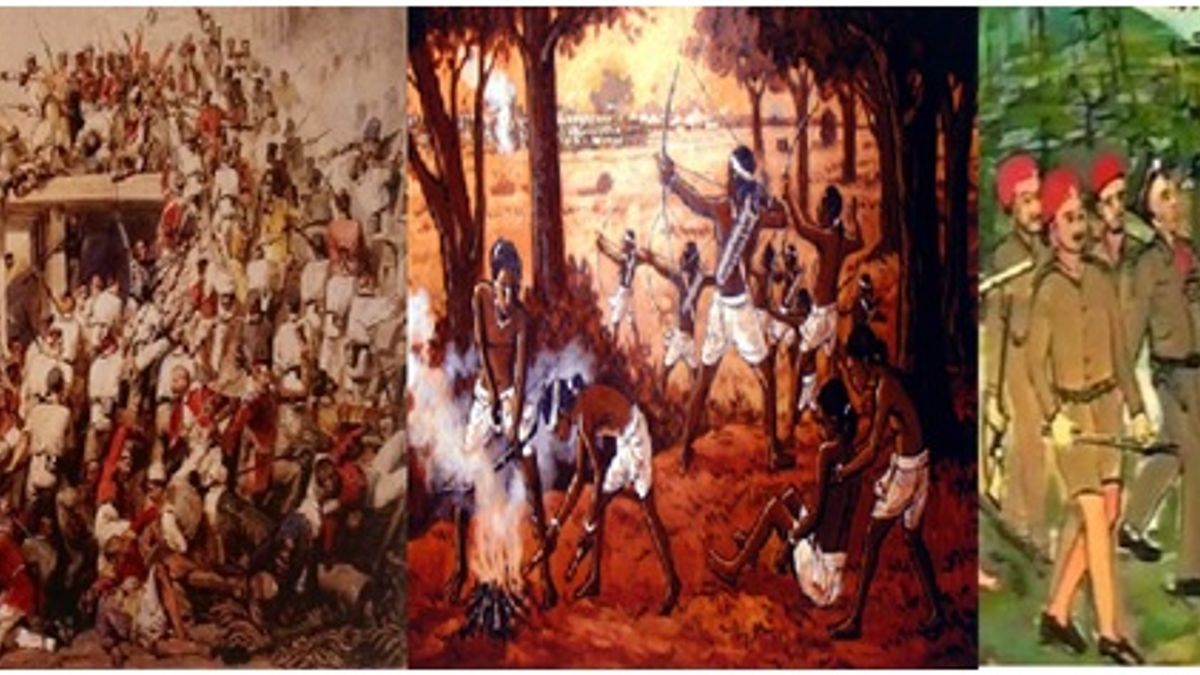
The Revolt of 1857 was not merely a product of Sepoy mutiny but was accumulated grievances of the people against the Company’s administration and of their dislike for the foreign regime. Here is the List of important leaders Associated with the Revolt of 1857.
_______________________ Shakeel Anwar / Updated Nov 10, 2020, 11:10 IST
Important leaders Associated with the Revolt of 1857
_____________________________
The Revolt of 1857 is also called the Sepoy Mutiny or India’s First War of Independence. It was started on 10 May 1857 at Meerut, as a mutiny of sepoys of the British East India Company’s army.
It was a prolonged period of armed uprising as well as rebellions in Northern and Central India against the British occupation of that part of the subcontinent. It began as a revolt of the sepoys of the British East India Company’s army but eventually secured the participation of the masses. The revolt is known by several names: the Sepoy Mutiny (by the British Historians), the Indian Mutiny, the Great Rebellion (by the Indian Historians), the Revolt of 1857, the Indian Insurrection, and the First War of Independence (by Vinayak Damodar Savarkar).
The revolt spread over the entire area from the neighborhood of Patna to the borders of Rajasthan. The main centers of revolt in these regions namely Kanpur, Lucknow, Bareilly, Jhansi, Gwalior, and Arrah in Bihar. Following is a list of important leaders who took part in the revolt from different parts of the country:
Important leader Associated with the Revolt of 1857
Place
Leader
Barrackpore
Mangal Pandey
Delhi
Bahadur Shah II, General Bakht Khan
Delhi
Hakim Ahsanullah (Chief advisor to Bahadur Shah II)
Lucknow
Begum Hazrat Mahal, Birjis Qadir, Ahmadullah (advisor of the ex-Nawab of Awadh)
Kanpur
Nana Sahib, Rao Sahib (nephew of Nana), Tantia Tope, Azimullah Khan (advisor of Nana Sahib)
Jhansi
Rani Laxmibai
Bihar (Jagdishpur)
Kunwar Singh, Amar Singh
Allahabad and Banaras
Maulvi Liyakat Ali
Faizabad
Maulvi Ahmadullah (He declared the Revolt as Jihad against English)
Farrukhabad
Tufzal Hasan Khan
Bijnaur
Mohammad Khan
Muradabad
Abdul Ali Khan
Bareilly
Khan Bahadur Khan
Mandsor
Firoz Shah
Gwalior/Kanpur
Tantia Tope
Assam
Kandapareshwar Singh, Manirama Datta
Orissa
Surendra Shahi, Ujjwal Shahi
Kullu
Raja Pratap Singh
Rajasthan
Jaidayal Singh and Hardayal Singh
Gorakhpur
Gajadhar Singh
Mathura
Sevi Singh, Kadam Singh
The revolt of 1857 was an unprecedented event in the history of British rule in India. It united, though in a limited way, many sections of Indian society for a common cause. Though the revolt failed to achieve the desired goal, it sowed the seeds of Indian nationalism.
source: http://www.jagranjosh.com / Jagrn Josh / Home> General Knowledge> History / by Shakeel Anwar, Jagran Josh / November 10th, 2022
After the Second World War, soldiers of the Azad Hind Fauj (Indian National Army) were captured by the British forces. They were charged with treason and tried by tribunals as war criminals. Indians protested against this treatment given to the freedom fighters of Azad Hind Fauj.
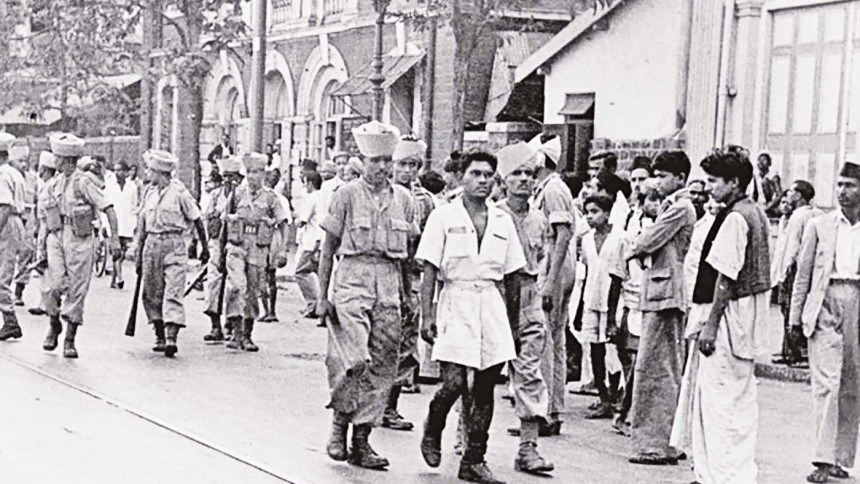
In February, 1945, soldiers and officers of the Royal Indian Navy mutinied in Mumbai and Karachi. English officials including the Viceroy took this mutiny as a sign of leaving India. The British forces killed many to quell the mutiny, many of which were Muslims.
Here, we are sharing names of the few Muslims we know, who attained martyrdom for taking part in the mutiny or supporting it.
Abdul, Ali, Din Mohammad: born 1929, took part in the popular demonstrations in support of the revolt by ratings of the Royal Indian Navy, received a bullet wound in firing by the police at Nagpada, Bombay, on 23 February 1946, died the same day.
Abdul Aziz: born 1921, domestic servant, hit by bullet in the premises of his employers as a result of firing by the police at Bombay on people demonstrating in support of the revolt by ratings of the Royal Indian Navy on 22 February 1946, died the same day.
Abdul Razak: born 1916, took part in the popular demonstrations in support of the revolt by ratings of the Royal Indian Navy, received a bullet wound on 22 February 1946 in firing by the police near Crawford market, Bombay, died on 24.2.46.
Abdul Rehman: born 1911, employee of private firm, hit by a bullet as a result of firing by the police at Doctor’s Street, Bombay, on people demonstrating in support of the revolt by rating of the Royal Indian Navy on 22 February 1946, died the same day.
Abdul Gani: born 1901, took part in the popular demonstrations in support of the revolt by ratings of the Royal Indian Navy, received a bullet wound in firing by police at Bombay on 22 February 1946, died the same day.
Abdul Karim: born 1926, took part in the popular demonstrations in support of the revolt by ratings of the Royal Indian Navy, received a bullet wound in firing by the police near Crawford Market, Bombay, on 22 February 1946, died the same day.
Abdul Sattar, Mohmmad Umar: born 1924, took part in the popular demonstrations in support of the revolt by ratings of the Royal Indian Navy, received a bullet wound in firing by the police on 22 February 1946 at Bombay, died the same day.
Abdulla, Abdul Kadar: born 1921, took part in the popular demonstrations in support of the revolt by ratings of the Royal Indian Navy, received a bullet wound in firing by the police at Bern- bay on 22 February 1946, died the same day.
Abdulla, Safi: born 1933, took part in the popular demonstrations in support of the revolt by ratings of the Royal Indian Navy, received a bullet wound on 22 February 1946 in firing by the police at Fort, Bombay, died in hospital the same day.
Adamji, Mohamed Hussain: born 1924, son of Allauddin Adamji, took part in the popular demonstrations in support of the revolt by ratings of the Royal Indian Navy, received a bullet wound on 22 February 1946, in firing by the police at Bombay, died in hospital.
Ali Mohammad: born 1906, hit by bullet in firing by the police at Dadar, Bombay, on people demonstrating in favour of the revolt by ratings of the RIN on 22 February 1946, died the same day.
Anwar Hossain: a student of Lahore College, hoisted the flags of revolt in the rating vessel Bahadur in Karachi, died with flags in hand on 23 February 1946.
Asgar Ismail: born 1934, received a bullet wound in firing by the police on people demonstrating in support of the revolt by ratings of the Hoyal Indian Navy on 23 February 1946, near the Paxsi Statue, at Byculla, Bombay, died on the spot.
Asghar Miya, Nawsati: born 1916, took part in the popular demonstrations in support of the revolt by ratings of the Royal Indian Navy, received a bullet wound in firing by the police near the J. J. Hospital, Bombay, on 23 February 1946, died in hospital.
Aziz, Chhotu: born 1921, took part in the popular demonstrations in support of the revolt by ratings of the Royal Indian Navy, received a bullet wound in firing by the police at Bombay on 23 February 1946, died in hospital the same day.
Dilawar, Abdul Malik: born 1931, son of Dilawar Muzawar, student, hit by bullet in firing by the police at Dongri, Bombay, on people demonstrating in support of the revolt by ratings of the Royal Indian Navy on 22 February 1946, died the same day.
Fida Ali, Kayam Ali: born 1933, received a bullet wound in firing by the police near J. J. Hospital, Bombay, on people demonstrating in favour of the revolt by ratings of the Royal Indian Navy on 23 February 1946, died the same day.
Gulam Hussain, Ali Mohammad: born 1906, took part in the popular demonstrations in support of the revolt by ratings of the Royal Indian Navy, received a bullet wound in firing by the police’ at Bombay on 22 February 1946, died the same day.
Haroon, Hamid: born 1931, took part in the popular demonstrations in support of the revolt by ratings of the Royal Indian Navy, received a bullet wound in firing by the police at Bombay, on 23 February 1946, died the same day.
Ibrahimji, Yusufali: born 1910, received a bullet wound in firing by the police at Bombay on people’s demonstrations in support of the revolt by ratings of the Royal Indian Navy on 22 February 1946, died the same day.
Ismail Hussain: born 1932, hit by bullet as a result of firing by the police at Bombay on people demonstrating in support of the revolt by ratings of the Royal Indian Navy on 22 February 1946.
Ismail, Rahimtulla: bom 1911, took part in the popular demonstrations in support of the revolt by ratings of the Royal Indian Navy, received a bullet wound in firing by the police near the Imperial Bank, Abdul Rehman Street, Bombay, on 22 February 1946, died the same day.
Jamal Mohammed: born 1926, took part in the popular demonstrations in support of the revolt by ratings of the Royal Indian Navy, received a bullet wound in firing by the police at Bombay on 22 February 1946, died the same day.
Khuda Bakhsh, Pyare: born 1876, hit by bullet as a result of firing by the police at Bombay on people demonstrating in support of the revolt by ratings of the Royal Indian Navy on 23 February 1946, died the same day.
Manzoor Ahmed: born 1906, took part in the popular demonstrations in support of the revolt by ratings of the Royal Indian Navy, received a bullet wound; in firing by the police at Bombay on 22 February 1946, died in hospital the same day.
Mohammed, Aboobakar: born 1928, took part in the popular demonstrations in support of the revolt by ratings of the RIN, received a bullet wound in firing by the police near Crawford Market, Bombay on 22 February 1946, died in hospital the same day.
Mohammed Aziz: born 1911, took part in the popular demonstra- lions in support of the revolt by ratings of the Royal Indian Navy, received a bullet wound in firing by the police at Bombay on 22 February 1946, died in hospital the same day.
Mohammed Hussain: born 1931, son of Mulla Gulam Ali Abdul Hussain, took part in the popular demonstrations in support of the revolt by ratings of the Royal Indian Navy, received a bullet wound in firing by the police near J. J. Hospital, Bombay, on 22 February 1946, died the same day.
Mohammed Sheik, Sayed Hassan: born 1921, took part in the popular demonstrations in support of the revolt by ratings of the Royal Indian Navy, received a bullet wound in firing by the police near Null Bazar police station, Bombay, on 22 February 1946, died the same day.
Mohiddin, Sheik Ghulam: born 1928, took part in the popular demonstrations in support of the revolt by ratings of the Royal Indian Navy, received a bullet wound in firing by the police at Parel, Bombay, on 22 February 1916, died the same day.
Mohmed Samikh, Taja-Urkh: born 1920, hit by bullet as a result of firing by the police at Kamathipura, Bombay, on people’s demonstration in support of the revolt by ratings of the Royal Indian Navy on 23 February 1946, died the same day.
Moula Bakhsh, Abdul Aziz: born 1906, took part in the popular demonstrations in support of the revolt by ratings of the Royal Indian Navy, received a bullet wound in firing by the police at Kamathipura, Bombay, on 22 February 1946, died the same day.
Siddik Mohamed: born 1921, son of Isak Mohamed, took part in the popular demonstrations in support of the revolt by ratings of Royal Indian Navy, received a bullet wound in firing by the police at Kamathipura, Bombay, on 23 February 1946, died the same day.
Sulemanji, Zakiuddin: took part in the popular demonstrations in support of the revolt by ratings of the Royal Indian Navy, received a bullet wound in firing by the police at Bombay on 22 February 1946, died in the hospital the same day.
Taj Mohamed, Fazal Mohamed: born 1930, took part in the popular demonstrations in support of the revolt by ratings of the Royal Indian Navy, received a bullet wound in firing by the police near the Salvation Army office at Bombay, on 22 February 1946, died the same day.
Vazir, Mohamed: born 1891, took part in the popular demonstrations in favour of the revolt by ratings of the Royal Indian Navy, received a bullet wound in firing by the police near Hindmata Cinema, Bombay, on 22 February 1946, died the same day.
source: http://www.heritagetimes.in / Heritage Times / Home> Featured Posts> Freedom Movements / by Mahino Fatima / August 14th, 2021
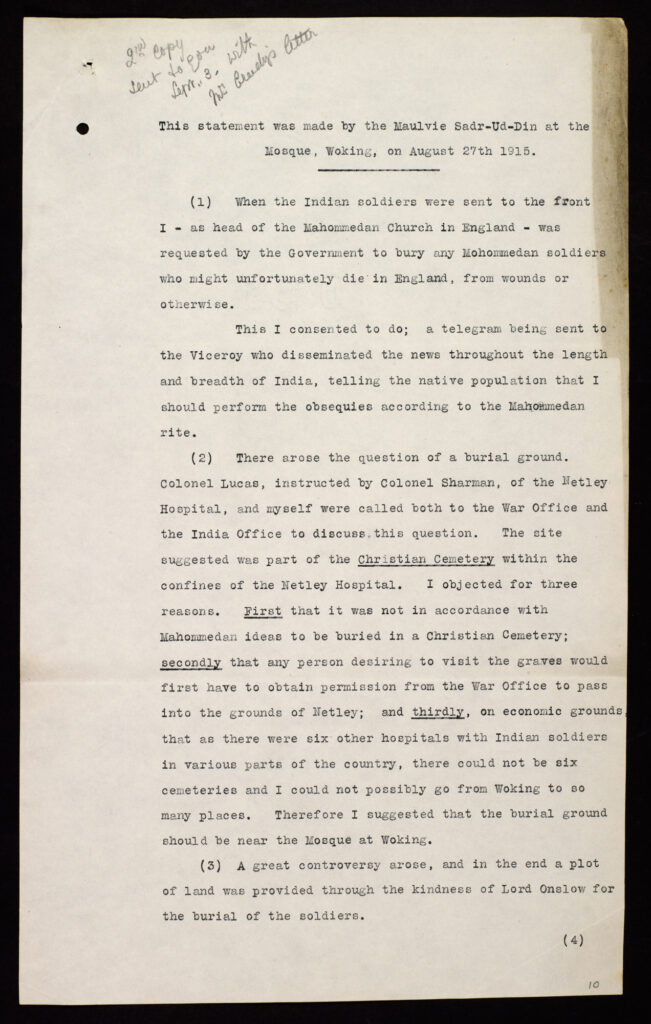
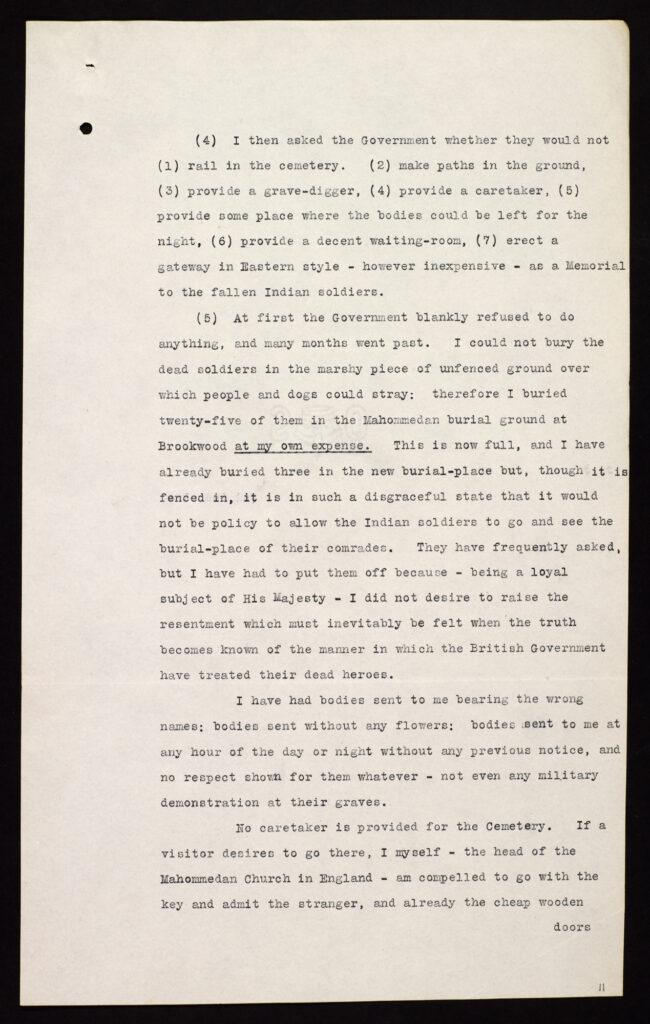
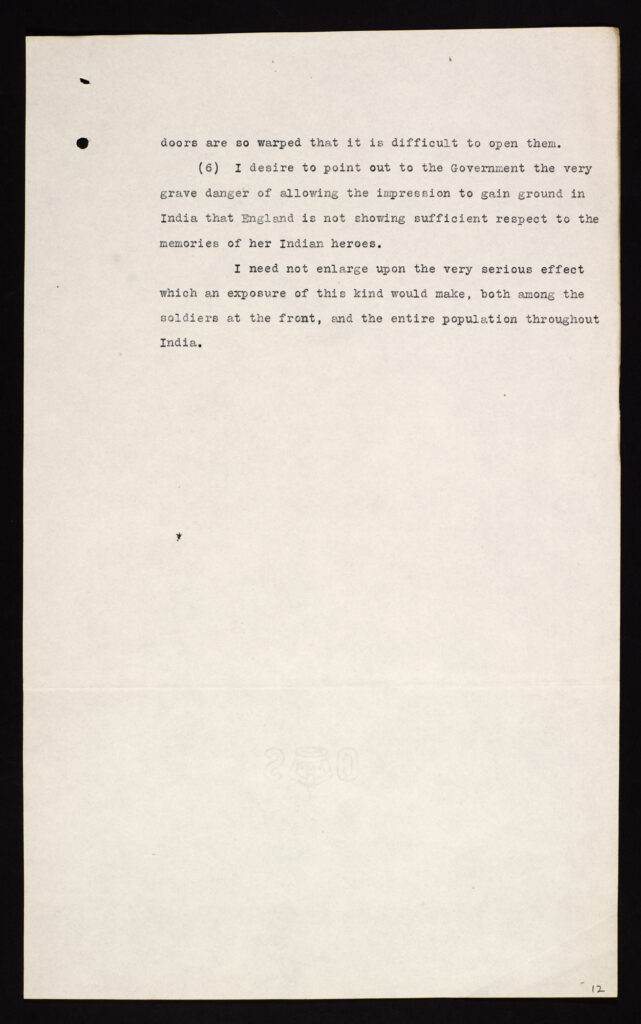
This statement, made by Maulvi Sadr-Ud-Din, provides an insight into the treatment of Muslim Indian soldiers who had fought during World War One and died in hospitals in Britain. Sadr-Ud-Din, from the Shah Jahan Mosque at Woking, was charged with overseeing their burial in England.
What does the statement reveal?
From 1915, there were nine sites in the South of England set up specifically for the treatment of wounded Indian soldiers. This included the Dome Hospital in Brighton and the convalescent camp at Barton-on-Sea. These were hospitals of high standards with up-to-date medical facilities, as well as services dedicated to catering for every religious need.
The Maulvi’s statement, however, raises issues with the posthumous treatment of soldiers who died in these hospitals. He states that the bodies of Muslim soldiers were often sent to him with the wrong name; without flowers; or with no provision for a military demonstration at the grave. Although Sadr-Ud-Din had been allocated a plot of burial land at Woking on Horsell Common, he describes it being in a poor state and maintains that his requests for improvements have been ignored.
Sadr-Ud-Din warns of the ‘grave danger of allowing the impression to gain ground in India that England is not showing sufficient respect to the memories of her Indian heroes’. His concluding words hint at the unease in Indian-British relations at this time and, in particular, the growing nationalist movement which was campaigning against British rule. In response, the government – in a public-relations exercise – commissioned improvements to the burial site at Woking.
These improvements were led, in part, by the suggestions made in Sadr-Ud-Din’s statement. These included a permanent enclosure of the piece of land; making paths in order to distinguish between grave and ground; to employ members of staff in the everyday running of the cemetery; and to build three structures: a morgue, a waiting room and a gateway to not only simplify the burial process, but to also give the area precedence. The gateway, at Sadr-Ud-Din’s request, was designed ‘in Eastern-style […] as a Memorial to the fallen Indian soldiers.’
The majority of these requests were realised, although the morgue and waiting room were never built.
________
source:
Full title:Correspondence about Moulvi Sadruddin, Imam of the Woking Mosque, and the burial of Muslim soldiers in England.
source: http://www.bl.uk / British Library / Home> Collection Items / (This item I feature in ‘All South Asians in Britain Collections’ and ‘All World War One Collection Items’ / (date viewed July 09th, 2022)
Over the past few years, and particularly after their recent tussle with the government over the statue of Bangabandhu Sheikh Mujibur Rahman, the Ulama’s involvement in politics has come back under scrutiny in Bangladesh. Since the 10th century, the Ulama have been exercising strong authority over religious issues; yet they have been accused of failing to respond to modernity and to the changes in society.
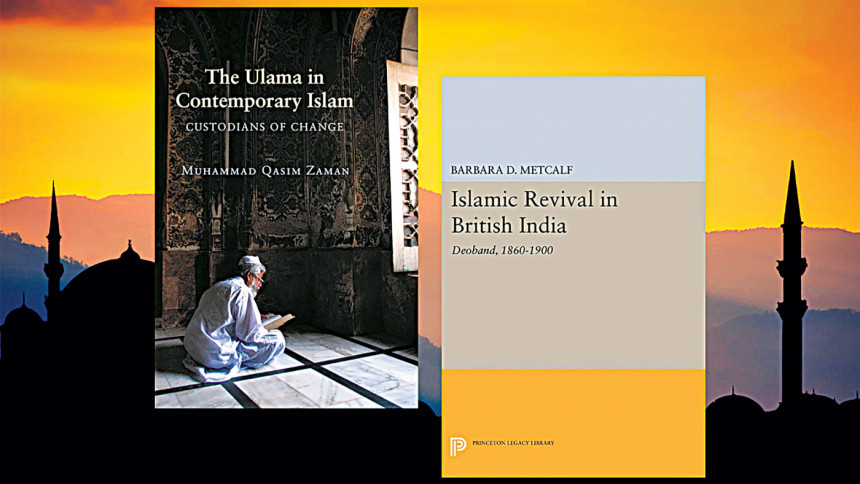
Against this backdrop, the actions, discourses, and history of the Ulama are well worth looking into. Muhammad Qasim Zaman’s The Ulama in Contemporary Islam: Custodian of Change (2002) and Barbara D Metcalf’s Islamic Revival in British India: Deoband, 1860-1900 (2016), both published by the Princeton University Press, are two outstanding studies in this regard. While Metcalf looks into the emergence, proliferation, and responses of the Deobandi Ulama to “modernity” when Muslim power in India was declining, Zaman looks at their strategy to establish authority in British India and Pakistan.
Shifting sands of influence
In pre-British India, religious education was a private enterprise and individual tutelage was the usual mode of the dissemination of religious knowledge. This tradition was to change with the emergence of the Farangi Mahall Ulama as custodians of Muslim intellectual traditions.
The Lucknow-based Farangi Mahall Ulama were known by the family of Mulla Hafiz, who received a land grant from Mughal Emperor Akbar sometime in the sixteenth century. He was the ascendant of Qutbu’d – Din (d. 1691), a Mughal courtier who participated in the collection of Fatawa-yi ‘Alamgiri’. The latter is a collection of Fatwa to be used in the Mughal courts. The family and students who took lessons from this family were known by the name of Farangi Mahall. The activities of the Ulama of Farangi Mahall, however, were confined to producing graduates for princely services. Their most significant contribution was their systemisation of the curriculum—dars-i-Nizami—for religious education. As Metcalf informs us, this curriculum came to Bengal when a Farangi Mahall graduate was appointed as the first principal of the madrasa yi ‘Aliyah’, Calcutta in 1780.
Farangi Mahall’s dominance declined and the centre for religious studies shifted from Lucknow to Delhi by the late 18th century. The person who played a key role in this shift was Shah Waliyu’llah, who advocated for more social and political responsibilities for the Ulama as opposed to those of the Farangi Mahall. Waliyu’llah’s successors had studied legal codes and written fatwa for the Muslim community, which had once become the main tool to disseminate religious instructions when the British were about to establish political authority over India. Besides claiming centrality of the hadith in the interpretation of the sharia, Shah Waliyu’llah discouraged blindly following the rulings of the earlier generations (taqlid). He suggested going back to the Quran or Sunnah for legal solutions.
The 1857 revolution landed heavily upon the revivalist movement initiated by Shah Waliyu’llah. Suspecting the Ulama’s involvement, British colonisers took all religious institutions in Delhi under their control. Fourteen hundred people were shot by British soldiers in Kuchah Chelan, where Shah Abdul Aziz (son of late Shah Waliyu’llah) used to preach, according to Metcalf. The Delhi-based Ulama were forced to move to the countryside and establish a madrasa at Deoband in 1867.
After the revolution, Deoband became the centre for Muslim intellectuals. They introduced formal religious education for Muslims in British India. Students had separate classrooms and a library, and the curricula were organised according to departments, such as Arabic, Persian, and others. A formal examination system was introduced and successful students were issued certificates of award. Graduates came from different corners of India. Most significantly, these graduates went back home and set up madrasas in their respective localities. By the end of the 18th century, nearly every town held the presence of the Deobandi Ulama.
One well known Deobandi Ulama was Muhammad Ashraf Ali Thanawi (1863-1943), who authored Bahishti Zewar (1981)—among the most popular books for Muslims of India, and masterminded the Dissolution of Muslim Marriages Act 1939—the first reformist legislation for Muslims of British India.
In the late 19th century, the Ulama played a crucial role in upholding the pride of their religion and their community through publications and public debate on religious issues. Their intellectual exercise peaked with the invention of print technology, multiplying the scale of the transmission of knowledge all over India. Publishing in local languages such as Urdu, instead of Arabic, was one of their effective strategies to establish authority. This also served as a medium of communication between common Muslims and the Ulama, and helped renew Muslim traditions against local customs. Following the birth of Pakistan on August 14, 1947, the Ulama consolidated their authority and forced the then government not to pass a law against sharia. Over the next few years, their continuous efforts would force the Pakistani government to establish a Supreme Sharia Board to oversee any inconsistencies between sharia and laws passed by the parliament.
The historiography of these two books may be compared with Geoffrey G Field’s Blood, Sweat and Toil: Remaking the British Working Class, 1939-1945 (Oxford University Press, 2011), in which Field understands “class” from multi-dimensional approaches including its relationship with the state, society, and family. Similarly, Barbara Metcalf and Qasim Zaman define the Ulama as a class by providing a social and intellectual history of their presence in South Asia. Metcalf highlights their hardships in the post-1857 revolution and the silent “intellectual” revolution of the Deobandi Ulama. Hers is an excellent cultural history. Despite being published earlier, Zaman fills in what Metcalf’s study left to be addressed: it focuses on how the Ulama have played an active role in different social and political contexts, particularly in post-colonial Pakistan. He disapproves of the allegation that the Ulama are against changes. The common mistake that most studies make, says Zaman, is not to consider the social and political context within which the Ulama work. To him, the flexibility of sharia depends on a socio-political context. Zaman suggested that the Ulama do not respond to changes as not because they do not like it but because of their fear of losing authority over religious issues in a modern state.
None of the above-mentioned studies, however, concerns the Ulama of Bangladesh. The growing presence of the Bangladeshi Ulama in the public sphere, particularly their increasing involvement in the political issues, merits investigation into—in Zaman’s words—their “transformation, their discourses, and their religio-political activism.” Could the Ulama in Bangladesh inherit the wind of the Islamic intellectual traditions? The question deserves to be addressed amongst others.
Dr Md Anisur Rahman is a legal historian at Asian University for Women. His research interests include Islam in Asia and South Asian Islamic Law and Society.
source: http://www.thedailystar.net / The Daily Star / Home> Reviews / by Md. Anisur Rahman / January 28th, 2021
.webp)