The first mutiny of World War I was led mostly by young men from villages of Hisar, Rohtak, Meham and Gurgaon districts of Haryana. The Singapore Mutiny, which is known as the first mutiny of WW-I and left an indelible mark on India’s freedom struggle, started on February 15, 1915. It was led by Muslim soldiers who belonged to British army’s 5th Light Infantry Brigade.
Even as the world observes the centenary of the Great War, the sacrifice of these soldiers has been all but forgotten as most of the soldiers and their descendants migrated to Pakistan after Partition.
The brigade mainly comprised Rajput Muslims and Pathans and had been sent from Madras to replace the Yorkshire Light Infantry in Singapore. They reached there in October 1914 and were to leave for Hong Kong in February. On the day of embarkment, a rumour spread that they were actually being sent to Turkey and would have to fight Muslims there.
Singapore Mutiny shook the foundation of British rule in Asia
A rumoured triggered the Singapore revolt. The sepoys killed British officers and seized ammunition. The mutiny went on for 5 days. Eight hundred Indian sepoys of the British army killed 47 British nationals; 200 sepoys faced court martial; 73 were given a range of punishments.
As many as 41 sepoys were shot by a firing squad in front of 15,000 spectators at Outram Prison in Singapore.
In his book “The Mutiny in Singapore”, author Sho Kuwajima has argued that the mutiny not only caught the British off-guard but also shook the foundation of British rule in Singapore and forced the British to reconsider their strategy in Asia.
“The mutiny had a great impact on India’s freedom struggle. Freedom fighters, including Ghadarites were vindicated when finally in 1946, the British decided to leave following the naval revolt of February 19, 1946 when they felt that their protective shield, the armed forces, had itself turned against them,” said historian Malwinder Jit Singh Waraich, who has penned a number of books on the freedom struggle.
Four of those executed in public were from Jamalpur (Hisar), three from Jatusana (Gurgaon) and two from Balyali (Hisar). According to Phul Chand Jain’s Swatantarta Sainik Granth Mala, most of these people belonged to Jamalpur, Paten, Balyali, Kirawad and Balliya Ali in Hisar; Jatusana, Karmpur and Kheri Nangal in Gurgaon; Garhi, Kani and Kahnaur in Rohtak. One sepoy each was from Muzaffarnagar in Uttar Pradesh, Karnal and Nabha in Punjab.
“These villages were gripped by violence of Partition, so, there is not much trace of their memories now,” says documentary filmmaker Daljit Ami, who is making a film on the Singapore Mutiny and has visited these villages a number of times. In the course of his research, he came across just one man who had heard about these heroes and their Haryana connection.
According to historians, the Singapore Mutiny was followed by the Russian soldiers’ mutiny in 1917 and a series of mutinies in the French armies.
source: http://www.timesofindia.indiatimes.com / The Times of India / Home> News> India News / by Sarika Sharma / TNN / July 05th, 2014
At the Battle of Malegaon, Muslim soldiers in the Maratha army defied the British army for a full month when they had no hope of victory as the Chhatrapati and Peshwa had already surrendered.
These battles, says Colonel Anil A Athale (retd), are in contrast to the colonial mindset driven narrative of Muslim separatism.
The current politics of both communities ensures that the heroes of Malegaon — or for that matter personalities like Ibrahim Khan, who led the Maratha artillery at the battle of Panipat in 1761 — are forgotten.
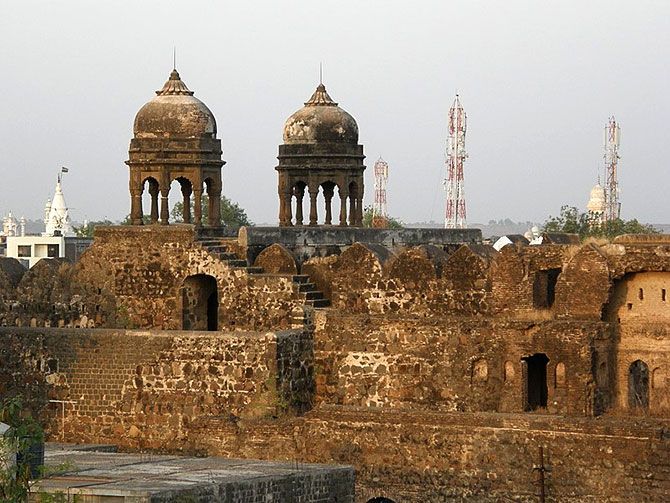
IMAGE: The Malegaon fort. Kind courtesy: Wikipedia
On January 1, 2018, the bicentenary of the defence of Koregaon by a small British force — that had a number of Mahar troops — was observed with great fanfare.
The British — the victors in the third Anglo-Maratha war — erected a pillar to commemorate the event.
During the same war, Muslim troops of the Marathas defied British forces for a full month from May 15, 1818 to June 13, 1818.
Since the Marathas were on the losing side, this saga of bravery was obliterated from history by the British.
As we approach the bicentenary of that event it is time to remember the brave soldiers of the Maratha army who continued to fight even when they had no hope since the Chhatrapati had already been captured by the British and Poona and Satara were under British occupation.
The loyalty to the Maratha flag by its Muslim soldiers even in a hopeless situation deserves to be remembered.
My own research in 1990 began with a question posed by the late Major General D K Palit, a military history scholar of repute.
The question he posed was this: How is it that the Marathas — who spiritedly fought a 22 year-long guerilla war against the mighty Mughal empire — succumbed to the British without a fight?
It is this quest for truth that led me to research the story of the Anglo-Maratha struggles of the 18th and 19th century.
The Battle of Malegaon fought in May-June 1818 was the last major attempt at resistance by the Marathas.
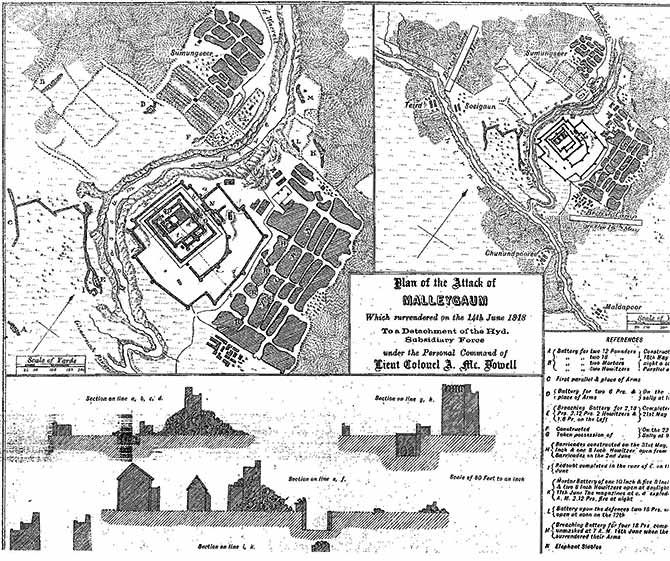
On May 15, 1818, a brigade strength force under Lieutenant Colonel A MacDowell reached the vicinity of Malegaon fort.
The British expected that this show of force would be sufficient to overawe the defenders of the Malegaon fort.
The British were in for a nasty surprise.
In response to summons to surrender, the defenders fired on the British camp leading to panic.
The quadrangular fort of Malegaon is located near the bend in the Musam river so as to cover two side of the fort, Malegaon town being on the other sides.
The fort had two lines of defence built of masonry surrounded by a seven feet wall and a 25 feet deep 16 feet wide ditch.
The outer wall had watch towers built of mud and stone. The inner fort or the citadel was 60 feet high with 16 feet wide ramparts.
On May 16, Colonel MacDowell reached the west bank of the river and began work to erect barriers of breastwork to deploy guns for the final assault.
At 8 am the British began bombardment of the fort with 20 guns, an assortment of 12 pounders (the biggest calibre gun then in India), 8 pounders and mortars.
The defending soldiers sortied out of the fort, destroyed the batteries and killed two British officers and several soldiers.
At the same time 7 guns from the fort opened devastating fire on the British lines on the west bank of the river.
The ding dong battle continued for six days.
On May 22, after particularly heavy shelling from the fort, the British were forced to abandon the breastwork for the guns and retreated.
On May 26, the British — through constant bombardment — succeeded in creating a breach in the inner wall of the fort.
The next day the British launched a three pronged attack after a bombardment lasting nearly two hours.
One column was led by Major Greenhill and consisted of a native battalion of 1,000 soldiers with 100 Europeans to directly go into the fort through the breach.
Another column of 800 sepoys under Lieutenant Colonel Stewart crossed the river downstream to outflank the fort from the west.
The third column consisting of 300 sepoys and 50 Europeans under Major Macbean went towards the river gate.
Each column had pioneers with tools, mines and ladders to tackle the fortification.
But the defenders of the Malegaon fort proved equal to the challenge.
The attacking British were met with a hail of bullets and gunfire. The attempt to scale the inner wall failed. Many of the engineer officers leading the attack suffered injuries.
Both the columns led by Majors Greenhill and Macbean were ordered to withdraw.
Only Lieutenant Colonel; Stewart’s column met with some success and he occupied part of the town.
The stalemate continued till June 4.
On that day another column under Major Watson arrived from Ahmednagar with a battalion of native infantry and a large number of siege guns.
For nine days, till June 13, the fort was subjected to heavy bombardment by the British guns.
On June 13, at 3 pm, the fort garrison accepted surrender and the Union Jack was hoisted in place of the Maratha saffron jari patka flag.
The next morning the garrison of 300 men marched out of the fort and surrendered their arms.
The British strength at Malegaon numbered over 2,000 troops. During the battle the British casualties numbered 11 officers and 220 soldiers (killed or wounded).
Thirty Maratha defenders died while 60 Maratha soldiers were wounded.
The British record states that in the end they used 36 guns, fired over 8,000 shells and used 35,500 pounds of gunpowder.
The British were so impressed with the valour and chivalry of the defenders that they permitted the surrendered soldiers to keep their daggers.
Historian N C Kelkar notes in his Marathi book Marathe ani Ingraj that at one stage the desperate British sent a message to the Muslim soldiers of the Maratha army that since the Chhatrapati had already surrendered, they should do likewise.
The doughty defenders replied that they were indeed aware that their king was in British captivity, but they were yet to receive instructions from him to surrender and therefore would keep fighting.
The devotion to duty and loyalty to their king was of the kind seen later only during World War II when many Japanese soldiers continued to fight even after Japan surrendered.
There is neither any victory pillar nor are the names of these brave soldiers engraved anywhere.
Even two hundred years after the event and the departure of British 70 years ago, the Muslim heroes of battle of Malegaon remain unknown, forgotten and unsung.
Two hundred years ago, the third Anglo-Maratha war fought in 1817 and 1818 ended in the Maratha Chhatrapati and Peshwa (prime minister) surrendering to the English.
After having defeated the Holkars and Shindias in early 1817, the British turned to the conquest of Maharashtra proper.
The full story of the Maratha struggle with the British has for long been swept under the carpet. In its place a modern myth of the British having directly taken over India from the Mughals or accidently acquired an empire has gained currency.
Ignoring the Marathas and their role in ruling most of north and central India was part of the grand colonial project of disinformation that sought to then play up Mughal-Rajput rule.
I recall an interesting news report some years ago, datelined Aligarh, where an Aligarh Muslim university ‘scholar’ had discovered that a major battle between the Marathas and the English had indeed taken place in Aligarh in 1803!
The worthy had, of course, never heard of the second Anglo-Maratha war that took place in 1803-1804 with battles at Delhi, Lassawari near Agra, Aligarh, Shekohabad etc.
The British had sound reasons to whitewash the Maratha period of our history.
Since the Marathas formed a formidable alliance with the Muslims, Jats and Sikhs in resisting the British, they posed a potential threat.
The distortions continued post-Independence as writing and teaching history was hijacked by the left-leaning Delhi elite. But those who ignore the Maratha or Sikh epoch fail to answer a simple question.
The Marathas fought three wars with the British, so did the Sikhs, the Gorkhas and Tipu Sultan in the south. Is there any mention of the Anglo-Mughal wars, even in the doctored historical narrative?
Note: The information about the Battle of Malegaon is based on a British Indian Army General Staff Publication (Simla 1910), Maratha and the Pindari War pages 89-91.
Colonel Anil A Athale (retd) is a military historian. This article is based on extracts from his forthcoming book, The Story of the Mighty Marathas and their Empire.
source: http://www.rediff.com / rediff.com / Home> News / by Colonel Anil A Athale (retd) / April 10th, 2018
At most of the places in the country, the names of the martyrs have been put on specially constructed Memorials. But the Memorial in Malegaon is still waiting for the names of the seven martyrs to be written over it.
“I have always wondered how, the Muslims and the Hindus together, had decided to set a Mandir on fire”, said Dr. Iftekhar Ansari recalling the incident when on April 25 in1921, the Malegaonians set the Pophale Mandir on fire where, Bhaskarrao, the PI and Incharge of the only Police Station in Malegaon was hiding. He was ultimately killed by the people. A Muslim Constable was also killed in the same uprising.
He further said, “It demonstrates not only the harmony with which the Malegaonians were living then, but also shows their eagerness for the country’s freedom. For them, the freedom was above everything, even their religion. In fact, Hindus and Muslims, except few from both the communities as was the case everywhere, had demonstrated a rare unanimity during the whole struggle. I believe if it was a Mosque, a Gurdwara or any other place, it must have met with the same fate.”
Agreeing with Dr. Iftekhar, Ramzan Painter 74, who has collected more than hundred-years of the city records added, “A confirmed account of the exact situation during 1921, clearly suggests the harmony with which people were living.” Mentioning the name of Balu Shah, owner of the first newspaper in Malegaon and a prominent figure of that time who was actively involved in the whole movement with the Muslims, he added, “And who can forget the contributions of Advocate Tatya Khare and Gadgil Wakeel, who remained at the forefront in establishing a separate court in Malegaon.”
“I have always wondered how, the Muslims and the Hindus together, had decided to set a Mandir on fire”
But, as it had done at several other places in the country, the British Police registered the whole incident as rioting and hanged the upfront leaders of the uprising in Yeroda jail. However, after the independence in 1947, the State as well as the Central governments, mentioned the historic event of April 1921 as part of the freedom struggle and included the names of the seven martyrs in their gazettes with due respects. Also, when the Parliament passed a resolution for the construction of a Memorial of similar shape everywhere in the country and to put the names of the martyrs on them, a Memorial was also built in Malegaon.
However in Malegaon, unlike other places in the country, the names of the martyrs have not been put on the Memorial till now. Interestingly the civic body, despite passing many resolutions in its general meeting for putting the names of these martyrs on the Memorial, has also not cared for doing so.
And as if it is not enough to dishonor these martyrs, every year on Kranti Diwas when officials gather everywhere near these Memorials for offering their tributes, in Malegaon, no one cares to honor these martyrs.
source: http://www.ummid.com / Ummid.com / Home / by Aleem Faizee (headline edited)
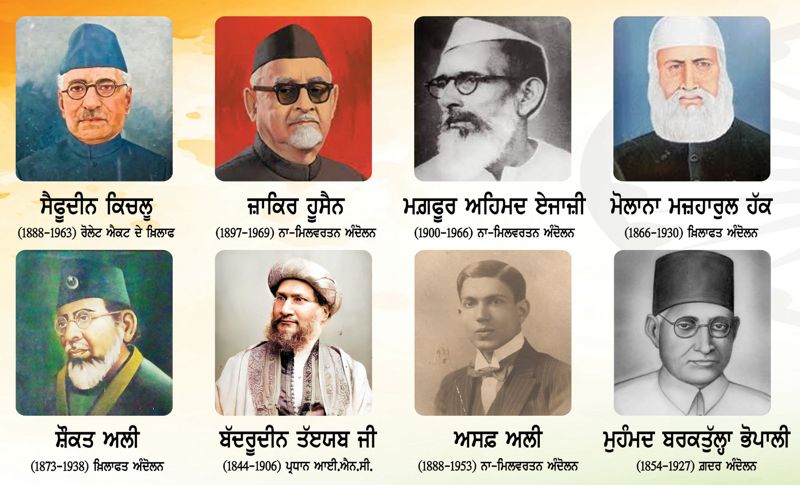
With an intent to highlight the role of Islamic leaders in the pre-independence freedom struggle, a group of Muslim youths have decided to organise a function on the occasion of Republic Day, during which sacrifices of unsung heroes from their community would be highlighted.
Besides organising an elaborate programme after unfurling the Tricolour at the Dehliz Chowk on January 26, the enthusiasts will also install banners displaying portraits of more than 20 prominent Muslim freedom fighters at various locations.
The organisers say the gesture will motivate Muslim youths of the region to come forward and play active in nation building, irrespective of their political, social or religious allegiances.
Zeshan Haidar, the convener of the scheduled event, said youths from various Muslim organisations of the area had been roped in to work in tandem for restoring the lost glory of leaders from their community, who had made supreme sacrifices in struggle against the British Government and played a major role in getting freedom for the country.
“Unfortunately, successive governments have failed to recognise the contributions of Muslim leaders in the freedom struggle and a majority of Muslim freedom fighters and martyrs have remained unsung during functions held to celebrate national events such as Republic Day and Independence Day,” Zeshan Haidar said, adding that these names were also missing from history books.
The enthusiasts have shortlisted names of about 100 Muslim leaders of pre-Independence era and portraits of 20 from them will be displayed in the region.
Maulana Shah Abdul Qadir Ludhianvi (grandfather of Shahi Imam Punjab Maulana Usman Ludhianvi), Zakir Husain, Begum Hazrat Mehal, Maulvi Ahmadullah, Abadi Bano Begam, Ashfaqulla Khan and Husain Ahmed Madni were cited among more prominent Muslim freedom fighters whose portraits figure on the proposed banners.
source: http://www.tribuneindia.com / The Tribune / Home> Ludhiana / by the Correspondent, The Tribune / January 24th, 2023
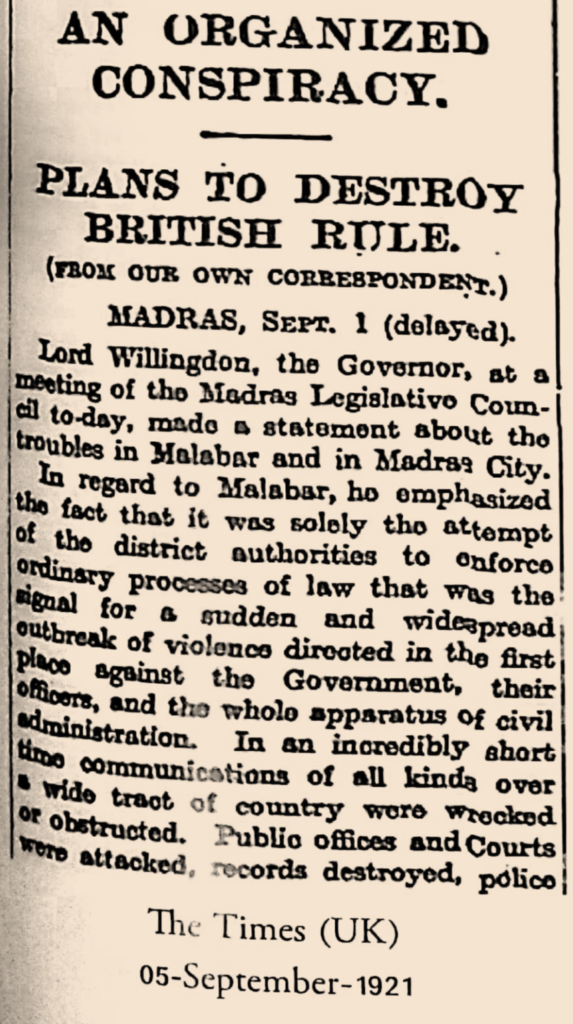
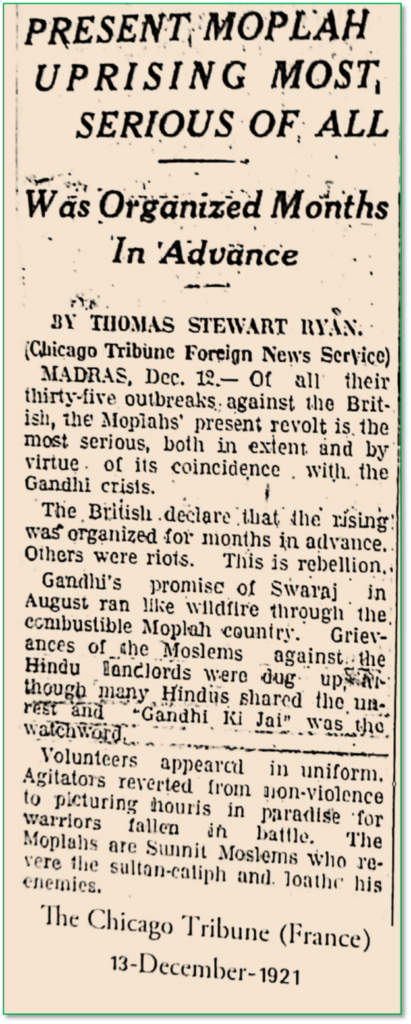
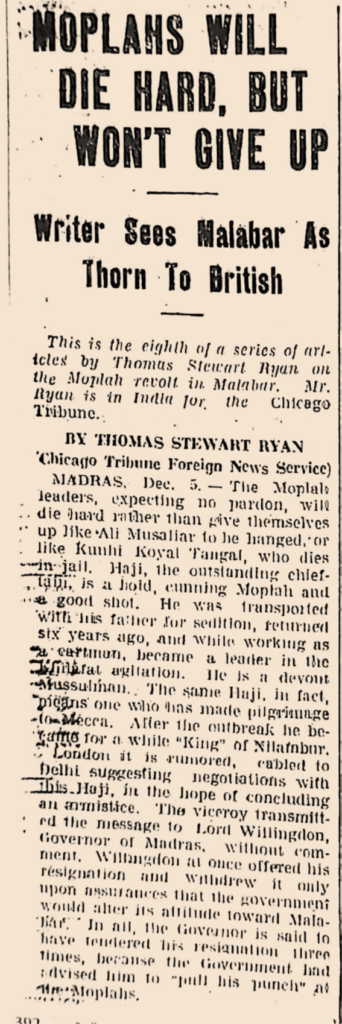
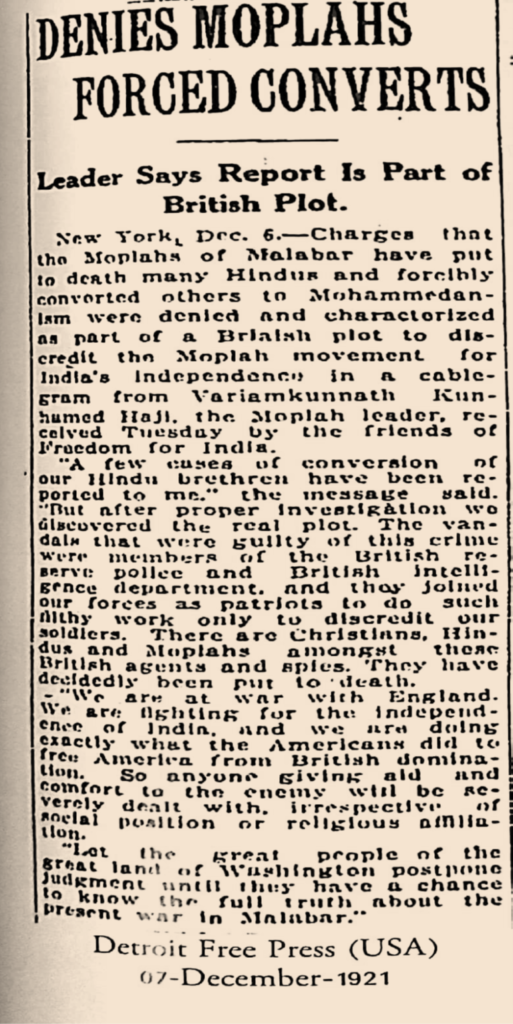
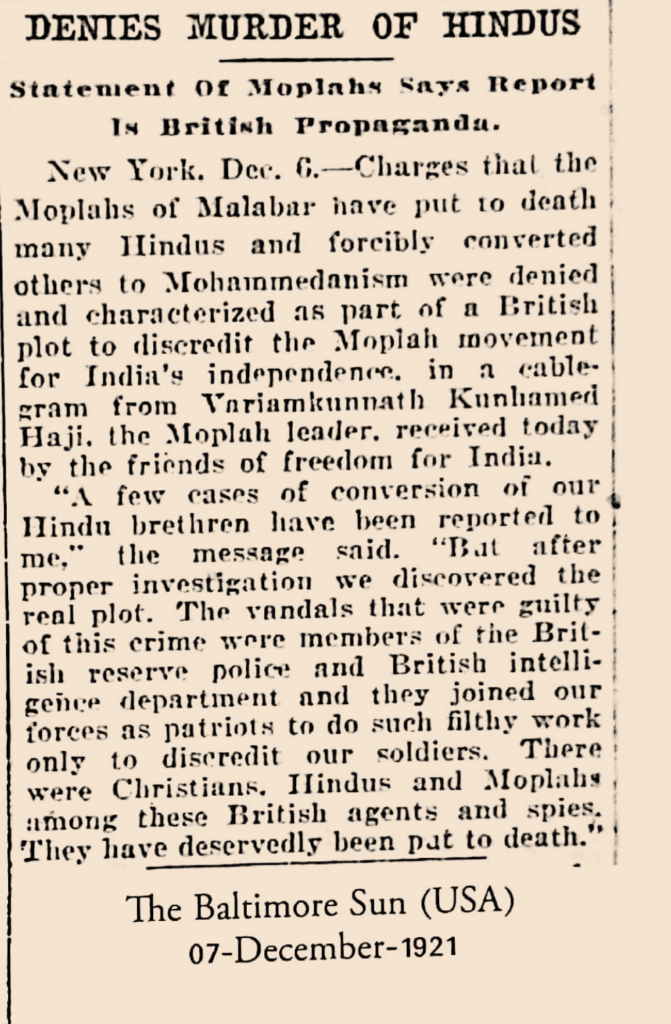
Hereunder are a selection of newspaper clippings, mainly from the US Press, extracted from the well-researched book just released titled, “Sultan Variomkunnan” by young historian Ramees Mohammed on the Mappila Uprising. These clippings furnish further evidence that the Mappilas were fighting for India’s Freedom and were not Anti-Hindu.
The following statements by the correspondent of the Chicago Tribune are pertinent:
“Hindus Shared the Unrest and ‘Gandhi ki Jai’ was the Watchword” “The Moplahs Revere the Sultan Caliph and Loathe his Enemies”
The Mappila Uprising was to Destroy British Rule
______________
“Hindus Shared the Unrest and ‘Gandhi ki Jai’ was the Watchword” “The Moplahs Revere the Sultan Caliph and Loathe his Enemies”
_____________
______________
______________
British Police and Intelligence responsible for forced conversions to discredit Mappilas
___________
source: http://www.turkvehind.org / Turkiye Ve Hindistan / by Noor Mohammed Khalid
When the English imprisoned Abu Zafar Sirajuddin Muhammad Bahadur Shah Zafar (1775-1862), the last Indian Moghul Emperor, in the Jail of Rangoon in 1857, instead of Indian Flag, Union Jack started hoisting at Dehli’s Red Fort and Queen Victoria became the full-fledged ruler of India without any obstacle, at that time, many country patriots came into field united to fight against the British rule.
Maulana Muhammad Qasmi Nanautavi (1832-1879) was one of them too.
In 1857, one Fatwa for Jihad against the English was issued.
The Fatwa carried the signature of 34 prominent Ulama. One among them was Maulana Nanautavi himself. As other elders had participated in the Jihad of Shamli in 1857, Maulana Nanautavi also had participated personally with his colleagues. Briefly in the battle of Shamli, Nanautavi and his colleagues got defeated to British forces.
He was a far sighted scholar. He comprehended that the British has not only occupied India and would attack the Indian culture, but even the faith of Indians would be at risk. Therefore, while on the one hand, he started fighting against the English, he began debating with clergyman on the other. But to that time, the freedom wasn’t destined for India, so he didn’t succeed in the mission.
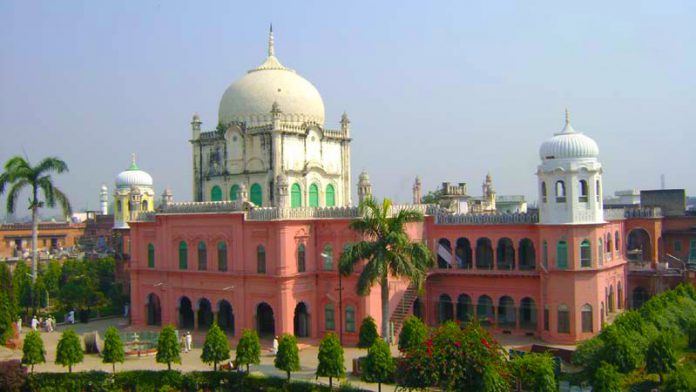
In this situation, intending to free India from the British rule, in the company of some friends, Maulana Nanautavi adopted another policy to establish a Madrasa on 21st May, 1866 (a famous learning centre of Indian Subcontinent, Darul Uloom, Deoband) beneath a pomegranate tree in Chattah Masjid of Deoband. So that the trained products of the Madrasa would sacrifice themselves to preserve the country and Islam both in British India. Alhamdulillah, Nanautavi succeeded in his mission and a good number of Darul Uloom’s product gave sacrifices for the sake of Indian freedom and Islam.
The noted Islamic scholar Maulana Manazir Ahsan Gilani (1892-1956) quoted in his book, “Ihaatae Darul Uloom Men Beete Huwe Din” (The Days Passed in the Campus of Darul Uloom) from his teacher and the first graduate of the seminary, Shaikhul Hind Mahmood Hasan Deobandi (1851-1920) saying:“Did my teacher (Maulana Muhammad Qasim Nanautavi) establish this seminary only for the teaching and learning? The seminary was established before me, as far as my knowledge goes, my teacher established this one in 1866 to compensate the defeat of 1857 from the British. I have chosen the same mission for which it was established before me.”
Very few people know the fact: “In the meeting of Jamiat Ulama-e-Hind at Kolkata in 1926, the participants included graduates of Darul Uloom, Deoband and they supported the group which called for complete independence of India from the British rule.
Indian National Congress was to declare complete independence as its goal three years later, in its session at Lahore.” (Wikipedia, Darul Uloom Deoband)The famous freedom fighter, Frontier Gandhi, Khan Abdu Ghaffar Khan (1890-1988), who visited Darul Uloom, during his visit to India in 1969, had said, “I have had relation with Darul Uloom since the time, Shaikhul Hind Maulana Mahmood Hasan, was alive. Sitting here, we used to make plans for the independence movement, as to how we might drive away the English from this country and how we could make India free the yoke of slavery of the British Raj. This institution has made great efforts for the freedom of this country.” (Wikipedia, Darul Uloom Deoband)Due to the great interest in India’s freedom struggle, Shaikhul Hind became an icon of Indian independence movement. Though he was a teacher of Darul Uloom, but made much effort to start an armed revolution against British rule from the both inside and outside India.
He started a programme to train volunteers and his students in the seminary from India and abroad for that goal. The most eminent among those who joined the movement were his students: Maulana Ubaidullah Sindhi (1872-1944), Maulana Husain Ahmad Madani (1879-1957), Maulana Muhammad Mian Mansoor Ansari etc.Shaikhul Hind sent Maulana Sindhi to Kabul and Ansari to the North-West Frontier Province to mobilize the popular support and recruit volunteers. And he with Maulana Husain Ahmad Madani travelled to Hijaz (KSA) to secure Turkish support. Getting the Turkish governor, Ghalib Pasha’s signature on a declaration of Jihad against the British, he planned to return to India via Baghdad and Bluchistan to start the rebellion.When Shaikhul Hind planned to return, the Silken Letter Movement was captured by Punjab CID.
Due to this movement, Shaikhul Hind was arrested in Hijaz. He was imprisoned in Malta, where he was tortured mercilessly, for more than three years.
Here it seems necessary to mention that what was the Silken Letter Movement. Shaikhul Hind wanted an armed revolution against the British rule, as I mentioned. So, he needed arms and ammunition. He and his colleagues, therefore, travelled to different countries to seek support from the anti-British countries; such as Afghanistan, Turkey and Russia. During the visiting different countries, letter exchanged between Shaikhul Hind and his colleagues, containing the outlines of the plan to recruit the volunteers for army and to establish a national government were written on silk piece of cloth. That is why the movement was known as the Silken Letter Movement/Tahreeke Reshmi Rumal (in Urdu)/Silk Letter Conspiracy (according to British government).When he returned to India, after release, was conferred upon by the title of Shaikhul Hind, leading leader of India.
Now he issued a Fatwa making it a duty of all Indian Muslims to support and participate with Mahatma Gandhi (1869-1948) and the Indian National Congress, who had prescribed a policy of non-cooperation and mass civil disobedience through non-violence.
He died on November 30, 1920 wishing to get martyrdom for India’s freedom.
Though Shaikhul Hind was no more, but he left a good number of students, who followed the footprint of their elders and worked tirelessly for the freedom of India.
Maulana Ubaidullah Sindhi (1872-1944), a 1891’s graduate of Darul Uloom, was also among them. He was the most active and prominent member of India’s freedom movement. He was among those leaders of Darul Uloom who left India, following the commandment of Shaikhul Hind, during World War 1, to get support of the anti-British central powers for an armed revolution against British rule.
Maulana Sindhi reached Kabul to rally the Afghan Amir Habibullah Khan.
After a period of time, he offered his support to Raja Mahendra Praratab’s plans for revolution in India with German support. He joined the Provisional Government of India formed in Kabul on 1st December, 1915. In this government, he was nominated the Minister for India. It was declared a revolutionary government in exile, which was supposed to take the charge of independent India, if the British government has been overthrown according to the plan. But unfortunately, in 1919, the provisional government was dissolved under the diplomatic pressure to Afghanistan.
He stayed in Afghanistan for 7-year nearly.
Then visiting Soviet Russia,he reached Turkey, where he issued the charter for the independence of India from Istanbul.
He left Turkey for Hijaz and remained there until 1929. He journeyed from a country to country for the sake of India’s independence. He died on 22nd August, 1944, at Deenpur in Pakistan.
Shikhul Islam Maulana Husain Ahmad Madani (1879-1957) was also one of the Shaikhul-Hind’s students and graduate and latter Professor of Hadith at Darul Uloom, Deoband.
Though he had been not convicted, but he accompanied Shaikhul Hind to Malta voluntarily, to take care of him. He stayed in Malta three years upto the release of Shaikhul Hind. Returning to India, he actively became involved in the freedom struggle. He had been imprisoned several times by the British authority for his participation in the freedom movement. It was he who dared to issue a Fatwa in the meeting of Indian National Congress at Karachi that working as British army and police is Haraam. After this Fatwa, he was rewarded two years rigorous imprisonment. He never stepped down from the freedom struggle movement, until India got freedom.
At the time of independence, the Muslim League and the Indian National Congress were at logger heads on partition of united India. On that occasion, Madani opposed the partition thoroughly. He journeyed the different provinces of India along with Maulana Abul Kalam Azad (1888-1958) and Mahatama Gandhi to assure the people safety and security and tried his level best to stop them to migrate from India to Pakistan. Many people targeted him, but he never conformed to the opinion of the partition.
After the independence, he was served a ministry, but he refused and restricted himself under the four walls of Darul Uloom and Jamiat Ulama-e-Hind for teaching and social works.
Like Madani and Sindhi, there were hundreds of Darul Uloom’s graduates, who actively took part in the freedom struggle of India. To mention the works of those patriots, the volumes and volumes are required.
It’s sorrowful matter that historians of modern India ignored completely the role played and efforts made by Darul Uloom for India’s freedom struggle. Today, most of the people aren’t aware of this historical institution. Some people know that Darul Uloom is a conservative seminary that produces merely Maulanas or a factory that only issues Fatwaas. And some say that Darul Uloom is “a Station of Terrorism” and “it produces terrorists”. This one is a famous opinion among Hindu fundamentalists, while the fact is otherwise as I stated in the essay.
It’s a bird’s eye view of the role of Darul Uloom, Deoband in India’s freedom struggle.
One who is interested on the topic, should go through the book, “Taarikhe Darul Uloom” (History of Darul Uloom).
May Allah accept the works of the seminary!
source: http://www.millattimes.com / Millat Times / Home> Special Column / by Khursheed Alam Dawood Qasmi , Email: qasmikhursheed@yahoo.co.in / August 15th, 2022
In a glittering ceremony, two books on Muslims’ contribution in India’s Freedom movement were launched here in Patna on 17th December. The function was presided over by Harsh Mandar, former IAS officer and human rights defender in the country.
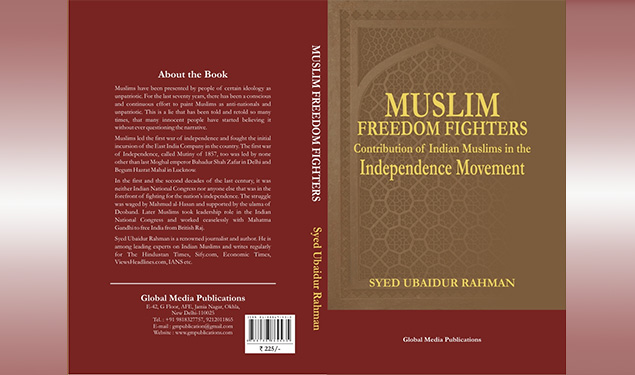
The books ‘Muslim Freedom Fighters: Contribution of Indian Muslims in the Independence Movement’ and its Urdu version ‘Muslim Mujahideen-e-Azadi aur Tehrik-e-Azadi Mein Unki Khidmat’ have been authored by Delhi based author and journalist Syed Ubaidur Rahman.
The two books try to fight the oft-repeated allegations that Muslims are anti-national and have not contributed for the freedom of the nation. The books nail the lie and prove that Muslims not just participated in the freedom movement, they went on to lead the freedom struggle for a long time. The first war of Independence or Mutiny of 1857 was led by Mughal emperor Bahadur Shah Zafar in Delhi and Begum Hazrat Mahal in Lucknow. The Independence Movement in the first two decades of the twentieth century was led by Mahmud Hasan and ulama of Deoband and they had respect and support of everyone including Hindus and Muslims.
If anyone has any doubt about the Muslim contribution in the freedom movement, the fact that the Indian National Congress had as many as nine Muslims as its president till the year 1947 will remove such doubts.
While speaking on the occasion, Harsh Mandar said that the divisive forces in the country are trying to divide the nation on the basis of religion and faith. He said that the danger from such forces for the national fabric and its unity has become grave.
Harsh Mandar added that the threat to the communal amity in the country was never so high as is today as divisive forces are doing every thing to pit one community against the other and create a fear psychosis among the majority community prompting it to turn it against minorities.
Khursheed Mallick, a Chicago based urologist, philanthropist and director of IMEFNA said that the book is a timely reminder to the nation that Muslims and Hindus both sacrificed for the nation and this fact must be clearly told to our young generation. He said Muslims sacrificed heavily for the cause of the freedom of the nation and efforts must be made to tell the history.
Syed Ubaidur Rahman, the author of the two books, while speaking on the occasion said Muslims have been rather loath to write about the sacrifices they have made for the cause of the Independence and freedom. He said Muslims suffered badly throughout the freedom movement. They were the worst suffers in the wake of the mutiny of 1857 and its aftermath when Muslims were hounded across North India and beyond. Tens of thousands of Muslims lost their lives for the freedom.
Syed added that ulama of Deoband played a stellar role in the freedom movement. Unlike the common perception, they were secular to the core and when they established a government in exile in Kabul in 1915, they appointed Raja Mahendra Pratap as its President and Maulana Barkatullah Bhopali as its Prime Minister.
The book documents the lives of forty renowned Muslim freedom fighters including, Shaikhul Hind Maulana Mahmud al-Hasan, Maulana Barkatullah Bhopali, Hakim Ajmal Khan, Maulana Ubaidullah Sindhi, Maulana Abul Kalam Azad, Maulana Mohammad Ali Jauhar, Dr Maghfoor Ahmad Ajazi, Dr Mukhtar Ahmad Ansari, Ashfaqulla Khan, Maulana Hasrat Mohani, Maulana Muhammad Mian Mansoor Ansari, Asaf Ali, Husain Ahmad Madani, Aruna Asaf Ali (Kulsum Zamani), Peer Ali Khan, Saifuddin Kitchlew, Mohammed Abdur Rahiman, Captain Abbas Ali, Abdul Qaiyum Ansari, Prof. Abdul Bari, Moulvi Abdul Rasul, Nawab Syed Mohammed Bahadur, Rahimtulla Mahomed Sayani, Syed Hasan Imam, Sir Syed Ali Imam, M.C. Chagla, Yusuf Meherally, Justice Fazal Ali, General Shah Nawaz Khan, Allama Fazle Haq Khairabadi, Maulana Shaukat Ali, Syed Mahmud, Maulana Mazharul Haque, Badruddin Tyabji, Col Mehboob Ahmed, Begum Hazrat Mahal, Maulana Shafi Daudi, Rafi Ahmed Kidwai, Syed Mohammad Sharfuddin Quadri, Batak Mian
The book launch function was organized at Anjuman Taraqqi Urdu and was presided over by Abdul Qaiyum Ansari, chairman of Anjuman Taraqqi Urdu Bihar.
Name of the Book: Muslim Freedom Fighters: Contribution of Indian Muslims in the Independence Movement Author: Syed Ubaidur Rahman ISBN: 81-88869-43-0 Price Rs 225/- Global Media Publications E-42, G. Floor, AFE, Jamia nagar, Okhla, New Delhi-110025
source: http://www.ummid.com / Ummid.com / Home> India / by ummid.com News Network / December 12th, 2017
When Nobles became non-entities, Princes became paupers and Begums were reduced to beggars…
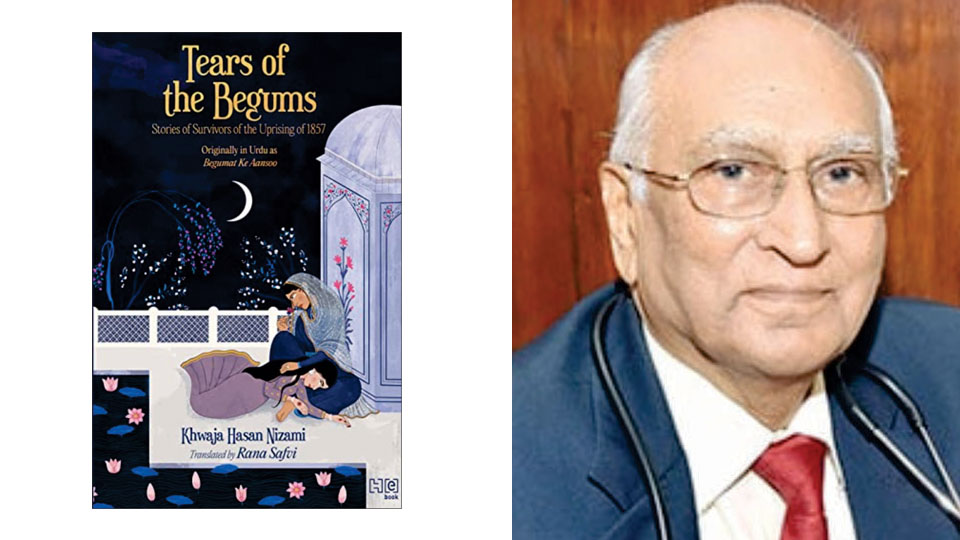
Title: Tears of the Begums: Stories of Survivors of the Uprising of 1857 (Originally in Urdu as ‘Begumat Ke Aansoo’)
Author: Khwaja Hasan Nizami
Publisher: Hachette India
Year of Publication : 1922
Translator : Ms. Rana Safvi (2022)
Pages: 212+xii
Price: Rs. 499
The Sepoy Mutiny (or the First War of Independence as we call it) started in 1857, over the issue of the greasing of the cartridges used in the guns of Indian soldiers of the East India Company army. It was known by the Urdu word “Ghadar” meaning rebellion or revolt.
The rebellion spread rapidly in North India particularly around Lucknow and Delhi. The rebellious soldiers killed a large number of British officers, women and children. They adopted as their leader the surviving Mughal emperor Bahadur Shah Zafar without his consent. He was only a namesake Emperor who was on a generous pension given by the East India Company, and did not have any power beyond the precincts of the Red Fort, nor had the money to help the soldiers. He was reluctant to take on the British army but was helpless and had to go with the demands of rebellious soldiers.
Though initially the British had a setback, they quickly regrouped and took over Delhi. The Red Fort had about 3,000 royal families all of whom were descendants of the present and past emperors. The emperor’s court life was filled with pomp and grandeur, though he had no real authority.
Bahadur Shah himself was a refined and gentle soul and a poet. Delhi was ruled by the English Resident. The lives of the royals living in the “Lal Qila” was lavish with big mansions, large number of servants and slaves. Ghadar was a watershed moment in Indian history and the grand and elegant Mughal culture ended suddenly and dramatically.
Kulsum Zamani Begum was the beloved daughter of the last emperor Bahadur Shah. On the night he left the fort, he sent her and her family away entrusting them to the care of Khuda (God). Within a few days of leaving the Red Fort they were looted of all their money, jewels and even their expensive clothes. Finally on the way some villagers give them shelter in a thatched hut. The company soldiers were looking for the emperor’s descendants to arrest and punish. They escaped to Hyderabad, where they were given shelter by Nawab Lashkar Jung, who had given shelter to many Mughal royals who had escaped from Delhi.
In a few years the British had their way and the Princess was advised to leave Hyderabad. Some of the well-wishers of the Mughals arranged for her to travel to Mecca. One of the slaves she had freed while she was the Princess in Delhi had migrated to Mecca and had become an extremely wealthy merchant there. He looked after her very well and made her family stay comfortable.
The Ambassador of Turkey learnt that the Emperor’s daughter had taken refuge in Mecca and arranged a pension for her from the Sultan of Turkey. She lived comfortably in Mecca for a number of years. Ultimately she longed to return to her beloved Delhi. When she went back to Delhi, the English Governor out of compassion, arranged a pension for her family. The British who had taken away her dad’s empire, gave her in return a grand compensation of ten rupees a month.
Sakina Khanum was the daughter-in-law of Nawab Faulad Khan. Nawab died while fighting the company soldiers during the Ghadar. When his body was brought home by the soldiers, Sakina was writhing in severe labour pains. The Nawabs’ son had died four days earlier in the war, and his wife had passed away two years ago. Sakina delivered a boy with the help of the servants, while the corpse of the Nawab was lying in the front yard, without even a shroud. She had to run away from their mansion at midnight, taking a few jewels, some cash which was in the house and her new-born baby. The four maids who were in the house went with her.
After a few days, the maids stole all the money and jewels and deserted her. They even took away the new-born son of the Princess. She tried to eke out a living by working as a maid in households. Unfortunately for her, she had no skills needed for domestic help. After all she was the daughter-in-law of a Nawab and had lived in luxury with many servants and slaves at her command. She was frequently thrown out of many homes where she worked, as she could not work hard enough.
Finally, the Princess became a beggar for her living. After a few years, one afternoon she was begging in front of a wedding house. She was exhausted due to the hot summer sun. She had not eaten for many days and was extremely hungry. As she was begging, one young handsome boy came out of the wedding hall. Hearing her wails, he sat in front of her and gave her the food he was carrying for himself. The boy spoke to the beggar and consoled her and told that his mother was a maid in the wedding house.
As he was speaking with her, his mother came out and Sakina immediately recognised her as her maid who had deserted her and realised that the boy who fed her was her own son. After many years Sakina the beggar Princess had been reunited with her long lost son.
Qismat Baig worked as a chef at the palatial Taj Mahal hotel in Bombay. He was a recluse and an irascible and difficult man. None knew his antecedents. Whenever asked about himself he would answer that he was a Badshah and walk away. The Maharaja of Bhavnagar would frequently stay at the Taj Mahal Hotel whenever he was in Bombay, and he immensely enjoyed the food cooked by Qismat Baig.
One day the Maharaja expressed his desire to meet the chef. Qismat Baig, who never liked to meet anyone, was persuaded to visit him. When the king asked Qismat Baig as to who he was, Baig gave a long philosophical discourse. Surprised at the erudition of the chef, the king persuaded him to tell his story. Baig started recounting his long sad story. He was the son of the last Mughal Emperor Bahadur Shah born to a slave girl. He was named Timur Shah after the great ancestor of the Mughals. The emperor had provided well for him and his mother and they lived comfortably in luxury with servants and maids. As a young boy he was well educated and would often visit a Dargah near his home in the evenings and had imbibed Sufi mysticism and Dervish practices.
When Ghadar started, his mother lost everything. He worked as an assistant to a cook and learnt the culinary art. Misfortune always haunted him. He lost his mother, wife and children to illnesses and became alone in the world. Living in Delhi made him very sad and migrated to Bombay where Timur Shah changed his name to Qismat Baig, a man of destiny. The son of the Mughal Emperor had become a Bawarchi (chef) in a hotel.
These are some of the poignant real-life stories in the book “Tears of the Begums”. Khwaja Hasan Nizami was a young man at the time of Mutiny. In later years he became a writer. He personally interviewed many survivors of nobility and recorded their tragic stories. It was published as a book “Begumat Ke Aansoo” in 1922. Ghadar was a cataclysmic event in the narrative of India. It ended the centuries of pomp of the Mughal Court and the wealthy refined and elegant lives of the aristocracy. Nobles became non-entities, Princes became paupers and Begums were reduced to beggars. The sad stories in the book bring “Aansoo” to the eyes of the readers.
source: http://www.starofmysore.com / Star of Mysore / Home> Feature Articles / by Dr. C.D. Sreenivasa Murthy / October 11th, 2022
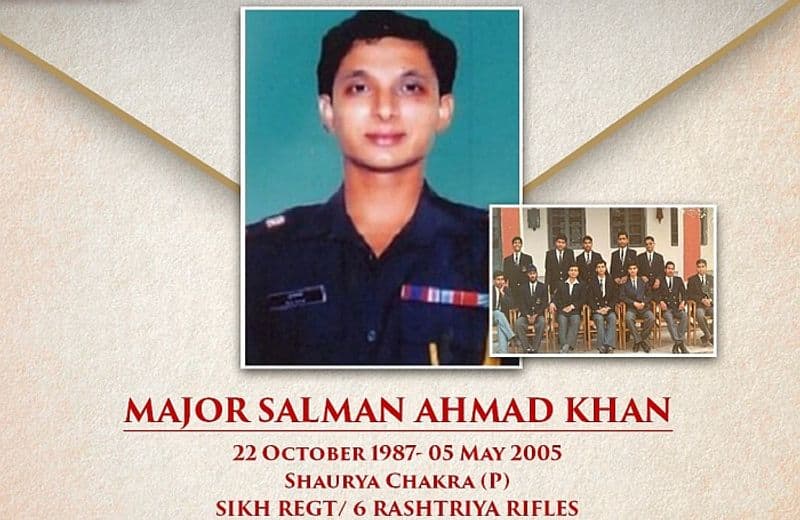
Major Salman Ahmad Khan was a gallant and committed soldier who laid down his life in the service of the nation, following the highest traditions of the Indian Army.
Bengaluru:
Kupwara in Kashmir had been a hotbed of terror. Deployment in the district required constant vigil. In 2005, Major Salman Ahmad was deputed to serve with the 6 Rashtriya Rifles battalion in Kupwara.
It was just the place for a determined soldier and a fine officer like Major Salman Ahmad Khan. Major Salman’s unit was always in a high state of alert and carried out a number of operations to flush out terrorists.
On May 5, 2005, the unit received credible information from intelligence sources about the presence of terrorists in a village of Kupwara district.
After analyzing the situation, a decision was taken by the security forces to launch an operation in the wee hours of May 5.
The 6 RR unit swung into action and launched an operation in the wee hours of May 5.
The assault team cordoned off the area. On being challenged, the terrorists opened fire at the security troops and a fierce gunbattle ensued.
Major Salman eliminated one terrorist in the gunbattle. He then chased another terrorist who was trying to flee. In the process, other terrorists hiding from a house opened fire at Major Salman with automatic weapons.
The officer was seriously wounded. But despite his injuries, he lobbed a grenade at the second terrorist and killed him.
Major Salman later succumbed to his injuries. He was a gallant and committed soldier who laid down his life in the service of the nation, following the highest traditions of the Indian Army.
Major Salman Ahmad Khan was honoured with Shaurya Chakra posthumously. Flags of Honour salutes this officer for his outstanding courage, unyielding fighting spirit and supreme sacrifice.
source: http://www.mynation.com / My Nation / Home> India / by Team MyNation / May 05th, 2021
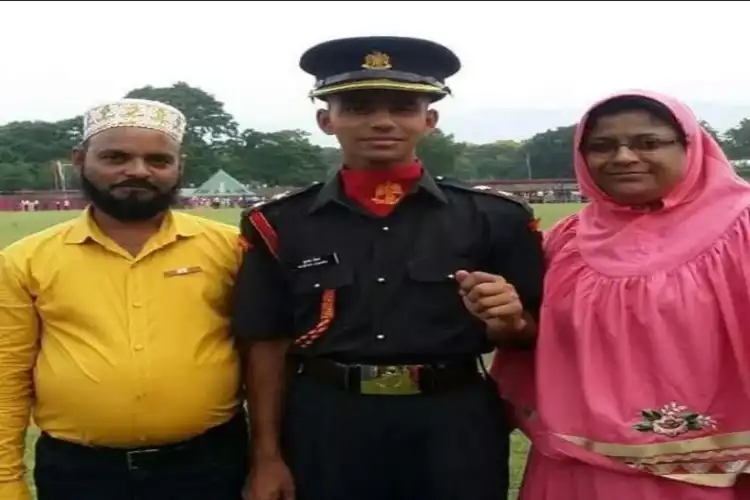
Martyr Mustafa Bohra with his parent at his passing out parade (Twitter)
Delhi:
A pall of gloom has descended on the house of Major Mustafa Bohra, co-pilots of the Indian Army Helicopter Cheetah that crashed at Siang, close to Tawan on the China border in Arunachal Pradesh on Friday killing five people onboard.
People from all walks of life, leaders, and Army officials have been visiting the family of Major Bohra in Udaipur, Rajasthan.
Local media said Major Bohra is survived by his parents Fatima and Jallaludin Bohra, and sister Alfia Bohra.
His father works in Kuwait and was away when the sad news came, Both the women at home are inconsolable and mostly in an unconscious state.
Major Mustafa Bohra was the only son of his parents.
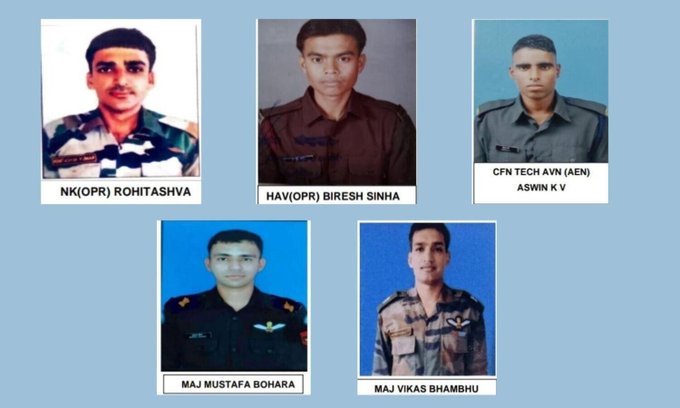
Martyrs of Arunachal Pradesh Helicopter crash (Indian Army Twitter)
When the last report was filed Jallaudin Bohra was trying to fly home to be with his family in this hour of grief.
Hitesh Kumar, a resident of Udaipur, who knew the Bohra family, and who spoke to local media said that Major Bohra’s mother and sister are in bad condition and in a state of deep shock.
The family hails from Kheroda village and currently lives in the street of Ajanta Hotel in Udaipur city.
Vallabhnagar MLA Preeti Shaktawat visited the family on Saturday and spent time with the women and their relatives.
Major Bohra completed his primary education at Uday Shiksha Mandir Higher Secondary School, Kheroda. Later the family shifted to Udaipur city and he joined St. Paul’s School. He joined the Indian Army after his higher secondary.
Major Bohra’s body is expected to reach by Sunday evening. Besides Bohra, Major Vikas Bhambhu, CFN Tech AVN (AEN) Ashwin KV, Havaldar (OPR) Biresh Sinha, and NK (PPR) Rohitashv Kumar also died in the accident.
The Advanced Light Helicopter (ALH) carrying five soldiers, including two pilots, was on a routine flight when it crashed at 10.43 am on Friday, October 21, near Miging, about 25 km south of Tuting.
Defense spokesman Lt Col AS Walia said the bodies of four other personnel were recovered from the crash site in the densely forested mountainous area, about 35 km from the Chinese border, on the evening of Friday, October 21.
source: http:/www.awazthevoice.in / Awaz The Voice / Home> India / by awazthevoice.in / October 23rd, 2022