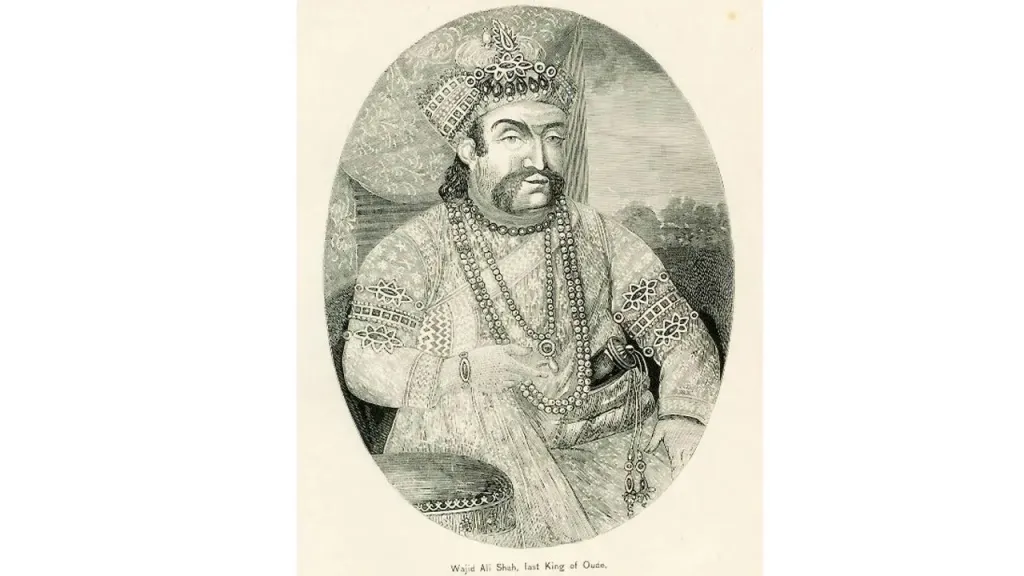
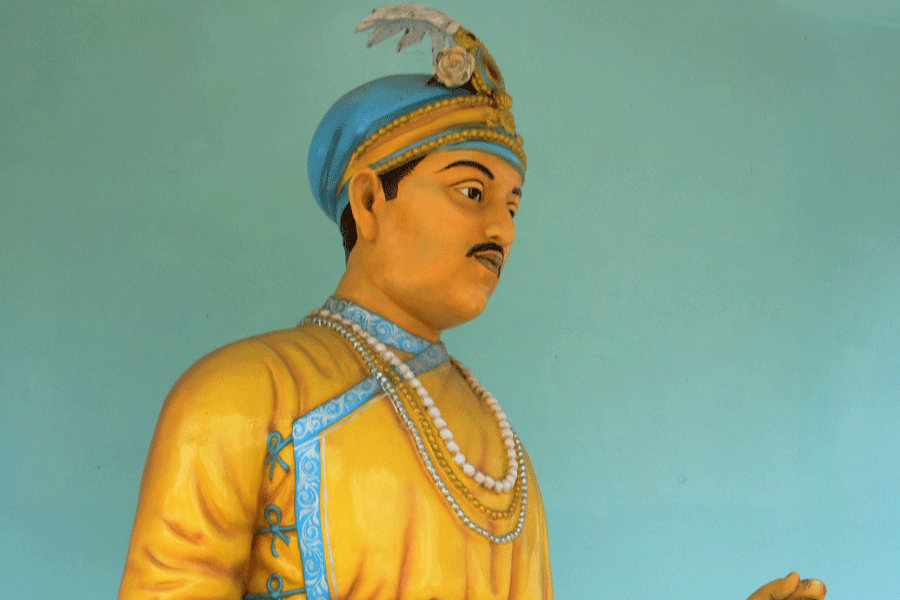
That culinary addition is attributed to Chef Manzilat Fatima’s great-great grandfather Wajid Ali Shah, the Nawab of Awadh.
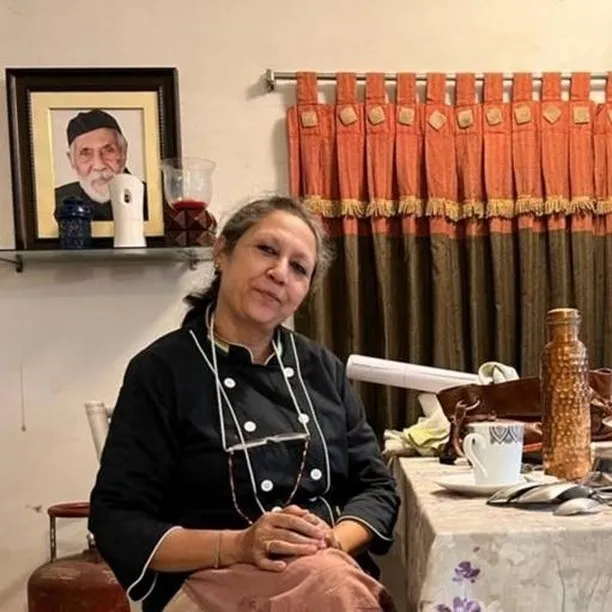
Chef Manzilat Fatima, April 22, 2024. (image courtesy: Umang Sharma)
Manzilat’s great-grandfather did
On most evenings, Manzilat Fatima’s rooftop restaurant in South Kolkata, aptly named Manzilat’s, is packed with food connoisseurs waiting to taste the incredible dishes she prepares for them. But there is another reason foodies climb four flights of stairs to her quaint little eatery.
An engraving of Nawab Wajid Ali Shah. Pic Courtesy/ Wikimedia Commmons
What Manzilat does, is nothing short of remarkable. Not only does she tantalize the tastebuds of food lovers with exceptional dishes such as Chicken Lazeez Shami Kebab, Lakhnavi Murgh Biryani, or the famed Lakhnawi Mutton Yakhni Pulav – but she also evocatively creates a bridge between the present and the royal past of Wajid Ali Shah, the last Nawab of Awadh.
Manzilat Fatima is the great-great granddaughter of the Nawab who made his home in Kolkata after the British East India Company annexed his kingdom. He gave the culinary world the famed aloo in Biryani.
A descendant of Awadh
“I am a direct descendent of Wajid Ali Shah and Begum Hazrat Mahal ,” Manzilat reveals.
After the annexation, her great, great grandmother Begum Hazrat Mahal who took charge of Awadh, put her son Birjis Qadr on the throne in 1857. Birjis Qudr was the son of Jaan e Alam Wajid Ali Shah and Begum Hazrat Mahal.
Manzilat is the daughter of Dr. Kaukub Qudr Meerza, the grandson of Birjis Qudr, she explains.
Like her pantry, stocked with delectable food, Manzilat is a storehouse of stories and fascinating history.
A conspiracy at play
According to Manzilat, despite having no inheritance, Birjs was still the legal heir of Wajid Ali Shah and Begum Hazrat Mahal.
“Birjs Qadr had a son Mehr Qadr who was my grandfather,” adds Manzilat. “He did not have any siblings growing up. He did have a family, but they were assassinated in cold blood on August 14, 1893.”
Manzilat says that the British invited Mehr Quadr from Kathmandu to Calcutta under a false pretext. “The other descendants of the Awadh royal family wanted to snuff out the last crown king, even though there was nothing to inherit by then.”
There was a deeper conspiracy at play.
A dish of Awadhi biryani (image courtesy: Manzilat Fatima restaurant)
A poisoned dinner
“In order to snuff out this branch they cooked up a conspiracy along with the British and invited him and his family over for dinner where they laced the food with poison. In that tragedy, he, along with a son and daughter as well as his guards and dogs were murdered.”
Only Mehr Quadr’s wife, Mehtab Ara Begum, survived. She was pregnant with Manzilat’s grandfather and did not attend the dinner. “Had she gone for the dinner, the entire course of history would perhaps have been different,” says Manzilat.
Her grandmother, Mehtab Ara Begum, survived along with an unborn child – Manzilat’s father- and a daughter who was four years old at that time. The little girl grew up and married, but died childless. But the lineage of Wajid Ali Shah continued through Mehr Qadr and Manzilat’s father Kaukub Qudr Meerza.
“My lineage shaped me into a very loyal Indian,” she says. “We grew up hearing stories of valor of Begum Hazrat Mahal and Birjs Qadr and how, after 1857, (she) chose to live free in Kathmandu, Nepal. Our history helped us be grounded and honest. We learned the art of sacrifice.”
From lawyer to chef
Growing up, Manzilat heard stories about the tragedy and the conspiracy that destroyed her family – from their time in Lucknow until Birjs Qadr’s assassination, and how her grandfather was protected and grew up very sheltered because of the constant threat to his life.
Being a chef was not always the game plan. Manzilat studied at Aligarh Public School and graduated with an English (Hons) degree from Women’s College, Aligarh Muslim University. She enrolled at Calcutta University for her Master’s in English and a few years after her marriage, even completed a five-year LL.B course in 2002.
Chef Manzilat Fatima (image courtesy: (Umang Sharma)
Manzilat opened the doors to her kitchen to food lovers from all over the world. As the smoke rises from her tender Mutton Awadhi Galwtii Kebab, or tear-drop-shaped condensation rolls down her chilled Khus ka sherbet, or even as patrons savor the pillowy soft aloo in their biryani, Manzilat knows that she has not only served some delectable dishes but offered her guests a panoramic view into the world of her ancestors and what they stood for – the mighty Wajid Ali Shah, the indomitable Begum Hazrat Mahal.
In the fragrant aroma of her kitchen, Manzilat Fatima is the custodian of the legacy of the last Nawab of Awadh. Her guests experience more than just culinary delights; they immerse themselves in a narrative of courage, tradition, and the enduring spirit of Awadh.
source: http://www.indiacurrents.org / India Currents / Home> Food> India> Lifestyle / by Umang Sharma / April 26th, 2024
Ellen Barry of the New York Times walked into my study and, wasting no time, came straight to the point. What did I know about the last “Begum of Oudh”? She had a quizzical, amused look like she knew what the answer would be but would still like to see my expression. The abruptness of the query was her way to establish a point of departure on the theme.
After reading Ellen’s evocative masterpiece on the Oudh (Awadh) Royals in the NYT, I am chastising myself for poor judgment. I dismissed Ellen’s pursuit as a “foreigner’s” quest for the exotic. This was months ago. The story titled “The Jungle Prince of Delhi” appeared last week.
Only after reading the lengthy piece which, in parts, reads like a poem in prose, did I, Google Ellen, out. She had been the paper’s bureau chief in New Delhi, Moscow, winner of the Pulitzer Prize and so on.
The story of the “Begum”, Princess and the jungle Prince, is a classic case of “news” which, when neither confirmed nor denied, takes root in the popular imagination. Public opinion then drives the government into action to minimize criticism. That is why Indira Gandhi in the early 80s agreed to transfer the “Royals” to a medieval hunting lodge on the ridge. It is known as Malcha Mahal.
Ali Raza, Prince
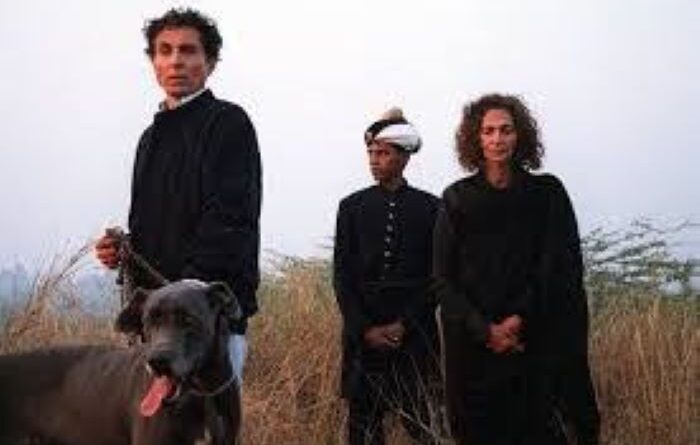
In the early 70s, a woman with sharp aristocratic features took up residence on platform number one of New Delhi Railway station and proclaimed herself the last Begum of Oudh. For greater credibility, she had in her entourage, two children, a handsome dog, and a liveried servant.
The mainstream media took a perfunctory interest but the Urdu press amplified the fall of the House of Oudh and readers, in enclaves like Jama Masjid, saw it as part of a continuing story of victimhood. Here was tear-jerking melodrama: “our royals betrayed”.
It says something of our journalism that a story laden with so much possibility waited unexplored for 40 years until Ellen Barry appeared. She tied up all the loose ends – the railway station Lucknow, Bradford, Texas, Lahore: and what a story she has delivered, a story under our noses but which we failed to see. This is not surprising because even our archaeology was excavated by Europeans. Why, even the Last Moghul, is something of a masterpiece by William Dalrymple. While Dalrymple diligently scoured archives in the fashion of scholarly investigation, the Oudh story was there for all newspapers and channels to see.
True, the story was, on the face of it, “fake” from the beginning. But what shames us, this hack included, is the fact that it required an outsider to tell up why the “fake” was being played out – across the subcontinent and two generations?
Toba Tek Singh in Manto’s story cannot understand how a place, which was in India, can “go” to Pakistan. Like Toba Tek Singh, Begum Wilayat of Oudh also spent time in an asylum for her grand delusion. She had to live with women who were “tied in chains”, Ellen’s investigations reveal for the first time.
Trust Saiyyid Ammar Rizvi, Lucknow’s omnipresent Shia (and gourmet in the classical Awadh mould) to has become something of an intermediary between the Royals and the UP Chief Minister. He must surely know about the other Royal in that splendid city – Prince Moinuddin, who also addresses himself as Bahadur Shah III. The last Moghul Emperor was his great, great grandfather: that is his story. His great grandfather escaped to Kerala. But why did Bahadur Shah III materialize in Lucknow?
Malcha-Mahal-Wilayat-Mahal
The Bahadur Shah story has remained unnoticed because the claimant to the title never made a nuisance of himself. Begum Wilayat Mahal did. When the New Delhi station master requested her to vacate the platform, she threw a fit. She would commit suicide by drinking some exotic poison. In fact, when she did die in 1993, her progeny tutored by her for decades, put out the story that, for a decorative expiry, she had swallowed “crushed diamonds”. Her daughter, Sakina’s death was presumably caused by neglect because there were stories of her unwashed hair dropping in matted locks. It was with the “Prince”, variously named as Prince Ali Reza, or Cyrus, who spent his last years in Malcha Mahal, that Ellen struck an equation of tenderness mingled with curiosity. Google her NYT piece titled “The Jungle Prince of Delhi”.
The yarn begins in Lucknow where Wilayat was happily married to the registrar of Lucknow University, Inayatullah Butt. The name itself is a give-away: it is a Sunni name whereas anybody claiming lineage from the Nawabs of Oudh would have to be Shia. A similar story of dubious veracity explains why the Butt’s left for Pakistan. During the high tension of Partition in 1947, Hindus armed with hockey sticks beat Butt up. I can bet my last rupee that the story is false. Yes, there was small-scale stone-throwing between Shias and Sunnis on appointed days annually. But Hindu-Muslim violence? Never – until caste politics reared its head in the late 80s.
The last king of Oudh (Awadh), Wajid Ali Shah’s exile to Matia Burj near Kolkata or the more recent Partition of India are disorienting events for those in the thick of it, by historical memory or raw experience. In minds like Wilayat Butt’s historical memory and immediate experience are all jumbled up in knots.
Is Malcha Mahal Really Haunted ?
Ellen believes that disruptions caused by a change (Partition for instance) had a great deal to do with the Butt tragedy. A grievance “unaddressed, had metastasized” to become an epic tragedy.
Wilayat was a “mental” as one of her relatives in Lahore said. Ellen has explored the story backward after she got to know the recluse “Prince Cyrus” in his Malcha Marg hideout. In the end, he turned out to be no more than Micky Butt. She writes of their sad delusion:
“It is impossible to know, now that he and his sister are dead, whether they even knew it wasn’t all true.”
Curated and Compiled by Humra Kidwai
source: http://www.theindiaobserver.com / The India Observer / Home> Diaspora> Editorial> India> Interface> Lifestyle / by Saeed Naqvi / edited by Adam Rizvi / Curated and Compiled by Humra Kidwai / November 29th, 2019
The cemetery and those who lie buried in the soil of time and fate are the witness to the the lost romance, their epitaphs bear a testimony to a history of prose and poetry.
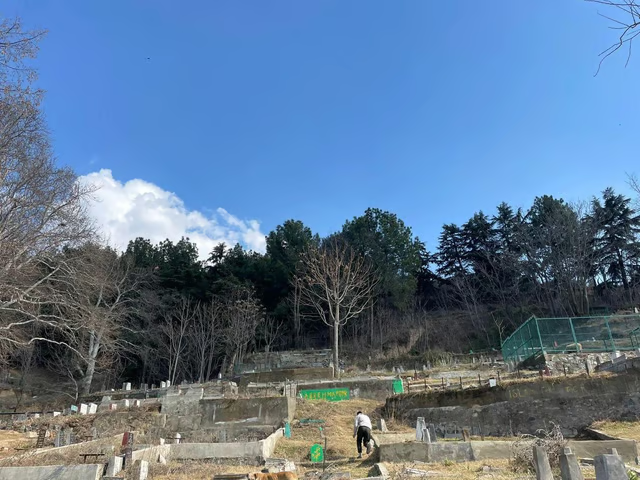
The forgotten poet cemetery of Kashmir / Photo: Shakir Mir / Internet
خاک میں کیا صورتیں ہوں گی کہ پنہاں ہو گئیں
(In the soil- what faces must be hidden)
Beauty finds its way at odd places; away from the flamboyant commotion of Boulevard, far from the amorous colours of Zabarwan and distant from the prospects, perspectives and spectre of present. Beauty finds its way at odd places: along the sombre shores of the lifelessness, in the weed, litter and rubbish of a graveyard, the withered tombstones of a cemetery,
The Cemetery of the Poets
The cemetery and those who lie buried in the soil of time and fate are the witness to the the lost romance, their epitaphs bear a testimony to a history of prose and poetry.
Laala tooram, na humchoon ghuncha gulboo zadaem
Shaula jae bakhya bar chaak-e-gereban meezenam
(I am the Tulip of Sinai and not the bud borne of a rose
To my torn collar, I apply the needle of my fire to stitch it)
Cries out poet Mazhari, having penned down 6000 Persian verses throughout his travels from Iran, Khorasan, Hindustan to Kashmir, but now lost in graves and indifference of another necropolis, Malkhah.
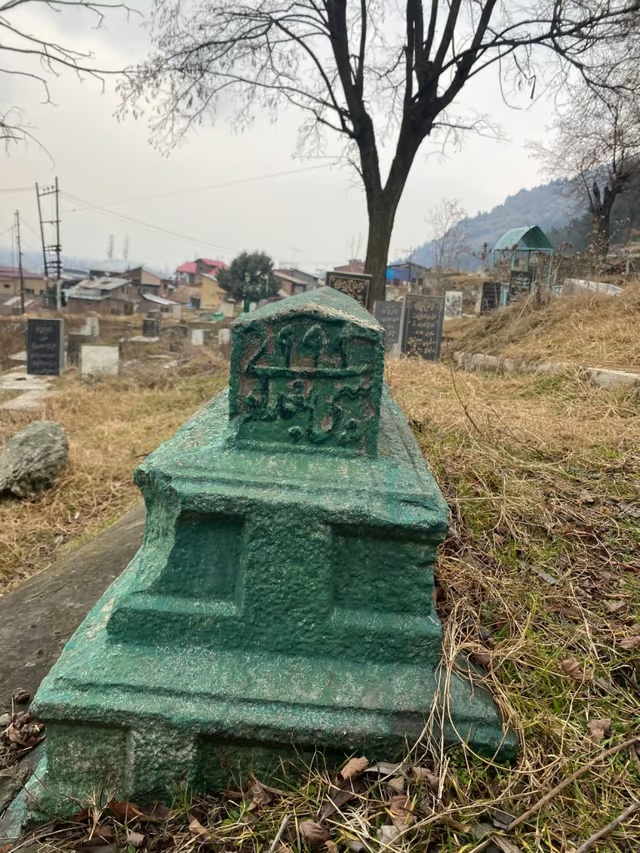
Founded in year 1587 C.E during by the Mughal emperor Akbar, the cemetery of poets, also called Mazar-e-Shoara is situated along the banks of Dal Lake. The burial ground for the once eminent poets seems to have been selected carefully to give the dead souls a serene eternal sleep. The historical records show that there were five poets and men of letters buried in the cemetery, all of them the eminent avant grade of Iran, associated with the literary upper class of Mughal court. However, as of today only three of the tombstones can be located in the mazar, rest covered in debris of time and apathy.
There seems to be some confusion regarding the first grave in the cemetery, largely appearing due to the mistakes in copying the previous historical accounts. In this regard the first reference comes from the great historian and author, Mohammad Azam Dedmari in his Waqiat-e-Kashmir. Dedmari was a scholar, researcher, and also a poet of his time and was born during Aurangzeb’s era when Abu Nasr was performing the duties of sobedar (Governor) of Kashmir. Therefore, due to his temporal proximity to the rule of Akbar and his other meticulous documentations, his record can be taken as more authentic.
According to him the great Iranian savant and scholar of his time, Shah Fatehullah had come from Iran to Deccan. According to M. A Alvi and Abdur Rahman’s seminal work, “Fathullah Shirazi: The great Indian scientist of 16th century” and Mohammad Akmal Makhdum’s, “A Great Man: Shah Fateh Ullah Shirazi”, Fatehullah was brought up in Shiraz and learnt under great teachers like Kamal-ud-din Masood Sherwani and Khwajah Jamaluddin Mahmud, a disciple of the logician Jalal-al-din-Davani. Shirazi furthered his knowledge in medicine, mathematics, and science under the instruction of Mir Ghayasuddin Mansur. After completing his education, Shirazi embarked on a career in education in Shiraz. Among his notable students was Abdul Rahim Khan-i-Khanan, who served as the close confidant of the Mughal Emperor Akbar. In 1583, Shirazi received an invitation from Mughal Emperor Akbar and subsequently joined the imperial court in Agra.He soon earned the title of Amir and a rank (mansab) of 3000. Two years later, in 1584, Akbar appointed him as the Amin-ul-Mulk, also known as the Trustee of the State.Shirazi’s first task was to reexamine and rectify the Mughal Empire’s vast transaction records, which he accomplished with diligence and success. Along with his administrative work, Shirazi also undertook the task of regulating the intrinsic and bullion values of coins. He identified and corrected discrepancies in the currency, ensuring its reliability and trustworthiness. Shirazi’s skills and talents also earned him various honors and titles. In 1585 and 1587, the emperor selected him to lead diplomatic missions to the Deccan, where he was recognized for his efforts with the title of Azud-ud-Dawlah, or the Arm of the Emperor. He also received a horse, 5000 rupees, a robe of honor, and the office of the Chief Sadr of Hindustan.
A great poet, he also made significant contributions to the fields of philosophy and logic, particularly in his work, Takmilah-i-Hashiyah. Additionally, he played a crucial role in compiling the Tarikh-i-Alfi, a thousand-year history of Islam, demonstrating his vast knowledge in the field of history.
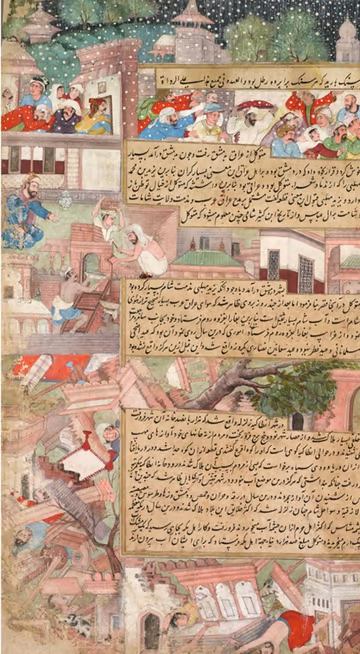
Page of disasters, from Tarikh-i-Alf
One can try to estimate the scholarship of Shah Fatehullah by the brief introduction Abul Fazal (Grand Vizier of Emperor Akbar the Great) writes about him. Abul Fazal being a royal minister and himself a great scholar did not recognise anybody at par with his own scholarship, but about Shah Fatehullah he writes:
“if all the books of all the subjects and sciences and crafts are destroyed then Shah Fatehullah, with his scholarship and knowledge, and with his memory, will create a parallel new library of books.”
Emperor Akbar mourns his death in following words:
“Had he fallen in the hands of Franks and had they they demanded all my treasures for him, I would gladly have entered such profitable traffic and brought the jewel cheap”
Shirazi was a great inventor and is credited with numerous innovations like improved cannons and guns, wagon mllls, mirrors that would make far things appear closer, travelling baths etc.
Two references are made to the death of Shah Fatehullah by Kashmiri scholars, one by Dedmari who says that he developed Typhoid and self treated it by over-eating Harisa. Another reference is made by Hassan Kuehami in his Tareekh-e-Hassan in which he refers to him (probably mistakenly) as Shah Abu Fateh and cites tuberculosis as his cause of death. The mistake (viz a viz name) seems an error while copying from Waqiat-e-Kashmir, where a poet called Mir Abu Fateh is mentioned immediately after Fatehullah, whom Kuehami seems to have skipped and probably mixed with the former. The location of his burial is mentioned atop Takht-e-Sulaiman, in Mazar-e-Shoara.
M.A Alvi and Abdur Rahman refer to Abdul Qadir Badaoni’s, Muntakhab-ut-Tawarikh, which narrates a story similar to that of Dedmari in which Fathullah Shirazi dies because of over-eating porridge made of meat while having an episode of febrile illness. But there is a very important historical fact that is referred to in this version. According to them Fathullah was buried on koh-e-sulaiman, in the monastery of Sayyid Ali Hamadani. However, today we do not know any such monastery that exists on koh-e-sulaiman (or takht-e–sulaiman). So could this be reference to the lost monastery of Sayyid Ali Hamadani’s student Mohammad Ismael Kubravi which is historically known to exist around the same place. It was a matter of reverence to teachers that the students would name their schools and shrines after them. The great scholars would be buried in graveyards adjacent to these monasteries. So, is the location of the Mazar-e-Shoara the place where the monastery of Mohammad Ismail Kubravi actually stood?
(The lost monastery has a history of its own, allegedly destroyed by Chak rulers, the location where it stood has been a centre of academic debate in archaeological and academic circles.)
Cemetery
Second grave in the cemetery is of Haji Jan Muhammad Qudsi Mashadi popularly called Qudsi Mashadi. He was a native of the Mashhad in Iran. He joined the court of the Mughal emperor Shah Jahan where he rose to become Malik-al-Shura (poet laureate). It is said that Mughal empire had Qudsi weighed in gold, which was then presented to him as a reward for his poetic excellence. On the occasion of the installation of the famous Peacock Throne in 1635, for example, Qudsi composed a dedicatory chronogram that was cast in glazed tile and inserted inside the throne canopy. Qudsi wrote several topographical poems as well, the most famous of which is his description of the journey to Kashmir.
When his son Mohammed Baqir died in the prime of his youth in Mashhad, Qudsi was heartbroken and decided not to go back to his native land but remain in India. Later he settled permanently in Kashmir. His works includes the poetical composition Zafarnama-yi Shahjahani, devoted to the king’s conquests, containing some 7000 rhymed couplets, and covering the first fourteen years of Shah Jahan’s reign and is by far Qudsi’s longest work, though it remained incomplete at the time of his death it was later completed posthumously by Kalim Kashani; a mathnawi entitled Wasf-I Kashmir. The poet remains buried in the Mazar-e-Shoara.
The third poet lying at rest in the graveyard is Abu Talib Kaleem. A native of the Persian city of Hamadan when Abu Talib Kaleem heard about Qudsi’s reception at the court of Shah Jahan, he was perturbed and said, “The man who was to be held by neck, it is strange, was weighed in gold”. He travelled Deccan and other Indian cities and later became a courtier of the Emperor at Shahjehani Darbar. Kaleem soon attained fame as a poet. The great Urdu poets Sauda and Mir Taqi Mir have written Tazmeens (poems formed by inserting verses from another’s poem) of his ghazals. Kaleem was assigned the task of writing a history of the Mughals, Padshah Nama or Shahnama Shaham Chugtia, in poetic form and sent to Kashmir so that he could do his work undisturbed. Hw wrote qasidas and mathnawis about every important event of his time, be it the fight of young Aurangzeb with an infuriated elephant, the famine in Deccan or his visit to a paper mill in Kashmir. He also composed a poetic chronicle sahgihannama Like Qudsi, he was a great admirer and friend of Ghani Kashmiri who wrote an elegy on his death (in 1650 C.E) in which he also remembered Qudsi and Saleem as great and noble poets. In the elegy he compared his friend to Moses ‘Kalimullah”, the pen being his miraculous rod, and gives chronograph of his death in the line:
The Sinai of inner meaning became radiant by Kalim
The fourth poet, another native of Iran, Mohammed Quli Saleem went to India in the reign of Shah Jahan. He joined the court of the prime minister Nawab Islam Khan. He was a man of high poetic calibre and is famous for his works ‘mathnawi-qadha-wa-qadar’ and another mathnawi in praise of Kashmir. Saleem was accused by the Iranian poet Sa’ib of plagiarising his poetry. During his stay in Kashmir he fell ill and passed away to be buried in the cemetery of the poets.
The last poet buried in the graveyard is Tughra Mashadi. Nothing is known of Tughra’s childhood and youth, other than that he probably was born in Mashad. Tughra moved to Mughal India and the court of Jahangir towards the end of the latter’s reign. During the reign of Jahangir’s successor, Shah Jahan, Tughra joined the court of one of Shah Jahan’s sons, Murad Bakhsh, and accompanied him on the Mughal campaign in Balkh (1646). Although unsuccessful, this campaign is nonetheless commemorated by the poet as a victory in his panegyric to Murad Bakhsh, Mir’āt al-futūḥ (Mirror of victories), which appears near the end of the present collection. Tughra subsequently settled in Kashmir, where he lived in a shop at Rainawari on the banks of Nayidyar canal, where he died in solitude. Tughra composed verse in all the popular forms of Persian poetry, but he is most famous for his prose works known as risālahs (epistles) which include Risālah-ʼi Firdawsīya and Mir’āt al-futūḥ.
Every grave in the cemetery has thousands tales to tell. Every epitaph bears signs of a glorious past. However, today the cemetery, just like our past, lies in shambles, withered and perishing.
References:
Waqiat-e Kashmir by Muhammad Azad Dedmari
Tareekh-e-Hassan by GH Khuehami
Muntakhab-ut-Tawarikh by AQ Badyuni
The Islamc literature of India by Annemarie Shimmel
Haji Jan Muhammad Qudsi by Prof. Zia-i-Ahmad
Fathullah Shirazi: A Sixteenth Century Indian Scientist by MA Alvi
A Great Man: Shah Fateh Ullah Shirazi by MA Makhdum
Encylcopedia Iranica
source: http://www.outlookindia.com / Outlook / Home> Culture & Society / by Khawar Khan / October 06th, 2024
Humayun World Heritage Site Museum in New Delhi opened for visitors on Tuesday
Latest addition to 16th-century tomb complex ‘brings alive 700 years of heritage’
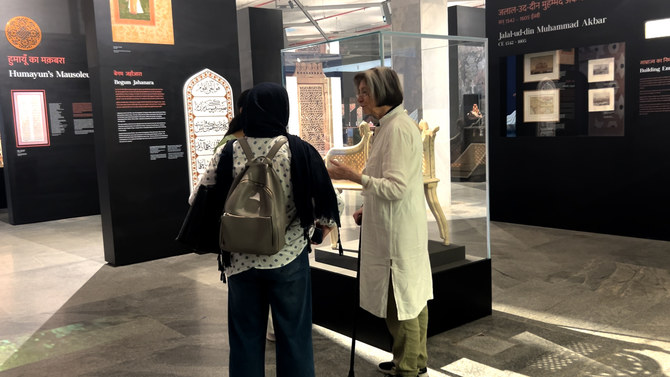
Visitors look at artifacts at the Humayun World Heritage Site Museum — the newest addition in Humayun’s Tomb complex — in New Delhi on July 29, 2024. (AN Photo)
The second Mughal emperor Humayun was widely known as an avid reader fond of journeys, architecture, and storytelling. Almost half a millennium after his death, a new museum in the heart of New Delhi highlights his role in shaping India’s cultural heritage.
Opened for visitors on Tuesday, the Humayun World Heritage Site Museum is the newest addition in Humayun’s Tomb complex — a landmark 300-acre area in New Delhi’s Nizamuddin that features dozens of historical monuments and includes Sunder Nursery, a 16th-century heritage park.
The advent of the Mughal dynasty, which ruled the Indian subcontinent between the 16th and 19th centuries, marked the global revival of Islamic architecture, with works that until today are examples of the highest quality and refinement.
Originally from Central Asia, the Mughals carried cultural elements borrowed from Arabs, Persians and Ottomans. As they settled in India, they fused these with the various local styles found in their new domains.
Humayun was the son and successor of Babur, founder of the dynasty, and ruled the empire from 1530 to 1540 and again from 1555 until his death the following year.
The new museum, established by the Agha Khan Trust for Culture and the Archaeological Survey of India, traces Humayun and his descendants’ lives, as well as the 700-year-old history of the whole Nizamuddin locality and its influence on Indian culture.
“There are hundreds of stories to be told, which the stones don’t speak,” Ratish Nanda, conservation architect and projects director at the AKTC, told Arab News. “The idea is to bring alive 700 years of heritage.”
The museum is located in Humayun’s Tomb, a UNESCO World Heritage Site, and the first of the grand mausoleums that became synonymous with Mughal architectural innovations and, three generations later, culminated in the construction of India’s most iconic monument, the Taj Mahal. About 7 million tourists from across India and abroad visit the complex every year.
“The idea is that people who now visit the World Heritage Site come with a deep understanding of the site,” Nanda said.
“We’ve been able to … combine architectural elements with incredible manuscripts, miniature paintings, calligraphy, textiles, coins, metalware, architectural elements — one is two one scale — with lots of films and digital technology, and models and so on.”
Spanning five galleries, the underground museum has over 500 artefacts sourced from the collections of the National Museum in New Delhi, ASI and AKTC.
“It captures the 700 years of history that is associated with the region of Nizamuddin and the World Heritage site of Humayun’s Tomb …This museum really captures the history,” said Ujwala Menon, AKTC conservation architect.
“The principal gallery talks about Humayun. There’s very little known about this emperor, and one of the things with this museum is to really address that … Then we have a second section of this gallery which talks about the personalities that are associated with Nizamuddin.”
Among the famed figures featured in the second gallery are Nizamuddin Auliya and Amir Khusro. Auliya was an 13th-century Indian Sunni Muslim scholar, Sufi saint of the Chishti Order, and is one of the most famous Sufis from the Indian subcontinent. His shrine and tomb are located near Humayun’s complex.
Khusro was a 13th-century poet and scholar who remains an iconic figure in the culture of the subcontinent.
Both Auliya and Khusro lived during the period of the Delhi Sultanate, which Humayun’s father conquered, leading to its succession by the Mughal empire. The museum shows how the empire did not come to its bloom in a cultural vacuum, but drew from and incorporated the culture of its predecessors.
“There was this idea of pluralism that existed during the Mughal period,” Menon said. “And this (museum) really captures all of that.”
source: http://www.arabnews.com / Arab News / Home> World / by Sanjay Kumar / July 31st, 2024
India has one of the greatest traditions of paintings on walls. Called murals or frescos, we see a high level of technical excellence, grace and sublime beauty among Indian murals right from the time of Ajanta.
In 1335 AD, the remarkable city of Vijayanagar or the ‘city of victory’ was established in south-central Karnataka. In no time, the city and the empire became a fertile ground for creativity, thanks to the patronage of its powerful King Krishnadeva Rai. A remarkable style of painting evolved with ideas merging from Deccan, Cholas of Tamil Nadu and Jain tradition. When the Vijayanagar Empire collapsed after the battle of Talikota in mid-16th century many of state artists moved to Serirangapatna, a pristine and sacred land surrounded by Cauvery River on all sides. Here they thrived under the royal patronage of the Mysuru Wodeyers. In 1761 AD, the island became the seat of power of Haider Ali Saheb. He and his son Tipu Sulatan established Mysuru as a vibrant Sultanate and continued to patronage the artisan of Vijayanagar ancestry.
Daria Daulat Bagh is a palace situated in the island near the village Ganjam at Seringapatna. The village is set amidst beautiful gardens. It was built by Tipu Sultan in 1784 as his summer palace.
Built entirely out of teakwood, the architecture of the palace shows remarkable fusion of Deccani, Persian and Rajput styles. The most stunning feature of the palace is that all the space available on the walls, pillars, jharokas and arches have colourful fresco work in the style of Vijayanagar-Mysuru paintings.
On the western wall right to the entrance is depicted the battle scene of second Anglo-Mysore war or the battle of Pollilur. The battle had been fought between Haider-Tipu and the British forces, in which Haider and Tipu combated splendidly and won.
The paintings executed by the artists at the instance of Tipu Sultan where primary aim was to glorify their victory over the British. Colonel Bailley, the defeated British officer was taken to Serirangapatna after his defeat. The battle mural is seen in four different panels portraying Tipu and Haider marching in procession towards Pollilur near Kanchipuram. Tipu is depicted in all finery, himself leading the army towards Pollilur riding a beautiful white horse. Baillie sits in a palanquin as he is wounded and biting his pointing figure – a gesture employed by many to signify defeat in dismay.
The climax of the battle scene depict Baillie’s defeat giving special prominence to the explosion of tumbril and to the consternation of the British square colonel.
On the eastern part of the building there are a number of small frames containing figural motifs, architecture in brilliant composition. The most special is the one where the queen is seen seated on a carpet smoking a hookah. Some of the layouts strongly resemble Rajasthani miniature. The other panels illustrate incidents in the lives of princes, rulers and grandees of Tipu’s contemporary and also includes several rajas defeated by him. There are also neighbouring nawabs and kings including the Hindu Rani of Chittore, Rajas of Tanjore, Benaras, and Balajirao Peshwa II.
Come, lets discover the murals of Daria Daulat Bagh and appreciate the legacy of Tipu Sulatan, a brave son of the soil and perhaps one of the earliest freedom fighters.
YOUTUBE
source: http://www.blogvirasatehind.wordpress.com / September 26th, 2016
The Salamat Ras departed Surat in India on the 20th September 1676, carrying hundreds of pilgrims from Gujarat. On board was Safi ibn Vali; unlike the other pilgrims, his journey was sponsored by Zib al-Nisa, daughter of the Mughal emperor Aurangzeb (1658-1707). Along with completing his Hajj, Safi ibn Vali was given the task of creating a Hajj guidebook for future pilgrims. Presumably aimed at Indian pilgrims like himself, the ‘Anis al-Hujjaj’ (The Pilgrim’s Companion) contains advice regarding all aspects of the pilgrimage, including the journey to Jidda by sea.
His book is but one of many surviving pilgrimage guidebooks, from various parts of the Islamic world, forming a long-established tradition. They are typically accompanied by diagrammatic views of the holy sites, and Anis al-Hujjaj is no different in this respect. What sets it apart, however, is its use of colourful illustrations depicting various scenes of the pilgrimage, as well as the remarkable accuracy of its maps.
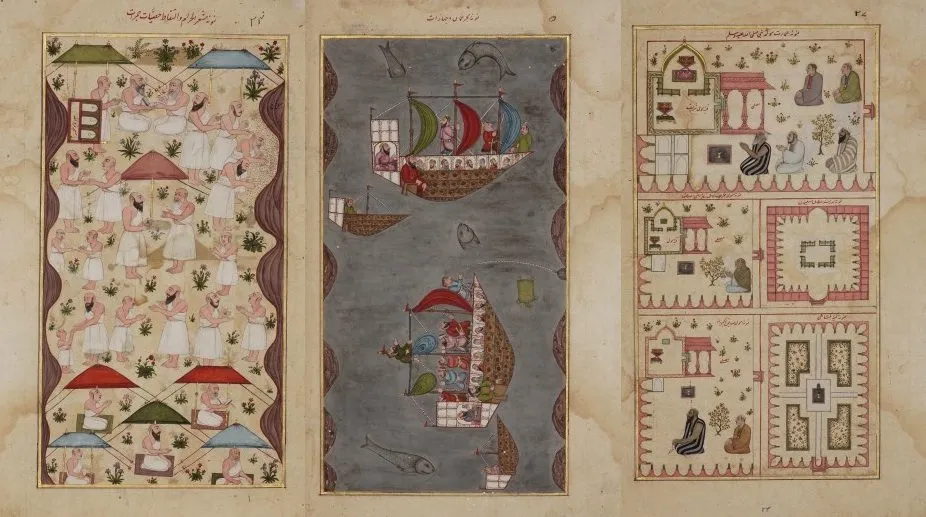
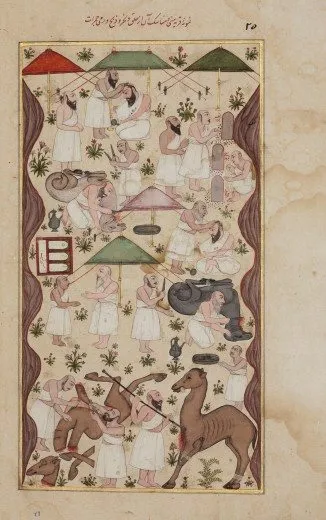
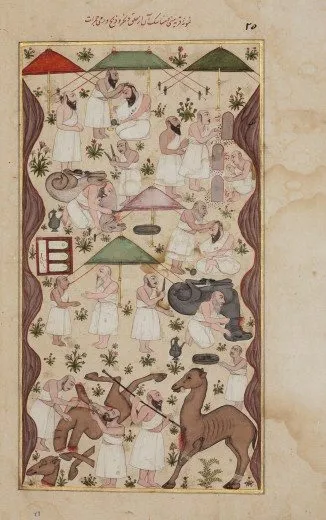
Safi ibn Vali’s Anis al-Hujjaj (‘Pilgrims’ Companion’), possibly Gujarat, India, circa 1677–80. Ink, gold and opaque watercolour on paper; modern leather binding. 3 separate folios show here side by side. Nasser D. Khalili Collection of Islamic Art. Copyright Nour Foundation. Courtesy of the Khalili Family Trust.
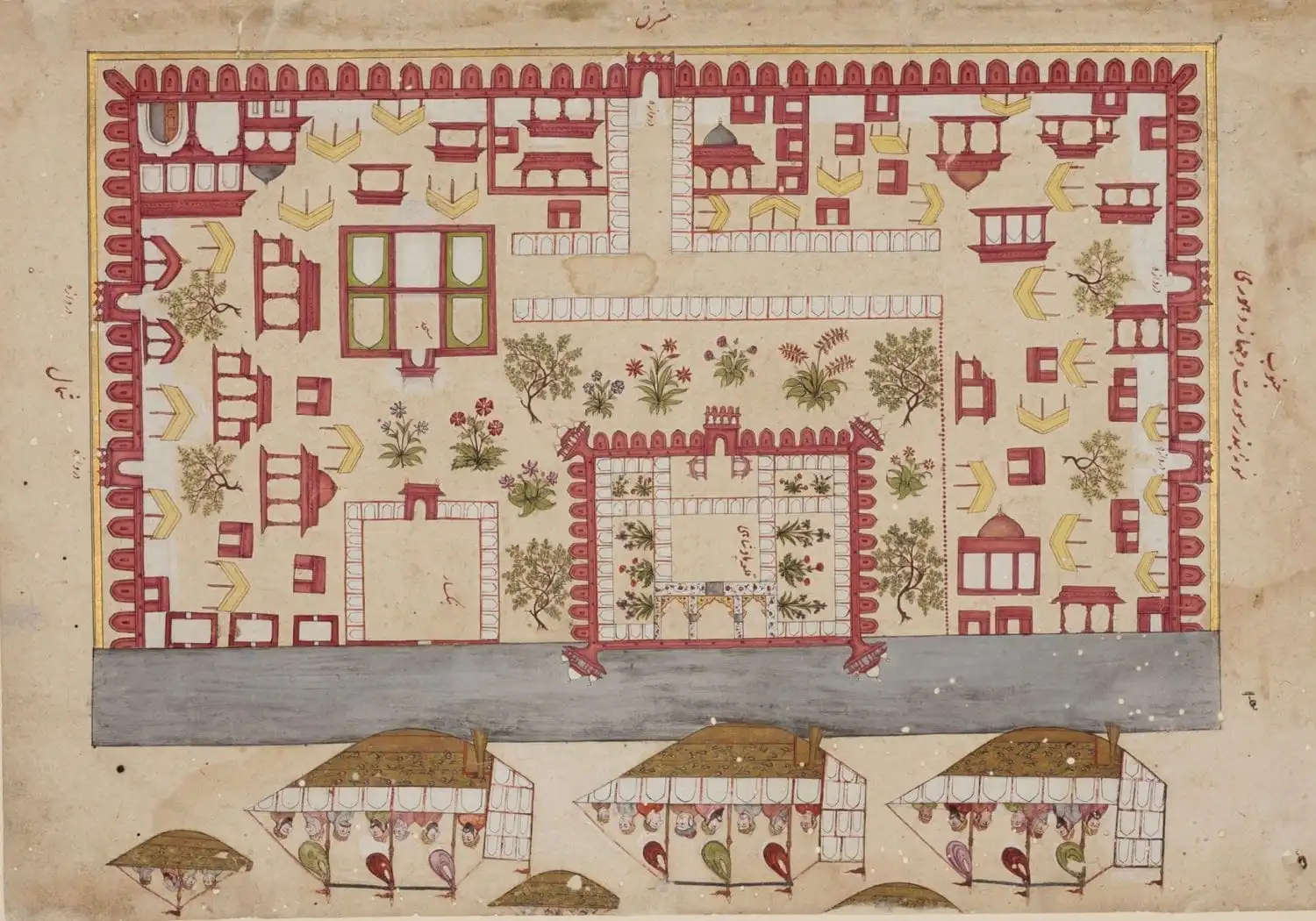
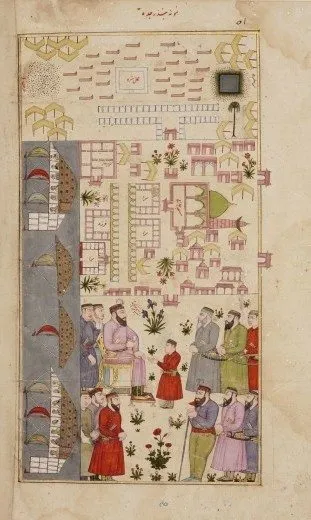
The illustration below is a map of Jidda. Jidda was a major port for pilgrims arriving for Hajj, and is thought to have been founded by Caliph Uthman in 647 AD. Safi ibn Vali, arriving at the port himself, maps major parts of the city. Archaeologist Dr Geoffrey King examined the map and found that the vast majority of places and landmarks depicted lie in the same position today.
Nasser D. Khalili Collection of Islamic Art. Copyright Nour Foundation. Courtesy of the Khalili Family Trust.
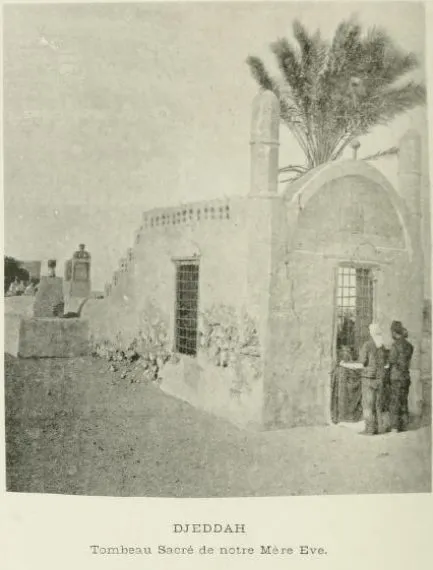
The upper section of the map depicts Hawa cemetery, thought to be the burial place of Eve, the mother of humanity. While the pink markers represent other graves, the black square indicates the head side of the resting place of Eve (peace be upon her), the white square her naval, and the gravelly area her feet. In Safi ibn Vali’s time, her grave, which is more than 100 feet in length, would have been marked by some sort of edifice. It is possible that the structure that can be seen in the image below, an illustration from 1894, or one similar to it, was what he saw two centuries earlier. The structure is no longer standing; it was destroyed in 1975 and covered with concrete by Saudi religious authorities.
Illustration of the Tomb of Eve in 1894, Jidda.
The middle section of Safi ibn Vali’s map shows the old city of Jidda. When examining the area, Dr King found that everything was accurately placed; a parade of shops and houses in the old city, as well as the surrounding roads, are all found in the same position today. There is however, one surprising discrepancy; an obvious landmark was mapped by Ibn Vali on the wrong side of the road. The green-domed Shafi’i mosque is shown in the Anis al-Hujjaj on the east side of the main street, whilst today it can be found on the west side; “This confuses me- was this main street in Jidda on a different alignment when the Anis al-Hujjaj was composed, or is it a simple error?” Given the remarkable accuracy of the map in every other way, King says this discrepancy is especially puzzling. The Shafi’i mosque is the oldest mosque site in Jidda; its floor is well below street-level, a fact that, according to Dr King, indicates that it predates the Shafi’i period. The oldest standing part of the mosque today is its Ayyubid minaret, dating back to the 13th century.
Nasser D. Khalili Collection of Islamic Art. Copyright Nour Foundation. Courtesy of the Khalili Family Trust.
Since there is no question over the identity of the mosque depicted by Safi ibn Vali, further research needs to be conducted to reach a clear conclusion over the discrepancy. In the foreground of the Jidda map, the governor of the city is shown welcoming pilgrims. There are numerous such illustrations in Safi ibn Vali’s book, depicting various scenes of the Hajj. On the folio below, pilgrims are shown on the day of Eid al-Adha. In the top right hand corner, pilgrims in ihram throw stones at the three pillars representing shaytan, while others have their heads shaved after completing the rites of the Hajj. In the foreground, animals are being slaughtered for the Eid sacrifice.
Safi ibn Vali also made mention of various holy places to visit that are not part of the Hajj itself. The illustration below is a typical diagrammatic view found in the tradition of Hajj guidebooks. According to the captions, the building in the upper section marks the birthplace of the Prophet Muhammad (peace and blessings be upon him). In Ibn Vali’s time, the blessed area was marked by a small mosque with a courtyard and dome. Today a simple library building built in the 1950’s stands over the area. Depicted beneath the upper section are the birthplaces of Lady Fatima and Abu Bakr al-Siddiq (may God be pleased with them both) as well as the Madrassa of Sultan Sulayman and a Sufi lodge of the Bektashi order. The clothes worn by the visitors indicate their various nationalities.
Nasser D. Khalili Collection of Islamic Art. Copyright Nour Foundation. Courtesy of the Khalili Family Trust.
While Safi ibn Vali’s Anis al-Hujjaj is not unique in its function, the accuracy of its map of Jidda, and possibly others, such as Surat in India and Mocha in Yemen, which are also represented, is remarkable, setting it apart from other guidebooks of the same genre. Its colourful illustrations give the viewer a sense of the energy of the pilgrimage, as well as the diversity of the pilgrims represented. Given that many of the sites Ibn Vali illustrates no longer exist in the same form, his work takes on added historical importance, preserving a past all but lost to modernity.
Bibliography
L. York Leach, Paintings from India, The Nasser D. Khalili Collection of Islamic Art, volume VIII, London 1998, cat.34, pp.124–9.
J.M. Rogers, The Arts of Islam. Masterpieces from the Khalili Collection, London 2010, cat.332–41, pp.284–7.
source: http://www.sacredfootsteps.com / SacredFootsteps.com / Home>Asia> Arabia> History / by Zara Choudhary
Ruins of Haveli of Basi Bangar, Bulandshahr, Uttar Pradesh
The history of the Khanpur Estate and Bara Basti (twelve villages) goes back to the reign of the Mughal Emperor Jahangir when a son of a Daudzai Afghan chieftain, Sheikh Ruknuddin Afghan founded a village on the banks of Ganga and gave it the name of “Basi Bangar”.
As a valiant warrior, Ruknuddin was inducted in the Mughal army. Later, his fortunes rose to the rank of Mansabdar and the title of Sher Khan was given to him. After his death, the emperor bestowed a portion of his jagir and rank to his brother and children. Later, his younger brother, Shaikh Allu Afghan was also inducted into the Mughal aristocracy and was awarded many grants.
Resting place of Shaikh Allu Afghan founder of Khanpur estate
A village with the name of “Khanpur” was established by Shaikh Allu Afghan. During his lifetime, he built a large mud fort, mosque and other structures in this village. This is how Khanpur became the administrative headquarters of Bara Basti, the settlements of Daudzai Afghans in the area.
Ruins of Khanpur fort
Role of Erstwhile Khanpur estate in the Great Uprising of 1857
During the Mughal era, there were only few taluqdar estates in the current Bulandshahr district and these were Khanpur Chattari, Kuchesar, Pahasu and Shikarpur. When the great Uprising of 1857 broke out, there wasn’t much force at Meerut camp.
Brand Sapte wrote letters to the taluqdars of district Bulandshahr asking for assistance of troops and horses. This request was positively responded immediately. However, the Khanpur Estate decided to join the Uprising.
Nawab Walidad Khan of Malagarh came to the Doab with a sanad from Emperor Bahadur Shah Zafar.
Azim Khan alias Azam Khan was the deputy of Nawab Walidad Khan of Malagarh in the Bulandshahr district of the former United Provinces. The family owned the erstwhile Khanpur Estate in the same district.
During the Great Uprising of 1857, Nawab Walidad Khan, who was related the Mughal emperor, Bahadur Shah Zafar by virtue of marriage within the royal family, was chosen as a leader of this movement to overthrow the colonial government.
On 10 October 1857, British forces attacked Malagarh. Azim Khan put up a stiff resistance under the overall command of Nawab Walidad Khan at Khurja and paralysed the British for a few days. He was finally arrested by Khusi Ram, the Police Officer of Anupshahr, while trying to cross the Ganga to move into Rohilkhand. He was tried by a court martial and subsequently hanged.
Haji Munir Khan was the only son of Azim Khan, the landlord of the Khanpur estate in Bulandshahr district. Munir Khan was the chief commander of the revolutionaries of the Bulandshahr district during the Great Uprising of 1857.
In the famous second battle of Gulaothi which was fought on 29 July 1857, British forces wanted to take control of the whole of the Bulandshahr district.
To stop their advance, Nawab Walidad Khan of Malagarh deputed his main commanders, Haji Munir Khan and Ismail Khan, to Gulaothi. Both of them established a picket on the canal just before Gulaothi to stop the colonial forces from entering the Bulandshahr district. In the ensuing battle, both Haji Munir Khan and Ismail Khan received severe sword cuts on their faces. Later, Haji Munir Khan crossed the Ganga with Walidad Khan and joined Khan Bahadur Khan’s forces and fought at Kachhlaghat and also served as Naib Kotwal under government of Khan Bahadur Khan rebel government. He continued fighting until his last breath.
Abdul Latif Khan was the nephew of Azim Khan, the landlord of the Khanpur’s estate in the Bulandshahr district. Abdul Latif Khan was the second wealthiest landholder in the district and the proprietor of 225 villages, with its headquarters in the Barah Basti villages.
During the Great Uprising of 1857, the British District Magistrate of Bulanshahr called upon all the principal landholders of the district, including Abdul Latif Khan, to help him by furnishing troops to suppress the revolt. Abdul Latif Khan initially refused to help the British, but when on 4 October 1857, Bulandshahr was occupied by the British force under Lieutenant Colonel Farquhar, he paid his due balance of land revenue to the British government. But he soon shifted his allegiance to Bahadur Shah Zafar.
Mosque in Basi Bangar on the shore of river Ganga and it’s very first village of Bara Basti settlement.
Though he never came to the battlefield, Abdul Latif Khan gave shelter to the revolutionaries of Bulandshahr district including Nawul Gujjar, Raheemoddeen and the Pathans of Barah Basti villages when they were engaged in fighting the British forces. For these acts, he was tried by a military court and sentenced to transportation for life to Andamans or Kala Pani for aiding the revolt of 1857.
The family’s erstwhile Khanpur estate in Bulandshahr district was subsequently confiscated by the British after the 1857 uprising was crushed by the colonial forces.
source: http://www.milligazette.com / The Milli Gazette / Home> News> Special Reports / by The Milli Gazette Online / by Musa Munir Khan / July 31st, 2024
Historians and enthusiasts are taking public education into their own hands to tell the story of the country’s Muslim communities.
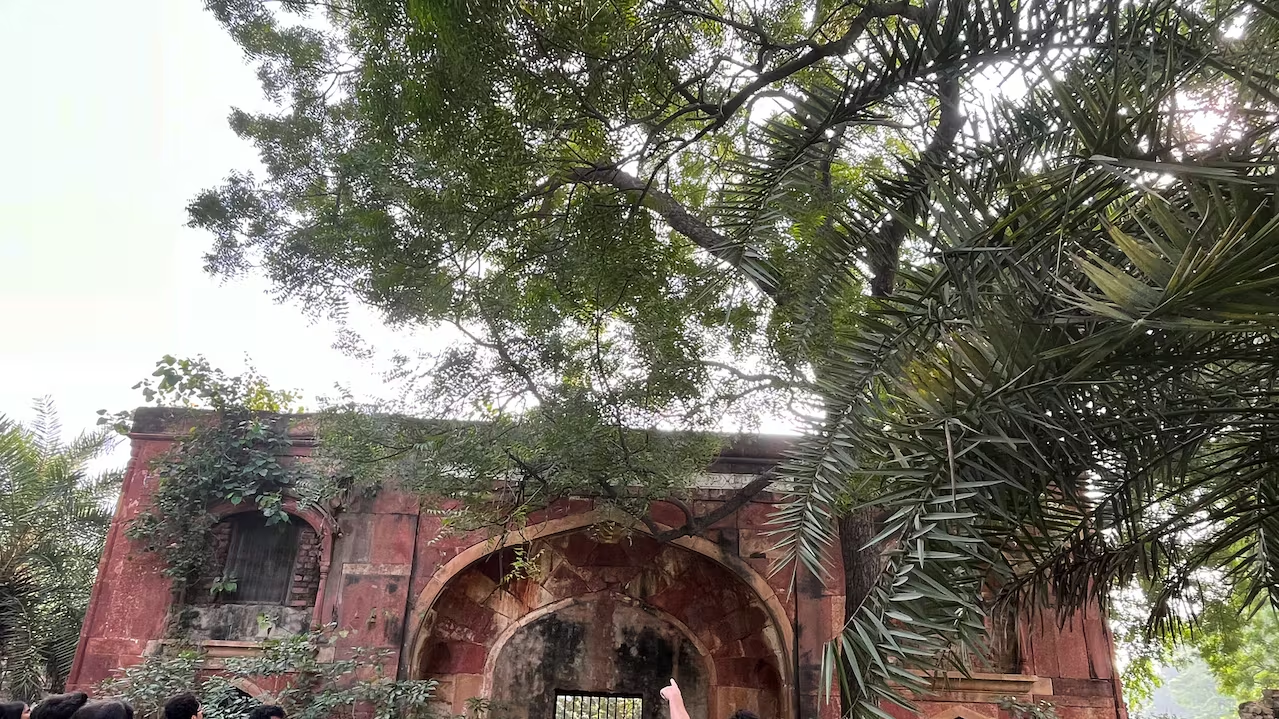
Chaotic narrow lanes lined with opulent old mansions, shops selling spices, dried fruits and kebabs, all overhung by dangling power cables – any trip to Old Delhi, a bustling Muslim hub built by Mughal ruler Shah Jahan, is a full sensory experience.
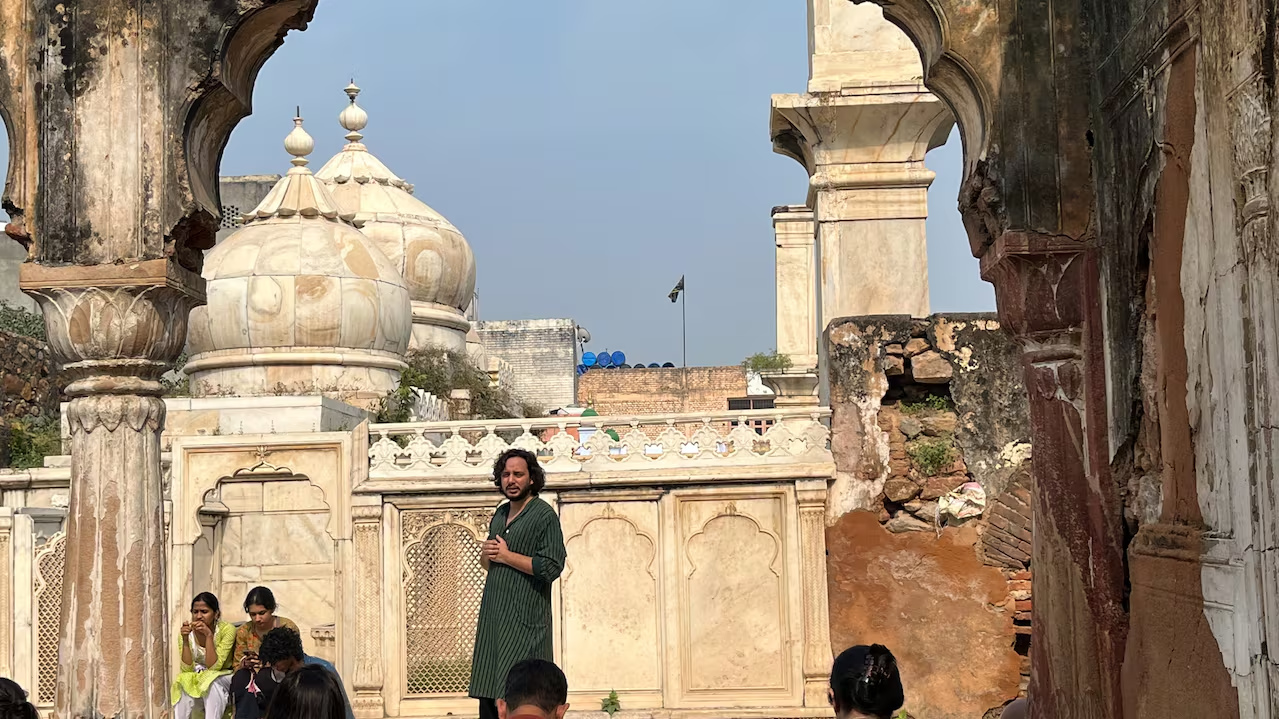
Abu Sufyan weaves through the crowd with about 20 people in tow, making his way through streets smelling of flatbread soaked in ghee, the call to prayer at a nearby mosque mingling with the bells of a Hindu temple.
He is on a mission to change negative perceptions of Muslims by showing visitors more of their history in the capital.
“People in old Delhi were labelled as ‘terrorists’ and ‘pickpockets’ because they were predominantly Muslims from the lower economic background, and Mughal rulers were vilified as cruel invaders, as they were considered the ancestors to Indian Muslims,” Abu Sufyan, 29, says.
“My walks involve the local community members including calligraphers, pigeon racers, cooks and weavers with ancestral links in the Mughal era to showcase old Delhi’s heritage beyond these stereotypes.”
Abu Sufyan is one of a growing crop of enterprising men and women using the medium of heritage walks to educate the Indian public and tourists on the nation’s lesser-known history.
He started his walks in 2016, when hatred against Muslim communities was on the rise after Prime Minister Narendra Modi’s ruling Bharatiya Janata Party introduced several anti-Muslim policies.
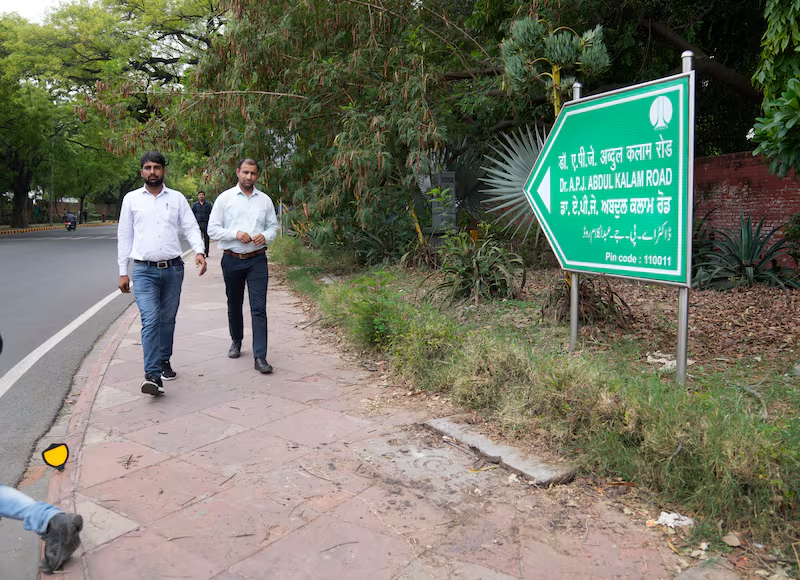
In 2015, a BJP politician urged the local civic body in Delhi to change the name of Aurangzeb Road to APJ Abdul Kalam Road. The civic body immediately obliged, removing the reference to the Mughal ruler from the road by naming it after the former president of India, who was always considered a “patriotic” Muslim.
Later, the 2019 Citizenship (Amendment) Act caused further division, as critics said it could be weaponised against Muslims, who are designated as “foreigners” under the National Register of Citizens.
Occasionally, divisions lead to violence: Thirty-six Muslims were killed in Hindu mob attacks for allegedly trading cattle or consuming beef between May 2015 and December 2018, according to Human Rights Watch.
‘A sense of belonging and togetherness’
Over 2,000 kilometres away in Chennai, documentary filmmaker Kombai S Anwar hosts walks in Triplicane to tell stories of Tamil Muslim history, Tamil Nadu’s pre-Islamic maritime trade links with West Asia, the arrival of Arab traders, Mughal emperor Aurangzeb’s rule, the appointment of a Mughal minister’s son Zulfikhar Ali Khan as the first Nawab of Arcot, and the lives of the subsequent nawab’s descendants.
“Predominantly, non-Muslims participate in these walks because they are ‘curious’ about local Muslims and their heritage. During [Ramadan], they are invited to the historic Nawab Walaja mosque, where they experience the breaking of fast and partake in the iftar meal,” Mr Anwar says.
Tickets for heritage walks across India range between 200 and 5,000 Indian rupees ($2-60).
Historian Narayani Gupta, who conducted heritage walks in Delhi between 1984-1997, said any controversy related to history generates more interest.
“Whether history is right or wrong or good or bad, it has to be backed by research findings,” she said
Saima Jafari, 28, a project manager at an IT firm, who has attended more than 30 heritage walks in the past five years, says it is hard to ignore the historical monuments in the city since they are almost everywhere.
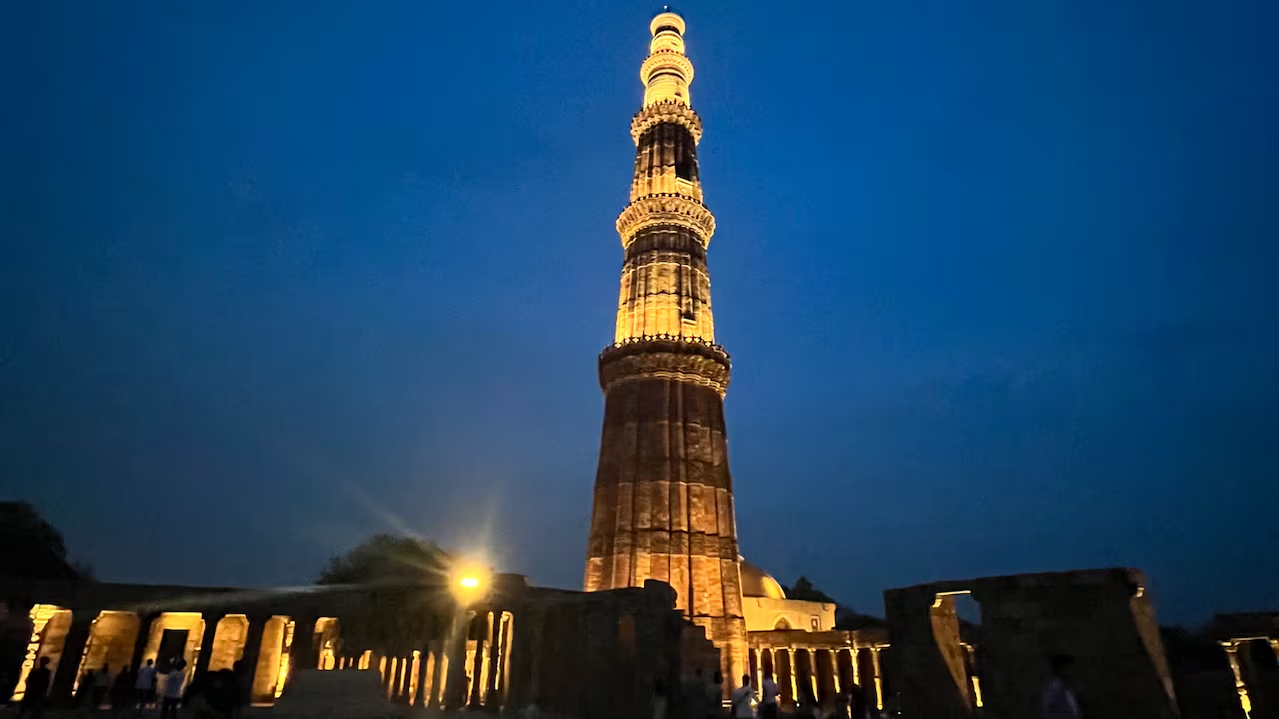
Delhi-based Ms Jafari recalled one of her best experiences was a walk, in 2021, trailing the path of “Phool Waalon Ki Sair”, an annual procession of Delhi florists, who provide sheets of flowers and floral fans at the shrine of Sufi saint Qutbuddin Bakhtiyar Kaki and floral fans and a canopy at the ancient Hindu temple of Devi Yogmaya in Mehrauli.
“When I walked along with others in that heritage walk, I realised that heritage enthusiasts across religion walk together in harmony,” Ms Jafari says.
“One of the best parts of heritage walks is the storytelling that connects places with lives of people of a certain period. Plus, it always gives a sense of belonging and togetherness.”
Anoushka Jain, 28, a postgraduate in history and founder of heritage and research organisation Enroute Indian History, which holds walks to explore the erstwhile “kothas (brothels),” and “attariyas (terraces)” of old Delhi, said during pandemic lockdowns, posts on Instagram helped sparked interest.
“Before the pandemic, barely 40 people participated in two weekly walks as opposed to 50 in each of the four weekly walks which we conduct now,” she says.
But it is not all smooth sailing.
Ms Jain says some people feel uncomfortable when they are given historical facts and research that show Hindu and Jain temples constructed by Rajput rulers were repurposed during the rule of Delhi Sultanate, Qutb ud-Din Aibak.
Iftekhar Ahsan, 41, chief executive of Calcutta Walks and Calcutta Bungalow, adds that sometimes, participants come with preconceived notions that Muslims “destroyed” India for more 1,000 years – but walk leaders hold open conversations to “cut through the clutter” with authentic information.
For some, heritage walks often change perceptions.
“Until I visited mosques in old Delhi during a walk, I didn’t know that women were allowed inside mosques,” law student Sandhya Jain told The National.
But history enthusiast Sohail Hashmi, who started leading heritage walks in Delhi 16 years ago, cautions that some walk leaders present popular tales as historical fact.
A mansion called Khazanchi ki Haveli in old Delhi’s Dariba Kalan is presented as the Palace of the Treasurer of the Mughals by some walk leaders, Mr Hashmi says. The Mughals, however, were virtual pensioners of the Marathas – Marathi-speaking warrior group mostly from what is now the western state of Maharashtra – and later the British and had no treasures left by the time the mansion was built in the late 18th or early 19th century.
Another walk leader had photo-copied an 1850 map of Shahjahanabad, now old Delhi, passing it off as his own research, he adds.
“The walk leaders must be well-read and responsible enough to ensure that the myths are debunked,” Mr Hashmi says.
source: http://www.thenationalnews.com / The National / Home> International Edition> World> Asia / by Sonia Sarkar / June 01st, 2023
On this day, Nawab of Bengal Siraj-ud-Daulah was at the gates of Fort William in Calcutta with an army of 50,000 soldiers, 50 cannons and 500 elephants.
Siraj-ud-Daulah / File image
On this day, Nawab of Bengal Siraj-ud-Daulah was at the gates of Fort William in Calcutta with an army of 50,000 soldiers, 50 cannons and 500 elephants. By that time the British had retreated to the British East India Company’s ships. John Zephaniah Holwell was in charge of the British side, which had less than 200 soldiers left at the fort. Holwell surrendered to Siraj on June 20 afternoon.
June 20, 1756, is marked by “the Black Hole Tragedy”. According to Holwell, the surrendered British were forced into a small chamber at the fort by the Nawab’s army.
More than a hundred of the prisoners died. Only 23 of them survived, Holwell’s account said. Later, commentators and historians have questioned Holwell’s account and claimed that fewer people had died.
source: http://www.telegraphindia.com / The Telegraph Online / Home> West Bengal / by Chandrima S Bhattacharya / June 19th, 2024
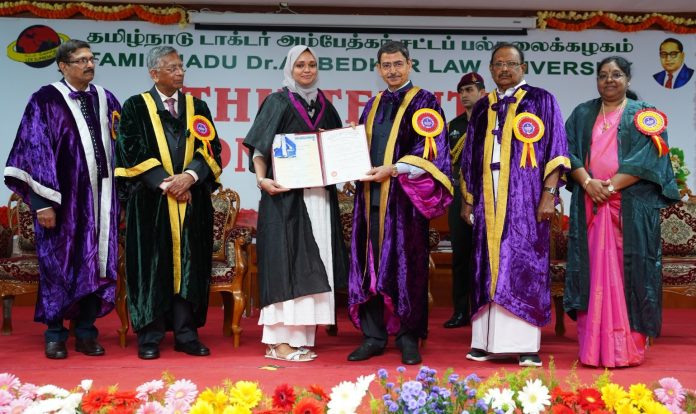
Nimrah Ali receiving Gold Medals and certificates of merit from Shri R.N. Ravi, Governor of Tamil Nadu on February 24, 2024
Chennai :
Nimrah Ali, wife of Hasnain Ahmed, has been honored with two prestigious Gold Medals and certificates of merit, the Tamil Nadu Dr. Ambedkar Law University Gold Medal Award and the Justice Subbiah Ratnavel Pandian Gold Medal Award from Madras Bar Association, for achieving the 1st Rank in the 5-Year B.Com. LL.B. (Hons.) Degree course at the Tamil Nadu Dr. Ambedkar Law University’s 13th Convocation held on February 24.
She was also awarded the P.B. Sanjana Endowment Scholarship cash prize and certificate of merit for her exceptional performance.
The above awards were presented to her by Shri R.N. Ravi, Governor of Tamil Nadu, in the presence of Mr. R. Venkataramani, Attorney General of India, a distinguished Constitutional Lawyer and Senior Advocate at the Supreme Court of India, Mr. S. Regupathy, Minister of Law, Courts, Prisons, and Prevention of Corruption of Tamil Nadu amongst other distinguished dignitaries.
In addition, she cleared ICSI (Institute of Company Secretary of India) course on the first attempt.
The awards recognize her outstanding accomplishment as the top-ranked law student at the prestigious Law University School of Excellence in Law, The Tamil Nadu Dr. Ambedkar Law University, Chennai.
She belongs to the illustrious Nawab of Arcot family.
source: http://www.radiancenews.com / Radiance News / Home> Pride of the Nation> Awards / by Radiance News Bureau / February 28th, 2024