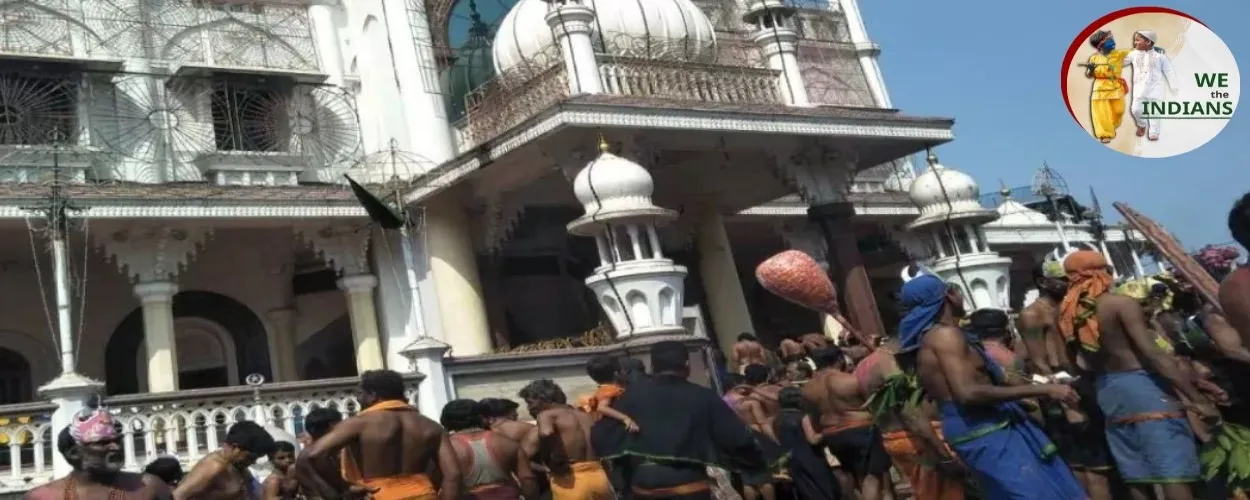
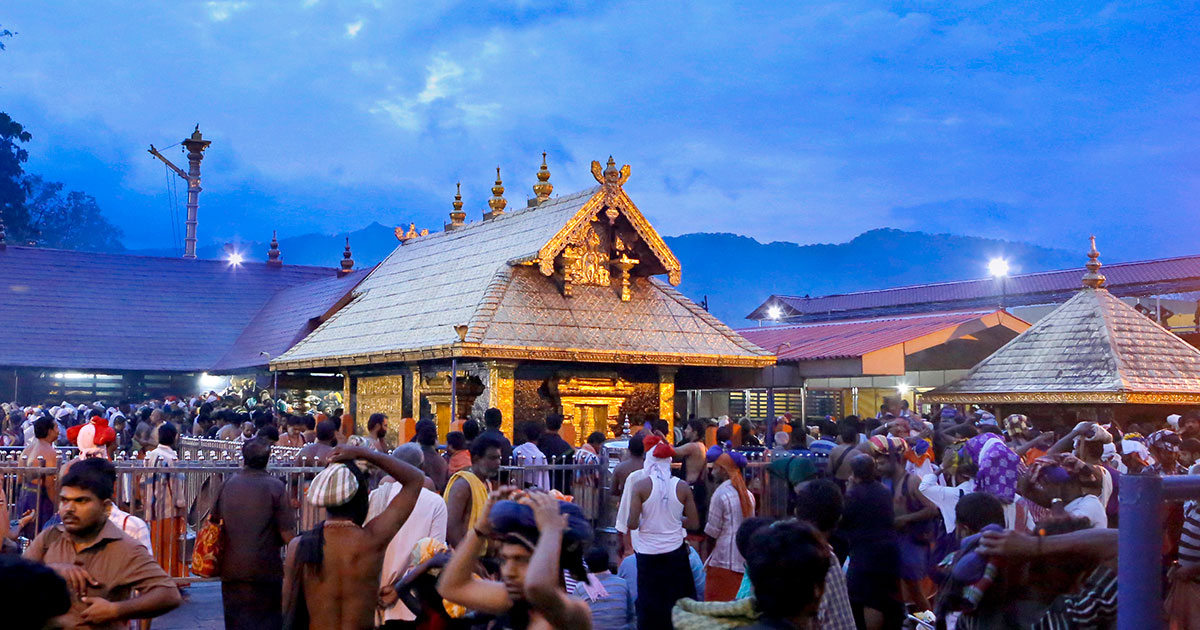
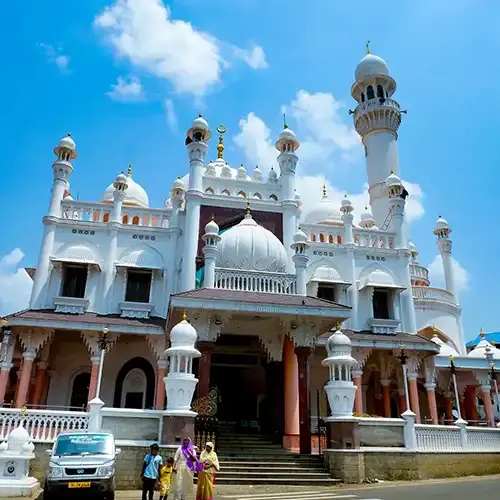
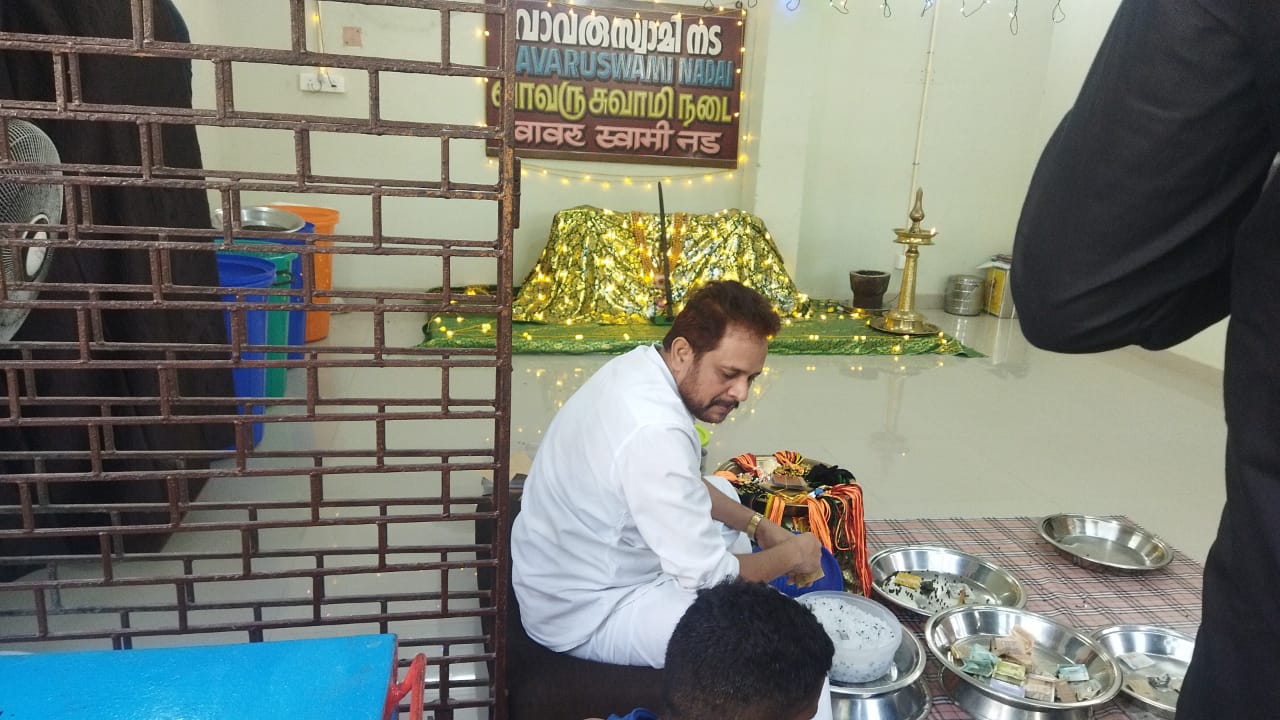
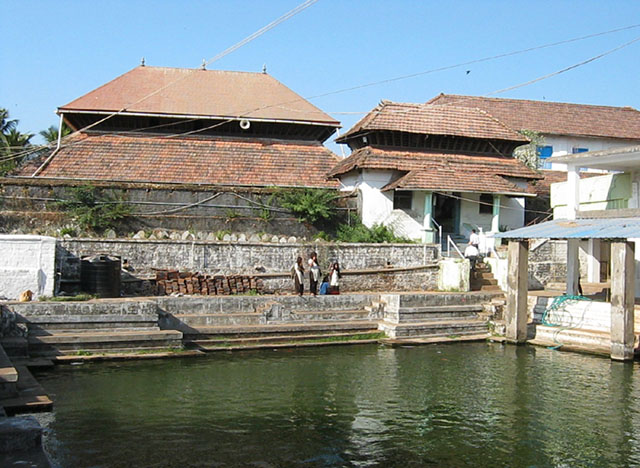
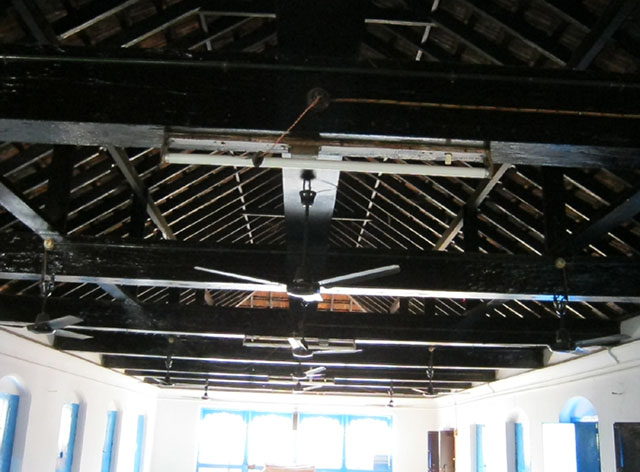
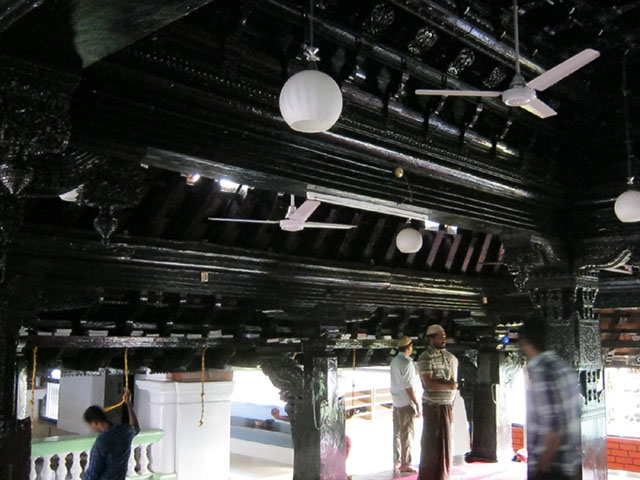
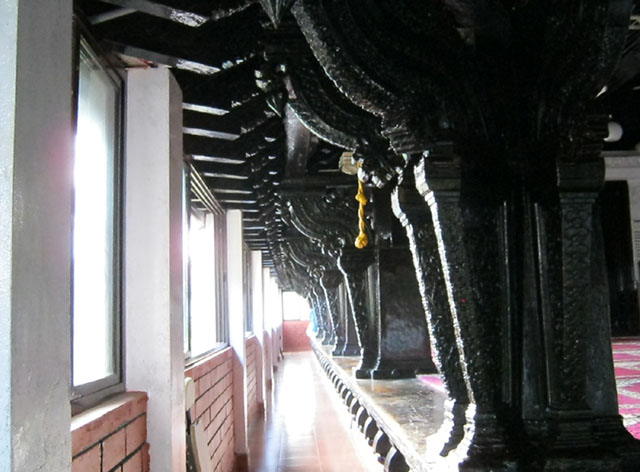
Pilgrims on way to Ayyappa shrine in Sabrimala at Vavar mosque, Erumeli, Kerala
I had waited to go to Sabarimala, a hilltop shrine dedicated to Lord Ayyappa in Kerala’s Pathanamthitta district, for a long time. Lord Ayyappa, the deity of truth and righteousness, is described as the son of Shiva and Mohini (the female avatar of Vishnu). He was said to have been adopted by the local king of Pandalam.
Ungorgettable Experiences
As a youngman, Ayyappa abdicated the crown and renounced the palace to vanish into the forests of Sabarimala to live a celibate and ascetic life. It’s in deference to Ayyapa’s celibacy that women are not allowed there till they turn 55.
After a 41-day mandatory fast, I joined my sister and her husband for the pilgrimage. The pilgrims wear black clothes and carry a bundle containing a couple of coconuts filled with ghee and other offerings for the deity.
We carried the bundle on our heads at the start of the four-kilometre uphill trek. We were not supposed to remove it before reaching the shrine.
At the crack of dawn, after breaking coconuts at the local shrine to ward off all obstacles, we left for the shrine.I was thrilled at the thought of visiting some of my favourite temples and shrines on the route, some of which I had only heard of but never visited.
Lord Ayyapa temple at Sabrimala
Holding our heavy bundles (kettu) on our heads, we stopped at Chottanikakara, Vaikom, and Ettumanoor shrines.
Soon we were at Erumeli. According to legend, Ayyappa defeated the demoness Mahishi (sister of Mahishasura) here. The name Erumeli is comes from Eruma-kolli—“the place where the buffalo-demon was slain.”
At Erumeli, the road streamed with pilgrims, mostly men and children, all clad in black. They had bright colours smeared on their faces, held colourful feather arrows, and danced to drum beats as part of a ceremonial dance called Petta thullal to mark the victory of the warrior Ayyappa over enemies and bandits.
We too swayed lightly, trying to shake off our inhibition-clad egos.
Holding arrows, wild leaves, and smeared in bright colours, we walked towards a temple there dedicated to a deity called Shastha. Shastha is an ancient protective warrior deity worshipped in Kerala even before the incarnation of Ayyappa. Ayyappa is considered a modern avatar of Sastha and is now almost synonymous with Sastha.
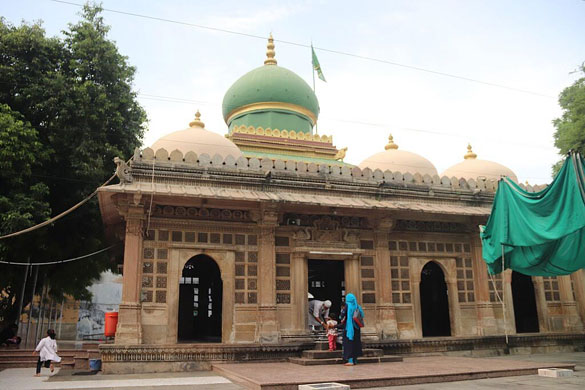
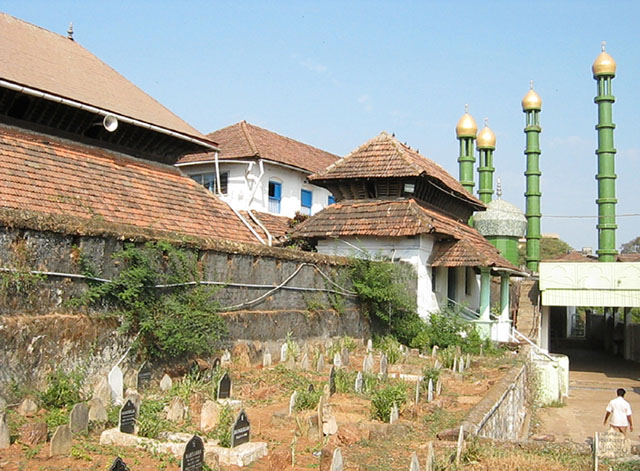
Vavar Juma Mosque, Erumeli
As we walked towards the temple, I was surprised. Were we at the threshold of a temple or a mosque? I saw taps for the ritual cleansing ceremony (wuzu) and a handful of Muslims saying namaz through the glass windows. It was a mosque.
We lined up respectfully outside the mosque. It was Vavar Palli (Vavar mosque), my brother-in-law explained.
Vavar was a close associate of Ayyappa. Their friendship is celebrated in folklore and devotional movies. Vavar was a Muslim, and thus the story gets significant.
“Vavar Swami may have worshipped at the mosque. That is why he is associated with the mosque,” Nasruddin Musaliyar, who traces his lineage from Vavar, explained to me when I spoke to him a few days later.
I felt pure joy at seeing Hindus offering respect outside a mosque and making offerings before worshipping the Shastha temple. After breaking a coconut at the Shastha temple, we began our long trek towards the Ayyappa shrine on Sabarimala.
It took us four or five hours, followed by a long five-hour wait in the crowd. Anyway, we had darshan in the morning. When we came out of the temple, another surprise awaited.
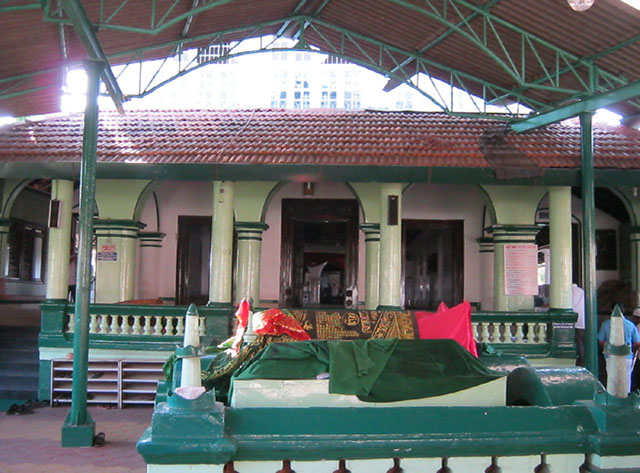
The shrine dedicated to Vavar Swamy
I found myself standing outside a small shrine just outside the Ayyappa temple. It was like a dargah, but I was told that it was called Vavarpadi, or the threshold of Vavar, a memorial to Ayyappa’s friend.
Pilgrims stopped to offer prayers and accept prasad of sugar candy and pepper. The man giving the prasadam said he was a descendant of Vavar and managed his tomb. He gave me his father’s number and asked me to speak to him for details about the shrine.
Nasruddin Musaliyar said that Vavar was part of a group of Arab settlers who were close to Lord Ayyappa.”This shows that the highest authority at that time accepted Vavar despite his different faith or origin,” Musaliyar said.
“Vavar Swami’s tomb and a mosque at Erumeli, where Vavar is said to have prayed, just cry out loud to us today that two faiths can co-exist and respect each other. All religions believe that there is one God. And that almighty wants to tell us that Hindus, Christians, and Muslims can co-exist in harmony,” he added.
Emotions well up as Mursliyar says that neither Ayyappa nor Vavar had asked anyone to build shrines and pray to them. These shrines represent the principle that they did not see any difference between man and man.
Author (left) with her sister and brother-in-law on the way to Sabrimala
Shrines and differences are man-made. “The Muslims don’t worship at Vavars shrine as they believe only in Allah,” he said.
There is no evidence that Vavar was buried there, though the royal records claim so. This shrine is symbolic, he says.
Ayyappa is believed to have renounced the throne, family, and palace to live as an ascetic in Sabarimala’s forests and merged with Sastha. He loved and honoured Vavar, expecting his devotees to do the same. In these times of religious tensions, such traditions continue thanks to a deity who rejected differences of caste and religion and loved everyone as human beings.
After darshan at Sabarimala, pilgrims feel lightheaded as they have all offered their heavy burdens at the shrine.
Perhaps they have removed something else also besides the kettu —the thought of differences itself.
They go as Hindus to worship a Hindu god but return feeling more than just a Hindu…a more complete human being, who embraces all differences.
source: http://www.awazthevoice.in / Awaz, The Voice / Home> Stories / by Sreelatha Menon / December 29th, 2025
This haunting historical site in Vijayapura deserves better conservation efforts from Archaeological Survey of India as well as deeper research from historians to understand the legends swirling around the monument.
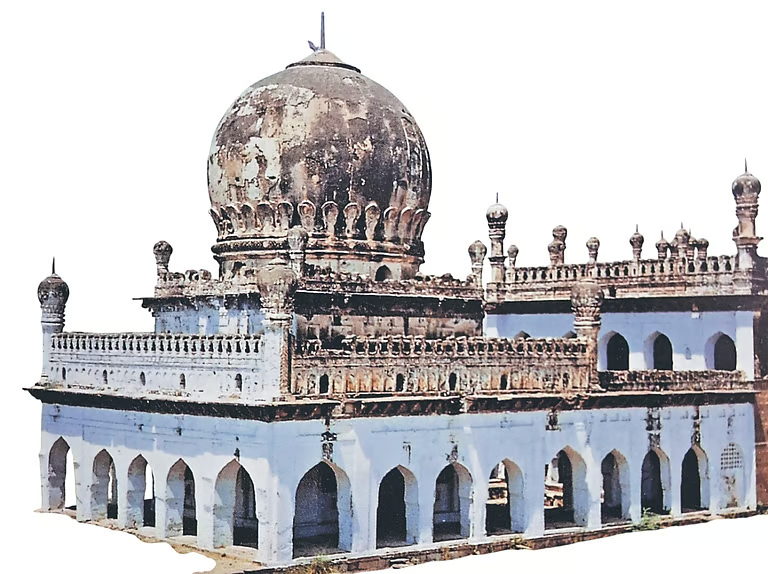
Saath Kabra, the cluster of 63 tombs, in Vijayapura (Photo | Express)
Vijayapura :
Far from being just another tourist destination, ‘Saath Kabra’ in Vijayapura stands out as one of the most haunting historical sites in the region. Often described as a silent witness to a tragic past, ‘Saath Kabra’ is a cluster of 63 tombs arranged on a raised black stone platform, that has generated legends, scholarly debate and enduring curiosity.
The most widespread legend surrounding ‘Saath Kabra’ is linked to the period of Ali Adil Shah II of the Bijapur Sultanate, who is also credited with commissioning the unfinished ‘Bara Kaman’ monument. During his reign, the Bijapur Empire faced a serious challenge from the Maratha leader Chhatrapati Shivaji. To counter this threat, Ali Adil Shah appointed his powerful general Afzal Khan to confront Shivaji.
Afzal Khan, originally from Afghanistan, was known as a formidable warrior. Historical narratives also describe him as deeply superstitious, placing great faith in astrology and spiritual predictions. In 1659, before leaving to face Shivaji, Afzal Khan is believed to have consulted a Sufi Pir, who foretold that he would not return from the campaign. According to local legend, this prophecy deeply disturbed him.
Folklore claims that Afzal Khan, fearing defeat and dishonour, killed more than 60 of his wives by pushing them into a well and later constructed tombs at the site. The alleged motive was to prevent them from remarrying or falling into the hands of enemies and facing humiliation or violence in the event of his death. This story has long been used to explain the existence of the mass graves at ‘Saath Kabra.’
The cenotaph of Afzal Khan
Afzal Khan later travelled to Pratapgarh in the present-day Maharashtra to confront Shivaji. Instead of a direct battlefield encounter, negotiations were arranged. Historical records state that Afzal Khan planned to assassinate Shivaji during a peace meeting. Shivaji, aware of the plot, took defensive measures by wearing armour and concealing iron tiger claws on his fingers. During a traditional embrace, Afzal Khan attempted to overpower Shivaji, but failed. Shivaji retaliated and killed Afzal Khan. Afzal Khan’s body was subsequently buried at the foothills of Pratapgarh Fort.
There is no evidence to support the claim that Afzal Khan murdered his wives or that ‘Saath Kabra’ is their burial site. Vijayapura-based historians Abdul Gani Imaratwale and Krishna Kolhara Kulkarni dismissed the popular narrative as baseless, stating that no credible historical text mentions such an act by Afzal Khan. They emphasised that, in the absence of documentary evidence, the story must be treated as legend rather than history, and that research is required to determine the true origins of the graves.
Dr Imaratwale likes to call the 60 women as ‘half-wives’ as though they were not legally wedded wives, however they enjoyed almost the same privileges that of wives. He said that Khan had four legally wedded wives.
Dr Imaratwale says that such women were accorded considerable respect and were not buried in public graveyards. Separate land was often chosen for their burial, which could explain the clustered graves at ‘Saath Kabra.’
Dr Imaratwale says that it is not credible that a general, who commanded an army of around 40,000 soldiers, would be so fearful of his enemy that he would drown his women one by one in an open well.
Dr Imaratwale suggests alternative possibilities. He said the deaths could have occurred due to mass poisoning or as a result of an accident, such as the collapse of a large structure where the women may have been residing. However, he acknowledged that no information is available to establish the exact cause.
The historians say there is no clear record to confirm whether the women died while Afzal Khan was in Bijapur or during his military campaign. They believe it is more likely that their deaths occurred when Afzal Khan was fighting in Maharashtra. Afzal Khan himself died there, and his body was never brought back to Bijapur. As a result, his cenotaph exists in Vijayapura, built in accordance with his wish to be buried there, a wish that ultimately remained unfulfilled.
Tourists largely confine their visits to prominent landmarks such as the Gol Gumbaz, Bara Kaman and Ibrahim Roza while dozens of other monuments remain overlooked. Located in Navarasapur on the outskirts of the city, ‘Saath Kabra’ is difficult to access. The site includes 63 black stone tombs, an ancient well now filled with silt. Many tombstones are broken or missing, and the entire complex is in a dilapidated state. Poor road connectivity, lack of signboards and absence of maintenance have further contributed to its neglect, with little effort made by the tourism department or the Archaeological Survey of India to promote or preserve the site.
Owing to its eerie atmosphere and disturbing legends, local residents often avoid the monument. Whether it represents a misunderstood burial site, a tragic episode lost to time, or folklore layered over fragments of history, ‘Saath Kabra’remains one of Vijayapura’s most enigmatic monuments, underscoring the urgent need for serious research, preservation and historical clarity.
source: http://www.newindianexpress.com / The New Indian Express / Home> Bengaluru / by Firoz Rozindar / February 08th, 2026
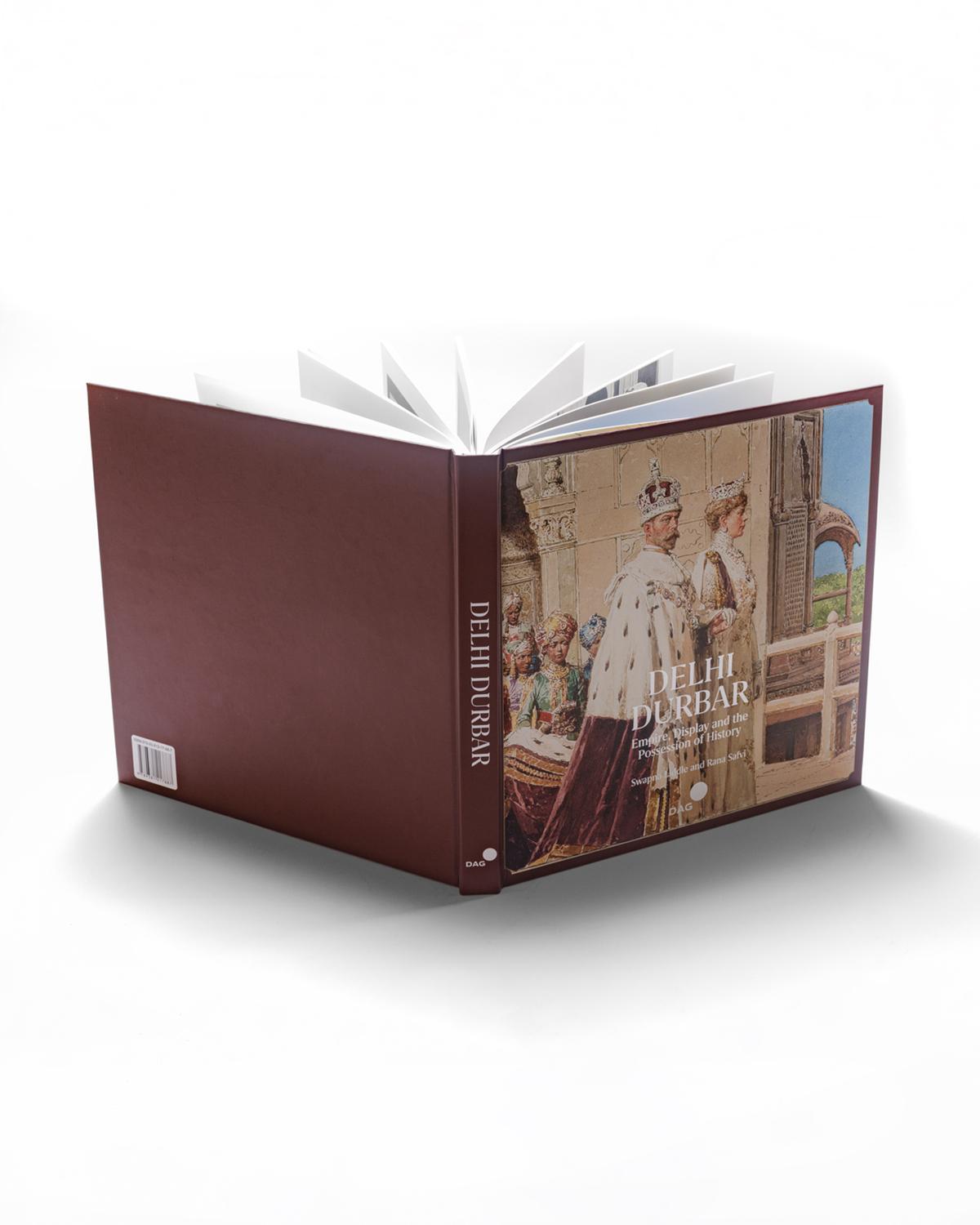
Curated by noted historians Rana Safvi and Swapna Liddle, DAG also launched a book, Delhi Durbar: Empire, Display and the Possession of History, co-authored by the duo.
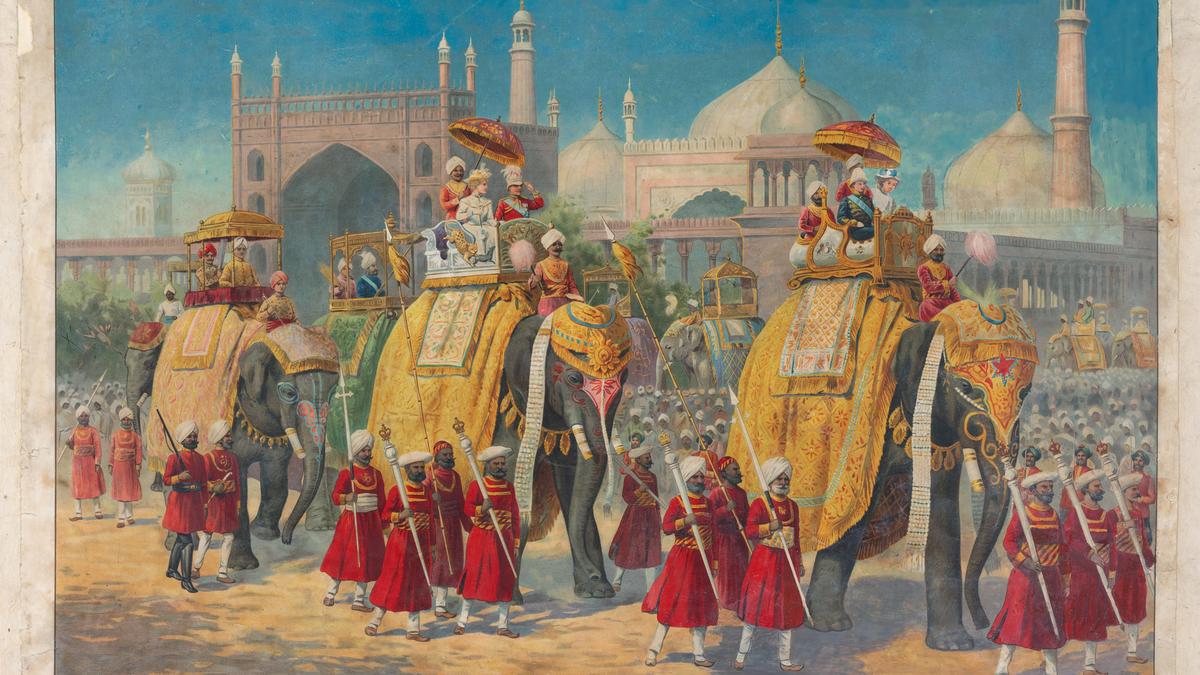
The Imperial Durbar (1903) | Photo Credit: Special Arrangement
In an important contribution to a facet of Delhi’s rich history, DAG is hosting an exhibition drawn from its archives of the city’s resplendent durbars. Curated by noted historians Rana Safvi and Swapna Liddle, DAG also launched a book, Delhi Durbar: Empire, Display and the Possession of History, co-authored by the duo.
“The British Delhi Durbars have been the subject of much recent scholarly study and re-evaluation,” writes Ashish Anand, the CEO and managing director of DAG. “The objects in this exhibition bring them materially present, through works by some of the leading artists and photographers of the period.” The essays give readers an insight into the city that was. We also get rare visuals of Delhi, its monuments, and its three durbars — all of which were landmarks in British-ruled India.
Safvi speaks to Magazine about the project. Excerpts:
Companion of the Most Eminent Order of the Indian Empire | Photo Credit: Special Arrangement
Question: Can you shed some light on the DAG project?
Answer: This exhibition was conceived by Giles Tillotson, senior vice president – exhibitions at DAG. It is the first exhibition that has been drawn from the DAG archives.
Q: With all the attention on the Central Vista project and the new Parliament, how important is it to revisit Delhi’s history?
A: Every ruler negotiates his/ her idea of kingship. If we read the history of Delhi, kings starting with the Tomara dynasty built cities and citadels to perpetuate their memory. While the Mughal city of Shahjahanabad played a pivotal role in the three Delhi durbars, the last one saw King George announce the shifting of the British capital from Calcutta to Delhi. He also laid the foundation for a new city. This is known today as Lutyens’ Delhi.
Q: The book talks of three durbars. How different were each?
A: While all three durbars were unique, there was a thread of continuity. They were all held in the Coronation Park in Delhi and close to the Ridge where the British had fought the Indian forces in the Uprising of 1857. [They] appropriated some Mughal symbols in a bid for continuity and so that Indians could relate to them.
The first durbar, held just 20 years after the Uprising, was called the Imperial Assemblage and was meant to announce the assumption of the title of Kaiser-e-Hind by Queen Victoria with pomp and splendour. It was also meant to legitimise and popularise British rule, using many of the idioms of the Mughal empire, including the word ‘durbar’, which Indians were familiar with.
The second, held in 1903, was to celebrate the coronation of King Edward VII. This durbar envisaged by the viceroy Lord Curzon was a grandiose event with the viceroy and 48 Indian princes riding on elephants through the city in a ceremonial procession. An art exhibition was conceived by Lord Curzon, in his own words, to ‘show that India can still imagine and create, and do’.
The third durbar of 1911 was the first in which the British monarch himself was present with his consort Queen Mary. It announced the reversal of the highly unpopular partition of Bengal and was also used to announce the shifting of the imperial capital in India from Calcutta to Delhi.
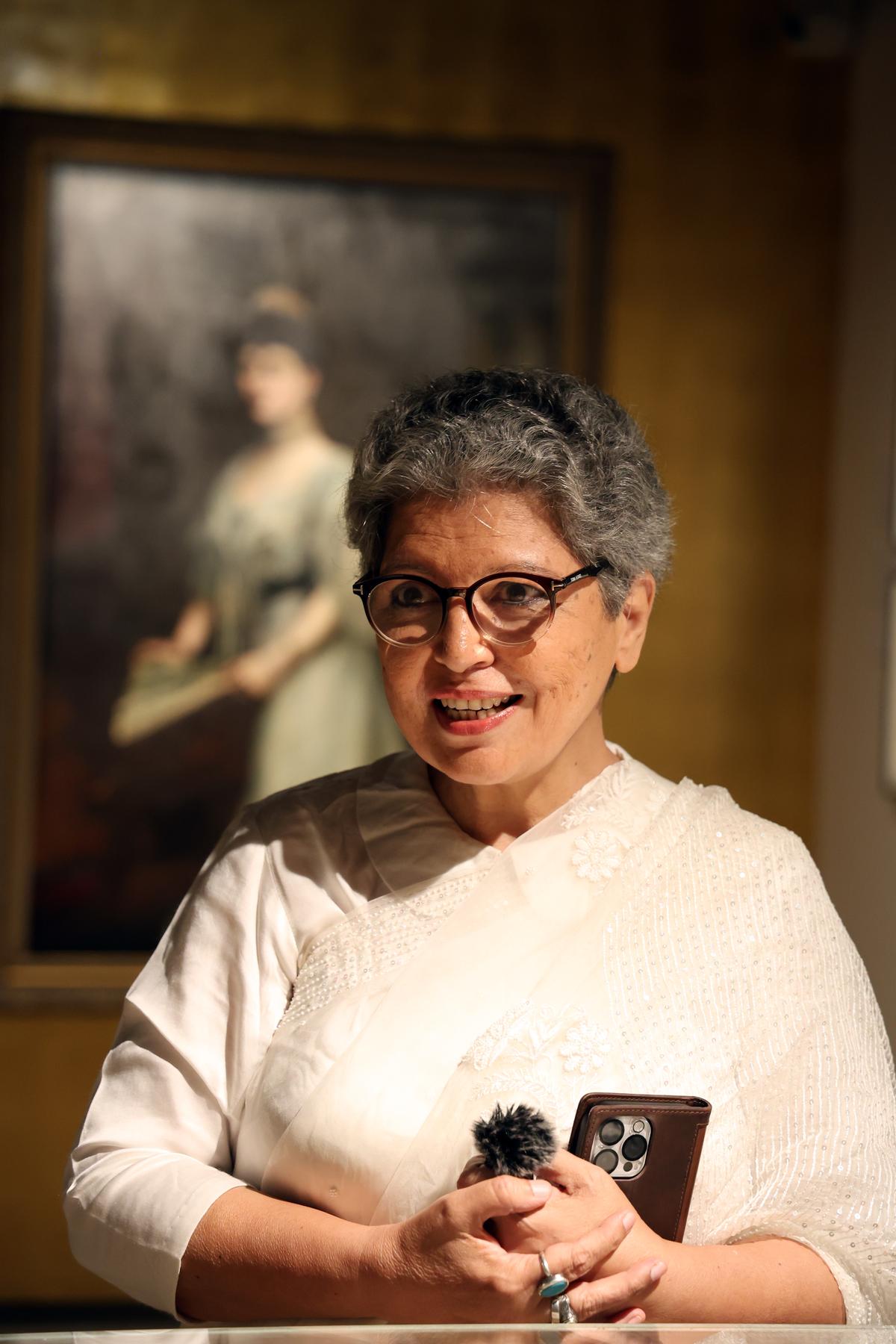
Historian Rana Safvi | Photo Credit: Special Arrangement
Q: The historic Jama Masjid was under British occupation for almost five years after the Uprising of 1857. Why and how did it become a vantage point for the durbar in 1903?
A: After the fall of Delhi, Jama Masjid was confiscated by the British; it was used as a mess and horses were tied along its corridors. In 1862, it was returned to Muslims for worship. The Jama Masjid has always been a symbol of Mughal magnificence and of Muslim togetherness.
Q: Can you elaborate on the demolition of Masjid Akbarabadi during the Uprising? It doesn’t always find a place in our textbooks…
A: When the city of Shahjahanabadwas being built, members of royalty as well as nobility were encouraged to build and add to it. Three mosques were built by three wives of Mughal emperor Shah Jahan. Fatehpuri Begum built the Fatehpuri mosque, Sirhindi Begum the Sirhindi mosque and Akbarabadi Begum the Akbarabadi mosque.
After the fall of Delhi, when the British army was victorious, the city and its people were punished for their ‘rebellion’. While many notables of Shahjahanabadwere killed or driven out of the city, the monuments and buildings were taken over. Fatehpuri mosque’s compound and galleries were auctioned and bought by Lala Chunnamal Ki Haveli and Akbarabadi Masjid was demolished. There is a beautiful description of Akbarabadi mosque in Syed Ahmed Khan’s Asar-us-Sanadid.
Delhi Durbar: Empire, Display and the Possession of History | Photo Credit: Special Arrangement
Q: Does the Coronation Durbar of 1911 mean the British had accepted the primary place of Delhi in India’s history?
A: Delhi’s importance can be seen from the fact that all three durbars were held here. Delhi was associated with Indraprastha, the legendary capital of the Pandavas, and was the city from where the Tomaras, Delhi Sultans and the Mughals ruled. Delhi’s grand history and traditions were used in the durbars. In the 1911 durbar, King-Emperor George V and Queen Mary even gave a jharokha darshan from the Red Fort’s Musamman Burj to Indians in the Mughal tradition.
ziya.salam@thehindu.co.in
source: http://www.thehindu.com / The Hindu / Home> Entertainment> Art / by Zia Us Salam / September 29th, 2023
Archeological Survey of India says the monument, which residents claim is the Akbarabadi Mosque demolished by the British in 1857, is definitely a ‘contemporary’ of the 17th century Red Fort.
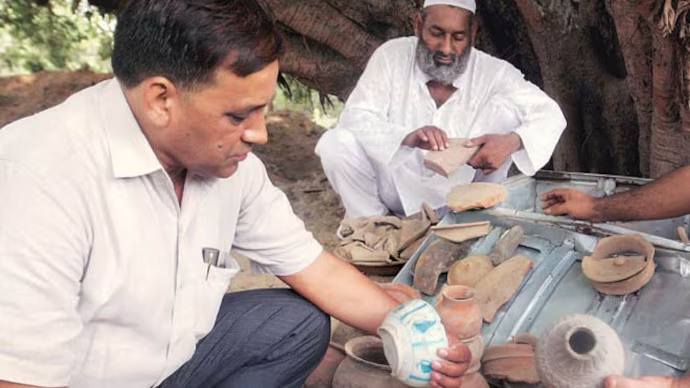
Archaeologist D.N. Dimri(l) shows the artefacts unearthed from the site at Matia Mahal, Old Delhi.
Remains of a historical monument, unearthed a few steps from Jama Masjid, belong to the golden age of Mughal Empire.
Archeological Survey of India said the monument, which residents claim is the Akbarabadi Mosque demolished by the British in 1857, is definitely a “contemporary” of the 17th century Red Fort, though whether it was a mosque or not will be known only after a detailed survey of the area.
The site in Matia Mahal, near Daryaganj, has been drawing visitors in hordes since the past three weeks after the first proofs of the historical structure – pottery and carved stones – were discovered in the area.
On Wednesday, a 10 metre wide wall was discovered a few feet under the ground. Residents claimed the wall was a part of the boundary of the main prayer enclosure, supposed to be about 85 metre wide.
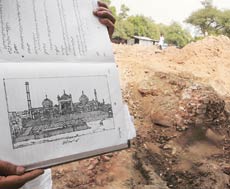
A sketch of the lost Akbarabadi Mosque. ASI officials said the discovery of the site is “indeed remarkable”.
“What we have here is a structure definitely of the time of the Red Fort. It is important due to its proximity both to the Jama Masjid and the Red Fort. The articles discovered from the site – Chinese porcelain, glaze pottery – belong to the period of the Mughals. What the structure exactly is will be known only after detailed survey,” superintending archaeologist Dr D.N. Dimri said.
But residents are confident that evidence of the structure being a mosque is present in the archives.
“We have maps clearly showing the structure of the Akbarabadi mosque in a book authored by the great scholar Sir Syed Ahmad Khan. There are illustrations of the mosque in the development plan of this area, issued by the Delhi government,” Matia Mahal MLA Shoaib Iqbal said.
source: http://www.indiatoday.in / India Today / Home> News> India> North / by Mail Today Bureau / published by AtMigration / July 07th, 2012
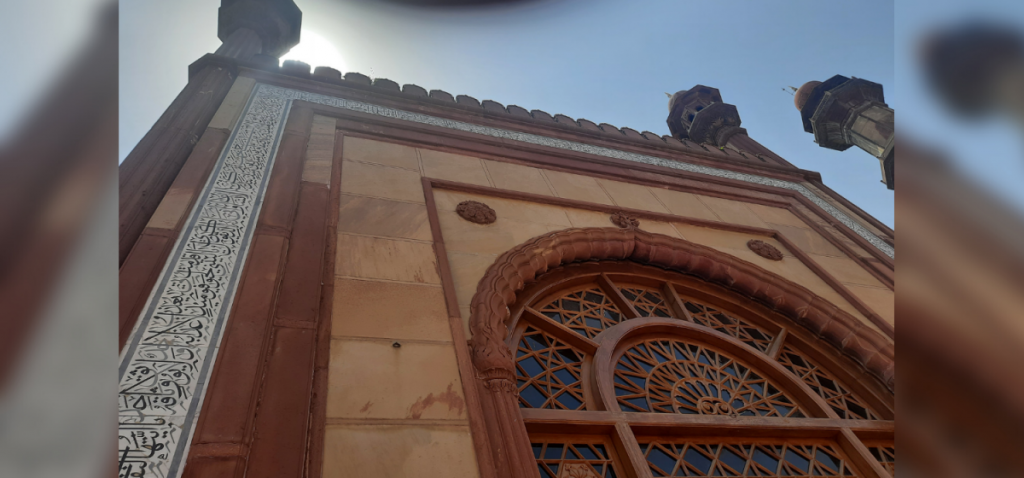
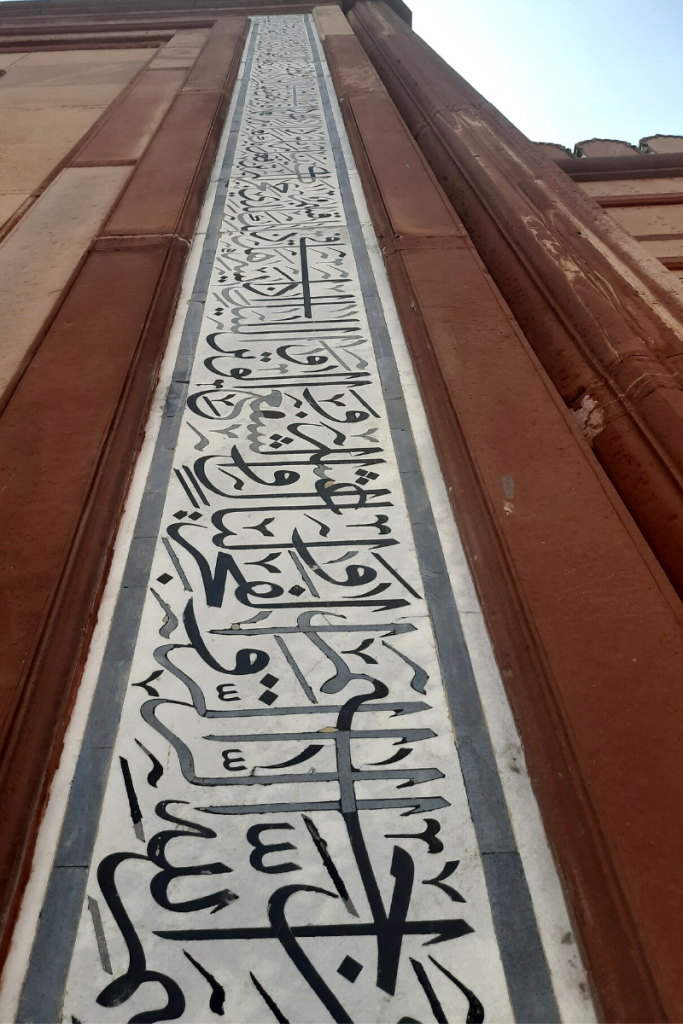
The imposing walls of both the Taj Mahal and Aligarh Muslim University’s Jama Masjid have Quranic verses crafted onto white marbles in black paint.
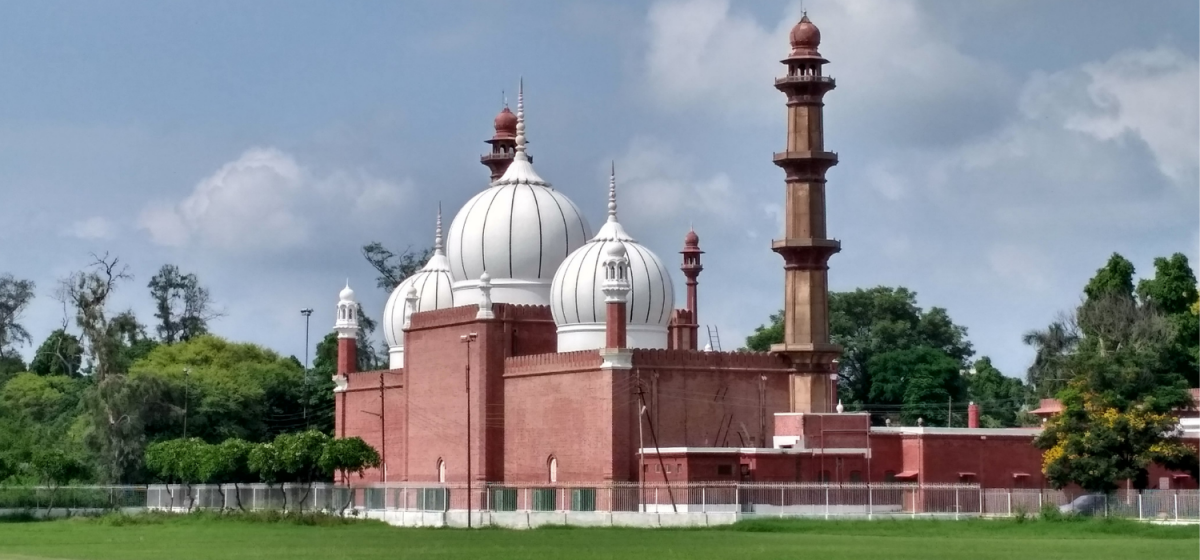
Jama Masjid on Aligarh Muslim University campus. Photo: Author provided.
Constructed nearly 250 years apart, the Taj Mahal in Agra and Jama Masjid at the Aligarh Muslim University (AMU) have an interesting connection.
The construction of the Taj Mahal began in 1632 and was completed in 1653, while the construction of Jama Masjid at AMU began in 1879 and was completed in 1915.
While the Taj Mahal, which is the tomb of Mughal emperor Shahjahan and his wife Mumtaz Mahal, attracts millions of visitors every year, AMU’s Jama Masjid is the main mosque of the university. AMU’s Jama Masjid is, perhaps, the last enduring symbol of the Mughals, constructed when the Mughals lost their kingdom during British rule.
A surprising connection
As one enters the Taj Mahal, beautiful calligraphy adorns all four corners. Several verses from the Holy Quran crafted in black calligraphy on white marble can be seen. This is a unique form of calligraphy, and expert artisans from Persia were involved in creating it. Similar calligraphy can be seem inscribed at the tomb of Mughal King Akbar at Sikandra, Agra, and also at the AMU Jama Masjid.
A closer look at the white marble with Quranic verses in black colour adorning the walls of Jama Masjid in Aligarh Muslim University. Photo: Special arrangement.
In fact, it is believed that the artisan responsible for the calligraphy at the Taj Mahal also brought his expertise to AMU’s Jama Masjid.
Since there is a difference of nearly 250 years between the construction of both architectural wonders, it is interesting to study how this was possible.
During Shah Jahan’s regime, several buildings were constructed, including the Taj Mahal and Delhi’s historic Jama Masjid. The calligraphist used was the same.
Professor Nadeem Ali Rezavi of the Centre of Advanced Studies, Department of History, Aligarh Muslim University, says that the master calligraphist in most of the buildings constructed during Shah Jahan’s regime is the same person.
“His name was Abdul Haq, and later due to his craftsmanship, his rank was elevated. He was given the title of Amanat Khan. In fact, he even signed the bands on this calligraphy with dates,” says Rezavi.
Still, there is a gap of over two centuries between these two buildings, Taj Mahal and AMU’s Jama Masjid.
The connection between the two monuments becomes clear with the involvement of Akbarabadi, one of Shah Jahan’s queens. Her original name was Aiza-un-Nisa. She, in 1650, commissioned the construction of a mosque situated in Daryaganj, Delhi, during the same period. In that mosque, Quranic calligraphy was done by the same artisan in black paint on white marble. This was around the same time as when the Taj Mahal was built.
After nearly two centuries, the Daryaganj mosque was demolished by the Britishers following the 1857 revolt. This was when Britishers gained control over the Red Fort, and the last Mughal emperor Bahadur Shah Zafar was sent in exile to Rangoon. They destroyed many buildings which were supposed to have harboured the rebels. At the site of the destroyed Akbarabadi Mosque, a park was developed and came to be known as Edward Park in 1911, which is now called Subhash Park.
During the same period, Sir Syed Ahmed Khan, the founder of the Mohammadan Anglo Oriental College (which later became AMU) felt the oppression against Muslims after the revolt. He nurtured the idea of setting up an educational institution to try and uplift the community.
A visionary man, Sir Syed had the taste for collecting things, particularly artefacts which had archaeological and historical importance. He was aware of the demolition of the Akbarabadi Mosque in Delhi.
As per the AMU Gazette, the scraps generated at the demolished Akbarabadi mosque were sold to a dealer and later purchased by Sahabzada Suleman Jah Bahadur. These remains were thus sold after over 200 years. These were presented to Sir Syed Ahmed Khan, who planned to use them in the Jama Masjid of the educational institution.
A closer look at the white marble with Quranic verses in black colour adorning the walls of Jama Masjid in Aligarh Muslim University. Photo: Special arrangement.
The white marbles with black calligraphy now present in the Jama Masjid of AMU depict Surah Fajr from the Holy Quran. Thus centuries apart, the two buildings carry the work of the same artisan.
“Even if you compare, it is the same thing and the only difference is in the scale. The artisans are the same who have shown their skills in the construction of the Taj Mahal,” says Prof. Rezavi.
Thus AMU’s Jama Masjid is, perhaps, the last enduring symbol of the Mughals, constructed when the Mughals lost their kingdom during the British rule. On the other hand, the domes of AMU’s Jama Masjid employed techniques of the Mughal era: they are “true domes” as they were built using lime mortar and vousseurs (wedge cornered stones/bricks).
“It is a brick structure, guava-shaped, carrying white marble with black stripes. This is the last true dome. After this, the particular technology faded out, and the buildings constructed after them have concrete domes,” said Rezavi.
Later, in 2016, AMU authorities began the conservation of the Jama Masjid. Now revived at the cost of Rs 90 lakh, the Jama Masjid has a Hauz in the courtyard, three domes, seven arches and two lofty minarets cornered by a Cricket Pavilion at its rear end. Sir Syed, the founder of the institution, was also buried in the same compound.
Faisal Fareed is a senior Lucknow-based journalist.
This article went live on June fifth, two thousand twenty one, at zero minutes past seven in the morning.
source: http://www.thewire.in / The Wire / Home> History / by Faisal Fareed / June 05th, 2021
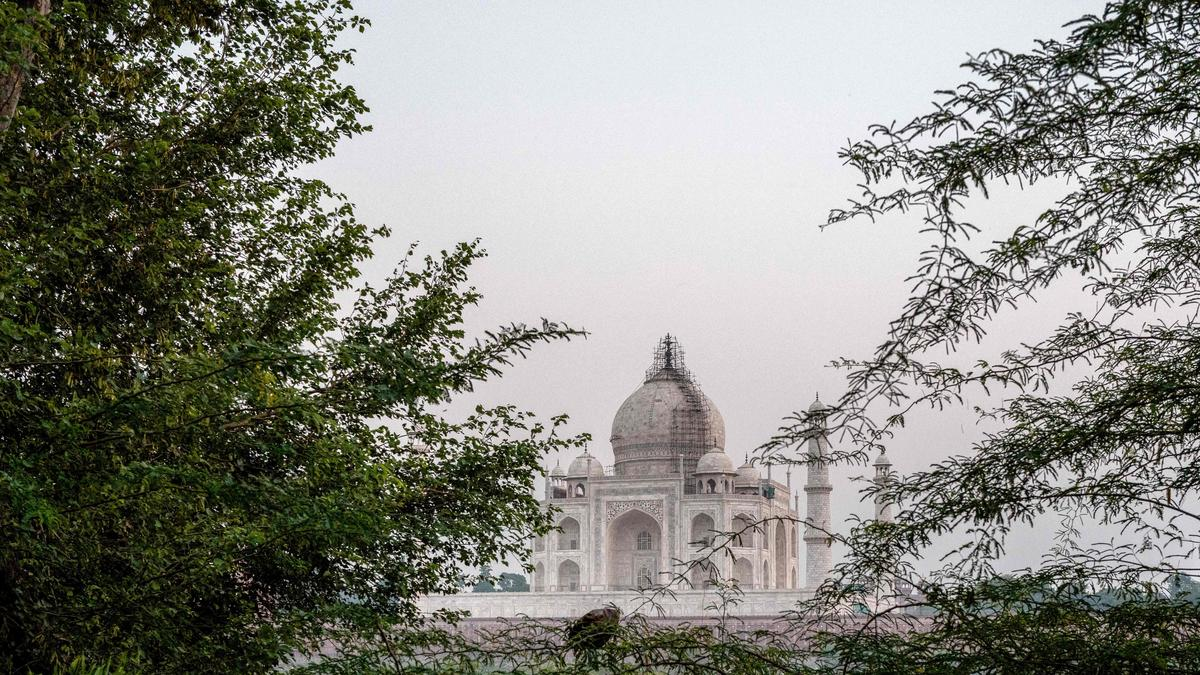
Tushar Goel’s film, ‘The Taj Story’, has reignited controversy over the Taj Mahal’s origins, claiming it is a Hindu temple rather than a mausoleum built by Mughal emperor Shah Jahan. The film’s debut highlights debates about the interplay of history and ideology in contemporary India.
Scaffoldings are pictured as restoration work goes on at the dome of the Taj Mahal in Agra on October 17. | Photo Credit: AFP
A little over 60 years ago, Purushottam Nagesh Oak slept and dreamt. He woke up and claimed that the Taj Mahal in Agra was actually a Hindu palace going back all the way to 4th century. Friends of Mr. Oak, an English teacher-turned-lawyer-turned-journalist but never a historian, told him that the Taj Mahal couldn’t have been a fourth century structure as the technology employed in building the Taj in the 17th century didn’t exist back then. The fantasist turned a pragmatist, and Oak brought his argument forward by a few centuries. The Taj was now claimed to be a Hindu temple. This was in 1989. He wrote articles and a book too, but found no support from historians. Even the Supreme Court dismissed his claims as “a bee in his bonnet” in 2000.
But post-2014, history is like a revolving door, you enter and exit at your ease and pleasure. You pick and choose, you circumvent and invent. Dress it up as a movie and claim you are looking at history anew. That is how we get a movie like Tushar Amrish Goel’s The Taj Story, starring former BJP MP Paresh Rawal; just like we had The Kashmir Files and The Bengal Files, starring Anupam Kher and Mithun Chakraborty, all ideological partners of the Bharatiya Janata Party (BJP).
With The Taj Story, Goel goes where no historian has gone. Proof, evidence and knowledge amount for nothing as the director makes a case for the Mughal monument being actually a Hindu temple, much like the BJP leader Sangeet Som who called it alternately a Shiva temple and a monument built by a man who incarcerated his father. Mr. Som obviously couldn’t make out a Shah Jahan from an Aurangzeb and hence got mixed up. Much like Oak, oops, Goel, who sees no difference between history and mythology, facts and fantasy.
Recorded history
Talking of facts, the Taj Mahal was built by the Mughal emperor Shah Jahan after his favourite wife Arjumand Bano Begum breathed her last after bearing the last of their 14 children. Its chief architect was Ustad Ahmed Lahori. The land for her last resting place was procured from Mirza Raja Jai Singh of Amber who had inherited it from Raja Man Singh, a celebrated general of Akbar, who was Shah Jahan’s grandfather. Shah Jahan compensated Jai Singh with four havelis from the royal property for the massive haveli in which rests Mumtaz Mahal. His firman to Jai Singh, the latter’s agreement and the Mughal emperor’s subsequent letter of granting him four havelis in lieu of one, are all part of history; unlike the claim of The Taj Story which talks in terms of a massacre and genocide of the locals for fulfilling the wishes of an emperor and his consort!
The work on the tomb started in 1632 with the finest craftsmen from across the country and West Asia. The chief mason was Mohammed Hanif from Baghdad who earned ₹1000 a month for his efforts. The pinnacle was built by Qayam Khan of Lahore and its Quranic inscriptions were done by Amanat Khan Shirazi. The mosaic work was done by local Hindu workers. Above all, some 20,000 workmen toiled for 22 years to build the monument to love. Its white marble came from Jaipur, lapis lazuli from Sri Lanka, crystal from China and coral from Arabia. The monument uses the double dome technique, previously seen only in the Humayun’s tomb in Delhi, and never seen in the country before the arrivals of the Turks.
Not the first time
Over the years, many have tried to appropriate credit for its beauty and majesty. In the 17th century, it was claimed by many in the West that the architect of the Taj was Venetian Geronimo Veroneo, a jeweller by profession. Then came the claim by Mughal Beg in Tarikh-e-Taj Mahal that it was designed by Muhammad Effendi, an architect supposedly sent by the Sultan of Turkey. Effendi though was as much an architect as Oak was a historian. In the mid 19th century it was claimed that the monument was the result of the genius of Frenchman Austin de Bordeaux, a jeweller. However, Austin died in 1632, the year the work on the Taj began. With his death all claims of Austin being the Taj’s architect were buried. And facts began to be raised.
As for fantasy, well there is Goel’s film, never mind its claim of presenting the “untold history of the Taj Mahal”. The film, replete with stereotypes of kohl-lined, skullcap-donning Muslims aims at building a nation’s memory on unreasoned mythology, far removed from the well argued debates of history. Much like Oak’s view that Christianity was nothing but Krishan-Niti. Not game for any ridiculous claims in an insipid film which opened with a mere 14% attendance in the first show? Watch M. Sadiq’s 1963-saga Taj Mahal. Sure, you would remember its song, ‘Jo wada kiya woh nibhana padega’, penned by Sahir Ludhianvi and sung with much love by Mohammad Rafi and Lata Mangeshkar. Sadiq’s film with Pradip Kumar and Bina Rai in the lead cast, made no effort at replacing history with mythology.
source: http://www.thehindu.com / The Hindu / Home> Entertainment> Movies> In the limelight / by Zia Us Salam / November 07th, 2025
Born in 902 or 910 Hijri, Hazrat Wajihuddin Alvi, son of Qazi Syed Nasrullah Alvi, belonged to the Hashmi family and Alvi Sadat
Main Points:
1. A key figure in the ancient Shattariya Silsila, linked to Shaykh Sirajuddin Abdullah Sattar and Hazrat Khwaja Bayazid Bastami, he helped spread Islam in India.
2. Received direct knowledge from Hazrat Prophet Muhammad (Sallallahu Alaihi Wasallam) in a dream, earning the title Ali Us-Sani for his profound wisdom.
3. Mastered over 60 Islamic disciplines by age 24, founded Madrasa Alia Alvia, and educated 80,000 students, earning the title of Mufti in Gujarat.
4. Transformed by Pir-Murshid Khwaja Ghaus Muhammad Gwaliori, he became a Wali-e-Kamil and Mujaddid, with his Gujarat Astana inspiring generations.
Hazrat Wajihuddin Alvi, a revered figure in the annals of Islamic history in India, is celebrated as a towering spiritual and scholarly personality. Known as the Mujaddid, Qutub, and Wali-e-Kamil, his life is a testament to unparalleled devotion, intellectual brilliance, and spiritual excellence. His contributions to the propagation of Islamic knowledge and the Silsila-e-Shattariya have left an indelible mark on the subcontinent’s religious landscape. This article delves into his life, lineage, spiritual journey, and enduring legacy.
According to historical traditions, Hazrat Wajihuddin Alvi was born either in 902 Hijri or 910 Hijri, a matter of scholarly debate. His father, Syed Nasrullah Alvi, served as the Qazi of Gujarat, a prestigious position that underscored the family’s deep-rooted connection to Islamic scholarship and jurisprudence. His name, Wajihuddin, meaning “leader of the religion-serving community,” aptly reflected his destined role as a guiding light for the faithful.
Hazrat Wajihuddin belonged to the illustrious Hashmi family, tracing his lineage to the noble Alvi Sadat. Despite his exalted ancestry, he maintained remarkable humility, never publicly revealing his status as an Alvi Sadat. This modesty only enhanced his stature as a true servant of Allah, whose life was dedicated to the pursuit of divine truth and the upliftment of humanity.
Hazrat Wajihuddin Alvi is intrinsically linked to the Silsila-e-Shattariya, a lesser-known but profoundly significant Sufi order in India. While the general populace is more familiar with the four prominent Sufi Silsilas, Chishtiya, Qadriya, Naqshbandiya, and Soharwardiya, the Shattariya Silsila boasts a rich and ancient heritage. Known as Bistamia in some regions, Ishqiya in Iran, and Shattariya in India, this Silsila traces its origins to Shaykh Sirajuddin Abdullah Sattar, a descendant of Shaykh Umar Sahabuddin Sohrawardy and a caliph of the revered Sultanul Arifeen, Hazrat Khwaja Bayazid Bastami.
Shaykh Sirajuddin Abdullah Sattar, the founder of the Shattariya silsila, arrived in India with a mission to spread the message of Islam. Known for playing the Nakkara (a traditional drum), he would attract crowds with its captivating sound and invite them to seek Allah. His powerful call, “Come, if someone is seeking to meet Allah, let me introduce him to Allah,” resonated deeply, drawing countless souls to the path of righteousness. As the son of Shaykh Sahabuddin Sohrawardy and a caliph of Hazrat Bayazid Bustami, Shaykh Sirajuddin’s spiritual stature was immense, and his legacy laid the foundation for the Shattariya silsila’s prominence in India.
The Shattariya Silsila, alongside Qadriya, Chishtiya, Naqshbandiya, Soharwardiya, and Owaisiya, played a pivotal role in disseminating Islam across the Indian subcontinent. These six Silsilas, through the sacrifices and efforts of their saints, transformed the spiritual landscape of the region, guiding millions towards the light of faith.
Hazrat Wajihuddin Alvi’s spiritual eminence earned him the title of Ali Us-Sani (the second Ali), a reference to the unparalleled status of Hazrat Ali Karamallahu Wajhul Kareem. This title was not merely honorific but a reflection of the divine knowledge bestowed upon him. Like Hazrat Ali, who received direct knowledge from the Hazrat Prophet Muhammad (Sallallahu Alaihi Wasallam), Hazrat Wajihuddin was blessed with divine wisdom in a remarkable incident.
During his education, when his teacher Allama Ilamuddin passed away, Hazrat Wajihuddin was consumed by worry about the knowledge he had yet to acquire. One night, the Hazrat Prophet Muhammad (Sallallahu Alaihi Wasallam) appeared in his dream, addressing him as “Nawase Wajihuddin” and assuring him, “Don’t worry, we have given you the knowledge of everything that even you and your teachers did not know.” The Prophet handed him a paper, instructing him to refer to it when questioned about his knowledge. This divine encounter transformed Hazrat Wajihuddin into an ocean of wisdom, earning him the epithet Ali Us-Sani for receiving knowledge directly from the Hazrat Prophet, much like Hazrat Ali.
Hazrat Wajihuddin’s family hailed from Yemen, a land the Hazrat Prophet Muhammad (Sallallahu Alaihi Wasallam) described as a “city of angels.” His ancestor, Hazrat Syed Bahauddin, migrated from Yemen to Mecca, where he preached Islam before receiving divine guidance to settle in India. This marked the beginning of the family’s illustrious journey in the subcontinent.
His grandfather, a Qazi in the court, exemplified the family’s tradition of combining religious scholarship with judicial authority. This legacy continued through his father, Syed Nasrullah Alvi, and his forefathers, Syed Atauddin Alvi and Syed Imamuddin Alvi, who served as imams and Qazis. The family’s intellectual and spiritual influence was profound, shaping Hazrat Wajihuddin’s upbringing and his commitment to the Shariah.
Hazrat Wajihuddin’s education began at the tender age of four with the Bismillah ceremony, marking the start of his formal learning. By the age of 19, he had memorized the Quran Majeed, a feat that underscored his prodigious intellect. Raised in a Persian-speaking household, he pursued higher education under the guidance of his uncle, Hazrat Allama Syed Shamshuddin Ahmed, and other family scholars. By the age of 24, he had mastered over 60 disciplines of Islamic knowledge, earning him widespread acclaim.
Recognizing his scholarly prowess, the ulema of Gujarat conferred upon him the title of Mufti at the remarkably young age of 24. This was no small achievement, as a Mufti in those times was a figure of immense respect, commanding authority over religious rulings across the region. Hazrat Wajihuddin established the Madrasa Alia Alvia on his own land, where he educated over 80,000 students, transforming them into Alims and hafiz of the Quran. His dedication to teaching reflected the Hazrat Prophet’s saying, “The best of you is the one who learns the Quran and teaches it to others.”
Remarkably, Hazrat Wajihuddin left the madrasa only four times in his lifetime, such was his commitment to education. His institution attracted scholars and students from far-off places like Lahore, cementing his reputation as a beacon of knowledge.
No account of a Wali-e-Kamil is complete without acknowledging the pivotal role of a Pir-Murshid (spiritual guide). For Hazrat Wajihuddin, this guide was Hazrat Khwaja Ghaus Muhammad Gwaliori Sattari. In 948 Hijri, when controversy arose over Khwaja Ghaus’s work Merajnama, with Hazrat Shaikh Ali Muttaqi declaring it un-Islamic, Hazrat Wajihuddin intervened. He met Khwaja Ghaus in Gujarat, spending an entire night in his company. This meeting was transformative, as Hazrat Wajihuddin later remarked that without it, he would not have truly become a Muslim. This underscores the profound impact of a spiritual guide, even on a scholar of his stature.
When presented with a fatwa against Khwaja Ghaus, Hazrat Wajihuddin tore it apart, declaring, “We are the people of the past, and they are Arabs.” His decisive action nullified the controversy, earning him the title of Mujaddid from Shaikh Ali Muttaqi. This incident highlighted his ability to balance Shariah with spiritual insight, a hallmark of his legacy.
Hazrat Wajihuddin’s piety was evident from childhood. As an infant, he refused to drink his mother’s milk unless she performed wudu, a testament to his innate spiritual purity. This incident earned him immense respect within his family, who recognized his extraordinary connection with Allah.
His adherence to Shariah was uncompromising. For two months, he abstained from eating home-cooked food, fearing that his father’s position as Qazi might lead to inadvertently consuming haram provisions. Instead, he sustained himself on grass and leaves from the forest. When his father inquired about his weakened state, Hazrat Wajihuddin explained his concerns, prompting his father to reassure him of the family’s commitment to halal. This incident reflects his meticulous observance of Shariah and his fear of Allah.
In his later years, weakened by age, Hazrat Wajihuddin considered retiring from teaching Hadith. However, the Hazrat Prophet (Sallallahu Alaihi Wasallam) appeared in a dream, saying, “O Nawase, when you recite Hadith, we sit and listen to you.” Moved to tears, he continued teaching with renewed devotion until his passing. His death sent shockwaves through Gujarat, with millions attending his funeral, yearning to carry the bier of the Naib-e-Gaus-e-Azam and Aashiq-e-Rasool.
Hazrat Wajihuddin Alvi’s legacy endures through his contributions to Islamic scholarship and the Shattariya Silsila. His Astana in Gujarat remains a source of spiritual strength, and his teachings continue to inspire generations. Muhaddis Abdul Haq Dehlvi noted Hazrat Wajihuddin was a Wali-e-Kamil who lived a life of rigorous spiritual discipline. Mulla Abdul Qadir Badayuni wrote that no book was beyond his knowledge, and his prayers could bring divine favour to any endeavour.
In summary, Hazrat Wajihuddin Alvi was a shining light of the Hashmi family, a Mujaddid, Qutub, and Wali-e-Kamil whose life exemplified the perfect blend of knowledge, piety, and spirituality. His contributions to Islamic education, his role in the Shattariya Silsila, and his unwavering devotion to Allah and Hazrat Prophet (Sallallahu Alaihi Wasallam) ensure that his legacy will remain alive until the end of time.
—–
A regular contributor to New Age Islam, Sahil Razvi is a research scholar specialising in Sufism and Islamic History. He is an alumnus of Jamia Millia Islamia.
source: http://www.newageislam.com / New Age Islam / Home> Islamic Perspectives / by Sahil Razvi / July 17th, 2025
India prides itself in recognising and celebrating “Unity in Diversity”, and to underline that great aspect Daijiworld Mangalore, after thousands of diverse articles and analyses, has enthralled readers for decades now. I would like to highlight, amidst the assortment of attractive information in this exclusive Special, a lesser-known history and ancient monument of our co-minority community of Mangalore, in two parts. The next part will be on other old historic monuments complementary and connected with Islam in Mangalore. There are always those who thirst to know the little-known history and geography too—for it is part and parcel of our Kudla roots, very ancient and very valuable.
Mangaluru, Kudla, Kodial, Maikala, Mangalapuram—this place of many names—no doubt is a place steeped in multifaceted ancient history. Temples, Churches, Mosques, and more exist which hold history and culture often unknown. Mangalore thrives on worship of the Gods, no doubt! At every nook and corner, historic Temples, Mosques, and Churches can be found. The history of Mangalore connects with different ancient regions, languages, faiths, and religions, multi-faceted and overlapping.
Taking a look at an ancient Mosque—probably the oldest in the region—in Bunder, the heart root of old Kudla/Mangaluru, is indeed very enriching and thrilling. The original roots of real old Mangalore run between Sharavu Ganapathi Temple in Kodialbail and Mangaladevi Temple in Bolar. The famed Muslim ruler of Mysore, Tipu Sultan, is known to have had a role in the development of Sharavu Ganapathi Temple, according to historians who have authored books on Tipu history—a strange dream while he camped nearby caused him to donate land for the temple.
Tuluva and local rulers are known to have protected Muslim/Arab traders in ancient times and have given them free passage through their kingdoms, much before Westerners were heard of in this area. Western rulers too established close trade and cultural ties with Muslim kingdoms and provided space for their lifestyle. It is evident that there has been much intercourse between cultures and beliefs for ages, creating a mosaic that is inseparable in and around Mangalore and beyond. A deeper look at the oldest Masjids of Mangalore and connected historic auxiliaries will enlighten the intricate mosaic.
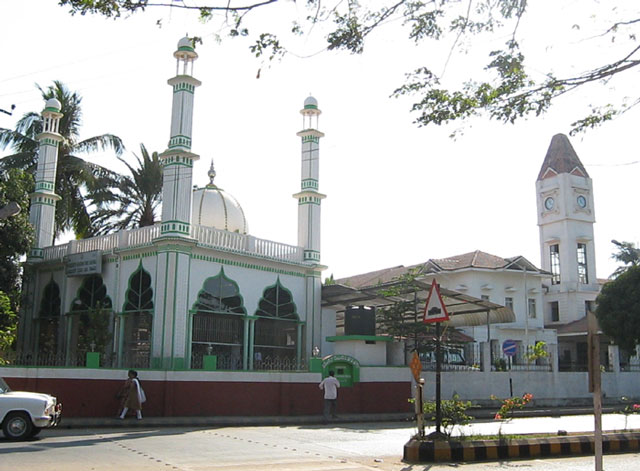
Zeenath Baksh Masjid, Bunder, Mangalore
This historic mosque is referred to as “Juma Masjid” and “Beliye Palli”. It is right in the middle of ever-bustling Bunder, the old port of commerce locality sandwiched between Golikatte Road and Port Road, just a stone’s throw from the Gurpur river and North Wharf to its west. Here, a wide range of commodities and condiments were—and are still—traded. The area seems in chaos with old dilapidated buildings amid newer ones and narrow lanes choked with heavy traffic of all descriptions and gutters. One’s olfactory senses will be tested with multiple oriental aromas of spice, coffee, areca, pepper, cardamom, chilies, garlic, ginger, rice, pulses, onions, potatoes… and all kinds of condiments, retail and wholesale—and of course, rotting garbage.
A trader, M M Kini, opposite the mosque, is a licensed dealer in arms and ammunition—it is an old family business. This unique and antique mosque is around the corner from the Bunder Police Station and the famous old renovated Bombay Lucky Restaurant, well known to local folks. The Kanara Chamber of Commerce and Industry (KCCI) is located a few yards opposite.
Bunder, the old port of Mangalore since ancient times, is the backbone of history, communication, and commerce, with thriving seaports and even the Lakshadweep Islands with which it shares a long history. The multi-religious business people around are of a very friendly and easy-going enthusiastic nature. A visit here is like going back in time and also tripping over the new order of life and faith.
The Masjid Zeenath Baksh in Bunder is said to have been established in Mangalore in 644 A.D. It was first established in Mangalore by Habeeb bin Malik, and the first Qadhi (Qazi) appointed was Hazarath Moosa Bin Malik, son of Malik Bin Abdullah. This mosque was probably inaugurated on Friday, the 22nd of the month of Jumadil Awwal (fifth month of the Islamic calendar) in the year 22 of Hijra (644 A.D.).
That this sacred Masjid was established by the holy men of Arabia, who were said to be kith and kin of the “Sahabas” (associates) of Prophet Hazarath Mohammad Rasulallah, makes it about 1400 years old—about a thousand years before the Portuguese brought Christianity here.
The Zeenath Baksh Mosque is indeed unique. The front portion (with a prayer hall on two levels) is no doubt added on in the 19th century (later too), and the tile roof has Basel Mission tiles. Another structure constructed later has four minarets and a typical dome and houses the 90-plus-year-old tomb of Hazrath Sheikuna Muhammed Moula Jalal Masthan Al Bhukhari, a saintly Khazi laid to rest here. Many young people come here to pray and find their lives changing with renewed goodness. Also, some of his kin’s tombs can be seen.
The inner ancient original mosque dates back centuries perhaps, and this old legend of a “Masjid” in the 1780s is said to have been refurbished and renovated systematically by the great Tiger of Mysore, Tipu Sultan, who is well known for such philanthropy. Anyone with a basic knowledge of layouts in the region cannot fail to recognise that this great monument, which spreads over a large area, has many characteristics of a temple—the large water tank (below ground level), the shape of the tiled roof (old Malabar), and the hand-carved woodwork (characteristically local).
Tipu added beautifully carved bulky rosewood pillars and also a carved ceiling—the huge carved works are majestic. The mosque was renamed after Tipu’s daughter, Zeenat Baksh. The prayer hall is on a plinth with an open colonnade running around the building under heavy overhanging eaves with carvings. The renovation coexists in harmony with the older, more ancient staccato structure.
The water tank in the center of the premises has granite steps and provides water for the ablutions or ‘Wuzu’ prescribed before ‘Namaz’. This Juma Masjid is well frequented by devotees for regular five-times Namaz and to visit the tombs. There is also a burial ground that partly encircles the mosque. One can see men and women frequenting this holy place; on festival occasions, this mosque can hold about 2000 people for the Namaz or prayer assembly. During Ramadan fasting and festivals, the religious spirit is at a peak and exemplary.
Tipu Sultan has also built a Masjid at Mangalore 2 km away from this mosque. It is presently called “Idgah Masjid” at the top of the hill (now called Light House Hill, in the town center near Aloysius University gate). Muslims from all over the district gather here and offer prayers on festive days of Eid-ul-Fitr and so on. Subsequently, in 1920, Mangalore Bail family constructed a large assembly hall or Jamath Khana. There are a good number of Muslims in Mangalore, and their concentration in this area is phenomenal.
Present Activity of the Masjid:
Considering the needs of the economically weaker people of the community, the management committee of the mosque has made initiatives to extend free service in various ways for the needy people of the community. Funds are raised from benevolent donors of the community for the purpose of marriages, education, medical relief, shelter, and other social basics. Also, the management committee of this mosque looks after the burial of destitutes free of cost. Efforts are on by the leaders for establishing and running schools and colleges from KG to PG for the benefit of the wider community who are rapidly marching forward in all spheres of activity.
“He is the One GOD; the Creator, the Initiator, the Designer. To Him belong the most beautiful names. Glorifying Him is everything in the heavens and the earth. He is the Almighty, Most Wise.” (Quran, 59:24).
The current perception of Islam and the followers of religion and culture in Kanara and the coastal areas, in the light of new developments and issues that rule, calls for a closer look at the history and practice of Islam in this region. Muslim groups are generally labelled as “minority” and weak, but it must be clearly understood that the population is significantly strong, and their presence here can be traced back to the 7th century A.D., while Christianity is from the 16th century practically, though it is credibly said that Christianity landed in Kerala in the first century (53 A.D.), even before it reached Europe.
There are many facets that Muslims have dominated here for centuries and still do. Their sway is very significant and ancient and needs serious consideration of the rights and values guaranteed by tradition and the Indian Constitution. Islam is now an indelible part of this region, India, and the world over. They cannot be labelled as aliens and are part and parcel of the mainstream.
The Muslim community here, in view of all aspects, is a strong, rooted, and recognised community. It can be observed that the Muslim community’s progressive principles here are indeed very forward, and their outlook is advancing, influenced by the Middle East and Western standards and good education and industry. Many prominent properties and businesses are owned by them. Families are largely active; elders in the families are secure and cared for, and women seek good education. The entire community is enterprising, hard-working, cooperative, and presents a happier picture generally. Religion-wise, they are fervent and keep the tenets strong even in the face of hurdles. The world over, it is seen they are going from strength to strength, and leaderships have to be transparent.
(dated October 16th, 2025 / source : daijiworld.com / by Ivan Saldanha-Shet )
Islamic Monuments of Mangalore: Part 2 / October 23rd, 2025
Mangalore and coastal Karnataka is steeped in multifaceted History and colour, many sources have facilitated the common person of interest to be aware and enjoy the depth of information. Daijiworld has been very generous and it is appreciated. Hindu, Muslim, Christian ……..and many more allow interesting facts and figures in and around mangalore / Canara since ages and fascinates. In the previous episode (Part 1 of 2) we noted the arrival and monument of Islam at Bundar, the original area of Kudla or Mangaluru at present. The matter would not be complete if a brief look at ancient contemporary Islamic monuments are not highlighted. No history is the sole property of any one in particular and is not esoteric in practicality. So, we continue and hope it will round off the interest and study of this history, let us have observations and comments.
KUTCHI MEMON MASJID. BUNDER. Mangalore : This is another ancient Masjid just near and on the way to Zeenath Baksh Masjid right opposite to famed ‘Bombay Lucky Restaurant’; the ‘Kanara Chamber of Commerce and Industry (KCCI) is in the backyard of this Masjid. It is also referred to as ‘Katchi Palli’. It is a wonder that this Mosque is credited with many firsts. Traditionally each of these many Masjids in Mangalore have their own section of regular devotees. Reliable sources say that Kutchi Memon Masjid was basically constructed in 1839 and is now 174 years old going on to be 175 years. The force behind this sacred work were Patels from Kutch in North Gujarat, traders who settled in the area and were masters in the spice trade, they spoke Kutchi language and gradually were assimilated into the Kanara culture, the cause of this development are the historical sea routes to Mangalore from the Arabian Sea. To and fro activity is still very visible it appears.
The wonders at this religious center are : It was the first to get power supply and the fourth in Mangalore to be electrified in the British era, in 1930s , the first to use loud speakers for the ‘azaan’, call to pray and in Urdu, the first where the ‘qutba’ (Friday Sermon) was delivered in Urdu and so on.
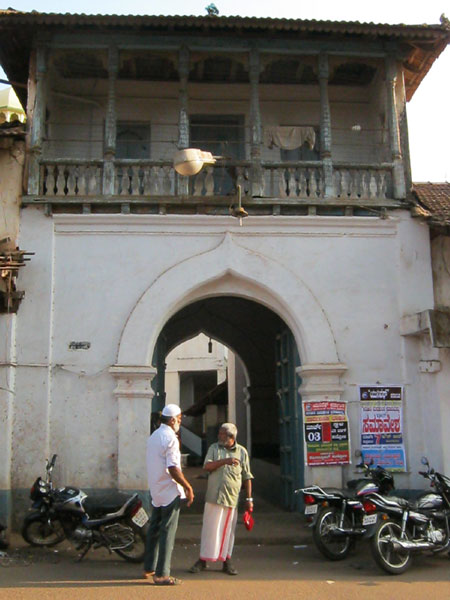
There has been development in the precincts of the masjid but the original structure on about 20-25 cents remains still very original. The new extension was first made in 1983 and plans to expand are ongoing. The unique gate way into the masjid has a picturesque oriental architecture. Indeed this area called Bunder is a wonder with many historic monuments still standing the test of time like sentinels spelling out the historical times gone by and hoping for better times for those who are to come.
Woman Saint’s Dargah in the Heart of M’lore : Hazrath Saidani Bibi Sahiba, the only dargah dedicated to a woman saint in Dakshina Kannada has become a refuge of hope without reference to religion, caste, creed or language. Located near A B Shetty circle, on the periphery of the prominent ‘Big Maidan’ (as it was then known) now, Nehru Maidan of Mangalore. This dargah (memorial tomb shrine) is visited by people of all faiths. Most of the people come here with a ‘harake’ (vow) as there is a strong belief that prayers are answered here. Hazrath Saidani Bibi, it is said, was a saintly lady, hailing from a ‘Fouji’ (Military) family during the regime of Tipu Sultan. She was buried in the military area (the present location of dargah on the edge of the City Police HQ – formerly the military barracks), though burial grounds were available, such was her reputation. People say that she was buried in the military area due to high respect and regard the local people of Mangalore particularly the warrior class had for her. Later, her close relatives were buried beside her. Now are seen three other tombs apart from that of Sayyadani Bibi in the dargah. Scores of people of all castes and creeds visit this place every day, giving alms to the poor that sit at this place, an accepted practice.
Another astonishing aspect of this dargah is that it is cared for and protected by retired or serving police officers of Mangalore. Hazrath Saidani Bibi Sahiba Dargah Management Committee is in the forefront of it’s maintenance. This dargah was frequently visited by the police staff and public, the tomb is adjacent to the police headquarters. In 1972, the then Dakshina Kannada SP K U Balakrishna Rau and the then Assistant SP H T Sangliana entrusted the administration of the dargah to Muslim police personnel. A committee was formed for the better administration of the dargah and in the year 1983 the old ‘Mazahar’ (tomb of the saint) was renovated. The dargah was built on land belonging to the Police department, and the property was later handed over to the Wakf Board. Indeed goodness knows no boundaries and so does harmony.
BEARY COMMUNITY IN MANGALORE: The origin of the ‘Beary’ Community is very ancient. It is known that there were many rich traders, from the Malabar coastal belt, connected with the traders of the Arab lands. Arab merchants have been visiting the coastal regions for business purposes even before the time of Muhammad (puh). Now most local Muslims in this region are part of the Beary Community.
The Beary (also known as Byari) is a community concentrated mostly along coastal Dakshina Kannada and Udupi districts in the Southern state of Karnataka. It is an ethnic group, having its own unique traditions and distinct cultural identity and language. The Beary community holds an important place as also Nawayaths of the Uttara Kannada district (who speak a type of Konkani). Bearys incorporate the local Tulu culture of undivided South Kanara and diverse traditions of the Moplahs of Malabar. The Beary community of Kanara or Tulunadu is one among the earliest Muslim inhabitants of the coast, with a clear history of more than 1350 plus years. Muslim Arab traders had a cordial relationship with the rulers of the western coastal belt of India. This is attested to also by the writing of Ibn Battuta, the intrepid North African traveller who passed through India in 1342AD. Lakshadweep too had connections with Mangalore since early times.
The word ‘Beary’ is said to be derived from the Tulu word ‘Byara’, which means trade or business. Since the major portion of the community was involved in business activities, particularly trading, the local Tulu speaking majority called them Beary or Byari, other reasons exist. According to the census of 1891, South Kanara in the Madras Presidency of British India had 92,449 Muslim businessmen consisting of 90,345 Bearys and 2,104 Nawayaths involved in business activities. The first Muslim missionaries to Mangalore can be traced to Malik Bin Deenar, an Arab trader said to be the kin of Sahabas (companions of Prophet Muhammad). He is said to have visited Malabar and landed near Manjeshwar on the northern Malabar coast, very close to Mangalore. He constructed the first Masjid in Kasargod, the Malik Dinar Masjid ( his shrine can still be seen).
Beary Language: Called ‘Beary Basse’ is spoken by the Muslim communities mainly along the Coastal Dakshina Kannada, Udupi and in some parts of Kasaragod district by the Bearys (Byaris). Beary is a language of mixed idioms, phonology and grammar of bothe Tulu and Malayalam. It is considered a dialect since Kannada alphabets are used in writing and is also known as ‘Mappila Bashe’ because of Bearys’ close contact with Mappilas of Malabar. Due to the intensive influence of Tulu for centuries, it is today considered as a language close to Tulu as well. Surrounded by the Tulu speaking community, the impact of Tulu on the phonological, morphological and syntactical structure of the dialect is evident. Beary Bashe can be related to Malayalam, Tulu or Perso-Arabic origin with Arabic influehttps://www.daijiworld.com/chan/exclusiveDisplay?articlesID=6784nce. ‘Beary Basse’ also has words related to Tamil and Malayalam.
The Bearys produced rich literary work using both Beary Bashe and Kannada language. The literature comprises Beary poetry, research articles on Bearys, historical analysis of Muslims, essays, stories and other fields of literature. “English-Kannada-Beary” dictionary is now available. The Bearys have also produced a number of magazines and periodicals from Mangalore and other places of the region. Some periodicals have become popular and a few of them have become a part of Beary history. Generally Kannada script is used to produce Beary literature which is quite popular and abundant in all possible forms. There is a lot of vergin content on electronic media too now, and the future is very bright.
(Part 2 concludes this history)
source: http://www.daijiworld.com / Daijiworld.com / Home> Karnataka / by Ivan Saldanha-Shet / part One October 16th and part Two October 23rd, 2025
A new study has revealed narratives of syncretism that counter the politically motivated and polarised versions of the Valley’s history.
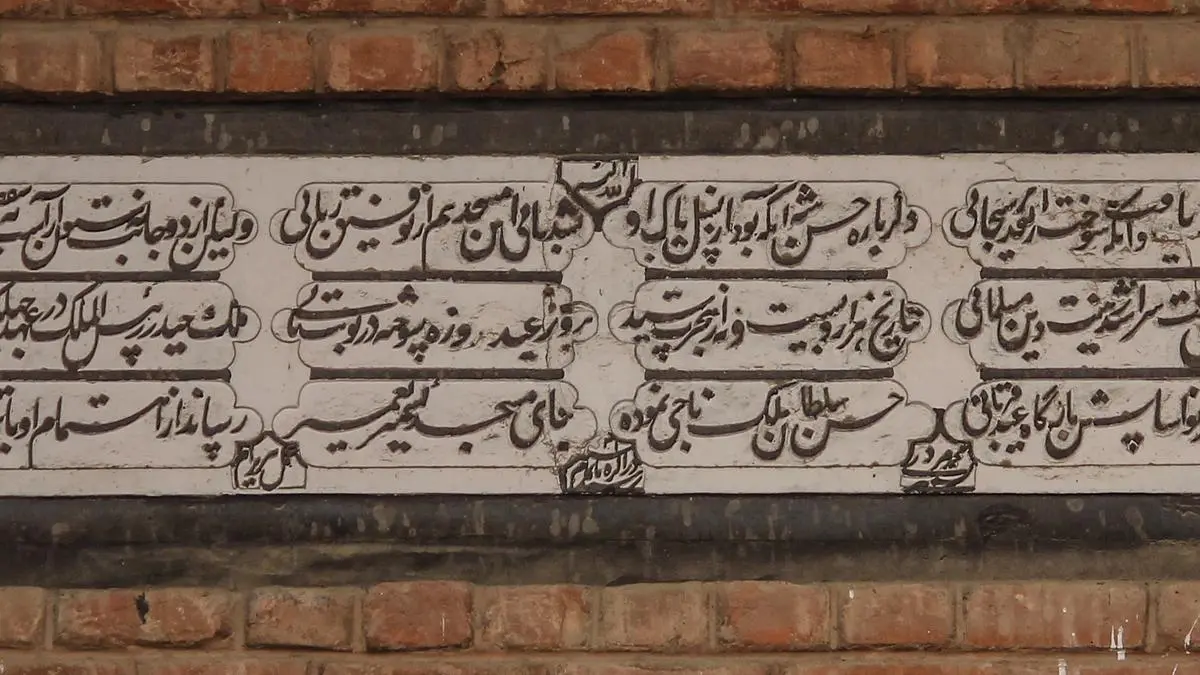
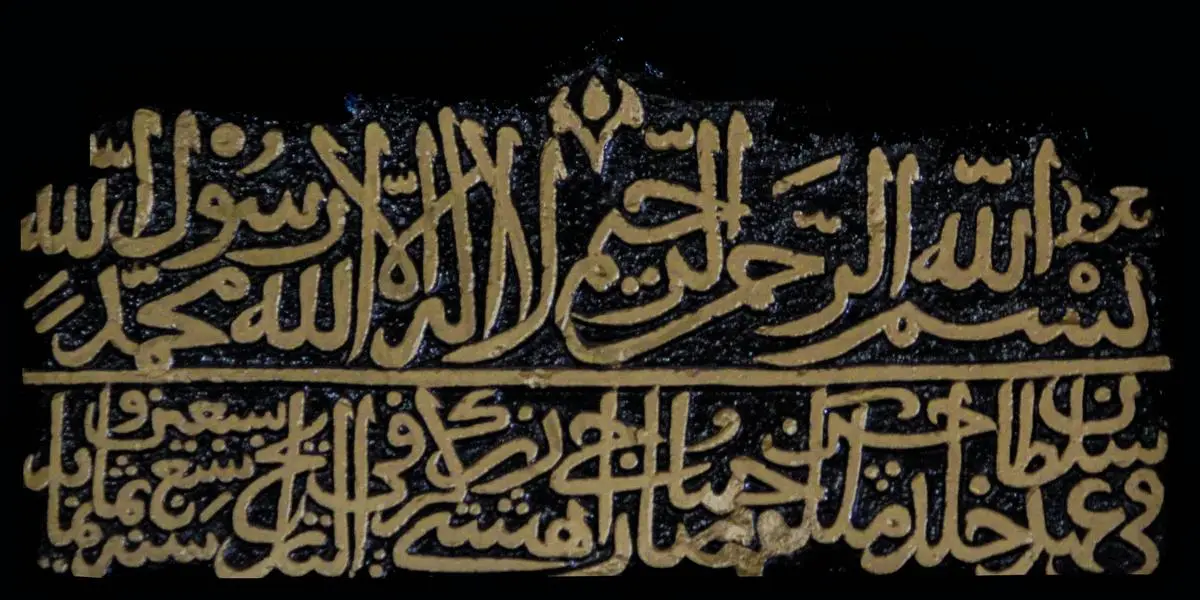
The 17th century limestone slab in the walls of Jamia Masjid in Srinagar. At the bottom, a small engraving reads, “the work of Hari Ram”. | Photo Credit: Tabish Haider, Barakat Trust
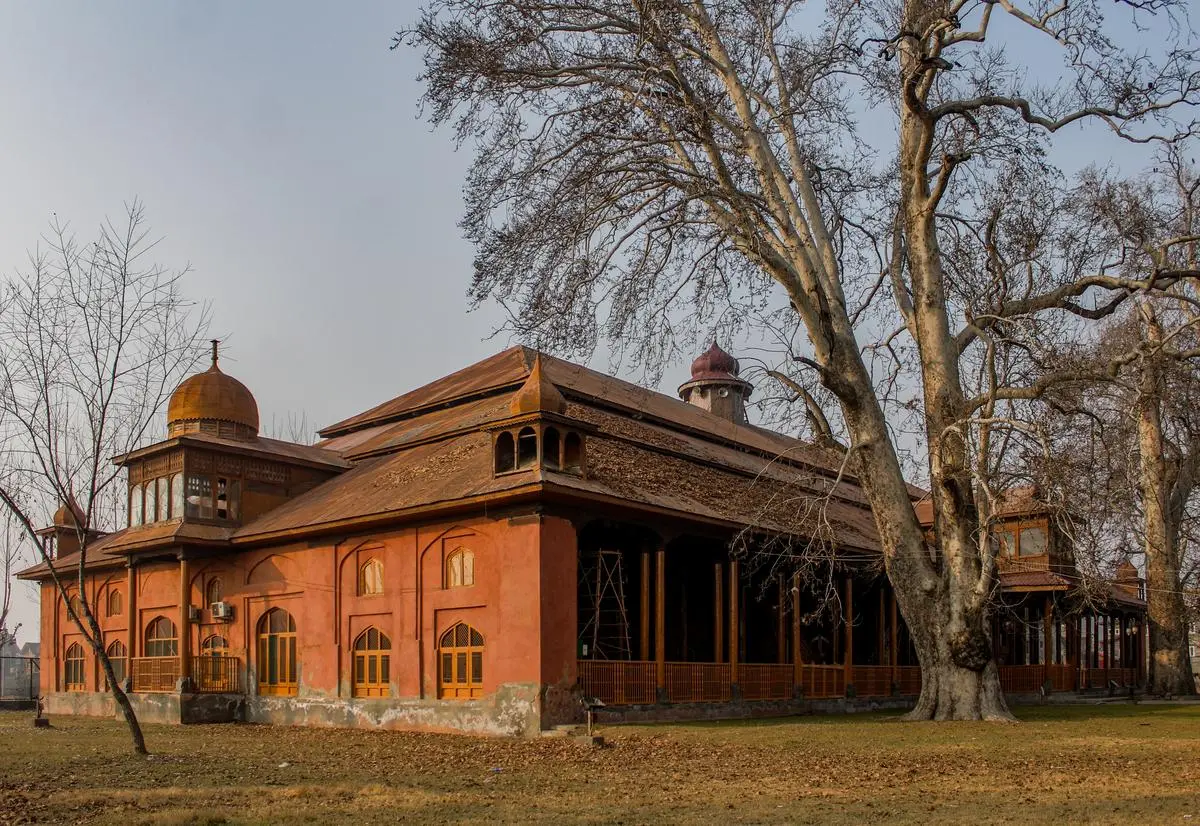
Strolling inside the quadrangle of Kashmir’s 600-year-old Jamia Masjid, worshippers stop to take pictures of the mosque’s large steeple, its outlines sharpened against the backdrop of Hari Parbat, the famous fort-hill of Srinagar. What they usually overlook is a limestone plaque with Persian inscriptions embedded in the wall just above the mosque’s entrance.
In January 2024, when the Srinagar-based art historian Hakim Sameer Hamdani (he is currently the Design Director of the Jammu and Kashmir chapter of the Indian National Trust for Art and Cultural Heritage) examined the slab, he found that it mentioned names of medieval-era sultans and their governors involved in the repeated repair and rebuilding of the mosque since its original construction in 1402. At the bottom, he noticed the name of the engraver: Hari Ram. Hamdani told Frontline: “Based on our investigation, it appears that Hari Ram, who inscribed the text on the limestone plaque, was a master carver in the Mughal atelier. There is no information about Hari Ram in any Mughal source. But from this slab we know now that he was Hindu and part of the overall Mughal patronage system.”
The Jamia mosque was constructed during the reign of Sultan Sikandar Shah Miri in 1402, a few decades after the Turkic-origin Shahmirid dynasty took over the reins of the kingdom from the royal house of the Loharas, who were Hindus. In Kashmir’s narrative tradition, the mosque is invested with great symbolism: Jamia Masjid embodies not just the crowning of Islam as the State religion of Kashmir after eight centuries of Hindu rule, but also the start of the spread of a culture heavily influenced by Persia.
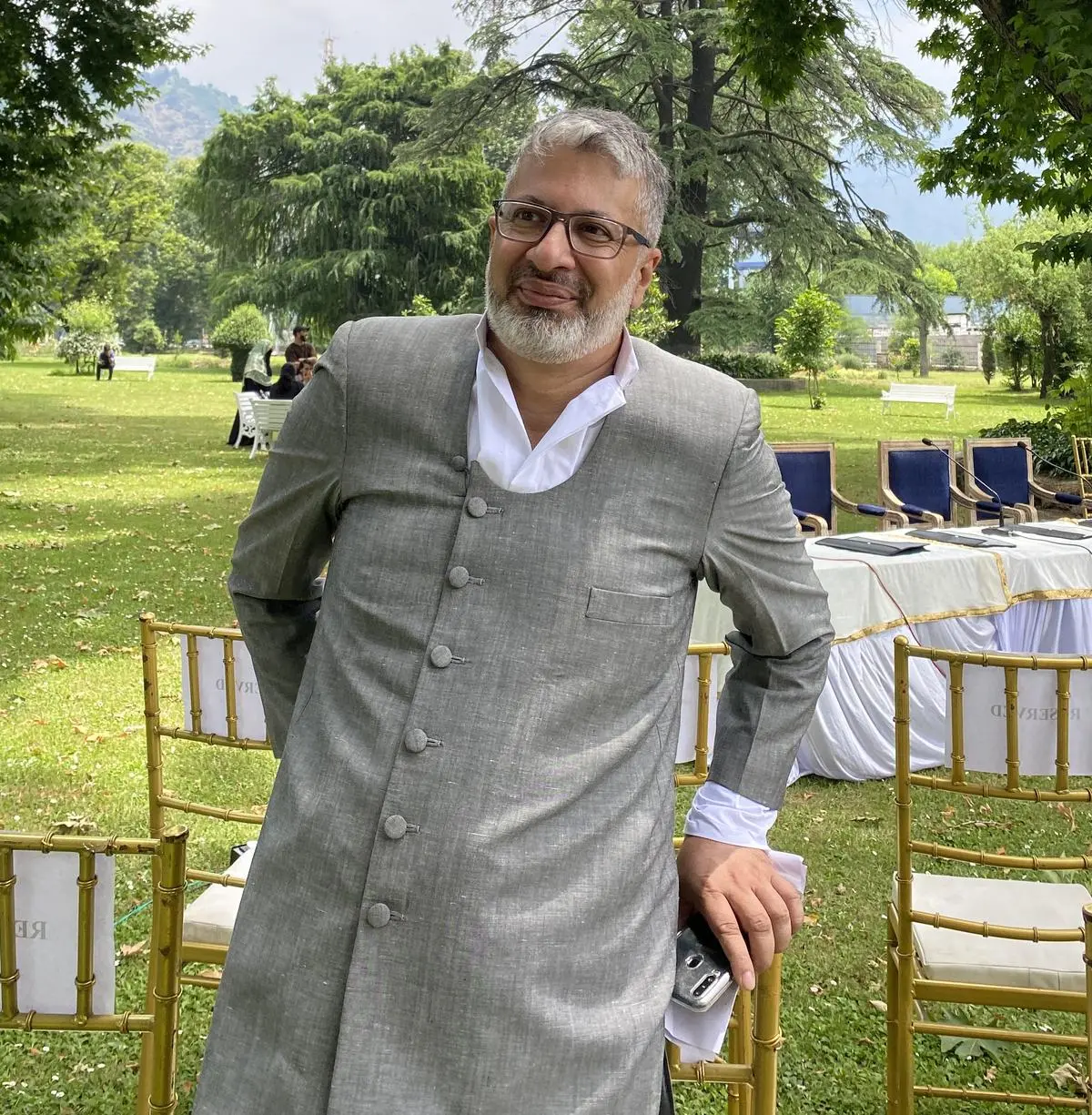
Hakim Sameer Hamdani, Srinagar-based architect and art historian who led the documentation project. Hamdani is Design Director with INTACH, Jammu & Kashmir. | Photo Credit: By Special Arrangement
The medieval era in Kashmir, particularly the 14th and 15th centuries, when it gradually transitioned to Islam, has been sought to be presented in contemporary political and cinematic discourse as a period of widespread persecution of Hindus. The movie The Kashmir Files (2022), for example, has a scene where the protagonist describes the Kashmir of yore as a thriving seat of Hindu learning until it was despoiled by Islamic rulers in the 14th century. However, historic epigraphs such as the one in Jamia Masjid and elsewhere in Srinagar point to a culture that was more syncretic than confrontational.
With such discoveries, Hamdani’s project intends to counter the politically motivated narratives around Kashmir’s history. He embarked on the project earlier in 2024, roping in a team of heritage architects and graphic designers from Srinagar. The team consisted of Umar Farooq (Assistant Professor, Department of Architecture, Islamic University of Science and Technology, or IUST, Jammu and Kashmir), who surveyed the inscriptions; Tabish Haider (cultural activist and Young India Fellow, 2022, at Ashoka University), who took life-size images of the plaques; Mehran Qureshi (Assistant Professor, Department of Architecture, IUST), who investigated the epigraphs and translated them into English; and Taha Mughal (a specialist in preservation), who rendered them into measured drawings. The team has examined several epigraphs, dating from the 15th to the 19th centuries, engraved in various heritage sites across the Valley. While the majority of them are in Persian, there are texts in Arabic and Sharda (an ancient script of Kashmir) as well.
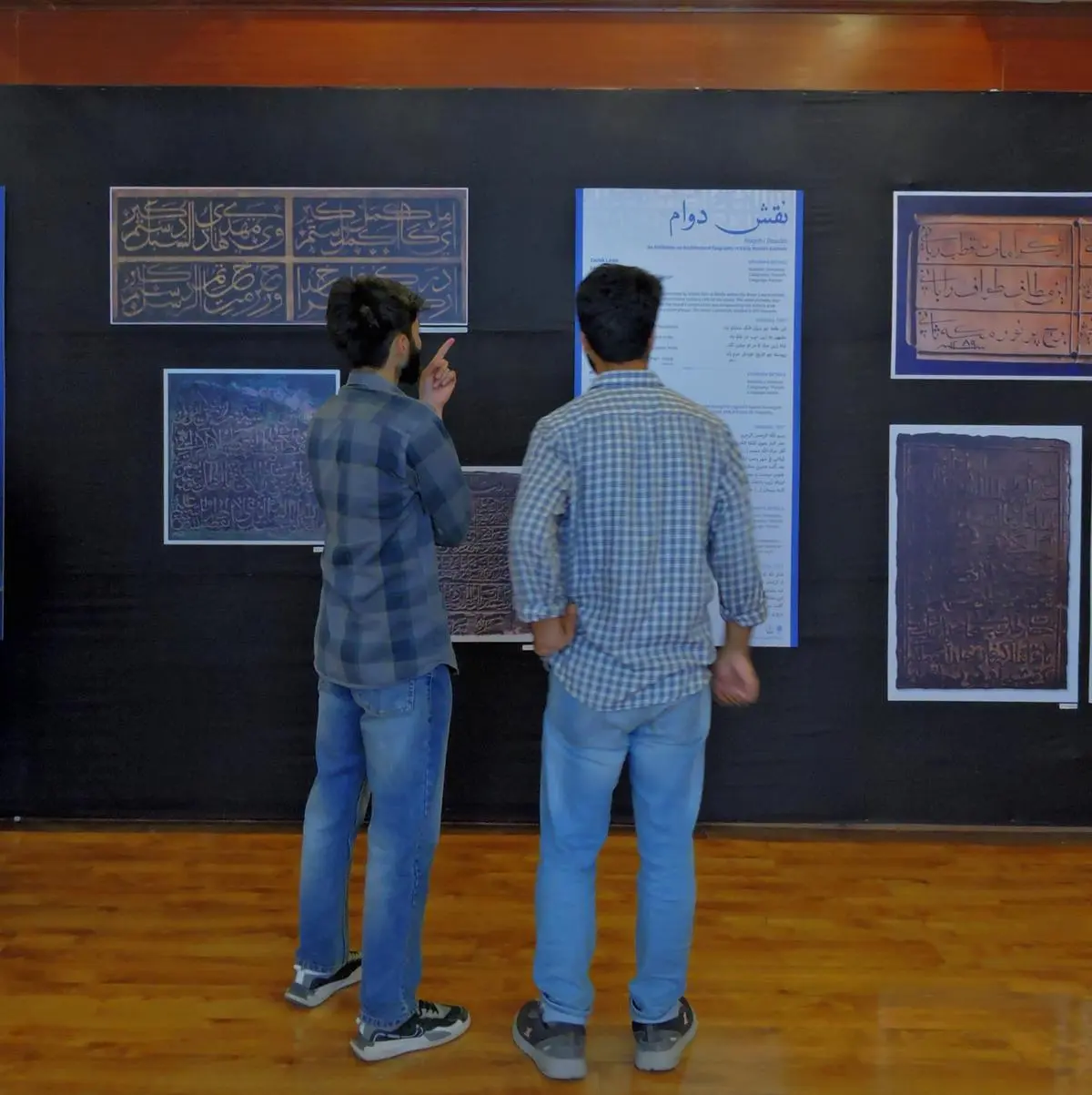
Many of these inscriptions have been rendered almost undecipherable by the passage of time—the main reason why they had escaped the attention of historians so far. Hamdani and his team used technology and linguistic expertise to decipher their content and to bring the information to the public domain for the first time. Of the over 100 slabs that the team has investigated across Kashmir, the details of 40 were catalogued and put on display in an exhibition, “Naqsh-i-Dawaam”, held in Srinagar in June 2024. Hamdani is currently writing a coffee-table book that will make the findings accessible to readers across India and the world. Qureshi is further expanding the scope of the investigation by surveying similar inscriptions found in medieval-era tombstones in Kashmir. Qureshi’s work is sponsored by the Netherlands-based Prince Claus Fund while the grant for Hamdani’s project came from London’s Barakat Trust, which researches the art, architecture, and history of the Islamic world.
_______________
Highlights
A documentation project undertaken by Srinagar-based architect and art historian, Hakim Sameer Hamdani, has added layers to Kashmir’s history, challenging its unipolar representation in popular narratives.
———— Of the over 100 slabs that Hamdani’s team has investigated across Kashmir, the details of 40 were catalogued and put on display in an exhibition, “Naqsh-i-Dawaam”, held in Srinagar in June 2024.
———— Hamdani is currently writing a coffee-table book that will make the findings accessible to readers across India and the world.
________________________________
“The idea was to add a layer of nuance to Kashmir’s history,” Hamdani said while talking about his project. “We tried to flesh out what we already knew about the transmission of knowledge and culture from the Central Asian regions into Kashmir at the onset of the Sultanate period in the 14th century.”
Adding layers
The investigation has added layers to the understanding of Kashmir’s history. Take the Jamia Masjid slab, for instance. It dates back to 1622, when Jahangir was the emperor of Hindustan. In 1589, Jahangir’s father, Akbar, had forced Kashmir to surrender its sovereignty to the larger Mughal Empire. This created resentment, sparking off rebellion and political unrest that continued for years until a semblance of stability was achieved during Jahangir’s rule. To mark the end of hostilities, Jahangir commissioned a renovation of the mosque and installed the slab, which attempts to naturalise him as the legitimate ruler of Kashmir.
The 15th century Aali Masjid, Srinagar’s second largest mosque. It combines Mughal, Kashmiri and Safavid architectural styles. | Photo Credit: Tabish Haider, Barakat Trust
Hamdani said: “The text seeks to connect Jahangir to a historical project, showing him as continuing the work of the sultans of Kashmir, who reigned before the Mughal annexation.” The association of a Hindu craftsman with a major imperial programme tells us something about the prevailing milieu, where royal patronage could be sought and obtained regardless of the craftperson’s religious affiliation.
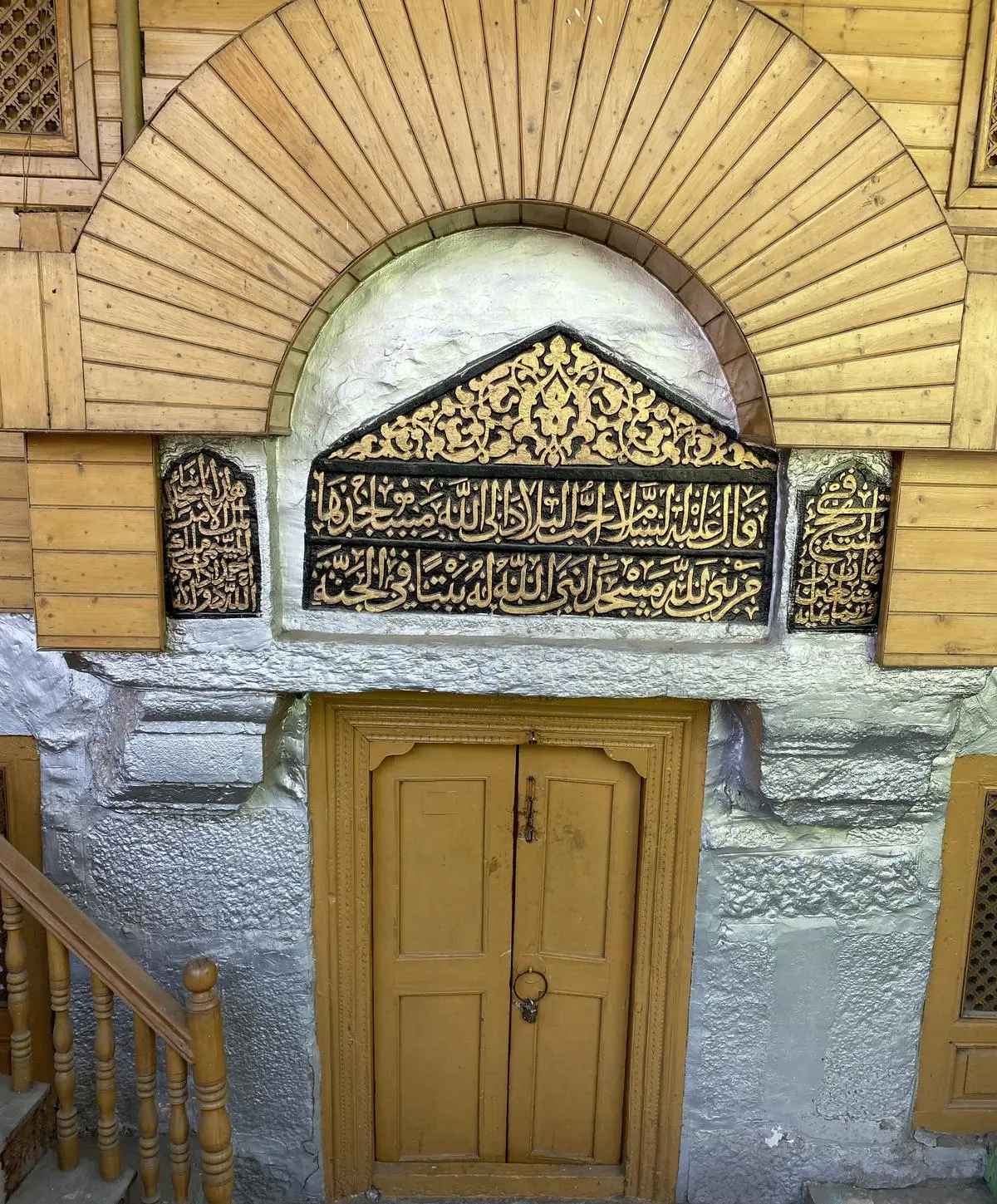
The idea of exploring epigraphs to unravel history came to Hamdani when he was working on his thesis on Islamic architecture at the School of Planning and Architecture, New Delhi, six years ago. As part of his study, he examined extant Islamic epigraphs in the monuments and buildings of Kashmir. Among the ones he analysed was an Arabic hadith (essays on the words and actions of the Prophet Muhammad) etched on the 15th century hospice of a Sufi mystic, Malik Ahmad Itoo, located at Safa Kadal in Srinagar city. It is a small hermitage on the banks of the Jhelum river. The verses, engraved on the shrine’s tympanum, remind the faithful of the spiritual rewards that would accrue to the builder of a mosque.
The Persian slab inside Aali Masjid which identifies the architect of the mosque as Raja Bihisti Zargar. | Photo Credit: Tabish Haider, Barakat Trust
Hamdani said: “Such inscriptions, commonly seen in Kashmiri shrines, are different from medieval Islamic epigraphy found in Delhi.” Speaking of the latter, the scholar Anthony Welch said that their “principal function in late-twelfth-century India was to warn the non-Muslim majority to accept Islam” (in his 2008 essay, “The Emperor’s Grief: Two Mughal Tombs”). The epigraphs associated with early Islam in Kashmir, by comparison, are devoid of such hegemonic overtones. “Their stress is rather on cultivating personal piety,” Hamdani said.
His project has thrown up unexpected stories that often go against the recorded textual histories of Kashmir. Consider the case of Aali Masjid, Srinagar’s second largest mosque. The 15th century mosque embodies a fusion of Iranian, Mughal, and Kashmiri architectural styles. Added during a renovation in the 17th century, the balusters of its portico rest on distinct stone bases reminiscent of those of Safavid pavilions in Iran; the technique was brought to Kashmir by the Mughals. Although the 1887 Persian text Tarikh-e-Hasan—thought to be an authoritative commentary on Kashmir’s medieval history—attributes its construction to Ali Shah, the eighth sultan of the Shahmirid dynasty, the stone slab restored by Hamdani names a different patron: Sultan Hasan Shah, who reigned 50 years later. The epigraph identifies Raja Bihisti Zargar as the architect of the mosque.
Startlingly, the same name was once engraved on a stone pillar inside Srinagar’s Shankaracharya temple. Today, no trace of this inscription remains in the temple, but it is important to remember its existence in view of recent attempts to polarise sentiments by creating a controversy over the name of the Shankaracharya hill, also called Takht-e-Suleiman.
The Shankaracharya temple is one of the oldest temples in Kashmir, mentioned by Kalhana, author of the 12th century Sanskrit text Rajatarangini (River of Kings), which gives a history of Kashmir. The Rajatarangini remained a text in progress for a long time, with Brahmin court historians adding bits to it at different periods. After Kalhana, Jonaraja took it up in the 15th century, followed by Srivara and Shuka in the 16th century.
The hadith inscription on the shrine of Sufi mystic, Malik Ahmad Itoo, in Srinagar. It is one of the earliest surviving Islamic epigraphies in Kashmir. | Photo Credit: Shakir Mir
Hamdani’s team was able to access a preserved facsimile of the temple epigraph in a book titled Illustrations of Ancient Buildings in Kashmir (1869), based on a survey conducted under the Archaeological Survey of India by Henry Hardy Cole. In the survey, Cole suggested that the inscriptions (there were more than one) were linked to repair work done in the temple in the 16th century. But he could not identify the ruler under whose leadership the work was carried out.
Cole was not the only one whose interest was piqued by the presence of Persian inscriptions inside a Hindu temple. The British explorer Alexander Cunningham (1814-93) also mentioned them in his “Essay on the Arian Order of Architecture in Temples of Kashmir” (1848), which says that he had copied out an inscription (a different one at the same site): “but since then it has been so completely defaced by the Dogar [Dogra] soldiery that I could with difficulty trace the name of Takht-i-Suliman”.
Later, in 1875, a group of European travellers made another attempt to decode the writings, scrawling a rudimentary translation in their diary. “This idol… was made by Haji Hashti… in the year 54 of the Samut (Samvat) or Hindoo era,” they wrote, adding that “the foot of the back part of the pillar states that he who raised up this idol was Quajah Rukm, son of Mirjan.”
The case seems to be have been buried in 1935 after it received a clumsy dismissal from an antiquarian, Pandit Anand Koul, who concluded: “Islam was unknown in that remote period when this temple was built, so there could not have been a Khwaja or a Mir then…. Nor would a Muhammadan build a temple as his own” (Archaeological Remains in Kashmir, 1935).
The restored epigraphs were put on display at an exhibition in Srinagar in June 2024. | Photo Credit: Tabish Haider, Barakat Trust
But when Hamdani’s team examined the Aali Masjid slab, a different story emerged: the Muslim architect (Raja Bihisti Zargar) responsible for designing the mosque was the same one who oversaw the repair of the Shankaracharya temple in the 16th century. This suggests that even in the late Sultanate era, often depicted as a period of widespread destruction of Hindu places of worship, Muslim rulers continued to extend their patronage to Hindu cultural spaces. Understandably, the Dogra militia had tampered with this evidence in the 19th century.
Folds of history
Another epigraph documented by Hamdani was written in Sharada on the limestone wall of a 15th century almshouse at Khonmoh in Srinagar, built by a Hindu merchant, Purnaka. The text seems to heap praises on one of the Shahmirid kings by describing him as the son of the “illustrious Sakandra” (Sultan Sikandar). The effusive language used for Sikandar by a Hindu merchant is especially significant because the sultan was depicted as an iconoclast by the contemporary Brahmin chronicler Jonaraja in Rajatarangini. Jonaraja’s characterisation of Sikandar was perpetuated by colonial historiographers. In his 1848 booklet, Cunningham invoked the “destroying hand of Mahomedan [sic] bigotry” to explain the ruin into which Kashmir’s ancient temples had fallen.
But the Khonmoh inscription reveals that there existed a multiplicity of narratives around Sikandar in the 15th century and not all of them told the same story. “We are not denying that persecutions have happened in the past,” Hamdani said. “Our project drives home the point that history never uncoils in a linear way. History has many folds, each one with layers and textures of its own.”
Shakir Mir is a freelance journalist based in Srinagar. He was previously a correspondent with The Times of India.
source: http://www.frontline.thehindu.com / Frontline / Home> Arts & Culture> Heritage> History / by Shakir Mir ./ September 13th, 2024
A short excursion through the towns of Bijapur, Gulbarga, Bidar and Yadgir in north-eastern Karnataka can turn into a marathon heritage walk with serendipitous sightings of monuments from the medieval era.
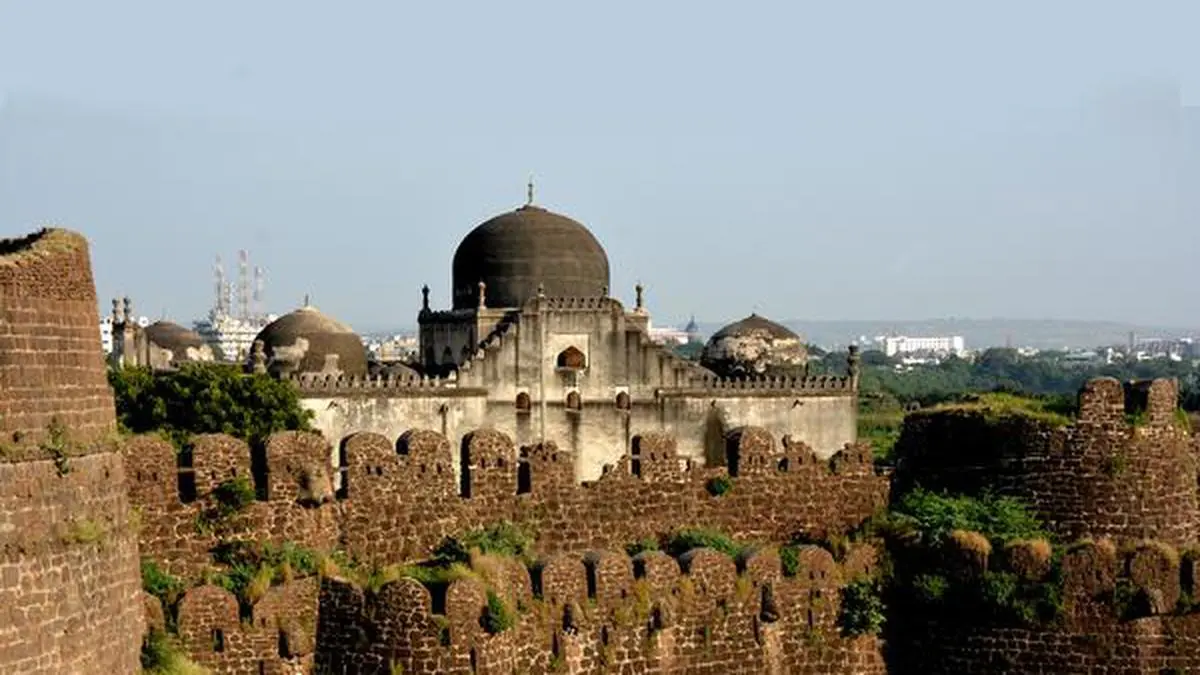
The Gulbarga fort and the Jama Masjid inside it.
SARMAST is said to have been the first Sufi to have come to the Deccan. He settled down in what is now the outskirts of Sagar village in Yadgir district of Karnataka. His grave is now venerated as a dargah. Rocky hillocks with generous splashes of greenery run along the road leading to Sagar from Gulbarga, a distance of 90 kilometres, belying the strong notion that all of the Hyderabad-Karnataka region is dry and dusty.
Tajuddin Dervish, the keeper of the holy grave, sat outside the arched entrance smoking a beedi. As we entered the dargah, we struck up a conversation with him about Sarmast. He recalled the legend, which must have got corroded by retellings over generation. In this tale, the necromancer Karmatgaar, who was up to mischief all the time, flew across the skies and disturbed the Sufi’s meditation. Enraged, Sarmast flung him across the Deccan plateau. In this fantastic tale, the goddess Yellamma (who is worshipped in the northern parts of Karnataka) also makes an appearance; her role is one of heroism. A temple supposedly dating back to the time of the incident is dedicated to her at Sagar.
If we link these hagiographical stories to actual events as the historian Richard M. Eaton has done in Sufis of Bijapur, 1300-1700: Social Roles of Sufis in Medieval India , it is certain that Sarmast was part of the raiding parties from the north sent by Alauddin Khalji (r. 1296-1316), who made forays into the Deccan and further south. The Deccan later became a part of the expanding Delhi Sultanate under the rule of the Tughlaqs. A bloody battle is supposed to have taken place at the site of Sarmast’s dargah, and many warriors were buried where they fell. The large circular area around the open grave of the saint is a medieval graveyard.
Unnamed tombs, locally called gumbad s, in various states of decrepitude and portions of walls with vestiges of fine carvings lie scattered around the area. Tomb raiders, probably lured by stories of treasures, have broken the graves inside these sepulchres. In the town of Sagar, there is a single-arched gateway so broad that an elephant can pass through it. A magnificent and well-maintained tomb on an imposing platform lies on the path a little ahead, next to a baoli (stepwell). None of these historical structures come under the purview of national or State-level archaeological conservation authorities.
The Bahmani sultanate
A few decades after the rulers from the north made forays into the Deccan, another Sufi saint, Sheikh Sirajuddin Junaydi (d. 1380), gained prominence. He blessed Alauddin Bahman Shah (r. 1347-1358), who broke away from the Tughlaq empire to establish the first independent Bahmani Sultanate in 1347, thereby inaugurating the rule of Muslim kings in the Deccan. While Junaydi’s tomb, marked by two imposing minarets, has flourished and is venerated to this day in Gulbarga, the tomb of Alauddin Bahman Shah is empty and the small compound in which it is situated is surrounded by illegal constructions.
Basavanappa, employed by the State Archaeological Department, guards the four Bahmani-era monuments. He said: “This is the man whose descendants built so many grand monuments. Guarding these gives us our daily bread and I have the responsibility of safeguarding his tomb.”
Alauddin Bahman Shah’s rule was brief. The moving of the capital from Daulatabad to Gulbarga, after severing links with the Delhi Sultanate, marked his reign. He also set up a dynasty that lasted two centuries (between 1347 and 1527) which, along with its legatee kingdoms, matched the Delhi Sultanate and later the Mughals in the splendour of their courts. At the centre of Gulbarga is the fort from where the Bahmanis ruled their vast empire which at its peak extended from Gujarat to Goa, all the way across modern-day Maharashtra, Karnataka, Telangana and Andhra Pradesh. While the Bahmanis constantly went to war with the Vijayanagara Empire, they also had deep cultural encounters with their neighbours.
The Bahmani kings ruled over a multi-ethnic and linguistically diverse empire whose citizens included indigenous residents, who spoke Marathi, Kannada and Telugu and other local languages, and migrants from north India. There was a regular stream of immigrants coming from Iran and Turkey to the royal cities via the sea route. African slaves, who rose up in the ranks, also played important roles in the matters of the Bahmani court.
The Bahmani Empire shifted its capital to Bidar in the 15th century, but an implosion was imminent because of differences between its ruling nobles. The waning empire gave birth to five independent sultanates that shone brilliantly in their maverick existences. They subsumed their differences and combined forces to defeat the Vijayanagara king at the Battle of Talikota (1565), but the sultanates were annexed by the Mughal Empire during the reign of Aurangzeb (r. 1658-1707), whose campaigns in the Deccan were to keep him occupied for half of his regnal period.
The Bahmani Sultanate and its splinter kingdoms have had a long impact on the culture and society of the Deccan. Magnificent architectural specimens of their reign can be seen in the entire region. Tombs, mosques, idgah s (prayer grounds), palaces and forts stud the entire area. These structures have a distinct style, which the architectural historian Helen Philon calls a “unique Deccan architectural vocabulary” in her book Gulbarga, Bidar, Bijapur . She says that this style is augmented by “building forms and decorative motifs introduced from Arabia and Persia, as well as from Turkey and Central Asia”.
A short excursion through Bijapur, Gulbarga and Bidar can turn into a heritage walk, marked by serendipitous sightings of monuments. While some of these edifices, such as the Gol Gumbaz, are fairly well known, there are others such as the royal necropolis of Ferozabad, around 30 kilometres from Gulbarga, which are known only to heritage enthusiasts.
One the most significant public works of the Bahmani kings was the karez system, in which water was supplied through tunnels from stepwells and other underground sources. Such tunnels supplied water to civilian settlements and the garrison inside the Bidar fort. The karez system is now being revived by Team Yuva, a Bidar-based non-governmental organisation led by Vinay Malge.
The Muslim kings also gave importance to landscape gardening and decorations. Local material such as basalt, granite and laterite have been used for buildings; lush gardens dominate the landscape around larger monuments. Vestiges of decorative motifs, murals and tile work can be seen in the monuments in Bidar.
A grand Jama Masjid is at the centre of the Gulbarga fort. It is a simple but imposing structure made even more stately because of the vacant space around it. There is a watchtower inside the fort on which a 29-foot cannon, said to be the longest in the world, is mounted.
Visitors are told that the Jama Masjid was the original congregational mosque of the Bahmani capital; actually, a large rectangular mosque in the crowded Shah Bazaar area of the city was the original Jama Masjid of Gulbarga. Prayers are held every Friday at this mosque, which is now known as the Shah Bazaar mosque. Visitors are allowed to go to the terrace, which is crowned with cupolas. This architectural style of domes on the terrace, mirroring the arches on the ceiling, can be found in prominent mosques from this era in the Deccan. Another historical site in Gulbarga that is worth seeing is the funerary complex, called the Haft Gumbad, of the Bahmani kings. Five rulers of the Bahmani dynasty until Feroz Shah Bahmani (r. 1397-1422) are buried at this site. The tombs, constructed over a period of a few decades, help one see the evolution of the architectural style. The early tombs have slightly sloping walls and are less distinguished, while the later tombs such as that of Feroz Shah, are larger, have a cleaner finish and are embellished with fine carvings.
Feroz Shah’s tomb reflects the king’s aesthetic sense as he was said to be a man of refined taste, was interested in local culture, and was also a polyglot who married the daughter of a Vijayanagara king. He built the city of Ferozabad. If one is visiting Ferozabad for the first time, one will get the feeling of discovering new things. The necropolis, which was inhabited briefly, can now be accessed only after passing through a village off the main road. The main entrance, which is through an arched gateway, is visible, although blocked. One must enter through an agricultural field. Ferozabad reveals itself little by little. It is a complete city with a fort, a palace, a mosque and royal residences, all of which are in ruins now. The apathy towards the upkeep of the architectural splendour of the region is evident from the poor maintenance of Ferozabad. Stone walls that formed part of the ramparts of the fort stand precariously on the ground. A tur dal field is being ploughed inside the premises of what was once the main mosque. The Bhima river glints some distance away. The city was abandoned towards the end of the 15th century after a deluge caused by the overflowing Bhima.
Shifting the capital to Bidar
A strange aspect of Feroz Shah’s tomb is that it has twin domes and separate chambers although only one of these was used for burial with the other lying vacant. Local legend has it that the second chamber was the designated burial space of Feroz Shah’s brother, Ahmed Shah (r. 1422-1436), who was not buried there. During the reign of Ahmed Shah, in 1432, the Bahmani capital shifted to Bidar, and Khwaja Hazrat Bandenawaz (d. 1422), the most well-known Sufi of the Deccan, is supposed to have been one of the causes for this. The Bahmani kings had close ties with Sufi saints, and Ahmed Shah continued the tradition but he was also considered a saint; the only king to be treated as such by his followers. His tomb in the funerary complex of Ashtur, just outside Bidar, is venerated by Muslims, who consider him to be a wali (friend of God), as well as by Hindus, who consider him to be an avatar of Allama Prabhu, a Vachana poet who lived before Basava. Ahmed Shah’s tomb has well-preserved murals and verses from the Quran. The resident caretaker at the tomb used a mirror to ingeniously cast splotches of reflected sunlight on the interior of the dome, which gave us an idea of the bright hues that are still intact.
The funerary complex of Ashtur is far more majestic than the Haft Gumbad. The tombs are bigger and more imposing and the well-maintained lawns add to the beauty of the location. Since the tombs must have been built at different times over a period spanning a century, each tomb has a different architectural style. One tomb that stands out is that of Humayun Shah (r. 1458-61). Lightning has damaged its dome, leaving only a portion of it intact. Visitors are told an apocryphal story of divine justice. Humayun Shah was such a cruel ruler that the word zaalim (tyrant) was affixed to his name. When this tyrant died, God in his infinite wisdom struck his tomb so that he would be exposed to sun and rain for eternity. As the influence of the dynasty waned and independent sultanates began to emerge, the tombs of its rulers also lost their magnificence. The tombs of the last two rulers remain poor cousins of the larger tombs at Ashtur, both in size and form.
From Ashtur, one can see the ramparts of the fort of Bidar, along the short drive to Bidar. This grand Bahmani era fort is surrounded by three moats and impressive bastions. The monuments of Bidar are in much better shape than those in Gulbarga. In the precincts of the fort, which has a massive gateway, are palaces and a mosque, an austere building with 16 arches crowned with a dome. Pathways run through gardens in the royal enclosure. Some of the best examples of exquisite woodwork (a hallmark of Hindu architecture) and mother-of-pearl inlays can be seen in Rangin Mahal, the palace inside the fort. Mahmud Gawan, a powerful prime minister in the Bahmani court, built a madrasa (theological school) bearing his name in 1472. The madrasa is located some distance away from the fort. There are remnants of turquoise tile work of Central Asian design on the tall minaret.
Adil Shahi dynasty
As the Bahmani Sultanate began to fall, it split into separate sultanates, the strongest of which was the Adil Shahi dynasty of Bijapur under Yusuf Adil Khan (r. 1490-1510).
“The period between accessions of Sultan Ali I (1558) to the death of Sultan Muhammad (1656) can be called the Golden Age of the Adil Shahis, as the kingdom flourished in all walks of life,” writes Abdul Gani Imaratwale, a historian based in Bijapur, in his book Studies in Medieval Bijapur . This is reflected by the grandeur of the monuments during this period.
Mohammed Adil Shah’s tomb, the Gol Gumbaz, is often featured on tourism brochures of the Karnataka Tourism Department. It would not be wrong to say that it is the grandest edifice in the modern State of Karnataka. The Gol Gumbaz is visible from many places in Bijapur and is overwhelming at close quarters because of its sheer size. Inside the large tomb, the cenotaph of Mohammed Adil Shah and his close family members can be seen, but these are replicas, with the original graves lying in an underground crypt. At the four corners of the room, steep and winding stairs that test the climber’s stamina lead up to the gallery. The vastness of this free-standing dome accentuates the acoustics within it. Schoolchildren can be seen clapping and yelling to hear the echo. Each burst of sound echoes several times making it difficult to stay there long enough to appreciate the engineering marvel.
The Ibrahim Rauza complex consisting of the tomb of Ibrahim II and a mosque is a delicately built structure and looks as if it has been laid out in front of visitors as they approach it from the garden. Bijapur has many other gems, such as the main congregational mosque, the Jama Masjid, which is an incomplete structure but is remarkable for its large and decorated mihrab (the prayer niche). The largest cannon in the world, the Malik-e-Maidan (lord of the field), which was truly a weapon of mass destruction in the medieval age, can also be found in Bijapur. A palace associated with the early Adil Shahis, the Chini Mahal, is now converted into a government office, and the throne room is now the treasury officer’s cabin.
The towns situated near Bijapur also have historical monuments. There is a 17th century mosque in Afzalpur built by Afzal Khan, a general who was killed by Chhatrapati Shivaji. This smart structure, ignored by archaeological authorities, is being maintained through the personal initiative of Maqsood Afzal, a descendant of the general.
This overview hardly does justice to the extensive architectural heritage in this part of Karnataka. These spectacular monuments do not figure in the itinerary of most tourists.
A wonderful monument like Ibrahim Rauza has only around 500 visitors in a day. In fact, some of the conservation authorities are not even aware of the necropolis of Ferozabad or the Afzal Khan mosque. Infrastructure essential for the growth of tourism is poor in the Hyderabad-Karnataka region. Information on the architectural sites in the region is limited. Efforts to get this heritage corridor recognised as a United Nations Educational, Scientific and Cultural Organisation (UNESCO) World Heritage Site have failed. Ayazuddin Patel, a Lalit Kala Akademi awardee based in Gulbarga, who has photographed the architecture of the region, laments: “We have been completely ignored and forgotten.” The Hyderabad-Karnataka region has been ignored by successive governments since Independence.
The Bahmani kingdom has receded into history although its rulers governed the Deccan for several centuries. This is partly due to the peripheral status of the Deccan and southern India in history writing in India. The long reign of the Bahmani Sultanate and its descendant sultanates has left behind another kind of legacy: a syncretic culture that is visible in harmonious communal relations, the participation of all communities at the shrines of various Sufi saints, and even during events that mark Muharram. The lingua franca of the region, Dakhni Urdu, is also a legacy of the Bahmanis. Many of these medieval rulers openly embraced non-Muslim practices and patronised local cultures, but a communal reading of history pits these kingdoms against the “Hindu” empire of Vijayanagara in a biased understanding of history.
Historians have often disproved this and have stressed aspects of mutual interpenetration and a fusion of cultures and practices (most recently in Power, Memory, Architecture: Contested Sites on India’s Deccan Plateau, 1300-1600 by Richard M. Eaton and Phillip B. Wagoner), but the religious reading of history continues in popular discourse. In February, a small attempt was made to celebrate the legacy of this regional history, with the district administration of Gulbarga deciding to hold a Bahmani and Rashtrakuta Utsav simultaneously. (The Rashtrakuta dynasty ruled this region between the eighth and 10th centuries.)
The Bharatiya Janata Party (BJP) instantly opposed this, with its Member of Parliament from Karnataka, Shobha Karandlaje, even tweeting: “Who is Bahamani Sulthans? Who killed lakhs of hindus, who burnt thousands of villages, who raped hindu women, who destroyed temples…. now congress celebrating thier festival… more dangerous” (sic). Considering that this was just a few months before elections to the Karnataka Assembly were to take place, the ruling Congress government quietly withdrew permission for the event. Needless to say, the inaugural edition of the Rashtrakuta Utsav was held in all its splendour. The BJP’s move of selectively opposing events on communal lines is part of its agenda. The partisan reading of history, where the history of Muslim rulers is ignored, will affect inter-religious relations.
Surreal experience
While Sarmast was the first Sufi of the Deccan, Bandenawaz, who was not averse to taking part occasionally in courtly intrigues, was the most well known. At his 15th century tomb in Gulbarga, the interiors of which have been garishly redecorated without any consideration to its architectural significance, Hindus and Muslims arrive in droves and bow in reverence before his grave.
Behind the tomb are a number of unmarked graves. A supplicant, his eyes closed, was ardently praying, with his head bent towards the direction of Bandenawaz’s tomb. Some things must not have changed at this place since the death of Bandenawaz in 1422. Walking through these lands where Sufis lived and kings ruled, where the detritus of empty tombs and unknown crypts can be found all over, one finds myth and fable combining with fact to create a surreal experience.
(In 2014, the names of Gulbarga and Bijapur were officially changed to Kalaburagi and Vijayapura respectively by the government of Karnataka. Yadgir, which was part of Gulbarga district, attained separate district status in 2009.)
source: http://www.frontline.thehindu.com / Frontline / Home> Arts & Culture> Heritage> Architecture / by Vikhar Ahmed Sayeed / Photographs Mohammed Ayazuddin Patel / October 20th, 2018