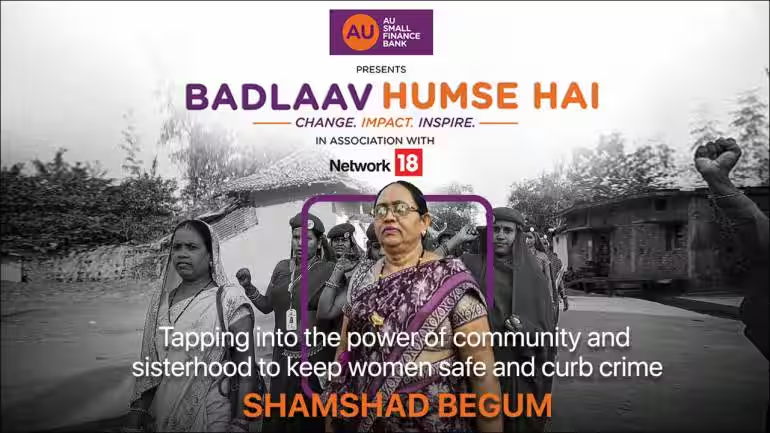
Discover the transformative story of women in maroon berets rewriting their community’s narrative.
In the heart of Chhattisgarh, where challenges of illiteracy, alcoholism, and crimes against women cast long shadows over communities, a remarkable force has emerged to rewrite the narrative. In the villages of Gunderdehi region, groups of women wearing maroon berets stand as a testament to resilience, empowerment, and the unwavering spirit of change. This is the brigade of Mahila Commandos, a force initiated in 2006 by the indomitable Shamshad Begum, an activist and Padma Shri recipient.
The journey began with a stark reality: women voicing the anguish of living in households marred by alcohol abuse, domestic violence, and the perils of substance abuse engulfing their children. The Mahila Commandos emerged as a response to this cry for change. Shamshad Begum, the founder and guiding force behind this brigade, transformed the pain of these women into a movement that has since become synonymous with hope, empowerment, and courage.
Shamshad Begum’s vision reached beyond the constraints of societal norms, and the Mahila Commandos became the embodiment of strength and resilience. From homemakers to labourers, these women found a new identity in the title of “Mahila Commando.” Voluntarily patrolling their villages at night, they became the frontline warriors against fights, gambling, and substance abuse, tirelessly combating domestic violence, dowry, female foeticide, and gender discrimination.
What sets the Mahila Commandos apart is their commitment to creating a safer and more just society. Recognizing the importance of their mission, the Chhattisgarh Police conferred the title of Special Police Officer to 200 Mahila Commandos as a testament to their dedication and to the impact they’ve had.
Beyond their role as guardians of societal norms, the Mahila Commandos have also extended their impact to education and economic empowerment. They have reached out to help over 9,000 underprivileged girls with their education. The Mahila Commandos also engage in economic activities, producing and selling items like cow dung diyas, leaf plates and vermicompost, in addition to cultivating flowers and engaging in agricultural work.
Shamshad Begum’s transformative work goes beyond the immediate impact on families. Under her guidance the Mahila Commandos have helped form 5,000 self-help groups, empowering 75,000 women with an outstanding 98% loan recovery rate from banks. A movement that began with a hundred women has now blossomed into a movement involving 65,000 women across 14 districts of Chhattisgarh. The Mahila Commandos are not just protectors; they are catalysts for change. Shamshad Begum’s vision, courage, and determination have created a network of empowered women who refuse to be silent spectators to the challenges that plague their communities.
To honour stories like Mahila Commandos and Shamshad Begum, AU Small Finance Bank presents Badlaav Humse Hai Season 2, in association with Network18. Just like the first season, Season 2 celebrates 25 stories that showcase changemakers whose unsung work has helped carve out cultural identities for communities, lifted them out of poverty; created access where only barriers existed; shown communities how to work with nature to create true sustainability; changed hearts and minds about othered communities; changed the lives of many through economic, social or educational empowerment, and much, much more.
Shamshad Begum’s Mahila Commandos Transforming Balod’s Safety Landscape | Badlaav Humse Hai Season 2 / youtube.com / moneycontrol.com
source: http://www.moneycontrol.com / MoneyControl.com / Home> Badlaav Humse Hai
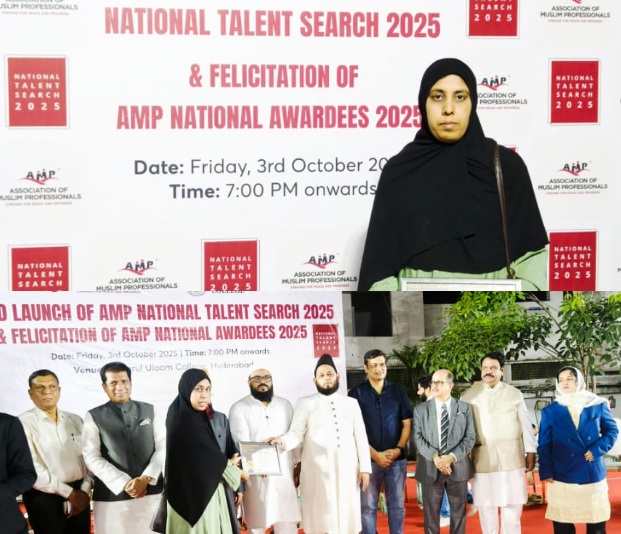
The Association of Muslim Professionals (AMP) hosted its 5th National Awards for Social Excellence (NASE) 2025 at Anwar-ul-Uloom College, Hyderabad, celebrating changemakers and institutions shaping social progress across India. The event, attended by more than 300 participants, honoured outstanding contributions in education, social welfare, and humanitarian service.
Ayat Education and Welfare Foundation from Kothagudem, Telangana, led by Dr Ayesha Sultana, won the Best NGO Award of the Year (State). In a short span, the foundation has impacted over 7,500 lives through education, women empowerment, and welfare programs. It offers academic and Qur’anic education, youth training in soft skills, and guidance for careers and personal growth. The foundation also provides medical aid, food relief, and disaster assistance. Its women’s online education program, which reached 1,500 learners in one year, was highlighted as a model of empowerment.
Maulana Khalid Saifullah Rahmani, Chairman of the All India Muslim Personal Law Board (AIMPLB), graced the ceremony as Chief Guest and felicitated awardees for their service to society. Prominent figures from academia, government, and civil society, including officials from the Telangana Waqf Board and retired IPS officers, attended the event.
AMP also recognized 10 national awardees such as Human Welfare Foundation, Jamiat Ulama-i-Hind Public Trust, and Sahayata Trust.
Lifetime Achievement Awards were presented to philanthropist Ghiasuddin Babukhan, educationist Dr P. A. Inamdar, and retired IPS officer Mohammad Wazir Ansari.
The event also marked the launch of AMP’s National Talent Search (NTS) 2025, expected to engage over two lakh students nationwide.
Ayesha Sultana is a regular contributor to radiancenews.com and former editor of AURA emagazine.
source: http://www.radiancenews.com / Radiance News / Home> Latest News> Markers of Excellence> Report / by Radiance News Bureau / October 04th, 2025
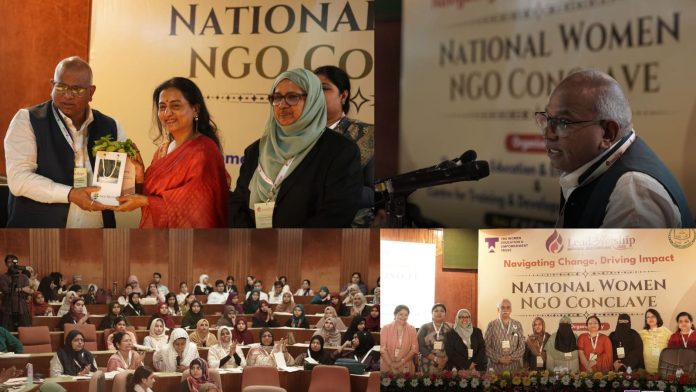
A two-day Women’s Conclave titled “Lead Her Ship” was inaugurated at Jamia Hamdard University on Wednesday with the participation of over 200 women representatives and 40 NGOs from across India. The event aims to build the capacity of women-led NGOs, enhance their leadership skills, and provide them with practical guidance on registration, funding, and community engagement.
The conclave, organised in collaboration with Tweet Foundation and the Centre for Training and Development is focused on helping women navigate challenges in running NGOs — from compliance and fundraising to partnership building and social outreach.
The event was inaugurated by Dr. M. Afshar Alam Vice-Chancellor of Jamia Hamdard, who emphasised the importance of empowering women to become effective leaders in social work. Ms. Prachi Kaur, the Chief Guest, and several experts from the development and academic sectors were also present.
Speaking at the inaugural session, Dr. Alam said, “We are organising this conclave for women-led NGOs from all over India to help them understand how to work efficiently — how to apply for funds, register their organisations, and collaborate effectively. The title ‘Lead Her Ship’ beautifully captures the spirit of women leadership — to ensure that their ship sails smoothly and contributes meaningfully to the nation and the world.”
He added that NGOs from all regions — North, South, East, West, and even the Andaman Islands are attending, making the conclave a truly national platform for women leaders.
The sessions across the two days will cover vital topics such as legal compliance, resource mobilisation, data collection, and result-oriented community engagement, Experts will also share success stories of established NGOs to inspire new entrants in the field.
Ms Rahmathunnissa, Chairperson of Tweet Foundation, outlined the core objectives of the conclave, saying, “Our goal is to collaborate, share ideas, and empower women through dialogue, sharing, and caring. The sessions will help participants understand how to legalise their work, comply with regulations, and develop leadership qualities. We also want to train them to identify and mobilise resources effectively.”
He further highlighted the need for NGOs to be financially committed and transparent, ensuring that their assistance helps beneficiaries — particularly women and girls — live with dignity and long-term self-reliance.
The conclave is designed as a forum for mutual learning and networking, where participants can exchange their experiences, discuss challenges, and explore partnerships with both government and non-government agencies. The second day will feature a directory release and special sessions chaired by Dr. Alam, along with presentations from leading NGOs and policymakers.
With its focus on leadership development, capacity building, and sustainable social change, the Women’s Conclave at Jamia Hamdard reflects a growing movement towards recognising women as central drivers of community transformation.
As Dr. Alam aptly summed up, “When women lead her ship, they not only navigate their own path but steer the entire community towards progress.
source: http://www.radiancenews.com / Radiance News / Home> Latest News> Report / by Radiance News Bureau / October 08th, 2025
The rope skipping medal winner from Mumbai chooses clinical psychology over foreign degrees, returning home with determination to serve India through education and awareness
Mumbai :
Ten years after making headlines as a rope skipping champion in Dubai, Mumbai’s Zia Maulvi has returned to India, carrying not just medals but also a mission. At 24, she has chosen to dedicate her life to mental health awareness and service in her own country.
Zia first rose to fame in 2015 when, as a 14-year-old studying in the eighth grade, she represented Maharashtra at the World Inter-School Rope Skipping Championship in Dubai. There, she secured second place and brought home a silver medal. For two years after that, she competed at the national level and collected dozens of gold and silver medals before shifting her focus towards academics.
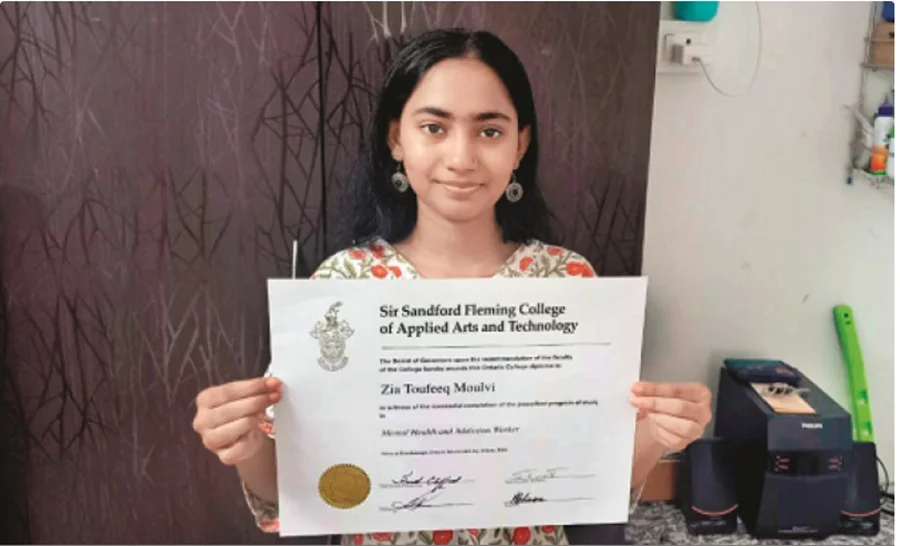
After scoring 78% in her SSC examinations, Zia pursued her education at Mumbai’s Sophia College, where she chose psychology as her special subject. Her interest in the field deepened over time, eventually guiding her towards international study. In 2023, she left for Canada to join Sir Sandford Fleming College of Applied Arts and Technology, where she successfully completed a two-year diploma in Mental Health and Addiction.
Despite opportunities abroad, Zia decided to return to India in April 2025. Explaining her decision, she told Clarion India: “There is not much awareness about psychology and mental health in India. There are also few psychologists, while I wish to serve the people of my country. My mission will be to try to overcome the growing trend of psychological stress and suicide.”
Currently, Zia is pursuing her Masters in Clinical Psychology at Indira Gandhi National Open University, Delhi. For her, studying in India means staying closer to the real issues faced by Indian society. “The studies in Canada matched the conditions of people there. But my people face different challenges. That is why I chose to study here, where I can directly connect with the needs of my country,” she said.
Alongside her academic journey, Zia has also excelled in martial arts. She has earned a black belt in karate, completed an instructor’s course, and qualified as a judge under the Karate India Organisation.
Zia’s journey from being a sports star to becoming a mental health advocate reflects not only her determination but also her deep sense of responsibility towards society. Those who once applauded her rope skipping feats now watch with pride as she dedicates her life to addressing psychological stress, depression, and the rising cases of suicide among young people in India.
source: http://www.clarionindia.net / Clarion India / Home> Editor’s Pick> India> Indian Muslims / by Team Clarion / September 11th, 2025
Raziya Sultana, wife of a top cop and third time MLA, is the only Muslim legislator in the 117-member Punjab Assembly]
Malerkotla (Punjab):
Raziya Sultana, wife of a top cop and third time MLA, is the only Muslim legislator in the 117-member Punjab Assembly. Congress is set to form its government in the state, and Raziya Sultana as one of the seniormost members in the party, eyes for a key post in the government.
Raziya Sultana, who contested the 2017 Punjab Assembly elections as Congress candidate, defeated her nearest rival Mohammad Owais of Akali Dal by over 12,000 votes. Raziya Sultana is wife of Mohammad Mustafa DGP Punjab who was bestowed with with five gallantry medals.
According to the final result of Punjab Assembly elections declared by the State Election Commission, Raziya Sultana polled a total of 58.982 votes whereas Mohammad Owais could bag just 46,280 votes.
Mohammad Arshad contesting from Malerkotla was the only Muslim candidate of the Aam Aadmi Party (AAP). Mohammad Arshad came a distant third bagging 17,635 votes.
Raziya Sultana was defeated by F. Nesara Khatoon (Farzana Alam) of Akali Dal in the 2012 elections in Malerkotla – the seat she won in 2002 and 2007.
Malerkotla has been represented by Muslims most of the time since 1957. Yusuf Zaman Begum was the first Muslim to win from Malerkotla in 1962. She was followed by H. H. N. I. A. Khan in 1967, Nawab Iftikhar Ali Khan in 1969, Sajida Begum in 1972 and 1980, Anwar Ahmad Khan in 1977, Nusrat Ali Khan in 1985 and 1997 and Abdul Ghaffar in 1992 state elections.
The Punjab Assembly had 02 Muslim MLAs in 2012. Besides, F. Nesara Khatoon (Farzana Alam) of Akali Dal who won from Malerkotla in 2012, Mohammad Sadique of the Congress won from Bhadaur Assembly seat in 2012.
Congress MLA Mohammad Sadique contested the 2017 elections from Jaito Assembly seat. But, he lost the elections to Baldev Singh of the Aam Aadmi Party (AAP) by some 10,000 votes. Baldev Singh polled 45,344 votes and Mohammad Sadique bagged 35,351 votes.
In Qadia, hub of Ahmadiyas, Fatehjang Singh Bajwa of Aam Aadmi Party (AAP) won the elections. No muslim candidate was in fray in this constituency.
Congress has fielded 02 Muslim candidates in 2017 Punjab Assembly elections, Aam Aadmi Party (AAP) and Akali Dali has given party ticket to 01 Muslim each. The BJP has not fielded any Muslim in the 2017 state elections
Overall, the Congress has won 77 of the total 117 seats of the Punjab Assembly. AAP is a distant second with 20 seats.
Akali Dal and BJP, ruling the state since last ten years, ended with 15 and 03 seats respectively. Lok Insaaf Party won 02 seats.
source: http://www.ummid.com / Ummid.com / Home> Politics / by ummid.com & Agencies / March 13th, 2017
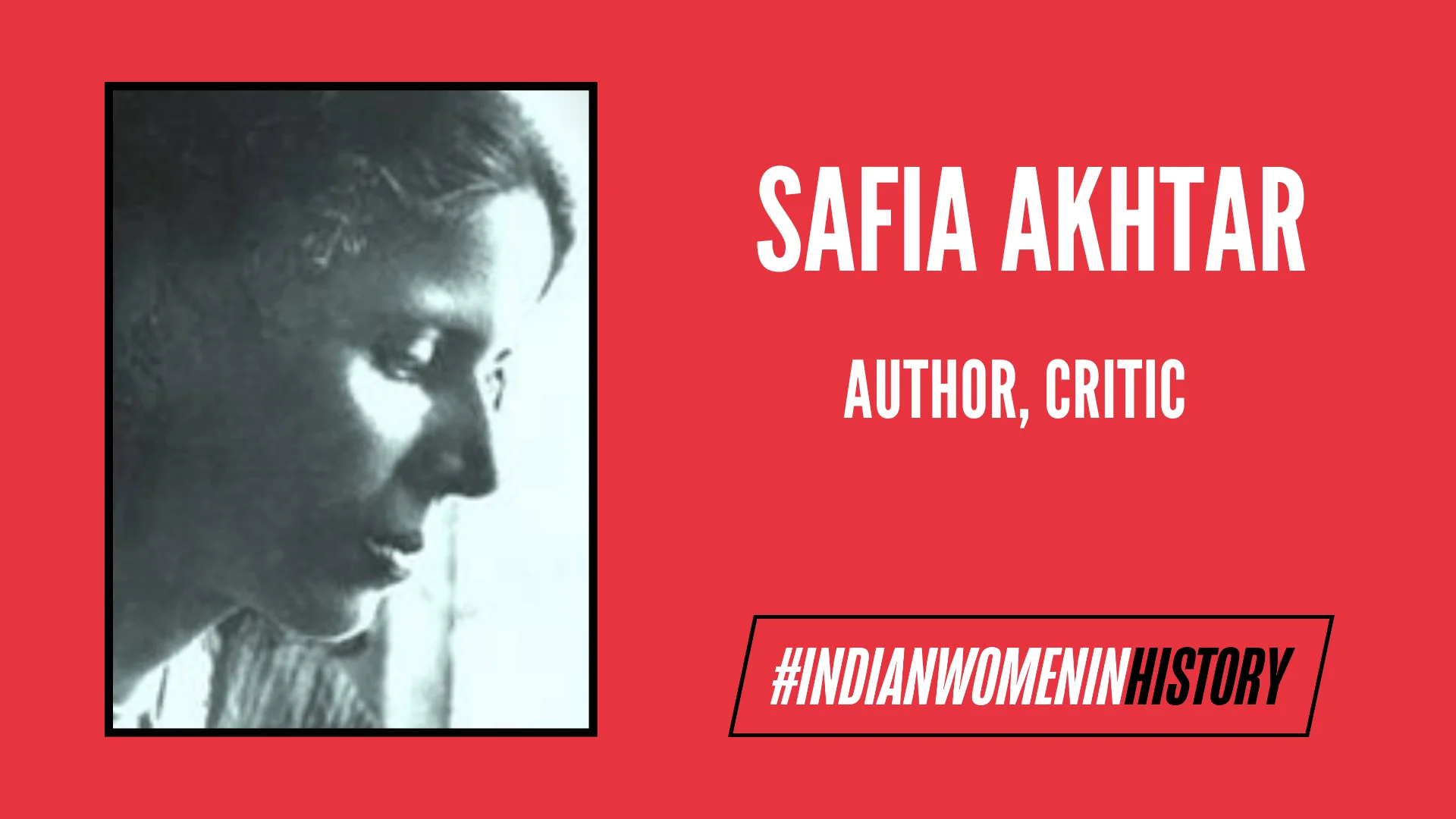
Safia Akhtar was a brilliant writer, poet, author, teacher, critic, and connoisseur of Urdu literature, who remains underrated.
If you know who Safia Akhtar is you would probably know her as Javed and Salman Akhtar’s mother, Jan Nisar Akhtar’s wife, or Asrar-ul-Haq, better known as Majaz Lakhnawi’s sister but Safia was quite the personality herself. She was a brilliant writer, poet, author, teacher, critic, and connoisseur of Urdu literature.
The best of Safia Akhtar’s work includes the letters that she wrote to her husband while they were apart. Her letters which were written over a period of nine years were published after her death by her husband as “Hurf-e-Ashna” and “Zer-e-lab” translating to “familiar words” and “below the lips” respectively. Safia Akhtar also wrote, “Andaz-e-Nazar” (The way to look at it) which is a collection of short essays.
Safia’s sister Hamida Salim was also a talented writer having authored many books like “Hum Saath the”(We were together) which gives an account of the lives of the siblings. Javed Akhtar, her son who lost Safia only when he was eight years old calls his mother a “nayaab aurat” during her time.
She set foot into education and pursued it at a time when women were rarely given the choice or opportunity to do so. Safia Akhtar chose her life partner, she worked and financially supported her family as well as her husband who was in another state, looking for work. To top it all off, she also took care of her two sons.
Safia Siraj-ul-Haq was born in Rudauli, Uttar Pradesh. Safia was an educated Muslim woman, one of the first of her time, in the 1940s. As Javed Akhtar recalls, his Nana (maternal grandfather) mentioned to him that someone once visiting couldn’t locate their house and asked for directions to the house of the girl who graduated and was easily guided to Safia Akhtar’s place.
Safia’s primary education took place at home where her father, Chowdhary Seraj-ul-Haq, taught her English, Urdu, and Farsi. Her brother, Majaz, assisted her with mathematics and she was tutored in the Quran by a female teacher. Owing to her father’s transfer, who was a law graduate, a door opened for Safia Akhtar and her siblings for further education. She was admitted to Karamat Hussain Muslim Girls college in the fourth grade. However, soon after, her father was transferred again from Agra, where Safia was studying living at a hostel, to Aligarh.
Safia Akhtar then started studying at Abdullah College and excelled in her academics. After completing high school, she had to wait a year for the B.A. classes to start in the girls’ college. Safia stayed in a hostel during her B.A. and after completing it, worked as a supervisor of a training program with her teachers as they were amazed by Safia’s caliber. After completing her undergraduate course, she studied further and got a Master’s degree in education from Aligarh Muslim University.
Safia grew up imbibing a progressive ideology. She set foot into education and pursued it at a time when women were rarely given the choice or opportunity to do so. Safia Akhtar chose her life partner, she worked and financially supported her family as well as her husband who was in another state, looking for work. To top it all off, she also took care of her two sons. Safia’s brother and husband were also part of the progressive writers’ movement at the time.
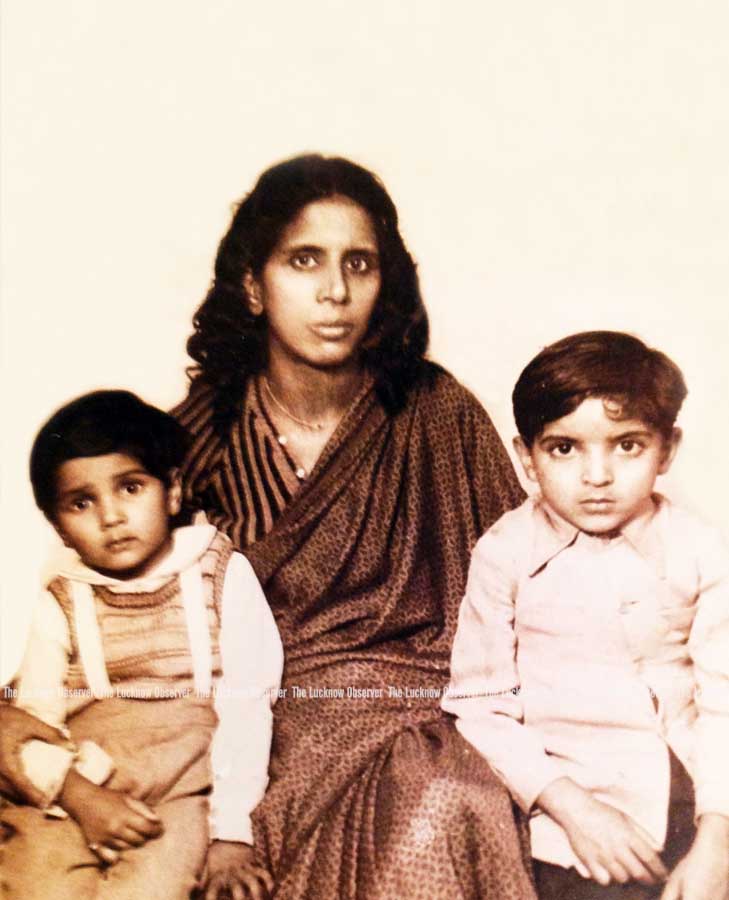
pix: lucknowobserver.com
Safia and Jan Nisar Akhtar
Jan Nisar Akhtar, the famous poet and Bollywood lyricist was a friend of Safia Akhtar’s brother Majaz and also the cousin of Salma, her roommate while she was staying in the hostel in Aligarh. Salma recounts Jan Nisar coming to the girls’ college randomly to meet Safia and introducing himself as a friend of her brother’s. Safia fell in love at first sight. However, the love seemed to be one-sided as Jan Nisar did not get in touch with her for quite a while and this disheartened Safia.
After some time passed, Jan Nisar wrote to Safia about his work, interests and disinterests, and himself. Soon after, Safia’s family received a marriage proposal from Jan Nisar’s side. As the culture still prevails, the girl’s family did a background check on Jan Nisar and his family. Salma, his cousin, testified for Jan Nisar’s family (even though she wasn’t too well informed about them) that they had a legacy of poets; his father Muztar Khairabadi was a well-known shayar of the time.
The letters give a glimpse of Safia’s immense love and optimism toward Jan Nisar. They also give an insight into episodes of her life events including her job, their two children Javed and Salman, her life at home, and towards the end, her suffering. These letters stand proof of what a literary genius Safia Akhtar was
Jan Nisar himself was well accomplished and was an Urdu literature lecturer in Gwalior. With no time wasted, Safia Akhtar’s parents sent their acceptance as they did not find any flaws as such in Jan Nisar. But to their disappointment, the Akhtars did not respond for a considerable amount of time.
This silence motivated Safia to take a rather valiant step. She poured her heart out to Jan Nisar in a letter and also enquired about the holdback from their side. Jan Nisar reverted with a confession about his feeling for another woman, his older, widowed relative who helped him during a rough patch after his first relationship came to an end. Safia appreciated Jan Nisar’s honesty. The proposal was re-established and the nikkah followed soon after, although there were some odd happenings during the time.
source: youtube.com / Letters Of Love & Loss | Jaan Nisar Akhtar Aur Safia Ke Khat | Rekhta Studio
In 1949, Jan Nisar switched cities from Bhopal to Bombay in the pursuit of becoming a lyricist in Bollywood. Safia Akhtar chose to stay back and continue with her teaching post at Hamidiya College, thus, supporting her husband money-wise and also rearing their two children. The distance between the two encouraged Safia to write letters to him.
She wrote to him consistently, multiple times a week in some instances. The letters give a glimpse of Safia’s immense love and optimism toward Jan Nisar. They also give an insight into episodes of her life events including her job, their two children Javed and Salman, her life at home, and towards the end, her suffering. These letters stand proof of what a literary genius Safia Akhtar was. Safiya suffered from an unconfirmed terminal illness (it was either blood cancer or skin cancer, not conclusive). Unfortunately, fate had other plans and Safia passed away prematurely in 1953 when she just was in her late 30s.
Without a doubt, Safia’s letters were and to this day are, a gem in Urdu literature. She expresses her feelings so very aesthetically and makes the most mundane of her daily tasks seem something literary and intriguing. About her letters being published, there seems to be a difference of opinion.
On one hand, there is the stance that the letters were something intimate, personal, and not meant to be out for the public. Salma, her roommate, calls it a “Dastan-e-Gham”, the saga of sorrows that she shared with her husband and would not want to be disclosed. While others appreciate the sheer brilliance of her words and feel lucky to have access to them.
source: http://www.feminisminindia.com / Feminism In India (FII) / Home> Culture> Books / by Tuba Chauhan / August 04th, 2022
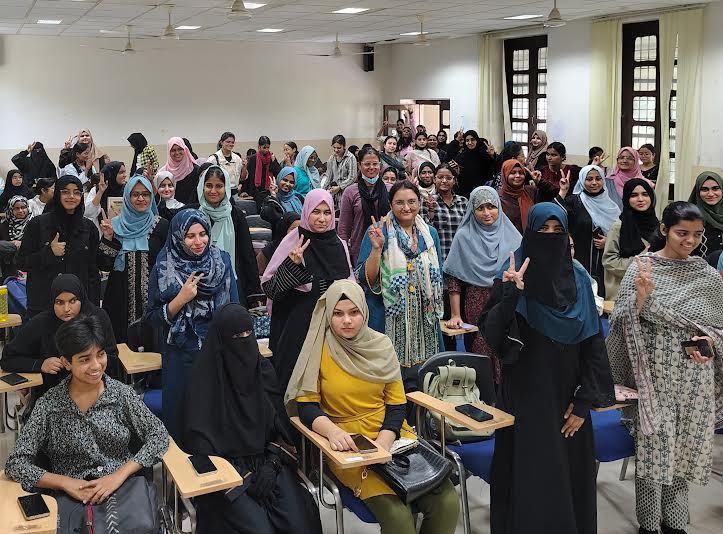
The Social Work and Outreach Activities Club of Women’s College, Aligarh Muslim University held an inaugural talk and launched its membership programme.
Highlighting the objectives of the club, Prof. Shadab Bano drew the critical distinction between charity and social work, and stressed that receiving an education gives us a responsibility to share its benefits with others. She urged the students to view social work as a civic duty.
Prof. Nazura Usmani emphasized the importance of the disability support committee and discussed strategies to foster inclusivity and increase the representation of differently-abled students on campus. She stressed the need for disability sensitization among the student body to build a more understanding and accessible environment for everyone.
Dr. Eisha Rahman announced the club’s committees and introduced the coordinators; Prof. Nazura Usmani and Prof. Shadab Bano as Main Coordinators; Dr. Arshi Shoaib and Dr. Shagufta Munir for Remedial Classes for Abdullah School students; Dr. Shagufta Niyaz and Dr. Mahjabeen for Disability Support; Dr. Arshia Shafqat, Dr. Fozia Waheed, and Dr. Eisha Rahman for Tuitions for Non-Teaching Staff’s children; Dr. Heena Parveen and Dr. Eisha Rahman for Adult Education for Fourth Grade Employees; and Dr. Fozia Waheed, Dr. Mohd. Firoz Ahamed, Dr. Mahjabeen and Dr. Masudullah Khan for the Locality Cleanliness Drive.
Prof. Shadab Bano and Dr. Eisha Rahman addressed the queries of the participants, providing clarity on the club’s goals and activities. About 65 students registered themselves as the members of the club.
Dr. Mohd Firoz Ahamed concluded the event, encouraging students to join the club for bringing meaningful changes and making a positive impact on their community.
source: http://www.indiaeducationdiary.in / India Education Diary / Home> National News / by India Education Diary / November 07th, 2024
It was a cold day in February 2016. A woman from a small town of Uttar Pradesh received her Ph.D. at the 63rd Annual Convocation of Aligarh Muslim University (AMU), Aligarh. She was the first from her clan to have taken admission to AMU in 2003. Her parents never attended college; her four brothers took up family businesses at a younger age. The woman in the discussion is me. I am Mahino Fatima, a Muslim girl from a backward caste who became a scientist against all odds.
pix: heritagetimes.in / Dr. Mahino Fatima
Friends, relatives, and peers celebrated my becoming a scientist as a consequence of my hard work and perseverance. In my heart of hearts, I knew this day has not come only because of me; I was grateful for the privilege of education that I was born with.
Most importantly, I should not forget Fatima Sheikh. If not for her, I would never have become a scientist. Lakhs of women who are successful because of education would have remained illiterate but for Fatima Sheikh’s pioneering work.
How can I, a woman, forget that my foremothers were not allowed to learn how to write? How can I, a backward caste woman, forget that my forefathers were not allowed to receive an education? Today, when we look at our curriculum, we find that women scientists, economists, philosophers, and intellectuals are negligible in comparison to men. Famous philosopher, Jaques Derrida, once remarked that no woman was a philosopher. His observation was true, but he did not delve into the reason. How can a woman become a philosopher when men for centuries controlled the development of her intellectual capacities in the name of culture?
In our society, men would not let women learn the art of writing for the fear that if literate these women would communicate to ‘lovers’ through letters. Bibi Ashraf, a late 19th-century educationist, recalled how she was not allowed to learn reading and writing like male members of her family. She secretly learned to write. The secret came out when during the revolt of 1857; she had to write a letter to her father and uncle. Instead of receiving accolades, she was abhorred by men in her family. Her uncle was furious and made her take an oath that she would never write a letter to a man. Similar was the story of Rassundari Devi, who secretly learned writing by stealing books from her son. How do we expect women scientists in such a society? Still, a large section of our society would not let women study more than what is needed in the ‘marriage market’.
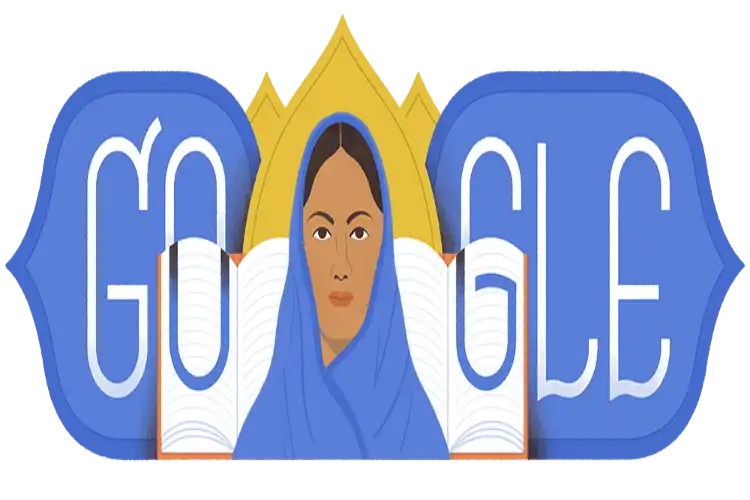
In this society, Fatima Sheikh, along with Savitribai Phule, started a school for girls in 1848. Yes, 1848. 26 years before Sheikh Abdullah, who later founded a women’s college at Aligarh, and 32 years before Begum Rukaiya Sakhawat, doyen of women education, were born, Fatima had started a girls’ school and taught herself. Today, that small classroom of 9 girls has prepared lakhs of educated women.
Today women are asking for gender parity in opportunities and pay scales. Thanks to Fatima, women today are educated to understand their worth and assert their rights.
Fatima was a pioneer; she was followed by Begum Rukaiya, Begum Wahid, Muhammadi Begum. A revolution starts with an idea. Fatima’s was the idea that put women of India in general and Muslim women in particular, on the march to empowerment through education.
Today, I thank Fatima for making me a scientist. Nobody knows how many bright women before 1848 had been deprived of education and were not allowed to dream of becoming a scientist. But, we surely know that after 1848, women have slowly entered different fields through education and are today competing with men to have their rightful place in the books, laboratories, and society.
(Author is a neurobiologist with her major research on depression and Alzheimer’s)
source: http://www.awazthevoice.in / Awaz, The Voice / Home> Stories / by Mahino Fatima / Saquib Salim / January 09th, 2022
Women’s education in nineteenth-century India was no easy task. In the case of Muslim women, the task was even more difficult due to their triply marginal identity: as colonial subjects, as women, and as Muslims. Not only did the custom of purdah added to their seclusion from the social and cultural changes, their men hated everything about the western cultural influence (being displaced as rulers by the British). As a result, the middle class (the initiators of reform) was to develop late among the Indian Muslims than their Hindu counterparts. Nevertheless, by the late nineteenth century, a middle-class among the Indian Muslims was fledging. For this, no institution of the nineteenth-century can be given more commendation than Aligarh Muslim University.
Formed in 1920, the Aligarh Muslim University just completed its hundred years as a modern residential university. There has been a perception that the Aligarh Movement, for whatever reasons, neglected the issue of modern education to Muslim women. But there is more to this argument, some things to be explored, some to be re-interpreted.
This article, therefore, attempts to trace the genesis and trajectory of women’s educational reform in Aligarh through the profile of a woman reformer – Waheed Jahan (1886-1939), wife of Shaikh Abdullah (1874-1965), and the co-founder of Aligarh’s first girls’ school. Waheed Jahan was a pioneer of Muslim women’s education at Aligarh in the early twentieth century. Her role in ending the relative isolation of Indian Muslim women, while at the same time preserving the Muslim identity of the community, is worthwhile to recall. Her biography was published in Urdu by her husband in 1954. [1]
The educational reforms among Indian women were mostly started by men. Such men started with writings advocating women’s education. In this regard, among Muslims, Nazir Ahmad (1833-1912) published his novel, Mirat-ul-Arus, in 1869; Altaf Hussain Hali (1837-1914) published Majlis-un-Nissa, in 1874. Soon, magazines and journals followed, like the Tahzib un-Niswan by Sayyid Mumtaz Ali (1860-1935), the Khatoon by Shaikh Abdullah and Waheed Jahan, and the Ismat by Rashid-ul- Khairi (1868-1936). Gail Minault regards these as ’The Big Three.’ [2] Apart from literary activism, others tried more practical measures, like opening schools for Muslim girls.
As the movement intensified, so did the opposition against it. In such an atmosphere, even the talk of women’s education by a woman herself was quite a chivalry.
Yet, unexpectedly, there were women who defied the odds and broke the ground. Rashid-un-Nissa of Patna, became the first Muslim woman to write an Urdu novel, Islah-un-Nissa in 1881 (published in 1894), when writing was a distant dream for Muslim women. Rokeya Sakhawat Husain (1880-1932), a widow herself, pioneered Muslim women’s education in Bengal. Muhammadi Begam (1878-1908) edited one of the leading ladies’ home journals, Tahzib-un-Niswan. One such icon of women’s education at Aligarh was Waheed Jahan.
Waheed was born in 1874 in a landholding family in Delhi. Her father Mirza Ibrahim Beg was of Mughal ancestry, serving as a minor municipal official in Delhi. Her only brother, Bashir Mirza went to the Mohammadan Anglo-Oriental College (MAO Colege), Aligarh, where he befriended Shaikh Abdulla (a Kashmiri convert to Islam, named Thakur Das before conversion).
As was the custom, Waheed received no formal schooling. She learnt Urdu and Persian from her father and arithmetic and elementary English from a visiting English tutoress.
Ismat Chughtai, in her autobiography, Kagazi hai Pairahan, records, how Waheed Jahan, before her marriage, had dreamt of establishing a school for the girls. She would gather the servants’ children and teach them, and soon the rudimentary school became popular among her neighbours. It is noteworthy that, at a time when others (mostly men) were still imagining a school for girls (that too only in their writings), Waheed, in her own limited capacity, was practically making a difference.
In 1902, Waheed married Shaikh Abdullah – a lawyer at Aligarh, and an ardent supporter of women’s education since his school days. Following the marriage to a woman with some education, he began to consider concrete ways to promote Muslim women’s education. The Mohammadan Education Conference (MEC, founded at Aligarh by Sir Syed Ahmad in 1886) had established a Women’s Education Section (WES) in 1896 to start a Normal School for girls and to train female (zenana) teachers. In 1902, Shaikh became the secretary of WES, which by then had merely achieved anything beyond discussions and debates around women’s education.
Luckily, Waheed’s marriage to a reformist like Abdullah helped her materialize her dream. To champion women’s education, they started an Urdu monthly, the Khatoon, in 1904 with Waheed Jahan as editor. Begum Sultan Jahan (1858-1930) of Bhopal, Binnat Nazir-al-Baqir, Suharwardiya Begum, and Binnat Nasiruddin Haider were some important female contributors to the journal.
The paucity of funds made it impossible to start a Normal School. Waheed Jahan advised her husband to start a primary school for the elite (Sharif) girls. In 1904, the Mohammadan Educational Conference passed a resolution to start a girls’ school in Aligarh. Waheed proved to be an efficient manager and fund-raiser for the cause.
Her capacities as a fund-raiser and organizer were displayed in 1905, when she organized a meeting of Muslim women in Aligarh, with participants from far corners of Lahore and Bombay. Judging from the context of the time when purdah among Muslims was so harsh, even the idea of organizing such an event was quite revolutionary.
Aware of women education in Turkey and Egypt and its benefits to society, she tried to convince other women; she said:
When women meet among themselves, there will be more solidarity. . . Now there is a division between educated and uneducated women. Uneducated women, who do not go out, think that respectability is confined to the four walls of their houses. They think that people who live beyond those walls are not respectable and not worthy of meeting. But God has ordained education for both men and women, so that such useless ideas can be dispensed with. . . [3]
The meeting was a success, the exhibition of women’s craft secured good funds; finally, the women passed a resolution favouring a girls’ school in Aligarh. In October 1906, Aligarh Zenana Madrasa (girls’ school) opened its doors, and seventeen students were enrolled. Urdu, arithmetic, needlework, and the Quran formed the curriculum. Leaving her own children in servants’ care, Waheed took the responsibility of supervising the school. Within six months, the number of students increased to fifty-six. Waheed’s efforts secured the school a cumulative grant of Rs. 15,000 and a monthly grant of Rs. 250. By 1909, the school taught 100 students and shifted to a larger building.
The opposition to girls’ school took new forms. One amusing story is recorded in Shaikh Abdullah’s Urdu memoir (1969), Mushahedaat o Taaassuraat. [4] Maintaining purdah, the girls were carried in daulis (curtained carriages) to school, and some street urchins started harassing the school going girls by lifting the curtains of their daulis. The mischief only stopped when Shaikh gave one of the miscreants a good thrashing. In another incident, Shaikh confronted a tehsildar who had accused the school of making the girls insolent.
When the Abdullahs proposed a girls’ boarding school, it invited opposition from elite corners. The European principal of MAO College, W.A.J Archbold; Ziauddun Ahmad (1873-1947); and Viqar-ul-Mulk (1841-1917) opposed vehemently.
The couple, however, succeeded in 1914, witnessing the transformation of the school into a boarding school. The same year saw the culmination of Muslim women’s activism by the foundation of Anjuman-i-Khavatin-i-Islam (AKI) at the same venue. Begum Sultan Jahan (1858-1930) of Bhopal graced the foundational ceremony of the boarding school, felicitating Waheed; she urged other women to follow her example. Fyzee sisters, Abru Begum, Begum Shafi, and Begum Shah Nawaz were the other dignitaries.
The Begum was already active in various social and educational reform projects. She served as the first chancellor of AMU from 1920 until her death in 1930. Having a woman as the first chancellor was indeed a historic feat.
Only nine girls became the residents, most of them from Waheed’s own family. By the end of the year, the enrollment rose up to twenty-five. This was the result of what the historian Gail Minault calls as Abdullahs’ portrayal of girls’ school as an extension of girls’ families and also of their own. To make the school successful, Waheed used to invite the parents of girls to Aligarh, for a few days stay in the hostel, to convince them that the conditions there were safe enough to let their daughters stay, records Sheikh Abdullah, in his Mushahedaat o Taaassuraat. She supervised everything – housekeeping, laundry, shopping, and even tasted each dish cooked for the girls.
It could be said that Waheed Jahan acted as a foster mother to these girls, counselling, nursing, and treating them as a part of her own extended family. They called each other as Apa (sister), Shaikh Abdullah as Papa Mian, and Waheed Jahan as Ala Bi. This created a sense of sisterhood among the girls.
This familial system of ethos still remains unique to the Aligarh Women’s College.
The boarding school project contained other complex problems, such as maintaining proper purdah. Both Shaikh and Waheed agreed that the purdah practiced in the Sharif society was more restrictive than purdah sanctioned by the Shari’a (Islamic Law). But to secure social acceptance for their school, they chose to go with strict purdah, building fortress-like walls to fend off the male gaze, students’ mails were scrutinized, and only close relatives were allowed inside.
This accommodation of purdah within the gamut of their reformist agenda, to gain social acceptance, was indeed very astute of the Abdullahs. Thus, Waheed Jahan succeeded in preserving both the elite and the “Muslim” identity of herself and her community while simultaneously breaking the relative isolation of Indian Muslim women. The girls’ school became an intermediate college in 1925 and started degree classes in 1937 (with 250 students). Waheed passed away in 1939, only after seeing her school becoming a degree college.
The relation between education and social change is complex, varying from culture to culture and among different classes in the same culture.
True, that Aligarh movement was late to include women’s education in its fold. Even the school founded by the Abdullahs did not fulfil all its expectations – their choosing an exclusively elite (Sharif) clientele limited the impact of their reforms.
But their efforts indeed bore fruits; the educational reforms for Muslim women at Aligarh contributed to many social developments. After the formation of AKI in 1914, the number of meetings and associations (for women-only) increased rapidly in the 1930’s. The growth in the number of educated women created a market for new publications for and by women.
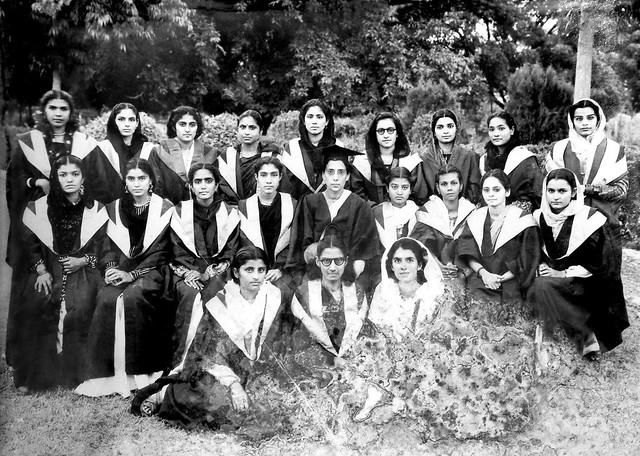
The Aligarh Women’s College produced many women of substance, who made sure to shine above and beyond purdah, some figuratively and others literally. These ladies excelled in various fields, from teaching to medicine to writing.
Rashid Jahan, Waheed Jahan’s daughter, became a successful physician, a radical writer, and a staunch communist. Her short stories in Angare (1932) became the opening salvo of the Urdu Progressive Writers Movement (1936). Rakhshanda Jalil, in her biographical work on Rashid, A Rebel and her Cause: The Life and Work of Rashid Jahan, writes that Angare was a “document of disquiet”; a self-conscious attempt “to shock people out of their inertia, to show how hypocrisy and sexual oppression had so crept in everyday life”. Rashid became an inspiration for a generation of women writers such as Ismat Chughtai, Attia Hosain, Sadia Begum Sohravi, and Razia Sajjad Zaheer, among others.
Like all other reform movements of that time period, the Aligarh movement had its limitations too. For a start, it did prioritize men’s education over women’s, for various reasons (a story that needs to be told elsewhere), but by the early twentieth century, things were changing. The Aligarh movement not only took up the cause of women’s education actively, but it also let women (Like Wahid Jahan) be a part of the process.
Notes
[1] Shaikh Abdullah, Savanih-i- Umri-i- Abdullah Begum, Aligarh, 1954
[2] Gail Minault, Gender, Language, and Learning: Essays in Indo-Muslim Cultural History, Permanent Black Publications, Ranikhet, 2009, p. 87
(Ishrat Mushtaq is PhD Candidate, Centre of Advanced Study in History, Aligarh Muslim University and Sajad Hassan Khan is PhD. Candidate, Centre of Advanced Study in History, Aligarh Muslim University. Article courtesy: Mainstream Weekly.)
Janata Weekly does not necessarily adhere to all of the views conveyed in articles republished by it. Our goal is to share a variety of democratic socialist perspectives that we think our readers will find interesting or useful. —Eds.
source: http://www.janataweekly.org / Janata Weekly / Home / by Ishrat Mushtaq and Saad Hassan Khan / January 24th, 2021
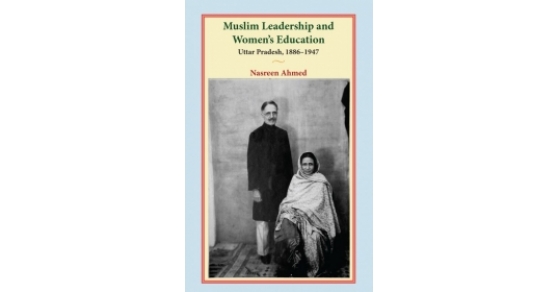
By Nasreen Ahmed / First Edition Pub. October 2012, x+190 pages, 8.5 x 5.5 in. / ISBNs: 978-81-88789-82-5
This is a broad study of the efforts at modern education for Muslim women, especially with reference to the Aligarh Movement and the initiatives inspired by it in other parts of UP, namely Lucknow, Allahabad, Rampur and Agra. The role of Muslim leaders, both male and female, the nature of the problems they encountered and the manner in which they countered them is the major thrust of this study. In the process we are introduced to the major debates on women and education during the course of late nineteenth and the first half of the twentieth century.
The author breaks many stereotypes as we learn that it was the more traditional among the Muslim leadership, rather than the ‘modernisers’, who pioneered women’s education and that Muslim women themselves played a major role in nurturing the first institutions under their personal care.
Based on an extensive range of primary sources and contemporary writings in English, Urdu, Hindi and Persian, this is a definitive work in many ways, gives food for thought on developments other than its main theme and will be useful to those concerned with women’s studies, social reform, education and modernity in colonial India, particularly with reference to Muslims.
CONTENTS
Muslim Women’s Education in the Nineteenth Century: A Study of the Traditionalist Attitudes
Efforts for the Education of Muslim Women, 1857-1885
Aligarh Movement and Muslim Women’s Education, 1875-1902
Female Education Section: Early Discussions, 1896-1904
A School for Muslim Girls at Aligarh
From Female Normal School to Muhammadan Girls’ School, 1906-1910
A Degree College Managed by the University
Establishment of Schools by Other Indigenous Efforts: Lucknow, Allahabad, Rampur and Agra.
Cover photo: Papa Mian (Sheikh Abdullah, 1864-1965) and Waheed Jahan Begum (1884-1939), founders of the first school for Muslim girls in Aligarh. Back cover: Carriage used to bring girls to school, accompanied by a female escort. (1923)
Nasreen Ahmed
Nasreen Ahmed (1954-2009) studied at the Aligarh Muslim University and later taught at the Karamat Husain College, Lucknow.
She is a pioneer among historians on concerns of Muslim women’s education, as her early essays on the theme published in the late 1970s show. Thereafter she presented her work at various national conferences and seminars. Her studies are rich in sociological data: she records a great deal that feminist scholars writing on Muslim women today have missed. She is author of many research articles published in the Proceedings of the Indian History Congress, a journal of frontier scholarship in history.
source: http://www.threeessays.com / Three Essays Collective