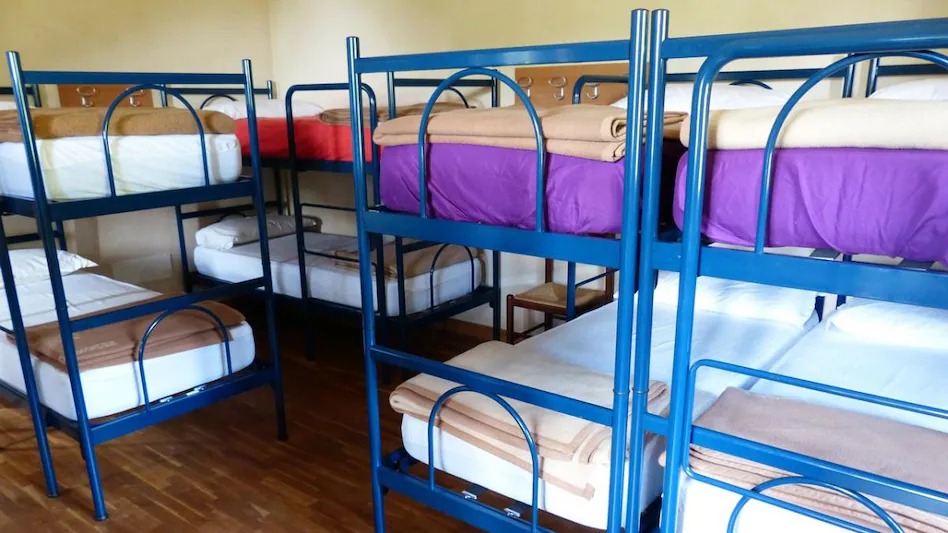
The deadline to submit applications for entry into the post-matriculation boys’ and girls’ hostels under the Minority Welfare Department for the current academic year (2024-25) has been extended to November 11.
Pre-university (PUC), parallel course, professional course, graduation and post-graduation students may apply for accommodation at the hostels, under the State Scholarship Programme, the authorities have said in a press release, adding that the applications are provided on the State Hostel Portal (SHP) site.
Additional information on applying for accommodation at the hostels is available on the SHP site. The applicants may also approach the government personnel at the district and taluk offices of the Minority Welfare Department, the press release has stated.
source: http://www.english.varthabharati.in / Vartha Bharati / Home> Karnataka / by Vartha Bharati / October 15th, 2024
Meet 25-year-old specially-abled girl, who plays basketball, does motivational speaking and drives a car.
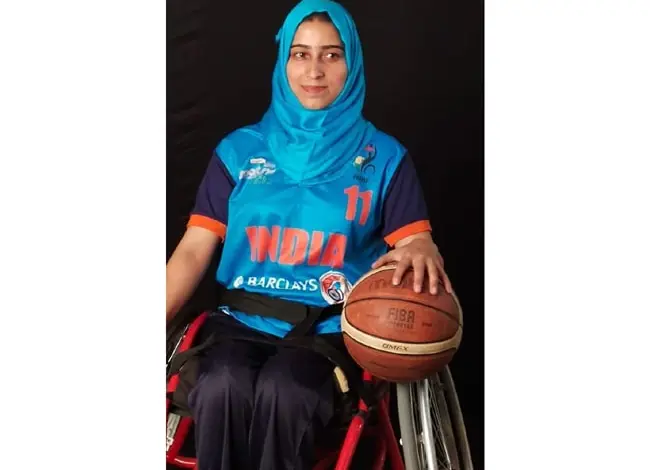
Ishrat Akhter in Team India jersey | eNewsroom India
Delhi:
Ishrat Akther from Baramulla in Jammu and Kashmir is a multi-faceted personality. She is an international wheelchair basketball player, a motivational speaker, Kashmir’s young leader and an achiever’s award-winner. Indeed, six years back, Ishrat’s life had no meaning — but an incident changed it all.
Now, Ishrat has become an inspiration for all those individuals who set limitations for themselves. Who refuse to dream and achieve their ambitions.
The girl next door
Ishrat was born in a village where women did not participate in sports. Like any other girl, she believed whatever her family taught her and did not dare to dream big. However, her life changed on August 24, 2016, when she fell from the balcony of her house. The injury was serious, it damaged her spinal cord – making her physically challenged.
Life changed for the good when the 25-year-old girl from the Authoora area in north Kashmir’s Baramulla district started her basketball career in 2018. For her, playing basketball was not just a love for the sport but a passion for standing against all odds, come what may.
“I never played any sport before 2016, not even in school, but in 2016 when I was just 18 years old, I met with an accident. I fell off from the balcony of my house and this made me bedridden for two long years,” recalls Ishrat.
Did not surrender to fate
A brave and resilient girl, she developed the will power to transform adversity into hope. Certainly, she did not wish to live a life of hopelessness and despair.
“After that accident, I was a patient at the Voluntary Medicare Society. I saw some boys coming to play basketball on the court which was in the society and all of them were in wheelchairs! Seeing them play, I was deeply influenced. I was inspired. I thought, “I don’t want to sit idle. Let people form their own, biased opinions,” she says and continues:
I, therefore, decided to play basketball. I remember that when the selection process for the Indian team started, police and army people came to my home and informed me that my name was in the list and if I wanted to attend the three-day selection process for the Indian team, I must leave for Chennai within a day. For me, this was a golden opportunity, so I left for Chennai all alone, and participated in the selection process. Luckily, and to my great joy, I got selected. Since then, I have been determined to live a life based on self-conviction, will power and courage.
At the Medicare Society, I joined the Wheelchair Basketball Team and got selected for the ‘nationals’ in Tamil Nadu, representing Delhi. Jammu and Kashmir did not have a team at that time. I was part of a team of good players. Eventually, a team for the state was conceived. I played the second national game at Mohali, representing J&K.
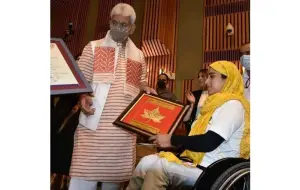
Ishrat Akhter receiving an award by the Lieutenant Governor of Jammu and Kashmir, Manoj Sinha | eNewsroom India
Conquering world
“I was selected to represent India at the Asia Oceania Wheelchair Basketball Championship at Pattaya, Thailand in 2019. I am the only girl from my state who has represented India at the international level. Besides, I have participated in a Boys’ Wheelchair Race, I being the only girl in the race. Happily, I secured the first position. I also play Wheelchair Table Tennis,” says Ishrat, with great pride.
Among others, Colonel Isenhower has been a constant support for Ishrat. He has been her guide, mentor and guru. And she is full of praise for him.
“When the selection process for the Indian team was going on, communication services were suspended in Kashmir. Hence, Colonel Isenhower, who was in Kochi, traced me out in two days and arranged everything. Since then, he has been an inspiration for me. He has always been motivating me to do much, much more. He always says that I have to make my name and thus refuse to be restrained — because I am a wheelchair-bound person,” says Ishrat.
Ishrat’s family has always acted with amazing positivity and magnanimity, giving her optimism and courage. She feels that, undoubtedly, it is due to the support of her family that she has reached the international forum, something impossible to conceive for a girl with the kind of difficulties she had faced in her life.
On the flip side, she believes that her life has completely changed because of the accident which resulted in her opting for basketball.
Indeed, after four years of the accident, Ishrat has resumed her academic life, and is currently pursuing a diploma in the Women’s Polytechnic College, Srinagar.
Truly, she represents the eternal metaphor of hope. For her, sky is the limit.
“Not just an international recognition but after 4 years of my accident, I resumed my studies. I passed my Class 10 and also appeared for my Class 12 exams. Now, I’m also pursuing my Diploma,” she says.
Controls her life
The specially-abled Ishrat, braving all odds drives a car, all by herself without anyone’s support.
“In the beginning, it was very difficult, but I wanted to drive by myself. If one has courage and willpower – one can achieve anything in life,” she adds.
“I remember, I used to feel scared even if I had to go some miles away from my home but today I travel alone, even when I have to go to some places outside Kashmir. There are instances when I observe people looking at me and seeing how I manage things but at the same time I’m proud of the fact that today, I get invited to speak as a motivational speaker across India,” she points out.
In 2019, she was also selected for a Sports Visitors Program- Wheelchair Basketball and Accessibility in the USA but because of personal issues she was not able to attend it.
Ishrat is also a motivational speaker and has delivered many talks in Kashmir and other states. She was presented the Kashmir Young leadership award and Kashmir Young Achievers Award 2021 by the Lieutenant Governor of Jammu and Kashmir, Manoj Sinha.
She has also received the Women Steel award 2022 from JKPCC.
source: http://www.enewsroom.in / eNews Room India / Home> Play On> She / by Varalika Mishra / May 08th, 2022
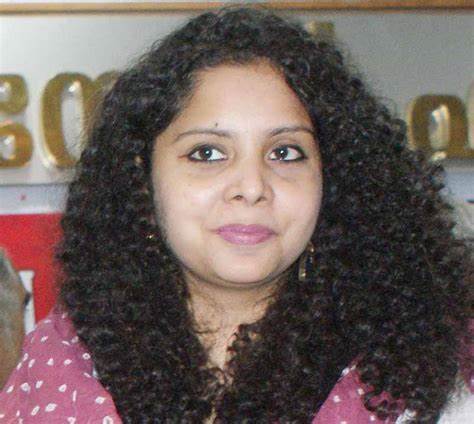
Rana Ayyub, an Indian investigative journalist and Global Opinion Writer at The Washington Post, is the recipient of one of the two coveted 2024 International Press Freedom Awards, as announced by Canadian Journalists for Free Expression (CJFE). She has been named for this award for her reporting that tenaciously upholds press freedom while holding governments accountable.
Ayyub will attend the CJFE Gala: A Night to Celebrate Courage in Journalism, where she will accept the award in Toronto on October 23.
When Ayyub went undercover in 2010 to look into the government’s role in communal violence – which is defined as violence based on race or religion – she established her reputation for fearless reporting. Since then, she has provided news and investigative reports about the persecution of minorities, state-sanctioned violence, and communal politics for a variety of Indian and international publications, such as The Washington Post, The New York Times, The Guardian, The Atlantic, and Foreign Policy. Her best-selling book, Gujarat Files: Anatomy of a Cover-up was released in 2016.
The Modi administration has reacted angrily to Ayyub’s political exposés. Ayyub is one of India’s most harassed and abused reporters, according to the International Centre for Journalists, and the UN special rapporteur has urged Indian government to stop the “relentless misogynistic and sectarian attacks” against her.
source: http://www.radiancenews.com / Radiance News / Home> Pride of the Nation> Awards / by Radiance News Bureau / October 04th, 2024
Anam Rais Khan is the first female and first ever Muslim from Aligarh Muslim University to qualify the prestigious Delhi Judicial Services Examination 2018, securing 71st rank to become a judge in Delhi.
She completed her B.A.LL.B (Hons) from AMU in 2015 and did LLM from National Law University Delhi in 2016. She was the University Gold Medalist and also received Gold Medal in Constitutional Law. Socially active on campus, she organised several legal literacy awareness programs, donation camps and environment campaigns.
She qualified UGC NET and got enrolled with Bar Council of Delhi in 2017. Then she moved to Australia with her husband, who is a software engineer at TCS, and started working at a reputed Immigration consultancy firm in Sydney. But her strong desire for competing judicial services exams was always there and she kept preparing for it for around 1.5 years and then gave it a shot in January 2019 and cleared the most coveted judicial services exam of India at the young age of 26.
Her husband, Adil Khan always stood by her, supported her and encouraged her, come what may. Her father, A.R. Khan, Retired Station Superintendent in Indian Railways always wanted to see her daughter adorn this respectable post, and Rahul Yadav, her mentor at Rahul’s IAS Coaching, guided her throughout the journey.
She also thanks her mother Prof. Samina Khan and sister Alvina Khan and her in-laws for being so supportive always. Anam says she always wanted to be a judge because being a judge gives one the power and also the responsibility to correct so many injustices in society. She says now she will be able to contribute to the evolution of law, serve the nation, and become a better student of law and at the end of the day sleep with a clear conscience by making a difference in the society.
Her advice to the aspiring candidates would be not to become bookworms and try to think out of the box.
source: http://www.radiancenews.com / Radiance News / Home> Latest News > Markers of Excellence / by Radiance News Bureau / October 03rd, 2024
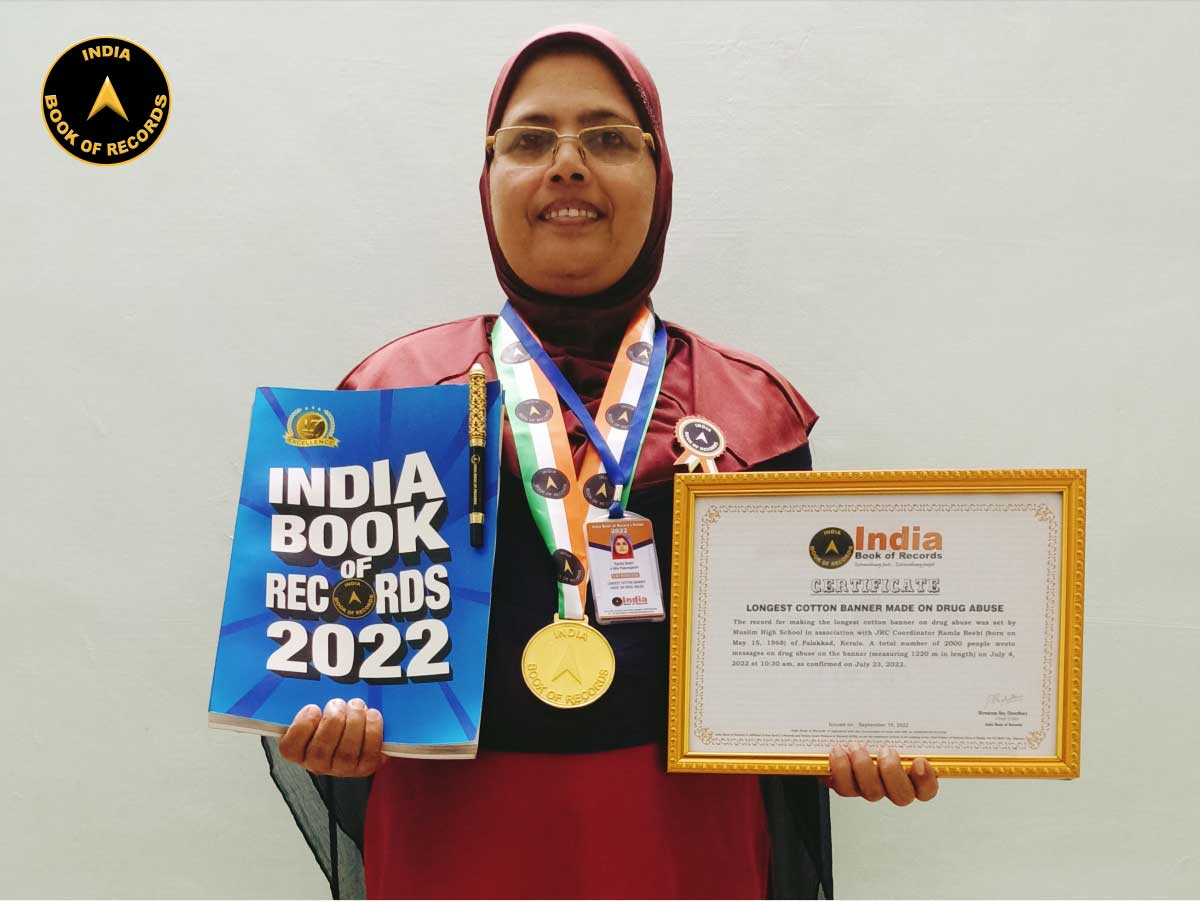
The record for making the longest cotton banner on drug abuse was set by Muslim High School in association with JRC Coordinator Ramla Beebi (born on May 15, 1968) of Palakkad, Kerala.
A total number of 2000 people wrote messages on drug abuse on the banner (measuring 1220 m in length) on July 4, 2022 at 10:30 am, as confirmed on July 23, 2022.
source: http://www.indiabookofrecords.in / India Book of Records – IBR / Home> Culture & Creativity / by ibr editor / November 01st, 2022
This is just not another memoir of a politician happily or unhappily bounds to look back; the author, instead, talks like a grandmother narrating a story of post-independent India somewhat interlinked with the Congress.
Mohsina Kidwai, author of the book ‘My Life in Indian Politics’
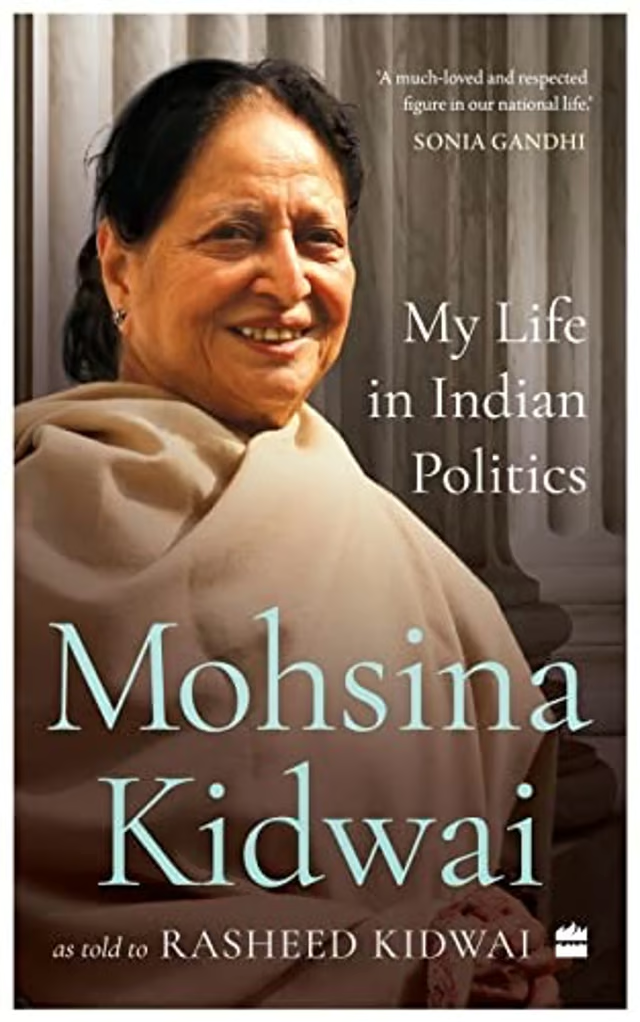
Book Review: Non-fiction (Memoir)/2022; My Life in Indian Politics by Mohsina Kidwai (As told to Rasheed Kidwai); HarperCollins, 300pp (Hardback)
Indian politics is a sort of ‘wonder’ and its unique existential positioning can’t be imagined without people behind its ups and downs. Reading the memoirs, especially of those who served in public life for long, is amongst the rewarding pastimes of a reader. I read Mohsina Kidwai’s memoir as a manuscript, and of course, I reread it even more carefully in its print version. Here is a candid account of a prominent political figure of India who dispels the stereotyped traditional notions that are usually expected to be self-centred and being extra boastful in the first person narrative.
Mohsina Kidwai has been in public life as a member of the Indian National Congress for over six decades. A cabinet minister in several successive central governments and a senior office-holder in the Congress, she has had a ringside view of Indian politics for almost the entire span of independent India’s existence. She has witnessed, and been a participant in, the tenures of prime ministers from Jawaharlal Nehru to Indira Gandhi and Rajiv Gandhi, and was a member of parliament until 2016, one of only twenty Muslim women to have been elected to the Lok Sabha since 1951. She has had a prolific track record that can’t be compared with her fellow women politicians, more so, from the Muslim community.
My Life in Indian Politics by Mohsina Kidwai
The book reflects well on her long and eventful life in politics and covers quite skilfully her contributions to public life, and also succeeds in providing an honest appraisal of the turn in fortunes of the political party she has remained a loyal member of over the decades. The author along with co-author and senior journalist Rasheed Kidwai, endow the readers with rare glimpses to homes, lives and hurly-burly of election campaigns from bygone era when Congress dominated the political landscape at centre and in the states.
One such memorable one was the Azamgarh bypoll in 1978, which Mohsina Kidwai won as Uttar Pradesh Congress Chief, and which signalled a revival of the Congress’s fortune after its spectacular defeat in the post-Emergency general elections of 1977. The book’s cover informs you and inside, the details and rich and beautifully presented.
We get to see little known facts about India’s Prime Ministers Pandit Jawaharlal Nehru, Lal Bahadur Shastri, Indira Gandhi, Rajiv Gandhi and P V Narsimha Rao. Similarly, she is forthright in accepting that her move to join the breakaway Tiwari Congress in 1995 was a mistake.
Here is a quick recap of a few of them:
Mohsina Kidwai talks about an incident which happened when Lal Bahadur Shastri had visited Barabanki sometime in the early 1950s. “A few years after marriage, I saw Shastriji, who had come to meet my father-in-law. Jameel ur Rahman Kidwai Saab had stood for elections and Shastriji was canvassing for him. Shastriji was a simple man. Our domestic help, who did not recognize him, asked him where he was from. Shastriji, by then already a Union minister, replied that he had come in connection with the election and wished to meet Jameel Saab.
“He will return home in the evening,” the domestic help told Shastriji and asked him to wait. Shastriji waited. The servant served him tea.
In the evening, when my father-in-law returned, he saw Shastriji waiting.
A little embarrassed, my father-in-law scolded the servant for not informing him about the guest. After that Shastriji became a member of our extended family.” Some rarest accounts on Indira Gandhi:
“Indiraji was extremely caring and attentive. I can go on talking about many instances. Sometime after the 1977 Lok Sabha polls when Indira ji was in opposition, she planned to visit Badrinath for puja. I and Narayan Dutt Tiwari and I accompanied her. It was an October month. We were told that puja starts at 4 am. Asking us to wait, she went to the temple for Puja. We were to start at 6 am on the return journey to New Delhi. At 5 am, Indiraji returned from the temple and checked whether all the vehicles of our convoy were ready. The pundit of the temple offered us breakfast. When we were having breakfast, the drivers were heating the engines of their respective vehicles. I told Indiraji, we had breakfast but poor drivers must be hungry. They have not even had tea as they were busy heating vehicle engines. I suggested we stop at the first tea shop in return for the drivers to have tea. She agreed.
Indiraji had the habit of carrying some snacks with her in a basket during travel. After a while I saw her taking out some biscuits from the basket kept beneath her seat. She tore the biscuits in four pieces and asked the driver to pick the pieces one by one from her hand while driving. She extended her hand carrying biscuit pieces and the driver did what he was told to do. Indiraji used to enjoy such affection and spontaneous display of it that it often stunned me and used to fill my heart with admiration and pride for my leader.”
“Indiraji could also sense what people around her were feeling. Once we were traveling by an overnight train to Gorakhpur and I suddenly realised I was alone with the Prime Minister in the first-class coupe. She sensed that I was a little uncomfortable and directed me to turn my face towards the wall and go off to sleep,” adds the author.
Undeniably, the book is written with honesty and simplicity, and should be better known as a work to assess an entire era in Indian politics. This is just not another memoir of a politician happily or unhappily bound to look back. She, instead, talks like a grandmother narrating a story of post-independent India somewhat interlinked with the Congress. The book is essential reading for anyone interested in knowing India, its democracy and the foundational stories of a remarkable journey.
(The author is a policy professional, columnist and writer with a special focus on South Asia. Views expressed are personal.)
source: http://www.outlook.com / Outlookindia.com / Home> Culture & Society> Book Review / by Atul K Thakur / January 07th, 2023
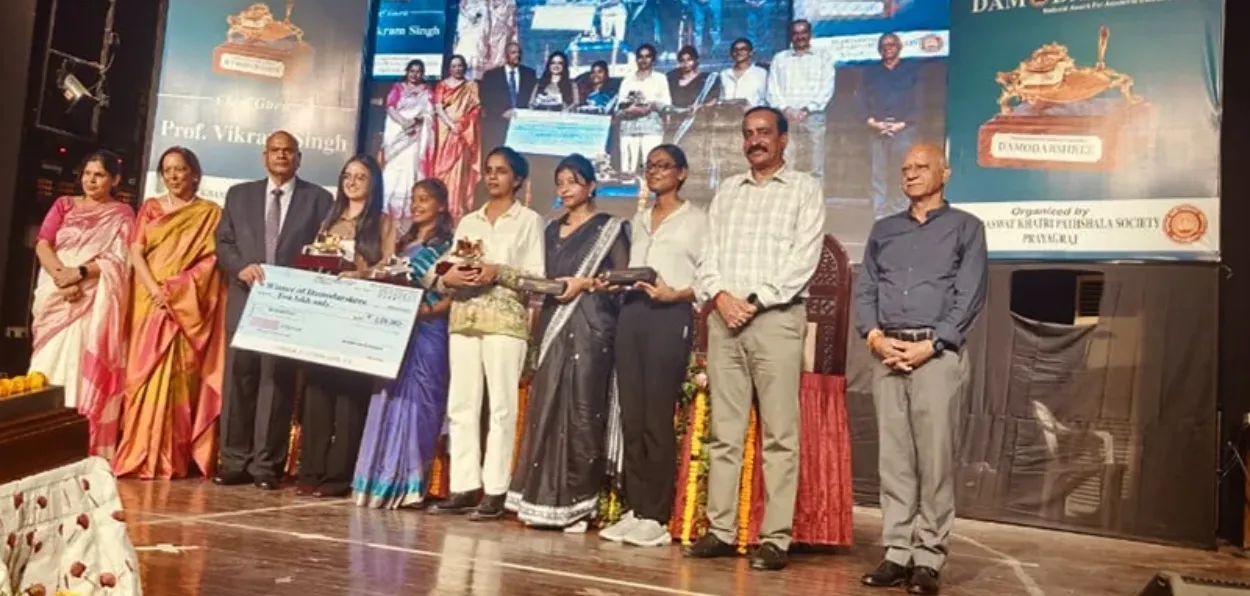
Areeba Anwar, an undergraduate student of the Department of Biosciences, Jamia Millia Islamia (JMI), has won the prestigious Damodarashri National Award for Academic Excellence 2024.
Her essay on the topic “Victory Will Be of Human Spirit” emerged as the best among participants from across the country. The Prayagraj-based SS Khanna Girls Degree College, affiliated with Allahabad University, has been giving away this award for 15 years.
This year, more t2,000 participants submitted their essays in the competition, out of which only 10 essays were selected for the final round.
Areeba Anwar’s essay not only featured in the top 10, but was also declared the winner for the best undergraduate essay across the country.
The award comprises a cash prize of Rs 30,000, a memento, and books worth Rs 5,000.
The award is given every year in a function on October 2. Areeba Anwar represented the university in the competition organized under the aegis of Literature, Fine Arts, Quiz and Debate Club under the DSW (Dean Students Welfare) office of Jamia Millia Islamia.
Before leaving for Prayagraj for the final defense of the essay, she presented her essay and discussed her ideas with Dr. Rumi Naqvi, a member of the Sahitya Club. Dr. Naqvi gave her important suggestions to make the essay stronger.
This 5,000-word essay by Areeba Anwar underlined the resilience of the human spirit. She explained how this spirit is important not only for our survival but also for the development of the nation.
Her essay was adjudged the best among 2,003 essays received from central universities, making her eligible for this prestigious award. This achievement is a proud moment for both Ariba Anwar and Jamia Millia Islamia, a testimony to the academic quality of the institution and the creativity of the students.
source: http://www.awazthevoice.in / Awaz, The Voice / Home> Story / by posted by Aasha Khosa, ATV / October 09th, 2024
An inside view of the storied, idealistic lives in the Savitribai Phule Community Libraries network
Photo Credit: Saba Khan
Saba Khan has participated in the EduLog programme with The Third Eye for its Education Edition. The EduLog mentored 12 writers and image-makers from India, Nepal and Bangladesh to remember—in the present continuous—their experience of education from a feminist lens.
During COVID, when almost everything was closed in Bhopal, we began delivering books to children by going door-to-door. Adults in the family took to reading those books too. Some girls’ mothers flipped through the pages of the book and looked at the illustrations. When we were giving books to young Rimsha Faiza, her sisters-in-law, who were not very old, came out inquisitively and asked about the books and about Savitribai Fatima Sheikh Library. In Mother India Colony, 14-year-old Saba said, “I am not educated at all. But can you give me some books to read?” Two days later, when I went back to her neighbourhood, she asked, “Can you get me a pad too?”
My friendship with Fiza started with books. When she took her first book, she said, “Next time, please give me two books. Both Rezwan and I will read them.” They were a newly married couple. Then one day she called me and said that Rezwan had beaten her. Fiza wanted me to counsel Rezwan, or else she would kill herself, she said. Perhaps she thought that Rezwan would listen to me—the lady with the books. We connected Fiza with a government-run One Stop Centre that works on the issue of violence against women. Meanwhile, Rezwan also started coming to our library and talking to us. They both complained about each other all the time. I patiently listened to both of them.
Gul Afsha, a mother of two, is a very brave woman. She steals a little time for herself from her kids and comes to the library for a while. She mixes with the other girls in the library and reads poems with great enthusiasm.
Photo Credit: Saba Khan
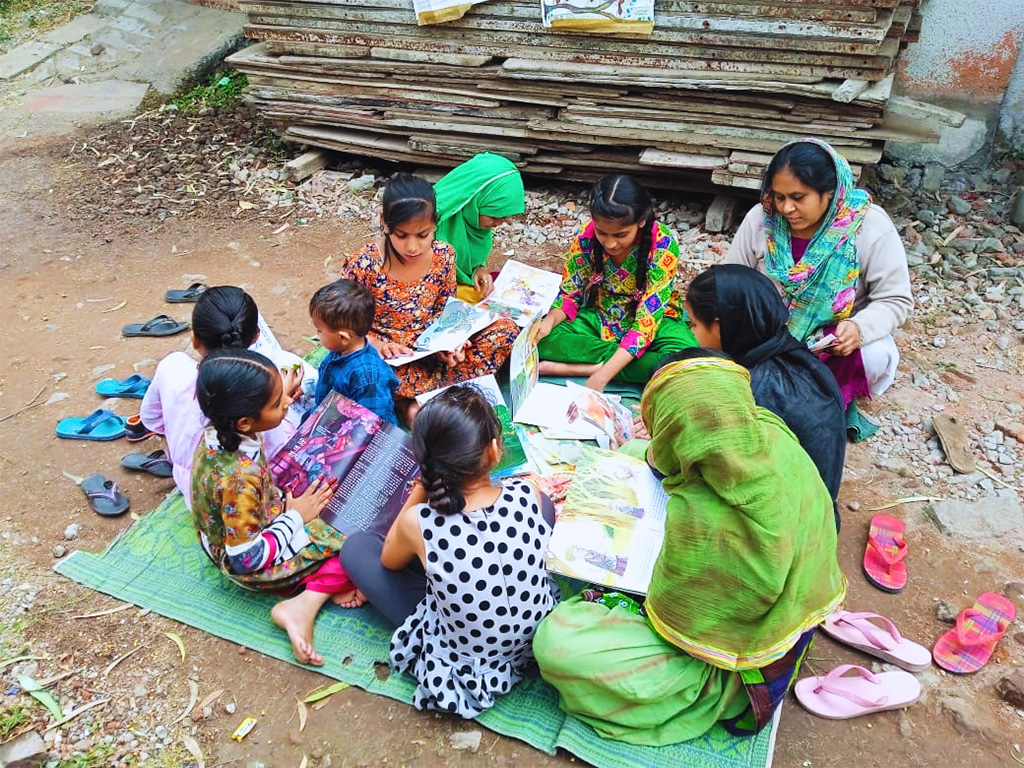
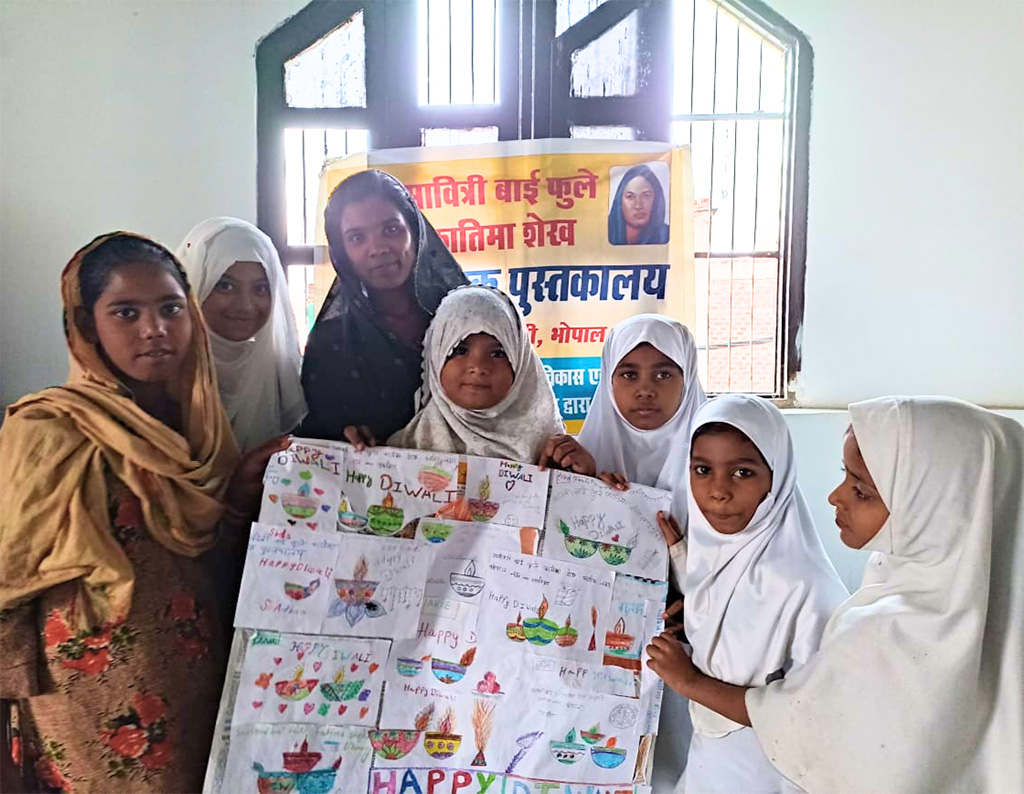
At the library, Zeba, Joya Tasmian, Mahak, Muskan, and Ilma, all help keep the books. These girls have been regular readers for a long time. When I was thinking of returning to my regular job post-COVID, I consulted with them if they could manage the library without me. They enthusiastically said, ‘Yes!’ At the library, I have often seen women from the community seeking advice about their children or sharing their difficulties with the librarian, no matter how young the librarian is. Among them, 14-year-old Mansi is the youngest librarian. She often imitates the way the older librarians speak. Whenever it is her turn to manage the library, she takes them to the park, forms a circle and reads poems aloud to them. One can already see the qualities of a leader in her.
I was born in Bhopal and grew up here. In 2011, as a social worker, I worked with several government schools under a Tata Trusts programme on education. I realised that often the relationship between teachers and children in schools is one where children sit silently with their fingers on their lips. They read only when the teacher asks them to and then put the book away. I had seen this happening in my school.
When I visited schools under this programme, some of the girls said that they had spoken to their mothers about me and their mothers had invited me home. I thought that this was an opportunity to talk to the children outside of the school. When I met the children in their neighbourhoods, I thought of how much fun it would be if they could read together. And that is how Savitribai Fatima Sheikh Library started.
Even since I was a child, I would always look for books to read. I have always felt that children must have books to read—that they should develop an affection for books and realise that books are their means to know about science, about the world. I used to think that wherever I would go, I would cultivate the habit of reading books in children and gradually, their love for books would grow. But I never imagined that I would see so many libraries opening up and so many educators joining in. Today, we have 11 community libraries across purana Bhopal, including areas like Arif Nagar Basti, Mother India Basti, Madari Mohalla, Bhanpur, Karund Basti and more. We have registered a total of 1,000 children. Twenty educators help run these libraries.
Photo Credit: Saba Khan
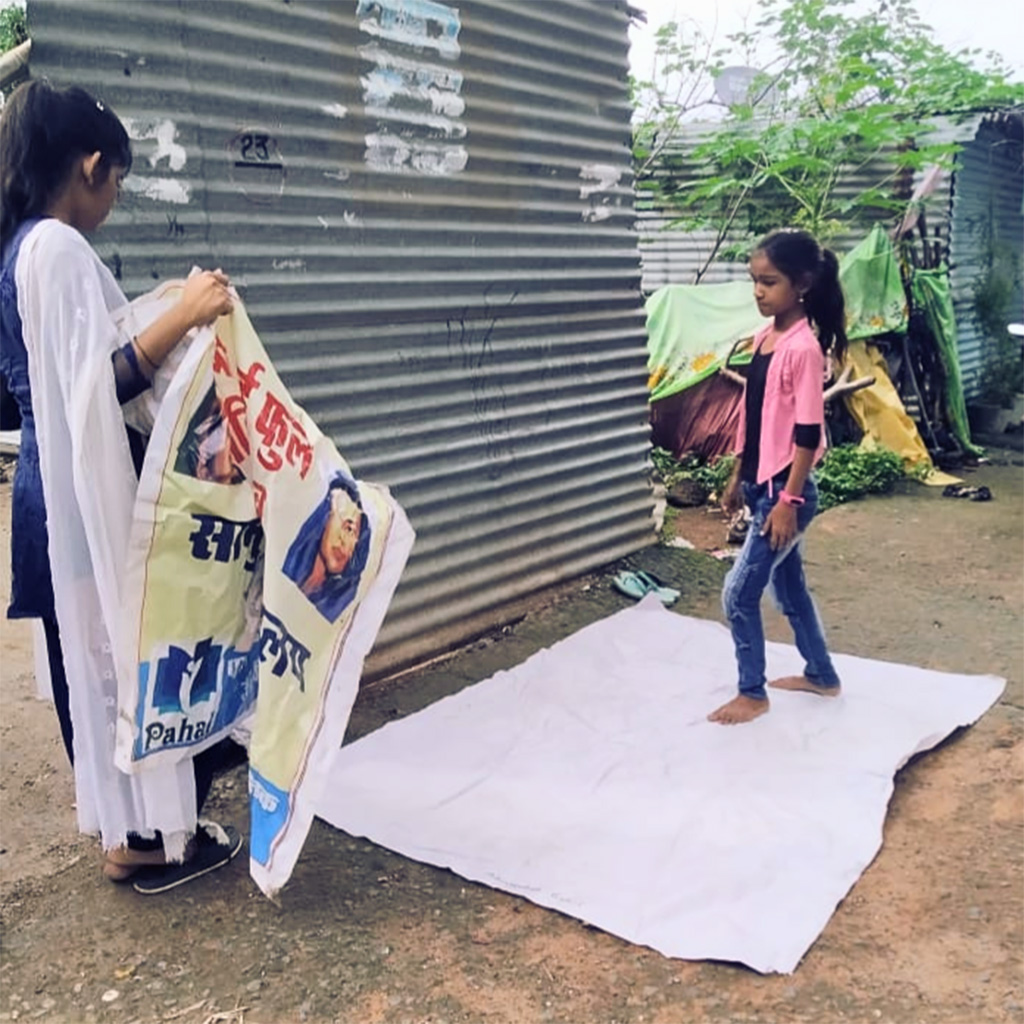
We collectively decided to name every library in the neighbourhood after Savitribai Phule and Fatima Sheikh. In a couple of neighbourhoods, boys like Chhotu, Musa and Irfan offered to help in the library. But everywhere else, it was the girls who took charge of the library, its activities and the visitors. In the beginning, we didn’t have tables, chairs, or shelves in our library. Our capital is the people of our community. They are always there to support us and be involved in the library’s future. When we had to move the library due to rain or other reasons, the women in the community created space in their homes and gently said, “Put it here.” In Mochi Mohalla, Sagar’s mother set up a library in her modest shanty where she used to cook food.
Saniya is one of our educators who sets up a library in her home every day. She lives near the Karond Mandi in the Blue Moon Colony where our oldest library used to run. Our library was located in a hamlet that was built on railway land and the place to run this library was given to us by the community. It was demolished by the Municipal Corporation in January 2022. In this situation, Saniya proposed to run the library from her home. She keeps the books and recites stories to children in her home library. She left school after the tenth grade but wants to resume her studies now. She hopes that working with children may convince her mother to somehow delay her marriage.
Jahangirabad is a largely Muslim neighbourhood where we had set up a library. Children who came to the library did not know of Ambedkar. Some called Savitribai Phule ‘Fula’, but some found it easy to pronounce Fatima Sheikh. In some schools, I noticed that they only talk about Muslim freedom fighters (as I imagine they would speak only of Hindu freedom fighters elsewhere). We need to talk about everyone so that children can know how diverse our country is.
Photo Credit: Saba Khan
We consciously try to include this diversity in our libraries. For example, two children from the Mehtar community visited our library. When it was time for them to enrol in school, a group of Muslim girls went with them to help. All the teachers at the school belonged to the upper castes. They commented, “These are Mehtar community children, they cannot study here. They won’t even wake up in the morning, how will they study? Their homes are so dirty.” Eventually, they were denied admission on these grounds. In the evening, everyone sat together in the library and we talked about the reasons behind ‘lower’ caste children being denied education. We decided to speak up as it was our right. The next day, we went to the school again and asked for the admission form. We asserted that our children would study there.
My intention in connecting children with books was also for them to learn to see the world through it. To see and understand the world means to know about the stories behind any discrimination, whether it is based on colour, caste, religion, or anything else.
When we learn about discrimination during the time of Savitribai Phule or Ambedkar, we understand our own biases too. For me, this is the meaning of loving books.
Our educator Tabassum worked continuously for three years to set up a library in Annunagar. Her father runs a madrasa at home where children learn Arabic while wearing scarves and caps. Tabassum believed that the children should learn Hindi and English alongside Arabic. They should also be able to play and move around the madrasa without wearing scarves. So, after her father’s class, she began telling the children to take off their scarves and caps if they wanted to and then she recited stories to them.
We do not keep books that attempt to demean or insult any language, race, religion, colour, caste, class, disability, group or individual. We strive to collect books related to various cultures, genders and people’s lives. Books are categorised according to the age of readers, considering the type of content, images and font size appropriate for each age group. We also have a separate category of books for new readers or those learning to read for the first time.
We have some other rules in our libraries that we tell all our educators to follow. For instance, no educator is allowed to use physical punishment or yell. If a child damages a book, we aren’t allowed to react angrily. We only explain. We do not tell the children how to sit or stand or poke at them generally.
If a child runs away with a book, we do not chase and force her to give it back. We have to trust that she will return it.
Most girls and older children get books issued and take them home. Sometimes, the books get damaged as well.
All the children and adults come together once a month to repair the books in the library. Taping torn pages or sticking them together with glue teaches children to handle the books gently in the future. It also reduces conflict.
Photo Credit: Saba Khan
All our librarians meet twice a month. It’s a treat to share our stories, experiences, happiness and excitement during those meetings. When we sit close to each other surrounded by books, it is like an entire world coalesces at a point. We recite poetry, oblivious to the surroundings or how we are sprawled, arms and legs stretched out. After chatting and singing, we choose books for the next month that can be used in various neighbourhood libraries. We identify spaces where we need each other’s help. We argue and persuade each other. These relationships are now so concrete that these librarians take care of each other’s families, eat out together, hang out during their free time and go out shopping for shoes or jewellery together, despite living in different parts of the city. Our librarians cherish their friendships and the community they have built, as much as the books.
This article is translated by Abhishek Shrivastava.
Saba lives in Bhopal, Madhya Pradesh. After completing her postgraduate studies in Child Psychology and Social Work, she has been working with different organisations on issues of girls and women for the last 13 years. Along with this, she independently manages the Savitri Bai Phule Fatima Shaikh Open Library in 11 different resettlements areas of Bhopal.
source: http://www.thethirdeyeportal.in / The Third Eye / Home> Praxis / by Saba Khan / February 14th, 2023
The development of Urdu prose and journalism and the parallel agenda of social reform in 19th-century Hyderabad played a vital role in setting the ground for the emergence of the Progressive Writers’ Movement a few decades later. The aims and objectives of the Progressive Writers’ Movement (PWM), which began in the 1930s in North India, resonated with students, poets, writers and scholars in Hyderabad. The PWM urged writers and poets to organise and break away from the hackneyed tropes, themes and genres of classical, romantic poetry that had dominated the literary milieu of Hyderabad and were associated with great cultural capital. Instead, the PWM wanted to create a new, more meaningful aesthetic that would represent changing political and social conditions and confront the material realities and experiences of everyday life. Apart from class struggle and class injustice, which was a major concern for the PWM, progressive writers also stressed the need to fight for political freedoms, resist political repression, and forge grassroots connections with the people 1.
The Hyderabad chapter of the Progressive Writers’ Association (PWA) was established by Makhdoom Mohiuddin along with Akhtar Hussain Raipuri and Sibt-e-Hasan in 1936. Sarojini Naidu offered her home, The Golden Threshold, as a venue for PWA gatherings and, later, for meetings of the banned Communist Party of India (CPI) 2. Among the women writers, journalists, intellectuals and activists associated with the PWA in the 1940s and 1950s were Jahanbano Naqvi, Zeenath Sajida, Rafia Sultana, Azeezunnisa Habibi, Brij Rani, Jamalunnisa Baji, her sisters Razia Begum and Zakia Begum, and Najma Nikhat. Amena Tahseen emphasises that the period after 1936 was critical for the history of women’s writing in Hyderabad because although women had been publishing their work, forming associations, and leading and participating in social, educational and literary initiatives for decades before the formation of the PWA, these endeavours were limited largely to women’s gatherings alone 3. The PWA changed this forever, and women began to attend and participate in literary and intellectual gatherings which had previously been restricted to men only.
Sarojini Naidu’s first collection of poems, named The Golden Threshold was published in 1905. (Photo: Getty Images)
The most vivid example and description of this shift comes from Jamalunnisa Baji’s autobiography, Bikhri Yaadein (Scattered Memories; 2008), which not only documents and assesses the political and literary events that took place in Hyderabad over the span of almost a century, but also furnishes information and reflection on what these events meant to women like Baji. Pardah is an important preoccupation in this account. Baji had long considered it her bane but had been unable to give it up. She describes how her younger sisters—who had had more freedom than her, were better educated, and were allowed greater choice in choosing their partners—had discarded the pardah at a young age. Literary gatherings with the leading Progressive figures of the day began to take place in Baji’s house in the 1940s on her and her brother Akhtar’s initiative. She had always been interested in literature and politics and was supported by parents and siblings who had an apparently insatiable appetite for education and literature. This drew her all the more to discussions that were happening beyond the curtain that separated her from gatherings where her sisters and other women who did not observe pardah, listened and spoke 4. Such gatherings offered her the opportunity to gradually emerge out of pardah.
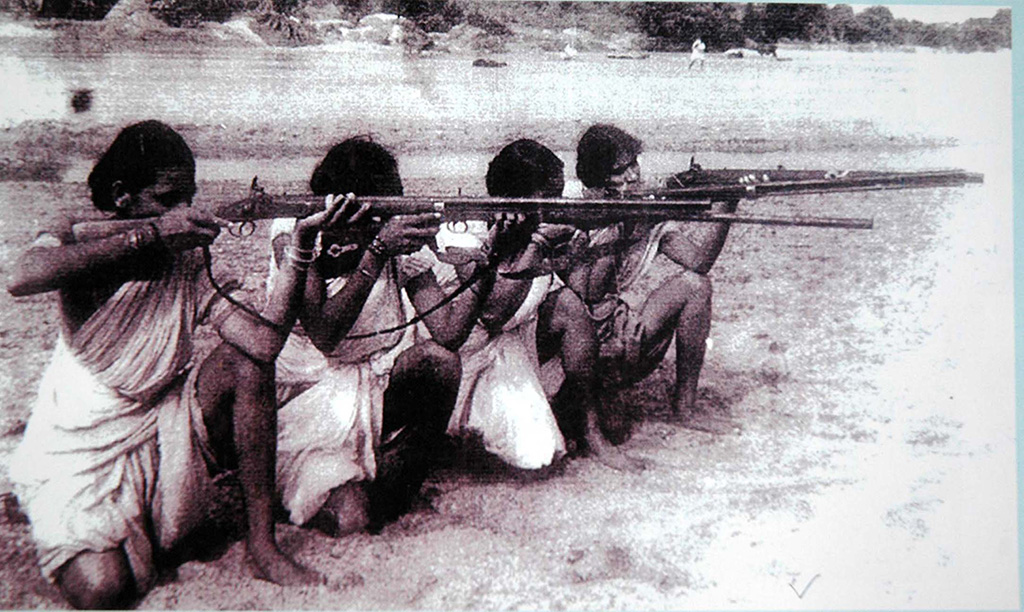
The Telangana people’s armed struggle. (Photo: People’s Democracy)
The Progressive writers and the Telangana People’s Struggle
Between 1946 and 1951, the rural districts of Telangana had risen against the feudal structure of the Hyderabad state and the oppression it had wreaked on peasants and agricultural labourers for generations. The struggle began organically, with a tenant cultivator named Chityala Ailamma refusing to hand over her harvest to the landlord’s men. Within a few months, however, the Communist Party entered the fray and began to operate under the aegis of the Andhra Mahasabha, which had been formed in 1930 to champion the cultural and social rights of Telugu-speaking people. At its height, the Telangana People’s Struggle involved three million people from 3,000 villages 5. The struggle also made its way to the cities, as factory workers and students protested and went on strike. Many Progressive writers also identified as communists and were active members of the CPI. As the people’s struggle intensified in Telangana, the CPI was banned in Hyderabad and many PWA members had to go underground. So,
PWA meetings began to take place at Baji’s house at night, which was less conspicuous than the Golden Threshold, Sarojini Naidu’s house, and offered better cover to the likes of Makhdoom, who was well-known and easily recognised.
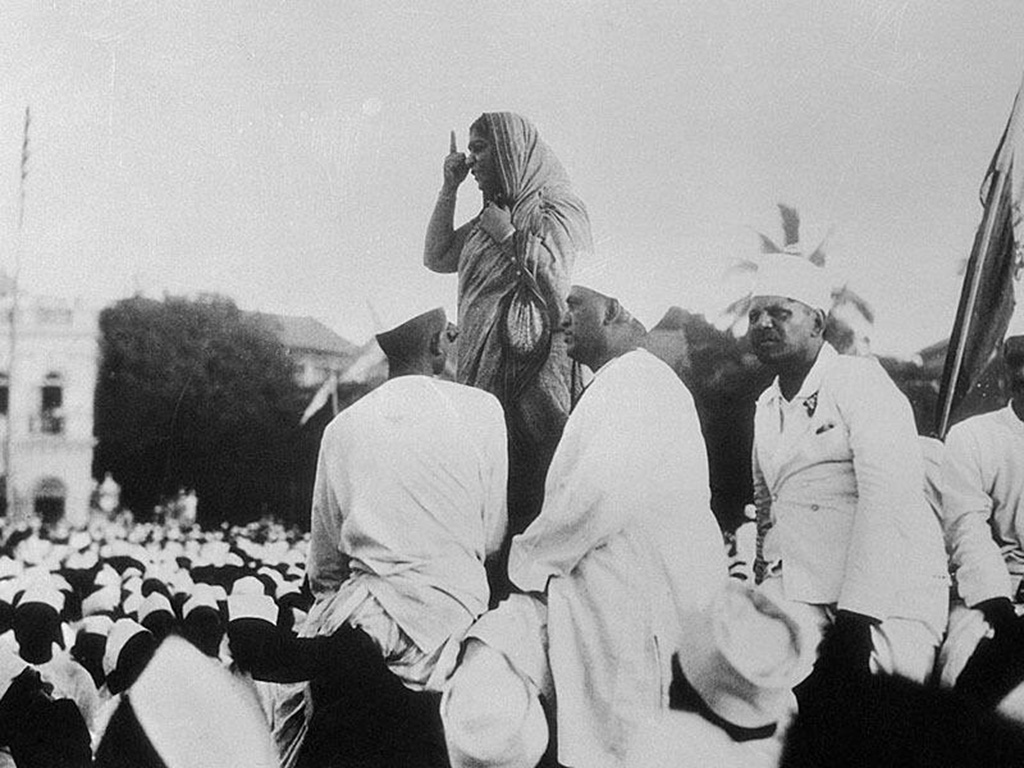
Baji formally discarded the pardah during the All-India Progressive Writers’ Conference in 1945, which was held in Hyderabad. She, her sisters, and one other woman were the only women to sit in the open with the men 6. What enabled the participation of a large number of Hyderabadis, especially women, in the Progressive movement was the PWA’s approach right from the start to not limit their membership to committed socialists 7. To be sure, there was always a core group of socialist writers at its centre, but the only expectation from all member writers—irrespective of ideological persuasions—consisted of them sharing the basic agenda of the manifesto, i.e. to build a sturdy organisation of writers who opposed reactionary social tendencies and stood for a literature rooted in reality. Indeed, so successful was this broadly defined manifesto that there were many writers who would not fall easily into this category if it had been ideologically restricted, but who nonetheless identified as Progressive and were closely connected with the PWM.
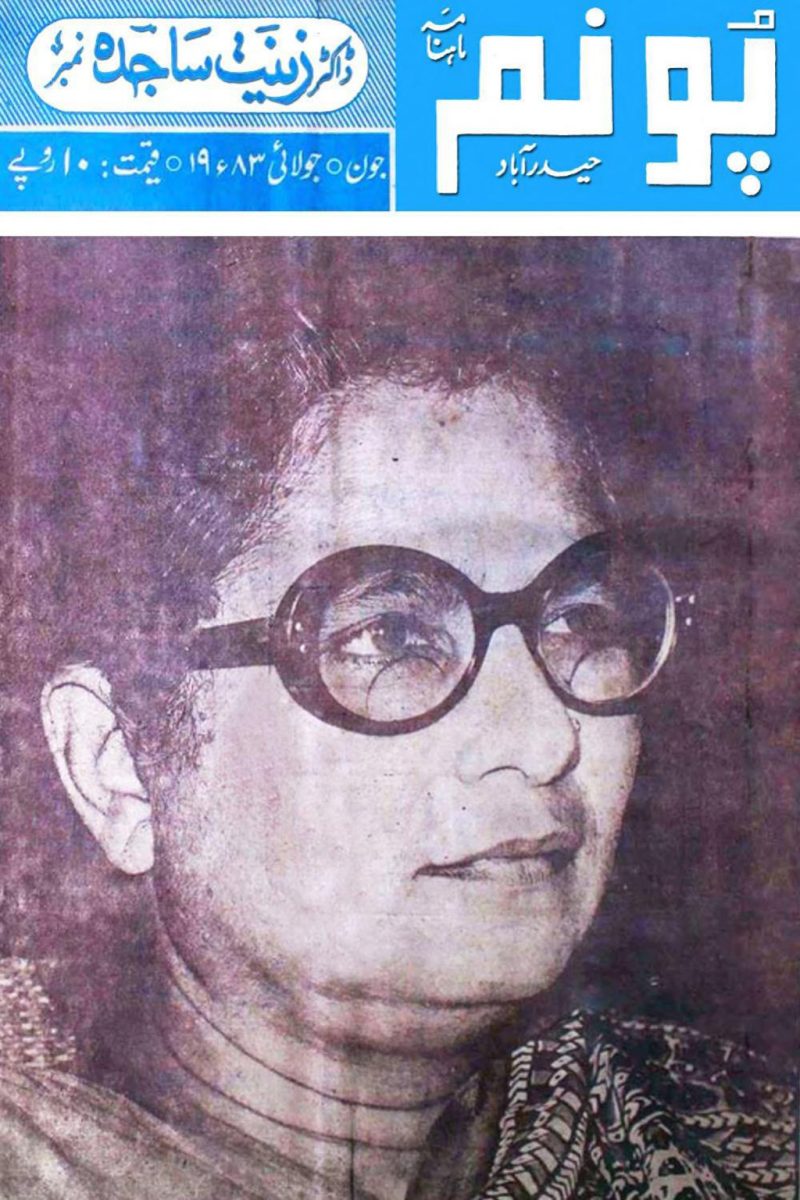
Dr. Zeenath Sajida on the cover of Poonam, Urdu monthly magazine in Hyderabad. (Photo: archive.org)
Zeenath Sajida (1924-2009) and a thriving culture of women writers
Zeenath Sajida was one such figure who dominated the literary and cultural circles of Hyderabad. She is a good example of a Progressive writer who not only wrote works criticising social injustices and exposing the hollowness of middle-class values, but also those that were less political and consisted of humorous essays as well as classic, romantic short stories. Sajida was most prolific in the decades spanning the 1940s to the 1960s, publishing an anthology of short stories in 1947 and several academic manuscripts on literatures of the Deccan. But the most fascinating literary writings she produced consisted of her essays in the genres of tanz-o-mizah (humour and satire) and khaake (pen-portraits), which were published in different newspapers and literary magazines and compiled only after her death in 2009. They cover subjects as varied as the gendered perspectives and lived experiences of women from different walks of life, critiques of social manners and everyday human folly, and nuanced documentation of the history and heritage of her beloved Hyderabad.
In the most political and radical of these texts, Sajida artfully and rigorously debates provocative social questions and taboos while disguising them in the genre of inshaiye or light sketches.
In these, she shows herself to be far ahead of her time, writing about things that we know today as gender fluidity, gender privilege, the mental load of women in relation to household management, the invisibility of domestic labour, and the unfair and unrealistic demands made of middle-class women professionals.
These essays also reveal the narrator’s most disarmingly vulnerable thoughts, feelings, and frailties; in the process, Sajida emerges as a writer who knows how to use emotion to extract both empathy as well as laughs from her readers.
There was a thriving culture of women writers of humour, satire and pen-portraits in Hyderabad right from the 1940s, which both received individual and institutional support from male writers and scholars and was also subjected to ridicule by them 8. Sajida’s work marks the best of this tradition of women’s non-fiction and is important to read and know also because non-fiction is generally neglected in favour of fiction and poetry, which have greater cultural capital; have come to form well-defined and durable stereotypes of Urdu literature; and, thus, capture the attention of translators, scholars and publishers alike.
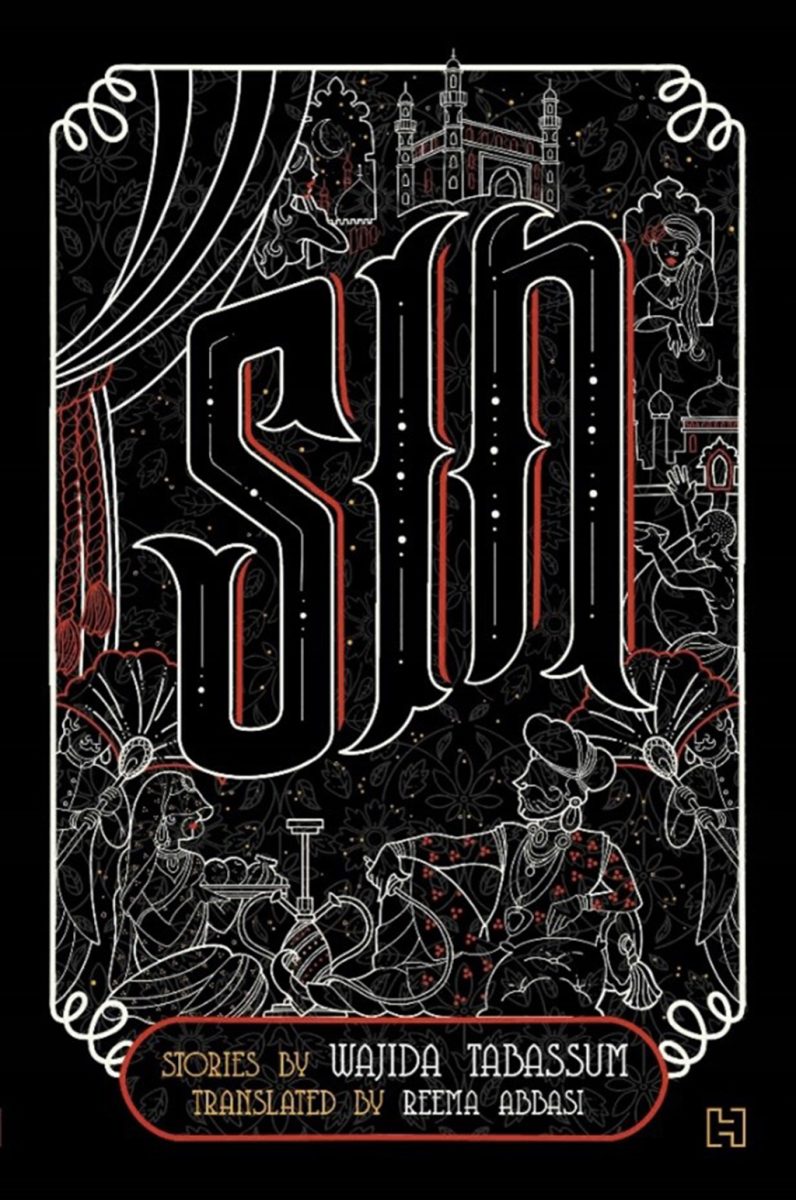
Among Sajida’s younger contemporaries were Jeelani Bano (b. 1936), Najma Nikhat (1936–1997), and Wajida Tabassum (1935–2011). Nikhat was a writer of short stories whose loyalty and commitment to the PWM exceeded the heyday of this organisation. Like Sajida, although Nikhat produced a relatively modest number of short stories, her oeuvre demonstrates skill and is important for its sustained engagement with her lifelong preoccupations and concerns. Her stories about life in the feudal deodis of Hyderabad are insightful and instructive in establishing how women of both working as well as upper classes lived and negotiated feudal patriarchy and the conservative social world of princely Hyderabad. She also wrote hopeful stories about the revolution and depicted the lives of the poor in the rural districts of Telangana and Andhra, where she lived for many years.
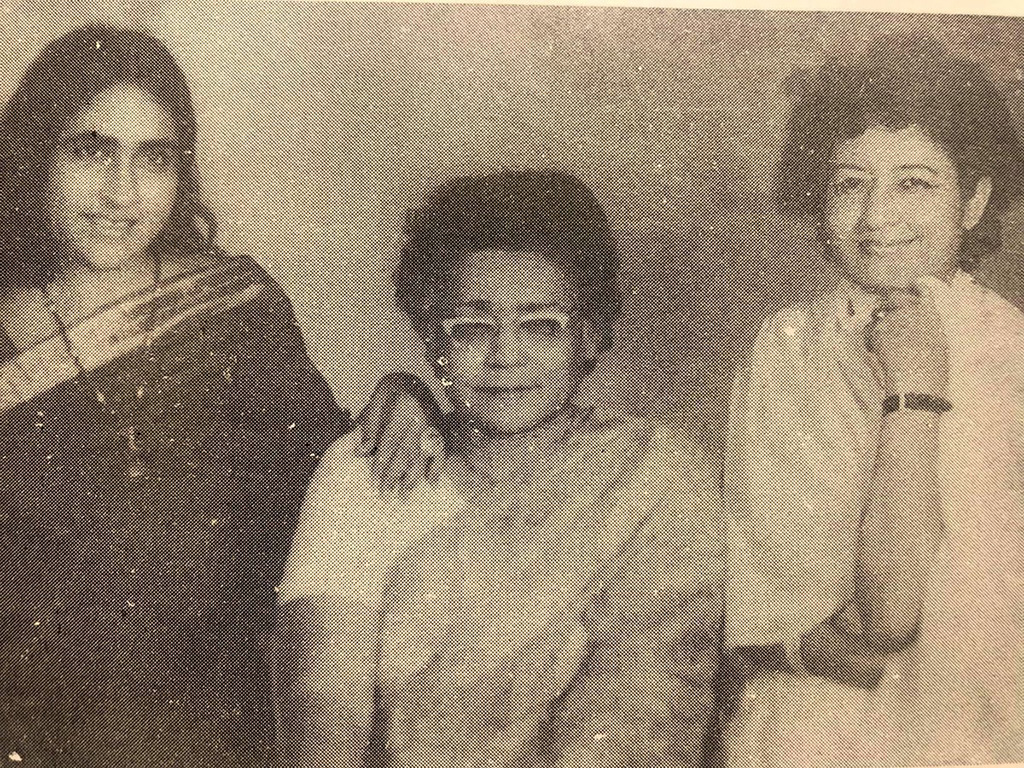
A rare picture of R-L Qurratulain Hyder, Ismat Chughtai and Wajida Tabassum – known names in Urdu Literature. Twitter- FaseehBariKhan
Wajida Tabassum is understood today to be more of a feminist than an avowed Progressive. This is because she writes defiantly and unselfconsciously about female sexuality, caste patriarchy and sexual violence against women in feudal homes.
Although her many novels and short stories were successful and popular and the latter, in particular, are enjoying a resurgence of interest among youth after the Me Too movement, many Hyderabadis, including scholars, look down on her work as “obscene” and “unjust” towards the feudal aristocracy 9.
The “shock value” of Tabassum’s approach often belies her profound and nuanced understanding of the precise workings of culture and society towards concentrating and maintaining power in a few hands. Until recently, only a couple of Tabassum’s stories were available in English translation.
Other continuities
Over time, the PWM—its ideology and aesthetic—acquired a hegemony that ensured the marginalisation of writers who did not consider themselves Progressives. This became a big problem when in the tension between the “creative section” and the “political section” of the PWA (Progressive Writers’ Association), the latter prevailed, and this often resulted in didactic writing dominated by socialist themes and motivations 10. The ambivalence and even disenchantment of writers in other places towards the PWA, which increasingly adopted a rigid, even conservative stance towards the choice and treatment of themes employed by its members, is well known 11. But given that it had such a compelling social message, an influential platform, and an overarching visibility and influence, it is understandable that many women writers would continue to operate under the aegis of the PWA and utilise its many resources.
Other writers who did not subscribe to Progressive writing often represented literary and cultural continuities that were desirable and significant in other ways. After 1948, Urdu had been relegated to a secondary place in Hyderabad, and its resources and institutions were severely undermined by the minoritisation imposed by the new regime. Despite this, nuha, marsiya, azadari and salaam, traditional poetic genres that belong to the Shia practice of Muharram, continued to be regularly published in magazines and newspapers and also performed in ashurkhanas. Other religious or mystical genres, such as hamd and naat, and ghazals, nazms, and qasidas that did not represent Progressive thought or aesthetics persisted too. Many women poets wrote and published in these genres. Additionally, nazms for children were very popular in Hyderabad, and women were enthusiastic proponents of this genre as well 12. Often, these engagements revealed completely different ways of engaging with social and political discourses from Progressive writing, as can be seen in the way the poet Syeda Bano “Hijab”/Hijab Bilgrami juxtaposed the battle of Karbala with the struggle for freedom from colonial rule 13.
New woman, new writing
The next major shift in Urdu literature came with jadeediyat or modernism in the 1960s, which turned the subject of literature inwards and focused on the psyche of the individual, allowing for much experimentation in genre, mode and language. Some of the short stories and novels of Jeelani Bano and Rafia Manzoor ul-Ameen are good examples of jadeediyat from Hyderabad. Both wrote short stories and novels about contemporary protagonists struggling with the human condition as well as a variety of issues associated with the modern state and society. They also produced scripts and screenplays for successful TV serials, documentaries and films.
Jeelani Bano
Rafia Manzoor ul-Ameen
Rafia Manzoor ul-Ameen is best known today for her novels, especially Alam Panaah (Refuge of the World; 1983) and Yeh Raaste (These Paths; 1995), and the immensely popular TV series that was based on the former text and whose screenplay she wrote too. Both novels fall in the genre of romantic fiction and testify to her craft with language, narration, plot, and pace. The most attractive feature of this writer’s work is her psychologically and emotionally complex heroines, who represent a new world after the transfer of power in Hyderabad, in which young women were stepping out of the ostensible “protection” of the zenana, seeking education, professional employment and financial independence, and negotiating a society that did not appear to be prepared for their entry and often openly expressed its disapproval. These novels also offer multifaceted commentary on the social culture and ethnography of groups associated with Hyderabad and the Nilgiris respectively.
The significance of Jeelani Bano’s modernist writing can be appreciated from PWA co-founder Sajjad Zaheer’s comment in a letter to Sulaiman Areeb, editor of Saba (Hyderabad), that as long as Jeelani Bano is in Hyderabad, they need not worry about the Naya Afsana (New Short Story), a genre that had picked up pace in Urdu-Hindi literature in the 1950s and focused more on the inner state of the individual subject than on the external world or its ideological preoccupations 14. Over more than 50 years of writing, Bano’s nationally and internationally acclaimed short stories span three identifiable schools of Urdu literature: taraqqi-pasand adab (Progressive writing), jadeediyat (modernism), and tajreediyat (abstractism), although she has consistently refused to declare her affiliation or identification with any of these schools, explaining that there are many influences in her work and that she seeks only to represent the world around her and does not adhere to any particular ideological position.
Although some of Bano’s work has been admirably translated into English by Zakia Mashhadi, her two novels have not been given their due by English-language readers and scholars. Aiwan-e-Ghazal and Baarish-e-Sang represent the most serious and rigorous engagement with the history of princely and post-princely Hyderabad in creative writing. While the former narrates the lives of four generations of an aristocratic family against the backdrop of transformative change during and after the transfer of power, the latter represents the lives of landless tillers and labourers tottering under the weight of crushing debts in the rural districts of Telangana. Both texts offer rich and sombre insight into urgent questions of class and gender and offer a remarkable degree of depth where class, in particular, is concerned.
Radio continued to be an important medium for women’s voices in Hyderabad after the transfer of power, and the work of most Progressive writers in Hyderabad (and elsewhere) as well as those who did not subscribe to this category remained in demand. Among the many women who wrote for All India Radio (AIR) and read out their stories and essays were Zeenath Sajida, Najma Nikhat, Fatima Alam Ali and Badrunnisa Begum. Another vital development for women’s literary culture was the establishment of the Mehfil-e-Khawateen (Women’s Gathering) in 1971 at Urdu Hall (f. 1955), which became a flourishing platform for Hyderabadi women writers. Women poets of Progressive and other persuasions, such as Azmat Abdul Qayyum, Azizunnisa Saba, Ashraf Rafi and Muzaffarunnisa Naz, were instrumental in founding and running the Mehfil over the years. Monthly meetings and annual events are conducted and are well attended. The association also publishes an annual magazine.
Life-writing and auto/biography
Another important feature of Hyderabadi women’s writing in Urdu is an enduring affinity for different forms of life-writing. While Jamalunnisa Baji’s autobiography is the richest example, meaningful deployments of auto/biography emerge also in other genres that demonstrate a strong element of self-construction and self-performance, usually through first-person narration. The travelogues of Sughra Humayun Mirza and the humorous essays and pen-portraits of Fatima Alam Ali (1923-2020) are a good example of this trend. Fatima Begum grew up in an environment suffused with literary, political and intellectual discussions in the 1930s and 1940s, for her father was Qazi Abdul Ghaffar (1889-1956), the immensely popular and admired Progressive editor of Payaam. Her humorous essays were published in Siasat from the 1960s to the 2000s and also read on AIR. Some of them were compiled into a book called Yaadash Bakhaer (May God Preserve Them; 1989), which also furnishes a selection of her pen-portraits of the poets and scholars she knew. These portraits animate in words the rich and potent milieu of the mid-20th century and vividly perform and re-create the development of Fatima Begum’s own subjectivity.
Fatima Alam Ali (Photo: Scroll.in)
Finally, scholar and translator Oudesh Rani Bawa (b. 1941) writes a weekly column, titled Mujhe Yaad Hai Sab Zara Zara Sa (My Blurred Memories of Yesteryear), in the Urdu daily Munsif, where she engages with popular and historiographical narratives of the past, filtered usually through her memories and research on the material and linguistic heritage of Hyderabad. She also uses this column as a platform for her political and social critique, and has, most recently, begun to actively criticise local and national events, with respect to government policies, heritage and development, and growing right-wing intolerance and violence.
Hyderabad continues to have a thriving culture of humorous writing among women in both prose and poetry, besides other modes of writing, such as the short story, novel, novelette, plays and ghazals.
Stree Shakti Sanghatana, We Were Making History: Life Stories of Women in the Telangana People’s Struggle, New Delhi: Kali for Women, 1989, 3.
Jamalunnisa 2008: 103. Op. cit.
Ordinary Hyderabadis were suspicious of communists because they were all thought to be atheists. Ibid. 121).
Habeeb Ziya, who is a humourist herself and has compiled and edited a collection of Hyderabadi women’s humorous writings, reveals that Mujtaba Hussain, the most prominent and celebrated humourist from Hyderabad, had criticised her article on Hyderabadi women’s humour in the Siasat newspaper. He had wondered if men are supposed to sweep and mop, while women write humour in large numbers. Ziya Hyderabad ki Tanz-o-Mizah Nigar Khawateen. Hyderabad: Shagoofa Publications, 2005, 7.
See e.g. Ashraf Rafi, “Hyderabad ki Afsana-Nigar Khawateen,” in Tahseen 2017: 173.
Mir and Mir 2006: 28. Op. cit.
See Ayesha Jalal, The Pity of Partition: Manto’s Life, Times and Work across the India-Pakistan Divide, Noida: Harper Collins, 2013, 162–72; Jalil 2014: chapter 7; Mir and Mir 2006: 33.
Tahseen 2017: 136. Op. cit.
Riyaz Fatima Tashhir, “Hyderabad mein Khawateen ki Rasaai Shayari,” in Tahseen 2017: 219.
Mosharraf Ali, Jeelani Bano ki Novel Nigari ka Tanqeedi Mutala, Delhi: Educational Publishing House, 2003, 21.
Nazia Akhtar is an Assistant Professor (Human Sciences Research Group) at the International Institute of Information Technology (IIIT), Hyderabad (India). In 2017, she was awarded a New India Foundation fellowship to write a book on Urdu prose by Hyderabadi women. Bibi’s Room: Hyderabadi Women and Twentieth-Century Urdu Prose went into print in July 2022.
source: http://www.thethirdeyeportal.in / The Third Eye / Home> Praxis / by Nazia Akhtar / January 19th, 2023
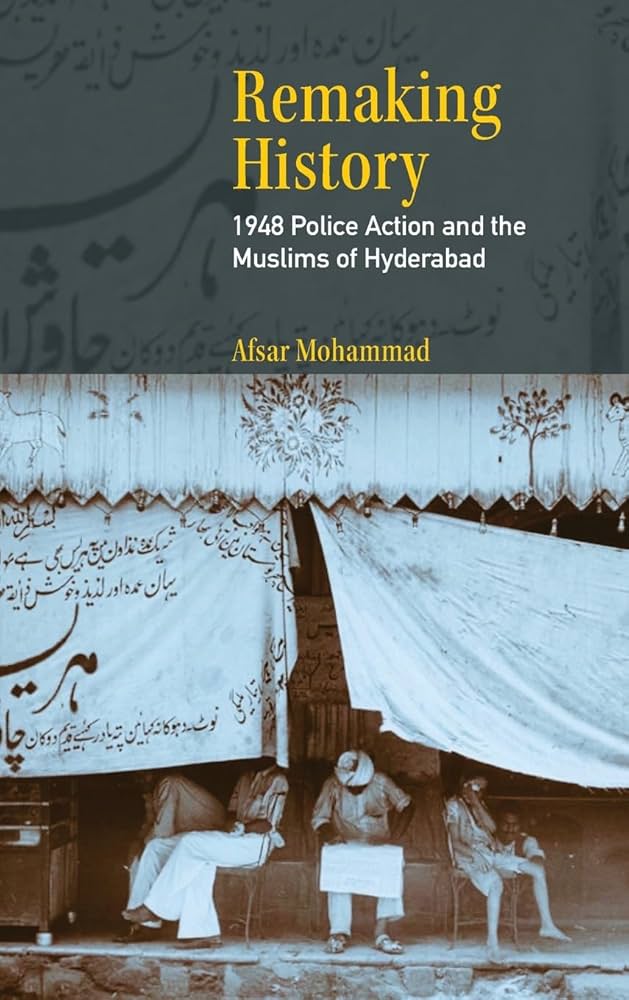
Hyderabad, known for its grandeur and the unique confluence of Hindu-Muslim culture, found itself at a crossroads of political and religious tensions. Afsar Mohammad sheds light on the brutal military campaign, where the ordinary citizens of Hyderabad became casualties in a political power play between the Nizam and the Indian government. The book emphasizes that…
Book: Remaking History: 1948 Police Action and the Muslims of Hyderabad
Author: Afsar Mohammad / Publisher: Cambridge University Press / Published:June 2023 /Hardcover: 320 pages
Afsar Mohammad, a renowned poet, scholar, and expert on South Asian literary cultures, brings forth a deeply researched and compelling narrative in his book Remaking History: 1948 Police Action and the Muslims of Hyderabad. As a professor of South Asian Studies at the University of Pennsylvania, Afsar has extensively studied the intersection of politics, religion, and literature in the Indian subcontinent. His previous works have explored themes of religious identity and cultural expression in the context of Hyderabad. With Remaking History, he delves into one of the most tragic and often overlooked episodes in India’s postcolonial history – the 1948 police action in Hyderabad.
The book addresses the military operation launched by the Indian government from September 14 to 18, 1948, to forcibly integrate the princely state of Hyderabad into the Indian Union. As India was celebrating its newfound independence, the state of Hyderabad was caught in a violent struggle. The operation, commonly referred to as the “police action,” resulted in immense bloodshed, with the Muslim population of Hyderabad suffering disproportionately.
Hyderabad, known for its grandeur and the unique confluence of Hindu-Muslim culture, found itself at a crossroads of political and religious tensions. Afsar Mohammad sheds light on the brutal military campaign, where the ordinary citizens of Hyderabad became casualties in a political power play between the Nizam and the Indian government. The book emphasizes that while the Razakars, a military group loyal to the Nizam, escaped across borders, it was the common Muslims of Hyderabad who bore the brunt of the violence that followed the military intervention. Thousands of lives were lost, and many more were displaced during the five days of turmoil.
One of the pivotal aspects of the book is its reliance on the Sunderlal Committee Report, an investigation commissioned by Prime Minister Jawaharlal Nehru in the immediate aftermath of the operation. This committee traveled across Hyderabad and the Deccan region, gathering firsthand testimonies from survivors. The report revealed shocking truths: thousands of Muslims were massacred during the police action, and the violence forced many others to flee to Pakistan and other countries. However, the report was suppressed for decades under the guise of “national security,” only surfacing in recent years thanks to the persistent efforts of historians. This suppression of critical historical evidence is a central theme of the book, as Afsar Mohammad argues that official narratives have long ignored or downplayed the extent of the violence.
In addition to exposing the atrocities committed, Remaking History explores how this dark period shaped the literary and cultural landscapes of postcolonial Hyderabad. The traumatic events of 1948 found their way into novels, poems, memoirs, and personal narratives written by survivors and their descendants. Afsar Mohammad highlights how literature became a means for the people of Hyderabad to process their grief, remember their dead, and make sense of the immense suffering they endured. The book documents the ways in which Hyderabad’s writers and poets used their work to preserve the memory of the police action, even as the official narrative sought to erase or obscure these painful truths.
Afsar Mohammad also critically examines the political reframing of the police action in later years. In 1998, L.K. Advani, a key figure in India’s Hindutva movement, proclaimed the police action as a “liberation” of Hyderabad, casting it as a moment of triumph rather than tragedy. This reinterpretation of history, the book argues, was part of a larger effort to further a communal agenda, obscuring the fact that the violence was largely directed at Muslims. Afsar Mohammad challenges readers to question whether the police action was truly a moment of liberation, or if it was a tool used to suppress the region’s Muslim population and further political interests.
One of the most striking aspects of Remaking History is the emphasis on the role of personal stories in reconstructing the past. Afsar Mohammad stresses that official documents and reports can only go so far in revealing the full picture. The true history, he argues, is often found in the personal memoirs, oral histories, and forgotten novels of those who lived through these events. Many of the eyewitnesses and survivors of the 1948 police action are no longer alive, their stories lost to time. However, the book insists that these personal accounts are essential to understanding the true scope of the violence and its lasting impact on Hyderabad.
The book also highlights the lasting cultural and social shifts that emerged from the violence. Despite the bloodshed, Hyderabad’s centuries-old legacy of Hindu-Muslim unity endured, and the city’s cultural landscape continued to evolve. In the years following the police action, a wave of literary and artistic movements arose, particularly in the Telangana region, shaping the social and cultural identity of Hyderabad for generations to come.
Afsar Mohammad’s Remaking History is a crucial work that brings much-needed attention to a neglected chapter in India’s postcolonial history. It challenges the sanitized narratives of Indian nationalism and raises important questions about the consequences of political violence. By combining rigorous historical research with a deep understanding of Hyderabad’s literary cultures, Afsar Mohammad presents a nuanced and powerful account of the 1948 police action and its aftermath. The book serves as both a historical investigation and a tribute to the resilience of Hyderabad’s people and culture in the face of adversity.
In conclusion, Remaking History is an essential contribution to the historiography of postcolonial India. It calls on readers to confront the uncomfortable truths of the past and reflects on how history is often manipulated to serve political agendas. Afsar Mohammad’s work is a timely reminder that the trauma of violence and suppression should not be forgotten, but instead, recognized and remembered in its entirety, for the sake of future generations.
source: http://www.radianceweekly.com / Radiance Viewsweekly / Home> Book Review / by Ayesha Sultana / September 24th, 2024