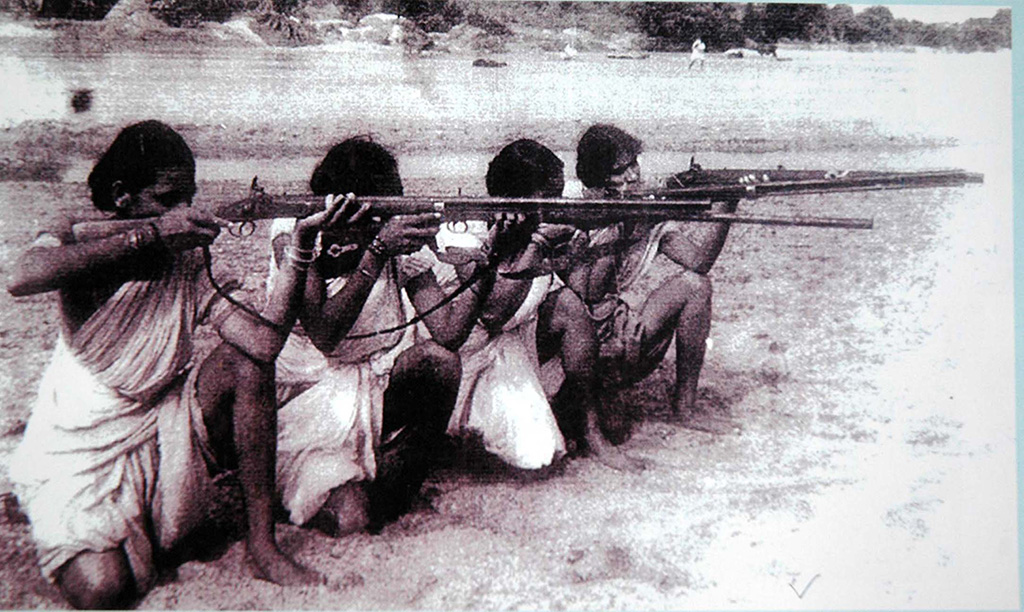
Many believed that the Azad Hind Fauj or the Indian National Army led by Subhas Chandra Bose during the Second World War was made of Indian Prisoners of War captured by Japan. This is a misconception, far away from reality.
A Slice Of History
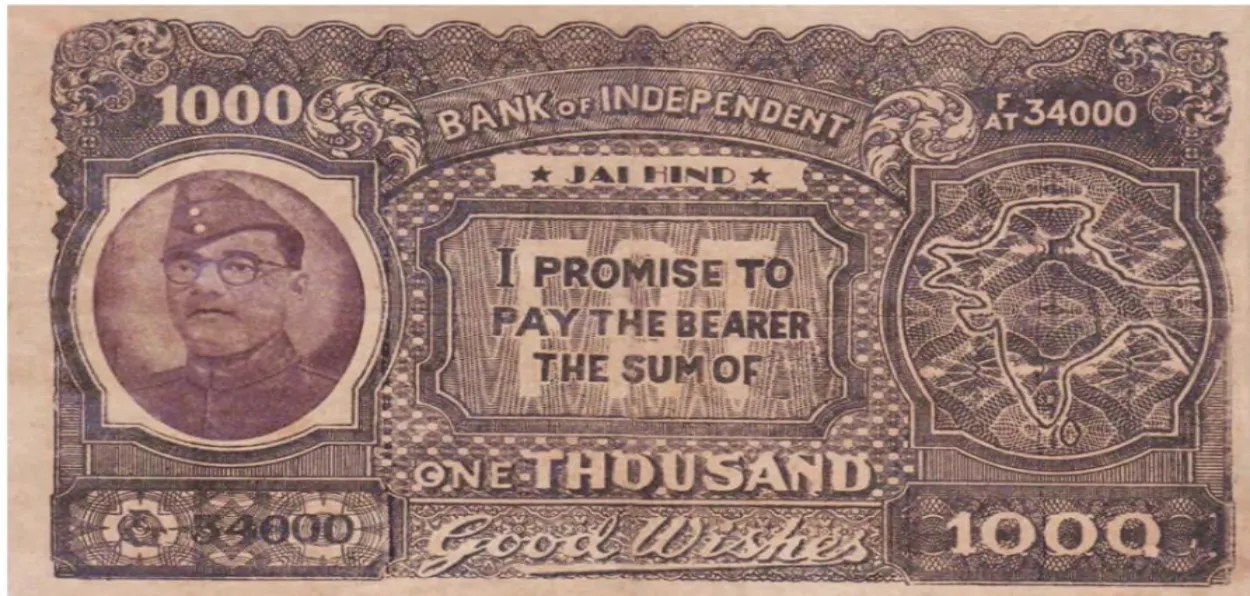
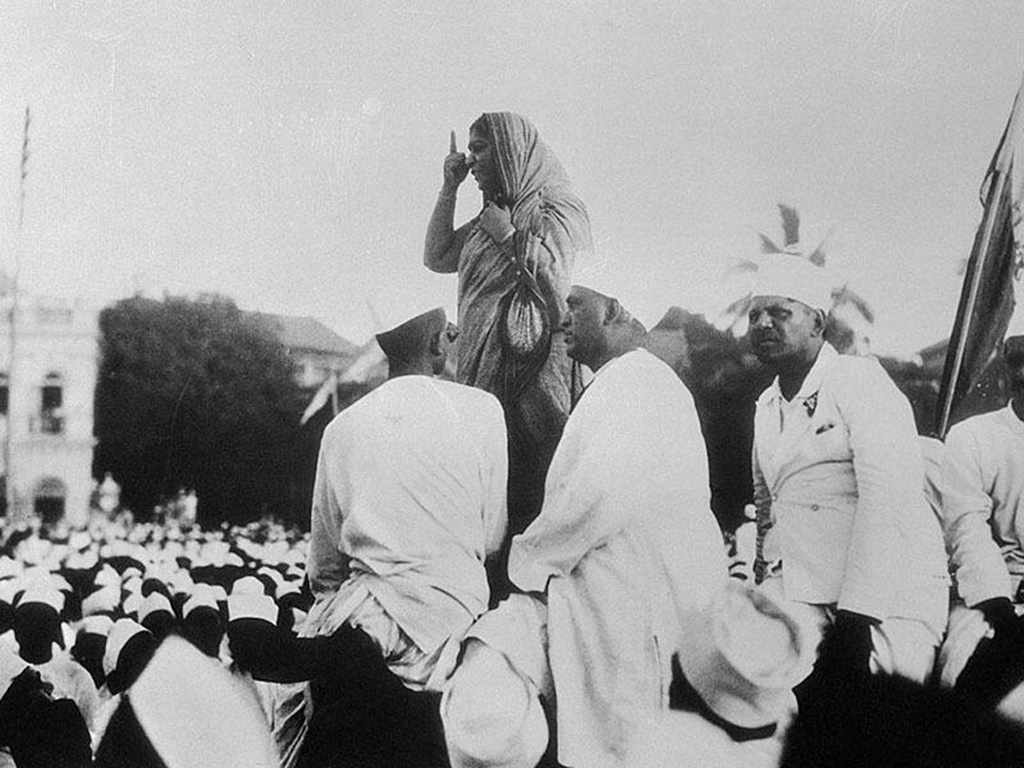
The reality is that INA was a military unit of Arzi Hukumat-i-Azad Hind (The Provisional Government of Free India). Popularly known as Azad Hind Sarkar, this government led by Subhas Chandra Bose had all the working departments of a civilian administration as health, women empowerment, research, civil services, and banks. It also has its currency. The provisional government was recognised by several countries.
Initially, the government was being run on crowdfunding from the Indian Diaspora of Malaysia, Singapore, Burma, and other Southeast Asian countries. Soon, Bose felt the need to have a central banking system and currency.
An official notification from the Azad Hind Sarkar declared, “His Excellency Netaji Subhas Chandra Bose inaugurated the National Bank of Azad Hind Ltd., on Wednesday, the 5th April, 1944. His Excellency the Finance Minister of Burma, His Excellency the Ambassador of Nippon, and other distinguished members of the Burmese Government and high ranking Officers of the Imperial Nipponese Army were also present.
“The aims and objectives of the National Bank of Azad Hind Ltd., are primarily two-fold Firstly this Bank will help to mobilise the financial resources of Indians as a part of our programme of Total Mobilisation, and secondly this Bank will serve the interests of Burma where it is now established.
“The Bank will also render service to the Provisional Government of Azad Hind by acting as its Agents.”
In April 1944, Bose was discussing plans to establish a central bank of Azad Hind Sarkar. Everyone was worried about the money. A woman officer of the INA in her book Jai Hind: Diary of a Rebel Daughter noted, “Netaji was discussing finance problems with a Muslim multi-millionaire here in Rangoon. He suggested to him that we must have our own Bank because a Government without a bank is unheard of. Again as soon as Imphal falls, our Government would be issuing its currency, and a bank would be invaluable then. Netaji asked our friend, the multi-millionaire, for his suggestions for it.
“The reply came in the form of a question “Netaji, with how much capital do you wish to make a beginning?” Subhas Babu suggested that fifty lakhs would suffice for the purpose. Prompt was the answer ‘Oh-ho, is that all you want? Then, I myself shall give 30 lakhs, and the rest of the twenty lakhs I guarantee to present to you in a week. And within a fortnight our Bank had taken legal shape and opened its doors to business.”
The man in question was Abdul Ghani. He was an Indian businessman settled in Burma, who had donated his wealth to Bose and Azad Hind Sarkar.
Lt. M. G. Mulkar of the INA later recalled, “Ghani paid more than what he said. He gave a contribution of 63 lakhs of rupees in cash and goods for the maintenance of the Indian National Army. In addition to his princely donation, he also gave an estate called the Ziawari Estate, which is worth several crores of rupees.”
S. A. Ayer was appointed Chairman of the bank while Dina Nath was one of the directors. When the war ended, the bank had 5,343,946 Dollars deposit. Apart from this, jewelry and gold worth 86,310 Dollars were also in the funds of Azad Hind Sarkar.
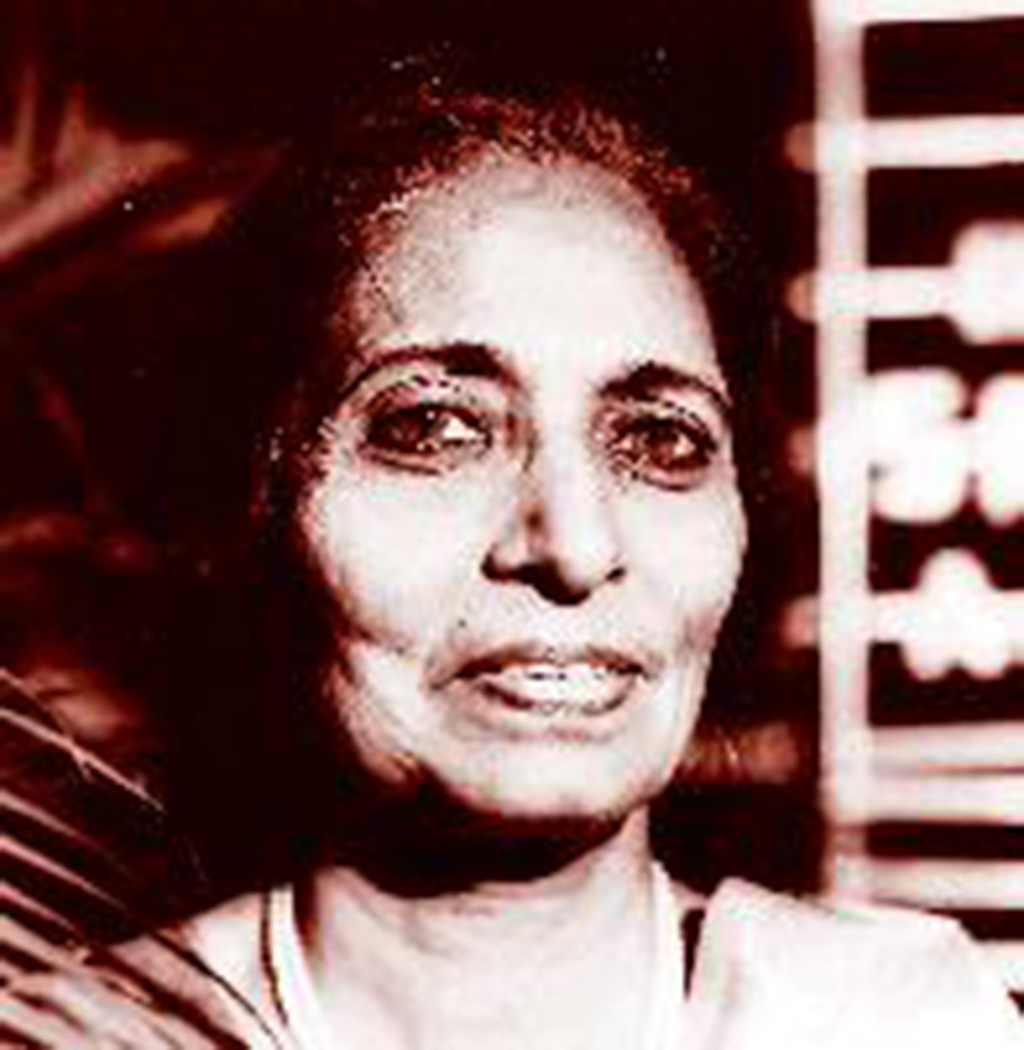
The bank issued its currency notes which had Subhas Chandra Bose, Mahatma Gandhi, Jawaharlal Nehru, and Lakshmi Sehgal printed over them.
source: http://www.awazthevoice.in / Awaz, The Voice / Home> Story / by Saquib Salim / October 07th, 2024
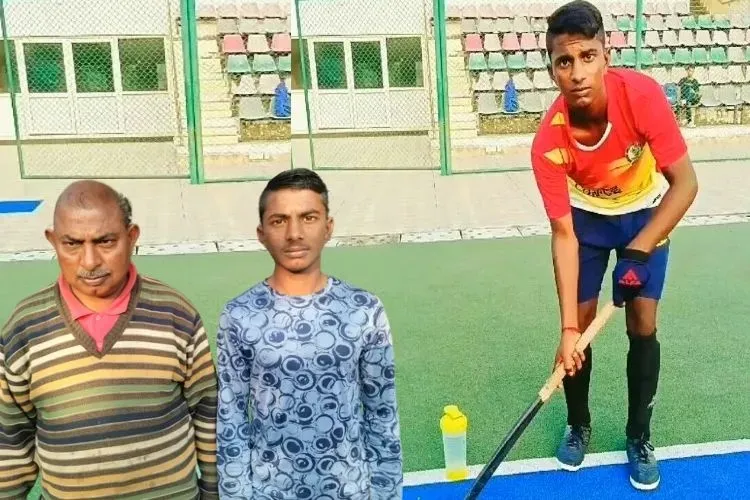
As one sees the young Shahrukh Ali training hard to be a professional hockey player at the KD Singh Babu Hockey Society, Lucknow, Uttar Pradesh, his father Tasawwur Ali is parked at the Shahnajaf Gate of the city with an iron box.
Tasawwur repairs two-wheelers – moped and scooter – to support his family, including Shahrukh. Braving all the financial constraints and with his meager and erratic income, he has never allowed his son’s hockey training to get affected.
As a result, 12-year-old Shahrukh Ali scored a hat-trick in the final of the National Sub Junior Hockey Championship that took the Uttar Pradesh team to become the winner of the championship for the first time. Shahrukh scored five goals in the final competition.
Rashid Aziz, a former hockey coach in KD Singh Babu Stadium, told Awaz-the voice, the story of Shahrukh Khan.
It was about seven years ago that Shahrukh came to Chandrabhanu Gupta Ground with his father and brother Amir Ali. “He must have been five years old, but his passion for playing hockey soon made him a big player. He made a place for himself in sports. At the age of nine, he played in the Sub Junior KD Singh Babu Hockey tournament in Lucknow and made people including big hockey stars turn into his admirers.”
Within some time, Shahrukh became a permanent member of the UP Sub Junior Team. He became a star player with his performance in the National Sub Junior Hockey Championship. Sports Authority of India coaoch said that Shahrukh’s biggest strength is the game inside D. “If Shahrukh somehow manages to get the ball in the opponent’s D (area), then the chances of the team scoring a goal increase manifold.
Tassawur says first it was Aamir and now Shahrukh: I had never thought that my sons would play hockey.
Tasavvur recalls the day he had taken Sghahrusk to the Chandrabhanu Gupta ground on an amateurish basis. “ I feel proud to see his performance today; it’s a great feeling to realize that it’s my little Shahrukh playing.” He told this reporter on the phone.
Tassawur sounds happy and proud. “I pray that one day he plays for the country and wins medals in the Olympics,” he said with an emotion-choked voice.
Hockey Olympian and Secretary of Babu Society, Syed Ali says that Shahrukh Ali has achieved a big position today. While training at Chandrabhanu Gupt ground, Shahrukh established himself as an accomplished hockey player. Hopefully, his career will go a long way.
source: http://www.awazthevoice.in / Awaz, The Voice / Home> Story / by M Mishra, Lucknow / May 24th, 2022
City lad Amir Ali will lead the 18-member Indian junior men’s hockey team in the 12th edition of the Sultan of Johor Cup in Malaysia. The team, announced on Sunday by Hockey India, also includes Shardanand Tiwari, a defender also from Lucknow.
The team, which will play under newly appointed head coach PR Sreejesh, will have Rohit as Amir’s deputy, said a Hockey India press release.
India will begin their campaign against Japan on Oct 19, followed by matches against Great Britain (Oct 20), hosts Malaysia (Oct 22), Australia (Oct 23), and New Zealand (Oct 25). The top two teams will advance to the final, scheduled for Oct 26.
Amir, son of a motorcycle mechanic Tasawar Ali, used to help at his father’s makeshift shop as a child. He began his hockey journey at the age of 10 at the KD Singh ‘Babu’ Society ground, where he was groomed by his coach, Rashid Aziz Khan. He was also guided by veteran players Syed Ali and Sujeet Kumar, who run the ‘Babu’ Society.
Talking about Amir, Rashid said, “Amir and his brother Shahrukh learned the basics of hockey from me. Amir is a very hardworking boy, and his growth is commendable.”
“After being announced as the Indian junior captain, Amir called me to share the news. I wish him and Shardanand Tiwari a fantastic career,” Rashid added.
Meanwhile, Amir’s brother Shahrukh was ecstatic over the news. “I am very happy that Amir will lead the country in the Sultan of Johor Cup,” he said, adding that he couldn’t talk to Amir as he was representing the Uttar Pradesh team in the All India KD Singh ‘Babu’ Tournament, but he will meet him soon.
“I must thank Rashid Aziz, Sujeet Kumar, and Syed Ali, and express my gratitude to the chief selector of Hockey India, RP Singh, for promoting hockey in Uttar Pradesh and supporting the players,” he said.
source: http://www.timesofindia.indiatimes.com / The Times of India / Home> News> Sports News> Hockey News / by Fazal Khan, TNN (headline edited) / October 07th, 2024
An inside view of the storied, idealistic lives in the Savitribai Phule Community Libraries network
Photo Credit: Saba Khan
Saba Khan has participated in the EduLog programme with The Third Eye for its Education Edition. The EduLog mentored 12 writers and image-makers from India, Nepal and Bangladesh to remember—in the present continuous—their experience of education from a feminist lens.
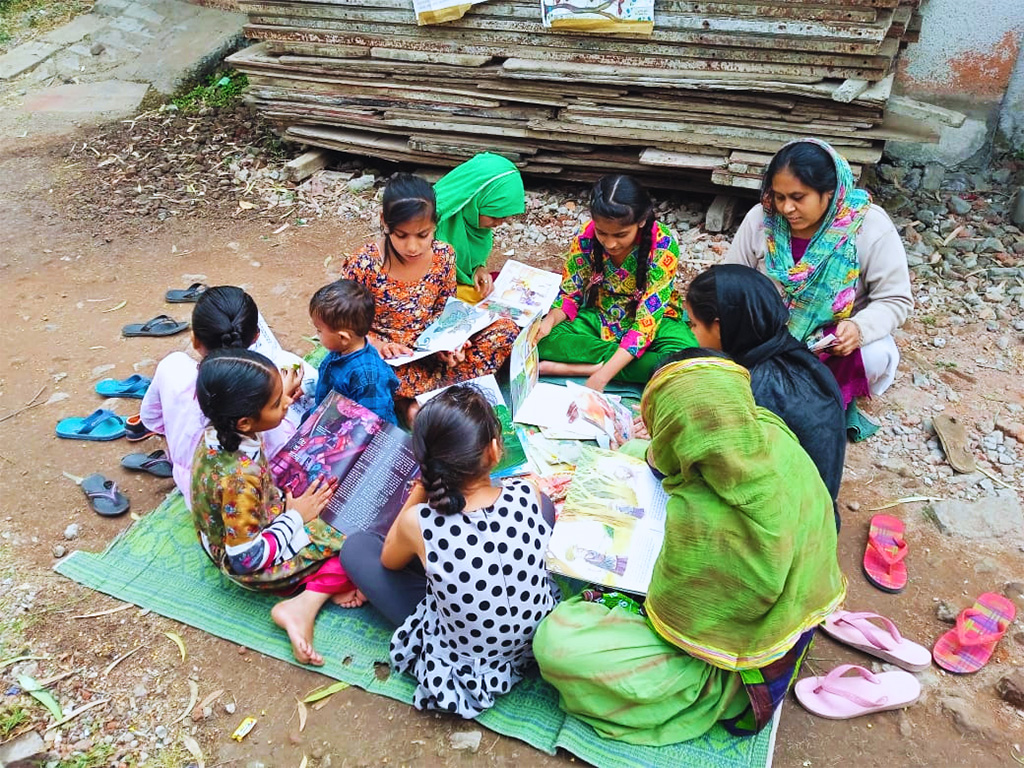
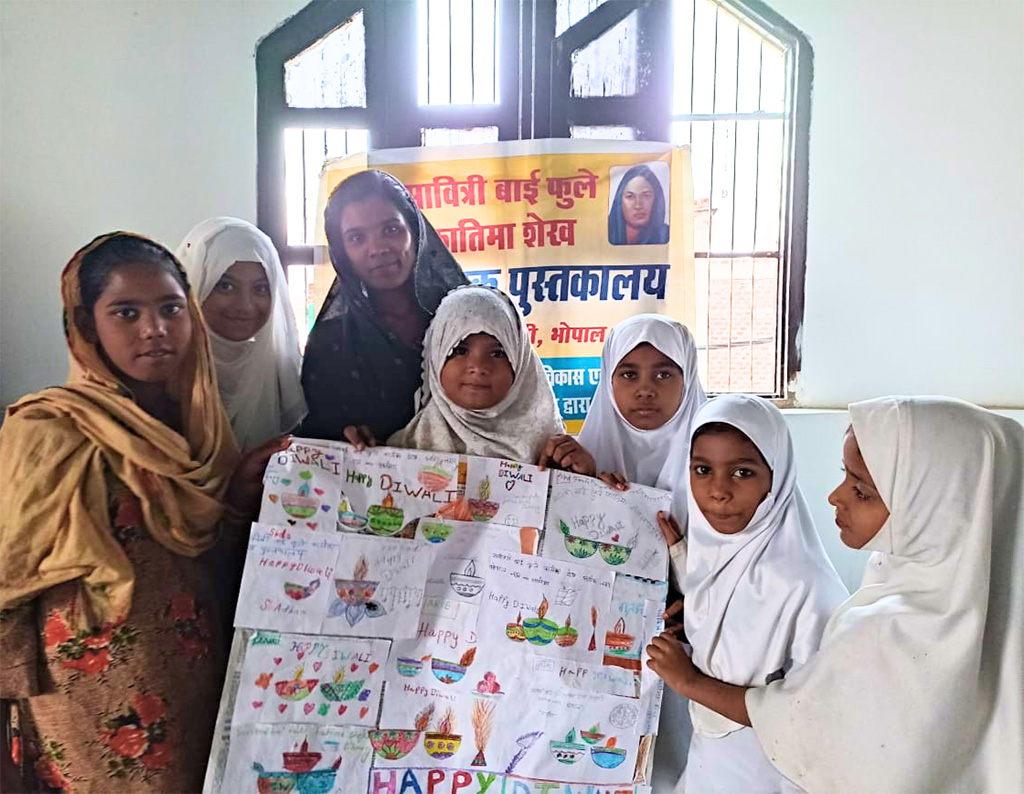
During COVID, when almost everything was closed in Bhopal, we began delivering books to children by going door-to-door. Adults in the family took to reading those books too. Some girls’ mothers flipped through the pages of the book and looked at the illustrations. When we were giving books to young Rimsha Faiza, her sisters-in-law, who were not very old, came out inquisitively and asked about the books and about Savitribai Fatima Sheikh Library. In Mother India Colony, 14-year-old Saba said, “I am not educated at all. But can you give me some books to read?” Two days later, when I went back to her neighbourhood, she asked, “Can you get me a pad too?”
My friendship with Fiza started with books. When she took her first book, she said, “Next time, please give me two books. Both Rezwan and I will read them.” They were a newly married couple. Then one day she called me and said that Rezwan had beaten her. Fiza wanted me to counsel Rezwan, or else she would kill herself, she said. Perhaps she thought that Rezwan would listen to me—the lady with the books. We connected Fiza with a government-run One Stop Centre that works on the issue of violence against women. Meanwhile, Rezwan also started coming to our library and talking to us. They both complained about each other all the time. I patiently listened to both of them.
Gul Afsha, a mother of two, is a very brave woman. She steals a little time for herself from her kids and comes to the library for a while. She mixes with the other girls in the library and reads poems with great enthusiasm.
Photo Credit: Saba Khan
At the library, Zeba, Joya Tasmian, Mahak, Muskan, and Ilma, all help keep the books. These girls have been regular readers for a long time. When I was thinking of returning to my regular job post-COVID, I consulted with them if they could manage the library without me. They enthusiastically said, ‘Yes!’ At the library, I have often seen women from the community seeking advice about their children or sharing their difficulties with the librarian, no matter how young the librarian is. Among them, 14-year-old Mansi is the youngest librarian. She often imitates the way the older librarians speak. Whenever it is her turn to manage the library, she takes them to the park, forms a circle and reads poems aloud to them. One can already see the qualities of a leader in her.
I was born in Bhopal and grew up here. In 2011, as a social worker, I worked with several government schools under a Tata Trusts programme on education. I realised that often the relationship between teachers and children in schools is one where children sit silently with their fingers on their lips. They read only when the teacher asks them to and then put the book away. I had seen this happening in my school.
When I visited schools under this programme, some of the girls said that they had spoken to their mothers about me and their mothers had invited me home. I thought that this was an opportunity to talk to the children outside of the school. When I met the children in their neighbourhoods, I thought of how much fun it would be if they could read together. And that is how Savitribai Fatima Sheikh Library started.
Even since I was a child, I would always look for books to read. I have always felt that children must have books to read—that they should develop an affection for books and realise that books are their means to know about science, about the world. I used to think that wherever I would go, I would cultivate the habit of reading books in children and gradually, their love for books would grow. But I never imagined that I would see so many libraries opening up and so many educators joining in. Today, we have 11 community libraries across purana Bhopal, including areas like Arif Nagar Basti, Mother India Basti, Madari Mohalla, Bhanpur, Karund Basti and more. We have registered a total of 1,000 children. Twenty educators help run these libraries.
Photo Credit: Saba Khan
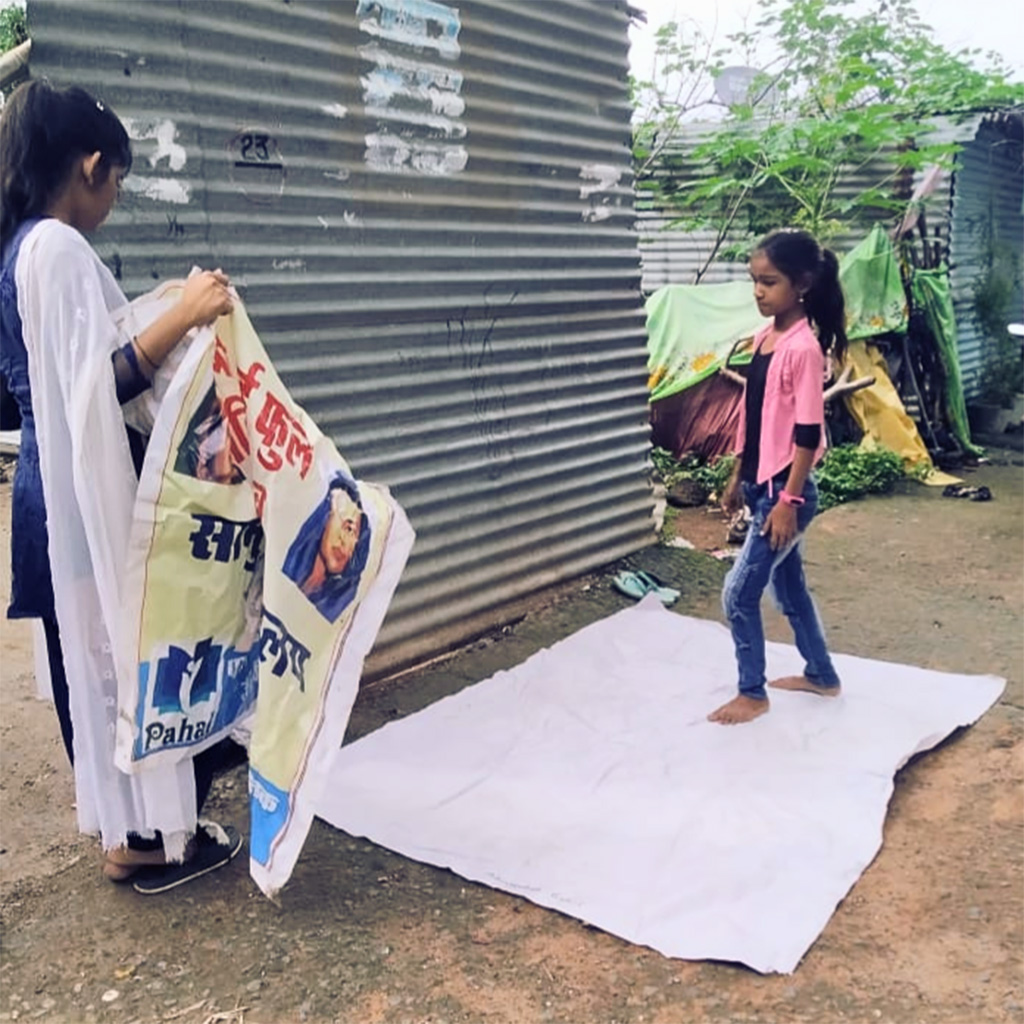
We collectively decided to name every library in the neighbourhood after Savitribai Phule and Fatima Sheikh. In a couple of neighbourhoods, boys like Chhotu, Musa and Irfan offered to help in the library. But everywhere else, it was the girls who took charge of the library, its activities and the visitors. In the beginning, we didn’t have tables, chairs, or shelves in our library. Our capital is the people of our community. They are always there to support us and be involved in the library’s future. When we had to move the library due to rain or other reasons, the women in the community created space in their homes and gently said, “Put it here.” In Mochi Mohalla, Sagar’s mother set up a library in her modest shanty where she used to cook food.
Saniya is one of our educators who sets up a library in her home every day. She lives near the Karond Mandi in the Blue Moon Colony where our oldest library used to run. Our library was located in a hamlet that was built on railway land and the place to run this library was given to us by the community. It was demolished by the Municipal Corporation in January 2022. In this situation, Saniya proposed to run the library from her home. She keeps the books and recites stories to children in her home library. She left school after the tenth grade but wants to resume her studies now. She hopes that working with children may convince her mother to somehow delay her marriage.
Jahangirabad is a largely Muslim neighbourhood where we had set up a library. Children who came to the library did not know of Ambedkar. Some called Savitribai Phule ‘Fula’, but some found it easy to pronounce Fatima Sheikh. In some schools, I noticed that they only talk about Muslim freedom fighters (as I imagine they would speak only of Hindu freedom fighters elsewhere). We need to talk about everyone so that children can know how diverse our country is.
Photo Credit: Saba Khan
We consciously try to include this diversity in our libraries. For example, two children from the Mehtar community visited our library. When it was time for them to enrol in school, a group of Muslim girls went with them to help. All the teachers at the school belonged to the upper castes. They commented, “These are Mehtar community children, they cannot study here. They won’t even wake up in the morning, how will they study? Their homes are so dirty.” Eventually, they were denied admission on these grounds. In the evening, everyone sat together in the library and we talked about the reasons behind ‘lower’ caste children being denied education. We decided to speak up as it was our right. The next day, we went to the school again and asked for the admission form. We asserted that our children would study there.
My intention in connecting children with books was also for them to learn to see the world through it. To see and understand the world means to know about the stories behind any discrimination, whether it is based on colour, caste, religion, or anything else.
When we learn about discrimination during the time of Savitribai Phule or Ambedkar, we understand our own biases too. For me, this is the meaning of loving books.
Our educator Tabassum worked continuously for three years to set up a library in Annunagar. Her father runs a madrasa at home where children learn Arabic while wearing scarves and caps. Tabassum believed that the children should learn Hindi and English alongside Arabic. They should also be able to play and move around the madrasa without wearing scarves. So, after her father’s class, she began telling the children to take off their scarves and caps if they wanted to and then she recited stories to them.
We do not keep books that attempt to demean or insult any language, race, religion, colour, caste, class, disability, group or individual. We strive to collect books related to various cultures, genders and people’s lives. Books are categorised according to the age of readers, considering the type of content, images and font size appropriate for each age group. We also have a separate category of books for new readers or those learning to read for the first time.
We have some other rules in our libraries that we tell all our educators to follow. For instance, no educator is allowed to use physical punishment or yell. If a child damages a book, we aren’t allowed to react angrily. We only explain. We do not tell the children how to sit or stand or poke at them generally.
If a child runs away with a book, we do not chase and force her to give it back. We have to trust that she will return it.
Most girls and older children get books issued and take them home. Sometimes, the books get damaged as well.
All the children and adults come together once a month to repair the books in the library. Taping torn pages or sticking them together with glue teaches children to handle the books gently in the future. It also reduces conflict.
Photo Credit: Saba Khan
All our librarians meet twice a month. It’s a treat to share our stories, experiences, happiness and excitement during those meetings. When we sit close to each other surrounded by books, it is like an entire world coalesces at a point. We recite poetry, oblivious to the surroundings or how we are sprawled, arms and legs stretched out. After chatting and singing, we choose books for the next month that can be used in various neighbourhood libraries. We identify spaces where we need each other’s help. We argue and persuade each other. These relationships are now so concrete that these librarians take care of each other’s families, eat out together, hang out during their free time and go out shopping for shoes or jewellery together, despite living in different parts of the city. Our librarians cherish their friendships and the community they have built, as much as the books.
This article is translated by Abhishek Shrivastava.
Saba lives in Bhopal, Madhya Pradesh. After completing her postgraduate studies in Child Psychology and Social Work, she has been working with different organisations on issues of girls and women for the last 13 years. Along with this, she independently manages the Savitri Bai Phule Fatima Shaikh Open Library in 11 different resettlements areas of Bhopal.
source: http://www.thethirdeyeportal.in / The Third Eye / Home> Praxis / by Saba Khan / February 14th, 2023
The development of Urdu prose and journalism and the parallel agenda of social reform in 19th-century Hyderabad played a vital role in setting the ground for the emergence of the Progressive Writers’ Movement a few decades later. The aims and objectives of the Progressive Writers’ Movement (PWM), which began in the 1930s in North India, resonated with students, poets, writers and scholars in Hyderabad. The PWM urged writers and poets to organise and break away from the hackneyed tropes, themes and genres of classical, romantic poetry that had dominated the literary milieu of Hyderabad and were associated with great cultural capital. Instead, the PWM wanted to create a new, more meaningful aesthetic that would represent changing political and social conditions and confront the material realities and experiences of everyday life. Apart from class struggle and class injustice, which was a major concern for the PWM, progressive writers also stressed the need to fight for political freedoms, resist political repression, and forge grassroots connections with the people 1.
The Hyderabad chapter of the Progressive Writers’ Association (PWA) was established by Makhdoom Mohiuddin along with Akhtar Hussain Raipuri and Sibt-e-Hasan in 1936. Sarojini Naidu offered her home, The Golden Threshold, as a venue for PWA gatherings and, later, for meetings of the banned Communist Party of India (CPI) 2. Among the women writers, journalists, intellectuals and activists associated with the PWA in the 1940s and 1950s were Jahanbano Naqvi, Zeenath Sajida, Rafia Sultana, Azeezunnisa Habibi, Brij Rani, Jamalunnisa Baji, her sisters Razia Begum and Zakia Begum, and Najma Nikhat. Amena Tahseen emphasises that the period after 1936 was critical for the history of women’s writing in Hyderabad because although women had been publishing their work, forming associations, and leading and participating in social, educational and literary initiatives for decades before the formation of the PWA, these endeavours were limited largely to women’s gatherings alone 3. The PWA changed this forever, and women began to attend and participate in literary and intellectual gatherings which had previously been restricted to men only.
Sarojini Naidu’s first collection of poems, named The Golden Threshold was published in 1905. (Photo: Getty Images)
The most vivid example and description of this shift comes from Jamalunnisa Baji’s autobiography, Bikhri Yaadein (Scattered Memories; 2008), which not only documents and assesses the political and literary events that took place in Hyderabad over the span of almost a century, but also furnishes information and reflection on what these events meant to women like Baji. Pardah is an important preoccupation in this account. Baji had long considered it her bane but had been unable to give it up. She describes how her younger sisters—who had had more freedom than her, were better educated, and were allowed greater choice in choosing their partners—had discarded the pardah at a young age. Literary gatherings with the leading Progressive figures of the day began to take place in Baji’s house in the 1940s on her and her brother Akhtar’s initiative. She had always been interested in literature and politics and was supported by parents and siblings who had an apparently insatiable appetite for education and literature. This drew her all the more to discussions that were happening beyond the curtain that separated her from gatherings where her sisters and other women who did not observe pardah, listened and spoke 4. Such gatherings offered her the opportunity to gradually emerge out of pardah.
The Telangana people’s armed struggle. (Photo: People’s Democracy)
The Progressive writers and the Telangana People’s Struggle
Between 1946 and 1951, the rural districts of Telangana had risen against the feudal structure of the Hyderabad state and the oppression it had wreaked on peasants and agricultural labourers for generations. The struggle began organically, with a tenant cultivator named Chityala Ailamma refusing to hand over her harvest to the landlord’s men. Within a few months, however, the Communist Party entered the fray and began to operate under the aegis of the Andhra Mahasabha, which had been formed in 1930 to champion the cultural and social rights of Telugu-speaking people. At its height, the Telangana People’s Struggle involved three million people from 3,000 villages 5. The struggle also made its way to the cities, as factory workers and students protested and went on strike. Many Progressive writers also identified as communists and were active members of the CPI. As the people’s struggle intensified in Telangana, the CPI was banned in Hyderabad and many PWA members had to go underground. So,
PWA meetings began to take place at Baji’s house at night, which was less conspicuous than the Golden Threshold, Sarojini Naidu’s house, and offered better cover to the likes of Makhdoom, who was well-known and easily recognised.
Baji formally discarded the pardah during the All-India Progressive Writers’ Conference in 1945, which was held in Hyderabad. She, her sisters, and one other woman were the only women to sit in the open with the men 6. What enabled the participation of a large number of Hyderabadis, especially women, in the Progressive movement was the PWA’s approach right from the start to not limit their membership to committed socialists 7. To be sure, there was always a core group of socialist writers at its centre, but the only expectation from all member writers—irrespective of ideological persuasions—consisted of them sharing the basic agenda of the manifesto, i.e. to build a sturdy organisation of writers who opposed reactionary social tendencies and stood for a literature rooted in reality. Indeed, so successful was this broadly defined manifesto that there were many writers who would not fall easily into this category if it had been ideologically restricted, but who nonetheless identified as Progressive and were closely connected with the PWM.
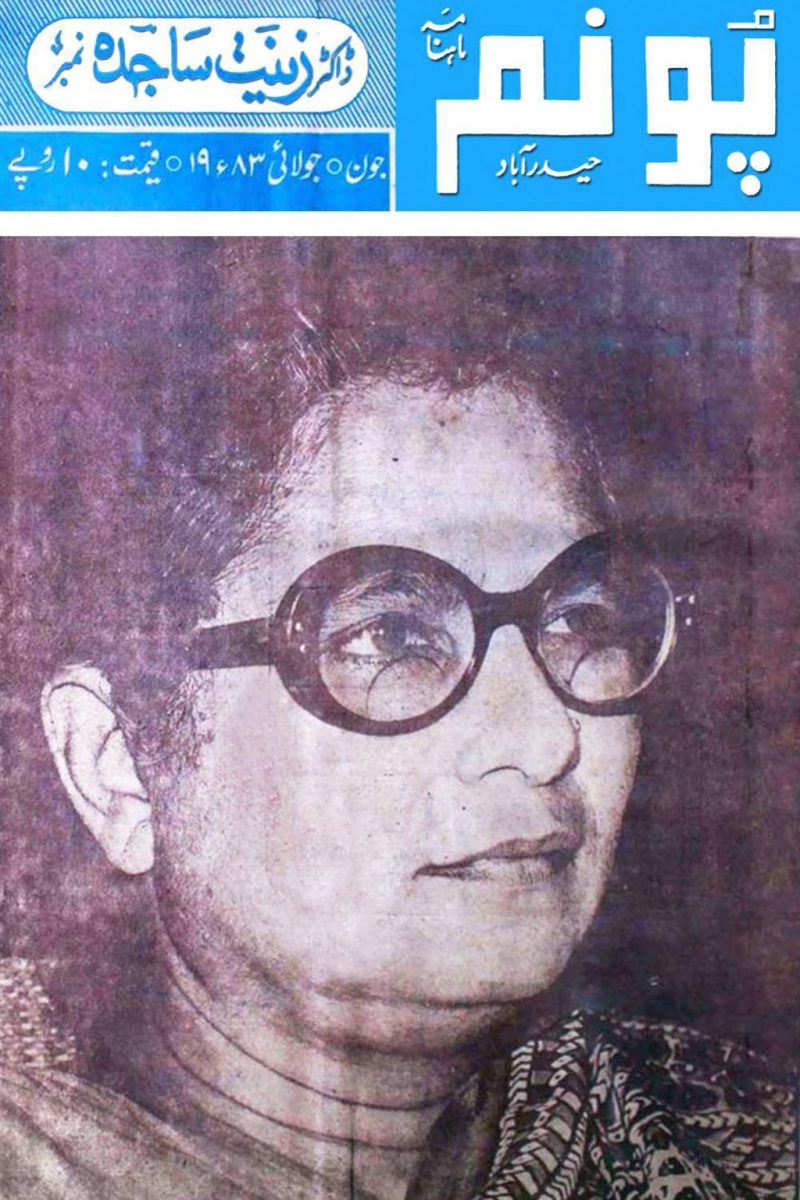
Dr. Zeenath Sajida on the cover of Poonam, Urdu monthly magazine in Hyderabad. (Photo: archive.org)
Zeenath Sajida (1924-2009) and a thriving culture of women writers
Zeenath Sajida was one such figure who dominated the literary and cultural circles of Hyderabad. She is a good example of a Progressive writer who not only wrote works criticising social injustices and exposing the hollowness of middle-class values, but also those that were less political and consisted of humorous essays as well as classic, romantic short stories. Sajida was most prolific in the decades spanning the 1940s to the 1960s, publishing an anthology of short stories in 1947 and several academic manuscripts on literatures of the Deccan. But the most fascinating literary writings she produced consisted of her essays in the genres of tanz-o-mizah (humour and satire) and khaake (pen-portraits), which were published in different newspapers and literary magazines and compiled only after her death in 2009. They cover subjects as varied as the gendered perspectives and lived experiences of women from different walks of life, critiques of social manners and everyday human folly, and nuanced documentation of the history and heritage of her beloved Hyderabad.
In the most political and radical of these texts, Sajida artfully and rigorously debates provocative social questions and taboos while disguising them in the genre of inshaiye or light sketches.
In these, she shows herself to be far ahead of her time, writing about things that we know today as gender fluidity, gender privilege, the mental load of women in relation to household management, the invisibility of domestic labour, and the unfair and unrealistic demands made of middle-class women professionals.
These essays also reveal the narrator’s most disarmingly vulnerable thoughts, feelings, and frailties; in the process, Sajida emerges as a writer who knows how to use emotion to extract both empathy as well as laughs from her readers.
There was a thriving culture of women writers of humour, satire and pen-portraits in Hyderabad right from the 1940s, which both received individual and institutional support from male writers and scholars and was also subjected to ridicule by them 8. Sajida’s work marks the best of this tradition of women’s non-fiction and is important to read and know also because non-fiction is generally neglected in favour of fiction and poetry, which have greater cultural capital; have come to form well-defined and durable stereotypes of Urdu literature; and, thus, capture the attention of translators, scholars and publishers alike.
Among Sajida’s younger contemporaries were Jeelani Bano (b. 1936), Najma Nikhat (1936–1997), and Wajida Tabassum (1935–2011). Nikhat was a writer of short stories whose loyalty and commitment to the PWM exceeded the heyday of this organisation. Like Sajida, although Nikhat produced a relatively modest number of short stories, her oeuvre demonstrates skill and is important for its sustained engagement with her lifelong preoccupations and concerns. Her stories about life in the feudal deodis of Hyderabad are insightful and instructive in establishing how women of both working as well as upper classes lived and negotiated feudal patriarchy and the conservative social world of princely Hyderabad. She also wrote hopeful stories about the revolution and depicted the lives of the poor in the rural districts of Telangana and Andhra, where she lived for many years.
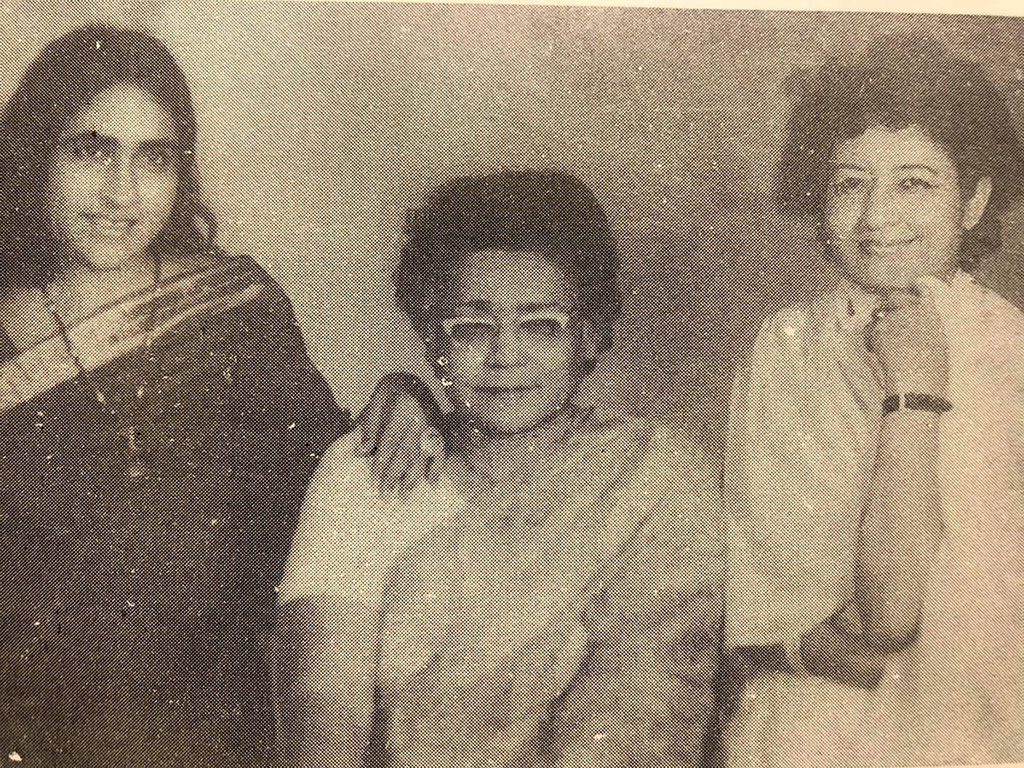
A rare picture of R-L Qurratulain Hyder, Ismat Chughtai and Wajida Tabassum – known names in Urdu Literature. Twitter- FaseehBariKhan
Wajida Tabassum is understood today to be more of a feminist than an avowed Progressive. This is because she writes defiantly and unselfconsciously about female sexuality, caste patriarchy and sexual violence against women in feudal homes.
Although her many novels and short stories were successful and popular and the latter, in particular, are enjoying a resurgence of interest among youth after the Me Too movement, many Hyderabadis, including scholars, look down on her work as “obscene” and “unjust” towards the feudal aristocracy 9.
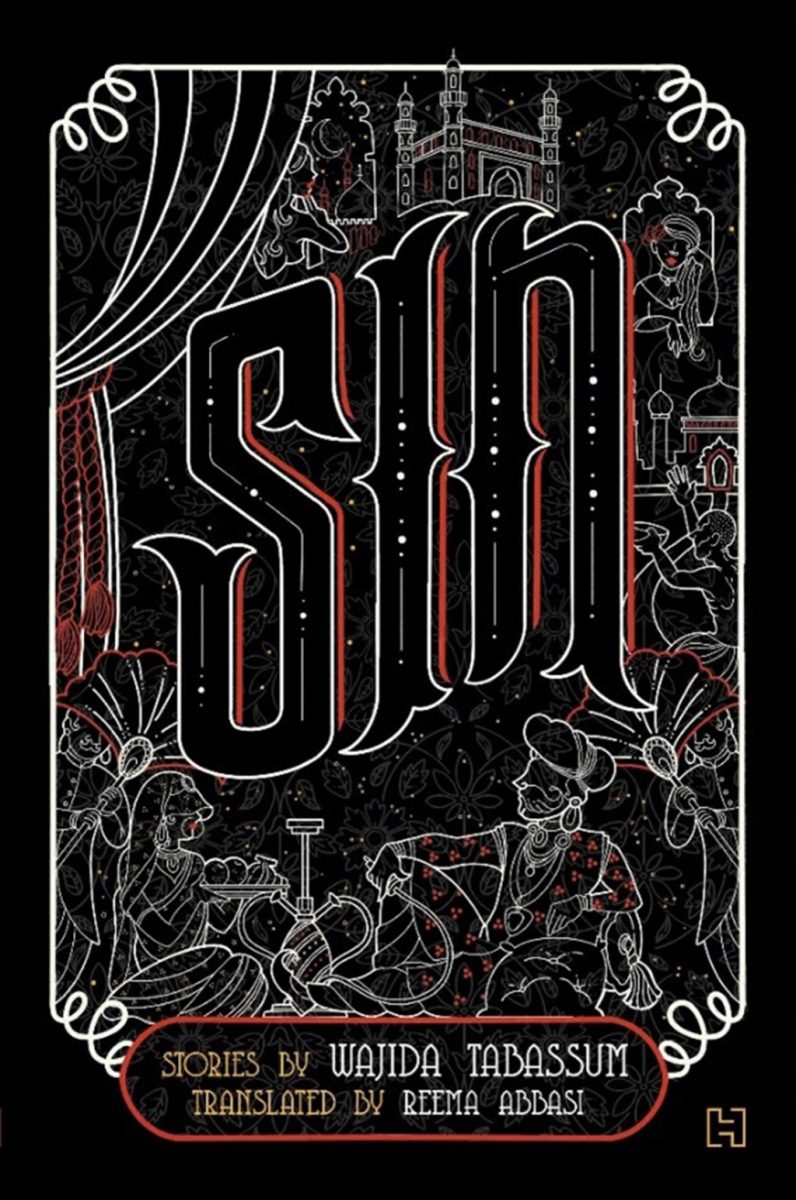
The “shock value” of Tabassum’s approach often belies her profound and nuanced understanding of the precise workings of culture and society towards concentrating and maintaining power in a few hands. Until recently, only a couple of Tabassum’s stories were available in English translation.
Other continuities
Over time, the PWM—its ideology and aesthetic—acquired a hegemony that ensured the marginalisation of writers who did not consider themselves Progressives. This became a big problem when in the tension between the “creative section” and the “political section” of the PWA (Progressive Writers’ Association), the latter prevailed, and this often resulted in didactic writing dominated by socialist themes and motivations 10. The ambivalence and even disenchantment of writers in other places towards the PWA, which increasingly adopted a rigid, even conservative stance towards the choice and treatment of themes employed by its members, is well known 11. But given that it had such a compelling social message, an influential platform, and an overarching visibility and influence, it is understandable that many women writers would continue to operate under the aegis of the PWA and utilise its many resources.
Other writers who did not subscribe to Progressive writing often represented literary and cultural continuities that were desirable and significant in other ways. After 1948, Urdu had been relegated to a secondary place in Hyderabad, and its resources and institutions were severely undermined by the minoritisation imposed by the new regime. Despite this, nuha, marsiya, azadari and salaam, traditional poetic genres that belong to the Shia practice of Muharram, continued to be regularly published in magazines and newspapers and also performed in ashurkhanas. Other religious or mystical genres, such as hamd and naat, and ghazals, nazms, and qasidas that did not represent Progressive thought or aesthetics persisted too. Many women poets wrote and published in these genres. Additionally, nazms for children were very popular in Hyderabad, and women were enthusiastic proponents of this genre as well 12. Often, these engagements revealed completely different ways of engaging with social and political discourses from Progressive writing, as can be seen in the way the poet Syeda Bano “Hijab”/Hijab Bilgrami juxtaposed the battle of Karbala with the struggle for freedom from colonial rule 13.
New woman, new writing
The next major shift in Urdu literature came with jadeediyat or modernism in the 1960s, which turned the subject of literature inwards and focused on the psyche of the individual, allowing for much experimentation in genre, mode and language. Some of the short stories and novels of Jeelani Bano and Rafia Manzoor ul-Ameen are good examples of jadeediyat from Hyderabad. Both wrote short stories and novels about contemporary protagonists struggling with the human condition as well as a variety of issues associated with the modern state and society. They also produced scripts and screenplays for successful TV serials, documentaries and films.
Jeelani Bano
Rafia Manzoor ul-Ameen
Rafia Manzoor ul-Ameen is best known today for her novels, especially Alam Panaah (Refuge of the World; 1983) and Yeh Raaste (These Paths; 1995), and the immensely popular TV series that was based on the former text and whose screenplay she wrote too. Both novels fall in the genre of romantic fiction and testify to her craft with language, narration, plot, and pace. The most attractive feature of this writer’s work is her psychologically and emotionally complex heroines, who represent a new world after the transfer of power in Hyderabad, in which young women were stepping out of the ostensible “protection” of the zenana, seeking education, professional employment and financial independence, and negotiating a society that did not appear to be prepared for their entry and often openly expressed its disapproval. These novels also offer multifaceted commentary on the social culture and ethnography of groups associated with Hyderabad and the Nilgiris respectively.
The significance of Jeelani Bano’s modernist writing can be appreciated from PWA co-founder Sajjad Zaheer’s comment in a letter to Sulaiman Areeb, editor of Saba (Hyderabad), that as long as Jeelani Bano is in Hyderabad, they need not worry about the Naya Afsana (New Short Story), a genre that had picked up pace in Urdu-Hindi literature in the 1950s and focused more on the inner state of the individual subject than on the external world or its ideological preoccupations 14. Over more than 50 years of writing, Bano’s nationally and internationally acclaimed short stories span three identifiable schools of Urdu literature: taraqqi-pasand adab (Progressive writing), jadeediyat (modernism), and tajreediyat (abstractism), although she has consistently refused to declare her affiliation or identification with any of these schools, explaining that there are many influences in her work and that she seeks only to represent the world around her and does not adhere to any particular ideological position.
Although some of Bano’s work has been admirably translated into English by Zakia Mashhadi, her two novels have not been given their due by English-language readers and scholars. Aiwan-e-Ghazal and Baarish-e-Sang represent the most serious and rigorous engagement with the history of princely and post-princely Hyderabad in creative writing. While the former narrates the lives of four generations of an aristocratic family against the backdrop of transformative change during and after the transfer of power, the latter represents the lives of landless tillers and labourers tottering under the weight of crushing debts in the rural districts of Telangana. Both texts offer rich and sombre insight into urgent questions of class and gender and offer a remarkable degree of depth where class, in particular, is concerned.
Radio continued to be an important medium for women’s voices in Hyderabad after the transfer of power, and the work of most Progressive writers in Hyderabad (and elsewhere) as well as those who did not subscribe to this category remained in demand. Among the many women who wrote for All India Radio (AIR) and read out their stories and essays were Zeenath Sajida, Najma Nikhat, Fatima Alam Ali and Badrunnisa Begum. Another vital development for women’s literary culture was the establishment of the Mehfil-e-Khawateen (Women’s Gathering) in 1971 at Urdu Hall (f. 1955), which became a flourishing platform for Hyderabadi women writers. Women poets of Progressive and other persuasions, such as Azmat Abdul Qayyum, Azizunnisa Saba, Ashraf Rafi and Muzaffarunnisa Naz, were instrumental in founding and running the Mehfil over the years. Monthly meetings and annual events are conducted and are well attended. The association also publishes an annual magazine.
Life-writing and auto/biography
Another important feature of Hyderabadi women’s writing in Urdu is an enduring affinity for different forms of life-writing. While Jamalunnisa Baji’s autobiography is the richest example, meaningful deployments of auto/biography emerge also in other genres that demonstrate a strong element of self-construction and self-performance, usually through first-person narration. The travelogues of Sughra Humayun Mirza and the humorous essays and pen-portraits of Fatima Alam Ali (1923-2020) are a good example of this trend. Fatima Begum grew up in an environment suffused with literary, political and intellectual discussions in the 1930s and 1940s, for her father was Qazi Abdul Ghaffar (1889-1956), the immensely popular and admired Progressive editor of Payaam. Her humorous essays were published in Siasat from the 1960s to the 2000s and also read on AIR. Some of them were compiled into a book called Yaadash Bakhaer (May God Preserve Them; 1989), which also furnishes a selection of her pen-portraits of the poets and scholars she knew. These portraits animate in words the rich and potent milieu of the mid-20th century and vividly perform and re-create the development of Fatima Begum’s own subjectivity.
Fatima Alam Ali (Photo: Scroll.in)
Finally, scholar and translator Oudesh Rani Bawa (b. 1941) writes a weekly column, titled Mujhe Yaad Hai Sab Zara Zara Sa (My Blurred Memories of Yesteryear), in the Urdu daily Munsif, where she engages with popular and historiographical narratives of the past, filtered usually through her memories and research on the material and linguistic heritage of Hyderabad. She also uses this column as a platform for her political and social critique, and has, most recently, begun to actively criticise local and national events, with respect to government policies, heritage and development, and growing right-wing intolerance and violence.
Hyderabad continues to have a thriving culture of humorous writing among women in both prose and poetry, besides other modes of writing, such as the short story, novel, novelette, plays and ghazals.
Stree Shakti Sanghatana, We Were Making History: Life Stories of Women in the Telangana People’s Struggle, New Delhi: Kali for Women, 1989, 3.
Jamalunnisa 2008: 103. Op. cit.
Ordinary Hyderabadis were suspicious of communists because they were all thought to be atheists. Ibid. 121).
Habeeb Ziya, who is a humourist herself and has compiled and edited a collection of Hyderabadi women’s humorous writings, reveals that Mujtaba Hussain, the most prominent and celebrated humourist from Hyderabad, had criticised her article on Hyderabadi women’s humour in the Siasat newspaper. He had wondered if men are supposed to sweep and mop, while women write humour in large numbers. Ziya Hyderabad ki Tanz-o-Mizah Nigar Khawateen. Hyderabad: Shagoofa Publications, 2005, 7.
See e.g. Ashraf Rafi, “Hyderabad ki Afsana-Nigar Khawateen,” in Tahseen 2017: 173.
Mir and Mir 2006: 28. Op. cit.
See Ayesha Jalal, The Pity of Partition: Manto’s Life, Times and Work across the India-Pakistan Divide, Noida: Harper Collins, 2013, 162–72; Jalil 2014: chapter 7; Mir and Mir 2006: 33.
Tahseen 2017: 136. Op. cit.
Riyaz Fatima Tashhir, “Hyderabad mein Khawateen ki Rasaai Shayari,” in Tahseen 2017: 219.
Mosharraf Ali, Jeelani Bano ki Novel Nigari ka Tanqeedi Mutala, Delhi: Educational Publishing House, 2003, 21.
Nazia Akhtar is an Assistant Professor (Human Sciences Research Group) at the International Institute of Information Technology (IIIT), Hyderabad (India). In 2017, she was awarded a New India Foundation fellowship to write a book on Urdu prose by Hyderabadi women. Bibi’s Room: Hyderabadi Women and Twentieth-Century Urdu Prose went into print in July 2022.
source: http://www.thethirdeyeportal.in / The Third Eye / Home> Praxis / by Nazia Akhtar / January 19th, 2023
Insiyah Vahanvaty on revisiting the life of the formidable ‘Muslim’ judge who was her grandfather.
Being a Muslim judge in India is not easy. It has never been.
The Indian judiciary has long struggled with a lack of Muslim representation, with only four Muslim Chief Justices in the history of the republic. Currently, there is just one Muslim judge on the Supreme Court – another proof of this lack of diversity. It also indicates that another Muslim Chief Justice may be a long way off.
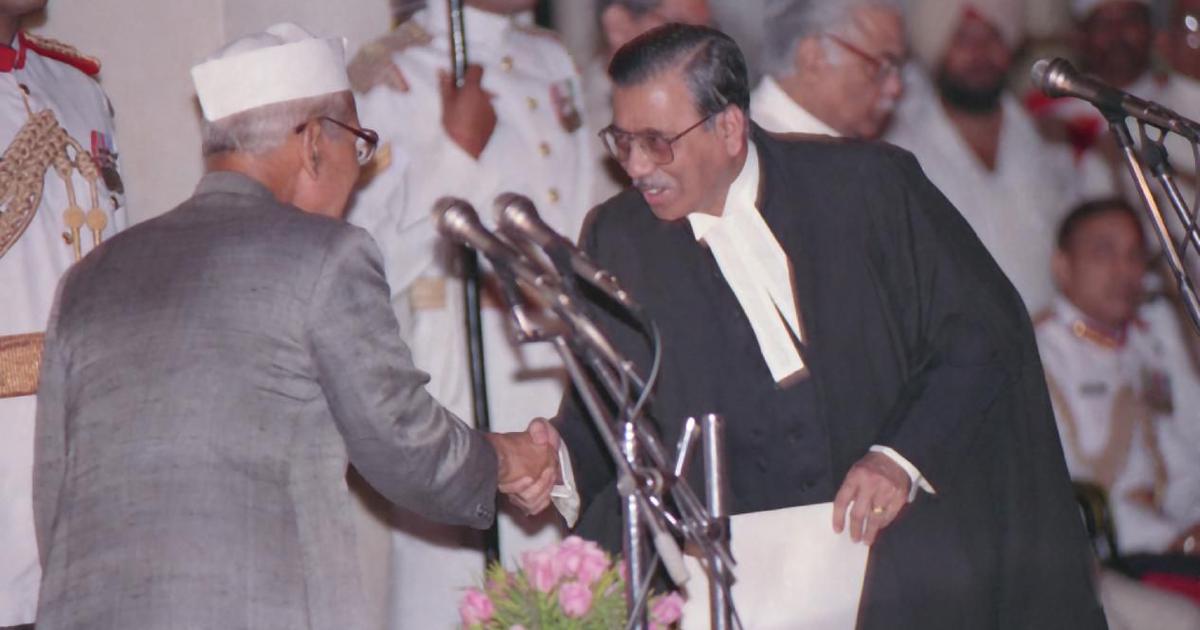
For me, the difficulties faced by Muslim judges have been witnessed through the life of my grandfather, Justice Aziz Mushabber Ahmadi, who served as Chief Justice of India from 1994 to 1997. That he was only the third Muslim to occupy this role is made starker by the fact that there has been only one more that succeeded him in the thirty years since.
When Aziz Ahmadi was appointed as a judge to the City Civil Court of Ahmedabad, he was 32 years old. Young and inexperienced, he knew that this appointment would make him the only Muslim judge on the bench; yet it had simply not occurred to him that his faith would suddenly become a matter of contention. When news of his elevation broke, it stirred up an unsettling, religiously charged atmosphere within legal and administrative circles. Bar Associations across the state of Gujarat united and called for a strike against his appointment, boycotting Ahmadi’s court. Communally charged allegations flew thick and fast with his appointment questioned in the legislative assembly. Concerns about his young age and fitness for the role were voiced. In the end, however, his appointment held – and Aziz Ahmadi began an extraordinary judicial career that would span three decades, culminating in the highest office of the Indian judiciary.
Yet, it would never be free of challenges.
Twenty-four years later, when his name was proposed for elevation to the Supreme Court of India in a closed-door meeting, a prominent member of the Bench hesitated, saying, “But he is a Muslim. Can we trust him?” And when he retired, Justice Ahmadi faced allegations of favouring the appointment of Muslim judges to High Courts and the Supreme Court. Unperturbed, he responded to these saying, “Such an allegation every Muslim Chief Justice, I suppose, has to face.” Although he did not voice it then, he felt a deep disappointment in witnessing such prejudice even in the highest offices of the country.
And yet, he wore his life with a remarkable lightness, with his easy laugh and mischievous wit. It was almost as if he was determined not to allow these experiences to make him bitter or dampen his natural optimism. Ironically, it was perhaps these very experiences that fuelled his commitment to secularism and tireless advocacy for the separation of religion and state.
My first memory of these values was during a particularly turbulent chapter in Indian history when I was just ten years old.
The year was 1992. The Babri Mosque had just fallen. A word which I had never heard before was now coming up every day at our dinner table. Kar seva. The television at home stayed locked on the news channel all day. My grandfather’s disappearance from family life, his secretaries rushing to and from the office with pens and notepads in hand, and worried family conversations about the future of the Indian Muslim marked those days.
But despite his inner turmoil, my grandfather maintained an outward calm, his composed demeanour never betraying the storm within. As ever, Justice Ahmadi, when distressed, would retire to his haven, his work. I knew the enormity of his mental anguish only because of the extent to which he did this. Those days, he emerged only for meals and slept for less than five hours a day. Pacing on the carpeted floor, he fought the numbness in his legs from hours spent hunched over his files, fuelled by endless cups of black tea.
It was only later that I learnt of his dissent in Ismail Faruqui vs Union of India – a challenge to the Acquisition of Certain Area at Ayodhya Act 1993 which was an attempt by the Central Government to gain control of administration and maintenance of the Ram Janma Bhumi-Babri Masjid structure along with its premises. In his view, validating the Ayodhya Act would effectively condone the trespass and destruction that occurred, with no consequences for those involved – especially as the effect of the Act would require pujas to continue at the site while failing to address the right of Muslims to offer namaaz.
It was while writing The Fearless Judge and going through his draft memoirs that I learnt of the immense strain my grandfather was under at the time to accept the majority judgement. But he would not succumb. Risking the ire of both, the incumbent Chief Justice as well as the executive, he knew that such a stand could come at great personal cost. Yet, he stood firm in this test of integrity, refusing to give in. Ultimately, he and Justice Bharucha dissented from the majority view.
Citing the Act to be unsecular and constitutionally unfit, the dissenting judgement authored by Justice Bharucha stated, “When…adherents of the religion of the majority of Indian citizens make a claim upon and assail the place of worship of another religion and, by dint of numbers, create conditions that are conducive to public disorder, it is the Constitutional obligation of the State to protect that place of worship and to preserve public order…To condone the acquisition of a place of worship in such circumstances is to efface the principle of secularism from the Constitution.” Once retired and therefore released from the bounds of propriety and decorum, my grandfather would speak freely about the regrettable and unlawful demolition of a place of worship – and the subsequent erosion of secularism in India.
The demolition of the mosque sent shockwaves throughout the country, prompting the Union government to dismiss state governments in a panic. This led to the landmark case SR Bommai vs. UOI, which addressed the limits of central authority over states. Because these dismissals were in response to the violence following the Babri Masjid demolition, the court also examined secularism as a key element of the Constitution’s basic structure. Justice Ahmadi wrote a separate 37-page judgment emphasizing the need for accommodation and tolerance toward vulnerable groups. Quoting Mahatma Gandhi to highlight the importance of the separation of religion and state, he wrote, “I swear by my religion. I will die for it. But it is my personal affair. The State has nothing to do with it. The State will look after your secular welfare, health, communication, foreign relations, currency and so on, but not my religion. That is everybody’s personal concern.”
Despite his deep understanding of the discriminations that Indian Muslims face in every sphere of life, he encouraged the community to resist the temptation to view itself from the lens of victims of prejudice; rather to focus on empowerment through education. Addressing the Muslim community, he said, “It is high time that we stop living in the past and start living in the present and work for a brighter future. We have to mould our own destiny – mustaqbil, no one else can do it for you. The only sure way is through education.”
A firm and vocal advocate for equality of opportunity until the end of his days, Justice Ahmadi remained troubled by the lack of diversity in the judiciary at all levels. With Muslims making up nearly 15 per cent of the population yet holding alarmingly few judicial positions, this lack of representation remains concerning to this day, raising questions about fairness and inclusivity. The implications of this imbalance are significant: Judges from diverse backgrounds ensure the judiciary mirrors the society it serves, bringing different perspectives and more fair-minded decisions. In turn, this shores up public trust in the legal system.
And as Justice Ahmadi put it so succinctly, “The judiciary has neither the purse nor the sword; its only shield is the trust of the people in the judicial process.”
source: http://www.scroll.in / Scroll.in / Home> Talking Books / by Insiyah Vahanvaty / September 30th, 2024
The fifth in an exclusive series of essays to mark the 75th anniversary of India’s independence, by winners of the New India Foundation Fellowship for writers.
Fatima Alam Ali.
As India completes 75 years of Independence, it is important to ask: what is the place of women in its historical imagination? Where in the corridors of memory – official, scholarly, and popular – are the women of this country to be found? The lives of women, whose voices have at best been indifferently preserved, necessitate that we think differently to locate and retrieve these marginalised histories. This also applies to the way literary historiography treats women writers.
Let us examine these questions through the archive of Fatima Alam Ali (1923-2020), an Urdu writer who lived in Hyderabad and wrote non-fiction essays in the genres of khaaka (pen-portrait) and tanzo-mizah (humour and satire). These essays were published in newspapers or read out over All India Radio, and later compiled into a book.
When Fatima passed away two years ago, her literary drafts, scholarly research, and college notes were found preserved in diaries and re-used school notebooks. She was also a fastidious record-keeper and left behind several hisaab ki kitaabein – books of expenses.
The way Fatima organised and conducted her writing offers us glimpses into not only her writing process but the realities of her life – as a busy homemaker with a husband and three children, and as a respected and active member of social and literary organisations.
She wrote on every available paper surface, demonstrating middle-class thrift in the way she used the blank pages of school notebooks discarded by her children and nieces at the end of every school year. She re-used institutional diaries – a common practice in the subcontinent – disregarding the outdated calendar year printed in them and putting them to any purpose she wished.
She produced entire drafts of essays, speeches, and letters on the backs of calendars, wedding invitations, and grocery receipts. She wrote with regular pencil, colour pencil, fountain pen, and ball-point pen, in inks of different colour. She did not follow any particular system of filling one notebook or diary before moving on to another, but moved back and forth between different ones with no apparent pattern that I have been able to discern thus far.
She wrote draft upon draft of some essays across notebooks and diaries. Sometimes she used the same notebook or diary from both ends for the same or different purposes. What we learn about her from this flexible approach to pen and paper is how versatile she was with these possessions and their applications in her full and hectic days, both because of the weight of the mental load she carried and because it was cheaper and more responsible to re-use things.
Among her papers are the many hisaab ki kitaabein Fatima maintained conscientiously over a number of years in re-used school notebooks. These contain details of her homemaking and domestic activity as well as documentation of important personal and family events, alongside drafts of her essays.
In fact, it is clear from the way these expense books were used that they were meant to serve as multipurpose sites for documenting and recording meaningful things in relation to her professional as well as her personal and family life.
The varied contents of these expense books give us insights into the social culture and domestic economy of the period; the contemporary history of her family; and Fatima’s writing process and the circumstances in which she produced her work.
Even in its most basic definition, a hisaab ki kitaab is of great importance to a historian or a sociologist for a time when people relied on writing to keep domestic records, something the advent of digital technology has changed forever for many of us. No longer do we maintain the kind of meticulous handwritten accounts that we may once have done. After all, online statements and instant text messages from the bank tell us when and what we have spent on groceries or school fees.
Itemised invoices sent by retailers and organisations give us a breakdown of what we have bought or how much we have paid for any service. Note-taking apps and other digital organisers help us to make sense of our everyday transactions and track our needs and wants.
But much before the arrival of digital technology, in the decades after Independence – that golden period in the history of this country when women finally had broad access to education and writing – these written accounts of domestic economy give us indispensable insights into middle-class households, lifestyles, and aspirations.
How did women manage homes? Can we tell from these accounts and lists how much time they spent in homemaking, ie, planning, management, and execution? What does that tell us about the quality of their lives?
What were the items – food and other necessities, such as fuel or paper – that were regularly consumed in a home, and what can that tell us about social position, class, and caste affiliations? Can we learn something about the aspirations of a particular family and, perhaps, by extrapolation, a certain society at a specific period of time, by looking at these weekly, monthly, or annual accounts and lists?
What commodities were sparingly purchased? What were the occasions for which special items were ordered, and what can we tell about the age from the things that were considered grand or fashionable? Can we learn something broader about the state of the economy and its impact on individual households by comparing prices, quantities, and substitutions that may have been made over months or years? What kind of wages were paid to domestic help and other service staff? How many such domestic helpers were there, and what role did they play in the family? Again, what can we learn about a family’s social or economic status from these things?
In short, there is a world of information and insight waiting for the willing in these unassuming accounts. These records of expenses are metaphor and synecdoche for aspirations, anxieties, and lived realities. They embody and document the everyday realities, banalities, and priorities of women’s lives.
A hisaab ki kitaab also often contains other kinds of lists and information about dates, events, people, and places. Fatima’s expense books contain lists of wedding and travel expenses as well as lists of books to buy or consider buying, which help us to re-create both everyday moments and unique experiences in her life as well as those of others around her.
But the most extraordinary and poignant documentation in her expense books consists of a single date on an otherwise blank page, bookmarked by an open blue Reynold’s pen: 8.6.2002. The eighth of June in the year 2002. Written at the top right corner of the right page, the date is the only writing on those two facing pages. Several pages – perhaps fifty on either side – are left blank. The date is significant, although no outsider could possibly know what it may have meant or why it is there. Fatima’s daughter Asma Burney, however, recognised it immediately: it was the day Alam Ali – Fatima’s husband and Asma’s father – had died.
Fatima and Alam Ali had been married for 53 years, and she had privately recorded the date of their earthly separation. The significance of this moment is marked in the brevity of what is written on the page. No words are needed to describe what had happened.
Fatima writes the date and places an open (still functioning) pen to mark the page, in recognition of its import and the magnitude of her loss. The blank pages before and after the recorded date appear to gesture towards the nature of bereavement. With grown-up children and grandchildren living elsewhere, Fatima was unarguably the one most affected by Alam Ali’s death, and so in some ways her grief stands alone.
One is reminded of Helen Macdonald’s words in H is for Hawk (2014), her deeply moving account of losing her father and trying to come to terms with her grief. “It happens to everyone,” she explains. “But you feel it alone. Shocking loss isn’t to be shared, no matter how hard you try.”
That Fatima allowed this date to vanish among the blank pages around it – separated from her accounts and lists – suggests that her loss was so profound that it isolated her from the bustle and activity of everyday life. She lived through it alone, despite the presence of family and friends who rallied around. Life was not the same again, and perhaps such an inscription was part of acknowledging that reality and coming to terms with it on her own.
And yet, the ink still flows from the pen that marks the page. Fatima continued to write and was an active member of various literary and social organizations, writing letters, giving interviews, and attending literary gatherings almost up to the year of her passing.
For women writers like Fatima, a hisaab ki kitaab can go even further than documenting domestic economy and important events in the life cycle. It may start out with the intent of being used for one purpose alone. But soon, the overburdened mind of the busy homemaker gives in to the demands of the writer, who begins to intrude quite aggressively on the business of the day.
In fact, Hyderabadi writer Zeenath Sajida (1924-2009), whose life and work are explored in my new book, once wrote that women’s expense books represent the daily struggle they undergo to find time and space for themselves and their craft.
Zeenath was one of Fatima’s dearest friends. She writes that every homemaking woman has a diary, in which household accounts, laundry lists, and knitting patterns jostle for space with nazms and ghazals. This, she stresses, is the reality of not only women who write, squeezing their compositions between lists and expenses, but also women who may not write but still indulge their creativity by copying a sher or nazm that has caught their fancy.
What she refers to, of course, is what we today call the mental load of women, ie. the constant pressure on the homemaker’s mind of the all-consuming labour and management involved in making a home and caring for a family, while also trying to juggle a writing career from home and even perhaps keeping a full-time job. Women write in the margins of time and space – at “the edges of the day,” as a weary Toni Morrison once explained.
And indeed, amid the pages of Fatima’s own expense books, sandwiched between the relentless and hectic paraphernalia of everyday life, are welcome drafts of her essays, worked and re-worked, again and again, with faithful and constant rigour. These drafts tell us how much labour and planning went into essays which seem so spontaneous and natural in published form, belying the workings of the craft that went into their making.
They demonstrate to us also what a normal day for her would have been like: full of the work that goes into making a home, her mind would still be preoccupied with her essays, so that she would stubbornly write and re-write until she deemed them ready to see the light of print.
Fatima’s expense books are also excellent illustrations of the workings of mind and memory. After all, neither thought nor memory is linear: it rambles and is frequently fragmented, disjointed, and interrupted, organising thought, feelings, and sensibility in shifting and fluid ways.
There are quick shifts in content and register in Fatima’s expense books as she goes from recording expenses to documenting an experience of intense loss to contemplating the title of an essay. These multiple registers of language, thought, and sensibility illuminate different aspects of women’s experiences and subjectivities.
They perform as well as demonstrate the gendered making, maintenance, and transmission of personal and family memory among women. There is so much more, then, to these multipurpose diaries, which encapsulate a way of life when seen in their entirety.
It is rare to come across such records in official or public archives, betraying our collective lack of understanding of not only the importance of hisaab in itself as a source, but also the multipurpose nature of the hisaab ki kitaab.
Furthermore, archives are not only sites of memory, but also sites of power, representing forms of national, public, and collective remembering. They embody official and institutional positions about what is believed to constitute knowledge deserving of transmission, who can thus be validated as a legitimate agent of such deserving knowledge, and what textual materials, therefore, are considered worthy of preservation. The inclusion of women in these archives is limited and conditional upon these constraints.
The circumstances of women’s lives and the conditions in which they work call for a redefinition of the archive. The dense, multipurpose notebooks and diaries that Fatima and no doubt many other women of her generation owned demand other ways of looking at women’s histories and also women’s writing, ie, the process and conditions in which texts are produced by women.
What Fatima’s hisaab ki kitaabein bring to us is a world gone by, where educated middle-class women used writing to document and capture their everyday lives, experiences, and aspirations. With the advent of digital technology, this world is rapidly changing for many women of this demographic.
It remains to be seen how digital records of home-making will fare in the choppy tides of history. Whether these will even take the same shape is debatable. What would a digital archive of homemaking by a woman writer today look like? It has never been easier to keep accounts and lists using apps with increasing degrees of sophistication and convenience, but it has also never been easier to delete data or lose it forever to the vagaries of short-lived technology.
In an age where there is so much information saturation and quick shifts in digital technology, data and the vessels in which we put them are, by definition, ephemeral. They become rapidly obsolete, moving along and beyond the conveyor belt of our days. With the ease of classification and separation into folders and labels, will digital records demonstrate the overlaps and variety of registers that Fatima’s work demonstrates and which Zeenath reveals to us as the reality of home-making women who write? Or are our records going to be equally chaotic, as we move from one app or device to another, depending on where we are and what we are doing? The mental load of women, after all, remains the same.
Also, how would the absence of tactility and materiality affect what we can learn from this digital archive? The smell, texture, and sound of paper; the conditions and locations in which records are preserved; and the uniqueness of an individual’s handwriting – shifting and changing with age, health, mood, and other circumstances – are particular to the written page and document the circumstances in which texts are produced and preserved. The ease of digital reproduction smoothens an individual’s handwriting down to the uniformity and anonymity of a font on a screen, so that critical dimensions of the human experience are lost from the archive.
Accounts such as the hisaab ki kitaabein of Fatima Alam Ali are vital for the historian of modern India. Such sources unravel and unmoor standardized notions of both history and archive, demanding greater creativity and, therefore, more effort to interpret and understand.
They attest to an age when writing became an important and accessible technology for educated women to harness in the management of their lives as well as in the channelling of their creative expression and aspirations.
While magisterial didactic tomes of domestic economy, such as those of Sultan Jahan Begum of princely Bhopal or Isabella Beeton of Victorian England, are known and celebrated and have been used by historians and scholars to make sense of domestic economy, the more modest everyday offerings – often interspersed with literary writings – have been neglected and deserve the attention and regard of both the social historian and the literary historian. Only then can we write more inclusive histories that represent the experiences of women in this country.
Nazia Akhtar is a Fellow of the New India Foundation whose book Bibi’s Room: Hyderabadi Women and Twentieth-Century Urdu Prose has just been published by Orient Black Swan.
source: http://www.scroll.in / Scroll.in / Home> Literature & History> Hyderabad> / by Nazia Akhtar / August 16th, 2022
Graduated with distinction from Lovely Professional University in aeronautical engineering.
Hyderabad:
Mohammad Yar Alam, a determined aerospace engineer and son of Former Imam Mohammad Shehriyar Alam of Masjid-e-Mohammedia, has long nurtured a dream of soaring the skies as a pilot. To turn his vision into reality, he enrolled in the prestigious Chimes Aviation Academy in Sagar, Madhya Pradesh, where he embarked on the challenging journey of a pilot training course.
The Rs. 51 lakh program cost, however, posed a significant challenge for the Alam family. Recognizing his son’s unwavering dedication and academic prowess, Mohammad Shehriyar Alam went to great lengths to support his aspirations, mortgaging their family home, liquidating precious jewelry assets, and securing loans from relatives. Despite these efforts, an additional Rs. 26 lakh is urgently needed by end of June 2024 to meet the tuition requirements.
In their quest for assistance, Mohammad Shehriyar Alam and Mohammad Yar Alam approached The Siasat Daily, where they met with Editor Zahid Ali Khan Secretary of Faiz Aam Trust, Iftekhar Hussain. They appealed for financial aid, emphasizing the urgency of their situation.
Moved by the Alam family’s plight, Zahid Ali Khan and Iftekhar Hussain pledged their support, requesting the community to come to Mohammad Yar Alam’s aid. They urged Hyderabadis, particularly those residing abroad, to contribute generously, ensuring that the talented young aspirant can pursue his dream of becoming a pilot.
Mohammad Yar Alam’s academic track record speaks to his exceptional abilities. He graduated with distinction from Lovely Professional University in aeronautical engineering and demonstrated academic excellence in both his SSC and Intermediate studies. Today, he embarks on his journey in the pilot training course, determined to turn his aspirations into reality.
Salva Fatima, a resident of Old City Hyderabad, also aspired to become a pilot. Editor Zahid Ali Khan had personally contributed 16 lakh rupees to Salva Fatima and secured an additional 36 lakh rupees from the government. As a result, Salva Fatima became the first Muslim woman pilot of Telangana.
Zahid Ali Khan and Iftekhar Hussain highlighted that with the community’s financial backing, Mohammad Yar Alam’s dream of becoming a pilot will be realized, inspiring other young individuals to pursue their ambitions with determination. They expressed their confidence in the power of collective support to help Mohammad Yar Alam achieve his dream and soar the skies as a pilot.
Bank Details
Interested individuals can directly send money to his saving bank account given below:
Mohammed Yar Alam Account Number 50100372006386 HDFC Bank, Branch: JEEDIMETLA, IFSC: HDFC0001041 Phone: +917989228679
source: http://www.siasat.com / The Siasat Daily / Home> News> Hyderabad / by Zahed Farooqui / May 21st, 2024
By Nikhil Mandalaparthy. Nikhil is a journalist, community activist, and consultant focused on religious pluralism and social justice in South Asia and North America. He is the curator of Voices of Bhakti, a digital archive that showcases translations of South Asian poetry and art on religion, caste, and gender. He recently served as Deputy Executive Director of Hindus for Human Rights and is currently conducting research as a 2024-25 Luce Scholar.
Editor’s Note: This story was supported by the Pulitzer Center for Crisis Reporting.
___________________________________
kitne pyare hai yeh badshah jis pe hum marte hain yeh haqeeqat hai tasawwur mein unka deedar karte hain unka roza hai beshaq maqaam-e-madad hum ghareeb ki taqdeer ko acche mein badal dete hain
How loving is this Badsha whom we “die” for The truth is: in our imagination, it’s him we see Without a doubt, his tomb is the destination for help; He changes our unfortunate destinies to good.
– Iqbal Sarrang (2002) (Translated by Goolam Vahed, with edits
_______________________________
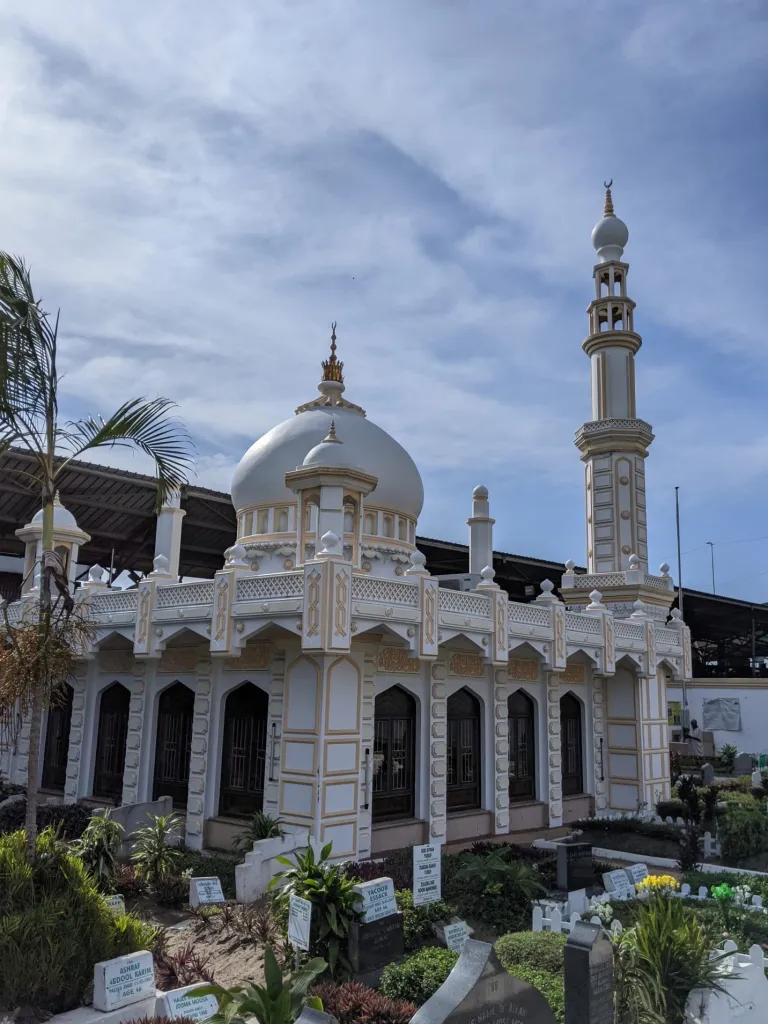
Mazaar of Badsha Peer, Durban, South Africa / Source: Author
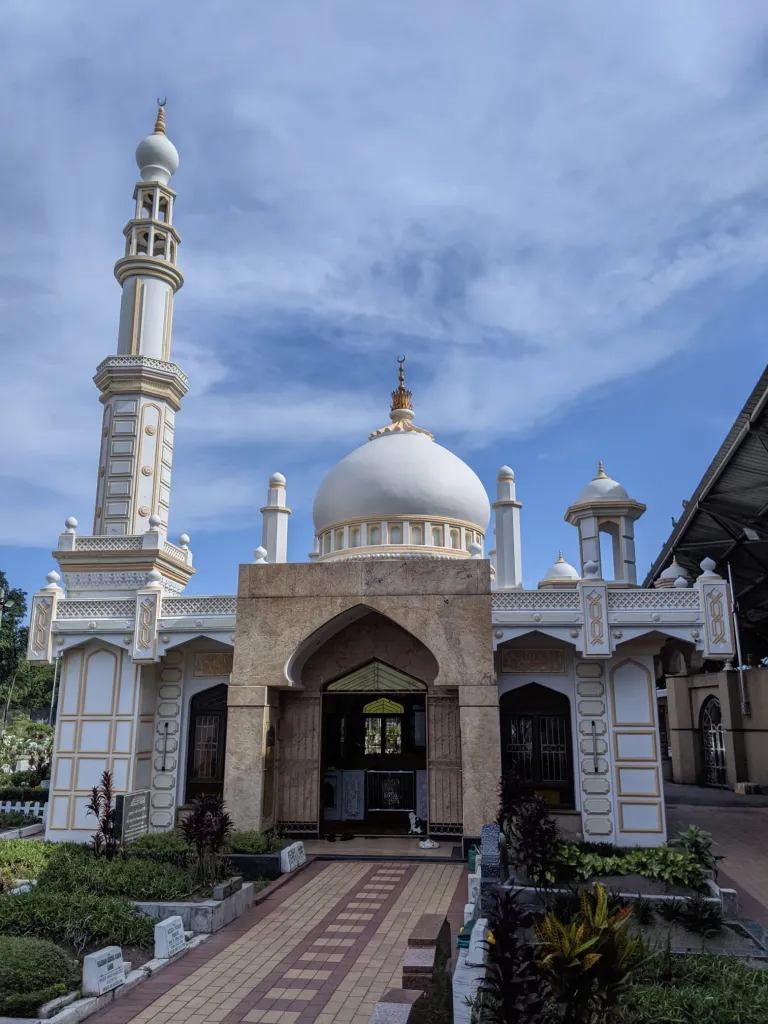
In the historic Brook Street cemetery in Durban, South Africa, a gleaming white and gold structure towers over dozens of tombstones. This is the mazaar (tomb) of Sufi saint Badsha Peer. Thousands of miles from his birthplace in southern India, he is said to have found his final resting place here in 1894.
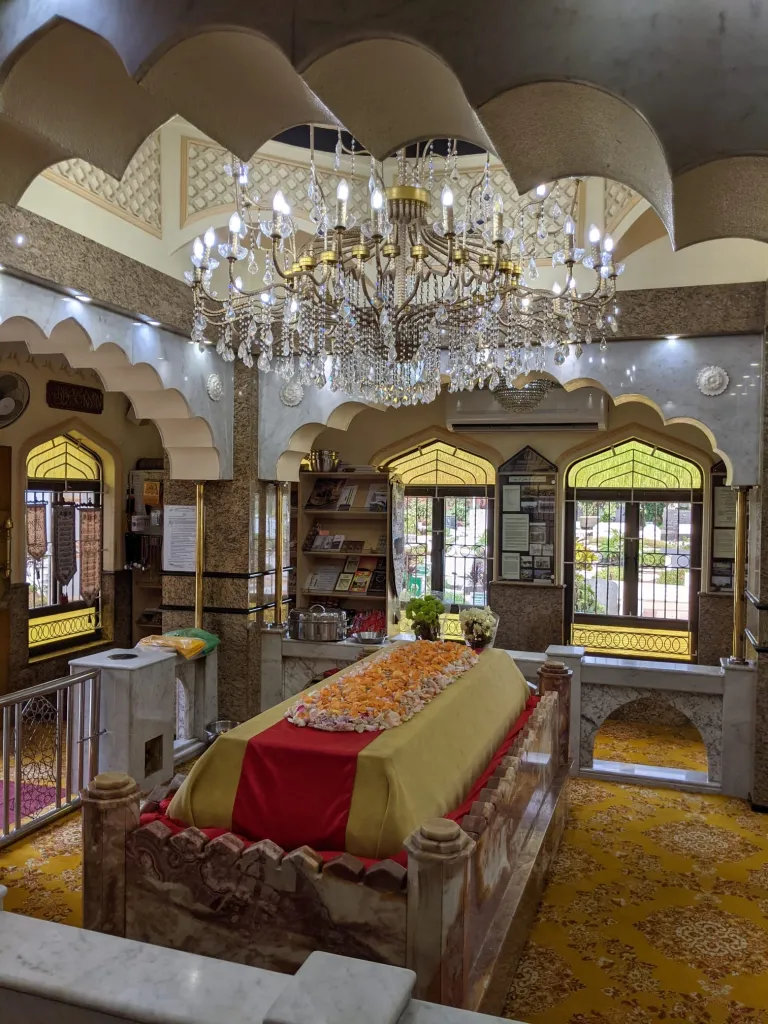
Inside the shrine, an inscription declares that this is “The MAQAAM (Resting Place) Of The King Of Africa – HAZRATH SHAYKH AHMED BADSHA PEER (RA)”.
Visiting Badsha Peer’s shrine challenged much of what I was told about South African Indian identity and history. In my conversations with South African Indians, I was told that most Muslims in the community were Gujarati or Konkani, and that most South Indians were Hindu or Christian. But here I was, at the shrine of a Muslim saint who was also South Indian. I was intrigued—and confused.
Digging deeper, I found that the story of this “King of Africa,” Badsha Peer, is a tale of multiple migrations, across the Deccan, South India, and beyond. His story involves Konkani Muslims and Hyderabadi Sufi teachers traveling to colonial Bombay, and Tamil and Telugu indentured workers making the long and treacherous journey from Madras to South Africa.
Tracing the story of Badsha Peer—and Soofie Saheb, the man who popularized his memory—shines light on how Indian religious, linguistic, and regional identities were transformed in the Deccan and South Africa, during the colonial period and through indenture and migration.
Locating Badsha Peer in History
Pinning down the historical Badsha Peer is difficult. Goolam Vahed, a scholar of South African Indian and Muslim history, describes the saint as having a “sketchy biographical profile and unclear genealogy”.
Ashwin Desai and Goolam Vahed write of a Sheikh Ahmed who arrived from Chittoor (modern-day Andhra Pradesh) or Arni in North Arcot district (modern-day Tamil Nadu) on the first ship from India, the SS Truro, which arrived on November 16, 1860. On the other hand, Nile Green, a historian of Indian Ocean Muslim networks, points to a Sheik Ahmed from Machilipatnam (modern-day Andhra Pradesh) who arrived a month later, in December 1860, on the Lord George Bentinc.
Either way, according to oral tradition and popular anecdotes, Badsha Peer is remembered as arriving with the first indentured laborers from India. A man of great spiritual power, he is popular for the miracles he performed on the colonial sugarcane plantations, such as accomplishing his tasks in the fields while simultaneously meditating all day.
According to Nile Green, South African oral traditions declare that he was “released early from his indenture due to ‘insanity’”, which was later given a Sufi interpretation as “spiritual rapture (jazb).” Following his release, he is said to have lived the rest of his life as a faqir (mendicant) around the Grey Street mosque until his death in 1894.
Muslims like Badsha Peer made up about 10 percent of the approximately 152,000 Indians who were brought to South Africa as indentured workers; over 80 percent were Hindu. Around 44 percent of indentured Muslims departed from Madras, and among these workers, over 60 percent came from four areas: Arcot (31 percent), Malabar (14 percent), Madras (11 percent), and Mysore (7 percent).
Indentured Muslims, like Hindus, largely came from marginalized castes. In his shrine, Badsha Peer’s caste is simply listed as “Muslim” and “Mohamedan”, which is how around half of indentured Muslims named their caste according to immigration records.
However, Desai and Vahed mention Badsha Peer’s caste as julaha (weaver). He may have been from the Dudekula community , a Telugu-speaking Muslim caste associated with weaving and cotton cleaning.
Soofie Saheb and His “Overpowering Influence”
Shrine of Badsha Peer, Durban, South Africa / Source: Author
The reason that Badsha Peer is remembered today is due to the efforts of a non-indentured Indian migrant. This pivotal figure is Shah Ghulam Muhammad (d. 1911), popularly remembered in South Africa as “Soofie Saheb.”
Soofie Saheb was born into a Konkani Muslim family in the town of Ibrahimpatan in Ratnagiri district. The family held a high social status on account of its claim to descend from Abu Bakr, the first caliph of Islam. After studying in Kalyan, he departed for Bombay. Nile Green situates his move within “a much larger migration of Konkani Muslims to the city that had taken place over the previous decades”.
In the early 1890s, Soofie Saheb became a disciple of Habib ‘Ali Shah (d. 1906), a Sufi teacher of the Chishti order. Habib ‘Ali Shah himself was a migrant from Hyderabad who developed a following primarily among Konkani Muslims in Bombay, particularly workers around the Mazgaon dockyard. In 1895, Soofie Saheb was instructed by his teacher to go to South Africa to spread the message of the Chishti order to the indentured Indian population.
Soon after arriving in Durban in 1895, Soofie Saheb “encountered a situation of close proximity and mixing between Muslims and the large majority of Hindu laborers,” as anthropologist Thomas Blom Hansen writes . Faced with the fact that “Muslims participated widely in Hindu rituals and festivals”, Soofie Saheb began to promote a more “proper” Islamic identity for indentured Muslims. Similar efforts would soon take place among the Hindu community as well, led by Arya Samaj missionaries like Bhai Parmanand and Swami Shankaranand.
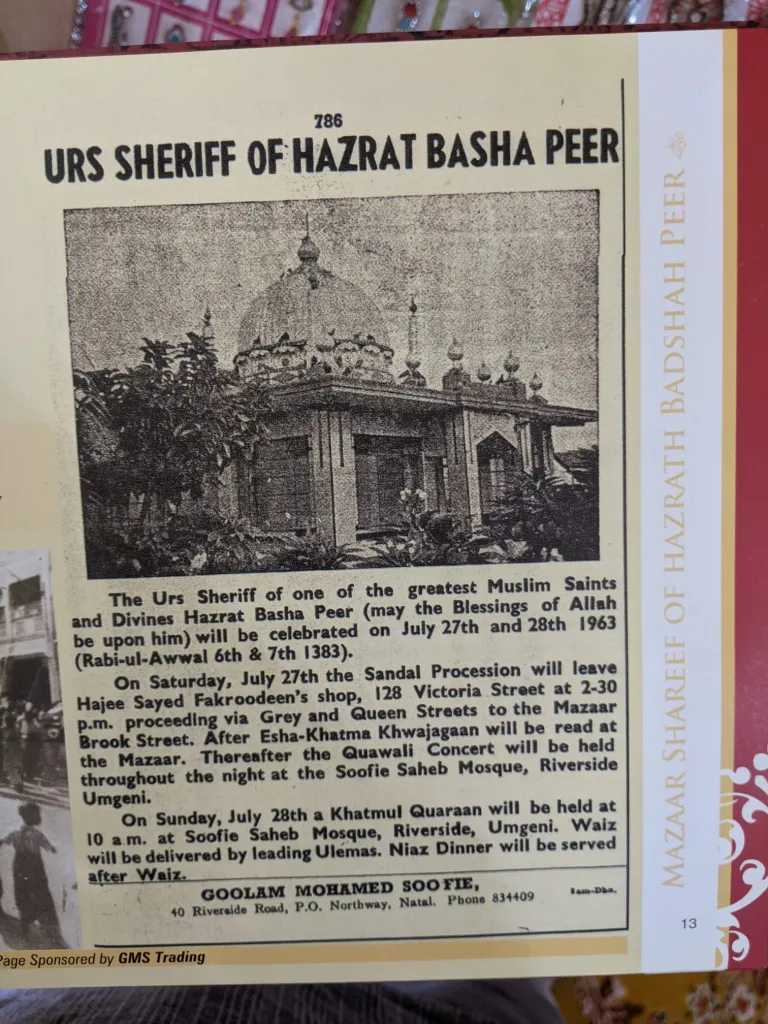
One of the first actions of Soofie Saheb in South Africa was to build a shrine over Badsha Peer’s grave, which he is said to have identified through a dream or vision. Shortly afterwards, in April 1896, he purchased a plot of land on the banks of the Umgeni river, upon which he built a complex that included a mosque, khanqah, madrasa, and Muslim cemetery.
Interestingly, the legal documentation for this purchase was prepared by a young Gujarati lawyer who had arrived in South Africa just a few years prior: Mohandas K. Gandhi. Vahed writes that “Between 1898 and his death in 1911 Soofie Saheb built 11 mosques, madrasas and cemeteries all over Natal.”
Reimagining South Asian Languages and Religions in South Africa
A book published by Soofie Saheb’s madrasa in 1970 includes this quote by a Hindu observer: “there were many Tamil-speaking Muslims who, but for the recitals of the Koran, were by tradition and culture typically South Indian. Soofie Saheb’s mystic personality had an overpowering influence on the Muslim community widely scattered.” (emphasis mine)
This framing positions South Indian and Muslim identities as mutually exclusive, with the suggestion that shifting towards a more explicitly Muslim identity necessitated shifting away from South Indian culture. The framing also implicitly links South Indian and Hindu identities together.
What was the nature of Soofie Saheb’s “overpowering influence” among indentured Muslims in South Africa? As Nile Green has noted, Soofie Saheb promoted the Urdu language as core to Muslim identity, even though few indentured Muslims spoke the language.
Green argues that Soofie Saheb was simply following “specific currents of linguistic change in his own Konkani community in India, in which the use of Urdu spread significantly during the early twentieth century, partly as a result of migration” from the Konkan coast to Bombay. Similar developments had taken place elsewhere in the Deccan, such as the rise of Urdu in Hyderabad State in the 1880s as the prestige language of education and social status.
Soofie Saheb’s efforts made Badsha Peer the most revered Sufi saint in South Africa. At the same time, he promoted a cosmopolitan, Urdu-centric Muslim identity that likely would have been unfamiliar to Badsha Peer himself, as a Telugu- or Tamil-speaking indentured Muslim.
These shifts were perhaps aided by the fact that in decades following Soofie Saheb’s death in 1911, many South Indian associations in South Africa adopted explicitly Hindu orientations.
For example, a year after the Andhra Maha Sabha of South Africa was formed in 1931, the organization became an affiliate of the South African Hindu Maha Sabha. The Andhra Maha Sabha’s logo is a Telugu-script Om, and the organization’s headquarters in the Indian township of Chatsworth includes an elaborate Venkateswara temple, which was built in 1983.
Thus, on one side, Telugu cultural associations in South Africa defined Telugu and Hindu identities as synonymous, while Muslim leaders like Soofie Saheb consolidated an Urdu-oriented Muslim identity.
South Asian Legacies: Shared Devotion at Badsha Peer’s Shrine
Interior of the Shrine for Badsha Peer / Source: Author
Although Badsha Peer is remembered as coming from Andhra Pradesh or Tamil Nadu, Soofie Saheb’s emphasis on an Urdu-centric Muslim identity means there is little to no visible South Indian influence in the rituals and practices associated with his shrine today.
And yet, despite Soofie Saheb’s activities to consolidate a distinct Muslim identity among indentured Indians, Badsha Peer’s shrine became a site for prayer, pilgrimage, and worship for Indians across regional and religious identities. In a way, his shrine provided a conduit for older South Asian practices of multi-religious devotion, such as reverence for Sufi mazaars and dargahs.
From the earliest years of the shrine, non-Muslim devotees played a role—Goolam Vahed notes that in 1917, “A corrugated iron structure was erected by a Hindu, Bhaga, around the dome” of the shrine. In 2002, one of the qawwali groups performing at the saint’s urs (death anniversary) was led by a Hindu singer.
Community archivist Selvan Naidoo, director of the 1860 Heritage Centre, recalls that “In my early childhood days, such was the power of this place that my staunch Tamil mother would often take us there to pray at this great place of indentured reverence.”
This reverence for Badsha Peer continues to this day. Mark Naicker, an interfaith activist in Durban from a Catholic family, shared with me that “sometimes you hear Hindus also go to Badsha Peer … when people have a baby, they would go to that shrine” to seek blessings.
It has been over 160 years since Badsha Peer and the first indentured Indians set foot on South African shores. He is a unique figure in South African Indian history. Unlike most indentured Indians, he was Muslim. Unlike most Indian Muslims in South Africa, he was from southern India. And unlike nearly any other indentured Indian Muslim in South Africa, he is revered as a saint whose power is manifest even to this day.
Badsha Peer’s story, intertwined with that of Soofie Saheb, provides us with a glimpse into how Indian identities were transformed and reconfigured in South Africa. “Muslim” and “South Indian” identities took increasingly divergent paths. And yet, despite these shifts, his memory lives on, drawing devotees from across religious and regional backgrounds who seek the blessings of this “King of Africa.”
source: http://www.maidaanam.com / Maidaanam / Home / by Nikhil Mandalaparthy / June 17th, 2024
‘Patent Man of India’ Prof Shamshad Ali so far bagged seven patents for his multifarious innovations. The professor of engineering at Aligarh Muslim University’s polytechnic is differently abled and keeps underscoring the need for innovation to achieve progress.
Professor of engineering Shamshad Ali at AMU
Aligarh:
Shamshad Ali, a professor of engineering at the polytechnic college of Aligarh Muslim University (AMU) has become popularly known as Patent Man of India for his multifarious innovations. Prof Shamshad Ali, who after taking classes keeps busy with his inventions, has over seven patents to his credit till now, granted by the Patent Office, Government of India, Delhi.
This differently-abled professor never loses heart and always strives for excellence. Be it teaching students or discovering something new, this physically challenged person’s hard work has become a source of inspiration for other teachers and innovators. Prof Shamshad Ali was granted three patents in 2022 alone.
The professor underscores the need for innovation to achieve progress. In his appeal to students and teaching faculty in the AMU, he said, “Innovation plays an important role in upping the university’s ranking. Discovering new things helps teachers and students. So they should keep on doing new research. I have bagged seven patents so far and two more patents will be granted soon.”
“When someone discovers new things. Then the innovator is supposed to apply and submit application online to Delhi patent office. Thereafter an exam is conducted. If you pass the test, they will grant you patent. If not, then you will have to work on it again. It all depends upon the examiner,” said Prof Shamshad.
source: http://www.etvbharat.in / ETV Bharat / Home> ETV Bharat> Bharat / January 07th, 2023