A soldier of the Indian Army from Harihar died during a demolition firing in Pokhran in Rajasthan on Monday.
Javed
Bengaluru / Davangere :
A soldier of the Indian Army from Harihar died during a demolition firing in Pokhran in Rajasthan on Monday. The body is expected to reach Bengaluru on Wednesday.
According to defence sources, the soldier is identified as Javed (33), a resident of PB Road area in Harihar in Davangere district. He was attached to an engineer regiment of the Indian Army located at Secunderabad. Javed who had been serving the Army for 14 years is survived by his wife and two children.
Lt Col Manish Ojha, Defence spokesperson, Rajasthan said, “During the demolition firing being conducted in Pokhran by an engineer regiment of the Indian Army as part of its annual training firing practice, a shaped charge exploded accidentally, resulting in the death of one soldier and injuring four others.” All injured were evacuated by air to Military Hospital in Jodhpur. An inquiry has been ordered to ascertain the exact cause of the accident, he added.
Javed was the second son of Abdul Khader Sab and Fathima Bi. He studied at MRB school at Harihar and did his second PU at SJVP College in Harihar. Soon after completing PU, he joined the Army in 2005 and later completed his BCom through distance education while in service. Javed had married Sartaz Bhanu in 2013 and had two daughters — Ameena Kaiser (3) and Umme Javera Aiyath (18 months), family sources said.
Javed used to talk to his mother over the phone daily and had called her on Monday morning. On Monday afternoon, he had informed his wife that he was going to attend a training at Pokhran, family sources said. The body is expected to arrive from Jodhpur to Bengaluru on Wednesday and reach Harihar late night. Final rites will be performed at Harihar on Thursday, source said.
source: http://www.newindianexpress.com / The New Indian Express / Home> States> Karnataka / by Express News Service / February 14th, 2018
Representation of Muslims in the Karnataka Assembly has marginally increased in this election compared to the last.
As many as nine candidates were declared elected on Saturday, compared to the seven in 2018. That was a steep fall from the 11 Muslim MLAs who were elected in 2013. All of them are from the Congress.
The JD(S) said 23 of its 211 candidates were Muslims, but none won.
BJP did not field any Muslims.
Those elected include:
-Rahim Khan from Bidar
-U.T. Khader from Mangaluru
-Tanveer Sait from Mysuru
-Asif (Raju) Sait from Belagavi north
-Rizwan Arshad from Shivaji Nagar
-B.Z. Zameer Ahmed Khan from Chamarajpet
-Kaneez Fatima from Gulbarga north
-Iqbal Hussein from Ramanagara
-N.A. Haris from Shanti Nagar.
All of them have been re-elected, except Asif (Raju) Sait and Iqbal Hussein, who are entering the Assembly for the first time.
source: http://www.thehindu.com / The Hindu / Home> Elections> by The Hindu Bureau (headline edited) / May 13th, 2023
Iram scored 100 percent marks in Mathematics and Physics.
Hyderabad:
The Telangana State Board of Intermediate Education (TSBIE) on Tuesday announced the much-awaited inter 1st and 2nd year results on Tuesday.
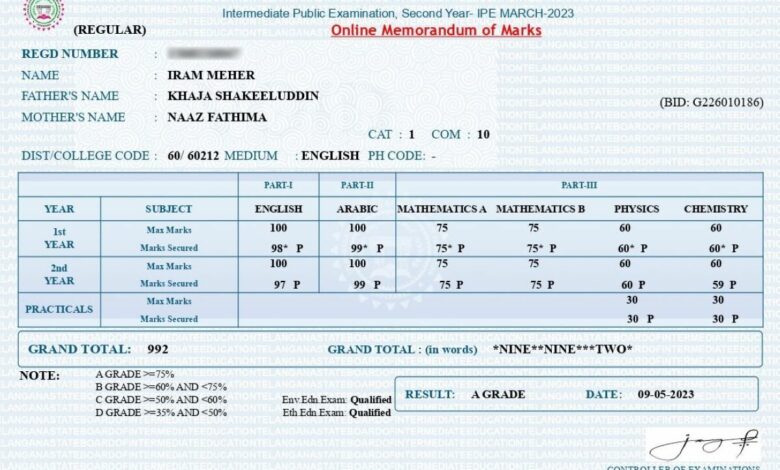
Among the toppers of the intermediate exam, Iram Meher Khaja Sahkeeluddin, a student of St. Joseph’s Junior College in Hyderabad’s Tolichowki branch, has made her mark by scoring 992 out of 1000 marks. This incredible achievement has made her one of Telangana’s intermediate toppers.
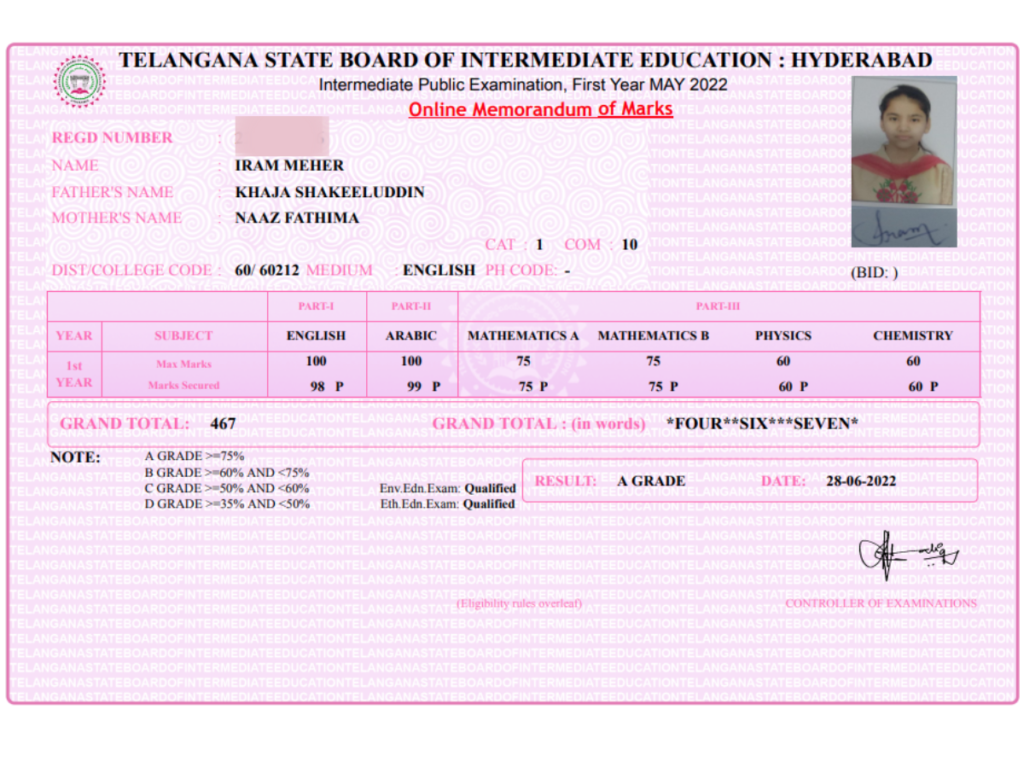
This is not the first time that Iram has shone in her academic career. Last year too, she became one of the toppers of Telangana’s intermediate exam by scoring 467 out of 470 marks.
Iram scored 100 percent marks in Mathematics IA, IIA, IB, IIB, Physics (first and second year) and Chemistry (first year).
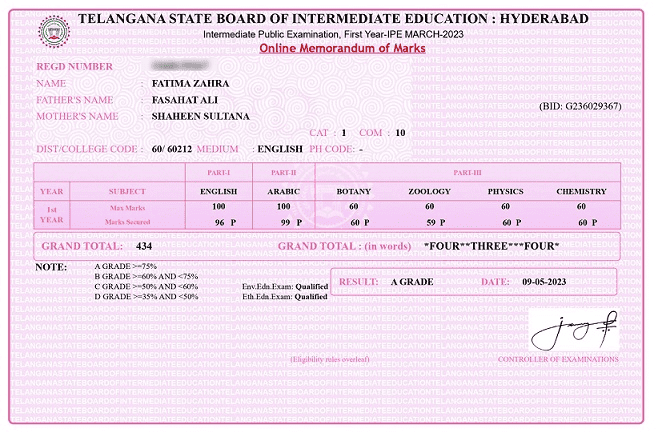
Apart from her, another candidate from the same college, Fatima Zahra, a BiPC student, scored 434 out of 440 marks and became one of the toppers of Telangana’s intermediate first-year exam.
According to the official data released by TSBIE, a total of 948153 students appeared for the examination at 1473 centers. Out of these students, 482675 were of the first year and 465478 were of the second year.
A total of 297741 candidates cleared the first-year exam, whereas 295550 students were successful in the second-year exam.
The incredible achievements of Iram Meher and Fatima Zahra, Telangana’s intermediate toppers, are an inspiration to all students.
In the run-up to 2024, with the pendulum poised between a secular or theocratic state, we need to revisit this forgotten chapter of history.
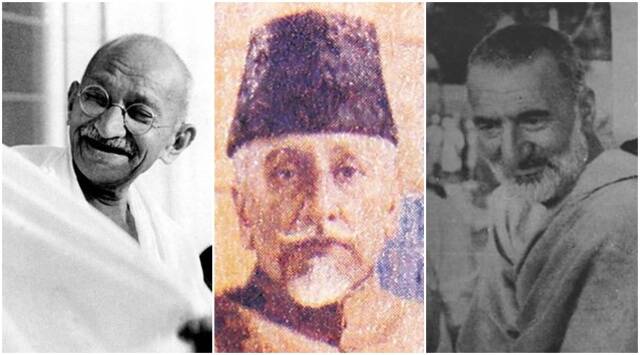
In the end, only three Indians spoke against Partition: Mahatma Gandhi, Maulana Abul Kalam Azad (centre) and Khan Abdul Ghaffar Khan (right). (Express Archives)
The hall of the Bharatiya Bhasha Parishad on Calcutta’s Shakespeare Sarani was fully packed when I arrived for the Hashim Abdul Halim Foundation International Seminar. The Foundation is named after a man who was the speaker of the West Bengal Assembly for 29 years. The Iran Society which brings out the journal Indo Iranica is located in his ancestral home. Fuad Halim and Saira Shah Halim, along with their group, were the spirit of this event.
The overhead banner read “Muslims for a United India — Unvisited Histories: Remembering the Azad Muslim Conference, April 27-30, 1947”. Each word of the banner was part of my life although I had never thought of framing it in this way.
In 1947, my family was forcibly evicted from our ancestral place, Panipat, where we had lived for 800 years. No one asked them if they wanted to go to a newly carved country named Pakistan. The women of my family left notes pasted on their front doors, “We are going for a short time; we will return”. Keys were handed to neighbours, tears flowed on both sides. All they could carry were bundles and potlis. They were mostly women; the men of Panipat worked in nearby cities. They would join later. Young men who were studying abroad did not “opt” for the new country until it became inevitable. Seventy-six years later in 2023, I live in Delhi, near the campus of a university, Jamia Millia Islamia. Those who established it in 1920 were fortunately not evicted; they stayed on amidst the communal frenzy because they believed in a united India.
That day I heard speaker after speaker in a hall which remained packed for almost eight hours. They spoke on topics like ‘The Case for a South Asian Union’, ‘1857 Joint Heritage Joint Martyrdom’, ‘Muslims against Partition – Carrying Forward the 1857 Legacy’, ‘Challenging the Two Nation Theory: Maulana Azad and Nationalist Muslims’, ‘The Two Nation Theory: One Thought of Hindu Mahasabha RSS and Muslim League’, ‘Muslims who opposed the Partition of India’, ‘Allah Bux Soomro and Muslim Politics’. These were academics from universities across West Bengal, plus a few from the US and the UK.
The Azad Muslim Conference was the cord that held it all together. It was organised in Delhi in 1940 for three days, its objective: Advocacy for composite nationalism and for a united India, and unequivocal opposition to Partition and the Two Nation Theory. Participants were from the Krishak Praja Party, the Jamiat, Majlis e Ahrar ul Islam, All India Momin Conference, Khudai Khidmatgar, All India Shia Political Conference, Anjuman i Watan Baluchistan and others. Wilfred Smith, a world-renowned orientalist from McGill University in Canada wrote that this conference represented the vast majority of India’s Muslims. The Bombay Chronicle reported that the Muslim attendance was five times that of any event organised by the Muslim League. Allah Bux Soomro, twice premier of Sindh, was its leading light. Born in 1900 in Shikarpur, his fierce commitment to a united India led him to return the honours bestowed on him by the Empire. An equally unequivocal opposer of the two-nation theory was Maulana Abul Kalam Azad. He was born in Mecca, lived in Kolkata and joined the struggle with the guerrilla movement of Jugantar with Rash Behari Ghosh and Shyam Sundar Chakravarty. Azad spoke from every platform, the highest being his addresses as President (twice) of the Indian National Congress , against Partition and for a united India. In his first presidential address in 1923, he spoke for Hindu-Muslim unity, even if it meant a delay in attaining Swaraj.
Three years after the AIMC, Allah Bux Soomro was assassinated by an assailant said to belong to the Muslim League.
As the conference proceeded, layer after layer opened up and, to reword John Keats, I felt as if a “new planet swam into my ken”.
In the last decade, I have heard the following refrain from many quarters: “They demanded Pakistan. So why are they here? The Muslims — expunge, expel, exorcise them.”
Questions: Who asked us? Was there a plebiscite? Was there a “rai shumari”? Who made it happen? Elite Muslims, colonial masters — who suffered?
In his excellent work, Muslims Against Partition, Shamsul Islam writes, “The people of India, Hindus, Muslims, Sikhs, unitedly challenged imperialist power. This unprecedented unity naturally unnerved the firangis and made them conscious that their rule could flourish only if Hindus and Muslims were divided along communal lines.” The Minister of Indian Affairs, Lord Wood wrote to Lord Elgin, ‘We have maintained our rule in India by playing off one part against another.’ John Lawrence, Administrator of the East India Company, wrote, ‘If Muslims and Hindus have quarrelled, so much better for us; let them slaughter each other…’”
In the end, only three Indians spoke against Partition: Mahatma Gandhi, who said “over my dead body” but succumbed to the Congress; Maulana Abul Kalam Azad who stood his ground and Khan Abdul Ghaffar Khan, who wrote to Gandhi, “We Pashtuns stood by you and had undergone great sacrifices for attaining freedom. But you have deserted us and thrown us to the wolves.”
In the run-up to 2024, with the pendulum poised between a secular or theocratic India, we need to recall this forgotten history. In the current din of Muslim hatred is heard the rasping voice of the Minster of State for Law and Justice. At Delhi’s Maharashtra Sadan, he said, “There are very few tolerant Muslims; those who pretend to be tolerant do so to grab the offices of the Vice President, the governor as well as vice-chancellors. As soon as they retire they start spitting poison. They wear the mukhota (mask) of tolerance; tolerant Muslims can be counted on fingers. The basic structure of the nation is Hindu Rashtra.”
I’m ending with two lines from Hafiz Shirazi, quoted in S Abid Husain’s prophetic work, The Destiny of Indian Muslims: “If sorrow raises its dire legion/ To overwhelm people of faith / The Saqi and I will join hands /To wipe it off the face of this earth.”
The writer is former Member, Planning Commission
source: http://www.indianexpress.com / The Indian Express / Home> News> Opinion> Columns / by Syeda Hamid / May 11th, 2023
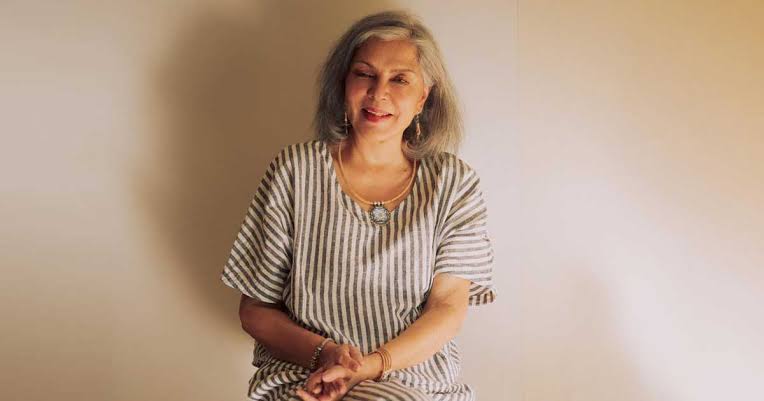
An epitome of beauty and style in the 70s and 80s, Zeenat Aman’s magnetic screen presence has arrested the hearts of millions. A pioneering fashion icon and trendsetter who broke away from stereotypes, she was bold enough to go for offbeat roles and carve her own niche in the film industry. The 71-year-old actor began her career as a model and made her debut in Bollywood opposite to Dev Anand in 1970. For the 1970s Bollywood, Zeenat Aman exuded modernity with confidence. With her free-spirited attitude, she ruled the industry and acted in almost seventy movies as the female lead, and has been a part of many hugely popular hit songs. She gained fame in India and around the world, starring in some major films such as Satyam Shivam Sundaram (1978), Yaadon Ki Baraat (1973), Don (1978), and Qurbani (1980).
Recently, Zeenat Aman has been owning her narrative through her Instagram account. Her followers are treated to glimpses of her personal life, with backstories behind every picture to accompany them. With graceful photos that come dipped in a vat of nostalgia and glamour as well as the wisdom of a septuagenarian, her Instagram posts reflect upon what it feels like to be a camera subject back then as she looks back at some of these iconic photos on the internet, almost half a century later.
She has been sharing her recollections of the making of some of India’s most iconic movies. In one of her early posts, alongside a photo of her sitting in the comfort of her home, she recounts how the film and fashion industry was absolutely male-dominated in the 70s, and how she would often be the only woman on a set. “A woman’s gaze, though, is different,” she says. As an actor who has expressed her disturbance back then on how “ornamental” women characters were (in an interview given to Keith Adam of Australian Broadcasting Commission on the sets of Qurbani), now, in the process of being the photographic subject, she enjoys not being the spectacle and rather being in her element. Though she is very optimistic about the women working behind and in front of the camera, she is apprehensive of the gender pay gap which hasn’t changed much over time. She writes in her post, “The roles available to women are clearly not just ornamental anymore. What hasn’t changed though is the gender pay gap. In my time, I was lauded as the “highest-paid female actor”, but the disparity in the pay cheque between my male co-stars and myself was so vast it was laughable. The Zeenat you see in this clip was quite certain that half a century would be enough time to even the scales. So it disappoints me that even today women in the film industry don’t have wage parity. Women have consistently put in the work, and I really think that the onus is now on our men – actors, directors, producers – to ensure that their female coworkers (not just stars) are paid fairly. It seems such a simple and obvious thing, and yet it would be revolutionary if any man actually did this.” Zeenat Aman’s comments on gender pay inequality in the film industry highlight a larger issue of gender disparity that women face in various areas. Her call for men to be accountable in ensuring equal pay among their female colleagues is a reminder that gender justice requires collective effort.
Zeenat Aman’s Instagram account serves as both a means of self-expression and a testament to her legacy. In one of her posts, she shares a photograph of herself posing before heading to a birthday party. However, she acknowledges the potential invasion of privacy that public figures often face and responds preemptively to her followers’ curiosity by saying, “I know you may want to ask me which friend, so I will give you an answer about privacy. I think there’s a fine line between a healthy interest in a public figure or a person you admire, and an entitlement or desire to know every detail of their lives.” She continues with a touch of humour, “the world is so spectacularly diverse and rich, I promise you there are more interesting things to learn than which celebrity met whom and where.” In this post, Zeenat Aman addresses the importance of boundaries when it comes to a public figure’s personal life, and encourages her followers to focus on more meaningful things that matter to them. She also expresses gratitude towards her fans who respected her choice of not posing for a photograph with them. She says, “I was sorry to disappoint these lovely fans, but there are boundaries that I find important to draw for myself. I am happy that they respected my response, as it’s not always the case.”
On the yesteryear actor Parveen Babi’s birth anniversary, she penned a heartfelt note which celebrated Parveen for the spirit that she embodied and ruminated on how the actor deserved to be remembered. She complimented her and remembered her as the glamorous and talented actor that she was. She recollected how society tries to pit women against each other: “Back in the 70s, we wore our hair in a similar manner and enjoyed Western fashion. Though neither of us saw it, we were told we had an uncanny resemblance. It must have been true because, as recently as last year, I was approached in Dubai as ‘Parveen ma’am’. Naturally, the media at the time spun tales of competition and rivalry between us, but in reality, we were always warm towards each other.” She writes, “Parveen’s struggle with mental illness came at a time when the country was still so insensitive and ignorant on these matters. After her death, I often ruminated on how she was remembered. The tabloids focused on her romantic relationships and ‘episodes’, but Parveen was much more than who she dated or what she said when she was unwell. I feel she never truly got the chance to say her piece. She was intelligent, hardworking, and creative…She achieved incredible success as an actor, even featuring on the cover of Time magazine.” The words were carefully chosen to convey not only her admiration for Parveen but also a deep human understanding of the issues her colleague faced. She questions the lack of sensitivity with which the tabloids handled the situation and forces us to think if there has been any significant change in recent times.
She is not afraid to call out how most celebrity accounts are “more akin to advertising billboards than blogs.” She emphasizes how it has helped her decide her own approach to the app. She is insistent on the word “purpose”—the purpose of her being on the gram, the purpose of the one reading it, and so on. In another thought-provoking post of hers, she remembers how “we see very few older women in the public eye. It’s not something I thought about when I was young, but now that I myself am silver-haired, I feel their absence.” She is concerned about how the absence of older women in the public eye reinforces negative stereotypes about aging and contributes to the erasure of their experiences and wisdom, reminding us of the power and importance of intergenerational relationships.
She questions how “(as) women, we are told that our social worth lies in youth and physical beauty. If not explicitly, then in a thousand subliminal ways. This is especially true for the entertainment industry… I was initially reluctant to stop dyeing my hair, and was strongly advised against it.” She emphasizes how we have minimal agency when it comes to presenting our bodies to others. She contemplates that “Being young is wonderful, but so is being old. It thrills me to see more and more silver-haired women (of all ages) challenge the status quo.” By celebrating her natural self and thereby refusing to conform to societal norms, she is a testament to the growing number of women who are rejecting the notion that youth equals beauty.
While the reflections and musings go in one hand, some serious fun goes on in the other. In one of her posts, she also talks about discovering some of the Zeenat Aman memes on Instagram. She shares them and even calls that version of her ‘Meme-at Aman.’ She also expresses her joy at learning what a ‘thirst trap’ means. In the rapidly changing media landscape, leveraging online platforms to shape and maintain a public persona is quite common among public figures and artists to stay relevant. By artfully curating her online presence, Zeenat Aman crafts and controls the narrative surrounding her career, image, and legacy with great care and self-awareness.
source: http://www.maktoobmedia.com / Maktoob / Home> Film and TV> Latest Opinion / by Ashikha N / March 2023
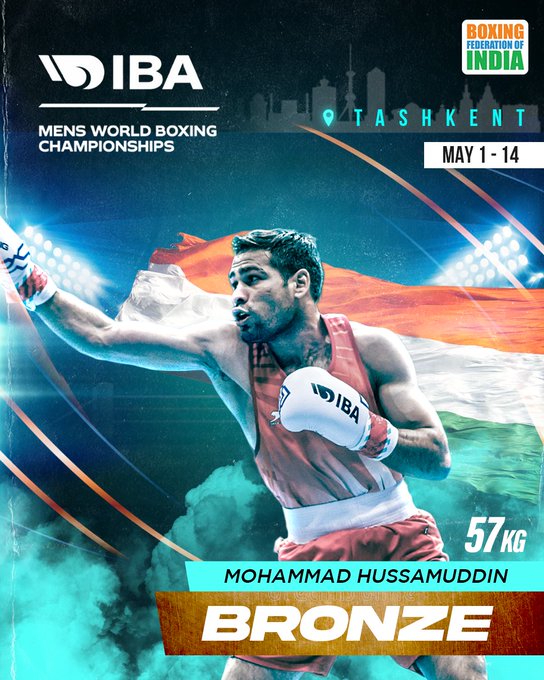
India’s Mohammed Hussamuddin finished his IBA World Boxing Championships campaign in Tashkent, Uzbekistan with a bronze medal on Friday.
India’s Mohammed Hussamuddin finished his IBA World Boxing Championships campaign in Tashkent, Uzbekistan with a bronze medal on Friday.
Hussamuddin was forced to give a walkover to Horta Rodriguez Del-Rey of Cuba in the 54-57kg semifinals due to a knee injury sustained during his quarterfinal bout, the Boxing Federation of India (BFI) said in a tweet.
Against a taller opponent landing blows from a long range, the Indian southpaw connected a few headshots to claim the first round 3-2.
Hussamuddim relied on his ring craft to stay marginally ahead in the second period and matched the Bulgarian in the physical third round, which witnessed both going all out, to emerge triumphant.
The Haryana boxer defeated Russia’s Eduard Savvin in the pre-quarters.
Mohammed Hussamuddin’s background
Hailing from a family of boxers, Mohammed Hussamuddin is the youngest of six brothers, four of whom are seriously entrenched in the sport. Hussamuddin, whose role model is Vasyl Lomachenko, two-time Olympic Champion, was afraid to don the gloves until his father and coach, Mohammad Shamsuddin, got him to shed that fear and trained him at the Collectorate grounds in Nizamabad, north Telangana.
Commonwealth Games champion Hussamuddin had upset fifth-seeded Bulgarian Javier Ibanez Diaz 4-3, via bout review, in a closely-contested fight in the quarterfinals.
The 29-year-old went on to outshine his siblings and established himself in the state-level competitions before moving on to the national scene, making his debut in the 2009 junior Nationals at Aurangabad, claiming bronze. He turned it into gold in his debut at the senior nationals.
The boxer’s potential was spotted early and in 2011, he was sent to a fortnight-long stint of training and competition to Havana, Cuba, before participating in the 2012 Tammer Tournament in Finland and later in the Youth World Championship in Yerevan, Armenia.
His barren-run on the international stage ended with bronze at the 2015 Military World Games. Since then, he has been on the up and today he has evolved into one of the finest boxers in the country in his weight category.
With a bronze in Commonwealth Games 2018 and a gold in the Chemistry Cup, Hussamuddin continued to shine and bag silver at the Gee Bee Boxing Tournament in 2019. He won silver at the Boxam International in march 2021 and finished 2022 with bronze medal at CWG and Asian Championships.
source: http://www.sportstar.thehindu.com / SportStar / Home> Boxing / by Team Sportstar / May 12th, 2023
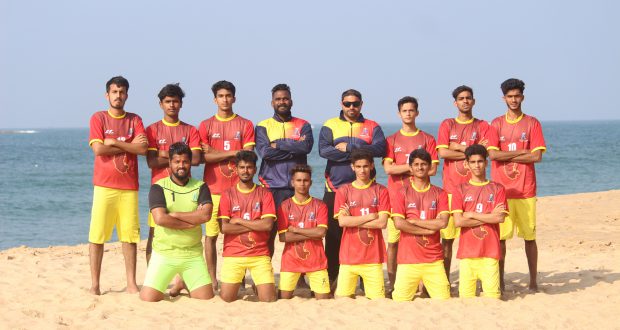
Eight players from Bhatkal will be part of the Karnataka beach football team that will take part in Hero Beach Soccer championship in Gujarat on January 26.
The tournament will be played in Surat city of Gujarat.
The team trials for team selection were held by Karnataka State Football Association at Hudmudi beach on the outskirts of Bhatkal in Coastal Karnataka.
Players from across the state gave trials for team selection and eight players from Bhatkal were selected in the team.
All eight players from Bhatkal player for BIFA team in Bhatkal.
The names of the team members are as follows:
Ranjeet Kumar R
Ahmed Ruyefa
Syed Abdul Samad
Ismail Mahumdu Jawpa
Mohammed Sufiyan
Mohammed Luqman Shaikji
Abdud Dayyan
Sushant S Naik
Mohammed Salman
Jasir Syed Kazhi
Abdus Subhan
Aaron Dominic Gudinho
(Manager: Mawiya Mohtisham)
(Coach: Shiva Gajendran)
source: http://www.bhatkallys.com / Bhatkallys.com / Home> Bhatkal News / by Bhatkal News Bureau / January 25th, 2023
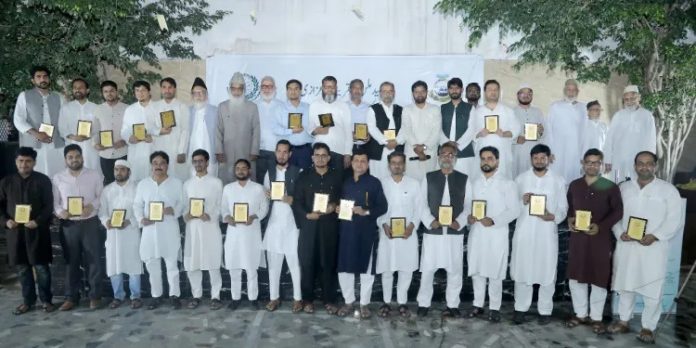
Dozens of alumni of Jamiatul Falah, one of the South Asia’s finest institutions of Islamic studies, were felicitated in New Delhi on Sunday for obtaining PhD from prestigious universities in different streams, smashing the perception and prejudices built around the institution of madrasa.
The speakers enlightened the general public about the contributions made by the institution in inculcating religious teachings and moral regeneration among the students.
The distinguishing feature of the graduates of the Jamia is that they maintain good relations with each other, keep in touch in a systematic manner and always strive for the welfare of the Jamia, said Maulana Muhammad Tahir Madani, the renowned Islamic scholar and Nazim of Jamiatul Falah while addressing the gathering on the occasion.
He said that Jamiat al-Falah is not just the name of an educational institution or a center or an educational institution but it is an educational movement from which many generations have benefited and this process continues.
Jamia alumni are our brand ambassadors and the university has paid special attention to women’s education so that they can play an important role in the formation of a righteous society, he added.
The secretary of the Delhi unit Old Boys Association Mohammad Ershad Alam Falahi said that Jamiatul Falah was established by a group of dedicated scholars to promote knowledge and achieve greater goals for the common good. He compared the effort to the process of creating new clothes by using old fabric, letter by letter.
Rafat Kamal Fallahi, the President of the unit, thanked the audience and appreciated the Association for presenting the accomplishments of the Delhi Unit and discussing future plans. He assured everyone that the Old Boys Association would continue to extend its support in the progress and development of the community.
Asim Akram (Abbu Adeem) Falahi’s book, ‘Quran, Saransh Hindi Ek Taarak,’ was also released during the event.
source: http://www.muslimmirror.com / Muslim Mirror / Home> Education> Indian Muslim > Positive Story / by Muslim Mirror Special Correspondent / May 07th, 2023
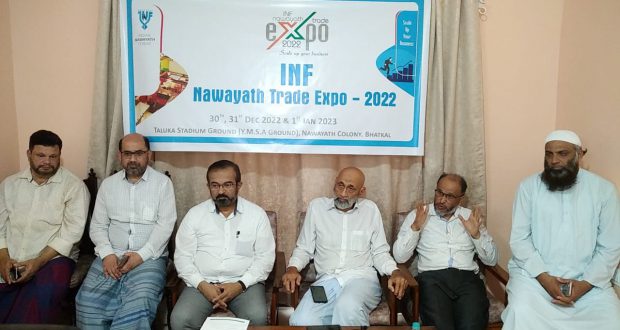
The Indian Nawayath Forum (INF) formed in 2018, is a non-profit charitable organization that is a joint Federation of 8 Indian Bhatkali Jamaaths Associations located across India, outside Bhatkal, to serve the community.
Since its inception in 2018, INF has been at the forefront to serve the people driving various activities in healthcare, education, promoting business and employment, providing scholarships, budget housing projects and NOW, INF is organizing a Trade Expo with 180 Stalls, in 25 categories of businesses at (YMSA Ground) Taluka Ground, Bhatkal, for 3 days from December 30th, 2022 to Jan 1st, 2023, one of its kind for the trade community of Bhatkal.
You are all invited to the trade expo and Inauguration ceremony to witness our businesses and promote and encourage our community businesses and help them to prosper.
The inauguration is scheduled InshaAllah this Friday, December 30th at 4:45 PM sharp.
Our Primary objectives of conducting the Trade Fair Expo were: • To promote and give more exposure to the business/services rendered by our Nawayath business community. • To encourage and promote entrepreneurship for our community youngsters. • To identify new business ventures instead of the present trend of starting/ repeating similar existing businesses. • To scale up the existing business by giving inputs/know-how in marketing and packaging of products. • To set up R&D for increasing the shell life of local food products. • To foster and encourage collective investment for carrying out business requiring larger Capex investments. • To promote local home products and increase their footprint in other areas/cities. • To impart knowledge and information for getting required permission/ licenses for carrying out legal trade practices
Bouncing back from adversity with indomitable resilience and willpower, Asif Iqbal helps others with disabilities as he pushes the limits. Ejaz Kaiser shares his story.
Since 2021, Iqbal has run 10 km each on 12 different races.
Chhattisgarh :
A life well lived is a life worth talking about. With complete vision loss, Mohammed Asif Iqbal’s life can force anyone to rethink disability.
A Kolkata resident, who had a successful stint in Central government’s smart city projects for digital inclusion initiative at Nava Raipur in Chhattisgarh, Iqbal (46) had partial vision loss since birth due to a genetic disorder called retinal degeneration. By the time he turned 16, he had turned completely blind.
He moved to the United States and managed complete his high school and partial college education in Oregon, USA. Iqbal returned to India in 1995 to later become the first visually challenged commerce graduate of St Xavier’s College Kolkata and got his MBA in human resources from Symbiosis Institute, Pune.
Around six years back, he was diagnosed with high blood pressure. Having given a choice to either change his lifestyle or be on medicines all his life, Iqbal decided to lead a life worth living. “I thought my health shouldn’t be a hurdle towards my contribution to nation-building. Just the thought of doing something to ensure I remain healthy. I was overweight. I began visiting the playground and park with the help of friends. It was there the idea clicked to participate in marathons and began preparing for the race to build my confidence”, Iqbal said.
Running became a routine; starting from 100 metre, he increased the length slowly to 300 and later to a few kilometres with the support of volunteers. Gradually, he learnt navigation on his own.
“I was competing with myself to enhance my performance”, he added. Since 2021, Iqbal has run 10 km each on 12 different races and has also been recognised by former Indian cricket skipper master blaster Sachin Tendulkar for his brave initiative.
But his biggest moment came on December 18, 2022 when he accomplished TSK-25 km (15.53 miles) marathon run in Kolkata only through voice guidance. He was blind-folded and had zero physical touch or physical assistance from anyone. He set a record and entered into Asian Book of Records, as the first Indian Asian blind runner to complete a marathon in 3:32 hours with voice navigation support from Dibyendu Mondel and Prakash Singh who piloted his run.
“While I run on voice guidance (talking GPS) issued by fellow buddy runners who run at the same speed, the mission of 25km marathon in Kolkata was well achieved,” Iqbal said.
He is also the recipient of a national award, West Bengal state role model award and the extraordinary citizen of Kolkata award among others.
During his career spanning over 15 years, he has designed and implemented social inclusion strategy for AADHAR enrollment, accessible income tax, and accessible telecom under Telecom Regulatory Authority of India (TRAI) among others.
He is presently an associate director at PricewaterhouseCoopers (PwC) India Ltd. In 2000, he filed a public interest litigation (PIL) for implementation of reservation quota in government-run universities including the IIMs and IITs.
source: http://www.newindianexpress.com / The New Indian Express / Home> Good News / by Ejaz Kaiser, Express News Service / January 29th, 2023